OPTIMIZATION ALGORITHMS FOR RESOURCE ALLOCATION PROBLEM OF AIR TASKING ORDER PREPARATION
A THESIS SUBMITTED TO
THE GRADUATE SCHOOL OF NATURAL AND APPLIED SCIENCES OF
MIDDLE EAST TECHNICAL UNIVERSITY
BY
AHMET ENG˙IN BAYRAK
IN PARTIAL FULFILLMENT OF THE REQUIREMENTS FOR
THE DEGREE OF MASTER OF SCIENCE IN
COMPUTER ENGINEERING
Approval of the thesis:
OPTIMIZATION ALGORITHMS FOR RESOURCE ALLOCATION PROBLEM OF AIR TASKING ORDER PREPARATION
submitted byAHMET ENG˙IN BAYRAKin partial fulfillment of the requirements for the degree of Master of Science in Computer Engineering Department, Middle East Technical Universityby,
Prof. Dr. Canan ¨Ozgen
Dean, Graduate School ofNatural and Applied Sciences Prof. Dr. Adnan Yazıcı
Head of Department,Computer Engineering Prof. Dr. Faruk Polat
Supervisor,Computer Engineering Dept., METU
Examining Committee Members: Assoc. Prof. Dr. Halit O˘guzt¨uz¨un Computer Engineering Dept., METU Prof. Dr. Faruk Polat
Computer Engineering Dept., METU Assoc. Prof. Dr. Veysi ˙Is¸ler
Computer Engineering Dept., METU Assoc. Prof. Dr. Ahmet Cos¸ar Computer Engineering Dept., METU Dr. C¸ a˘gatay ¨Unde˘ger
General Manager, SimBT Inc.
I hereby declare that all information in this document has been obtained and presented in accordance with academic rules and ethical conduct. I also declare that, as required by these rules and conduct, I have fully cited and referenced all material and results that are not original to this work.
Name, Last Name: AHMET ENG˙IN BAYRAK
ABSTRACT
OPTIMIZATION ALGORITHMS FOR RESOURCE ALLOCATION PROBLEM OF AIR TASKING ORDER PREPARATION
Bayrak, Ahmet Engin
M.Sc., Department of Computer Engineering Supervisor : Prof. Dr. Faruk Polat
August 2010, 55 pages
In recent years, evolving technology has provided a wide range of resources for Mil-itary forces. However, that wideness also caused resource management difficulties in combat missions. Air Tasking Order (ATO) is prepared for various missions of air combats in order to reach objectives by an optimized resource management. Consid-ering combinatorial military aspects with dynamic objectives and various constraints; computer support became inevitable for optimizing the resource management in air force operations. In this thesis, we study different optimization approaches for re-source allocation problem of ATO preparation and analyze their performance. We proposed a genetic algorithm formulation with customized encoding, crossover and fitness calculation mechanisms by using the domain knowledge. A linear program-ming formulation of the problem is developed by integer decision variables and it is used for effectivity and efficiency analysis of genetic algorithm formulations.
Keywords: Combinatorial Optimization, Air Tasking Order, Genetic Algorithms, Re-source Allocation
¨
OZ
HAVA HAREKAT PLANI KAYNAK PAYLAS¸TIRMA PROBLEM˙I ˙IC˙IN OPT˙IM˙IZASYON ALGOR˙ITMALARI
Bayrak, Ahmet Engin
Y¨uksek Lisans, Bilgisayar M¨uhendisli˘gi B¨ol¨um¨u Tez Y¨oneticisi : Prof. Dr. Faruk Polat
A˘gustos 2010, 55 sayfa
Son yıllarda, gelis¸en teknoloji askeri kuvvetlere genis¸ bir kaynak c¸es¸itlili˘gi sa˘glamak-tadır. Bununla birlikte, bu c¸es¸itlilik savas¸ g¨orevleri ac¸ısından kaynak y¨onetim zor-luklarına da sebep olmaktadır. Hava Harekat G¨orevleri, hava harekatlarının farklı g¨orev t¨urleri ic¸in kaynakları en iyi s¸ekilde kullanarak hedeflere ulas¸abilmesi ic¸in hazırlanmaktadır. Kombinasyonel askeri hedefleri, de˘gis¸ken savas¸ durumlarını ve kısıtlamalar bir arada d¨us¸¨un¨uld¨u˘g¨unde; hava operasyonlarında kaynak y¨onetimi opti-mizasyonu ic¸in bilgisayar deste˘gi kac¸ınılmaz olmaktadır. Bu tezde, hava harekat planı kaynak paylas¸tırma problemi ic¸in farklı optimizasyon yaklas¸ımları ¨uzerinde c¸alıs¸tık ve bas¸arılarını analiz ettik. Alan bilgileri kullanarak ¨ozelles¸tirdi˘gimiz c¸aprazlama, de˘gerlendirme ve kodlama y¨ontemleri ile genetik algoritma formulasyonları ¨onerdik. Tamsayı karar de˘gis¸kenleri ile gelis¸tirdi˘gimiz do˘grusal programlama formulasyonu ile genetik algoritma formulasyonları ic¸in etkililik ve etkinlik analizleri yaptık.
Anahtar Kelimeler: Kombinasyonel Optimizasyon, Hava Harekat Planı, Genetik Al-goritmalar, Kaynak Paylas¸tırma
ACKNOWLEDGMENTS
I would like to present my deepest thanks to my thesis supervisor Prof. Dr. Faruk Polat for his valuable guidance, motivation and support throughout this thesis study. My special thanks go to Ays¸e Hilal Yerg¨ok for her help and support to complete this work and to all my friends who gave me support whenever I needed.
I am very grateful to my family and partners in Minder and MobilG companies for all their patience and tolerance.
TABLE OF CONTENTS
ABSTRACT . . . iv
¨ OZ . . . v
ACKNOWLEDGMENTS . . . vii
TABLE OF CONTENTS . . . viii
LIST OF TABLES . . . x
LIST OF FIGURES . . . xi
CHAPTERS 1 INTRODUCTION . . . 1
2 BACKGROUND AND RELATED WORK . . . 4
2.1 Resource Allocation Problem in Air Tasking Order Preparation 4 2.2 Required Features of Resource Allocation Solutions . . . 7
2.3 Related Work . . . 8
2.4 Resource Allocation Methodologies . . . 11
2.4.1 Exhaustive Search . . . 11
2.4.2 Greedy Algorithm . . . 12
2.4.3 Integer Linear Programming . . . 12
2.4.4 Genetic Algorithm . . . 14
2.4.4.1 Encoding . . . 16
2.4.4.2 Selection Operators . . . 17
3 OUR WORK . . . 20
3.1 Problem and Solution Formulation . . . 20
3.2 NP-Completeness of Problem . . . 22
3.4 Input Generation and Input Sets . . . 26
3.5 Framework Architecture . . . 27
3.6 Algorithm Implementations and Customizations . . . 28
3.6.1 Exhaustive Search . . . 28 3.6.2 Greedy Search . . . 28 3.6.3 Integer Programming . . . 29 3.6.4 Genetic Algorithms . . . 32 3.6.4.1 Encoding . . . 33 3.6.4.2 Crossover . . . 34 3.6.4.3 Mutation . . . 36 3.6.4.4 Fitness Value . . . 36
4 EVALUATION OF THE RESULTS . . . 39
4.1 Results of Small Sized Input Set . . . 40
4.1.1 Exhaustive Search Implementation . . . 41
4.1.2 Simple Genetic Algorithm Implementation . . . . 42
4.1.3 Genetic Algorithm Implementation with Fleet Group-ing (GA Grouped) . . . 43
4.1.4 Greedy Algorithm Implementation . . . 43
4.1.5 Integer Linear Programming Implementation . . . 44
4.2 Results for Input Set With High Capacity Rate . . . 45
4.3 Results for Input Set With Low Capacity Rate . . . 47
5 CONCLUSION AND FUTURE WORK . . . 50
5.1 Conclusions . . . 50
5.2 Future Work . . . 52
LIST OF TABLES
TABLES
LIST OF FIGURES
FIGURES
Figure 2.1 Air Tasking Order Production Life Cycle . . . 5
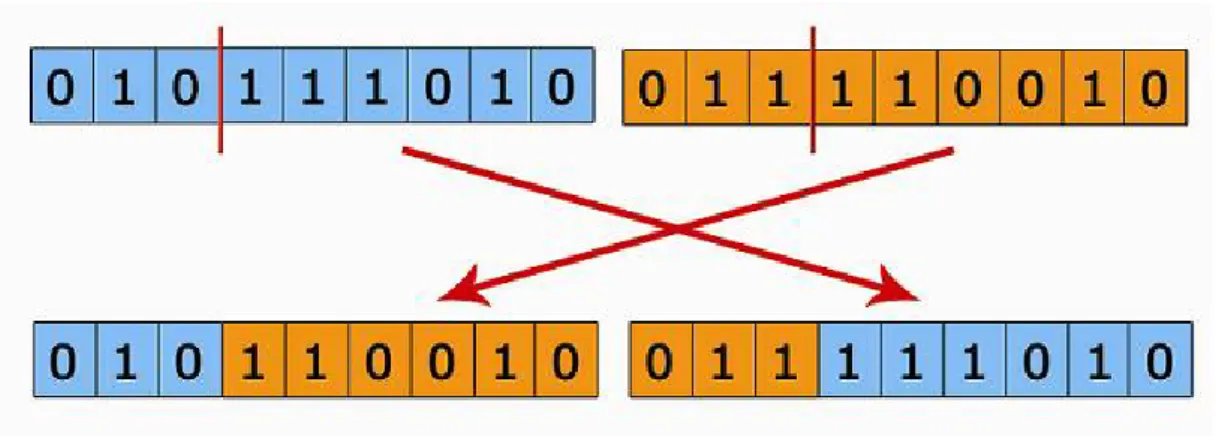
Figure 2.2 Single Point Crossover . . . 15
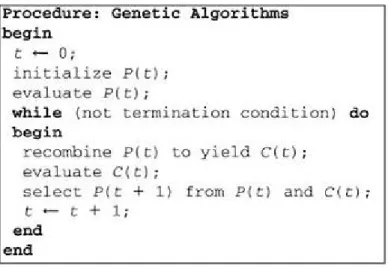
Figure 2.3 Genetic Algorithm Procedure . . . 16
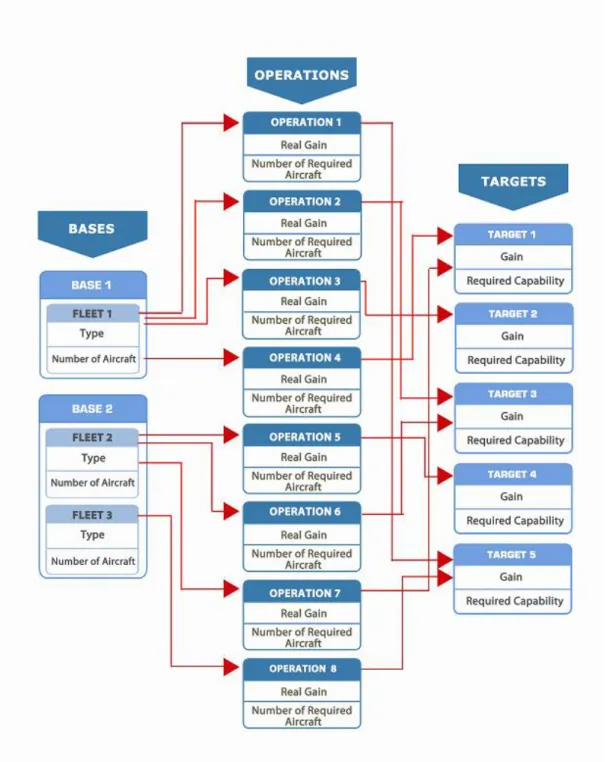
Figure 3.1 Problem Input Format . . . 21
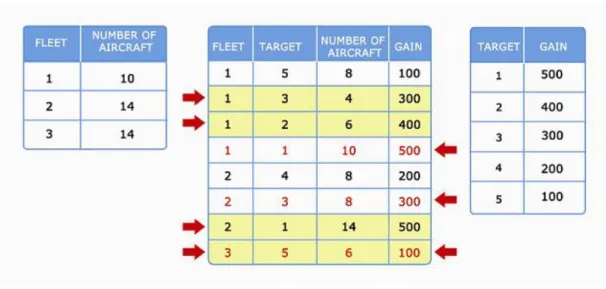
Figure 3.2 Problem Instance with Solutions . . . 22
Figure 3.3 Single Point Crossover . . . 35
Figure 3.4 Boundary Points Crossover . . . 35
Figure 3.5 Layered Hybrid Crossover . . . 37
Figure 4.1 Results of Input Set 1 . . . 40
Figure 4.2 Elapsed Time Change for Algorithms . . . 41
Figure 4.3 Elapsed Time for Exhaustive Search Algorithm . . . 41
Figure 4.4 Elapsed Time for GA Simple Algorithm . . . 42
Figure 4.5 Gain Values for GA Simple Algorithm . . . 42
Figure 4.6 Elapsed Time for GA Grouped Algorithm . . . 43
Figure 4.7 Elapsed Time for Greedy Algorithm . . . 44
Figure 4.8 Gain Values for Greedy Algorithm . . . 44
Figure 4.9 Elapsed Time for Integer Linear Programming Algorithm . . . 45
Figure 4.10 Results of Input Set 2 . . . 46
Figure 4.11 Elapsed Time Values of Algorithms . . . 46
Figure 4.12 Results of Input Set 3 . . . 47
CHAPTER 1
INTRODUCTION
In recent years, evolving technology has provided a wide range of resources for Mil-itary forces. However, that wideness also caused resource management and planning problems in combat missions. Resource management problem for a combat mission is composed of various sub-problems encountered throughout the combat missions’ planning. One of the main problems of combat planning is resource allocation prob-lem, which defines the operations against enemy targets and aims to optimize the resource allocation efficiency and effectivity. Researches on this problem emerged with scientific approach usage in the organization management. While dealing strate-gic and tactical problems of military operations in World War II, need for academic study and scientific support raised and Operations Research (OR) activity officially began with created military OR teams [1]. Resource allocation problem is studied within OR domain, which is a common interest of computer scientists and industrial engineers.
Air Tasking Order (ATO) is a plan, prepared for various missions of air combats in order to reach objectives by an optimized resource allocation. Considering both dynamic conditions of a warfare and command and control facilities, an optimal re-source allocation should be provided with a fast decision. Long time required for ATO production makes scientific support inevitable for the air force military opera-tions. Computer assistance has been used as a decision support system for 30 years by U.S. Army [2].
Resource allocation optimization problem of military operations has combinatorial aspects with dynamic objectives and various constraints like resource limitations, cost
and transportation [3]. Therefore, resource allocation formulation of ATO prepara-tion can be studied inCombinatorial Optimization problem set, which deals with NP - Hard optimization problems [4]. Previous resource allocation studies, mostly formulate the problem as an integer linear programming problem [5, 6]. These stud-ies investigate solutions through varying methods like greedy, branch-and-bound and knapsack approaches. Some researchers concentrated on genetic algorithm formula-tion of the problem [7].
Military forces cannot use the methods with exponential execution time complexities, because time ambiguity is not acceptable for time critical ATO preparation. On the other hand, optimizing the gain value for an air combat is crucial for combat envi-ronment. Requirement for an algorithm that meets these necessities constitute the motivation of this study.
In this study, we study genetic algorithm formulations for resource allocation prob-lem in ATO production. Probprob-lem specific crossover, fitness calculation and selection approaches are proposed for genetic algorithm solution of resource allocation prob-lem through this thesis. These approaches mainly concentrate on dividing the genetic problem into smaller genetic problem pieces using domain knowledge. Customized genetic algorithm approaches are implemented and examined through experiments. Linear programming formulation is implemented for the problem with integer deci-sion variables. Standard greedy and exhaustive search algorithms are implemented. Linear programming, greedy and exhaustive search algorithms’ solutions are used for evaluating implemented genetic algorithm customizations.
We extend the framework in [8] to be able to use different solution approaches on the same input problem set. Enhanced framework eliminates the different problem formulations and execution environment. Moreover, that framework has important capabilities from input generation to solution analysis. Varying resource, target and operations can be created based on provided air force capability configuration by the help of random input generator. Generated combat cases can be rendered and persisted for future analysis and solution executions. Adapters for different solution approach formulations allow the usage of same combat case input for solution genera-tion. In case of a need for new solution formulation, a small adapter can be developed
for an easy integration as a result of plug-in strategy used by the framework.
Feasibility and success ratios of each implementation are analyzed and their diff er-ences are compared with each other in order to assess their efficiency and effectivity. Input sets with different characteristics are used for those comparisons.
The remainder of the thesis is organized as follows:
Chapter 2 - Background and Related Workgives an overview of Air Tasking Order preparation and resource allocation problem in ATO preparation. Then related studies in literature are described and their approaches are identified in details. Pros and cons of these approaches are discussed. Main algorithms and formulations used in resource allocation studies are described briefly.
Chapter 3 - Our Workpresents our research details. The overview of the framework is presented, the input representation scheme is explained, the algorithm implemen-tations and customizations are described in detail.
Chapter 4 - Evaluation of the Resultsprovides a summary of solutions created by implemented algorithms for various input sets and presents experimental results. Chapter 5 - Conclusion and Futureincludes the concluding remarks and states the future work.
CHAPTER 2
BACKGROUND AND RELATED WORK
This chapter aims to present an overview of Air Tasking Order preparation and re-source allocation problem in ATO preparation. It also includes the current studies in literature and their approaches in detail. Main algorithms and formulations used for resource allocation problem are described briefly.
2.1 Resource Allocation Problem in Air Tasking Order Preparation
In warfare, military forces should be flexible to accommodate to dynamic environ-ment conditions for being successful. This flexibility requires the ability of planning and managing the combat dynamically with effective and fast decisions.
Anair tasking order (ATO) involves both a process of assigning mili-tary aircraft, long-range missiles, and relevant air defense and informa-tion operainforma-tions resources to missions contributing to an overall air cam-paign plan, as well as the actual sets of orders to be followed by aircraft and units of aircraft.[9]
Air Tasking Order (ATO) is used to define management and planning issues of an air attack. Steps followed during ATO production are shown in Figure 2.1.
Diverse resource types of air forces are used in resource planning of ATO. Our study also involves varying attack resources distributed on bases for problem formulation. This variance is achieved by the computer support during input generation. Resources in our subject of interest are listed below:
• Base:Military area where all type of resources like munitions, aircrafts, tanks, choppers and staffare located is called base in the literature. Each force (air, naval and ground) has its specific bases and some joint bases.
• Fleet:Combatant unit is called fleet in air force bases. Aircrafts and their pilots uniform a fleet unit which is used for target assignment as a group.
• Aircraft: Military forces have different types of vehicles used for air combats. They differentiate according to ranges, load capacities and gun capacities.
• Pilot: Air combats can be one of two types: air-to-air and air-to-ground com-bats. Each combat type requires specifically trained pilots who are main staff for a combatant fleet. Pilot capability is one of the key points of combat success as it directly affects the attack potential.
• Munitions: Munitions like rockets and missiles are carried by aircrafts in an air combat. As the mass of munitions define their destruction potential, load capacity of an aircraft is directly related with the attack performance.
Each air combat has a procedure from collecting the intelligence information to tar-get destruction. Firstly, enemy resources are examined by related units of air force to collect target information for miscellaneous goals of the military and government. Secondly attack assets; which will be used for enemy target destruction, are prepared by summing up aircrafts, munitions and resources. Each asset resembles a military operation for an air force fleet. In real world’s military environment, generally pos-sessed resources are not enough for completing these operations. So, defined oper-ations are analyzed and evaluated according to their reloper-ationships with each other. Resource allocation in ATO preparation is finalized with selecting the operations to optimize the combat performance.
ATO resource allocation planning is also performed during a combat according to the realized operations’ performance. Considering the both mathematical complexity of resource allocation and time shortness in warfare condition, need for computational decision support system can be seen easily. Computational decision support for re-source allocation optimization is one of the active subjects in operations research and computer science domains, which is widely studied [10, 11].
In this thesis work, we elaborated mostly on the allocation problem of scarce re-sources to varying operations defined according to enemy targets. This problem is also named as ”Weapon Target Assignment” or ”Military Asset Allocation”. In the literature, this resource allocation problem is solved by grouping military attack re-sources into asset packages and assigning these packages to enemy targets by opti-mizing the gain from the attack resource potential [8]. Structures of air force targets like airports, buildings, etc. also supports the attack resource grouping strategy as single resource potential are not sufficient for destroying a single target. So, we also analyzed the input problem set in similar way and created operations against enemy targets by grouping resources in the air force.
2.2 Required Features of Resource Allocation Solutions
Proposed solutions for resource allocation problem of ATO preparation should have some features as the real world military environment forces some constraints during an air combat. Requested features are following:
• Integer solutions: In real world military environment, we cannot assign half aircraft to a target, so every aircraft should be grouped and assigned as a whole. This constraint affects the usage of algorithms with real number solutions as they cannot be used singly but can be a part of a hybrid solution. In addition, operation necessities should be fully meet as partly completed operations do not have any value for an air combat.
• Efficiency: Solution algorithms are expected to run in acceptable time and space. An algorithm with high resource complexity causes inefficient solutions for the bigger sized inputs.
• Effectivity:Solution performance of algorithms is very crucial for the problem as they are used in mission critical plans. Gain loss according to best solution is evaluated for an algorithm together with their time acquisitions.
• Problem formulation:Each algorithm should have a solution space that max-imizes the coverage of all available resource allocation possibilities. Solutions are expected to meet real world military constraints.
2.3 Related Work
Rosenberger et al. [5] formulated the problem as a linear integer programming prob-lem. They investigated two different solution methods for the optimization of military resource allocation problem:
• Greedy Approach: This approach is based on sequential application of auc-tion algorithm. In each step a resource is allocated to a target from the graph. Greediness improves the time performance in this solution.
• A branch-and-bound framework that enumerates feasible tours of assets / re-sources - a process that can become computationally intensive with increasing number of sources and targets but will find an optimal solution. An optimal solution is tried to be found by enumerating their feasibilities. Branching in this solution methodology works for small sized inputs. If a greedy selection is performed in between branching steps, several suboptimal solutions would be pruned.
Collaborative planning, multiple target assignments for a platform is additional works done in this topic by the researchers. Assigning multiple sources to targets in branch and bound approach seems to make algorithm stronger against greedy approach [5]. Toet and Waard [12] studied the algorithms used for combinatorial optimization prob-lems in military domain. This research is a part of The EUCLID (European Coop-eration for the Long term In Defence) CALMA(Combinatorial Algorithms for Mil-itary Applications) RTP (Research and Technology Project). Their study explains the Weapon Target assignment problem and different approaches used for solution optimization. Optimization performances of those approaches are analyzed based on:
• Space and time required,
• Ease of implementation and flexibility,
• Quality, computing time relation,
CALMA algorithms are analyzed and their solutions are evaluated according to sur-viving value maximization and threat minimization approaches [12]. These algo-rithms aim to optimize resource allocation for a defence force against an air attack. So their objective is maximizing the asset survival and minimizing the attacking en-emy threats for a better defence performance.
Ahuja et al. [13] studied Weapon Target Allocation problem as optimization of threat minimization by assigning defense resources against enemy attack threats. Their study is a combination of most commonly used optimization algorithms for WTA problem. A branch and bound algorithm is applied to the problem using the branch-ing lower bounds which are calculated usbranch-ing:
• Linear programming,
• Mixed integer programming (MIP),
• Minimum cost network flow,
• Greedy approach based on combinatorial arguments.
Ahuja et al. proposed a very large-scale neighborhood (VLSN) search algorithm and a construction heuristic that uses the minimum cost flow. VLSN algorithm solves the problem like a partition problem and gives highly impressive results. Problem is divided into partitions and neighborhood search is performed on these partitions. In addition, the MIP lower bounding scheme gives the tightest lower bounds but also takes the maximum computational time [13].
Griggs et al. [14] studied on resource allocation problem of air mission planning and described their research called Joint Stochastic Warfare Analysis Research (JS-TOCHWAR). They propose a mixed integer programming with asset grouping strat-egy which also uses Suppression of Enemy Air Defenses (SEAD) aircrafts against enemy targets.
Aberdeen et al. [10] formulated the planning problem of military operations as a problem of Markov Decision Process (MDP) by considering timing and relationships of military operations. Real-time heuristics that is generated automatically is used in evaluation. MDP formulation is as following:
• State Space:States defined by operations, resources, time, etc. about the mili-tary operation.
• Actions:Military operations that are enabled for the given state.
• Successor State:A new state after the performed operation.
• Costs:Resources used, targets destroyed, etc. for the state transition.
Aberdeen et al. proposed a Labeled Real Time Dynamic Programming (LRTDP) which can be defined as a combination of greedy approach with labeling of converged states [10].
Lee et al. [7, 15] studied genetic algorithm solutions of weapon target assignment problem. In [7], Lee et al. proposed to include domain specific knowledge for the crossover operator and local search mechanism in the genetic algorithm implementa-tion. According to this approach following operations are performed:
• Local search with domain knowledge is performed before and after the mu-tation of each recombination step of genetic algorithm. They investigated the decrease in time requirement after elimination of weak genomes of the popula-tion.
• Fitness value is optimized by the help of Simulated Annealing methodology. This research [7] mostly emphasizes use of domain specific knowledge in local search and cross-over phases. It is shown that, modification or usage in hybrid solutions can over-perform relative to basic algorithm [7].
In [15], eugenics aided genetic algorithm approach is studied. Genetic algorithm and simulated annealing methods were realized individually and together. Greedy eugen-ics contribution based on domain knowledge performed better for the problem [15]. McDonnell et al. [16, 17] studied different approaches for genetic algorithm solution of Strike Force Asset Allocation Problem. In [16], a genetic algorithm solution is proposed for resource allocation in strike forces domain. Each genome represents an assignment of a platform to a target in representation. They used CHC selection
methodology described in [18]. In CHC, population is doubled after mutation and crossover operations then best individuals are selected for decreasing the population size to normal.
In [17], McDonnell et al. proposed case based reasoning injection to genetic al-gorithm for strike force allocation problem in dynamic warfare scenarios. In this proposal following operations are performed in given order:
1. A case database for each recombination in population should be created from warfare scenarios.
2. Some genomes similar to current best solution genome should be added to the population in order to replace previous weak genomes. Those injected new genomes are selected from a case database by the help of a Case Based reason-ing component. Matchreason-ing the relevant case in the database is performed usreason-ing its hamming distance to a best solution genome in the population.
This novel approach performs better than standard implementation [17].
2.4 Resource Allocation Methodologies
Main algorithms and formulations used for resource allocation problem are described briefly in this part.
2.4.1 Exhaustive Search
Exhaustive search is the methodology that finds a solution for a problem by search-ing best solution with full coverage on the solution space. Although it has very high time complexity, best solution is guaranteed for this algorithm. In real world military environment, its time consumption is unacceptable so we used this methodology for finding the optimum solution. In resource allocation problem, this algorithm’s for-mulation has O(2N) complexity. N is equal to T X F where T is the target count, F is the fleet count. However, one assignment for each target constraint decreases this
complexity to O(HF). Some bounding strategies can be used for decreasing the time consumption of exhaustive search. These strategies are:
• Branch and Bound:After creating a single full solution, remaining candidates can be evaluated according to forecasting with their current result quality. A candidate solution is not processed anymore if its forecasted potential is lower than current best solution.
• Greedy Bound: Unaffordable operations are removed from solution space and every new candidate is processed greedily with better result quality expectation.
• Knapsack Bound: It is used for evaluating remaining candidates. In a Knap-sack Problem, there are entities with given size and values and it is expected to select some (one or more) of subsets from these entities for maximizing the sum of entity values without exceeding the total size capacity [19].
2.4.2 Greedy Algorithm
Greedy algorithm is a customization of exhaustive search based on greedy selection of best solution. This methodology does not change selected best result and constructs a single solution at the end of execution. Time complexity of greedy algorithm is O(NlogN). Greedy algorithm can also use different evaluation bounds for resource allocation problem like ones given for exhaustive search.
2.4.3 Integer Linear Programming
Linear programming is used for optimization problems and it is applied on specific problems with a particular formulation described in [20]. Best solutions like maxi-mum gain or minimaxi-mum cost is found through a mathematical model by the help of domain constraints encoded as linear equations.
Linear programming methodology is widely used in operations research. Elements of linear programming are given below:
• Linear Objective Function:Value to be optimized is called objective function. This function should be represented as a linear equation, such as:
– Maximize: c1x1+c2x2
• Constraints: Linear inequalities of the problem domain that bounds the solu-tion space are called constraints. An optimum solusolu-tion that meets these con-straints’ requirements is searched by objective function. Each constraint should be represented as a linear equation, such as:
– a1,1x1+a1,2x2≤ b1 – a2,1x1+a2,2x2≤ b2 – a3,1x1+a3,2x2≤ b3
• Decision Variables: Both objective function and constraints are based on de-cision variablesxi whose optimal values are searched with simplex methods in linear programming.
Simplex Method:Basic algorithm generally used for linear programming is the sim-plex method [21, 22]. It was proven to solve linear formulated problems of acceptable size in a reasonable time.
The simplex method works by finding a feasible solution, and then mov-ing from that point to any vertex of the feasible set that improves the cost function. Eventually a corner is reached from which any movement does not improve the cost function. This is the optimal solution.[21]
The problem is usually formulated inmatrix form, and represented as:
• Maximize:cTx
• Subject to: Ax≤b,x≥0
where x represents the vector of variables (to be determined), c and b are vectors of (known) coefficients andA is a (known) matrix of coefficients [23]. In this for-mulation, a vector x is a feasible solution of the linear programming problem if it satisfies the given constraints. Problems defined in this formulation have three diff er-ent types [21]:
• Infeasible: None of the vectors in solution space can satisfy the given con-straints.
• Unbounded: Given constraints are not enough for bounding objective func-tion parameters in the solufunc-tion space. So, a better solufunc-tion with an improved objective function value can exist.
• Optimal:Problem formulated in linear programming has an optimum value for the objective function and there exists vector(s) that can create such optimum value with satisfying the given constraints.
Integer linear programming is a customized version of linear programming where all decision variables of objective function areintegers. As resource allocation problem requires integer results, only integer linear programming can be used for finding the solution.
2.4.4 Genetic Algorithm
Genetic algorithm is one of the powerful and widely used evolutionary computation methodologies for optimization and search problems [24, 25]. Genetic algorithm does not create a problem specific result. However, it proposes a general formulation for every problem by searching solution space with defined relevance calculation. Used randomness and statistics cause different solution for different executions of the algorithm so more than one trial can be made for gathering best result. Main terms used in this formulation are as followings:
• Genome:Each individual solution is defined as genome so each solution should be able to be represented as genome in a genetic algorithm. Genome encoding has a critical importance for algorithm performance. Encoding can be binary or numerical in any dimension (1D, 2D, etc.).
• Population: Genomes in solution space constitutes a population. Genetic al-gorithm aims to maximize the individual solution performance in a defined population by the information from each other and from the outside. This per-formance improvement is realized by genetic operations step by step.
Figure 2.2: Single Point Crossover
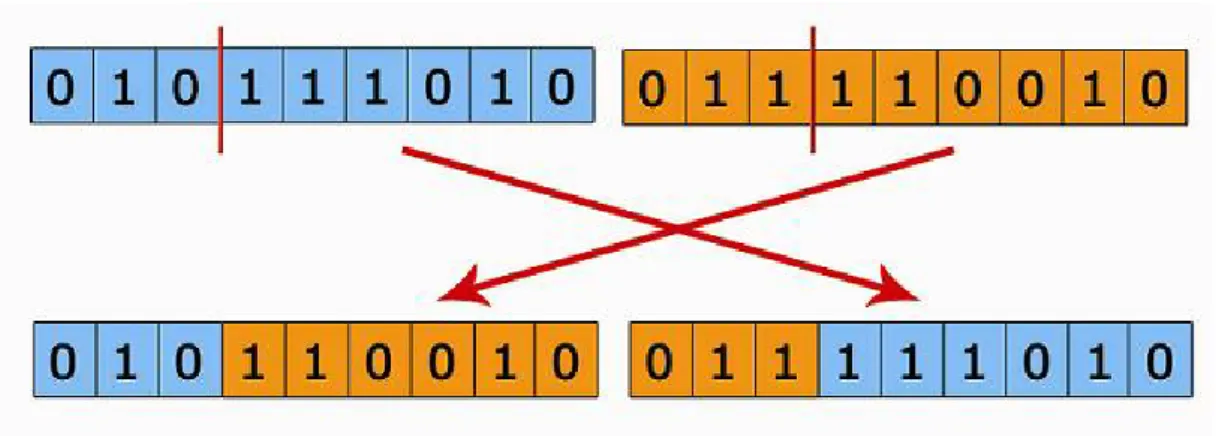
• Crossover:In each step, genetic information of population genomes are shared by genetic crossover operations over selected random individuals. Offspring genomes are created from existing genomes by that way. Procedure for single point crossover operation is shown in Figure 2.2:
• Mutation: Closed population has the risk of being caught by local maximum value after some individual genome’s quality improvements because total in-formation shared has the limitation for a closed population. In order to escape from these local maximums, some outside information can be added to popula-tion. Mutation is one of the outer information addition strategies, where some parts of randomly selected genomes mutated.
• Fitness Value: Relevance calculation used for each genome’s evaluation is called fitness function. Return value of this function is called fitness value which is used as a primary property in the selection step.
A random search is performed in this algorithm where crossover and mutation opera-tors help the searcher in heading towards the population’s subset which optimizes the objective value. This help should be in such a way that satisfies the equilibrium be-tween exploration and exploitation of the population space. Therefore, such operators and population encoding should be examined carefully when formulating the genetic algorithm solution for the specific problem [24]. Steps of a typical genetic algorithm is given in Figure 2.3 whereP(t)represents the solution population for generation t andC(t)represents the created offsprings for thetthgeneration:
Figure 2.3: Genetic Algorithm Procedure
Main problems that should be solved for genetic algorithm adaptation of a problem are encoding and selection operators.
2.4.4.1 Encoding
A solution instance is represented as genomes in genetic algorithms and this repre-sentation is realized by the help of selected encoding methodology. Problem require-ments and solutions spaces vary in operations research domain. Some of the real world problems can be defined with binary encoding but some problems’ complexity does not allow binary encoding usage. Encoding classifications according to used symbolsare:
• Binary Encoding: It is generally used because of simple encoding which pro-vides easiness in selection of operators [26].
• Real Number Encoding: Used for optimization problems as real number us-age is identical to the problem’s real world representation [27].
• Literal Permutation Encoding:Used for problems that search for a best com-bination or permutation of the parameters.
• Data Structure Encoding: Used for complex problems that cannot be repre-sented with other encodings. A data structure related with problem domain is
used.
Encodings are also classifiedaccording to genome dimensionsas:
• One Dimensional Encoding: Used for problems that does not lose informa-tion. It has a low selection operator complexity.
• Multi Dimensional Encoding: Used for the complex real world problems that loses information in one dimensional encoding [28]. A matrix is used as genome so selection operator complexity increases.
Adaptation can be made with a suitable encoding methodology defined above. Any encoding methodology chosen for a problem formulation should have following prop-erties to be effective [24]:
1. Complete:Any solution should be able to be represented in the solution popu-lation with encoding.
2. Legal: Encoding permutation of a solution should yield another solution in population.
3. One-to-One Mapping: Encoded genomes should not be redundant with real solutions. One representation exists for one solution instance.
4. Heritable (Lamarckian): Genomes should not have context dependent prop-erties. Genome properties should pass from parent to offspring [29].
5. Causal:This property defines the effect of genome mutation on the real world solution representation. It is preferred to have small changes in real world representation when a genome representation has a small change [30].
2.4.4.2 Selection Operators
In genetic algorithm, solution space which is called population is searched for a genome with best objective function values. There are two approaches in the search-ing methodology:
• Random Search: Population is explored entirely and local maxima can be escaped.
• Local Search: Solution space is searched with optimum genome exploitation and local maxima cannot be escaped.
For a good solution, search in population should satisfy the equilibrium between ploring whole solution space with random search and accumulated information ex-ploitation with local search [24]. Crossover operator defines the offspring generation in genetic operation. Mutation operator determines the random changes over popu-lation. Crossover and mutation operators play a critical role in satisfying that search equilibrium. In the literature following methodologies used for adding exploitation power to the random search:
• Building Blocks: This genetic approach is developed by Holland [26] and im-proved by Goldberg [31]. It emphasizes on the attribute heritage from parent genomes to offspring genomes by recombining genome parts called genes with crossover operator. Quantity of feature heritage determines the offspring at-tribute quality calculated as fitness value. These fitness values are generally calculated by fitness functions which are using both feature values alone and together as patterns. Building blocks approach is applicable for the genome representations in which effect of a gene singly on fitness value is more than effect of gene patterns on fitness value. So, genes with dependency to other genes in fitness value calculation are not suitable for this recombination of fea-tures approach.
• Convergence Controlled Variation:This approach is developed by Eshelman and his friends [32]. Genetic search is directed according to solution conver-gence of the population. Exploitation is realized by extending a population in the way of a preferred convergence distribution such that solution space varia-tion becomes more focused on convergence to objective.
Exploitation strategy is determined according to problem formulation and its genome encoding. One other step of genetic algorithm is the selection of genomes. Fitness
value calculation becomes critical in this step as the future generations of the popu-lation is dependent on the selected genome. Generally fitness values are defined with considering both the problem objective and the genetic formulation used. Selection mechanism is another property that uses and affects the fitness function. Some of the commonly used selection mechanisms in the literature are followings:
• Roulette wheel selection: It is a random selection for gene recombination. In this mechanism, a genome is randomly selected for crossover from a pool filled according to a probability based on genome’s fitness value. Percentage of a genome’s fitness value defines the possibility of that genome in the pool.
• Tournament selection: Tournaments are prepared between genome instances and the winner is selected.
• Steady State selection:In this mechanism, survival of the current populations’ some parts is achieved.
• Elitism based selection: Best solution of the current population survives by copying to new population.
Effects of the selection mechanism choice can be observed from the minimum gener-ation count required for that implementgener-ation.
CHAPTER 3
OUR WORK
This section presents details of our research about resource allocation problem in ATO preparation. First, problem formulation and scenario assumptions are defined. Then, input generation and input sets are explained. Finally, architecture of used framework, algorithm implementations and customizations are described in detail.
3.1 Problem and Solution Formulation
In this study resource allocation problem is solved as selecting a subset from the defined operation list in order to maximize the gain from targets with the possessed air attack resource potential. Gain is calculated as sum of all destroyed targets’ gaining. An air combat’s goal is to destroy enemy targets whose classification, location and gain value information are defined in intelligence information acquired. An operation with calculated risk and gain value is defined against a single target in our study. Selecting an operation list subset with more than one operation dealing with the same threat does not improve the total gain of the solution as one target can be destroyed once in real world. The input format is shown in Figure 3.1.
In the initial operation list, each operation is generated according to resource require-ments of a target. This requirement is defined in terms of attack resource capabilities and operations represent these requirements in terms of aircraft counts from a fleet. There can be more than one operation in a selected operation list subject with the same resource fleet. However, number of aircrafts in all operations in a selected subset can-not be more than available aircrafts in the related fleet. Considering the combinatorial
Figure 3.2: Problem Instance with Solutions
constraints and the allocation specifications, some real world parameters are not used for decreasing complexity by scenario assumptions described in Section 3.3.
In this thesis, solutions found by different algorithms and approaches are expected to optimize the gain of the selected subset from the given operation list. Each operation is performed by aircrafts of single fleet and against single target. Solutions with requiring more than fleet’s aircraft capacity is not considered as well as solutions against the same targets.
An instance of the resource allocation problem with solutions are shown in Figure 3.2. If that problem is solved greedily, solution will be a subset consisting of operations with an arrow on the left side of the table. However, an optimized solution is available if a subset is created from operations which have an arrow on right side of table.
3.2 NP-Completeness of Problem
After defining the problem formulation, problem properties are analyzed in order to be able to select appropriate solution methodologies accordingly. Main property ana-lyzed for algorithm implementation is problem’s complexity with the help of compu-tational complexity theory [33].
In complexity theorem, a problem is examined with varying sizes to decide on the problem behaviour. This behavior is evaluated by applying the algorithms to problem instances and analyzing the algorithm execution time. An algorithm is called polyno-mial time algorithmif maximum value of this execution time can be defined within terms of a polynomial function. Using algorithm’s execution time formulation, each problem is classified as an element of one of the following sets:
• P Class: Elements of this set has a polynomial time algorithm implementation that can find a solution in polynomial time, working on a deterministic machine.
• NP Class: Elements of this set has a polynomial time algorithm implementa-tion that can only find a soluimplementa-tion in polynomial time with a non-deterministic machine. A machine with unlimited parallelism is called non-deterministic. Well known combinatorial optimization problemtravelling salesman is an NP problem as all solution possibilities of the problem can only be examined with a non-deterministic machine in polynomial time [34].
Relation betweenPandNPSet can be defined asP⊆ NP. However, it is not proved whether P is equal to NP or P is a subset of NP. Hardest problems in NP set form a NP - complete set. This problem set is defined for some NP problems using the convertibility property such that a NP problem can be transformed to any other with a conversion algorithm working in polynomial time. This property shows us that any NP - complete problem is at least as hard as all other NP problems. Therefore, if there exists an algorithm with polynomial time(P) for a NP - complete problem, there is a similar algorithm for all NP problems. We can say that NP - complete problems cannot be solved in polynomial time(P)until NP and P sets’ equality is proved. The optimization problem in our research can be proved to be an element of NP -complete problem set according to complexity theorem:
• We define the problem formulation as decision problem for examining whether gain of a solution is greater than or equal to a valueX:
∀t∈T X o∈O0,d(o)=t 1 ≤ 1,∀f ∈F X o∈O0,s(o)=f k(o) ≤c(f),X o∈O0 g(o)≥X (3.1)
– O is the set of all operations
– O’ is the compared problem solution,O0 ⊂O – F is the set of all fleets
– T is the set of all targets
– s(o) is the fleet source used for the operation o,s(o)∈F – c(f) is the number of existing aircrafts in fleet f,c(f)∈Z+ – d(o) is the destination target for the operation o,d(o)∈T
– k(o) is the total number of aircrafts used for the operation o,k(o)∈Z+ – g(o) is the gain of the operation o,g(o)∈R+
• First requirement of NP - completeness, being a NP problem is valid for defined problem. Because, calculating gain value of a solution instance and checking the solution validity can be performed in polynomial time.
• Then we find a NP - complete problem that can be reduced to our problem in polynomial time to provethe convertibilityrequirement of NP - completeness defined above. Well known NP - complete problem, 0-1 knapsack decision problem[35] is examined: X v∈V0 w(v)≤ W,X v∈V0 p(v)≥X (3.2)
– X is the objective value – V is a finite set of objects
– W is the total weight that can be carried with the knapsack – w(v) is the weight of the object v,w(v))∈Z+
– p(v) it the gain of the object v, p(v)∈Z+
• Reduction of 0-1 knapsack problem to our resource allocation problem can be achieved fully by following formulation:
– Single fleet assumption by F =f and representing all aircrafts in fleet by
c(f) as W of knapsack
– Single operation for each target assumption (same identification by d(o) =o) so representing each operation as an object, O=V
– Every operation is performed with the single fleet,s(o)=f
– Number of aircrafts used for an operation is represented as weight of an object,k(x)=w(v)
– Gain of an operation is represented as gain of an object,g(o)=p(v) – Total gain of solutions are equal and represented withX
As our problem verifies the requirements of NP - completeness, we can say that re-source allocation problem is an element of NP - Complete problem set.
3.3 Scenario Assumptions and Restrictions
Different algorithms used in this thesis have different problem forms. In our study, some assumptions are made and some restrictions are determined in order to be able to use the same input scenario for all implemented algorithms. These assumptions and restrictions simplify the algorithm formulation and execution. They are listed below:
1. Each pilot in a fleet has the same capability and each fleet has single type air-crafts. Single type aircraft restriction in a fleet can be adapted to real world military environment by creating sub fleets according to pilot capability or air-craft type differences.
2. Fleet capabilities are defined for each operation type according to all aircrafts and pilots in the fleet.
3. One operation should be able to destroy the target. Target, that requires two operations, is not acceptable for our study. However, such requirement in an air combat can be adapted to the framework by propagating targets with virtual target addition.
4. Time and dependency relationships of operations are ignored in resource al-location problem by the framework. In case of a scenario requirement with
such relationships, layered problem architecture can be used after dividing the problem into sub problems.
5. Only resources in a fleet are used for the algorithms. However, other resources in bases can be adapted to our formulation by virtual fleet addition for such resources.
Our assumptions do not change the problem structure. Simplified representation still covers most of the real world air combat scenarios.
3.4 Input Generation and Input Sets
Using the same input for various algorithms is one of the key points of our study as it gives us a chance of better evaluation and comparison. Moreover, our framework lets us future usage of the same input for another execution. The input is randomly generated and maintained by the tool. Properties of the generated input set play a critical role for the algorithm execution according to the following main parameters:
• Fleet and Target Count: Each algorithm has its own complexity and these values are the variables used in complexity calculations. Increase in these pa-rameters directly effects efficiency and some algorithms like exhaustive search.
• Operation List:Operation list is automatically generated according to require-ments of the randomly generated targets and potential capabilities of the fleets. It is important for some problems such as genetic algorithms as genome length is directly proportional with the operation list size.
• Required and Provided Capacity Rate:Success possibility of each generated input is represented by this capacity rate. For example, if the required aircraft count is 60 for enemy targets and air force has 30 aircrafts for that combat then probably half of the targets would be destroyed.
Playing with parameters given above, input scenarios with different characteristics are generated. This diversity is needed because of exhaustive search algorithm’s com-plexity and demand for larger inputs. Moreover, linear programming has also high
complexity for the studied problem as integer decision variables required. Other al-gorithms and their customizations also needed to be evaluated with various inputs. Input sets created for this study depend on size and capacity rate differences;
• Small sized input set applicable for exhaustive search and linear programming,
• Input set with high capacity rate and
• Input set with low capacity rate.
3.5 Framework Architecture
In this thesis, the framework used is a plug-in based algorithm execution tool for resource allocation problem. Scenarios are created by Random Input Generator tool with parameters described before. An air combat scenario passes through following path until the comparison step:
1. Input Encoding: Every algorithm added to framework as a plug-in should have an encoding unit that takes the well defined common input representation and encodes in the way algorithm requires.
2. Algorithm Configuration:Each algorithm has its own parameters and specific configuration. Framework gives a graphical user interface for such configura-tions to the user. Customizaconfigura-tions are directly used in execution.
3. Algorithm Execution: Framework runs added algorithms (plug-ins) on the same input scenario. This execution details are not known by framework so each plug-in determines the execution steps.
4. Result Collection: Each algorithm is expected to return its result by a well defined interface to a table for analysis.
3.6 Algorithm Implementations and Customizations
This part defines the algorithms and customization made for them for this thesis work.
3.6.1 Exhaustive Search
All instances in solution space are evaluated in exhaustive search algorithm. Studied problem is represented as examining all operations for each target and finding the optimum in the solution space. In this thesis, none of the bounding approaches is used for decreasing the execution time for this algorithm, because we implemented exhaustive search to create reference optimum solution values for small sized input scenarios. Following is the general structure of exhaustive search algorithm imple-mentation for resource allocation problem:
1. Input:
• A set of operations O; representing all operations for the problem in-stance.
• A set of targetsT; representing all targets for the problem instance.
• A set of fleetsF; representing all fleets for the problem instance. 2. Output:
• A set of operationsSrepresenting operations that will be performed from theOset for optimization,S ⊂ O
3. ExhaustiveSearch (O, T, F)function that examines all subsets of O and returns with the maximum gain.
3.6.2 Greedy Search
Solution space is explored greedily in this algorithm. Operations are sorted according to goal in a list and each operation from the list is examined and added to solution subset one by one. Any operation requiring more than existing fleet resource is passed
and no change is tried on previously generated solution subset for such situations (greediness).
Greedy search algorithm formulation of resource allocation problem is a two step process:
• Sort:Solution sorting step is executed first according to goal of the algorithm. In our problem operations are sorted according to gain values as our aim is to maximize the gain value. This takesO(NlogN)whereNrepresents the number of elements in searched solution space of operations.
• Examine: Solution examining step is executed last. Each solution instance is analyzed according to resources and targets. Therefore, this step has a com-plexity of O(N) where N represents the number of elements in the solution space.
Dominant complexity forces greedy search algorithm toO(NlogN)complexity.
3.6.3 Integer Programming
Integer programming algorithm is implemented based on the well known freelp solve library for resource allocation problem1. We can definelp solve as a library which performs a set of linear programming routines and provides an Application Program-ming Interface (API) that can be called from customized codes for custom problems. Simplex method is supplied by this library which is integrated with a developed plug-in of the framework. Formulation of the problem is given below:
• Encoding:Problem encoding is achieved by creating a vector from thebinary decision variables. This vector has a size equal to all operations defined. A sample vector~xis defined as in the following equation:
~x= x1x2x3...xK (3.3)
– K is the total number of operations in the defined operations set
– xNis a binary (integer) decision variable with lower bound of0and upper bound of1
– Each decision variable xN in the vector is matched with Nth operation in the defined operations set
– If value of a decision variable is0, related operation is not performed – If value of a decision variable is1, related operation is performed.
• Objective function:The resource allocation problem aims to optimize the gain for an air combat by selecting a subset from the defined operations set. So, integer programming formulation’s objective function is the maximization of the total gain calculation as given in the following equation:
maxX
o∈O
coxo (3.4)
whereOis the set of all operations, cois the gain from the operationoand xo is the value representing the operationoin the decision variables vector~x.
• Constraints: Any solution of the resource allocation problem should have some defined features to be valid. Those features can be formulated by the constraints term in the linear programming. Following items define constraints implemented in our study:
1. Resource Bounding: Each solution should guarantee not to use more than existing resource of the fleets. For each fleet, sum of performed operations’ requirement for that fleet cannot exceed the resource count. To control the resource requirements, a vectorrr~ is created for each fleet:
~
rr =rr1rr2rr3...rrK (3.5)
– K is the total number of operations in the defined operations set – rrN is an integer value that represents the resource requirement of the
Nthoperation in the defined operations set.
In order to add resource bounding constraint for a fleet fi, created vector
~
rr is used in the following constraint equation:
X
o∈O
– Ois the set of all operations
– rrois the resource requirement representation of the operationofrom theithfleet inrr~
– xo is the value representing the operationoin the decision variables vector~xand
– rc( fi)represents the total resource capacity of theithfleet
Vectors created for all fleets are used in composing coefficient matrixA:
A= ~ rr1 ~ rr2 . . ~ rrK (3.7)
where K is the total number of fleets and rr~N is the created resource re-quirement vector for Nthfleet.
Matrix A is used in well known A~x ≤ ~b constraint equation of linear programming, where ~b vector is filled with the resource capacity rc(fi) values.
2. Single Destruction:Each solution for resource allocation problem should guarantee not to perform more than one operation for the same target. In order to add this single destruction constraint, a vector of binary values is created for each target.
~
dt =dt1dt2dt3...dtK (3.8)
– K is the total number of operations in the defined operations set – dtNis a binary value that represents the relevance of theNthoperation
with the related target.
– IfdtN is 0,Nthoperation does not destroy the related target. – IfdtN is 1,Nthoperation destroys the related target.
Vectors created for all targets are used in composing coefficient matrixA: A= ~ dt1 ~ dt2 . . ~ dtK (3.9)
where K is the total number of fleets and dt~N is the created resource re-quirement vector for Nthfleet.
Matrix A is used in well known A~x ≤ ~b constraint equation of linear programming, where~bvector is filled with binary value1 for each target as single destruction is requested at most.
Simplex method of the integrated library uses the constraints given above and aims to find thexvector representing the operation realizations which maximizes the total gain of resource allocation.
3.6.4 Genetic Algorithms
In genetic algorithm implementations of optimization problems, the proposed general formulation is adapted by deciding on the representation and calculation terms of the algorithm according to the real world problem. During our study, we implemented different approaches for specific terms of genetic algorithm like encoding, crossover, etc. Resource allocation problems are adapted according to these implementations and solution qualities are analyzed for each approach for terms. Two different strate-gies are used in this approach:
• Simple Exploring Strategy: Genetic algorithm is used without much cus-tomization. Main genetic algorithm properties are kept to constitute a reference solution for the genetic algorithm customizations.
• Divisive Greedy Strategy:In order to optimize the solution, operations are di-vided into sub solutions (sub-genomes) according to the required fleet resource
of operations. Search and selection are performed more greedily than simple exploring strategy by increasing the exploitation rate.
Besides the used strategies, resource allocation problem is represented as a genetic algorithm problem by specifying elements of the genetic algorithm given below:
3.6.4.1 Encoding
Binary encoding is used for representing genomes. Each genome is a one dimen-sional, fixed length bit sequence. Each bit represents the execution of corresponding operation. Length of each genome is equal to the number of operations in the prob-lem. Binary encoding, fixed length and one dimensionality provide easiness and low complexity for the genetic operations. However, each genome contains useless bits for the operations which are not executed.
Each genome can be represented as:
G = Eo1Eo2Eo3...EoK (3.10)
where:
• Kis the total number of operations in the problem,
• EoN represents the execution status ofNthoperation,
• Operations with corresponding bit with value 1 are executed and 0 are not exe-cuted.
An example genome isg = ’01011001000’ and g represents a solution of resource allocation of resource allocation problem by defining a set of executed operations which is a subset of all operations. This encoding is complete as all solutions in solution space can be represented by a genome. Bit ordering in each genome is im-plemented with two different approaches:
1. Simple Maximum Gain Encoding:All operations (bits) in solution space are ordered according to the gain value of corresponding operation. Dependency of
each operation to another is discarded and heritage is expected from crossover operation according toBuilding Blocks Hypothesis[26, 31].
2. Fleet Based Maximum Gain Encoding: Bits are ordered according to corsponding operation’s required fleet identifier. By that way, all operations re-quiring the same fleet are grouped together through encoding. Bits in the same group are ordered according to gain values. Each genome becomes a composi-tion of sub-genomes, each representing an operacomposi-tion group as:
G= S Gf1S Gf2S Gf3...S Gf K (3.11) where:
• Kis the total number of fleets in the problem,
• S Gf N represents the sub-genome created forNthfleet,
• Each sub-genome is filled with binary values that represent execution sta-tus of corresponding operation,
• A sub-genome for fleetXis formulated as:
S GfX = Eox1Eox2Eox3...EoxK (3.12)
where EoxN represents the execution status of N
th operation of the sub-genome created for Xthfleet.
3.6.4.2 Crossover
Crossover is the key point of the solution space search. Three approaches are imple-mented for the crossover term of genetic algorithm:
1. Single Point Crossover: A random point from genome is selected in this im-plementation. Offsprings are generated from parent genomes’ fraction accord-ing to that randomly selected point. Random search is performed with the ex-ploration effect of random crossover point choice in this approach. Attribute heritage is expected from parent genomes’ recombining. Figure 3.3 explains single point crossover.
Figure 3.3: Single Point Crossover
Figure 3.4: Boundary Points Crossover
2. Boundary Points Crossover: This crossover is applied to the genomes with fleet based encoding. Points are not randomly selected in this implementation. Selected crossover points are the boundary points between two sub-genomes. Crossover point count is one less than fleet count because count of sub-genomes is equal to the fleet count. Figure 3.4 exemplifies the boundary points used for the crossover. Additional local search behaviour is added to the random search of genetic algorithm by grouping bits. Convergence randomness is decreased by not selecting random crossover points. Attribute heritage in this implemen-tation contains both feature propagation and feature pattern propagation to off -spring. In this heritage, sub-genome (bit pattern) with higher gain is propagated
to children to use theconvergence controlled variation hypothesis. In order to avoid local maxima solutions and achieve equilibrium between random search and local search, randomness is added for the selection point. With fifty per-centage probability, sub-genome selection is performed as in the single point crossover implementation.
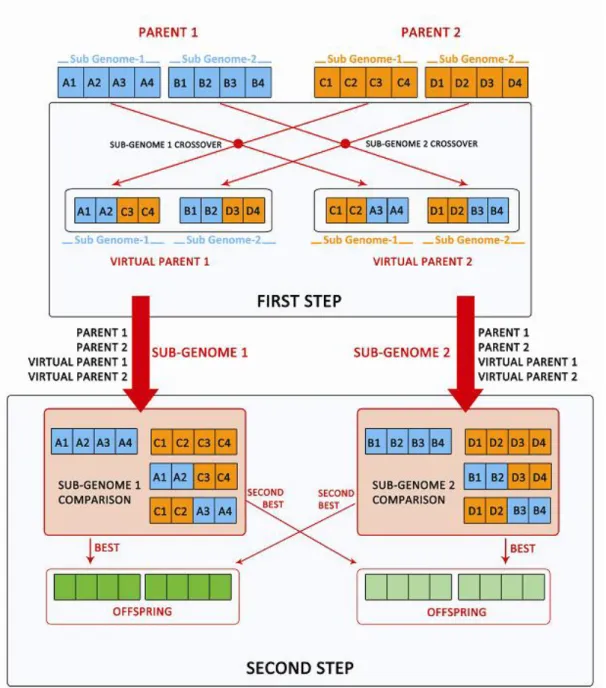
3. Layered Hybrid Crossover: This is an experimental approach with two lay-ered crossover action. This crossover is applied to the genomes with fleet based encoding.
(a) First step is similar to the single point crossover with randomly selected single point recombining. However, this first step crossover is applied to each sub genome separately. Propagated two offsprings are the combina-tion of created offsprings of sub-genomes. These offsprings are used as a parent in second step.
(b) Second step is similar to the boundary points crossover. Only difference is that there are four parent genomes: two real parents and two parent from offsprings of the first step. The same crossover action of boundary point crossover approach is applied. However, best two parents are selected from four parents (two real, two virtual) before applying the crossover. Layered hybrid crossover methodology aims to use best features of other two crossover methodologies by applying them in different layers. This approach is shown in Figure 3.5.
3.6.4.3 Mutation
Single bit mutation is used in all implementations of the genetic algorithm. Mutation rate is parametric.
3.6.4.4 Fitness Value
1. The first one is the maximum gain objective function that sums the performed operation gain values. Simple fitness calculation is performed for genome G as in equation 3.13.
simpleFitness(G)=X o∈G
gain(o).isE xecuted(o) (3.13) Where gain(o) is the gain of related operation and isExecuted(o) is the execu-tion status of the related operaexecu-tion.
2. The second is a customized version of objective function that looks for the sub-genomes’ fitness by the gain percentage for a specific fleet. Main idea in this function is to support genomes with high performing sub-genomes rather than a total good performance. Fitness value of a genome G, which is represented asG= S Gf1S Gf2S Gf3...S Gf K, is calculated as in equation 3.14.
totalFitness(G)= X S G∈G
subFit(S G) (3.14)
where SG is the sub-genome created for fleetfand subFit(SG) is calculated as in equation 3.15.
subFit(S G)= simpleFit(S G) allGain(S G) ∗
aircra f t(S G)
cra f tCount(f) (3.15) Using the utility functions in following equations:
simpleFit(S G)= X o∈S G
gain(o).isE xecuted(o) (3.16) allGain(S G)= X o∈S G gain(o), (3.17) aircra f t(S G)= X o∈S G f leetRequired(o) (3.18)
where craftCount(f) is the total number of aircrafts in the fleet f and fleetRe-quired(o) is the number of aircrafts used for operationo.
CHAPTER 4
EVALUATION OF THE RESULTS
This chapter provides a summary of solutions created by implemented algorithms and presents experimental results. Evaluations are performed according to objective function values for the input set. Configuration parameters used for implementations are determined according to similar studies in literature and experiments made. These parameters can be listed as:
• Exhaustive Search: – No bounding
– Maximum gain based sorting
• Genetic Algorithms: – Crossover probability=0,85 – Generations=100 – Mutation probability=0,1 – Population count=1 – Population size=400 – Replacement ratio=0,4 • Greedy Algorithm:
– Maximum gain based sorting
• Integer Linear Programming – Integer valued parameters
Figure 4.1: Results of Input Set 1 – Verbose level=3 – epsel=1.0e-11 – epsd=1.0e-8 – epspivot=1.0e-5 – epsb=1.0e-9 – epsint=1.0e-3
Results are presented separately for each type of input set in the following sections.
4.1 Results of Small Sized Input Set
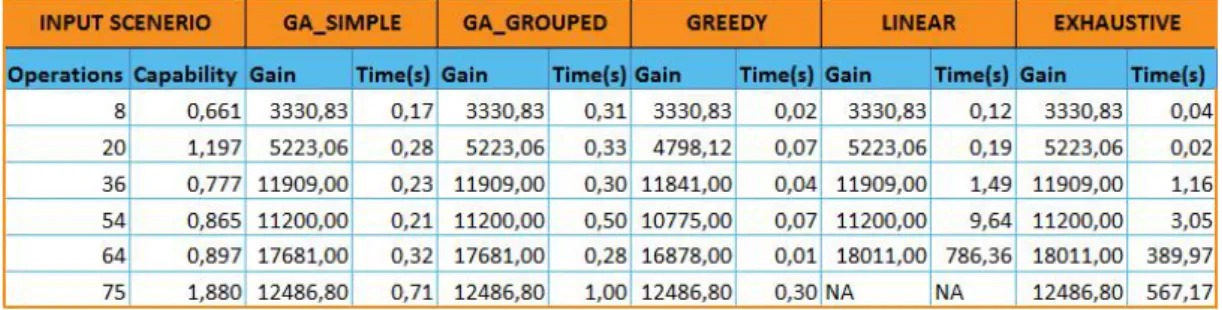
The time complexity of exhaustive search and integer linear programming avoids us to examine all input scenarios. So some specific scenarios with small sized data with high capacity rate are produced in order to be able to compare algorithms’ effectivity. Exhaustive search will be a reference for calculating the gain loss of an implementa-tion. Figure 4.1 shows the generic result values of this input set.
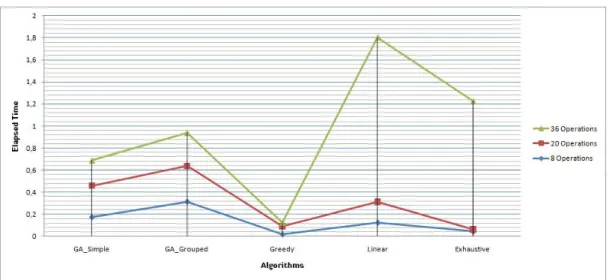
Most important difference is the required time change according to input size. These values depend on the time complexities of the algorithms. Figure 4.2 shows elapsed time values for first three input scenarios of this input set.
Vertical values are the elapsed time of each algorithm for corresponding operation size. Other three inputs are not used in the Figure as the time difference improves so fast to view the complexity variance. Analysis for each implementation is listed below:
Figure 4.2: Elapsed Time Change for Algorithms
Figure 4.3: Elapsed Time for Exhaustive Search Algorithm
4.1.1 Exhaustive Search Implementation
This algorithm is used for getting reference gain values for input scenarios so none of the bounding approaches are analyzed. Results are optimum for this implementation as all operation subsets are examined. However, elapsed time values shown in Figure 4.3 is very high for the studied problem. Therefore, this implementation is not useful for real world military environment’s resource allocation problem.
Figure 4.4: Elapsed Time for GA Simple Algorithm
Figure 4.5: Gain Values for GA Simple Algorithm
4.1.2 Simple Genetic Algorithm Implementation
A simple genetic algorithm (GA Simple) with single random point crossover is used for collecting results. Figure 4.4 shows the efficiency analysis of this algorithm for the related input set by comparing elapsed times with corresponding scenario’s operation size.
Simple genetic algorithm’s elapsed time graph depicts that; this implementation can find solutions for huge sized input scenarios within a reasonable time. Figure 4.5 shows the effectivity analysis of this algorithm by comparing values with reference values (exhaustive search results) for different sized inputs.
Figure 4.5 depicts that; solutions of simple genetic algorithm implementation is equal to the reference values for most of the scenarios and difference is less than two per-centage for the radical scenarios with very low capacity rates.
Figure 4.6: Elapsed Time for GA Grouped Algorithm
4.1.3 Genetic Algorithm Implementation with Fleet Grouping (GA Grouped)
This implementation is very similar to the simple genetic algorithm with a small dif-ference on crossover methodology. In this algorithm boundary points crossover approach is applied to genomes which are grouped by required fleet. Solutions’ gain values are equal to the simple genetic algorithm implementation, so effectivity of this implementation is shown to be same with that algorithm. In terms of elapsed time, there is a difference with simple genetic algorithm implementation, Figure 4.6 shows the efficiency analysis of this implementation.
Figure 4.6 depicts that; this implementation can find solutions for huge sized input scenarios within a reasonable time. This time is slightly larger than simple genetic algorithm implementation’s elapsed time.
4.1.4 Greedy Algorithm Implementation
Scenarios in the first input set are also used for examining the greedy algorithm in terms of efficiency and effectivity. Figure 4.7 shows the efficiency analysis of this implementation.
As this algorithm tries operations of input scenario greedily, elapsed time values are very small according to other algorithm. Figure depicts that a solution can be found in a reasonable time for studied problems. Figure 4.8 shows the effectivity analysis of this algorithm by comparing values with reference values (exhaustive search results)