Efficient Mechanisms for Single-task Reliable-communication
Master-Worker Computing with Malicious and Rational Workers
∗Evgenia Christoforou University of Cyprus [email protected]
Antonio Fern´andez Anta Inst. IMDEA Networks and URJC
[email protected] Chryssis Georgiou
University of Cyprus [email protected]
Miguel A. Mosteiro Rutgers University and URJC
Abstract
We consider Internet-based master-worker computations, where a master processor assigns, across the Internet, a computational task to a set of untrusted worker processors, and collects their responses; examples of such computations are the “@home” projects such as SETI. Prior work deal-ing with Internet-based task computations has either considered only rational, or only malicious and altruistic workers. Altruistic workers always return the correct result of the task, malicious work-ers always return an incorrect result, and rational (selfish) workwork-ers act based on their self-interest. However, in a massive computation platform, such as the Internet, it is expected that all three type of workers coexist. Therefore, in this work we study Internet-based master-worker computations in the presence of Malicious, Altruistic, and Rational workers. A stochastic distribution of the workers over the three types is assumed. Considering all the three types of workers renders a combination of game-theoretic and classical distributed computing approaches to the design of mechanisms for reli-able Internet-based computing. Indeed, in this work such an algorithmic mechanism that makes use of realistic incentives to obtain the correct task result with a parametrized probability is designed. Only when necessary, the incentives are used to force the rational players to a certain equilibrium (which forces the workers to be truthful) that overcomes the attempt of the malicious workers to deceive the master. Finally, the mechanism is analyzed in two realistic Internet-based master-worker applications.
Technical Report TR-11-04 Department of Computer Science
University of Cyprus May 2011
∗
This work is supported in part by the Cyprus Research Promotion Foundation grant TΠE/ΠΛHPO/0609(BE)/05, Comu-nidad de Madrid grant S2009TIC-1692, Spanish MICINN grant TIN2008–06735-C02-01, and NSF grant 0937829.
1
Introduction
Motivation and Prior Work. In recent years, the Internet has become an alternative (to expensive supercomputing parallel machines) computational platform for processing complex computational jobs. Examples of such Internet-based processing are the “@home” projects [5], such as SETI [29] (a clas-sical example ofvolunteer computing) and Grid computing [12]. However, Internet-based computing (referred sometimes as P2P computing–P2PC [17, 47]) has not reached its full potential due to the un-trustworthiness nature of the platform’s components [5,20]. Typically, in Internet-based computing (e.g, in SETI) the following Master-Worker approach is employed: A master computer sends jobs (ortasks), across the Internet, to worker computers that are willing to execute them. These workers execute and report back the result of the task computation. However, these workers are unavoidably non-trustworthy, and hence might report incorrect results. Naturally, the master attempts to minimize the impact of these bogus results (and increase its chance of obtaining the correct task result) by assigning the same task to several workers and comparing their outcomes (that is,redundanttask allocation is employed [5]).
This problem has recently been studied under two different views: from a “classical” distributed computing view [15, 28, 43] and from a game-theoretic view [16, 47]. Under the first view, the workers are classified as eithermalicious(Byzantine) oraltruistic, based on a predefined behavior. The mali-cious workers have a “bad” behavior which results in reporting an incorrect result to the master. This behavior is, for example, due to a hardware or a software error or due to an ill-state of the worker (it behaves maliciously intentionally). Altruistic workers exhibit a “good” behavior, that is, they compute and truthfully return the correct task result (they are essentially the “correct” nodes). Under this view, “classical” distributed computing models are defined (e.g., a fixed bound on the probability of malicious nodes is assumed) and typical malicious-tolerant voting protocols are designed.
Under the game-theoretic view, workers act on their ownself-interestand they do not have an a priori established behavior, that is, they are assumed to berational[2, 20]. In other words, the workers decide on whether they will behonest(and hence compute and truthfully report the correct task result) orcheat
(and hence report a bogus result) depending on which strategy increases their benefit (utility). Under this view, Algorithmic Mechanisms [2, 10, 38] are employed, where games are designed to provide the necessary incentives so that processors’ interests are best served by acting “correctly.” In particular, the master provides some reward (resp. penalty) should a worker be honest (resp. cheat). The design objective is for the master to force a desired uniqueNash equilibrium(NE) [37], i.e., a strategy choice by each worker such that none of them has incentive to change it. That Nash equilibrium is the one in which the master achieves a desired probability of obtaining the correct task result.
The above views could complement one another, if a certain computation includes only malicious and altruistic workers, or only rational workers. However, the pragmatic situation on the Internet is different: all three type of workers might co-exist in a given computation. One could assume that all workers are rational, but what, for example, if a software bug occurs that makes a worker deviate from its protocol, and hence compute and return an incorrect result? This worker is no longer exhibiting a rational behavior, but rather an erroneous or irrational one (that from the master’s point of view it can be seen as malicious).
Contributions. In this work we consider Internet-based master-worker computations where Mali-cious, Altruistic and Rational workers co-exist. To the best of our knowledge, this is the first work that considers such co-existence in Internet-based master-worker (P2PC) computing. Considering all the three types of workers renders a combination of game-theoretic and classical distributed computing approaches to the design of mechanisms for reliable Internet-based computing. In particular
• A collection of realistic payoff parameters and reward models are identified (Section 2) and the above Internet-based master-worker computation problem is formalized as aBayesian game[24] (Section 3). There is a probability distribution of workers among the worker types. The master and
the workers do not know the type of other workers, only the probability distribution. The rational workers play a game looking for a Nash Equilibrium, while the malicious and altruistic workers have a predefined strategy to cheat or be honest, respectively. The master does not participate in the game, it designs the game to be played.
• We design a general voting algorithm that the master runs to implement the abovementioned game (Section 3). The algorithm is parametrized in terms of a probability of auditingpA(defined in Section 3). Under a general type probability distribution, we analyze the master’s utility and probability of error (probability of obtaining the incorrect task result) and identify the conditions under which the game has Nash Equilibria.
• Based on specific type probability distributions, an algorithmic mechanism in which the master chooses the values ofpAto guarantee a parametrized bound on the probability of error is designed (Section 4). Once this is achieved, the master also attempts to maximize its utility. Note that the mechanism designed (and its analysis) is general in that reward models can either be fixed exogenously or be chosen by the master. It is also shown that this mechanism is the only feasible approach for the master to achieve a given bound on the probability of error.
• Finally, under the constrain of the bounded probability of error, it is shown how to maximize the master utility in two realistic scenarios (Section 5). The first scenario abstracts a system of volunteering computing like SETI, and the second, a company that buys computing cycles from Internet computers and sells them to its customers in the form of a task-computation service, such as Amazon’s Mechanical Turk [4].
Related work. Prior examples of game theory in distributed computing include work on Internet rout-ing [19,30,34,41], resource/facility location and sharrout-ing [18,21], containment of viruses spreadrout-ing [36], secret sharing [2, 23], P2P services [3, 31, 32] and task computations [16, 47]. For more discussion on the connection between game theory and computing we refer the reader to the survey by Halpern [22] and the book by Nisan et al [39].
Distributed computation in presence of selfishness was also studied within the scope of Combina-torial Agencies in Economics [6]. The computation is carried out as a game of complete information where only rational players are considered. The goal in that work is to study how the utility of the mas-ter is affected if the equilibria space is limited to pure strategies. To that extent, the computation of a few Boolean functions is evaluated. If the parameters of the problem yield multiple mixed equilibrium points, it is assumed that workers accept one “suggested” by the master.
Eliaz [13] seems to be the first to formally study the co-existence of Byzantine (malicious) and rational players. He introduces the notion ofk-fault-tolerant Nash Equilibrium as a state in which no player benefits from unilaterally deviating despite up tokplayers acting maliciously. He demonstrates this concept by designing simple mechanisms that implement the constrained Walrasian function and a choice rule for the efficient allocation of an indivisible good (e.g., in auctions). Abraham et al [2] extend Eliaz’s concept to accommodate colluding rational players. In particular they design a secret sharing protocol and prove that it is(k, t)-robust, that is, it is correct despite up tokcolluding rational players andtByzantine ones.
Aiyer et al. [3] introduce the BAR model to reason about systems with Byzantine (malicious), Al-truistic, and Rational participants. They also introduce the notion of a protocol being BAR-tolerant, that is, the protocol is resilient to both Byzantine faults and rational manipulation. (With this respect, one might say that our algorithmic mechanism designed in this work is BAR-tolerant.) As an application, they designed a cooperative backup service for P2P systems, based on a BAR-tolerant replicated state machine. Li et al [32] also considered the BAR model to design a P2P live streaming application based on a BAR-tolerant gossip protocol. Both works employ incentive-based game theoretic techniques (to
remove the selfish behavior), but the emphasis is on building a reasonably practical system (hence, for-mal analysis is traded for practicality). Recently, Li et al [31] developed a P2P streaming application, called FlightPath, that provides a highly reliable data stream to a dynamic set of peers. FlightPath, as opposed to the abovementioned BAR-based works, is based on mechanisms for approximate equilib-ria [9], rather than strict equilibria. In particular, -Nash equilibria are considered, in which rational players deviate if and only if they expect to benefit by more than a factor of. As the authors claim, the less restrictive nature of these equilibria enables the design of incentives to limit selfish behavior rigorously, while it provides sufficient flexibility to build practical systems.
Recently, Gairing [19], introduced and studiedmalicious Bayesian congestion games. These games extend congestion games [42] by allowing players to act in a malicious way. In particular, each player can either be rational or, with a certain probability, be malicious (with the sole goal of disturbing the other players). As in our work, players are not aware of each other’s type, and this uncertainty is described by a probability distribution. Among other results, Gairing shows that, unlike congestion games, these games do not in general possess a Nash Equilibrium in pure strategies. Also he studies the impact of malicious types on the social cost (the overall performance of the system) by measuring the so-called
Price of Malice. This measure was first introduced by Moscibroda et al [36] to measure the influence of malicious behavior for a virus inoculation game involving both rational (selfish) and malicious nodes.
2
Definitions and Notation
System model. The assumed distributed system is formed by a master processor M and a set W of
n = |W|workers. We assume that the master choosesnto be odd. The master has a task that wants to compute. For some reason, the master does not compute the task itself, but chooses to send it toall
the workers, wait for their answers, and decide on a value that it believes to be the correct output of the task. The tasks considered in this work are assumed to have a unique solution although such limitation reduces the scope of application of the presented mechanisms, there are plenty of computations where the correct solution is unique: e.g., any mathematical function.
Each of thenworkers has one of the following types,rational,malicious, oraltruistic. The exact number of workers of each type is unknown. However, it is known that each worker is independently of one of the three types with probabilitiespρ, pµ, pα, respectively, wherepρ+pµ+pα = 1. Malicious
and altruistic workers always cheat and are honest, respectively, independently of how such a behavior impacts their utilities. In the context of this paper, being honest means returning the correct value, and cheating means returning some incorrect value. On the other hand, rational workers are assumed to be selfish in a game-theoretic sense, i.e., their aim is to maximize their benefit (utility) under the assumption that other workers do the same. Hence, they will be honest or cheat depending on which strategy maximizes their utility. While it is assumed that rational players make their decision individually, it is assumed that all the (malicious and rational) workers that cheat return the same incorrect value. This yields a worst case scenario (and hence analysis) [43] for the master with respect to its probability of obtaining the correct result. (In some sense, this can be seen as a cost-free, weak form of collusion). Finally, it is assumed that all workers reply (abstention is not allowed) and that all their answers reach the master.
In order to model the individuality of the non-monetary part of each rational worker benefit/penalty, the distribution over types could be generalized to different types of rational workers instead of one. More precisely, define a probability distribution over each possible combination of payoffs inR4,
re-stricting signs appropriately, so that each rational worker draws independently its strategic normal form from this distribution. However, the analysis presented here would be the same but using expected payoffs, the expectation taken over such distribution. Thus, for the sake of clarity and without loss of generality, we assume that the strategic normal form is unique for all players, i.e., all rational workers are of the same type.
The objective of the master is twofold. First, the master has to guarantee that the decided value is correct with probability at least1−ε, for a known constant0 ≤ ε < 1. Then, having achieved this, the master wants to maximize its own benefit (utility). To achieve this it has two weapons. On the one hand, it can audit the response of the workers (at a cost). In particular, the master computes the task by itself, and checks which workers have been truthful or not. (From the assumptions that cheaters return the same incorrect answer and tasks have unique solutions, it follows that there can only be two kind of replies – a correct and an incorrect one.) On the other hand, the master can punish and reward workers, which can be used (possibly combined with audit) to encourage rational workers to be honest. When the master audits, it can accurately punish and reward workers. However, when the replies are not audited, rewards and penalties can be applied following different models.
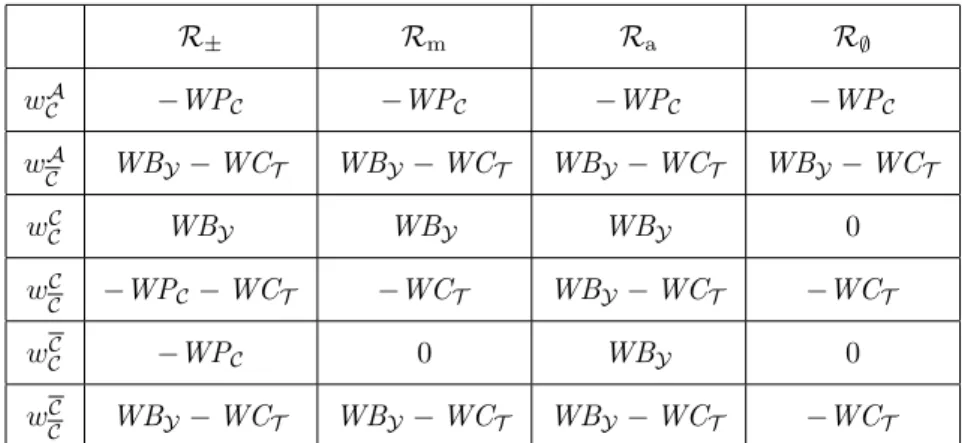
The reward models considered in this paper are presented in Table 1. Two of the models reward or penalize a worker depending on whether its reply is equal to the majority of replies (observe that at most two replies are possible, and sincen is odd, one reply has majority). These reward models are sensible when the probability of a majority of honest replies is reasonably large. Observe as well that three models do not punish (some even reward) the workers whose reply is in the minority. This tries to avoid punishing honest workers that are outnumbered by cheaters. The payoff parameters used are detailed in Table 2. All these parameters are non-negative. Observe that there are different parameters for the rewardWBY to a worker and the cost MCY of this reward to the master. This models the fact that the cost to the master might be different from the benefit for a worker. In fact, in some applications they may be completely unrelated, as for example in the SETI-like scenario presented in Section 5.1. It is assumed thatWBY andWPCare chosen by the master whereas the other payoff parameters and the reward models can be fixed exogenously.
R± the master rewards the majority and penalizes the minority
Rm the master rewards the majority only
Ra the master rewards all workers
R∅ the master does not reward any worker
Table 1: Reward models
Game Theory concepts. We study the problem under the assumption that the rational workers, or
players, will play a game looking for an equilibrium (malicious and altruistic workers have a predefined strategy to cheat or be honest, respectively). The master does not play the game, it only defines the protocol and the parameters to be followed (i.e., it designs the game or mechanism). The master and the workers do not know the type of other workers, only the probability distribution. Hence, the game played is a so-called game with imperfect information orBayesian game[24]. The action space is the set of pure strategies{C,C}, and the belief of a player is the probability distribution over types. Each player knows in advance the distribution over types, the total number of workers, and its normal strategic form, which is assumed to be unique. The game formulation is given in the next section.
WPC worker’s punishment for being caught cheating WCT worker’s cost for computing the task
WBY worker’s benefit from master’s acceptance
MPW master’s punishment for accepting a wrong answer MCY master’s cost for accepting the worker’s answer MCA master’s cost for auditing worker’s answers MBR master’s benefit from accepting the right answer
Table 2: Payoffs
equi-librium(MSNE) if, and only if, for each playeri,
Ui(si, σ−i) =Ui(s0i, σ−i),∀si, s0i ∈supp(σi),
Ui(si, σ−i)≥Ui(s0i, σ−i),
∀si, s0i:si ∈supp(σi), s0i∈/ supp(σi),
wheresi is the strategy used by playeriin the strategy profiles,σi is the probability distribution over
pure strategies used by playeriinσ,σ−iis the probability distribution over pure strategies used by each
player butiinσ,Ui(si, σ−i)is the expected utility of playeriwhen using strategysiwith mixed strategy
profileσ, andsupp(σi)is the set of strategies inσwith positive probability.
In words, given a MSNE with mixed-strategy profileσ, for each playeri, the expected utility, as-suming that all other players do not change their choice, is the same for each pure strategy that the player can choose with positive probability inσ, and it is not less than the expected utility of any pure strategy with probability zero of being chosen inσ. Then, in order to find conditions for equilibria, we want to study for each playeri
∆Ui ,Ui(si=C, σ−i)−Ui(si =C, σ−i).
If we show conditions such that∆U = 0, then we have a MSNE.1If we denote bypCthe probability that playericheats, then in the MSNE06=pC6= 1. On the other hand, if we show conditions that make
∆U < 0for each player i, we know that there is a pure strategies NE where all players choose to be honest, i.e. pC = 0. (There is no NE where some players choose a pure strategy and others do not because the game is symmetric for all rational players. If a distribution over many types of rational players is defined, then we would have to consider such a NE.)
The following notation will be used throughout.
Pq(n)(a, b), b X i=a n i qi(1−q)n−i
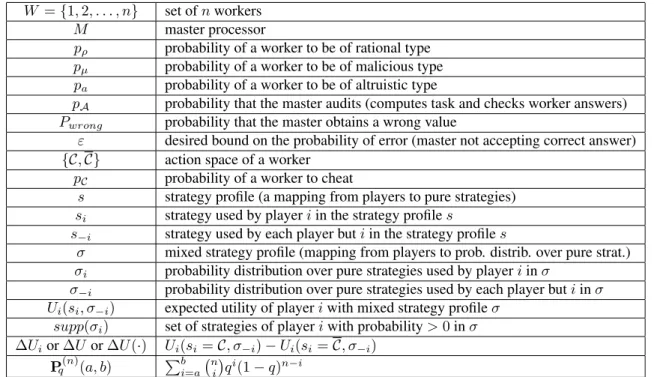
The notation used throughout the paper is summarized in Table 3.
3
Game Definition and Analysis
In this section we present the protocol that the master uses to obtain the result of the task. The protocol essentially implements the game to be played by the (rational) workers, which we also define in this section. Finally we analyze the game under a general type probability distribution.
3.1 Protocol Description
The basic protocol used by the master to accept the task result can be described as follows. After receiving the replies from all workers, and independently of the distribution of the answers, the master processor chooses to audit the answers with some probability pA. If the answers were not audited it accepts the result of the majority. Then, it applies the corresponding reward model. The protocol is detailed in Algorithm 1. The specific values ofpA are chosen in the next sections according with the known type distribution of workers and payoffs.
For computational reasons, besidespAand the task to be computed, the master also sends a certifi-cate. The certificate includes the strategy that if the rational workers play will lead them to the unique
W ={1,2, . . . , n} set ofnworkers
M master processor
pρ probability of a worker to be of rational type pµ probability of a worker to be of malicious type pa probability of a worker to be of altruistic type
pA probability that the master audits (computes task and checks worker answers)
Pwrong probability that the master obtains a wrong value
ε desired bound on the probability of error (master not accepting correct answer)
{C,C} action space of a worker
pC probability of a worker to cheat
s strategy profile (a mapping from players to pure strategies)
si strategy used by playeriin the strategy profiles
s−i strategy used by each player butiin the strategy profiles
σ mixed strategy profile (mapping from players to prob. distrib. over pure strat.)
σi probability distribution over pure strategies used by playeriinσ
σ−i probability distribution over pure strategies used by each player butiinσ Ui(si, σ−i) expected utility of playeriwith mixed strategy profileσ
supp(σi) set of strategies of playeriwith probability>0inσ ∆Uior∆Uor∆U(·) Ui(si=C, σ−i)−Ui(si=C, σ−i)
Pq(n)(a, b) Pbi=a niqi(1−q)n−i
Table 3: Summary of Symbols
Algorithm 1:Master algorithm
send (task,pA, certificate) to all the workers inW; uponreceiving all answersdo
audit the answers with probabilitypA;
ifthe answers were not auditedthenaccept the majority; apply the reward model;
endupon
NE, together with the appropriate data to demonstrate this fact. More details for the use of the certificate are given in Section 4.5.
Notice that the protocol is one-shot, in the sense that it terminates after one round of communication between the master and the workers. This enables fast termination and avoids using complex cheater detection and worker reputation mechanisms. The benefit of one-round protocols is also partially sup-ported by the work of Kondo et al. [27] that have demonstrated experimentally that tasks may take much more than one day of CPU time to complete.
As discussed in Section 2, there are only two values returned to the master – the correct value and a unique incorrect one. Together with the fact that the master choosesnto be odd, in line 4 it is not possible to have relative majority. Considering relative majority could be made possible by making appropriate changes to the model and to the mechanism analysis. However, the analysis becomes more involved while not giving more insight to the problem under study.
3.2 Game Definition
Putting together the game-related discussion in Section 2 and the above protocol, we formulate the Internet-based Master Worker computation considered in this works as the following Bayesian game
G(W, ε,D, A, pA,R,pfs), 1
whereW is the set ofnworkers,0≤ε <1is the error probability,Dis the type probability distribution (pρ, pµ, pα), A = {C,C} is the workers’ actions space (recall that only rational players have a
prob-abilistic choice over pure strategies, malicious workers always cheat and altruistic workers are always honest), pA is as described in Algorithm 1, Ris one of the reward models given in Table 1, andpfs are the payoffs as described in Table 2. Recall that the master and the workers do not know the other workers types, butDis known.
As mentioned before, the master does not participate in the game, but it designs the game to be played. In particular, the master runs Algorithm 1 after using a mechanism designed in Section 4. In order to obtain a mechanism that is useful for any scenario we do not restrict ourselves to a particular instance of payoffs or reward models. Instead, we leave those variables as parameters and focus our study on how to choose pA to have the probability of error bounded by ε. Were payoffs and reward models a choice of the master, its utility can be maximized choosing those parameters conveniently in Equation 2 (given below). Two realistic examples are given in Section 5.
3.3 Game Analysis
We now analyze the game under a general type probability distribution. In the next section we design a mechanism for specific families of type probability distributions.
Error Probability and Master Utility. Recall thatnis assumed to be odd. Lettingq =pµ+pρpC,
where pC is the probability that a rational player chooses strategyC, the probability that the master obtains the wrong answer is
Pwrong = (1−pA)Pq(n)(dn/2e, n). (1)
On the other hand, the expected utility of the master is
UM =pA MBR−MCA−n(1−q)MCY + (1−pA) MBRPq(n)(0,bn/2c) −MPWPq(n)(dn/2e, n) +γ . (2) Where, γ = −MCY(E1(n−)q(dn/2e, n) +E (n) q (dn/2e, n))
for theRmandR±models.
−nMCY
for theRamodel.
0
for theR∅model. andE(pn)(a, b),Pbi=a niipi(1−p)n−i,p∈[0,1].
Equilibria Conditions. For any playeri, letwCsi be the payoff of playeriwhen using strategysi in
the strategy profilesif the majority of workers cheat and the master does not audit,wCsi if the minority of workers cheat and the master does not audit, andwAsiotherwise.
R± Rm Ra R∅ wCA −WPC −WPC −WPC −WPC wA C WBY−WCT WBY−WCT WBY−WCT WBY−WCT wCC WBY WBY WBY 0 wC C −WPC−WCT −WCT WBY−WCT −WCT wCC −WPC 0 WBY 0 wC C WBY−WCT WBY−WCT WBY−WCT −WCT
Table 4: Payoffs for each reward model. Then, for each playeri,
∆U = (wCA−wCA)pA+ (1−pA) (wCC−wCC)Pq(n−1)(dn/2e, n−1) + (wCC−wCC)Pq(n−1)(0,bn/2c −1) + (wCC−wCC) n−1 bn/2c qbn/2c(1−q)bn/2c .
Notice in Table 4 thatwAC −wAC = WCT −WPC−WBY for all models. Also notice from Table 4 that, for any reward model,wCC=wCC−WCT andwCC=wCC−WCT. Replacing,
∆U =WCT −pA(WPC+WBY) + (1−pA)
(wCC(Pq(n−1)(bn/2c, n−1)−Pq(n−1)(0,bn/2c))
+wCC(Pq(n−1)(0,bn/2c −1)−Pq(n−1)(dn/2e, n−1))). (3)
In the remainder of the paper, in some cases, we will be using the notation ∆U(parameter) to denote the evaluation of∆U under a certain value ofparameter.
The following observationwill be useful.
Lemma 1. For anyi∈W,∆U(pC)is a non-decreasing function inpC∈[0,1].
Proof. In order to prove this lemma, it is enough to replace the payoffs from Table 4 in Equation 3 for each model as follows.
Rmmodel. ∆U =WCT −WPC−WBY + (1−pA) (WPC+WBY)Pq(n−1)(bn/2c, n−1) +WPCPq(n−1)(0,bn/2c −1) +WBYPq(n−1)(dn/2e, n−1). ∆U =WCT −WPC−WBY + (1−pA) WPC+WBY(Pq(n−1)(bn/2c, n−1) +Pq(n−1)(dn/2e, n−1)) .
It can be seen that∆U is an increasing function in the intervalq∈[0,1]hence the claim follows for this model.
RaandR∅ models. For theRamodel,
∆U =WCT −WPC−WBY + (1−pA)
(WPC+WBY)(Pq(n−1)(bn/2c, n−1) +Pq(n−1)(0,bn/2c −1)).
∆U =WCT −WPC−WBY + (1−pA)(WPC+WBY).
And for theR∅model,
∆U =WCT −WPC−WBY + (1−pA)
WPCPq(n−1)(bn/2c, n−1) +WBYPq(n−1)(0,bn/2c)
+WPCPq(n−1)(0,bn/2c −1) +WBYPq(n−1)(dn/2e, n−1).
∆U =WCT −WPC−WBY + (1−pA)(WPC+WBY).
Thus,∆U is a constant with respect topChence it is non-decreasing for this model.
R±model.
∆U =WCT −WPC−WBY + (1−pA)(WPC+WBY)
Pq(n−1)(bn/2c, n−1) +Pq(n−1)(dn/2e, n−1) .
Again, it can be seen that∆U is an increasing function in the interval q ∈ [0,1]hence the claim follows for this model.
4
Algorithmic Mechanism
Appropriate strategies to carry out the computation with the desired probability of error under various scenarios are considered in this section. It is important to stress again that, in order to obtain a mechanism that is useful for any of those scenarios we do not restrict ourselves to a particular instance of payoffs or reward models leaving those variables as parameters. Thus, we focus our study here on how to choosepAto have the probability of error bounded byεfor each of the reward models assuming that the payoffs have already been chosen by the master or are fixed exogenously. For settings where payoffs and reward models are a choice of the master, its utility can be easily maximized choosing those parameters conveniently in Equation 2, as demonstrated in Section 5.
In order to design an efficient mechanism, the following issues must be taken into account. Although known, the worker-type distribution is assumed to be arbitrary. Likewise, the particular value of εis arbitrary given that it is an input of the problem. Finally, although the priority is to obtainPwrong ≤ε, it
is desirable to maximize the utility of the master under such restriction. Thus, the mechanism to choose
pA is designed taking into account two scenarios that we name: guided rationals – when a specific behavior of rational workers (pC) has to be enforced – andfree rationals– otherwise. We analyze these scenarios in the following sections. An explicit protocol implementing this mechanism, is detailed in Algorithm 2.
Algorithm 2:Master protocol to choosepA. Ri is a Boolean variable indicating if modelRi is used.
Free rationals:;
ifPp(µn)(dn/2e, n)> εthen /* even if pC = 0, Pwrong is big */ pA ←1−ε/Pp(µ+n)pρ(dn/2e, n);q←pµ+pρ;
end
else ifPp(µ+n)pρ(dn/2e, n)≤εthen /* even if pC = 1, Pwrong is low */
pA ←0;q ←pµ+pρ;
end
else if∆U(pC = 1, pA= 0)≤0and(Rm∨ R±)then /* pC = 0, even if pA= 0 */
pA ←0;q ←pµ; Guided rationals:; else /* pC= 0 enforced */ q ←pµ; caseRm pA ←1− WPC+WBY−WCT WPC+WBY(Ppµ(n+−pρ1)(bn/2c,n−1)+Ppµ(n+−pρ1)(dn/2e,n−1)); endsw caseRa∨ R∅
pA ← WPCWCT+WBY +ψ /* ψ >0 is an arbitrarily small constant.
*/; endsw caseR± pA ←1− WPC+WBY−WCT (WPC+WBY)(Ppµ(n+−pρ1)(bn/2c,n−1)+Ppµ(n+−pρ1)(dn/2e,n−1)); endsw end end ifUM(pA, q)< UM(1−ε, pµ+pρ)then pA ←1−ε;
4.1 Free Rationals
We study in this section the various cases where the behavior of rational workers does not need to be enforced. As mentioned before the main goal is to carry out the computation obtaining the correct output with probability at least1−ε. Provided that this goal is achieved, it is desirable to maximize the utility of the master. Hence if, for a given instance of the problem, the expected utility of the master utilizing the mechanism described below is smaller than the utility of setting pA = 1−ε, the latter is used, because this value trivially guarantees the desired probability of error while yielding better utility.
Lemma 2. In order to guaranteePwrong ≤ε, it is enough to setpA= 1−ε.
First, we consider pesimistic worker-type distributions, i.e., distributions wherepµis so large that
the probability of having a majority of bad answers is above the desired upper bound, more precisely, whenPp(µn)(dn/2e, n)> ε. Thus, even if all rationals choose to be honest, the probability of error is too
large. Hence, in order to lowerPwrong, the master has to audit with a probability big enough, perhaps
bigger than the minimum needed to ensure that all rationals are honest. Rational workers still might use somepC <1corresponding to some NE. However, as argued later in Theorem 7, the only unique NE that can be obtained in this game ispC= 0and, if the parameters of the game are such that there is some NE such thatpC >0there is also another NE inpC= 1. Therefore, to give error-probability guarantees it has to be assumed that all rational workers cheat. Thus, in this case pA is set from Equation 1 to
1−ε/Pp(µ+n)pρ(dn/2e, n).
Lemma 3. In order to guaranteePwrong ≤ε, it is enough to setpA= 1−ε/Pp(µ+n)pρ(dn/2e, n).
Now, we consider cases where no audit is needed to achieve the desired bound on the probability of error. The first case occurs when the type-distribution is such that, even if all rational workers cheat, the probability of having a majority of bad answers is at mostε. More precisely, ifPp(µ+n)pρ(dn/2e, n)≤ε, thenpA is set to0. A second case happens when the particular instance of the parameters of the game force a unique NE such that rationals do not cheat even if they know that the result will not be audited. More precisely, ifPp(µn)(dn/2e, n) ≤ εand there is a unique NE in pC = 0 ifpA = 0, then pA can
be set to 0. To decide under which parameter conditions this case occurs, we observe the following. Replacing in Eq. 3 the valuepA = 0and the payoffs for each reward model (Table 4), it can be shown that∆U(pC, pA = 0)is increasing in the intervalpC∈[0,1]for theRmandR±models, and a positive constant for theRa andR∅ models. Thus, if∆U(pC = 1, pA = 0) ≤0 and one of theRm andR± models are used, the rate of growth of∆U implies a single pure NE atpC = 0. In this case, no rational worker cheats and ifPp(µn)(dn/2e, n)≤εthenpAis set to0.
Lemma 4. In order to guaranteePwrong ≤ε, ifPp(µ+n)pρ(dn/2e, n)≤ ε, or ifP (n)
pµ (dn/2e, n) ≤εand
there is a unique NE inpC = 0whenpA = 0, it is enough to setpA= 0.
4.2 Guided Rationals
We study in this section worker-type distributions such that the master can take advantage of a specific NE to achieve the desired bound on the probability of error. Given that the scenario where all players cheat was considered in Section 4.1, in this section it is enough to study Equation 3 for each reward model conditioning∆U(pC = 1)≤ 0to obtain appropriate values forpA. As proved in the following lemma, the specific valuepAassigned depends on the reward model and it is set so that, simultaneously, a unique pure NE is forced atpC = 0(rendering the rationals truthful) and the error bound is achieved. The reason for uniqueness is to force all workers to the same strategy; this is similar tostrong implementation
in Mechanism Design, cf., [6]. (Multiple equilibria could be considered that could perhaps favor the utility of the master. However, in this work, correctness is the priority which, as shown later, our mechanisms guarantee.)
Lemma 5. In order to guarantee Pwrong ≤ ε, ifPp(µ+n)pρ(dn/2e, n) > εandP (n)
pµ (dn/2e, n) ≤ ε, it is
enough to setpAas follows.
ForRm, pA = 1−(WPC+WBY −WCT)/ (WPC+WBY (Pp(µ+n−p1)ρ(bn/2c, n−1) +Pp(µ+n−p1)ρ(dn/2e, n−1))) ForRaandR∅, pA> WCT WPC+WBY ForR±, pA = 1−(WPC+WBY −WCT)/ ((WPC+WBY) (Pp(µ+n−p1)ρ(bn/2c, n−1) +Pp(µ+n−p1)ρ(dn/2e, n−1)))
Proof. It was shown in Lemma 1 that, for any of the reward models,∆U(pC)is an increasing function in the intervalpC ∈ [0,1]. Then, in order to enforce a unique NE, it is enough to condition∆U(pC =
1) ≤ 0 while minimizing the cost of verification. Thus, replacing the payoffs from Table 4 making Equation 3∆U(pC= 1)≤0for each model the claimed values ofpAare obtained.
4.3 Correctness
The following theorem summarizes the previous analyses and proves the correctness of the mechanism designed. Its proof is the simple aggegation of the results presented.
Theorem 6. The game obtained by combining the parameters of the system with the values of pA
obtained in Sections 4.1 and 4.2 satisfy thatPwrong ≤ε.
4.4 Optimality
In this section we show that only two approaches are feasible to bound the probability of accepting an incorrect value. In this respect, the strategy enforced by the mechanism designed is optimal.
Theorem 7. In order to achieve Pwrong ≤ ε, the only feasible approaches are either to enforce a NE
wherepC= 0or to use apAsuch that(1−pA)Pp(µ+n)pρ(dn/2e, n)≤ε.
Proof. It can be shown as in Lemma 5 that∆U is increasing for allq, so∆U(pC <1)≤∆U(pC = 1). Then, the only NE that can be made unique corresponds topC= 0(recall the NE conditions). Consider any other NE wherepC >0which is not unique. ThenpC = 1is one of these NE. In face of more than one equilibrium to choose from, different players might choose differentpC’s. Thus, for the purpose of a worst case analysis with respect to the probability of error, it has to be assumed that all players cheat. But thenpAhas to be chosen so that(1−pA)Pp(µ+n)pρ(dn/2e, n)≤ε.
4.5 Computational Issues
In previous sections, a mechanism for the master to choose appropriate values ofpA for different sce-narios was designed. A natural question is what is the computational cost of using such mechanism. In addition to simple arithmetical calculations, there are two kinds of relevant computations required: binomial probabilities and verification of conditions for Nash equilibria. Both computations are n-th degree polynomial evaluations and can be carried out using any of the well-known numerical tools [26] with polynomial asymptotic cost. These numerical methods yield only approximations, but all these calculations are performed either to decide in which case the parameters fit in, or to assign a value to
pA, or to compare utilities. Given that these evaluations and assignments were obtained in the design as inequalities or restricted only to lower bounds, it is enough to choose the appropriate side of the approximation in each case.
Regarding the computational resources that rational workers require to carry out these calculations, notice that the choice ofpA in the mechanism either yields a unique NE inpC = 0 or does not take advantage of the behavior of rational workers. Furthermore, pC = 1 was assumed as a worst case. Notice from Table 4 and Equation 3 that setting WPC = WBY = 0 for the later cases we have a dominant strategy in pC = 1. (Recall that WBY andWPC can be chosen by the master.) Thus, the mechanism is enriched so that rational workers are enforced to use always a unique NE, eitherpC= 0or
pC = 1. Then, in order to make the computation feasible to the workers, the master sends together with the task a “certificate” proving such equilibrium. Such a certificate is the value ofpA and the payoff values, which is enough to verify uniqueness (recall the analysis in Section 4).
5
Putting the Mechanism into Action
In this section two realistic scenarios in which the master-worker model considered could be naturally applicable are proposed. For these scenarios, we determine how to choosepA andnin the case where the behavior of rational workers is enforced, i.e., under the conditions of Lemma 5.
5.1 SETI-like Scenario
The first scenario considered is a volunteering computing system such as SETI@home, where users accept to donate part of their processors idle time to collaborate in the computation of large tasks. In this case, we assume that workers incur in no cost to perform the task, but they obtain a benefit by being recognized as having performed it (possibly in the form of prestige, e.g., by being included on SETI’s top contributors list). Hence, we assume that WBY > WCT = 0. The master incurs in a (possibly small) cost MCY when rewarding a worker (e.g., by advertising its participation in the project). As assumed in the general model, in this model the master may audit the values returned by the workers, at a costMCA > 0. We also assume that the master obtains a benefitMBR > MCY if it accepts the correct result of the task, and suffers a costMPW >MCAif it accepts an incorrect value.
Plugging WCT = 0 in the lower bounds of Lemma 5 it can be seen that, for this scenario and conditions, in order to achieve the desired bound onPwrong, it is enough to setpAto0for theRmand
R± models and arbitrarily close to 0for theRa andR∅ models. So, we want to chooseδ ≤ pA ≤
1, δ→0,so that the utility of the master is maximized. However, using calculus, it can be seen thatUM
is monotonic in such range. Nevertheless, the growth of such function depends on the specific instance of the master-payoff parameters. Thus, it is enough to choose one of the extreme values ofpA. I.e.,
UM ≈max{MBR−MCA−n(1−pµ)MCY,
MBRPp(µn)(0,bn/2c)−MPWP (n)
pµ (dn/2e, n) +γ} (4)
γ = −MCY(E(1n−)pµ(dn/2e, n) +E(pnµ)(dn/2e, n))
for theRmandR±models.
−nMCY
for theRamodel.
0
for theR∅model.
The approximation given in Equation 4 provides a mechanism to choosepAandnso thatUM is
maxi-mized forPwrong ≤εfor any given worker-type distribution, reward model, and set of payoff parameters
in the SETI scenario. For example, given thatE(1n−)pµ(dn/2e, n) +E(pnµ)(dn/2e, n) ≥n(1−pµ), ifRm
orR±is used andMPWPp(µn)(dn/2e, n) >MCA for somen, the best choice ispA = 1. On the other
hand, ifR∅ is used, pµ < 1/2, and MBR+MPW ≤ 2MCA+nMCY, pA = 0 is the best choice. Hence, if the master were to choose the reward model, it is clear that in the above case it would choose
R∅. Similar examples can be given for each combination. 5.2 Contractor Scenario
The second scenario considered is a company that buys computational power from Internet users and sells it to computation-hungry costumers, such as Amazon’s mechanical turk [4]. In this case the com-pany pays the users an amountS =WBY =MCY for using their computing capabilities, and charges the consumers another amountMBR >MCY for the provided service. Since the users are not volun-teers in this scenario, we assume that computing a task is not free for them (i.e.,WCT >0), and that rational workers must have incentives to participate (i.e.,U > 0). As in the previous case, we assume that the master verifies and has a cost for accepting a wrong value, such thatMPW >MCA >0.
As mentioned before, using calculus it can be seen that UM is monotonic on pA but the growth depends on the specific instance of master-payoff parameters. Thus, the maximum expected utility can be obtained for one of the extreme values. Naturally,pA = 1is the upper bound. For the lower bound,
pAmust be appropriately bounded so that the utility of rational workers is positive andPwrong ≤ε. For
example, for theR∅model, using Lemma 5 and conditioningU >0, we get,
UM ≈max MBR−MCA−n(1−pµ)S, WCT S MBR−MCA−n(1−pµ)S + 1−WCT S MBRPp(µn)(0,bn/2c)−MPWP (n) pµ (dn/2e, n) (5) As in the previous section, the approximation given in Equation 5, and similar equations for the other reward models which are omitted for clarity, provide a mechanism to choosepAandnso thatUM
is maximized forPwrong ≤ εfor any given worker-type distribution, reward model, and set of payoff
parameters in the contractor scenario. Specific examples can be given for each combination of these parameters either if they are fixed exogenously or by the master.
5.3 Graphical Characterization of Master’s Utility
In this section, in order to provide a better insight of our work, we provide a graphical characterization of the master’s utility. Specifically we present and analyze scenarios for our mechanism on the two realistic settings considered before. We considerMCA = 1 as our normalizing parameter andMPW = 100
(a) (b) (c)
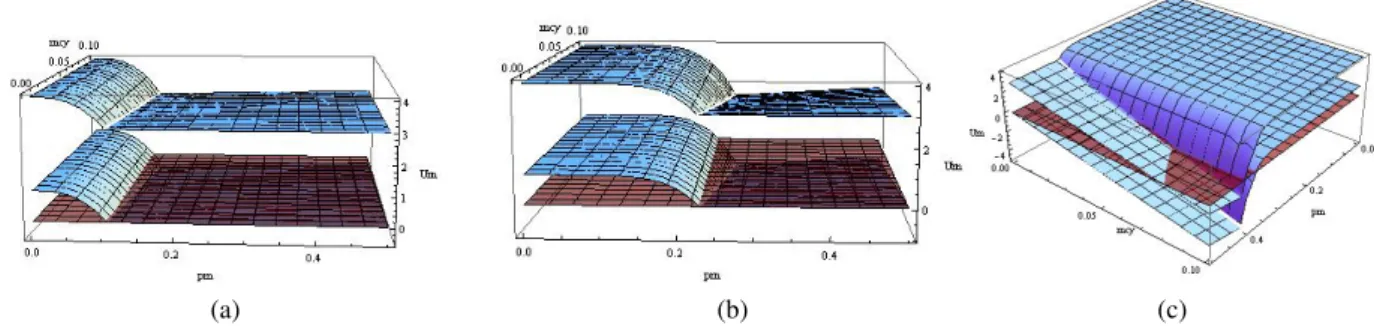
Figure 1: Plots of the SETI-like scenario. The upper plane corresponds toMBR = 4the lower plane to
MBR= 1and the red flat plane toUM = 0. (a) Fixn= 5. (b) Fixn= 15. (c) Fixn= 75.
a realistic large enough value, using other values for this parameter will not change qualitatively the results. Recall that, by plotting on the parameters, the best strategy of the master ispA = 0orpA = 1.
We choosepµ∈[0,0.5]as we believe this is a reasonable interval. As it can be seen from the empirical
evaluations of SETI-like systems reported in [1] and [11],pµis less than 0.1. So we took a larger range
pµto examine its general impact on the utility of the master. We choose[0,0.1]as the range ofMCY, to reflect the small cost incurred by the master for maintaining a workers contribution list.
We consider three plots for the SETI-like scenario applying the R∅ model were we vary pµ and
MCY as discussed above: (a) We fix n=5 and compute the utility of the master forMBR ={1,4}, the results are depicted in Figure 1(a). (b) We fix n=15 and compute utility of the master forMBR ={1,4}, the results are shown in Figure 1(b). (c) We fix n=75 for both values ofMBRmentioned earlier and in Figure 1(c) are the corresponding results. All plots include a reference surface planeUM = 0.
In all plots we can notice a threshold where the behavior of the utility changes. The threshold depicts the transition point in which the master changes its strategy from non auditing to auditing. For all three plots in Figure 1, we generally observe small values of the utility of the master when the master audits and much higher when it does not. Remember that we apply theR∅model when the master follows a non auditing strategy; thus the master rewards the honest workers only when it audits and this decreases its own utility proportionally to the value of payment to the workersMCY. Another interesting observation about the plots in Figure 1, is the sharp declining curve before the threshold where the master follows a non auditing strategy; this curve is due to the fact that the probability of the master getting an incorrect reply increases withpµ increasing and the utility of the master decreases when it accepts an incorrect
reply. Notice that this declining curve is much sharper in Figure 1(c), since the probability of the master getting an incorrect reply decreases as the number of workers increases.
We can observe that a significant difference between the plots of Figure 1 is the threshold value where the master changes its strategy to auditing; the larger the number of workers the bigger the value of the transition pointpµ. This behavior is due to the fact that when auditing is applied the master has to
reward the honest workers, thus the larger the number of workers the larger the number of honest ones and the total payment by the master. So the master together with the fact that the larger the number of workers the higher the probability of getting the correct reply audits for higher values ofpµwhen the
number of workers is large.
In Figure 1 we also notice that the UM increases slightly aspµ increase after the threshold value
where the master audits; all though not expected this indicates the fact that since the master follows an auditing strategy and thus always gets the correct reply it is in the master’s best interest to reward as few workers as possible. A natural and expected observation in Figure 1, is that the higher the value ofMBR the higher the utility of the master without this affecting the shape of the plot.
In the SETI-like setting we only considered the case ofR∅ model because is the simplest one. For the other reward models the plots will have the same behavior, but before the threshold point (the master
(a) (b) (c)
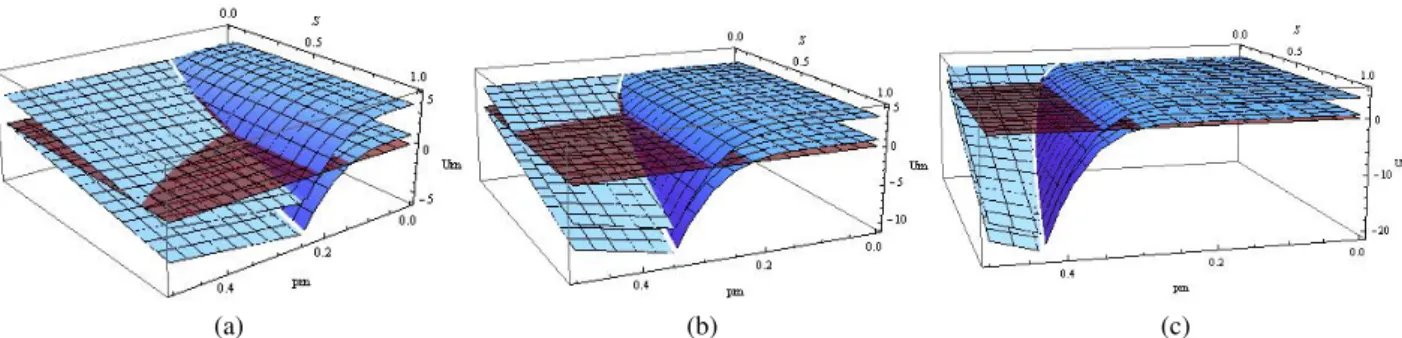
Figure 2: Contractor Scenario plots for fixedWCT.The upper plane corresponds toMBR= 4the lower plane toMBR= 1and the red flat plane toUM = 0. (a) Fixn= 7. (b) Fixn= 15. (c) Fixn= 35.
(a) (b) (c)
Figure 3: Contractor Scenario plots for fixed S.The upper plane corresponds to MBR = 4the lower plane toMBR= 1and the red flat plane toUM = 0. (a) Fixn= 7. (b) Fixn= 15. (c) Fixn= 75.
does not audits) the utility of the master will also depend onMCY.
For the Contractor setting we consider again in Figure 2 plots for theR∅model and sinceWCT is now a non-zero value we fix this value to WCT = 0.01, this we believe is a reasonable assignment. In Figure 2, we depict the utility of the master were we varypµ ∈ [0,0.5]andS ∈ [WCT,1]. As for the SETI-like setting we give three different plots in Figure 2, (a) fix n=7 in Figure 2(a), (b) fix n=15 in Figure 2(b) and (c) fix n=35 in Figure 2(c). Again for each of these plots we have two planes one for each value ofMBR={1,4}and a reference surface planeUM = 0.
The plots in Figure 2 have the same general behavior as the ones in the SETI-like setting respectively for similar reasons to those explained above.
In Figure 3 a second set of plots for the Contractor setting depicts the utility of the master for theR∅ and for a fix value ofS = 0.8were we varypµ∈[0,0.5]andWCT ∈[0, S]. In Figure 2(a) we fix n=7, in Figure 2(b) we fix n=15 and in Figure 2(c) we fix n=75. For each of these plots we have two planes one for each value ofMBR={1,4}and a reference surface planeUM = 0.
In Figure 3 we observe as in the previous figures that a threshold point exists where the master changes its strategy from auditing with some probability, that guaranties the utility of the rational work-ers is positive, to auditing. We generally observe that (not surprisingly) for values ofpµandMCY close to zero we get the highest utility.
For all plot in Figure 3 we can notice that when the master audits with some probability asWCT increases the utility of the master decreases for every pµ; this is due to the increment of the auditing
probability pA as WCT increases, since the cost of auditing and accepting a workers answer has a decreasing impact on the utility of the master.
Another observation made in Figure 3 when the master audits with some probability is that aspµ
increases the utility of the master slightly increases and then decreases for every value ofWCT (except when close to WCT = 0 andWCT = S). When pµ is increasing the number of truthful workers
decreases thus the master has to reward less honest workers and so its utility increase; remember that the master will audit the answers with some probability. But on the other hand when the value ofpµincrease
even more the probability of having a majority of incorrect answers is very large; so it is possible since the master audits with some probability to get an incorrect result and thus its utility decreases.
Naturally when the master audits for every value ofWCT aspµincreases, so does the utility of the
master; this is a consequence of the increase inpµthat implies a lower probability of honest workers and
thus the master has to reward less workers having a positive impact on its own utility. As in the SETI-like setting having larger MBR does not affect the shape of the plots and it only increases uniformly the utility of the master. Again for similar reasons as in the SETI-like setting the threshold valuepµ
increases for larger number of workers. Finally we could conclude for the plots in Figure 3 that having a large number of workers decrease the utility of the master since the reward to the workers will be higher and so it will affect the utility of the master.
Concluding we see that by having the distribution on the type of worker; for a givenpµthe master
is able to determine if it will audit, not audit or audit with some known probability. Also the master can maximize its utility by choosing the correct value forMCY. For all the scenarios considered above if the value ofpµis beyond the threshold value i.e. the master follows an auditing strategy,MCY should be set as close to zero as possible for the master to maximize its utility.
6
Discussion
In this paper we have combined a classical distributed computing approach (voting) with a game-theoretic one (cost-based incentives and payoffs) that lead to an algorithm that enables a master to reliably obtain a task result despite the co-existence of malicious, altruistic and rational workers. To the best of our knowledge, this is the first work to consider such Internet-based master-worker computations under these assumptions.
Several future directions emanate from this work. For example, in this work we have considered a cost-free, weak version of worker collusion (all rational cheaters and malicious workers return the same incorrect task result). It would be interesting to study more involved collusions, as the ones studied in [2] or [8]. Another interesting extension of our work would be to consider the case in which the network is unreliable, and hence the replies of some workers might not reach the master. This should greatly affect the decision policy and the reward scheme of the master. Finally, in this work, we have considered a single-task one-shot protocol, in which the master decides which task result to accept in one round of message exchange with the workers. It would be interesting to consider several task waves over multiple rounds, that is, view the computation as anEvolutionary Game[25, 46]. The master could use the knowledge gained in the previous rounds to increase its utility and decrease its probability of error in future rounds. Issues such as workeraspiration level[7] could be taken into account.
Acknowledgments. We thank Luis L´opez Fern´andez and Marios Mavronicolas for helpful discus-sions.
References
[1] T. Estrada, M. Taufer and D. P. Anderson. Performance Prediction and Analysis of BOINC Projects: An Empirical Study with EmBOINC. In J Grid Computing, Springer, 2009.
[2] I. Abraham, D. Dolev, R. Goden, and J.Y. Halpern. Distributed computing meets game theory: Robust mechanisms for rational secret sharing and multiparty computation. Inproc. of PODC 2006, pp. 53–62, 2006.
[3] A. S. Aiyer, L. Alvisi, A. Clement, M. Dahlin, J. Martin, and C. Porth. BAR fault tolerance for cooperative services. Inproc. of SOSP 2005, pp. 45–58, 2005.
[4] Amazon’s Mechanical Turk,https://www.mturk.com.
[5] D. Anderson. BOINC: A system for public-resource computing and storage. Inproc. of GRID 2004, pp. 4–10, 2004.
[6] M. Babaioff, M. Feldman, and N. Nisan. Mixed Strategies in Combinatorial Agency. Inproc. of WINE 2006, pp. 353–364, 2006.
[7] J. Bendor, D. Mookherjee and D. Ray. Aspiration-based reinforcement learning in repeated interac-tion games: An overview. Internainterac-tional Game Theory Review, Vol. 3 2001, pp. 159174.
[8] J. R. Douceur. The Sybil attack. Inproc. of IPTPS 2002, pp. 251–260, 2002.
[9] S. Chien and A. Sinclair. Convergence to approximate Nash equilibria in congestion games. Inproc. of SODA 2007, pp. 169–178, 2007.
[10] G. Christodoulou and E. Koutsoupias. Mechanism design for scheduling. Bulletin of the EATCS, 97:39–59, 2009.
[11] “Einstein@home”,http://einstein.phys.uwm.edu. [12] “Enabling Grids for E-sciencE”,http://www.eu-egee.org.
[13] K. Eliaz. Fault tolerant implementation. Review of Economic Studies, 69:589–610, 2002.
[14] W. Feller. An Introduction to Probability Theory and Its Applications. John Wiley & Sons, 3rd edition, 1968.
[15] A. Fern´andez, Ch. Georgiou, L. Lopez, and A. Santos. Reliably executing tasks in the presence of untrusted processors. Inproc. of SRDS 2006, pp. 39–50, 2006.
[16] A. Fern´andez Anta, Ch. Georgiou, and M. A. Mosteiro. Designing mechanisms for reliable Internet-based computing. Inproc. of NCA 2008, pp. 315–324, 2008.
[17] I.T. Foster and A. Iamnitchi. On death, taxes, and the convergence of P2P and grid computing. In
proc. of IPTPS 2003, pp. 118–128, 2003.
[18] D. Fotakis. Memoryless facility location in one pass. Inproc. of STACS 2006, pp. 608–620, 2006. [19] M. Gairing. Malicious Bayesian congestion games. Inproc. of WAOA 2008, pp. 119–132, 2008. [20] P. Golle and I. Mironov. Uncheatable distributed computations. Inproc. of CT-RSA 2001, pp.
425–440, 2001.
[21] M. Halldorsson, J.Y. Halpern, L. Li, and V. Mirrokni. On spectrum sharing games. Inproc. of PODC 2004, pp. 107—114, 2004.
[22] J.Y. Halpern. Computer science and game theory: A brief survey. Palgrave Dictionary of Eco-nomics, 2007.
[23] J.Y. Halpern and V. Teague. Rational secret sharing and multiparty computation. Inproc. of STOC 2004, pp. 623–632, 2004.
[24] J. C. Harsanyi. Games with incomplete information played by Bayesian players, I, II, III. Man-agement Science, 14:159182, 320332, 468502, 1967.
[25] J. Hofbauer and K. Sigmund, Evolutionary Games and Population Dynamics. Cambridge Univer-sity Press, 1998.
[26] W. G. Horner. A new method of solving numerical equations of all orders by continuous approxi-mation. Philos. Trans. Roy. Soc. London109:308–335, 1819.
[27] D. Kondo, F. Araujo, P. Malecot, P. Domingues, L. Silva, G. Fedak, and F. Cappello. Characterizing result errors in Internet desktop grids. Inproc. of Euro-Par 2007, pp. 361–371.
[28] K.M. Konwar, S. Rajasekaran, and A.A. Shvartsman. Robust network supercomputing with mali-cious processes. Inproc. of DISC 2006, pp. 474–488, 2006.
[29] E. Korpela, D. Werthimer, D. Anderson, J. Cobb, and M. Lebofsky. SETI@home: Massively distributed computing for SETI. Computing in Science and Engineering, 3(1):78–83, 2001.
[30] E. Koutsoupias and Ch. Papadimitriou. Worst-case equilibria. Inproc. of STACS 1999, pp. 404– 413, 1999.
[31] H. C. Li, A. Clement, M. Marchetti, M. Kapritsos, L. Robison, L. Alvisi, and M. Dahlin. Flight-Path: Obedience vs Choice in Cooperative Services. Inproc. of USENIX OSDI 2008, pp. 355–368, 2008.
[32] H. C. Li, A. Clement, E. L. Wong, J. Napper, I. Roy, L. Alvisi, and M. Dahlin. BAR gossip. In
proc. of OSDI 2006, pp. 191–204, 2006.
[33] G. Mailath and L. Samuelson.Repeated Games and Reputations: Long-run Relationships, Oxford University Press, 2006.
[34] M. Mavronicolas and P. Spirakis. The price of selfish routing. Algorithmica, 48(1):91–126, 2007. [35] M. Mitzenmacher and E. Upfal. Probability and Computing: Randomized Algorithms and
Proba-bilistic Analysis. Cambridge University Press, 2005.
[36] T. Moscibroda, S. Schmid, and R. Wattenhofer. When selfish meets evil: byzantine players in a virus inoculation game. Inproc. of PODC 2006, pp. 35–44, 2006.
[37] J.F. Nash. Equilibrium points inn-person games. National Academy of Sciences, 36(1):48–49, 1950.
[38] N. Nisan and A. Ronen. Algorithmic mechanism design.Games and Economic Behavior, 35:166– 196, 2001.
[39] N. Nisan, T. Roughgarden, E. Tardos, and V.V. Vazirani, editors. Algorithmic Game Theory. Cam-bridge University Press, 2007.
[40] M. J. Osborne. An Introduction to Game Theory. Oxford University Press, 2003.
[41] T. Roughgarden and E. Tardos. How bad is selfish routing? Journal of ACM, 49(2):236–259, 2002. [42] R. W. Rosenthal. A class of games possessing pure-strategy Nash equilibria.International Journal
of Game Theory, 2:65-67, 1973.
[43] L. Sarmenta. Sabotage-tolerance mechanisms for volunteer computing systems.Future Generation Computer Systems, 18(4):561–572, 2002.
[44] J. Shneidman and D.C. Parkes. Rationality and self-interest in P2P networks. Inproc. of IPTPS 2003, pp. 139–148, 2003.
[45] Tables of Probability Functions, Volume = 2, National Bureau of Standards, 1942. [46] J.W. Weibull, Evolutionary Game Theory. , MIT Press, Cambridge (1995).
[47] M. Yurkewych, B.N. Levine, and A.L. Rosenberg. On the cost-ineffectiveness of redundancy in commercial P2P computing. Inproc. of CCS 2005, pp. 280–288, 2005.