2
MSIT-121B (Elective 2):
Software Project
3
______________________________________________________________
Course Design and Editorial Committee
Prof. M.G.Krishnan Prof. Vikram Raj Urs
Vice Chancellor Dean (Academic) & Convener Karnataka State Open University Karnataka State Open University Mukthagangotri, Mysore – 570 006 Mukthagangotri, Mysore – 570 006
Head of the Department and Course Co-Ordinator Rashmi B.S
Assistant Professor & Chairperson DoS in Information Technology Karnataka State Open University
Mukthagangotri, Mysore – 570 006
Course Editor Ms. Nandini H.M
Assistant professorof Information Technology DoS in Information Technology Karnataka State Open University Mukthagangotri, Mysore – 570 006
Course Writers
Dr. H S Nagendra Swamy Associte Professor,
DoS in Computer Science, Manasagangothri,
University of Mysore, Mysore
Dr. Manjunath S Assistant Professor,
PG Dept. of Computer Science, JSS College of Arts, Commerce & Science, Oooty road, Mysore.
Publisher Registrar
Karnataka State Open University Mukthagangotri, Mysore – 570 006
Developed by Academic Section, KSOU, Mysore
Karnataka State Open University, 2014
All rights reserved. No part of this work may be reproduced in any form, by mimeograph or any other means, without permission in writing from the Karnataka State Open University.
Further information on the Karnataka State Open University Programmes may be obtained from the University‘s Office at Mukthagangotri, Mysore – 6.
Printed and Published on behalf of Karnataka State Open University, Mysore-6 by the Registrar (Administration)
4
Karnataka State
Open University
Muktagangothri, Mysore – 570 006
Master of Science in Information Technology
MSIT – 121B Software Project Management and Practices
Module 1
Unit-1 Introduction to Project Management 01-18
Unit-2 Project Planning 19-42
Unit-3 Project Scope Management 43-63
Unit-4 Project Scheduling 64-84
Module 2
Unit-5 Project Cost Estimation 85-99
Unit-6 Project Cost Estimation Model 100-115
Unit-7 Project Quality Management 116-129
Unit-8 Quality Management Tools 130-149
Module 3
Unit-9 Human Resource Management 150-167
Unit-10 Case Study and Issues Involved 168-184
Unit-11 Planning and Reporting 185-201
Unit-12 Project Communication 202-218
Module 4
Unit-13 Risk Management and Case Study 219-240
Unit-14 Procurement Procedures 241-257
Unit-15 Contract Administration 258-274
5
PREFACE
Software project management is the art and science of planning and leading software projects. It is a sub-discipline of project management in which software projects are planned, implemented, monitored and controlled. The main objective of this course is to understand the software project management and their applications; also to acquire knowledge on working principles of project related applications. The overall course is divided into four modules and each module consist of four units. Thus there are totally sixteen units. In summary, module 1 gives introduction to the project management, project planning, scope management and project scheduling. Module 2 covers topics such as cost estimation principles and importance, cost estimation models, Quality management characteristics and importance, Quality management tools and case study. Module 3 discusses issues like Human resources management, Case study and issues involved, Planning and reporting. Some live case study descriptions are also included in this module. In final module of this course, we discuss on risk management. A related case study is given for better understanding of the topic. In the later part this module we discuss on procurement procedures, and Planning, execution and closing of the project. A separate unit is dedicated for case study description, which covers issues like source selection, contract administration, and contract close-out related cases. A detailed examples are included and links for the addition resources are given in reference section. Students are advised to go through the each and every unit and simulate the same with some hypothetical project for better understanding of the concepts.
Wish you all a happy reading.
6
INTRODUCTION TO PROJECT MANAGEMENT
STRUCTURE
1.0 Objectives 1.1 Introduction1.2 Definition of a Project
1.3 Problems with Software Projects 1.4 Project Management
1.5 Project and Product Life Cycle 1.6 Project Management Framework 1.7 Project Management Knowledge Area 1.8 The Role of Project Manager
1.9 Project Management Tools and Techniques 1.10 Summary 1.11 Keywords 1.12 Questions 1.13 Exercise 1.14 Reference
1.0 OBJECTIVES
After studying this unit, you will be able to:
Explain the growing need for better project management, especially for information technology projects.
Explain what a project is, provide examples of information technology projects, list various attributes of projects, and describe the triple constraint of project management. Describe project management and discuss key elements of the project management
framework, including project stakeholders, the project management knowledge areas, the role of project manager and tools and techniques for project management.
7
1.1 INTRODUCTION
Many people and organizations today have a new or renewed interest in project management. Until the 1980s, project management primarily focused on providing schedule and resource data to top management in the military, computer, and construction industries. Today‘s project management involves much more, and people in every industry and every country manage projects. New technologies have become a significant factor in many businesses.
Software project management encompasses the knowledge, techniques, and tools necessary to manage the development of software products. Software project management remains different from project management in other, more established fields for a number of reasons: Software is a ―brain product‖ only, unconstrained by the laws of physics or by the limits of manufacturing processes. It is difficult to detect and prevent defects in software. Software can be highly complex. Finally, as a discipline, software development is so young that measurable, effective techniques are not yet available, and those that are available are not well-calibrated. Despite these difficulties, there is an increasing body of knowledge about software project management. Many organizations assert that using project management provides advantages, such as:
Better control of financial, physical, and human resources Improved customer relations
Shorter development times
Lower costs and improved productivity Higher quality and increased reliability Higher profit margins
Better internal coordination
Positive impact on meeting strategic goals Higher worker morale
8
In order to discuss project management, first, we need to understand the concept of a project. A
project is a temporary endeavour undertaken to create a unique product, service, or result. Operations, on the other hand, is work done in organizations to sustain the business.Projects are different from operations in that they end when their objectives have been reached or the project has been terminated.
Examples of Information Technology Projects
Projects can be large or small and involve one person or thousands of people. They can be done in one day or take years to complete. Information technology projects involve using hardware, software, and/or networks to create a product, service, or result. Examples of information technology projects include the following:
A small software development team adds a new feature to an internal software application for the finance department.
A college campus upgrades its technology infrastructure to provide wireless internet access across the whole campus.
A company develops a new system to increase sales force productivity and customer relationship management.
A television network implements a system to allow viewers to vote for contestants and provide other feedback on programs.
The automobile industry develops a web site to streamline procurement. A government group develops a system to track child immunizations.
A large group of volunteers from organizations throughout the world develops standards for environmentally friendly or green IT.
The Triple Constraint
Every project is constrained in different ways by its scope, time, and cost goals. These limitations are sometimes referred to in project management as the triple constraint. To create a successful project, a project manager must consider scope, time, and cost and balance these three often-competing goals. He or she must consider the following:
Scope: What work will be done as part of the project? What unique product, service, or result does the customer or sponsor expect from the project? How will the scope be verified?
9
Time: How long should it take to complete the project? What is the project schedule? How will the team track actual schedule performance? Who can approve changes to the schedule?
Cost:What should it cost to complete the project? What is the project s budget? How will costs be tracked? Who can authorize changes to the budget?
Managing the triple constraint involves making trade-offs between scope, time, and cost goals for a project. For example, you might need to increase the budget for a project to meet scope and time goals. Alternatively, you might have to reduce the scope of a project to meet time and cost goals. Experienced project managers know that you must decide which aspect of the triple constraint is most important. If time is most important, you must often change the initial scope and/or cost goals to meet the schedule. If scope goals are most important, you may need to adjust time and/or cost goals. Although the triple constraint describes how the basic elements of a project scope, time, and cost interrelate, other elements can also play significant roles. Quality is often a key factor in projects, as is customer or sponsor satisfaction. Some people, in fact, refer to the quadruple constraint of project management, which includes quality as well as scope, time, and cost. Others believe that quality considerations, including customer satisfaction, must be inherent in setting the scope, time, and cost goals of a project. A project team may meet scope, time, and cost goals but fail to meet quality standards or satisfy their sponsor, if they have not adequately addressed these concerns. How can you avoid the problems that occur when you meet scope, time, and cost goals, but lose sight of quality or customer satisfaction? The answer is
good project management, which includes more than meeting the triple constraint.
1.3 PROBLEMS WITH SOFTWARE PROJECTS
Every software project has to face some problems depending on the domain and scope. The scale, complexity, heterogeneity, different stakeholders with different viewpoints, volatile requirements and other business related problems.
10
Fickle clients can be a huge hassle. If a client doesn‘t know what they want until a certain stage is complete, then schedule those decision points into the project as milestones. It is important to have a clear path mapped out from start to finish because it forces the client to be specific with their requirements, as well as keeping the project on track.
Be clear at the outset about what your task is going to be on the project and how much leeway is available. If you will need to be compensated for big revisions or changes in direction, then set a clear outline about the number of adjustments you can make before you need to charge more. If you can, quantify these adjustments with a number; it makes it much easier to keep track of things.
2. Client is slow with communication
People are busy, but it‘s tough for you to move forward on a project if you can never get answers from the person you‘re working with. The good news is that you will drastically increase your response rate if you do a little bit of work ahead of time. Instead of waiting for the back-and-forth discourse to finally take place, simply start moving in the direction that you think is best and then seek verification. This strategy makes it easy for your client to quickly say yes (or no).
3. The project does not start on time
You know that you need to take on the work when you can get it, but now you are worried that you will not be able to start all of your projects on time as you promised. Or perhaps your client says you are a top priority - but tomorrow a different project becomes more important.
If the holdup is on your end, then it is important that you do something to jump-start the project - even if it is in a really small way. Give the client a call to discuss their expectations and set a more realistic timeframe for the first milestone. This could take as little as a few minutes, but it makes the client feel like things have started. However, beware of doing this more than once. That is known as stringing the client along - they do not take that too well, and for good reason. If the holdup is on their end, then you need to communicate very clearly how that alters things moving forward. Be sure to let them know exactly how this change affects the completion dates of future milestones and you should check the revised schedule against other commitments with other projects.
11
There has never been a project that has the same circumstance, requirements, and needs as another project. Situations, people, and goals change over time. Instead of squeezing every project into the same template, spend some time crafting milestones specific to the needs of each project. Every job requires specific milestones that meet the schedules of all parties involved. To put it simply, your schedule changes all the time. That means the way you plan your projects needs to change as well.
5. The client does not like what you created
If this happens often, then there is a communication issue that needs to be addressed. Make sure you understand not just the technical requirements of a project, but also the underlying rationale of your clients. Why did they decide to do this in the first place? What are they hoping your work will enable them to do when all is said and done? How do they see your project fitting in with their overall strategic vision?
Good project managers create a shared vision between all parties. It is your responsibility to understand the direction of your particular project as well as the overall strategy of your client and then to make sure those two items match up.
6. Your point of contact does not seem to care about your project
Working on a project that is not high on a client‘s priority list can be frustrating. In some cases, the person responsible for communicating with you has little or no interest in your project. The completed product will have no direct effect on their job, they are hard to ask questions to, even harder to get answers from, and they provide minimal guidance.
This issue is best solved when choosing a client. So, when screening potential clients, do your best to find out if the contact person has a vested interest in the project. Pay attention to their awareness about potential problems or risks you could run into, their level of urgency when scheduling this project in their calendar, and their desire to communicate with you quickly and consistently from the beginning. If they brush these issues to the side, then it is worth your time to talk with someone else and establish a second point of contact before deciding whether to take on the project or to avoid the project all together.
12
There are bound to be a few bugs here and there, but this is a classic problem caused by focusing too much on production, and not enough on testing. If this continually becomes an issue, then there are two possible solutions.
First, schedule in more time to test your projects from the start. Double your typical testing time if needed. Yes, it will stretch your schedule further, but in the long run, it will save you from the countless little problems that prevent your days from being productive.
Second, if your ongoing issues are a result of clients constantly wanting you to tweak something here and there, then you need to be clearer about what you do and don‘t provide with your services. When you set guidelines with a client at the beginning of a project, you need to state very clearly that your work ends after the final product is created and handed off. This can be avoided by outlining boundaries at the beginning of a project that explicitly state that additional service after delivery will cost extra.
1.4 PROJECT MANAGEMENT
Project management is the application of knowledge, skills, tools and techniques to project activities to meet project requirements. Project managers must not only strive to meet specific scope, time, cost, and quality goals of projects, they must also facilitate the entire process to meet the needs and expectations of the people involved in or affected by project activities.
Stages of Project
A software project undergoes a series of identifiable stages during its life time. Following are the various stages of a project:
Feasibility Study: The aim of the feasibility study is to determine whether developing the product is financially and technically feasible. The data collected in this phase are analyzed to arrive at the following:
• An abstract definition of the problem.
13
• Examination of alternative solution strategies and their benefits, indicating resources required, development, cost and time in respect of each of the alternative solutions. • A cost/benefit analysis is performed to determine which solution is the best. At this stage,
it may also be determined whether any of the solutions is not feasible due to high cost, resource constraints, or extraordinary technical reasons.
Cost-Benefit Analysis (CBA): It estimates and totals up the equivalent money value of the benefits and costs to the community of projects to establish whether they are worthwhile. These projects may be dams and highways or can be training programs and health care systems. Following are the principles of cost benefit analysis in any project:
• There must be a common unit of measurement
• CBA valuations should represent consumers or producers valuations as revealed by their actual behaviour
• Benefits are usually measured by market choices
• The analysis of a project should involve a With versus Without comparison • Cost benefit analysis involves a particular study area
• Double counting of benefits or costs must be avoided
Project planning: Project planning is a discipline for stating how to complete a project within a certain timeframe, usually with defined stages, and with designated resources. The main purpose of Project Planning is to guide the execution of projects. The key outputs of Project Planning include:
• Team contract • Scope statement
• Work breakdown structure
• Project schedule in the form of Gantt chart with all dependencies and resources entered • List of prioritized risks
Project Execution: The Project execution takes most of the time and resources in Project Management. Project Managers must use their leadership skills to handle the various challenges that occur during project execution. Project Sponsors and customers focus on the deliverables related to providing the products, services or results desired from the project. A milestone report will help the Project Manager to keep the focus on completing major milestones.
14
1.5 PROJECT AND PRODUCT LIFE CYCLE
A life cycle model prescribes the different activities that need to be carried out to develop a software product and the sequencing of these activities. A software life cycle model is a descriptive and diagrammatic representation of the software life cycle. Following are the various stages of a software project:
Requirement Analysis and Specification: The aim of the requirement analysis and specification phase is to understand the exact requirements of the customer and to document them properly. This phase consists of two distinct activities:
• Requirement analysis • Requirement specification
The goal of the requirements analysis is to collect and analyze all related data and information with a view to understanding the customer requirements clearly and weeding out inconsistencies and incompleteness in these requirements.
During requirements specification, the user requirements are properly organized and documented in a SRS document. The SRS document addresses the functional requirements, the nonfunctional requirements and the special requirements on the maintenance and development of the software product, if any.
Design: The goal of the design phase is to transform the requirements specified in the SRS document into a structure that is suitable for implementation in some programming language. In technical terms, during the design phase the software architecture is derived from the SRS document. Two distinctly different approaches are available: the traditional design approach and the object-oriented design approach.
Traditional design approach: Traditional design consists of two different activities; first a structured analysis of the requirements specification is carried out where the detailed structure of the problem is examined. This is followed by a structured design activity. During structured design, the results of structured analysis are transformed into the software design.
15
Object-oriented design approach: In this technique, various objects that occur in the problem domain and the solution domain are first identified, and the different relationships that exist among these objects are identified. The object structure is further refined to obtain the detailed design.
Coding and Unit Testing: The purpose of this phase (also called the implementation phase) of software development is to translate the software design into source code. The end product of the implementation phase is a set of program modules that have been individually tested.
Integration and System Testing: During this phase the different modules are integrated in a planned manner. The different modules making up a system are almost never integrated in a single shot. The goal of system testing is to ensure that the developed system functions according to its requirements as specified in the SRS document. The system testing usually consisting of three different kinds of testing activities:
• α-testing • β-testing, and • Acceptance testing
Maintenance: Maintenance involves performing any one or more of the following three kinds of activities:
1. Correcting errors that were not discovered during the product development phase. This is called corrective maintenance.
2. Improving the implementation of the system and enhancing the functionalities of the system according to the customer‘s requirements. This is called perfective maintenance.
3. Porting the software to a new environment, e.g. to a new computer or to a new operating system. This is called adaptive maintenance.
1.6 PROJECT MANAGEMENT FRAMEWORK
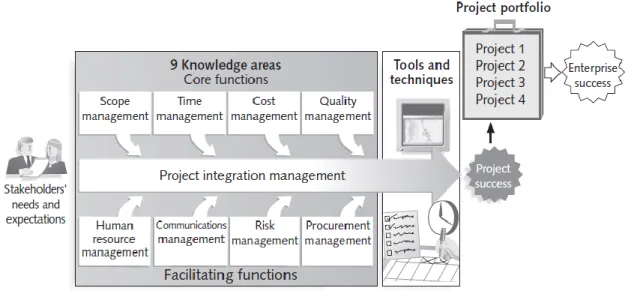
Figure 1-1 illustrates a framework to help you understand project management. Key elements of this framework include the project stakeholders, project management knowledge areas, project management tools and techniques, and the contribution of successful projects to the enterprise.
16
Project Stakeholders: Stakeholders are the people involved in or affected by project activities and include the project sponsor, project team, support staff, customers, users, suppliers, and even opponents of the project. These stakeholders often have very different needs and expectations. For example, building a new house is a well-known example of a project. There are several stakeholders involved in a home construction project.
Figure 1-1 Project Management Framework
The project sponsors would be the potential new homeowners. They would be the people paying for the house and could be on a very tight budget, so they would expect the contractor to provide accurate estimates of the costs involved in building the house. They would also need a realistic idea of when they could move in and what type of home they could afford given their budget constraints. The new homeowners would have to make important decisions to keep the costs of the house within their budget. Can they afford to finish the basement right away? If they can afford to finish the basement, will it affect the projected move-in date? In this example, the project sponsors are also the customers and users for the product, which is the house.
The project manager in this example would normally be the general contractor responsible for building the house. He or she needs to work with all the project stakeholders to meet their needs and expectations.
The project team for building the house would include several construction workers, electricians, carpenters, and so on. These stakeholders would need to know exactly what work
17
they must do and when they need to do it. They would need to know if the required materials and equipment will be at the construction site or if they are expected to provide the materials and equipment. Their work would need to be coordinated since there are many interrelated factors involved. For example, the carpenter cannot put in kitchen cabinets until the walls are completed.
Support staff might include the buyers‘ employers, the general contractor‘s administrative assistant, and other people who support other stakeholders. The buyers‘ employers might expect their employees to still complete their work but allow some flexibility so they can visit the building site or take phone calls related to building the house. The contractor‘s administrative assistant would support the project by coordinating meetings between the buyers, the contractor, suppliers, and so on.
Building a house requires many suppliers. The suppliers would provide the wood, windows, flooring materials, appliances, and so on. Suppliers would expect exact details on what items they need to provide, where and when to deliver those items, and so on.
There may or may not be opponents of a project. In this example, there might be a neighbour who opposes the project because the workers are making so much noise that she cannot concentrate on her work at home, or the noise might wake her sleeping children. She might interrupt the workers to voice her complaints or even file a formal complaint. Or, the neighbourhood might have association rules concerning new home design and construction. If the homeowners did not follow these rules, they might have to halt construction due to legal issues.
As you can see from this example, there are many different stakeholders on projects, and they often have different interests. Stakeholders‘ needs and expectations are important in the beginning and throughout the life of a project. Successful project managers develop good relationships with project stakeholders to understand and meet their needs and expectations.
1.7 PROJECT MANAGEMENT KNOWLEDGE AREAS
Project management knowledge areas describe the key competencies that project managers must develop. The center of Figure 1-1 shows the nine knowledge areas of project management. The four core knowledge areas of project management include project scope, time, cost, and
18
quality management. These are core knowledge areas because they lead to specific project objectives.
Project scope management involves defining and managing all the work required to complete the project successfully.
Project time management includes estimating how long it will take to complete the work, developing an acceptable project schedule, and ensuring timely completion of the project. Project cost management consists of preparing and managing the budget for the project. Project quality management ensures that the project will satisfy the stated or implied
needs for which it was undertaken.
The four facilitating knowledge areas of project management are human resource, communications, risk, and procurement management. These are called facilitating knowledge areas because they are the processes through which the project objectives are achieved.
Project human resource management is concerned with making effective use of the people involved with the project.
Project communications management involves generating, collecting, disseminating, and storing project information.
Project risk management includes identifying, analyzing, and responding to risks related to the project.
Project procurement management involves acquiring or procuring goods and services for a project from outside the performing organization.
Project integration management, the ninth knowledge area, is an overarching function that affects and is affected by all of the other knowledge areas. Project managers must have knowledge and skills in all nine of these areas. This text includes an entire chapter on each of these knowledge areas because all of them are crucial to project success.
1.8 THE ROLE OF PROJECT MANAGER
You have already read that project managers must work closely with the other stakeholders on a project, especially the sponsor and project team. They are also more effective if they are familiar with the nine project management knowledge areas and the various tools and techniques related
19
to project management. Experienced project managers help projects succeed. But what do project managers do exactly? What skills do they really need to do a good job? The next section provides brief answers to these questions, and the rest of this book gives more insight into the role of the project manager. Even if you never become a project manager, you will probably be part of a project team, and it is important for team members to help their project managers.
Project Manager Job Description
A project manager can have many different job descriptions, which can vary tremendously based on the organization and the project. For example, Monster.com includes thousands of job listings for project managers. They even have a job category for project/program managers. Here are a few edited postings:
Project manager for a consulting firm: Plans, schedules, and controls activities to fulfill identified objectives applying technical, theoretical, and managerial skills to satisfy project requirements. Coordinates and integrates team and individual efforts and builds positive professional relationships with clients and associates.
IT project manager for a financial services firm: Manages, prioritizes, develops, and implements information technology solutions to meet business needs. Prepares and executes project plans using project management software following a standard methodology. Establishes cross-functional end-user teams defining and implementing projects on time and within budget. Acts as a liaison between third-party service providers and end-users to develop and implement technology solutions. Participates in vendor contract development and budget management and provides post implementation support.
IT project manager for a non-profit consulting firm:Responsibilities include business analysis, requirements gathering, project planning, budget estimating, development, testing, and implementation. Responsible for working with various resource providers to ensure development is completed in a timely, high quality, and cost-effective manner. The job description for a project manager can vary by industry and by organization, but there are similar tasks that most project managers perform regardless of these differences. In fact, project management is a skill needed in every major information technology field, from database administrator to network specialist to technical writer.
20
1.9 PROJECT MANAGEMENT TOOLS AND TECHNIQUES
Project management tools and techniques assist project managers and their teams in carrying out work in all nine knowledge areas. For example, some popular time management tools and techniques include Gantt charts, project network diagrams, and critical path analysis. Table 1-1 lists some commonly used tools and techniques by knowledge area.
Knowledge area/category
Tools and techniques
Integration management
Project selection methods, project management methodologies, stakeholder analyses, project charters, project management plans, project management software, change requests, change control boards, project review meetings, lessons-learned reports
Scope management
Scope statements, work breakdown structures,
statements of work, requirements analyses, scope management plans, scope verification techniques, and scope change controls
Time management
Gantt charts, project network diagrams, critical path analysis, crashing, fast tracking, schedule performance measurements
Cost management
Net present value, return on investment, payback analysis, earned value management, project portfolio management, cost estimates, cost management plans, cost baselines
Quality management
Quality metrics, checklists, quality control charts, Pareto diagrams, fishbone diagrams, maturity models, statistical methods
Human resource management
Motivation techniques, empathic listening, responsibility assignment matrices, project organizational charts, resource histograms, team building exercises
21 Communications management
Communications management plans, kick-off meetings,
conflict management, communications media selection, status and progress reports, virtual communications, templates, project Web sites
Risk management Risk management plans, risk registers, probability/ impact matrices, risk rankings
Procurement management Make-or-buy analyses, contracts, requests for proposals or quotes, source selections, supplier evaluation matrices
Knowledge area/category Tools and techniques
1.10 SUMMARY
A project is a temporary endeavour undertaken to create a unique product, service, or result. An information technology project involves the use of hardware, software, and/or networks. Projects are unique, temporary, and developed incrementally; they require resources, have a sponsor, and involve uncertainty. The triple constraint of project management refers to managing the scope, time, and cost dimensions of a project.
Project management is the application of knowledge, skills, tools, and techniques to project activities to meet project requirements. Stakeholders are the people involved in or affected by project activities. A framework for project management includes the project stakeholders, project management knowledge areas, and project management tools and techniques. There are many tools and techniques in each knowledge area. There are different ways to define project success, and project managers must understand the success criteria for their unique projects.
1.11 KEYWORDS
Project management, Stakeholders, Triple constraint, Project life cycle, Feasibility study, Cost-benefit analysis, Software tools, Framework.
22 1. What is a project, and what are its main attributes?
2. How is a project different from what most people do in their day-to-day jobs? Discuss. 3. What is the triple constraint? Explain.
4. What is project management? Briefly describe the project management framework, providing examples of stakeholders, knowledge areas, tools and techniques, and project success factors. 5. What is the role of the project manager?
6. What functions can you perform with project management software?
7. What are some popular names of low-end, midrange, and high-end project management tools?
1.13
EXERCISE
1. Search the Internet for the terms project management, project management careers, project portfolio management, and information technology project management. Write down the number of hits that you received for each of these phrases. Find at least three Web sites that provide interesting information on one of the topics. Write a two-page paper summarizing key information about these three Web sites as well as the Project Management Institute‘s Web site (www.pmi.org).
2. Find any example of a real project with a real project manager. Feel free to use projects in the media (the Olympics, television shows, movies, etc.) or a project from your work, if applicable. Write a two-page paper describing the project in terms of its scope, time, and cost goals. Discuss what went right and wrong on the project and the role of the project manager and sponsor. Also describe if the project was a success or not and why.
1.14 REFERENCE
1. Information Technology Project Management: Kathy Schwalbe, International Student Edition, Thomson Course Technology, 2003.
2. Software Project Management: Bob Hughes and Mike Cotterell, Third Edition, Tata McGraw-Hill.
3. Basics of Software Project Management: NIIT, Prentice-Hall of India, 2004. 4. Software Project Management in Practice: Pankaj Jalote, Pearson Education, 2002.
23
5. Software Project Management – A Concise Study: S.A.Kelkar, Revised Edition, Prentice-Hall of India, 2003.
24
UNIT – 2
PROJECT PLANNING
STRUCTURE
2.0 Objectives 2.1 Introduction 2.2 Integration Management2.3 Strategic Planning and Project Selection 2.4 Developing a Project Management Plan 2.5 Directing and Managing Project Execution 2.6 Monitoring and Controlling Project Work 2.7 Performing Integrated Change Control 2.8 Closing Projects or Phases
2.9 Softwares to assist in Project Integration Management 2.10 Summary 2.11 Keywords 2.12 Questions 2.13 Exercise 2.14 Reference
2.0 OBJECTIVES
After studying this unit, you will be able to:
Describe an overall framework for project integration management.
Explain the strategic planning process and apply different project selection methods. Explain the importance of creating a project charter to formally initiate projects.
Describe project management plan development, understand the content of these plans, and review approaches for creating them.
25
Explain project execution, its relationship to project planning, the factors related to successful results, and tools and techniques to assist in managing project execution.
Describe the process of monitoring and controlling a project.
Understand the integrated change control process, planning for and managing changes on information technology projects, and developing and using a change control system.
Explain the importance of developing and following good procedures for closing projects. Describe how software can assist in project integration management.
2.1 INTRODUCTION
All the projects that should be managed by a project manager should have a project plan. The project plan details many aspects of the project to be executed. First of all, it details out the project scope. Then, it describes the approach or strategy used for addressing the project scope and project objectives. The strategy is the core of the project plan and it could vary depending on the project purpose and specific project requirements. The resource allocation and delivery schedule are other two main components of the project plan. These detail each activity involved in the project as well as the information such as who executes them and when. This is important information for the project manager as well as all the other stakeholders of the project.
2.2 INTEGRATION MANAGEMENT
Project integration management involves coordinating all of the other project management knowledge areas throughout a project s life cycle. This integration ensures that all the elements of a project come together at the right times to complete a project successfully. There are six main processes involved in project integration management:
1. Developing the project charter involves working with stakeholders to create the document that formally authorizes a project the charter.
2. Developing the project management plan involves coordinating all planning efforts to create a consistent, coherent document the project management plan.
3. Directing and managing project execution involves carrying out the project management plan by performing the activities included in it. The outputs of this process are deliverables, work
26
performance information, change requests, project management plan updates, and project document updates.
4. Monitoring and controlling project work involves overseeing activities to meet the performance objectives of the project. The outputs of this process are change requests, project management plan updates, and project document updates.
5. Performing integrated change control involves identifying, evaluating, and managing changes throughout the project life cycle. The outputs of this process include change request status updates, project management plan updates, and project document updates.
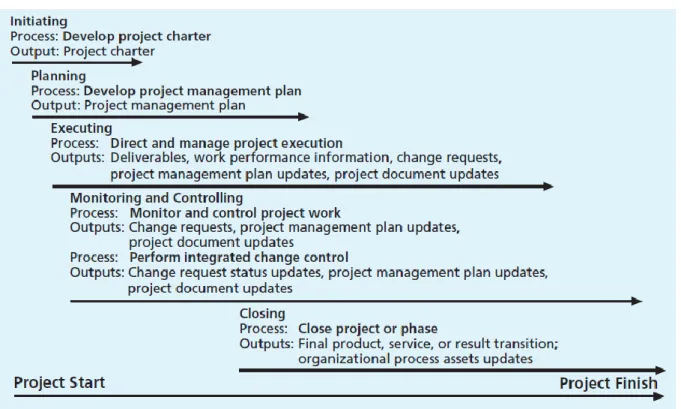
6. Closing the project or phase involves finalizing all activities to formally close the project or phrase. Outputs of this process include final product, service, or result transition and organizational process assets updates. Figure 2-1 summarizes these processes and outputs, showing when they occur in a typical project.
FIGURE 2-1Project integration management summary
Good project integration management is critical to providing stakeholder satisfaction. Project integration management includes interface management. Interface management involves identifying and managing the points of interaction between various elements of the project. The number of interfaces can increase exponentially as the number of people involved in a project
27
increases. Thus, one of the most important jobs of a project manager is to establish and maintain good communication and relationships across organizational interfaces. The project manager must communicate well with all project stakeholders, including customers, the project team, top management, other project managers, and opponents of the project.
2.3 STRATEGIC PLANNING AND PROJECT SELECTION
Successful leaders look at the big picture or strategic plan of the organization to determine what types of projects will provide the most value. Some may argue that project managers should not be involved in strategic planning and project selection because top management is usually responsible for these types of business decisions. But successful organizations know that project managers can provide valuable insight into the project selection process.
Strategic Planning
Strategic planning involves determining long-term objectives by analyzing the strengths and weaknesses of an organization, studying opportunities and threats in the business environment, predicting future trends, and projecting the need for new products and services. Strategic planning provides important information to help organizations identify and then select potential projects.
Many people are familiar with SWOT analysis analyzing Strengths, Weaknesses, Opportunities, and Threats which is used to aid in strategic planning. For example, a group of four people who want to start a new business in the film industry could perform a SWOT analysis to help identify potential projects. They might determine the following based on a SWOT analysis:
Strengths:
As experienced professionals, we have numerous contacts in the film industry. Two of us have strong sales and interpersonal skills.
Two of us have strong technical skills and are familiar with several filmmaking software tools.
We all have impressive samples of completed projects.
Weaknesses:
28
We have no clear marketing strategy for products and services. We have little money to invest in new projects.
We have no company Web site and limited use of technology to run the business.
Opportunities:
A current client has mentioned a large project she would like us to bid on. The film industry continues to grow.
There are two major conferences this year where we could promote our company.
Threats:
Other individuals or companies can provide the services we can.
Customers might prefer working with more established individuals/ organizations. There is high risk in the film business.
Identifying Potential Projects
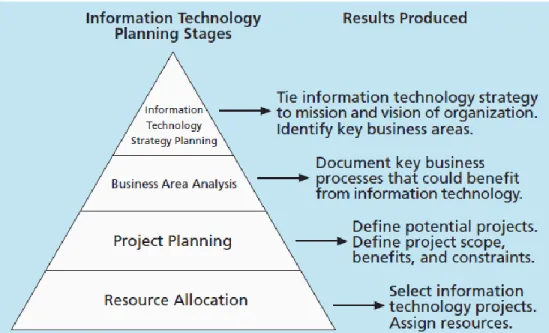
The first step in project management is deciding what projects to do in the first place. Therefore, project initiation starts with identifying potential projects, using realistic methods to select which projects to work on, and then formalizing their initiation by issuing some sort of project charter. In addition to using a SWOT analysis, organizations often follow a detailed process for project selection. Figure 2-2 shows a four-stage planning process for selecting information technology projects. Note the hierarchical structure of this model and the results produced from each stage. The first step in this process, starting at the top of the hierarchy, is to tie the information technology strategic plan to the organization s overall strategic plan. It is very important to have managers from outside the information technology department assist in the information technology planning process, as they can help information technology personnel understand organizational strategies and identify the business areas that support them.
29
FIGURE 2-2Planning process for selecting information technology projects
After identifying strategic goals, the next step in the planning process for selecting information technology projects is to perform a business area analysis. This analysis outlines business processes that are central to achieving strategic goals and helps determine which ones could most benefit from information technology. The next step is to start defining potential information technology projects, their scope, benefits, and constraints. The last step in the planning process for selecting information technology projects is choosing which projects to do and assigning resources for working on them.
Methods for Selecting Projects
Organizations identify many potential projects as part of their strategic planning processes, and they often rely on experienced project managers to help them make project selection decisions. However, organizations need to narrow down the list of potential projects to those projects that will be of most benefit. Selecting projects is not an exact science, but it is a necessary part of project management. Many methods exist for selecting from among possible projects. Five common techniques are:
Focusing on broad organizational needs Categorizing information technology projects
Performing net present value or other financial analyses Using a weighted scoring model
30 Implementing a balanced scorecard
In practice, organizations usually use a combination of these approaches to select projects. Each approach has advantages and disadvantages, and it is up to management to decide the best approach for selecting projects based on their particular organization.
Focusing on Broad Organizational Needs
Top managers must focus on meeting their organization s many needs when deciding what projects to undertake, when to undertake them, and to what level. Projects that address broad organizational needs are much more likely to be successful because they will be important to the organization. For example, a broad organizational need might be to improve safety, increase morale, provide better communications, or improve customer service. However, it is often difficult to provide a strong justification for many information technology projects related to these broad organizational needs. For example, it is often impossible to estimate the financial value of such projects, but everyone agrees that they do have a high value.
One method for selecting projects based on broad organizational needs is to determine whether they first meet three important criteria: need, funding, and will. Do people in the organization agree that the project needs to be done? Does the organization have the desire and the capacity to provide adequate funds to perform the project? Is there a strong will to make the project succeed? For example, many visionary CEOs can describe a broad need to improve certain aspects of their organizations, such as communications. Although they cannot specifically describe how to improve communications, they might allocate funds to projects that address this need. As projects progress, the organization must re-evaluate the need, funding, and will for each project to determine if the project should be continued, redefined, or terminated.
Categorizing Information Technology Projects
Another method for selecting projects is based on various categorizations, such as the impetus for the project, the time window for the project, and the general priority for the project. The impetus for a project is often to respond to a problem, an opportunity, or a directive.
Problems are undesirable situations that prevent an organization from achieving its goals. These problems can be current or anticipated. For example, users of an information system may be having trouble logging onto the system or getting information in a timely manner because the system has reached its capacity. In response, the company could initiate a
31
project to enhance the current system by adding more access lines or upgrading the hardware with a faster processor, more memory, or more storage space.
Opportunities are chances to improve the organization. For example, the project described in the opening case involves creating a new product that can make or break the entire company.
Directives are new requirements imposed by management, government, or some external influence. For example, many projects involving medical technologies must meet rigorous government requirements.
Organizations select projects for any of these reasons. It is often easier to get approval and funding for projects that address problems or directives because the organization must respond to these categories of projects to avoid hurting their business. Many problems and directives must be resolved quickly, but managers must also apply systems thinking and seek opportunities for improving the organization through information technology projects. Another categorization for information technology projects is based on the time it will take to complete a project or the date by which it must be done. For example, some potential projects must be finished within a specific time window. If they cannot be finished by this set date, they are no longer valid projects. Some projects can be completed very quickly within a few weeks, days, or even minutes. Many organizations have an end user support function to handle very small projects that can be completed quickly. Even though many information technology projects can be completed quickly, it is still important to prioritize them. Organizations can also prioritize information technology projects as being high-, medium-, or low-priority based on the current business environment. For example, if it is crucial to cut operating costs quickly, projects that have the most potential to do so would be given a high priority. The organization should always complete high-priority projects first, even if a low- or medium-priority project could be finished in less time. Usually there are many more potential information technology projects than an organization can undertake at any one time, so it is very important to work on the most important ones first.
Performing Net Present Value Analysis, Return on Investment, and Payback Analysis
Financial considerations are often an important aspect of the project selection process, especially during tough economic times. Many organizations require an approved business case before
32
pursuing projects, and financial projections are a critical component of the business case. Three primary methods for determining the projected financial value of projects include net present value analysis, return on investment, and payback analysis. Because project managers often deal with business executives, they must understand how to speak their language, which often boils down to these important financial concepts.
Net Present Value Analysis: Everyone knows that a dollar earned today is worth more than a dollar earned five years from now. Net present value (NPV) analysis is a method of calculating the expected net monetary gain or loss from a project by discounting all expected future cash inflows and outflows to the present point in time. An organization should consider only projects with a positive NPV if financial value is a key criterion for project selection. This is because a positive NPV means the return from a project exceeds the cost of capital the return available by investing the capital elsewhere. Projects with higher NPVs are preferred to projects with lower NPVs, if all other factors are equal.
Return on Investment: Another important financial consideration is return on investment. Return on investment (ROI) is the result of subtracting the project costs from the benefits and then dividing by the costs. For example, if you invest Rs.100 today and next year it is worth Rs.110, your ROI is (Rs. 110 - 100)/100 or 0.10 (10 percent). Note that the ROI is always a percentage. It can be positive or negative. It is best to consider discounted costs and benefits for multi-year projects when calculating ROI.
Payback Analysis: Payback analysis is another important financial tool to use when selecting projects. Payback period is the amount of time it will take to recoup, in the form of net cash inflows, the total dollars invested in a project. In other words, payback analysis determines how much time will lapse before accrued benefits overtake accrued and continuing costs. Payback occurs when the net cumulative benefits equal the net cumulative costs, or when the net cumulative benefits minus costs equals zero.
Using a Weighted Scoring Model
A weighted scoring model is a tool that provides a systematic process for selecting projects based on many criteria. These criteria can include factors such as meeting broad organizational needs; addressing problems, opportunities, or directives; the amount of time it will take to
33
complete the project; the overall priority of the project; and projected financial performance of the project.
The first step in creating a weighted scoring model is to identify criteria important to the project selection process. It often takes time to develop and reach agreement on these criteria. Holding facilitated brainstorming sessions or using groupware to exchange ideas can aid in developing these criteria. Some possible criteria for information technology projects include:
Supports key business objectives Has strong internal sponsor Has strong customer support Uses realistic level of technology Can be implemented in one year or less Provides positive NPV
Has low risk in meeting scope, time, and cost goals
Implementing a Balanced Scorecard
A balanced scorecard is a methodology that converts an organization‘s value drivers, such as
customer service, innovation, operational efficiency, and financial performance, to a series of defined metrics. Organizations record and analyze these metrics to determine how well projects help them achieve strategic goals.
Developing a Project Charter
After top management decides on which projects to pursue, it is important to let the rest of the organization know about these projects. Management needs to create and distribute documentation to authorize project initiation. This documentation can take many different forms, but one common form is a project charter. A project charter is a document that formally recognizes the existence of a project and provides direction on the project‘s objectives and management. It authorizes the project manager to use organizational resources to complete the project. Ideally, the project manager will provide a major role in developing the project charter. Instead of project charters, some organizations initiate projects using a simple letter of agreement, while others use much longer documents or formal contracts. Key project stakeholders should sign a project charter to acknowledge agreement on the need for and intent of the project.
34
Inputs that are helpful in developing a project charter include the following:
A project statement of work: A statement of work is a document that describes the products or services to be created by the project team. It usually includes a description of the business need for the project, a summary of the requirements and characteristics of the products or services, and organizational information, such as appropriate parts of the strategic plan, showing the alignment of the project with strategic goals.
A business case: Many projects require a business case to justify their investment. Information in the business case, such as the project objective, high-level requirements, and time and cost goals are included in the project charter.
A contract: If you are working on a project under contract for an external customer, the contract should include much of the information needed for creating a good project charter. Some people might use a contract in place of a charter; however, many contracts are difficult to read and can often change, so it is still a good idea to create a project charter. Enterprise environmental factors: These factors include relevant government or industry
standards, the organization s infrastructure, and marketplace conditions. Managers should review these factors when developing a project charter.
Organizational process assets: Organizational process assets include formal and informal plans, policies, procedures, guidelines, information systems, financial systems, management systems, lessons learned, and historical information that can be used to influence a project‘s success.
The main tool and technique for developing a project charter is expert judgment. Experts from within as well as outside the organization should be consulted when creating a project charter to make sure it is useful and realistic.
The only output of the process to develop a project charter is a project charter. Although the format of project charters can vary tremendously, they should include at least the following basic information:
The project s title and date of authorization.
The project manager s name and contact information.
A summary schedule, including the planned start and finish dates; if a summary milestone schedule is available, it should also be included or referenced.
35
A summary of the project s budget or reference to budgetary documents.
A brief description of the project objectives, including the business need or other justification for authorizing the project.
Project success criteria, including project approval requirements and who signs off on the project.
A summary of the planned approach for managing the project, which should describe stakeholder needs and expectations, important assumptions, and constraints, and refer to related documents, such as a communications management plan, as available.
A roles and responsibilities matrix.
A sign-off section for signatures of key project stakeholders.
A comments section in which stakeholders can provide important comments related to the project.
2.4 DEVELOPING A PROJECT MANAGEMENT PLAN
To coordinate and integrate information across project management knowledge areas and across the organization, there must be a good project management plan. A project management plan is a document used to coordinate all project planning documents and help guide a project‘s execution and control. Plans created in the other knowledge areas are considered subsidiary parts of the overall project management plan. Project management plans also document project planning assumptions and decisions regarding choices, facilitate communication among stakeholders, define the content, extent, and timing of key management reviews, and provide a baseline for progress measurement and project control. Project management plans should be dynamic, flexible, and subject to change when the environment or project changes. These plans should greatly assist the project manager in leading the project team and assessing project status. To create and assemble a good project management plan, the project manager must practice the art of project integration management, since information is required from all of the project management knowledge areas. Working with the project team and other stakeholders to create a project management plan will help the project manager guide the project‘s execution and understand the overall project. The main inputs for developing a project management plan include the project charter, outputs from planning processes, enterprise environment factors, and
36
organizational process assets. The main tool and technique is expert judgment, and the output is a project management plan.
Project Management Plan Contents
Just as projects are unique, so are project management plans. A small project involving a few people over a couple of months might have a project management plan consisting of only a project charter, scope statement, and Gantt chart. A large project involving a hundred people over three years would have a much more detailed project management plan. It is important to tailor project management plans to fit the needs of specific projects. The project management plans should guide the work, so they should be only as detailed as needed for each project. There are, however, common elements to most project management plans. Parts of a project management plan include an introduction or overview of the project, a description of how the project is organized, the management and technical processes used on the project, and sections describing the work to be performed, the schedule, and the budget. The introduction or overview of the project should include, as a minimum, the following information:
The project name: Every project should have a unique name. Unique names help distinguish each project and avoid confusion among related projects.
A brief description of the project and the need it addresses: This description should clearly outline the goals of the project and reason for the project. It should be written in layperson s terms, avoid technical jargon, and include a rough time and cost estimate. The sponsor s name: Every project needs a sponsor. Include the name, title, and contact
information of the sponsor in the introduction.
The names of the project manager and key team members: The project manager should
always be the contact for project information. Depending on the size and nature of the project, names of key team members may also be included.
Deliverables of the project: This section should briefly list and describe the products that will be produced as part of the project. Software packages, pieces of hardware, technical reports, and training materials are examples of deliverables.
A list of important reference materials: Many projects have a history preceding them. Listing important documents or meetings related to a project helps project stakeholders understand that history. This section should reference the plans produced for other
37
knowledge areas. Therefore, the project management plan should reference and summarize important parts of the scope management, schedule management, cost management, quality management, human resource management, communications management, risk management, and procurement management plans.
A list of definitions and acronyms, if appropriate: Many projects, especially information technology projects, involve terminology unique to a particular industry or technology. Providing a list of definitions and acronyms will help avoid confusion.
The description of how the project is organized should include the following information:
Organizational charts: In addition to an organizational chart for the company sponsoring the project and for the customer‘s company (if it is an external customer), there should be a project organizational chart to show the lines of authority, responsibilities, and communication for the project.
Project responsibilities: This section of the project plan should describe the major project functions and activities and identify those individuals who are responsible for them. Other organizational or process-related information: Depending on the nature of the
project, there may be a need to document major processes followed on the project. For example, if the project involves releasing a major software upgrade, it might help everyone involved in the project to see a diagram or timeline of the major steps involved in this process.
The section of the project management plan describing management and technical approaches should include the following information:
Management objectives: It is important to understand top management s view of the project, what the priorities are for the project, and any major assumptions or constraints. Project controls: This section describes how to monitor project progress and handle
changes. Will there be monthly status reviews and quarterly progress reviews? Will there be specific forms or charts to monitor progress? Will the project use earned value management to assess and track performance? What is the process for change control? What level of management is required to approve different types of changes?