Design and Cavitation Performance
of Contra-Rotating Propellers
by
Dimitrios Laskos
Bachelor of Science in Marine Engineering Hellenic Naval Academy, 2002
Submitted to the Department of Mechanical Engineering in Partial Fulfillment of the Requirements for the Degrees of
NAVAL ENGINEER
ARCHIVES
and
MASTER OF SCIENCE IN MECHANICAL ENGINEERING MASSACHUSETTS INSTliiT E OF TECHNOLOGY
at the
MASSACHUSETTS INSTITUTE OF TECHNOLOGY
SEP 0 1 2010
June 2010
LIBRARIES
C 2010 Dimitrios Laskos. All rights reserved.
The author hereby grants to MIT permission to reproduce and to distribute publicly paper and electronic copies of this thesis document in whole
or in part in any medium now know hereafter created. "'__ /z7/7
Signature of Author:
6/ 11' Department of Mechanical Engineering
May 5, 2010
/I,
Certified by:
Chryssostomos Chryssostomidis Dohty Professor of Ocean Science and Engineering Professor of Mechanical and Ocean Engineering Thesis Supervisor Certified by: Richard W. Kimball Thesis Supervisor Accepted by: -g David E. Hardt
Professor of Mechanical Engineering Chairman, Departmental Committee on Graduate Students
Design and Cavitation Performance
of Contra-Rotating Propellers
by
Dimitrios Laskos
Submitted to the Department of Mechanical Engineering on May 5, 2010 in Partial Fulfillment of the Requirements for the Degrees of
Naval Engineer and
Master of Science in Mechanical Engineering
Abstract
Improvement of the propulsive efficiency of ships has always been one of the main objectives for naval architects and marine engineers. Contra-Rotating propellers (CRP) are propulsor configurations offering higher efficiency compared to conventional single propellers by recovering the rotational energy in the propeller slipstream. The application of this type of propulsive device to modern ships becomes even more attractive, considering the recent developments in electric propulsion and the increased emphasis on fuel economy. Propeller design codes are therefore expected to include CRP design capabilities.
This thesis describes two methods for designing CRP in the context of lifting-line theory, along with a procedure for predicting the cavitation performance of conventional propellers and CRP. All of the above methods have been implemented numerically and integrated into a computer program developed in MATLAB@.
Comparisons of numerical predictions of efficiency between single and contra-rotating propellers, which confirm the superiority of the latter are presented. Physical insight into the increased efficiency of CRP is also obtained by presenting results for the velocity fields induced by these propulsor configurations. In addition, the predicted cavitation patterns, observed on conventional and contra-rotating propellers operating in uniform and non-uniform wakes, show the advantage of CRP with respect to the occurrence of cavitation.
Thesis Supervisor: Chryssostomos Chryssostomidis
Title: Doherty Professor of Ocean Science and Engineering Professor of Mechanical and Ocean Engineering
Thesis Supervisor: Richard W. Kimball
A(PIEP(t,)VcTal UTO v dvOponro rou uov ' gu apprapaoTaOt I " pE 6AE(; rov TT; 6VVGtuEh; KaTa Tj
61' Ma aVTCO'V TCOV Tpicov ETC4)V, Kai oXi povo... H CO)Vravia, 0 EVOO-Valauu,
O(P 0(; Kai 17 ayaM7 7rOV
7rpoupEpEi 61vovv gcopioTo voilua Kai a ia orrq (coll'Pov...
--Acknowledgements
I would like to express my gratitude to my thesis advisor, and director of the MIT Sea Grant College Program, Professor Chryssostomos Chryssostomidis, for supporting me and giving me the opportunity to work on such an interesting topic.
I am also grateful to Professor Richard Kimball for his guidance during the course of my thesis work. His class has been the basis for my understanding of the propeller design theory.
Special thanks to Dr. Brenden Epps for his valuable feedback on the numerical implementation of the CRP design theory.
For providing the MATLAB@ codes for calculating minimum pressure envelopes with the use of XFOIL, I would like to thank Chris Peterson.
For their mentoring and support during the three years of my studies I am grateful to: Captain Patrick J. Keenan, USN
Captain Mark S. Welsh, USN
Commander Trent R. Gooding, USN
Table of Contents
A bstract... 2
A cknow ledgem ents ... 4
Table of Contents... 5
List of Figures... 7
List of Tables ... 9
Introduction... 10
1.1 Historical Background and M otivation... 10
1.2 V ortex Lattice Lifting Line Theory... 12
D esign M ethods for CRP... 15
2.1 Criteria for Optim um Circulation D istribution ... 15
2.2 Lifting Line M ethods for CRP ... 17
2.3 Tw o CRP D esign M ethods... 19
2.3.1 'Uncoupled' M ethod ... 20
2.3.2 'Coupled' M ethod ... 24
2.4 Interaction V elocities ... 28
2.4.1 Axial Interaction V elocities ... 29
2.4.2 Tangential Interaction Velocities ... 32
2.5 Blade Design ... 33
N um erical Predictions ... 37
3.1 Single Case Com parison ... 38
3.2 Param etric D esign Results ... 44
3.3 Com parison betw een the Tw o M ethods... 49
A dditional Considerations ... 51
4.1 Effect of Lagrange M ultipliers... 51
4.3 Finite H ub Loading ... 55
4.4 H ub D rag Cancellation... 56
C avitation on M arine Propellers ... 61
5.1 Introduction... 61
5.2 Blade Section and Cavitation Perform ance... 62
5.3 M ethods for Calculating Pressure Coefficients... 66
5.3.1 V LM ... 66
5.3.2 X FO IL ... 68
5.4 Com parison betw een V LM -X FO IL ... 71
C avitation A nalysis R esults... 73
6.1 Steady Cavitation in U niform W ake ... 73
6.2 U nsteady Cavitation ... 75
6.3 Rem arks on Cavitation Perform ance of CRP... 81
C onclusions and Future W ork... 84
7.1 Conclusions ... 84
7.2 Recom m endations for future w ork... 85
R eferences... 87
A ppendices... 90
A ppendix A : CRP V ariational Optim ization Equations... 90
A ppendix B : M A TLA B@ functions ... 92
B l. 'U ncoupled' M ethod ... 92
B2. 'Coupled' M ethod ... 97
B3. Calculation of Pressure D istributions... 127
List of Figures
Figure 1-1: Lifting Line Lattice of bound and free, trailing vortices... 13
Figure 1-2: Force elem ents on lifting line... 14
Figure 2-1: Comparison of optimum circulation distributions for various thrust loadings ... 16
Figure 2-2: Relative Velocities at Blade Sections ... 18
Figure 2-3: Contra-Rotating Propeller Set... 20
Figure 2-4: Flow Chart for 'Uncoupled' Method ... 23
Figure 2-5: Flow Chart for 'Coupled' M ethod ... 27
Figure 2-6: Representation of the interacting components of a CRP set ... 31
Figure 2-7: Axial velocity profiles at different axial locations... 32
Figure 2-8: Geometry of CRP set designed with the current code ... 35
Figure 3-1: Circulation Distributions as predicted by the 'Coupled' method ... 39
Figure 3-2: Circulation Distributions as predicted by the 'Uncoupled' method... 40
Figure 3-3: Axial induced velocities far downstream /'Coupled' method... 42
Figure 3-4: Axial induced velocities far downstream /'Uncoupled' method... 42
Figure 3-5: Tangential induced velocities far downstream / 'Coupled' method ... 43
Figure 3-6: Tangential induced velocities far downstream /'Uncoupled' method ... 43
Figure 3-7: Efficiency for various propellers as a function of thrust loading for Js=0.89 and C d= 0 .00 85 ... 4 5 Figure 3-8: Propulsor configurations which have been studied... 46
Figure 3-9: Ideal Efficiency as a function of thrust loading for Js=0.89 ... 47
Figure 3-10: Efficiency as a function of advance coefficient with Cd=0.0085... 48
Figure 3-11. Efficiency of CRP for viscous-inviscid case (Ct=0.69)... 49
Figure 4-2: Circulation Distributions for different values of ... 52
Figure 4-3: Total tangential induced velocities far downstream ... 53
Figure 4-4: Total axial induced velocities far downstream ... 53
Figure 4-5: Effect of Axial Spacing on Efficiency and Geometric Pitch Ratio... 54
Figure 4-6: Vortex on a lifting line and its image... 56
Figure 4-7: Hub Loaded Circulation Distributions as predicted by the 'Coupled' method... 59
Figure 5-1: Minimum pressure envelope for NACA 66 section (TMB modified) with the NACA a=0.8 camberline having a maximum camber ratio of 0.01 and a m axim um thickness ratio of 0.08... 63
Figure 5-2: Minimum pressure envelopes using vortex lattice method (VLM code) for NACA 66 sections (TMB modified) with the NACA a=0.8 camberline having a m axim um cam ber ratio of 0.01... 65
Figure 5-3: Pressure distributions obtained with VLM for a NACA 66 (TMB modified) thickness and NACA a=0.8 meanline with a maximum thickness ratio of 0.08 and a maximum camber ratio of 0.01, for two different angles of attack... 68
Figure 5-4: Pressure distributions obtained with XFOIL for a NACA 66 (TMB modified) thickness and NACA a=0.8 meanline with a maximum thickness ratio of 0.08 and a maximum camber ratio of 0.01, for two different angles of attack... 70
Figure 5-5: Comparison of Minimum Pressure Envelopes between VLM and XFOIL for sections having a maximum camber ratio of 0.06 but different thickness ratios ... 72
Figure 6-1: Geometry and steady cavitation patterns of a conventional propeller ... 74
Figure 6-2: Geometry and steady cavitation pattern of a CRP set using VLM ... 75
Figure 6-3: Circumferential axial wake distribution... 76
Figure 6-4: Variation in the angle of attack due to non-uniform axial wake... 78
Figure 6-5: Geometry and unsteady cavitation patterns of a conventional propeller using V L M ... 7 9 Figure 6-6: Geometry and Unsteady Cavitation patterns of a CRP set using VLM... 80
Figure 6-7: Comparison between SRP and CRP efficiency curves at the design point for a thrust loading of 0.69 ... 82
List of Tables
Table 3-1: Characteristics of CRP set used in comparing the two design methods ... 39
Table 3-2: Chord Distribution for the 4-bladed single propeller ... 46
Table 4-1: Comparison between efficiencies of hub-loaded and hubless variants... 60
Table 6-1: SR propeller characteristics used in steady cavitation analysis ... 73
Table 6-2: SR propeller characteristics used in unsteady cavitation analysis ... 78 Table 6-3: Comparison between SRP-CRP design for operation in a non-uniform axial
Chapter 1
Introduction
Increase of the propulsive efficiency of ships has always been the objective of naval architects and propeller designers. Several propulsor configurations have been developed aiming at improving the propulsive efficiency. Contra-rotating propellers are one of the most attractive propulsive devices, which can be expected to improve the open water efficiency remarkably by reducing the rotational kinetic energy losses. Despite the hydrodynamic advantages and the possible improvement of the propulsive efficiency that the CRP concept could offer, application to ships has been limited. A reasonable explanation can be given by considering the mechanical complexity, the increased installation cost and the high maintenance requirements associated with the installation of this 'unconventional' propulsor configuration in mechanically driven ships.
The development of the podded propulsion during the past few years has removed the need for complex transmission systems and has brought the concept of CRP back into the daylight. In addition, advances in the field of electric propulsion are expected to further increase the application of CRP systems.
1.1 Historical Background and Motivation
The concept dates back to the Swedish naval architect John Ericsson who applied contra-rotating propellers to a shallow draught boat in order to overcome directional instability problems arising from unbalanced forces produced by single propellers. Their principal application since then has been to torpedoes, where torque cancellation is necessary to prevent spinning and to secure directional stability. Over the past several decades model tests and computer simulations have yielded significant predicted power reductions for application of CRP to surface ships, the main reason being the recovery of the rotational energy losses originating from a forward propeller by a counter rotating aft propeller. However, their application to ships was limited, as already
mentioned, mainly due to the mechanical complexity of the drive train which has to include a gearbox, and the bearing of the inner shaft within the outer one.
One major application of CRP system to full-scale ship was made in Japan in 1988 (Nishiyama 1990), after the forementioned issues related to the mechanical complications had been tackled. The sea trial results showed reduction in power compared to the performance of the conventional propeller originally fitted to this ship of 15 percent. Given the increased emphasis on fuel economy, the number of ships equipped with contra-rotating propellers is expected to grow.
Therefore, propeller design and analysis methods, capable of treating CRP receive increased attention. In spite of the development of elaborate lifting surface methods, as well as the introduction of surface panel methods, lifting line theory still plays an essential role in propeller design and particularly in the preliminary design stage. According to Kerwin (1986), the hydrodynamic design of a propeller can be thought to consist of two steps:
1. Establishment of the radial and chordwise distribution of circulation over the blades which will produce the desired thrust
2. Determination of the blade shape that will produce the prescribed circulation distribution
However, within the limitations of lifting line theory, only the radial distribution of circulation can be obtained since the blades are modeled by straight lines carrying point vortex elements. The radial circulation values are distributed chordwise by assuming that the propeller blade consists of hydrofoil sections with specific camber and thickness distributions. In this work the focus is placed on determining optimum radial circulation distributions for CRP by presenting two numerical methods in the context of lifting line theory. Both methods were coded in MATLAB@, a widely used high-performance language for technical computing. The computer codes borrow from the vortex-lattice lifting line formulation, utilized in the open-source propeller design code 'OpenProp' (R.W. Kimball et al. 2008). OpenProp evolved from the MIT Propeller Vortex Lattice Lifting Line Program (PVL) developed by Kerwin (2001), which was later translated into the GUI-based MATLAB@ program called MPVL (Chung 2007). The ultimate goal of this work is the extension of the OpenProp's capabilities so that it can design contra-rotating propeller sets and perform a basic cavitation analysis. Before discussing the CRP
design theory and its detailed numerical implementation, it is necessary to describe the vortex lattice lifting line theory as applied to the case of the single propeller design.
1.2 Vortex Lattice Lifting Line Theory
In the framework of vortex lattice lifting line theory, the propeller blades are represented by straight, radial lifting lines with the blades having equal angular spacing and identical loading. The inflow to the propeller disk is assumed to vary radially but is constant in the circumferential sense. Since all blades have the same circulation distribution, one blade is designated as the key blade. The span of the key blade is divided into M panels extending from the hub root to the blade tip. The radial distribution of bound circulation F(r) is approximated by a set of M vortex elements of constant (but not identical) strength extending from rv(m) to rv(m + 1), where rv(m)denotes the radius of the mnth vortex point on the lifting line. A discrete trailing (free) vortex line is shed at each of the panel boundaries, with strength equal to the difference in strengths of the adjacent bound vortices. Alternatively, the vortex system can be thought to comprise a set of M horseshoe vortex elements, each consisting from a bound vortex segment and two free vortex lines (see Fig. 1-1) which are of helical shape as we will see later. Taking into account all blades, each horseshoe element actually represents a set of Z identical elements of equal strength, one emanating from each blade. The velocity field induced at the lifting line by this system of vorticity is computed using the efficient asymptotic formulas developed by Wrench (1957).
w
h.
Figure 1-1: Lifting Line Lattice of bound and free, trailing vortices (Breslin & Andersen 1994)
Vortex elements shed by the propeller blade rotating about a fixed point at angular velocity w in a stream U are in principle convected by the resultant relative velocity composed of U, rw plus the axial, tangential and radial components (self-induced velocity components) induced at the shed element by all members of the vortex array. Thus the trajectory of vortices shed from any radial blade element is not a true helix as the induced velocities vary with distance from the propeller. Only in the ultimate wake (some two-three diameters downstream) a true helical pattern is achieved as the axial inductions achieve their asymptotic values and the radial component vanishes. Moreover, as the vortices act on each other the sheet of vorticity shed from all blade elements as in the flow abaft wings is unsteady and wraps up into two concentrated vortices, a straight one streaming aft of the hub and one inboard of the tip radius.
Once the radial distribution of circulation [(r) and the total inflow velocity distribution V(r) have been determined, the total force acting at any radius r is given by the Kutta-Joukowsky law:
dF(r) = pV(r)F(r) (1)
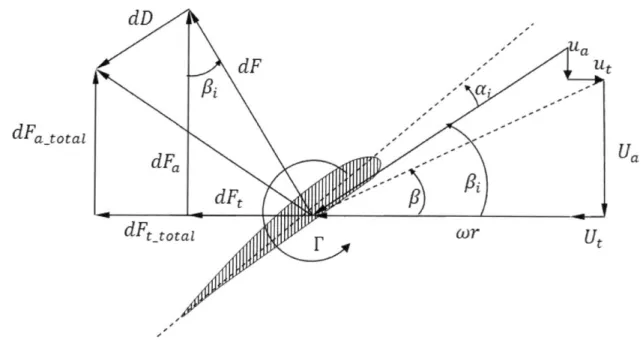
and is directed at right angles to the total inflow velocity (see Fig. 1-2).The differential axial and tangential forces acting at any radius r can then be calculated using the hydrodynamic pitch angle
Al:
dFa = pVFcosfli
dFt = pVusinli
(2)
(3) The radial velocity components do not contribute to either the thrust or the torque elements since they are parallel to the lifting line.
dFa total
Ua
Figure 1-2: Force elements on lifting line
Simplifications which are often applied to the lifting line theory involve the geometry of the propeller wake to be purely helical, with a pitch at each radius determined either by the undisturbed inflow in the lightly loaded case (linear theory) or by the induced flow at the lifting line in the moderately loaded case. In the present application of the CRP design theory the moderately loaded model is implemented.
The lightly loaded propeller is analogous to the wing where the trajectories of the trailing vortices are assumed to be independent of the wing loading. In addition, the trailing vortex rolling-up process is neglected due to the extremely large computational burden and the fact that the precise details of the deformed trailing vortex wake are not critical in determining the flow at the blades.
Chapter 2
Design Methods for CRP
This chapter deals with the different approaches for designing contra-rotating propellers using lifting line theory. First, the optimum loading criteria for single propellers are presented. A review of the various methods for designing CRP is given next. Section 2.3 describes the numerical implementation of two design methods for CRP. A detailed description of the interaction velocities calculation procedure, which is an important part for the design of interacting components, is given in section 2.4. Finally, the process of determining the shape of the blade once the loading distribution has been calculated, is explained.
2.1 Criteria for Optimum Circulation Distribution
As mentioned, lifting line theory is the basis for propeller design since it provides the radial distribution of loading or circulation. This distribution is obtained by use of criteria for optimum efficiency or modifications of such a distribution, for example to reduce the hub or the tip loading, avoid cavitation, high vibratory forces and noise, etc.
Betz(1919) first derived the optimum circulation distribution criterion for propellers operating in uniform wake by using Munk's 'displacement law' that states that the total force on a lifting surface is unchanged if an element of bound circulation is displaced in a streamwise direction. His result suggested that the ultimate forms of the vortices far downstream for an optimum
circulation distribution are true helices and is expressed as
tanpi = tanp/V (4)
where 1* is a dimensionless constant depending on the required thrust produced by the propeller. The condition for non-uniform or wake-adapted inflow was given by Lerbs (1952) by extending Betz's work after including the thrust deduction and the wake fractions in his computations. Lerbs' method remains one of the universally accepted procedures for establishing the radial
distribution of circulation and calculating the propeller efficiency in the context of lifting line theory. Several other criteria were developed afterwards but all gave a distribution of the hydrodynamic pitch angle tan
fl
of the formtanfli = k - F(r) (5)
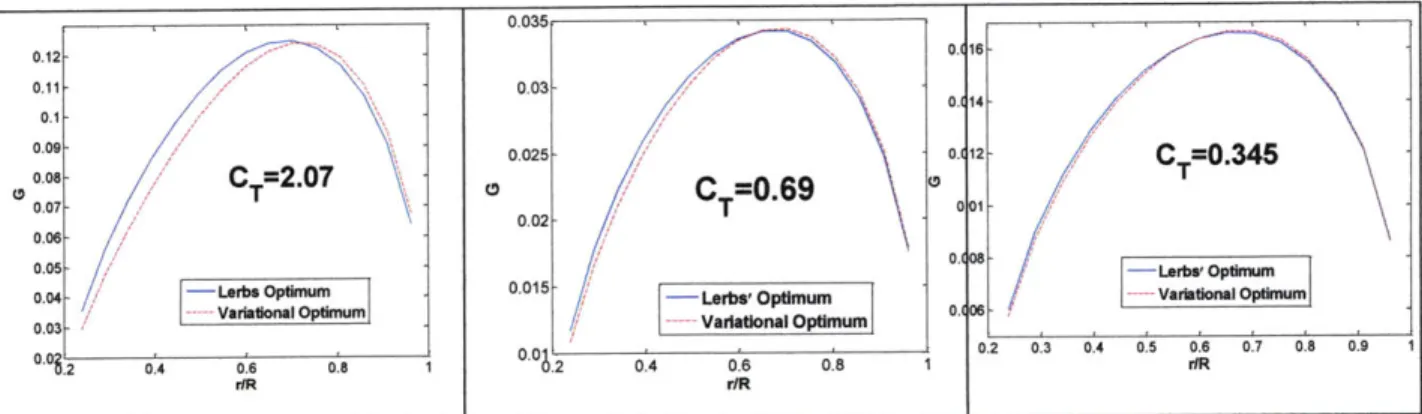
where k is an unknown factor related to the required thrust and F a function depending on the optimum criterion. A different procedure for determining optimum circulation distributions has been developed by Kerwin, Coney and Hsin (1986). Instead of deriving optimum criteria corresponding to Betz or Lerbs a numerical version of their derivation using calculus of variations and Lagrange multipliers, but working with the unknown circulations, is used. Interestingly, both methods yield similar results and in the limit of light loading the variational optimum approaches Lerbs' optimum. Optimum circulation distributions plots for a single four bladed propeller operating in uniform wake for three different thrust loadings are given in Fig.2-1 below. It is evident that the variational optimum approaches the Lerbs' optimum as the thrust loading becomes lighter.
0.035 0.12 0.(16 0.11 0.03-0.1 0.(14-0.1 0.09 0.025- 0.%12 C =0.345 0.08- C= 2.07 C 0.07 0.02 C T 0.06 0.05 0.(08
-0.04 - Lers Optimum 0.015 Lerbs' Optmum Varational Opumum 0.03 Variational Optimum Vaational Opimum 0-
0.0i_ 0.0_ 1 0.2 0.3 0.4 0.5 0.6 0.7 0.8 0.9 1
0 .2 0.4 0.6 0.8 1 &'%2 0.4 0.6 0.8 1 rdR
Figure 2-1: Comparison of optimum circulation distributions for various thrust loadings
Another method based on a genetic algorithm has been presented by Caponnetto et al.(1997). This method is based on a trial and error procedure through which several different propellers, all satisfying the design requirements are sequentially analyzed and their efficiency is calculated. Each time a more efficient propeller is found and it is used as a base for a new candidate optimum propeller, modified by a small random perturbation. Thus, neither a closed analytical form for describing efficiency nor an optimality criterion is required, even though several thousand iterations would be necessary in order to obtain a 'smooth' propeller geometry.
2.2 Lifting Line Methods for CRP
A contra-rotating propeller is defined to consist of two, coaxial, open propellers positioned a short distance apart and rotating in opposite directions. The first lifting line method for predicting optimum circulation distributions for CR propellers with equal number of blades was outlined by Lerbs (1955). His method was an extension of his lifting line method for single rotation (SR) propellers with the inclusion of the mutual interaction velocities as well as the self induced velocities. Lerbs in his theory first assumed that the axial distance between the fore and aft propellers was zero which he later corrected for the actual spacing. Thus he was able to design a so-called 'equivalent' propeller which produced one half the total thrust. He also determined the interaction velocities between the two propellers by using weighting factors applied to the self-induced velocities. Morgan (1960) derived once again Lerbs' theory for CR propellers with any combination of number of blades for both the wake-adapted and the free-running cases. In a complimentary paper, Morgan and Wrench (1965) rederived the integro-differential equation for the equivalent circulation distribution of a CRP set, and most importantly, derived efficient and accurate formulas for the evaluation of the velocity induction factors. CRP theory has been developed since that time as a logical extension of the foregoing concepts underlying the classical vortex theory for SR propellers, but several additional approximations have to be introduced.
In a CRP set not only must the self induced velocities arising from the induction of the trailing vortices on the lifting lines be calculated but also the interaction velocities on one propeller due to the presence of the other must be taken into account. The mutual interactions between forward and aft propellers give rise to time dependent flow and forces. In particular, the aft propeller blades rotate through the vortex sheets in the slipstream of the forward propeller. The forward propeller is also subjected to the circumferentially varying flow disturbance generated by the aft propeller. The theory for time-average (or steady) forces rests on a fundamental approximation. The onset flow to each propeller is divided into a circumferential average component (which may vary radially and axially) and components which are periodic (harmonics). It is assumed that the average component of velocity produces the steady forces on the propeller while the periodic components produce alternating forces with zero mean.
Forward Propeller
rcur U,
at Aft Propeller
Ut
Figure 2-2: Relative Velocities at Blade Sections
Thus, the forward and aft propellers are usually regarded as SR propellers operating in steady, axisymmetric flows in which the onset flow to each propeller is modified to include the average axial, radial, and tangential components of the velocity field induced by the other propeller. This necessarily involves an iterative procedure in which the loadings and induced velocities of each propeller are successively determined until a converged solution is reached. Velocity diagrams at the forward and the aft propeller blade sections are shown in Fig.2-2. Both the self-induced and the interaction velocity components,ua, ut and UG, is respectively are included.
More recently, Kerwin, et al.( 1986) presented a more rigorous lifting line method for the design of multi-component propulsors which could model CRP as an integrated propulsive unit and not by coupling single propeller codes in an iterative way. The coupled integro-differetial equations for circulation distributions are solved simultaneously by using a variational optimization
scheme. An extensive list of the different design methods for CRP is given by Cox and Reed (1988). One of the latest contributions to the optimization and design of contra-rotating propellers has been made by Caponetto (2000). His technique is also based on an iterative procedure where one propeller is designed at a time, but the genetic algorithm, described in the section 2.1, is used.
It has become obvious by now that two different methods for determining optimum circulation distributions for contra-rotating propellers can be identified in general. The first one, referred to from now on as the 'Uncoupled' method, treats the components of the contra-rotating propeller set as if they were SR propellers. Optimum circulation distribution criteria for SR propellers can therefore be utilized in order to obtain the solution for the CRP set. The second one, referred to as the 'Coupled' method, treats the two propellers as a single unit and is the extension of the variational optimization approach developed by Kerwin, et al. to the case of two-component propulsors. The specifics of the numerical implementation of these two methods are given next.
2.3 Two CRP Design Methods
Before presenting the detailed description of the 'Coupled' and the 'Uncoupled' methodologies, the underlying general assumptions should be listed first. In the current formulation of the optimum circulation distribution methods for CRP the major assumption is that the streamlines do not contract. Consequently, there's no need for the aft propeller diameter to be smaller than the forward one since the tip vortices from the latter do not impinge on the former. Furthermore, tracking of the contracting streamlines is avoided, thus making the computation algorithms lighter. Hence, both propellers are assumed to have the same diameter. The hub diameter is also the same for both components. A representation of such a configuration can be seen in Fig.2-3.
Figure 2-3: Contra-Rotating Propeller Set
2.3.1 'Uncoupled' Method
As already mentioned this method decouples the circulation distributions for the forward and aft propellers by eliminating the requirement of designing an equivalent propeller as described in Morgan's and Lerbs' model for the CRP interactions. Either Lerbs' or Kerwin's (variational optimization) methods for single propulsors can be used for setting up the system of equations for the bound circulation values on the two propellers. In the present work the variational optimization is implemented so that there is consistency in the way the circulation values are determined by both methods ('Uncoupled' -'Coupled') and the results of the comparison capture the differences exclusively due to the way the CRP set is modeled (a combination of two SR propellers or an integrated propulsor with two components), even though the implementation of Lerbs' optimization method is expected to yield similar results (see section 2.1).
According to the variational optimization scheme for a single propeller as described by Coney (1989) an auxiliary function
H = Q + X(T - Tr) (6)
is formed. The goal is to find a set of discrete circulation values 1(1) ... F(M) applied at the M
control points on the lifting line, such that the torque,
-M
Q = pZ [Va(m) + u*(m)] r(m)F(m)Ar (7)
M=1
is minimized subject to the constraint that the thrust,
M
T = pZ [Vt(m) + wr + u*(m)] r(m)F(m)Ar (8)
M=1
has a prescribed value Tr. The parameters Va, Vt, u* and u* correspond to the total axial inflow, total tangential inflow, induced axial and induced tangential velocities respectively. The partial derivatives of H with respect to the unknown M circulation values and the Lagrange multiplier 1 are set to zero. The resulting system of M + 1 equations is linearized by assuming that the Lagrange multiplier is known where it forms quadratic terms with the circulations and solved for the M + 1 unknowns. Initially setting the Lagrange multiplier equal to -1 proved to be a suitable estimate. The solution yields the optimum circulation distribution and the value for 2. The variational optimization for single component propulsors has been implemented numerically by Epps (2009).
The coupling between the 'two SR propellers' is provided entirely by the interaction velocities between them and the resulting equations are subjected to two constraints, the total required thrust produced by the set and the torque ratio between the elements of the set,
Tr1 + Tr2 = Tr (9)
and
q= Q2/Q 1 (10)
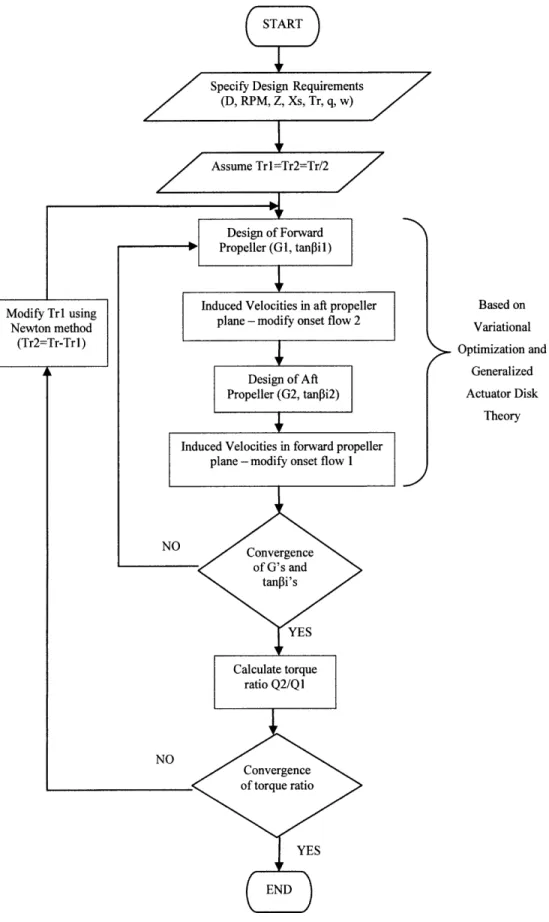
These systems of equations are solved using an iterative scheme where one system is solved at a time as if it was solved for a conventional SR propeller. The interaction velocities induced on the forward propeller by the aft are initially assumed to be zero and the linear system of equations for the unknown circulations and the Lagrange multiplier for the forward propeller are solved. Once the solution for the forward propeller is obtained, the interaction velocities induced by the
forward propeller on the aft one are computed. These interaction velocities are then added to the onset flow for the aft propeller and the linear system of equations for that propeller is then solved as if it were a SR propeller. The interaction velocities induced on the forward by the aft component are then computed and the new circulation values on the forward component for the updated onset flow are then determined. This iterative procedure is repeated until convergence for the forward and aft circulation distributions is achieved. Once convergence for the circulation distributions F (r), F2(r) is reached a check is performed on whether or not the obtained solution
satisfies the torque requirement. Matching of the specified total thrust and torque ratio is accomplished by first using an initial guess with the total thrust being equally divided into the two components, Tr = Tr2 = Tr/ 2, and then applying Newton's method to find the thrust ratio
which produces the required torque ratio q. This procedure is implemented numerically in the
Specify Design Requirements
(D, RPM, Z, Xs, Tr, q, w)
Induced Velocities in aft propeller plane -modify onset flow 2
Based on Variational Optimization and Generalized Actuator Disk Theory Induced Velocities in forward propeller
plane - modify onset flow 1
The fact that the induced velocities due to the aft propeller acting on the forward one are generally small, especially as the axial separation X, increases, insures that this iterative scheme converges very quickly. In order to compute the circumferential mean axial interaction velocity components the analytic expressions from generalized actuator disk theory developed by Hough and Ordway (1965) are used. As far as the computation of the tangential interaction velocity components is concerned, a direct application of Kelvin's theorem for the conservation of circulation is utilized. A detailed description of the procedure for calculation the interaction velocities is given in section 2.4. The 'Uncoupled' method presented above is similar to the lifting line design method developed by Caster and LaFone (1975). Their method however uses Lerbs' criterion for determining optimum circulation distributions instead of the variational optimization. In addition, Caster and LaFone used Kerwin's field point velocity program for calculating the average axial and tangential interaction velocities (J.E. Kerwin & Leopold 1964).
2.3.2 'Coupled' Method
This method was developed by Kerwin, Coney and Hsin (1986) and is an extension of the variational optimization approach for single propeller design. The optimization procedure enables one to determine both the division of loading between CRP components and the radial distribution of loading (circulation) on each component simultaneously since the two propellers comprising the set are regarded as a unit. This method can also be applied to other multi component propulsors, such as propellers with pre or post swirl stators or vane wheels, provided a computational scheme for calculating the interaction velocities exists. The same technique for calculating the interaction velocity components, as in the 'Uncoupled' method, is being used. Following Coney, in the case of two propulsor components, the goal is to find the discrete circulation values F1(1) ... [1(M1), 12(1) ... F2(M2) such that the total power P = wi -
Q
1 + 02-Q
2, absorbed by the propulsor is minimized. The propulsor is additionally required to develop a prescribed thrust Tr. In addition, two component propulsors are often constrained to have a specific division of torque between the components. Therefore, a torque ratio, q =Q
2/Q
1, is also specified. These three conditions are used to form an auxiliary function H,After expressing the thrust and torque of the individual components of the CRP set in terms of the circulation values, the partial derivatives of H with respect to the unknown circulation values and the Lagrange multipliers are set equal to zero:
= 0 = wi + W2 -aaQ21
[
( 7Q) Q 2 +4 qAQ -a +O =, ao ) + AT allO + aT2 - AQ) 2 a i',(i) forj=1,2andi=1,...,M and, oH =H 0 8 H 0 =(T
1+ Ty ) +
(T12 +TV2) Tr q(Q 1 + QV) - (Qi 2 + Qv2)The expressions for the inviscid and viscous thrust and torque terms acting on a CRP component can be written as:
T1 = pZ n=1
QI
=
pZ I
n=1 [Vtj(n)+
wor(n)+ u* (n)]
l;(n)Ay[V (n)
+
u*
(n) r
(n) ;(n)Ar (15) (16) V* (n) [Vaj (n) + u* (n)] c;(n)CDy (n)Lj aH a1(i) + ALT [aTt (12) aT2 a d1,(i) (13) (14) Ty = 2 pZ; (17)Mj
Qv, =iPZ> V*(n)
[Vt,(n)
+ wjr(n) + u* (n)] r(n)cj(n)CD j(n)Arj (18) n=1forj = 1,2
where CDv and c are the 2D viscous drag coefficients and the chordlengths of the blade sections respectively. The velocity induced on a given control point is a summation of the velocities induced by the individual horseshoe vortices and is given by:
K M u* (n) = ( (n, m) (19) k=1 m=1 K M u* (n) = ) (n, m), (20) k=1 m=1
where u*jk (n, m), Uk (n, m) are the axial and tangential velocities respectively induced at
control point n of component
j
by the horseshoe vortex of unit strength surrounding control point m of component k. Wheneverj
= k, u* and u* are the self-induced velocities, otherwise they are the interaction velocities.This is a non-linear system of M1 + M2 + 2 equations for the M1 unknown circulation values on
component 1, the M2 unknown values on component 2 and the two Lagrange multipliers.
Kerwin, et al. solved the resulting system of non-linear equations by freezing the Lagrange multipliers where they formed quadratic terms with the circulation values. The only terms in which the Lagrange multipliers were allowed to contribute to the system of equations were those where they forms products with the onset flow velocities Va and Vt, and the angular velocities a1 and w2. The final, linear system can be found in Appendix A.
At this point we should note that Kerwin, et al's linearization represents an arbitrary linearization of the non-linear equations. An exact linearization of the equations for the circulation and Lagrange multipliers should involve using the vector equivalent of a Taylor series expansion of the non-linear equations in terms of the unknowns. The exact linearization of the inner problem
has been performed by Cox and Reed (1988) and is the most complete lifting line theory which can be developed within the assumptions of the theory.
START
Specify Design Requirements (D,
RPM1I, RPM2, Z1I, Z2, Xs, Tr, q, w)
Firstimation of Lagrange Multipliers (LQ=0, LT=-1)
Assume that the
hydrodynamic pitch angles are equal to the undisturbed flow angles (tanpi--tans)
Solve for Circulation Distributions and Lagrange Multipliers (G1I, G2, LT, LQ) NO Convergence of G1, G2, LT, LQ YES Wake Alignment NO Convergence of tanpi's YES END
In the current formulation, like in the variational optimization for SR propellers, Kerwin, et al. had two nested problems to solve. The inner problem was the determination of the optimum circulation distributions for the forward and aft propellers; it was solved for fixed value of the hydrodynamic pitch angles, tan
fi,
on the forward and aft propellers. The outer problem was that of determining the appropriate distributions of tanfl
for both propellers; it was solved by selecting an initial distribution of tanfl,
usually, tan#/, and solving the inner problem for the optimum circulation distributions. The induced velocities due to these circulation distributions were then used to determine new tan3i distributions, which were used to solve again the inner problem for the optimum circulation distributions. This process was repeated as many times as necessary until the tanfl
and the circulation distributions had converged. Fig.2-5 shows the flow chart for the 'Coupled' method.Interestingly, by setting the torque ratio q = Q2/Q1, the number of blades Z2 and the rotational speed of the aft propeller ( 2 equal to zero, one recovers the optimum circulation distribution for
the single propeller, thus minimization of the objective functions H = w1
Q
1 +AT(T1 - Tr) andH =
Q
+ A(T - Tr) yields the same results, as expected.Initial estimates of zero for AQ and -1 for 17 were suitable according to Coney (1989). However,
if the values of the Lagrange multipliers are not updated each time the linear system of equations is solved, and values other than zero and -1 are used, the results are found to differ significantly. In particular, the obtained circulation distributions appear to be very sensitive to the values of the Lagrange multipliers, whereas the efficiency is not. Plots of propeller efficiency and circulation distributions as a function of Ae and tT will be presented in the next section.
With respect to the element arrangement of the vortex lattice model, both constant and cosine spacing were implemented successfully. However, for cosine spacing with more than 15 panels the algorithm would not converge. Therefore, constant spacing was employed in both methods.
2.4 Interaction Velocities
The major difference between SR and CR propellers in terms of modeling is the fact that for CRPs the velocity field is much more complex, since both the self-induced and the interaction velocities between the components of the set must be included in the optimization equations.
Therefore, a detailed knowledge of the velocity field induced by a propeller at axial locations other than the propeller plane itself is necessary.
An analytical solution for the steady (circumferentially average) velocity fields induced by a lightly loaded propeller of arbitrary blade number and circulation distribution has been developed by Hough and Ordway (1965). In their formulation, the propeller is represented by a conventional vortex system consisting of bound radial vortex lines and a helical sheet of vortices trailing from each line. The induced velocities at any field point are then determined by the Biot-Savart law. In order to achieve that, they first calculated the velocity fields induced by an actuator disk with uniform radial distribution of load and then constructed by superposition the solution for general load distributions by integrating the constant-loading solutions.
The selection of this method for calculating the induced velocity fields is further justified by the work of Hsin (1987), who compared three different methods for computing the circumferential average induced velocity for multi-component propulsors and found Hough's and Ordway's method to be the most computationally efficient. Conway (1995) also derived the solutions given by Hough and Ordway by using a different method based on construction of the velocity and potential fields induced by a vortex ring.
In the case of CRPs, only the axial and the tangential interaction velocities are of interest since the radial component does not contribute to the development of forces on the propeller blades. Besides, the contraction of the wake is ignored which effectively implies that there is no motion of the fluid particles in the radial direction. A detailed description of the interaction velocities calculation procedure follows.
2.4.1 Axial Interaction Velocities
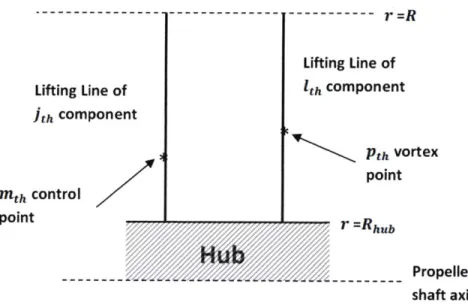
In the calculation of the axial velocity, only the free trailing helical vortices are taken into account since there is no contribution from the bound vorticity. Kerwin, et al. applied the formulas developed by Hough and Ordway to the case of moderately loaded propellers. Following Coney's notation, the local axial velocity induced at the mth control point of component
j
by the Pth trailing vortex with unit strength of component 1 is given by:Raji (m, p) = ir(p) tan (flj(p)) CZ I C1 with: Xf r r +
Q
_(q) + AO (s, t),) 2 rc1(m)r 1(p) 2 CXf I_Q
1(q) 2 AO(s, t) 2j rc(m)r, (p)2where the parameters included in the definition of C1 are given by:
q = 1 + 2 X2 + (rm) - r s = sin~1 4rc;(m) r,,(p) 2 f+
(r(m)
- rp(p))Q_i
is the Lengendre function of the second kind and half integer order and AO is the Heumann's Lambda function. A representation of the interacting components of a CRP set can be seen in Fig.2-6. (21) (22) (23) (24) (25) 2rc( ,(p)rcj (m) < r,(p)
rc, (m) > ry,(p)
--- --- --- r=R
Lifting Line of Lifting Line of 1th component
jth component Pth vortex point mth control point r =Rhub r =R Propeller shaft axis
Figure 2-6: Representation of the interacting components of a CRP set
In the formulation of the optimization for the circulation distribution, the bound circulation values are set to be the unknowns. Therefore, the axial interaction velocities should be expressed in terms of the strength of the bound vortex segments (at the M control points) and not in terms of the strength of the trailing vortices (at the M+1 vortex points). Thus, an axial interaction velocity 'influence function' on the mth control point of component j induced by the Pth bound vortex segment of unit strength of component 1 is defined as:
*,(m, p) = Uay (m, p) - Uay (m, p + 1) (26)
The above formulas for the calculation of the 'trailing vortex influence function' iiay (M, p) and the 'horseshoe influence function' i4
, (m, p) have been implemented in the Hough. m and the
Horseshoeint. m MATLAB functions respectively.
An example of the axial velocity fields predicted by these expressions is presented next. The radial circulation distribution of the propeller inducing these fields follows roughly a typical parabolic shape. The radial variation of the axial velocity at various axial stations is given in Fig.2-7.
0.2 0.16-* XsR= 0.080 0.12- 4 Xs/R=-1O 0.8 1 1 0.04 - - ---- LI -SO5 .. XsIR=-1 0.2 0.4 0.6 0.8 1
r/R
Figure 2-7: Axial velocity profiles at different axial locations
The axial velocity appears to decay fast as we move upstream (Xs<O) and increases just as fast downstream (Xs>O). At a plane located three blade radii downstream it approaches twice its value at the propeller plane, as momentum theory would have predicted. Understanding these trends is crucial for the CRP design where the axial separation between the components of the set has a significant effect on the axial interaction velocity fields experienced by the forward and aft propellers.
2.4.2 Tangential Interaction Velocities
Contrary to the axial velocity component, both the bound and the trailing vorticity contribute to the tangential induced velocity. Hough's and Ordway's formula for the total tangential velocity shows that it vanishes everywhere outside the slipstream of the horseshoe vortex and is proportional to the bound circulation values and inversely proportional to the radial distance from the propeller hub. The resulting expression for this velocity is the same as the one obtained by a direct application of Kelvin's theorem using a circular path about the propeller shaft axis.
Based on the notation used by Coney, a horseshoe vortex of strength F with lattice points at radii rv(p - 1) and rv1(p) of one component will induce a tangential circumferential mean velocity
on a control point rc (m) of the other component, of:
0, S > 0, -oo Xf < oo 0, S 0, Xf < 0 -Z*m, p (27) , rj M S < 0, Xf > 0 where, S = (r,(p - 1) - rc(m)) (r, (P) - rcj(m) (28)
The above algorithm for the calculation of the tangential circumferential mean velocity has also been implemented numerically in the Horseshoeint.m function in a non-dimensional form (Appendix B).
2.5 Blade Design
Until this point, the first step for the design of CRP has been accomplished by developing methods for calculating optimum circulation distributions. Once these loading distributions have been determined, the second step involves finding the shape of the blades that will generate the prescribed loadings for the forward and the aft propellers. In general, this is accomplished by combining the lifting line results with theoretical or experimental two-dimensional section data characterized by standardized meanline and thickness types.In the design code used throughout this thesis the procedure for determining the shape of the blades can be described as follows:
First, the required lift coefficients for the blade sections at each radial location are determined based on the non-dimensional circulation values:
- 2F(r) (29)
where V* denotes the total inflow velocity, c is the chord length and F the dimensional circulation which can be expressed in terms of the blade radius R, the ship speed V, and the non-dimensional circulation G:
F(r) = 21TRVsG(r) (30)
Second, the blade sections are assumed to follow a specific type of meanline and thickness distribution. Typical distributions for propeller applications are the NACA a = 0.8 meanline and the NACA 66(TMB modified) thickness. The properties of this kind of profile will be discussed extensively in Chapter 5, where cavitation considerations are introduced.
Third, the exact blade geometry and orientation are obtained by requiring a shock free entry with each section operating at its ideal angle of attack. The required values for the maximum camber ratio and the ideal angle of attack at each radial location for the NACA a = 0.8 meanline are:
fo/c
= 0.0679 C, (31)aideal = 1.54 C, (32)
Finally, the propeller geometry is defined by placing all blades sections such that the nose-tail pitch angle equals the sum of the hydrodynamic pitch angle and the ideal angle of attack. The procedure for determining the propeller geometry discussed above is integrated in the
Geometry.m MATLAB function. Fig.2-8 shows a sample rendering of a contra-rotating
Figure 2-8: Geometry of CRP set designed with the current code
We have seen that the maximum camber ratio and the ideal angle of attack have been calculated assuming that the blade sections operate as two-dimensional airfoil sections, which is a reasonable assumption if the blade aspect ratio is high. Unfortunately, marine propellers are forced to have low aspect-ratio blades, the result being that the induced velocity and hence the total inflow velocity will vary along the chord length of the blade sections. In order to account for these discrepancies of lifting line theory and also include the effect of the thickness, lifting-surface corrections are frequently introduced. Morgan, Silovic and Denny (1968) have developed such surface correction factors and their findings indicate that, if three dimensional effects are included, the actual camber and ideal angle of attack are generally greater than two dimensional values at the same lift coefficient.
As far as the radial chord length distribution is concerned, this is a direct user input in the code. The chord lengths are necessary for determining the viscous components of thrust and torque on the lifting line. They are also used for defining the geometry of the complete propeller in the final stage of the design process. The selection of the chord lengths is a tradeoff between the
propeller efficiency and the cavitation performance along with the structural strength. Small chord lengths are expected to improve the efficiency by inducing low viscous losses. On the other hand, the blades would then become more vulnerable to the occurrence of cavitation due to increased loading.
Blade rake and skew are also direct inputs in the part of the code that generates the propeller geometry. Nevertheless, their effects on the efficiency cannot be captured by lifting line codes which place vortices on straight radial lines. If the impact of skewed or raked blades on the efficiency, the cavitation and the vibratory forces is of interest, lifting surface codes should be implemented. In the preliminary design stage though, a simple lifting line approach, as the one used throughout this thesis, is sufficient.
Chapter 3
Numerical Predictions
Before moving on to the presentation of characteristic CRP design examples and comparisons, the different definitions of efficiency will be given. The propulsive efficiency can be divided into three components; hull efficiency, relative rotating efficiency and open water efficiency. The hull efficiency is defined as:
nH = (33)
The expression (1 - t) is the thrust deduction factor and w is the wake fraction. The relative
rotative efficiency is given by:
nR = - (34)
Qo
where
Q
andQo
are the torques behind the hull and in open water respectively. Open water efficiency for a single propeller is defined as:no = (35)
27rnQo
where T, VA, n are the thrust, the speed of advance and the rotational speed respectively.
Although it is necessary to consider the total propulsive efficiency, the propeller designer has mainly influence on the open water efficiency. In this work only the open water efficiency will be of interest, even though the wake fraction and the thrust deduction are also expected to be different between ships equipped with contra-rotating versus single propellers. Sasaki, et al. (1998) compared the self propulsion factors for ships equipped with CRP and single propulsors and developed a method for estimating these factors.
Before presenting the results from both methods it is necessary to define the open water efficiency for a CRP set. Efficiency of a two stage propulsor is given as:
T1-VA1+T 2 -VA2 -Fh'VS (36)
(01 Q1 + (w2 'Q
where T, w,
Q
are the thrust, rotational speed and torque for each of the propellers and VA1, VA2 are the volumetric mean effective inflows for the forward and aft components respectively defined by:2 R
VA= (Rh2 rIrVa( r)dr (37)
The hub drag term F , is given by
Fh= (In l -+ 3) [Z1F1(1) - Z2r2(1)]2 (38)
16r ro
This drag force is experienced due to the presence of a concentrated hub vortex created when the circulation at the hub is not zero. In CRP configurations the hub drag can be reduced or even eliminated if the circulation shed onto the hub from each propeller has the same magnitude. A detailed discussion about the presence of the hub will be given in Chapter 4.
3.1 Single Case Comparison
A comparison between the results obtained by the 'Coupled' and the 'Uncoupled' methods is performed next. Figures of optimum circulation distributions, axial and tangential induced velocities for a pair of free-running contra-rotating propellers are presented. The propellers are rotating at the same speed at an advance coefficient of Js=0.89 and are required to develop a thrust corresponding to Ct=0.69.
Table 3-1: Characteristics of CRP set used in comparing the two design methods
Number of blades Z1=Z2=4
Blade Diameter D1=D2=D
Hub Diameter Dhub/D=0.2
Thrust Loading/Coef. CT=0.69/Kt=0.214
Torque Ratio Q2/Q1=q=1
Advance Ratios Js1=Js2=0.89
Axial Separation Xs/D=0.25
In all of the cases considered the presence of the hub as a solid boundary is not taken into account, therefore the circulation values at the hub and the associated hub drag forces are equal to zero. Both propellers of the set are four bladed and are required to absorb equal torque, thus the torque ratio is set to one. The axial separation distance between the components is equal to a quarter of the propeller diameter. Viscous forces are neglected. The characteristics of the CRP set are given in Table 3-1. Figs 3-1 and 3-2 give the circulation distributions for the forward and the aft propellers. Also shown is an optimum circulation distribution for a single eight bladed propeller operating at the same advance ratio and required to generate the same thrust. Each blade of the SR propeller produces approximately the same thrust as the blades of the CRP set. Constant radial spacing with 15 panels has been implemented in all cases.
0.018 L L t t CRP Efficiency = 84.03% 0.016 -0.014 0.012
L
0.01 0.008 0.006-0.004
-0.0 0.3 0.4 0.5 0.6 0.7 0.8 0.9 r/RFigure 3-1: Circulation Distributions as predicted by the 'Coupled' method 39
0.018 0.016 0.014-Y 0.012 0.01 8-bladed SR 0.08 Efficiency = 80.9% 0.006- -Forward/Uncoupled --- 8-bladed SR 0.004- ,Aft/Uncoupled 0.00.2 0.3 0.4 0.5 0.6 0.7 0.8 0.9 1 r/R
Figure 3-2: Circulation Distributions as predicted by the 'Uncoupled' method
The results for the 'Coupled' CRP design method are characterized by an inward shift in the circulation distributions for both the forward and the aft propellers of the set compared to the SR propeller (see Fig.3-1). On the other hand, from the application of the 'Uncoupled' method we obtain an inward shifted circulation distribution for the aft propeller (Fig.3-2) while the circulation distribution for the forward one is relatively unaffected. However, the efficiencies obtained by the two methods are comparable (84.03% versus 83.87%). The fact that the two methods specify different circulation distributions as the optima can be attributed to the different optimization routines used. In the 'Coupled' method the inward shifted distributions are obtained under the assumption of uniform onset flow, whereas in the 'Uncoupled' method the shift of the circulation distributions (always compared to the SR propeller) is due to the modified onset flows, mainly by the interaction velocities. The fact that the interaction velocities on the forward propeller induced by the aft are small provides an explanation for the relatively unaffected circulation distribution on the forward propeller.
Before attempting to explain the efficiency increase of the contra-rotating propulsor configurations a short reference to the energy losses related to the propeller action is necessary. The hydrodynamic energy losses associated with the action of a propeller are due to increases in the kinetic energy of the water passing through the propeller disk area. These losses have two components, axial and rotational. The development of thrust results from axial acceleration of
the water and causes an increase in the axial kinetic energy, while the shaft torque is transferred to the water causing induced rotational velocities and a rotational energy loss. Taken together, these two losses result in the ideal efficiency of the propeller. Moreover, in an ideal fluid the efficiency will approach 100% as the propeller diameter approaches infinity since, as the mass flow increases, the increase in speed for a required increase in momentum becomes smaller. In a real fluid with viscous drag losses there will be an optimum, finite diameter at which the efficiency will have a maximum value for a given thrust and advance coefficient. Inversely, within the limitations of propeller-hull clearances, for a given diameter and thrust loading there will be an optimum advance coefficient for which the highest efficiency will be realized. In the current work, the presentation of efficiency curves for a wide range of thrust loadings and advance coefficients for both CR and SR propellers will show the agreement with the fore mentioned theoretical concepts.
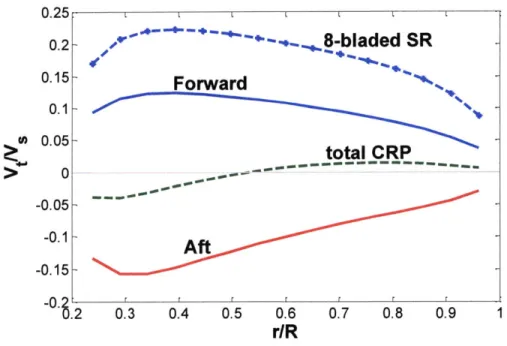
Returning to the comparison between the two optimization methods, the axial and tangential induced velocities far downstream (five diameters downstream of the forward propeller plane) by the same propulsor configurations are given in Figs 3-3-3-6. Some physical insight into the increased efficiency of the CRP pairs over that of the SR propeller (efficiency of the 8-bladed SR propulsor is 80.9%) can be obtained by comparing these velocity components to the one corresponding to the ideal case of the actuator disk.
0.3 0.4 0.5 0.6
r/R
0.7 0.8 0.9 1
Figure 3-3: Axial induced velocities far downstream /'Coupled' method
0.3 0.4 0.5 0.6
r/R
0.7 0.8 0.9
Figure 3-4: Axial induced velocities far downstream /'Uncoupled' method
The total axial induced velocities of the contra-rotating pairs are more uniform and less concentrated toward the tip than that of the single propeller. This observation is connected with the increased efficiency. These velocities are also closer to the constant value predicted by actuator disk theory. In the limit of light loading we expect the circumferential mean axial induced velocities to approach that of the actuator disk.
42 0.3 0. >00.2 0. 0.1 4 L L L L L 3 --
Atao Ds
. 2 -5 -4~8/
8-bladed
SR
2- Forward 1 -4 rrr 0. 0 0 0.4 0.35 0.3F U)0.25Ftotal
r r r 0.2 0.15 0.1 0.0
.
. ... ... . ... . .