Dilan Sahin
A dissertation submitted in partial fulfillment of the requirements for the degree of
Doctor of Philosophy
( Information Systems Engineering) in the University of Michigan Dearborn
2016
Doctoral Committee:
Assistant Professor Marouane Kessentini, Chair Professor William Grosky
Assistant Professor Bochen Jia Associate Professor Bruce Maxim
ii
DEDICATION
This thesis work is dedicated to my dear family who has been always with me at every important step of my life. I want to thank my dear mother, Dudu Sahin, who always encouraged me to be a strong woman and be able to stay on my own foot. As a working mother, she did everything in an extraordinary way to raise me and my brother and always showed us how valuable is to be a hard-worker and fighter in this life. I owe everything I have to my strong mother. Her wish was to see me on the stage while getting my PhD diploma. How lucky I am to give her what she wished for. My father, Mahmut Sahin, is the person who gave me strength to follow my dreams. He is my number one supporter in this life. All the sacrifices he did for me to gain this experience are countless. I cannot forget the day when we get on the plane together to start my childhood dream. He is my hero. My brother, Cem Deniz Sahin, is the dearest of our family. He is my friend whom I can share everything in my life. I will always remember his cooking for me whenever I needed to study. I want to thank my dear aunt, Dondu Serin, for being my second mom whenever I needed her during my school years. She also has a lot of influence on me to make my dream come true. I also want to thank all my family members back in Turkey.
iii
ACKNOWLEDGEMENTS
Deciding to pursue a PhD degree was not an easy choice especially when it involved me leaving everyone behind and come to United States on my own. It has been a difficult journey for me with ups and downs however it was totally worth it. This was not only an education, but a life experience which made me who I am. I became a strong person who knows what she wants from life and know how to get it if she puts enough hard work and sprinkle a bit enthusiasm in it. This achievement would not be possible if Professor Kessentini was not in the picture. I want to thank him for being the most important part of this journey. As an advisor, he gave me an opportunity to learn how to do research and introduced me to this existing field which I will continue building my career on top of it. I cannot thank him enough for his endless support, time and energy to make this dream come true. I would also want to thank my dissertation committee, Prof. Bruce Maxim, Prof. William Grosky and Prof. Bochon Jia who has been there each step I took in this journey.
I want to give my special thanks to another strong woman in my life, Emily Wang, for all her support whenever I came across an obstacle in this journey. She gave me strength, courage and hope when I most needed it. Thank you Emily.
I want to thank the members of SBSE lab whom I shared most of this journey with. I specifically want to thank Mohamed Wiem Mkaouer for his countless support during my PhD, Nivin Tama for a great collaboration for our paper, Usman Mansoor for making us laugh all the time during our lab meetings. I also want to thank my dearest friend John Baluch for his great support in the last leap of this journey. I want to thank Kate Markotan for her support at every obstacle I had during my studies.
I want to thank my friends Don Barbarci, Gaurav Sheth, Marinus Koelman, Josselin Dea, Paty Ortiz, Nick Crooker and Scott Riopelle for all their great support.
iv
PREFACE
The research that led to this thesis was performed at Search-Based Software Engineering Laboratory at the Department of Computer and Information Science, University of Michigan-Dearborn, with Prof. Marouane Kessentini as the main advisor. This work was funded by Search-Based Software Engineering Laboratory in collaboration with Ford Motor Company.
v
TABLE OF CONTENTS
DEDICATION ii
ACKNOWLEDGMENTS iii
PREFACE iv
LIST OF TABLES viii
LIST OF FIGURES ix
Chapter 1: Introduction ... 1
1.1 Research Context ... 1
1.2 Problem Statement ... 7
1.2.1 Code Smells Detection ... 10
1.2.2 Model Transformation Testing ... 12
1.3 Proposed Solutions... 14
1.3.1 Contribution 1: Bi-Level Code Smells Detection ... 14
1.3.2 Contribution 2: Model Transformation Testing ... 15
Chapter 2: Related Work ... 17
2.1 Bi-Level Optimization Technique ... 17
2.2 Code-Smells Detection ... 20
2.2.1 Interactive-based approaches ... 21
2.2.2 Symptom-based detection ... 22
2.2.3 Search-based Approaches ... 24
2.3 Model Transformation Testing ... 25
2.3.1 Test Input Model Generation ... 25
2.3.2 Mutation-based Analysis of Transformations ... 27
vi 3.1 Introduction ... 28 3.2 Approach ... 30 3.2.1 Problem Formulation ... 34 3.2.2 Solution Approach ... 37 3.3 Validation ... 42 3.3.1 Research Questions ... 43
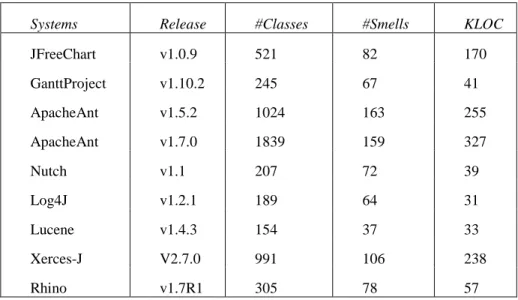
3.3.2 Software Projects Studied ... 44
3.3.3 Evaluation Metrics Used ... 46
3.3.4 Inferential statistical test methods used ... 47
3.3.5 Parameter tuning ... 49
3.3.6 Results ... 51
3.4 Industrial Case Study and Relevance of the Detected Code-Smells ... 68
3.4.1 Subjects ... 70
3.4.2 Questionnaire, Instructions and Pilot Study... 70
3.4.3 Results of the Industrial Case Study and Relevance of Detected Code-Smells ... 76
3.5 Threats to validity ... 87
3.6 Conclusion ... 92
Chapter 4: Model Transformation Testing: A Bi-Level Search-Based Software Engineering Approach 94 4.1 Introduction ... 94 4.2 Approach ... 96 4.2.1 Problem Formulation ... 97 4.2.2 Evaluation ... 104 4.3 Validation ... 105
vii
4.3.1 Research Questions ... 105
4.3.2 Experimental Settings ... 108
4.3.3 Results and discussions ... 110
4.3.4 Threats to Validity ... 115
Chapter 5: Conclusion and Future Work ... 117
viii LIST OF TABLES
Table 1 List of quality metrics ... 9
Table 2 Software studied in our experiments. ... 45
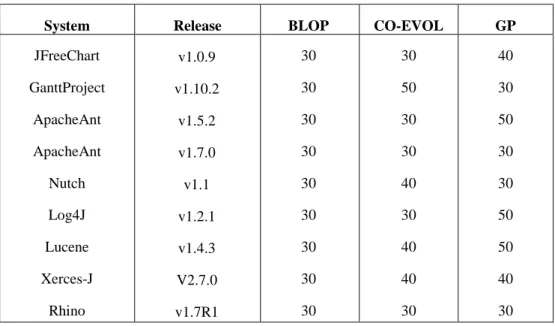
Table 3 Best population size configurations ... 50
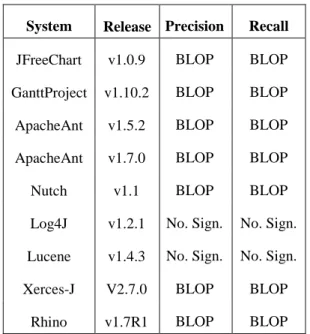
Table 4 The significantly best algorithm among random search, BLOP, GP and Co-Evol over 31 independent runs. “No. Sign.” Means no method is significantly better than another. ... 52
Table 5 . Median PR and Rc values on 31 runs for BLOP, random search (RS), GP [Kessentini et al. 2011] and Co-Evol [Boussaa et al. 2013]. The results were statistically significant on 31 independent runs using the Wilcoxon rank sum test with a 99% confidence le ... 52
Table 6 Adjusted p-values of comparisons related to table 4 ... 58
Table 7 Software studied in our experiments. ... 69
Table 8 Survey organization to study the relevance of some detected code-smells. ... 74
Table 9 Manual validation of the detected code-smells on JDI-Ford. ... 77
Table 10 Adjusted p-values of comparisons related to table IX. ... 77
Table 11 QMOOD quality factors [Bansiya et al. 2002] ... 79
Table 12 QMOOD metrics for design properties [Bansiya et al. 2002] ... 79
Table 13 Scenarios ... 108
Table 14 The Wilcoxon test p-values and the effect size values (Cohen‟s d statistic) of the comparisons between BLOP and Co-Evol on the 10 scenarios. ... 113
ix
LIST OF FIGURES
Figure 1 Building blocks of model transformation testing ... 5
Figure 2 Family to Person example: metamodels and example models. ... 6
Figure 3 Uni-directional relationship between test model generation and analysis ... 13
Figure 4 Illustration of the two levels of an exemplified bi-level single-objective optimization problem. ... 19
Figure 5Approach Overview ... 31
Figure 6 (a) Pseudo-code of the bi-level adaptation for code-smell's detection ... 36
Figure 7 (b) Pseudo-code of the bi-level adaptation for code-smell's detection ... 37
Figure 8 Solution representation: vector (GA) to generate artificial code-smell ... 39
Figure 9 Box plots on three different systems (Gantt: small, Xerces: medium, Ant-Apache 1.7.0: large) of precision values ... 54
Figure 10 Box plots on three different systems (Gantt: small, Xerces: medium, Ant-Apache 1.7.0: large) recall values. ... 54
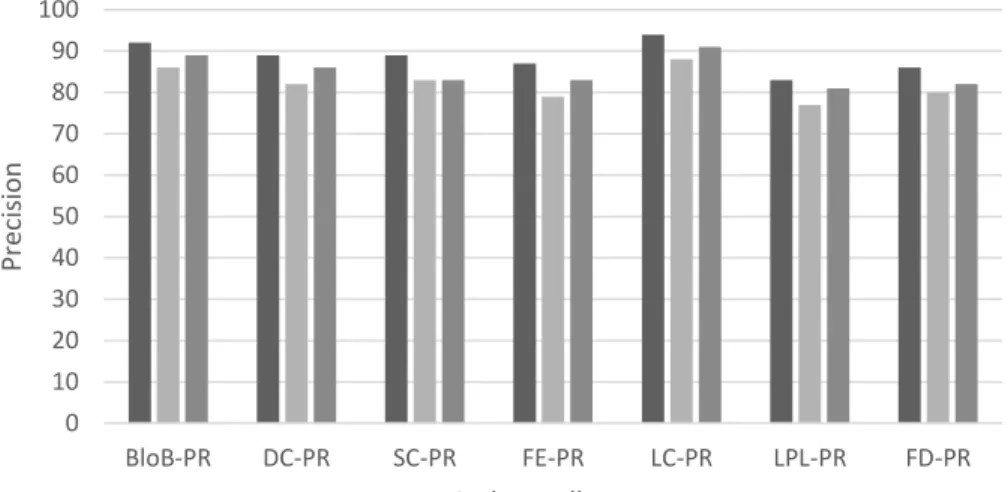
Figure 11 Median PR scores for every code-smell's type over 31 runs on the different 9 open source systems. ... 55
Figure 12 Median Rc (b) scores for every code-smell's type over 31 runs on the different 9 open source systems. ... 56
Figure 13 The median precision score of detected artificial code-smells by BLOP and Co-Evol 60 Figure 14 The median precision and recall scores of detected code-smells by BLOP, GP and Co-Evol on Xerces-J based on a target final fitness function values ... 61
Figure 15 The impact of the number of code-smell examples on the quality of the results (PR on Xerces-J). ... 61
Figure 16 The median precision and recall scores of BLOP and DECOR obtained on GanttProject, Nutch, Log4J, Lucene and Xerces-J based on three code-smell types (Blob, SC and FD). ... 64
x
Figure 17 The impact of the number of selected solutions at upper level on the quality of the
results (PR, Rc and CT) using JFreeChart v1.0.9. ... 66
Figure 18 The number of evaluations required by the different algorithms (BLOP, Co-Evol and GP) to reach acceptable results (f-measure=0.7) using Xerces-J v 2.7.0. ... 67
Figure 19 Scalability of our bi-level approach for code-smell's detection on three different versions of Eclipse. ... 68
Figure 20 The impact of fixing a number of code-smells (refactorings) on QMOOD quality attributes for JDI-Ford ... 81
Figure 21 The relevance of detected code-smells on the JDI-Ford system evaluated by the original developers. ... 82
Figure 22 The usefulness of detected code-smells on the JDI-Ford system evaluated by the original developers. ... 83
Figure 23 The relevance of detected code-smells on the different open source systems evaluated by developers from groups A, B and C... 85
Figure 24 The relevance of the types of detected code-smells on the different open source systems evaluated by developers from the groups A, B and C. ... 86
Figure 25 The usefulness of detected code-smells for software maintenance activities on the different open source systems evaluated by developers from the A, B and C groups ... 87
Figure 26 Approach overview ... 97
Figure 27 Cut-and-splice crossover principle ... 102
Figure 28 Pseudo-code of the bi-level adaptation for model transformation testing. ... 103
Figure 29 Pseudo-code of the bi-level adaptation for model transformation testing. ... 104
Figure 30 Precision median values of BLOP, Co-Evol and Fleurey et al. [28] over 31 independent simulation runs. ... 111
Figure 31 Precision median values of BLOP and Co-Evol over 31 independent simulation runs. ... 113
xi
A
BSTRACTLarge-scale software systems exhibit high complexity and become difficult to maintain. In fact, it has been reported that software cost dedicated to maintenance and evolution activities is more than 80% of the total software costs. In particular, object-oriented software systems need to follow some traditional design principles such as data abstraction, encapsulation, and modularity. However, some of these non-functional requirements can be violated by developers for many reasons such as inexperience with object-oriented design principles, deadline stress. This high cost of maintenance activities could potentially be greatly reduced by providing automatic or semi-automatic solutions to increase system‟s comprehensibility, adaptability and extensibility to avoid bad-practices.
The detection of refactoring opportunities focuses on the detection of bad smells, also called antipatterns, which have been recognized as the design situations that may cause software failures indirectly. The correction of one bad smell may influence other bad smells. Thus, the order of fixing bad smells is important to reduce the effort and maximize the refactoring benefits. However, very few studies addressed the problem of finding the optimal sequence in which the refactoring opportunities, such as bad smells, should be ordered. Few other studies tried to prioritize refactoring opportunities based on the types of bad smells to determine their severity. However, the correction of severe bad smells may require a high effort which should be
xii
optimized and the relationships between the different bad smells are not considered during the prioritization process.
The main goal of this research is to help software engineers to refactor large-scale systems with a minimum effort and few interactions including the detection, management and testing of refactoring opportunities. We report the results of an empirical study with an implementation of our bi-level approach. The obtained results provide evidence to support the claim that our proposal is more efficient, on average, than existing techniques based on a benchmark of 9 open source systems and 1 industrial project. We have also evaluated the relevance and usefulness of the proposed bi-level framework for software engineers to improve the quality of their systems and support the detection of transformation errors by generating efficient test cases.
KEYWORDS
Search-based Software Engineering, Model-Driven Engineering, Refactoring, Bi-level Optimization
1
Chapter 1:
Introduction
1.1
Research Context
The key to successful software is to integrate software maintenance step into software life cycle smoothly. The recent studies have showed the importance of the software maintenance in software life cycle, total cost of the software projects, and easiness in the flexibility and extensibility of software design. Software maintenance has been the focal point of many research topics and software companies how to find better, more automated ways to increase the impact of software maintenance on software quality and also decrease the cost of software maintenance since it consumes up to 90% of the total cost of a software system.
Restructuring the internal structure of the software systems while keeping the external behavior unchanged, has been recognized as an important and powerful approach to improve the quality of the software in terms of many aspects, e.g., software maintainability, reusability, and extensibility [1, 2]. This approach has been known as Software Refactoring [2, 3] which is an effective method to increase the internal quality of software systems and widely acknowledged among software‟s best practices. The most important step in software refactoring is to find how to identify refactoring opportunities in the systems which may be in need of software restructuring. Code smells, also called antipatterns[4], defects, smells [5], anomalies[6] or bad design practices[7] which have been recognized as the design situations that may cause software
2
failures indirectly, can be summarized as the identification methods to find out which software systems or which part of software are in need refactoring[5, 8]. A code-smell is defined as bad design choices that can have a negative impact on the code quality such as maintainability, changeability and comprehensibility which could introduce bugs[12]. Code-smells classify shortcomings in software that can decrease software maintainability. They are also defined as structural characteristics of software that may indicate a code or design problem that makes software hard to evolve and maintain, and trigger refactoring of code[6]. Code-smells are not limited to design flaws since most of them occur in code and are not related to the original design. In fact, most of code-smells can emerge during the evolution of a system and represent patterns or aspects of software design that may cause problems in the further development and maintenance of the system. As stated by [4], code-smells are unlikely to cause failures directly, but may do it indirectly. In general, they make a system difficult to change, which may in turn introduce bugs. It is easier to interpret and evaluate the quality of systems by identifying code-smells than the use of traditional software quality metrics. In fact, most of the definitions of code-smells are based on situations that are daily faced by developers. Most of the code-smells identify locations in the code that violate object-oriented design heuristics, such as the situations described by Riel[13] and Coad et al.[14]. The 22 Code Smells identified and defined informally by Fowler et al. [4] aim to indicate software refactoring opportunities and „give you indications that there is trouble that can be solved by a refactoring‟. Zhang et al.[15] identified in their survey the code-smells that attracted more attention in current literature.
Van Emden and Moonen[16] developed one of the first automated code-smell detection tools for Java programs. Mantyla studied the manner of how developers detect and analyse
code-3
smells[17]. Previous empirical studies have analysed the impact of code-smells on different software maintainability factors including defects[18] and effort[19]. In fact, software metrics (quality indicators) are sometimes difficult to interpret and suggest some actions (refactoring) as noted by Anda et al.[20] and Marinescu et al.[20, 21]. Code-smells are associated with a generic list of possible refactorings to improve the quality of software systems. In addition, Yamashita et al. [22] show that the different types of code-smells can cover most of maintainability factors[12]. Thus, the detection of code-smells can be considered as a good alternative of the traditional use of quality metrics to evaluate the quality of software products. Brown et al. [23] define another category of code-smells that are documented in the literature, and named anti-patterns.
In our experiments, we focus on the seven following code-smell types:
Blob: It is found in designs where one large class monopolizes the behavior of a system (or part of it), and the other classes primarily encapsulate data.
Feature Envy (FE): It occurs when a method is more interested in the features of other classes than its own. In general, it is a method that invokes several times accessor methods of another class.
Data Class (DC): It is a class with all data and no behavior. It is a class that passively store data
Spaghetti Code (SC): It is a code with a complex and tangled control structure.
Functional Decomposition (FD): It occurs when a class is designed with the intent of performing a single function. This is found in a code produced by non-experienced object-oriented developers.
4
Lazy Class (LC): A class that is not doing enough to pay for itself.
Long Parameter List (LPL): Methods with numerous parameters are a challenge to maintain, especially if most of them share the same data-type.
We choose these code-smell types in our experiments because they are the most frequent, hard to detect and fix based on recent empirical study[24], cover different maintainability factors, and also due to the availability of code-smell examples. However, the proposed approach in this thesis is generic and can be applied to any type of code-smells. The code-smell detection process consists in finding code fragments that violate structural or semantic properties such as the ones related to coupling and complexity. In this setting, internal attributes used to define these properties, are captured through software metrics, and properties are expressed in terms of valid values for these metrics. This follows a long tradition of using software metrics to evaluate the quality of the design including the detection of code-smells. The most widely-used metrics are the ones defined by Chidamber and Kemerer[25] and other studies[12, 26]. In this thesis, we use variations of these metrics and adaptations of procedural ones as well[27, 28]. The list of metrics is described in Table I.
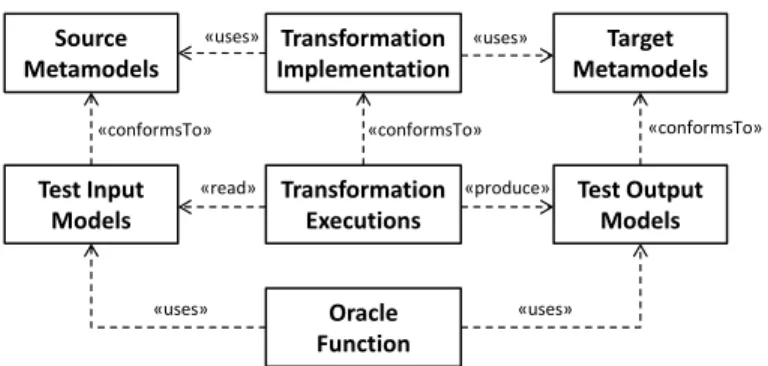
On the other hand, model transformation testing is considered as one of the main challenges in MDE [32]. Figure 1 illustrates the model transformation pattern extended for the context of model transformation testing. In order to test a given transformation implementation, a set of test input models is needed for running the transformation to obtain test output models. As soon as the output models of the transformation runs are available, the validity of the output models can be determined by using an oracle function. In the context of model transformations, model comparison may be used by defining the expected output models for given input models or
5
contracts may be applied that are evaluated over pairs of input and output models [33-35]. In this thesis, we focus on the generation of test input models. Thus, we reuse existing approaches for specifying oracle functions and transformations implementations in the context of this work.
Figure 1 Building blocks of model transformation testing
1.1.1.1 Model Transformation Example
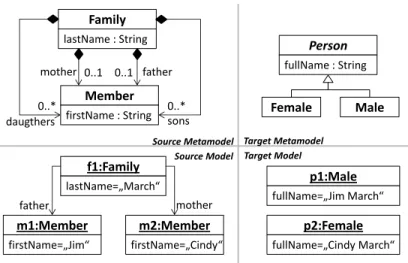
Before we proceed with discussing the relationships between test case generation and the analysis of the generated test cases, we introduce a small transformation example to explicate the definition of metamodels, models, and model transformations. The example we use for this purpose is the Families to Person example1 presented in the ATL documentation example collection. The source and target metamodels and models are illustrated in UML class diagram and UML object diagram notation, respectively, in Figure 2. In this example, the family members are transformed into persons based on their family/member relationships. Furthermore, the fullNames of persons are computed based on the concatenation of the firstName of persons and the lastName of the families. An example source/target model pair is used to exemplify these 1 http://www.eclipse.org/atl/documentation/basicExamples_Patterns/ Source Metamodels Transformation Implementation Test Input Models Target Metamodels Test Output Models Transformation Executions
«conformsTo» «conformsTo» «conformsTo»
«produce» «read» «uses» «uses» Oracle Function «uses» «uses»
6 transformation requirements.
Figure 2 Family to Person example: metamodels and example models.
In Listing 1, the corresponding ATL code for the given transformation example can be found. The transformation module consists of two helpers and two rules. Helpers are used to define reusable queries. Helpers are called from the rules which are the major elements of an ATL transformation. A rule consists of a part which is querying elements from the source models and of a to part which is generating elements in the target models and setting their features by defining bindings (cf. <- operator in Listing 1). By running this transformation for the given source model of Figure 2, the corresponding target model is produced. An example for an oracle function, to detect a possible error, may be the following requirement for the transformation: there have to be as many Person instances in the target model as we have Member instances in the source model. This may be true for the given sample source model, but for other source models, the opposite may be the case. Thus, proper means for generating test source models is needed to judge if a transformation is actually realizing the stated requirements in terms of oracle functions or not. Family lastName : String Member firstName : String Person fullName : String Male Female daugthers sons father mother 0..* 0..* 0..1 0..1 f1:Family lastName=„March“ m1:Member firstName=„Jim“ m2:Member firstName=„Cindy“ p1:Male fullName=„Jim March“ p2:Female fullName=„Cindy March“ father mother
Source Metamodel Target Metamodel
7
Listing 1: Family to Person example: ATL transformation.
moduleFamiliesToPersons; createOUT: Pers fromIN: Fam;
helpercontextFam!Member def: isFemale : Boolean =... helper contextFam!Member def: familyName : String =... ruleMember2Male {
froms:Fam!Member (not s.isFemale) tot: Pers!Male(
fullName <- s.firstName+‟ ‟+s.familyName )
}
ruleMember2Female {
froms:Fam!Member (s.isFemale) tot:Pers!Female(
fullName <- s.firstName+‟ ‟+s.familyName )
}
1.2
Problem Statement
In tackling increasing software degradation, the first thing to look is where exactly the problematic areas in the software are, in other words, to detect the design defects in the system. There have been proposed many solutions to detect those anomalies in the software system, however most of these solutions involve detecting the code smells manually. Those methods are mostly based on declarative rule specification in which the identification of the code-smells are made by the manually defined rules. Hence, code smells are identified by combinations of mainly quantitative (metrics), structural, and/or lexical information. However, manual code-smell identification process has some drawbacks. However, in an exhaustive scenario, the number of possible code-smells used to manually characterize with rules can be large. For each code-smell, rules that are expressed in terms of metric combinations need substantial calibration efforts to find the right threshold value for each metric. Another important issue is that translating symptoms into rules is not obvious because there is no consensual symptom-based
8
definition of code-smells[9]. When consensus exists, the same symptom could be associated to many code-smells types, which may compromise the precise identification of code-smell types. These difficulties explain a large portion of the high false-positive rates reported in existing research. Recently, a Search-Based Software Engineering (SBSE) approach[10], based on genetic programming[11], is used to generate code-smell's detection rules from a set of examples of code-smells identified manually by developers[7]. However, such approaches require a high number of code-smell examples (data) to provide efficient detection rules solutions. In fact, code-smells are not usually documented by developers (unlike bugs report). Thus, it is time-consuming and difficult to collect code-smells and inspect manually large systems. In addition, it is challenging to ensure the diversity of the code-smell examples to cover most of the possible bad-practices.
As the last step, we want to emphasize the importance of testing. In the current state of work, there is a lack of generating the optimum test cases which suit the specific system the most. With that inspiration, as our last step, we try to tackle this problem.
In this thesis, we are addressing how to overcome the current problems by bringing the bi level optimization approach into the picture, and getting highly good results after applying detection, maintenance, refactoring and testing steps and showing the importance how these steps are highly dependent on each other. Next sections we give a detailed description about the current problems in the existing work that our contribution is trying to solve.
9
Table 1 List of quality metrics
Metrics Description
Weighted Methods per Class (WMC) WMC represents the sum of the complexities of its methods.
Response for a Class (RFC) RFC is the number of different methods that can be executed when an object of that class receives a message.
Lack of Cohesion of Methods (LCOM) Chidamber and Kemerer define Lack of Cohesion in Methods as the number of pairs of methods in a class that does not have at least one field in common minus the number of pairs of methods in the class that does share at least one field. When this value is negative, the metric value is set to 0.
Number of Attributes (NA)
Attribute Hiding Factor (AH) AH measures the invisibilities of attributes in classes. The invisibility of an attribute is the percentage of the total classes from which the attribute is not visible. Method Hiding Factor (MH) MH measures the invisibilities of methods in classes.
The invisibility of a method is the percentage of the total classes from which the method is not visible.
Number of Lines of Code (NLC) NLC counts the lines but excludes empty lines and comments.
Coupling Between Object classes (CBO) CBO measures the number of classes coupled to a given class. This coupling can occur through method calls, field accesses, inheritance, arguments, return types, and exceptions.
Number of Association (NAS) Number of Classes (NC)
Depth of Inheritance Tree (DIT) DIT is defined as the maximum length from the class node to the root/parent of the class hierarchy tree and is measured by the number of ancestor classes. In cases involving multiple inheritances, the DIT is the maximum length from the node to the root of the tree.
Polymorphism Factor (PF) PF measures the degree of method overriding in the class inheritance tree. It equals the number of actual method overrides divided by the maximum number of possible method overrides.
Attribute Inheritance Factor (AIF) AIF is the fraction of class attributes that are inherited.
Number of Children (NOC) NOC measures the number of immediate descendants of the class.
10 1.2.1 Code Smells Detection
In this section, we introduce some issues and challenges related to the detection of code-smells. Overall, there is no general consensus on how to decide if a particular design violates a quality heuristic. In fact, there is a difference between detecting symptoms and asserting that the detected situation is an actual code-smell. For example, an object-oriented program with a hundred classes from which one class implements all the behavior and all the other classes are only classes with attributes and accessors. No doubt, we are in the presence of a Blob.
Unfortunately, in real-life systems, we can find many large classes, each one using some data classes and some regular classes. Deciding which classes are Blob candidates heavily depends on the interpretation of each analyst. In some contexts, an apparent violation of a design principle may be consensually accepted as normal practice. For example, a “Log” class responsible for maintaining a log of events in a program, used by a large number of classes, is a common and acceptable practice. However, from a strict code-smell definition, it can be considered as a class with an abnormally large coupling. Another issue is related to the definition of thresholds when dealing with quantitative information. For example, the Blob detection involves information such as class size. Although we can measure the size of a class, an appropriate threshold value is not trivial to define. A class considered large in a given program/community of users could be considered average in another. All the above issues make the process of manually defining code-smell detection rules challenging. The generation of detection rules requires a huge code-code-smell example set to cover most of the possible bad-practice behaviors. Code-smells are not usually documented by developers (unlike bugs report). Thus, it is time-consuming and difficult to collect code-smells and inspect manually large systems [13]. In addition, it is challenging to
11
ensure the diversity of the code-smell examples to cover most of the possible bad-practices then using these examples to generate good quality of detection rules.
We address the open issues related to applying code smells detection approaches.
Problem 1.2.1.1 The vast majority of existing work in code-smells detection relies on declarative rule specification [7, 29, 30]. In these settings, rules are manually defined to identify the key symptoms that characterize a code-smell using combinations of mainly quantitative (metrics), structural, and/or lexical information. However, in an exhaustive scenario, the number of possible code-smells used to manually characterize with rules can be large.
Problem 1.2.1.2 For each code-smell, rules that are expressed in terms of metric combinations need substantial calibration efforts to find the right threshold value for each metric.
Problem 1.2.1.3 Another important issue is that translating symptoms into rules is not obvious because there is no consensual symptom-based definition of code-smells [7, 31]. When consensus exists, the same symptom could be associated to many code-smells types, which may compromise the precise identification of code-smell types.
Problem 1.2.1.4 Recently, Search-Based Software Engineering (SBSE) approach, based on genetic programming is used to generate code-smells detection rules from a set of examples of code-smells identified manually by developers [7]. However, such approaches require a high number of code-smell examples (data) to provide efficient detection rules solutions. In
12
fact, code-smells are not usually documented by developers (unlike bugs report). Thus, it is time-consuming and difficult to collect code-smells and inspect manually large systems. Problem 1.2.1.5 It is challenging to ensure the diversity of the code-smell examples to cover most of possible bad-practices.
1.2.2 Model Transformation Testing
1.2.2.1 Open Issue: Marrying Generation & Analysis of Test Input Models
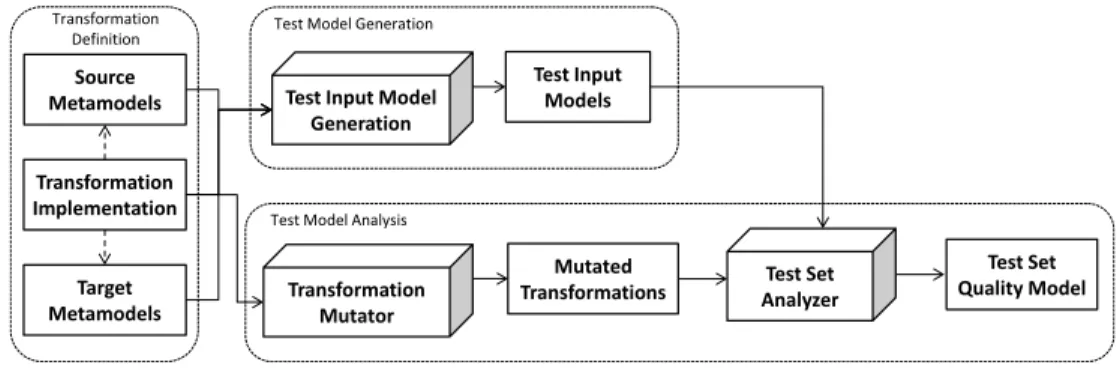
For the generation of test models, several different techniques (e.g.,[36-39] to mention just a few) are available that are based on different notions of coverage criteria. While some approaches focus mainly on black-box criteria such as metamodel coverage (e.g., which meta-classes and which meta-features are actually instantiated by the test models), other approaches focus on white-box criteria such as transformation coverage (e.g., rule, statement, or path coverage). These approaches support model generator components (cf. upper part of Figure 3) that are mostly based on constraint satisfaction techniques such as CSP or SAT. In particular, they transform the metamodels and/or model transformations to constraints which are solved in order to provide the requested test data.
Of course, the coverage criteria is only an approximation for the fitness of a set of test input models. In order to determine the effectiveness of a test set, mutation-based analysis of test sets for model transformations have been proposed[40, 41] and applied in several studies to compare the appropriateness of different coverage criteria, e.g., see [42].
13
Figure 3 Uni-directional relationship between test model generation and analysis
In the context of model transformations, mutation testing is achieved by defining a set of mutation operators based on fault models, i.e., typical errors that occur, for model transformations which are applied to the model transformation implementation. The result of applying the mutation operators to a model transformation is called a mutant (cf. lower part of Figure 3). The mutant is killed if the test input models are able to detect the mutation, i.e., one test should fail. The goal is to kill as many mutations as possible for a given set of input models. For instance, a mutant of the transformation in Listing 1 may be produced by changing the type of the output element (cf. to part) of the second rule from Female to Male or by deleting the bindings for setting the fullName values in the output models. Mutation-based analysis is mostly used as a post-generation activity for quality assurance as can be seen in Figure 3. The model generation phase feeds the analysis phase, but not the other way round. However, we propose to consider the relationship between generation and analysis as a bi-directional one. Instead of “just” evaluating the quality, the evaluation results may be again propagated to the model generation component in order to improve automatically the set of test input models.
Source Metamodels Target Metamodels Transformation Implementation
Test Input Model Generation Test Input Models Test Set Analyzer Transformation Mutator Mutated Transformations Test Set Quality Model Transformation
Definition Test Model Generation
14
1.3
Proposed Solutions
To address the above mentioned problems, we propose the following solutions which are organized into four principal contributions. First of all, we want to talk about Bi-Level optimization since in all our contributions it is the main part.
1.3.1 Contribution 1: Bi-Level Code Smells Detection
In this thesis, we introduce a novel formulation of the code-smells detection as a bi-level problem. We report the results of an empirical study with an implementation of our bi-level approach. The obtained results provide evidence to support the claim that our proposal is more efficient, on average, than existing techniques based on a benchmark of 9 open source systems and 1 industrial project. We also evaluate the relevance and usefulness of the detected code-smells for software engineers to improve the quality of their systems.
Contribution 1.1 We have proposed a bi-level evolutionary optimization approach. The upper-level optimization produces a set of detection rules, which are combinations of quality metrics, with the goal to maximize the coverage of not only a code-smell example base but also a lower-level population of artificial code-smells.
Contribution 1.2 The lower-level optimization tries to generate artificial code-smells that cannot be detected by the upper-level detection rules, thereby emphasizing the generation of broad-based and fitter rules.
Contribution 1.3 The statistical analysis of the obtained results over nine studied software systems have shown the competitiveness and the outperformance of our proposal in terms of
15
precision and recall over a single-level genetic programming, co-evolutionary, and non-search-based methods.
1.3.2 Contribution 2: Model Transformation Testing
A novel formulation of model transformation testing as a bi-level optimization problem is introduced. We report the results of an empirical study with an implementation of our bi-level approach. The obtained results provide evidence to support the claim that our proposal is more efficient, on average, than an existing technique based on metamodels coverage.
Contribution 2.1 In our adaptation, the upper level generates a set of test cases (models) which maximizes the coverage of source and target metamodels; and mutants (errors introduced in the rules/program) are generated by the lower level.
Contribution 2.2 The lower level maximizes the number of errors that cannot be detected by test cases produced by the upper level. The errors are detected by comparing the target models produced by both programs (rules) at the lower (mutants) and upper levels. If they are the same, we can assume that the test cases were not sufficient to cover all the transformation possibilities. Contribution 2.3 The overall problem appears as a BLOP task, where for each generated test cases, the upper level observes how the lower-level acts by generating errors/mutants that cannot be detected by the upper level (leader) test cases, and then chooses the best test cases which suits it the most, taking the actions of the errors generation process (lower level or follower) into account.
16
Contribution 2.4 The main advantage of our bi-level formulation is that the generation of test cases is not limited to the metamodels coverage but it allows evaluating the ability of generated test cases to detect errors and their coverage of transformation possibilities.
Contribution 2.5 In addition, we considered in our approach the dependency between mutation analysis and test cases generation and we do not consider them as two separate steps. We implemented our proposed bi-level approach and evaluated it on two different ATL transformation programs.
17
Chapter 2:
Related Work
2.1
Bi-Level Optimization Technique
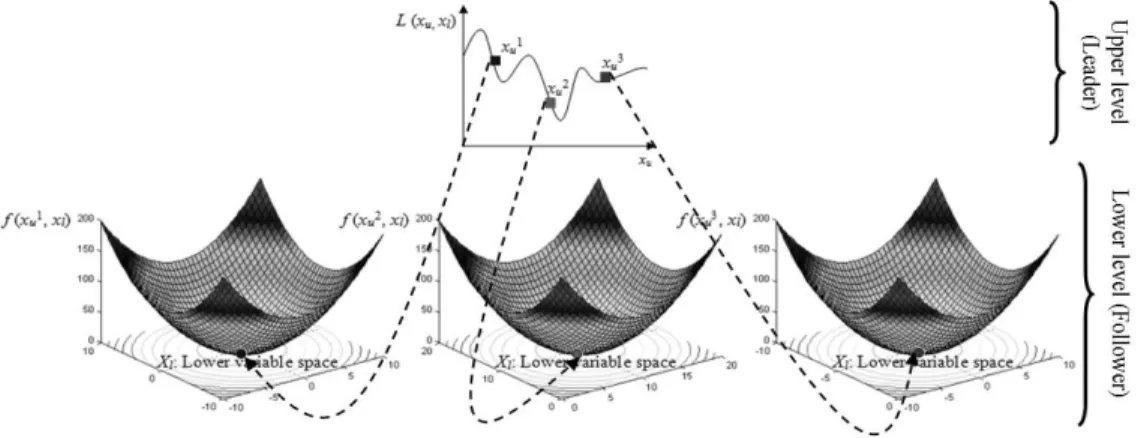
Most studied real-world and academic optimization problems involve a single level of optimization. However, in practice, several problems are naturally described in two levels. These latter are called BLOPs[43]. In such problems, we find a nested optimization problem within the constraints of the outer optimization one. The outer optimization task is usually referred as the
upperlevel problem or the leader problem. The nested inner optimization task is referred as the
lower level problem or the follower problem, thereby referring the bi-level problem as a leader-follower problem or as a Stackelberg game[44]. The leader-follower problem appears as a constraint to the upper level, such that only an optimal solution to the follower optimization problem is a possible feasible candidate to the leader one. A BLOP contains two classes of variables: (1) the upper level variables xuXU n and (2) the lower level variables xlXLm. For the follower problem, the optimization task is performed with respect to the variables , and the variables act as fixed parameters. Thus, each corresponds to a different follower problem, whose optimal solution is a function of and needs to be determined. All variables (xu,xl)are considered in the leader problem, but are not changed (cf. Figure 1). In what follows, we give the formal definition of BLOP:
Definition 1: Assuming L:nm to be the leader problem andf :nm to be the
18 ) , ( ,x X u l X x x x L Min L l U u subject to
K k x x G J j x x g x x f ArgMin x l u k l u j l u l ,..., 1 , 0 ) , ( ,..., 1 , 0 ) , ( ), , (BLOPs are intrinsically more difficult to solve than single-level problems, it is not surprising that most of existing studies to date has tackled the simplest cases of BLOPs, i.e., problems having nice properties such as linear, quadratic or convex objective and/or constraint functions. In particular, the most studied instance of BLOPs has been for a long time is the linear case in which all objective functions and constraints are linear with respect to the decision variables. Although the first works on bi-level optimization date back to the seventies, it was not until the early eighties that the usefulness of these mathematical programs in modeling hierarchical decision processes and engineering problems prompted researchers to pay close attention to BLOPs. A first bibliographical survey on the subject was written by Kolstad [43] in mid-eighties. BLOPs being intrinsically more difficult than single-level problems, it is not surprising that most algorithmic research to date has tackled the simplest cases of BLOPs, i.e., problems having nice properties such as linear, quadratic or convex objective and/or constraint functions[45, 46]. In particular, the most studied instance of BLOPs has been for a long time the linear case in which all objective functions and constraints are linear with respect to the decision variables[47, 48].
19
Figure 4 Illustration of the two levels of an exemplified bi-level single-objective optimization problem.
Existing methods to solve BLOPs could be classified into two main families: (1) classical methods and (2) evolutionary methods. The first family includes extreme point-based approaches[49], branch-and-bound[46], complementary pivoting[50], descent methods[51], penalty function methods [51], trust region methods[52], etc. The main shortcoming of these methods is that they heavily depend on the mathematical characteristics of the BLOP at hand. The second family includes meta-heuristic algorithms that are mainly Evolutionary Algorithms (EAs). Recently, several EAs have demonstrated their effectiveness in tackling such type of problems thanks to their insensibility to the mathematical features of the problem in addition to their ability to tackle large-size problem instances by delivering satisfactory solutions in a reasonable time. Some representative works are by [44, 53, 54].
To the best of our knowledge and based on recent surveys [55, 56], there is no work in the software engineering literature that considers a software engineering problem as a bi-level one.
20
2.2
Code-Smells Detection
The vast majority of existing work in code-smells detection relies on declarative rule specification[17]. In these settings, rules are manually defined to identify the key symptoms that characterize a code-smell using combinations of mainly quantitative (metrics), structural, and/or lexical information. However, in an exhaustive scenario, the number of possible code-smells used to manually characterize with rules can be large. For each code-smell, rules that are expressed in terms of metric combinations need substantial calibration efforts to find the right threshold value for each metric. Another important issue is that translating symptoms into rules is not obvious because there is no consensual symptom-based definition of code-smells[9]. When consensus exists, the same symptom could be associated to many code-smells types, which may compromise the precise identification of code-smell types. These difficulties explain a large portion of the high false-positive rates reported in existing research. Recently, a Search-Based Software Engineering (SBSE) approach[64], based on genetic programming[97], is used to generate code-smell's detection rules from a set of examples of code-smells identified manually by developers[7]. However, such approaches require a high number of code-smell examples (data) to provide efficient detection rules solutions. In fact, code-smells are not usually documented by developers (unlike bugs report). Thus, it is time-consuming and difficult to collect code-smells and inspect manually large systems. In addition, it is challenging to ensure the diversity of the code-smell examples to cover most of the possible bad-practices. There are several studies that have recently focused on detecting code-smells in software using different techniques. These techniques range from fully automatic detection to guided manual inspection.
21 2.2.1 Interactive-based approaches
In [4], Fowler and Beck have described a list of design smells that may exist in the program. They suggested that the software maintainers should manually inspect the program to detect existing design smells. In addition, they specify particular refactorings for each code-smell type. Travassos et al. [16] have also proposed a manual approach for detecting code-smells in object-oriented designs. The idea is to create a set of “reading techniques” that help a reviewer to “read” a design artifact for finding relevant information. These reading techniques give specific and practical guidance for identifying code-smells in object-oriented design. In this way, each reading technique helps the maintainer focusing on some aspects of the design, in such a way that the inspection team applying the entire family should achieve a high degree of coverage of the design code-smells. In addition, in [57], another proposed approach is based on violations of design rules and guidelines. This approach consists of analyzing legacy code, specifying frequent design problems as queries and locating the occurrences of these problems in a model derived from the source code. The high rate of false-positives generated by the above-mentioned approaches encouraged other teams to explore semi-automated solutions. These solutions took the form of visualization-based environments. The primary goal is to take advantage of the human capability to integrate complex contextual information in the detection process. Kothari et al. [58] present a pattern-based framework for developing tool to detect software anomalies by representing potential code-smells with different colors. Dhambri et al. [59] have proposed a visualization-based approach to detect design anomalies by automatically detecting some symptoms and letting others to a human analyst. The visualization metaphor was chosen specifically to reduce the complexity of dealing with a large amount of data. Although
22
visualization-based approaches are efficient to examine potential code-smells on their program and in their context, they do not scale to large systems easily. In addition, they require great human expertise, and thus they are still time-consuming and error-prone strategies. Moreover, the information visualized is mainly metric-based, meaning that complex relationships can be difficult to detect. Indeed, since visualization approaches and tools such as VERSO [59] are based on manual and human inspection, they are still, not only, slow and time-consuming, but also subjective.
The main disadvantage of existing manual and interactive-based approaches is that they are ultimately a human-centric process which requires a great human effort and strong analysis and interpretation effort from software maintainers to find design fragments that correspond to code-smells. In addition, these techniques are time-consuming, error-prone and depend on programs in their contexts.
2.2.2 Symptom-based detection
Moha et al. [60] started by describing code-smell symptoms using a domain-specific-language (DSL) for their approach called DECOR. They proposed a consistent vocabulary and DSL to specify anti-patterns based on the review of existing work on design code-smells found in the literature. Symptom descriptions are later mapped to detection algorithms. However, converting symptoms into rules needs a significant analysis and interpretation effort to find the suitable threshold values. In addition, this approach uses heuristics to approximate some notions, which results in an important rate of false positives. Indeed, this approach has been evaluated on only four well-known design code-smells: the Blob, functional decomposition, spaghetti code, and
23
Swiss-army knife because the literature provides obvious symptom descriptions on these code-smells. Recently, another probabilistic approach has been proposed by Khomh et al. [30] extending the DECOR approach [60], a symptom-based approach, to support uncertainty and to sort the code-smell candidates accordingly using a Bayesian Belief Network (BBN). The detection outputs are probabilities that a class is an occurrence of a code-smell type, i.e., the degree of uncertainty for a class to be a code-smell. They also showed that BBNs can be calibrated using historical data from both similar and different context. Similarly, Munro et al.[8] have proposed a template-based approach using a precise definition of bad smells from the informal descriptions given by the originators Fowler and Beck [4]. The template consists of three main parts: a code-smell's name, a text-based description of its characteristics, and heuristics for its detection.
In another category of work based on the use quality metrics, Marinescu et al. [17] have proposed a mechanism called "detection strategy" for formulating metrics-based rules that capture deviations from good design principles and heuristics. Detection strategies allow to a maintainer to directly locate classes or methods affected by a particular design code-smell. As such, Marinescu has defined detection strategies for capturing around ten important flaws of object-oriented design found in the literature. After his suitable symptom-based characterization of design code-smells, Salehie et al.[61] proposed a metric-based heuristic framework to detect and locate object-oriented design flaws similar to those illustrated by Marinescu [17]. It is accomplished by evaluating design quality of an object-oriented system through quantifying deviations from good design heuristics and principles by mapping these design flaws to class level metrics such as complexity, coupling and cohesion by defining rules. Erni et al. [53]
24
introduce the concept of multi-metrics, as an n-tuple of metrics expressing a quality criterion (e.g., modularity). Unfortunately, multi-metrics neither encapsulate metrics in a more abstract construct, nor do they allow a flexible combination of metrics.
Van Emden and Moonen[16] developed one of the first automated code-smells detection tools for Java programs. They developed a prototype code-smells browser that detects and visualizes code-smells in Java programs. Mantyla studied the manner of how developers detect and analyse code-smells[9]. Previous empirical studies have analyzed the impact of code-smells on different software maintainability factors [18]. In fact, software metrics (quality indicators) are sometimes difficult to interpret and suggest some actions (refactoring) as noted by Anda et al.[18] and Marinescu et al.[21]. In addition, Yamashita et al.[22] show that the different types of code-smells can cover different maintainability factors[12]. In other studies, Yamashita et al.[62] analyzed the benefits of detecting code-smells on several industrial projects and evaluated their impact on different maintainability aspects. Recently, Palomba et al. [24] used the history of changes to detect code-smells instead of the use of quality metrics. For example, classes that change frequently are considered as a blob. A comparison with DECOR confirms the outperformance of their approach and the benefits of the use of the history of changes for the detection of code-smells.
2.2.3 Search-based Approaches
SBSE [10] uses search-based approaches to solve optimization problems in software engineering. After the formulation of software engineering task as a search problem, many search algorithms can be applied to solve that problem. In [63], we have proposed another
25
approach, based on search-based techniques, for the automatic detection of potential code-smells in code. We used the notion that the more code deviates from good practices, the more likely it is bad. In another work [7], we generated detection rules defined as combinations of metrics/thresholds that better conform to known instances of bad-smells (examples). Then, the correction solutions, a combination of refactoring operations, should minimize the number of bad-smells detected using the detection rules. Thus, our previous work treats the detection and correction as two different steps.
Based on recent SBSE surveys[63, 64], the use of bi-level optimization is still very limited in software engineering. Indeed, this work represents the first attempt to use bi-level optimization to address software engineering problem.
2.3
Model Transformation Testing
Several techniques have been proposed to generate test cases for model transformations [32, 33, 37, 38, 40, 104]. The majority of them generate models conforming to source metamodels in order to maximize the coverage of metamodels. With respect to the contribution of this thesis, we organize related work into two categories. First, we survey approaches used for test input model generation, and second, we elaborate on approaches used for mutation-based analysis of test input models. We base our related work categorization on recent surveys on model transformation testing approaches.
2.3.1 Test Input Model Generation
26
general approaches: black-box based approaches and white-box based approaches. Regarding white-box-based methods in the area of model transformations, Küster et al. [36] assume the existence of a high-level design of model transformations to produce test cases. Consequently, to apply this approach to existing model transformations such as ATL transformations, the manual extraction of these conceptual transformation rules is required, being in contrast to our vision of testing these transformations directly and automatically. In Gonzáles & Cabot [38] a very interesting white-box based testing approach for ATL transformations is provided by extracting OCL constraints from ATL code to automate the generation of test input models. The generation of test cases from Triple Graph Grammars is discussed in [30].
Besides white-box testing, many approaches have been proposed for black-box testing, i.e., test source models may be generated either on basis of the source metamodels as done in [9,10,20], the specified requirements, for instance, as visual contracts [14], as done in [13,21], or both [19]. For the actual test source model generation, most of these approaches rely–similar to software engineering–on constraint satisfaction, e.g., by means of SAT solvers. Finally, the Tracts approach [22,23,44] provides a semi-automatic approach, since the transformation designer must specify a generation script on basis of the declarative ASSL language [11]. Other approaches are using fully manually engineered test input and output models, especially ones that are using model comparison as oracle function [17].
Finally, in [15] we presented an approach to test model transformations based on existing input/output model pairs that are equipped with trace links. By analyzing trace links produced by new transformation runs, one may detect errors in transformation implementations when having untypical trace links for newly transformed models. Regression testing for model transformations
27
when metamodels evolve based on search-based techniques has been discussed in [27]. Another work [28] discusses the application of a bacteriologic algorithm [29] (an extension of genetic algorithm) to the generation of test cases in order to find an optimal solution with respect to metamodel coverage.
To sum up, none of the aforementioned approach has considered the application of mutation-based analysis for actively guiding the generation of test input models.
2.3.2 Mutation-based Analysis of Transformations
The application of mutation analysis for a set of test input models to predict the quality of the test set is elaborated in several publications [18,24,31]. The first two papers discuss different mutation operators for model transformations. Regarding the application of mutation-based analysis of model transformations test data, different coverage criteria (mostly black-box ones) have been evaluated by means of mutation testing (cf., e.g., [13,20]). In [31] coverage criteria are defined based on mutation testing for programmed graph transformations. The only work we are aware of combining mutation analysis with the adaption of test cases is presented in [25], however there are two main differences compared to our work. First, in our approach we introduce mutants more guided by having the competition between the two levels of our bi-level approach instead of generating mutations fully randomly, and second, we do not only use as stopping criterion that 100% of mutations are detected, because this may be also due to the fact that the introduced mutants are easy to detect independent of how good the test cases are.
28
Chapter 3:
Code-Smells Detection as a Bi-Level Problem
3.1
Introduction
In this work, we start from the observation that the generation of efficient code-smells detection rules heavily depends on the coverage and the diversity of the used code-smell examples. In fact, both mechanisms for the generation of detection rules and the generation of code-smell examples are dependent. Thus, the intuition behind this work is to generate examples of code-smell that cannot be detected by some possible detection rules solutions then adapting these rules-based solutions to be able to detect the generated code-smell examples. These two steps are repeated until reaching a termination criterion (e.g. number of iterations). To this end, we propose, for the first time, to consider the code-smell's detection problem as a bi-level one [52]. Bi-Level Optimization Problems (BLOPs) are a class of challenging optimization problems, which contain two levels of optimization tasks[43]. In these problems, the optimal solutions to the lower level problem become possible feasible candidates to the upper level problem. In our adaptation, the upper level generates a set of detection rules, combination of quality metrics, which maximizes the coverage of the base of code-smell examples; and artificial code-smells are generated by the lower level. The lower level maximizes the number of generated “artificial” code-smells that cannot be detected by the rules produced by the upper level. The overall problem appears as a BLOP task, where for each generated detection rule, the upper level observes how the lower-level acts by generating artificial code-smells that cannot be detected by the upper level (leader) rule, and then chooses the best detection rule which suits it the most, taking the actions of the
code-29
smells generation process (lower level or follower) into account. The main advantage of our bi-level formulation is that the generation of detection rules is not limited to some code-smell examples identified manually by developers that are difficult to collect but it allows the prediction of new code-smell behaviours that are different from those in the base of examples.
We implemented our proposed bi-level approach and evaluated it on several open source systems: JFreeChart, GanttProject, ApacheAnt, Nutch, Log4J, Lucene, Xerces-J, and Rhino. In addition, we evaluated our proposal on one industrial system provided by our industrial partner, i.e., the Ford Motor Company. We found that, on average, the majority of seven types of code-smells were detected with more than 86% of precision and 90% of recall. The statistical analysis of our experiments over 31 runs shows that BLOP performed significantly better than two existing search-based approaches[7, 98] and a practical code-smell detection technique [60]. The software developers considered in our experiments confirm the relevance of the detected code-smells for several maintenance activities.
The primary contributions of this chapter can be summarized as follows:
(1) The chapter introduces a novel formulation of the code-smell's detection as a bi-level problem.
(2) The chapter reports the results of an empirical study with an implementation of our bi-level approach. The obtained results provide evidence to support the claim that our proposal is more efficient, on average, than existing techniques based on a benchmark of 9 open source systems and 1 industrial project. The chapter also evaluates the
30
relevance and usefulness of the detected code-smells for software engineers to improve the quality of their systems.
3.2
Approach
This section shows how the above-mentioned issues can be addressed using bi-level optimization and describes the principles that underlie the proposed method for detecting code-smells. We first present an overview of our bi-level code-smells detection approach, and then we describe the details of our bi-level formulation including the adaptation of both lower and upper levels. The concept of bi-level is based on the idea that the main optimization task is usually termed as the upper level problem, and the nested optimization task is referred to as the lower level problem. The detection rules generation process has a main objective which is the generation of detection rules that can cover as much as possible the code-smells in the base of examples. The code-smell's generation process has one objective that is maximizing the number of generated artificial code-smells that cannot be detected by the detection rules and that are dissimilar from the base of well-designed code examples. There is a hierarchy in the problem, which arises from the manner in which the two entities operate. The detection rules generation process has higher control of the situation and decides which detection rules for the code-smells generation process to operate in. Therefore, in this framework, we observe that the detection rules generation process acts as a leader (the important output of the problem), and the code-smells generation process acts as a follower.
31
The overall problem appears as a bi-level optimization task, where for each generated detection rules, the upper level observes how the lower-level acts by generating artificial code-smells that cannot be detected by the upper level (leader) rules and then chooses the best detection rules which suit it the most, taking the actions of the code-smells generation process (lower level or follower) into account. It should be noted that in spite of different objectives appearing in the problem, it is not possible to handle such a problem as a simple multi-objective optimization task. The reason for this is that the leader cannot evaluate any of its own strategies without knowing the strategy of the follower, which it obtains only by solving a nested optimization problem.
Figure 5 Approach Overview
As described in Figure 2, the leader (upper level) uses knowledge from code-smells examples (input) to generate detection rules based on quality metrics (input). It takes as inputs a base (i.e. a set) of code-smells‟ examples, and takes, as controlling parameters, a set
32
of quality metrics and generates as output a set of rules. The rule generation process chooses randomly, from the metrics provided list, a combination of quality metrics (and their threshold values) to detect a specific code-smell. Consequently, the solution is a set of rules that best detect the code-smells of the base of examples. For example, the following rule states that a class c having more than NAD=10 attributes and more than NMD=20 methods is considered as a blob smell:
R1: IF NAD(c)≥10 AND NMD(c)≥20, THEN Blob(c).
In this exemplified sample rule, the number of attributes (NAD) and the number of methods (NMD) of a class correspond to two quality metrics that are used to detect a blob. The detected smells can be method(s) or class(es) depending on the type of the smells to detect. Given the above detection rule, it is not obvious what set of diverse code-smells exist in the software. In the bi-level formulation of the code-smell detection problem, the lower level problem allows us to find just that. An upper-level detection rules solution is evaluated based on the coverage of the base of code-smell examples (input) and also the coverage of generated “artificial” code-smells by the lower-level problem. These two measures are used to be maximized by the population of detection rules solutions. The follower (lower level) uses well-designed code examples to generate “artificial” code-smells based on the notion of deviation from a reference (well-designed) set of code fragments. The generation process of artificial code-smell examples is performed using a heuristic search that maximizes on one hand, the distance between generated code-smell examples and