P R I F Y S G O L
C
ae
RD
y
£>
C ou n ter In tru sion Softw are
M alw are D e te c tio n u sin g S tru ctu ral
and B eh a v io u ra l F eatu res and
M ach in e L earning
by
Joseph R abaiotti
School of Computer Science Cardiff University
A thesis submitted in partial fulfilment of the requirement for the degree of Doctor of Philosophy
All rights reserved
INFORMATION TO ALL USERS
The quality of this reproduction is dependent upon the quality of the copy submitted.
In the unlikely event that the author did not send a complete manuscript and there are missing pages, these will be noted. Also, if material had to be removed,
a note will indicate the deletion.
Dissertation Publishing
UMI U584957
Published by ProQuest LLC 2013. Copyright in the Dissertation held by the Author. Microform Edition © ProQuest LLC.
All rights reserved. This work is protected against unauthorized copying under Title 17, United States Code.
ProQuest LLC
789 East Eisenhower Parkway P.O. Box 1346
This work has not previously been accepted in substance for any degree and is not concurrently submitted in candidature for any degree.
Signed (candidate) Date
STATEMENT 1
This thesis is being submitted in partial fulfillment of the requirements for the degree of
(inoort MGh , MD, MPhil, PhD e tc, ao appropriate?)
Signed ... . i S . . ... (candidate) Date . . 3 $
J..Q P.
STATEMENT 2
This thesis is the result of my own independent work/investigation, except where otherwise stated. Other sources are acknowledged by explicit references.
S ig n e d iS .r. (candidate) Date
STATEMENT 3
I hereby give consent for my thesis, if accepted, to be available for photocopying and for inter- library loan, and for the title and summary to be made available to outside organisations.
Abstract
Over the past twenty-five years malicious software has evolved from a minor annoyance to a m ajor security threat. Authors of malicious software are now more likely to be organised criminals than bored teenagers, and modern malicious software is more likely to be aimed at stealing d ata (and hence money) than trashing data. The arms race between malware authors and m anufacturers of anti-malware software continues apace, but despite this, the m ajority of anti-malware solutions still rely on relatively old technology such as signature scanning, which works well enough in the majority of cases but which has long been known to be ineffective if signatures are not updated regularly.
The need for regular updating means there is often a critical window between the publication of a flaw exploitable by malware and the distribution of the appropriate counter measures or signature. At this point a user system is open to attack by hitherto unseen malware. The object of this thesis is to determine if it is practical to use machine learning techniques to abstract generic structural or behavioural features of malware which can then be used to recognise hitherto unseen examples.
Although a sizeable amount of research has been done on various ways in which malware detection might be autom ated, most of the proposed methods are burdened by excessive complexity. This thesis looks specifically at the possibility of using learning systems to classify software as malicious or nonmalicious based on easily-collectable structural or behavioural data. On the basis of the experimental results presented herein it may be concluded th at classification based on such structural d ata is certainly possible, and on behavioural d ata is at least feasible.
Acknowledgements
P erso n a l ack n ow led gem en ts
I would like to thank my supervisor Professor Antonia Jones for her support and encouragement during the past three years. I must also thank my friend Stuart Goring, without whose keen observations C hapter 3 would not have come into being, my parents Robert and Carole for supporting me financially and providing me with accommodation for the first two and a half years, and Mark, for supporting and putting up with me for the remainder of the time and without wdiose love and encouragement this thesis could never have been written.
T echnical ack n ow led gem en ts
I must also acknowdedge the significant contribution to this work made by the authors of the wTebsite winch hosted the virus/m afware library, without winch this wTork could not have proceeded. I hope they will forgive me for not naming them explicitly, but they probably knowT wTho they are.
Work of this type is not without risk and approaches a grey area of UK Lawr. Everyone involved has taken great pains to remain within the lawT as wre understand it. Con siderable thought and discussion occurred within the School and University, before agreements wTere reached winch ensured th at the wTork could be undertaken safely, i.e. th at no harm wxmld be caused by the study. A number of precautions wrere put in place in order to isolate, and limit access to, the computers used in this wrork. There fore, thanks are also due to my Supervisor Professor Antonia J. Jones, the Head of the Cardiff School of Computer Science Professor Nick Fiddian, Robert Evans of the School’s Computer Support Group, to the University level Computer Support team in INSRV, and to the Corporate Compliance and HR sections in the University,1 wiio collectively, and somewhat courageously, trusted me sufficiently to allowr the wrork to go forwrard.
Contents
C o n ten ts 3
List o f F igu res 9
List o f T ables 11
1 In tro d u ctio n 14
1.1 W hat Is Malicious S o ftw are?... 14
1.2 The Connectivity I s s u e ... 15
1.3 Combat Approaches ... 19
1.4 Scope and A i m ... 20
1.4.1 H y p o th e s e s ... 20
1.4.2 A im s ... 20
1.4.3 Principal C o n trib u tio n s... 21
2 H isto rica l B ackground and L iterature R eview 22 2.1 Types of M a lw a re ... 22 2.1.1 V iru ses... 23 2.1.2 W o rm s ... 27 2.1.3 O ther Email T r i c k s ... 28 2.1.4 Trojan H o r s e s ... 29 2.1.5 B a c k d o o rs ... 29 2.1.6 Spyware and A d w a r e ... 30
2.1.7 Botnets and DDoS A tta c k s... 32
2.1.8 R o o tk its ... 35
2.1.9 Malware P a y lo a d s... 35
2.2 Vulnerabilities exploited by malware ... 36
2.2.1 Code Injection ... 36
2.2.2 Buffer O v e rflo w ... 36
2.3 Malware Naming C o n v e n tio n s... 37
2.4 Detection and Prevention T e c h n iq u e s... 38
2.4.1 Heuristic Scanners ... 40
2.4.2 Structure-Based D e te c tio n ... 41
2.4.3 Activity M o n ito rs... 41
2.4.4 Behaviour-Based Anomaly D e te c tio n ... 42
2.5 Detection Countermeasures ... 42
2.5.1 Heuristic Frustration: C o n c e a lm e n t... 43
2.5.2 Polymorphism and M etamorphism ... 43
2.5.3 Encryption and P a c k i n g ... 43
2.5.4 R etro v iru ses... 44
2.6 Malware and the L a w ... 44
2.7 Literature R ev iew ... 45
2.7.1 In tro d u c tio n ... 45
2.7.2 Early Research and Theory ... 46
2.7.3 Practical Detection S y s te m s ... 48
2.7.4 Static and Semantic Analysis ... 49
2.8 Tools and Sources of I n f o r m a tio n ... 54
3 T h e law o f u n in ten d ed consequences: a case stu d y 55 3.1 In tro d u c tio n ... 55
3.2 D isc la im e r... 56
3.3 Unintended consequences... 56
3.4 The login pro ced u re... 57
3.5 The V u ln e ra b ility ... 58
3.6 Attack M e th o d o lo g y ... 59
3.7 Probabilistic A n aly sis... 61
4 M ach in e learning classification m eth o d s and sy stem s 66 4.1 In tro d u c tio n ... 66 4.2 Classification m e t h o d s ... 66 4.2.1 Decision T re e s ... 67 4.2.2 Naive B a y e s ... 68 4.2.3 Artificial Neural N e tw o r k s ... 69
4.3 Classifier Implementations: Machine Learning S y s t e m s ... 70
4.3.1 C 4 . 5 ... 71
4.3.2 W E K A ... 73
4.4 C onclusion... 74
5 G a th erin g stru ctu ral and b eh aviou ral d ata in W indow s 76 5.1 In tro d u c tio n ... 76
5.2 Structural D a t a ... 77
5.2.1 W hat sort of d ata to u s e ? ... 77
5.2.2 The Portable Executable (PE) file format ... 77
5.2.3 The PE H e a d e r ... 79
5.2.4 Sections and the Section T a b le ... 79
5.2.5 Viruses and the PE f o r m a t... 80
5.2.6 Collecting Structural D a t a ... 87
5.3 Behavioural Monitoring ... 88
5.3.1 The collection of real-time process d a t a ... 88
5.3.2 Behavioural D ata Gathering M e th o d s ... 97
5.3.3 Two Means of M o n ito r in g ... 99
5.3.4 Windows Performance D a t a ... 100
5.3.5 Lower-Level M e th o d s ... 102
5.3.6 Collecting Other Relevant Behavioural D a t a ...103
5.3.7 Behavioural Monitoring: Conclusion ...104
6 S tru ctu ral id en tification ex p erim en ts 106 6.1 In tro d u c tio n ... 106
6.2 Methodology ...106
6.2.1 The data-gathering p r o g r a m ... 107
6.2.2 The source d a ta s e ts ... 109
6.2.3 Creating experimental d a t a s e t s ... 110
6.2.4 Splitting into Training and Test sets ... 110
6.3 R e s u lts ... 110
6.3.1 The kappa statistic k ... I l l 6.3.2 B a s e lin e ... I l l 6.3.3 Learning c u r v e s ... I l l 6.3.4 Experiment One ...113 6.3.5 Experiment T w o ...114 6.3.6 Experiment Three ...115 6.3.7 Experiment F o u r ... 116 6.3.8 Experiment Five ... 117 6.4 A n a ly s is ... 118 6.4.1 General T r e n d s ... 118 6.4.2 S p e cific s... 119 6.5 C onclusion... 120
7 B eh aviou ral id en tification e x p e r im e n ts 121 7.1 In tro d u c tio n ...121
7.2 Methodology ... 121
7.3 The D ata-G athering P r o g r a m ...122
7.3.1 Real-time D a t a ... 123 7.3.2 Choice of Malicious E x a m p le s ...123 7.3.3 Final D a ta s e ts ... 124 7.4 R e s u lts ...124 7.4.1 Experiment One ...125 7.4.2 Experiment T w o ...125 7.4.3 Experiment Three ... 126 7.4.4 Experiment F o u r ...127 7.5 C o n c lu s io n s ...128
8 C on clu sion s and Future W ork 129
8.1 E v a lu a tio n ... 129
8.2 The Original hypotheses and the final c o n tr ib u tio n ... 130
8.3 The PhD: A retrospective r e v i e w ... 131
8.4 Future W o rk ... 132
8.4.1 Anomaly D e te c tio n ...134
8.4.2 Combining Anomaly Detection and A u th e n tic a tio n ...134
8.4.3 A Network for Malware R e s e a r c h ...135
8.4.4 A Complete Protection S y s t e m ... 136
8.5 Final T h o u g h t s ...138
A p p en d ix A D eta iled S tru ctu ral R e su lts 140 A .l Experiment One: detecting specific categories of m a lw a re ... 141
A. 1.1 V irus-N onM al... 141
A. 1.2 T ro jan -N o n M a l...142
A. 1.3 Backdoor-NonM al...143
A. 1.4 Worm-NonMal ...144
A.2 Experiment Two: pairwise malware co m p ariso n s... 145
A.2.1 Backdoor-W orm ...145
A.2.2 T ro ja n -B a c k d o o r...147
A.2.3 T ro ja n -W o rm ... 148
A.2.4 V iru s-B ack d o o r...149
A.2.5 Virus-Trojan ... 150
A.2.6 V irus-W orm ... 151
A .3 Experiment Three: three-way comparisons of m alw are...152
A.3.1 Backdoor-Trojan-Worm ...152
A.3.2 Backdoor-Virus-Troj a n ...153
A.3.3 B ackdoor-V irus-W orm ...154
A.3.4 Trojan-V irus-W orm ... 155
A.4 Experiment Four: four-way comparison of m a l w a r e ...156
A.4.1 Backdoor-Trojan-V irus-W orm ...156
A.5 Experiment Five: non-malware versus m alw are...157
A.5.1 Part 1: Backdoor-Trojan-Virus-W orm-NonM al...157
A.5.2 P art 2: M a l-N o n M a l...158
A.6 S u m m a r y ...159
A p p en d ix B D eta iled B eh aviou ral R esu lts 160
B .l Experiment O n e ... 161
B.1.1 B ackdoor-N onm al... 161
B.1.2 T ro ja n -N o n m a l...162 B.1.3 Worm-Nonmal ...163 B.2 Experiment Two ... 164 B.2.1 Backdoor-W orm ... 164 B.2.2 T ro ja n -B a c k d o o r...165 B.2.3 T ro ja n -W o rm ... 166 B.3 Experiment T h r e e ...167 B.3.1 Backdoor-Trojan-Worm ...167
B.3.2 B ackdoor-W orm -N onm al...168
B.3.3 Trojan-Backdoor-Nonmal ... 169
B.3.4 T ro jan -W o rm -N o n m al... 170
B.4 Experiment F o u r ...171
B.4.1 Part One: Backdoor-Trojan-W orm -N onm al...171
B.4.2 Part Two: Mal-Nonmal ...172
B.5 General T r e n d s ... 172
A p p en d ix C T h e D a ta G a th erin g P rogram 173 C .l In tro d u c tio n ...173
C.2 General Design and User In te rfa c e ... 173
C.3 Collecting Structural D a t a ...174
C.4 Collecting Behavioural D a t a ...175
C.5 D ata P ro cessin g ... 177
C.6 A ck now ledgem ents... 177
B ib liograp h y 179
List of Figures
2.1 How Different File Infectors Infect F i l e s... 23
2.2 A diagram of the process by which spammers use zombie (virus-infected) computers to send spam. Image and description below copyright ©Foobar Obfusco 2005, licensed under the G NU Free Docum entation License) . . . . 34
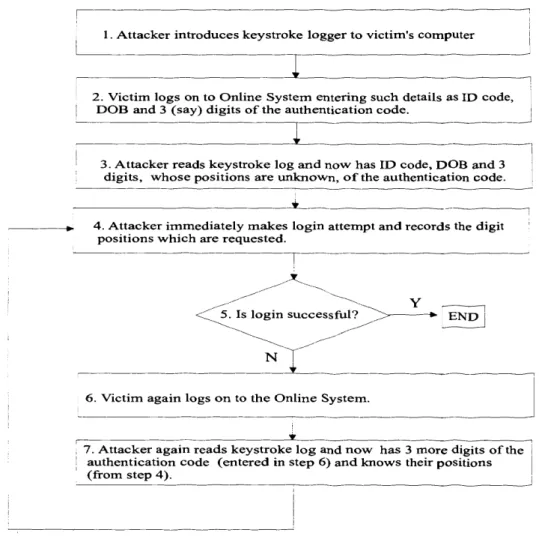
3.1 The sequence of attack steps described as a flow chart... 60
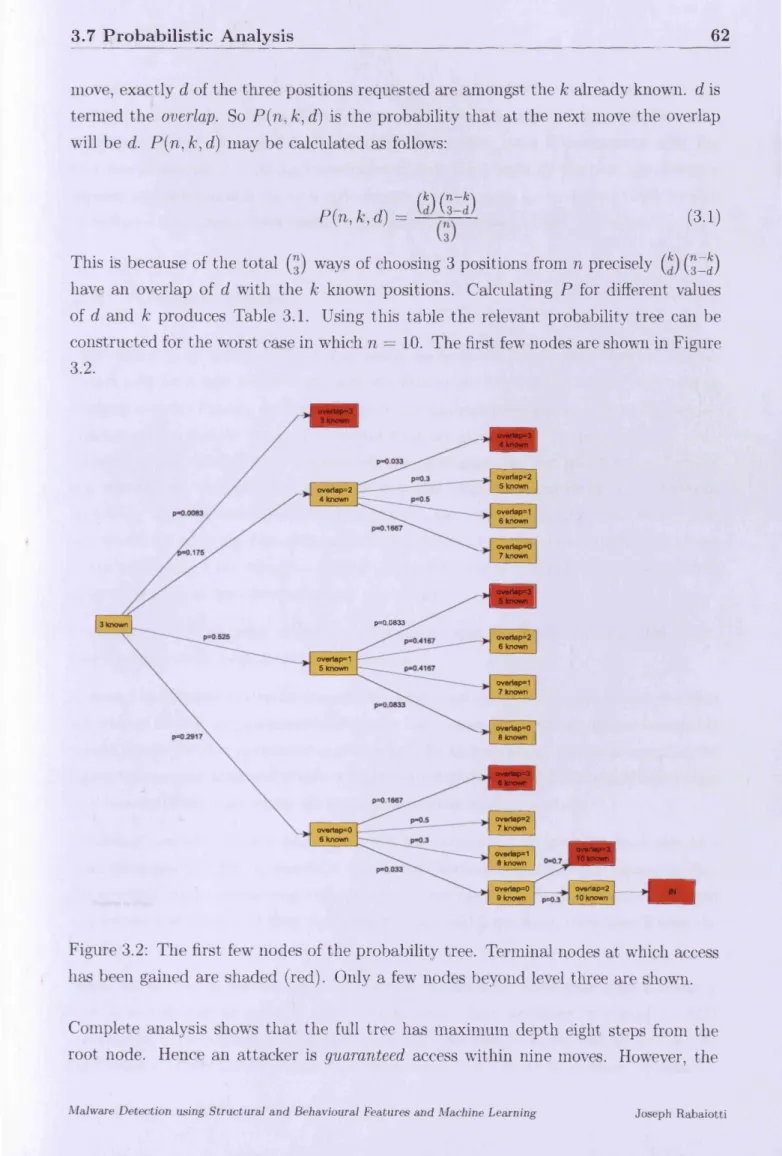
3.2 The first few nodes of the probability tree. Terminal nodes at which access has been gained are shaded (red). Only a few nodes beyond level three are shown... 62
5.1 The Asylum backdoor client program by ‘Slim ’ ... 89
6.1 D ata Gathering Process ... 107
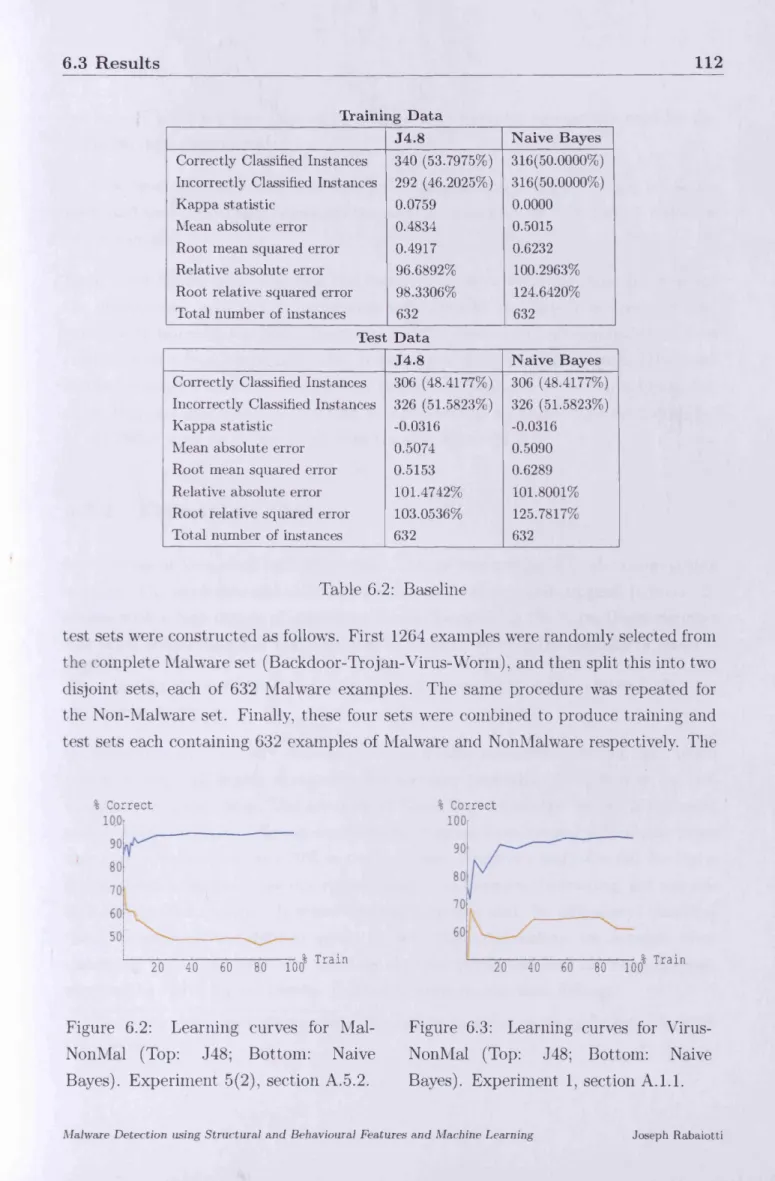
6.2 Learning curves for Mal-NonMal (Top: J48; Bottom: Naive Bayes). Experiment 5(2), section A.5.2... 112
6.3 Learning curves for Virus-NonMal (Top: J48; Bottom: Naive Bayes). Experiment 1, section A. 1.1... 112
6.4 Structural Experiment One ...114
6.5 Structural Experiment T w o ... 114
6.6 Structural Experiment Three ... 115
6.7 Structural Experiment F o u r ... 116
6.8 Structural Experiment Five ...117
7.1 Behavioural Experiment O n e ...125
7.2 Behavioural Experiment Two ... 126
7.3 Behavioural Experiment T h r e e ... 126
7.4 Behavioural Experiment F o u r ... 127
8.1 Example Network for Malware R e s e a r c h ...135
8.2 D ata collection and detection of infection. Here any appropriate adaptive pattern recognition program could be used. (Process boxes blue, D ata boxes g r e e n . ) ...136
8.3 System Block D ia g r a m...137
C .l The initial VMON program w in d o w ... 173
C.2 Diagram of Key Classes in the VMON P r o g r a m ... 174
C.3 The Program D ataC apture dialog b o x ...175
C.4 The ProcessD ataCapture Dialog B o x ... 175
C.5 The ProcessSystemQuery Dialog B o x ... 176
C.6 Diagram of Behavioural D ata Storage O b je c t... 177
List of Tables
2.1 Salomon’s Seven Types of M a lw a r e ... 22
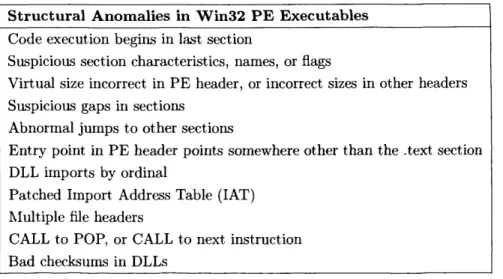
2.2 Some of the structural anomalies common in infected program files given by S z o r... 41
3.1 Probabilities P(10, k, d) for the o v e r l a p ... 61
4.1 Example C4.5 Input D ata F i l e s ... 72
4.2 Example WEKA A RFF F i l e ... 74
5.1 Some of the structural anomalies common in virus-infected program files as described by Szor ... 78
5.2 Diagram of PE File S t r u c t u r e ... 79
5.3 Call-to-Pop: Simplest f o r m ... 84
5.4 Call-to-Pop in AlephOne’s Shellcode ... 85
5.5 Call-to-Pop: C o v e rt... 85
5.6 Call-to-Pop in u s e ... 86
5.7 Some of the behavioural properties th at might be expected to help detect malware... 89
5.8 The commands used by Asylum’s communication p r o t o c o l ... 91
5.9 Excerpt from Welchia’s unpacking c o d e ... 93
5.10 Registry Access Code from Backdoor.Win32.Asylum ... 96
5.11 Contents of a PROCESSJVIEMORY .COUNTERS s t r u c t u r e ... 101
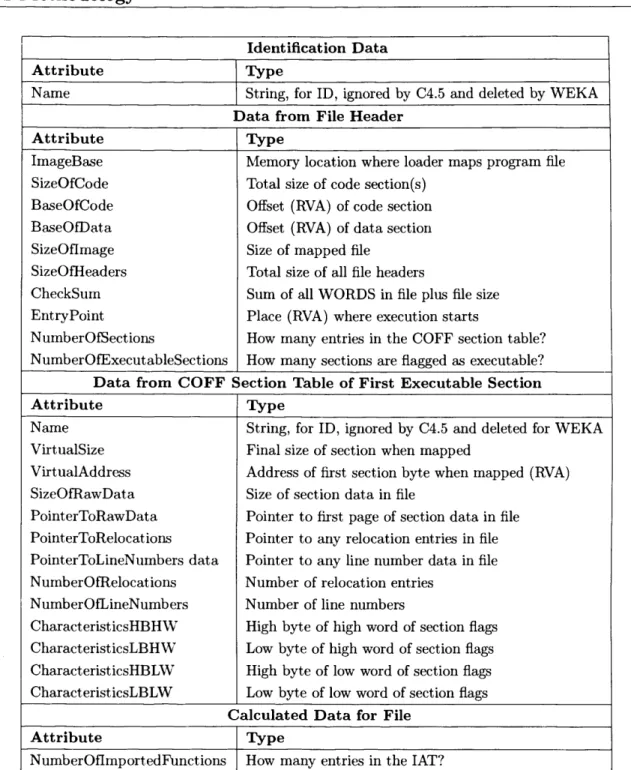
6.1 Structural A ttributes Used for C la ssific a tio n ... 108
6.2 B a s e lin e ...112
6.3 Structural Experiment Four: J4.8 Confusion M a tr ix ... 117
6.4 Structural Experiment Five (Part One): J4.8 Confusion Matrix . . . . 118
7.1 Process A ttributes Sampled Over T i m e ... 123
7.2 Malware used for behavioural d a ta c a p tu r e ...124
A .l Results from W EKA Classifiers Applied to V irus-N onM al...141
A.2 Results from W EKA Classifiers Applied to T ro jan -N o n M al...142
A.3 Results from W EKA Classifiers Applied to B ac k d o o r-N o n M al... 143
A.4 Results from W EKA Classifiers Applied to W o rm -N o n M a l...144
A.5 Results from W EKA Classifiers Applied to Backdoor-Worm ... 145
A.6 Results from W EKA Classifiers Applied to T ro jan -B ack d o o r...147
A.7 Results from W EKA Classifiers Applied to T ro jan -W o rm ... 148
A.8 Results from W EKA Classifiers Applied to V irus-B ackdoor...149
A.9 Results from WEKA Classifiers Applied to V ir u s - T r o ja n ...150
A. 10 Results from W EKA Classifiers Applied to V irus-W orm ... 151
A. 11 Results from WEKA Classifiers Applied to Backdoor-Trojan-Worm . . 152
A. 12 Results from W EKA Classifiers Applied to Backdoor-Virus-Trojan . . . 153
A. 13 Results from W EKA Classifiers Applied to Backdoor-Virus-Worm . . . 154
A. 14 Results from WEKA Classifiers Applied to Trojan-Virus-Worm . . . . 155
A. 15 Results from W EKA Classifiers Applied to Backdoor-Trojan-Virus-Worm 156 A. 16 Results from W EKA Classifiers Applied to Experiment 5 (part 1) . . . 157
A. 17 Results from W EKA Classifiers Applied to Experiment 5 (part 2) . . . 158
A. 18 Summary: Classifier Accuracy on Test D a t a ... 159
B .l Backdoor-N onm al... 161
B.2 Backdoor-Nonmal: Results by C la s s ...161
B.3 T ro ja n -N o n m a l... 162
B.4 Trojan-Nonmal: Results by C l a s s ... 162
B.5 W orm -N onm al... 163
B.6 Worm-Nonmal: Results by Class ... 163
B.7 Backdoor-W orm ... 164
B.8 Backdoor-Worm: Results by C la s s ...164
B.9 T ro ja n -B a c k d o o r...165
B.10 Trojan-Backdoor: Results by C l a s s ...165
B.12 Trojan-Worm: Results by C l a s s ... 166
B.13 Backdoor-Trojan-W orm ... 167
B.14 Backdoor-Trojan-Worm: Results by Class ...167
B.15 B ackdoor-W orm -N onm al... 168
B.16 Backdoor-Worm-Nonmal: Results by C l a s s ...168
B.17 Trojan-Backdoor-N onm al... 169
B.18 Trojan-Backdoor-Nonmal: Results by Class ... 169
B.19 Trojan-Worm-Nonmal ...170
B.20 Trojan-Worm-Nonmal: Results by C l a s s ...170
B.21 Backdoor-Trojan-W orm -N onm al... 171
B.22 Backdoor-Trojan-Worm-Nonmal: Results by C la s s ... 171
B.23 M al-N o n m al...172
B.24 Mal-Nonmal: Results by C l a s s ...172
Chapter
1
Introduction
1.1
W hat Is M alicious Software?
A m alicious program is a program deliberately designed to cause some form of harm or damage to the user or the system. Examples would be viruses, Trojan horses, back doors, and spyware, all of which are referred to by the umbrella term ‘malware’.1 The problem of malicious software (or ‘software w ritten for malicious purposes’) will be familiar to most people - by now, nearly any com puter user will have had some experi ence of it. An increased number of online transactions means most malicious software is now w ritten and deployed by fraudsters or organised criminals [Bradbury, 2006]. Malicious software can be used to send untraceable spam email, to steal confidential data, or as a means of extortion. Existing approaches to control of malicious software have limitations, and research into possible new methods is therefore worthwhile.
As the interconnection of com puter systems has risen the need for intelligent flexible counter intrusion systems has become imperative. Existing systems, such as signature- based malware (virus) scanners and Intrusion Detection Systems, have disadvantages. For example, malware scanners will only function properly if they are constantly up dated with newT malwrare signatures. Software companies must therefore continue to produce updated signature files. If they do not charge for this service they may lose money, but if they do, users are less inclined to update. Current Intrusion Detection Systems are predominantly concerned with protection against attacks launched from
1 This definition intentionally excludes cases of software which causes unintentional harm (e.g. owing to a bug), and will also leave aside philosophical questions about the intent of the author or introducer of the software (who might be termed a “malicious agent”).
outside via network services. For total protection, it would be ideal to have a sys tem which could combine protection against attackers on the outside with protection against malicious software from the inside.
1.2
T he C on n ectivity Issue
Before computers were networked on a large scale, connectivity was not really an issue, as the only way most people could transfer d ata between computers was by moving disks or tapes from one machine to another. Someone who wished to gain unauthorised access to a computer would first need to break in to the building and room in which it was situated, and someone who wished to introduce malicious software would have to have the same physical access to the d a ta media (disks or tapes) or the computer. Computer security, in those days, was mostly a m atter of physically securing the computer and its media.
At the present time, however, almost every com puter is networked in some wray - even laptops and mobile devices (PDAs or mobile telephones) are generally connected. In 1995 Internet Protocol version 6 [Deering and Hinden, 1995] was introduced to serve the growing demand for network addresses - and there was much talk of a time when all consumer appliances - fridges, freezers, toasters, washing machines, televisions - would have an internet connection. T h at point may not have been reached in practice, but the number of consumer appliances w ith network connectivity is growing. Witness the current popularity of ‘media centres’ - specialised computers wdiich perform all the functions of a DVD recorder, set-top box, games console and music centre. Mi crosoft’s XBox 360, though primarily a games console, is in reality an example of this - its website proudly states th at users can “Play the most compelling games. Watch DVD movies. Enjoy digital music, photos, and videos in an integrated entertainment system.” [Microsoft, 2005].
Unfortunately, such widespread connectivity raises many security issues which may not have been anticipated, since most of the im petus for consumer appliance connectivity has come for other reasons. It is conceivable th at appliance-cracking may become as popular as computer-cracking. Despite the obvious objection that the only people who would get a kick out of making people’s food go off or burn or replacing their video libraries with offensive or pornographic material are immature e-vandals, more serious scenarios are possible - for example, burglars being able to compromise and disable alarms and access control systems if these are connected to the Internet. If,
as predicted, there is a rapid increase in connected consumer devices, then an equally rapid increase in security awareness will be needed if a security disaster is to be avoided. At the moment home users have enough trouble keeping their computers secure and free of malicious software: the task will become much more complicated when all their appliances are online as well.
The subject of ‘information w arfare’ was widely discussed during the 1990s. An oft- cited early commentator on this issue was W inn Schwartau, whose book on the subject [Schwartau, 1994] provides extensive analysis with reference to the global sociopolitical and economic conditions of the early 1990s. While it is true th at the more extreme scenarios it outlines have not come to pass, many of the smaller predictions it makes have been accurate, including the prediction of the rise of international terrorism. Schwartau makes the point th at inform ation has become the most valuable commodity in the modern economy. Anyone who can disrupt, corrupt, or destroy information has a potent weapon. Despite over ten years having passed since Schwartau’s book, one of his main points - th at most organisations give little thought to protecting their information assets - remains true in many cases. Some factors have changed since Schwartau wrote his book. For instance, passive eavesdropping has become much easier owing to the introduction of wireless networking. In Schw artau’s scenarios, would-be eavesdroppers had to rely on the use of Van Eck-type equipment to pick up stray radiation from display units [Eck, 1985], or electronic snoopers which were physically connected to network wiring. As wired networks are replaced by wireless ones, these eavesdropping methods from the past become obsolete: all th a t is needed now is a laptop with a wireless network card and the appropriate software. Early encryption methods such as W EP were repeatedly shown to be insecure [Cam-Winget et a/., 2003]. Even now that better encryption and authentication is available for wireless networks, users (even businesses) resist deploying it because of the inconvenience it entails - particularly in an organisation which has many visitors who require legitimate access to the wireless network.
A company may pride itself on its commitment to security, its constantly-updated firewall, committed system adm inistrators, VPNs, Intrusion Detection Systems, etc., but all this impressive security technology is rendered instantly useless if the internal network traffic passes unencrypted across the company wireless LAN and can be picked up by someone across the street with a laptop. In large cities, where many companies have wireless LANs, the sport of ‘wardriving’ - moving around an urban area with a wireless-enabled computer trying to find and gain access to wireless networks - has proliferated. The main motivation for wardriving is to obtain free internet access:
however, the potential for security breach should be obvious.
Even if nothing is compromised on the internal network, unwittingly sharing one’s internet access with the rest of the world is not a good idea. Assume someone is able to gain internet access via an unsecured business WLAN. He or she could then proceed to malicious or illegal activities - hacking, viewing child pornography, blackmail, fraud, etc. - and any tracing would lead back to the company whose LAN was abused, who would then have a difficult tim e proving th at it was not one of their employees who committed the crime! In any case, the genuine perpetrator is highly unlikely to be caught. Back in the days before widespread com puter networking and when telephone switching was still analogue, persons known as “phone phreaks” or “telephone hackers” would explore telecommunications networks in much the same way th at their later counterparts did computer networks. Telephone hackers who wished to perform high- risk exploration without being traced would take steps to obscure the point at which they were accessing the telephone network. The simplest way to do this was to gain access to someone else’s telephone line, usually via a telephone company junction box on the outside of a house or in the street. A payphone could also be used, especially in the USA where local calls were often free of charge (telephone hackers had many ways of fooling switching equipment into connecting other types of call at local rates). This way, when the telephone company a n d /o r law enforcement finally tracked down the source of all the fraudulent calls, they ended up arresting the innocent owner of the compromised telephone line. The same techniques were later used by the first computer hackers to avoid paying for their extensive d ata calls and to further frustrate tracing attem pts by law enforcement. W ardriving could be seen as the 21st-century equivalent, with the added bonuses th a t you are less likely to get caught (no wires) and it can be done in relative safety from the comfort of your vehicle.
Another of Schwartau’s points is th a t malicious software programs may be used as weapons in information warfare. During the first Gulf War, it was rumoured th at the National Security Agency had embedded a virus in a chip that controlled a certain printer, one or more of which were subsequently sold to Iraq. During the war, the virus was activated and used to destroy the Iraqi air defence system. Despite the small m atter of the source m aterial being dated April 1st, not to mention the many technical problems such a m ethod would face, national news agencies in America are said to have broadcast the story as fact. W ith present-day technology, an attack based on a similar method could certainly work in many circumstances. Despite increased awareness of the need for information security since 1994, many laypeople still often assume th at information security is only about preventing hackers from accessing your
system from outside over a network. Conventional Intrusion Detection Systems (IDS) concentrate on protecting against this threat . The state of technology to defend against malicious programs - which may be introduced unwittingly by legitimate users inside an organisation - is much less advanced. Though various alternatives have been proposed, the basic signature-based virus scanner still reigns supreme.2 Few higher technology alternatives exist outside classified m ilitary research - Schwartau reports rumours th at governments and military organisations have been interested in the offensive potential of computer viruses for some time. If this is so, it would be logical for them also to be considering defensive measures against such viruses. One factor which must constantly be considered when investigating malware is the principle of ‘greatest cost to the user’. In other words, there are certain types of malware which have the potential to produce the ‘worst-case scenario’, and both the scenario and the malware have changed. Back in the early days, losing d ata was the worst thing th a t could happen. Whilst loss of data would undoubtedly still be a m ajor concern, an argument could be made th at it is no longer the most serious thing th at could happen in the event of a malware ‘attack ’. As it is, in today’s networked world, the strongest contender is undoubtedly the leaking of private or confidential information. Since online shopping and banking became popular, more and more individuals and businesses are storing confidential information such as bank and credit card details on networked personal computers. Countermeasures are sometimes taken by banks, but in some cases these have been shown to be ineffective [Goring et a/., 2007], and consequently, malware which is specifically designed to acquire such information and feed it back to the author or controller is going to become a serious problem.
The risk th at an average individual internet user will suffer a Distributed Denial of Ser vice (DDoS) attack is quite small. The risk for a business is a little larger, particularly if they are large or have much ‘web presence’. However, the cost of a DDoS attack is insignificant compared to the cost of having your custom ers’ credit card details leaked [Thurston, 2007]. It is well known th a t many DDoS and cracking attacks are now being orchestrated by organised crime interests for the purposes of extortion [Brad bury, 2006]. It is also to be expected th at criminals will start attem pting to obtain confidential information via specifically targeted malware.
In a conventional DDoS attack it is necessary for the controller of the botnet to send some kind of signal to start the attack - possibly leading to their detection. Similarly, malware which steals d a ta generally has to know how to send it back to the controller,
2This is a slight assumption, since manufacturers tend not to release much information on their products, but it is certainly true that all existing anti-malware products require regular updates.
who can thus be traced. However, this could be avoided via the use of covert channels.
Consider a hypothetical situation where a piece of malware, propagated via virus or worm techniques and covertly present on a home user’s PC, could leak confidential information in the form of a (perhaps steganographically-disguised) newsgroup posting. Most newsgroup users would ignore the message - but someone ‘in the know’ could read between the lines and extract the relevant information.
In many countries it is a criminal offence to gain unauthorised access to a computer system, whether to extract confidential information or otherwise: however, if a com puter, under the control of a piece of malware, sends confidential information to the public domain, the legal position is trickier: the author of the malware would almost certainly still be liable, but it may be impossible to trace them, and it would certainly be impossible to arrest everyone who read the newsgroup. All in all, it is arguable that the need for protection against malware has never been greater.
1.3
Com bat A pproaches
A full survey of the approaches th a t are currently used to combat malware wTill be given in section 2.4 of Chapter 2. However, it is possible (with some overlap) to divide past and present approaches to malware into four main categories:
• D etection : the determ ination th a t a given program is likely to be malicious.
• Identification: classifying a given program as identical to or related to a known piece of malware.
• Prevention: stopping a given program from carrying out hostile functions.
• Recovery: removing a malicious program from a system and/or repairing any damage it has caused.
An ideal system to protect against malware ought to span all these categories, though the most popular practical systems at the present time are category 2 and 4 (signature- based malware scanners). Academic research has proposed various solutions which fit categories 1 and 3, but these have rarely resulted in practical implementations. For the purpose of this thesis, consideration wall only be given to the first three categories.
1.4
Scope and A im
1 .4 .1
H y p o th e s e s
1. An autom ated classification system, provided with structural data on malicious and non-malicious programs, should be able to distinguish between the two classes with a high degree of accuracy.
2. Since other types of malicious program, such as Trojans, do not necessarily have marked structural anomalies, one might expect th a t a structural classification system would have much more difficulty distinguishing them from non-malicious programs.
3. In contrast an autom ated classification system, provided with behavioural data
instead of structural data, should be able to classify all types of malicious software with equal success.
1 .4 .2
A im s
The aim of this PhD, broadly stated, is to determ ine whether the detection of malicious programs can be autom ated using a learning system, and to develop programs utilising this concept. Such programs might eventually form parts of an intelligent, flexible counter-intrusion system th at can defend a com puter or network against malicious and unauthorised programs. Use will be made of an isolated computer on which viruses and other malicious programs may run, in order th at their characteristics can be stud ied safely. Software tools to analyse w hat is running on the isolated machine will be developed. These tools will gather pertinent statistics and output results which can be fed into learning systems. Experim ents can then be performed to determine whether machine learning systems can be used to detect malicious software, firstly by deter mining whether the rules produced by the learning systems from a set of training data correspond to the rules already produced by human experts, and then by determining whether the learning systems can classify unseen programs as benign or malicious with a high degree of accuracy.
If this proves practical, the ideas could be used to develop some or all of the components of an intelligent and flexible counter-intrusion system th at can defend a computer network against malware. By “intelligent and flexible” it is meant that the response of the counter-intrusion system should be reasonably context-sensitive (e.g. the response
will differ in different circumstances). However, the development of such a system is far beyond the scope of a PhD thesis.
1 .4 .3
P r in c ip a l C o n t r ib u tio n s
The m ajor contribution of this thesis is to show th at the use of such systems could help bridge the vital time-gap, wThich exists at present, between the central detection of a new outbreak and the m anual creation of a new signature file for download to subscribers’ computers. In essence, the thesis demonstrates that the decision tree classifier approach is perfectly feasible on simple structural data and offers a relatively high degree of protection. W hilst a prelim inary investigation for the same techniques applied to behavioural d ata has also been conducted, the results were less clear-cut.
The structure of the thesis is as follows: C hapter 2 will give a brief historical overview of the development of different types of malware and malware combat methods, followed by a review of the academic literature on the subject. Chapter 3 is a case study which uses a real-life security flaw to illustrate both the actual and potential uses of malware for financial fraud. C hapter 4 gives information about the machine learning systems and classification methods chosen and the reasons for their choice. Chapter 5 describes how structural and behavioural program /process d ata may be collected on the Windows operating system .3 C hapter 6 gives information on the structural classification experiments, with analysis of the results, and Chapter 7 gives similar information on the behavioural classification experiments. Finally, Chapter 8 gives an overall evaluation of the results and a retrospective on the PhD project, and lists future work th at could be done in this subject area.
Any tradem arks referred to in this thesis are the property of their respective owners.
3Investigation was restricted to the Windows operating system due to the vast majority of malware being written for Windows.
Chapter
Historical Background and Literature Review
This chapter starts with an overview of the different types of malware and their history, and the development of tools to combat them. This is followed by a review of the available literature.
2.1
T yp es o f M alware
This section aims to give an overview of the more common types of malicious program. The definition of a malicious program (‘malware’) varies. Authors such as [Gollmann, 1999] gives only four types: Trojan horses, viruses (resident and transient), logic bombs and worms. Confusingly, Gollmann seems to refer to all malware as ‘viruses’ (see for instance [Gollmann, 1999] ppl34-136). On the other hand, David Salomon gives seven types ([Salomon, 2006] p34). Salomon’s list is reproduced here in Table 2.1, since it includes distinctions not made by other authors:
T y p e D e s c rip tio n Virus Logic bom b Tim e bom b R abbit Backdoor Worm T rojan horse
Resides in an executable file and propagates to other executables
A virus whose payload is delayed and is triggered by some event in the com puter A special case of logic bom b where the trigger is a particular time or date A virus whose payload is to annoy and vex the user rather th an destroy d a ta
A hidden feature (normally in T rojans or spyware) th a t gives certain people special privileges Executes independently of other program s, replicates itself, and spreads through a network Hides in the com puter as an independent program and has a malicious function
Table 2.1: Salomon’s Seven Types of Malware
Salomon’s list is probably the most comprehensive available in the literature, and he also recognises th at some of the definitions are overlapped (for instance Backdoors and Trojans are not always distinct).
2 .1 .1
V ir u s e s
Salomon’s definition of a virus has already been given in Table 2.1. However, a more general definition is given by Bishop: “a sequence of instructions that copies itself into other programs in such a way th a t executing the program also executes th at sequence of instructions.” [Bishop, 1992]. Like biological viruses, true computer viruses cannot
exist independently from their host programs. Unfortunately the term “virus” is often used as a generic term for any piece of malware,1 which means that the reader may encounter this sense even here, especially in quotes or references to other authors.
There are many types of virus. This section will give a relatively simple overview of the more common types. More technical details will be given in subsequent chapters. The reader is also referred to Peter Szor’s monumental “The Art of Computer Virus Research and Defense” [Szor, 2005], one of the most up-to-date books on the subject.
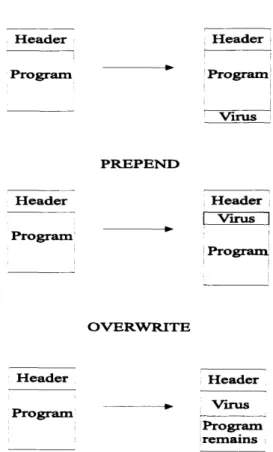
Figure 2.1 shows how three types of file-infecting virus modify program files.
APPEND Header Program PREPEND Header Program ^ OVERWRITE Header Virus Program remains
Figure 2.1: How Different File Infectors Infect Files
1Furthermore, common terms for malware-fighting software are ‘antivirus’ or ‘virus scanner’ rather than ‘anti-malware’ or ‘malware scanner’.
Header Program Header Program; Virus Header 1 Virus 1 i ! Program!
O verw riting V iruses
These are the simplest viruses. As their name suggests, these viruses overwrite target programs in such a way th a t the program is no longer able to carry out its original func tion. The older overwriting viruses could generally only cope with simple executable file formats (such as the DOS COM format, inherited from CP/M ). One advantage of overwriting is th at the virus cannot be detected by simply observing file size changes. Furthermore, such viruses are very easy to write, even in high-level languages on mod ern operating systems with complicated file formats. They thus represent very little of a technical challenge for virus writers, and since such viruses are very easy to detect as infected programs no longer work, they remain uncommon.
A p p en d in g and P rep en d in g V iruses
The viral code is appended or prepended to the target executable, and the executable header is patched so th at the viral code executes first, then passing control back to the target. If the viral code is sufficiently small and efficient, the user of the target program will be unaware of any change in its function. Appending viruses that attack complex executable files (e.g. Win32 PE format, UNIX E L F /C O F F formats) generally append a new section to the file, altering the file headers, but sometimes they can make use of unused areas in existing sections, or enlarge the sections by patching the section table.
Prependers can be as complex as appenders, but are often far simpler, as illustrated by the variety which merely creates a new copy of itself with the target executable compressed and stored as data within the executable. Then, the target executable is deleted and the new virus executable is given the targ et’s original name. W hen the new executable runs, the virus code executes first, then the code for the target executable is decompressed, copied to a temporary file, and executed. This type of prepender virus might be expected to appeal to novice virus writers as it can be written in a variety of high-level languages ([Szor, 2005] pl35) and requires little in the way of technical skill.
M em ory-resid en t V iruses
A memory-resident virus is a virus which remains in memory and continues to infect files rather than infecting just a few files and then terminating. This sort of virus was common in the days of MS-DOS, because the service routines for various interrupts - used by DOS as an API - could be modified by any program. It was thus possible for
a virus to load itself into memory and redirect one or more interrupt service routines to point to its own code, then term inate itself without freeing the memory. Whenever a hooked interrupt was called, the virus would be executed.2 Viruses used the hooked interrupts to locate files to infect, as well as to hide the results of infections (such as increased file sizes).
The most well-known form of memory-resident virus is the boot sector virus, which is covered below. Boot sector viruses generally used interrupt hooks to determine when a disk was inserted or read from. They would then write themselves to its boot sector, thus infecting the new disk. Like the boot-sector virus, the form of resident virus described here died out with MS-DOS (e.g. Windows 98/Me), but equivalents were soon developed, and for a full description of these the reader is directed to Chapter 5 of [Szor, 2005].
B o o t S ector V iruses
Boot sector viruses are a special case of memory-resident virus. The ‘boot sector’ of a disk contains the code which starts the operating system. When a computer is switched on, the BIOS, having completed its various initial functions, passes control to the program in the boot sector. All disks contain a boot sector even if they are not actually bootable: therefore, in the days when floppy disks were more widely used to transfer data between computers, boot sector viruses were extremely common. Generally, these viruses infected the boot sector of the hard drive, which meant that they were loaded whenever the computer was started. They then subverted the disk access routines of the operating system (usually DOS, in which case the subversion was done by hooking Interrupt 19H) so th at they could infect any floppies th at were used in the machine.
The Michaelangelo virus was a fairly run-of-the-mill boot sector virus which had a destructive payload [Kephart et a/., 1993]. If an infected computer was booted on March 6th, the virus would destroy all the data on the hard drives. Thus, the weeks before March 6th 1992 were characterised by doom-laden press reports and hysterics from computer users. However, as in most cases, the situation was severely over-hyped: IBM estim ated th at more hard drives died of routine hardware failure on March 6th 1992 than were affected by the virus [Kephart et a/., 1993]. The massive epidemic th at the press had been predicting did not occur - however, massive public demand
2It should be noted that this idea, known as Terminate-Stay-Resident (TSR), was also used by legitimate programs.
for antivirus products was generated, with some vendors selling more of their product in the week before March 6th than in all of the rest of the year.
Boot sector viruses could spread rapidly but most did not contain destructive payloads - the Michaelangelo virus was a notable exception. Others, such as the ANTICMOS family, contained a payload which, as the name suggests, attem pted to corrupt the targ et’s BIOS - though it is unclear whether this ever succeeded. Boot sector viruses are generally thought to be obsolete (along with floppy disks) but with the advent of bootable CDs and DVDs and Flash RAM disks, there is clearly some potential for new boot sector viruses to be developed.
M acro V iru ses
Macros are defined by W ikipedia as “an abstraction, whereby a certain textual pattern is replaced according to a defined set of rules.” Macros are often used in compilers and assemblers to allow programmers to shortcut frequently-used sequences. Eventually, the term was applied to any software which gave the user the facility to autom ate tasks - present in many programs since the early days of personal computing. Most of these originally used a ‘record/playback’ system - users would set the program to ‘record’ their input, and do a task manually. They could then ‘play back’ th at task whenever they wanted to do the same thing (the Recorder in Windows 3.0 was an early example). Later, programming languages specifically designed for writing macros were produced.
Many products produced by Microsoft contain inbuilt support for macros w ritten in a special form of the BASIC programming language known as Visual Basic for Ap plications (or VBA). VBA can perform many functions normally restricted to ‘real’ programming languages (e.g. reading and writing files) - and was also designed to be compatible across the entire Microsoft Office suite. As a result it was not long before the first macro viruses appeared in Microsoft Word documents. When an infected doc ument was opened, the macro code within it would run automatically, installing itself in the user’s ‘document tem plate’ file. This meant th at every new document produced by that user would be infected. Microsoft did provide a warning message about macros, but most users ignored it or switched it off, especially if they used macros for legitimate purposes. Macro languages have also been used to create email worms.
2 .1 .2
W o rm s
Worms differ from viruses in th at they are autonomous programs in their own right. Their aim is to spread from computer to computer, and they usually exploit vulnera bilities in network interface software to do this. When the worm runs, it connects to a remote computer and attem pts to inject its exploit code via a known vulnerability. The wTorm ’s exploit code will attem pt to subvert the vulnerable process into somehow receiving a copy of the worm’s code, saving it to a file and executing it on the target computer.
In 1988, Robert Morris, a graduate student at Cornell University and, ironically, the son of the head of the NSA’s Computer Security division, developed what came to be known as the Internet Worm. Morris’ program, which he claimed had escaped accidentally, spread rapidly across the Internet (which was of course vastly smaller than it is today) and caused widespread disruption. This event is also documented in [Stoll, 1989]. The Internet Worm spread from computer to computer by exploiting buffer overflow vulnerabilities in privileged network utility programs running on BSD Unix systems. Luckily, other operating systems were unaffected, leading Stoll to make comments about operating system diversity being a good thing. These comments seem prescient considering the Windows worms th at emerged ten years later: Blaster, Sasser and all the others once again exploited buffer overflow vulnerabilities in privileged network service programs. But whereas in 1988 the various system adm inistrators who ran the large computers which made up the Internet could neutralise the worm within a few days (according to [Stoll, 1989]), the Windows worms had a vastly larger Internet to spread around and a huge number of unpatched home computers to infect. As a result, cleaning up the mess was much harder.
E m ail W orm s
As previously mentioned, VBA macros were designed to be compatible across many different Microsoft applications. This included the Microsoft email client, Outlook, or the cut-down version Outlook Express. Macros within email messages could send email, read d ata from address books, download and execute programs, and do many other things - all without the knowledge or consent of the user. In some cases, an infected message would not even need to be opened. Furthermore, Outlook left macros turned on by default, and not everyone knew how to turn them off. It had been common to send malicious programs as email attachm ents for some time - usually with something to entice the user to execute the attachm ent (such as a message body stating th a t it
contained free pornography). Now, with the addition of a suitable macro, there was no need to spend time enticing the user - they could be infected at the click of a mouse.
The first email macro worms (such as the ‘Love Bug’ of 2000) tended to do little damage beyond clogging up inboxes. Thanks to increased awareness and Microsoft making its Outlook email client more secure, emailed macro worms have now mostly been superseded by binary email worms (as opposed to macro-based ones). Such binary email worms usually attem pt to connect to a mail server and send out multiple copies of an email with the worm attached, bypassing the user’s mail client entirely. Worms may also spread using alternative communications protocols such as IRC and ICQ.
2 .1 .3
O th e r E m a il T rick s
Emailed malware employs various ruses to trick the user into running the executable payload, usually by representing it as an ‘im portant docum ent’ or as a pornographic picture. Some such ruses are technical as well as psychological. Knowledgeable users know th at one should not run executable attachm ents unless from a trusted source, so the viruses have started disguising the attachm ents as innocuous files. There is a particularly insidious way of doing this which exploits two Windows features. By default, Windows will hide file extensions from the user if the file is a recognised type (such as a program). Thus, it is possible to have a file called ‘xxxpics.jpg.scr’.3 By default, Windows will hide the ‘.scr’ or \e x e ’ extension from the user, who will only see the ‘.jpg’ extension. If the malicious author has been clever enough, he or she will have assigned an icon to the malicious program which looks like a picture (or like the standard Windows picture icon). So the user is confronted with a file which appears to have a picture file extension, and has the correct picture icon. W hat harm could there be in opening it...? An astute user may have noticed th at, with extension hiding turned on, the ‘.jpg’ extension ought to be hidden for a real picture file, but even astute users may well overlook such an apparently insignificant detail, and it is also possible to hide the ‘real’ file extension by putting lots of spaces or other characters in the filename, e.g.
xxxslutz.jpg .exe
Since email clients often used to display only the first characters of a long filename, users may not think to check before they attem pt to open the file. On the other hand,
3For historical reasons to do w ith screensavers, ‘.scr’ is a Windows executable file extension equiv alent to ‘.exe’, though users may be unaware of this.
some modern email clients will warn users if a message has an executable attachm ent. However, in the right circumstances, the attacker may even be able to send a genuine picture file to accomplish a malicious purpose. For instance, in 2004 a buffer overflow in a Microsoft JPE G rendering library was discovered, which meant th at it was possible for an attacker to embed malicious code in a JPEG image that would get executed when the image was viewred ([Salomon, 2006] p59).
2 .1 .4
T r o ja n H o r se s
As might be guessed from the title, these are programs which appear to have an innocuous function but which contain hidden code wiiich does something harmful. Some have claimed th at the first Trojan Horse was w ritten by the East German hacker Karl Koch (‘Hagbard’) whose attacks on United States military computer systems wrere documented by Clifford Stoll in “The Cuckoo’s Egg” . This could refer to pages 55-57 which documents an attem pt to install a shell script which masquerades as the login program to steal passwords - as Stoll writes,
“T he hacker’s Trojan horse program collected passwords. O ur visitor wanted our passwords badly enough to risk getting caught installing a program th a t was bound to be detected. Was this program a T rojan horse? M aybe I should call it a mockingbird: a false program th a t sounded like the real thing. I didn’t have tim e to figure out the difference...” - [Stoll, 1989].________________________________________________________________
Most modern Trojans employ various enticement techniques in order to induce people to download and run them (for example, by masquerading as pornography or cracked software). They may also be 'dropped’ (as a payload) by viruses or worms. It seems there is no longer any requirement for a program to pretend to perform a legitimate function in order to be called a Trojan, and the definition overlaps with 'Backdoor’ to a considerable extent.
2 .1 .5
B a c k d o o r s
A backdoor was originally a hidden function in a legitimate program which allowed those privy to its secret to obtain special privileges - for instance, a cryptography program could contain a backdoor which allowed a user’s private key to be recovered. In the late 1990s the discovery th at part of the verification mechanism for the Microsoft
Crypto API was called ‘NSAKEY’ led to allegations that Microsoft had installed such a backdoor at the behest of the NSA, though this was considered extremely unlikely by security experts, not least because if the NSA had wanted covertly to compromise the Microsoft Crypto API, they would have been extremely unlikely to be so obvious about it.
Modern backdoors are more likely to be Trojans of the ‘remote control’ type. Two of the earliest examples were ‘BackOrifice’4 and ‘SubSeven’, both developed in the late 1990s, though very similar programs have been developed ever since. These programs consisted of two parts: a server, which had to be installed on the target computer, and a client, which was used by the attacker. The servers, which communicated with the clients over high network ports (BackOrifice famously used port 31337 by default), would generally modify the Windows registry to ensure th at they were run (transpar ently to the user) every time the computer was started. Attackers had almost complete control - they could access any files, delete or modify them, display messages, open and close windows and in some cases even take control of the mouse and CD-ROM drive. The definition of a Backdoor is not discontinuous: some programs considered to be Backdoors by some antivirus researchers are classified as Trojans by others. Fur thermore, some legitimate remote adm inistration software has the potential to be used as a backdoor if improperly set up or installed without a user’s knowledge.
2 .1 .6
S p y w a re a n d A d w are
Spyware is the term given to a piece of software (which can be a program, part of a program, or a web browser extension) which overtly or covertly collects information about the user of a computer or program. Adware refers to advertising-supported software, but there is a substantial overlap with spyware as adware often also collects user d ata in order to display targeted advertisements.
Information collected by spyware or adware can range from relatively harmless usage statistics through to outright invasions of privacy. The motivation for adware and spyware is commercial - advertisers will pay large sums for the data it can gather. Sometimes, the d ata are used to display tailored advertisements to the user, but in other situations the user may be entirely unaware that the data gathering is going on. In the early days, programs which had spyware or adware components would mention it openly in the licence agreement, often claiming th at the only way they could justify
4The nam e was a pun on a Microsoft product called BackOffice Server, which was discontinued in 1999.
releasing their program as freeware or shareware was by generating revenue through a data-gathering/targeted advertising combination. However, modern spyware is de signed specifically to hide from the user (except when it is popping up advertisement windows), and to make uninstallation as difficult as possible. Such programs are often autom atically downloaded and installed when a user visits a certain web site (this is known as a ‘drive-by download’) . Not only is this unethical, it is also unsafe, as the same techniques can and have been used by malicious programs which attem pt to steal passwords etc.
The G ator eWallet program [Gator, 2005] is a particularly insidious, if dated, ex ample of spyware. The user would download and install a program to assist them in ‘remembering’ passwords and form entries on web pages5. W hat the user might not have realised was th at the program was also tracking their internet usage habits and sending d ata back to the Gator company. Furthermore, the Gator program could also be included with other software - the user might not have chosen to download and install it at all. According to [Webb, 2005] this was done in a particularly insidious manner. A user would download and install an unrelated piece of shareware, which - unknown to the user - contained a program called ‘trickier’. This would then modify the user’s registry so that it ran every time the computer was started. The trickier program would then slowly download the full Gator program, then install and run it. The download was done slowly so th at the user wouldn’t notice their bandw idth being lost. Once running, the Gator program would display advertisements while the user was online. This included replacing the original advertisement images on a web site with differing ones. Several companies sued Gator for stealing their advertising space (see [Edelman, 2002], an expert witness statem ent from the case, which was eventually settled in 2003).
Programs like Gator and other explicitly advertisement-supported programs had a measure of legitimacy in that users were informed, in theory at least, of the data collection process when they read the license agreement, and could choose not to use the program if they were unhappy with it. This clearly does not apply to modern examples of spyware, which are much more obviously malicious. Not all programs which collect data are spyware, but the definition is a little less clear-cut. The following lists may provide helpful criteria for distinguishing spyware and malicious adware from legitimate advertisement-supported software.
5This functionality was later integrated into web browsers.
CHARACTERISTICS OF LEGITIMATE SOFTWARE
1. The user is clearly informed th a t the program collects d ata a n d /o r is supported by advertise m ents (e.g. not as a footnote hidden away at the bottom of the license agreement).
2. T he user is informed exactly w hat d a ta are being collected, where it is being sent, and what is being done w ith it (and th e company or organisation receiving the d ata has a clearly-defined privacy policy).
3. Advertisements, if present, are displayed only within the program ’s main window and only when th e program is in use.
4. T he program does not collect any d a ta which personally identifies the user or their com puter. 5. All data-collecting com ponents are p art of th e program, do not function independently of it, do
not use up excess resources, and are uninstalled completely when the program is uninstalled. CHARACTERISTICS OF ADW ARE A N D SPYW ARE
1. T he d a ta collection process is hidden from the user, as is th e type, quantity, destination and use of any d a ta collected.
2. Advertisements, if present, appear as separate pop-up windows and randomly, regardless of w hether the supported program is running or not.
3. T he data-collection and advertisem ent-display features are separate and autonom ous from the m ain program .
4. The program refuses to allow itself to be uninstalled or term inated.
5. T he data-collection or advertisem ent-display features do not get uninstalled w ith th e main program , but remain on the system, often going to elaborate lengths to hide them selves and prevent removal.
2 .1 .7
B o t n e t s an d D D o S A tta c k s
Some of the latest Trojans are designed for a specific purpose. They spread using the usual techniques (either as spammed email attachm ents, or as the payloads of worms or conventional viruses), or may be introduced deliberately by human crackers who have compromised a system. The Trojans, known as bots, sit unobtrusively on a computer. Each individual bot will contain code for communicating via the internet, often using the Internet Relay Chat (IRC) protocol. The malware author or controller can thus search for infected machines (which are sometimes termed ‘zombies’), and send commands to them. The group of infected computers controlled by an attacker are known collectively as a botnet. Such botnets may be used for a variety of purposes, and controllers may sell or rent access to them, the commonest purchasers of such access being spammers and organised criminal groups [Bradbury, 2006].
such a case, whoever controls the botnet instructs each bot to launch a denial-of-service attem pt against a target IP address. On its own, one bot may be insignificant, but with hundreds or thousands of zombies hammering away at an IP address, the situation is very different. Such an attack is known as a Distributed Denial-of-Service (DDoS) attack. Various companies have been subject to extortion relating to botnets, with criminals threatening to launch DDoS attacks against them unless some sort of ransom is paid. The more computers th at are infected by bots, the greater the effectiveness of DDoS attacks, but the greater the risk of the bot being discovered and added to virus scanner signature lists. For this reason, modern bot authors are moving away from massive untargeted distribution via worms and towards less noticeable forms of distribution. According to a virus expert quoted by Danny Bradbury in his article on the motivation of malware authors:
"..sending out a rapidly proliferating worm to create a huge botnet is too obvious and raises too m any alarms, prom pting users to take security measures. Yesterday’s hobbyist malware w riter was generally an adolescent male w anting to be noticed by his peers. T oday’s for- profit malware w riters want to stay under th e radar, because if their product is noticed it prom pts victims to take action and reduces the num ber of compromised machines. This is why m odern malware is less