Contents lists available at ScienceDirect
Computers
&
Security
journal homepage: www.elsevier.com/locate/cose
DL-Droid:
Deep
learning
based
android
malware
detection
using
real
devices
Mohammed K. Alzaylaee
a ,∗, Suleiman Y. Yerima
b, Sakir Sezer
c a CollegeofComputinginAl-Qunfudah,UmmAl-QuraUniversity,SaudiArabiab DeMontfortUniversity,Leicester,England,LE19BH,UnitedKingdom
c CentreforSecureInformationTechnologies(CSIT),Queen’sUniversityBelfast,BelfastBT71NN,UnitedKingdom
a
r
t
i
c
l
e
i
n
f
o
Articlehistory:
Received16January2019 Revised17October2019 Accepted7November2019 Availableonline12November2019 Keywords: Android Codecoverage Deeplearning Dynamicanalysis Machinelearning Malwaredetection Mobilesecurity Staticanalysis
a
b
s
t
r
a
c
t
TheAndroidoperatingsystemhasbeenthemostpopularforsmartphonesandtabletssince2012. This popularityhasled toarapidraiseofAndroidmalware inrecent years.ThesophisticationofAndroid malwareobfuscationanddetectionavoidancemethodshavesignificantlyimproved,makingmany tradi-tionalmalwaredetectionmethodsobsolete.Inthispaper,weproposeDL-Droid,adeeplearningsystem todetectmaliciousAndroidapplicationsthroughdynamicanalysisusingstatefulinput generation. Ex-perimentsperformedwithover30,000applications(benignandmalware)onrealdevicesarepresented. Furthermore,experimentswerealsoconductedtocomparethedetectionperformance andcode cover-ageofthestatefulinputgenerationmethodwiththecommonlyusedstatelessapproachusingthedeep learningsystem.OurstudyrevealsthatDL-Droidcanachieveupto97.8%detectionrate(withdynamic featuresonly)and99.6%detectionrate(withdynamic+staticfeatures)respectivelywhichoutperforms traditionalmachinelearningtechniques.Furthermore,theresultshighlightthesignificanceofenhanced input generationfor dynamicanalysis as DL-Droidwith thestate-based input generationis shownto outperformtheexistingstate-of-the-artapproaches.
© 2019TheAuthors.PublishedbyElsevierLtd. ThisisanopenaccessarticleundertheCCBYlicense.(http://creativecommons.org/licenses/by/4.0/)
1. Introduction
Androidoperatingsystem,whichisprovidedbyGoogle,is pre-dicted to continue have a dramatic increase in the market with around 1.5billion Android-based devicesto be shipped by 2021 sta . It is currently leadingthe mobile OS market with over 80% market share compared to iOS, Windows, Blackberry, and Sym-bianOS.TheavailabilityofdiverseAndroidmarketssuchasGoogle Play,theofficialstore,andthird-partymarkets makesAndroid de-vices a populartarget to not onlylegitimate developers,butalso malware developers.Overone billiondeviceshavebeensold and morethan65billiondownloadshavebeenmadefromGooglePlay (Smartphone, 0 0 0 0 ).Android appscanbefoundindifferent cate-gories,such aseducational apps,gaming apps,social media apps, entertainmentapps,bankingapps,etc.
As a technology that is open source and widely adopted, An-droid isfacing manychallengesespeciallywithmalicious applica-tions.Themalwareinfectedappshavetheabilitytosendtext
mes-∗ Correspondingauthor.
E-mail addresses:[email protected] (M.K. Alzaylaee),[email protected] (S.Y.Yerima),[email protected](S.Sezer).
sagestopremiumratenumberswithouttheuseracknowledgment, gainaccesstoprivatedata,oreveninstallcodethatcandownload andexecute additionalmalware on thevictim’s device. The mal-warecanalsobe usedtocreatemobilebotnets(Anagnostopoulos et al., 2016 ).Overthelastfewyears,thenumberofmalware sam-ples attackingAndroid has significantly increased. According toa recentreportfromMcAfee,over2.5millionnewAndroidmalware appswerediscoveredin2017,thusincreasingthenumberof mo-bile malware samples in the wild to almost 25 million in 2017 (McA, 0 0 0 0 ).
Inordertomitigatethespreadofmalware,Googleintroduceda detectionmechanismtoitsappmarketinFeb2012calledBouncer. Bouncer tests submitted applications in a sandbox for five min-utes in order to detect any harmful behaviours; however, it has beenshownthatbouncercanbeevadedbymeansofsomesimple detectionavoidancemethods(Oberheide and Miller, 2012 ). Along-sideBouncer,GoogleintroducedGooglePlayprotectintheGoogle 2017event(Google Play, 2018 ).GooglePlayProtectisanalways-on servicethatscanstheapplicationsautomaticallyevenafter instal-lation to ensure that the installed applications remains harmless 24/7.It has been reportedthat over 50billion appsare scanned andverified every day regardless of where they were download https://doi.org/10.1016/j.cose.2019.101663
from.However,accordingtoMcAfee,GooglePlayProtectalsofailed whentested againstmalware discovered inthe previous 90 days in2017 (McA, 0 0 0 0 ).Furthermore,mostthird-party storesdonot havethecapabilitytoscananddetectsubmittedharmful applica-tions.Clearly,thereisstillaneedforadditionalresearchinto effi-cientmethodstodetect zero-dayAndroid malwareinthewildin ordertoovercometheaforementionedchallenges.
Variousapproacheshavebeenproposedinpreviousworkswith theintentionofdetectingAndroidmalware.Theseapproachesare categorizedinto static analysis, dynamic analysis orhybrid anal-ysis(where static and dynamicare used together). The methods basedonstaticanalysisreverse engineerstheapplicationfor ma-liciouscodeanalysis. Arp et al. (2014) , Aafer et al. (2013) , Yerima et al. (2015a) , Fan et al. (2017) , Yerima et al. (2015b) , Kang et al. (2016b) , Cen et al. (2015) , Westyarian et al. (2015) and Kang et al. (2016a) arefewexamplesofdetectionmethodsusingstatic analy-sis.Bycontrast,dynamicanalysisexecutestheapplicationina con-trolledenvironmentsuchasanemulator,orarealdevicewiththe purposeoftracingitsbehaviour.Severaldynamicapproaches,such as Enck et al. (2010) ; Alzaylaee, M.K., Yerima, S. Y., and Sezer S. (2016) DroidBox ; Rastogi et al. (2013) ; Tam et al. (2015) tra, NVISO havebeenproposed. However, the efficiencyofthese approaches rely on the ability to detect the malicious behaviour duringthe runtimewhileprovidingtheperfectenvironment tokick-startthe maliciouscode.
Deep learning(DL) hasgainedincreasing attentioninthe ma-chinelearningcommunityandisre-emergingasapopularmethod ofAIbeingappliedinmanyfields(Hou et al., 2016; 2017; Karbab et al., 2017; LeCun et al., 2015; McLaughlin et al., 2017; Yuan et al., 2014; 2016 ).DLclassifiershave inspireda greatnumberof effec-tive approachesin image classification, naturallanguage process-ing,andspeechrecognition.Recently,Androidmalwareresearchers havealsobeenexploring DLclassifiersformalwareanalysisin or-dertoincreasedetectionaccuracy.
Contrary to previous deep learning based dynamic detection works,thispaperproposesandinvestigatesanewsystemthat ex-ploitstheadvantagesofdeeplearningcoupledwithdynamic state-fulinputgeneration, withtheobjectiveofachieving higher accu-racydetectionofzero-dayAndroid malware.Furthermore,several experimentsareconductedusingrealdevicestocomparethe per-formanceofthe proposed DLbasedapproach withthoseof pop-ularmachinelearningclassifiers.Insummary,themain contribu-tionsofthispaperareasfollows:
• We presentDL-Droid, adeep learning-based dynamicanalysis systemforAndroidmalwaredetection.Unlikeexistingdynamic analysis systems, DL-Droid utilizes a state-based input gener-ation approach forenhanced codecoverage thus enabling im-provedperformance.
• UsingDL-Droid,we investigatetheperformance ofthestateful inputgenerationapproachbyutilizingthestate-of-the-practice stateless (random-based) input generation as a comparative baseline.Higheraccuracieswereobtainedwiththestateful ap-proach, thus highlighting the significance of enhanced input generation forAndroid malwaredetectionsystems that utilize dynamicanalysis.
• We present an extensive comparative study of DL-Droid with seven popular machine learningclassifiers. Unlikemost exist-ing studies that are based onemulators, ourexperiments are conducted ina more realistic environment usingreal devices. Experimental results show that DL-Droid outperforms the ac-curacyoftraditionalclassifiers.
The rest of the paper is structured as follows. Section 2 dis-cusses the related work. Followed by the methodology and ex-periments undertaken to evaluate DL-Droid in Section 3 Sec-
tion 4 presents detailed experimental results and discussions of theseresults.Followedbytheconclusionin Section 5
2. Relatedwork
ThissectiondiscussestherelatedworkonAndroidmalware de-tection, automated test input generation for Android, and recent worksondeeplearningapproaches.As mentionedearlier, detect-ing Android malware with static analysis, where the application will be disassembled to be examined for presence of any mali-ciouscodeisa popularapproach.Severalsolutionshavebeen de-velopedusing the staticapproach, utilizing features such as per-missions,APIcalls,commands,andIntents.(Aafer et al., 2013; Arp et al., 2014; Cen et al., 2015; Fan et al., 2017; Yerima and Sezer, 2019; Yerima et al., 2016a; 2015a; 2015b ),are examplesof detec-tionsolutionsbasedonstaticanalysis.Althoughstaticanalysis ap-proaches enablemore extensivecodecoverage,malware develop-erscan useobfuscation techniquesto hide themalicious codein ordertoevadestaticanalysis.Forexample,dataencryption, obfus-cation,updateattacksorpolymorphictechniques.Therefore,inthis workwe onlyextractAndroid permissionsstaticallypriorto each run,andthen extracttheAPIcallsandIntentsdynamicallyatrun time.
Dynamicanalysis approachon theother hand,consist of run-ning Android applications in a controlled environment such as an Android Virtual Device (AVD) emulator emu , or Genymotion Gen orin a realdevice inorder to monitorthe apps’behaviour. Alzaylaee et al. (2017) showedthat analysingAndroid application inrealphonesismoreeffectiveintermsofstabilityanddetecting more features comparedto the emulatorenvironment. Therefore, we chose torun ouranalysis onfeatures extractedfromreal de-vicesinsteadofemulators.
AutomateddynamicanalysisofAndroid appsrequires streams ofuseremulatedinput eventssuchastouches,gestures,orclicks to enable greater code coverage when run in either emulator or real phone. Choudhary et al. (2015) demonstrated that among the input generation tools analysed comparatively in their study (i.e. Monkey Developers (2012) , Dynodroid Machiry et al. (2013) , ACTEve Anand et al. (2012) ,A3E Azim and Neamtiu (2013) , GUIRip-per Amalfitano et al. (2012) , SwiftHand Choi et al. (2013) , and PUMA Hao et al. (2014) ),Monkey performedthebestintermsof codecoverage.Nevertheless,in Alzaylaee et al. (2017) and Yerima et al. (2019) investigationsprovedthatMonkey’scodecoverage ca-pabilitycould besurpassed bystatefulapproach enabledbytools suchasDroidBot Li et al. (2017) .Thesamestudieshavealsoshown that a stateful input generation is more stable and robust com-pared to the stateless approach enabled by Monkey. Hence, the deep learning-based system DL-Droid proposed in this paper is basedonthedynamicstatefulinputgenerationapproach.
The difficulty of detecting Android malware manually has led researchestoexploretheuseofmachinelearningtoautomateand speed the detectionprocess. Arp et al. (2014) ; Dini et al. (2012) ; Peiravian and Zhu (2013) ; Rasthofer et al. (2014) ; Shabtai et al. (2012) ; Yerima et al. (2015b, 2016b) are examples of published research that apply machine learning techniques to detect zero-dayAndroidmalware.Deep learningisre-emerging asa machine learningapproachthatisgrowinginpopularityinmanyfields in-cludingAndroidmalwaredetection.Droid-Sec Yuan et al. (2014) is one ofthefirstframeworksthat applieddeep learningto classify Androidmalware,achieving96.5%accuracyusing200features ex-tractedby means ofa hybrid(static + dynamic)approach evalu-atedon250cleanand250malwareAndroid apps.Droid-Secwas a preliminary work for DroidDetector Yuan et al. (2016) , where theauthorsincreasedthenumberoftheanalysed appsto20,000 cleanand1760malwareandachieved96.76%accuracy. Hou et al. (2016) proposed Deep4MalDroid, an automatic Android malware
detectionsystem,whichwilldynamicallyextractLinuxkernel sys-temcallsusingGenymotionemulator.Thebestdetectionaccuracy they reachedwas93.68%onfeatures extractedfrom1500benign and1500malware Androidapps.Similarly, Hou et al. (2017) pro-posedAutoDroid(automaticAndroid malwaredetection)basedon API calls extractedusing static analysis.Their systemwas devel-oped usingdifferenttypesofdeepneuralnetworks(i.e.,DBNand SAEs).The bestaccuracyoftheDBNwas95.98%basedon experi-mentswith2500benignand2500malwareAndroidapps.
In contrast to existing deep learning based Android malware detection frameworks,the keydifferentiates ofour proposed DL-Droidframeworkisitsdynamicstatefulinputgenerationapproach. Furthermore, our work is based on realdevices rather than em-ulators. Moreover, we employed 420static anddynamic features andachievedbetterperformancethanexistingframeworks.Tothe best of ourknowledge, thisis the first work that extensively in-vestigates Androidmalwareonrealdevicesusingover30,000 ap-plications,andpresentsevaluationswithdifferentinputgeneration methodsinordertomeasuretheimpactoftheircodecoverage ca-pabilitiesontheproposedDL-basedmalwaredetectionapproach.
Sinceourapproachisbasedonfeatureextractionfromreal de-vicesinsteadofemulators,thesystemisinherentlyrobustagainst detection avoidance techniquesaimed at emulators. Dynamic ex-tractionfromrealdevicesalsoenablesthesystemtoovercomethe limitations of static analysis e.g. dynamic code loading, obfusca-tion,dataencryption,etc.Itisalsoworthnotingthatsome ofthe 420 features extracted are indicative of the malware incorporat-ing these evasivebehaviours, thus the deeplearning systemwill be automaticallyequippedwiththeabilitytolearnhowtodetect malwarewiththesebehavioursduringthetrainingphase. 3. Methodologyandexperiments
In this section, we describe the methodology and the experi-mentswhichwereconductedinordertoevaluatetheperformance oftheDL-Droidapproachusingrealphonesandtwodifferenttest inputgenerationmethods:StatelessandStateful.
3.1. Experimentalsetup
AnautomatedplatformisneededtorunAndroid appsand ex-tracttheir features. Thesefeatures willbe used asinputsfor DL-Droid’s deep learningbased classification in order to detect An-droid malware. Since our aim is to investigate the performance ofDL-Droidthroughseveralexperiments,weutilizedtheDynaLog dynamicanalysisframework describedin Alzaylaee, M.K., Yerima, S.Y. and Sezer, S. (2016) .
DynaLogis designedto acceptandrun a largenumberof An-droid apps automatically, launch them in sequence using either an emulator (an Android Virtual Device “AVD”) or a real phone, and log and extract several dynamic features (i.e. API calls, Ac-tion/events). With thedynamicanalysis ofAndroid apps,test in-putgenerationisneededinordertoensuresufficientcode cover-agetotriggerthemaliciousbehaviours.DynaLogiscapableof uti-lizing differenttest input generation methods including:stateless (random-based)(usingtheMonkeytool Developers (2012) ), state-ful(usingDroidBot Li et al. (2017) ),andhybrid-based(which com-bines statelessandstateful inputgeneration tools Alzaylaee et al. (2017) .Thestatelessapproachisthemostpopularinputgeneration approach and have been used extensively by researchers in this field.Infact,mostexistingdynamicanalysisplatformsforAndroid malwaredetectionutilizeastatelessapproach(basedonthe Mon-keytool).Apreviousstudy Yerima et al. (2019) ,comparedthe per-formance of stateless, stateful andhybrid-based input generation on various machinelearningclassifiers.In thisstudy,the stateful approach is proved to be more robust andenabled greater code
coveragethanthehybrid-basedinputgeneration.Therefore,inthis paper,weusedonlystateless(Monkey)andstateful(DroidBot) in-putgenerationforourexperimentswithDL-Droid.
The Monkey tool generates pseudo-random streams of events becauseofapseudo-randomnumbergeneratorwhichiscontrolled byaseed.Apseudo-randomstreamofeventsisstillarandom ap-proachsincetheeventselectionisnotbasedonapre-determined pattern,eventhoughitisconfigurable.Itisimportanttonotethat randomherereferstoselectionofnexteventtobeexecutedi.e.no specificpatternisfollowed,unlike inthestatefulapproachwhere theeventtobeexecutedischosenbasedonevaluationofthe cur-rentstate(i.e.theuserinterfacesstateataparticulartime). Mon-keyisbasedonastatelessapproachandthisisthemostimportant differencethatdistinguishestheapproachfromthestateful Droid-Bot. We propose the stateful approach the defaultcomponent of theDL-Droidframework,whileweutilizethestatelessmethodas abaselineforcomparativeanalysisinthispaper.
Alzaylaee et al. (2017) haveshownthatdynamicanalysisdone onreal devicesis more efficientthan using emulators. Thus, our experimentsare completelybased onreal phones.Eightdifferent phone brands were used with the following configurations: An-droid6.0“Marshmallow”,4GBRAM,2.6HzCPU,32GBROMand32 GBofexternalSDcardstorage.Eachsmartphoneprocessedan av-erageof100appsdaily.TheSDcardscontainedafolderfullof dif-ferentresourcessuchaspictures,textfiles,videos,soundfiles,etc. tosimulatea typical phone.Moreover,each phonewasequipped witha sim card containing call credits to enable3G data usage, sendtextmessages,andevenmakeaphonecallswhenrequested. Thephoneswerealsoconnectedtoan internalWiFiservicein or-der to enable tested applications to connect with their external serverswhennecessary.
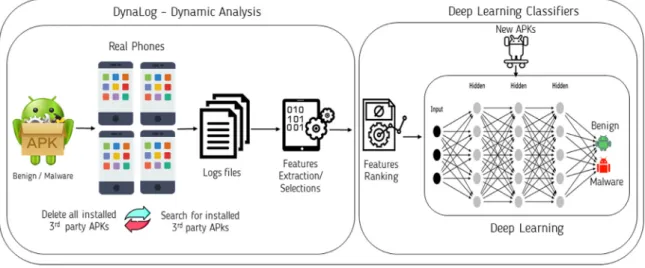
The executed runtime was different on each run and deter-mined by the chosen test input generation. The required timing was confirmed after evaluation with several apps to determine howmuchtime wasneededtotriggereverypossibleeventusing eitherthestateful tool (DroidBot),orthestateless tool (Monkey). Forthe statefulmethod,180swasfoundtobe sufficient.Forthe statelessgenerationusingMonkey,300s wasenough togenerate 4000eventsfortheapps.Beyond4000events,mostappsdidnot generateanyfurtherdynamicoutputfromDynalog.Theoverview oftheDL-DroidprocessusingDynaLogaswellastheDLclassifier engineisshownin Fig. 1
3.2.Dataset
Forthe purpose of evaluating DL-Droid accuracy performance and to compare it with other popular machine learning classi-fiers, we used a dataset consisting 31,125 Android applications. Out of these, 11,505 were malware samples while the rest were 19,620internallyvettedbenignsamplesobtainedfromIntel Secu-rity (McAfeeLabs).Thesesamplesconsist ofa varietyofapp for-mats,includingpaidapps,powerfulutilityapps,bankingapps, me-diaplayerapps,andpopulargameapps.Thesamplesareavailable tootherresearchersonrequest.
3.3.Featuresextractionandpreprocessing
Inthefeatureextractionphase,eachapplicationisinstalledand run on one of the eight phones using DynaLog (Alzaylaee, M.K., Yerima, S. Y. and Sezer, S. 2016 ).Once completed foreach ofthe twoscenarios, StatelessandStateful,the loggedfeatures are pre-processed into text files of feature vectors representing the fea-tures extracted from each application. These text files were fur-therprocessedintoasingle.csvfileforeachscenariowiththe pur-poseofevaluatingthedetectionperformanceusingdeeplearning. The.csvisan acceptablefile formatforbothH2O flowandWEKA
Fig.1. DL-Droidframework.
Table1
Totalnumberoftheextractedfeaturesusedinthe ex-periments.
Featureset No.offeatures Applicationattributesfeatures 97
Actions/Eventsfeatures 23 Permissionfeatures 300
Total 420
whichwereusedlaterintheexperiments.Notethat,eachfeature inthe.csvfileisbinarycontainingeither‘0’or‘1’whichrepresents theabsenceorpresenceofeachextractedfeatures.
Originally, DynaLog was equipped to extract 178 features dy-namically(i.e. API calls and intents - Actions/Events).These fea-tures were ranked using InfoGain (information gain provided by WEKA),andthenthetop120featureswereselectedforthe exper-iments.Dynalog wasextended to enable extractingAndroid per-missionsstatically priortoeach dynamicrun.Thisstepallows us totestthedetectionperformanceofDL-Droidwithmorefeatures asabonus.
Over 300 Android permissions that have been used by the investigated Android apps that governaccess to different device hardwareandsystemresources.Thesepermissionsareconsidered aseither normal, signature, or dangerous permissions. This step allowed usto collect the most relevant permissionswhich some ofwhichwere relativelynewandhadnot beenused inprevious works.Hence,asshownin Table 1 ,weobtainedatotalof420 fea-turesfromourfeatureextractionphase.The420extractedfeatures wererankedusingtheinformationgain(InfoGain)featureranking algorithminWEKA.The top20 rankeddynamicfeatures (includ-ing and excluding the extracted permissions) based on InfoGain inboth test input scenarios (stateless andstateful)are shown in Tables 2 –5 respectively.
3.4.Featuresrankingcomparisons
From Tables 2 ,and–5 ,itisinterestingtonotethattheAPIcalls methods getDeviceId, getSubscriberId, getLine1Number, and get-SimSerialNumberfromtheTelephonyManagerclass,that provides accessto informationaboutthetelephony servicesonthedevice, were among the top 20. However, the InfoGain score is higher for these features when extracted using DroidBot-based stateful input generation. For example, the InfoGain score of the feature TelephonyManager;->getDeviceIdis0.099in Tables 2 and 3 using
DroidBotbasedstatefulinputgeneration,whereasthescoreforthe samefeatureusingstatelessMonkey basedrandominput genera-tionis0.075in Tables 4 and 5 .
Similar findings can be seen with the feature TelephonyManager;->getSubscriberId which scored 0.057 us-ing DroidBotbased inputgeneration, whilethe scoreis0.042for Monkeybasedinputgeneration.Thefeatureaction.SMS_RECEIVED scores 0.096 fortheDroidBot basedgeneration in Table 2 ,which is higher than the score for the same feature extracted using Monkeybasedgenerationin Table 4 Hence,thisindicatesthatthe stateful DroidBot based input generation method has triggered more behaviours than the stateless Monkey based random input generation. Notethat most existing dynamicanalysis onAndroid utilizetheMonkeytoolforinputeventgeneration.
3.5. InvestigatingDeepLearningClassifiervs.otherpopularmachine learningalgorithms
OurmaingoalistobuildamodelforDL-Droidtoenable accu-rateclassification anddetectionofAndroid malware frombenign apps. In our experiments, we train our deep learning classifiers on a classification problemwithtwo labels, benign ormalicious. WeutilizeH2O whichcurrentlysupports onlytheMultilayer Per-ceptron classifier (MLP) Candel et al. (2016) . A confusion matrix isperformedinoursystemtoevaluatetheeffectivenessof differ-entclassifiers.Thesecondphaseoftheexperimentscomparedthe performancebetweentheproposedDLandsevenpopularmachine learningapproachesproposed in theliterature. The classifiers in-clude:Support VectorMachine(SVMLinear), SupportVector Ma-chine with radial basis function kernel (SVM RBF), Naive Bayes (NB), Simple Logistic(SL), Partial Decision Trees (PART), Random Forest (RF), and J48Decision Tree. We also investigated the per-formanceofeach classifierfortwo differenttestinput generation methods.The resultsofourexperiments arepresentedin section IIIusingtheperformancemetricsdefinedasfollows:
Thetruepositiveratio(TPR)alsoknownasrecall,truenegative ratio(TNR),falsepositiveratio(FPR),falsenegativeratio(FNR),and precisionaredefinedasfollows:
TPR= TP TP+FN (1) TNR= TN TN+FP (2) FPR= FP FP+TN (3)
Table2
Top20RankedFeaturesbasedonInfoGainusingStatefulinputgenerationDroidBot (Per-missionsexcluded).
Feature Malware Bening InfoGainscore TelephonyManager;->getDeviceId 4899 1078 0.099 com.android.vending.INSTALL_REFERRER 741 3890 0.096 action.SMS_RECEIVED 2421 375 0.096 TelephonyManager;->getSubscriberId 1993 203 0.057 action.USER_PRESENT 2633 545 0.056 methods/HttpPost;-><init> 3408 1044 0.054 TelephonyManager;->getLine1Number 1429 163 0.043 WifiManager;->getConnectionInfo 2680 792 0.039 content/Context;->bindService 573 2271 0.037 Ljava/util/TimerTask;-><init> 7399 4068 0.033 Ljava/io/FileOutputStream;->write 3775 1563 0.032 PackageManager;->checkPermission 2726 858 0.032 Landroid/net/NetworkInfo;->getState 1632 396 0.032 Ljava/io/File;->exists 6217 3361 0.027 security/MessageDigest;->getInstance 4905 2779 0.027 Landroid/content/Context;->unbindService 264 1347 0.02 action.PHONE_STATE 1030 215 0.019 action.PACKAGE_ADDED 1540 508 0.018 TelephonyManager;->getSimSerialNumber 859 157 0.018 SmsManager;->sendTextMessage 351 2 0.018 Table3
Top20RankedFeaturesbasedonInfoGainusingStatefulinputgenerationDroidBot (Permissionsincluded).
Feature Malware Bening InfoGainscore permission.SEND_SMS 5128 1084 0.16 permission.READ_PHONE_STATE 10,508 10,183 0.133 TelephonyManager;->getDeviceId 4899 2011 0.099 com.android.vending.INSTALL_REFERRER 741 7285 0.096 permission.RECEIVE_SMS 4054 1565 0.096 action.MOUNT_UNMOUNT_FILESYSTEMS 2889 781 0.082 permission.WRITE_SMS 2847 764 0.071 permission.READ_SMS 3592 1429 0.07 permission.SYSTEM_ALERT_WINDOW 4314 2276 0.069 action.SMS_RECEIVED 2421 665 0.066 TelephonyManager;->getSubscriberId 1993 387 0.057 action.USER_PRESENT 2633 912 0.056 permission.INSTALL_PACKAGES 1640 290 0.054 permission.ACCESS_MTK_MMHW 1092 29 0.047 permission.GET_TASKS 5790 5040 0.046 permission.RECEIVE_BOOT_COMPLETED 6648 6378 0.044 methods/HttpPost;-><init> 3408 1985 0.044 permission.USE_CREDENTIALS 313 3369 0.043 TelephonyManager;->getLine1Number 1429 278 0.041 permission.ACCESS_WIFI_STATE 8406 9802 0.039 Table4
Top20RankedFeaturesbasedonInfoGainusingstatelessMonkeybasedinputgeneration (Permissionsexcluded).
Feature Malware Bening InfoGainscore
com.android.vending.INSTALL_REFERRER 737 6686 0.106 TelephonyManager;->getDeviceId 4269 1800 0.075 action.SMS_RECEIVED 2416 608 0.057 action.USER_PRESENT 2627 853 0.053 TelephonyManager;->getSubscriberId 1682 363 0.042 TelephonyManager;->getLine1Number 1385 286 0.035 Landroid/content/Context;->bindService 589 3260 0.031 Landroid/net/NetworkInfo;->getState 1570 593 0.026 client/methods/HttpPost;-><init> 2526 1634 0.022 Ljava/io/FileOutputStream;->write 3082 2296 0.021 Ljava/util/TimerTask;-><init> 6943 7564 0.021 action.PHONE_STATE 1026 349 0.018 TelephonyManager;->getSimSerialNumber 896 257 0.018 Landroid/content/Context;->unbindService 287 1800 0.018 wifi/WifiManager;->getConnectionInfo 1977 1235 0.018 action.PACKAGE_ADDED 1533 804 0.017 /PackageManager;->checkPermission 2111 1419 0.017 Ljava/io/File;->exists 5674 6027 0.016 telephony/SmsManager;->sendTextMessage 332 1 0.015 action.NEW_OUTGOING_CALL 655 182 0.013
Table5
Top20RankedFeaturesbasedonInfoGainusingstatelessMonkeybasedinput gener-ation(Permissionsincluded).
Feature Malware Bening InfoGainscore permission.SEND_SMS 5117 1006 0.16 permission.READ_PHONE_STATE 10,468 9146 0.135 android.vending.INSTALL_REFERRER 737 6686 0.106 permission.RECEIVE_SMS 4043 1420 0.082 TelephonyManager;->getDeviceId 4269 1800 0.075 permission.WRITE_SMS 2841 697 0.07 action.MOUNT_UNMOUNT_FILESYSTEMS 2879 741 0.069 permission.READ_SMS 3584 1322 0.068 permission.SYSTEM_ALERT_WINDOW 4299 2138 0.063 action.SMS_RECEIVED 2416 608 0.057 action.USER_PRESENT 2627 853 0.053 permission.INSTALL_PACKAGES 1638 243 0.049 permission.ACCESS_MTK_MMHW 1087 26 0.046 permission.GET_TASKS 5770 4534 0.044 permission.RECEIVE_BOOT_COMPLETED 6621 5760 0.043 permission.USE_CREDENTIALS 311 3004 0.043 TelephonyManager;->getSubscriberId 1682 363 0.042 permission.GET_ACCOUNTS 3012 8601 0.039 permission.ACCESS_WIFI_STATE 8376 8941 0.035 TelephonyManager;->getLine1Number 1385 286 0.035 FNR= FN FN+TP (4) P= TP TP+FP (5)
WhereTPdenotesthenumberoftruepositives,TNthenumberof truenegatives,FPthenumberoffalsepositives,andFNthe num-beroffalsenegatives.
FM isthe F measure calculated forboth malware and benign classes.ThecombinedmeasureknownasweightedFMisdefined asfollows: FM=2 ∗recall∗precision recall+precision (6) W−FM=
(
Fm.Nm)
+(
Fb.Nb)
Nm+Nb (7) Where Fb and Fm are the FM of the benign and malwaredatasetsrespectively,whereasNb andNmarethenumberof
sam-ples inthebenignandmalware datasetsrespectively.The 10-fold crossvalidationapproachwasusedinallofthepresented experi-ments.
4. Experimentalresultsanddiscussions
4.1. Deeplearningclassifieranalysis
4.1.1. DLcomparisonswithdynamicfeatures:Statefulvs.Stateless inputgeneration
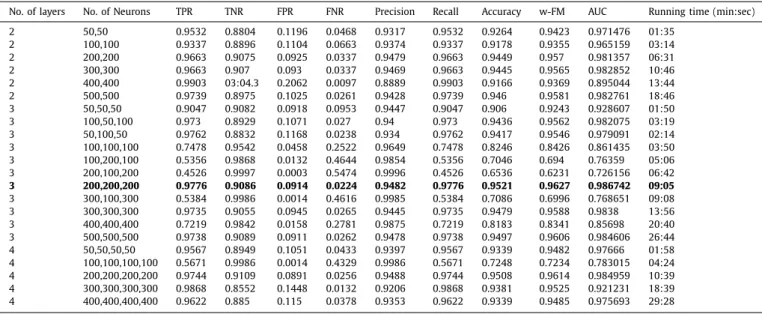
Table 6 depictstheresults ofexperimentsundertakento eval-uatetheperformanceoftheDLapproachwithdifferent combina-tions ofhiddenlayers. Theresultsshownhereis forthe dynamic featuresonly,usingthestatefulDroidbotinputgenerationtool.22 different combinations of hiddenneurons, containing two, three, andfourlayers,havebeenappliedinordertodeterminethebest possible performance basedon the w-FM. At Table 6 , theresults showthatthe200,200,200combinationperformsthebestwhen comparedto othercombinations,withrunningtime ofnine
min-Table6
Deeplearningresultswithdifferentcombinationsofhiddenlayers(withtheuseofstatefulinputgenerationanddynamicfeaturesonly).
No.oflayers No.ofNeurons TPR TNR FPR FNR Precision Recall Accuracy w-FM AUC Runningtime(min:sec) 2 50,50 0.9532 0.8804 0.1196 0.0468 0.9317 0.9532 0.9264 0.9423 0.971476 01:35 2 100,100 0.9337 0.8896 0.1104 0.0663 0.9374 0.9337 0.9178 0.9355 0.965159 03:14 2 200,200 0.9663 0.9075 0.0925 0.0337 0.9479 0.9663 0.9449 0.957 0.981357 06:31 2 300,300 0.9663 0.907 0.093 0.0337 0.9469 0.9663 0.9445 0.9565 0.982852 10:46 2 400,400 0.9903 03:04.3 0.2062 0.0097 0.8889 0.9903 0.9166 0.9369 0.895044 13:44 2 500,500 0.9739 0.8975 0.1025 0.0261 0.9428 0.9739 0.946 0.9581 0.982761 18:46 3 50,50,50 0.9047 0.9082 0.0918 0.0953 0.9447 0.9047 0.906 0.9243 0.928607 01:50 3 100,50,100 0.973 0.8929 0.1071 0.027 0.94 0.973 0.9436 0.9562 0.982075 03:19 3 50,100,50 0.9762 0.8832 0.1168 0.0238 0.934 0.9762 0.9417 0.9546 0.979091 02:14 3 100,100,100 0.7478 0.9542 0.0458 0.2522 0.9649 0.7478 0.8246 0.8426 0.861435 03:50 3 100,200,100 0.5356 0.9868 0.0132 0.4644 0.9854 0.5356 0.7046 0.694 0.76359 05:06 3 200,100,200 0.4526 0.9997 0.0003 0.5474 0.9996 0.4526 0.6536 0.6231 0.726156 06:42 3 200,200,200 0.9776 0.9086 0.0914 0.0224 0.9482 0.9776 0.9521 0.9627 0.986742 09:05 3 300,100,300 0.5384 0.9986 0.0014 0.4616 0.9985 0.5384 0.7086 0.6996 0.768651 09:08 3 300,300,300 0.9735 0.9055 0.0945 0.0265 0.9445 0.9735 0.9479 0.9588 0.9838 13:56 3 400,400,400 0.7219 0.9842 0.0158 0.2781 0.9875 0.7219 0.8183 0.8341 0.85698 20:40 3 500,500,500 0.9738 0.9089 0.0911 0.0262 0.9478 0.9738 0.9497 0.9606 0.984606 26:44 4 50,50,50,50 0.9567 0.8949 0.1051 0.0433 0.9397 0.9567 0.9339 0.9482 0.97666 01:58 4 100,100,100,100 0.5671 0.9986 0.0014 0.4329 0.9986 0.5671 0.7248 0.7234 0.783015 04:24 4 200,200,200,200 0.9744 0.9109 0.0891 0.0256 0.9488 0.9744 0.9508 0.9614 0.984959 10:39 4 300,300,300,300 0.9868 0.8552 0.1448 0.0132 0.9206 0.9868 0.9381 0.9525 0.921231 18:39 4 400,400,400,400 0.9622 0.885 0.115 0.0378 0.9353 0.9622 0.9339 0.9485 0.975693 29:28
Table7
Deeplearningresultswithdifferentcombinationsofhiddenlayers(withtheuseofstatefulinputgenerationandstatic+dynamicfeatures).
No.oflayers No.ofNeurons TPR TNR FPR FNR Precision Recall Accuracy w-FM AUC Runningtime(min:sec) 2 50,50 0.8701 0.9252 0.0748 0.1299 0.952 0.8701 0.8904 0.9092 0.920539 03:43 2 100,100 0.9669 0.9162 0.0838 0.0331 0.9516 0.9669 0.9482 0.9592 0.980748 07:18 2 200,200 0.9661 0.8771 0.1229 0.0339 0.9306 0.9661 0.9332 0.948 0.970208 14:51 2 300,300 0.9693 0.9121 0.0879 0.0307 0.9495 0.9693 0.9481 0.9593 0.980417 21:42 2 400,400 0.972 0.9082 0.0918 0.028 0.9475 0.972 0.9484 0.9596 0.978372 30:50 2 500,500 0.9735 0.9261 0.0739 0.0265 0.9574 0.9735 0.956 0.9654 0.983072 36:36 3 50,50,50 0.9718 0.9059 0.0941 0.0282 0.9462 0.9718 0.9474 0.9588 0.978387 04:05 3 100,50,100 0.9718 0.9149 0.0851 0.0282 0.9512 0.9718 0.9507 0.9613 0.983224 07:38 3 50,100,50 0.9646 0.8707 0.1293 0.0354 0.9271 0.9646 0.9299 0.9455 0.976274 04:34 3 100,100,100 0.9733 0.9202 0.0798 0.0267 0.9541 0.9733 0.9537 0.9636 0.982417 08:33 3 100,200,100 0.9737 0.9231 0.0769 0.0263 0.9557 0.9737 0.955 0.9647 0.984257 09:40 3 200,100,200 0.9733 0.9314 0.0686 0.0267 0.9603 0.9733 0.9578 0.9668 0.984114 15:13 3 200,200,200 0.9956 0.967 0.033 0.0044 0.9809 0.9956 0.985 0.9882 0.997105 17:21 3 300,100,300 0.976 0.9089 0.0911 0.024 0.9481 0.976 0.9512 0.9618 0.980004 22:34 3 300,300,300 0.9762 0.912 0.088 0.0238 0.9498 0.9762 0.9525 0.9628 0.982277 26:29 3 400,400,400 0.9764 0.9166 0.0834 0.0236 0.9523 0.9764 0.9543 0.9642 0.982026 38:16 3 500,500,500 0.9765 0.9287 0.0713 0.0235 0.959 0.9765 0.9588 0.9676 0.983941 49:31 4 50,50,50,50 0.9676 0.9195 0.0805 0.0324 0.9535 0.9676 0.9498 0.9605 0.981414 04:31 4 100,100,100,100 0.9661 0.9265 0.0735 0.0339 0.9573 0.9661 0.9515 0.9617 0.982657 09:29 4 200,200,200,200 0.9757 0.9207 0.0793 0.0243 0.9545 0.9757 0.9553 0.965 0.982594 20:05 4 300,300,300,300 0.9739 0.9131 0.0869 0.0261 0.9503 0.9739 0.9514 0.9619 0.980652 36:36 4 400,400,400,400 0.9717 0.9093 0.0907 0.0283 0.9481 0.9717 0.9486 0.9597 0.982227 43:52
utes.WecanseethatDLcanachievew-FMof0.963whensetting thenumberoflayersto3andselecting200neuronsineachlayer withdynamicfeaturesonly.
Werepeatedthesameexperimentsonthedynamicfeatures ex-tractedusingthestatelessMonkeybasedrandominputgeneration tool in order to compare the results with the previous scenario. Table 8 showstheresultsobtained.Thebestw-FMisalsorecorded with three layers similar to the previous scenario. However, this isobtainedwithdifferentcombinationofneurons.Thenumberof neuronsineachlayeris300,100,300respectivelyforthebest w-FMof0.958.Eventhoughtherunningtimeis8minutes,whichis lessby almost one minute, ourfocus has beenthe detection ac-curacy. Therefore,from Tables 6 and 8 ,we can confirm that the DL-Droidachievesitsbestperformancewiththefeaturesobtained fromtheuseofthestatefulinputgenerationapproach.
4.1.2. DLcomparisonswithdynamicfeaturesandstaticfeatures: Statelessvs.Statefulinputgeneration
Thesameexperimentsoutlinedintheprevioussectionwere re-peatedwiththeadditionofstaticfeatures,i.e.permissions,and re-sultsareshownin Table 7 Wecanseethatthesamecombination of200neuronsineachhiddenlayerwiththreehiddenlayersis su-periortotheother deepnetworksforAndroidmalwaredetection using the stateful input generation approach. The w-FM reached approximately0.99.
4.2. ComparisonoftheperformanceoftheDeepLearningClassifier withotherpopularmachinelearningclassifiers
Inthissection,wecomparethedetectionaccuraciesofthe pro-posed DL approach with the most popular machine learning al-gorithms as shown in Tables 10 and 11 . Overall seven machine learningalgorithmswereselectedbasedonresultsofseveral pre-liminary experiments had been conducted. From the tables, we can clearly see that the proposed DL approach outperforms the othermachinelearningalgorithms.In Table 10 ,whereresultsfrom onlydynamicfeaturesare presented,thesecondhighestw-FMof 0.94 is achieved by the Random Forest algorithm, while that of the deep learning approach is 0.963. When we perform further comparison byadding permissionsto theanalysis (Table 11 ), the DL approach still topped the rest with a w-FM of nearly 0.99, while the next highest, which is again Random Forest, achieved
a w-FM of 0.97. We can clearly observe that the addition of staticfeatures i.e.permissionsimprovedthedetectionaccuracyof DL-Droid.
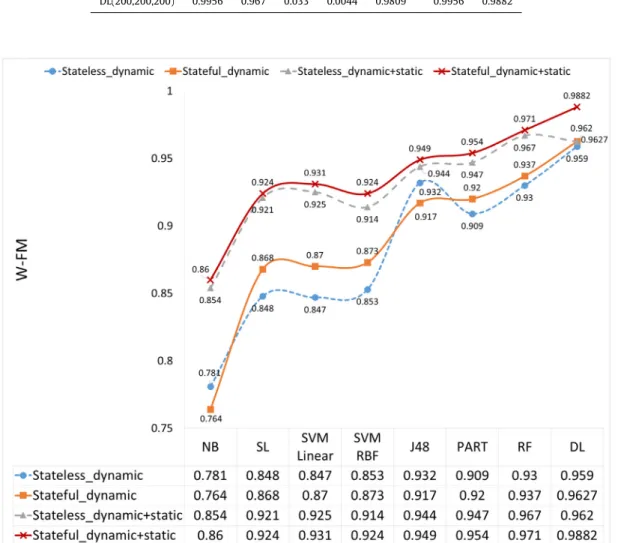
Fig. 2 ,presentstheresultsofcomparisonbetweenthetwo in-putgenerationmethods i.e.stateful(usingDroidbot)andstateless (using monkey). Fig. 2 shows the w-FM results for DL-Droid as well as the selected seven popular machine learningalgorithms. Inthe experiments withdynamicfeatures only, all classifiers ex-cept for NBand J48,performed better where stateful input gen-erationwithDroidbotwasutilized,comparedto thestateless ap-proachusingMonkey.However,intheexperimentwithcombined staticanddynamicfeatures,thestatefulinputgenerationapproach wassuperiorforall theclassifiers.Withtheseresultsdepictedin Fig. 2 ,wecan concludethatDL-Droid withstatefulinput genera-tion(our initiallyproposed approach) achievesthe bestdetection accuracy.
4.3.Resultscomparisonwithexistingwork
Table 12 ,presentsacomparisonofDL-Droidperformancewith other existingdeep learningbasedmethods forAndroid malware detection.DroidDetector’sstaticanddynamicbaseddeeplearning methodachieved96.76%accuracycomparedtoDL-Droidwhichhas 98.5%accuracy.DL-DroidoutperformedDroidDetector(Yuan et al., 2016 ) in all other metrics, while utilizing more samples for the experiments. DL-Droid also outperforms Maldozer (Karbab et al., 2017 ), Deep4MalDroid (Hou et al., 2016 ), AutoDroid (Hou et al., 2017 )andtheCNNapproachpresentedin(McLaughlin et al., 2017 ). Itisinterestingtonotethat,justlikeinDeep4MalDroidand Auto-Droid,thenumber ofthe optimum hiddenlayers forDL-Droid is three.
5. Conclusion
In thispaper, we presented DL-Droid, an automated dynamic analysisframeworkforAndroid malware detection.DL-Droid em-ploysdeeplearningwithastate-based inputgeneration approach asthedefaultmethod,althoughithasthecapabilitytoemploythe state-of-the-practicepopular Monkey tool (stateless method). We evaluated DL-Droid using 31,125 Android applications, 420 static and dynamic features, comparing its performance to traditional machine learning classifiers as well as existing DL-based frame-works. The presented results clearly demonstrate that DL-Droid
Table8
Deeplearningresultswithdifferentcombinationsofhiddenlayers(withtheuseofstatelessinputgenerationanddynamicfeaturesonly).
No.oflayers No.ofNeurons TPR TNR FPR FNR Precision Recall Accuracy w-FM AUC Runningtime(min:sec) 3 100,100,100 0.6111 0.9954 0.0046 0.3889 0.9951 0.6111 0.7619 0.7572 0.803875 03:31 3 50,100,50 0.6285 0.967 0.033 0.3715 0.9659 0.6285 0.7648 0.7615 0.806743 02:00 2 400,400 0.726 0.9615 0.0385 0.274 0.9666 0.726 0.8189 0.8292 0.854101 12:33 2 100,100 0.8221 0.9105 0.0895 0.1779 0.9321 0.8221 0.8575 0.8736 0.886959 02:53 2 50,50 0.8795 0.8266 0.1734 0.1205 0.8867 0.8795 0.8587 0.8831 0.89001 01:26 3 500,500,500 0.997 0.7606 0.2394 0.003 0.8622 0.997 0.9025 0.9247 0.879508 06:10 3 100,50,100 0.9233 0.9081 0.0919 0.0767 0.9372 0.9233 0.9172 0.9302 0.940436 02:52 3 50,50,50 0.9526 0.8824 0.1176 0.0474 0.9257 0.9526 0.9249 0.9389 0.973505 01:36 4 300,300,300,300 0.9672 0.8975 0.1025 0.0328 0.9349 0.9672 0.9396 0.9508 0.981281 17:00 4 50,50,50,50 0.9671 0.8977 0.1023 0.0329 0.9355 0.9671 0.9397 0.951 0.979724 01:49 3 200,200,200 0.9764 0.8905 0.1095 0.0236 0.9302 0.9764 0.942 0.9527 0.984125 07:12 4 100,100,100,100 0.9752 0.8902 0.1098 0.0248 0.9311 0.9752 0.9415 0.9527 0.981828 04:14 2 500,500 0.971 0.901 0.099 0.029 0.9363 0.971 0.943 0.9533 0.982513 16:08 4 200,200,200,200 0.9791 0.8831 0.1169 0.0209 0.9293 0.9791 0.9417 0.9535 0.981191 09:53 4 400,400,400,400 0.973 0.8978 0.1022 0.027 0.9359 0.973 0.9433 0.9541 0.982963 25:48 3 300,300,300 0.9754 0.8945 0.1055 0.0246 0.9342 0.9754 0.9435 0.9543 0.980887 11:57 3 200,100,200 0.9717 0.903 0.097 0.0283 0.9384 0.9717 0.9444 0.9547 0.983906 05:50 2 200,200 0.9696 0.9077 0.0923 0.0304 0.9415 0.9696 0.9452 0.9553 0.982541 06:19 3 400,400,400 0.9759 0.8963 0.1037 0.0241 0.9355 0.9759 0.9446 0.9553 0.983396 16:45 3 100,200,100 0.9741 0.9104 0.0896 0.0259 0.943 0.9741 0.9488 0.9583 0.985178 04:23 2 300,300 0.9798 0.8997 0.1003 0.0202 0.9386 0.9798 0.9486 0.9588 0.984684 09:37 3 300,100,300 0.9778 0.9064 0.0936 0.0222 0.9408 0.9778 0.9495 0.9589 0.985202 08:08 Table9
Deeplearningresultswithdifferentcombinationsofhiddenlayers(withtheuseofstatelessinputgenerationandstatic+dynamicfeatures).
No.oflayers No.ofNeurons TPR TNR FPR FNR Precision Recall Accuracy w-FM AUC Runningtime(min:sec) 2 50,50 0.8788 0.8905 0.1095 0.1212 0.9244 0.8788 0.8834 0.901 0.916957 03:32 2 200,200 0.9246 0.8612 0.1388 0.0754 0.9102 0.9246 0.8995 0.9174 0.956576 14:11 3 50,50,50 0.9443 0.8505 0.1495 0.0557 0.9058 0.9443 0.9071 0.9247 0.961333 03:46 3 50,100,50 0.9403 0.87 0.13 0.0597 0.9168 0.9403 0.9125 0.9284 0.963836 04:18 2 100,100 0.9569 0.8841 0.1159 0.0431 0.9263 0.9569 0.928 0.9413 0.971361 07:18 4 400,400,400,400 0.9703 0.8882 0.1118 0.0297 0.9296 0.9703 0.9377 0.9495 0.975414 44:27 2 300,300 0.9625 0.9063 0.0937 0.0375 0.9399 0.9625 0.9402 0.9511 0.978022 21:32 3 200,200,200 0.9609 0.9131 0.0869 0.0391 0.9439 0.9609 0.942 0.9524 0.977116 16:27 4 50,50,50,50 0.9653 0.906 0.094 0.0347 0.9399 0.9653 0.9418 0.9525 0.977894 04:12 3 300,100,300 0.9764 0.8921 0.1079 0.0236 0.9323 0.9764 0.943 0.9539 0.977185 21:11 4 100,100,100,100 0.9649 0.9125 0.0875 0.0351 0.9438 0.9649 0.9441 0.9542 0.979354 08:42 3 100,100,100 0.9627 0.9191 0.0809 0.0373 0.9477 0.9627 0.9454 0.9551 0.98 07:51 4 300,300,300,300 0.9671 0.9137 0.0863 0.0329 0.9446 0.9671 0.9459 0.9557 0.979939 36:36 2 400,400 0.9755 0.901 0.099 0.0245 0.9375 0.9755 0.9459 0.9561 0.980394 28:08 4 200,200,200,200 0.9711 0.9107 0.0893 0.0289 0.9431 0.9711 0.9472 0.9569 0.981067 19:10 2 500,500 0.9693 0.9155 0.0845 0.0307 0.9459 0.9693 0.948 0.9575 0.980055 34:25 3 100,50,100 0.9707 0.9148 0.0852 0.0293 0.9455 0.9707 0.9486 0.958 0.980691 07:16 3 200,100,200 0.9658 0.9261 0.0739 0.0342 0.9521 0.9658 0.9501 0.9589 0.981751 15:04 3 100,200,100 0.9668 0.9251 0.0749 0.0332 0.9516 0.9668 0.9503 0.9591 0.982598 09:29 3 300,300,300 0.9649 0.9301 0.0699 0.0351 0.9546 0.9649 0.9511 0.9597 0.981693 25:08 3 500,500,500 0.9732 0.9248 0.0752 0.0268 0.9517 0.9732 0.954 0.9623 0.984339 48:29 3 400,400,400 0.9719 0.9272 0.0728 0.0281 0.9531 0.9719 0.9542 0.9624 0.983771 38:19 Table10
ResultsforDLandsevenmachinelearningalgorithms(withstatefulinputgenerationanddynamic featuresonly). TPR TNR FPR FNR Precision Recall w-FM NB 0.62 0.855 0.145 0.38 0.765 0.768 0.764 SL 0.761 0.933 0.067 0.239 0.87 0.87 0.868 SVMLinear 0.758 0.938 0.062 0.242 0.872 0.872 0.87 SVMRBF 0.758 0.944 0.056 0.242 0.876 0.875 0.873 J48 0.855 0.954 0.046 0.145 0.917 0.918 0.917 PART 0.861 0.955 0.045 0.139 0.92 0.92 0.92 RF 0.88 0.971 0.029 0.12 0.938 0.938 0.937 DL(200,200,200) 0.9776 0.9086 0.0914 0.0224 0.9482 0.9776 0.9627
achievedhigh accuracy performance reaching better figures than thosepresentedinexistingdeeplearning-based Androidmalware detectionframeworks. To the best of our knowledge, this is the firstwork toinvestigatedeeplearningusingdynamicfeatures ex-tracted from apps using real phones. Our results also highlight thesignificance of enhancing input generation fordynamic
anal-ysis systems that are designed to detect Android malware using machine learning. As future work, self-adaptation such as intro-duced and investigated recently for Intrusion Detection systems (Papamartzivanos et al., 2019 ) could be explored as a means of improvingtheperformanceofthedeeplearningbasedsystemfor Androidmalwaredetection.
Table11
ResultsforDLandsevenmachinelearningalgorithms(withstatefulinputgenerationandstatic +dynamicfeatures). TPR TNR FPR FNR Precision Recall w-FM NB 0.816 0.886 0.114 0.184 0.86 0.86 0.86 SL 0.871 0.957 0.043 0.129 0.925 0.925 0.924 SVMRBF 0.871 0.957 0.043 0.129 0.925 0.925 0.924 SVMLinear 0.875 0.964 0.036 0.125 0.931 0.931 0.931 J48 0.919 0.967 0.033 0.081 0.949 0.949 0.949 PART 0.931 0.968 0.032 0.069 0.954 0.954 0.954 RF 0.941 0.988 0.012 0.059 0.971 0.971 0.971 DL(200,200,200) 0.9956 0.967 0.033 0.0044 0.9809 0.9956 0.9882
Fig.2. w-FMforDL-DroidandsevenselectedMLalgorithms.Statefulvs.statelessinputgeneration.
Table12
ComparisonsofDL-Droidwithotherexistingdeeplearningapproaches.
ClassificationSystem ExtractedFeaturesTypes Benign Malware No.ofneurons Acc. Prec. Recall F-score DroidDetectorYuanetal.(2016) Staticonly 880 880 [150,150] 89.03 90.39 89.04 89.76 DroidDetectorYuanetal.(2016) Dynamiconly 880 880 [150,150] 71.25 72.59 71.25 71.92 DroidDetectorYuanetal.(2016) Static&Dynamic 880 880 [150,150] 96.76 96.78 96.76 96.76
CNNMcLaughlinetal.(2017) Static(opcode) 863 1260 N/A 98 99 95 97
MalDozerKarbabetal.(2017) Staticonly 37,627 20,089 N/A N/A 96.29 96.29 96.29 Deep4MalDroidHouetal.(2016) Dynamic(sys.Calls) 1,500 1,500 [200,200,200] 93.68 93.96 93.36 93.68 AutoDroidHouetal.(2017) Staticonly 2,500 2,500 [200,200,200] 96.66 96.55 96.76 96.66 DL-Droid(Stateless) Dynamiconly 19,620 11,505 [300,100,300] 94.95 94.08 97.78 95.89 DL-Droid(Stateless) Static&Dynamic 19,620 11,505 [400,400,400](Table9) 95.42 95.31 97.19 96.24 DL-Droid(Stateful) Dynamiconly 19,620 11,505 [200,200,200] 95.21 94.82 97.76 96.27 DL-Droid(Stateful) Static&Dynamic 19,620 11,505 [200,200,200] 98.5 98.09 99.56 98.82
Declarationofcompetinginterest
Theauthorsdeclarethattheyhavenoknowncompeting finan-cialinterestsorpersonalrelationshipsthatcouldhaveappearedto influencetheworkreportedinthispaper.
References
Aafer,Y.,Du,W.,Yin,H.,2013.Droidapiminer:miningAPI-Levelfeaturesforrobust malwaredetectioninandroid.Secur.Priv.Commun.Netw.127,86–103.doi:10. 1007/978-3-319-04283-1_6.
Alzaylaee,M.K.,Yerima,S.Y.,andSezer,S.,2016.Dynalog:anautomateddynamic analysis frameworkfor characterizingandroid applications.In:2016 Interna-tionalConferenceOnCyberSecurityAndProtectionOfDigitalServices(Cyber Security),pp.1–8.doi:10.1109/CyberSecPODS.2016.7502337.
Alzaylaee,M.K.,Yerima,S.Y.,Sezer,S.,2017.Emulatorvsrealphone:android mal-waredetectionusingmachinelearning.In:Proceedingsofthe3rdACMon In-ternationalWorkshoponSecurityAndPrivacyAnalytics.ACM,Scottsdale, Ari-zona,USA-March24,-24,2017,pp.65–72.doi:10.1145/3041008.3041010. Alzaylaee,M.K.,Yerima,S.Y.,Sezer,S.,2017.Improvingdynamicanalysisofandroid
appsusinghybridtestinputgeneration.In:2017InternationalConferenceon Cyber SecurityAnd ProtectionOf Digital Services(Cyber Security),pp. 1–8. doi:10.1109/CyberSecPODS.2017.8074845.
Amalfitano,D.,Fasolino,A.R.,Tramontana,P.,DeCarmine,S.,Memon,A.M.,2012. Usingguirippingforautomatedtestingofandroidapplications.In:Proceedings ofthe27thIEEE/ACMInternationalConference onAutomatedSoftware Engi-neering.ACM,NewYork,NY,USA,pp.258–261.doi:10.1145/2351676.2351717. Anagnostopoulos,M.,Kambourakis,G.,Gritzalis,S.,2016.Newfacetsofmobile
bot-net:architectureandevaluation.Int.J.Inf.Secur.15(5),455–473.
Anand,S., Naik,M., Harrold,M.J.,Yang, H.,2012.Automatedconcolic testingof smartphoneapps.In:ProceedingsoftheACMSIGSOFT20thInternational Sym-posiumontheFoundationsofSoftwareEngineering.ACM,p.59.
Arp,D., Spreitzenbarth,M.,Hubner,M.,Gascon,H.,Rieck, K., Siemens,C.,2014. Drebin:effectiveandexplainabledetectionofandroidmalwareinyourpocket.. In:Ndss,14,pp.23–26.
Azim, T., Neamtiu, I., 2013. Targeted and depth-first explorationfor systematic testingofandroidapps.SIGPLANNot.48(10),641–660.doi:10.1145/2544173. 2509549.
Candel,A.,Parmar,V.,LeDell,E.,Arora,A.,2016.Deeplearningwithh2o.H2O.ai Inc.
Cen,L.,Gates,C.S.,Si,L.,Li,N.,2015.Aprobabilisticdiscriminativemodelfor an-droidmalwaredetectionwithdecompiledsourcecode.IEEETransDependable SecureComput12(4),400–412.doi:10.1109/TDSC.2014.2355839.
Choi,W.,Necula,G.,Sen,K.,2013. Guidedguitestingofandroidappswith min-imal restartand approximatelearning.In: ACM SIGPLAN Notices,48. ACM, pp.623–640.
Choudhary,S.R.,Gorla,A.,Orso,A.,2015.Automatedtestinputgenerationfor an-droid:Arewethereyet?In:AutomatedSoftwareEngineering(ASE),201530th IEEE/ACMInternationalConferenceon.IEEE,pp.429–440.
Developers,A.,2012.Ui/applicationexercisermonkey.
Dini,G., Martinelli,F., Saracino,A., Sgandurra, D., 2012.MADAM: A multi-level anomalydetectorforandroidmalware.LectureNotesinComputerScience (in-cludingsubseriesLectureNotesinArtificialIntelligenceandLectureNotesin Bioinformatics)7531LNCS,240–253.doi:10.1007/978-3-642-33704-8-21. DroidBox,GoogleArchivehttps://code.google.com/archive/p/droidbox/.
Enck,W.,Gilbert,P.,Chun,B.-G.,Cox,L.P.,Jung,J.,McDaniel,P.,Sheth,A.N.,2010. Taintdroid:aninformation-Flowtrackingsystemforrealtimeprivacy monitor-ingonsmartphones.Osdi’1049,1–6.doi:10.1145/2494522.
Fan,M.,Liu,J., Wang,W.,Li,H.,Tian,Z.,Liu,T.,2017.Dapasa:detectingandroid piggybackedappsthroughsensitivesubgraphanalysis.IEEETrans.Inf.Forensics Secur.12(8),1772–1785.doi:10.1109/TIFS.2017.2687880.
Genymotion,Fast&EasyAndroidEmulator.(2018).Genymotion,AndroidEmulator forapptesting.https://www.genymotion.com/.
GlobalsmartphoneshipmentsbyOS2016–2022|Statistic. GooglePlayProtect.Android2018.
Hao,S.,Liu,B.,Nath,S.,Halfond,W.G.,Govindan,R.,2014.Puma:programmable ui-automationforlarge-scaledynamicanalysisofmobileapps.In:Proceedings ofthe 12thannualinternationalconferenceonMobilesystems, applications, andservices.ACM,pp.204–217.
Hou,S.,Saas,A.,Chen,L.,Ye,Y.,2016.Deep4maldroid:adeeplearningframework for androidmalware detectionbasedonlinuxkernelsystemcallgraphs.In: 2016IEEE/WIC/ACMInternational ConferenceonWebIntelligenceWorkshops (WIW).IEEE,pp.104–111.
Hou,S.,Saas,A.,Chen,L.,Ye,Y.,Bourlai,T.,2017.Deepneuralnetworksfor auto-maticandroidmalwaredetection.In:Proceedingsofthe2017IEEE/ACM Inter-nationalConferenceonAdvancesinSocialNetworksAnalysisandMining2017. ACM,pp.803–810.
Kang,B.,Yerima,S.Y.,Mclaughlin,K.,Sezer,S.,2016.N-opcodeanalysisforandroid malwareclassificationandcategorization.In:2016InternationalConferenceOn Cyber SecurityAnd Protection OfDigital Services (Cyber Security),pp.1–7. doi:10.1109/CyberSecPODS.2016.7502343.
Kang,B.,Yerima,S.Y.,Sezer,S.,McLaughlin,K.,2016. N-gramopcodeanalysisfor androidmalwaredetection.CoRRabs/1612.01445.
Karbab,E.B.,Debbabi,M.,Derhab,A.,Mouheb,D.,2017.Androidmalwaredetection usingdeeplearningonapimethodsequencesarXiv:1712.08996.
LeCun,Y.,Bengio,Y.,Hinton,G.,2015.Deeplearning.Nature521(7553),436. Li,Y.,Yang,Z.,Guo,Y.,Chen,X.,2017. Droidbot:alightweightui-guidedtest
in-putgeneratorforandroid.In:2017IEEE/ACM39thInternationalConferenceon SoftwareEngineeringCompanion(ICSE-C),pp.23–26.doi:10.1109/ICSE-C.2017.8. Machiry,A.,Tahiliani,R.,Naik,M.,2013.Dynodroid:aninputgenerationsystemfor androidapps.In:Proceedingsofthe20139thJointMeetingonFoundationsof SoftwareEngineering.ACM,pp.224–234.
McAfeeLabsThreatsPredictionsReport|McAfeeLabs.
McLaughlin,N., MartinezdelRincon,J., Kang,B., Yerima,S.,Miller, P., Sezer, S., Safaei,Y.,Trickel,E., Zhao,Z., Doupe,A., etal., 2017.Deepandroidmalware detection.In:ProceedingsoftheSeventhACMonConferenceonDataand Ap-plicationSecurityandPrivacy.ACM,pp.301–308.
NVISOApkScanScanAndroidapplicationsformalwarehttps://apkscan.nviso.be/. Oberheide,J.,Miller,C.,2012.Dissectingtheandroidbouncer.Summercon2012. Papamartzivanos,D.,GasmezMAarmol,F.,Kambourakis,G.,2019.Introducingdeep
learningself-adaptivemisusenetworkintrusiondetectionsystems.IEEEAccess 7,13546–13560.doi:10.1109/ACCESS.2019.2893871.
Peiravian,N.,Zhu,X.,2013.Machinelearningforandroidmalwaredetectionusing permissionandapicalls.In:ToolswithArtificialIntelligence(ICTAI),2013IEEE 25thInternationalConferenceon.IEEE,pp.300–305.
Rasthofer,S.,Arzt,S.,Bodden,E.,2014.Amachine-learningapproachforclassifying andcategorizingandroidsourcesandsinks..NDSS.
Rastogi,V.,Chen,Y.,Enck,W.,2013.Appsplayground:automaticsecurityanalysis ofsmartphoneapplications.In:CODASPY’13(3rdACMconferenceonDataand ApplicationSecurityandPrivac),pp.209–220.doi:10.1145/2435349.2435379. Shabtai,A.,Kanonov,U.,Elovici,Y.,Glezer,C.,Weiss,Y.,2012.”Andromaly”:a
be-havioralmalwaredetectionframeworkforandroiddevices.J.Intell.Inf.Syst.38 (1),161–190.doi:10.1007/s10844-010-0148-x.
Smartphone OS market share worldwide 2009–2017 | Statis-tic, Statista https://www.statista.com/statistics/263453/ global-market-share-held-by-smartphone-operating-systems.
Start the emulator from the command line | Android Developers. (2018). Android Developers. https://developer.android.com/studio/run/emulator-commandline.
Tam,K.,Khan,S.J.,Fattori,A.,Cavallaro,L.,2015.Copperdroid:automatic reconstruc-tionofandroid malwarebehaviors. Ndss(February) 8–11. doi:10.14722/ndss. 2015.23145.
Tracedroidhttp://tracedroid.few.vu.nl/.
Westyarian, Rosmansyah, Y.,Dabarsyah, B., 2015. Malware detection on android smartphonesusingapiclassandmachinelearning.In:2015International Con-ferenceonElectricalEngineeringandInformatics(ICEEI),pp.294–297.doi:10. 1109/ICEEI.2015.7352513.
Yerima,S.Y.,Alzaylaee,M.K.,Sezer,S.,2019.Machinelearning-baseddynamic anal-ysisofandroidappswithimprovedcodecoverage.EURASIPJ.Inf.Secur.2019 (1),4.doi:10.1186/s13635-019-0087-1.
Yerima,S.Y., Sezer, S.,2019.Droidfusion: anovel multilevelclassifierfusion ap-proachfor android malware detection.IEEETrans. Cybern.49 (2),453–466. doi:10.1109/TCYB.2017.2777960.
Yerima,S.Y.,Sezer,S.,McWilliams,G.,Muttik,I.,2016.Anewandroidmalware de-tectionapproachusingbayesianclassificationarXiv:1608.00848.
Yerima,S.Y.,Sezer, S.,Muttik, I.,2015.High accuracyandroidmalware detection usingensemblelearning.IETInf.Secur.9(6),313–320.doi:10.1049/iet-ifs.2014. 0099.
Yerima,S.Y.,Sezer,S.,Muttik,I., 2015.Androidmalwaredetection:aneigenspace analysisapproach. In:Science and InformationConference (SAI), 2015. IEEE, pp.1236–1242.
Yerima,S.Y.,Sezer,S.,Muttik,I.,2016.Androidmalwaredetectionusingparallel ma-chinelearningclassifiersarXiv:1607.08186.
Yuan,Z.,Lu,Y.,Wang,Z.,Xue,Y.,2014.Droid-sec:deeplearninginandroid mal-waredetection.In:ACMSIGCOMMComputerCommunicationReview,44.ACM, pp.371–372.
Yuan,Z.,Lu,Y.,Xue,Y.,2016.Droiddetector:androidmalwarecharacterizationand detectionusingdeeplearning.TsinghuaSci.Technol.21(1),114–123.
MohammedK.AlzaylaeereceivedhisPh.D.degreeinComputerScience(Cyber
Se-curity)fromQueen’sUniversityBelfast,U.K.in2019.HeHoldsM.Sc.degreein Com-puterSciencefromtheUniversityofNewBrunswick,Fredericton,NB,Canada,2012, andcurrentlyheisanassistantprofessorintheDepartmentofInformation Sys-tems,CollegeofComputinginAl-Qunfudah,Umm-Al-QuraUniversity,SaudiArabia. HisresearchinterestsincludedynamicanalysisofAndroidapplications,machine learningforthemalwaredetection,andcybersecurity.
SuleimanY.YerimareceivedhisPh.D.degreeinMobileComputingand
Commu-nicationsin2009fromtheUniversityofSouthWales,U.K.(formerlyUniversityof Glamorgan).HeholdsanMSc(withDistinction)inPersonal,MobileandSatellite CommunicationsfromtheUniversityofBradford,U.KandaB.Eng.(FirstClass) de-greeinElectricalandComputerEngineeringfromFederalUniversityofMinna, Nige-ria.HewasamemberoftheMobileComputingCommunicationsandNetworking (MoCoNet)ResearchgroupatGlamorganfrom2005to2009.From2010to2012 hewasaResearchAssistantintheUK-IndiaAdvancedTechnologyCentreof excel-lenceinNextGenerationNetworks,SystemsandServices(IUATC)attheUniversity ofUlster,NorthernIreland.HejoinedtheCentreforSecureInformation Technolo-gies(CSIT),Queen’sUniversityBelfastin2012wherehehadbeenaResearchFellow
inMobileSecurityuntil2017.HeiscurrentlyaSeniorLecturerinCyberSecurityat DeMontfortUniversity,Leicester,UK.SuleimanisaCertifiedInformationSystems SecurityProfessional(CISSP)andaCertifiedEthicalHacker(CEH).Hecurrent re-search interestsareinmobilesecurity,malware analysisand detection,machine learning,intrusiondetectionsystemsandauthentication.Suleimanistherecipient ofthe2017IETInformationSecuritypremium(bestpaper)award.
SakirSezerreceived the Dipl.Ing.degree inelectricaland electronic
engineer-ingfromRWTHAachen University,Germany,andthePh.D.degreein1999from Queen’sUniversityBelfast,U.K.Prof.SezeriscurrentlySecureDigitalSystems
Re-searchDirectorandHeadofNetworkSecurityResearchintheSchoolofElectronics ElectricalEngineeringandComputerScienceatQueen’sUniversityBelfast.His re-searchisleadingmajor(patented)advancesinthefieldofhighperformance con-tentprocessingandiscurrentlycommercializedbyTitanICSystems.Hehas co-authoredover120conferenceandjournalpapersintheareaofhighperformance network,contentprocessing,andSystemonChip.Prof.Sezerhasbeenawardeda numberofprestigiousawardsincludingInvestNI,EnterpriseIrelandandIntertrade Irelandinnovationandenterpriseawards,andtheInvestNIEnterpriseFellowship. Heisalsoco-founderandCTOofTitanICSystemsandamemberoftheIEEE Inter-nationalSystem-on-ChipConferenceexecutivecommittee.