Darknet as a Source of Cyber Threat Intelligence:
Investigating Distributed and Reflection Denial of Service Attacks
Claude Fachkha
A Thesis in
The Department of
Electrical and Computer Engineering
Presented in Partial Fulfillment of the Requirements for the Degree of Doctor of Philosophy at
Concordia University Montreal, Quebec, Canada
November 2015
c
CONCORDIA UNIVERSITY SCHOOL OF GRADUATE STUDIES
This is to certify that the thesis prepared
By: Claude Fachkha
Entitled:
Darknet as a Source of Cyber Threat Intelligence:
Investigating Distributed and Reflection Denial of
Service Attacks
and submitted in partial fulfilment of the requirements for the degree of
Doctor of Philosophy
complies with the regulations of the University and meets the accepted standards with respect to originality and quality.
Signed by the final examining committee:
Chair External Examiner External to Program Examiner Examiner Thesis Supervisor Approved by
Chair of Department or Graduate Program Director
Dean of Faculty 'U$PLU$VLI 'U$EGHO5D]LN6HEDN 'U0RXUDG'HEEDEL 'U5RFK+*OLWKR 'U5DFKLGD'VVRXOL 'U-RH\3DTXHW 'U0RKDPPDG=XONHUQLQH 'U'HERUDK'\VDUW*DOH
ABSTRACT
Cyberspace has become a massive battlefield between computer criminals and com-puter security experts. In addition, large-scale cyber attacks have enormously ma-tured and became capable to generate, in a prompt manner, significant interruptions and damage to Internet resources and infrastructure. Denial of Service (DoS) attacks are perhaps the most prominent and severe types of such large-scale cyber attacks. Furthermore, the existence of widely available encryption and anonymity techniques greatly increases the difficulty of the surveillance and investigation of cyber attacks. In this context, the availability of relevant cyber monitoring is of paramount im-portance. An effective approach to gather DoS cyber intelligence is to collect and analyze traffic destined to allocated, routable, yet unused Internet address space known as darknet. In this thesis, we leverage big darknet data to generate insights on various DoS events, namely, Distributed DoS (DDoS) and Distributed Reflection DoS (DRDoS) activities. First, we present a comprehensive survey of darknet. We primarily define and characterize darknet and indicate its alternative names. We further list other trap-based monitoring systems and compare them to darknet. In addition, we provide a taxonomy in relation to darknet technologies and identify research gaps that are related to three main darknet categories: deployment, traffic analysis, and visualization. Second, we characterize darknet data. Such informa-tion could generate indicators of cyber threat activity as well as provide in-depth understanding of the nature of its traffic. Particularly, we analyze darknet pack-ets distribution, its used transport, network and application layer protocols and
Darknet as a Source of Cyber Threat Intelligence
pinpoint its resolved domain names. Furthermore, we identify its IP classes and destination ports as well as geo-locate its source countries. We further investigate darknet-triggered threats. The aim is to explore darknet inferred threats and cat-egorize their severities. Finally, we contribute by exploring the inter-correlation of such threats, by applying association rule mining techniques, to build threat asso-ciation rules. Specifically, we generate clusters of threats that co-occur targeting a specific victim. Third, we propose a DDoS inference and forecasting model that aims at providing insights to organizations, security operators and emergency re-sponse teams during and after a DDoS attack. Specifically, this work strives to predict, within minutes, the attacks’ features, namely, intensity/rate (packets/sec) and size (estimated number of compromised machines/bots). The goal is to under-stand the future short-term trend of the ongoing DDoS attacks in terms of those features and thus provide the capability to recognize the current as well as future similar situations and hence appropriately respond to the threat. Further, our work aims at investigating DDoS campaigns by proposing a clustering approach to infer various victims targeted by the same campaign and predicting related features. To achieve our goal, our proposed approach leverages a number of time series and fluc-tuation analysis techniques, statistical methods and forecasting approaches. Fourth, we propose a novel approach to infer and characterize Internet-scale DRDoS attacks by leveraging the darknet space. Complementary to the pioneer work on inferring DDoS activities using darknet, this work shows that we can extract DoS activities without relying on backscattered analysis. The aim of this work is to extract cyber security intelligence related to DRDoS activities such as intensity, rate and geo-location in addition to various network-layer and flow-based insights. To achieve this task, the proposed approach exploits certain DDoS parameters to detect the attacks and the expectation maximization and k-means clustering techniques in an attempt to identify campaigns of DRDoS attacks. Finally, we conclude this work by providing some discussions and pinpointing some future work.
DEDICATION
I dedicate this thesis to my parents, Antonio and Georgette, my brothers Jean and Gilbert, and my sister Nathalie. Thank you for your unconditional support with my studies. I am honored to be a member of your peaceful and lovely family. Thanks for standing by me and giving me an ever-lasting chance to prove and improve myself through all my walks of life. I love you all.
ACKNOWLEDGEMENTS
- I would primarily like to express my gratitude to my academic father and supervi-sor, Professor Mourad Debbabi, for the training and guidance during my graduate studies. Thanks for giving me the chance to work and grow with you. Furthermore, thanks for teaching me on perfectionism and dedication in the workplace throughout your professionalism and distinguished leadership skills.
- I thank National Cyber-Forensics & Training Alliance (NCFTA) Canada for pro-viding facilities for conducting research, this work would not be possible without their active supports. I thank Farsight Security, Inc. and in particular, Dr. Paul Vixie, for access to rich data feeds.
- I would also like to express my appreciation towards the students, faculty and staff of Concordia University. I thank them for providing crucial aid and constant support throughout my graduate studies at Concordia University.
- I wish to extend my utmost gratitude to all my lab-mates and friends for their wonderful participation and cooperation. In particular, I would like to thank my friend, colleague and teammate, Dr. Elias Bou-Harb, who acted as a real brother during my PhD studies.
- Furthermore, I would like to thank my partner Flora for being so kind and loving. - Last but not least, I would like to thank God, the natural power of creation, for giving me strength, courage, dedication, determination, patience, as well as guid-ance in conducting this long research study, despite all difficulties.
TABLE OF CONTENTS
LIST OF FIGURES . . . x
LIST OF TABLES . . . xii
1 Introduction 1 1.1 Objectives . . . 4 1.2 Contributions . . . 4 1.3 Organization . . . 5 2 Background 6 2.1 Darknet Definitions . . . 6
2.2 Trap-Based Monitoring Systems . . . 7
2.3 Darknet Inferred Cyber Threats . . . 10
2.4 Darknet Operation . . . 12
2.5 DoS Attack Techniques . . . 15
2.5.1 Protocol-based Flooding Attacks . . . 16
2.5.2 Protocol-based Reflection Attacks . . . 18
2.5.3 Summary . . . 20
2.6 DoS Defense Mechanisms . . . 21
2.6.1 Attack Prevention and Mitigation . . . 21
2.6.2 Attack Detection . . . 22 2.6.3 Attack Attribution . . . 23 2.6.4 Summary . . . 24 3 Darknet Taxonomy 25 3.1 Darknet Deployment . . . 26 3.1.1 Darknet Variants . . . 28 3.1.2 Deployment Techniques . . . 29
3.1.3 Sensor Placement Techniques . . . 31
3.1.4 Sensor Identification Techniques . . . 33
3.1.5 Data Handling Techniques . . . 35
3.1.6 Projects . . . 35 3.1.7 Summary . . . 39 3.2 Darknet Analysis . . . 41 3.2.1 Data Analysis . . . 41 3.2.2 Threat Analysis . . . 49 3.2.3 Events . . . 70 3.2.4 Summary . . . 72 3.3 Darknet Visualization . . . 74 3.3.1 Summary . . . 79 3.4 Related Surveys . . . 80 4 Darknet Investigation 82 4.1 Darknet Measurements . . . 83 4.1.1 Inside Darknet . . . 84 4.1.2 Case Studies . . . 85 4.2 Darknet Profiling . . . 88 4.2.1 Threat Analysis . . . 93 4.3 Threats Correlation . . . 95 4.3.1 Approach . . . 95 4.4 Empirical Evaluation . . . 100 4.5 Related Work . . . 104 4.6 Summary . . . 105
5 Prediction Model for DDoS Activities 107 5.1 Attack Prediction . . . 110
5.1.2 Extracting Session Flows . . . 111
5.1.3 Inferring DDoS Activities . . . 111
5.1.4 Testing for Predictability . . . 113
5.1.5 Predicting DDoS Attacks . . . 115
5.1.6 Empirical Evaluation . . . 117
5.2 Predicting Campaigns Targeting Multi-victims . . . 123
5.2.1 Clustering of DDoS Campaigns . . . 124
5.2.2 Empirical Evaluation . . . 124
5.3 Related Work . . . 129
5.4 Summary . . . 130
6 Analysis of Reflection (DRDoS) Attacks 132 6.1 Inferring Internet Reflection Activities . . . 134
6.1.1 Proposed Approach . . . 136 6.1.2 Empirical Evaluation . . . 143 6.2 Related Work . . . 155 6.3 Summary . . . 157 7 Conclusion 159 7.1 Discussions . . . 162 7.2 Considerations . . . 165 7.3 Future Work . . . 166 Bibliography 171
LIST OF FIGURES
2.1 Trap-based Monitoring Systems - Address Space Distribution . . . 10
2.2 Probing Activities . . . 13
2.3 DDoS Activities . . . 14
2.4 DRDoS Activities . . . 15
3.1 Trend of Publications Per Year . . . 25
3.2 Darknet Research Taxonomy . . . 26
3.3 Basic Darknet Deployment - Inspired by [1] . . . 27
3.4 Deployment Research Taxonomy - Overview . . . 27
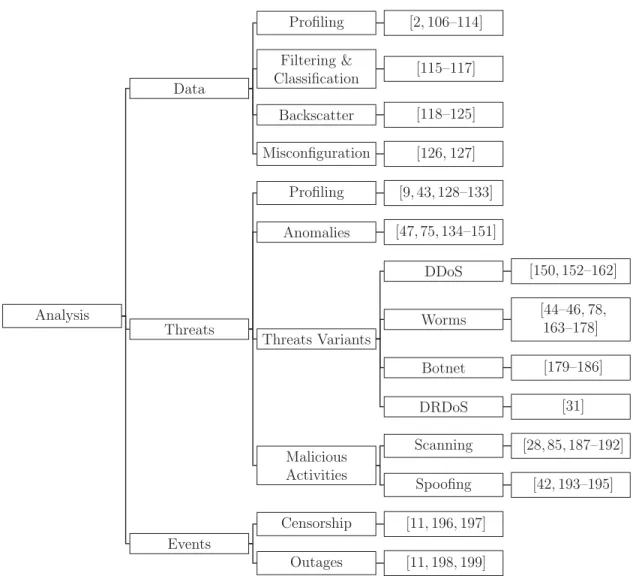
3.5 Analysis Research Taxonomy - Overview . . . 42
3.6 Visualization Research Taxonomy - Overview . . . 75
4.1 Conficker Worm in 2009 - Traffic Distribution (1 hour interval) . . . . 85
4.2 Sality Botnet SIP Scan in 2011 - Traffic Distribution (12 days) . . . . 86
4.3 The Largest NTP-based DRDoS Attack in History . . . 87
4.4 Darknet Network and Transport Layer Protocols . . . 89
4.5 Darknet Application Layer Protocols . . . 90
4.6 Darknet TCP Targeted Ports . . . 91
4.7 Darknet UDP Targeted Ports . . . 92
4.8 Darknet Sources - Heat Map . . . 92
4.9 Threats Sources - Heat Map (in thousands) . . . 95
5.1 Flow Chart of the Proposed Approach . . . 110
5.2 TCP SYN Flooding on an HTTP Server - Intensity Prediction . . . . 119
5.3 TCP SYN Flooding on an HTTP Server - Size Prediction . . . 119
5.4 TCP SYN Flooding on a DNS Server - Intensity Prediction . . . 121
5.6 ICMP (ping) Flooding - Intensity Prediction . . . 122
5.7 Clustered Victims Through Fuzzy Hashing . . . 125
5.8 Clustered Victims Through the Fusion Technique . . . 126
5.9 TCP SYN Flooding on Multiple HTTP Servers - Intensity Prediction 128 5.10 TCP SYN Flooding on Multiple HTTP Servers - Size Prediction . . . 128
6.1 DNS-based DRDoS Scenario . . . 133
6.2 Packet Count Parameter Estimation . . . 138
6.3 Rate Threshold . . . 141
6.4 DNS Queries Distribution - Semi-annual 2013 Data . . . 144
6.5 DNS Queries Distribution - March 2013 Data . . . 144
6.6 Top 5 Source Countries (Attacks) . . . 146
6.7 Top 5 Source Countries (Generated Traffic) . . . 146
6.8 Top Requested Domains . . . 147
6.9 k-means Clustering of DNS Reflection DDoS attacks . . . 149
LIST OF TABLES
2.1 Trap-based Monitoring Systems - Comparison . . . 9
3.1 Darknet Variants Research Papers - Summary . . . 28
3.2 Deployment Techniques Research Papers - Summary . . . 29
3.3 Sensor Placement Research Papers - Summary . . . 31
3.4 Sensor Identification Research Papers - Summary . . . 33
3.5 Data Handling Research Papers - Summary . . . 35
3.6 Large-Scale Darknet Projects - Summary . . . 36
3.7 Profiling Research Papers - Summary . . . 43
3.8 Filtering & Classification Research Papers - Summary . . . 45
3.9 Backscatter Research Papers - Summary . . . 46
3.10 Misconfiguration Research Papers - Summary . . . 48
3.11 Threat Profiling Research Papers - Summary . . . 50
3.12 Anomalies Detection and Mitigation Research Papers - Summary . . 52
3.13 DDoS Research Papers - Summary . . . 57
3.14 Worm Investigation Research Papers - Summary . . . 60
3.15 Botnet Research Papers - Summary . . . 64
3.16 Scanning Research Papers - Summary . . . 67
3.17 Spoofing Investigation Research Papers - Summary . . . 69
3.18 Events Research Papers - Summary . . . 70
3.19 Visualization Research Papers - Summary . . . 76
4.1 Protocols Distribution - Inspired by [2] . . . 84
4.2 Top TCP-based Services . . . 84
4.3 Packets Distribution - Nature of Traffic . . . 88
4.5 IP Class Distribution . . . 90
4.6 Darknet Threats and Corresponding Severities . . . 93
4.7 Vectors of Darknet Threats . . . 96
4.8 Darknet Threat Patterns . . . 100
5.1 Summary of the Analyzed DDoS Case Studies . . . 118
5.2 HTTP-based TCP SYN Flooding - Absolute Prediction Error (%) . . 120
5.3 DNS-based TCP SYN Flooding - Absolute Prediction Error (%) . . . 122
5.4 ICMP (ping) Flooding - Absolute Prediction Error (%) . . . 123
5.5 Summary of the DDoS Campaign Clustering Approach . . . 126
5.6 Summary of the Analyzed DDoS Campaign Case Study . . . 127
5.7 TCP SYN Flooding on Multiple HTTP Servers - Prediction Error (%) 127 6.1 DNS DRDoS Attacks Identification Parameters . . . 137
6.2 Classification per Attack Rate . . . 140
6.3 Chosen Clustering Attributes . . . 142
6.4 Top 5 DNS Query Type - 2013 Semiannual Darknet Data . . . 145
6.5 k-means Clustered Instances . . . 148
6.6 k-means Training Cluster Centroids . . . 149
7.1 Summary of DNS Amplification DDoS Traces (February 2013) . . . . 168
7.2 Summary of DNS Amplification DDoS Traces (March 2013) . . . 169
Chapter 1
Introduction
Today, the safety and security of our society are entirely dependent on having a secure Information Communication Technology (ICT) infrastructure, which spans over public and private organizations in the sectors of government, defense, en-ergy (i.e., Nuclear and Power), telecommunications (i.e., mobiles), public health (i.e., hospitals), emergency services (i.e., 911), agriculture, finance (i.e., banks) and transportation (i.e., aviation). This infrastructure is controlled and operated using the Internet (also known as cyberspace): a network of numerous inter-connected computers.
Recent Internet events have demonstrated that corporations and governmental organizations could be subjected, nearly instantaneously and in full anonymity, to large-scale disrupting cyber attacks with the potential to lead to severe privacy, secu-rity and economic consequences (i.e., cyber terrorism, denial of service, information theft, spam, fraud, etc.). For instance, a nuclear power plant was targeted for the first time by Stuxnet, a complex computer virus discovered in 2010 [3]. In 2012, a more complicated malware known as Flame [4] was found to have massive espionage capabilities. There has been an increasing trend of cyber attacks, which have been used to exhaust and/or deny services of large organizations (.i.e., Google, Facebook, Government Websites) through the flood of computer network traffic to the victim
targeted by the attack. For example, in 2014, the Internet experienced the largest DoS threat in history with 400 Gbps of bandwidth [5]. In addition, orchestrated cyber campaigns, which occur when a given cyber force conducts a series of planned and coordinated cyber attacks, leverage botnet (networks of orchestrated and in-fected computers) to communicate and execute attacks; such threats have caused over $110 billion in losses worldwide [6]. These events constitute a serious threat with the potential to endanger human lives, especially when physical entities such as smart grids [7] and nuclear power plants can be reached through cyberspace. The existence of widely available encryption and anonymity techniques greatly increases the difficulty of the surveillance and investigation of cyber attacks. In this context, the availability of relevant cyber monitoring is of paramount importance.
One of the effective ways to observe Internet activity is to employ passive monitoring using sensors or traps such as darknet [8]. Darknet data is defined as traffic targeting advertised, but unused, IP addresses. Since these network addresses are unused, they represent new hosts that have never been communicating with other devices, neither for benign or legitimate communication. As a result, any observed traffic destined to these non-interactive hosts raises suspicion and hence necessitates investigation. These darknet-based monitoring systems are designed through these unused IP addresses to attract or trap attackers for intelligence gathering. For instance, darknet has been used in the past to extract insights on: 1) probes or scanning activities [9] due to worms, bots and other automated exploit tools; 2) DDoS attacks due to victims’ reply (backscatter) packets to spoofed IP addresses [10]; and 3) other activities, such as misconfiguration [1], and political events [11]. Darknet is an asset for network security. Several deployment techniques [12] were invented, various projects (i.e., CAIDA1) were built, and numerous visualization
techniques were used in order to observe the data.
Denial of Service is an attempt to make a computer or network resources un-available. It consists of attacks that are deployed to temporarily or indefinitely shutdown services. The timing of such attacks can be coordinated to exploit the availability of critical organization infrastructures by directing an enormous flood of Internet traffic towards targeted Internet Protocol (IP) addresses. By flooding the available bandwidth with intensive traffic, DDoS can effectively bring down a service with potential loss of brand name, trust, and financial revenue. Indeed, DoS activ-ities continue to dominate today’s attack landscape. In a recent report by Arbor Networks [13], it was concluded that 48% of all cyber threats are DoS. Further-more, it was stated that the top 4 perceived threats for the next 12 months will be DDoS related, targeting customers, network and service infrastructures [14]. Some governmental organizations, corporations as well as ICT infrastructures were also recently deemed as DDoS victims [15–17]. Moreover, a recent event demonstrated that one of the largest cyber security organizations, namely Spamhaus, became a victim of a 300 Gbps Domain Name System (DNS) DDoS attack [18]. In addition to this, in 2014, the Internet has experienced the largest reflection DDoS attack in history [5]. Thus, DDoS attacks are a significant cyber security problem, causing momentous damage to several victims as well as negatively affecting, by means of collateral damage, the availability of services, business operations, market share, the confidence, as well as the reputation of the organization under attack. In this thesis, we leverage darknet data to investigate DDoS and DRDoS activities, which are special types of DoS events. In particular, we detect, analyze, predict and assess the threat behind their activities to generate DoS insights, which can be leveraged for situational awareness and mitigation purposes.
1.1
Objectives
The aim of this thesis is to generate cyber threat intelligence related to the inference of DoS activities. In this context, the thesis’ objectives are listed below:
• Perform darknet data analysis and characterization.
• Provide inferences and insights related to DoS threats in addition to generate global cyber intelligence related to large-scale cyber activities.
• Investigate DoS activities in an attempt to predict their events and attribute such activities to certain campaigns as well as to certain Internet-scale mali-cious events.
• Develop approaches that can infer and assess the impact of large-scale DoS attacks and campaigns on the Internet.
• Design, implement and deploy a cyber security capability to infer Internet and DoS events.
1.2
Contributions
This thesis attempts to tackle the above-mentioned objectives. To this end, our contributions can be summarized as follows:
• Provide the first state-of-the-art survey on darknet research and the largest taxonomy of Internet passive monitoring.
• Leverage intrusion detection and data mining approaches on darknet for indi-cating cyber threat activities.
• Design and implement statistical and fuzzy hashing approaches for character-izing and inferring cyber campaigns of DoS attacks.
• Propose a prediction model based on time series techniques with capabilities to assess prediction, forecast and hence mitigate future DDoS threat occurrences.
• Propose a novel approach to fingerprint DRDoS activities through darknet analysis and identify the first real traces of large DNS reflection attacks.
In a nutshell, our work aims at studying darknet to generate DoS cyber intel-ligence. The latter could be adopted for immediate detection, mitigation and even attribution of DoS attacks.
1.3
Organization
The structure of this thesis is as follows. In Chapter 2, we primarily provide a back-ground information on darknet. As a result, we define darknet and compare it to other trap-based monitoring systems. Furthermore, we provide some examples on its operation online. In Chapter 3, we provide a taxonomy in relation to darknet technologies and identify research gaps that are related to three main darknet cat-egories: deployment, traffic analysis, and visualization. In Chapter 4, we elaborate on the work related to the investigation of darknet traffic, namely, characterization of its traffic and correlation among inferred threats. In Chapter 5, we describe the design and implementation of our DDoS prediction model. To this end, we also forecast DDoS cyber campaigns attempts. In Chapter 6, we elaborate on our novel approach to fingerprint DDoS reflection activities. Finally, Chapter 7 concludes this thesis, summarizes its contributions and highlights some research gaps that pave the way for future work.
Chapter 2
Background
This chapter provides an overview of darknet and highlights the focus of our survey by: 1) Providing definitions that list the alternative names; 2) discussing the differ-ences between darknet and other trap-based monitoring systems; and 3) providing some examples of darknet and its operation on the Internet.
2.1
Darknet Definitions
The term darknet can refer to the following:
• Any communication system that operates by stealth and conceals its users’ identity. Freenet [19] and BitTorrent [20] software are two examples that fit in this category.
• Servers and programs used to illegally distribute copyrighted material [21]. Such systems can include peer-to-peer file sharing technologies such as Napster and Gnutella [22].
• Servers configured to trap adversaries and collect suspicious data. This type of darknet runs in a passive mode without interacting with attackers. This is similar to the darknet project of Team Cymru [23].
In this work, we refer to darknet as per the last definition. Since these servers run in passive mode and correspond to unused hosts or devices, any observed traffic destined to them raises suspicion and hence necessitates investigation.
It is noteworthy to mention that the word darknet has been known under vari-ous alternative terms, including darkspace, blackhole monitors, unused IP addresses, network telescopes, unsolicited network traffic, unwanted traffic, non-productive or non-responsive traffic, spurious traffic, Internet background radiation (IBR), unal-located but reachable IP addresses and unassigned IP addresses. To harmonize the terminology, we use the word darknet throughout this thesis.
2.2
Trap-Based Monitoring Systems
Trap-based monitoring systems aim to deploy online sensors to trick and trap ad-versaries to collect malicious activities. Several systems leverage this approach such as darknet [8] and greynet [24]. A thin line separates various forms of trap-based network monitoring systems. In this subsection, several monitoring systems are contrasted and classified based on their types, interactivity levels, complexity, data collection and security aspects.
• Darknet: An IP address block configured in passive mode. Most of the darknet sensors return “unreachable” errors when a request is sent to listening hosts. This error explains that a certain host or port is not reachable. Darknet implementation is considered simple since these sensors do not communicate with the initiator of the communication. The captured traffic therefore consists mostly of the first request in communication.
• IP Gray Space: These addresses refer to devices that are not assigned to any host throughout a given time period (i.e., 1 hour, 1 day). Conceptually, IP gray space is similar to darknet; the only difference is that IP gray space addresses are unused only for a limited time, whereas darknet addresses are
permanently unused. Unlike darknet, IP gray space might prove more difficult to be detected by an attacker since the underlying hosts might be active and operating as a regular machine during various periods of time. The aim is to imitate regular hosts.
• Honeypot: This is an interactive computer system, mostly connected to the Internet, that is configured to trap attackers. Honeypots are similar in nature to darknet but with more specific goals. Honeypots require more resources than darknet, since they interact during communication. As far as interaction is concerned, there are three major types of honeypots, namely, low, medium and highly interactive. A low-interactive honeypot is configured to interact with the initiator of the communication by emulating basic services such as replying to Internet Control Message Protocol (ICMP) ECHO request (i.e., Ping). A medium-interactive honeypot is similar to a low-interactive one but with further interactions and a greater number of emulated services for more data capturing and analysis. A highly interactive honeypot is a computer sys-tem that does not emulate services; it instead runs a fully-fledged, potentially vulnerable, operating system, services and applications.
• Honeynet: This network is simply a group of honeypots used to deploy dis-tributed trap-based network monitoring systems for large-scale data collection and analysis.
• Greynet: This network is populated with active IP addresses interspersed with darknet addresses. In other words, greynet uses both darknet (passive) and honeypots (active) in the same monitoring IP address space. The purpose is to make the monitored IP space appear as a more attractive trap for adversaries. Take for example, a range of IPs that have both darknet and other active sensors running fake services. This scenario imitates a typical organization network that hosts both running and unused IP addresses, which may trick
the attacker into thinking that the whole range of IPs in the monitored block is an appropriate target.
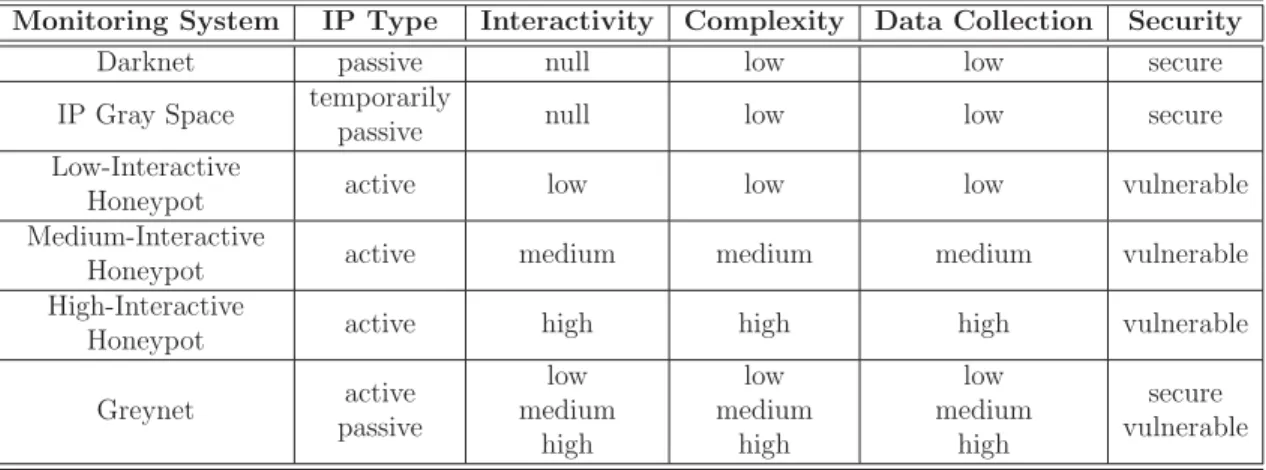
Table 2.1 provides a comparison of trap-based network monitoring systems based on several features: type of sensor, interactivity with the initiator, deploy-ment complexity, data collection, and security of the monitoring IP address space. First, as mentioned earlier, darknet and IP gray space share similar features. These two trap-based monitoring systems are considered secure since they do not interact with the adversary. Furthermore, since they run in passive mode (null interactivity), their deployment difficulty and data gathering features are considered low compared to other monitoring systems. Second, regarding honeypots, the interactivity, the complexity and the data gathering features are mostly proportional to each other. For instance, the more interaction there is with the adversary, the more complex the implementation to setup and the greater is the amount of data that needs to be collected. However, all honeypots with an interactive feature are potentially vulner-able in terms of security. Finally, since greynet consists of darknet and honeypots, it is considered a more comprehensive monitoring system and could therefore have more possibilities in terms of interactivity, complexity, data collection and security.
Monitoring System IP Type Interactivity Complexity Data Collection Security
Darknet passive null low low secure
IP Gray Space temporarily
passive null low low secure
Low-Interactive
Honeypot active low low low vulnerable
Medium-Interactive
Honeypot active medium medium medium vulnerable
High-Interactive
Honeypot active high high high vulnerable
Greynet active passive low medium high low medium high low medium high secure vulnerable
Table 2.1: Trap-based Monitoring Systems - Comparison
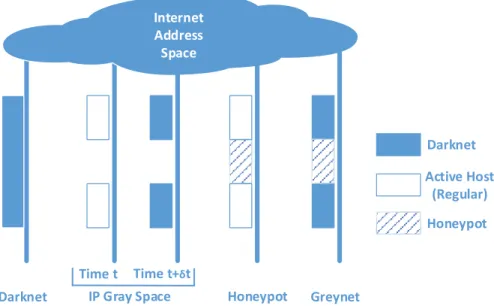
Figure 2.1 provides a graphical comparison between these major trap-based monitoring systems.
Internet Address Space
Time t Time t+δt IP Gray Space
Darknet Honeypot Greynet
Active Host (Regular) Honeypot Darknet
Figure 2.1: Trap-based Monitoring Systems - Address Space Distribution
First, the darknet contains only unused addresses running in passive (inactive) mode. Second, the IP gray space (at time t+δt) is similar to darknet. However, the same address space was already active in a previous period of time (time t). Third, honeypots can run in various modes, either solely on a network or with other active/passive hosts. The latter case represents the greynet address distribution.
It is worthy to mention that some monitoring systems have the capability to run in both darknet and honeypot modes, a feature, which allows honeypots to capture more data. Given that our aim is to investigate passive monitoring of unused IP addresses, the scope of our work covers mainly the study of darknet, greynet, IP gray space and few honeypots that solely target unused address space, such as Honeyd [25] and LaBrea Tarpit [26].
2.3
Darknet Inferred Cyber Threats
Darknet is indeed an effective approach to infer various Internet activities and threats related but not limited to the following:
Scanning/Probing or Reconnaissance Activities
Internet scanning is the task of probing enterprise networks or Internet wide ser-vices, searching for vulnerabilities or ways to infiltrate IT assets. Scanning can be initiated by computer worms, bots and other automated exploit tools. Scanning is a significant cyber security concern. The latter is due to the fact that probing is commonly the primary stage of an intrusion attempt that enables an attacker to remotely locate, target, and subsequently exploit vulnerable systems. It is basically a core technique and a facilitating factor for cyber attacks.
Distributed Denial of Service (DDoS) Attacks
DDoS attack is an attempt to make a computer and/or network resources unavail-able. It consists of attacks that are deployed by one person or a group of people to temporarily or indefinitely shutdown services. The timing of such attacks can be coordinated to exploit the availability of critical organization infrastructure by directing enormous flood of Internet traffic to a small set of targeted IP addresses belonging to a target organization. By flooding the available bandwidth with inten-sive traffic, DDoS perpetrators can effectively bring down a service with potential loss of financial revenue. In addition, DDoS attacks can be coordinated via a botnet, which is a platform to orchestrate and manage cyber attacks.
Distributed Reflection Denial of Service (DRDoS) Attacks
DRDoS is a special type of DDoS attacks. In a typical DRDoS scenario, the attack-ers aim to hide their identities by leveraging third parties such as web servattack-ers and routers to redirect malicious traffic to the victim. In this case, all these third parties are called reflectors. Any host that responds to any incoming request can become a potential reflector. DRDoS threats have the ability to amplify attack traffic, which makes the threat even more severe. A well known type of DRDoS attacks is theDNS amplification threat. In this attack, an adversary tries to generate a flood of tiny DNS requests, but with high amplified replies, on the Internet to reach open amplifiers. As a result, all amplified replies are sent back from these amplifiers (re-flectors) to the victim.
More details on darknet activities and threats can be found in Chapter 3.
2.4
Darknet Operation
In this section, to achieve a better understanding on how darknet operates, we pro-vide a brief background information related to some darknet scenarios. In particular, we show how darknet can be exploited on the Internet to generate various elements of cyber threat intelligence, including probing, DDoS and DRDoS activities.
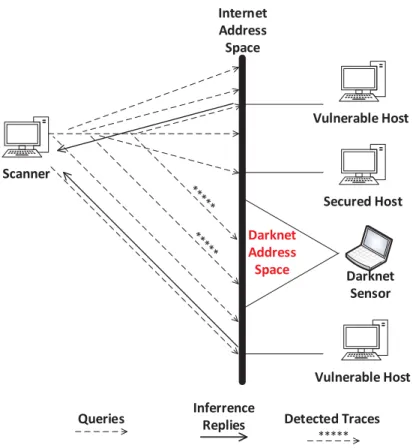
A darknet is indeed an effective approach to infer various Internet-scale prob-ing activities [27]. Figure 2.2 presents an illustrative example, in which a probprob-ing machine is scanning the Internet. Such machine could have been previously infected by a worm that is trying to propagate, or perhaps is participating in automated Internet-scale scanning [28]. Some of these network probing packets can hit the network telescope and thus are subsequently captured. Recall that the probing machine, while spraying its probes across the Internet, cannot probably avoid the network telescope as it does not have any knowledge about its existence. Further, it has been shown in [29] that it is extremely rare if not impossible for a probing source to have any capability dedicated to such avoidance.
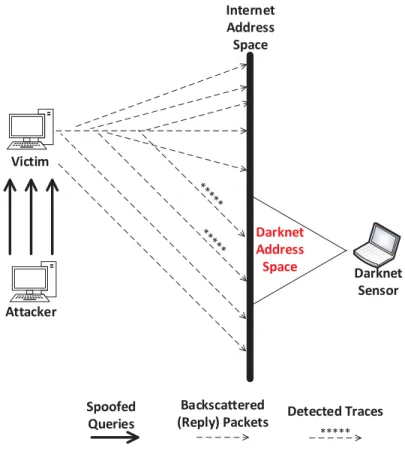
Darknet traffic analysis is an effective technique in pinpointing victims of DDoS attacks [30]. Figure 2.3 illustrates such scenario. The attacker is directed to launch a DDoS attack towards the victim. To hide its identity, the attacker spoofs its address and replaces it with a random IP address. Such random address could happen to be that of the darknet. When the attack is launched, the reply packets from the
Internet Address Space Darknet Address Space Darknet Sensor Vulnerable Host Secured Host Vulnerable Host Scanner Inferrence
Replies Detected Traces
*****
Queries
Figure 2.2: Probing Activities
victim will be directed towards some dark IP address. Traces that hit the darknet are often dubbed as backscattered packets [30] and could be effectively employed to infer that the victim has been the target of a DDoS attack.
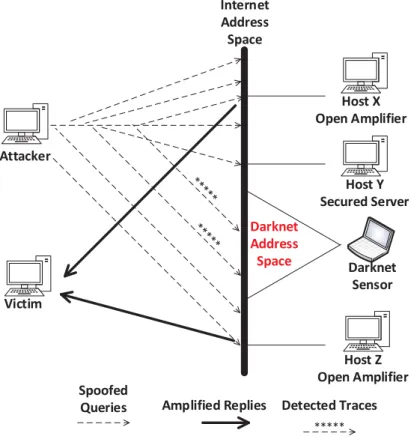
In the last scenario, a darknet is leveraged to infer DRDoS attacks [31]. In-deed, as previously mentioned, such attacks are an emerging form of DDoS attacks that rely on the use of publicly accessible UDP servers [32]1, which act as “open
amplifiers” of the attack. The bandwidth amplification factors are function of the instrumented protocol. The idea is to send small queries to such amplifiers in which the replies, that aim at flooding the victim, are orders of magnitude larger. Recall that such approaches are behind the notorious 300 and 400 Gbps attacks that hit the Internet in the last couple years [32]. More on amplification attacks can be found in Section 2.5.2. Figure 2.4 depicts this scenario. Commonly, the attacker will spray
Internet Address Space Darknet Address Space Darknet Sensor Victim Attacker Detected Traces ***** Backscattered (Reply) Packets Spoofed Queries
Figure 2.3: DDoS Activities
the Internet with such spoofed queries in a hope to reach as many open amplifiers as possible in order to achieve a large amplification factor. This case will occur in the scenario where attackers do not know in advance the IP addresses of Internet open amplifiers. We argue that such generated requests are not probes intended to gather information, since the attackers in this case do not aim to build/manage a list of open amplifiers nor do they want to jeopardize being detected (by using their real IP addresses, which is typical in probing activities). Intuitively, some of those requests will hit the darknet and hence will be captured. Requests that actually reach those servers will be amplified and directed towards the victim.
Internet Address Space Darknet Address Space Darknet Sensor Host X Open Amplifier Host Y Secured Server Host Z Open Amplifier Attacker Victim
Amplified Replies Detected Traces
*****
Spoofed Queries
Figure 2.4: DRDoS Activities
2.5
DoS Attack Techniques
DoS attacks can be initiated in two major ways. The first is designed to consume host’s resources. In this scenario, the victim could be a web service or proxy con-nected online. Obviously, any host has limited resources to process information. In a normal network operation, if the network flows exceeds this limit, the destina-tion host starts dropping packets and informs the sender. As a result, legitimate senders slow down their sending rates to keep the operation balanced between the other host(s). In contrary, malicious users keep flooding victims to exhaust their resources, such as memory and CPU usage. The second way has impact on the consumption of network bandwidth, which could be more devastating than the first way. In this scenario, the attacks congest victims’ network with corrupted or even legitimate flood of packets. Therefore, all benign requests of services destined to
such victims will be partially or fully denied. To help readers gain a better under-standing of such DDoS attacks, we list some well-known attacks in the following sections.
2.5.1
Protocol-based Flooding Attacks
Protocol-based attacks leverage vulnerabilities in Internet protocols to flood the victims with legitimate or corrupted packets. Some of the classical examples of these attacks are similar to SYN flooding and ICMP flooding. We describe the major flooding attacks below.
Transmission Control Protocol (TCP) SYN Flood
A SYN flood DoS attack exploits a known weakness in the TCP connection sequence, the three-way handshake, wherein a SYN request to initiate a TCP connection with a host must be answered by a SYN-ACK response from that host, and then confirmed by an ACK response from the requester. In a SYN flood scenario, the requester sends multiple SYN requests, but either does not respond to the host’s SYN-ACK response, or sends the SYN requests from a spoofed IP address. Either way, the host system continues to wait for acknowledgment for each of the requests, binding resources until no new connections can be made, and ultimately resulting in a DoS attack.
User Datagram Protocol (UDP) Flood
This DoS attack leverages UDP, a session-less networking protocol. This type of attack floods random ports on a remote host with large number of UDP packets, causing the host to frequently check for the application listening on that port, and reply with an ICMP Destination Unreachable packet if the application is not found. This process exhausts hosts CPU and memory resources, and can ultimately lead to inaccessibility.
Internet Control Message Protocol (ICMP) Flood
Similarly, an ICMP flooding attack overwhelms the target resource with ping or ICMP Echo Request traffic. Such attack can exhaust both incoming and outgoing bandwidth capacity and can cause a delay or shutdown in services. A well known type of ICMP flooding threat is the Ping of Death (POD) attack.
Domain Name System (DNS) Flood
In a DNS flood scenario, malicious users target one or more DNS servers, attempting to bombard and turning down DNS root operations. In a typical DNS attack, the attacker attempts to overwhelming server resources and impeding the servers ability to direct legitimate DNS requests. DNS flooding are different than DNS amplification attacks. In general, DNS runs on top of UDP transport, which is a connection-less service. As such, spoofing DNS flooding attacks is more easily accomplished.
Hypertext Transfer Protocol (HTTP) Flood
HTTP is a well-known application layer protocol running on top of TCP port 80. HTTP flooding attacks hits web servers with a large amount of HTTP requests. HTTP requests can be crafted by attacks to avoid detection. These attacks are known to leverage botnet infrastructure to orchestrate attacks on one or many vic-tims. The large usability of the web (www) services over the Internet has made HTTP flooding attacks popular and hence difficult to filter and detect.
Session Initiation Protocol (SIP) Flood
The recent deployment of Voice over IP (VoIP) telephony and its usability have created the SIP services. Unfortunately, attackers can leverage this technology to flood telephony services with DoS attacks. SIP services run generally on top of UDP
port 5060. This telephony service is designed to provide easy service and use for legitimate services. Adversaries leverage vulnerabilities in SIP services, for example, to flood the victim with spoofed SIP invite packets.
2.5.2
Protocol-based Reflection Attacks
Recent events have demonstrated that amplification or reflection DoS attacks are probably the most effective and devastating cyber attacks. We list below the major ones such as DNS-based, NTP-based reflection attacks, among others.
Network Time Protocol (NTP) Amplification
NTP servers support monlist requests, which most NTP server implementations accept in their short form of only 8 bytes. Upon receiving a monlist request, an NTP server shares its recent clients in up to 100 UDP datagrams with 440 bytes payload each. One response datagram specifies statistics for NTP clients (such as the client’s IP address, its NTP version and the number of requests) who contacted this NTP server. This response datagram is a useful debugging feature in the legitimate use case. The total response length depends on the number of client statistics a server shares upon request. An attacker can abuse this feature to amplify DoS traffic to a victim.
Domain Name System (DNS) Amplification
Name lookup (i.e., A or MX records), the traditional use case of DNS, have low amplification rates. Traditionally, the size of UDP replies was limited to 512 bytes and DNS switched to TCP communication for larger replies. However, many DNS servers adopted the DNS extensions (EDNS0) that allow for UDP responses of up to 4096 bytes. Attackers may abuse ANY request with EDNS0, for which a server returns all known DNS record types for a given domain. A well-known attack abuses
DNS open resolvers to function as amplifiers. Attackers can enforce high amplifi-cation rates by resolving ANY requests from domains that result in large responses. Attackers can even configure a domain they control such that its authoritative name server responds with 4096-byte-wide responses. Another reason behind this amplifi-cation is the deployment of DNSSEC, in which each resource record is accompanied with a typically 1024-bit-wide signature in a special RRSIG record.
Simple Network Management Protocol (SNMP) Amplification
Certain SNMP version (i.e., v2) supports the GetBulkoperation, in which a device returns a list of SNMP identifiers that can be monitored. In the legitimate use case, this request can be used to iterate all monitoring values. An attacker can abuse this feature to amplify DoS traffic to a victim. The exact response size is determined by the number and length of identifiers in the returned item list.
Simple Service Discovery Protocol (SSDP) Amplification
Upon SSDPdiscoveryrequests, UPnP-enabled hosts respond with one reply packet per service they have configured. The response size depends on the configured services and the length of the service name. Some amplifiers respond with a few reply packets only, as they offer fewer services. An attacker could thus abuse this service by sending SSDP request packets spoofed with the victims IP address as the source of the request.
Character Generator Protocol (CharGen) Amplification
According to RFC 864, CharGen servers reply with random characters to incoming UDP datagrams of any length. An attacker may leverage this service on many servers and use small UDP packets with a spoofed victim IP address as the source to overwhelm the target.
Quote of the Day (QOTD) Amplification
Similar to CharGen, Quote of the Day servers (RFC 865) also send replies to UDP datagrams of any length. So an attacker may leverage this service on many servers and use small UDP packets with a spoofed victim IP address as the source to overwhelm the intended target.
Quake 3 Amplification
Quake 3 game servers are found to have the highest amplification when asking a server for its current status, a 15-byte-wide request. The reply is significantly larger and includes, i.e., the detailed server configuration and a list of current players. Given a number of Quake 3 servers with a large number of users currently active on the server; an attacker may leverage this service on any number of Quake 3 servers by sending status requests to the server and replacing the source IP address with that of the victim in order to overwhelm the target.
Network Basic Input/Output System (NetBios) Amplification
For NetBios, an attacker may achieve DoS amplification using a name lookup, for which a receiving Windows system responds with its current network and host name configuration. The response sizes are influenced by the host names and network con-figurations of the amplifiers. An attacker may send requests to a NetBios capable server spoofing the victims IP address as the source so that the victim receives the overwhelming reply traffic.
2.5.3
Summary
We have presented several DoS attacks, namely, flooding and amplification. It is noteworthy to mention that the types of threats are not always mutually exclusive.
In practice, an adversary might leverage several features of multiple types in only one attack. For instance, TCP SYN flooding and ICMP flooding are generally initiated simultaneously against DNS root servers. As far as our approach is concerned, based on the aforementioned inference techniques of Section 2.4, we are able to identify all the aforementioned types of attacks only if their traces hit our darknet sensors.
2.6
DoS Defense Mechanisms
In general, there are three defense mechanisms against DoS attacks, namely, at-tack prevention and mitigation, atat-tack detection, and atat-tack attribution. Atat-tack prevention aims to fully/partially block the attack or successfully handle its flood. Attack detection identifies the occurrence of the attack. Finally, attack attribution identifies the source of the attack. It is noteworthy to mention that a complete DoS defense mechanism consists of prevention, detection and attribution techniques.
2.6.1
Attack Prevention and Mitigation
The aim of attack prevention and mitigation is to completely or partially block the attack before causing any interruption of service. As shown earlier, since DoS attacks are generally initiated from spoofed (fake) IP addresses, some of the best techniques used to block such threats are to leverage ingress/egress filtering [34]. The latter is an efficient technique to control incoming and outgoing packets on the local or Internet network. For instance, an organization can block all outgoing packets coming from (leaving) its network if they do not have source IP addresses registered under the name of this organization. The same technique can be imple-mented at any Internet service provider or Internet backbone associations. One of the protocols that operate based on the same concept is the Source Address Validity Enforcement (SAVE) [35]. Moreover, some techniques are protocol-dependent and are designed with security features to prevent or mitigate DDoS. For instance, the
Stream Control Transmission Protocol (SCTP) [36] runs on the transport layer with advanced security features to defend against TCP SYN flooding attack. Although this protocol can mitigate the threat of SYN flooding, its implementation requires more attention because it may cause other types of DDoS such as the ones using malformed ICMP packets andINIT(initialization packet) flooding attack [37]. Sim-ilarly, the Datagram Congestion Control Protocol (DCCP) [38] has a mechanism to allow the server to avoid holding any state of unacknowledged communication during a handshake. Since the development of DCCP is relatively new, develop-ers must be very careful while implementing DCCP services. For instance, one of the DoS security concerns can happen when associating applications with service codes2. This operation requires additional processing time to interpret information
and hence may cause a DoS attack. Last but not least, a recent implementation of cloud-based DDoS protection mechanisms [39] leverage several servers to act on behalf of the victim during an attack. The latter technique is more recent than the other ones and is found to be efficient, but not perfect, to mitigate the impact of attacks [40].
2.6.2
Attack Detection
The most effective way to defend against DoS attacks is attack prevention. However, since adversaries are always discovering new techniques to attack a victim, preven-tion may not be always successful. Therefore, attack detecpreven-tion is also a fundamen-tal step to defend against DoS attacks. This technique can help in fingerprinting a malicious flood and provide useful insights on several attack parameters such as rate, attack type, signature, CPU and memory usage, among others. Attack detec-tion techniques leverage several algorithms, namely, flow-based, signature-based and anomaly-based. Flow-based algorithms leverage the flood parameters (i.e., attack speed, nature of packets) to detect attacks. For instance, the approach proposed by
Moore et al. [30] is a typical flow-based detection algorithm that leverages backscat-ter packets to infer DDoS activities. Signature-based algorithms leverage packet information to match a malicious activity based on a database of signatures. This method cannot identify zero-day (new) DoS attacks. A network-based intrusion detection system such as snort [41] runs such algorithms. While signature-based algorithms can identify solely known attacks, anomaly-based approaches use train-ing models and pattern recognition techniques to identify floods of old/new DoS threats.
2.6.3
Attack Attribution
Attack attribution aims at identifying the source of attack and affiliating them with a specific IP address. Since DoS attacks are usually leveraging spoofed IP addresses, the attribution of attacks is a difficult problem. In fact, IP spoofing is still a funda-mental weakness of Internet operations. Two reasons are behind this issue. First, the availability of tools and techniques to initiate packets with forged IP addresses. Second, the stateless nature of Internet routers, which generally store information and forward packets to the next hop only. Some of the attack traceback techniques that are used include active interaction, probabilistic and hash-based schemes. First, a main feature of the active interactive approach is that on the way to the victim, routers interact with adversaries in a certain way (i.e., forwarding requests). As such, this technique traces the source of the attack based on the reaction of flood during the attack. Second, in general, probabilistic IP traceback models leverage the fact that routers probabilistically insert fragmentary network path data in the incoming packets. As such, this technique attempts to reconstruct the flow path using these inserted information. Finally, many probabilistic approaches can fail, especially when large-scale DoS attack traffic is distributed over many routers in different locations. Consequently, a hash-based IP traceback approach is proposed
to store information on each packet passing through routers. Regardless of the tech-nique used in addressing DoS attribution and spoofing, this problem is still a major concern for Internet users.
2.6.4
Summary
We listed above the major defense mechanisms against DoS attacks. We divided the techniques over three categories, namely, attack prevention and mitigation, attack detection, and attack attribution. Although darknet can be used to attribute DDoS attacks [42], our approach falls mainly in the attack detection research area. Obvi-ously, uncovering the type of the attack, and the techniques behind it can help in understanding the malicious behavior and hence can solve the problem. Therefore, our analytics and assessment of attacks can be leveraged by academia and industry to help in preventing, mitigating, and attributing DoS cyber attacks.
Chapter 3
Darknet Taxonomy
Despite the fact that the idea of monitoring unused IP addresses started in the early 90’s [9, 43], we provide a background information that mainly focuses on the study of darknet research during the past thirteen years. The reason behind choosing this period is that the major contributions started after 2001.
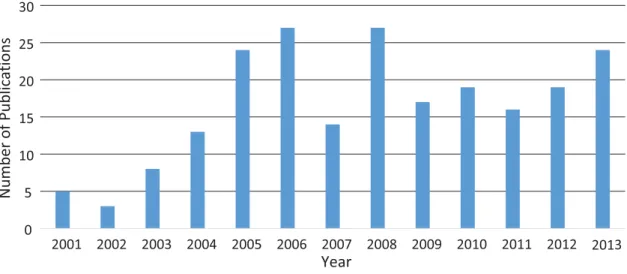
Ϭ ϱ ϭϬ ϭϱ ϮϬ Ϯϱ ϯϬ ϮϬϬϭ ϮϬϬϮ ϮϬϬϯ ϮϬϬϰ ϮϬϬϱ ϮϬϬϲ ϮϬϬϳ ϮϬϬϴ ϮϬϬϵ ϮϬϭϬ ϮϬϭϭ ϮϬϭϮ ϮϬϭϯ EƵŵďĞƌ ŽĨWƵďůŝĐĂƚŝŽŶƐ zĞĂƌ
Figure 3.1: Trend of Publications Per Year
Figure 3.1 represents the trend of the darknet research from 2001 to 2013 in terms of research publications. Some of the important contributions include the discovery of the relationship between backscatter traffic and DDoS attacks, which emerged in 2001 [30], the trend of worms propagation and analysis between 2003 and
2005 [44–46], the use of time series and data mining techniques on darknet traffic raised in 2008 [47], and finally the monitoring of large-scale cyber events [11], which began in the past few years.
Our taxonomy classifies current darknet research into three major areas, namely, darknet deployment and setup, analysis and measurement of darknet data through deployed sensors, and tools and techniques for the visualization and representation of its traffic. A high level overview of the proposed taxonomy is shown in Figure 3.2.
Darknet Research
Deployment Analysis Visualization
Figure 3.2: Darknet Research Taxonomy
3.1
Darknet Deployment
The first step in darknet monitoring is the deployment of sensors, which aims to capture network traffic. This exercise requires an understanding of the network ar-chitecture and a careful configuration of the dynamic host server or the upstream router to forward unreachable packets to darknet sensors. A basic darknet deploy-ment architecture is shown in Figure 3.3.
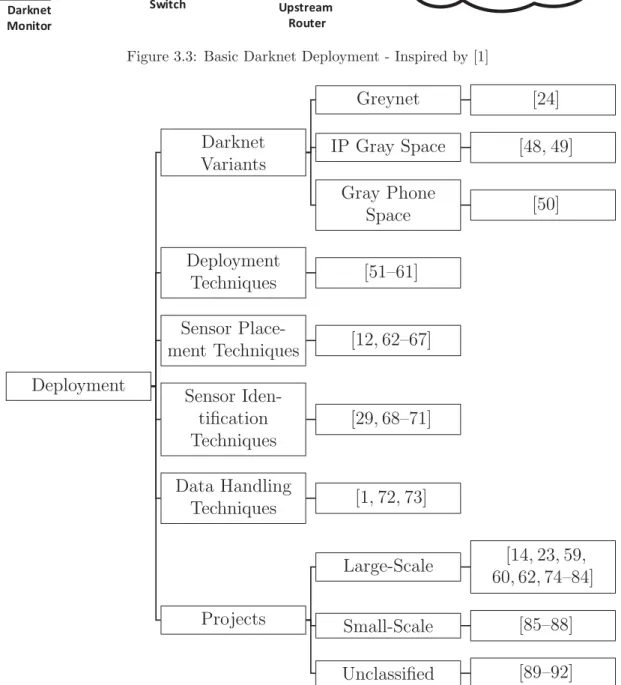
This section provides insights on the elements of darknet deployment, namely, darknet variants, as well as techniques such as sensor placement/identification and data handling, and projects. Figure 3.4 provides a taxonomy of deployment research works based on the aforementioned elements.
Internet
Darknet Monitor
Switch Upstream
Router
Figure 3.3: Basic Darknet Deployment - Inspired by [1]
Deployment Projects Unclassified [89–92] Small-Scale [85–88] Large-Scale [14, 23, 59, 60, 62, 74–84] Data Handling Techniques [1, 72, 73] Sensor Iden-tification Techniques [29, 68–71] Sensor Place-ment Techniques [12, 62–67] Deployment Techniques [51–61] Darknet Variants Gray Phone Space [50] IP Gray Space [48, 49] Greynet [24]
3.1.1
Darknet Variants
Recalling Section 2.2, darknet variants are the deployment mechanisms of trap-based monitoring systems using techniques similar to those of a darknet. This part thus includes deployment of IP gray address space and greynet monitors. Table 3.1 summarizes the papers on darknet variants.
Publications Approach/Technique Contribution Tool/Project
[24] Defining and Characterizing Greynet Development Custom
[48] Heuristic Algorithm IP Gray Space Development Custom
[49] Heuristic Algorithm IP Gray Space Development Custom
[50] Statistics Gray Phone Space Development Greystar
Table 3.1: Darknet Variants Research Papers - Summary
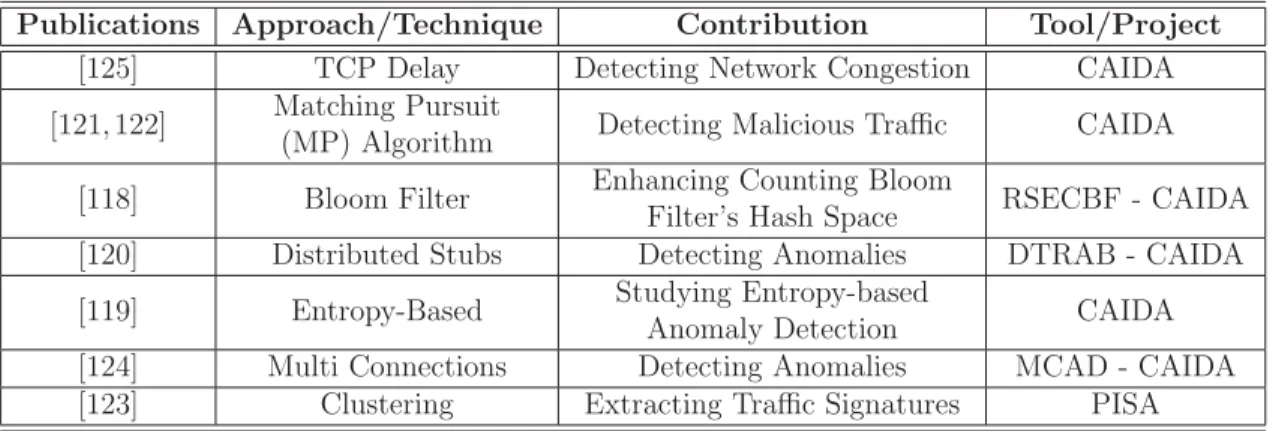
Harrop et al. [24] define and assess the concept of a greynet, a network address space that is populated with darknet addresses mixed with active IP addresses. Using data collected from a university network, the authors evaluate their concept and show how a small number of dark IP addresses can increase the efficiency of network scanning detection. Furthermore, Jin et al. [48, 49] are among the pioneers to use IP gray space in passive monitoring. This work applies a heuristic algorithm to identify IP gray space addresses. The authors investigate the behavior of such traffic. This study tackles patterns such as dominant and random behaviors. The approach identifies the usefulness of IP gray space to uncover insights on the behavior of malicious activities as well as their intentions. The result identified several malicious activities such as scanning, worm propagation as well as spam. Finally, in a unique work, Jiang et al. [50] investigate passive monitoring in mobile communication. This work presents a novel approach to detect SMS spammers on a cellular network. The approach is based on greystar technology and employs a statistical model to infer spam size through fingerprinting. The proposed approach also has the capability to reduce the spam traffic by 75% during peak periods. The authors analyzed five months of SMS data from large cellular networks and inferred thousands of unreported spam activities.
3.1.2
Deployment Techniques
In this section, we discuss the research works that mainly target the techniques of deploying passive monitoring systems. Table 3.2 summarizes these contributions. In this category, research works are mainly leveraging Intrusion Detection Systems (IDS) and hybrid techniques.
Publications Approach/Technique Tool/Project
[51] IDS honeyd/DShield/DOMINO
[52] Sink - IDS iSink
[53] Sink - IDS honeyd/iSink
[54] Statistics - IDS Custom
[55] Mobile-Based AS Data honeyd/Mohonk
[56] Hybrid honeyd
[1] Hybrid IMS
[61] Hybrid Custom
[58] Comparative Study honeyd
[57] Hybrid IMS
Table 3.2: Deployment Techniques Research Papers - Summary
Yegneswaran et al. [51] introduce a scalable, heterogeneous, and robust Dis-tributed Overlay for Monitoring InterNet Outbreaks (DOMINO). The proposed ap-proach provides an architecture for collaboration of distributed IDS data on differ-ent nodes on an overlay network. In an overlay design, a network is built on top of another one. One of DOMINO’s components is the use of active nodes, which measure connections targeting unused IP addresses. The authors emphasize the importance of the approach in detecting sources of IP spoofing, classifying cyber attacks, generating updated blacklists and reducing false positives. Moreover, Yeg-neswaran et al. [52] introduce iSink and elaborate on a darknet case study to analyze attack traces. The study is composed of various components such as the analysis of backscatter packets and the investigation of unique periodic probes. iSink de-ployment proved its relevancy in detecting worms such as Sasser. Through iSink, the authors managed to observe different worm variants and malware. Furthermore,
Yegneswaran et al. [53] explore ways to integrate trap-based monitoring informa-tion, including darknet data, into daily network security monitoring with the goal of sufficiently classifying and summarizing the data to provide ongoing situational awareness. To this end, the authors develop a system based on honeynets, analyzers that leverage Network-based Intrusion Detection System (NIDS), and a back-end database to facilitate the analysis of honeynet data. The system is able to capture and identify numerous malicious activities including botnet and worms.
Choi et al. [54] propose a framework to monitor and respond to security events. The approach aims to trace potential attackers using darknet. The approach was evaluated using a/24 darknet IP address block and other alert logs. Several attack trends and patterns were identified. In addition, the approach showed capabilities to detect zero-day attacks. Furthermore, Krishnamurthy et al. [55] propose a mobile darknet-based mechanism that allows unwanted traffic to be detected significantly closer to the origin source of attack. The scheme is based on two pieces of infor-mation: the additional data that is made accessible to the upstream autonomous systems (AS) and the changes in the advertised darknet. Such shared data among ASes can identify and minimize unwanted traffic between these entities.
Bailey et al. [56] propose a hybrid monitoring architecture that uses low-interaction honeypots (honeyd) as front-end filters and high-low-interaction honeypots as a back-end for further investigation. In order to reduce loads on back-ends, a filtering mechanism is used coupled with a novel hand-off mechanism. The authors use five months of data to demonstrate the efficiency, scalability and robustness of their work. In addition, Bailey et al. [1] discuss the major elements of darknet de-ployment setup, namely, the storage and network requirements and the dede-ployment techniques. They further review the methods to collect darknet data and list the most suitable formats. They propose three major darknet deployment approaches to build darknet sensors. Moreover, Bailey et al. [57] examine the singular and
distributed passive monitoring sensors to effectively build a scalable hybrid moni-toring system. The authors demonstrated that the majority of the threats coming to darknet were based on a limited number of source hosts, and proposed a new source-distribution approach to reduce the number of events found while investigat-ing darknet data. The analysis listed several threats includinvestigat-ing worms and scanninvestigat-ing activities.
Pouget et al. [58] provide a thorough comparison between honeypots based on their level of interaction. Using honeyd as a low-interactive honeypot, this qualita-tive and quantitaqualita-tive comparison uncover interesting classification and correlation among detected threats. Finally, Komisarczuk et al. [61] discuss the opportuni-ties and research directions in the Internet sensor grid for detecting and analyzing malicious behaviors online. The authors review the developments of monitoring sensors in active and passive modes. They further share their experiences in sensor deployments.
3.1.3
Sensor Placement Techniques
This category includes techniques that are used to improve sensor placement and setup. Table 3.3 lists the relevant research works.
Publications Approach/Technique Tool/Project
[62] Hybrid IMS
[63] Comparative Study honeyd/Leurre.com [66] Multiscale Density Estimation iSink/DShield
[65] Comparative Study DShield
[64] Empirical Analysis Netflow
[67] Sampling Custom
[12] Comparative Study IMS
Table 3.3: Sensor Placement Research Papers - Summary
Several techniques have been used to improve darknet monitors placements. For example, Cooke et al. [12] examine variations observed on different network
blocks. The authors showed evidence that distributed address blocks exhibit signif-icant changes in traffic patterns. They further demonstrated changes over protocols (services) and specific worm signatures. Moreover, Bailey et al. [62] examine the properties of individual and distributed darknet sensors to test the effectiveness of deploying hybrid systems (darknet with honeypots). The authors used source-based techniques to reduce redundant actions generated by individual darknet and hence lowered the evaluated connections by over 90%. They also expanded source-distribution based techniques to detect a variety of global attacks. Furthermore, Chen et al. [63] demonstrate the importance of deploying multiple sensors in different locations. The authors deployed two identical sensors, having the same configura-tions, in two different locations and compared various parameters. While analyzing data from a six-month period, the analysis revealed different anomalies. Likewise, Berthier et al. [64] focus on the size and the location of darknet sensors to perform an empirical analysis and increase the efficiency of darknet monitors. In addition, Abu Rajab et al. [65] quantify the importance behind the design of a distributed monitor-ing system and evaluate the applicability of this approach. In order to achieve their goals, the authors propose a worm propagation model to evaluate the locations of monitors, the size of the monitored IP addresses, and the impact of worm detection time. Over 1.5 billion suspicious connection attempts were observed through many detection systems across the Internet. The results showed that distributed moni-toring systems were better than centralized ones. In terms of speed, a distributed monitor system was found to act four times faster than a centralized one. Further-more, the authors mentioned that monitor placement can be improved by having partial knowledge of the vulnerable population density. In some cases, exploiting information related to vulnerable host locations can help decrease the detection time by seven times compared to random monitoring deployment. Furthermore, Barford et al. [66] present a study of source locations of hosts that send unwanted traffic through dark addresses. The researchers use a multi-scale density estimation
method which allowed them to see a small number of tight clusters that are formed by darknet source addresses. The authors propose a multiplicative model for darknet host locations that can be used to generate data with the same distributed property as empirical data. Their model can be used for testing, evaluating, measuring, sim-ulating and analyzing traffic for the purpose of reducing darknet pollution. Finally, Pemberton et al. [67] outline results from a /16 darknet network by experimenting with various sampling techniques and applying them to arrival density measures. The authors found that current darknet deployments using continuous lists of IP addresses were inefficient in predicting threats. They further studied three other address space allocation techniques and discovered better accuracy. The researchers claim that business users as well as Internet Service Providers (ISPs) can use these techniques to enhance darknet deployment in the future.
Publications Approach/Technique Contribution Tool/Project
[70] Marking Algorithm Detecting Listening
Sensors Online Custom
[71] Probe Response Attack Proposing a Technique
to Detect Sensors Custom
[69] Automatic Profiling -Random Sampling
Discussing Sensor
Identification and Configuration Custom [29] Perspective-Aware
Address Discovery
Proposing a Model to
Uncover Darknet Dark Oracle
[68] Sampling Highlighting an Evasive Attack
that Identifies Sensors DShield
Table 3.4: Sensor Identification Research Papers - Summary
3.1.4
Sensor Identification Techniques
This part includes research targeting the identification of darknet sensors. From the adversary’s point of view, the identification of monitoring sensor locations allows them to avoid detection. Table 3.4 summarizes these related works. Abu Rajab et al. [68] highlight an evasive attack that detects passive monitoring systems such
as darknet. By sampling the IP address space in a coordinated manner, the au-thors show that detection and evasion of monitors is possible. Using this technique, attackers can identify active hosts on the network and hence proceed with their attacks. The proposed methodology can overtake the entire vulnerable population within seconds. In a similar work, Sinha et al. [69] elaborate that monitoring sensor configurations are easy for attackers to discover. The authors discuss that man-ually building a monitoring system is usman-ually a large and difficult task to handle. Therefore, the authors propose an automated technique for sensor configuration. They further argue that networks with consistent nodes and proportional repre-sentation are more efficient in detecting attacks and more resistant to detection. Using random sampling and profiling, the authors propose a technique for auto-mated configuration of sensors. More on identifying monitors’ locations, Shinoda et al. [70] propose several algorithms that are designed to detect listening sensors on the Internet. Consequently, they propose an approach to enhance the sensor setup and deployment. In a similar work, Bethencourt et al. [71] demonstrate the use of probing to detect sensors’ locations on systems that publicly report security results. This probe response technique, which can target darknet sensors, shows how to locate monitors. With limited capabilities, the simulation results of this technique illustrate the power of determining the sensors’ identity within one week. The authors further target the anonymized schemes used by network administrators and discuss some potential countermeasures based on the sensors’ characteristics. Finally, Cooke et al. [29] propose the Dark Oracle, which is an architecture that aims to uncover dark addresses. The authors validated the effectiveness of their work, which uses internal as well as external routing and host setup information for automatic discovery. The proposed methodology uncovered almost 80,000 unique source IPs compared to 4,000 with a traditional /24 darknet. The authors further demonstrated the capability of the Dark Oracle by shedding light on local attacks.
3.1.5
Data Handling Techniques
Deploying darknet requires handling data, which includes processing, storing and sharing its traffic. Darknet may receive a large amount of unsolicited network traffic. Processing such information at the sensor level and sharing it with investigators and researchers may therefore require several development steps. Table 3.5 summarizes the data handling research papers.
Publications Approach/Technique Tool/Project
[72] Resource-Aware Multi-Format Data Storage IMS
[73] Graphical Processor Custom
Table 3.5: Data Handling Research Papers - Summary
In this category, Cooke et al. [72] propose a resource-aware multi-format data storage of security information with the aim to simultaneously save various security information. The proposed architecture consists of a set of algorithms for storing various formats of data. Furthermore, a darknet-based prototype is built based on numerous sources of data and the results show reasonable short- and long-term out-puts. Moreover, Nottingham et al. [73] suggest graphical processors to accelerate darknet big data analysis. They further discuss the construction, the performance and the limitations of the packet filtering approach, which employs multi-match ca-pabilities to differentiate between packets. The aim is to build a fully programmable virtual machine with massive parallel classification, data mining and data transfor-mation capabilities to provide complex security filtering, indexing and manipulation functions.
3.1.6
Projects
The outcome of deploying darknet sensors is to build a functional platform, an operational project or center to monitor the cybersp