ENGINEERING AND GINNING
Long-Term Storage of Polyethylene Film Wrapped Cotton Bales and Effects
on Fiber and Textile Quality
S. E. Hughs*, Gary Gamble, Carlos B. Armijo, and Dennis C. Tristao
S.E. Hughs* and C.B. Armijo, USDA-ARS, Southwestern Cotton Ginning Research Laboratory, P. O. Box 578, Mesilla Park, NM 88047; G. Gamble, USDA-ARS, Cotton Quality Research Station, Ravenel Center Court, Ravenel Center, Room 10, Clemson, SC 29634; and D.C. Tirstao, J. G. Boswell Company, P. O. Box 457, Corcoran, CA 93212 *Corresponding author: [email protected]
ABSTRACT
Cotton bales are stored for various lengths of time after ginning in any given year depending on crop size as well as market demand. Storage of cotton bales in covered warehouses is the general industry practice for most of the U.S. cotton belt. However, some cotton bales are stored in outside holding yards in the more arid parts of the cotton belt by producer preference or because of lack of available indoor storage due to the size of the cotton crop in any particular year. Data is lacking on the relative effects on cotton quality between outside and inside storage of cotton bales. A one-year bale storage test was initiated to determine the effects of long-term outside and inside bale
storage under arid conditions, on fiber and textile
processing quality. Ten bales of Pima cotton were stored in an approved warehouse and ten bales were stored in an outside storage yard. The bales were covered with a specially formulated
linear low-density polyethylene (LLDPE) film
with UV inhibitors. Each bale was sampled to determine HVI properties at the time of ginning and then instrumented with a temperature and humidity recorder prior to being placed in storage. The objective of the test was to determine
if there were any significant differences in cotton
quality factors due to storage location from raw
fiber through textile processing. No significant
statistical differences were found to exist.
A
ll farm-produced commodities must be stored in some fashion from the time of their initial harvest until the time of their consumption. How storage affects the quality of the commodity isof interest to everyone involved in the process from production to consumption and cotton is no exception to the rule. U.S. cotton bale production
varies from year to year but a significant percentage
of each year’s cotton production is stored for some period of time. The goal during this storage is to
protect and maintain the fiber quality of each bale
of cotton from the time of ginning until textile processing.
Because of the interest in quality preservation of stored cotton, research has been conducted for many years to measure how the quality of baled cotton is affected by storage time and conditions. Cable et al. (1964) reviewed the research literature current at that time and concluded that one of the most apparent effects of storage on cotton quality is the change in
fiber color. Howell (1956) stated that, “Although
cotton is considered to be relatively nonperishable, its grade does change when stocks are kept in storage for extended periods, particularly in a warm, humid climate. The most noticeable effect of such storage is the tendency of the yellowness of cotton to increase”. Besides the problem of color change of baled cotton, there existed the problem of long-term storage of
cotton standards. Nickerson (1951) identified the
prevention of excess yellowing of cotton from the time it was selected until the standard boxes were made up as a constant problem in cotton grade standardization. Cable et al. (1964) reported that the problem was worldwide and included review of
research from India that identified color change as
a principle problem with long-term storage.
Besides their literature review, Cable et al. (1964) also reported the results of their own research on the long-term storage of a total of 1000 bales of cotton taken from the San Joaquin Valley of California, the Texas High Plains, and the
Mississippi Delta. The 1000-bale sample included
both gin-flat and gin-standard density bales, stored
(2007) reported that storage of cotton bales for two years in warehouses resulted in increased yellowness accompanied by decreases in surface sugar content and yarn strength. In addition, it has been shown (Gamble, 2008) that the yellowing is a result of the Maillard reaction, a sugar-protein reaction producing colored products which accelerates with temperature and humidity.
The cotton bale package has evolved in size, density and covering materials since 1964. In 1982 the Joint Cotton Industry Bale Packaging Committee (JCIBPC) developed the first publication of, A Guide for Cotton Bale Standards (National Cotton Council of America, 2001). This provided the cotton ginning industry with a guide to indicate what the cotton textile industry would like to see in terms of cotton bale packaging. Work has continued on bale packaging from that time so that currently, 100% of cotton ginned in the U.S. is gin Universal Density (UD) or equivalent, and is completely covered using a bagging material approved by the JCIBPC.
A number of bale bagging materials that have been approved by the JCIBPC have been tested on full-size (nominal weight of 227 kg (500 lb)) UD cotton bales to determine their permeability to moisture (Byler and Anthony 2009, and Byler and Jordan 2010). The bagging materials tested included cotton, burlap, woven polypropylene of varying construction and coating, and linear low-density polyethylene (LLDPE)
film with various hole patterns and sizes. The holes in the LLDPE film allow air to escape during bagging
and they allow some passage of air into and out of the bale during storage. Byler and Anthony (2009) determined the half-time to bale weight change equilibrium for various bagging materials when stored
in constant high humidity conditions. They then fit
a single-term exponential decay model to the data
from each configuration of bale bagging material
and determined that the weight change of different bales covered with the same material was consistent. Byler and Jordan (2010) expanded on the work of Byler and Anthony (2009) by including additional types of bale bagging. They documented the effect on moisture transfer rate by making holes in the relatively impermeable bags (LLDPE) with selected patterns and they included bales with no covering in the test. The bale weight change relative to ambient moisture data over time was then modeled using a single term exponential model. Bale weight change was the only bale or quality parameter addressed by the work reported.
The J. G. Boswell Co., Corcoran, CA normally stores their entire annual bale production on-site in outside storage areas that are hard surfaced and shaped so that any rain and runoff that might occur during the storage period is carried away from the stored cotton bales. This type of storage is not a generally approved practice but does also occur in other parts of the cotton belt for variable periods of time, if local cotton production in a given year exceeds available warehouse space. In addition to their practice of outside storage, the Boswell Company wraps their bales in LLDPE bags that have been specially formulated to resist loss of strength from deterioration from UV light and to have no holes in them so that they can be tightly sealed. Boswell’s intent is that the bales will be packaged with a moisture content below the USDA (2006) recommendation that the bale not exceed 7.5% (wet basis) for long-term storage and that no additional moisture will easily be removed or added to the bales during their storage. The UV formulation of these bags is considered proprietary information by the J. G. Boswell Co. The bag construction has been formulated by their supplier to meet the
qualifications under section 2.2.3. Polyethylene (PE)
Film Bagging for approved LLDPE bagging by the Joint Cotton Industry Bale Packaging Committee (JCIBPC, 2005) with the exception of the color, which is a light blue.
A preliminary short-term test was done on the internal temperature and humidity of these polyethylene wrapped UD bales stored outside under arid desert conditions in the San Joaquin Valley of California (Tristao et al., 2002). The test by Tristao et al. indicated that the relative humidity under the
bale covering remained significantly lower than
the ambient relative humidity over a six-day test period. It was speculated that the results reported by Tristao et al. may indicate that, for bales in a sealed package, and baled below 7.5% moisture content, ambient relative humidity fluctuations between bale covering and bale may not be high
enough to significantly affect the color of the baled fiber. Based on these preliminary results, a long-term
storage test to evaluate both indoor and outdoor storage under desert conditions was planned for the 2004-05 ginning season (Hughs et al., 2007). The
hypothesis was that none of the raw fiber or textile
properties of the bales wrapped in the sealed LLDPE bagging used by the J. G. Boswell Co. would be
particular interest was whether or not barré effects or occurrence would be measurably different in fabrics made from the cottons stored under the two conditions. The objective of the test reported here was to determine if outside long-term cotton bale storage practices by the J. G. Boswell Co. for tightly sealed and maintained polyethylene wrapped bales of Pima cotton are equivalent to indoor storage in an approved warehouse (FSA, 2010) in the San Joaquin Valley of California.
MATERIALS AND METHODS
The test was planned as a cooperative test with the J. G. Boswell Co., Corcoran, CA processing, ginning and wrapping all bales using their normal methods and bale packaging. The USDA, ARS, Southwestern Cotton Ginning Research Laboratory, Mesilla Park, NM would develop the entire test plan, monitor the ginning, specify and install all required instrumentation and oversee all data collection. The USDA, ARS, Pilot Spinning Plant, Clemson, SC
would process the ginned fiber into greige fabric for final fiber and yarn quality evaluation. Cotton
Incorporated, Cary, NC would dye and evaluate the
final quality of the dyed fabric. Details of the test
plan are as follows:
Ginned Fiber Quality Determinations.
Standard HVI properties of each test bale were
determined by the USDA, AMS classing office from
the normal bale samples taken from both sides of the bale at the time of ginning. The assumption was made
that the fiber properties for the control and treatment
bales were similar as these were randomly chosen, paired bales that came from two uniform modules
harvested sequentially from a uniform field. The HVI classification for all bales was used to represent the initial fiber properties of the experimental and control
bales. At the end of the storage period each bale was more intensively sampled through the bale (see below) and HVI properties once again determined
for each fiber sample by AMS. These samples were used to determine if there had been any significant change in fiber properties during storage.
Test Materials. Pima cotton as normally grown, harvested, ginned, baled, covered and stored by J. G. Boswell Co. of the San Joaquin Valley of California was the raw test material. All production, harvesting and ginning practices were identical for both the test and control bales. The bagging material was a
specially formulated LLDPE film with UV inhibitors
without any manufactured holes. This bagging is the standard material used by the Boswell Company on all their bales.
Test Procedure. Two modules were selected of first-pick Pima cotton that were harvested
sequentially from the same uniform field on the same day and were field stored at the same location and
under the same conditions. Environmental weather conditions at time of ginning were not recorded but the day was clear and there was no rain or any other notable weather events during the time the two modules were processed through the gin plant.
Both modules were processed sequentially on the same day at the same roller gin plant using a seed cotton cleaning and conditioning that consisted of a hot air pickup, 15 cylinder horizontal cleaning, stick machine, 15 cylinder horizontal cleaning, second stage of high-slip drying, 6-cylinder incline, a Lummus 700 feeder, and conveyor distributor over Lummus rotary-knife roller gin stands. Both drying systems were operated with an exhaust air temperature of 93ºC (200ºF) as the drying control parameter. Following ginning, lint cleaning consisted of a 12-cylinder horizontal cleaner followed by a superjet pneumatic cleaner and then the UD bale press. A water spray system was used on the bale press lint slide that applied approximately 2.8 l (3/4 gal.) of water per bale.
During ginning of the selected modules, sequential bales for a total of 20 test bales were
selected and identified. Of each pair, one bale was
randomly selected as the experimental bale (stored outside) and the other bale as the control bale ( stored in an approved covered warehouse). All test data was analyzed as a paired t-test.
The 20 total bales used for the test were
normally handled, conditioned, and sampled for fiber classification. Prior to bagging, each of the 20 bales was fitted with a temperature and humidity sensor and transmitter. After being individually fitted with
the sensor, each bale was covered and sealed by
heating the open flaps with a specially designed hot tool to melt or “weld” the plastic bagging flaps shut
as per Boswell’s normal practice.
Spinning Lab for textile processing. At Clemson prior to processing, each bale was re-sampled and the samples tested for moisture content (wet basis) and HVI properties according to the following procedure:
• Each bale was laid on its side and marked for 10 layers and then opened.
• A cotton sample for oven moisture determination was taken from each of the 10 opened layers. Each of the 10 layers was sampled from 5 spots: upper left, upper right, lower left, lower right, and center. No gloves were worn during sampling. Duplicate wet basis moisture determinations on the 190 cotton samples were performed according to standard test methods (ASTM, 2001).
• Samples for HVI class were taken from layers number 1, 3, 6, and 10.
• Approximately seven kilogram (15 lb) spinning samples were taken from layers number 1, 3, 6, and 10.
Through the bale sampling was necessary to
determine if raw fiber color or other raw fiber quality
changes had occurred throughout the bale as a result of the storage treatments.
All of the seven kg (15 lb) samples from the test bales were combined and blended into one batch and all of the seven kg (15 lb) samples from the control bales were combined and blended into a second batch. Each batch represented a laydown in a mill that was to be processed into yarn. The blended batch from the test bales was separated into three processing lots numbered 1, 2, and 3. The blended batch from the control bales was also separated into three processing lots numbered 4, 5, and 6. All six lots were processed separately as follows:
• Each lot was processed separately on the Truetzschler (American Truetzschler Inc., Charlotte, NC) opening line and 803 card to produce 70 gr sliver at 45.4 kg/hr (100 lbs/hr). All waste was weighed and evenness testing was
done on the card sliver.
• First drawing on a Rieter RSB 951 (Rieter Corp., Spartanburg, SC) then produced eight cans of 60 gr sliver, six ends up.
• Second drawing using a Rieter RSB 51 produced 32 cans of 70 gr sliver, eight ends up. Evenness testing was done on the sliver at this stage.
• Roving was produced on a Zinser 660 (Saurer, Inc., Charlotte, NC) to make 1.00 HR, 1.015 T.M. at 1200 spindle speed. Enough roving was produced for two full doffs in spinning.
to 50ºC (41ºF to 122ºF) in condensing and non-fogging conditions with an accuracy ±5%. See www. onsetcomp.com for technical information. This type of data logger required a data line connection be run to the outside of the bale package.
Each logger was fitted in a “cutout” pocket on
the crown surface of each bale so that the logger did not protrude above the crown surface. The
temperature and RH measurements reflected the air
conditions between the bag and the surface of the bale. Location of the logger was in the center of the crown between the second and third bale ties from one end. An external data line was pulled through the bale covering and the hole sealed with a room temperature vulcanizing (RTV) silicone sealant.
Each data logger was programmed to continuously take and record a temperature and humidity reading every 15 minutes for a total of 96 readings per day. At this data rate, each logger had the capacity to internally store over 200 days of data. In practice, however, data was downloaded from each data logger onto a laptop on a weekly basis. This data was stored on the laptop and was also transferred to the Mesilla Park Ginning Lab via e-mail.
Storage. The ten test bales were stored outside on a hard, sloped surface using normal storage practices for the Boswell Company. Several months into the storage period, one of the outside bale coverings was damaged by wild animals, such that the overall integrity of the bale was compromised past recovery. This damaged bale was removed from the test and the test continued with nine bales stored outside. The ten control bales were
stored in a certified local warehouse owned by the
Boswell Company. Consultation with a USDA, ARS, Southern Plains Area (SPA), biometrician
determined that the selected number of test and control bales planned for the test were adequate for statistical analysis to have the required sensitivity to detect statistically valid differences using P-values less than or equal to 0.05 in this paired t-test.
Storage time was to be one year starting on March 16, 2005 and ending March 16, 2006. During this time, temperature and relative humidity levels were automatically recorded in real time (every 15 minutes) for each individual test and control bale as well as the outdoor and warehouse ambient.
• Lots were spun on Zinser 321 ring spinning frames with full doff on 320 spindles. Spun 28/1 yarn at 13,000 spindle speed and 3.50 T.M. Ends down were recorded, sample bobbins were collected for yarn analysis and classimat data were run on each lot.
• Forty-four bobbins were wound for knitting from each lot.
• Five rolls of fabric were knit on a Vanguard Supreme (Vanguard Supreme Knitting Machine Corp., Monroe, NC) from each lot using approximately 2.3 kg (5 lbs) of yarn from each lot. Four of the rolls from each lot were sent to Cotton Inc. for dying and testing.
• At Cotton Inc., the knit fabric L*a*b* color values were measured on a spectrophotometer in the greige, scoured, bleached and dyed stages of fabric preparation. The fabrics were dyed blue using either direct or reactive systems. The greige and dyed fabrics were then
compared for color difference (ΔE value) on a
spectrophotometer.
Analysis. After test completion, all data were then analyzed as a paired t-test using the SAS GLM Procedure (Version 9.1; SAS Institute, Inc.; Cary,
NC) to determine statistically significant differences
between storage treatments in fiber and textile properties.
RESULTS AND DISCUSSION
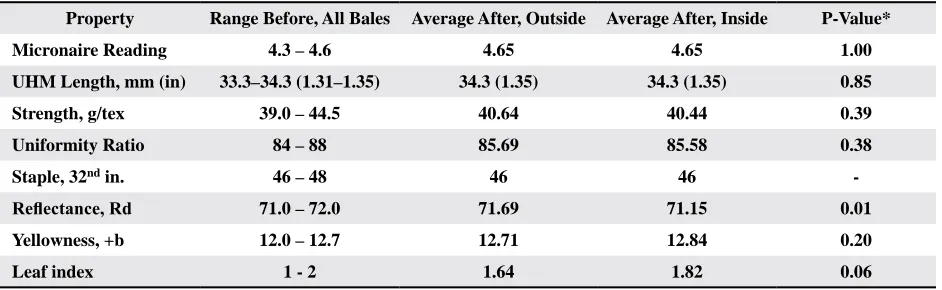
The range of HVI fiber properties from all bales prior to storage, and the average HVI fiber properties
by treatment after storage are shown in Table 1. The
range of fiber properties prior to storage are normal
for good quality Pima produced in the San Joaquin
Valley of California under established production and
ginning practices. There were statistically significant
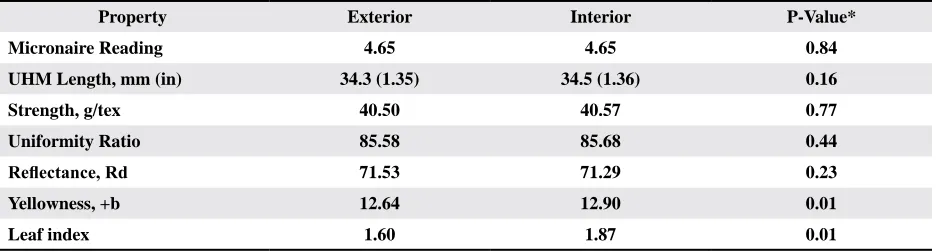
differences in HVI Rd properties between the storage treatments based on the four HVI samples taken through each bale at the end of the storage period. There was anecdotal evidence that the exterior surfaces of all the bales stored outside appeared to be bleached more white than the bales stored inside. Table 2 shows the statistical analysis of the four HVI samples taken at the end of the storage period. These samples were statistically analyzed to determine if
there were significant differences between the two
HVI samples taken at the surface of each bale and the two samples taken from the interior of the bale.
Table 2 shows that fiber yellowness (+b) of the
samples taken from the exterior of the bales were
significantly less yellow (though the differences were small) than fiber samples taken from the interior of the bales. There was no significant difference in average reflectance (Rd) but fiber samples from the
exterior of the bales tended to be brighter than the samples from the interior of the bales. However, the observed bleaching did not appear to penetrate to any
depth into the bale and did not seem to significantly
affect the dyed cloth made from these bales. Table
2 also shows a significant difference between HVI
leaf index between the exterior and interior of the cotton bales with the interior leaf index being the higher. It is not known whether the difference comes from a certain amount of trash being lost from the bale surfaces due to packaging and handling or some other cause, however the average overall trash level of all bales is low and the difference between
interior and exterior leaf index, though significant,
is relatively minor and may just be an artifact of sample variability.
Table 1.Range of HVI Values Before Storage and Averages After Storage.
Property Range Before, All Bales Average After, Outside Average After, Inside P-Value*
Micronaire Reading 4.3 – 4.6 4.65 4.65 1.00
UHM Length, mm (in) 33.3–34.3 (1.31–1.35) 34.3 (1.35) 34.3 (1.35) 0.85
Strength, g/tex 39.0 – 44.5 40.64 40.44 0.39
Uniformity Ratio 84 – 88 85.69 85.58 0.38
Staple, 32nd in. 46 – 48 46 46
-Reflectance, Rd 71.0 – 72.0 71.69 71.15 0.01
Yellowness, +b 12.0 – 12.7 12.71 12.84 0.20
Leaf index 1 - 2 1.64 1.82 0.06
Figure 1 shows the outside and warehouse ambient temperature data plotted every 15 minutes for selected times during the one-year test. Figure 1 also shows the temperatures averaged across the ten control and the nine experimental bales and plotted on the same 15 minute increments for selected times during the one-year test. All outside and warehouse ambient temperatures were monitored and recorded by single HOBO H8 Pro Series loggers that were permanently mounted in close proximity to the test bales. The outside ambient logger did not become operational until about three weeks after the test started. Figure 1 shows that the indoor warehouse ambient temperatures reached higher daily peaks than did the control bale (warehouse) temperatures. However, the temperature of the experimental bales (stored outside) that was measured in the space between the bagging and the bale exceeded the daily outside ambient temperatures for all four periods. Maximum daytime outside ambient temperature did not exceed 46ºC (115ºF) while the temperature under the bale covering of the outside stored bales exceeded 66ºC (150ºF) several times during the June 30 to July 28 test period. Even though the measured temperature of the experimental bales exceeded the outside maximum ambient temperature by approximately 130%, the maximum temperature of the experimental bales between the covering and the bale surface was still far below the maximum recommended gin drying temperature of 176.7ºC (350ºF) that was discussed by Hughs et al., (1994). These temperature levels would indicate that outside bale storage under these same ambient
conditions is not likely to cause any significant
fiber damage due to temperature, though they could possibly lead to melting and re-solidifying of the surface wax component, possibly resulting in
affects upon yarn processing and quality. No such affects were observed, however, as seen in Table 5. The control bales did not exceed 35ºC (95ºF) with warehouse ambient air temperature highs of around 38ºC (100ºF) during the same period.
Table 2. Average HVI Values Relative to Bale Position of Sample. Exterior Sampled from Layers 1, 10 and Interior Sampled from Layers 3, 6.
Property Exterior Interior P-Value*
Micronaire Reading 4.65 4.65 0.84
UHM Length, mm (in) 34.3 (1.35) 34.5 (1.36) 0.16
Strength, g/tex 40.50 40.57 0.77
Uniformity Ratio 85.58 85.68 0.44
Reflectance, Rd 71.53 71.29 0.23
Yellowness, +b 12.64 12.90 0.01
Leaf index 1.60 1.87 0.01
* P-value is the test of significance of means being equal in the PROC GLM procedure of SAS. Any P-value greater than 0.05 was considered to be non-significant and the means to be not significantly different.
Figure 2 shows a plot of the relative humidity recordings during the same test times of Figure 1. All data were plotted on 15 minute increments during selected times with ambient RH being single readings at interval and the control and experimental RH being averaged across the control and test bales at 15 minute intervals. The maximum recorded average internal relative humidity for both the control and the test bales started at around 45% and gradually
decreased to between 30 and 40% during the first
30 day test period. The warehouse stored bales kept a constant range of between 30 and 40% during the remaining recorded test period. The outside bales did approach 50% relative humidity within the bale covering occasionally following periods of high ambient humidity but would then decrease back to 45% or less. The relative humidity peaks
for the outdoor ambient that were at approximately 104% indicates that liquid water (dew or rainfall) had collected on the ambient sensor with the bale wrapped with LLDPE and should be considered as a 100% relative humidity condition.
year of storage. Taking the final average moisture content and the final average bale weight gain of all
bales of approximately 2 kg (4 to 5 lbs), it can be inferred that the bales were originally packaged at an average moisture content of approximately 4.2% wet basis. This moisture content is considerably less that the USDA (2006) recommended maximum of
7.5% in order to avoid fiber color changes during
storage from moisture. Even though the bale packaging material is relatively tightly sealed at the time of ginning, there is enough air exchange between the ambient environment and the inside of the bale bagging to allow some moisture exchange during long storage periods.
Table 4 shows other average raw fiber properties
measured after the one-year storage period. None
of the fiber properties were significantly different
due to the storage treatments. The Shirley Analyzer visible levels of less than 1.5% are consistent with good quality roller-ginned and cleaned Pima cotton. It is interesting to note how uniform the average moisture levels of all the bales were after the one-year storage period.
Table 5 shows average yarn properties for the 28/1 ring spun yarn made from the test bales. As indicated by their P-values, none of the reported
yarn properties were significantly different due to
storage treatment. Also, the yarn values shown in Table 5 for the experimental and control treatments are consistent with what would be expected with this type of yarn made from Pima cotton.
Table 3. Average Bale Weights.
Treatment Before, kg (lbs) After, kg (lbs) % Change
Experimental (Outside Storage) 228.2 (503) 230.9 (509) 1.2
Control (Inside Storage) 222.7 (491) 224.5 (495) 0.8
Table 4. Average Raw Fiber Properties After Storage.
Property Inside Outside P-value*
Shirley Analyzer Visible, % 1.39 1.31 0.42
AFIS Length (w), mm (in) 30.7 (1.21)` 30.2(1.19) 0.14
AFIS Length CV, % 31.0 31.5 0.46
AFIS UQL (w), mm (in) 36.6 (1.44) 36.1 (1.42) 0.07
AFIS SFC, % 4.41 4.67 0.53
Nep, #/g 128 143 0.18
Fiber Moisture, % (wet basis) 5.14 5.16 0.71
* P-value is the test of significance of means being equal in the PROC GLM procedure of SAS. Any P-value greater than 0.05 was considered to be non-significant and the means to be not significantly different.
Table 3 shows the average bale weights of both bale storage treatments taken before and after the storage period. All of the bales gained an average of approximately 2 kg during the one -year storage period regardless of where stored. Hughs et al. (1994) indicate that a long-term exposure to relative humidity of between 30 and 40%, cotton fiber will equilibrate at a moisture content of approximately 5.5% (wet basis). Table 4 indicates that the average moisture content of both the control and test bales was approximately 5.15% after one
Anecdotal evidence in the past has indicated that there may be problems in the visual quality of dyed cloth made from cotton bales that have been stored outside for a length of time. This
visual problem is known as barré. Barré is defined
as an unintentional, repetitive visual pattern of continuous bars and stripes usually parallel to
the filling of woven fabric or to the courses of
circular knit fabric (Cotton Inc, 1992). Yarn from each storage treatment was knit into fabric and
dyed a solid blue color to determine if significant
differences could be detected in perceived barré levels between bale storage treatments. Tables 6 and 7 show the colorimetric data obtained from two rolls of greige fabric. Each roll included lengths knit from both the control bales and the outside storage bales. Following color analysis of the greige fabrics, each was then prepared for dyeing. One roll (Roll C) was then dyed with a
reactive blue dye, and Roll D was dyed using a direct blue dye. In both cases, the color difference,
ΔE (ΔE = [ΔL2 + Δa2 + Δb2]1/2 ), was calculated for
both the greige and the dyed fabrics. Neither roll exhibited a perceptible difference in L*a*b* color coordinates due to storage conditions, and the same
was also true for the dyed fabrics. A ΔE value of less than 1.00 is generally indicative of insignificant
perceptual differences, but neither roll exhibited a
ΔE value of greater than 1.00 for either the greige
or dyed fabrics
CONCLUSIONS
The hypothesis being tested was that no
significant difference in fiber or textile properties
between cotton bales stored as indicated existed.
With the exception of reflectance and yellowness, there were no significant differences in fiber or yarn
Table 5. Average Yarn Properties.
Property Inside Outside P-value*
Total Card Waste, % 4.32 4.34 0.45
Ends Down, #/1000 hr 3.33 2.33 0.10
Single Strand Strength, g/tex 23.0 22.9 0.88
Neps, #/1000 yd 52 54 0.42
Thick Places, #/1000 yd 203 214 0.26
Low Places, #/1000 yd 10 9 0.29
Yarn Evenness CV, % 15.5 15.6 0.10
Major Faults, #/1000 yd 2.0 7.7 0.18
* P-value is the test of significance of means being equal in the PROC GLM procedure of SAS. Any P-value greater than 0.05 was considered to be non-significant and the means to be not significantly different.
Table 6. Colorimeter Data for Roll C.
Roll C L* a* b* ΔEcontrol-outside
Greige (control) 78.03 (1.25) 2.44 (0.16) 14.90 (0.56)
Greige (outside) 78.16 (1.43) 2.32 (0.23) 14.74 (0.54) 0.24
Reactive Blue (control) 35.85 (0.75) -1.31 (0.27) -28.70 (0.45)
Reactive Blue (outside) 35.62 (0.98) -1.06 (0.14) -28.63 (0.49) 0.34
Table 7. Colorimeter Data for Roll D.
Roll D L* a* b* ΔEcontrol-outside
Greige (control) 78.15 (0.83) 2.41 (0.13) 14.74 (0.44)
Greige (outside) 78.28 (0.92) 2.33 (0.13) 14.78 (0.40) 0.16
Direct Blue (control) 42.33 (0.78) 2.18 (0.16) -29.16 (0.38)
quality between Pima cotton bales stored inside a warehouse and stored outside in a storage lot with no protective covering other than the bale covering. On
bales stored outside, reflectance was slightly higher
and yellowness was slightly lower as measured by HVI. There was some anecdotal evidence that the exterior bale surface of the outside bales was bleached whiter. However, the bleaching did not penetrate to any depth of the interior of the bale, and
none of the measured fiber or yarn properties were significantly affected.
The temperature of the bales stored inside remained lower than the ambient temperature inside of the warehouse. The temperature of the bales stored outside exceeded the ambient temperature of the environment, but the temperature of the bales remained far below any temperature that could
cause fiber damage. Relative humidity both inside
of the warehouse and outside in the storage lot were approximately the same and remained at acceptable levels. Bales stored inside and outside gained the same amount of weight. There was no difference in
final fiber moisture content at the end of the storage period between bales stored inside or outside; final
moisture content was considerably less than the USDA recommended maximum.
There was no perceptible difference in color in both greige and dyed fabrics manufactured from bales stored inside and outside. There was no evidence of barré in the dyed cloth due to storage conditions, based upon L*a*b* values. Speculative concerns of barré occurring in bales stored outside were not supported.
In conclusion, the hypothesis of no significant difference in either fiber or textile quality of cotton
bales stored as indicated was supported by this test.
DISCLAIMER
Mention of a trade name or commercial product in the publication is solely for the purpose of providing specific information and does not imply recommendation or endorsement by the U. S. Department of Agriculture.
ACKNOWLEDGEMENTS
The authors would like to thank Christina Wright and Mary Ankeny, Dyeing Research, Cotton Inc. for their help in analyzing and interpreting the results for the dyed fabrics from this test.
ABBREVIATIONS
USDA, AMS – United States Department of Agriculture, Agricultural Marketing Service.
HVI – The method used by the USDA, AMS
for assigning most cotton fiber quality values to bale
samples utilizing specialized instruments.
Rd – One of the measurements of the HVI that gives an indication of how bright or dull a cotton sample is by measuring the degree of light
reflectance from cotton samples.
+b – An HVI measure of the degree of yellowness of a cotton sample.
AFIS – Advanced Fiber Information System marketed by Uster Technologies Inc. (Charlotte, NC, USA) that measures certain length properties
of cotton fibers.
CV – Coefficient of variation.
UQL – Upper quartile length is the length that is
exceeded by 25% of the fibers in the cotton sample. SFC – Short fiber content is the percentage of cotton fibers in a bundle that are less than 12.7 mm
(0.5 inch) in length.
L* - lightness or darkness of sample on scale of
100, 0 denoting no reflectance, 100 is total reflectance a* - denotes redness or greenness, more positive a* is redder, negative a* is greener
b* - denotes yellowness or blueness, more positive b* is yellower, negative b* bluer
delta E - the square root of the square of the sum of differences in L* (delta L*), a* (delta a*), and b*
(delta b*); or ÄE = [(ÄL*)2 + (Äa*)2 + ( Äb*)2]1/2 HR is “Hank Roving”. The number of Hanks is
the number of 914.4 m (840 yd) lengths that weighs a total of 0.45 kg (1 lb).
TM is “Twist Multiple”. Twists per Inch = TM
x (Roving Hank)1/2
gr - denotes grains per yard and a grain is 1/7000 lb.
REFERENCES
American Society for Testing and Materials (ASTM). 2001. Standard test method for moisture in cotton by oven drying (D2495-01). In Annual Book of ASTM Standards. Vol. 07.01. ASTM, West Conshohocken, PA.
Byler, R. K., and A.G. Jordan. 2010. Model of cotton bale weight changes related to bagging. American Society of Agricultural and Biological Engineers. Appl.Eng.in Agric. 26(2): 203-208.
Cable, C.C., Jr., H.R. Smith, and Z.M. Looney. 1964. Changes in Quality and Value of Cotton Bales and Samples during Storage. USDA, Economic Research Service, Agricultural Marketing Service, Marketing Research Report No. 645. 58 pages.
Cotton Incorporated. 1992. Technical Bulletin: Barré. Cary, North Carolina. 6 pages.
Farm Service Agency (FSA). 2010. USDA, FSA website –
http://www.fsa.usda.gov/FSA/webapp?area=home&s ubject=coop&topic=was-ca. Contains regulations and
guidelines for approved cotton storage warehouses.
Gamble, G.R. 2007. The effect of bale ageing on cotton fiber
chemistry, processing, and yarn quality. J. Cotton Sci. 11: 98-103.
Gamble, G.R. 2008. Method for the prediction of the rate of +b color change in upland cotton (Gossypium hirsutim
L.) as a function of storage temperatures. J. Cotton Sci. 12:171-177.
Howell, L.D. 1956. Influence of certificate stocks on
spot-futures price relationships for cotton. U.S. Dept. Agr., Tech. Bul. No. 1151, Oct.
Hughs, S.E., G.J. Mangialardi, Jr., and S.G. Jackson. 1994. Moisture Control. USDA, ARS, Cotton Ginners Handbook, Agricultural Handbook Number 503, p. 58-68.
Hughs, SE., G.R. Gamble, and D.C. Tristao. 2007.
Long-term storage effects on fiber and textile quality of
polyethylene wrapped cotton bales. In Proc. Beltwide
Cotton Conf. [CD-ROM, p. 1936-1942] New Orleans,
LA. 9-12 Jan. 2007. Natl. Cotton Counc. Am., Memphis, TN.
Hughs, S.E., G.J. Mangialardi, Jr., and S.G. Jackson. 1994. Moisture Control. Cotton Ginners Handbook. USDA, ARS, Agricultural Handbook Number 503, pp. 58-68.
Joint Cotton Industry Bale Packaging Committee (JCIBPC).
2005. 2005 specifications for cotton bale packaging
materials. National Cotton Council of America website, http://www.cotton.org/tech/index.cfm, June 20, 2005. 19 pages.
National Cotton Council of America. 2001. A Guide for Cotton Bale Standards. National Cotton Council, Memphis, TN. 12 pages.
Nickerson, D. 1951. Effect of exposure and storage on color and other factors of quality in raw cotton. U. S. Dept. of Agr., Prod. And Mktg. Admin., Jan.
Tristao, D.C., P. Denton, H. Bello, P.J. Wakelyn, S.E. Hughs, and R. Isom. 2002. The effect of outside ambient air conditions on the interstitial relative humidity of linear
low density polyethylene film wrapped cotton bales. Am.
Soc.of Agric. Eng. Paper No. SE2104.