
ISTITUTOITALIANO UNIVERSITÀ DEGLISTUDI
DITECNOLOGIA DIGENOVA
DEPARTMENT OFPATTERN ANALYSIS AND COMPUTERVISION(PAVIS), ISTITUTOITALIANO DI TECNOLOGIA
DIPARTIMENTO DIINGEGNERIANAVALE, ELETTRICA, ELETTRONICA E DELLE TELECOMUNICAZIONI(DITEN), UNIVERSITÀ DEGLI STUDI DI GENOVA PhD in Science and Technology for Electronic and Telecommunication Engineering
Curriculum: Computational Vision, Automatic Recognition and Learning
Learning Discriminative Features for
Person Re-Identification
Xiangping Zhu
A thesis submitted in fulfilment of the requirements for the degree of Doctor of Philosophy
Supervisor:Prof. Dr. Vittorio Murino
Coordinator of the PhD Course: Prof. Dr. Mario Marchese
Acknowledgments
Time flies and now in finishing my thesis, I am also moving to the end of my Ph.D. career in Pattern Analysis and Computer Vision (PAVIS), Istituto Italiano di Tecnologia (IIT). First of all, I should thank Prof. Vittorio Murino who is my supervisor in these three years. Many thanks to him for accepting me as a Ph.D. student in his PAVIS team and also for his patience and guidances. I should also thank Prof. Shaogang Gong who is my supervisor when I was an intern in his Vision Group, Queen Mary University of London. I experienced six great months in his lab.
I would like to express my thanks to Dr. Mohamed Lamine Mekhalfi, Dr. Paolo Rota, Dr. Pietro Morerio in PAVIS who directly supervised me and gave me detailed guidances on my research in the past three years. When I was an intern in Queen Mary University of London, I worked closely with Dr. Xiatian Zhu and Dr. Minxian Li. They gave me a lot of helps on my research, especially Dr. Xiatian Zhu who spent lots of time discussing with me about my work. In addition, thanks also go to the kind secretary Sara Curreli and the excellent technician Matteo Bustreo for their great supports.
Lastly, I want to express my thanks to my family members, in particular my parents, my aunt, my brothers and my sisters. Their enduring love and endless supports always encouraged me to move forward in this journey.
Abstract
For fulfilling the requirements of public safety in modern cities, more and more large-scale surveillance camera systems are deployed, resulting in an enormous amount of visual data. Automatically processing and interpreting these data promote the development and applica-tion of visual data analytic technologies. As one of the important research topics in surveil-lance systems, person re-identification (re-id) aims at retrieving the target person across non-overlapping camera-views that are implemented in a number of distributed space-time locations. It is a fundamental problem for many practical surveillance applications, e.g., person search, cross-camera tracking, multi-camera human behavior analysis and predic-tion, and it received considerable attentions nowadays from both academic and industrial domains.
Learning discriminative feature representation is an essential task in person re-id. Although many methodologies have been proposed, discriminative re-id feature extraction is still a challenging problem due to: (1) Intra- and inter-personal variations. The intrinsic properties of the camera deployment in surveillance system lead to various changes in person poses, view-points, illumination conditions etc. This may result in the large intra-personal vari-ations and/or small inter-personal varivari-ations, thus incurring problems in matching person images. (2) Domain variations. The domain variations between different datasets give rise to the problem of generalization capability of re-id model. Directly applying a re-id model trained on one dataset to another one usually causes a large performance degradation. (3) Difficulties in data creation and annotation. Existing person re-id methods, especially deep id methods, rely mostly on a large set of inter-camera identity labelled training data, re-quiring a tedious data collection and annotation process. This leads to poor scalability in practical person re-id applications.
Corresponding to the challenges in learning discriminative re-id features, this thesis con-tributes to the re-id domain by proposing three related methodologies and one new re-id setting:
(1)Gaussian mixture importance estimation. Handcrafted features are usually not dis-criminative enough for person re-id because of noisy information, such as background clut-ters. To precisely evaluate the similarities between person images, the main task of distance metric learning is to filter out the noisy information. Keep It Simple and Straightforward MEtric (KISSME) is an effective method in person re-id. However, it is sensitive to the feature dimensionality and cannot capture the multi-modes in dataset. To this end, a Gaus-sian Mixture Importance Estimation re-id approach is proposed, which exploits the GausGaus-sian
Mixture Models for estimating the observed commonalities of similar and dissimilar person pairs in the feature space.
(2)Unsupervised domain-adaptive person re-id based on pedestrian attributes. In per-son re-id, perper-son identities are usually not overlapped among different domains (or datasets) and this raises the difficulties in generalizing re-id models. Different from person identity, pedestrian attributes, e.g., hair length, clothes type and color, are consistent across differ-ent domains (or datasets). However, most of re-id datasets lack attribute annotations. On the other hand, in the field of pedestrian attribute recognition, there is a number of datasets labeled with attributes. Exploiting such data for re-id purpose can alleviate the shortage of attribute annotations in re-id domain and improve the generalization capability of re-id model. To this end, an unsupervised domain-adaptive re-id feature learning framework is proposed to make full use of attribute annotations. Specifically, an existing unsupervised domain adaptation method has been extended to transfer attribute-based features from at-tribute recognition domain to the re-id domain. With the proposed re-id feature learning framework, the domain invariant feature representations can be effectively extracted. (3) Intra-camera supervised person re-id. Annotating the large-scale id datasets re-quires a tedious data collection and annotation process and therefore leads to poor scal-ability in practical person re-id applications. To overcome this fundamental limitation, a new person re-id setting is considered without inter-camera identity association but only with identity labels independently annotated within each camera-view. This eliminates the most time-consuming and tedious inter-camera identity association annotating process and thus significantly reduces the amount of human efforts required during annotation. It hence gives rise to a more scalable and more feasible learning scenario, which is named as Intra-Camera Supervised (ICS) person re-id. Under this ICS setting, a new re-id method, i.e., Multi-tAsk mulTi-labEl (MATE) learning method, is formulated. Given no inter-camera association, MATE is specially designed for self-discovering the inter-camera identity cor-respondence. This is achieved by inter-camera multi-label learning under a joint multi-task inference framework. In addition, MATE can also efficiently learn the discriminative re-id feature representations using the available identity labels within each camera-view.
Keywords: Visual Surveillance, Metric Learning, Deep Learning, Unsupervised Domain Adaptation, Intra-Camera Supervised Person Re-Identification
Publication List
The work of this thesis is based on the following papers, which have been published or submitted:
Chapter 3
1. Xiangping Zhu, Amran Bhuiyan, Mohamed Lamine Mekhalfi and Vittorio Murino, Exploiting Gaussian Mixture Importance for Person Re-identification, IEEE Interna-tional Conference on Advanced Video and Signal Based Surveillance (AVSS), 2017. (Best Paper, Honorable Mention)
Chapter 4
1. Xiangping Zhu, Pietro Morerio and Vittorio Murino,Unsupervised Domain-Adaptive Person Re-identification Based on Attributes, IEEE International Conference on Image Processing (ICIP), 2019.
Chapter 5
1. Xiangping Zhu, Xiatian Zhu, Minxian Li, Vittorio Murino and Shaogang Gong, Intra-Camera Supervised Person Re-Identification: A New Benchmark, International Con-ference on Computer Vision (ICCV) Workshop on Real-World Recognition from Low-Quality Images and Videos, 2019.
2. Xiangping Zhu, Xiatian Zhu, Minxian Li, Pietro Morerio, Vittorio Murino and Shao-gang Gong,Intra-Camera Supervised Person Re-Identification, Submitted to Interna-tional Journal of Computer Vision (IJCV).
Contents
1 Introduction 1 1.1 Visual Surveillance . . . 1 1.2 Person Re-Identification . . . 3 1.2.1 Problem Formulation . . . 3 1.2.2 Applications . . . 5 1.2.3 Challenges . . . 7 1.2.4 Datasets . . . 12 1.2.5 Evaluation Metrics . . . 151.3 Contributions of This Thesis . . . 18
1.4 Thesis Outline . . . 20
2 Related Works 22 2.1 Handcrafted Feature Extraction and Metric Learning . . . 22
2.1.1 Handcrafted Feature Extraction . . . 22
2.1.2 Metric Learning. . . 26
2.2 Pedestrian Attribute Based Methods . . . 29
2.3 Deep Learning Methods. . . 31
2.3.1 Fully Supervised Person Re-Identification . . . 32
2.3.2 Unsupervised domain-adaptive Person Re-Identification . . . 35
2.3.3 Other Methods . . . 38
3 Gaussian Mixture Importance Estimation 40 3.1 Introduction . . . 40
3.2 Background . . . 41
3.2.1 KISS Metric Learning . . . 41
3.2.2 Gaussian Mixture Models . . . 43
3.3 Our Proposed Approach. . . 44
3.3.1 Gaussian Mixture Importance Estimation . . . 45
3.3.2 Person Re-Identification Process Using GMIE. . . 47
3.4 Experiments . . . 47
3.4.2 Experiments on GRID Dataset . . . 48
3.4.3 Experiments on PRID 450S Dataset . . . 50
3.5 Conclusions . . . 51
4 Unsupervised Domain-Adaptive Person Re-identification Based on Attributes 52 4.1 Introduction . . . 52
4.2 Background . . . 53
4.2.1 Adversarial Process. . . 54
4.2.2 Adversarial Discriminative Domain Adaptation . . . 55
4.3 Our Proposed Methodology. . . 55
4.3.1 Attribute Recognition. . . 56
4.3.2 Unsupervised Domain Adaptation . . . 57
4.3.3 Feature Extraction . . . 59
4.4 Experiments . . . 59
4.4.1 Dataset . . . 59
4.4.2 Implementation Details . . . 60
4.4.3 Comparisons with State-Of-The-Art Results. . . 60
4.4.4 Domain Adaptation Influences . . . 61
4.4.5 Attribute Classifier Influences . . . 62
4.4.6 Sample Feeding Influences . . . 63
4.5 Conclusions . . . 64
5 Intra-Camera Supervised Person Re-Identification 65 5.1 Introduction . . . 65
5.2 Problem Formulation . . . 68
5.3 Method . . . 69
5.3.1 Per-Camera Multi-Task Learning. . . 70
5.3.2 Cross-Camera Multi-Label Learning . . . 71
5.3.3 Final Objective Loss Function . . . 75
5.4 Experiments . . . 75
5.4.1 Benchmarking the ICS Person Re-ID . . . 77
5.4.2 Comparing Different Person Re-ID Paradigms . . . 80
5.4.3 Further Evaluations . . . 81
5.5 Conclusions . . . 83
6 Conclusions and Future Work 84
List of Figures
1.1 Examples of three application scenarios of CCTV cameras. . . 1
1.2 The pipeline of visual data processing in autonomous visual surveillance. . 2
1.3 Camera layout considered in person re-id and a toy example of person re-id. 3 1.4 The general pipeline of person re-id. . . 4
1.5 Examples of person re-id applications. . . 7
1.6 Examples of different kinds of intra- and inter-personal variations. . . 9
1.7 Samples from two person re-id datasets for illustrating dataset domain vari-ations. . . 10
1.8 Camera-view domain variations in Market1501 dataset. . . 11
1.9 Illustrations of manually annotating identity labels. . . 12
1.10 A toy example of the difference between CMC and average precision mea-surements . . . 15
1.11 Precision-recall curve. . . 19
1.12 Visualization of thesis outline. . . 21
2.1 SDALF handcrafted feature extraction. . . 23
2.2 Illustration of localizing human body parts using CPS. . . 24
2.3 Illustrations of the effectiveness of Retinex and LOMO feature extraction. . 24
2.4 Illustration of GOG feature extraction process.. . . 25
2.5 Illustration of training process in LMNN. . . 27
2.6 Illustration of the idea behind learning the discriminative null space. . . 28
2.7 Two sample examples of identity and attribute labels. . . 29
2.8 Overview of the learning strategy which combines identity and attribute as supervision for learning discriminative re-id features. . . 30
2.9 Different solutions for partial person re-id. . . 32
2.10 Illustration of the resource aware person re-id model. . . 33
2.11 Examples of extracted body regions by using part-aligned person re-id model. 34 2.12 The network architecture proposed in [140]. . . 34
2.13 The TJ-AIDL re-id model. . . 35
2.14 The pipeline of the re-id method proposed in [29]. . . 36
2.16 The re-id model proposed in [22]. . . 37
2.17 The semi-supervised person re-id method proposed in [167]. . . 38
2.18 The BUC unsupervised person re-id method.. . . 39
3.1 Illustration example of approximating a distribution with two modes using Gaussian density. . . 41
3.2 Illustration example of approximating a one dimensional distribution with GMMs. . . 44
3.3 Experimental results on VIPeR dataset with GOG feature.. . . 48
3.4 Experimental results on VIPeR dataset with LOMO feature. . . 49
3.5 Experimental results of dimensionality influence on grid dataset with both GOG and LOMO features. . . 49
3.6 Experimental results on PRID 450S dataset with GOG feature. . . 51
4.1 Overview of the considered re-id problem based on the annotated attribute recognition dataset. . . 53
4.2 Overview of the ADDA method. . . 54
4.3 The proposed attribute related re-id feature learning framework. . . 56
4.4 The attribute recognition network architecture.. . . 56
4.5 The proposed unsupervised adversarial adaptation. . . 57
4.6 Person re-id feature extraction network. . . 59
4.7 Person image samples from RAP, Market1501 and DukeMTMC-reID datasets. 62 4.8 Adaptation performance comparisons between the unsupervised domain-adaptive re-id frameworks with and without the additional classifier. . . 63
5.1 Labels in person re-id data. . . 66
5.2 Illustrations of data annotation process. . . 67
5.3 Overview of the proposed MATE deep learning method. . . 69
5.4 Three baseline learning methods for ICS person re-id. . . 77
5.5 Feature distribution visualization of a randomly selected person identity ap-pearing under all the six camera views of the Market-1501 dataset. . . 78
5.6 Dynamic statistics of cross-camera identity association over the training rounds. Dataset: Market-1501. . . 81
5.7 The t-SNE figures of the inter-camera identity association process in the proposed MATE. . . 83
List of Tables
1.1 Person re-id datasets. . . 13
3.1 Experimental results on GRID dataset of different methods comparing with our GMIE approach. . . 50
4.1 Performance comparisons with existing attribute based unsupervised adap-tive person re-id methods.. . . 60
4.2 Comparing experimental results before and after adaptation. . . 61
4.3 Ablation study results for evaluating the sample feeding influences.. . . 64
5.1 Benchmarking the ICS person re-id performance. . . 76
5.2 Comparative evaluation of representative person re-id paradigms in the model trainingsupervisionperspective. . . 79
Chapter 1
Introduction
1.1 Visual Surveillance
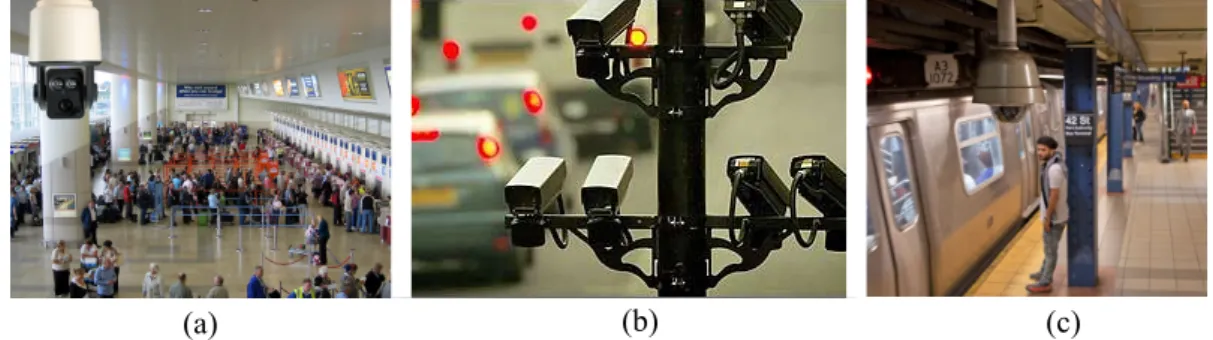
More and more large-scale surveillance camera systems are being deployed for increasing the public safety in modern cities. Based on the statistics in [1], the number of closed-circuit television (CCTV) surveillance cameras in the world has been increased from less than 10 millions in 2006 to over 100 millions in 2016, and the number is still rapidly increasing in recent years. This huge amount of surveillance cameras are installed in different public spaces for various surveillance application purposes, for example monitoring traffic flow on highway and detecting abnormal activities in train station or shopping mall. Figure1.1gives examples of several application scenarios of CCTV cameras.
Visual surveillance refers to a visual monitoring process that aims at analyzing and interpret-ing visual data generated by CCTV cameras in order to understand the visual events of the scene [57]. The traditional surveillance visual data processing mostly depends on manual methods. The visual data from the cameras in a surveillance system are pooled in the control room [38]. Several or more operators are involved in data analyzing. Specifically, operators in the control room use a bank of wall monitors to get the quick snapshots of the scenes
(a) (b) (c)
Figure 1.1: Examples of three application scenarios of CCTV cameras. From (a) to (c), cameras are deployed in airport, highway and metro station1.
1The images are from
Feature Representation Extraction
High Level Visual Information Discovery
Machine Learning or Computer Vision Technologies Visual Data Acquisition
Figure 1.2: The pipeline of visual data processing in autonomous visual surveillance. The visual data is acquired from CCTV cameras. The machine learning or computer vision methods are used to extract feature representations and discover high level visual informa-tion, for example activity name in activity recognition and trajectory in pedestrian trajectory prediction.
in the area that is under surveillance. With the expansion of CCTV camera numbers, visual surveillance done solely by human is becoming unfeasible. As one example reported in [38], there is a control room in which one operator was responsible for 153 CCTV cameras, re-sulting in many cameras not being monitored for long periods of time. As unexpected events (involving specific individuals) often take place in a split second, real-time apprehension of the events may be missed. In addition, CCTV cameras keep recording videos consistently while for operators, continuously watching and analyzing videos is a very labor-intensive task.
Autonomous visual surveillance provides an alternative way to solve the challenges encoun-tered in using manual methods, as mentioned above. It aims at automatically processing and interpreting visual data with the assistance of machine learning or computer vision tech-nologies, for example object or human detection, tracking, action recognition and person re-identification (re-id). The visual data processing pipeline in autonomous visual surveillance is presented in Fig. 1.2. Compared with manual visual surveillance methods, autonomous visual surveillance is characterized with several advantages. For example, it can provide stable and real-time monitoring results. It is generally agreed that for human, long time of continuous watching videos requires a bigger level of visual attention than most every day tasks [47]. This can cause visual fatigue and thus result in errors in observing the incident happened in the monitored areas, which can further lead to unstable monitoring results. Au-tonomous visual surveillance methods can efficiently solve these problems using automatic image or video processing algorithms.
Due to large demands in practical applications, substantial efforts have been devoted into developing autonomous visual surveillance technologies [47,145,172,192,7]. Person re-id is one of the fundamental problems in autonomous visual surveillance and it attracts lots of attentions of both academy and industry [192, 7, 117, 132, 78,175, 105, 186, 20]. In
One probe image
from Cam. 1 Gallery set from Cam. 2
person re-id
…
Similarity Ranking Result:
(a) Camera layout (b) Person re-id
Figure 1.3: (a) An example of camera layout that is considered in person re-id problem [7]. There are 15 person identities (i.e., , No. 1-15) and they are color encoded. The dashed lines denote the person trajectories; (b) A toy example of person re-id.
the following section, detailed introductions will be sequentially presented about different aspects of person re-id, i.e., problem formulation, applications, challenges, datasets and evaluation metrics.
1.2 Person Re-Identification
1.2.1 Problem Formulation
The origin of person re-id can be dated back to multi-camera pedestrian tracking [192,
145]. In multi-camera surveillance system, it commonly happens that pedestrians leave one camera-view and re-appear in another camera-view. A successful tracking algorithm should be able to associate the same pedestrian appeared in different camera views. This is a non-trivial problem due to the variations of person poses, illuminations, occlusionsetc. Person re-id independently considers cross-camera person association procedure but under a more challenging scenario with no overlaps between camera views. Fig. 1.3(a) gives an example of the camera layout considered in person re-id. A general assumption in person re-id is that individuals keep the same clothing in different camera views. This is reasonable in most of practical cases. In a surveillance camera network, it only takes a short period of time for pedestrians walking from one camera-view to another one and most probably, pedestrians do not change their clothes. Based on this assumption, most of person re-id works mainly rely on pedestrian appearance as the cue for re-identification.
Feature Representation
Extraction Similarity Calculation
Ranking or Matching Person Images
Figure 1.4: The general pipeline of person re-id. Input contains all of person images from both probe and gallery sets. Different methods can be applied in feature representation extraction part,e.g., handcrafted features, metric learning and deep learning. A full version diagram of person re-id system can be found in [7].
converted into a cross-camera image retrieval problem. As in image retrieval, there are also probe and gallery sets in person re-id data. The probe set contains the images of target person while gallery set contains the images of candidates. Fig. 1.3(b) presents a toy example of person re-id. For simplifying the problem, only two cameras are illustrated here. Given a probe image, person re-id retrieves the target person images from the gallery set by ranking the candidate images according to their similarities to the probe. For a successful person re-id method, if there are images of the probe in the gallery set, theses images should be on the top positions in the ranking list.
Generally, most of person re-id methods are composed of: (1) feature representation ex-traction, (2) similarity calculation and (3) ranking or matching person images. Fig. 1.4 shows the general pipeline of person re-id. Learning discriminative feature representation is the essential task in person id. Various methods have been proposed for extracting re-id feature representations, including handcrafted features [78, 31,25,37], metric learning [123,61,78,79,44] and deep learning [186,23,200,134,181]. According to the exist-ing works [192,63,205,204,200], after extracting the discriminative re-id features, simple distance functions,e.g., euclidean or cosine distance, can be applied for calculating similari-ties between probe and gallery images. Although many methodologies have been proposed, discriminative re-id feature extraction is still a hard problem resulted from different chal-lenges in person re-id, as detailed in Section1.2.3. This thesis mainly focuses on designing discriminative feature extraction methods.
Although there are works directly applying distance functions on handcrafted features to calculate similarities withoutlearning or trainingphase [192,31,25,188], most of person re-id methods have two phases: (1) Training. With the given person re-id data, the main task of this phase is to train the re-id model to be capable of extracting discriminative features. There are two major types of training strategies,i.e., verification and identification [197]. Based on person re-id purpose of matching person images, verification fulfills this by ap-plying the idea that samples from the same identity are pulled together while samples from
different identities are pushed away. The methods based on this strategy include distance metric learning [173,52,123,61,78,79,44] and deep metric learning [51,18,192,177]. Some existing works also treat verification strategy as a binary classification task which takes a pair of images as input and predicts if they are from the same person [72,192]. On the other hand, identification treats person re-id as a multi-class classification task, in which person images are input into the re-id model, which provides predictions for their identi-ties [192, 205, 165, 14, 109]. Recently, there are also works trying to benefit from both verification and identification strategies by combining them together in training re-id model [197,142,185,134,138]. (2) Test or evaluation. In this procedure, the images from gallery set are ranked according to their similarities to the probe, and evaluation metrics, which will be detailed in Section1.2.5, are applied to evaluate the performances of the designed person re-id methods.
1.2.2 Applications
In addition to visual surveillance, person re-id also has a wide applications in other areas, for example robotics [39]. Several typical person re-id applications are introduced as follows: (1)Person Search: Given a target person image and the whole scene images, person search tries to find the target person in the scene images [169,166,112,171]. For person re-id, the dataset is created by detecting the pedestrians in the scene images and then the person image bounding boxes are cropped out. The re-id algorithm will be performed on these cropped person images. Person search unifies pedestrian detection and person re-id by directly per-forming person matching on scene images. In [69], Liet al. proposed another person search problem in which the natural language description is used for describing the target person, and this person search aims at searching a person in the database whose attributes is same as or close to the text description. Compared with person re-id, this person search problem has the additional task to encode the text description into feature vector that can be used for matching the person images in the database.
(2)Pedestrian Tracking: Visual tracking plays an important role in computer vision. The ob-jects to be tracked can be pedestrians [172,116], vehicles [60,8], sport players [95], animals [96,135]etc. Compared with other objects, pedestrian tracking is a more challenging prob-lem both within and across camera views. In addition to the fact that human body is non-rigid that results in pose variations, the occlusions caused by other pedestrians or objects, espe-cially in a crowded scenario, challenges pedestrian tracking even within camera-view. For tracking pedestrian across camera views, the illumination changes from one camera-view to another one, for example from indoor to outdoor environment, introduces new
difficul-ties in tracking. On the other hand, these challenges are fully considered in many existing person re-id algorithms. Based on this observation, several works have started to include person re-id technology in pedestrian tracking [145,33]. In [145], a person re-id model is included for matching person hypotheses over longer temporal gaps in the proposed track-ing framework. In [33], the pedestrian tracking is considered in multiple cameras but with overlapping Field of Views (FOVs). Person re-id is used for solving the problem of identity switches when pedestrians come close to each other. Both of these two introduced works show that pedestrian tracking can benefit from person re-id.
(3) Vehicle Re-Identification: Vehicle is a significant object class in urban video surveil-lance and vehicle detection, re-identification, tracking and classification are attracting more and more attentions. Vehicle re-identification is a relative new research topic in vehicle monitoring. Given a query vehicle image, vehicle re-id, similar with person re-id, is to search in a database for images contained the same vehicle captured by multiple cameras [87,88,183,48,146,156]. Thus different from vehicle detection, tracking or classification, vehicle re-id can be regarded as an instance-level object search problem. It is a non-trivial problem due to the large intra-instance differences of the same vehicle in different cameras, and subtle inter-instance differences between different vehicles in the same views. Based on the observations on the similarities between person and vehicle id, the existing person re-id methods can be adapted for vehicle re-re-id, for example handcrafted feature design, siamese network and also performance evaluation metrics [88].
(4)Human-Machine Interaction: Robots are more and more involving in our human’s daily life. One of the main tasks of mobile service robots is to accurately follow its master or other target person. For example, he/she can be a target customer for the shopping guide robot and a child for the nanny robot. Imagine a scenario where the robot and its master are in a crowded place, for example shopping mall. In this case, from the FOV of the robot, its master can disappear for several seconds due to the occlusions caused by other persons or objects. In order to continuously follow its master, the robot needs to re-identify its master. Re-identifying the target person is exactly the problem considered in person re-id. Thus the algorithms in person re-id can be adapted for service robot to re-identify its master. In addition, person re-id can be also applied for assisting industrial robot to re-identify its cooperator.
(5)Human Behavior and Activity Analysis: The task of human behavior and activity analysis is to automatically interpret behavior and activity patterns generated when humans interact with others or with machines. It has a wide applications including surveillance systems, patient monitoring systems, and a variety of systems that involve interactions between per-sons and electronic devices such as human-computer interfaces [2]. There are still many
(a) (b) (c)
(d) (e) (f)
Figure 1.5: Examples of six applications that can benefit from person re-id: (a) Person search from the whole scene images [166], (b) Person search using natural language descriptions [69], (c) Pedestrian tracking [145], (d) Vehicle re-identification [87], (e) Mobile Service robot [6] and (f) Activity analysis [168].
open issues in this research topic, including the joint modeling of behavioral cues taking place at different time scales, the inherent uncertainty of machine detectable evidences of human behavior, the mutual influence of people involved in interactions, the presence of long term dependencies in observations extracted from human behavior, and the important role of dynamics in human behavior understanding [124]. Person re-id can be an assistance technology in human behavior and activity analysis. In work [94,93], person re-id is applied for modelling correlations between multi-camera activities.
The examples of each described person re-id application are shown in Fig.1.5.
1.2.3 Challenges
Person re-id is an inherently challenging problem due to the fact that it suffers from not only the challenges, for example domain variations, in generic computer vision and machine learning problems but also some specific challenges, for example intra- and inter-personal variations. In [7], the challenges in person re-id system are summarized in two categories, i.e., system-level challenges and component-level challenges. The component-level
chal-lenges are further divided into descriptor issues and correspondence issues. In this thesis, learning discriminative features for person re-id is considered.
Learning discriminative features is an essential task in person re-id. With discriminative features, simple distance functions,e.g., euclidean and cosine distance, can be applied for calculating the similarities between person images. Although many related methodologies have been proposed, extracting discriminative re-id features still remains a challenging prob-lem because of intra- and inter-personal variations, domain variations and complexities in data creation and annotation.
1.Intra- and Inter-Personal Variations
Fig. 1.3 presents an illustrative example of the camera layout in a surveillance system. From the figure, it can be observed that cameras are dispersedly deployed in an area with no overlaps between camera FOVs. Due to the problems, such as the differences in camera lo-cations and installation angles, the same person captured with different cameras can present with many variations:
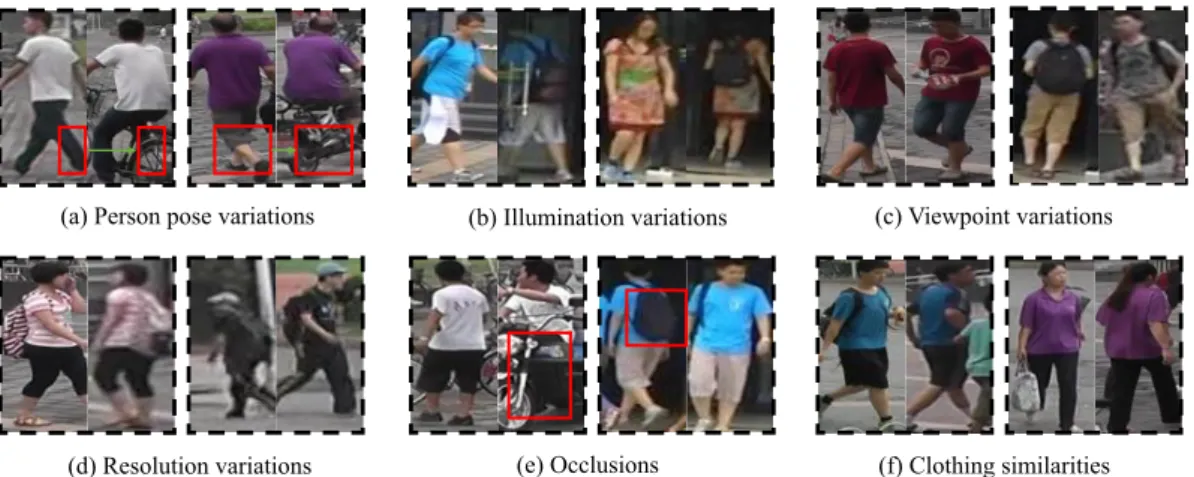
(a) Person poses: The non-rigid property of human body results in the variations of per-son poses. This causes the problem in perper-son re-id which is mostly based on the perper-son appearance features. Pose variations destroy the body part alignment in the extracted fea-ture vectors. As shown in Fig. 1.6(a), the same positions (as indicated in the red bounding boxes) between two images do not correspond to the same body part because of the changes in person pose,i.e., the person is walking in one image while changes to ride the bike or mo-torbike in the other image. This can mislead the person image matching using appearance features. In order to mitigate this problem, the designed re-id algorithms should be capable of extracting feature vectors against pose variations.
(b) Illuminations: Different cameras in different locations can have different illumination conditions, results in the common illumination variation problem in person re-id data. For images from indoor camera, usually it is darker than the images from outdoor cameras. In addition, the images from same camera but different time, there may be also illumination variations. Two examples are presented in Fig.1.6(b). From the figures, it can be found the appearance of the same person under different illuminations can be very different.
(c)Viewpoints: Due to different camera installation angles and locations, the same person presented in images from different cameras can have different viewpoints. Take person 2 who walks from camera 2 to 1 in Fig. 1.3 for example. Most probably, the front view of person 2 can be captured in camera 2 but after entering the FOV of camera 1, normally the camera will only capture the back or side view of the person. This can significantly increase
(a) Person pose variations (b) Illumination variations
(e) Occlusions
(c) Viewpoint variations
(d) Resolution variations (f) Clothing similarities
Figure 1.6: Examples of different kinds of intra- and inter-personal variations. In sub-figures (a)-(e), the images in the same bounding box contain the same person whilst in sub-figure (f), the images in the same bounding box refer to two different persons.
the difficulty in person re-id, especially when the target person is carrying a backpack as shown in Fig. 1.6(c). This causes the large difference between the appearances of the front and back view of the person.
(d)Resolutions: To reduce the number of cameras in the surveillance system, cameras are usually installed in high places to get the large FOVs. Thus, pedestrians are usually far away from cameras. Even for high resolution cameras, the person image can still be of relative low resolution. Due to the changes of the distance between pedestrians and cameras, resolution variation is also a very common problem both for the person images from one specific camera-view or different camera views, as illustrated in Fig. 1.6. This requires that the designed re-id algorithm should be able to match person images not only in low-resolution but also across different low-resolutions.
(e)Occlusions: In re-id data, pedestrians may be partially occluded by other pedestrians or objects. This can happen when the pedestrian is carrying the backpack. Fig. 1.6(e) gives the examples that the pedestrian is occluded by the motorbike or backpack. As shown in the figure, occlusions can result in large differences between the person images from the same person and finally leads to the misleading person re-id results.
(f)Clothing similarities: Two different pedestrians wearing very similar clothes can be also very challenging for person re-id. Fig.1.6(f) gives two examples. The person images in the same bounding box are from two different pedestrians. It can be observed from the figure that the person images are very similar to each other and hard to be distinguished even for humans.
(a) CAVIAR4ReID (b) QMUL iLIDS
Figure 1.7: Samples from two person re-id datasets for illustrating dataset domain varia-tions. The person images in the same column represent the same person. (a) CAVIAR4ReID dataset is collected from a shopping mall [25] while (b) QMUL iLIDS dataset is collected from an airport [161].
All of these different kinds of intra- and inter-personal variations can cause the problems in extracting discriminative re-id features. This further results in the problems of similarity comparison.
2.Domain Variations
Domain variation is a common problem in machine learning and computer vision. The data collected from different domains, e.g., different time and locations, usually present different domain specific information. The conventional learning algorithms rely heavily on the assumption that data used for training and test are drawn from the same distribution (from same domain). If this kind of algorithms trained on one domain are directly applied on a different one, a large performance degradation will be observed. In order to solve this problem, many domain adaptation methodologies have been proposed [151,152,103,35,
26,141].
The domain variations in person re-id data can be roughly divided into two categories,i.e., dataset domain variations [179,155,81,180,178,200] and camera-view domain variations [199,22,77,201]:
(a)Dataset domain variations. Different re-id datasets are usually collected from different domains and this leads to different domain information presented in datasets. Fig. 1.7 shows the samples from two different datasets. One is CAVIAR4ReID collected from a shopping mall [25] while the other one is QMUL iLIDS collected from an airport [161]. From the figure, it can be observed that pedestrians in airport are carrying luggages while this not happens for the pedestrians in the shopping mall. If the re-id model is trained
(a) Camera 1 (b) Camera 2
Figure 1.8: Camera-view domain variations in Market1501 dataset [191]. The persons in (a) camera 1 are the same as in (b) camera 2.
using QMUL iLIDS dataset, the model will not only focus on person appearance but also luggages in extracting re-id features since luggages can also provide discriminative features for re-identifying persons. If such re-id model is directly applied on CAVIAR4ReID dataset, it can be expected that the performance will largely degrade since most of pedestrians in CAVIAR4ReID dataset are not carrying luggages. In addition, it can be also observed that the resolutions and illuminations in these two datasets are also different.
(b)Camera-view domain variations. As aforementioned, person re-id is a problem of retriev-ing person images across non-overlappretriev-ing camera views. Thus, re-id data are collected from different camera views. Because of the distributed deployment of cameras in surveillance system, person images from one camera-view usually contain domain specific information [201]. For example, for two cameras located in places with different illuminations, the per-son images from these two cameras will also present with different illuminations. Fig. 1.8 gives the examples of the camera-view domain variations. The person images from camera 2 are darker than the ones from camera 1. In addition to illumination, the viewpoint can be also one of the camera-view domain variations. For example, one camera mostly captures the front views of pedestrians while the other one camera mostly captures the back views of pedestrians. This can happen when two cameras are separately installed on the top of the entrance and exit gate.
3.Difficulties in Dataset Creation and Annotation
Existing person re-id methods depend mostly on a large set of cross-camera identity labelled training data, especially the deep learning-based methods. This requires a tedious data col-lection and annotation process.
Specifically, in order to label a fully supervised person re-id training dataset, a human anno-tator often needs to match manually a given person identity from one camera view with all the persons from the other camera views. This has a quadratic complexity with the number of both camera views and person identities. Assume an ideal case withM cameras andN
Cam. 3
Cam. 1 Cam. 2 Cam. 4 Cam.𝑖
(a) (b)
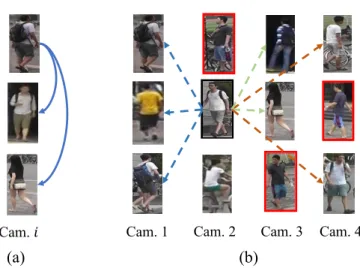
Figure 1.9: (a) Illustration of manually annotating identity labels for the samples ini-th
cam-era view. (b) Illustration of manually associating identity labels across camcam-era views (only four camera-views are illustrated here). For inter-camera identity association, the selected identity (e.g., the identity with black bounding box as in (b)) needs to be compared with the identities from all of the other camera views. The arrow line denotes the comparison made between two identities. The identities in red bounding boxes denote that they have already been associated and will not be compared for further association. In each column, the identities are from the same camera-view.
identities in each camera view, and each identity has one person image in each camera-view. The cost of annotating identity labels in one single camera view isO(N). This is because for
most people, re-appearing in a camera view is rare during a limited time period. However, the cross-camera identity association complexity isO(M2N2). Fig.1.9gives the illustrative
examples for manually annotate re-id data.
In addition, given the large size of most current machine learning and computer vision datasets, the data annotation process is almost impossible to be completed by one anno-tator. Thus, several or more annotators are usually involved in annotating one dataset. The whole dataset is divided into many parts and each part is assigned to one annotator. For fully supervised re-id dataset, in order to get a unified identity space, the annotators need to com-municate to each other in the data annotation process to guarantee that the person images are assigned with right identity labels. This communication process adds the extra complexity in data annotation.
1.2.4 Datasets
As one of the important research topics in visual surveillance, person re-id is receiving a large amount of attentions nowadays and various new methodologies have been proposed in
the past one decade. In order to evaluate the designed methodologies, many datasets have been created.
Person re-id datasets can be categorized into two groups. One is image-based datasets and the other one is video-based datasets. Image based person re-id is a more generic problem compared with video-based person re-id. The methods proposed for image-based person re-id can be easily extended to video-based case by considering each frame in the video as one image. Image based person re-id can be further separated into single-shot re-id, which consists in matching pairs of images, a probe and a gallery image for each individual, and multi-shot re-id, in which each individual has multiple images, either in the gallery and/or the probe set. Compared to single shot re-id, multi-shot re-id can be exploited to accumulate more visual information and ensure higher re-id accuracy. In this thesis, the image-based person re-id is considered with emphasizing on multi-shot case.
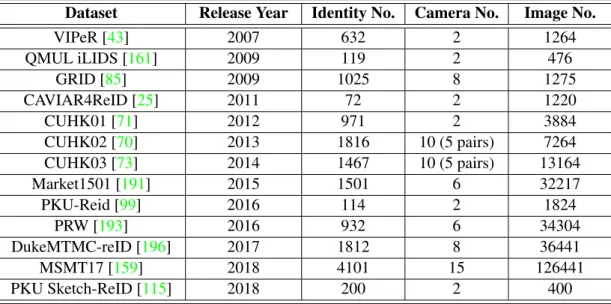
A comprehensive list of person re-id datasets can be found in [42]. Here, a part of image-based person re-id datasets are summarized in Table1.1. These datasets are collected from different scenarios, for example airport [161], underground station [85], shopping mall [25] and campus [71, 70, 72, 191]. Different person re-id challenges are included in these datasets. The re-id datasets that are used for evaluating the proposed methods in Chapters 3-5are briefly introduced as follows:
VIPeR dataset [43] is widely used for evaluating the performance of re-id methods. It contains 632 person image pairs from two cameras. Large variations of viewpoint and
illu-Table 1.1: Person re-id datasets.
Dataset Release Year Identity No. Camera No. Image No.
VIPeR [43] 2007 632 2 1264 QMUL iLIDS [161] 2009 119 2 476 GRID [85] 2009 1025 8 1275 CAVIAR4ReID [25] 2011 72 2 1220 CUHK01 [71] 2012 971 2 3884 CUHK02 [70] 2013 1816 10 (5 pairs) 7264 CUHK03 [73] 2014 1467 10 (5 pairs) 13164 Market1501 [191] 2015 1501 6 32217 PKU-Reid [99] 2016 114 2 1824 PRW [193] 2016 932 6 34304 DukeMTMC-reID [196] 2017 1812 8 36441 MSMT17 [159] 2018 4101 15 126441 PKU Sketch-ReID [115] 2018 200 2 400
mination in images make it a challenging dataset. In compliance with common evaluation scenario, 316 person image pairs are randomly selected for training, and the rest of 316 image pairs are retained for test.
GRID dataset [85] is composed of 250 person image pairs. Each pair consists of two images of the same person but from different camera views. In addition, there are another 775 person images that do not belong to any of the 250 paired persons. In the experiment, 125 person image pairs are randomly selected for training. The remaining 125 person image pairs and 775 unpaired person images are used for test. As a result, in the test set, there are 125 probe images and 900 gallery images.
PRID 450S dataset[123] contains 450 single-shot image pairs that depict the walking per-sons captured in two spatially disjoint camera views. The dataset also provides the binary segmentation masks separating the foreground from background and the person part-level segmentation results are also contained.
Market-1501 Dataset[191] is a popular person re-id dataset in deep learning that is created using six cameras in front of a campus supermarket. It contains 1501 identities in which 751 identities for training and the other 750 identities for test. For each identity, multiple images are available and for training, it provide12,936images. In test set, there are19,732gallery
images and3,368probe images.
DukeMTMC-ReID Dataset[196] is created by selecting and annotating pedestrian images from a multi-target, multi-camera tracking dataset. There are1,404identities in total from
eight cameras. 702 identities with16,522images are selected for training and the other 702
identities with17,661images are for test. The query set is formulated by picking one person
image for each identities in test set in each camera. Thus, there are2,228query images in
total.
MSMT17 Dataset[159] is collected from a 15-camera network in campus in which there are 12 outdoor and 3 indoor cameras. Faster RCNN [121] is utilized for pedestrian bounding box detection. The dataset is annotated with three annotators by checking all detected bounding boxes and annotating identity labels in 2 months. The final dataset contains126,441
bound-ing boxes of4,101identities. The training set contains 32,621bounding boxes of 1,041
identities. The test set contains93,820bounding boxes of3,060identities, in which there are11,659query images and82,161gallery images.
1 2 3 4 5 1 2 3 4 5 1 2 3 4 5 AP = 1 AP = 1 AP = 0.71 (a) (b) (c) rank list rank list rank list
Figure 3. A toy example of the difference between AP and CMC measurements. True matches and false matches are in green and red boxes, respectively. For all three rank lists, the CMC curve remains 1. But AP = 1, 1, and 0.71,resp.
Fig. 3(a)). In this case, precision and recall are the same issue. However, if multiple ground truths exist, the CMC curve is biased because “recall” is not considered. For ex-ample, CMC curves of Fig. 3(b) and Fig. 3(c) both equal to 1, which fail to provide a fair comparison of the quality between the two rank lists.
For Market-1501 dataset, there are on average 14.8 cross-camera ground truths for each query. Therefore, we use mean average precision (mAP) to evaluate the overall performance. For each query, we calculate the area under the Precision-Recall curve, which is known as average pre-cision (AP). Then, the mean value of APs of all queries,i.e., mAP, is calculated, which considers both precision and re-call of an algorithm, thus providing a more comprehensive evaluation. When average precision (AP) is used, rank lists in Fig.3(b) and Fig.3(c) are effectively distinguished.
Our dataset is randomly divided into training and testing sets, containing 750 and 751 identities, respectively. During testing, for each identity, we select one query image in each camera. Note that, the selected queries are hand-drawn, in-stead of DPM-detected as in the gallery. The reason is that in reality, it is very convenient to interactively draw a b-box, which can yield higher recognition accuracy [20]. The search process is performed in a cross-camera mode, i.e., relevant images captured in the same camera as the query are viewed as “junk”. In this scenario, an identity has at most 6 queries, and there are 3368 query images in total. Queries of two sample identities are shown in Fig.4.
4. Our Method
4.1. The Bag-of-Words Model
For three reasons, we adopt the Bag-of-Words (BoW) model. First, it well accommodates local features, which are indicated as effective by previous works [25,38]. Sec-ond, it enables fast global feature matching, instead of ex-haustive feature-feature matching [40, 39, 3]. Third, by quantizing similar local descriptors to the same visual word, the BoW model achieves some invariance to illumination,
Figure 4. Sample query images. In Market-1501 dataset, queries are hand-drawn bboxes. Each identity has at most 6 queries, one for each camera.
Color Names Descriptor
Figure 5. Local feature extraction. We compute the mean CN vec-tor for each 4×4 patch. Local features are quantized, and pooled in a histogram for each horizontal stripe.
view,etc. We describe the individual steps below.
Feature Extraction. We employ the Color Names (CN) descriptor [32]. Given a pedestrian image normalized to 128×64 pixels, patches of size 4×4 are densely sampled. The sampling step is 4, so there is no overlapping between patches. For each patch, CN descriptors of all pixels are calculated, and are subsequentlyℓ1normalized followed by
!
(·)operator [2]. The mean vector is taken as the
descrip-tor of this patch (see Fig.5).
Codebook. For Market-1501, we generate a codebook on its training set. For other datasets, the codebook is trained on the independent TUD-Brussels dataset [35]. Standard
k-means is used, so codebook size isk.
Quantization. Given a local descriptor, we employ Multi-ple Assignment (MA) [15] to find its near neighbors under Euclidean distance in the codebook. We set MA = 10, so a feature is represented by the indices of 10 visual words.
TF-IDF.The visual word histogram is weighted by TF-IDF scheme. TF encodes the number of occurrences of a visual word, and IDF is calculated aslogNn
i, whereN is the
num-ber of images in the gallery, andniis the number of images
containing visual wordi. In this paper, we use the avgIDF
[41] variant in place of the standard IDF.
Burstiness. Burstiness refers to the phenomenon where a query feature finds multiple matches in a test image [16]. For CN descriptor, burstiness could be more prevalent due
AveP = 0.7 AveP = 1 AveP = 1
Figure 1.10: A toy example of the difference between CMC and average precision (AveP) measurements [191]. True matches and false matches are in green and red boxes, respec-tively. For all of three rank lists (a)-(c), the CMC curve remains 1, whilst for AveP, its value is 1, 1 and 0.7.
1.2.5 Evaluation Metrics
Evaluation metrics are important for evaluating the quality of the designed algorithm and also makes it possible for comparing performances of different related algorithms. In per-son re-identification, Cumulated Matching Characteristics (CMC) curve is the most popular metric for evaluating the performance of person re-id methodologies. However, as discussed in [191], CMC is valid only if there is only one ground truth match for a given query,i.e., single-shot person re-id. For the multi-shot re-id scenario, CMC is not enough to provide a good evaluation about the person image retrieval quality since in CMC, the “recall” is not considered. Fig.1.10shows a toy example of the evaluation bias in CMC. For (b) and (c), it can be observed that the retrieval quality of the rank list (b) is better than the rank list (c), but CMC cannot reflect this and its value is 1 for both of them. In order to solve this problem, Zhenget al. proposed to use the mean average precision (mAP) for re-id algorithm evalua-tion [191]. Both CMC and mAP are related with two image retrieval metrics,i.e., precision and recall, which are also used in Chapter5. Thus in the following, precision and recall will be first described before the introduction of CMC and mAP.
1.Precision and Recall
In image (or information) retrieval, many metrics have been proposed and used for evaluating the retrieval quality of the designed algorithms [119,89]. Precision and recall are two basic and widely used evaluation metrics. Usually these two metrics are used together to reflect different aspects of the algorithm. Precision is used to measure “how useful the search results are” while recall is to measure “how complete the results are”. Given the top-k
images retrieved using a query (or target) image, the precisionP(k)can be calculated as:
P(k) = |{relevant images} ∩ {retrieved images}|
|{retrieved images}| (1.1)
in which |{·}| denotes the number of items in the set and ∩ is the intersection operator between two sets. The corresponding recallR(k)can be calculated as:
R(k) = |{relevant images} ∩ {retrieved images}|
|{relevant images}| (1.2)
From Eqs. (1.1) and (1.2), it can be observed that precision is the percentage of the top-k
retrieved images that are relevant to the query and recall is the percentage of all the relevant images in the search database which are retrieved.
2.Cumulated Matching Characteristics
CMC curve is the most commonly used evaluation metrics in person re-id [192, 39, 73,
189,191]. It represents results of an identification task by plotting the probability of correct identification against the number of candidates returned [114]. The faster the CMC curve approaches one, the better the person re-id algorithm. For the calculation of CMC curve, there is a difference between the single-shot and multi-shot person re-id case.
Given a query image in the single-shot case, the re-id model algorithm will rank all gallery images according to their similarities to the query image from large to small. The top-k CMC accuracyACCkfor this query image is calculated as:
ACCk=
(
1 if top-kranked gallery images contain the query identity,
0 otherwise. (1.3)
The CMC accuracy will be calculated for all of query images and the final CMC curve is obtained with averaging everyACCkover all query images. Thek-th value in CMC curve
is: CMC(k) = PNQ q=1ACCk NQ (1.4)
in whichk ∈[1,2, . . . , NG]. NG andNQ denote the number of query and gallery images,
respectively.
For the multi-shot person re-id case, CMC curve calculation is still not agreed in person re-id community. Take CUHK03 [73] and Market1501 [191] benchmarks for example, their calculations about CMC curves are different:
(a) In CUHK03 benchmark [73], the query and gallery images are from different camera views. In calculation ofACCk, only one of gallery images is randomly sampled for each
query identity. Then, theACCkand CMC curve are calculated as in single-shot person re-id
case. This process is performed forN times (N = 20in [73]) and the final CMC curve is
obtained by averaging these repeatedly performed results.
(b) In Market1501 benchmark [191], the query and gallery images in Market1501 dataset can be from the same camera views. In the calculation ofACCkfor each individual query
identity, the corresponding gallery images from the same camera-view are excluded. In addition, the random sampling is not performed on the considered gallery images for each query. Thus in the calculation of top-k CMC accuracy for each query, only the easiest
positive gallery image (which shares the same identity as query) is considered, while for other positive gallery images, they are ignored.
3.Mean Average Precision
From the description of CMC curve, it can be observed that CMC curve is not comprehen-sive enough for evaluating the quality of the image rank list returned by the person re-id algorithm, especially for the multi-shot person re-id case. For the CMC curve calculation provided in CUHK03 benchmark [73], the randomly sampling process should be performed forN times in whichN can be varied in different work and thus may cause the problem
in algorithm comparisons. Although Market1501 benchmark provides a simple way to cal-culate CMC cuve as shown in Fig. 1.10, it does not consider the recall and thus gives a biased evaluation result. Zhenget al. introduced the mean average precision (mAP) metric for solving the problems in CMC curve [191].
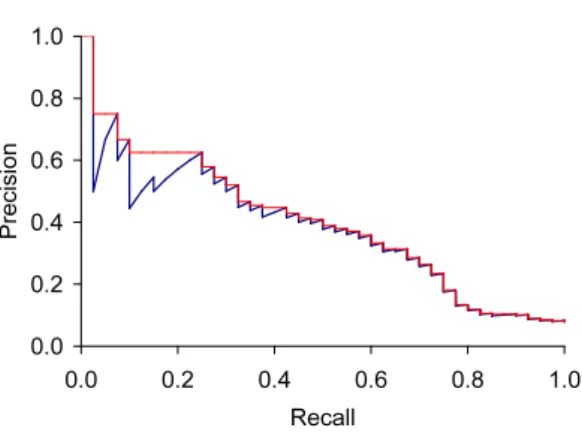
mAP is a popularly used metric in information retrieval and it starts to be widely used in evaluating person re-id algorithms since the work [191]. As introduced before, precision and recall are two complementary metrics that are used for evaluating different aspects of the image retrieval algorithm and usually, they are used together. mAP can be regarded as a metric that makes the trade off between precision and recall. Given a query image and the corresponding rank list returned by one person re-id algorithm, the precision and recall can be calculated using Eqs. (1.1) and (1.2) at every position in the rank list. A example of
precision-recall curve is presented in Fig.1.11. Supposep(r)denotes the precision at recall
r. The average precision is the average value ofp(r)over the recall interval[0,1]:
AveP=
Z 1
0
p(r)dr. (1.5)
AveP is exactly the area under the precision-recall curve.
In practical calculation, this integral is obtained with a finite sum over every position in the ranked list of gallery images:
AveP= NG
X
k=1
P(k)∆R(k) (1.6)
P(k)andR(k)are the same as in Eqs. (1.1) and (1.2). N is the number of gallery images. ∆R(k)is the change of the recall fromk−1tok:∆R(k) =R(k)−R(k−1).
Based on the average precision,i.e., AveP, the mAP is the average of AveP over all query images and it can be formulated as:
mAP=
PNQ
q=1AvePq
NQ
(1.7) in which AvePqdenotes the AveP for theq-th query image.
Compared with CMC curve, mAP gives a more comprehensive evaluation of person image retrieval results by considering both precision and recall. Consider the rank lists (b) and (c) in Fig.1.10, the true matches are all in top-2 in (b) and its retrieval result is better than rank list (c) in which only one true match is contained in top-2. The CMC curve of these two rank lists cannot reflect their retrieval qualities with the value1for both of them, while mAP
gives its metric value 1 for rank list (b) and0.7for rank list (c). However, mAP is not as
intuitive as CMC curve. In most of recent person re-id works [192,73,189,39,7], both of CMC curve and mAP are considered for algorithm performance evaluation.
1.3 Contributions of This Thesis
As discussed in Section 1.2.3, learning discriminative person re-id features has the chal-lenges of (1) Intra- and inter-personal variations, (2) domain variations and (3) difficulties in data creation and annotation. Corresponding to these three challenges, this thesis contributes to the re-id domain by proposing three related methodologies and one new re-id setting:
Online edition (c) 2009 Cambridge UP
158 8 Evaluation in information retrieval
0.0 0.2 0.4 0.6 0.8 1.0 0.0 0.2 0.4 0.6 0.8 1.0 Recall P re cisio n
!Figure 8.2 Precision/recall graph.
Exercise 8.3 [⋆⋆] Derive the equivalence between the two formulas for F measure shown in Equa-tion (8.5), given thatα=1/(β2+1).
8.4 Evaluation of ranked retrieval results
Precision, recall, and the F measure are set-based measures. They are com-puted using unordered sets of documents. We need to extend these measures (or to define new measures) if we are to evaluate the ranked retrieval results that are now standard with search engines. In a ranked retrieval context, appropriate sets of retrieved documents are naturally given by the topk re-trieved documents. For each such set, precision and recall values can be plotted to give aprecision-recall curve, such as the one shown in Figure8.2.
PRECISION-RECALL
CURVE Precision-recall curves have a distinctive saw-tooth shape: if the(k+1)th
document retrieved is nonrelevant then recall is the same as for the topk documents, but precision has dropped. If it is relevant, then both precision and recall increase, and the curve jags up and to the right. It is often useful to remove these jiggles and the standard way to do this is with an interpolated precision: theinterpolated precision pinter pat a certain recall levelris defined INTERPOLATED
PRECISION
Figure 1.11: Precision-recall curve. The blue line denotes the interpolated precision at a certain recall level. Refer to [127] for more information
(1)Gaussian mixture importance estimation. Handcrafted features are usually not dis-criminative enough for person re-id because of noisy information, such as background clut-ters. To precisely evaluate the similarities between person images, the main task of distance metric learning is to learn the Mahalanobis matrix to filter out the noisy information. KISS metric learning is an effective method in person re-id. However, it is sensitive to the feature dimensionality and can not capture the multi-modes in dataset. To this end, a Gaussian Mix-ture Importance Estimation re-id approach is proposed, which exploits the Gaussian MixMix-ture Models for estimating the observed commonalities of similar and dissimilar person pairs in the feature space. This work has been accepted inIEEE International Conference on Ad-vanced Video and Signal Based Surveillance (AVSS), 2017 [203] and it was recognized as theBest Paper, Honorable Mention.
(2)Unsupervised domain-adaptive person re-id based on pedestrian attributes. Differ-ent from person idDiffer-entity, pedestrian attributes, e.g., hair length, clothes type and color, are consistent across different domains (or datasets). However, most of re-id datasets lack at-tribute annotations. On the other hand, in the field of pedestrian atat-tribute recognition, there is a number of datasets labeled with attributes. Exploiting such data for re-id purpose can alleviate the shortage of attribute annotations in re-id domain and improve the generaliza-tion capability of re-id model. To this end, an unsupervised domain-adaptive re-id feature learning framework is proposed to make full use of attribute annotations. Specifically, an ex-isting unsupervised domain adaptation method has been extended to transfer attribute-based features from attribute recognition domain to the re-id domain. With the proposed re-id feature learning framework, the domain invariant feature representations can be effectively extracted. This work has been accepted in the IEEE International Conference on Image Processing (ICIP), 2019[204].
re-quires a tedious data collection and annotation process and therefore leads to poor scal-ability in practical person re-id applications. To overcome this fundamental limitation, a new person re-id setting is considered without inter-camera identity association but only with identity labels independently annotated within each camera-view. This eliminates the most time-consuming and tedious inter-camera identity association annotating process and thus significantly reduces the amount of human efforts required during annotation. It hence gives rise to a more scalable and more feasible learning scenario, which is named as Intra-Camera Supervised (ICS) person re-id. Under this ICS setting, a new re-id method, i.e., Multi-tAsk mulTi-labEl (MATE) learning method, is formulated. Given no inter-camera association, MATE is specially designed for self-discovering the inter-camera identity cor-respondence. This is achieved by inter-camera multi-label learning under a joint multi-task inference framework. In addition, MATE can also efficiently learn the discriminative re-id feature representations using the available identity labels within each camera-view. This work has been accepted in a workshop of IEEE International Conference on Computer Vision (ICCV), 2019 [205] and its journal extension has been submitted to International Journal of Computer Vision (IJCV).
1.4 Thesis Outline
This thesis is organized as follows:
Chapter 2 presents a review on related works about different categories of person re-id problems and various related strategies and methodologies that proposed for solving these problems.
Chapter 3describes a new metric learning methodology,i.e., Gaussian Mixture Importance Estimation (GMIE), for person re-id. Different from the existing re-id methodologies, it shows that GMIE not only can model the multi-modes in re-id dataset but also it is robust to the increase of feature dimension.
Chapter 4proposes a new person re-id framework which bridges the pedestrian attribute recognition and person re-id. Based on the observation that attributes are consistent across dataset while person identities are not, the proposed framework applies an extended unsuper-vised domain-adaptive method to adapt the trained attribute recognition model to the re-id domain for extracting attribute related features for person re-id.
Chapter 5explains the intra-camera supervised (ICS) person re-id setting and a new method-ology using this re-id setting. It shows that in ICS person re-id, the data is annotated
with-out inter-camera identity association but only with identity labels independently annotated within each camera-view and thus significantly reduces the data annotation efforts. Under this ICS setting, a new re-id method,i.e., Multi-tAsk mulTi-labEl (MATE) learning method, is formulated and the experiments validates that the effectiveness of MATE in solving ICS person re-id problem.
Chapter 6concludes this thesis and several potential re-id research directions are discussed as the future works.
The outline of this thesis is visualized in Fig.1.12.
Chapter 1
:
IntroductionChapter 2
:
Related worksChapter 3
:
Gaussian Mixture Importance EstimationChapter 4:
Unsupervised Domain-Adaptive Person Re-identification Based on AttributesChapter 5:
Intra-Camera Supervised Person Re-Identification Deep Learning Metric LearningChapter 6
:
Conclusions and Future work
Chapter 2
Related Works
The related works of person re-id are roughly separated into (1) Handcrafted Feature Extrac-tion and Metric Learning, (2) Pedestrian Attribute Based Methods and (3) Deep Learning Methods. Although the second category has overlaps with first and third categories, there are a large number of person re-id methods based on pedestrian attributes and these methods are grouped as a single category.
2.1 Handcrafted Feature Extraction and Metric Learning
Before deep learning, person re-id is mainly based on handcrafted feature extraction and metric learning. In this category, part of works propose to directly apply distance func-tions on handcrafted features for calculating similarities for person re-id [31,25,188,192]. However, handcrafted features are usually not discriminative enough due to the noisy in-formation, for example background clutters. The learning-based methods aims at apply-ing metric learnapply-ing to filter out noisy information and extract more discriminative features [123,61,78,79,44,192].
2.1.1 Handcrafted Feature Extraction
Handcrafted feature extraction aims at manually designing feature extraction methods to ex-tract appearance features, e.g., color and texture, based on the experiences from designer. A common way in designing handcrafted feature is firstly dividing the person image in hand into horizontal stripes [10,78,175], triangular graph [37], regions clustered by color [157], symmetry and assymetrical parts [31], semantic or meaningful parts [25,9], concen-tric rings [37] or grid of localized patches [5]. Then, different kinds of descriptors, e.g., HSV histogram, Scale Invariant Local Ternary Pattern (SILTP) [80] and Local Binary Pat-tern (LBP) [113], are applied for extracting color and/or texture features from each divided image parts. In order to extract robust and discriminative person re-id feature representa-tions, many handcrafted features have been proposed, e.g., the ensemble of local features
(a) (b) (c) (d) (e)
Figure 2.1: SDALF handcrafted feature extraction [31]. (a) two images of the same per-son; (b) x- and y-axes of asymmetry and symmetry, respectively; (c) weighted histogram back-projection (brighter pixels mean a more important color), (d) Maximally Stable Color Regions; (e) Recurrent Highly Structured Patches.
(ELF) [44], Symmetry-Driven Accumulation of Local Features (SDALF) [31], Custom Pic-torial Structure (CPS) [25], kBiCov [98], fisher vectors (LDFV) [97], Local Maximal Occur-rence (LOMO) [78], Gaussian Of Gaussian (GOG) [105,106]. Several popular handcrafted feature extraction methods are presented in the following.
In [31], a handcrafted feature named SDALF has been proposed. Fig. 2.1 presents the SDALF handcrafted feature extraction method. The person images are pre-processed in SDALF by segmenting out the pedestrian foreground, and then salient parts of the body fig-ure are selected by adopting perceptual principles of symmetry and asymmetry. Specifically, as shown in Fig.2.1(b), two horizontal axes of asymmetry (blue and red lines) are firstly ob-tained in each person image which isolate the person body into three main regions,i.e., head, torso and legs. Then, the vertical axes of appearance symmetry (green and yellow lines) are separately estimated for the torso and legs part. At last, three complementary aspects of the human body appearance are extracted from each part, including: (i) the general chromatic content via HSV histogram; (ii) the per-region color displacement, through Maximally Sta-ble Colour Regions (MSCR) [34]; (iii) the presence of Recurrent Highly Structured Patches , estimated through a novel per-patch similarity analysis. In order to minimize the effects of pose variations, the extracted features are weighted by the distance with respect to the vertical axis. Matching these features gives the similarity measure between the candidates. In [25], Pictorial Structures (PS) [32] is applied to localize human body parts. With fitting PS to person image in single-shot re-id, an ensemble of features are extracted from each localized body parts. Fig.2.2(a) illustrates the PS fitting result. As in SDALF [31], different local descriptors are introduced to encoding complementary aspects, such as the chromatic
Figure 2.2: Illustration of localizing body parts [31]. Single-shot PS in (a). Multi-shot CPS at iteration 1: (b) initial PS fitting; (c) the parts are aligned and per-pixel statistics is collected employing spatio-temporal reasoning; (d) the ad-hoc part detectors are estimated, whose means Îij are shown. At every iteration until L, the fitting becomes more accurate due to the improving part detectors.
(a) (b) (c)
Figure 2.3: (a) Example pairs of images from the VIPeR database [43]. The images in the same column are from same person. (b) Processed images in (a) by Retinex. (c) Illustration of the LOMO feature extraction method.
content and the spatial arrangement of colors. The local descriptors include HSV histograms and MSCR [34,31]. The features of each part are subsequently combined into a single ID signature. Matching between signatures is carried out by standard distance minimization strategies. For the multi-shot re-id, a model called Custom Pictorial Structure (CPS) has been proposed to get more accurate body parts. The main idea is to learn the local appearance of each part in a given subject so that ad- hoc appearance part detectors can provide more accurate PS fitting [25]. Localizing body parts using CPS is illustrated in Fig. 2.2. As in single-shot re-id case, after localizing body parts, the features of each part are extracted and combined to get the final features for each person image.
In [78], Liaoet al. proposed the Local Maximal Occurrence (LOMO) handcrafted feature for person re-id. LOMO feature is designed by considering two m
![Figure 1.5: Examples of six applications that can benefit from person re-id: (a) Person search from the whole scene images [166], (b) Person search using natural language descriptions [69], (c) Pedestrian tracking [145], (d) Vehicle re-identification [87],](https://thumb-us.123doks.com/thumbv2/123dok_us/777855.2598363/21.892.165.696.149.537/examples-applications-language-descriptions-pedestrian-tracking-vehicle-identification.webp)

![Figure 2.3: (a) Example pairs of images from the VIPeR database [43]. The images in the same column are from same person](https://thumb-us.123doks.com/thumbv2/123dok_us/777855.2598363/39.892.147.726.377.545/figure-example-images-viper-database-images-column-person.webp)
![Figure 2.4: Illustration of GOG feature extraction process [105, 106].](https://thumb-us.123doks.com/thumbv2/123dok_us/777855.2598363/40.892.166.698.161.363/figure-illustration-gog-feature-extraction-process.webp)
![Figure 2.5: Illustration of training process in LMNN [163, 162]. Before training (Left), samples randomly locate in the space](https://thumb-us.123doks.com/thumbv2/123dok_us/777855.2598363/42.892.189.662.162.353/figure-illustration-training-process-training-samples-randomly-locate.webp)
