Energy generation with Directed Technical
Change
∗
Gilbert Kollenbach
†Department of Economics, University of Hagen
Abstract
To analyze the direction of technical change with respect to energy gen-eration, we use a growth model with two cost reducing technologies, one as-sociated with an exhaustible resource and one with a backstop. We show that research in the exhaustible resource sector is not optimal in the long run. Furthermore, it can be only conducted in the short run, if the economy is suf-ciently rich. Otherwise, the temporally limited eect of R&D in the resource sector is outweighed by the unlimited eect of R&D in the backstop sector or of capital accumulation. If the exhaustible resource causes pollution, the resource is partly substituted by the backstop. Therefore, the attractiveness of research in the resource sector is reduced while research in the backstop sector gets more attractive. We not only describe the direction of technical change but the complete economic development. With two non-exhaustible energy sources, R&D is conducted in both sectors in the long run. Thus, the limited resource stock alters the direction of technical change fundamentally. Key words: Fossil Fuels, Energy, Renewable Resources, Endogenous Growth, Directed Technical Change
1 Introduction
At least since the 1970s scarce fossil fuels are one of the major issues both in public and academic discussion. While the famous Club of Rome report (Meadows et al. (1972)) predicts an end of all economic growth due to exhaustible resources, a broad strand of economic literature advocates a more optimistic viewpoint. E.g. Stiglitz (1974) shows in a neoclassical growth model that sustainable growth is possible as long as technology, which serves as a substitute for an exhaustible resource, grows ∗The author thanks Thomas Eichner, Benjamin Florian Siggelkow and Daniel Weinreich for
helpful comments and discussions.
†University of Hagen, Universitätsstraÿe 41, 58097 Hagen, Germany, e-mail:
fast enough.1 Barbier (1999) endogenizes the technological progress without altering
the result substantially.2 The possibility of sustainable growth in consideration of
a backstop technology, such as solar energy or fusion power, is shown by Tsur and Zemel (2005). The development of alternative energy sources is addressed by Tsur and Zemel (2011).
However, it was not until the works of Acemoglu (1998), Kiley (1999) and Acemoglu (2002) that the eect of scarce resources on the direction of technical change have been analyzed. More precisely, Acemoglu (2002) assumes that a composite good is produced by means of two intermediate goods using a CES production function. The production of both intermediates is based on inputs like capital or labor and a particular technology. Both technologies can be improved by R&D. Di Maria and Valente (2008), Grimaud and Rouge (2008) and Acemoglu et al. (2012) have aug-mented this framework with exhaustible resources. They assume that an exhaustible resource, like fossil fuels, is needed for the production of one of the two intermedi-ates. It is shown that the direction of technology progress depends crucially on the substitutability of the resource based intermediate and the second intermediate. If the intermediates are good substitutes, i.e. the resource based intermediate is not necessary for production, research is only conducted in the sector of the non-resource based intermediate in the long run, as demonstrated by Acemoglu et al. (2012). On the other hand, Di Maria and Valente (2008) show that R&D eorts are completely allocated to the sector of the resource based intermediate, if the intermediates are bad substitutes.
However, two aspects of the literature seem critical if energy generation is taken into account explicitly. Firstly, renewable energy sources like solar or wind energy are ignored, albeit they are already used and may serve as backstops after the exhaustion of fossil fuels. The second critical aspect is the resource augmenting technology. This assumption is common in the endogenous growth theory and crucial for the optimistic results of Stiglitz (1974), Barbier (1999) and Di Maria and Valente (2008). In the long run, the assumption allows the production of a vast amount of energy by means of a vanishing low amount of resources and a suciently advanced technology. With respect to fossil fuels this property can be hardly brought into accordance with thermodynamics, which require a minimum stake of resources.3
The intention of our paper is to analyze the eects of energy generation based
1Stiglitz (1974) belongs to a series of articles which can be seen as a direct response to Meadows
et al. (1972). Other works are Dasgupta and Heal (1974), Solow (1974) and Hartwick (1977).
2Barbier (1999) stands in the tradition of the endogenous growth theory. An overview of this
broad strand of literature is given by Aghion et al. (1998) as well as by Barro and Sala-i Martin (2003).
on both fossil fuels and backstops on economic development and especially on the direction of technical change without these critical assumptions. For this purpose we augment the endogenous growth model of Tsur and Zemel (2005) with a second technology. Green and black energy are perfect substitutes in this model. Fur-thermore, R&D reduces the costs of energy supply. We characterize the complete optimal development process, which encompasses the optimal capital investment, R&D investments both in the green and the black energy sector (black and green research), consumption and the energy mix at every point in time. The capital endowment and the ability to conduct research in the two energy sectors aect the process, which is driven by a competition between consumption and investments in either one of the research sectors or the capital stock over shares of an universally usable nal good. Since the two energy sources are perfect substitutes and the tech-nical progress not resource augmenting, the attractiveness of black research vanishes with the resource stock. Therefore, it is not optimal to conduct black research in the long run. In the short run, black research can be only optimal for an economy with a suciently high capital stock, i.e. a rich economy. In contrast, green research can be optimal for rich as well as poor economies in both the long and the short run. If the exhaustible resource pollutes the environment, e.g. by generating CO2
emissions, her optimal utilization rate is lower than without pollution. This aects negatively the attractiveness of black research but boosts the one of green research, as black energy is substituted by green energy. In a decentralized economy, the re-searching companies exert market power, i.e. the utilization rate of both green and black energy are ineciently low. A subsidy for both energy sources can internalize the market power distortion. If the exhaustible resource causes pollution, a tax on the resource is sucient to internalize environmental pollution.
Our model diers from Acemoglu et al. (2012) with respect to the research ap-proach, too. The "standing on the shoulders of giants" R&D apap-proach, used by Acemoglu et al. (2012), drives a wedge between the productivity of R&D in the two research elds. If both energy sources are non-exhaustible, this eect shifts R&D to the more advanced sector. In contrast, we apply the lap equipment approach, which eliminates such a wedge. Therefore, R&D investments are split among both research sectors in the long run. 4
Furthermore, we determine not only the direction of technological change but also the optimal levels of R&D, consumption and capital accumulation. Thus, in con-trast to Acemoglu et al. (2012) and Di Maria and Valente (2008) R&D investments
4Both research approaches are analyzed by Rivera-Batiz and Romer (1991) in an endogenous
can be abandon in favor of capital accumulation or a steady state.
The outline of the paper is as follows. In section 2 we describe the model and derive the conditions characterizing the optimal solution. Section 3 describes the optimal development process with two non-exhaustible energy resources, while the exhaustibility of one resource is taken into account in section 4. We augment the model with pollution in section 5 and analyze governmental interventions necessary for the realization of the social optimum in a decentralized economy in section 6. Section 7 concludes the paper.
2 Model
We augment the endogenous growth model of Tsur and Zemel (2005) with a second technology. The basic framework of the augmented model is described in the fol-lowing.5A single composite good Y is produced by means of capital K and energy
x. The production function F(K, x) has positive but diminishing marginal
prod-ucts FK and Fx, i.e. FKK < 0, Fxx < 0. Furthermore, F(0, x) = F(K,0) = 0,
FKx = FxK > 0 and J = FKKFxx −FKx2 > 0, implying the concavity of F(K, x).
Energy is generated by means of an exhaustible resource R (coal, oil, gas) and a backstop resource b (solar, fusion power), respectively, according to proportionate transformations. We assume x = R +νb, where the constant marginal rate of substitutionν ∈]0,1]reects infrastructure adjustments associated with changes in
backstop utilization. We think here of a more complex high voltage network, en-ergy storage solutions necessary for reliable enen-ergy supply based on renewables and conversion losses, e.g. the energy input needed for the synthesis of liquid fuels.6All
mentioned issues imply energy losses, explaining 0 < ν < 1. In the case of fusion
power it is reasonable to assume that the existing infrastructure can be used with only minor adaptions implying a highν.
The supply of both resources causes costs. The extraction costs of the exhaustible resource are given byM(R)BR(AR). BR(AR)>0represents the eect of the (black)
technologyAR on the extraction costs, while the "pure" or technology adjusted
ex-traction costs areM(R). We assume that the extraction costs as well as the marginal
extraction costs are increasing in the extracted amount R, i.e. M0(R) > 0 and M00(R) > 0. Additionally, we assume M(0) = M0(0) = 0. Technological progress
reduces the extraction costs, i.e. BR0 (AR) < 0. However, this eect diminishes as
technology increases and vanishes completely for AR→ ∞. Thus, BR00(AR)>0 and
5For the sake of simplicity time index t is suppressed. It is only added, if needed for
under-standing.
lim
AR→∞
BR0 (AR) = 0. We assume lim AR→∞
BR(AR) = ¯BR > 0, so that technology can
not lower the extraction costs of a marginal resource unit below a specic threshold
¯
BR. The costs of the backstop are MbBb(Ab)b, with Mbb as the "pure" or
technol-ogy adjusted costs, which are linear in backstop utilization. Similar toBR(AR) the
function Bb(Ab) >0represents the eect of the (green) technology Ab on backstop
costs. Bb(Ab)exhibit the same properties as BR(AR), i.e. Bb0(Ab)<0, Bb00(Ab)>0,
lim
Ab→∞
Bb(Ab) = ¯Bb >0and lim Ab→∞
B0b(Ab) = 0. The costs for resource utilization are
deducted from production, so that the net production is given by
Yn=F(K, x)−M(R)BR(AR)−MbBb(Ab)b. (1)
Both technologies increase linear in R&D investments Ii, i=R, b, i.e.
˙
Ai =Ii, i=R, b. (2)
R&D investments as well as capital investments and consumption are using the com-posite goodY. Therefore, the net productionYncan be either consumed or invested in capital and research, respectively. With C as consumption, the (dis)investments in capital K˙ are
˙
K =F(K, R+νb)−C−M(R)BR(AR)−MbBb(Ab)b−IR−Ib. (3)
The sum of Ib and IR is limited by net production such that I = Ib +IR ∈ [0,I¯],
with I¯=Yn. The stock S
R of the exhaustible resource, with the initial value SR0,
decreases according to
˙
SR=−R. (4)
The representative household derives its utility only from consumption. The utility is given by the increasing and strictly concave functionU(C), i.e. U0(C)>0, U00(C)< 0.
In the following section we analyze the social optimum. A social planer maxi-mizes the present value of utilityR∞
0 U(C)e
−ρtdt, withρas the time preference rate,
over the complete planing period [0,∞[, given the initial states (K0, Ab0, AR0, SR0)
and subject to (3), (2), (4), K ≥0, SR ≥ 0, 0≤ IR+Ib ≤ I¯and R, b, C ∈ [0,∞[.
With λ, κR, κb and τ representing the current-value costate variables of K, AR, Ab
the current value Lagrangian is
L=U(C)+λ[F(K, R+νb)−C−M(R)BR(AR)−MbB(A)b−IR−Ib]
+κRIR+κbIb −τ R+ζKK+ζSRSR+ζI¯[ ¯I−Ib−IR] +ζIbIb
+ζIRIR+ζRR+ζbb+ζCC. (5)
An interior optimum with respect to capital, resource stock, resource and backstop utilization and consumption, i.e. ζK = ζSR = ζR = ζb = ζC = 0, is given by the
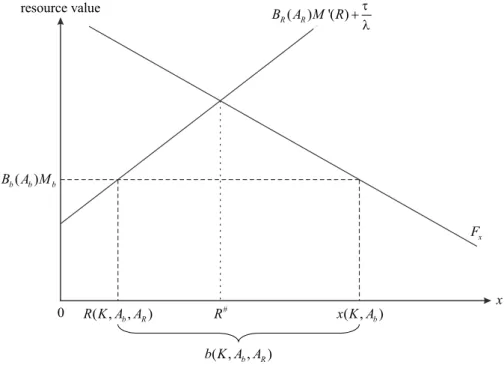
necessary conditions7 UC =λ, (6) Fx=M0(R)BR(AR) + τ λ, (7) Fx= Mb ν Bb(Ab), (8) λ=κb−ζI¯+ζIb =κR−ζI¯+ζIR. (9) (7) and (8) give Fx(K, x(K, Ab, AR)) =M0(R(K, Ab, AR))BR(AR) + τ λ = Mb ν Bb(Ab). (10) Equation (10) determines the total amount of energy utilization x as well as the shares of the two energy resourcesb and R as illustrated in Fig. 1.8If the marginal costs of the backstop are to high, only the exhaustible resource is used. The total energy equals then the amountR#. IfM0(0)B
R(AR) +τλ < MνbBb(Ab)< M0(R#) +τλ
holds for the marginal backstop costs, energy generation is based on both resources. The backstop is used alone, if Mb
ν Bb(Ab) < M
0(0)B
R(AR) + τλ. Following Tsur
and Zemel (2005), we assume the simultaneous use of both resources. This implies that the amount of total energy supply is independent from AR as can be seen
in Fig. 1. The term τ
λ of the exhaustible resource supply function relates the
shadow price of the exhaustible resource to that of capital. Since the shadow prices of a variable indicate its scarcity, the term measures the relative scarcity of the
7In the sequel we assume that the sucient conditions are satised. They
hold as long as M(R)BR00(AR)Bb00(Ab) ≥ M0(R)2 M00(R) BR0(AR)2 BR(AR) hF KK J Mb ν2 Bb0(Ab)2 b +B 00 b(Ab) i + M(R)Mb ν2 Bb0(Ab)2 b B 00 R(AR) h 1 M00(R)B R(AR)− FKK J i ,M(R)BR00(AR)≥ M 0(R)2 M00(R) BR0(AR)2 BR(AR) andB 00 b(Ab)≥ Mb ν2 B0b(Ab)2 b h 1 M00(R)B R(AR)− FKK J i
. It can be shown that the last two conditions hold forb >0and
R >0ifMb is suciently small andM(R)suciently high, respectively. If both conditions hold with inequality, the rst conditions will hold, too.
8Tsur and Zemel (2005) use a similar gure without the second technology A
exhaustible resource in terms of capital scarcity. Therefore, we call it the relative scarcity index.
Figure 1: Utilization of exhaustible resource and backstop
In the following the index ∗ indicates optimal values, while unmarked variables
denote all feasible values. The optimal R&D investments have to maximize H = U(C) +λ[F(K, R+νb)−C−M(R)BR(AR)−MbB(A)b−IR−Ib] +κRIR+κbIb−τ R, which gives Ib∗ =IR∗ = 0, if−λ+κb <0and −λ+κR <0, 0≤Ib∗ ≤I,¯ if−λ+κb = 0 and −λ+κR <0, 0≤IR∗ ≤I,¯ if−λ+κb <0and −λ+κR = 0, 0≤Ib∗+IR∗ ≤I,¯ if−λ+κb = 0 and −λ+κR = 0, (11) Ib∗ = ¯I, if−λ+κb >0and κb −κR>0, IR∗ = ¯I, if−λ+κR>0and κb−κR<0, Ib∗+IR∗ = ¯I, if−λ+κb >0and κb −κR= 0.
The optimal research investments are given by (11) together with (9) and the Kuhn-Tucker conditions ζI¯ ≥ 0, ζI¯[ ¯I − IR − Ib] = 0, ζIb ≥ 0, ζIbIb = 0 and ζIR ≥
0, ζIRIR = 0. Depending on the relation of κb toκR and λas well as of κR toλ, the
R&D investments in the backstop technology or the exhaustible resource technology are minimal, singular or maximal. E.g.: If κb > λ and κb > κR, green research
investments are maximal while the black ones are minimal. This implies ζIb = 0,
ζI¯>0 and ζIR >0, such that (9) holds.
The costate variables grow according to
ˆ λ =ρ−FK, (12) τˆ=ρ, (13) ˆ κR=ρ+ λ κR M(R)BR0 , (14) κˆb =ρ+ λ κb MbbBb0. (15)
Dierentiating (6) with respect to time and combining with (12) gives
ˆ
C = FK−ρ
η . (16)
(16) is the well known Ramsey - rule, which states that consumption grows as long as the time preference rate is lower than the marginal product of capital. η is the positive elasticity of marginal utility. Thus, if marginal utility is rather elastic, changes in consumption are small. The transversality conditions
(a) lim t→∞e −ρtλ(t) [K(t)−K∗ (t)]≥0, (b) lim t→∞e −ρtτ(t) [S R(t)−SR∗(t)]≥0, (c) lim t→∞e −ρtκ b(t) [Ab(t)−A∗(t)]≥0, (d) lim t→∞e −ρtκ R(t) [AR(t)−A∗R(t)]≥0 (17)
complete the equation system of necessary conditions.
3
R
as a non-exhaustible resource
Since our model is an extension of Tsur and Zemel (2005), we adapt their analysis method. At every point in time the energy mix is given by (10). Furthermore, (9) and (11) together with the Kuhn-Tucker conditions determine the optimal R&D investments. Therefore, the optimization problem reduces to the task of identifying for all t ∈ [0,∞[ the optimal consumption and capital investment given optimal
R&D and the optimal energy mix. It turns out that this task can be solved by the relative position of four characteristic two dimensional manifolds (planes) in the three dimensional technologies capital (Ab, AR, K) space. To deduce the
character-istic manifolds we assume a non-exhaustible resource stock SR, i.e. SR = ∞. We
will return to the original assumption of a limited resource stock after the derivation of the planes. If SR = ∞, the resource stock is not scarce, implying τ = 0. Thus,
(10) becomes
Fx(K, x(K, Ab)) = M0(R(AR, Ab))BR(AR) =
Mb
Since the relative scarcity index does not exist forSR=∞, capital has no inuence
on the utilization of the exhaustible resourceR. Therefore, (18) determinesx(K, Ab),
R(AR, Ab)and b(K, Ab), with ∂K∂x >0, ∂A∂xb ≥0, ∂A∂RR >0, ∂A∂Rb ≤0, ∂K∂b ≥ 0, ∂A∂bb ≥ 0
and ∂b
∂AR ≤0 as can be seen in Fig. 1 by using comparative statics.
The rst three planes are given by the non-arbitrage conditions ∂Yn
∂Ab = ∂Yn ∂K , ∂Yn ∂AR = ∂Yn ∂K and ∂Yn ∂Ab = ∂Yn
∂AR, which compare the eects of green and black research with
capital accumulation and with each other. The conditions can be written as
−MbBb0(Ab)b(K, Ab, AR) =FK(K, x(K, Ab)), (19)
−M(R(Ab, AR))BR0 (AR) =FK(K, x(K, Ab)), (20)
−M(R(Ab, AR))BR0 (AR) =−MbBb0(Ab)b(K, Ab, AR). (21)
All equations assign maximal one value of K to every Ab, AR combination.
There-fore, all three equations implicitly determine a specic function. These functions are given by KS
b (Ab, AR), KRS(Ab, AR) and KA(Ab, AR), respectively. In the following
we show that every function corresponds with a specic characteristic of the R&D process. In the case ofKS
b(Ab, AR), we substitute two requirements of singular green
research,λ =κb and λ˙ = ˙κb, into (15), which gives λˆ =ρ+MbBb(Ab)b. Using (12)
we get (19). Therefore, KbS(Ab, AR) corresponds to singular green research if the
black research option is ignored. In a similar manner, KRS(Ab, AR) corresponds to
singular AR research if the Ab research option is ignored. The R&D characteristic
corresponding to KA(A
b, AR) is given by κb = κR and κ˙b = ˙κR, i.e. R&D
invest-ments are split among both sectors.
All three functions are describing a two-dimensional manifold (plane) in theAb, AR, K
space. 9 Since the plane described by KS
b (Ab, AR) consists of all points of the
Ab, AR, K space where singular Ab research is possible, we call it the singular plane
- b (SiP-b). Analogously, the plane described by KS
R(Ab, AR) is called SiP-R and
the one described byKA(Ab, AR) SiP-A. 10
9Although "manifold" is mathematically correct, "plane" is more descriptive. Therefore, we
use plane in the following.
10To simplify notation, we use the terms SiP-b, SiP-R and SiP-A not only for the planes but
also for the functionsKS
For everyAb (AR) level the slope ofKbS,KRS and KA is given by dKS b dAR = MbB 0 b ∂b ∂AE − J Fxx −MbB 0 b ∂b ∂K >0, (22) dKbS dAb = FKx ∂x ∂Ab +MbB 00 bb+MbBb0∂A∂bb − J Fxx −MbB 0 b ∂b ∂K , (23) dKS R dAR = M 0B0 R ∂R ∂AR +M B 00 R − J Fxx , (24) dKRS dAb = FKx ∂x ∂Ab +M 0B0 R∂A∂Eb − J Fxx >0, (25) dKA dAR = MbB 0 b ∂b ∂AR −M B 00 R−M 0B0 R ∂R ∂AR −MbBb0 ∂b ∂K , (26) dKA dAb = MbB 00 bb+MbBb0 ∂b ∂Ab −M 0B0 R ∂R ∂Ab −MbBb0 ∂b ∂K . (27)
Since the eect of an increasing technology level on Bb(Ab) and BR(AR) vanishes
for Ab → ∞ and AR → ∞, respectively, dKbS dAb, dKS R dAR and dKA
dAb are positive for high
technology levels, while dKA
dAR is negative. To simplify the analysis we follow Tsur and
Zemel (2005) and assume monotonic functions, i.e. SiP-b as well as SiP-R increases in both technologies while SiP-A increases in Ab and decreases in AR. Since the
three SiPs correspond with κb = λ, κR = λ or κb = κR, an intersection of only
two SiPs is not possible. Together with dKS b dAR > 0, dKS R dAR and dKA dAR < 0 this implies
maximal one intersection point along theARaxis. However, along theAb axis several
intersection points are possible. As lim
Ab→∞
dKA
dAb =∞, the SiP-A lies above SiP-b and
SiP-R for large Ab. Thus, the planes form pockets, if several intersection points
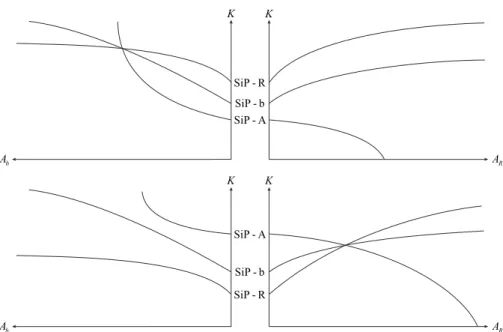
exist. In the long run these pockets are insignicant, while they complicate the analysis. Therefore, we assume maximal one intersection between the SiPs. Fig. 2 shows the two possible developments with one intersection along theAb andARaxis,
respectively. It is important to notice that the SiP-A cannot be located between the two others SiPs. Otherwise, the long run development implies an intersection of only two SiPs, which is impossible.
The last of the four planes is given by the Steady StateAˆb = ˆAR = ˆK = ˆC = 0.
The technology levels are only constant if no R&D is conducted, which requires λ > κR, κb. Due to (6) a constant consumption implies λ˙ = 0. Substituting into
(12) gives
Figure 2: Development of the SiP planes along the technology axes
Since the right hand side is constant, (28) allocates maximal one capital value to every technology combination (Ab, AR) and therefore implicitly denes the
func-tion KN(A
b). As KbS, KRS and KA, the function KN(Ab) describes a plane in the
Ab, AR, K space. The plane consists of all points where a steady state is possible.
Therefore, we call it the steady state plane (SSP). The slope of the SSP is given by dKN dAR = 0 and dKN dAb = − FxxFKx FKKFxx−FKx2 ∂x
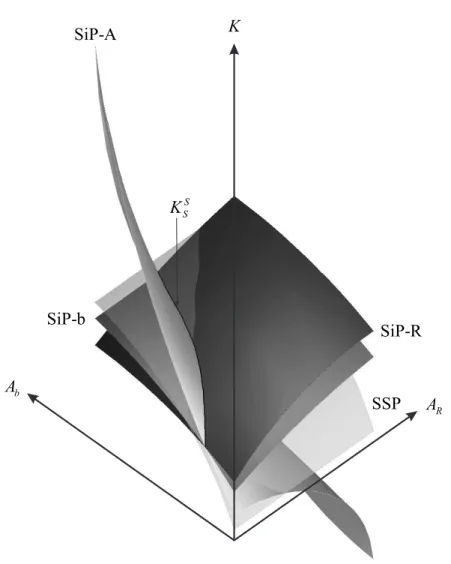
∂Ab ≥ 0. Fig. 3 illustrate the planes in the
technologies - capital - space. The line denoted with KSS is the intersection line of the three SiP.
In the following we show how the economic development can be predicted by using the four characteristic planes. For this purpose we relate point (KP, AP
b , APR)
which describes the state of the economy to the planes. We say that "the economy is located above (on, below) the SiP-b, SiP-R, SiP-A or SSP", if KP > (<,=) i(AP
b, APR), i = KbS, KRS, KA, KN holds. The four planes divide the
technologies capital space in subspaces with particular static properties:11
• Consumption increases (decreases) below (above) the SSP.
• Above (below) the SiP-b the related Ab research has a greater (smaller) eect
on the net production than capital accumulation.
• Above (below) the SiP-R the related ARresearch has a greater (smaller) eect
on the net production than capital accumulation.
Figure 3: The planes
• Above (below) the SiP-A Ab research has a greater (smaller) eect on the net
production than AR research.
The restrictions of the dynamic development process are derived on the basis of this four properties in Appendix A.2. It is shown that:
i. A development process can be located above the SSP only temporarily. ii. A steady state above the SiP-b or SiP-R is not optimal.
iii. MaximalAb (AR) research investments are only optimal above the SiP-b
(SiP-R). Below (on) the SiP-b (SiP-R) the related R&D expenditures are minimal (singular).
iv. All three SiP have a binding eect on the development process.
v. Ab research is not optimal below the SiP-A. AR research above the SiP-A is
Item i. is explained by C <˙ 0 above the SSP. If the development path would be
located above the SSP permanently, consumption had to decrease. However this can not be optimal, as constant consumption is possible by switching over to the SSP at one point during the process. To understand item ii. recall C >˙ 0 below
the SSP and ∂Yn
∂Ai > (=, <)
∂Yn
∂K , i = b, R above (on, below) the SiP-b and SiP-R.
If the economy is located on the SSP and above the SiP-b (SiP-R), consumption is constant. By converting some capital through research into technology the eect of the increasing technology outweighs the eect of the decreasing capital stock. Therefore, net production increases allowing a higher consumption. The eects of R&D and capital accumulation on net production are also important to rationalize iii. The two extreme R&D options are only possible away from the SiP-b and SiP-R, respectively, as ∂Yn
∂Ai >
∂Yn
∂K , i = b, R above the SiP-b (SiP-R) and ∂Yn
∂Ai <
∂Yn
∂K , i = b, R below it. Only on the both SiP the eects of the related R&D and
capital accumulation are equal. Therefore, only SiP-b and SiP-R allow for both an increasing technology and an increasing capital stock. A similar argument is applied on the SiP-A in item v. Above the SiP-A Ab research has a greater eect on net
production than AR research, while the reverse is valid below the SiP-A. However,
the argument holds only below and on the SiP-A. Above the SiP-A, it is possible that the less eectiveARresearch is optimal, as shown below in Fig. 5. In the same
manner, capital changes instead of research can be optimal above the SiP-b (SiP-R). Due to item i. to v. we can state:
Proposition 1 The optimal development process converges at a most-rapid-approach-path either against a steady state on the SSP or the intersection line KSS. If KSS lies below the SSP for large technology levels, the economy grows for ever along the KS
S.
Otherwise, the economy switches into a steady state on the SSP.
To understand the most-rapid-approach-path recall that the economy can either conduct minimal or maximal R&D away from the SiP-b or SiP-R. Furthermore, an economy that approaches one of the SiP will reach the intersection lineKS
S at some
point in time. Therefore, the intersection line is crucial for dening two economic types which were already distinguished by Tsur and Zemel (2005). On the one hand this is an economy that converges against a steady state (converging economy) and on the other hand an economy with the potential of steady growth (potentially growing economy). The latter is dened by a KS
S which lies below the SSP for
large technology levels, i.e. lim
Ab→∞
lim
AR→∞
[KSS(Ab, AR)−KN(Ab, AR)] < 0.
Analo-gously, a converging economy is on hand, if the intersection line exceeds the SSP, i.e. lim
Ab→∞
lim
AR→∞
Since a growing economy develops along theKS
S in the long run, capital increases and
research in both sectors is conducted. The simultaneous research in both sectors con-trasts sharply with the results of Acemoglu et al. (2012). Although Acemoglu et al. (2012) analyze a decentralized economy, this contradiction highlights the importance of the R&D function. The one of Acemoglu et al. (2012) follows the "building on the shoulders of giants" approach, which assumes a positive research productivity eect of the respective technology level. Therefore, the development process is biased to-wards the more advanced sector. By shifting more R&D eorts into the advanced sector the productivity wedge between the two sectors increases. Thus, research in the backward sectors becomes less attractive and, in the long run, research will be only conducted in the advanced sector.12In the "lab equipment" R&D approach,
chosen here, the productivity of research eorts is independent from the technology level, i.e. there does not exists a productivity wedge between the two sectors. On the contrary, the eects of R&D in both sectors on net production equalize, since the impact of R&D in one sector on the related resource costs decreases with a higher technology level. Therefore, a marginal increase of the technology level in the less advanced sector decreases the resource unit costs more than a marginal technology increase in the more advanced sector, making R&D in the backward sector more at-tractive. Thus, the "lab equipment" approach does not only avoid the productivity wedge but also eliminates a possible impact gap of the two research possibilities on net production. Therefore, R&D expenditures are distributed among both research sectors in the long run.
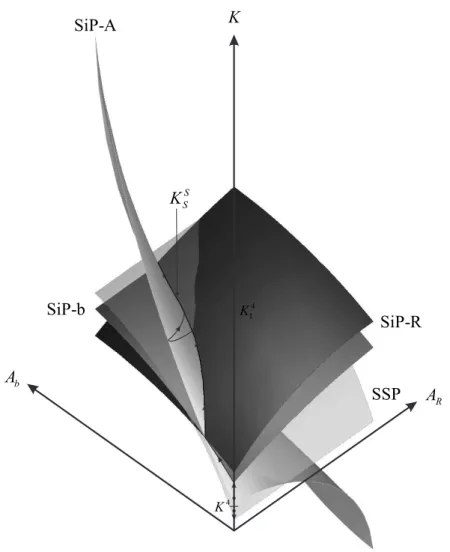
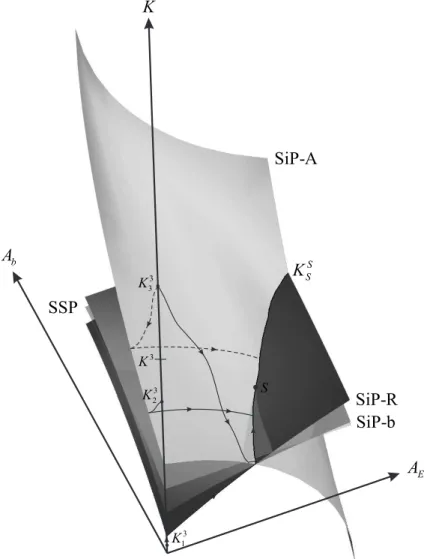
The optimal development path of a potentially growing economy is derived in Fig. 4. If the capital endowment is suciently high (K0 > K4) the economy
ap-proaches one of the SiP with minimal or maximal R&D investments, thus on a MRAP. Due to the bonding force of the SiP, the economy follows the rst SiP it reaches. In Fig. 4 an economy with a high capital endowment (K4
1) conducts
max-imal Ab research at the beginning. Consequently, the capital stock declines. In the
moment the development paths reaches the SiP-A the maximal R&D expenditures are allocated between both research sectors in a manner that guarantees a develop-ment along the SiP-A. Following the SiP-A the economy reaches the intersection line KSS and switches to singular R&D investments, which are still distributed among both research sectors. However, the capital stock increases now, too. If the capi-tal endowment is only slightly greater than K4 the economy conducts no research
at rst and approaches the SiP-b by capital accumulation. As soon as the SiP-b is
12Acemoglu et al. (2012) get the same result as we, if both resources are essential for production.
reached, the economy switches to singularAb research to follow the SiP-b to theKSS,
on which the singular R&D expenditures are distributed among both research sec-tors. In both cases consumption declines at rst but growths after the intersection of the development path with the SSP. If the capital endowment is small (K0 < K4)
the research option is too costly for the economy. Therefore, it is ignored and the economy converges against a steady state at the point (KN(Ab0), Ab0, AR0). This
explains the term "potentially" in potentially growing economy, as the economy needs a sucient high capital endowment to realize the research option. The most pessimistic result appears if the economy is very poor, i.e. the capital endowment below (KN(A
b0), Ab0, AR0). In this case capital accumulation may be not
possi-ble, since the complete production is needed for consumption. Thus, the economy consumes its own capital stock leading to a collapse of production and consumption.
Figure 4: Development paths of a potentially growing economy
capital endowment is small (K3
1) the economy approaches the SiP-b or SiP-R by
capital accumulation to switch to singular research on one of the SiP and afterwards on the KSS. At the intersection of KSS and the SSP denoted with S the economy switches into a steady state. With a high capital endowment (K23) the economy will conduct maximal research. Above the SiP-A, Ab is generally more advantageous,
so that the economy conducts Ab research as on the path starting at K23. However,
AR research can be the optimal choice above the SiP-A, too. An example is given
by the path starting at K3
3. If Ab research was conducted above the SiP-A, the
economy would reach theKS
S on a point after the intersection pointS. This implies
declining consumption forever. The alternative path withAR research leads to the
steady state S and is therefore the optimal one. Another possible path above the SiP consists of a part with maximal research which is given up in favor of minimal research before one of the SiP is reached. Such a path converges to a steady state on the SSP with at least one higher technology level than inS.
We conclude:
Proposition 2 The economy follows a most rapid approach path to either one of the SiP or the SSP. If the SiP-b or the SiP-R is reached rst, the economy switches to the related singular R&D. If the SiP-A is reached rst, the maximal research expenditures are divided among the both research sectors. The paths on any of the SiP lead the economy to the intersection line KS
S.
4
R
as exhaustible Resource
After having derivated the characteristic planes we turn back to the original as-sumption of an exhaustible resource stock SR, which implies τ > 0. Equation (10),
which determines both the energy supply and the energy mix becomes Fx(K, x(K, Ab, AR)) =M0(R(K, Ab, AR))BR(AR) +
τ λ =
Mb
ν Bb(Ab). (29) The scarcity of the resource aects the energy mix through the relative scarcity in-dexmq = τ
λ, which grows according to mˆ q =F
K. As can be seen in Fig. 1 a growing
scarcity index reduces the input of exhaustible resources under ceteris paribus condi-tions, while increasing the utilization of backstops. The total energy supply is not af-fected, since it is independent from the exhaustible resource as long as both resources are used. BecauseR andbenter (19), (20) and (21), all three SiP are aected by the scarcity. On the other hand, the SSP is dened by (28), which depends on total en-ergy supply. Therefore, the scarcity has no impact on the SSP. The inuence of the scarcity on the SiP should be explained by a comparison of the two corner casesSR =
∞and SR= 0. The caseSR = 0has been analyzed above and establishes the three
SiP. Assume the combinationKu, Au
b, AuRis a point on the SiP-b dened forSR=∞,
then−MbBb(Aub)b(Ku, Aub, AuR) = FK(Ku, x(Ku, Aub))andKu =KbS(Aub, AuR). If the
resource stock SR is instead exhausted, energy is only supplied by the backstop,
i.e. x(Ku, Au
b) = b(Ku, Aub, AuR) +R(AuR, Aub) = b0(Ku, Aub) = x0(Ku, Aub), with 0
denoting the variables in the case of SR = 0. Thus, b(Ku, Aub, AuR) < b0(Ku, Aub)
and therefore −MbBb(Aub)b
0(Ku, Au
b) > FK(Ku, x(Ku, Aub)). The equation dening
the SiP-b is not fullled. We now have to determine the capital stock which fullls the equation given the technology levelsAub, Aur. A lower capital stock increases the right hand side, because dFK
dK =
FKKFxx−FKx2
Fxx <0. On the other hand, a lower capital
stock reduces energy demand and therefore b, as the marginal product of energy increases in the capital stock. Thus, the left hand side decreases. We conclude that the capital stock must be smaller then Ku. If the consideration is applied to all
technology combinations, we get the SiP-b for a exhausted resource stock. Since the capital stock is always smaller, the SiP-b for SR = 0 lies below the SiP-b for
SR =∞in the technologies capital space. Before using the argumentation for every
nite resource stock SR, we have to notice that every nite resource stock can be
associated with a value of the constantly increasing scarcity index mq and that the utilization of the backstop increases withmqunder ceteris paribus conditions. Then the argumentation establishes a SiP-b for every nite resource stock or every mq
value, respectively, which lies the lower in the Ab, AR, K space the higher mq is.
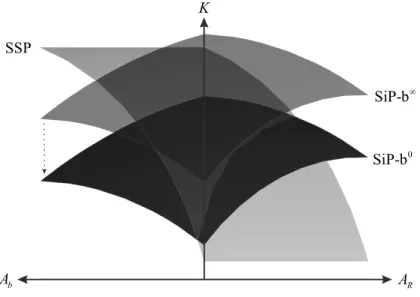
By adding the mq dimension to the technologies capital space, the family of SiP-b
forms a three-dimensional manifold in the four-dimensionalAb, AR, K, mqspace. By
projecting the SiP-b on the Ab, AR, K space, we get a downward shifting plane as
shown in Fig. 6, where ∞ and 0 denote the SiP-b of the two corner cases. Fig. 6
incorporates also the SSP, which is not aected by scarcity.
Figure 6: The SiP-b in theAb, AR, K space
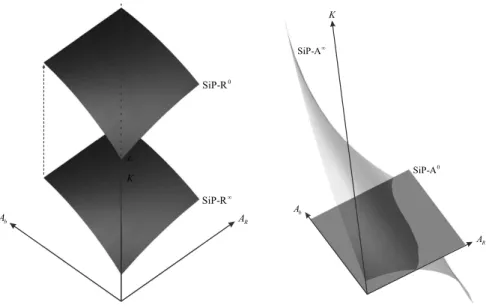
A similar argumentation is used to analyze the eects of the scarcity on the SiP-R and SiP-A. In case of the SiP-R the scarcity (mˆq>0) decreasesRceteris paribus and therefore the left hand side of (20): −M(R(K, Ab, AR))BR0 (AR) = FK(K, x(K, Ab)).
Since the argumentation is based upon a ceteris paribus comparison with a xed rel-ative scarcity index, dierent capital stock values do not aectR(K, Ab, AR).
There-fore, the equation holds only for higher capital stock values, because of dFK
dK <0. In
the corner caseSR =R = 0, the left hand side is 0and the equation fullled only if
K =∞. Thus, the SiP-R is shifting upwards in the Ab, AR, K space as the relative
The SiP-A is given by (21): −MbBb0(Ab)b(K, Ab, AR) = −M(R(K, Ab, AR))BR0 (AR).
An increasing scarcity index reduces the right hand side, while increasing the left hand side. The equation holds only for a reduced capital stock value, since back-stop utilization increases in the capital stock while the amount of used exhaustible resources remains unchanged. If the resource stockSR is exhausted, the right hand
side is 0. Energy demand is zero if and only if the capital stock is also zero. Thus,
the SiP-A decreases in theAb, AR, K space with an increasing scarcity index and is
given by the plain spanned by theAb - and AR - axis for SR = 0. Fig. 7 illustrate
the development of the SiP-R and the SiP-A.
Figure 7: SiP-R and SiP-A in the Ab, AR, K space
Proposition 3 The SiP-b (SiP-R, SiP-A) shifts downwards (upwards, downwards) in theAb, AR, K space with an increasingmq. With an exhausted resource stock SR,
SiP-R and SiP-A are only reached for K =∞ and K = 0, respectively. The SSP is
not aected by the scarcity of R.
The movement of SiP-b, SiP-R and SiP-A in the technologies capital space can be explained by the scarcity of the exhaustible resource. According to their def-inition the SiP-b and the SiP-R compare the eect of an increase of Ab and AR
technology, respectively, to a change of the capital stock. It was shown that the capital eect is higher (smaller) below (above) the SiP. Ceteris paribus scarcity re-duces the utilization of the exhaustible resource while increases backstop use. Thus, a higherAb level reduces resource utilization costs more than without scarcity. On
the other hand, a higher AR level has a lower eect on the resource costs.
input but is independent from the energy mix. Therefore, the scarcity has no inu-ence on the eect of a capital increase. With scarcity theAb (AR) technology eect
outweighs the capital eect for more (less) technologies - capital combination im-plying a lower(higher) SiP-b (SiP-R). The SiP-A compares both technology eects to each other. As the Ab eect increases with scarcity and the AR eect decreases,
scarcity raises the number of technologies - capital combination where theAb eect
outweighs theAR eect. Therefore, the SiP-A lies lower in the technologies capital
space.
The long run positions of SiP-R and SiP-A have signicant consequences for the development of the economy. The capital value of the SiP-R converges toK =∞in nite time. However, no economy can accumulate an innite high capital stock in nite time. Therefore, it is not possible to follow the R forever. Since the SiP-R bounds the development path, this implies that the optimal path cannot reach the SiP-R. Otherwise, consumption decreases to zero as the whole net production is needed to accumulate capital. Though, a position on the SSP with positive and constant consumption is pareto-superior. Consequently, singular AR - research is
never optimal. Furthermore, as maximal AR - research is only possible above the
SiP-R, maximal AR - research can be optimal only temporally. This follows also
from the long run position of the SiP-A withK = 0. As stated above, AR- research
above the SiP-A is only possible, if the development reaches the SiP-A. However, a depleted capital stock implies a production and consumption collapse. In that case any point on the SSP is pareto-superior, since it guarantees a positive and constant consumption. Therefore, a path following the SiP-A, and therefore AR - research
above the SiP-A, can not be optimal. Thus, only Ab - research can be conducted
above the SiP-A. This implies that in the long run only Ab - research is possible,
as the complete relevant Ab, AR, K space will lie above the SiP-A. This result is
self-explanatory, as the resource stock SR will be exhausted in nite time.
There-after, an increase ofAR has no eect on the resource costs and the related research
investments must be zero. As black research is not optimal in the long run and the SiP-R and SiP-A are de facto irrelevant, the optimization problem reduces to the one of Tsur and Zemel (2005), i.e. the social planer has to how much net pro-duction is invested into green research and/or capital and how much is consumed. Consequently, the denition of the two economic types of a potentially growing and a converging economy must be adapted. Both are no longer dened by the position of theKS
S in relation to the SSP but by the relation of the SiP-b to the SSP. In the
case of a potentially growing (converging) economy the SiP-b lies below (above) the SSP for large technology levels, i.e. lim
Ab→∞
KS
with TR denoting the point in time resource stock SR gets exhausted.
With the exception of two special cases, which will be described below, the scarcity of R make sure that the three SiP divide the Ab, AR, K space in subspaces in line
with the arbitrage conditions the SiP are based on: • Above (on, below) the SiP-b ∂Yn
∂Ab > (=, <)
∂Yn
∂K holds, and maximal (singular,
minimal) Ab - research is only optimal above (on, below) the SiP-b.
• Above (below) the SiP-R ∂Yn
∂AR > (<)
∂Yn
∂K holds, and maximal (minimal) AR
-research is only optimal above (below) the SiP-R. • Above (below) the SiP-A ∂Yn
∂Ab > (<)
∂Yn
∂AR holds, and Ab - research (AR -
re-search) is only optimal above (below) the SiP-A.
The rst exception appears if green research is optimal below the SiP-A. With an exhaustible resource stock this is possible, since the argumentation from Appendix A.2 Lemma 8(b) does not hold anymore. However, AR - research above the
SiP-A was ruled out. So, if Ab - research is optimal below the SiP-A, green research
is generally superior to black research. In that case, the optimization problem of phase 3 reduces to the one discussed by Tsur and Zemel (2005). Therefore, this case is ignored in the following.
The second exception is a converging economy in which research is or becomes generally to expensive. In that case, research is not conducted or abandoned in favor of a steady state reached by variations of capital, even above the SiP-b. Taken the discussed aspects of scarcity into account Proposition 2 reads now: Proposition 4 If the Ab - research is not generally superior to AR - research, the
economy follows a modied MRAP, with superiority ofAb - research (AR - research)
over AR - research (Ab - research) above (below) the SiP-A, to either the SiP-b or
the SSP. On the SiP-b the economy switches to singularAb - research.
Our result is in line with the analysis of Acemoglu et al. (2012), who also nd that R&D is only conducted in the backstop sector in the long run, but contradicts with the results of Di Maria and Valente (2008). This highlights the importance of the substitutability of the two resource or intermediates. If both intermediates are necessary and the technological progress factor augmenting, as in Di Maria and Valente (2008), it is evident that R&D eorts have to be allocated to the exhaustible resource sector to guarantee a sustainable development. On the other hand, with a high substitutability and a cost reducing technological progress, as in our model, R&D eorts would be wasted, if allocated to the exhaustible resource sector in the
long run. Indeed, a sustainable development requires the good substitutability of the two resources, as the technological progress is not factor augmenting. Otherwise, production decreases to zero with the exhaustion of SR no matter how high the
technology levelsAb and AR are.
The result has also signicant consequences for both poor (low capital endow-ment) and rich (large capital endowendow-ment) economies. A poor economy can only conduct research in the area of the backstop resource, although it relies heavily on the exhaustible resource in the short run - a small capital stock implies a low energy demand and therefore a low backstop utilization. This reects that the nal product available for investment is too valuable for a poor economy to be invested in a tech-nology which pays o only temporally. However, in a rich economy (maximal) AR
research may be possible. In this case, the short run resource cost reductions caused by an improvingAR technology outweighs the enduring costs reductions of a better
Ab technology. The eect of black research is the higher the higher is the stockSR.
A highSR implies a long utilization period of the exhaustible resource, in which the
improvedARtechnology can pay o. In theAb, AR, K space this is reected by a low
position of the SiP-R and a high one of SiP-A. However, with a declining resource stock SR the backstop becomes increasingly important for production, resulting in
an increasing attractiveness of Ab research. Due to this eect very rich economies
conduct only green research, as they rely heavily on backstops in early periods. The result can also be seen from the resource extraction path. To deduce it, we totally dierentiate (29) to obtain the well known Solow-Stiglitz condition
ˆ Fx = mq M0B R+mq FK + M0BR M0B R+mq ˆ BR+ M00R M0 Rˆ = ˆBb. (30)
(30) is the ecient allocation rule of the exhaustible resource over time. According to the condition the growth rate of the marginal product of energy equals both, the growth rate of the marginal costs of the exhaustible resource and the backstop. If green research is conducted, the latter decreases. As only maximal black research is possible, Bˆ
R = 0 in this case. Therefore, (30) implies m
q
M0B
RFK <−
M00R
M0 Rˆ. Since
the left hand side is positive, utilization of the exhaustible resource must decline. A similar argumentation holds, if the research eorts are zero. If the research in-vestments are allocated to the black sector, no green research can be conducted. Thus, Bˆb = 0 and mq M0B RFK = − ˆ BR− M 00R
M0 Rˆ. As BR decreases with improving AR
technology, −BˆR > 0. Therefore, the utilization of the exhaustible resource may
increase, if the AR level is suciently enhanced. Due to the nite resource stock
path with an increasing part must have a peak after which it decreases, implying a higher utilization of the backstop and therefore a higher eect of green research on net production.13
5 Pollution
In addition to exhaustible resources, pollution, specically CO2 and its eect on
global warming, is linked to energy generation. Pollution is extensively discussed in the literature.14Following Acemoglu et al. (2012) and Schou (2000), we augment our
model with pollution caused by the exhaustible resource. The pollution accumulates in the environment according to
˙
SE =R−γSE. (31)
SE denotes the emission stock, which increases in resource utilization R and
de-creases due the natural regeneration rate γ.15The pollution stock decreases utility that is now given by
U =U(C, SE), (32)
with USE < 0 and USESE < 0. Let θ be the current-value costate variable of the
emission stock. As utility decreases, if the emission stock is increased exogenously, the related shadow priceθ is negative. Using the same procedure as in the previous section, the necessary condition (7) is now given by
∂L
∂R =λ[Fx−M 0
(R)BR(AR)]−τ +θ = 0. (33)
The costate variable develops according to ∂L
∂SE
=USE −θγ =ρθ−θ˙ (34)
13All variables and functions of (29) determining R are continuous. Therefore, R must be
continuous as well. Furthermore, by applying the proof of Tsur and Zemel (2003), Appendix A1 and A2 it is possible to show that the transition form the utilization of both resources to a pure backstop based economy is smooth.
14E.g. Bovenberg and Smulders (1995), Chakravorty et al. (2006) and Ricci (2007). A
compre-hensive overview of the endogenous growth theory related to environmental questions is given by Pittel (2002).
15A similar function is used by Acemoglu et al. (2012), Kolstad and Krautkraemer (1993) and
and the transversality reads
lim
t→∞e
−ρtθ(t) [S
E(t)−SE∗(t)]≥0. (35)
Energy input and the energy mix is given by
Fx(K, x(K, Ab, AR)) = M0(R(K, Ab, AR))BR(AR) +
τ+|θ|
λ =
Mb
ν Bb(Ab). (36) A ceteris paribus comparison of (36) with (10) shows that the relative scarcity index is higher with pollution. Therefore, pollution reduces the utilization of the exhaustible resource and boosts backstop. This implies both a lower position of SiP-b and SiP-A and a higher position of SiP-R in the technologies capital space, i.e. a higher attractiveness ofAb research. After the exhaustion of the resource stock
SR at t = TR, the emission stock can not be inuenced. Instead, it is determined
byS˙E =−γSE. Therefore, the shadow priceθ is zero for all t > TR. To determine
the shadow price at t = TR, we split the optimization problem into two parts. In
the rst part utility is maximized given the known constraints over the time interval t∈[0, TR[, while the problem for the time intervalt∈[TR,∞[is solved in the second
part. The value function of the second part is given by VS. 16 Then, the shadow
price at t = TR equals ∂V
S
∂SE.
17Since a higher emission stock reduces utility U, the
value function decreases in SE, i.e. ∂V
S
∂SE < 0. This property is important for the
forthcoming analysis of a decentralized economy.
Proposition 5 If the exhaustible resource causes pollution, backstop (exhaustible resource) utilization increases (decreases), which boosts the attractiveness ofAb
com-pared to both capital accumulation and AR research.
6 Market Economy
After the analysis of the social optimum we decentralize the economy and show under which conditions the social optimum can be realized in a market economy. With the exception of the energy market we follow the neoclassical assumptions of perfect competition, i.e. the economy consists of a great number of identical individuals and nal good producers. The individuals own both capital and the shares of all rms. They buy a composite good, which can be either invested into the capital stock or consumed. The individuals maximize their intertemporal utility
16VS := max C,b,Ib R∞ TRU(C, SE(TR))e −ρ[t−TR]dtsubject toK˙ =F(K, b)−C−M bBb(Ab)b−Ib, ˙ Ab=Ib. 0≤Ib≤I¯andb, C, K≥0.
subject to their budget constraint. The composite good producers rent capital from the individuals and purchase energy or resources, respectively, on the energy market. Since they do not face an intertemporal optimization problem, they just maximize their prot at every point in time. Energy is supplied by the resource owners which also conduct research to lower their costs. In the endogenous growth theory it is common to assume that the R&D rms exercise market power due to patents on new developments. We apply this assumptions to our framework such that there are two R&D rms, one in the green and one in the black sector. As research is conducted by the resource owners, the backstop as well as the exhaustible resources are each owned by one rm. 18 For the market structure we assume a Cournot
competition. 19To conduct research the rms have to buy goods on the composite
good market. The government levies the unit taxφon the exhaustible resource and subsidizes the utilization of both resources withsb and SR, respectively. A balanced
budget is guaranteed by the lump-sum transfer T S0.
The representative individual maximizes R∞
0 U(C, SE)e −ρtdt subject to K˙ = r pYK+ π pY+ πb pY+ πR pY + T
pY −C, withrdenoting the interest rate,pY the composite good
price and π, πb and πR the prots of the composite good producers, the backstop
resource supplier and the exhaustible resource supplier, respectively. Due to the great number of individuals, a single individual takes the prots, the transfer and the emission stock as exogenously given. With the costate variable λH the current
value Hamiltonian is given byH =U(C, SE)+λH h r pYK+ π pY + πb pY + πR pY + T pY −C i . The composite good producers rent their capital from the individuals and buy the energy from the resource owners. They maximize their prot for every point in time. The representative producer's prot is given byπ=pYF(K, R+νb)−rK−pbb−(pR+
φ)R, withpb and pR denoting the prices of energy generated by means of backstops
and exhaustible resources, respectively. The rst order conditions of the optimiza-tion problems establish the resource demand funcoptimiza-tionpYFx(K, R+νb) = pνb =pR+φ
and the Ramsey - rule, as stated in the third column of Table 1.
The resource owners maximize their intertemporal prot subject to the develop-ment of the related technology and in case of the exhaustible resources subject to the limited resource stock. Since the resource owners are engaged in a Cournot
com-18It is possible to assume more detailed R&D sectors with several rms, as in Acemoglu et al.
(2012). However, this increases the complexity of the model considerably without gaining more in-sight. Finally, the government has to internalize market power eects stemming from the monopoly of R&D rms concerning a specic technology, machine, etcetera.
19The assumption of a Cournot competition is made to allow for positive R&D investments in the
green sector without governmental intervention. With Bertrand competition the earnings of the backstop owners would equal their costs. Therefore, green research investments must be directly given by the government.
petition, they take the resource demand function into account. The instantaneous prots are given by
πb =pYFx(K, R+νb)νb−pYMbBb(Ab)b+sbb−pYIb, (37)
πR= [pYFx(K, R+νb)−φ]R−pYM(R)BR(AR) +sRR−pYIR. (38)
With κbH, κRH and τH as costate variables the current value Hamiltonians are
given by Hb = pYFx(K, R+νb)νb−pYMbBb(Ab)b+sbb−pYIb +κbHIb and HR =
[pYFx(K, R+νb)−φ]R−pYM(R)BR(AR) +sRR−pYIR−τHR+κRHIR. In case
of the backstop owner, the rst order conditions can be written as20
Fx(K, R+νb) = Mb ν Bb(Ab)−Fxx(K, R+νb)νb− sb νpY , (39) ˆ κbH =ρ+ pY κbH MbBb0(Ab)b. (40)
For the exhaustible resource owner we get the rst order conditions21
Fx(K, R+νb) = M0(R)BR(AR)−Fxx(K, R+νb)R+ φ pY − sR pY + τH pY , (41) ˆ κRH =ρ+ pY κRH M(R)BR(AR). (42)
and τˆH = τ0Heρt, with τ0H as the initial value of τH. The capital stock, the tax,
the subsidies and the price pY are taken by the energy suppliers as given, while
they determine the related technology by their own decision. The development τH depends only on its initial value. Therefore, (39) and (41) dene implicitly
optimal resource utilization subject to the resource supply of the competitor and the technology level, i.e. b∗(R, Ab) and R∗(b, AR). The Nash - Cournot equilibrium is
established by substitutingb∗(R, Ab)and R∗(b, AR)into (41) and (39), respectively:
Fx(K, R∗+νb∗(R∗, Ab)) =M0(R∗)BR(AR)−Fxx(K, R∗ +νb∗(R∗, Ab))R∗ + φ pY − sR pY +τH pY , Fx(K, R∗(b∗, AR) +νb∗) = Mb ν Bb(Ab)−Fxx(K, R ∗ (b∗, AR) +νb∗)νb∗− sb νpY .
20The transversality condition is lim
t→∞e −ρtκ
bH[Ab(t)−A∗b(t)]≥0.
21The transversality conditions are τ
H(TR) = γSR, γSR ≥ 0, γSRSR(TR) = 0and HR(TR) = ≤0, ifTR= 0 = 0, if0< TR<∞ ≥0, ifTR=∞ .
Finally, the maximization of the two Hamiltonians with respect to research invest-ments gives
Ib∗ = 0, if −pY +κbH <0, IR∗ = 0, if −pY +κRH <0,
0≤Ib∗ ≤I¯−IR, if −pY +κbH = 0, 0≤IR∗ ≤I¯−Ib, if −pY +κRH = 0,
Ib∗ = ¯I−IR, if −pY +κbH >0, IR∗ = ¯I−Ib, if −pY +κRH >0. (43)
A comparison of the second and the third column of Table 1 reveals that the social optimum can be realized in a decentralized economy, if the exhaustible resource is taxed and both resources subsidized according to Proposition 6
Proposition 6 In the case the resource owner with the higher willingness to pay for R&D dominates the other resource owner on the composite good market, the market equilibrium replicates the social optimum, if λH = λ, τH = τ, κbH = κb
and κRH =κR hold, the resources are subsidized according to sb =−pYFxxν2b and
sR=pYFxxR, respectively, and the exhaustible resource tax equals |θ|.
See Appendix A.3 for the proof.
The optimal development of the tax is given by (34):
ˆ
φ = (ρ+γ)φ+USE (44)
As the rst term on the right hand side is positive and the second negative, the tax may increase as well as decrease. To analyze the eects of R&D on the tax, we totally dierentiate (36) h ˆ φ−ρ i φ τ+φ +FK = BRM0+τ+λφ τ+φ λ ˆ Bb− BRM0 τ+φ λ ˆ BR+ M00R M0 Rˆ . (45)
The left hand side is the growth rate of the relative scarcity index τ+φ
λ , while the
right hand side shows the three forces that determine the development of the index. The tax decreases in both green research and the extraction growth rateRˆ, whereas
it increases in black research. The rst point is explained by the backstop costs reduction, which boosts the utilization of the backstop and depresses the extraction of exhaustible resources. Therefore, less pollution is emitted, implying a lower tax. The opposite argument holds for black research, which decreases the costs of the exhaustible resources. This boosts black energy and therefore pollution, implying a higher tax. The second point shows how the government can inuence the resource extraction by the tax. E.g. assume minimal R&D, then a higher extraction rate needs a lower tax. Since research can be only conducted in one sector and the black
so cial optim um decen tralized econom y Ramsey -rule ˆC= FK − ρ η ˆC= FK − ρ η marginal pro duct of R Fx = M 0 (R ) BR ( AR ) + τ − θ λ Fx = M 0 (R ) BR ( AR ) − Fxx R + φ pY − sR pY + τM pY marginal pro duct of b Fx = M b ν Bb ( Ab ) Fx = M b ν Bb ( Ab ) − Fxx ν b − sb νpY capital accum ulation ˙K= F ( K ,x ) − M b B ( A ) b − M ( R ) − I − C ˙K= F ( K ,x ) − M b B ( A ) b − M ( R ) − I − C R&D ˆ κR = ρ + λ κR M ( R ) B 0 (R AR ) ˆ κR H = ρ + pY κRH M ( R ) B 0 (R AR ) ˆ κb = ρ + λ κb M b B 0 (b Ab ) b ˆ κbH = ρ + pY κbH M b B 0 (b Ab ) b (i) I ∗ b = I ∗ R = 0 , if − λ + κb < 0 and − λ + κR < 0 (I) I ∗ R = 0 , if − pY + κR H < 0 (Ia) I ∗ b = 0 , if − pY + κbH < 0 (ii) 0 ≤ I ∗ R ≤ ¯I, if − λ + κb < 0 and − λ + κR = 0 (I I) 0 ≤ I ∗ R ≤ ¯I− Ib , if − pY + κR H = 0 (iii) 0 ≤ I ∗ b ≤ ¯I, if − λ + κb = 0 and − λ + κR < 0 (I II) 0 ≤ I ∗ b ≤ ¯I− IR , if − pY + κbH = 0 (iv) 0 ≤ I ∗ b + I ∗ R ≤ ¯I, if − λ + κb = 0 and − λ + κR = 0 (v) I ∗ b = ¯I, if − λ + κb > 0 and κb − κR > 0 (V) I ∗ b = ¯I− IR , if − pY + κbH > 0 (vi) I ∗ R = ¯I, if − λ + κR > 0 and κb − κR < 0 (VI) I ∗ R = ¯I− Ib , if − pY + κR H > 0 (vii) I ∗ b + I ∗ R = ¯I, if − λ + κb > 0 and κb − κR = 0 T able 1: Comparison of the decen tralized econom y and the so cial optim um
research option can be only realized by rich economies, (45) connotes that rather rich than poor economies should exhibit a high tax rate on fossil fuels.
7 Conclusion
The literature regarding directed technical change and exhaustible resources exhibit two critical aspects if applied on energy generation: resource augmenting techno-logical progress and the absence of backstops. This paper analyzes the direction of energy related technological progress without these two critical aspects. On the one hand, it incorporates backstops. On the other hand, it applies a cost reducing technological progress instead of a resource augmenting one. Both is realized by the augmentation of Tsur and Zemel (2005) with a second technology. We show that re-search in the exhaustible resource sector can be optimal only temporary. This result, which diers totally from Di Maria and Valente (2008), highlights the importance of the substitutability of the exhaustible resource and the form of the technological progress. If the technological progress is factor augmenting, a sustainable develop-ment is possible even if the exhaustible is necessary for production. By abandon this assumption and introducing cost reducing technological progress, we show that a good substitutability of the exhaustible resource is necessary for a sustainable de-velopment. If those two energy sources are bad substitutes, production collapses in the moment when the resource stock becomes exhausted.
Since the exhaustible resource cannot used forever, a reduction of its extraction costs is of temporary nature. Due to the availability of a backstop, the research inputs are then too valuable for a poor economy, i.e. an economy with a low capital endowment, to be invested in this cost reduction. Thus, despite the heavy reliance on the exhaustible resource in early periods, black research is not an option for poor economies. Instead the composite goods are consumed or invested either in capital or in green research. These trade-os between the two research options as well as be-tween both research and capital accumulation and consumption and investments are illustrated by four characteristic manifolds. In a rich economy, i.e. an economy with a suciently high capital endowment, the cost reduction can be high enough to jus-tify research in the exhaustible resource sector. However, with a declining resource stock the attractiveness of black research compared with both capital accumulation and green research decreases and vanishes completely with the exhaustion of the resource. On the other hand, the attractiveness of backstop research is boosted by the increasing share of the backstop in the energy mix. Thus, in the long run a rich economy can also only conduct green research. If and for how long research
is conducted is determined by two of the four manifolds, the steady state and the singular-b plane, and the capital endowment of the economy, resembling the results of Tsur and Zemel (2005). Accordingly, an economy which realizes the research option either grows forever or switches into a steady state with a technology level higher then its endowment level.
In the case that the exhaustible resource causes CO2- emissions the eect of scarcity
on R&D is enforced by a pollution eect. As the utilization of the exhaustible re-source harms the environment, it is optimal to use lesser exhaustible rere-sources than without pollution. Consequently, the utilization of the backstop increases, implying a higher attractiveness of green research compared with both black research and capital accumulation.
To realize the social optimum in a decentralized economy the government has to sub-sidize both resources to counter market power eects of the research rms, which are common among endogenous growth models. Additionally, the exhaustible resource must be taxed if it pollutes. The tax increases in black research while it decreases in green research. Since the former can be only conducted by rich economies, our model suggests that an emission tax should be the higher the richer the economy.
By applying the "lap equipment" R&D approach instead of the "standing on the shoulders of giants" one, used by Acemoglu et al. (2012), we emphasize the importance of the assumption related to the research sectors. If both resources are non-exhaustible, the approach of Acemoglu et al. (2012) drives a wedge between the productivity of the research sectors. Therefore, R&D is only conducted in the more advanced sector in the long run. Our approach does not allow for such a productivity wedge. Instead it eliminates inequalities of the R&D eects. Consequently, we nd that the R&D eorts are split among both sectors in the long run, which contrasts completely with the result if one resource is exhaustible.
We have already augmented our model with pollution and environmental con-cerns in 5. Further extensions in this area, like a ceiling on the stock of pollution, seems to be an interesting eld of research.
References
Acemoglu, D., 1998. Why do new technologies complement skills? Directed technical change and wage inequality. The Quarterly Journal of Economics 113 (4), 1055 1089.
Acemoglu, D., 2002. Directed technical change. Review of Economic Studies 69 (4), 781809.
Acemoglu, D., Aghion, P., Bursztyn, L., Hemous, D., 2012. The Environment and directed technical change. American Economic Review 102 (1), 131166.
Aghion, P., Howitt, P., García-Peñalosa, C., 1998. Endogenous growth theory. the MIT Press.
Barbier, E., 1999. Endogenous growth and natural resource scarcity. Environmental and Resource Economics 14 (1), 5174.
Barro, R., Sala-i Martin, X., 2003. Economic growth, 2nd Edition. The MIT Press. Bovenberg, A., Smulders, S., 1995. Environmental quality and pollution-augmenting technological change in a two-sector endogenous growth model. Journal of Public Economics 57 (3), 369391.
Chakravorty, U., Magné, B., Moreaux, M., 2006. A Hotelling model with a ceiling on the stock of pollution. Journal of Economic Dynamics and Control 30 (12), 28752904.
Dasgupta, P., Heal, G., 1974. The optimal depletion of exhaustible resources. The Review of Economic Studies 41, 328.
Di Maria, C., Valente, S., 2008. Hicks meets Hotelling: the direction of technical change in capitalresource economies. Environment and Development Economics 13 (06), 691717.
Grimaud, A., Rouge, L., 2008. Environment, directed technical change and economic policy. Environmental and Resource Economics 41 (4), 439463.
Hartwick, J., 1977. Intergenerational equity and the investing of rents from ex-haustible resources. The American Economic Review 67 (5), 972974.
Kamien, M., Schwartz, N., 2000. Dynamic optimization: the calculus of variations and optimal control in economics and management, 2nd Edition. North-Holland New York.
Kiley, M., 1999. The Supply of Skilled Labour and Skill-biased Technological Progress. The Economic Journal 109 (458), 708724.
Kolstad, C., Krautkraemer, J., 1993. Natural resource use and the environment. Handbook of Natural Resource and Energy Economics 3, 12191265.
Meadows, D., Meadows, D., Randers, J., Behrens, W., of, R. C., 1972. The limits to growth. Universe Books New York.
Meyer, E., Müller-Siebers, K., Ströbele, W., 1998. Wachstumstheorie. Oldenbourg. Pittel, K., 2002. Sustainability and endogenous growth. Edward Elgar Publishing. Ricci, F., 2007. Environmental policy and growth when inputs are dierentiated in
pollution intensity. Environmental and Resource Economics 38 (3), 285310. Rivera-Batiz, L., Romer, P., 1991. Economic integration and endogenous growth.
The Quarterly Journal of Economics 106 (2), 531555.
Schou, P., 2000. Polluting non-renewable resources and growth. Environmental and Resource Economics 16 (2), 211227.
Solow, R., 1974. Intergenerational equity and exhaustible resources. The review of economic studies 41, 2945.
Stiglitz, J., 1974. Growth with exhaustible natural resources: ecient and optimal growth paths. The review of economic studies 41 (128), 123137.
Tsur, Y., Zemel, A., 2003. Optimal transition to backstop substitutes for nonrenew-able resources. Journal of Economic Dynamics and Control 27 (4), 551572. Tsur, Y., Zemel, A., 2005. Scarcity, growth and R&D. Journal of Environmental
Economics and Management 49 (3), 484499.
Tsur, Y., Zemel, A., 2009. Endogenous discounting and climate policy. Environmen-tal and Resource Economics 44 (4), 507520.
Tsur, Y., Zemel, A., 2011. On the dynamics of competing energy sources. Automat-ica.