Document downloaded from:
This paper must be cited as:
The final publication is available at
Copyright
http://dx.doi.org/10.1016/j.compositesb.2014.10.026
http://hdl.handle.net/10251/51598
Elsevier
Carbonell Verdú, A.; García García, D.; Jordá Vilaplana, A.; Samper Madrigal, MD.; Balart
Gimeno, RA. (2015). Development of slate fiber reinforced high density polyethylene
composites for injection molding. Composites Part B: Engineering. 69:460-466.
doi:10.1016/j.compositesb.2014.10.026.
1 2 3 4 5 6 7 8 9 10 11 12 13 14 15 16 17 18 19 20 21 22 23 24 25 26 27 28 29 30 31 32 33 34 35 36 37 38 39 40 41 42 43 44 45 46 47 48 49 50 51 52 53 54 55 56 57 58 59
“Development of slate fiber reinforced high density polyethylene composites for injection molding”
A. Carbonell1, D. García-García1, A. Jordá2, M.D. Samper1, R. Balart1,*
1
Instituto de Tecnología de Materiales (ITM) Universitat Politècnica de València (UPV)
Plaza Ferrandiz y Carbonell 1, 03801, Alcoy, Alicante (Spain)
2
Departamento de Ingeniería Gráfica Universitat Politècnica de València (UPV)
Plaza Ferrandiz y Carbonell 1, 03801, Alcoy, Alicante (Spain)
Abstract
During the last decade the use of fiber reinforced composite materials has consolidated as an attracting alternative to traditional materials due to an excellent balance between
mechanical properties and lightweight. One drawback related to the use of inorganic fibers such as those derived from siliceous materials is the relative low compatibility with conventional organic polymer matrices. Surface treatments with coupling agents and the use of copolymers allow increasing fiber-matrix interactions which has a positive effect on overall properties of composites. In this research work we report the use of slate fiber treated with different coupling agents as reinforcement for high density polyethylene from sugarcane. A silane
(propyltrimethoxy silane; PTMS) and a graft copolymer (polyethylene-graft-maleic anhydride; PE-g-MA) were used to improve fiber-matrix interactions on HDPE-slate fiber. The effect of the different compatibilizing systems and slate fiber content were evaluated by scanning electron microscopy (SEM), dynamic thermo mechanical analysis (DTMA) as well as mechanical properties (tensile, flexural and impact). The results show that the use of silane
1 2 3 4 5 6 7 8 9 10 11 12 13 14 15 16 17 18 19 20 21 22 23 24 25 26 27 28 29 30 31 32 33 34 35 36 37 38 39 40 41 42 43 44 45 46 47 48 49 50 51 52 53 54 55 56 57 58 59
coupling agents leads to higher fiber-matrix interactions which has a positive effect on overall mechanical properties. Interesting results are obtained for composites containing 30 wt.% slate fiber previously treated with propyltrimethoxy silane (PTMS) with an increase in tensile and flexural strength of about 16% and 18% respectively.
Keywords: A. Fibres; B. Mechanical properties; B. Microstructures; E. Injection moulding; E. Thermoplastic resin
1.- Introduction.
In the last decade a remarkable increase in concern about the environment has been detected and different topics related to petroleum depletion, recycling, biodegradation, waste upgrading, etc. act as leading forces for the development of new and environmentally friendly materials. This situation has been particularly marked in the field of polymers and polymer-based composites which traditionally use petroleum-polymer-based polymers characterized by non-biodegradability. In the case of composite materials, research has been focused on the use of low environmental impact polymer matrices and reinforcing fibers.[1-5]
Commodity plastics such as polyolefins (polyethylene, polypropylene, etc.) find
attracting uses in medium to low technical applications due to excellent balance between overall properties (mechanical, thermal, chemical resistance, etc.) and easy processing by conventional techniques such as extrusion and injection molding. Nevertheless these polymers do not reach, in general, typical properties of technical or engineering polymers. For this reason, it is quite usual to reinforce commodity plastics (and also, engineering plastics)[6] with short or long fibers such as natural (flax, sisal, coir, jute, henequen, etc.),[7-13] inorganic (glass fiber),[14-17] synthetic (aramid, polyamide, polyester, etc.),[18] carbon fiber,[19] etc. in order to provide them with improved properties such as stiffness, thermal resistance, shrinkage reduction, etc. in order to offer materials in the frontier line separation between commodity and
1 2 3 4 5 6 7 8 9 10 11 12 13 14 15 16 17 18 19 20 21 22 23 24 25 26 27 28 29 30 31 32 33 34 35 36 37 38 39 40 41 42 43 44 45 46 47 48 49 50 51 52 53 54 55 56 57 58 59
thermoplastics, in the last years new inorganic fibers have invaded the composite’s industry as alternatives to glass and carbon fibers for industrial, medical, electrical, etc. applications.[20] This is the case of basalt fiber obtained from widely spread basalt mineral, which offers some advantages with regard to glass fiber by considering Life Cycle Assessment (LCA) approach or nature silica.[21-24] Another recent initiative is the slate fiber (SF) obtained from slate wastes.
Slate is a widely used material for roofing; this industry is characterized by a large waste generation (one ton end product could generate almost 30 tons of waste) thus leading to a high environmental impact. For this reason the survival of this industry is directly linked to its capacity to upgrade wastes.[25] Some attempts have been used in order to upgrade slate powder as filler for polymers [26] or even as a filler for thermosetting resins such as unsaturated
polyesters or epoxies. Galicia is one of the largest producers of slate in Europe with about 90% production in Europe. Being aware of the high environmental impact of the generated slate wastes, important efforts focused on slate waste upgrading have been made in the last years. Mifibra is a Galician company which commercializes a novel fiber obtained from slate wastes with potential uses in composite’s industry (pultruded bars and profiles, fabrics for laminates, isolation panels, twisted yarns, etc.). This contributes twice to environment: on one hand the large volume amounts of slate wastes are reduced and on the other hand, wastes represent the base material for fiber production with new and attractive industrial and technical uses.
The main aim of this work is manufacturing of new environmentally friendly thermoplastic reinforced composites by using high density polyethylene from sugarcane and slate fiber from slate wastes. Slate fibers treated with a hydrophobic silane namely,
propyltrimethoxy silane (PTMS) are used in combination with and without conventional compatibilizer copolymer (polyethylene graft maleic anhydride, PE-g-MA) to evaluate the influence on overall properties for a fixed slate fiber content of 20 wt.%. In addition, the effect of the slate fiber content in the 5-30 wt.% on mechanical properties of HDPE-slate fiber composites is evaluated.
1 2 3 4 5 6 7 8 9 10 11 12 13 14 15 16 17 18 19 20 21 22 23 24 25 26 27 28 29 30 31 32 33 34 35 36 37 38 39 40 41 42 43 44 45 46 47 48 49 50 51 52 53 54 55 56 57 58 59
2.- Materials and methods.
2.1.- Materials.
Base polymer for composites was high density polyethylene (HDPE) commercial grade SHA7260 from Braskem (BRASKEM, Sao Paulo, Brasil) supplied by FKuR (FKuR Kunststoff GmbH, Willich, Germany) with a minimum biobased content of 94% (as determined by ASTM D6866). It is characterized by a melt flow index (MFI) of 20 g/10 min at 190 ºC and a density of 0.955 g cm-3. And it is suitable for injection molding.
Slate fiber (SF) from Mifibra (MIFIBRA S.L., Ourense, España) 15 mm in length and a diameter in the 15-23 m range was used as reinforcing fiber for HDPE-based composites. Before composite manufacturing, slate fibers were washed with distilled water and subsequently they were placed in an oven at 350 ºC for 3 h to remove organic sizings. Chemical
characterization of slate fiber was carried out with X-ray fluorescence spectroscopy in a sequential X-ray spectrometer PHILIPS MAGIX PRO PW2400 equipped with a rhodium tube and a beryllium window. Results of chemical composition were analyzed by using the SuperQ analytical software. Table 1 shows a summary of the chemical composition of slate fiber obtained by XRF.
Table 1
A hydrophobic silane coupling agent was used to improve fiber-matrix interactions: propyl trimethoxy silane; PTMS supplied by Sigma Aldrich (Sigma Aldrich, Madrid, Spain). A typical graft copolymer polyethylene-graft-maleic anhydride; PE-g-MA supplied by Sigma Aldrich was also used to increase compatibility between the inorganic slate fiber and the organic HDPE matrix.
1 2 3 4 5 6 7 8 9 10 11 12 13 14 15 16 17 18 19 20 21 22 23 24 25 26 27 28 29 30 31 32 33 34 35 36 37 38 39 40 41 42 43 44 45 46 47 48 49 50 51 52 53 54 55 56 57 58 59
2.2.- HDPE-SF composite manufacturing.
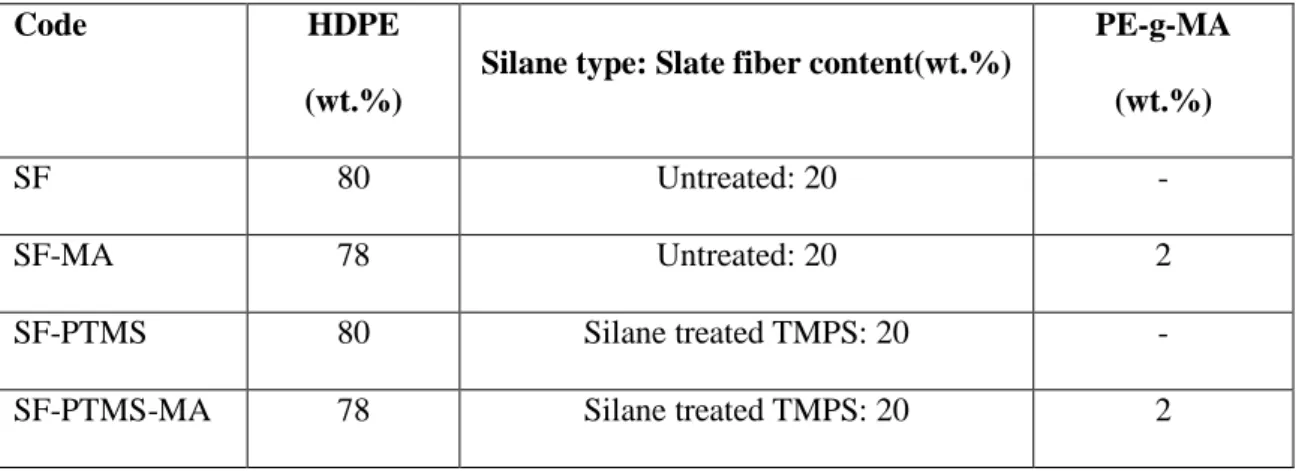
Four different HDPE-SF composite formulations were manufactured by varying the compatibilizing system at a constant slate content (see Table 2).
Table 2
Silane treatment was carried out as follows: 1 wt.% silane with respect to the slate fiber to silanize, was dissolved in a 50/50 water/methanol solution and the final solution was stirred for 10 min to ensure homogenization and hydrolysis of alkoxy groups. After this, slate fiber was immersed in this solution for 15 min and subsequently, slate fiber was removed and was washed with distilled water and dried at room temperature for 24 h.
HDPE-SF composites were manufactured with a twin screw extruder with 4
temperature stages (160 ºC, 160 ºC, 165 ºC and 170 ºC from the feeding to the dye) at a rotating speed of 40 rpm and subsequently pelletized. Standardized samples for testing were obtained with an injection molding machine Meteor 270/75 (Mateu and Solé, Barcelona, Spain) at an injection temperature of 190 ºC.
2.3.- Mechanical characterization of HDPE-slate fiber composites.
HDPE-SF composites were characterized by standardized mechanical tests: tensile, flexural, hardness and impact. Tensile and flexural tests were carried out at room temperature in a universal test machine Ibertest ELIB 30 (S.A.E. Ibertest, Madrid, España) following the guidelines of the ISO 527-5 and ISO 178 respectively. A 5 kN load cell was used and the crosshead speed was set to 5 mm min-1. Al least five samples were tested and average values of different parameters were calculated.
With regard to the impact test, a 1 J Charpy’s pendulum (Metrotec S.A., San Sebastián, Spain) was used as indicated in the ISO 179:1993 standard. Five different notched samples (“V”
1 2 3 4 5 6 7 8 9 10 11 12 13 14 15 16 17 18 19 20 21 22 23 24 25 26 27 28 29 30 31 32 33 34 35 36 37 38 39 40 41 42 43 44 45 46 47 48 49 50 51 52 53 54 55 56 57 58 59
notch type at 45º with a notch radius of 0.25 mm) were tested and average values of absorbed energy were calculated.
Hardness characterization was obtained with a Shore D durometer 673-D (Instrumentos J. Bot S.A., Barcelona, Spain) following the ISO 868. At least five different measurements were taken and average values were calculated.
2.4.- Characterization of HDPE-slate fiber fractured surfaces.
Fractured surfaces of HDPE-SF composites from impact tests were analyzed by scanning electron microscopy (SEM) with a FEI mod. Phenom (FEI Company, Eindoven, The Netherlands). All fractured samples were previously coated with a thin gold-palladium alloy with a sputter coater EMITECH model SC7620 (Quorum Technologies, East Suseex, UK).
2.5.- DMA de los composites de BioPE-Slate fiber.
Mechanical dynamical properties of HDPE-SF composites was evaluated in an oscillatory rheometer AR G2 (TA Instruments, New Castle, EEUU) equipped with a DMA accessory (torsion mode) for solid samples. Samples sizing 40x40x4 mm3 were subjected to a temperature program from -50 ºC up to 100 ºC at a heating rate of 2 ºC min-1under controlled strain of 0.1%.at a frequency of 1 Hz.
3.- Results and discussion.
3.1.- Study of the effect of compatibilizing system.
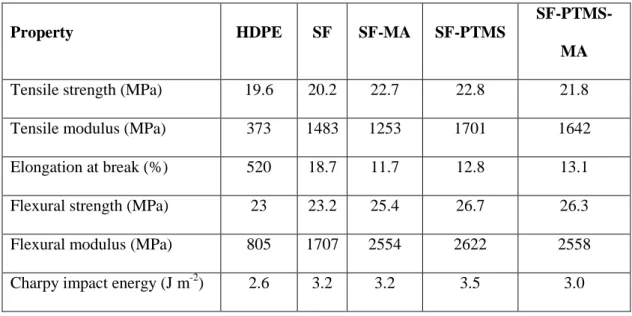
Firstly, the effect of the compatibilizing system on overall mechanical properties of HDPE-SF composites was evaluated at a constant slate fiber content of 20 wt.%. Table 3 shows a summary of the main mechanical properties obtained in tensile and flexural tests and impact tests.
1 2 3 4 5 6 7 8 9 10 11 12 13 14 15 16 17 18 19 20 21 22 23 24 25 26 27 28 29 30 31 32 33 34 35 36 37 38 39 40 41 42 43 44 45 46 47 48 49 50 51 52 53 54 55 56 57 58 59
As expected, tensile strength values of HDPE-SF composites are higher for all
composites if compared to unreinforced HDPE matrix. In addition, all tensile strength values of compatibilized HDPE-SF composites are higher than the value corresponding to
uncompatibilized HDPE-SF composites. Uncompatibilized HDPE-SF composite is
characterized by a tensile strength of about 20.2 MPa and this value is increased up to values of 22.8 MPa for composites containing PTMS silane treated slate fiber which represents a
percentage increase of about 13% with regard to the uncompatibilized HDPE-SF composite. Silanes can be attached to hydrophilic substrates by reaction of hydrolyzed alkoxy groups with hydroxyl groups such as Si-OH (in slate and other siliceous fibers) and C-OH (in natural fibers) thus leading to tailored functionalities.[27-29] Different research works focused on basalt fiber have shown the effectiveness of a silane treatment to improve fiber-matrix interactions. [30-32] Even in the case of the compatibilizing system consisting on a combination of silane treatment with propyletrimethoxy silane and a polyethylene-graft-maleic anhydride copolymer (PTMS-MA), the tensile strength is still higher with regard to the uncompatibilized HDPE-SF composite with values of 21.8 MPa (percentage increase of 8%). Some research works have proved the effectiveness of combination of silanes and copolymers to improve interactions between fiber and polymer matrix as in the case of polyethylene and glass fiber or
nanoclays.[33-35]
As it can be observed, addition of conventional compatibilizer (SF-PTMS-MA) does not lead to an increase in tensile strength but a small decrease can be detected which is accompanied by a slight increase in elongation at break. Obviously, as the elastic modulus is directly related to tensile strength and inversely related to elongation at break, the overall effect of the combination of hydrophobic silane and conventional graft compatibilizer is a slight decrease in elastic modulus.
Regarding the evolution of the tensile modulus, similar tendency can be observed. The only addition of slate fiber without any compatibilizer leads to a remarkable increase in stiffness. The initial elastic modulus of the unreinforced HDPE is close to 373 MPa and this
1 2 3 4 5 6 7 8 9 10 11 12 13 14 15 16 17 18 19 20 21 22 23 24 25 26 27 28 29 30 31 32 33 34 35 36 37 38 39 40 41 42 43 44 45 46 47 48 49 50 51 52 53 54 55 56 57 58 59
value is increased up to values of about 1483 MPa by the only addition of 20 wt.%
uncompatibilized slate fiber. One can observe that the silane treatment (alone or combined with the maleinized copolymer) promotes an increase in stiffness up to values of 1701 and 1642 MPa respectively.
With regard to flexural tests of HDPE-SF composites we observe the same behavior as previous tensile results. Composite samples with slate fiber subjected to silane (PTMS)
treatment show the highest flexural strength with values of 26.7 MPa which is slightly higher to the value corresponding to composites with combined compatibilizer system (PTMS silane treatment combined with 2 wt.% polyethylene graft maleic anhydride). In the case of flexural tests, the effectiveness of the compatibilization is clearly evident as both flexural strength and modulus are higher for HDPE-slate fiber composites with different compatibilization systems compared to the uncompatibilized system. The flexural modulus is increased up to values of about 2622 MPa which represents almost 54% higher than uncompatibilized HDPE-SF composites and 325% increase with regard to the unreinforced HDPE matrix.
As expected, the addition of reinforcing fiber into HDPE matrix leads to a remarkable decrease in elongation at break as observed in Table 3. Short fibers randomly dispersed into the HDPE matrix provide good stiffness but they act as stress concentrators thus leading to dramatic decrease in elongation at break.
Concerning to impact energy, all HDPE-SF composites (notched samples) show higher energy absorption than the unreinforced HDPE matrix. HDPE-SF composites with slate fibers subjected to surface treatment with PTMS offer the maximum energy absorption with values of about 3.4 J m-2 which represents a percentage increase of 13% with regard to the untreated slate fiber and 35% with regard to unreinforced HDPE matrix.
Scanning electron microscopy can be useful to evaluate interaction phenomena among fiber-matrix. Fig. 1 shows SEM images corresponding to fractured surfaces of HDPE-SF from impact tests.
1 2 3 4 5 6 7 8 9 10 11 12 13 14 15 16 17 18 19 20 21 22 23 24 25 26 27 28 29 30 31 32 33 34 35 36 37 38 39 40 41 42 43 44 45 46 47 48 49 50 51 52 53 54 55 56 57 58 59 Figure 1
As we can see, HDPE-SF composites with untreated slate fiber (SF) are characterized by a very low fiber-matrix interaction as observed in Fig. 1a. This is evidenced by presence of gaps at fiber-matrix interface. In addition, big holes and cavities related to removed slate fiber during impact tests can be observed thus evidencing low interaction between the organic matrix and the inorganic reinforcing fiber. The absence of fiber-matrix interactions does not allow load transfer from the matrix to the fiber so that, the fiber has a stress concentration effect which is responsible for relatively poor mechanical properties. The use of different compatibilizer systems leads improved fiber-matrix interactions as it can be observed in Fig. 1b, 1c and 1d. Presence of cavities due to removed slate fiber during fracture is less intense as compared to untreated slate fiber (SF). As a consequence load transfer between matrix and fiber occurs in a higher extent and this is responsible for higher tensile and flexural strength values for HDPE-SF composites with different compatibilizing systems. This effect is more evident for silane-treated samples as observed in Fig. 1c and 1d since fewer cavities can be detected in the fractured surface. Another evidence of the better interface interaction is the amount of material (HDPE matrix) that remains adhered to the fiber after the fracture by impact; this can be seen in Fig. 1c and 1d in which, a small amount of polyethylene matrix can be detected along the fiber surface. HDPE-SF composites without previous silane treatment offer clean and smooth surfaces representative for low fiber-matrix interaction.
Figure 2
The effect of the compatibilizing system can also be observed by following the evolution of the storage modulus (G’) with temperature. Fig. 2 shows plots evolution of the storage modulus for unreinforced HDPE and HDPE-SF composites with different
1 2 3 4 5 6 7 8 9 10 11 12 13 14 15 16 17 18 19 20 21 22 23 24 25 26 27 28 29 30 31 32 33 34 35 36 37 38 39 40 41 42 43 44 45 46 47 48 49 50 51 52 53 54 55 56 57 58 59
a remarkable increase in G’ and this phenomenon is more intense at low temperatures. In general terms we can see that silane-treated slate fiber (alone and combined with PE-g-MA) leads to slightly higher G’ values which is in total accordance with previous tensile and flexural results. With regard to the use of PE-g-MA as unique compatibilizer, once again we observe slightly lower G’ values (even lower than the uncompatibilized HDPE-SF composites). The highest G’ values for all the temperature range are obtained for HDPE-SF composites with previous silane treatment (PTMS) for slate fibers.
3.2.- Effect of slate fiber content on properties of HDPE-SF composites.
As we have clearly observed, silane-treated (propyletrimethoxy silane, PTMS) is the best compatibilizing system for the HDPE-slate fiber system. The silane treatment allows chemical anchorage of hydrophobic groups (propyl) as a consequence of the reaction between the hydrolyzed methoxy groups and hydroxyl groups in the topmost layers of the slate fibers thus leading to increase affinity with hydrophobic polyethylene chains. In general terms, propyletrimethoxy silane provides dual functionality to increase polyethylene (hydrophobic)-slate fiber (hydrophilic) interaction.
Once the optimum compatibilizing system has been selected, the influence of the slate fiber content on HDPE-slate fibers was studied by varying the slate fiber content in the 5-30 wt.% range).
Figure 3
Fig. 3 shows the plot evolution of different mechanical properties of HDPE-SF composites as a function of the slate fiber content (previously treated with propyletrimethoxy silane, PTMS). With regard to mechanical resistant properties we observe an increase in strength and modulus values (for both tensile and flexural tests) as the slate fiber content increases. By considering the tensile test results, the tensile strength is increased from 19.6 MPa
1 2 3 4 5 6 7 8 9 10 11 12 13 14 15 16 17 18 19 20 21 22 23 24 25 26 27 28 29 30 31 32 33 34 35 36 37 38 39 40 41 42 43 44 45 46 47 48 49 50 51 52 53 54 55 56 57 58 59
(unreinforced HDPE) up to values of about 22.7 MPa for HDPE-SF composites containing 30 wt.% slate fiber and this represents a percentage increase of about 16%. These values indicate the reinforcing effect of slate fiber. In addition, the addition of slate fiber leads to a remarkable increase in stiffness as detected by the increase in the elastic modulus which changes from 373 MPa (unreinforced HDPE) up to 2150 MPa for HDPE-SF (30 wt.% SF) which represents a percentage increase of almost 476%. This increase is elastic modulus is also a consequence of the decrease in elongation at break which is dramatically reduced from 520% (unreinforced HDPE) up to values of about 10-12% for composites containing 20-30 wt.% slate fiber. If we consider that the elastic modulus relates the strength and elongation in the linear region, an increase in strength and a decrease in elongation at break have a positive effect on increasing stiffness. Similar results are observed for flexural tests. The flexural strength of the unreinforced HDPE is 23 MPa and this value is increased up to values close to 30 MPa for composites containing 20-30 wt.% slate fiber. In a similar way, the flexural modulus suffers a noticeable increase of about 356%, as it changes from 805 MPa (unreinforced HDPE) up to 2864 MPa for HDPE-SF composites containing 30 wt.% slate fiber.
With regard to the ability of the material to absorb energy (impact conditions), we observe a slight decrease in the Charpy’s impact energy values for low slate fiber contents in the 5-10 wt.% range. In this case, it seems that it is not possible to transfer impact load from the HDPE matrix to the fiber as slate fiber appears as short dispersed fibers in the HDPE matrix and this low content is not enough to support all the impact stress. On the other hand, composites containing 20 and 30 wt.% slate fiber show a clear increase in the absorbed energy. Charpy’s impact energy reaches maximum values for HDPE-SF composites containing 30 wt.% slate fiber with values of about 4.2 kJ m-2 which represents a percentage increase of almost 61%.
1 2 3 4 5 6 7 8 9 10 11 12 13 14 15 16 17 18 19 20 21 22 23 24 25 26 27 28 29 30 31 32 33 34 35 36 37 38 39 40 41 42 43 44 45 46 47 48 49 50 51 52 53 54 55 56 57 58 59
As we have described previously, the slate fiber content has a positive effect on
mechanical resistant properties such as strength, modulus, stiffness but a decrease is detected for mechanical ductile properties such as elongation at break. Fig. 4 shows different SEM images of fractured surfaces after impact tests for HDPE-SF composites with different slate fiber content. With regard to HDPE-SF composites with 5 wt.% slate fiber, we have previously observed a slight decrease in Charpy’s absorbed energy and this can be explained by observing the corresponding fracture surface (Fig. 4a). When impact occurs, the composite is subjected to high stress; then, the matrix tries to transfer load/stress to the stiffer component (slate fiber) but in this case, the slate fiber content is too low to support all the transferred loads so that, the composite breaks with relatively low energy absorption. As the slate fiber content increases, the impact strength is transferred to more slate fibers which can dissipate some additional impact energy thus leading to increased Charpy’s absorbed energy values. Fractured surfaces for HDPE-SF composites with 20-30 wt.% slate fiber (Fig. 4 c and 4d) show clear evidence of the potential distribution of the impact stress between a high amount of short slate fibers and this has a positive effect on impact absorbed energy as described before.
Figure 5
The improvement on stiffness is also evident from DMA (torsion) tests as observed in Fig. 5. The addition of very low weight percentages of slate fiber does not provide reinforcing properties. It is important to take into account the relative density of both components: HDPE (0.955 g cm-3) and slate fiber (2.68 g cm-3); so that 5 wt.% slate fiber represents only a 1.8 v/v %. The non-reinforcing effect can be clearly observed by following the evolution of the storage modulus, G’ for HDPE-SF composites containing 5 wt.% slate fiber which overlaps the
unreinforced material. The reinforcing effects can be observed for slate fiber contents over 10 wt.% as G’ is shifted to higher values.
1 2 3 4 5 6 7 8 9 10 11 12 13 14 15 16 17 18 19 20 21 22 23 24 25 26 27 28 29 30 31 32 33 34 35 36 37 38 39 40 41 42 43 44 45 46 47 48 49 50 51 52 53 54 55 56 57 58 59 4.- Conclusions.
High environmentally friendly thermoplastic composites were manufactured by using high density polyethylene (HDPE) from sugarcane and new siliceous fiber namely slate fiber (SF) from slate wastes. Composites were manufactured by extrusion-compounding followed by injection molding. Different compatibilizing systems were tested in order to improve fiber-matrix interactions: silane treatment with hydrophobic propyltrimethoxy silane (PTMS) and a polyethylene graft maleic anhydride copolymer (PE-g-MA), alone and in combination. Optimum results were obtained for HDPE-SF with silane-treated (PTMS) slate fibers as described by mechanical properties and SEM analysis. On the other hand, the real reinforcing effect of slate fibers can be observed for fiber contents over 10 wt.% slate fiber as all
mechanical resistant properties (strength, modulus, stiffness) are remarkably increased but, in addition, the Charpy’s absorbed energy is higher than the unreinforced matrix. Due to the nature and density of the slate fiber, it is possible to add it in conventional extrusion and subsequent injection molding processes up to a total content of about 30 wt.% with attraction increase in stiffness. As a general conclusion, we report new attractive materials from technical,
economical and environmental points of view which can compete with conventional glass fiber (GF) reinforced petroleum-based polyolefins such as polyethylene and polypropylene but with a marked environmental efficiency as the matrix is obtained from renewable resources and slate fiber gives a solution to an increasing problematic linked to slate wastes accumulation.
Acknowledgements
Authors thank “Ministerio de Economia y Competitividad” ref: MAT2011-28468-C02-02 for financial support.
1 2 3 4 5 6 7 8 9 10 11 12 13 14 15 16 17 18 19 20 21 22 23 24 25 26 27 28 29 30 31 32 33 34 35 36 37 38 39 40 41 42 43 44 45 46 47 48 49 50 51 52 53 54 55 56 57 58 59 References
1. Koronis G, Silva A and Fontul M. Green composites: A review of adequate materials for automotive applications. Compos Part B-Eng 2013;44(1):120-127.
2. Dicker MPM, Duckworth PF, Baker AB, Francois G, Hazzard MK and Weaver PM. Green composites: A review of material attributes and complementary applications. Compos Part A-Appl S 2014;56(280-289.
3. Kwon H-J, Sunthornvarabhas J, Park J-W, Lee J-H, Kim H-J, Piyachomkwan K, Sriroth K and Cho D. Tensile properties of kenaf fiber and corn husk flour reinforced
poly(lactic acid) hybrid bio-composites: Role of aspect ratio of natural fibers. Compos Part B-Eng 2014;56(232-237.
4. Faruk O, Bledzki AK, Fink H-P and Sain M. Progress Report on Natural Fiber Reinforced Composites. Macromol Mater Eng 2014;299(1):9-26.
5. Ganster J, Erdmann J and Fink H-P. Biobased composites. Polymery-W 2013;58(6):423-434.
6. Arif MF, Meraghni F, Chemisky Y, Despringre N and Robert G. In situ damage mechanisms investigation of PA66/GF30 composite: Effect of relative humidity. Compos Part B-Eng 2014;58(487-495.
7. Asasutjarit C, Charoenvai S, Hirunlabh J and Khedari J. Materials and mechanical properties of pretreated coir-based green composites. Compos Part B-Eng
2009;40(7):633-637.
8. Balakrishna A, Rao DN and Rakesh AS. Characterization and modeling of process parameters on tensile strength of short and randomly oriented Borassus Flabellifer (Asian Palmyra) fiber reinforced composite. Compos Part B-Eng 2013;55(479-485. 9. Herrera-Franco PJ and Valadez-Gonzalez A. A study of the mechanical properties of
1 2 3 4 5 6 7 8 9 10 11 12 13 14 15 16 17 18 19 20 21 22 23 24 25 26 27 28 29 30 31 32 33 34 35 36 37 38 39 40 41 42 43 44 45 46 47 48 49 50 51 52 53 54 55 56 57 58 59
10. Ku H, Wang H, Pattarachaiyakoop N and Trada M. A review on the tensile properties of natural fiber reinforced polymer composites. Compos Part B-Eng 2011;42(4):856-873.
11. Yan L, Chouw N and Jayaraman K. Flax fibre and its composites - A review. Compos Part B-Eng 2014;56(296-317.
12. Yan ZL, Zhang JC, Lin G, Zhang H, Ding Y and Wang H. Fabrication process optimization of hemp fibre-reinforced polypropylene composites. J Reinf Plast Comp 2013;32(20):1504-1512.
13. Chianelli-Junior R, Reis JML, Cardoso JL and Castro PF. Mechanical Characterization of Sisal Fiber-Reinforced Recycled HDPE Composites. Mater Res-Ibero-Am J
2013;16(6):1393-1397.
14. Erkendirci OF and Haque BZ. Quasi-static penetration resistance behavior of glass fiber reinforced thermoplastic composites. Compos Part B-Eng 2012;43(8):3391-3405. 15. Santos Almeida Junior JH, Amico SC, Botelho EC and Rico Amado FD. Hybridization
effect on the mechanical properties of curaua/glass fiber composites. Compos Part B-Eng 2013;55(492-497.
16. Rahman NA, Hassan A, Yahya R and Lafia-Araga RA. Impact Properties of Glass-fiber/Polypropylene Composites: The Influence of Fiber Loading, Specimen Geometry and Test Temperature. Fiber Polym 2013;14(11):1877-1885.
17. Huang R, Xu X, Lee S, Zhang Y, Kim B-J and Wu Q. High Density Polyethylene Composites Reinforced with Hybrid Inorganic Fillers: Morphology, Mechanical and Thermal Expansion Performance. Materials 2013;6(9):4122-4138.
18. Hintze C, Boldt R, Wiessner S and Heinrich G. Influence of processing on morphology in short aramid fiber reinforced elastomer compounds. J Appl Polym Sci
1 2 3 4 5 6 7 8 9 10 11 12 13 14 15 16 17 18 19 20 21 22 23 24 25 26 27 28 29 30 31 32 33 34 35 36 37 38 39 40 41 42 43 44 45 46 47 48 49 50 51 52 53 54 55 56 57 58 59
19. Arao Y, Yumitori S, Suzuki H, Tanaka T, Tanaka K and Katayama T. Mechanical properties of injection-molded carbon fiber/polypropylene composites hybridized with nanofillers. Compos Part A-Appl S 2013;55(19-26.
20. Mokhtar I, Yahya MY and Kadir MRA. Mechanical Characterization of Basalt/HDPE Composite under In-Vitro Condition. Polym-Plast Technol 2013;52(10):1007-1015. 21. Lopresto V, Leone C and De Iorio I. Mechanical characterisation of basalt fibre
reinforced plastic. Compos Part B-Eng 2011;42(4):717-723.
22. Manikandan V, Jappes JTW, Kumar SMS and Amuthakkannan P. Investigation of the effect of surface modifications on the mechanical properties of basalt fibre reinforced polymer composites. Compos Part B-Eng 2012;43(2):812-818.
23. Segatelli MG, Pagotto Yoshida IV and Goncalves MdC. Natural silica fiber as reinforcing filler of nylon 6. Compos Part B-Eng 2010;41(1):98-105.
24. Deak T, Czigany T, Marsalkova M and Militky J. Manufacturing and Testing of Long Basalt Fiber Reinforced Thermoplastic Matrix Composites. Polym Eng Sci
2010;50(12):2448-2456.
25. Barluenga G and Hernandez-Olivares F. Self-levelling cement mortar containing grounded slate from quarrying waste. Constr Build Mater 2010;24(9):1601-1607. 26. de Carvalho GMX, Mansur HS, Vasconcelos WL and Orefice RL. Composites
obtained by the combination of slate powder and polypropylene. Polimeros 2007;17(2):98-103.
27. Rodriguez MA, Rubio J, Rubio F, Liso MJ and Oteo JL. Study of the reaction of gamma-aminopropyltriethoxy silane with slate particles. Bol Soc Esp Ceram V 2001;40(2):101-106.
28. Xie Y, Hill CAS, Xiao Z, Militz H and Mai C. Silane coupling agents used for natural fiber/polymer composites: A review. Compos Part A-Appl S 2010;41(7):806-819.
1 2 3 4 5 6 7 8 9 10 11 12 13 14 15 16 17 18 19 20 21 22 23 24 25 26 27 28 29 30 31 32 33 34 35 36 37 38 39 40 41 42 43 44 45 46 47 48 49 50 51 52 53 54 55 56 57 58 59
29. El-Sabbagh A. Effect of coupling agent on natural fibre in natural fibre/polypropylene composites on mechanical and thermal behaviour. Compos Part B-Eng 2014;57(126-135.
30. Deak T, Czigany T, Tamas P and Nemeth C. Enhancement of interfacial properties of basalt fiber reinforced nylon 6 matrix composites with silane coupling agents. Express Polym Lett 2010;4(10):590-598.
31. Espana JM, Samper MD, Fages E, Sanchez-Nacher L and Balart R. Investigation of the effect of different silane coupling agents on mechanical performance of basalt fiber composite laminates with biobased epoxy matrices. Polym Composite 2013;34(3):376-381.
32. Varley RJ, Tian W, Leong KH, Leong AY, Fredo F and Quaresimin M. The effect of surface treatments on the mechanical properties of basalt-reinforced epoxy composites. Polym Composite 2013;34(3):320-329.
33. Bikiaris D, Matzinos P, Prinos J, Flaris V, Larena A and Panayiotou C. Use of silanes and copolymers as adhesion promoters glass fiber/polyethylene composites. J Appl Polym Sci 2001;80(14):2877-2888.
34. Pascual J, Fages E, Fenollar O, Garcia D and Balart R. Influence of the
compatibilizer/nanoclay ratio on final properties of polypropylene matrix modified with montmorillonite-based organoclay. Polym Bull 2009;62(3):367-380.
35. Catto AL, Stefani BV, Ribeiro VF and Santana RMC. Influence of coupling agent in compatibility of post-consumer HDPE in thermoplastic composites reinforced with eucalyptus fiber. Mater Res 2014;ahead):0-0.
1 2 3 4 5 6 7 8 9 10 11 12 13 14 15 16 17 18 19 20 21 22 23 24 25 26 27 28 29 30 31 32 33 34 35 36 37 38 39 40 41 42 43 44 45 46 47 48 49 50 51 52 53 54 55 56 57 58 59 Figure captions
Figure 1.- SEM images of fractured surface (1000X) of HDPE-SF composites with different compatibilization systems: a) untreated slate fiber (SF), b) untreated slate fiber and use of 2 wt.% PE-g-MA copolymer (SF-MA), c) slate fiber subjected to silane treatment with propyltrimethoxy silane (SF-PTMS) and d) slate fiber subjected to silane treatment with propyltrimethoxy silane (SF-PTMS) in combination with 2 wt.% PE-g-MA copolymer (SF-PTMS-MA).
Figure 2.- Plot evolution of the storage modulus (G’) of HDPE-SF at a fixed slate fiber content of 20 wt.% for different compatibilizing systems.
Figure 3.- Plot evolution of mechanical properties of HDPE-SF composites in terms of the slate fiber content (wt.%) a) tensile modulus, tensile strength and elongation at break, b) flexural modulus and flexural strength and c) Charpy’s impact energy.
Figure 4.- SEM images of fractured surface from impact tests (400X) for HDPE-SF composites with different wt.% of slate fiber coupled with propyltrimethoxy silane, PTMS: a) 5 wt.%, b) 10 wt.%, c) 20 wt.% and d) 30 wt.%.
Figure 5.- Plot evolution of the storage modulus (G’) of HDPE-SF composites containing different wt. % of slate fiber (silanized with propyltrimethoxy silane, PTMS).
Table 1.- Chemical composition of slate fiber obtained by X-ray fluorescence spectroscopy. Composition wt.(%) SiO2 53.50 Fe2O3 15.70 Al2O3 15.11 CaO 10.05 TiO2 3.02 K2O 2.38 MnO 0.25 Table 1
Table 2.- Composition of HDPE-slate fiber composites and their code.
Code HDPE
(wt.%)
Silane type: Slate fiber content(wt.%)
PE-g-MA (wt.%)
SF 80 Untreated: 20 -
SF-MA 78 Untreated: 20 2
SF-PTMS 80 Silane treated TMPS: 20 -
SF-PTMS-MA 78 Silane treated TMPS: 20 2
Table 3.- Mechanical properties of HDPE-slate fiber composites obtained by tensile, flexural and impact tests in terms of the compatibilizing system for a constant slate fiber content of 20 wt.%.
Property HDPE SF SF-MA SF-PTMS
SF-PTMS-MA Tensile strength (MPa) 19.6 20.2 22.7 22.8 21.8
Tensile modulus (MPa) 373 1483 1253 1701 1642
Elongation at break (%) 520 18.7 11.7 12.8 13.1 Flexural strength (MPa) 23 23.2 25.4 26.7 26.3 Flexural modulus (MPa) 805 1707 2554 2622 2558 Charpy impact energy (J m-2) 2.6 3.2 3.2 3.5 3.0 Table 3