Center for Development Economics,
WILLIAMS COLLEGE
CDE Working Paper Series
Title:
Cosigners As Collateral
Authors:
Stefan Klonner and Ashok S. Rai
Date:
May
2008
Abstract:
We investigate the role of cosigners as collateral using data from a South Indian financial institution. Using an exogenous change in the cosigner requirement, we establish a negative causal effect of cosigners on defaults: an increase in the number of cosigners reduces defaults all else equal. Our results suggest that a one-sixth increase in the number of cosigners reduces the incidence of a default by 7:5 percent. While most theories of collateral predict that increased cosigners will reduce defaults, we are first to find empirical evidence of this effect.
Cosigners As Collateral
May 2008Abstract: We investigate the role of cosigners as collateral using data from a South Indian …nancial institution. Using an exogenous change in the cosigner requirement, we establish a negative causal e¤ ect of cosigners on defaults: an increase in the number of cosigners reduces defaults all else equal. Our results suggest that a one-sixth increase in the number of cosigners reduces the incidence of a default by 7:5 percent. While most theories of collateral predict that increased cosigners will reduce defaults, we are …rst to …nd empirical evidence of this e¤ect.
JEL Codes: O16, D82, G21
1
Introduction
There is a widespread theoretical presumption that collateral induces borrowers to repay loans by overcoming information asymmetries or enforcement problems.1 Identifying this causal link has proved di¢ cult for the following reason. In many situations the lender has "soft" information about the riskiness of particular borrowers – and this information is not observed by the researcher (Petersen and Rajan, 1994; Uzzi and Lancaster, 2003). A lender will then ask ex-ante riskier borrowers for more collateral which will lead the researcher to report a positive correlation between collateral and ex-post defaults. This positive correlation has been found in a variety of developed and less developed …nancial markets (Berger and Udell,1990;Carey, Post and Sharpe,1998;Jimenez, Salas and Saurina
2006; John, Lynch and Puri 2003 and Liberti and Mian, 2008). There is little empirical evidence for an underlying negative causal link, however. Put di¤erently, the question that motivates us –does collateral induce repayments –has largely been unanswered in the previous literature.
We investigate a particular form of collateralized lending in which a borrower’s repay-ment is backed by the collateral of one or more cosigners. Such cosigned loans are ubiquitous.2 We use data on 11;141 loans given by a non-bank …nancial institution in South India with an average default rate of 12:5 percent. The lender asks for anywhere between zero to six cosigners on each loan (with a mean of1:2cosigners per loan). Cosign-ers pledge their future wages as collateral – and fewer cosignCosign-ers are associated with less collateral pledged.
We make two contributions in this paper. First, we extend the …ndings of the empirical 1
This literature includes models in which collateral reduces moral hazard (Chan and Thakor, 1987 and Boot and Thakor, 1994), enforces contracts (Aghion and Bolton, 1992), and screens risky borrowers (Bester, 1985; Chan and Kanatas, 1985; Besanko and Thakor, 1987a and Besanko and Thakor, 1987b). La Porta, Lopez-de-Silanes and Shleifer (2008) review the broader institutional consequences of such a view.
2
Cosigned loans are popular in the United States (Berger and Udell, 1998), in Europe (Pozzolo, 2004) and in many developing countries. There are also numerous historical accounts of this lending practice (Baker, 1977; Guinnane, 1994; Newton, 2000; Phillips and Mushinski, 2001).
literature on traditional collateral cited above to cosigners as collateral. We …nd that the number of cosigners is positively correlated with default rates: an additional cosigner is associated with an increase in the incidence of default by about one tenth. Secondly, we investigate the causal e¤ect of the number of cosigners on default rates. We exploit a discontinuity in the rules of the lender, which instruct loan o¢ cers to relax the number of cosigners required for some loans, but not for others. We …nd that defaults rise in response to this relaxation of the cosigner requirement. The e¤ects are substantial: a relaxation of the cosigner requirement by one-sixth increases the probability that the borrower will default by 7:5 percent or more.
We show that additional cosigners do more than simply provide a way to collect funds after the loan has been defaulted on by the borrower. Put di¤erently, we reject the null hypothesis that cosigners serveonlyas a hedge against default risk in favor of the alternative that they promote repayment by the borrower. Cosigners may improve repayment by the borrower herself by solving adverse selection problems (Besanko and Thakor, 1987a) and moral hazard problems (Banerjee, Besley, Guinnane, 1994) just as traditional collateral does. Unlike traditional collateral, cosigners may also promote repayment by providing a borrower with insurance if she experiences a shock (Rai and Sjöström, 2004). We cannot distinguish between these three channels with our data.
We also investigate an interesting and counterintuitive alternative in which relaxing the number of cosigners on a loan may reduce defaults. This "lazy banks hypothesis" was suggested by Manove, Padilla and Pagano (2001). In contrast with the rest of the literature, banks have an information advantage over borrowers in their model. It is e¢ cient for banks to screen borrowers ex ante and not to fund low return projects. But if loans are collateralized, then banks become lazy since screening is costly. Screening and collateral are substitutes for the bank. So relaxing the collateral requirement will causally lead (a) to better screening and (b) even to lower defaults. In our context then relaxing the cosigner requirement should have the same e¤ects. While we do …nd slight evidence for the former implication, we …nd no evidence that fewer cosigners lower default rates.
Our study is part of a broader literature on …nance and economic development. The lack of collateral – and the accompanying …nancial constraints on the poor – are thought to be a primary cause of underdevelopment (Banerjee 2003, Townsend 1997). Cosigners could serve to provide …nancial access to borrowers with no traditional collateral of their own –and thus ease these …nancial constraints. Cosigned loans are related to group loans popular in micro…nance (Bond and Rai, 2008); both types of lending are based on the use of "social collateral" to promote repayment.
Plan for the Paper
The paper proceeds as follows. In Section 2 we provide background on the non-bank
…nancial institution in South India and on our dataset. In Section 3 we outline our empirical strategy. We discuss our results in Section 4 and conclude in Section 5.
2
Data and Institutional Background
This study uses data on Rotating Savings and Credit Associations (commonly referred to as Roscas). Roscas match borrowers and savers but do so quite di¤erently from banks. They are common in many parts of the world (Besley et al, 1993). In this section we provide some background on how the Roscas in our study operate. We pay particular attention to who holds the default risk and how loans are secured by cosigners. We also describe the sample of Rosca borrowers that we will use in our subsequent empirical analysis.
Rules
Roscas are …nancial institutions in which the accumulated savings are rotated among par-ticipants. Participants in a Rosca meet at regular intervals, contribute into a "pot" and rotate the accumulated contributions. So there are always as many Rosca members as meetings. In random Roscas, the pot is allocated by lottery and in bidding Roscas the pot is allocated by an auction at each meeting. Our study uses data on the latter.
More speci…cally, the bidding Roscas in our sample work as follows. Each month participants contribute a …xed amount to a pot. They then bid to receive the pot in an oral ascending bid auction where previous winners are not eligible to bid. The highest bidder receives the pot of money less the winning bid and the winning bid is distributed among all the members as an interest dividend. The winning bid can be thought of as the price of capital. Consequently, higher winning bids mean higher interest payments. Over time, the winning bid falls as the duration for which the loan is taken diminishes. In the last month, there is no auction as only one Rosca participant is eligible to receive the pot. We illustrate the rules with a numerical example:
Example (Bidding and Payo¤s) Consider a 3 person Rosca which meets once a month and each participant contributes $10: The pot thus equals $30. Suppose the winning bid is $12in the …rst month. Each participant receives a dividend of $4: The recip-ient of the …rst pot e¤ ectively has a net gain of $12(i.e. the pot less the bid plus the dividend less the contribution, 30 12 + 4 10). Suppose that in the second month, when there are 2 eligible bidders, the winning bid is $6: And in the …nal month, there is only one eligible bidder and so the winning bid is zero: The net gains and contributions are depicted as:
Month 1 2 3
Winning bid 12 6 0 First Recipient 12 -8 -10 Second Recipient -6 16 -10 Last Recipient -6 -8 20
The …rst recipient is a borrower: he receives $12and repays $8and $10in subsequent months, which implies a 30% monthly interest rate. The last recipient is a saver: she saves $6 for 2 months and $8for a month and receives $20, which implies a 67% monthly rate. The intermediate recipient is partially a saver and partially a borrower. In what follows, we shall often refer to the winning bid or the "repayment burden"
relative to the pot size. The winning bid in the above example in round 1 is $12 or
40 percent of the pot size. The repayment burden is the total owed (i.e. the sum of contributions less dividends for a Rosca winner). The repayment burden for the round 1
borrower in the above example is$18or60percent of the pot size. The repayment burden for round2 winner is$10or one-third of the pot.
The Sample
The bidding Roscas we study are large scale and organized commercially by a non-bank …nancial …rm. The data we use is from the internal records of an established Rosca organizer in the southern Indian state of Tamil Nadu.3 We collected data on the cosigners for all Roscas started in the year2001:
Several hundred Roscas of di¤erent durations and contributions were started in 2001:
Table1 summarizes the di¤erent Rosca denominations. The most common Rosca
denom-ination met for 40 months with a Rs. 250 monthly contribution (the total pot is then Rs. 10;000):There were also Roscas that met for shorter durations (25or 30 months) or for longer (50 months) and with higher and lower total pot sizes. These di¤erent Rosca denominations serve to match borrowers and savers with di¤erent investment horizons.
Every Rosca participant (other than the …rst and last winner) is both a borrower and a saver. For instance, the round22 winner in a30month Rosca has been contributing for21
months, takes a loan, and then repays for the remaining 8 months of the Rosca. In what follows we shall refer to the observations in our sample as Rosca borrowers for simplicity – by this we mean Rosca winners who have one or more contributions due after winning the pot –and hence are a repayment risk. So the round 22 borrower in a30 round Rosca will have a lower repayment burden (sum of contributions due net of dividends from rounds 23
3
Bidding Roscas are a signi…cant source of …nance in South India, where they are called chit funds. Deposits in regulated bidding Roscas were12:5%of bank credit in the state of Tamil Nadu and25%of bank credit in the state of Kerala in the 1990s, and have been growing rapidly (Eeckhout and Munshi, 2004). There is also a substantial unregulated chit fund sector.
to30)than, say, a round5 borrower.
In these bidding Roscas, participants do not know each other and the …rm that organizes the Roscas takes on the default risk. If a participant fails to make a contribution, the organizer will contribute funds on his/her behalf. In this way, a round22borrower who fails to contribute in round23 will not reduce the pot available to the other Rosca participants in round 23: In exchange the organizer receives a commission of 6 percent of the pot in each round. The Rosca organizer is also a special Rosca member who receives the entire …rst pot (at a zero bid) and makes contributions thereafter.
We construct our sample of Rosca borrowers from the Roscas started in2001as follows:
1. We include Rosca winners for the14rounds before and after the middle of the Rosca. This allows us to use all the information for those Roscas that lasted30rounds. The …rst pot in these Roscas is won by the Rosca organizer clearly has no default risk and the last recipient (the pure saver) never has to make a repayment –so all28 auction winners in30round Roscas who have some risk of default are included in our sample. Table1 shows that30 round Roscas are very common.
2. About one third of all Rosca participants are institutional investors. These institu-tional investors never default and are exempt from collateral requirements. For this reason we have excluded pots won by institutional investors from our sample.
3. We exclude pots won by housewives from our sample because conversations with loan o¢ cers indicate that they are treated quite di¤erently from other Rosca participants (their husbands are partly liable for repayment and so their cosigner requirement is not comparable to other Rosca borrowers). That said, our results were una¤ected when we did include housewives.
Descriptive statistics for the11;141non-institutional non-housewife Rosca borrowers in our sample are in Table 1 and 2. Each observation refers to a pot awarded to an auction winner. From Table2;the mean duration is34months and the mean monthly contribution is Rs. 1424:8 (approximately $29:7 using the exchange rate of 48 Indian Ruppees to one
US dollar). The winning bid is 17 percent of the pot on average in these Roscas. That represents (roughly) the fraction of the pot that the borrower is willing to forego to other participants in order to borrow. Notice that the maximum winning bid is30percent of the pot. This is because of a government imposed ceiling on bids that binds in early rounds of most Roscas (discussed further in Eeckhout and Munshi,2004and Klonner and Rai,2006). The repayment burden is42 percent of the pot on average.
Defaults refer to overdues at the maturity of the loan (at the end of the Rosca). The mean default rate in our sample is12:5percent (Table2). The default rate for each Rosca borrower is calculated as the amount outstanding at the end of the Rosca as a fraction of the repayment burden. So for instance, in the three-person example above, if the Rosca borrower in round 2failed to make his round 3repayment, his default rate would be 1: If the Rosca borrower in round 1failed to make his round 3repayment of$10(but did make the round2 repayment of$8), his default rate would be 1018 or56 percent.4
Cosigners and Enforcement
As we have mentioned above, the …rm that organizes the Roscas takes on the risk of default. Rather than asking for physical collateral, the organizer requires auction winners to provide cosigners before releasing the loans. Cosigners are required to be salaried employees with a minimum monthly income that depends on the Rosca denomination. This is because the organizer has a legally enforceable claim against their future income as collateral for the loan. Relatives (even spouses) can act as cosigners on loans.5
Our …eld conversations with loan o¢ cers indicate that they use a variety of character-istics of the borrower to decide on the number of cosigners required. For instance, the
4
We are interested in defaults (or missed contributions) for Rosca participants after they have won the pot. In some cases Rosca participants may drop out before winning the pot because they fail to make contributions – and they are replaced by other participants.
5
We did not have access to cosigner salaries – a variable which would have given us an indication of the quality of each cosigner – and hence a better measure of the "total" collateral pledged by cosigners. We return to this issue when we interpret our results in Section4:
winning bid is sometimes seen as an indication of the repayment prospects. A Rosca par-ticipant who has a history of making contributions on time (in the months before he wins the auction) is looked on favorably. Moreover, the loan o¢ cer may have access to soft information on the borrower through social networks. The researcher may observe some of these characteristics (e.g. the winning bids) but not others, such as the history of on-time contributions and informal unrecorded opinions that the loan o¢ cer has gathered about the borrower.
While the loan o¢ cer has discretion in deciding on the number of cosigners required for each loan, the Rosca organizer issues allows for a relaxation of the cosigner requirement in the middle round. Rosca borrowers are issued a guideline requiring three cosigners for winners of auctions up to the middle round of a Rosca, but only two cosigners for winners of later auctions. To illustrate, for Roscas of 40 months duration and a contribution of Rs. 250 per month, the booklet with information for participants states:
"Nature of Security: If prized within 20 installments - 3 guarantors with a net income of Rs. 3000 per month and if prized after the above said installments 2 guarantors as above must be furnished."
The rationale is that later borrowers have fewer contributions due and hence are lower risks than earlier borrowers. Loan o¢ cers told us that they view this guideline as a "rule of thumb" that allows them to relax the cosigner requirement for borrowers in the second half of the Rosca relative to borrowers in the …rst half.
The average number of cosigners attached to a loan in our sample is1:2with considerable variation (Table2): If the guidelines were followed strictly, then we would expect an average of 2:5 cosigners per loan. But as we shall demonstrate in Section 3, the guidelines are followed in spirit but not to the letter; there is indeed a discontinuous relaxation in the number of cosigners required at the middle round of Roscas. This particular discontinuity in assigning cosigners to loans is what we shall exploit to identify the causal e¤ect of cosigners on defaults.
The loan o¢ cer may also verify the auction winner’s income before releasing the loan. For instance, a self-employed person will be asked for tax returns or bank statements while a salaried employee will be asked for an earning record. This veri…cation occurs in only half the cases (see Table 2): Veri…cation is a form of costly screening on the part of the loan o¢ cer – because it takes time and e¤ort. If a borrower’s income veri…cation process yields additional information that suggests he may be a repayment risk, the loan o¢ cer may ask for additional cosigners. In the data we only observe the eventual number of cosigners that was required – we do not observe if there was an upward revision in the cosigner requirement. If the winner of the pot is unable to provide su¢ cient cosigners, then the pot is re-auctioned at a subsequent Rosca meeting. These re-auctions happen infrequently and are not recorded explicitly as re-auctions in the dataset. In e¤ect, loan o¢ cers can push a person who has won the won the pot but is of dubious repayment quality to later rounds by such screening. The implications of costly screening will be discussed further in Section
4 when we discuss the "lazy banks" hypothesis.
The defaults we measure re‡ect payments made by the borrower to the Rosca organizer – and some of these may indeed be …nancial help that the borrower has received from cosigners –but not payments collected directly from the cosigners by the organizer. To understand why this is so, it is useful to describe the long and costly collection process.6 When a borrower misses an installment, then the organizer sends a legal notice to the borrower (after5months), another legal notice to borrower and cosigners (after6 months) and takes them to court (at 12 months if the amount is still overdue). The court begins to collect money from the cosigners approximately27months after the missed installment, and remits collection proceeds to the Rosca organizer around4years after the missed installment. The court also collects a12percent per year interest penalty on overdues. Our …eld interviews indicate that the Rosca organizer pushes through with this long costly collection process to make its collateral threat credible.
6
Visaria (2006) …nds that legal reforms that improve loan collection in India have substantial e¤ects on repayment and interest rates.
Loan o¢ cers con…rmed that they never collect money directly from cosigners through the long legal process, but only receive funds collected from cosigners through the court at the very end of the 4 year process. Our measure of default is based on overdues at the end of a Rosca. As our sample comprises only 28 rounds around the middle round of each Rosca and the longest Rosca duration is 50 months, the longest possible period that a borrower may have overdues is 39 months (50=2 + 14). We are thus assured that our default measure is based only on repayment by the borrower herself, not on money collected from the cosigner approximately4 years after a missed installment. This feature will allow us to distinguish whether cosigners promote repayment or are simply an ex-post hedging device. Since we do not have any data on the money collected through court proceeding from cosigners, we are unable to quantify the degree to which wages garnished from cosigners can reduce the12:5percent default rate for our sample. Put di¤erently, we cannot test the extent to which cosigners serve as a hedge for the lender against default risk.
3
Empirical Strategy
Our empirical strategy is based on a rule of thumb that allows loan o¢ cers to relax the cosigner requirement for borrowers in the middle of a Rosca. The identifying assumption is that loan terms such as winning bids and repayment burdens change continuously from round to round but the cosigner requirement changes discontinuously.
To illustrate, consider a 30 round Rosca in which the loan o¢ cer is allowed to ask for fewer cosigners in round16relative to round15: Our empirical approach will be to compare the default rates for round 16 borrowers with those of round 15 borrowers holding other loan terms constant. In other words, our test is whether round 16 loans are more likely to default compared with observationally identical round 15 loans. Our null hypothesis is that cosigners do not induce repayment and so round 16 borrowers are just as likely to default as round15 borrowers - holding other loan terms constant.
cosigners required in the middle round of Roscas. We then discuss how we shall use the relaxation in the cosigner requirement to test if there is a causal relationship between the number of cosigners and defaults. In other words, does the decrease in the number of cosigners induce a drop in the likelihood of repayment?
Discontinuity in Cosigner Requirement
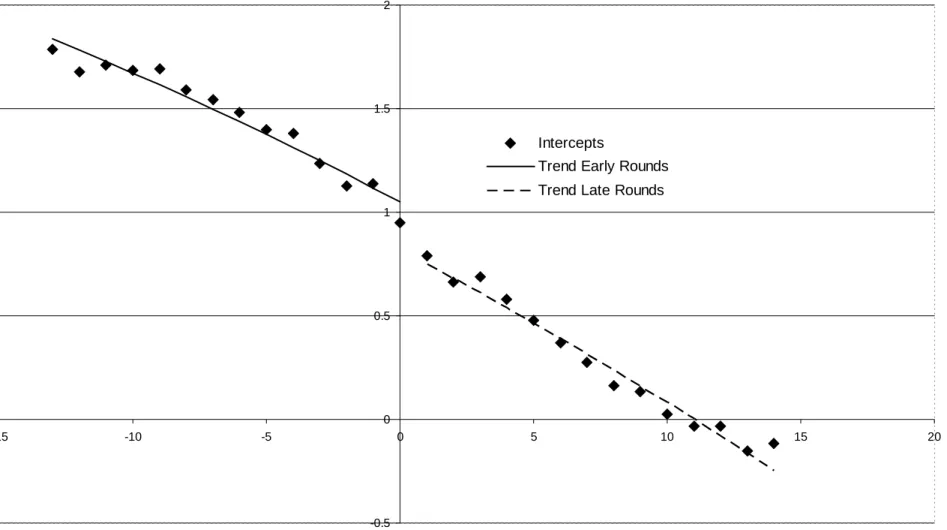
The number of cosigners required on a loan depends on the loan o¢ cer’s discretion and on the rule of thumb loosening the cosigner requirement after the middle round. We test if this rule of thumb does indeed explain loan o¢ cer behavior in Table 4 (and Figure 1): Is there is a decrease in the cosigner requirement in the middle round holding other loan terms constant?
We …rst estimate the following OLS regression for the determinants of the number of cosigners:
zit= t+ xit+"it (1)
wherezitis the number of cosigners attached to the loan of the borrower in roundtof Rosca iandxitis a vector of controls. The vector of controls includes dummies for 18 branches and
18 denominations (listed in Table 1) and the 10 borrower employment category dummies (listed in Table3): The point estimates of the intercept tare plotted in Figure1; for space
considerations they are not reported in a table. The round of a borrower is normalized around the median round in each Rosca.7 OLS estimates of the coe¢ cients in (1) when relative winning bids and relative repayment burdens are included as controls are shown in Table4 column1: The downward trend in the estimated intercept terms t suggests that
loan o¢ cers relax the cosigner requirement not only at the median round but also gradually from round to round.
We next explore the downward trend suggested by Figure 1 and investigate if there is a trend break in the median round. To do so, we regress the number of cosigners required
7
IfT is the number of Rosca members/rounds, we de…ne the median round as T =2if T is even and as one plus the integer ofT =2ifT is odd.
against a time trend and thelateit indicator:
zit= 0+ 1t+ 2t2+ lateit+ xit+"it:
where lateit equals one for all borrowers later than the median round and zero otherwise.
This speci…cation is based on the identifying assumption that loan terms change continu-ously from round to round but the cosigner requirement changes discontinucontinu-ously.
The results of this estimation are in Table4 column2(without winning bid and repay-ment burden as controls) and in column 3 (with all controls). The quadratic trend line with the intercept change after the median borrower from column2 of Table 4 is depicted in Figure 1. The trend line is downward sloping as fewer cosigners are required for later
borrowers whose repayment burdens are smaller. The estimate of (the coe¢ cient on
lateit) is positive and signi…cant indicating a trend break. This trend break can be seen
in Figure 1: borrowers just after the median round have signi…cantly fewer cosigners than those at the median round, controlling for the downward trend. The relaxation in cosigner requirement is large – the number of cosigners required fell by 0:22 cosigners, around 18
percent of the sample mean number of cosigners. The quadratic trend term is insigni…cant in column3 indicating the linear trend …ts the default generating process over rounds well but the …t is not as good when the winning bid and repayment burden are excluded from the list of controls (column2):
Note that the winning bid is an important determinant of the number of cosigners in Table 4. When the winning bid increases by 10 percentage points, the loan o¢ cer asks for nearly0:3 additional cosigners. The positive relation between higher winning bids and cosigners required holds conditional on the round (column1) as well as in the speci…cation with a time trend and break (column3). This accords well with our …eld research in which loan o¢ cers told us that many factors (including the winning bid –and potentially factors correlated with the winning bid) help determine their decision on how many cosigners to ask for.
Identifying the Causal Effect of Cosigners on Defaults
Our aim in this paper is to test if the loosening in the cosigner requirement in the median round (established above) causes an increase in defaults. In this section we …rst discuss how the correlation between cosigners and defaults may obscure this causal link. We then describe how the discontinuity in the cosigner requirement will help isolate the causal e¤ect of cosigners on defaults but not the channel through which this causal e¤ect operates.
We shall …rst estimate the correlation between cosigners and defaults through a Tobit regression of default rates on trend terms and the number of cosigners:
yit= 0+ 1t+ 2t2+ zit+ xit+"it; (2)
whereyit is the default rate in Roscaiin roundt,zitare the number of cosigners attached
to the loan,xitare controls and"it is an error term. A tobit speci…cation is required as the
default rate is censored at0and 1: The estimate of gives the conditional (on observable loan characteristics) correlation between cosigners and defaults.
As we have discussed before the correlation coe¢ cient con‡ates both the causal link between cosigners and defaults – and the unobserved (by the researcher) characteristics of borrowers on which loan o¢ cers base the cosigner requirement. In other words, even if an increase in cosigners causes a drop in defaults, we might very well estimate >0 because inherently risky borrowers are more likely to default –and this inherent riskiness is buried in the error term "it:
To identify the causal e¤ect of the number of cosigners on defaults, then, we regress default rates on trend terms and thelateit indicator :
yit= 0+ 1t+ 2t2+ lateit+ xit+"it; (3)
where the coe¢ cient is the causal e¤ect of the cosigner requirement relaxation in the middle round on defaults.
We should note one important issue of interpretation at the outset. Even if we …nd that relaxing the cosigner requirement reduces repayment in round 16 relative to round 15;we
will not be able to distinguish why this might have occurred. In other words, an increase in defaults could arise if the reduction in cosigners either (a) gave round 16 borrowers incentives to make riskier project choices or (b) gave riskier types the incentive to wait to take loans in round 16 rather than round 15 or (c) reduced the insurance provided by cosigners to borrowers in round16relative to round15. Our null hypothesis is simply that cosigners are ine¤ective in simultaneously (a) preventing moral hazard, (b) screening bad risks, and (c) providing insurance. So if we reject the null, we can conclude that cosigners are e¤ective in one or more of these three channels but cannot distinguish which one.
Our empirical strategy may super…cially resemble the fuzzy regression discontinuity methods (surveyed by van der Klaauw, 2007) — but there is one important di¤erence. If the discontinuity in the number of cosigners was unanticipated, then we would expect no selection around the middle round. Borrowers who took loans at similar terms just before and just after the median round would be "as good as randomly assigned." We could then estimate the treatment e¤ect of cosigners on repayment (through preventing moral hazard or providing insurance) by using thelateitdummy as an instrument for the number of cosigners
in regression (2). But in practice the relaxation in the cosigner requirement in the middle round is public information. We therefore cannot rule out the possibility that riskier types will delay borrowing till just after the middle round. This form of selection may result in an upward trend break in defaults – and arguably is an e¤ect of cosigners that we wish to capture.8 So we do not use the instrumental variable technique (or equivalently fuzzy regression discontinuity methods) to isolate the treatment e¤ect of cosigners on defaults. Instead we shall interpret the coe¢ cient in regression (3) as the combined treatment and selection e¤ect of cosigners on defaults.
Finally, we discuss a problem of inference in our setting, namely that the treatment assignment depends on the round, a discrete variable. Since the number of cosigners is lowered in round 16 (compared with round 15) of a 30 round Rosca, it is impossible to
8
There is some empirical evidence that riskiness is indeed unobserved by lenders as is assumed in adverse selection models of credit markets (Klonner and Rai,2006;Berger et al,2007):
compare default rates for borrowers just above and just below the threshold. Lee and Card (2006) discuss how non-parametric or semi-parametric estimation is impossible in such a setting. Further, they show how approximating the underlying "true" continuous process through a lower-order polynomial with discrete support can have speci…cation errors. Lee and Card (2006) recommend clustering standard errors by round to account for such speci…cation error in inference. This is exactly what we do.9
4
Results
In this section we present our main empirical …ndings. First, cosigners and defaults are positively correlated. Secondly, the causal e¤ect of additional cosigners on defaults is negative.
We …nd a strong positive relationship between cosigners and default rates, no matter whether winning bid is included or not, or whether the trend over rounds is parametrized with separate intercepts for each round or not. These estimates are in Columns1through4
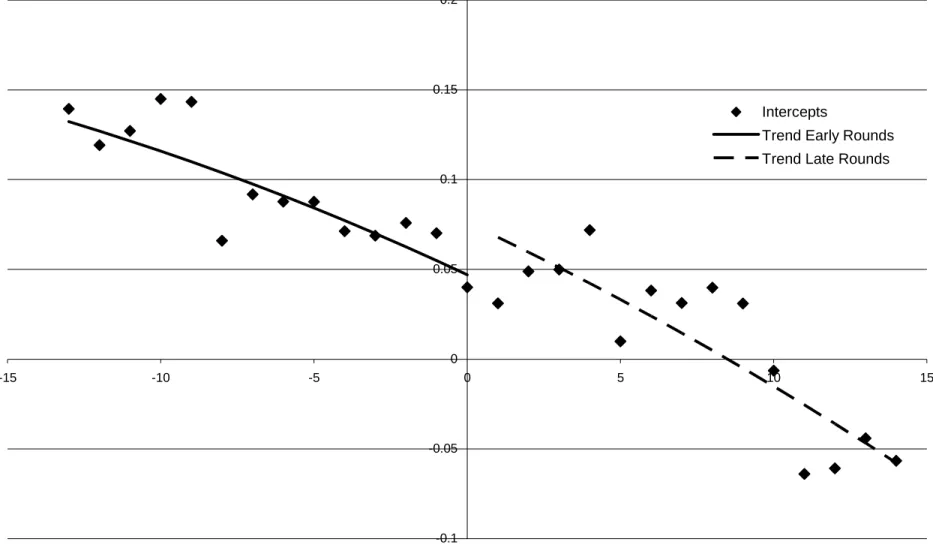
of Table5. The default rate is regressed against round dummies with and without controls in columns 1 and 2 and the time intercepts corresponding to column 1 are in Figure 2: The regression coe¢ cients of default rates on trend terms and the number of cosigners in speci…cation (2) are reported in columns 3 and 4: According to the point estimates of , an additional cosigner is associated with a5:1to5:6 percent increase in default rates.
In contrast to the positive correlation, we …nd that cosigners have a negative causal e¤ect on defaults in columns 5and 6: In these speci…cations, based on (3), we allow for a trend break in the median round corresponding to the discontinuous rule of thumb documented in in Section 3: The coe¢ cient onlateitis positive and signi…cant indicating an upward trend
break in defaults as a consequence of the cosigner relaxation. The trend line from column
5 is shown in Figure 2 which illustrates the upward trend break. The linear trend model appears to capture the trend in the data satisfactorily. The point estimate forlateitimplies
9
Accordingly, the standard errors are also clustered by round in Table4where we report on the discon-tinuity in cosigners.
that the probability of a default, which is 56%in this sample, increases by 4:3 percentage points at the median round (column 5)and6:8 percentage points (column6).
Putting together our …ndings from Tables 4 and 5; then, an 18 percent fall in the number of cosigners leads to a 4:3 to6:8 percentage point increase in default rates at the middle round (about a ten to …fteen percent increase in defaults). In other words, we reject the null hypothesis that cosigners simply provide a hedging role but do not provide any repayment inducement. As we discussed in Section 3, we cannot identify the precise mechanism through which fewer cosigners increase defaults. The default increase could be because fewer cosigners induced Rosca borrowers after the middle round to take riskier projects than those before (moral hazard), pushed riskier types to just after the middle round (adverse selection) or reduced the insurance provided by cosigners to Rosca borrowers after the middle round.
The rule of thumb that guides loan o¢ cers allows for a cosigner relaxation in the middle round but does not specify a cosigner relaxation in other rounds. As a robustness check, we tested for a relaxation5rounds before and5rounds after the median round –and found no trend break in the cosigners required in those rounds. Reassuringly, there was no trend break in default rates either both 5 round before and 5 rounds after the median round. This form of a "placebo" check lends credence to our estimation strategy that is based on the median round discontinuity. (Note that testing for a discontinuity in the cosigner requirement closer to the middle round is likely to pick up the middle round trend break given that there are just 28time intercepts for such an estimation).
One way in which loan o¢ cers may respond to the relaxation allowed in the number of cosigners in the middle round of Roscas is by asking for each of the fewer cosigners to pledge more salary as collateral. As we mentioned in Section 2, the salary information on cosigners was not available from the Rosca organizer – and so we have no way of directly testing whether there was such a substitution (from quantity to quality of cosigners). That said, asking for more salary per cosigner after the middle round would bias our estimates of the causal e¤ect in (3) downwards. So if anything, our estimated causal e¤ects are
lower bounds.
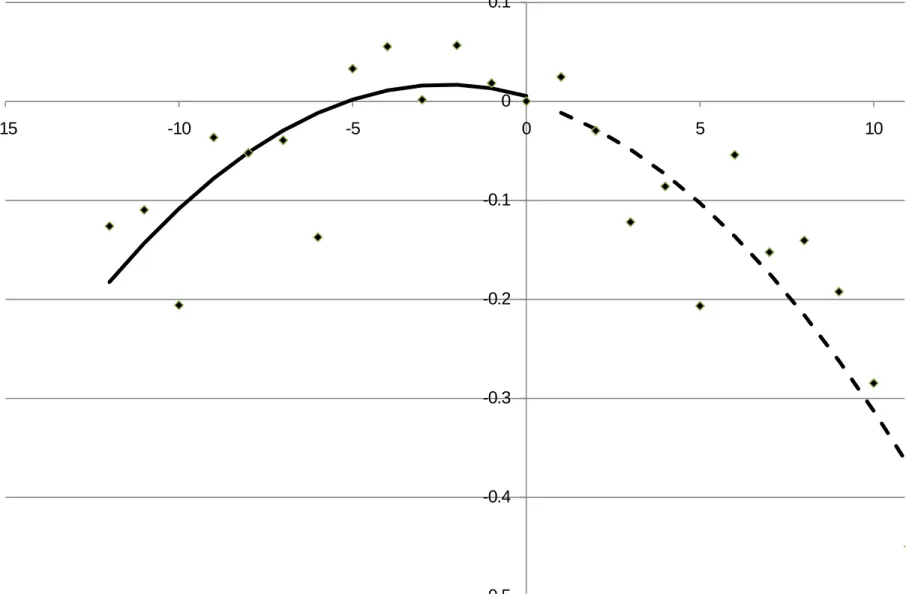
Finally, we provide some additional empirical investigation of the lazy-banks hypothesis (Manove et al, 2001). Recall that the hypothesis would predict increased screening after the middle round as a consequence of the cosigner relaxation. In other words, the loan o¢ cers may respond to the drop in collateral (cosigners) by increasing their screening e¤ort – and if the latter e¤ect is strong enough, this would lead to safer borrowers being funded just after the middle round – and a drop in defaults. A good measure of costly screening activity by the lender in our context is the income veri…cation of the borrower. This is a time-consuming process and involves substantial paperwork. In Table 6 we show that there is a slight upward trend break in income veri…cation around the median round. The quadratic polynomial approximation is not very good, however. This slight upward trend break is also shown in Figure3: So even though the loan o¢ cer may be spending more time screening in response to the relaxation in cosigner requirement, the increase in screening is relatively small and does not prevent defaults from rising in the middle round (Table5; columns 5and 6): So while screening and collateral might indeed be slight substitutes, we do not …nd empirical support for the lazy-banks hypothesis in our context.
5
Conclusion
In this paper we investigate the use of cosigners as collateral using data from South India. We show that the number of cosigners is positively correlated with defaults – presumably because borrowers who are high default risk are asked for more cosigners. This is very similar to the positive correlation …nding in the empirical collateral literature. We go further to investigate whether there is a causal link between the number of cosigners required on a loan and the subsequent default probability. We use an exogenous relaxation in the number of cosigners required to isolate this causal e¤ect.
To summarize, our …ndings are broadly consistent with models in which ex-ante riskier borrowers are asked for more cosigners and cosigners reduce defaults ex-post. One such model that has both the positive correlation and the negative causation between collateral
and defaults is by Boot, Thakor and Udell (1991). In their model the collateral is provided by borrowers – but the same results would apply if collateral were provided by cosigners instead. Borrowers di¤er in terms of observed riskiness and are subject to moral hazard. Lenders ask observably riskier borrowers for more collateral (positive correlation) – yet collateral also has an incentive e¤ect (negative causal e¤ect). Simpler models which just have a positive correlation between cosigners and defaults but no causal link –or a negative causal link but no correlation – are not consistent with what we …nd. A model in which cosigners merely hedge against ex-post risk is inconsistent with our …ndings. So too is a model based on Manove et al (2001) in which an increase in collateral provided by cosigners causes an increase in defaults.
References
[1] Aghion, P., P. Bolton 1992. An Incomplete Contracts Approach to Financial Con-tracting. The Review of Economic Studies, 59, 473-494.
[2] Baker, A. B.,1977. Community and Growth: Muddling Through with Russian Credit Cooperatives. Journal of Economic History 37, 139-160.
[3] Banerjee, A., T. Besley and T. Guinnane 1994. Thy Neighbor’s Keeper: The Design of a Credit Cooperative with Theory and a Test. Quarterly Journal of Economics 109, 491-515.
[4] Banerjee, A. 2003: “Contracting Constraints, Credit Markets and Economic Devel-opment”in Dewatripont, M., L. Hansen and S. Turnovsky eds. Advances in Economic Theory and Econometrics: Theory and Applications, Theory and Applications, Eight World Congress of the Econometric Society, Cambridge University Press, 1-46. [5] Bester, H.1985. Screening vs. Rationing in Credit Markets with Imperfect Information,
[6] Berger, A.N., Udell, G.F., 1990. Collateral, loan quality, and bank risk. Journal of Monetary Economics 25, 21–42.
[7] Berger, A. N. and G. Udell, 1998. The Economics of Small Business Finance: The Roles of Private Equity and Debt Markets in the Financial Growth Cycle, Journal of Banking and Finance 22, 613-673.
[8] Berger, A.N., Marco A. Espinosa-Vega, W. Scott Frame and Nathan H. Miller. 2007: "Why Do Borrowers Pledge Collateral? New Empirical Evidence on the Role of Asym-metrical Information" Working Paper.
[9] Besley, T., Coate, S., Loury, G., 1993:The Economics of Rotating Savings and Credit Associations. American Economic Review 83, 792-810.
[10] Besanko, D., Thakor, A.V., 1987a. Collateral and rationing: sorting equilibria in mo-nopolistic and competitive credit markets. International Economic Review 28, 671–689. [11] Besanko, D., Thakor, A.V., 1987b. Competitive equilibrium in the credit market under
asymmetric information. Journal of Economic Theory 42, 167–182.
[12] Bond, P. and A.S. Rai2008: Cosigned or Group Loans. Journal of Development Eco-nomics. 85: 58-80.
[13] Boot, A.W.A., Thakor, A.V., Udell, G.F., 1991. Secured lending and default risk: equilibrium analysis, policy implications and empirical results. Economic Journal 101, 458–472.
[14] Boot, A.W., Thakor, A.V., 1994. Moral hazard and secured lending in an in…nitely repeated credit market game. International Economic Review 35, pp. 899–920
[15] Carey, Mark, Mitch Post and Steven A. Sharpe, 1998. Does corporate lending by banks and …nance companies di¤er? Evidence on specialization in private debt contracting, Journal of Finance 53, 845-878.
[16] Chan, Y.-S., Kanatas, G., 1985. Asymmetric valuations and the role of collateral in loan agreements. Journal of Money, Credit and Banking 17, 84–95.
[17] Chan, Y.-S., Thakor, A.V., 1987. Collateral and competitive equilibria with moral hazard and private information. Journal of Finance 42, 345–363.
[18] Eeckhout, J. and K. Munshi,2004:Economic Institutions as Matching Markets. Man-uscript, Brown University.
[19] Guinnane Timothy W., 1994 A Failed Institutional Transplant: Rai¤eisen’s Credit Cooperatives in Ireland, 1894-1914, Explorations in Economic History 31:1, 38-61. [20] Jiménez, G.,V. Salas and J. Saurina, 2006: Determinants of collateral, Journal of
Fi-nancial Economics 81: 255–281.
[21] John, Kose; Anthony Lynch and Manju Puri.2003:Credit ratings, collateral and loan characteristics: Implications for yield. Journal of Business. 76(3), 371-409.
[22] Klonner, S., A.S. Rai 2006: Adverse Selection in Credit Markets: Evidence from a Policy Experiment. Working Paper.
[23] Lee, David S. and Card, David E.,2006:Regression Discontinuity Inference with Spec-i…cation Error. NBER Working Paper No. T0322
[24] Liberti, J. and A. Mian2008: Collateral Spread and Financial Development. Working Paper, Chicago GSB.
[25] La Porta R., F. Lopez-de-Silanes and Andrei Shleifer, 2008. The Economics Conse-quences of Legal Origins. Journal of Economic Literature, forthcoming.
[26] Manove; Michael; A. Jorge Padilla; Marco Pagano 2001: Collateral versus Project Screening: A Model of Lazy Banks. The RAND Journal of Economics, Vol. 32, No. 4. (Winter, 2001), pp. 726-744.
[27] Newton, L.,2000. Trust and Virtue in Banking: the Assessment of Borrowers by Bank Managements at the Turn of the Twentieth Century. Financial History Review 7, 177-199.
[28] Phillips, R.J. and D. Mushinski,2001. The Role of Morris Plan Lending Institutions in Expanding Consumer Micro-Credit in The United States. Working Paper, Department of Economics, Colorado State University.
[29] Petersen, Mitchell, and Raghuram G. Rajan, 1994, The bene…ts of lending relation-ships, Journal of Finance 49, 3–37.
[30] Pozzolo, Z., 2004. The Role of Guarantees in Bank Lending. Discussion Paper No. 528, Banca D’Italia.
[31] Rai, A. and T. Sjöström, 2004. Is Grameen Lending E¢ cient? Repayment Incentives and Insurance in Village Economies. Review of Economic Studies 71, 217-234.
[32] Townsend, R.1997: “Microenterprise and Macropolicy”in Kreps, D. and K. Wallis eds. Advances in Economics and Econometrics: Theory and Applications, Seventh World Congress of the Econometric Society, Cambridge University Press, II:160-209.
[33] Uzzi, B. and R. Lancaster, 2003. Relational embeddedness and learning: The case of bank loan managers and their clients. Management Science 49, 383-399.
[34] Visaria, S. 2006: Legal Reform and Loan Repayment: The Microeconomic Impact of Debt Recovery Tribunals in India. Working Paper, Boston University.
[35] Van der Klaauw, Wilbert, 2007. Regression-Discontinuity Analysis. The New Palgrave Dictionary of Economics, Forthcoming.
Figure 1. Number of Cosigners. Estimated Intercepts and Fitted Polynomial.
-0.5 0 0.5 1 1.5 2 -15 -10 -5 0 5 10 15 20 InterceptsTrend Early Rounds Trend Late Rounds
Figure 2. Default Rate. Estimated Intercepts and Fitted Polynomial.
-0.1 -0.05 0 0.05 0.1 0.15 0.2 -15 -10 -5 0 5 10 15 InterceptsTrend Early Rounds Trend Late Rounds
Figure 3. Income Verification. Estimated Intercepts and Fitted Polynomial.
0 5 -0.4 -0.3 -0.2 -0.1 0 0.1 -15 -10 -5 0 5 10Table 1. Rosca Denominations.
Duration
(Months) Contribution Pot Value
Number of Roscas Number of Observations 25 400 10,000 141 1,016 25 1,000 25,000 48 911 25 2,000 50,000 42 933 25 4,000 100,000 18 422 30 500 15,000 71 1,306 30 1,000 30,000 19 451 30 2,500 75,000 11 238 30 3,000 90,000 5 105 30 5,000 150,000 16 443 30 10,000 300,000 5 140 40 250 10,000 310 1,707 40 500 20,000 12 182 40 625 25,000 39 929 40 1,250 50,000 37 857 40 2,500 100,000 33 1,020 40 5,000 200,000 1 17 50 1,000 50,000 20 359 50 2,000 100,000 3 105
Notes: “Number of Roscas” is the number of distinct Roscas started in 2001 in the sample.
“Number of Observations” is the observations from a particular denomination that are used in the subsequent analysis. Each
observation refers to a Rosca winner. This column sums to 11,141 which is our sample size.
Table 2. Descriptive Statistics.
Mean
Std. Dev.
Minimum
Maximum
Rosca Value (Pot), Rs.
45,892.7
47,381.8
10,000
300,000
Contribution per Month, Rs.
1,424.8
1,546.9
250
10,000
Rosca Duration
33.59
7.31
25
50
Number of Cosigners
1.221
1.174
0
6
Late Round (Incidence)
0.570
0.495
0
1
Round 1.771
7.891
-13
14
Default Rate
0.125
0.183
0
1
Winning Bid Relative to Pot
0.175
0.098
0.050
0.300
Repayment Burden Relative to Pot
0.418
0.208
0.064
0.862
Borrower Income Verified by Lender
0.507
0.500
0
1
Notes: 11141 observations from Roscas started in the year 2001 in 18 branches and 18 Rosca denominations. Institutional borrowers
and housewives are excluded from the sample. Repayment Burden is the sum of net contributions (required contributions less
dividends) due from a Rosca winner in round t in rounds t+1, t+2...T, where T is the last month of the Rosca. Default rate refers to
amount outstanding at the termination of the Rosca relative to the repayment burden.
Table 3. Occupational Characteristics of Borrowers.
Borrower Occupation
Frequency
Relative Frequency (%)
Services 597
5.36
Education 712
6.39
Banking and Law
555
4.98
Government 310
2.78
Health 275
2.47
Manufacturing 1,005
9.02
Self-employed 1,188
10.67
Agriculture 150
1.35
Retired 320
2.87
Not Verified
6,029
54.12
Table 4. OLS Analysis of the Number of Cosigners.
(1)
(2)
(3)
Dependent Variable: Number of Cosigners
Late Round (Dummy)
-0.2209***
-0.0805*
(0.0441)
(0.0416)
Round
-0.0690***
-0.0455***
(0.0029)
(0.0074)
Round Squared
-0.0006**
0.0002
(0.0002)
(0.0002)
Winning Bid
2.9673***
2.9251***
(0.2555)
(0.2501)
Repayment Burden
-0.0541
0.0823
(0.3329)
(0.2890)
Round Dummies
Yes
No
No
Observations 11141
11141
11141
Estimation Method
OLS
OLS
OLS
R-squared 0.46
0.44
0.46
Notes: Standard errors in parentheses. Standard errors clustered by round.
*** p<0.01, ** p<0.05, * p<0.1.
All specifications include dummy variables for branch locations (18), Rosca denomination (18)
and profession of the borrower (10). In addition, specification 1 includes 28 dummies for each
round. Winning bid and repayment burden are measured relative to pot.
Table 5. Tobit Estimation of the Default Rate.
(1) (2) (3) (4) (5) (6)
Dependent Variable: Default Rate
Number of Cosigners 0.0368*** 0.0346*** 0.0359*** 0.0344***
(0.0035) (0.0034) (0.0034) (0.0033)
Late Round (Dummy) 0.0284* 0.0465**
(0.0145) (0.0191) Round -0.0035*** -0.0006 -0.0080*** -0.0037 (0.0007) (0.0043) (0.0010) (0.0043) Round Squared -0.0001 -0.0000 -0.0001 -0.0000 (0.0001) (0.0001) (0.0001) (0.0001) Winning Bid 0.3219*** 0.1757** 0.3317*** (0.0655) (0.0734) (0.0707) Repayment Burden 0.1418 0.0473 0.0794 (0.2124) (0.1988) (0.2065)
Round Dummies Yes Yes No No No No
Observations 11,141 11,141 11,141 11,141 11,141 11,141
Estimation Method Tobit Tobit Tobit Tobit Tobit Tobit
Log-Likelihood -3,625.6 -3,607.5 -3,664.31 -3,658.9 -3,733.0 -3,715.2
Notes: Standard errors in parentheses. Standard errors clustered by round. *** p<0.01, ** p<0.05, * p<0.1. There are 4,406 (default-rate of zero) left and 51 right-censored (default-rate of one) observations.
All specifications include dummy variables for branch location (18), Rosca denomination (18) and profession of the borrower (11). In addition, specifications 1 and 2 include dummies for each round (28).Winning bid and repayment burden are measured relative to pot.
Table 6. Probit Estimation of Income Verification.
(1) (2)
Dependent Variable: Income Verified by Lender (Dummy)
Late Round (Dummy) 0.0230 0.0973*
(0.0439) (0.0497) Round -0.0130*** 0.0262* (0.0037) (0.0138) Round Squared -0.0019*** -0.0016*** (0.0003) (0.0003) Winning Bid 0.3846 (0.3595) Repayment Burden 1.5620*** (0.5734) Observations 11,141 11,141
Estimation Method Probit Probit
Log-Likelihood -4610.8 -4,596.3
Notes: Standard errors in parentheses. Standard errors clustered by round. *** p<0.01, ** p<0.05, * p<0.1.
All specifications include dummy variables for branch location (18), Rosca denomination (18) and profession of the borrower (11). Winning bid and repayment burden are measured relative to pot.