DEPARTMENT OF ECONOMICS AND FINANCE
COLLEGE OF BUSINESS AND ECONOMICS
UNIVERSITY OF CANTERBURY
CHRISTCHURCH, NEW ZEALAND
Building Trust One Gift at a Time
Maroš Servátka, Steven Tucker, and Radovan Vadovič
WORKING PAPER
No. 11/2009
Department of Economics and Finance
College of Business and Economics
University of Canterbury
Private Bag 4800, Christchurch
WORKING PAPER No. 11/2009
Building Trust One Gift at a Time
Maroš Servátka 1, Steven Tucker 2, and Radovan Vadovič 3
June 17, 2009
Abstract: This paper reports an experiment evaluating the effect of gift giving on building trust in a relationship. We have nested our explorations in the standard version of the investment game. Our gift treatment includes a dictator stage in which the trustee decides whether to give a gift to the trustor before both of them proceed to play the investment game. We observe that in such case the majority of trustees offer their endowment to trustors. Consequently, receiving a gift significantly increases the amounts sent by trustors when controlling for the differences in payoffs created by it. Trustees are, however, not better off by giving a gift as the increase in the amount sent by trustors is not large enough to offset the trustees’ loss associated with the cost of giving a gift. Our results indicate that a relationship which is initiated by gift giving leads to higher trust and efficiency but at the same time is probably not stable.
Keywords: Experimental economics, gift, investment game, trust, trustworthiness
JEL Classifications: C70, C91
Acknowledgements: We are grateful to the University of Canterbury, College of Business and Economics for financial support. We thank Andrea Menclová for helpful comments.
1 Department of Economics and Finance, University of Canterbury, Private Bag 4800,
Christchurch 8140, New Zealand
2 Department of Economics and Finance, University of Canterbury, Private Bag 4800,
Christchurch 8140, New Zealand
3 Department of Economics, Instituto Tecnológico Autónomo de México, Centro de
Investigación Económica, Camino a Sta. Teresa 930, Colonia Héroes de Padierna, C.P. 10700, México, D.F.
*Corresponding Author: Maroš Servátka, email: [email protected], phone: +64-3-3642825, fax: +64-3-3642635
WORKING PAPER No. 11/2009
Building Trust One Gift at a Time
1. Introduction
The majority, if not all, economic interactions rely on trust (Arrow (1974)). Whether it is a situation involving a hidden action or hidden information, the trusting party might get adversely affected if their counterpart decides to appropriate too much or the entire monetary surplus. Dasgupta (2000) states that: “Trust is important because its presence or absence can have a bearing on what we choose to do, and in many cases what we can do” (p.330). Recent years have seen an explosion of work on the importance of trust in economic transactions and for well-being (e.g., Putnam (1993) and Fukuyama (1995)), its applications and implications (e.g., Knack and Keefer (1997), La Porta, et al. (1997), Zak and Knack (2001), and Servátka, et al. (2008a)), as well as studies exploring mechanisms trying to foster trust and cooperation (e.g., Andreoni (2005), Andreoni and Samuelson (2006), Charness and Dufwenberg (2006), Ben-Ner, et. al. (2007), Bracht and Feltovich (2007), Servátka, et al. (2008b), and Ben-Ner and Putterman (forthcoming)).
At first glance, it might seem that increasing trust is desirable as it (often) improves economic efficiency. However, a significant fraction of defectors who betray trust exists in the world and thus trusting everyone is not an optimal strategy. The way to win trust is to make concessions and clearly explain how much these gifts cost.1 In a nice experiment Andreoni and Samuelson (2006) find that cooperation is best achieved when the parties first cooperate in a small-stakes, low-temptation environment and then slowly evolve through a series of successful interactions into a large-stakes partnership. It is as if giving a gift prior to a transaction created a reputation that might pay dividends in the future.2 Servátka (2008, 2009) has made a similar argument with respect to generosity and Riedl and Seinen (2002) with respect to trust.
1 “Tips to build trust during negotiation” The New York Times Syndicate, Tuesday, January 06, 2009.
2 If there exists a possibility for reputation building due to repeated interaction (Kreps,
et al. (1982) and
Kreps and Wilson (1982)) and/or if the contract between the transacting parties is verifiable and enforceable (Charness, et al. (2008)), the problem whether to trust or not is easily mitigated because the
parties face severe punishments on the off-equilibrium path. A competition among trustees is observed to have even stronger effects than reputation building (Huck, et al. (2007)).
In this paper we present an experiment which evaluates the effect of gift giving on the amount of trust in the investment game (Berg, et al. (1995)). A gift is a binary decision of a trustee who can send either nothing or all of his $10 endowment to the trustor in a dictator game stage prior to playing the investment game. If a gift is given, then in a case of failed relationship the trustor is at least as well off as if no transaction ever took place.
The psychological incentives introduced by the gift into the investment game may be nontrivial. The gift could have a positive effect on the relationship if, for example, it represents an informal contract that binds the trustee to trustworthiness in the subsequent play3; or if it is viewed as a signaling device which separates those trustees with the intention to share the surplus in the investment game from the rest. But there cannot be a separating equilibrium since the costs-and-benefits of the signal (the gift) do not vary between various types of trustees and hence it could be easily mimicked. It is therefore possible that the gift is completely uninformative about the future behavior of the trustee in which case it would be behaviorally neutral. Finally, it is conceivable that the gift may inadvertently harm the relationship by possessing a negative connotation. The gift could deter investment if it is interpreted as a bait or if it contributes to the trustor’s doubt about a positive return on his investment.
A somewhat similar experiment to ours has been run by Andreoni (2005) who examines satisfaction guaranteed that explicitly promises to refund the price to the buyer. In reality, not honoring satisfaction guarantee can have legal consequences for sellers, but suing over a small transaction can be too costly and thus this trust building contract device can be seen as nonbinding for some sellers. In his experimental design, Andreoni combines the investment game with the ultimatum game (Güth, et al. (1982)), thus giving the trustor an option to annul the transaction if he is not satisfied with the outcome. If satisfaction guaranteed is voluntary and non-binding, the trust of buyers is greatly reduced comparing to when it is binding. The decrease in trust is well justified as only 17% of experimental sellers choose to honor the guarantees. The main difference between our study and Andreoni’s (other than a gift and satisfaction guaranteed not being strategically equivalent) is the fact that a gift is given before the transaction takes place,
and hence there is no way to reverse the gift if the trustee defects whereas in satisfaction guaranteed sellers can renege if a refund is requested.
Bracht and Feltovich (2007) study a simple precommitment mechanism in the investment game. Similarly to our experiment, they also add a pre-game stage during which the trustee has an opportunity to place some amount of money into an escrow account. The entire sum money from the escrow account is returned to him if the trustor does not invest any money or if the trustors invests and the trustee splits the surplus. However, if the trustor invests and trustee appropriates the surplus, the entire escrow amount gets forfeited, but the trustor does not receive anything. Bracht and Feltovich find that the efficiency of the mechanism depends on the amount that is deposited into an escrow account, but not so much on whether it is chosen voluntarily or imposed by the experimenter.
The common feature of satisfaction guaranteed and escrow account is that they both enhance “trust” when they are enforceable. Thus, the punishment mechanism drives the behavior of trustors and trustees as the investment can be recouped and escrow forfeited. However, enforceable satisfaction guaranteed and escrow accounts are not always available to the transacting parties. Therefore, it is important to understand what other monetary mechanisms can increase trust when enforceability is not an option.
2. Experimental Design and Procedures
The experiment consisted of 10 sessions conducted at the University of Canterbury, Christchurch, New Zealand in 2007 and 2008. Each session included a minimum of 12 subjects with a total of 206 subjects participating in the study. Most of the subjects had previously participated in economics experiments, and some (but not a majority) had experience with an investment-game-like-scenario. Each subject only participated in a single session of the study. On average, a session lasted 50 minutes including initial instructional period and payment of subjects. Subjects earned on average 15.66 NZD.4 All sessions were hand run in a classroom under a single-blind social distance protocol.
4 The adult minimum wage in New Zealand at the time of the experiment was 10.25 NZD per hour (1 NZD = 0.6943 USD).
Our experiment consists of three treatments (Baseline, Gift, and Endowment Control) implemented in an across subjects design. Baseline is the standard investment game by Berg, et al. (1995). There are two players, A and B, both endowed with $10 at the beginning of the game. The first mover, player A, decides on a whole dollar amount to send to his counterpart player B. The amount sent is tripled by the experimenter. The second mover, player B, then decides how much of the tripled amount,
to return in whole dollar amounts to player A.
{
0,1,2,...,10 ∈ t{
t}
r∈ 0,...,3}
5Gift involves the investment game as described in Baseline preceded by a dictator game stage during which player B has a binary decision of whether to transfer his entire $10 endowment to player A or not.6 In the investment game that follows, player A is still constrained to sending a maximum of $10 even if player B decided to transfer his endowment to player A.
Endowment Control treatment is analogous to Baseline and differs only in the endowment given to both players: Player A starts the game with $20 and player B with $0. This treatment is necessary to control for possible confounding effects when we compare behavior between the Baseline and Gift treatments in order to see whether giving a gift increases amounts sent and returned. A confound can occur between these two treatments because giving a gift changes the payoffs of players A and B from ($10, $10) to ($20, $0). It is therefore possible, that any changes in amounts sent by players A and returned players B are due to this endowment effect rather than a pure effect of giving the gift.
The subjects in each session were randomly assigned to be either player A or player B and randomly matched into pairs. The procedures for this allocation were as follows. The classroom used for the experiment was segmented in half such that the group of desks corresponding to a given type was located on the same half of the room. The desks for each type were arranged in rows facing opposite walls such that subjects of opposing types could not see each other while making decisions during the experiment. At the beginning of each session, subjects were free to choose any desk upon entering the 5 The behavior of player A and player B can be interpreted as proxies for trusting and trustworthy behavior (Charness et al. (2008)).
6 The decision of player B is binary for two reasons: (i) It makes mimicking of trustworthy types simple and (ii) it makes it easy to design a treatment controlling for the amount of money possessed by the two players when making their respective decisions.
classroom. The allocation of types to the two different groups of subjects was done by publicly flipping a coin. The experimenter then randomly assigned a member from each group to create individual and anonymous type A and B pairings.
All instructions were projected on an overhead screen and read aloud. Subjects were encouraged to privately ask any questions they may have throughout the experiment. In the Gift treatment, the investment game and general procedures were explained first. Only then did the experimenters announce that before the described game is played, player B has an opportunity to send their endowment to their counterpart player A. Upon completion of the instructional phase of for this dictator game stage, players B made their decisions of whether to transfer their endowment or not to their counterpart on provided decision sheets, which were afterwards collected by the experimenters. The decision of players B was written by the experimenter on their counterpart players’ A investment game decision sheet in the following form:
Player B has transferred $____ to you before the start of the game. This amount is yours to keep and will be added to your earnings.
Given this information, Players A were asked to answer a question of why they believed that their counterpart player B transferred or did not transfer their $10 endowment to them. It was made clear to subjects that their answer to this question would be private information and not shared with their counterparts. This completed the dictator game phase of the Gift treatment.
The following investment game procedures were the same for all treatments. Players A wrote on their private decision sheet of how much money they wanted to transfer to their counterpart player B, which was constrained to [$0, $10]. Players’ A decision sheets were collected, the amount transferred was tripled by the experimenter and written on their counterpart player’s B decision sheet, and then all decision sheets were returned to the subjects. Now knowing how much their counterpart transferred to them, players B decided how much of that tripled amount they wanted to transfer back to their counterpart player A and how much to keep for themselves. The experimenters then collected all decision sheets, wrote players’ B decision on their counterpart players’ A decision sheet, and returned the decision sheets to all players to reveal their earnings.
Lastly, subjects completed a short survey on the experiment and general demographic information and were privately paid their experimental earnings.
3. Results
3.1 Behavior of Players A
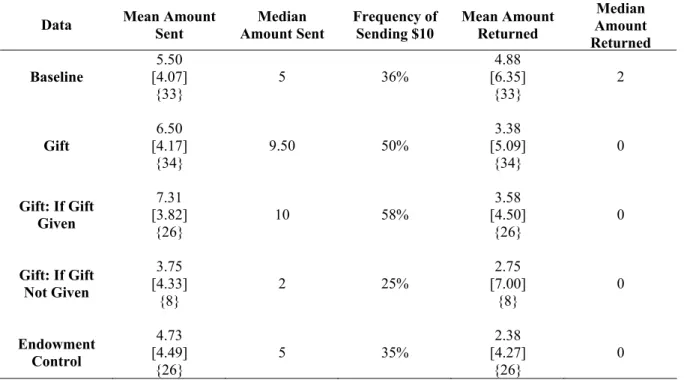
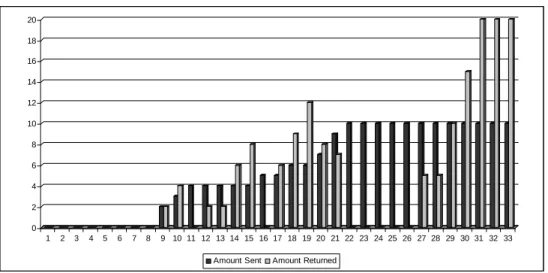
Subjects’ behavior from all three treatments is summarized in Table 1 and presented in Figures 1-3 rank ordered by the amount sent by player A. The amount sent by players A is represented as a blue bar and the corresponding amount returned by their counterpart player B as an adjacent red bar. Players A sent the lowest average amount of 4.73 in Endowment Control, slightly higher of 5.50 in Baseline, while in Gift the average amount was equal to of 6.50 (7.31 if the gift was actually received and 3.75 if not). This difference is even more pronounced when looking at medians: While in Baseline and Endowment Control the median amount sent was equal to 5, in Gift it was 9.50 (10 if the gift was actually received and 2 if not).
Table 1. Behavior of Players A
Data Mean Amount Sent Amount Sent Median Frequency of Sending $10 Mean Amount Returned Amount Median Returned Baseline 5.50 [4.07] {33} 5 36% 4.88 [6.35] {33} 2 Gift 6.50 [4.17] {34} 9.50 50% 3.38 [5.09] {34} 0 Gift: If Gift Given 7.31 [3.82] {26} 10 58% 3.58 [4.50] {26} 0 Gift: If Gift Not Given 3.75 [4.33] {8} 2 25% 2.75 [7.00] {8} 0 Endowment Control 4.73 [4.49] {26} 5 35% 2.38 [4.27] {26} 0
Standard deviations in brackets. Number of subjects in braces.
Figure 1: Baseline treatment decisions. 0 2 4 6 8 10 12 14 16 18 20 1 2 3 4 5 6 7 8 9 10 11 12 13 14 15 16 17 18 19 20 21 22 23 24 25 26 27 28 29 30 31 32 33
Amount Sent Amount Returned
Figure 2: Gift treatment decisions.
0 2 4 6 8 10 12 14 16 18 20 1 2 3 4 5 6 7 8 9 10 11 12 13 14 15 16 17 18 19 20 21 22 23 24 25 26 27 28 29 30 31 32 33 34
Amount Sent Amount Returned
Figure 3: Endowment Control treatment decisions.
0 2 4 6 8 10 12 14 16 18 20 1 2 3 4 5 6 7 8 9 10 11 12 13 14 15 16 17 18 19 20 21 22 23 24 25 26
Players A are obviously better off when they receive a gift.7 Is there clear evidence that a gift increases the amounts sent by players A? The 2-sided Means and Mann-Whitney tests presented in Table 2 break up the behavior of players A into an endowment effect and a gift effect. It might be somewhat surprising that players A sent on average less money when they were endowed with $20 than when they were endowed with only $10. The endowment effect, however, is not statistically significant. Similarly, neither Means nor Mann-Whitney tests detect a statistical significance for the amount sent in Gift versus Endowment Control and for the amount sent in Gift versus Baseline at the treatment level. So just having a chance to receive a gift or having a larger endowment does not change player’s A behavior.
Table 2. Tests for Gift and Income Effects on the Behavior of Players A
Data a Effects Tested Means Test Mann-Whitney Test
Gift vs. Baseline - 0.92 (.361) 0.99 (.323)
Gift vs.
Endowment Control - 1.53 (.131) 1.53 (.127)
Gift given vs. Baseline endowment effect gift effect 1.71 (.093) 1.71 (.087)
Gift given vs. Endowment
Control gift effect 2.23 (.030) 2.03 (.043)
Baseline vs.
Endowment Control endowment effect 0.72 (.474) 0.65 (.519)
p-values in parentheses
a amounts sent in the respective treatments
But what happens if the gift is actually received? Twenty-six out of thirty-four players A who received a gift from players B sent on average 7.31 (with a median of 10), whereas the remaining eight who did not receive a gift sent on average only 3.75 (with a
7 The average earnings of players A who received a gift were equal to $16.00 while those of who did not received a gift were equal to $9.00. For a comparison, the earnings of players A in Baseline were $9.30.
median of 2). The appropriate point of reference for a comparison is the Endowment Control treatment data. When we control for the endowment differences, receiving a gift is responsible for an increase in the amount sent by player A (p = 0.030 and 0.043, respectively) as reported by both Means and Mann-Whitney tests presented in row 4 of Table 2.
A combination of the gift effect and an endowment effect (i.e., the comparison of the data when a gift was received with Baseline) is also (weakly) statistically significant as reported in row 3 of the same table (p = 0.093 and 0.087). Thus, we conclude that receiving a gift caused players A to send higher amounts in our experiment.
3.2 Behavior of Players B
In this subsection we analyze whether players B are (i) made better off by giving a gift; and (ii) how does giving a gift affect the amounts they return back to players A.
Giving a gift is costly to player B as he might be forgoing $10 if player A decides not to send anything. In order to determine whether players B are made better off by giving a gift, we compare the payoffs of players B who give a gift with those who do not (within treatment comparison) and also with those who participate in Baseline (across subjects comparison). Twenty-six players B who gave a gift earned on average $18.00 while those eight who did not made on average $19.00. This difference is not statistically significant according to Mann-Whitney test (p = 0.525). On the other hand, thirty-three players B who participated in Baseline and thus did not have an option to give a gift made on average $21.80. Albeit higher, this amount is not statistically significantly different from payoffs of players B who gave a gift according to Mann-Whitney test (p = 0.639). Nevertheless, when comparing means, the increase in the amounts sent by players A was too low to offset the reduction in players’ B payoffs due to the giving a gift.8
To address the effect of giving a gift in the dictator stage on players’ B’ decisions of how much to return, we estimate the following Tobit relation between amounts sent, St, and a dummy, DD, indicating whether the gift was given (DD = 1) or not (DD
= 0), and the amounts returned, Rt:
8 The difference between the average amounts sent by players A who received a gift and those in Baseline is equal to $1.81. So even if this amount is tripled and would be all retained by players B, they would be better off my keeping the $10 gift.
t t D D t t S D D S R =α +β1 +β2 +β3 +ε .
The bounds for the Tobit estimation were imposed by the experimental design: ] 3 , 0 [ t t S R ∈ .9
We report the results from the estimation in Table 4. The only significant variables were the amount sent by players A and a constant. Because of a relatively small sample and large variation, giving a gift does not seem to influence the behavior of players B neither directly
(
β2)
nor through the interaction term( )
β3 .Table 4: Tobit Regression Estimates for the Effect of Giving a Gift on Players’ B Behavior
Rt Coefficient St. Error t P>|t|
St 1.78 0.87 2.04 .050
DD -38.67 39.29 -0.98 .333
DDSt 3.62 4.03 0.90 .375
Constant -10.85 6.19 -1.75 .090 Next we turn our attention to whether the amount in possession of players B when making their decision of how much to return affected their behavior. Because there are qualitative differences in whether they had $0 ($10) because they gave (did not give) a gift or because they were endowed with $0 ($10) at the start of the game, we explore this question by comparing the amounts returned in Baseline and Endowment Control only. We estimate the following relation between amounts sent, St, and a dummy, DE,
indicating whether player B had $10 (DE = 1) or $0 (DE = 0) when making their decision,
and the amounts returned, Rt:
t t E E t t S D D S R =δ +γ1 +γ2 +γ3 +ε ,
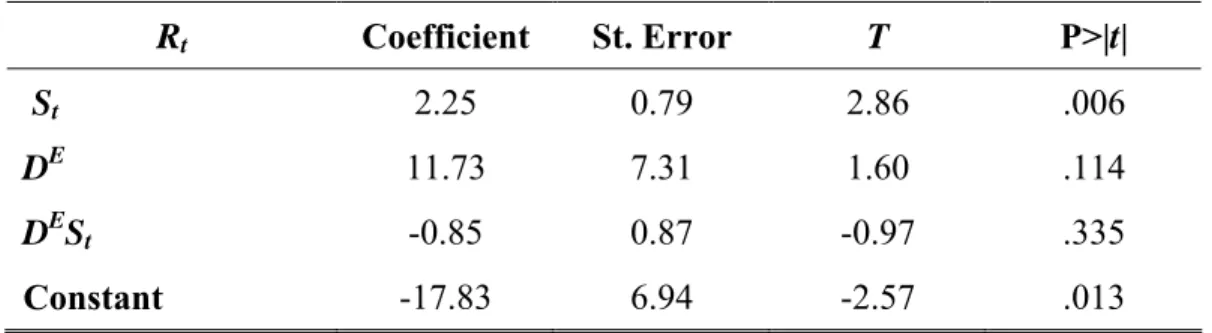
where the bounds were imposed by the experimental design in the same way as before. The results or the estimation are detailed in Table 5. As before, the only significant variables explaining the behavior of players B in Baseline and Endowment Control were
9 While our data can theoretically be bound from above by 3
St, in the actual experiment it never happened in that a subject would return the full amount. In fact, the maximum ever returned was 2St thus the
constraint was never binding. Because Stata, in which we estimated our tobit regressions, does not allow to specify upper or lower limits using variables, we used 30 as an upper bound.
the amount sent by players A and a constant. The variation in endowments has marginally insignificant direct effect as reported by γ2.
Table 5: Tobit Regression Estimates for the Endowment Effect on Players’ B Behavior
Rt Coefficient St. Error T P>|t| St 2.25 0.79 2.86 .006 DE 11.73 7.31 1.60 .114 DESt -0.85 0.87 -0.97 .335 Constant -17.83 6.94 -2.57 .013 4. Discussion
This paper reports on an experiment that studies the effectiveness of a gift giving in promoting trust and building a relationship. We have nested our findings in the standard version of the investment game to clearly observe the directional changes. We observe that when controlling for the endowment differences, receiving a gift significantly increases the amount sent by players A in the investment game. However, players B are not better off by giving a gift as the increase in the amount sent is not large enough to offset the loss to players B. The Tobit analysis of data also shows that players B do not change the amount returned after they have given a gift.
Our finding thus suggests that giving a gift increases trust. However, our data is still to be interpreted with caution as it is not obvious how the size of the gift implemented in the experiment interacts with the decisions of both players. Our primary goal was not to provide an exact recommendation on how to use gifts in order to induce an optimal amount of trust, but rather to illustrate that a gift could be an important step in building a trusting relationship.
Because it was common knowledge in the experiment that giving a gift was an option, not giving a gift could have had some consequences as well. Therefore, we think that an interesting extension of our work would be to give players B an option to send a gift, but not letting players A know that player B can do so. Such a design would reflect situations where the option is less pronounced, and it is therefore possible that a gift
would have different behavioral implications. We leave this line of research for future explorations.
References
Andreoni, J. (2005) "Trust, Reciprocity, and Contract Enforcement: Experiments on Satisfaction Guaranteed," University of California San Diego working paper.
Andreoni, J. and L. Samuelson (2006) "Building Rational Cooperation," Journal of Economic Theory, 127, 117-154.
Arrow, Kenneth J. (1974). The Limits of Organization. Norton, New York.
Ben-Ner, A. and L. Putterman (forthcoming) “Trust, Communication and Contracts: An Experiment,” Journal of Economic Behavior and Organization.
Ben-Ner, A., L. Putterman, and T. Ren (2007) “Lavish Returns on Cheap Talk: Non-binding Communication in a Trust Experiment,” Brown University Department of Economics Working Paper.
Berg, J., J. Dickhaut, and K. McCabe (1995) “Trust, Reciprocity, and Social History,” Games and Economic Behavior, Vol. 10(1), 122-42.
Bracht, J. and N. Feltovich (2008) “Efficiency in the Trust Game: An Experimental Study
of Precommitment,” International Journal of Game Theory 37:39–72
Charness, G., R. Cobo-Reyes, and N. Jiménez (2008) “An Investment Game with Third Party Intervention,” Journal of Economic Behavior and Organization,
Charness, G. and M. Dufwenberg (2006) “Promises and Partnership,” Econometrica, Vol. 74(6), 1579-1601.
Dasgupta, P. (2000), ‘Economic progress and the idea of social capital’, In Dasgupta, P. and Serageldin, I. (eds) (2000), Social Capital: A multifaceted perspective, Washington, D.C.: World Bank.
Güth, W., R. Schmittberger, and B. Schwarze (1982) “An Experimental Analysis of Ultimatum Bargaining,” Journal of Economic Behavior and Organization, 3,367–388. Huck, S., G. Ruchala, and J.-R. Tyran (2007) "Pricing and Trust" University of Copenhagen working paper.
Kreps, D., P. Milgrom, J. Roberts, and R. Wilson (1982) “Rational Cooperation in the Finitely Repeated Prisoners’ Dilemma,” Journal of Economic Theory, 27, 245-52.
Kreps, D. and R. Wilson (1982) “Reputation and Imperfect Information,” Journal of Economic Theory 27, 253–279.
Leider, S. and J. Kessler (2008), “Norms and Contracting,” Harvard University working paper.
Levitt, S. and J. List (2007) “What Do Laboratory Experiments Measuring Social Preferences Tell Us about the Real World,” Journal of Economic Perspectives, 21(2), 153-174.
Riedl A. and I. Seinen (2002) “Observation, Trust, and Trustworthiness,” CREED presentation slides.
Servátka, M. (2008) “Does Generosity Generate Generosity? An Experimental Study of Reputation Effects in a Dictator Game” University of Canterbury working paper.
Servátka, M. (2009) “Separating Reputation, Social Influence, and Identification Effects in a Dictator Game,” European Economic Review, 53(2), 197-209.
Servátka M., S. Tucker, and R. Vadovič (2008a) “Strategic Use of Trust” University of Canterbury working paper.
Servátka M., S. Tucker, and R. Vadovič (2008b) “Words Speak Louder Than Money?” University of Canterbury working paper.
You
are
a
Player
____
ID#:____
GENERAL INSTRUCTIONS
May, 2007
This is an experiment studying decision-making. The instructions are simple and if you follow them carefully and make good decisions, you might earn a considerable amount of money which will be paid to you in cash at the end of the experiment. It is therefore very important that you read these instructions with care.
No Talking Allowed
It is prohibited to communicate with other participants during the experiment. Should you have any questions please ask us. If you violate this rule, we shall have to exclude you from the experiment and from all payments.
Anonymity
Each person will be randomly matched with another person in the experiment. No one will learn the identity of the person she/he is matched with. You will be matched with the same person for the entire experiment.
Types
Each two person group will consist of two types of participants (Player A and Player B) that are assigned randomly. Your assigned type will be listed at the top of each task instruction sheet.
The Game
You are randomly paired with another individual. One member of your pair will be a player A and the other one will be player B. Find your type in the upper right corner of this sheet. You will never be able to find out the identity of the player you are paired with.
Each player’s final dollar payout will be determined according to the process below. The game is divided into stages in which players take turns making decisions. Both player A and player B begin the game with $10. We will refer to this initial $10 as each player’s endowment.
Stage 1:
At the beginning to stage 1, player A has the opportunity to transfer all, any portion, or none of his/her $10 endowment to player B. The amount that is not transferred is player A’s to keep. The amount that player A transfers triples when it reaches player B. For example, if A transfers $10 to B, B receives $30. If A transfers $5 to B, B receives $15. If A transfers $0 to B, B receives $0.
Stage 2:
Player B then has the opportunity to transfer all, any portion, or none of the tripled amount that was transferred to him/her from player A. The amount that is not transferred is player B’s to keep, and the amount transferred is added to player A’s final dollar payout.
You
are
a
Player
B
ID#:____
Pre-Game Decision Sheet
Player A is endowed with $10. Player B is endowed with $10.
The Game to be played NEXT:
¾
Player A must decide how much, if any, of his/her $10 endowment he/she wants to
transfer to player B.
¾
Each dollar that is not transferred is player A’s to keep.
¾
Each dollar that is transferred to Player B is multiplied by 3 by the experimenter.
¾
Player B must then decide how much, if any, of this tripled amount they want to
transfer back to player A and the remaining portion is theirs to keep.
Before we play this game, Player B has the opportunity to transfer his/her $10
endowment to player A.
If player A transfers the $10, then it is added to player B’s earnings.
If player A does not transfer the $10, then it is added to player A’s earnings.
Note: If the $10 endowment is transferred by player B,
¾
it
DOES NOT
increase the amount that player A has available to transfer in Stage
1.
¾
the $10 transferred
IS NOT
tripled.
¾
Player A is guaranteed to be at least as well off as the initial starting position ($10
endowment) regardless of both players’ transfer decisions during the game.
Please complete the statements below by circling one of the amounts:
I have decided to transfer the following to player A: $0 or $10
Why did you transfer or not transfer your $10 endowment to player A?
________________________________________________________________________
________________________________________________________________________
_____________________________________________
You are a Player A
ID#:____
The Game: Stage 1 Decision Sheet
Player B has transferred $____ to you before the start of the game.
This amount is yours to keep and will be added to your earnings.
Why do you believe Player B transferred or did not transfer their $10 endowment to
you in the pre-game?
________________________________________________________________________
________________________________________________________________________
_____________________________________________
The Game decision:
You must decide how much, if any, of your $10 endowment you want to transfer to
player B.
Each dollar that is not transferred is yours to keep.
Each dollar that is transferred to Player B is multiplied by 3 by the experimenter.
Please complete the statements below. Your decisions must be non-negative
integers, e.g. 0, 1, 2,…, 10.
I have decided to transfer $______ to player B.
You are a Player B
ID#:____
The Game: Stage 2 Decision Sheet
Player A has transferred $______ to you in Stage 1.
The experimenter has tripled this amount, and you have received $_______.
Why do you believe Player A transferred $____ to you in stage 1?
_______________________________________________________________
_______________________________________________________________
_______________________________________________________________
You must decide how much, if any, of the $______ you want to transfer to
player A.
Each dollar that is not transferred is yours to keep.
Each dollar that is transferred is added to player A’s earnings.
Please complete the statements below. Your decisions must be
non-negative integers.
I have decided to transfer $______ to player A.
QUESTIONNAIRE
Thank you for participating in the experiment. While we calculate your earnings, please complete the following survey. All of your responses will remain anonymous and only linked to the decisions within the experiment via your ID#. Therefore, please answer as truthfully and completely as possible.
1. Were you a player A or player B?
2. Did you find the instructions clear and self-explanatory? If not, please specify.
General Demographic Information
1. What is your age? __________2. What is your sex? (Circle one number.)
01 Male 02 Female
3. Which ethnic group(s) do you belong to? (Circle as many as you need, then write the country you are from if applicable.)
01 NZ European/Pakeha _ 04 Asian
02 NZ Maori _ Country: _______________
03 Pacific Islander _ 05 Other
Country: _______________ Country: _______________ 4. What is your major? (Circle one.)
01 Accounting 02 Economics
03 Finance or Information Systems 04 Education
05 Engineering
06 Law
07 Biological Sciences
08 Math, Computer Sciences, or Physical Sciences 09 Social Sciences or History
10 Humanities 11 Psychology 12 Other Fields
5. What is your class standing? (Circle one.)
01 Undergraduate – first year 04 Honours 02 Undergraduate – second year 05 Masters 03 Undergraduate – third year 06 Doctoral
6. What is the highest level of education you expect to complete? (Circle one.) 01 Bachelor’s degree
02 Honour’s degree 03 Master’s degree 04 Doctoral degree
7. What was the highest level of education that your father (or male guardian)
completed? (Circle one.)
01 Less than high school (Fifth Form Certificate or Sixth Form Certificate) 02 High school (Bursary or UE)
03 Vocational or trade school 04 College or university
8. What was the highest level of education that your mother (or female guardian)
completed? (Circle one.)
01 Less than high school (Fifth Form Certificate or Sixth Form Certificate) 02 High school (Bursary or UE)
03 Vocational or trade school 04 College or university
9. What is your citizenship status in New Zealand? 01 NZ citizen
02 Permanent Resident 03 Refuge
04 Other
10. Are you a foreign student on a Student Visa?
01 Yes
02 No
11. Are you currently …
01 Single and never married? 02 Married?
03 Separated, divorced or widowed?
12. On a 9-point scale, what is your current GPA if you are doing a Bachelor’s degree, or what was it when you did a Bachelor’s degree? This GPA should refer to all of your coursework, not just the current year. Please pick one:
01 Between 7.01 and 9.0 GPA (A- to A+ average) 02 Between 5.01 and 7.0 GPA (B to A- average) 03 Between 3.01 and 5.0 GPA (C+ to B average) 04 Between 1.01 and 3.0 GPA (C- to C+ average) 05 Between 0 and 1.0 GPA (D- to C- average) 06 Have not taken courses for which grades are given
13. How many people live in your household? Include yourself, your spouse and any dependents. Do not include your parents or flatmates unless you claim them as dependents. ____________
14. Please circle the category below that describes the total amount of INCOME earned last year by the people in your household (as “household” is defined in question 13). [Consider all forms of income, including salaries, tips, interest and dividend payments, scholarship support, student loans, parental support, social security, alimony, and child support, and others.]
01 $15,000 or under 02 $15,001 - $25,000 03 $25,001 - $35,000 04 $35,001 - $50,000 05 $50,001 - $65,000 06 $65,001 - $80,000 07 $80,001 - $100,000 08 Over $100,000
15. Please circle the category below that describes the total amount of INCOME earned last year by your parents. [Consider all forms of income, including salaries, tips, interest and dividend payments, social security, alimony, and child support, and others.] 01 $15,000 or under 02 $15,001 - $25,000 03 $25,001 - $35,000 04 $35,001 - $50,000 05 $50,001 - $65,000 06 $65,001 - $80,000 07 $80,001 - $100,000 08 $100,001 - $120,000 09 $120,001 - $140,000 10 Over $140,000 11 Don’t know
12 Known only in foreign currency
Write currency and amount here: _________________ 16. Do you work part-time, full-time, or neither? (Circle one.) 01 Part-time
02 Full-time 03 Neither
01 __________ per hour before taxes 02 __________ per week before taxes 03 __________ per month before taxes 04 __________ per year before taxes 18. Do you currently smoke cigarettes? (Circle one.) 01 No
02 Yes