Adaptive Data Fusion for Energy Efficient Routing
in Wireless Sensor Networks
†
Hong Luo, Jun Luo, Yonghe Liu, and Sajal K. Das
{
luo,juluo,yonghe,das
}
@cse.uta.edu
Dept. of Computer Science and Engineering
The University of Texas at Arlington, Arlington, TX 76019
Abstract
While in-network data fusion can reduce data redundancy and hence curtail network load, the fusion process itself may introduce significant energy consumption for emerging wireless sensor networks with vectorial data and/or security requirements. Through a set of experimental studies, we first demonstrate that for certain applications, fusion costs indeed are comparable to those of communications. Therefore, fusion-driven routing protocols for sensor networks cannot optimize over communication cost only – fusion cost must also be accounted for. In our prior work [2], while a randomized algorithm termed
Minimum Fusion Steiner Tree (MFST) is devised towards this end, it assumes that data fusion shall be performed at any intersection node whenever data streams encounter. Motivated by this limitation of
MFST, in this paper, we design a novel routing algorithm, called Adaptive Fusion Steiner Tree (AFST), for energy efficient data gathering in sensor networks. Not only does AFST jointly optimize over the costs for both data transmission and data fusion, but also AFST evaluates the benefit and cost of data fusion along information routes and adaptively adjusts whether fusion shall be performed at a particular
node. Analytically and experimentally, we show that AFST achieves better performance than existing
algorithms including SLT, SPT, and MFST.
Index Terms
sensor networks, data gathering, data fusion, routing
†
I. INTRODUCTION
Wireless sensor networks have attracted a plethora of research efforts due to their vast potential applications [3][4]. In particular, extensive research work has been devoted to providing energy efficient routing algorithms for data gathering [5–19]. While some of these approaches assume statistically independent information and have developed shortest path tree based routing strategies [5, 6], others have considered the more realistic case of correlated data gathering [7–18]. By exploring data correlation and employing in-network processing, redundancy among sensed data can be curtailed and hence the network load can be reduced [8]. The objective of sensor routing algorithms is then to jointly explore the data structure and network topology to provide the optimal strategy for data gathering with as minimum energy as possible.
Regardless of the techniques employed, existing strategies miss one key dimension in the optimization space for routing correlated data, namely the data aggregation cost. Indeed, the cost for data aggregation may not be negligible for certain applications. For example, sensor networks monitoring field temperature may use simple average, max, or min functions which essentially are of insignificant cost. However, other networks may require complex operations for data fusion1.
Energy consumption of beamforming algorithm for acoustic signal fusion has been shown to be on the same order of that for data transmission [20]. Moreover, encryption and decryption at intermediate nodes will significantly increase fusion cost in the hop-by-hop secure network since the computational cost is on the scale of nJ per bit [21]. In our own experimental study described in the Appendix, we show that aggregation processes such as image fusion cost tens of nJ per bit, which is on the same order as the communication cost reported in the literature [7, 20].
Different from transmission cost that depends on the output of the fusion function, the fusion cost is mainly determined by the inputs of the fusion function. Therefore, in addition to transmission
1
In this paper we will consider “aggregation” and “fusion” interchangeable, denoting the data reduction process on intermediate sensor nodes.
cost, the fusion cost can significantly affect routing decisions when involving data aggregation. In our prior work [2], we presented a randomized algorithm termed Minimum Fusion Steiner
Tree (MFST) that jointly optimizes over both the fusion and transmission costs to minimize
overall energy consumption. MFST is proved to achieve a routing tree that exhibits 54log(n+ 1) approximation ratio to the optimal solution, where n denotes the number of source nodes.
While MFST has been shown to outperform other routing algorithms including Shortest Path
Tree (SPT), Minimum Spanning Tree (MST), and Shallow Light Tree (SLT) in various system
settings, it assumes that aggregation is performed at the intersection nodes whenever data streams encounter. However, as we shall show below, such a strategy may introduce unnecessary energy consumption. Specifically, performing fusion at certain nodes may be less efficient than simply relaying the data directly. This observation motivates us to design an adaptive fusion strategy that not only optimizes information routes, but also embeds the decisions as to when and where fusion shall be performed in order to minimize the total network energy consumption.
A. Motivation
Fig. 1 depicts a sensor network where sensor nodes
source router sink fusion point L h o p s v s u t A B
Fig. 1. Illustration of fusion benefit, or disadvantage,
in sensor networks.
are deployed on grid and sensed information of the source nodes is to be routed to sinkt. Arrow lines form the aggregation tree in which nodes u and v initially aggregate data of areas A and B, respectively. As the sink is far away, u and v further aggregate their data at v and then send one fused data to the sink. Assume
each hop has identical unit transmission cost c0, the fusion cost is linear to the total amount of incoming data, and the unit fusion cost isq0. Letw(u)andw(v)respectively denote the amount of data atuandv before the aggregation between them. The amount of resultant aggregated data atv
can be expressed as(w(u)+w(v))(1−σuv), whereσuv represents the data reduction ratio owing to
aggregation. In this scenario, if v performs data fusion, the total energy consumption of the route fromvtot, assuming there areLhops in between, isLc0(w(u)+w(v))(1−σuv)+q0(w(u)+w(v)). On the contrary, if v does not perform data fusion, the total energy consumption of the same route is simply the total relaying cost, Lc0(w(u) +w(v)). To minimize the total energy consumption of
the network, v should not perform data fusion as long as σuv< Lcq00.
This simple example reveals that to minimize total network energy consumption, the decision at an individual node has to be based on data reduction ratio due to aggregation, its related cost, and its effect on the communication costs at the succeeding nodes. Although the criteria can be easily obtained for this simple example, a sensor network confronting various aggregation/communication costs, and data/topology structures, undoubtedly will dramatically augment the difficulty of the fusion decisions.
B. Our Contribution
In this paper, we propose Adaptive Fusion Steiner Tree (AFST), a routing scheme that not only optimizes over both transmission and fusion costs, but also adaptively adjusts its fusion decisions for sensor nodes. By evaluating whether fusion is beneficial to the network based on fusion/transmission costs and network/data structures, AFST dynamically assigns fusion decisions to routing nodes during the route construction process. Analytically we prove that AFST out-performs MFST. Through an extensive set of simulations, we demonstrate that AFST provides significant energy saving over MFST (up to 70%) and other routing algorithms under a wide range of system setups. By adapting both the routing tree and fusion decisions to various network conditions, including fusion cost, transmission cost, and data structure, AFST provides a routing algorithm suitable for a broad range of applications.
In particular, we prove that the routing tree resulted from AFST consists of two parts: a lower part where aggregation is always performed, and an upper part where no aggregation occurs. The
result can be readily applied in designing clustering algorithms in sensor networks: based on where fusion stops, the network can be partitioned into clusters where data aggregation is confined to be within the clusters only.
The remainder of this paper is organized as follows. In Section II, we describe the system model and formulate the routing problem. Section III first gives an overview of the randomized approximation algorithm MFST, and then presents in detail the design and analysis of the proposed algorithm AFST. In section IV we experimentally study the performance of AFST. Section V gives the related work and section VI concludes the paper.
II. SYSTEMMODEL AND PROBLEMFORMULATION A. Network Model
We model a sensor network as a graph G= (V, E) where V denotes the node set and E the edge set representing the communication links between node-pairs. We assume a set S ⊂V of n nodes, are data sources of interests and the sensed data needs to be sent to a special sink node
t ∈V periodically. We refer the period of data gathering as a round in this paper.
For a node v ∈S, we define node weight w(v) to denote the amount of information outgoing fromv in every round. An edgee∈E is denoted bye= (u, v), whereu is the start node andv is the end node. The weight of edgee is equivalent to the weight of its start node, i.e.,w(e) = w(u). Two metrics, t(e) and f(e), are associated with each edge, describing the transmission cost and fusion cost on the edge, respectively.
Transmission cost, t(e), denotes the cost for transmitting w(e)amount of data from u to v. we abstract the unit cost of the link for transmitting data fromutov asc(e)and thus the transmission cost t(e) is
Notice that c(e) is edge-dependent and hence can accommodate various conditions per link, for example, different distances between nodes and local congestion situations.
Fusion cost, f(e) denotes energy consumption for fusion process at the end node v. f(e) depends on the amount of data to be fused as well as the algorithms utilized. In this paper, we use q(e)to abstract the unit fusion cost on edge e. Since data fusion is performed by intermediate nodes to aggregate their own data with their children’s, in order to avoid confusion, we use we(·) to denote the temporary weight of a node before current data fusion. Then the cost for fusing the data of nodes u and v at node v is given by
f(e) = q(e)·
³
w(u) +we(v)
´
. (2)
Key to a sensor data routing protocol with data fusion is the data aggregation ratio. Unfortu-nately, this ratio is heavily dependent on application scenarios. Here, we use an abstract parameter
σto denote the data reduction ratio due to aggregation. To be more specific, if nodev is responsible for fusing nodeu’s data (denoted byw(u)) with its own, we havew(v) = (w(u)+we(v))(1−σuv),
where we(v)and w(v)denotes the data amount of node v before and after fusion. Notice thatσu,v
may be different before and after the fusion process between node u and another node, as the weight w(u) will change by the fusion and the data correlation between node u and v will be different as well.
Due to aggregation cost, nodev may choose not to perform data aggregation in order to realize maximum energy saving. Instead, it will simply relay the incoming data of nodeu. In this case, the new weight of node v is simply w(v) = (w(u) +we(v)). Jointly considering both cases described above, we can summarize the aggregation function at node v as
w(v) = (w(u) +we(v))(1−σuvxuv), (3)
B. Problem Formulation
Given the source node set S and sink t, our objective is to design a routing algorithm that minimizes the energy consumption when delivering data from all source nodes in S to the sink t. Not only do we need to design routing paths back hauling sensed information driven by information aggregation, but also we have to optimize over the decisions as to whether aggregation shall occur or not on a particular node.
Mathematically, a feasible routing scheme is a connected subgraphG0 = (V0, E0)whereG0 ⊂G contains all sources (S ⊂ V0) and the sink (t ∈ V0). Depending on whether fusion is performed or not, the edge set E0 can be divided into two disjoint subsets Ef0 and En0, where Ef0 ={e|e ∈
E0, x
e = 1} and En0 ={e|e∈E0, xe = 0}. Our goal is to find a feasible subgraph G∗ such that
G∗ =argminG0 X e∈E0 f ³ f(e) +t(e) ´ + X e∈E0 n t(e) (4)
III. DESIGN AND ANALYSIS OFAFST
While MFST [2] has provided an approximation routing algorithm that jointly optimizes over both the transmission and fusion costs with proven performance bound, it lacks fusion decisions in routing construction. This motivates us to design Adaptive Fusion Steiner Tree (AFST), which achieves significantly better performance than MFST due to the incorporation of fusion decision. In designing AFST to solve the optimization problem as presented in (4), our approach is as follows. By exploiting certain network properties, we first propose a heuristic solution termed
Binary Fusion Steiner Tree (BFST), which is analytically shown to have better performance than
MFST. However, BFST is still constrained to the tree structure obtained from MFST. By employing SPT rather than the structure obtained via MFST, where appropriate, we further improve BFST to AFST. As a result, we are able to analytically show that AFST is capable of achieving better performance than BFST.
decisions into the routing structure generated by the MFST scheme. Following that, we detail our new solution.
A. Brief Overview of MFST
The minimum fusion steiner tree (MFST) is based on the techniques presented in [14, 22]. It first pairs up source nodes (or source with the sink) based on defined metrics and then randomly selects a center node from the node-pair. The weight of the non-center node will be transferred to the center node, paying appropriate transmission and fusion costs on that edge. Subsequently, the non-center node will be eliminated and the center node with aggregated weight will be grouped as a new set of sources. This process will then be repeated on the new set until the sink is the only remaining node. The algorithm is detailed below for the sake of completeness.
MFST ALGORITHM:
1) Initialize the loop index i= 0. Define S0 =S∪ {t}, andE∗ =∅. Let w0(v) for any v ∈S denote its original weight, and let w0(t) = 0.
2) For every pair of nodes (u, v)∈Si:
• Find the minimum cost path (u, v) in G according to the metric
M(e) =q(e)·(wi(u) +wi(v)) +α(wi(u), wi(v))c(e) (5)
whereα(wi(u), wi(v)) = wi(u)wwi(2v)(wi(u)+wi(v))
i(u)+w2i(v) if(u, v)is no-sink pair andα(wi(u), wi(v)) =
wi(u) if v is just the sink t.
• Define Ki(u, v) to be the distance under metric M(e) of this path.
3) Find minimum-cost perfect matching2 between nodes in Si. Let (ui,j, vi,j) denote the j-th
matched pair in Si, where 1 ≤ j ≤ |Si|/2. If there is only one non-sink node left after
matching, match it to itself without any cost, and consider it as the last “single-node pair”
2
Minimum-cost perfect matching is a matching of edges in a graph that guarantees the total cost (distance) for all pairs under
in Si.
4) For each matched pair (u, v), add those edges that are on the path defining Ki(u, v) to set
E∗.
5) For each pair of non-sink matched nodes (u, v), choose u to be the center with probability
P(u =center) = wi2(u)
w2
i(u)+wi2(v). Otherwise, node v will be the center. For pair (u, t), choose sink t to be the center.
6) Transport weight of non-center node to its corresponding center node. The weight of the center satisfies wi+1(center) = (wi(u) +wi(v))(1−σuv).
7) Remove all non-center nodes from Si, then the remaining center nodes induce Si+1. 8) If Si+1 contains only the sink, we return G∗ = (V∗, E∗), where E∗ is the set of edges
we constructed and V∗ includes the source nodes and the sink. Otherwise increment i and return to step 2.
In MFST, the size of the set Si is reduced half after one iteration of the algorithm. Therefore,
the process terminates after log(n + 1) iterations. In the remainder of this paper, we call each iteration a “stage” of the algorithm.
MFST jointly considers both fusion and transmission costs. It has been shown that it yields 5
4log(n+ 1) approximation ratio to the optimal solution. Although extensive experiments [2] have shown that MFST can outperform other routing algorithms including SLT, SPT, and MST, one optimizing dimension is still missing, namely the aforementioned fusion decisions at sensor nodes. As MFST requires fusion to be performed along a routing path whenever possible, unnecessary energy may be wasted due to the inefficiency of fusion, for example, little information reduction due to weak correlation and high fusion cost.
Specially, this phenomena can be magnified in the proximity of the sink itself. As aggregated information streams are approaching the sink, their correlation decreases which will introduce
small data reduction owing to fusion. At the same time, directly relaying the data will not incur high communication cost as fewer hops are needed for relaying. Naturally, in this scenario, there is a high probability for direct relaying to outperform aggregation.
To solve this problem, we design AFST where adaptive fusion decisions will be incorporated into the routing construction process.
B. 3-D Binary Tree Structure
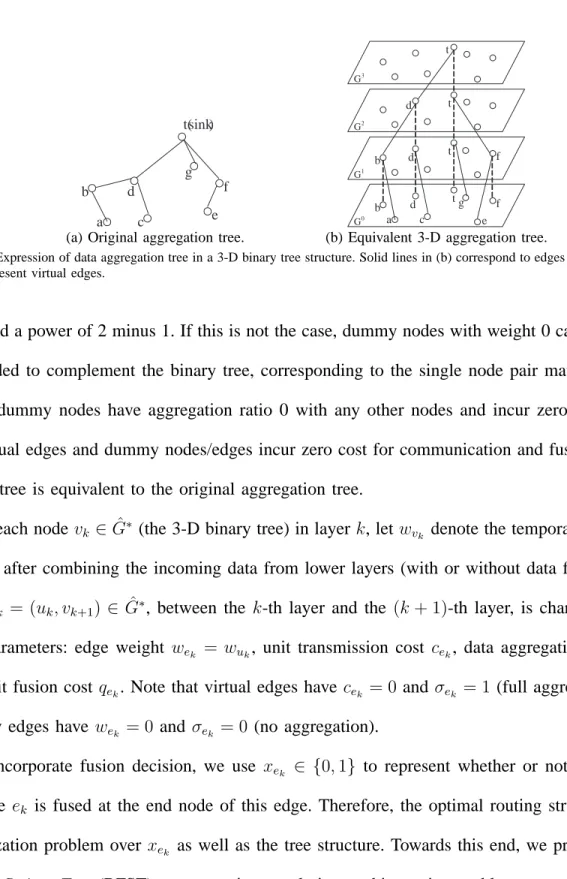
In order to make our analysis more clear, we use a 3-D binary tree structure to describe the process of the hierarchical matching technique used in MFST. Fig. 2 illustrates a mapping example of original aggregation tree and its transformation. From bottom to top, the edges between two layers represent the result of node matching and center selection in each iteration of MFST.
Assuming there are n sources in the aggregation tree G∗ obtained via MFST, to perform the transformation, we first clone N = dlog(n+ 1)e copies of G∗, denoted by G1, G2, . . . , GN. For convenience, we label the original G∗ as G0 and arrange them into vertical layers as shown in Fig. 2(b). For simplification, we will refer node v’s clone in layer k asvk. Subsequently, we map
the original aggregation tree G∗ as shown in Fig. 2(a) to a new graph Gˆ∗ embedded into these clones. Gˆ∗ is the targeted 3-D binary tree. The process is to map the result of each matching stage
k in MFST to the edges betweenGk andGk+1. If we match u andv in stage k andv is selected as the center node in MFST, we first add an edge e linking v’s clones in Gk andGk+1 with zero unit transmission cost c(e) = 0. This edge is termed virtual edge (dotted line). Then we connect
uk to vk+1 with the same unit communication cost c(e) as in G∗.
The result of this transformation is a binary tree which is rooted at the sink in GN and has all leaves in S residing in G0. For each sourcev ∈S, there is a path going through all clones of G∗, from v in G0 to the sink t in GN, via exactly N hops.
a t (sink) g f e d c b
(a) Original aggregation tree.
a t g f e d c b t f d b G0 G1 t d G2 t G3
(b) Equivalent 3-D aggregation tree.
Fig. 2. Expression of data aggregation tree in a 3-D binary tree structure. Solid lines in (b) correspond to edges in (a) and dotted
lines represent virtual edges.
assumed a power of 2 minus 1. If this is not the case, dummy nodes with weight 0 can be created as needed to complement the binary tree, corresponding to the single node pair matching cases. These dummy nodes have aggregation ratio 0 with any other nodes and incur zero fusion cost. As virtual edges and dummy nodes/edges incur zero cost for communication and fusion, the 3-D binary tree is equivalent to the original aggregation tree.
For each node vk ∈Gˆ∗ (the 3-D binary tree) in layerk, letwvk denote the temporary weight of node v after combining the incoming data from lower layers (with or without data fusion). Each edge ek = (uk, vk+1) ∈ Gˆ∗, between the k-th layer and the (k+ 1)-th layer, is characterized by four parameters: edge weight wek = wuk, unit transmission cost cek, data aggregation ratio σek, and unit fusion cost qek. Note that virtual edges have cek = 0 and σek = 1 (full aggregation), and dummy edges have wek = 0 and σek = 0 (no aggregation).
To incorporate fusion decision, we use xek ∈ {0,1} to represent whether or not information on edge ek is fused at the end node of this edge. Therefore, the optimal routing structures is an
optimization problem over xek as well as the tree structure. Towards this end, we present Binary
C. Binary Fusion Steiner Tree (BFST)
In BFST, we first obtain a routing tree using MFST algorithm, where fusion is performed by any intermediate node. Subsequently, we evaluate whether fusion on individual nodes will reduce the energy consumption of the network. If not, the fusion process on the node will be cancelled and instead data will be directly relayed.
BFST ALGORITHM:
1) Run MFST algorithm to obtain routing tree with fusion at every node possible. Convert the resulting aggregation tree to the 3-D binary tree as described above. For all edges in the tree, set xek = 1.
2) From bottom to top, calculate the fusion benefit for each edge in the aggregation tree (excluding virtual edges), which can represent the energy saving by data fusion on that edge. Let ∆uk,vk+1 denote the fusion benefit of edge ek = (uk, vk+1). It is defined as
∆uk,vk+1 = (wuk +wvk)C(vk+1, tN)−
³
(wuk +wvk)(1−σek)C(vk+1, tN) +qek(wuk +wvk)
´
(6) where C(vk+1, tN) denotes the summation of unit transmission costs from vk+1 to tN in
MFST. Set xek = 1 if ∆uk,vk+1 >0; otherwise, set xek = 0.
3) For all edges with xuk,vk+1 = 0, set xvk,vk+1 = 0 to their corresponding virtual edges. In our analysis, we will employ the 3-D binary tree described in the previous subsection. To simplify the analysis, we assume that in BFST, the data reduction ratio σ is non-increasing on each path from the source to the sink while the unit fusion cost q is non-decreasing, excluding virtual edges. This assumption can be naturally justified. First, strong correlation and thus high aggregation ratio usually are due to spatial correlation resulting from short distances between nodes. In turn, these short distances will lead to small unit transmission cost. Based on the metric
M(e) defined in MFST (which is a combination of fusion cost and transmission cost), it will match strongly correlated nodes before matching weakly correlated nodes. Therefore, for edges
on a source-sink path, the aggregation ratio for edges near the sink will not be larger than those further away. Reflected on the 3-D binary tree, this will lead to non-increasing σ on a particular source-sink path. The reason for skipping virtual edges is that their data aggregation ratio is set to 1 and does not affect the actual energy consumption of the network. Second, the unit fusion cost q is determined mainly by the complexity of the fusion algorithm and the input data set. As the information is being routed toward the sink, the data size and complexity will naturally increase due to aggregation on the route. Therefore, performing fusion thereon will incur more computation and hence more energy consumption per unit data.
Based on this assumption, we first introduce Lemma 1.
Lemma 1: xe is non-increasing on each path from a source to the sink in BFST.
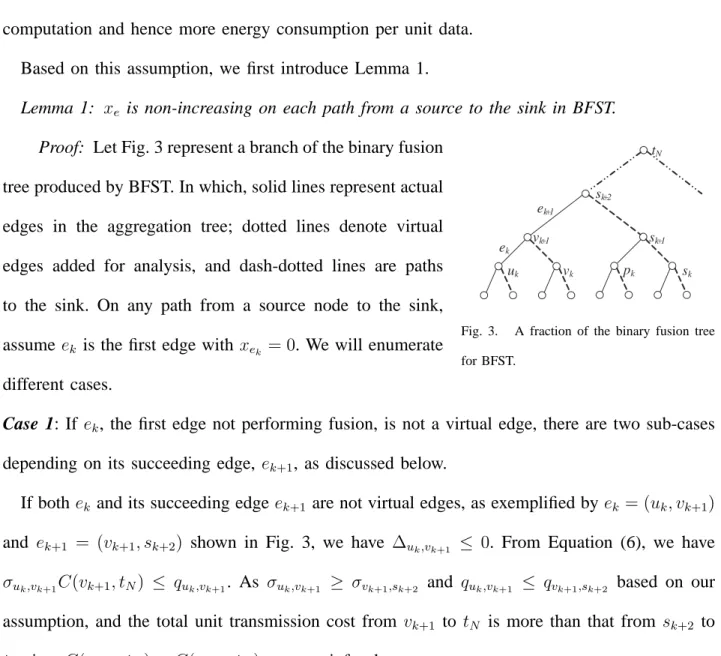
Proof: Let Fig. 3 represent a branch of the binary fusion
uk vk vk+1 pk sk sk+1 sk+2 tN ek+1 ek
Fig. 3. A fraction of the binary fusion tree
for BFST.
tree produced by BFST. In which, solid lines represent actual edges in the aggregation tree; dotted lines denote virtual edges added for analysis, and dash-dotted lines are paths to the sink. On any path from a source node to the sink, assume ek is the first edge with xek = 0. We will enumerate different cases.
Case 1: If ek, the first edge not performing fusion, is not a virtual edge, there are two sub-cases
depending on its succeeding edge, ek+1, as discussed below.
If both ek and its succeeding edgeek+1 are not virtual edges, as exemplified byek = (uk, vk+1) and ek+1 = (vk+1, sk+2) shown in Fig. 3, we have ∆uk,vk+1 ≤ 0. From Equation (6), we have
σuk,vk+1C(vk+1, tN) ≤ quk,vk+1. As σuk,vk+1 ≥ σvk+1,sk+2 and quk,vk+1 ≤ qvk+1,sk+2 based on our assumption, and the total unit transmission cost from vk+1 to tN is more than that from sk+2 to
tN, i.e., C(vk+1, tN)> C(sk+2, tN), we can infer that
This will lead to ∆vk+1,sk+2 <0. Consequently, we have xvk+1,sk+2 = 0.
If ek is not a virtual edge but its succeeding edge ek+1 is, as exemplified by ek = (pk, sk+1) and ek+1 = (sk+1, sk+2), the same conclusion can be obtained similarly.
Case 2: If ek is a virtual edge, as exemplified by ek= (vk, vk+1), according to BFST algorithm,
its matching pair edge e0k= (uk, vk+1)must havexuk,vk+1 = 0. From the result of Case 1, we also have xvk+1,sk+2 = 0.
Inductively, we can conclude that all succeeding edges of an edge that does not perform fusion will not perform fusion either. Since the fusion decision xek ∈ {0,1}, it is evident that xe is non-increasing on the path from source to sink.
Theorem 1: The total cost of BFST is no more than MFST.
Proof: Since BFST retains the same tree structure as MFST, for all edges with xek = 1, the BFST and MFST schemes will consume the same amount of energy. For any edge with xek = 0, owing to Lemma 1, any edge ei on the path from this edge to the sink satisfy xei = 0. This means that all edges on the path after ek have negative effect on energy conservation. In other
words, performing fusion will introduce additional cost. Therefore, BFST is a better algorithm than MFST by avoiding fusion when direct relaying is a better choice.
Intuitively, Lemma 1 depicts that the routing tree generated by BFST can be divided into two parts: the lower part where data aggregation is always performed and the upper part where direct relaying is employed. As no data aggregation is performed in the upper part of the tree, instead of sticking to MFST, we can further improve the routing structure to reduce energy consumption. Inspired thereby, we develop AFST.
D. Adaptive Fusion Steiner Tree (AFST)
AFST further improves BFST by introducing SPT into the routing tree. Similar to BFST, it performs a matching process as in MFST in order to jointly optimize over both transmission
and fusion costs. During the matching process, it also dynamically evaluates if fusion shall be performed or not. If it is determined at a particular point that fusion is not beneficial to the network, as shown by the analysis of BFST, we can conclude that any succeeding nodes on the routing path shall not perform fusion either. Consequently, we can employ SPT as the strategy for the remainder of the route as SPT is optimal for routing information without aggregation. Our analysis shows that AFST achieves better performance than BFST and thereon MFST.
AFST ALGORITHM:
1) Initialize the loop index i = 0. Define S0 =S ∪ {t}, and E∗ = ∅. Let wv0 for any v ∈ S equal to its original weight, and let wt0 = 0.
2) For every pair of non-sink nodes (u, v) ∈ Si: find the minimum cost path (u, v) in G
according to the metric
M(e) = qui,vi+1(wui +wvi) +α(wui, wvi)c(e). (7) Define Ki(u, v) to be the distance under metric M(e) of this path.
3) Find minimum-cost perfect matching between nodes in Si. If there is only one non-sink
node left after matching, match it to itself without any cost, and consider it as the last “single-node pair” in Si.
4) For each matched pair (u, v), calculate the fusion benefit for node u and v respectively according to this new definition:
∆ui,vi+1 = (wui +wvi)SP(vi, t)−
³
(wui+wvi)(1−σei)SP(vi, t) +qei(wui +wvi)
´
, (8) whereSP(vi, t)denotes the summation of unit transmission cost from vi to the sinkt using
shortest path.
We call(u, v)a non-fusion pair if there is no fusion benefit regardless which node is selected as the center. It means that the two following inequations are satisfied
Otherwise, we call them a fusion pair. 5) For each non-fusion pair (u, v),
• Add those edges that are on the shortest paths of (u, t) and (v, t) to set En∗. • Remove both nodes u and v from Si.
6) For each fusion pair (u, v),
• Add those edges that are on the path defining Ki(u, v) to set Ef∗ .
• choose u to be the center with probability P(u=center) = w 2 ui
w2
ui+wvi2 . Otherwise v will be the center. For pair (u, t), choose sink t to be the center.
• Transport weight of non-center node to its corresponding center node. According to Equation (3), the weight of the center satisfies wi+1(center) = (wui+wvi)(1−σui,vi+1). • Remove all non-center nodes from Si, then the remaining center nodes induce Si+1. 7) If Si+1 is empty or contains only the sink, we return G∗ = (V∗, E∗) (E∗ = Ef∗ +En∗),
where Ef∗ and En∗ is the set of fusion edges and non-fusion edges, respectively, and V∗ includes source nodes and the sink. Otherwise, increment i and return to step 2.
The size of set Si is reduced at least half after one run of the algorithm. However, the process
may terminate sooner than MFST and BFST if fusion is deemed unworthy in the early iterations.
Theorem 2: The total cost of AFST is no more than BFST.
Proof: The tree resulting from AFST also contains a lower part where aggregation is always
performed and an upper part where no aggregation occurs. The lower part of AFST is the same as that of BFST due to their MFST based matching procedure and thus incurs the same cost as well. The task left is then to show that for any non-fusion pair (u, v) satisfying inequality (9), their transmission costs based on SPT in AFST is no more than the corresponding routing costs, including fusion and transmission costs, incurred in BFST. The proof is given below.
denotes the summation of unit transmission cost fromvk to the sinktusing shortest path. Without
loss of generality, assume that v is selected as the center in BFST, and our goal is to prove
wvkSP(vk, t) +wukSP(uk, t) < wukc(uk, vk+1) +quk,vk+1(wuk +wvk) (10)
+(wuk +wvk)(1−σuk,vk+1)SP(vk+1, t).
For that, we have
wvkSP(vk, t) +wukSP(uk, t)
≤ wvkSP(vk+1, t) +wuk(c(uk, vk+1) +SP(vk+1, t))
= (wuk+wvk)SP(vk+1, t) +wukc(uk, vk+1)
= (wuk+wvk)(1−σuk,vk+1+σuk,vk+1)SP(vk+1, t) +wukc(uk, vk+1)
≤ (wuk+wvk)(1−σuk,vk+1)SP(vk+1, t) +quk,vk+1(wuk +wvk) +wukc(uk, vk+1)
When it is determined that the fusion benefit is positive for every node, the tree structure obtained from AFST degenerates to the tree from MFST. However, when fusion is not always beneficial for all nodes, AFST will stop doing nonsensical data fusion and directly deliver data to the sink for more energy saving, as a result, it can significantly outperform MFST. From the process of route construction, we can see that AFST can dynamically assign fusion decisions to routing nodes during the route construction process by evaluating whether fusion is beneficial to the network based on fusion/transmission costs and network/data structures.
E. Application in Clustering
Clustering in sensor networks is often used to group closely correlated sensor together in order to perform local decision making, detection, or classification. To facilitate these operations, fusion and transmission cost shall be considered due to severe resource constraints. While the concept of clustering has been widely applied, clustering itself is often based on static techniques mainly
based on geographic proximity, fixed cluster number, or certain cluster sizes.
The two-layer structure of AFST naturally provides a new clustering technique for sensor networks. Separated by the routing nodes not performing fusion, the lower part of AFST routing tree is composed of discrete branches within which data of every member will be fused together. These branches can be considered as clusters decided by energy consumption due to fusion and communication. Therefore, AFST provides a clustering algorithm as a byproduct that is energy efficient for gathering correlated data. Sensors in the same cluster will employ MFST based routing structure while cluster heads (roots of the branches) will directly send the aggregated data to the sink via shortest path without fusion. Since AFST is a randomized algorithm, we can rerun the process to generate a different structure and therefore re-assign the role of cluster heads to different nodes. Load balancing in terms of fusion is thus naturally implemented.
IV. EXPERIMENTALSTUDY
In this section, we compare the performance of AFST with other routing algorithms. In partic-ular, we select MFST, SPT, MST, and SLT to represent the class of routing schemes where fusion occurs on all routing nodes if possible. For routing schemes that does not perform aggregation, we employ SPT as it is the optimal routing strategy in this class. To distinguish it from the SPT scheme with data aggregation opportunistically occurs where information streams intersect, we denote the SPT without performing aggregation by SPT-nf, short name for SPT-no-fusion.
We study the impact of network connectivity, correlation coefficient, and unit fusion cost on different algorithms. Concurring with our design goal and analysis of the AFST algorithm, our key finding of the experiments is that AFST can adapt itself to a wide range of data correlations and fusion cost. Therefore, AFST can achieve better performance in all kinds of system setups.
A. Simulation Environment
In our setup, 100 sensor nodes are uniformly distributed in a region of a 50m×50m square. We assume that each node produces one 400-byte packet as original sensed data in each round and sends the data to the sink located at the bottom-right corner. All sensors act as both sources and routers. We also did sets of experiments of different number of sensors and different sizes of field, the results are similar and omitted here.
We assume the maximal communication radius of a sensor is rc, i.e, if and only if two sensor
nodes are within rc, there exists a communication link between them, or an edge in graph G. By
varying rc, we can control the network connectivity and hence equivalently the network density.
We instantiate unit transmission cost on each edge,c(e), using the first order radio model presented in [7]. According to this model, the transmission cost for sending one bit from one node to another that is d distance away is given by βdγ+ε when d < rc, where γ and β are tunable parameters
based on the radio propagation. We set γ = 2 and β = 100pJ/bit/m2 to calculate the energy consumption on the transmit amplifier. ε denotes energy consumption per bit on the transmitter circuit and receiver circuit. Typical values of ε range from20to 200nJ/bit according to [20]. We set it to be 100nJ/bit in our simulation.
We model data reduction due to aggregation based on correlation among sensed data. The correlation model employed here is an approximated spatial model where the correlation coefficient (denoted by ρ) decreases with the distance between two nodes provided that they are within the correlation range,rs. If two nodes are more thanrsdistance apart, simply the correlation coefficient
ρ = 0. Otherwise, it is given by ρ = 1−d/rs, where d denotes the distance between the nodes.
If nodev is responsible for fusing node u’s data (denoted by w(u)) with its own, we assume that the weight of node v after fusion is given by
where we(v) and w(v) respectively denote the data amount of node v before and after fusion.
Recall that we use σ to denote the data reduction ratio due to aggregation. From Equation (3),
w(v) = (w(u)+we(v))(1−σuv)if fusion is performed at nodev, we can get that the data reduction
ratio σuv is proportional to the correlation coefficient ρ. By varying the correlation range rs, we
can control the average correlation coefficient of the network, and further control the average data reduction after data fusion. For example, a very small rs essentially eliminates the correlation
among sensors (ρ→0), so that the amount of output data is equal to the summation of all input data. While an extremely largersmakes the sensed data completely redundant (ρ→1), as a result,
the fused data size equals to the bigger data size between the two input data. In our simulation, we use ρ instead of σ to describe the impact of data structure for ease of understanding. For the fusion cost, we assume that q is constant and use ω to denote the average fusion cost per bit at each node.
In the following subsections, we will study the performance of AFST and other algorithms under various system setups, including network connectivity, correlation coefficient, and fusion cost.
B. Impact of Network Connectivity
Since rc denotes the communication range of a node, by varying rc, we can control the
connectivity of the network. Here we set ω, the average unit fusion cost, to be 80nJ/bit, which is a typical value as demonstrated by our experimental study for fusion cost described in the Appendix. And we set rs, the correlation range, to be 50m to simulate a network with moderate
data reduction.
Fig. 4(a) summarizes the performance of all algorithms studied. The larger rc is, the more
strongly the network is connected. As we can see, MST wastes precious energy on data fusion at numerous relaying nodes and hence incurs high cost when the data reduction is not high. On the
5 15 25 35 45 70 75 80 85 90 95 100 105 110 Communication range rc (m) Total cost (mJ) MFST AFST SPT MST SLT
(a) Total cost
5 15 25 35 45 1 1.05 1.1 1.15 1.2 1.25 1.3 1.35 1.4 Communication range rc(m)
Cost ratio to other algorithms
MFST vs. AFST AFST SLT vs. AFST MST vs. AFST SPT vs. AFST
(b) Cost ratio to other algorithms
Fig. 4. Impact of network connectivity to energy consumption(ω= 80nJ/bit, rs= 50m,rc= 5∼45m).
contrary, SPT wastes energy owing to redundant data transmissions and also induces high cost since it tends to use fewer hops to reach the sink. As SLT is a hybrid tree structure balancing MST and SPT, it achieves better performance than both of them. However, inherently constrained by its algorithm construction, energy consumption of SLT is still relatively high.
As MFST explicitly considers fusion cost, it can effectively trade off between multi-hop relay benefitting from high data reduction ratio and single-hop transmission benefitting from less fusion cost. In a dense network with strong network connectivity, the benefit due to this flexibility to the network energy cost is more apparent. When rc is larger than 20m, MFST performs better than
all other algorithms except AFST.
As expected, AFST performs well in all communication ranges, almost steadily outperforming all other algorithms. This can be explained as follows. In a network with moderate data correlation, data from nodes that are far apart has little correlation and hence leads to small reduction ratio if aggregated. Therefore, performing data fusion over them cannot significantly benefit the network but still incur the fusion cost. AFST can effectively avoid such situations by evaluating fusion benefit. If the data reduction ratio due to correlation together with the fusion cost could not justify the fusion process, it employs the shortest paths toward the sink by using direct relay. Therefore, the cost of AFST continuously decreases along with the increase of communication range. Notably, it has significantly less energy cost for weakly connected network resulted from
short communication range as well. It can be reasoned in the same way.
Fig. 4(b) illustrates the cost ratio of other algorithms to AFST. As shown in the figure, the proposed AFST can save over 40% energy compared to MST, up to 35% energy to SPT, and about 10% to SLT when connectivity degree is high. Compared with MFST, AFST can save around 10% of energy in weakly connected environment while maintaining the same or better performance when network is strongly connected.
C. Impact of Correlation Coefficient
Naturally, performing aggregation is futile in a network with no data redundancy (ρ= 0). Even in a network with 100% data redundancy (ρ= 1), data fusion at all possible nodes may not bring benefit because of the high fusion cost. In this simulation, we fix the transmission range of the sensor nodes and study the impact of correlation coefficient to the performance of AFST. We increase the correlation range, rs, from 0.2 to 2000m which corresponds to varying ρ from 0 to
1. 0.25 1 4 16 64 256 2048 50 100 150 200 Correlation range rs(m) Total cost (mJ) MFST AFST SPT SPT−nf SLT
(a) Low fusion cost (ω= 50nJ/bit)
0.25 1 4 16 64 256 2048 70 100 150 200 250 Correlation range rs(m) Total cost (mJ) MFST AFST SPT SPT−nf SLT
(b) High fusion cost (ω= 120nJ/bit)
Fig. 5. Impact of average correlation coefficient to energy consumption (rc= 30m,rs= 0.25∼2000m).
Fig. 5(a) and (b) depict the total energy costs under light fusion cost and heavy fusion cost, respectively, for AFST and other algorithms like MFST, SPT, SLT, and SPT-nf. Naturally, costs of all algorithms with data fusion decrease as ρ increases. This exemplifies that data aggregation in sensor networks can greatly benefit the routing performance by reducing redundancy among correlated data. As SPT-nf totally ignores data aggregation, its cost remains constant.
When the data correlation in the network is very weak (ρ → 0), AFST follows SPT-nf, the optimal solution, by avoiding any data aggregation. When the data correlation in the network increases, AFST dynamically adjusts its decisions accordingly.
We also observe that different fusion cost will affect AFST as well by comparing Fig. 5(a) and (b). As shown in Fig. 5(a), when fusion cost is low, AFST performs data fusion partially in order to benefit from data aggregation and resultant data reduction, even when the correlation degree in the network is weak (rs being 4m). When the data in network is highly correlated (ρ→1), AFST
follows MFST to pursue the most energy saving by performing data fusion at each possible node. On the other hand, Fig. 5(b) illustrates the performance of AFST when the fusion cost is high. As we can see, even when ρ → 1, there are only a few nodes (about 15%) performing data fusion. This shows that AFST chooses not to perform fusion most of the time as the fusion cost itself is too high, overwhelming the benefit of reduction in data and communication costs. As a result, AFST performs better than any algorithm performing network wise fusion. At the same time, it also outperforms SPT-nf in the first case as SPT-nf does not perform fusion at all.
Fig. 5(a) and (b) demonstrate that the cost of AFST is extremely smooth in the whole range of the correlation coefficient and steadily outperform others. As correlation among nodes are often varying from application to application, from node to node, and even from time to time, only a general algorithm such as AFST optimized for a wide range of ρcan accommodate those versatile scenarios.
D. Impact of Unit Fusion Cost
In this set of experiments, we study the impact of varying unit fusion cost to the algorithms. Fig. 6 illustrates the results when ω, the unit fusion cost, increases from 10nJ/bit to 200nJ/bit. Fig. 6(a) shows the total cost of AFST as compared with other algorithms as the unit fusion cost increases. As we can see, the total costs of MFST and SLT increase unboundedly along
10 50 100 150 200 40 60 80 100 120 140 160
Unit fusion cost ω (nJ/bit)
Total cost (mJ)
MFST AFST SPT−nf SLT
(a) Total cost
10 50 100 150 200 10 20 30 40 50 60 70 80 90 100
Unit fusion cost ω (nJ/bit)
Number of fusion clusters
(b) Number of fusion clusters
10 50 100 150 200 0 20 40 60 80 100 120
Unit fusion cost ω (nJ/bit)
Fusion cost (mJ) MFST AFST SPT−nf SLT (c) Fusion cost 10 50 100 150 200 40 45 50 55 60 65 70 75 80 85
Unit fusion cost ω (nJ/bit)
Transmission cost (mJ) MFST AFST SPT−nf SLT (d) Transmission cost
Fig. 6. Impact of unit fusion cost to energy consumption(rc= 30m,rs= 20m,ω= 10∼200nJ/bit).
with the increase of ω, even though MFST has a lower slope. On the contrary, AFST follows the performance curve of MFST first and then leans towards SPT-nf, the optimal solution when fusion cost is high. The figure can be best explained when we jointly examine it with Fig. 6(b), which depicts the number of clusters, the branches of the routing tree that always perform aggregation on their nodes. All algorithms with network wise fusion are unable to stop fusion even when fusion cost is extremely high. However, for AFST, as shown in Fig. 6(b), when ω is very small, there are only two fusion clusters. This denotes that data fusion is performed almost on all nodes, which takes advantage of the low fusion cost. When ω increases, AFST increases the number of fusion clusters and hence reduces the number of fusions due to reduced fusion benefit in order to balance the fusion cost and transmission cost. And when ω is too large, AFST can achieve the same constant cost as SPT-nf by completely stopping data fusion.
Fig. 6(c) and (d) provide us a closer look at the routing behaviors by breaking the total cost into transmission and fusion costs. As both SLT and SPT-nf have fixed tree structure when the network topology is determined, their transmission costs are fixed as well. Naturally, the fusion cost of SLT increases linearly with ω while there is no fusion cost in SPT-nf.
As MFST jointly explores the transmission and fusion costs to optimize the routes, it can tradeoff between them. As a strategy, it can explore long one-hop transmission in order to reduce the number of fusions and hence fusion cost. As a result, the transmission cost in MFST increases in order to prevent the fast increase of fusion cost. Consequently, the increase of fusion cost
and total cost in MFST are significantly slower than SLT. However, when ω increases more and fusion cost is dominant in the total cost, adjustment of routing tree structure will have insignificant impact and hence MFST’s fusion cost increases almost linearly while its transmission cost remains constant.
On the contrary, AFST can better balance the fusion and transmission costs by adjusting the number of fusion clusters. When the unit fusion cost is insignificant, AFST effectively reduces its transmission cost by fully exploiting data fusion. In this case, AFST’s cost is similar to that of MFST. When the unit fusion cost continues to increase, AFST can reduce data fusion points and employ more shortest paths for direct relaying. Therefore, while its transmission cost increases rapidly, the fusion cost also decreases rapidly simultaneously. As a result, the total cost can be kept low. When the unit fusion cost is extremely large, AFST simply approaches SPT-nf with no node performing fusion and hence obtains zero fusion cost. In this case, the total cost equals to the transmission cost and remains constant.
As described in Section II, fusion cost may vary widely from network to network, from application to application. As an example, a temperature surveillance sensor network may have little fusion cost to calculate the max, min, or average temperature. On the other hand, a wireless video sensor network may incur significant fusion cost when performing image fusion. Our experiments show that among all algorithms, AFST can adapt best to a wide range of fusion costs and hence be applicable to a variety of applications.
E. Extreme Cases of Correlation Coefficient
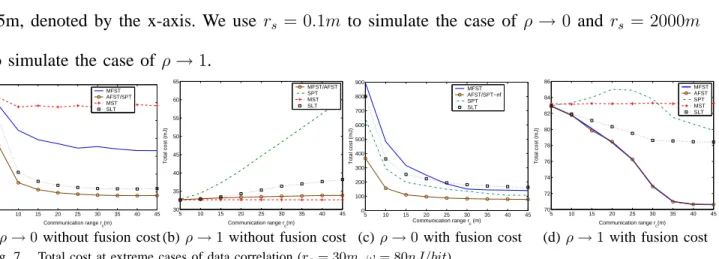
In this set of experiments, we study the performance of AFST when the correlation coefficient takes extreme values. We examine the scenario where there is no data redundancy (ρ → 0) and the scenario of 100% data aggregation (ρ → 1). Fig. 7 summarizes the results. Two cases, with or without fusion cost, are studied for each of the scenarios. In all cases, rc is varied from 5m to
45m, denoted by the x-axis. We use rs = 0.1m to simulate the case of ρ → 0 and rs = 2000m
to simulate the case of ρ→1.
5 10 15 20 25 30 35 40 45 0 100 200 300 400 500 600 700 Conmmunication range rc(m) Total cost (mJ) MFST AFST/SPT MST SLT
(a)ρ→0without fusion cost
5 10 15 20 25 30 35 40 45 30 35 40 45 50 55 60 65 Communication range r c(m) Total cost (mJ) MFST/AFST SPT MST SLT
(b) ρ→1without fusion cost
5 10 15 20 25 30 35 40 45 0 100 200 300 400 500 600 700 800 900 Communication range r c (m) Total cost (mJ) MFST AFST/SPT−nf SPT SLT
(c)ρ→0 with fusion cost
5 10 15 20 25 30 35 40 45 70 72 74 76 78 80 82 84 86 Communication range r c(m) Total cost (mJ) MFST AFST SPT MST SLT
(d)ρ→1 with fusion cost
Fig. 7. Total cost at extreme cases of data correlation (rc= 30m,ω= 80nJ/bit).
1) Without fusion cost: We first disregard fusion cost. The simulation results shown in Fig. 7(a)
and (b) concur with those described in [15]. In a weakly correlated network, SPT is the optimal solution while MST is the worst. On the contrary, in a strongly correlated network, MST is the optimal solution and SPT is the worst. Fig. 7(a) also shows that AFST is the same as the optimal solution, SPT, in a weakly correlated network and has a gain factor of 3 compared with MFST. Fig. 7(b) shows that both AFST and MFST closely approximate the optimal solution, MST. The approximation ratio is within 5%, and they can save 10% energy compared with SLT.
2) With fusion cost: In this set of simulations, we include fusion cost and study the two extreme
scenarios again. We set ω, the unit fusion cost, to be 80nJ/bit. Fig. 7(c) illustrates that AFST can achieve the optimal
0 20 40 60 80 100 120 140 160 0.5 2 8 32 128 512 0 20 40 60 80 100 Correlation range r s (m)
Unit fusion cost ω (nJ/bit)
Number of fusion clusters
Fig. 8. The number of fusion clusters in AFST.
performance by avoiding data fusion completely compared with all other algorithms with inefficient data fusion on uncorrelated data.
When ρ → 1 as illustrated in Fig. 7(d), since the unit fusion cost is comparable to the average of transmission cost, AFST behaves similarly as MFST by performing
F. The Number of Fusion Clusters in AFST
Fig. 8 illustrates the number of fusion clusters with varying correlation coefficient and unit fusion cost. When ρ → 0, the cluster number equals 100, denoting that no data fusion occurs. When the unit fusion cost is small, the number of fusion clusters decreases rapidly with the increase of ρ. When ρ approaches 1, the cluster number becomes 1, meaning that all nodes will perform fusion and the network becomes a full fusion tree. At the same time, when unit fusion cost increases, AFST will tradeoff the fusion cost with transmission cost. As a result, the decreasing of the cluster number slows down. For example, for ω = 80nJ/bit, a unit fusion cost comparable to the average unit transmission cost, there are 33 fusion clusters when ρ → 1. This means on average, there are only three nodes in a cluster performing data fusion. The fused data are then forwarded to the sink via shortest paths directly with simple relaying. If ωkeeps increasing, fewer nodes perform fusion to avoid the high fusion cost.
V. RELATEDWORK
If the complete knowledge of all data correlations is available in advance at each source, theoretically the best routing strategy is to use a distributed source coding typified by Slepian-Wolf coding [24]. In this technique, compression is done at the original sources in a distributed manner to achieve the minimum entropy and hence avoid the need for data aggregation on the intermediate nodes. An optimal rate allocation algorithm for nodes in the network is proposed in [15] and SPT is employed as the routing scheme. However, implementation of distributed source coding in a practical setting is still an open problem and likely to incur significant additional cost because of the requirement on the knowledge of network wise correlation.
Routing with data aggregation can be generally classified into two categories: routing-driven and aggregation-driven. Routing-driven algorithms [7–9, 12, 13] emphasize source compression at each individual node and aggregation occurs opportunistically when routes intersect. On the contrary,
routing paths in aggregation-driven algorithms [14–16] are heavily dependent on data correlation in order to fully benefit from information reduction resulting from data aggregation. In [15], the authors proved that the minimum-energy data gathering problem is NP-complete by applying reduction set-cover problem and claimed that the optimal result is between SPT and the travelling salesman path. In [14], a hierarchical matching algorithm is proposed resulting in an aggregation tree with a logarithmic approximation ratio to the optimal for all concave aggregation functions. In this model, each node can theoretically obtain the joint entropy of its subtree to receive the maximal aggregation ratio. However, aggregation only depends on the number of nodes in the subtree rooted at the aggregation node regardless of the correlation among the data.
Indeed, the idea of embedding fusion decisions in routing has been implicitly explored in the literature. For example, LEACH [7] is a cluster-based protocol, in which sensors directly send data to cluster heads where data fusion is performed. Aggregated data is then delivered to the sink through multi-hop paths. The authors of [16] proposed an optimal algorithm MEGA for foreign-coding and an approximating algorithm LEGA for self-coding. In MEGA, each node sends raw data to its encoding point using directed MST, and encoded data is then transmitted to the sink through SPT. LEGA uses SLT [25, 26] as the data gathering topology, and achieves
2(1 +√2) approximation ratio for self-coding. LEGA and MEGA implicitly assume that fusion
stops after first aggregation as encoded data cannot be recoded again. However, the decision regarding fusions in these schemes are rather static and cannot adapt to network/data structure changes. As demonstrated earlier, this decision shall be based on various conditions of the networks in order to minimize energy consumption.
VI. CONCLUSION
In this paper, we propose AFST, a routing algorithm for gathering correlated data in sensor networks. AFST not only optimizes over both the transmission and fusion costs, but also adaptively
adjusts fusion decisions for sensor nodes as to whether fusion shall be performed. Generalized from MFST, an algorithm guarantees an approximation ratio of 54log(n+1)to the optimal solution, AFST is analytically shown to be a better algorithm than its ancestor. Extensive experiments show that AFST achieves near optimal solutions under various networking conditions, including broad scopes of fusion/transmisison costs and network/data structures.
Furthermore, our analytical result indicates that AFST partitions the routing tree into two distinct parts based on whether aggregation is performed or not. Naturally, AFST also provides a clustering scheme with near optimal routing performance, where fusion can be confined within the clusters only.
As an ongoing effort, we are quantifying theoretically the performance improvement of AFST over MFST. In our future work, we plan to develop an online algorithm based on AFST that can be executed in a distributed manner by sensor nodes.
REFERENCES
[1] H. Luo, J. Luo, Y. Liu, and S. K. Das, “Routing correlated data with adaptive fusion in wireless sensor networks,” in
Proceedings of the 3rd ACM/SIGMOBILE International Workshop on Foundation of Mobile Computing, Cologne, Germany,
Aug. 2005.
[2] H. Luo, Y. Liu, and S. K. Das, “Routing correlated data with fusion cost in wireless sensor networks,” IEEE Transactions
on Mobile Computing, to appear.
[3] C. Chong and S. Kumar, “Sensor networks: Evolution, opportunities, and challenges,” Proceedings of the IEEE, vol. 91, no. 8, Aug. 2003.
[4] I. Akyildiz, W. Su, Y. Sankarasubramaniam, and E. Cayirci, “A survey on sensor networks,” IEEE Communications Magazine, vol. 40, no. 8, Aug. 2002.
[5] W. Heinzelman, J. Kulik, and H. Balakrishnan, “Adaptive protocol for information dissemination in wireless sensor networks,” in Proceedings of ACM Mobicom, Seattle, WA, Aug. 1999.
[6] A.A. Ahmed, H. Shi, and Y. Shang, “A survey on network protocols for wireless sensor networks,” in Proceedings of the
IEEE ITRE’03, Newark, NJ, Aug. 2003.
[7] W.R. Heinzelman, A. Chandrakasan, and H. Balakrishnan, “Energy-efficient communication protocol for wireless microsensor networks,” in Proceedings of the 33rd Annual Hawaii International Conference on System Sciences, Maui, HI, Jan. 2000. [8] B. Krishnamachari, D. Estrin, and S. Wicker, “Impact of data aggregation in wireless sensor networks,” in Proceedings of
the 22nd International Conference on Distributed Computing Systems, Vienna, Austria, July 2002.
[9] A. Scaglione and S. D. Servetto, “On the interdependence of routing and data compression in multi-hop sensor networks,” in Proceedings of ACM MobiCom, Altanta, GA, Sept. 2002.
[10] S. Pattem, B. Krishnamachari, and R. Govindan, “The impact of spatial correlation on routing with compression in wireless sensor networks,” in Proceedings of IPSN’04, Berkeley, CA, Apr. 2004.
[11] W. Zhang and G. Cao, “Dctc: Dynamic convoy tree-based collaboration for target tracking in sensor networks,” IEEE
[12] C. Intanagonwiwat, D. Estrin, R. Govindan, and J. Heidemann, “Impact of network density on data aggregation in wireless sensor networks,” in Proceedings of ICDCS’02, Vienna, Austria, July 2002.
[13] C. Intanagonwiwat, R. Govindan, D. Estrin, J. Heidemann, and F. Silva, “Directed diffusion for wireless sensor networking,”
IEEE/ACM Transactions on Networking, vol. 11, no. 1, Feb. 2003.
[14] A. Goel and D. Estrin, “Simultaneous optimization for concave costs: Single sink aggregation or single source buy-at-bulk,” in Proceedings of ACM-SIAM Symposium on Discrete Algorithms, Baltimore, MD, Jan. 2003.
[15] R. Cristescu, B. Beferull-Lozano, and M. Vetterli, “On network correlated data gathering,” in Proceedings of IEEE Infocom, Hongkong, China, Mar. 2004.
[16] P.V. Rickenbach and R. Wattenhofer, “Gathering correlated data in sensor networks,” in Proceedings of ACM
DIALM-POMC’04, Philadelphia, PA, Oct. 2004.
[17] Y. Yu, B. Krishnamachari, and V. Prasanna, “Energy-latency tradeoff for data gathering in wireless sensor networks,” in
Proceedings of IEEE Infocom, Hongkong, China, Mar. 2004.
[18] S. Lindsey and C. S. Raghavendra, “Pegasis: Power-efficient gathering in sensor information systems,” in Proceedings of
IEEE Aerospace Conference, Big Sky, MT, Mar. 2002.
[19] W. Zhang and G. Cao, “Optimizing tree reconfiguration for mobile target tracking in sensor networks,” in Proceedings of
IEEE Infocom, Hongkong, China, Mar. 2004.
[20] A. Wang, W. B. Heinzelman, A. Sinha, and A. P. Chandrakasan, “Energy-scalable protocols for battery-operated microsensor networks,” Journal of VLSI Signal Processing, vol. 29, no. 3, Nov. 2001.
[21] D. W. Carman, P. S. Kruus, and B. J. Matt, “Constraints and approaches for distributed sensor network security,” NAI Labs
Technical Report 00-010, Sept. 2000.
[22] A. Meyerson, K. Munagala, and S. Plotkin, “Cost-distance: Two metric network design,” in Proceedings of the 41st Annual
Symposium on Foundations of Computer Science, Redondo Beach, CA, Nov. 2000.
[23] C. Papadimitriou and K. Steiglitz, Combinatorial Optimization: Algorithms and Complexity, Dover Publications Inc, 1998. [24] S. S. Pradhan and K. Ramchandran, “Distributed source coding using syndromes (DISCUS): Design and construction,”
IEEE Transactions on Information Theory, vol. 49, no. 3, Mar. 2003.
[25] A. Goel and K. Munagala, “Balancing steiner trees and shortest path trees online,” in Proceedings of the 11th ACM-SIAM
symposium on Discrete Algorithms, San Francisco, CA, Jan. 2000.
[26] B. Raghavachari S. Khuller and N. Young, “Balancing minimum spanning and shortest path trees,” in Proceedings of the
4th ACM-SIAM symposium on Discrete Algorithms, Austin, TX, Jan. 1993.
[27] “http://www.eecs.umich.edu/ panalyzer/,” .
[28] T. Austin, E. Larson, and D. Ernst, “Simplescalar: an infrastructure for computer system modeling,” Computer, vol. 35, no. 2, pp. 59, Feb. 2002.
[29] L.J. Chipman, T.M. Orr, and L.N. Graham, “Wavelets and image fusion,” in Proceedings of the International Conference
on Image Processing, Washington DC, USA, Oct. 1995.
[30] W. B. Pennebaker and J. L. Mitchell, JPEG: Still Image Data Compression Standard, Van Nostrand Reinhold, 1993. [31] J. M. Shapiro, “Embedded image coding using zerotrees of wavelet coefficients,” IEEE Transactions on Signal Processing,
vol. 41, no. 12, Dec. 1993.
APPENDIX
We have performed a series of experiments to investigate the aggregation cost in sensor net-works. Our platform used is Sim-panalyzer [27], an extension of Simple Scalar [28] for power analysis. Simple Scalar is a well established architectural simulator that provides cycle-level tool sets for detailed processor-architecture study. As its extension, Sim-panalyzer provides analytical
power simulation models for ARM CPU and Alpha CPU. In our experiments, we choose Stron-gARM SA-1110 as our embedded core as it is commonly used for high performance sensor node design in academic research and industrial development.
A. Measurement Model for Data Aggregation
We first detail the model of data aggregation process
Input Data Raw Data
Decompression Data Filtering
Compression Fusion Algorithm
Transmission
Fig. 9. Measurement model for data aggregation.
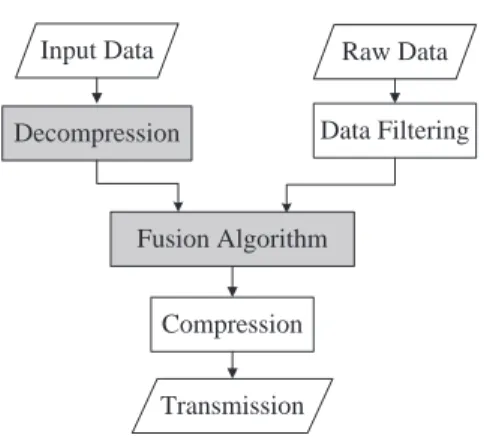
used in our simulation. As illustrated in Fig. 9, we assume that each sensor is capable of data sensing, pre-processing, and data aggregation. A sensor node will compress its local raw data before transmitting it on the route back to the sink. If it receives data from another node, in a compressed form, to perform data aggregation, the node shall decompress the
data first and perform the designated aggregation algorithm with its own raw data. The aggregated data will then be compressed and routed to the next hop. In this model, the aggregation cost is composed of two parts, marked in gray in Fig. 9, the cost for decompressing the input data and the cost for performing the fusion algorithm itself. In the following, we will only focus on these two parts.
Energy consumption of a system contains static power dissipation and dynamic power dissipa-tion. Dynamic power dissipation denotes the application processing energy with given instruction set and data set. Evidently, this part is the investigating target of our experiment. Equation (11) is a model for dynamic power dissipation commonly employed in energy measurement [20].
Etotal =CtotalVdd2 +Vdd(I0e Vdd nVT)(N
f ). (11)
Here, N represents the number of cycles for executing the algorithm with the given data set. It is determined by the algorithm complexity and affected by the compiling method. Ctotal denotes the
it is also affected by the switching activity parameter. Vdd and f are the core supply voltage and
clock frequency of the CPU, respectively. VT denotes thermal voltage. I0 and n are core specific which we assign 1.196mA and 21.26 according to [20]. The SA-1110 core can be configured to various combinations of supply voltage and system clock. In our experiment we use 100MHz clock and 1.5V for core voltage. We have performed simulations using other configurations and the simulation results are similar.
B. Image Fusion
One of our experiments is wavelet-based image fusion. Wavelet-based image fusion is generally considered as the most efficient algorithm for image fusion and different approaches have been proposed [29]. In our experiment, we simulate a simple and efficient method described in [29]. According to the measurement model illustrated in Fig. 9, a fusion node will use Discrete Wavelet Transformation (DWT) to generate wavelet coefficients from local image. To perform fusion with another node’s data, the node will use Zerotrees expansion to decompress the input data into wavelet coefficients. Given the wavelet coefficients of the two input images, the averages of these coefficients are computed as those for the fusion result. While this algorithm is simple, it provides a lower bound on the computation cost. More complex algorithms for better fusion result will undoubtedly incur even higher cost. Consequently, the aggregation cost is the cost of the decompression process and the merging process.3
(a) Input image (b) Local image (c) Fused image
Fig. 10. Image Fusion Example.
3The cost of the final Zerotree compression on the merged data shall not be considered as part of the fusion cost as the node
The gray scale images depicted in Fig. 10 are used in the simulation. Fig. 10(a) is the input image representing data from another node. Notice that it has a blurred area at the top-left corner. Fig. 10(b) is the local image at the fusion node, with a blurred area at the bottom-left corner. Fig. 10(c) is the fused image by performing the aforementioned fusion algorithm on Fig. 10(a) and (b). Notice that in the fused image, the blurred areas are effectively eliminated.
2000 4000 6000 8000 10000 12000 0 1 2 3 4 5 6 7 8x 10 −3
Input data size (byte)
Energy cost (J)
(a) Energy cost
2000 4000 6000 8000 10000 12000 20 30 40 50 60 70 80 90 100 110 120
Input data size (byte)
Energy cost on per bit (nJ)
(b) Per bit energy cost
Fig. 11. Wavelet image fusion cost.
Fig. 11(a) and (b) depict our experiment results. During our simulation, we scaled the image content from 64×64 pixels to 220×220 pixels. Reflected on the X axis of the figures, it is the total data size in byte of the two input images of the fusion algorithm. As we perform two level DWT and apply the embedded coding scheme [30, 31] using Zerotrees, the compression ratio is approximately 8:1. Therefore, the X axis ranges from 1 KB (corresponding to 64×64pixels) to 12 KB (corresponding to220×220 pixels) as the summation of two image sizes. The total image fusion energy consumption in Jouleis shown in Fig. 11(a) while the per bit energy cost is shown in Fig. 11(b). As we can see, the total image fusion cost monotonically increases with the input data size. Fig. 11(b) shows that the per bit energy cost remains roughly constant at 75nJ/bit, comparable to per bit communication cost reported in the literature [7, 20]. The irregular variations of per bit energy cost between consecutive measurements (image sizes) are due to the Zerotrees encoding scheme.