Hardware Transactional Memory for GPU Architectures
Wilson W. L. Fung
†Inderpreet Singh
†Andrew Brownsword
Tor M. Aamodt
†Department of Computer and Electrical Engineering
†University of British Columbia
[email protected] [email protected] [email protected] [email protected]
ABSTRACT
Graphics processor units (GPUs) are designed to efficiently exploit thread level parallelism (TLP), multiplexing execution of 1000s of concurrent threads on a relatively smaller set of single-instruction, multiple-thread (SIMT) cores to hide various long latency opera-tions. While threads within a CUDA block/OpenCL workgroup can communicate efficiently through an intra-core scratchpad memory, threads in different blocks can only communicate via global mem-ory accesses. Programmers wishing to exploit such communication have to consider data-races that may occur when multiple threads modify the same memory location. Recent GPUs provide a form of inter-block communication through atomic operations for sin-gle 32-bit/64-bit words. Although fine-grained locks can be con-structed from these atomic operations, synchronization using locks is prone to deadlock. In this paper, we propose to solve these prob-lems by extending GPUs to support transactional memory (TM). Major challenges include supporting 1000s of concurrent transac-tions and committing non-conflicting transactransac-tions in parallel. We propose KILO TM, a novel hardware TM design for GPUs that scales to 1000s of concurrent transactions. Without cache coherency hardware to depend on, it uses word-level, value-based conflict detection to avoid broadcast communication and reduce on-chip storage overhead. It employs speculative validation using a novel bloom filter organization to increase transaction commit parallelism. For a set of TM-enhanced GPU applications, KILO TM captures 59% of the performance of fine-grained locking, and is on average 128×faster than executing all transactions serially, for an estimated hardware area overhead of 0.5% of a commercial GPU.
Categories and Subject Descriptors
C.1.4 [Computer System Organization]: Processor Architectures—
Parallel Architectures; D.1.3 [Software]: Programming Techniques—
Concurrent Programming
General Terms
Design, Performance
1.
INTRODUCTION
Recently, there has been much interest in the use of GPUs to provide cost-effective parallel performance. GPUs have the poten-tial to provide higher computation per unit cost since they devote a
Permission to make digital or hard copies of all or part of this work for personal or classroom use is granted without fee provided that copies are not made or distributed for profit or commercial advantage and that copies bear this notice and the full citation on the first page. To copy otherwise, to republish, to post on servers or to redistribute to lists, requires prior specific permission and/or a fee.
MICRO’11, December 3-7, 2011, Porto Alegre, Brazil Copyright 2011 ACM 978-1-4503-1053-6/11/12 ...$10.00.
larger fraction of their area to functional units rather than schedul-ing logic. Applications that benefit from runnschedul-ing on a GPU tend to contain plenty of data parallelism coupled with regular mem-ory access patterns that ensure efficient use of off-chip memmem-ory bandwidth. In this work, we explore a generic manycore accelera-tor architecture similar to contemporary GPUs from NVIDIA and AMD and focus on the challenge of running applications that re-quire some form of synchronization.
A common problem with using lock-based synchronization is the potential for deadlocks. Manycore accelerators such as GPUs use more threads to deliver more throughput at a lower cost and energy consumption. More threads, and correspondingly larger problem sizes, exacerbate the challenge of lock-based programming by in-creasing the number of ways in which a deadlock can manifest [4]. One obstacle preventing GPUs from tackling a wider variety of application workloads is the difference between CPU and GPU programming models. This is particularly true for synchroniza-tion primitives, which perform poorly and can interact in intri-cate ways (from a programmer perspective) with the underlying multi-threaded execution hardware on a GPU. We believe it is nec-essary to simplify the programming of highly parallel workloads that require data synchronization. Enabling transactional mem-ory (TM) [28] on GPUs simplifies synchronization, and provides a powerful programming model that promotes fine grained com-munication and strong scaling of parallel workloads. This work focuses on enabling TM on a GPU efficiently and evaluates a de-tailed implementation to understand the trade-offs involved.
The contributions of this paper are:
• It proposes the use of hardware transactional memory (HTM) for GPU computing.
• It proposes KILO TM, a novel, scalable HTM design. The design combines aspects of value-based conflict detection [42, 19], RingSTM [49], and Scalable TCC [16] (Transactional Coherence and Consistency) to support 1000s of concurrent transactions without requiring a cache coherency protocol. It detects conflicts at word-level granularity and employs spec-ulative validation to increase transaction commit parallelism. • It proposes an extension to SIMT [35] hardware to handle
control flow divergence due to transaction aborts.
• It introduces therecency bloom filterwhich incorporates a notion of time and supports implicit, multi-item removal. • It evaluates the potential of transactional memory on a set of
GPU computing workloads that employ transactions. • It describes an extension to the GPU hardware thread
sched-uler to control transaction concurrency, and shows that the mechanism benefits high-contention workloads.
Our evaluation shows that KILO TM captures 59% of the perfor-mance of fine-grained locking. We find that KILO TM outperforms fine-grained locking for low contention applications that require
SIMT Core Constant Cache Texture Cache Memory Port L1 Data Cache SIMT Stacks SIMT Core Constant Cache Texture Cache Memory Port L1 Data Cache SIMT
Stacks Memory PartitionMemory Partition CPU Kernel Launch Inte rco nn ect ion Ne two rk Memory Partition Last-Level Cache Bank Off-Chip DRAM Channel Atomic Op. Unit Commit Unit SIMT Core Thread Block Thread Block Sh are d M em
ory ConstantCache
Texture Cache Memory Port Re gist er Fi le L1 Data Cache TX Log Unit SIMT Stacks
Figure 1: High-Level GPU architecture exposed by the CUDA programming model. TX Log Unit, Commit Unit added for KILO TM. SIMT stack modified to support transactions.
acquiring multiple locks to enter a critical section. On the other hand, we find that TM applications ported from CPU-optimized versions can perform poorly on GPUs regardless of the data syn-chronization mechanism used (fine-grained locking or TM). Opti-mizing these applications for GPUs would involve redesigning the algorithm and data structures, possibly requiring data synchroniza-tion at a much finer-granularity to expose more parallelism. Doing so without TM would require rewriting much of the application before testing for correctness, a risky investment that might deter wider adoption of GPU computing for these types of applications. Our estimation with CACTI [47] indicates that implementing KILO TM on an NVIDIA Fermi GPU [40] would increase area by only 0.5%, a small overhead for the large increase in programmability.
The rest of this paper is organized as follows: Section2briefly reviews relevant background information. Section3motivates TM on GPUs, and outlines the challenges in adopting prior HTMs on GPUs. Section4describes KILO TM, our TM design for a GPU that supports 1000s of concurrent transactions. Section5describes our methodology and benchmark applications, Section6presents results, Section7discusses related work, and Section8concludes.
2.
BACKGROUND
2.1
Transactional Memory
Transactional memory [28,27] simplifies software development for parallel architectures by providing the programmer with the il-lusion that blocks of code, calledtransactions, execute atomically. With TM, the programmer does not need to write code with locks to ensure mutual exclusion. For example, in the ATM benchmark (Section5), each scalar thread uses a transaction to specify that funds should be debited from one account and deposited into an-other account as a single action. If two threads try to access the same account at the same time, one transaction will be restarted. In the absence of such conflicts, all transactions can perform the transfer in parallel.
2.2
Baseline GPU Architecture
Figure1shows the high-level organization of our baseline GPU-like manycore accelerator that runs CUDA and OpenCL applica-tions [39,41, 31]. A CUDA program starts on a CPU and then launches parallelcompute kernelsonto a GPU. Each kernel launch dispatches a hierarchy of threads (agrid of blocks of warpsof scalarthreadsrunning the same compute kernel) onto the accel-erator. Blocks are allocated as a single unit of work to a heavily multi-threaded SIMT core. Threads within a block can communi-cate via an on-chipshared memory1. The SIMT cores access a dis-tributed, shared, read/writeable last-level (L2) cache and off-chip DRAM via an on-chip network.
With the SIMT execution model, scalar threads are managed as a SIMD execution group called a warp (or wavefront in AMD ter-minology). Each warp contains 32 scalar threads [41].
116kB scratchpad memory per SIMT core.
SIMT Stack - Branch Divergence Hardware.Each warp has a SIMT stack that serializes the execution of different subsets of threads that diverge to different control flow paths. We summarize the SIMT stack mechanism in our baseline below [23,24].
If some threads in a warp have different outcomes when a branch executes, i.e. the branch diverges, new entries are pushed onto the warp’s SIMT stack. Each entry contains a reconvergence PC (RPC) which is set to the immediate post-dominator2of the branch. Each bit in the active mask indicates whether the corresponding thread follows the control flow path corresponding to the stack entry. The PC of the top-of-stack (TOS) entry indicates the target path of the branch. Reaching the reconvergence point is detected when the next PC equals the RPC at the TOS entry. When this occurs, the top of the stack is popped (current GPUs use special instructions to manage the stack [34,18,3]). This switches execution to the next branch target that is to be executed by the other subset of threads. After all threads reach the reconvergence point, the TOS entry will reveal a full active mask with the reconvergence PC of the divergent branch, indicating that the threads have effectively reconverged.
Memory Subsystem.When a warp executes a memory instruc-tion, each scalar thread in the warp sends a scalar memory access to the memory subsystem in the SIMT core. For shared memory accesses, each shared memory bank processes conflicting accesses in successive cycles. Forglobalandlocalmemory spaces [41], ac-cesses from different threads in the same warp to the same cache line are merged (coalesced) into a single wide access. The L1 data cache services these wide accesses one per cycle.
Each thread has access to a privatelocal memory space [41], which is used mainly for register spilling. The local memory is stored in off-chip DRAM and cached in the per-core L1 data cache and the last-level (L2) cache. It is organized such that consecutive 32-bit words are accessed by consecutive scalar threads in a warp. When all the threads in a warp are accessing the same address in their own local memory space, their accesses can be coalesced into a single wide access that can be serviced by the L1 data cache in a single cycle.
The L1 data caches in the SIMT cores are not coherent. Simi-lar to NVIDIA Fermi [40], a write hit at a memory location in the
global memory space[41] evicts the cache line from the L1 and sends the updated contents to the L2 cache bank at the correspond-ing memory partition. A stale version of the same cache line may be cached in another SIMT core. To ensure that a global mem-ory access always returns coherent data, the CUDA application can configure the GPU hardware to skip the L1 cache for all global memory accesses [41]. These accesses are then serviced directly by the L2 cache.
Atomic Operations. Current GPUs provide hardware atomic operations for simple single-word read-modify-write operations [41, 31]. These are implemented by extending alpha blending hard-ware [54,37] (Atomic Op. Unit in Figure1) to perform these read-modify-write operations to individual locations atomically.
3.
TRANSACTIONAL MEMORY ON GPU:
OPPORTUNITIES AND CHALLENGES
Atomic operations on current GPUs enable implementation of locks, allowing complex irregular algorithms [12]. Fine-grained locking enables higher concurrency in applications, but requires the application developer to consider all possible interactions between locks to ensure deadlock-free code – a challenging task [33]. With tens of thousands of threads running concurrently on a GPU, the number of possible interactions among these fine-grained locks can
2
Closest point in the program that all paths leaving the branch must go through before exiting the function.
Example 1CPU spin-lock code. CAS = compare-and-swap. A: while(CAS(lock,0,1)==1); B: // Critical Section ... C: lock = 0; A B PC RPC T0 B - - 1 A B 0 TOS T1 1 1
GPU Deadlock E.g.
Example 2Spin-lock implementation on GPU to avoid deadlock due to implicit synchronization in warps [1].
A: done = 0; B: while(!done){ C: if(CAS(lock,0,1)==0){ D: // Critical Section ... E: lock = 0; F: done = 1; G: } H: }
be overwhelming in practical applications. This problem is well known to the supercomputing community and has inspired special debugging tools to summarize thread behaviours for deadlock/data-race analysis [4]. Concurrent with this work, IBM has announced support for TM in their upcoming BlueGene/Q supercomputer [5]. In this paper, we propose to increase support for irregular algo-rithms on GPUs by extending GPU architecture to support TM [28]. While originally proposed for CPUs, we find TM to be a natural extension to the existing GPU/CUDA programming model. From a programmer’s perspective, a transaction is executed as an atomic block of code in isolation. A thread in a transaction is never blocked waiting to synchronize with another thread. This is important be-cause a CUDA/OpenCL application can launch many more threads than the GPU hardware can concurrently execute. Like transac-tions, thread execution sequencing is abstracted away in the CUDA programming model. The hardware thread schedulers on current GPUs can execute transactions with simple extensions.
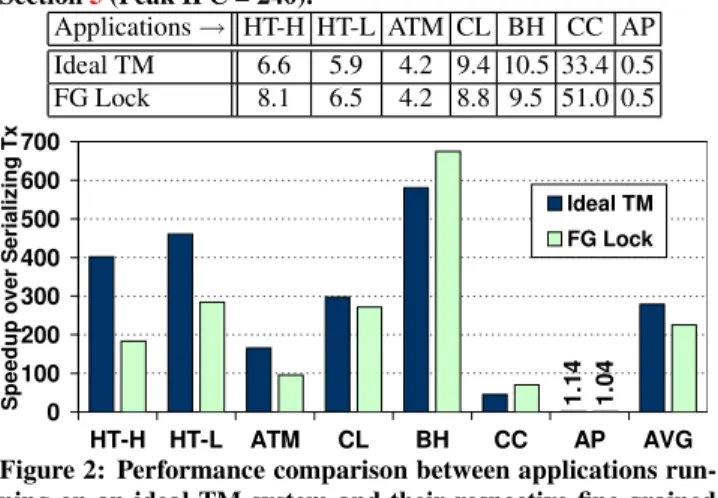
In addition to the traditional deadlock problem, GPU applica-tion developers have to deal with interacapplica-tions between the SIMT stack and atomic operations. Example1shows how a critical sec-tion may be guarded by the acquisisec-tion and release of a fine-grained lock (line A and C) on the CPU. On a GPU, this code may dead-lock [1]. This can happen if the threads in the same warp attempt to acquire the same lock at line A. For example, consider a warp with two threads, T0 and T1, both trying to acquire the same lock. T0 succeeds and exits the loop, but waits at the start of the critical section (line B) for reconvergence, while T1 still spins in the loop (see inset at right in Example1). T1 will continue spinning and waiting for the lock held by T0 and never exit, forming a deadlock. To remove the deadlock, the program must be modified to use code similar to Example2. This issue is known among GPU application developers [1] and explored in more detail by Ramamurthy [43]. With TM, the GPU hardware can be designed to handle such inter-actions between transinter-actions and the SIMT stack (see Section4.1). Figure2compares the performance of a set of GPU TM applica-tions (described in Section5) running on an ideal GPU TM system against fine-grained lock versions of the applications. In this ideal TM system, TM overheads related to detecting conflicting trans-actions are removed. The performance shown is normalized to that obtained by serializing all transaction executions via a single global lock. On average, the applications running on ideal TM achieve 279×speedup over serializing all transactions, which is 24% faster than fine-grained locking.
Table1shows the IPC of these applications with the ideal TM system and fine-grained locking. Some of our applications (CL, BH and CC) achieve reasonable performance, while others suffer from GPU performance bottlenecks such as control flow and memory di-vergence (see Section6.2for further discussion). We believe these
Table 1: Raw performance (IPC) of applications described in Section5(Peak IPC = 240).
Applications→ HT-H HT-L ATM CL BH CC AP Ideal TM 6.6 5.9 4.2 9.4 10.5 33.4 0.5 FG Lock 8.1 6.5 4.2 8.8 9.5 51.0 0.5 1 .1 4 1 .0 4 0 100 200 300 400 500 600 700 HT-H HT-L ATM CL BH CC AP AVG S p e e d u p o v e r S e ri a li z in g T x Ideal TM FG Lock
Figure 2: Performance comparison between applications run-ning on an ideal TM system and their respective fine-grained (FG) locking version (applications described in Section5).
applications can be optimized via performance tuning – identifying bottlenecks and redesigning the applications incrementally to ad-dress these bottlenecks one by one. Performance tuning is beyond the scope of this work. Transactional memory arguably provides an easier programming model for performance tuning because it allows GPU application developers to rework algorithms and data structures without concern for deadlock. This work focuses on en-abling TM on GPUs efficiently, and with minimum overhead.
3.1
Challenges with Prior HTMs on GPUs
Hardware transactional memory (HTM) has been researched ex-tensively. Many proposed HTMs leverage cache coherence for conflict detection among concurrent transactions, while assuming that each transaction owns a private L1 cache. Even though recent GPUs have caches [40], the caches local to a SIMT core are not co-herent and are shared among 100s of threads that execute concur-rently on the core. GPUs are designed to exploit fine-grained data parallelism; adjacent memory words are often accessed by differ-ent threads. These differences raise many challenges in adopting existing HTMs for GPUs.
An emerging class of manycore accelerators, such as Intel’s Lar-rabee [46], feature fewer concurrent threads per core and coherent caches that can be partitioned per thread. The following challenges may be less severe for this class of manycore accelerators.
3.1.1
Access Granularity and Write Buffering
Each line in the L1 data caches could be extended to identify and isolate speculative data written by individual transactions. How-ever, each transaction might obtain only a few cache lines before the cache overflows because there are fewer L1 cache lines than scalar threads on a SIMT core. Transactions typically lack the spa-tial locality required to fully use a cache line and make poor use of the few lines they can access. Furthermore, the fine-grained, inter-leaved accesses among different threads can introduce significant false-sharing and reduce the accuracy of conflict detection.3.1.2
Transaction Rollback
Many proposed HTMs checkpoint the architectural state of the hardware thread at the start of a transaction for restoration upon rollback. Maintaining copies for 10s of registers at transaction boundaries in a CPU core is relatively cheap. GPUs, however, are designed to execute 1000s of concurrent threads, and spend signif-icant hardware resources on register file storage. NVIDIA Fermi has 2MB of register file storage, which exceeds its aggregate cache capacity [40]. Naively checkpointing this many registers would in-troduce significant overheads.
3.1.3
Scaling Conflict Detection
A key challenge for scaling TM beyond 1000s of concurrent transactions is designing a conflict detection mechanism that works effectively at this scale. Naive broadcast-based conflict detection scales poorly; T concurrent transactions will broadcast to T-1 other transactions, generatingO(T2
)traffic.
Many proposed TMs use global metadata, such as a cache coher-ence directory, to eliminate unnecessary traffic. Recently, directory based cache coherence protocols supporting up to 1000 cores have been proposed [29,58,22]. However, GPUs such as Fermi [40] do not have a private cache for each thread.
Using bloom filters to represent read- and write-sets of a trans-action [56,15,36] allows each thread to quickly react to incoming requests and enables fine-grained conflict detection. We experi-mented with an ideal version of a signature-based HTM (lazy con-flict detection and lazy version management) with each transaction maintaining both its read- and write-sets in a bloom filter. We used the parallel bloom filters described by Sanchezet al. [45]. Each fil-ter contained 4 separate sub-signatures and each sub-signature was indexed by a uniqueH3 hash function. We had to use a 1024-bit
filter per thread (3.8MB of total storage for 30720 threads) to keep the false conflict rate below 20% for the benchmarks CL, BH and AP. Using 512-bit filters increased the rate to 60%.
3.1.4
Commit Bottleneck
Even if we reduce the bloom filter storage by limiting the num-ber of concurrent transactions (Section4.6), the bloom filters of all transactions and the directory cannot be modified when one of the transactions is committing. Otherwise, a conflicting access may go undetected when a transaction that has resolved all of its con-flicts is updating memory [16]. Scalable TCC [16] solves this issue by locking entries in the directory, but its commit protocol seri-alizes transaction commit at each directory bank. LogTM-SE [56] uses eager version management, writing speculative data directly to global memory, to allow transactions to commit in parallel. How-ever, data isolation of each transaction is maintained by eager con-flict detection via a cache coherence protocol. The potential com-mit bottleneck and the signature storage explosion (Section3.1.3) issue persuaded us towards exploring alternatives.
4.
KILO TRANSACTIONAL MEMORY
In this section, we present KILO Transactional Memory, a TM system scalable to 1000s of concurrent transactions. KILO TM does not leverage a cache coherence protocol for conflict detec-tion among running transacdetec-tions. Instead, each transacdetec-tion per-formsword-level, value-based conflict detectionagainst committed transactions by comparing the saved value of its read-set against the value in memory upon its completion [42,19]. A changed value in-dicates a conflict. This mechanism offers weak isolation [27]. Each transaction buffers its saved read-set values and memory writes in a read-log and a write-log (in address-value pair) in local memory (lazy version management). When a transaction finishes executing, it sends its read- and write-log to a set of commit units for con-flict detection (validation), each of which replies with the outcome (pass/fail) back to the transaction at the core. Each commit unit validates a subset of the transaction’s read-set. If all commit units report no conflict detected, the transaction permits the commit units to publish the write-log to memory. To improve commit parallelism for non-conflicting transactions, transactions speculatively validate against committed transactions in parallel, leveraging the deeply pipelined memory subsystem of the GPU. The commit units use an address-based conflict detection mechanism to detect conflicts among these transactions (we call thesehazardsto distinguish them from the conflicts detected via value comparison). A hazard is
re-A: t = tid.x; if (…) { B: tx_begin; C: x[t%10] = y[t] + 1; D: if (s[t]) E: y[t] = 0; F: tx_commit; G: z = y[t]; } H: w = y[t+1]; @ tx_begin: @ tx_commit,
thread 6 & 7 failed validation:
@ tx_commit,
restart Tx for thread 6 & 7:
Implicit loop when abort
@ tx_commit,
all threads with Tx committed: Copy Active Mask Copy Active Mask + PC
Branch Divergence within Tx: Active Mask 1111 1111 1111 0011 0000 0000 1111 0011 RPC PC Type --H N H B N --C R --C T Active Mask 1111 1111 1111 0011 0000 0011 0000 0000 RPC PC Type --H N H B N --C R --F T Active Mask 1111 1111 1111 0011 0000 0000 0000 0011 RPC PC Type --H N H B N --C R --C T Active Mask 1111 1111 1111 0011 0000 0000 1111 0011 0001 0011 RPC PC Type --H N H B N --C R --F T F E N Active Mask 1111 1111 1111 0011 0000 0000 RPC PC Type --H N H G N --C R TOS TOS TOS TOS TOS 1 2 3 4 5
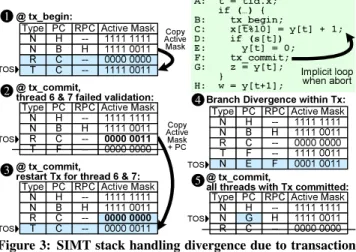
Figure 3: SIMT stack handling divergence due to transaction aborts (validation fail). Thread 6 and 7 have failed validation and are restarted. Stack entry type: Normal (N), Transaction Retry (R), Transaction Top (T). For each scenario, added en-tries or modified fields are shaded.
solved by revalidating one of the conflicting transactions at a later time. Section4.5describes the protocol in detail.
In KILO TM, transaction-specific communication (conflict de-tection and memory updates) occurs only between the commit units and the committing thread (shown in Figure4a). This restriction permits the communication packets from different threads to be pipelined and interleaved, as long as the end-to-end message order between the SIMT cores and the commit units is maintained. KILO TM restricts each transaction to have a single entry and a single exit, matching ‘atomic{}’ semantics in common TM language extensions [27]. Transaction boundaries are conveyed to hardware
withtx_beginandtx_commitinstructions in the compute
ker-nel. Nested transactions are flattened [27] into a single transaction. Figure1highlights the changes required to implement KILO TM on our baseline GPU architecture. These include an extension to the SIMT stack, a Transaction Log Unit, and a Commit Unit.
4.1
SIMT Stack Extension
When a warp finishes a transaction, each of its active threads will try to commit. Some of the threads may abort and need to reexecute their transactions, while other threads may pass the validation and commit their transactions. Since this outcome may not be unani-mous across the entire warp, a warp may diverge after validation.
Figure3shows how the SIMT stack can be extended to handle control flow divergence due to transaction aborts. When a warp en-ters the transaction (at line B,tx_begin), it pushes two special entries onto the SIMT stack (1). The first entry of typeRstores information to restart the transaction. Its active mask is initially empty, and its PC field points to the instruction aftertx_begin. The second entry of typeTtracks the current transaction attempt. At tx_commit(line F), any thread that fails validation sets its mask bit in theRentry. TheTentry is popped when the warp fin-ishes the commit process (i.e., its active threads have either com-mitted or aborted) (2). A newTentry will then be pushed onto the stack using the active mask and PC from theRentry to restart the threads that have been aborted. Then, the active mask in theR entry is cleared (3). If the active mask in theRentry is empty, both Tand Rentries are popped, revealing the originalNentry (5). Its PC is then modified to point to the instruction right
af-tertx_commit, and the warp resumes normal execution. Branch
divergence of a warp within a transaction is handled in the same way as non-transactional divergence (4).
4.2
Scalable Conflict Detection
Section3.1.3discussed how signature-based conflict detection is prone to the commit bottleneck and storage explosion when scaled to 1000s of threads. Typical conflict detection used in HTMs checks the existence of conflictsandidentifies the specific conflicting trans-actions. One insight Spearet al.present with RingSTM [49] is that a committing transaction only needs to detect the existence of con-flicts with transactions that have committed. Transactions with de-tected conflicts can self-abort without interfering with execution of other running transactions. This reduces storage and traffic require-ments because the TM system does not need to maintain a set of in-flight sharers/modifiers for each memory location, and each trans-action only performs the detection once before it commits. How-ever, in our experiment with RingSTM, we had to use 512-bit write-signatures in the commit record ring to keep the false conflict rate below 40% (1.9MB of total storage for a ring with 30720 records to support 30720 concurrent transactions). Value-based conflict de-tection [42,19] exhibits similar traffic requirements as RingSTM. Transactions detect conflicts with other committed transactions, but without using any global metadata – only values from global mem-ory are used. KILO TM combines aspects of RingSTM and value-based conflict detection in hardware, and extends them to permit concurrent validations (Section4.5).
A transaction isdoomedif it has observed an inconsistent view of memory (e.g., in between memory reads to two different tions, another transaction has committed and updated both loca-tions). These doomed transactions may enter an infinite loop. To ensure that doomed transactions are eventually aborted, we use a watchdog timer to trigger a validation pass. This satisfies opac-ity[26] with minimum overhead for GPUs.
4.3
Version Management
KILO TM manages global memory accesses in hardware and uses software for version management of registers and local mem-ory space. Section3.1.2discussed how blindly checkpointing each transaction is too expensive on GPUs. We observed that the original values in many registers are rarely used when a transaction restarts, and do not need to be restored. A compiler could determine which registers are both read and written within a transaction and insert code to checkpoint and restore them before/after a transaction. We observed that transactions in the BH benchmark require restoring
tworegisters on average. Other benchmarks do not require any reg-ister restoration upon transaction aborts. Hence, we do not model the register checkpoint overhead as we believe it to be minor com-pared to validation and commit overheads in our workloads.
Accesses to global memory are buffered in the read/write-log in local memory. A small bloom filter can be used to detect whether a transaction is reading a value in its write-set. A hit in the filter will trigger the transaction log unit to walk the write-log. Since the member set of the filter is constrained to only the memory accesses of a single transaction, a small filter should produce reasonably few false positives. In our evaluations, this detection is perfect.
4.4
Transaction Log Storage and Transfer
The read- and write-logs of transactions in KILO TM are stored as linear buffers in local memory located in off-chip DRAM, cached in the per-core L1 data cache, and mapped to physical addresses such that consecutive 32-bit words are accessed by consecutive scalar threads in a warp. GPU applications can specify the max-imum size of local memory to avoid overflow.
When a warp accesses global memory in a transaction, a new entry is appended to the read/write-log for all threads in the warp. Entries for the inactive threads are marked with a special address to void the entry. This organization allows the log accesses to be coalesced. If only part of a warp needs to walk the write-log for
Tim e SIMT Core CU1 CU2 CU3 Rd/Wt-Log SIMT Core CU1 CU2 CU3 CU Pass/Fail SIMT Core CU1 CU2 CU3 TX Pass/Fail SIMT Core CU1 CU2 CU3 Done (a)
Commit Unit
Ring Buffer Read-SetBuffer Write-SetBuffer Status
Last-Level (L2) Cache
DRAM
YCID RCID Logical Stage ManagementLast Writer History
Addr CID Evict Lookup Table Recency Bloom Filter CID (b)
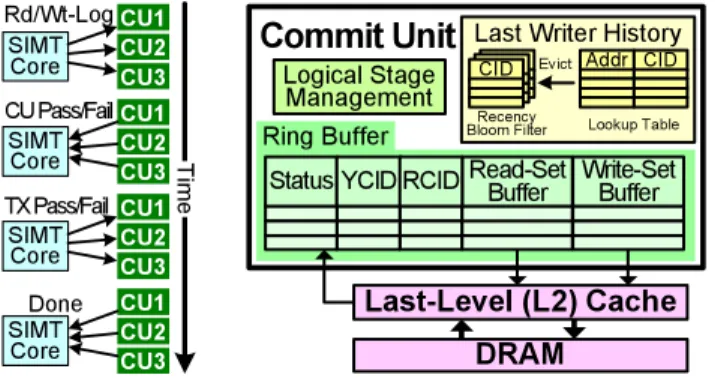
Figure 4: Commit Unit. (a) Communication flow with a SIMT core. (b) Overview of a commit unit.
data, the entire warp will wait for the walk to finish before pro-ceeding to the next instruction. When threads in a warp are ready to validate their transactions (before commit), the transaction log unit walks the read- and write-logs of each thread and sends the address-value pairs to the commit unit in the corresponding memory parti-tion. The individual entries sent to the same memory partition are grouped into a single larger packet to reduce interconnection traffic. This transaction log design addresses the fact that per-core caches in contemporary GPUs are shared by 100s of threads. GPUs em-ploy a flexible register allocation scheme that balances the number of registers per warp against the number of concurrent warps to avoid spilling registers. Hence, memory reads rarely access data written by the same transaction, reducing the penalty of storing the write-log as a linear buffer.
4.5
Distributed Validation/Commit Pipeline
A naive implementation of value-based conflict detection seri-alizes transaction commits. Memory updates from a transaction (its write-set) are invisible to others until the transaction commits. Two conflicting transactions validating concurrently will observe no changes to their read-sets, and will subsequently update global memory with their contradicting write-sets. While serializing all transaction commits prevents this potential data race, it also pre-vents non-conflicting transactions from committing in parallel [9]. To enable parallel commits, prior STMs with value-based con-flict detection [19,42] use a set of versioned locks, each serializing commit to a memory region. Each transaction checks/acquires the locks of all the memory regions that require protection during vali-dation and commit. Acquiring locks imposes significant overhead. KILO TM increases commit parallelism by using a set of com-mit unitsthat quickly detect conflicts among a limited set of trans-actions. GPU memory subsystems are deeply pipelined to support a large number of in-flight accesses to maximize throughput. The commit units leverage this capability. In each commit unit, a subset of transactions are speculatively validated in parallel. This valida-tion only detects conflicts with the already committed transacvalida-tions. Later, ahazard detectionmechanism is applied to conservatively detect all potential conflicts. Any hazard is resolved by deferring one of the conflicting transactions andrevalidatingits read-set af-ter the other transaction has updated global memory. Revalidation serializes the validation/commit process among transactions when necessary. This mechanism guarantees forward progress by giving the deferred transaction a second chance to validate and commit in case the earlier transaction failed.
Each memory partition has a commit unit (shown in Figure4b) that handles validations and commits of TM accesses to that mem-ory partition. Before a transaction starts the validation/commit pro-cess, it acquires a commit ID (CID) from a centralized ID vendor (similar to Scalable TCC [16]). This commit ID is associated with
Communication with SIMT Cores U nu se d R et ire Log Transfer + Speculative Validation
Younger Transactions Older Transactions
Hazard
Detection ValidationWait FinalizingOutcome Commit Read-Set + Write-Set TX Final Outcome (Pass/Fail) CU Local Outcome (Pass/Fail) Speculative
Validation MemoryUpdate
Revalidation
Done
Last-Level (L2) Cache / DRAM
Pass/ Fail 1 2 3 4 5 6 7 8 9
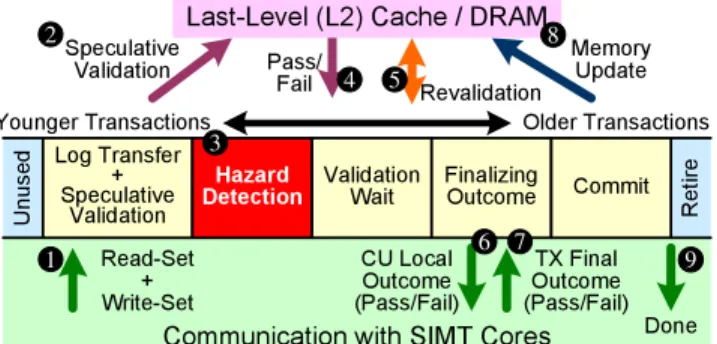
Figure 5: Logical stage organization and communication traffic of the bounded ring buffer stored inside commit unit.
a logical entry in the commit unit at every memory partition, and dictates the relative commit order of this transaction (so that the conflict/hazard resolution is unanimous among all commit units). Each commit unit has a ring buffer of commit entries [49] orga-nized in the logical stages shown in Figure5. Each entry tracks the state of a committing transaction in this memory partition. The Statusfield in each commit unit ring buffer entry in Figure4b in-dicates the current status of the transaction. TheYCIDandRCID fields are used for hazard detection. TheRCIDof a transaction is a pointer to the oldest committing transaction when this transaction started speculative validation. Transactions that committed before this transaction started speculative validation do not trigger a haz-ard with this transaction. TheYCIDof a transaction points to the youngest conflicting transaction detected to have a hazard with this transaction. The transaction needs to wait for the conflicting trans-action to retire before it can start revalidation. TheRead-Setand Write-Set Buffersconsist of bounded linear buffers that store, for value comparison, the exact address-value pairs of each transac-tional access to this memory partition.
The following is an overview of the validation/commit process of a transaction at different logical stages (Figure5):
Log Transfer + Speculative Validation.The transaction transfers its read- and write-logs to an allocated entry in the commit unit (1). The incoming read-set is speculatively validated against the current values in global memory (accessing L2 cache/DRAM 2).
Hazard Detection.Once the read- and write-logs have been trans-ferred to the commit unit, the read-set of the transaction is checked against theLast Writer Historyunit (LWH) forhazard detection
(3), detecting conflicts between the transaction and all committing transactions in the later stages. Existence of a hazard indicates that the speculative validation may have accessed stale data in global memory that will be updated before the transaction commits. The hazard is resolved in the Validation Wait stage.
Validation Wait.Each transaction waits for the speculative valida-tion to complete before advancing to later stages (4). Transactions with hazards will wait until all conflicting transactions have retired to revalidate their read-set with the updated global memory (5).
Finalizing Outcome. This stage finalizes the outcome of each transaction by replying with the local outcome (pass/fail) of the transaction to the core (6). After a transaction has received replies from all commit units, it will broadcast the final outcome (pass/fail) to all commit units (7). Each commit unit entry waits for its final outcome before proceeding to the next stage.
Commit. Each passed transaction updates the global memory at this stage (8). Failed transactions are skipped.
Retire.The commit unit entry associated with each transaction is deallocated, releasing storage for future transactions. The core is informed so that the thread running the transaction can proceed to the next instruction, or restart the failed transaction (9).
4.5.1
Commit Unit Resource Allocation
When a warp executestx_commit, the transaction log unit ac-quires credits from a per-core credit pool of commit unit entries before acquiring contiguous commit IDs and proceeding with the commit. Insufficient credits prevent the warp from acquiring the commit IDs until the credits are returned when the validation/com-mit operation of another warp completes. In this paper, we assume that the commit units always have enough entries to support all in-flight transactions. Section6.4.2measures the resources required.
4.5.2
Hazard Detection, Last Writer History Update
At the Hazard Detection stage, each transaction checks the in-tegrity of its speculative validation via theLast Writer Historyunit (LWH) in Figure4b. This unit has an approximate but conserva-tive representation of the write-sets of all older transactions at the later stages that have not yet retired. The LWH unit identifies the youngest conflicting transaction (returns its commit ID) in the later stages that may modify the read-set of the transaction at the haz-ard detection stage. If this conflicting transaction retired before the current transaction started validating (itsCID<RCIDof the current transaction), no hazard remains. Otherwise, a hazard is detected. The hazard is resolved in the Validation Wait stage by waiting for this conflicting transaction (now tracked byYCID) to retire, and then revalidating the transaction with the updated memory. After detection, the current transaction updates the LWH unit with its write-set. This mechanism leverages the same intuition described in Section4.2. The LWH unit can approximately maintain the latest pending writer to each memory location, as a slightly younger false writer only slightly lengthens the wait at Validation Wait stage.The LWH unit has an address-indexed set-associative lookup ta-ble and arecency bloom filter. The two structures, in combination, conservatively track the CID of the youngesttransaction in later stages that may write to a given memory location. The lookup ta-ble stores the exact write-sets from recent transactions, whereas the bloom filter stores the approximate write-sets from distant transac-tions. As write-sets from newer transactions are deposited into the lookup table, entries are updated (replacing the CID if addresses match), or evicted into the bloom filter to free up storage for dif-ferent addresses. The recency bloom filter has multiple sub-arrays of buckets (each bucket storing a CID) indexed by a hash of the given memory address. Each evicted entry updates a CID bucket in each sub-array according to the hashed written memory address. Due to address aliasing in each sub-array, an older CID writing to an address may be replaced by a younger CID writing to a differ-ent address. When the bloom filter is queried with an address, one CID is retrieved from each sub-array. The oldestretrieved CID is returned as it is least likely to have been aliased by a younger writer. This oldest CID can also be aliased, causing the LHW unit to report a false writer. The write-set of a retiring transaction is implicitly removed from the LWH unit as its CID can no longer trigger a hazard.
4.5.3
Unbounded Transactions
If the commit entry’s read-set buffer overflows, the commit unit will continue to speculatively validate the address-value pair of the incoming read-set, but will stop populating the read-set buffer. The commit unit will ask the transaction to resend its read-set from the SIMT core during hazard detection and revalidation. Similarly, if the commit entry’s write-set buffer overflows, the commit unit will ask the transaction to resend the write-set during LWH update after hazard detection and memory update at the Commit stage.
4.6
Concurrency Control
While KILO TM can support thousands of concurrent transac-tions, limiting the number of concurrent transactions can improve
the performance of high-contention applications (with transactions that are likely to abort), and lowers the resource requirement for KILO TM. To limit the number of concurrent transactions within a SIMT core, we use a counter to track the number of warps currently in transactions. We will explore adaptive mechanisms (e.g., [57,7]) that react to the dynamic contention in applications in the future.
5.
METHODOLOGY
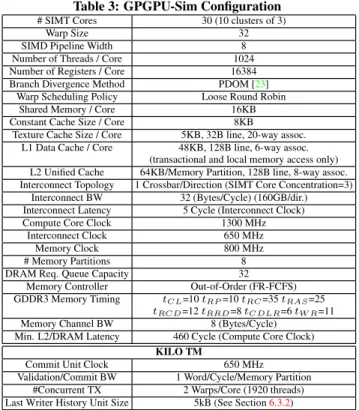
We model our proposed hardware changes by extending GPGPU-Sim 3.0 [6]. We evaluate performance of various hardware config-urations on the benchmarks listed in Table2. We add transactions with empty functionstx_begin()andtx_commit()that are recognized by the simulator as transaction boundaries. The follow-ing CUDA/OpenCL applications are used in our evaluations.
Hash Table (HT)is a microbenchmark in which each thread inserts an element into a chained hash table. Each slot in the hash table is a linked list of key-value pairs. We use two table sizes to create high contention (HT-H with 8k entries) and low contention (HT-L with 80k entries) workloads.
Bank Account (ATM)is a microbenchmark with∼16k concur-rent threads accessing an array of structs that represents 1M bank accounts. Each transaction transfers money between two accounts.
Cloth Physics (CL)is based on “RopaDemo”, which simulates the cloth physics for a T-shirt [11]. Performance is limited by the Distance Solver kernel, which implements a spring-mass system using a set of constraints between cloth particles. To forbid two constraints concurrently modifying the same particle, the original demo processes these constraints sequentially in octets (i.e., 8 at a time). We modified this kernel to process all∼4k distance con-straints of each T-shirt in parallel transactions.
Barnes Hut (BH)is based on the tree-based n-Body algorithm implemented by Burtscheret al. [12] with 30000 bodies. We focus on the iterative tree-building kernel using lightweight locks, which we modified to use transactions. Each thread in this kernel appends a body into the octree, and inserts any branch node required to iso-late its body in a unique leaf node. Each level of traversal down the tree and the node insertions are protected by separate transactions.
CudaCuts (CC)applies a maxflow/mincut algorithm to segmen-tation of a 200×150 pixel image [53]. It consists of Push kernels that use atomic operations to push excessive flow from a node to its neighbours, and Relabel kernels that change the height of a node when excessive flow cannot be pushed. We grouped consecutive atomic operations in the Push kernels into transactions.
Data Mining (AP)is based on Apriori in the RMS-TM bench-mark suite [2,30]. We evaluate theapriori_gen()function, which was modified [43] to use CUDA, with each thread process-ing a unique record. As in the CPU TM version, transactions are used to protect candidate insertion and support value counting.
Our modified GPGPU-Sim is configured to model a GPU simi-lar to NVIDIA Quadro FX5800, extended with L1 data caches and a L2 unified cache similar to NVIDIA Fermi [40]. We validated GPGPU-Sim 3.0 with the NVIDIA Quadro FX5800 configuration (no cache extensions and using PTX instead of SASS) against the hardware GPU and observed an IPC correlation of∼0.93 for a subset of the CUDA SDK benchmarks. GPGPU-Sim incorporates a configurable interconnection network simulator [20]. Traffic in each direction between the SIMT cores and the memory partitions are serviced by two separate crossbars. The crossbars can transfer a 32-byte flit per interconnect cycle to/from each memory partition (∼160GB/s per direction). Each flit takes 5 cycles to traverse the crossbar. The 30 SIMT cores are grouped in 10 clusters. Cores in a cluster share a common port to each crossbar (concentration of three). The memory partition has an out-of-order memory
ac-Table 3: GPGPU-Sim Configuration
# SIMT Cores 30 (10 clusters of 3)
Warp Size 32
SIMD Pipeline Width 8 Number of Threads / Core 1024 Number of Registers / Core 16384 Branch Divergence Method PDOM [23]
Warp Scheduling Policy Loose Round Robin Shared Memory / Core 16KB Constant Cache Size / Core 8KB
Texture Cache Size / Core 5KB, 32B line, 20-way assoc. L1 Data Cache / Core 48KB, 128B line, 6-way assoc.
(transactional and local memory access only) L2 Unified Cache 64KB/Memory Partition, 128B line, 8-way assoc. Interconnect Topology 1 Crossbar/Direction (SIMT Core Concentration=3)
Interconnect BW 32 (Bytes/Cycle) (160GB/dir.) Interconnect Latency 5 Cycle (Interconnect Clock) Compute Core Clock 1300 MHz
Interconnect Clock 650 MHz
Memory Clock 800 MHz
# Memory Partitions 8 DRAM Req. Queue Capacity 32
Memory Controller Out-of-Order (FR-FCFS) GDDR3 Memory Timing tCL=10tRP=10tRC=35tRAS=25
tRCD=12tRRD=8tC DLR=6tW R=11
Memory Channel BW 8 (Bytes/Cycle) Min. L2/DRAM Latency 460 Cycle (Compute Core Clock)
KILO TM
Commit Unit Clock 650 MHz Validation/Commit BW 1 Word/Cycle/Memory Partition
#Concurrent TX 2 Warps/Core (1920 threads) Last Writer History Unit Size 5kB (See Section6.3.2)
cess scheduler. We model detailed GDDR3 timing. Every memory access sent to L2 cache/DRAM has a minimum pipeline latency of 460 cycles (in compute core clocks) to match that observed by microbenchmarks of NVIDIA Quadro FX5800 [55]. The actual latencies of individual accesses can be higher due to delays from memory access scheduling and queuing as DRAM bandwidth sat-urates. We have an optimistic performance model for atomic op-erations (used in fine-grained locking). Atomic compare-and-swap operations on GPGPU-Sim have∼4×higher throughput than on NVIDIA Fermi GPU, while other types of atomic operations on GPGPU-Sim perform roughly the same as Fermi. Table3lists the other major configuration parameters.
We model all interconnection network traffic between the SIMT cores and the commit units. Packets from the transaction log unit are sized according to the payload within the packet, and they con-tend for the same interconnection port with packets for normal memory accesses. Each short commit protocol message occupies a single flit. Packets containing multiple read/write-log entries (see Section4.4) may occupy multiple flits, taking multiple cycles to transfer. In our evaluations, KILO TM validates and commits each transaction as directed by the timing simulation. In our simulation, timing of committing transactions affects functional behaviour of the application, and hence any undetected data-race would likely lead to an application error, which we verify does not occur.
6.
EXPERIMENTAL RESULTS
6.1
Performance
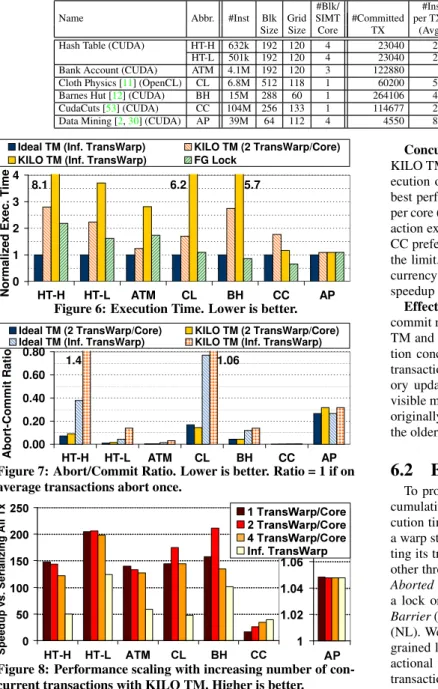
In this section, we compare the performance of KILO TM against the ideal TM system (Ideal TM) and fine-grained locking (FG Lock) described in Section3. Figure6shows the execution time of each application with KILO TM and fine-gained locking normalized to the execution time of Ideal TM. In our evaluations, KILO TM uses commit units with unlimited capacity.
With unlimited transaction concurrency (Inf. TransWarp), KILO TM is on average 4.1×slower than Ideal TM. HT, CL, and BH are affected the most. These applications have many concurrent trans-actions with high contention (Figure 7). Although BH’s overall
Table 2: Benchmarks. #Inst obtained from Ideal TM version. Other metrics refer to KILO TM with unlimited concurrency.
#Blk/ #Inst #Aborts Read-Set Write-Set Max # Name Abbr. #Inst Blk Grid SIMT #Committed per TX per TX (#Words) (#Words) Concurrent TX
Size Size Core TX (Avg) Avg Max Avg Max Avg Max (KILO TM) Hash Table (CUDA) HT-H 632k 192 120 4 23040 26 1.39 2 1.0 1 4.0 4 23040
HT-L 501k 192 120 4 23040 26 0.14 2 1.0 1 4.0 4 23040 Bank Account (CUDA) ATM 4.1M 192 120 3 122880 8 0.03 3 3.0 3 2.0 2 16131 Cloth Physics [11] (OpenCL) CL 6.8M 512 118 1 60200 53 1.06 8 11.2 12 4.8 8 22816 Barnes Hut [12] (CUDA) BH 15M 288 60 1 264106 48 0.15 14 4.3 40 0.82 14 8640 CudaCuts [53] (CUDA) CC 104M 256 133 1 114677 21 0.004 3 1.4 4 1.4 4 735 Data Mining [2,30] (CUDA) AP 39M 64 112 4 4550 89 0.32 6 15.7 174 6.2 109 192
0 1 2 3 4 HT-H HT-L ATM CL BH CC AP N o rm a li ze d E x e c . T im e
Ideal TM (Inf. TransWarp) KILO TM (2 TransWarp/Core) KILO TM (Inf. TransWarp) FG Lock
5.7
8.1 6.2
Figure 6: Execution Time. Lower is better.
0.00 0.20 0.40 0.60 0.80 HT-H HT-L ATM CL BH CC AP A b o rt -C o m m it R a ti o
Ideal TM (2 TransWarp/Core) KILO TM (2 TransWarp/Core) Ideal TM (Inf. TransWarp) KILO TM (Inf. TransWarp)
1.4 1.06
Figure 7: Abort/Commit Ratio. Lower is better. Ratio = 1 if on average transactions abort once.
Sp ee du p vs. S er ia lizi ng A ll Tx 0 50 100 150 200 250 HT-H HT-L ATM CL BH CC 1 1.02 1.04 1.06 1.08 1.1 AP 1 TransWarp/Core 2 TransWarp/Core 4 TransWarp/Core Inf. TransWarp
Figure 8: Performance scaling with increasing number of con-current transactions with KILO TM. Higher is better.
abort-commit ratio is relatively low, it starts with a high-contention period when all transactions are competing to insert nodes near the root of the octree. When conflicting transactions attempt to commit concurrently, the commit unit defers revalidating one transaction. This reduces overall performance. Notice that AP has relatively few concurrent transactions, so its high abort-commit ratio has lit-tle impact on performance (Table2).
Limiting each core to two transaction warps (2 TransWarp/Core in Figure6, 1920 threads globally) reduces contention in HT-H, CL, and BH and improves their performance with KILO TM by 2-3×. ATM speeds up by 2.3×from improved hazard detection accuracy. The performance of HT-L improves by 66%, while AP is unaffected. CC’s performance drops by 34% because of this limit. In CC, warps are typically diverged before entering transactions. CC would not be penalized with thread-level concurrency control. Overall, KILO TM performs significantly better with this concur-rency limit, capturing 52% of Ideal TM and 59% of fine-grained locking performance.
Concurrency Control. Figure8compares the performance of KILO TM under different concurrency limits versus serializing ex-ecution of all transactions. HT-L, ATM, CL and BH achieve the best performance with transaction execution limited to two warps per core (2 TransWarp/Core), while HT-H performs best with trans-action execution limited to one warp per core (1 TransWarp/Core). CC prefers unlimited transaction concurrency. AP is insensitive to the limit. Overall, KILO TM performs best with transaction con-currency limited to two warps per core, achieving on average 128× speedup over serially executing each transaction.
Effects on Abort-Commit Ratio. Figure7compares the abort-commit ratios between KILO TM and the ideal TM system. KILO TM and Ideal TM show similar abort-commit ratios with transac-tion concurrency limited to two warps per core. With unlimited transaction concurrency, contention at the commit unit defers mem-ory updates from older transactions that would have been made visible much earlier with Ideal TM. Younger transactions that were originally reading the updated values in Ideal TM now conflict with the older uncommitted transactions.
6.2
Execution Time Breakdown
To provide further insight, Figure9shows a breakdown of the cumulative per-hardware thread cycles, scaled by the overall exe-cution time of each application. At each cycle, a thread can be in a warp stalled byConcurrency control(TC), be in a warp commit-ting its transactions (TO), have passed commit and beWaitingfor other threads in its warp to pass (TW), be executing an eventually
Aborted(TA) or committed/Useful(TU) transaction, be acquiring a lock or performing anAtomic operation (AT), be waiting at a
Barrier(BA), or be performing non-atomic non-transactional work (NL). We compare the thread-state distributions between the fine-grained locking versions of the benchmarks (FGL), and the trans-actional versions running on Ideal TM (IDEAL), KILO TM with transaction concurrency limited to two warps per core (KL), and KILO TM with unlimited transaction concurrency (KL-UC).
We observe the overheads of lock acquisition (AT) in the lock-based versions to be proportional to the inherent contention in their transactional versions. Transactional HT-H and CL have the largest abort-commit ratios in Figure7and their lock-based counterparts have the greatest locking overheads in Figure9. HT-L, ATM and CC have lowest abort-commit ratios and the smallest locking over-heads. Lock-based BH has a significant locking overhead because of the initial high-contention period, as explained in Section6.1. Lock-based AP shows insignificant locking overhead, despite a high abort-commit ratio in its transactional version, due to limited par-allelism in its implementation. For the lock-based benchmarks, the NL cycles include the execution of the critical sections and are therefore greater than in the transactional versions. Detailed anal-ysis (not shown) indicates that lock-based benchmarks suffer from increased branch divergence, further increasing their NL cycles.
Threads running on KILO TM with unlimited transaction con-currency spend much of their time waiting to be committed (TO). This overhead is significantly reduced by limiting transaction
exe-0% 50% 100% 150% 200% 250% FG L K L-U C KL ID E A L FG L K L-U C KL ID E A L FG L K L-U C KL ID E A L FG L K L-U C KL ID E A L FG L K L-U C KL ID E A L FG L K L-U C KL ID E A L FG L K L-U C KL ID E A L HT-H HT-L ATM CL BH CC AP No rm al iz ed T hr ea d Cy cl es TC TO TW TA TU AT BA NL 812%280% 370% 281% 624% 574%275%
Figure 9: Breakdown of thread execution cycles. Scaled by the overall execution time, normalized to IDEAL TM.
0% 100% 200% 300% 400% 500% FG L K L-U C K L ID E A L FG L K L-U C K L ID E A L FG L K L-U C K L ID E A L FG L K L-U C K L ID E A L FG L K L-U C K L ID E A L FG L K L-U C K L ID E A L FG L K L-U C K L ID E A L HT-H HT-L ATM CL BH CC AP No rm al iz ed C or e Cy cl es IDLE STALL SCRB EXEC IDLE 12% STALL 18% SCRB 527% IDLE 36% STALL 29% SCRB 728% IDLE 12% STALL 124% SCRB 473%
Figure 10: Breakdown of core execution cycles.
cution to two warps per core in exchange for long waits in concur-rency control (TC). For most benchmarks this provides an overall gain in performance. CC’s performance on KILO TM, however, degrades with concurrency control. This is because CC’s originally low commit overhead remains unchanged with reduced rency, and because CC benefits from increased transaction concur-rency as indicated by its scaling performance in Figure8. Figure10
shows the cumulative execution cycle breakdown of each core. At each cycle, a SIMT core may issue a warp (EXEC), be stalled by downstream pipeline stages (STALL), have all warps blocked by the scoreboard due to data hazards, concurrency control, pend-ing commits or any combination thereof (SCRB), or not have any warps ready to issue in the instruction buffer (IDLE). This figure shows that limiting concurrency in KILO TM reduces stalling and waiting at the scoreboard. Stalling is reduced as a result of fewer concurrent transactional memory accesses, while shorter and fewer commits reduce the amount of time spent waiting at the scoreboard. The amount of time spent on transactional work, indicated by TU and TA in Figure9, is lower on KL than on KL-UC and IDEAL. This is also due to the reduction in STALL cycles in Figure10for KL. Reduced stalling leads to faster transaction completion. BH saw only a small decrease in transaction time when concurrency was reduced. This is because BH contains inherent and limiting memory dependencies that are visible in Figure10as SCRB cycles on IDEAL TM. Similar to TU and TA, TW also decreases with reduced concurrency as passed transactions spend less time waiting for failed transactions in their warp to re-execute and commit.
In Figure9, HT-H, HT-L and ATM spend less time doing useful transactional work (TU) on KL-UC than on IDEAL, even though both have unlimited concurrency. This is because KILO TM caches global memory writes in write-logs stored in the L1 data cache. HT-H benefits most from this buffering during transaction execution
as its transactions are dominated by writes (See Table2). HT-L and ATM’s lower data locality negates some of the benefit of write buffering. CL and BH are dominated by reads and gain little benefit from write buffering. The memory write overhead of write buffer-ing is eventually incurred durbuffer-ing transaction commit (TO).
CC and AP both suffer from load imbalance as indicated in Fig-ure10by the significant portion of IDLE cycles - the portion of the time when the cores run out of warps to execute. The inter-thread load imbalance suffered by CC is exacerbated by transac-tional overheads. AP suffers from inter-core load imbalance. AP spends most its execution in non-transactional work, but the over-head of KILO TM still impacts performance because of the time involved in transferring logs for the large transactions. AP spends 90% of its core cycles in IDLE. This behaviour contributes to the low absolute performance of AP. We created the CUDA version of AP from its CPU TM version without changing much of the algo-rithm and data structures. An improved version may redesign the algorithm to spread the workload across more threads.
Overall, even with a significant portion of time spent on execut-ing aborted transactions, the Ideal TM system performs comparably to fine-grained locking. This indicates that the performance penal-ties of KILO TM may be reduced with future refinements.
6.3
Sensitivity Analysis
6.3.1
L2 Cache Miss from Validation Access
We observe that>90% of validation accesses for KILO TM hit
in the L2 cache for all benchmarks with transactional execution limited to two warps per core. This also applies to most bench-marks with unlimited concurrent transactions, but for HT-L, ATM and CL, the cache hit rate for validation access is lower (70% for HT-L, 46% for ATM and 62% for CL). These extra accesses are easily handled by the GPU memory subsystem. In a sensitivity study with idealized validation accesses that always hit in the L2 cache, performance of ATM and CL improves only by 11% and 17%, respectively. Other benchmarks (including HT-L) are in-sensitive to this change. In this study, KILO TM employs LWH units that detect hazards perfectly. About 50% of the validation-induced L2 cache accesses in CL are pending hits. In ATM, the extra L2 cache misses improve the row-hit rate in the open-row, out-of-order DRAM controller, increasing the bandwidth efficiency by 5%. The improved efficiency partly compensates the penalty from validation-induced DRAM accesses. In HT-L, these L2 cache misses increase the DRAM bandwidth utilization by 5% and do not impact performance. This ability to handle extra memory accesses in GPUs shows why value-based conflict detection is a viable solu-tion for supporting TM on GPUs.
6.3.2
Hazard Detection Sensitivity
We explored the performance of KILO TM with different haz-ard detection mechanisms. We compared two versions of the LWH mechanism described in Section4.5.2and an additional mechanism based on a bloom filter array. The first 5kB LWH consists of a 512-entry, 4-way set-associative lookup table (3kB) and a 1024-bucket bloom filter (2kB) split into 4 separate sub-arrays, each array in-dexed by a uniqueH3hash function (similar to the parallel bloom
signature described by Sanchezet al.and Cezeet al.[45,15]). The second 512B LWH configuration consists of a 64-entry lookup ta-ble and a 64-bucket bloom filter. A second detection mechanism, bloom filter array (BF Array), encodes the read-set and write-set of each transaction into two 512-bit signatures in the commit unit. Each signature consists of 4 sub-signatures with each indexed by a uniqueH3hash function. Incoming read/write accesses check for
Write Buffer Usage (#Words) Read Buffer Usage (#Words)
% A c ti ve C U E n tr ies 0% 20% 40% 60% 80% 100% 0 1 2 4 8 16 32 64 0 1 2 4 8 16 32 64 HT-H HT-L ATM CL BH CC AP
Figure 11: Buffer usage in active commit unit (CU) entries.
KILO TM with 5kB LWH unit performs almost identically to perfect hazard detection. The 512B LWH reduces the storage by 10×but increases execution time by only 36% on average. Despite taking 24×more storage than the LWH unit (120kB vs. 5kB per commit unit), BF Array slows down KILO TM by up to 7.8×(4.3× on average). The lookup table plus bloom filter design in a LWH unit dedicates extra resources to ensure that an unnecessarily reval-idating transaction and its false writers are far apart in the commit unit pipeline, minimizing the stalling at the Validation Wait stage.
6.4
Implementation Complexity of KILO TM
In each SIMT core, KILO TM implementation involves extend-ing the SIMT stack to support transactions, employextend-ing concurrency control, and adding a transaction log unit. Even though each trans-action log unit manages 1000s of transtrans-actions, most of the book-keeping is amortized across the warp. For example, threads in the same warp have the same read-log and write-log sizes, and they al-ways have consecutive commit IDs. The L1 data cache stores the read-/write-logs. Evicted entries are written back to L2/DRAM. We believe the area overhead of a transaction log unit is negligible. The area overhead of a commit unit consists of the storage re-quired for the LWH unit, the entries in the ring buffer, and the read-and write-set storage buffers for each entry. Section6.3.2showed that a 5kB LWH unit is sufficient. Each commit unit ring buffer entry occupies 10 bytes for the status,RCIDandYCIDfields, and pointers to a shared pool of the read- and write-set buffers. The area required for the read- and write-set buffers is a product of the size of each buffer and the number of buffers present. Section6.4.1
examines how large each fixed-size buffer should be to limit buffer overflow. Section6.4.2 examines how many of these fixed-size buffers are required concurrently.
6.4.1
Read-Set/Write-Set Buffer Capacity
Figure 11 shows the cumulative distribution of the read- and write-set buffer usage for the active ring buffer entries in the com-mit units. The distributions show that an 8-word (64 Bytes) read-set buffer and an 8-word write-set buffer can serve>90% of the
com-mit unit ring buffer entries. If the read-set or the write-set buffer overflows (a rare event), the penalty involves resending the read-and write-log. We leave performance evaluation with finite-sized read- and write-set buffers as future work.
6.4.2
Commit Unit Capacity
As not all commit unit ring buffer entries will need read- and write-set buffers, dynamically allocating these buffers from a shared pool reduces the area overhead of buffers. Figure12shows the av-erage and maximum number of read- and write-set buffers required for 4 different buffer allocation schemes. TheAllandAccessed
allocation schemes allocate fixed-size read- and write- buffers for a commit unit ring buffer entry when it is created, and deallocate the buffers when the entry retires.Allallocates the two buffers for all active entries in the ring buffer, whileAccessedonly allocates buffers for the entries whose transaction has accessed this memory partition. The number of ring buffer entries in theAllandAccessed
0 500 1.0K 1.5K 2.0K 0 1.0K 2.0K 3.0K 4.0K
Avg Max Avg Max Avg Max Avg Max Avg Max Avg Max Avg Max
HT-H HT-L ATM CL BH CC AP # CU Ring Buf fe r E nt rie s for All and Ac ce ss ed # Alloc at ed R / W Buf fe rs All Accessed Used Needed All = 5116, Accessed = 4754
Figure 12: Number of in-flight, allocated read and write buffers for different buffer allocation schemes. All⊇Accessed⊇Used
⊇Needed. Y-axis on right shows number of commit unit ring buffer entries with buffers allocated for All and Accessed.
schemes is given by the right Y-axis in Figure12. TheUsed allo-cation scheme improves uponAccessedby allowing a single fixed-size read- or write-set buffer to be allocated if the transaction has an empty write-set or read-set buffer for this memory partition, re-spectively.Neededfurther improves uponUsedby allowing buffers to be deallocated before the ring buffer entry retires. For example, buffers are deallocated as soon as a transaction fails. In Figure12, the number of concurrent transactions is limited to two warps per core (1920 in total) via concurrency control, and there is no capac-ity limit on the number of ring buffer entries.
HT-H, HT-L, ATM, CL and BH use∼700 ring buffer entries on average (All). BH’s maximum number of entries exceeds the concurrent transaction limit because it has many read-only transac-tions. The SIMT core considers a read-only transaction to be done when it receives the local outcome reply from commit units, allow-ing the next waitallow-ing transaction to proceed before the correspond-ing commit unit entries are retired. We observed that the number of in-flight entries exceeded the concurrent transaction limit of 1920 for only<1% of the execution time for BH. CC and AP have sig-nificantly fewer concurrent transactions and therefore require fewer entries. A commit unit with 1920 entries with two 64B buffers for all entries (All) would require 240kB for read- and write-set storage, and 19kB for the ring buffer storage (10B per ring buffer entry). TheAccessed,UsedandNeededoptimizations reduce the storage requirement for buffers. To serve most of theNeededbuffer usage,∼500 buffers per commit unit (32kB per unit, 256kB for the whole GPU) are enough. The rare worst case can be handled by deferring validation/commit via the credit-based allocation mecha-nism described in Section4.5.1. We leave the performance evalua-tion of this allocaevalua-tion mechanism as future work.
6.4.3
Area Estimation
We assume that both the 32kB read- and write-set buffer pool and the 19kB ring buffer have 4 banks of SRAM arrays. The 5kB last writer history unit (Section6.3.2) consists of a 3kB lookup ta-ble and a 2kB bloom filter, each an SRAM array. Using CACTI 5.3 [47], we estimate the area of each commit unit (the aggre-gate area of these arrays) to be 0.40mm2
in a 40nm technology. NVIDIA Fermi GPU features 6 memory partitions [40], so imple-menting the commit units on Fermi architecture requires an area of 2.41mm2
. This is just 0.5% of Fermi’s 520mm2
die area.
7.
RELATED WORK
Cache Coherence Protocol Based HTMs.Many existing hard-ware and hybrid TM systems focus on leveraging the sharer/modi-fier information maintained by cache coherency hardware for con-flict detection and using thread-private caches for version manage-ment. Some of the HTMs propose to extend the cache coherence protocol with new coherence states for conflict detection and
ver-sion management [16,52,17,21]. Other HTMs monitor the cache coherency traffic (of an existing protocol) for conflict detection, using per-transaction metadata stored in signatures [36,56,13], or extra bits added to the cache line [38,10,44].
Cache Coherence Protocol for ManyCore Architecture. Sev-eral cache coherence directories scalable to 1000 cores have been proposed [29,58,22]. Tarjanet al.propose a sharing tracker that tracks cache lines in the private cache of each GPU core (a SIMT core) imprecisely [51]. It only maintains a subset of sharers for a cache line, insufficient for correct conflict detection.
Signature-Based Conflict Detection. In BulkTM [15], a com-mitting transaction broadcasts its write-set in a bloom filter based signature, which is compared for conflicts against the signature and the L1 cache tags at each recipient transaction. SigTM [36] and LogTM-SE [56] eagerly detect conflicts with signatures by mon-itoring the address of each incoming cache coherence request. A software conflict resolution handler is invoked when the address hits the signatures. Other HTMs (TMACC [13], FlexTM [48]) use signatures to handle unbounded transactions.
Software transactional memory (STM) systems also use signa-tures for conflict detection. RingSTM [49] uses a ring of commit records that hold the write-signatures of recently committed trans-actions. Before each transactional load, the transaction compares its read-signature against the write-signatures of newly committed transactions added to the commit records since the transaction’s last load. A match indicates a new conflict and the transaction is aborted. In InvalSTM [25], a committing transaction compares its write-signature against the read- and write-signatures of other run-ning transactions. A contention manager is invoked upon a match.
To handle unbounded transactions in hazard detection, each com-mit unit in KILO TM uses a last writer history unit that tracks the write-sets of all committing transactions via a novel recency bloom filter. This bloom filter has commit IDs in its buckets and is im-plicitly cleared as the associated transactions retire. The recency bloom filter has some similarities to a time-out bloom filter [32]. The time-out bloom filter was proposed for use in network packet sampling, where the key result is the existence of a similar packet occurring within a given window. In contrast, the recency bloom filter provides greater detail. In the presence of a conflict it returns the identity of the conflict rather than simply a pass/fail result. The identity it returns is that of the most recent item inserted into the bloom filter that can possibly conflict.
KILO TM and RingSTM [49] are conceptually similar in that both use a ring to order transaction commits, and detect conflicts between read-set of a transaction and write-sets of committed trans-actions. KILO TM uses value-based conflict detection to eliminate storage for committed write-sets, and uses a LWH unit to detect hazards (conflicts) among committing transactions. Each transac-tion in KILO TM stores its read-set in exact address-value pairs. It also features multiple commit units, each with a separate ring, and maintains consistent commit order via a protocol similar to Scal-able TCC [16]. KILO TM enforces opacity via a watchdog timer, removing the need to validate before every transactional read.
Value-Based Conflict Detection.JudoSTM [42] allows parallel commits with a set of versioned locks each guarding a memory re-gion. Each transaction checks/acquires the locks of all the regions that requires protection during validation and commit. NORec [19] uses a single global versioned lock to offer fast checking with a small number of concurrent threads. DPTM [50] is a cache coher-ence protocol based HTM. It uses value-based conflict detection to mitigate the false conflicts that are caused by false sharing of cache lines between transactions. KILO TM uses value-based con-flict detection, but the motivation is to eliminate global metadata
for conflict detection with 1000s of concurrent transactions. It uses special hardware to allow non-conflicting transactions to validate and commit in parallel.
Transaction Scheduling. In this paper, we describe an exten-sion to the GPU hardware thread scheduler to control the number of concurrent transactions. It is effective for high-contention work-loads. There exist other transaction schedulers that dynamically adjust concurrency according to predicted contention [57,7] or the detected transaction footprint [8]. We leave the exploration of such adaptive transaction schedulers on GPUs as future work.
STM for GPUs.Cedermanet al.have proposed two versioned lock-based STMs (blocking/non-blocking) on GPUs [14]. In their evaluations, while STM-based data structures scale well, they per-form∼10×slower than lock-free data structures. KILO TM, our GPU hardware extension to support TM, uses value-based conflict detection to remove the storage overhead for versioned locks. With dedicated hardware to increase commit parallelism and limit con-currency, KILO TM performs much closer to fine-grained locking, which should perform on-par with lock-free data structures.
8.
CONCLUSION
This paper proposes the use of transactional memory for GPU co