A B S T R A C T R É S U M É Practical guidelines to assist the athlete with type 1 diabetes
in preventing the complications of exercise are not well established in the clinical literature. As a companion paper to “Type 1 Diabetes and Vigorous Exercise: Applications of Exercise Physiology to Patient Management” in this issue of
Canadian Journal of Diabetes(page 63-71), this review expands on physiological concepts and provides basic approaches for insulin pump therapy during exercise training. Fundamental insulin pump therapy parameters are reviewed, the concept of extra carbohydrates for exercise (“ExCarbs”) is introduced and strategies for manipulating prandial and basal insulin to safely accommodate exercise are outlined.
Les directives pratiques visant à aider les athlètes atteints de diabète de type 1 à éviter les complications de l’exercice ne sont pas bien établies dans la presse clinique. À titre d’article parallèle à l’article intitulé Type 1 Diabetes and Vigorous Exercise: Applications of Exercise Physiology to Patient Managementqui fi-gure dans le présent numéro (voir page 63-71), cet article traite de concepts physiologiques et de modes d’approche fondamentaux du traitement par la pompe à insuline pendant l’entraînement. On y passe en revue les paramètres de base du traitement par la pompe à insuline, le concept des glu-cides supplémentaires pendant l’exercice et les stratégies pour déterminer les doses d’insuline prandiale et d’insuline de base en toute sécurité compte tenu de l’exercice.
Type 1 Diabetes and Exercise: Using the
Insulin Pump to Maximum Advantage
Bruce A. Perkins1MD MPH, Michael C. Riddell2PhD
1Division of Endocrinology and Metabolism, University of Toronto,Toronto, Ontario Canada 2
Department of Kinesiology and Health Science, York University,Toronto, Ontario, Canada
Address for correspondence: Bruce A. Perkins
Division of Endocrinology and Metabolism University of Toronto
200 Elizabeth Street, Room EN-11-239 Toronto, Ontario
Canada M5G 2C4 Telephone: (416) 340-4333 Fax: (416) 340-3314
E-mail: [email protected]
Keywords:continuous subcutaneous insulin infusion, exercise, insulin therapy, pump therapy
73
CANADIAN JOURNAL OF DIABETES. 2006;30(1):72-79. INTRODUCTION
Exercise is important in the pursuit of a high quality of life.The psychosocial advantages of sport participation, the beneficial effects on cardiac risk factors, weight loss and physical con-ditioning are available to those who choose to exercise (1). Clinical trials of exercise programs in patients with type 1 diabetes, however, have generally failed to demonstrate sig-nificant improvement in glycemic control (2-5), possibly a consequence of both the inherent demands of intensive insulin therapy and the complex physiology of blood glucose (BG) regulation during exercise.The challenge of long-term adherence was well demonstrated by the participants who were randomized to intensive therapy in the Diabetes Control and Complications Trial (6). Despite prior access to the best standards of care, within a year after study completion these patients had not sustained optimal levels of glycemic control (7). Furthermore, they reported major concerns over
the frequent hypoglycemia and weight gain that were side effects of intensive therapy (8). The inherent difficulties in attaining and maintaining optimal glycemic control—and in preventing hypoglycemia—can be magnified by the addition-al chaddition-allenges that the active patient with type 1 diabetes faces in order to pursue athletic activities. Unfortunately, the mech-anisms of BG regulation during exercise are sufficiently com-plex that diabetes care frequently does not include providing patients with practical guidelines for engaging in exercise (9). It is hypothesized that continuous subcutaneous insulin infusion therapy (hereafter referred to as “insulin pump ther-apy”) may be a practical solution to the challenges of both long-term adherence to exercise (10) and physiological insulin replacement for exercise (11). Compared with multiple daily injections (MDI) of insulin, insulin pump therapy permits quantitative administration of basal insulin with the capacity for instantaneous change, changes in insulin dosing for meals and a convenient means of delivering insulin to correct for unanticipated hyperglycemia. For the athlete with type 1 dia-betes, the ability to reduce basal insulin delivery for exercise can be a very useful strategy to counteract hypoglycemia, to promote safe exercise-induced weight loss and to prevent the risk of complicated hyperglycemia and ketoacidosis associated with exercise. In fact, coordinating exercise to coincide with a time when the action of insulin is not peak-ing—the traditional practice for competitive athletes with type 1 diabetes—was difficult to achieve in the era preced-ing insulin pump therapy.
A systematic review of the peer-reviewed literature reveals a paucity of practical clinical strategies for the athlete with type 1 diabetes. By synthesizing principles of exercise physiology (1) with approaches described in the clinical and lay literature, this review aims to present practical manage-ment strategies for initiating exercise training in patients using insulin pump therapy.
FUNDAMENTAL PARAMETERS OF INSULIN PUMP THERAPY
The design of any insulin regimen for patients with type 1 dia-betes follows the basic principle that insulin replacement must include 2 components:basaland bolusinsulin replacement. Basal insulin profile
Basal insulin is the low-level insulin concentration required while a patient is fasting in order to maintain euglycemia and to prevent the excess formation of ketoacids.The concentration of insulin must be sufficiently low to permit the hepatic glucose output necessary to maintain the energy supply to vital organs such as the brain and heart during the fasted state, yet suffi-ciently high to suppress the excess formation of ketoacids.
The ability to adjust basal insulin for exercise using insulin pump therapy can help to minimize the risk of hypoglycemia and thus prevent the need to consume excessive carbohy-drates.To accommodate these instantaneous changes in basal
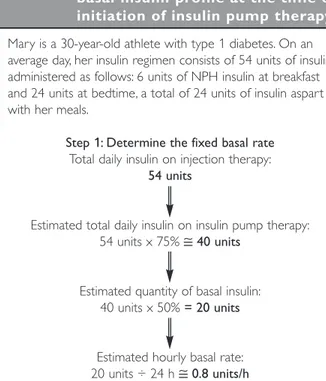
Mary is a 30-year-old athlete with type 1 diabetes. On an average day, her insulin regimen consists of 54 units of insulin administered as follows: 6 units of NPH insulin at breakfast and 24 units at bedtime, a total of 24 units of insulin aspart with her meals.
Step 1: Determine the fixed basal rate
Total daily insulin on injection therapy:
54 units
Estimated total daily insulin on insulin pump therapy: 54 units x 75% ≅40 units
Estimated quantity of basal insulin: 40 units x 50% = 20 units
Estimated hourly basal rate: 20 units ÷ 24 h ≅0.8 units/h
Step 2: Determine the diurnal variability in the basal rate
To determine the diurnal variation in the basal insulin rate, Mary undertook a basal assessment protocol described in the text. During this protocol, she experienced morning hyperglycemia and afternoon hypoglycemia, requiring adjustments in the constant rate of 0.8 units/h determined in Step 1. Her basal insulin profile at the end of the 2-week protocol was as follows:
Midnight to 5:00 AM 1 unit/h
5:00 AMto noon 0.8 units/h Noon to 5:00 PM 0.5 units/h
5:00 PMto midnight 0.7 units/h
Figure 1. A method for calculating the basal insulin profile at the time of initiation of insulin pump therapy
insulin rates, pump therapy usually uses a rapid-acting ana-logue as the insulin of choice.
To illustrate a benefit of insulin pump therapy in deliver-ing physiological quantities of basal insulin, consider the case of Mary, a 30-year-old athlete with type 1 diabetes who
wishes to try pump therapy. She is currently on an MDI regimen consisting of morning and bedtime intermediate-acting insulin (NPH) as the basal insulin, supplemented with mealtime rapid-acting analogue insulin (insulin aspart) as the bolus insulin. The morning dose of NPH insulin is intended to provide daytime basal insulin, but its action peaks from approximately noon to 2:00 pm. On days when Mary spon-taneously decides to go for a run at lunchtime in place of eat-ing a meal, she is highly susceptible to hypoglycemia because of the combined influences of peaking insulin levels and exercise on non-insulin-mediated glucose uptake.
At the initiation of insulin pump therapy, a fixed basal insulin rate can be estimated by the total daily insulin dose prior to pump therapy and can be subsequently modified by applying a basal assessment protocol.These 2 steps are shown in Figure 1. On the first day of insulin pump therapy, after determination of the fixed hourly insulin rate, Mary began the basal rate assessment protocol with an overnight basal assessment. She refrained from exercising that day and con-sumed a small and early dinner (consisting of 40 g of carbo-hydrate at 5:00 pm). Four hours following this meal, when the effect of her dinner bolus insulin had subsided and only the action of basal insulin remained, she began to monitor her BG. According to the protocol, she tracked her BG at 9:00 pm, midnight, 3:00 am and 7:00 am. BG fluctuations >1.7 mmol/L are generally considered to be excessive and indicate the need for a basal rate change. Traditionally, increases in basal rate are made in increments of 0.1 units at least 3 h before the rise occurs. In Mary’s case, her BG was 5.0 mmol/L at midnight and rose to 9.0 mmol/L at 3:00 am, requiring an increase of 0.1 unit/h beginning at midnight. On repeat testing, a further increase was required, such that her midnight to 5:00 amrate eventually reached 1 unit/h (Figure 1). Depending on the total daily insulin, patients may require an increase in basal rate of as much as 30% between the hours of 1:00 amto 3:00 amand 4:00 amto 7:00 am. The basal rate from 7:00 amto noon, from noon to 5:00 pm and from 5:00 pm to 9:00 pm were determined by having Mary omit breakfast, lunch and dinner, respectively. On any given day she only conducted 1 of the 4 basal time period assessments, and each assessment was undertaken at least twice, such that a total of 2 weeks was required for Mary to establish and confirm her basal profile.
In theory, a patient with type 1 diabetes with accurate basal insulin replacement may fast for an extended period of time without experiencing hypoglycemia or ketoacidosis.This abil-ity to limit caloric intake for prolonged periods may be partic-ularly advantageous to the competitive athlete in whom excessive carbohydrate intake may cause gastric upset (12). Bolus insulin
Bolus insulin is the insulin required to maintain euglycemia
The case example of Mary is continued from Figure 1. She weighs 60 kg. Her current BG is 10.0 mmol/L and she is preparing to eat a meal that consists of 75 g carbohydrate. Her target BG is 5.0 mmol/L
Step 1: Determine the food bolus
The carbohydrate-to-insulin ratio is estimated by the equation:
500 ÷ total daily insulin on pump therapy 500 ÷ 40 units = 12.5 g of carbohydrate/unit of insulin
Evaluate the accuracy of the carbohydrate-to-insulin ratio in achieving post-prandial BG targets*
For 75 g of carbohydrate, Mary requires a food bolus dose of: 75 g of carbohydrate ÷ 12.5 g of carbohydrate/unit
of insulin = 6 units of insulin
Step 2: Determine the correction bolus dose
Calculate the sensitivity index using the “90 rule”: 90 ÷ total daily insulin on pump therapy 90 ÷ 40 units of insulin = 2.0 mmol/L per unit of insulin
Evaluate the accuracy of the sensitivity index in achieving post-correction BG targets†
For a BG of 10.0 mmol/L, Mary requires a correction bolus dose of:
(Current BG – target BG) ÷ sensitivity index (10.0 mmol/L – 5 mmol/L) ÷ 2.0 mmol/L per unit of insulin
= 2.5 units of insulin
Step 3: Determine the bolus dose
Bolus dose = food bolus dose + correction bolus dose 6 units + 2.5 units = 8.5 units of insulin aspart
Figure 2. Methods for calculating the bolus insulin dose
*The accuracy of the estimated carbohydrate-to-insulin ratio can be evaluated by tracking blood glucose (BG) with the aim of an increase of 2.0 to 4.0 mmol/L 2 h after the meal and a return to the pre-meal level 4 h after the meal Conventional adjustments in the ratio are made in increments of 2.5 g (6)
†The accuracy of the sensitivity index is evaluated by tracking
the BG 3 h after a correction bolus, at a time during which no additional food or insulin is taken. At this time the expected BG
75
CANADIAN JOURNAL OF DIABETES. 2006;30(1):72-79.
the limits of the prescribed nutrition plan, to engage in nor-mal eating habits.With an accurately set basal rate, no signif-icant consequences should arise from additional meals, missed meals, aberrantly timed meals, or inconsistently sized meals. Determining bolus insulin doses requires the calcula-tion of 2 separate insulin doses—the food bolusinsulin dose and the correction bolusinsulin dose.The food bolus represents the amount of insulin required to metabolize the carbohy-drate content of a meal.To calculate the food bolus for meals, the patient is assigned a carbohydrate-to-insulin ratio. A sim-ple estimation of this ratio can be made using the “500 rule” in which the total daily dose of insulin is divided into 500 g of carbohydrate (Figure 2, Step 1). Additional insulin needed to account for elevated preprandial BG levels is referred to as the correction bolus insulin dose. Compared with the tradi-tional sliding scale method, the correction bolus method rep-resents a more quantitative way of delivering additional insulin for elevated BG. To calculate the correction bolus dose of insulin, a patient is assigned a “sensitivity factor,” which is tra-ditionally estimated by the “90 rule” (Figure 2, Step 2). Total bolus insulin dose is therefore the sum of the food bolus insulin dose and the correction bolus insulin dose (Figure 2, Step 3). If the fundamental pump parameters (i.e. the basal insulin profile, carbohydrate-to-insulin ratio and sensitivity index) are not properly assessed and re-evaluated at regular inter-vals, strategies for quantitative changes in insulin dosing for exercise may not be effective in preventing the complications of exercise.
CLINICAL STRATEGIES FOR THE ATHLETE USING INSULIN PUMP THERAPY
BG concentration during exercise depends largely on a bal-ance between fuel mobilization from the liver (hepatic glu-cose output) and gluglu-cose disposal into working muscles (1). In the setting of inappropriately high insulin concentration during exercise, hepatic glucose output is inhibited and glu-cose disposal into active muscle therefore causes hypo-glycemia. Oral carbohydrate intake is required to maintain the BG concentration. In the setting of inappropriately low insulin levels or excessive counterregulatory hormone release, hepatic glucose output (and ketone production) will be excessive. In this situation, oral hydration and additional insulin administration are required to prevent hyper-glycemia, dehydration and ketoacidosis.
Hypoglycemia, hyperglycemia and ketoacidosis are conse-quences of exercise that not only affect athletic performance, but are also potentially life threatening. Hypoglycemia may occur during or be delayed by up to 24 to 36 h after exercise. Furthermore, hypoglycemia occurs more frequently and more profoundly in those with hypoglycemia-associated autonomic failure (i.e. hypoglycemia unawareness), and is promoted by antecedent hypoglycemia as well as antecedent exercise. As such, exercise may create a vicious cycle of fre-quent hypoglycemia in active patients (13).
Hyperglycemia and ketoacid production may be exagger-ated during high-intensity exercise or in the setting of com-petition and heat stress, due to excessive secretion of counterregulatory hormones such as catecholamines and cortisol (1). The athlete with type 1 diabetes must intimately understand the balance between the risk of hyperglycemia/ ketoacidosis and the risk of hypoglycemia.
Strategy #1: Estimation of extra carbohydrate intake for exercise
During aerobic exercise, glucose disposal into muscle causes an immediate requirement for increased hepatic glucose out-put. If insulin doses are not altered to accommodate for exer-cise, insulin concentrations will generally be relatively high and hepatic glucose output will be inhibited. Hyperglycemia and ketoacidosis are unlikely complications in this setting of relative insulin excess. Oral carbohydrate intake, however, is required to maintain the BG concentration and prevent hypoglycemia (14). Therefore, a simple strategy for preven-tion of hypoglycemia is to completely disregard any potential contribution of the liver in BG homeostasis and simply have the patient consume a quantity of oral carbohydrate to match the amount of glucose disposal into muscle. This amount of ingested glucose is intended to maintain BG concentrations during exercise and to provide the necessary glucose for glycogen repletion during recovery from exercise. Walsh and Roberts coined the term “ExCarb” to represent these addi-tional carbohydrates required for exercise (15), while Riddell and Bar-Or refer to these as “Exercise Exchanges” for children with diabetes (16). Such “ExCarbs” can be estimated in 3 ways. Basic strategy for ExCarb estimation
The general recommendation for carbohydrate consumption is 15 to 30 g of carbohydrate every 30 to 60 min of exercise (17,18). Although activities vary widely in terms of fuel requirements, this range likely represents a safe starting point for most patients who wish to begin moderate-intensi-ty exercise regimens. Using this strategy, it is important for the patient to monitor BG at least every 30 min, limit exer-cise to mild- or moderate-intensity activities and review BG measurements in order to adjust carbohydrate intake for future planned exercise. Furthermore, this approach does not require any adjustment of the insulin dosage for meals or food or correction boluses.
As an example of the basic strategy for ExCarb estima-tion, Mary consumes 30 g of carbohydrate every 30 min dur-ing a low-intensity cycldur-ing work-out. Her first 30 g is taken at the start of her work-out, and then at 30 min and 1 h, for a total of 90 g of carbohydrate.
Semi-quantitative method of ExCarb estimation An estimation of carbohydrate requirement can be based on body mass (16). In general, intense activity at the time of peak insulin activity is associated with glucose disposal into
muscle of approximately 1 g glucose/kg body weight/h (14,19). Given that glucose disposal depends on the intensity of exercise and the current insulin concentration (as well as exercise duration, the state of physical conditioning of the patient, and the pre-exercise nutritional metabolic state), this 1 g/kg/h estimate is a conservative approach for pre-venting hypoglycemia for a starting regimen of mild- to moderate-intensity exercise.
For example, Mary, who weighs 60 kg, planned a 1-h cycling work-out at moderate intensity in the mid-morning. Based on the semi-quantitative method of ExCarb calcula-tion, she supplemented 60 g of carbohydrate intake during that hour and monitored her BG every 30 min. She chose to use a commercially available sports drink for supple-mentation, which contained approximately 15 g of carbohy-drate/250 mL. At the start of her work-out, her BG was 7.2 mmol/L, and she consumed 250 mL. After 30 min, she consumed another 250 mL, and then drank the remaining 500 mL during her recovery (within 1 h of finishing her work-out). Her BG was 8.3 mmol/L at 30 min, 6.9 mmol/L at 1 h and 8.9 mmol/L 30 min after the work-out. Prior to eating lunch at noon, her BG was 7.5 mmol/L.
Quantitative method of ExCarb estimation
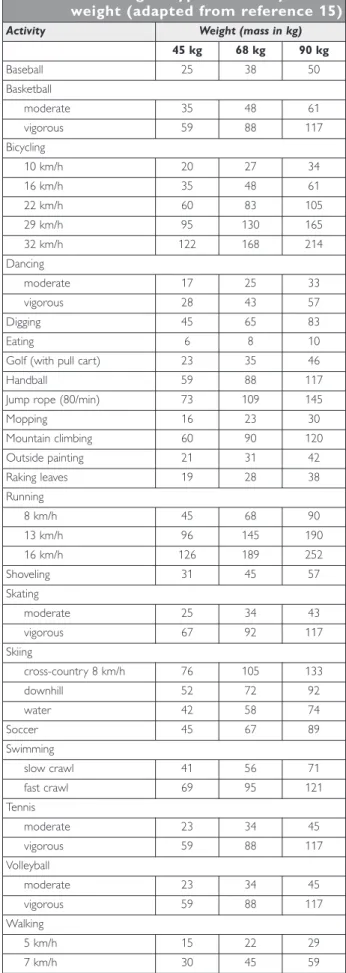
To account for the variable fuel requirements of different types of exercise, standardized tables have been devised to help athletes estimate ExCarbs for many different activities with varying intensities according to body weight (15,16). This activity-specific approach to estimating ExCarbs, although not tested in a clinical trial setting, is a popular resource among active patients with type 1 diabetes. Compared with the basic and semi-quantitative strategies, this approach takes into consideration more of the funda-mental aspects of energy metabolism during exercise. Energy utilization during exercise varies with the type, dura-tion and intensity of exercise. Furthermore, the state of physical conditioning of the athlete and the timing of the exercise relative to a meal and insulin bolus are additional factors that require consideration (1).
To apply this method, Mary calculated her ExCarb requirement for a 1-h low-intensity cycling work-out at an average of 16 km/h. Based on her weight of 60 kg, she esti-mated her carbohydrate requirement to be 48 g (Table 1) (15). She therefore consumed approximately 250 mL (con-taining 15 g of carbohydrate) of her sports drink at the start, midpoint and end of her cycling trip.
Strategy #2: Insulin adjustment for exercise The knowledgeable athlete on insulin pump therapy can apply strategies to adjust insulin administration to accommo-date exercise without needing to consume the full amount of carbohydrates required for the exercise. Some patients may
Table 1. Estimation of ExCarbs (g/h) according to type of activity and weight (adapted from reference 15)
Activity Weight (mass in kg)
45 kg 68 kg 90 kg Baseball 25 38 50 Basketball moderate 35 48 61 vigorous 59 88 117 Bicycling 10 km/h 20 27 34 16 km/h 35 48 61 22 km/h 60 83 105 29 km/h 95 130 165 32 km/h 122 168 214 Dancing moderate 17 25 33 vigorous 28 43 57 Digging 45 65 83 Eating 6 8 10
Golf (with pull cart) 23 35 46
Handball 59 88 117
Jump rope (80/min) 73 109 145
Mopping 16 23 30 Mountain climbing 60 90 120 Outside painting 21 31 42 Raking leaves 19 28 38 Running 8 km/h 45 68 90 13 km/h 96 145 190 16 km/h 126 189 252 Shoveling 31 45 57 Skating moderate 25 34 43 vigorous 67 92 117 Skiing cross-country 8 km/h 76 105 133 downhill 52 72 92 water 42 58 74 Soccer 45 67 89 Swimming slow crawl 41 56 71 fast crawl 69 95 121 Tennis moderate 23 34 45 vigorous 59 88 117 Volleyball moderate 23 34 45 vigorous 59 88 117 Walking
77
CANADIAN JOURNAL OF DIABETES. 2006;30(1):72-79.
suming additional carbohydrates for an activity, Mary could decrease her insulin dose at the time of a meal that precedes exercise or adjust her basal insulin profile to safely accom-modate the exercise. This strategy is more apt to encourage weight loss as a benefit of exercise.
The estimated ExCarb amount can be translated from grams of carbohydrate to units of insulin by way of the car-bohydrate-to-insulin ratio. An activity that requires 48 g of ExCarbs (such as Mary’s 1-h cycling activity discussed above) represents approximately 3.8 units of insulin. This is calcu-lated by dividing the 48 g of carbohydrates by her carbohy-drate-to-insulin ratio (12.5 g of carbohydrate per unit of insulin aspart), precisely the same calculation that she would perform in order to determine the food bolus insulin dose of a 48-g carbohydrate meal. However, to accommodate the exercise she would administer 3.8 fewer units of insulin.This decrease in insulin can be achieved in 3 ways: a decrease in the food bolus insulin dose for a meal preceding exercise, a decrease in basal insulin or a combination of both approaches. Food bolus approach
The concept of preventing exercise-induced hypoglycemia by adjusting prandial insulin is well supported by the litera-ture (20-22). For exercise that will begin within 90 min after eating, the food bolus insulin dose calculation can be based on the ExCarbs subtracted from the carbohydrate intake for that meal. For example, Mary consumes 75 g of carbohydrate for breakfast at 8:30 am. In order to accommodate her 1-h cycling work-out at 10:00 am. that requires 48 g of Excarbs, she could instead adjust her food bolus insulin dose for 27 g of carbohydrates at breakfast time (75 g of carbohydrate – 48 g ExCarbs). She would therefore administer a food bolus of 2.2 units of insulin aspart (27 g of carbohydrate ÷ 12.5 g of carbohydrate/unit of insulin aspart) instead of 6 units (75 g of carbohydrate ÷ 12.5 g of carbohydrate/unit of insulin aspart).
Basal insulin approach
When activity is remote from mealtimes or prolonged in duration, adjustments to the basal insulin may be required. For high-intensity and longer-duration activities, this approach is favoured specifically to avoid the peaking activity of insulin from a food bolus insulin dose. Furthermore, meals eaten before some high-intensity sports can cause nausea and abdominal pain. In such situations, it may be preferable to exercise at a time that does not coincide with a meal.
The study that best supports basal insulin changes in the prevention of exercise-induced hypoglycemia for patients on insulin pump therapy was performed prior to the era of rapid-acting insulin analogues (22).The ideal basal insulin for insulin pump therapy is a rapid-acting analogue specifically because of its more rapid onset and peak and shorter dura-tion of acdura-tion. In general, the onset, peak and duradura-tion of the rapid-acting analogues can be considered to be 10 to 15 min,
1 to 1.5 h, and 4 to 5 h, respectively, compared to 30 min to 1 h, 2 to 4 h, and 5 to 8 h, respectively, for Regular insulin. Consequently, programmed changes in basal insulin rates have a more immediate effect with the rapid-acting analogues.
Because the rapid-acting analogue insulin peaks at 1 to 1.5 h, it is advisable to make basal rate changes at least 90 min (1.5 h) before the onset of exercise. Furthermore, it is often advantageous to continue reduced basal rates for at least 90 min after exercise in order to prevent post-exercise hypoglycemia. For intense evening exercise, in addition to replenishing glycogen stores during and immediately follow-ing exercise by consumfollow-ing the necessary ExCarbs, the basal reduction may need to be programmed throughout the night in order to prevent delayed post-exercise hypoglycemia.
To apply this method, let us consider an activity of longer duration. Mary planned to play a round of golf beginning at 10:00 am, 3 h after breakfast. She referred to the ExCarb table (Table 1), and based on her weight of 60 kg, she esti-mated an hourly ExCarb requirement of approximately 35 g of carbohydrate. Over 4 h (the anticipated time to play the round of golf) this represented 140 g of carbohydrate. However, she planned to consume 250 mL (15 g carbohy-drate) of her sports drink every 30 min during her round of golf.This represented 120 g of additional oral carbohydrates. Therefore, there were 20 g of ExCarbs unaccounted for (140 g total ExCarbs – 120 g accounted for by oral carbohy-drate intake). Based on her carbohycarbohy-drate-to-insulin ratio of 12.5, she required a basal rate adjustment of 1.6 units (20 g ExCarbs ÷ 12.5 g of carbohydrate/unit of insulin aspart). For the total duration of the basal adjustment of 7 h (begin-ning 90 min before the round of golf until 90 min after-ward), she required a 0.2 units/h reduction in the basal rate (1.6 units ÷ 7 h). Given that her basal rate from 10:00 amto noon was pre-set at 0.8 units/h (Figure 1), she programmed a temporary basal rate of 0.6 units/h during this time. Given that from noon to 5:00 pm her basal rate was pre-set at 0.5 units/h, she programmed a temporary basal rate of 0.3 units/h through these afternoon hours.
It is generally recommended that patients not reduce their basal rate by more than 50% as an initial strategy for exercise. Further reductions should be based on experience from self-monitoring of BG and ketones during previous activity. For example, Mary may learn from the experience of her first round of golf described above that she is able to make further reductions in basal insulin beyond the 50% decrease in the afternoon hours, permitting her to consume fewer carbohydrates during her rounds of golf. This further reduction in basal insulin should only be considered if she is not experiencing hyperglycemia during the exercise and in the hours following her exercise. It is common for endurance athletes to require dramatic reductions in basal insulin. For example, as training runs increase in duration and intensity during a 4-month training program for a marathon, small incremental reductions in basal insulin rates beyond a
50% decrease can be made after each training run by review-ing BG and ketone records. Marathon runners often require very low rates of basal insulin for a part of the race, however, complete suspension of basal insulin delivery is not advised.
SPECIAL CONSIDERATIONS FOR ANAEROBIC EXERCISE
The counterregulatory hormone response associated with high-intensity anaerobic exercise is frequently the cause of dramatic exercise-induced hyperglycemia and places a theo-retical risk of exercise-induced ketoacidosis in the patient with inappropriately low basal insulin concentrations. Anaerobic respiration metabolizes intracellular stores of muscle glycogen as opposed to the uptake of glucose from the circulation that occurs with aerobic respiration. Furthermore, these hormones may act to antagonize the effects of insulin at non-working muscles, thus allowing a greater amount of available glucose for use by working mus-cles. In the individual without diabetes, these processes often lead to hyperglycemia, but the normal secretion of insulin permits resolution very rapidly. For the athlete with dia-betes, high-intensity exercise performed until exhaustion (at 80% of maximal oxygen-carrying capacity) often leads to elevated BG levels after exercise that remain high for a sig-nificantly longer period of time than in controls without dia-betes (23). This is thought to result from the inability of the athlete with diabetes to initiate a rise in insulin in the post-exercise phase.
Clinical strategies for preventing the BG aberrations of anaerobic exercise are not described in the literature. One approach is for the patient to administer a correction bolus insulin dose using the sensitivity index for the immediate post-exercise BG. If such correction boluses are needed on a consistent basis, increases in basal insulin beginning 90 min before such anaerobic exercise may be required. For exam-ple, a temporary basal insulin rate may be set to 110% of the usual basal rate during this time. Increments of 10% can be made if post-exercise hyperglycemia persists. Increases of basal insulin to as much as 200% are frequently needed with intense anaerobic exercise.
For the athlete with diabetes, hyperglycemia induced by the counterregulatory hormone responses may be further enhanced during the stress of competition, game days and excessive heat.
PREVENTION OF EXERCISE-INDUCED KETOACIDOSIS
The general guidelines for exercise in patients with type 1 diabetes recommend a warm-up regimen, hydration and the measurement of capillary BG (17,24). Although the true risk of exercise-induced ketoacidosis is likely to be low, a conser-vative approach is to consider that unanticipated capillary
monitored during endurance sports using a portable ketone meter or urine dipstick testing. If ketone test results are negative and the high BG is felt to result from recent food intake, exer-cise can be undertaken cautiously with frequent BG measure-ments and a repeat ketone test. If positive, a correction bolus insulin dose should be taken and exercise delayed until the ketones are negative and the BG is <14.0 mmol/L. If ketones persist 3 h after the first test, an infusion set change should be made and contact with the healthcare team may be required.
The athlete must monitor the integrity of the infusion site and the insulin pump during exercise in order to prevent site irritation, displacement of the subcutaneous catheter or physical damage to the pump. A final consideration for endurance athletes is the risk of euglycemic ketoacidosis in the setting of insufficient insulin and low glycogen stores, which can be seen after exercise of long duration. It is there-fore generally recommended that endurance athletes moni-tor serum or urine ketones in addition to BG during prolonged physical activity, ideally during the recovery peri-od following the activity.
SUMMARY
Insulin pump therapy may provide the athlete with type 1 diabetes with a set of strategies for making quantitative changes in insulin delivery in order to prevent the frequent complications commonly observed with exercise (i.e. induced hypoglycemia, post-exercise hypoglycemia, exercise-induced hyperglycemia and ketosis). This article reviewed the fundamental parameters of insulin pump therapy, sug-gested simple methods for re-evaluating these in the athlete and presented strategies for engaging in safe athletic training. Knowledge of the techniques for estimating ExCarbs permits the athlete with type 1 diabetes to consume adequate carbo-hydrates during exercise, translate these carbohydrate doses into reductions in prandial and basal insulin, or combine these 3 strategies.
AUTHOR DISCLOSURE
No duality of interest declared.
REFERENCES
1. Riddell M, Perkins B. Type 1 diabetes and vigorous exercise: applications of exercise physiology to patient management. Can J Diabetes. 2006;30:63-71.
2. Wallberg-Henriksson H, Gunnarsson R, Henriksson J, et al. Increased peripheral insulin sensitivity and muscle mitochon-drial enzymes but unchanged blood glucose control in type 1 diabetics after physical training.Diabetes. 1982;31:1044-1050. 3. Zinman B, Zuniga-Guajardo S, Kelly D. Comparison of the acute and long-term effects of exercise on glucose control in type I diabetes.Diabetes Care.1984;7:515-519.
79
CANADIAN JOURNAL OF DIABETES. 2006;30(1):72-79. control and lipoprotein levels.Diabetologia. 1986;29:53-57.
5. Heise T, Berger M, Sawicki PT. Non-evidence-based concepts are still established in the treatment of IDDM. Horm Res. 1998;50(suppl 1):74-78.
6. The Diabetes Control and Complications Trial Research Group. The effect of intensive treatment of diabetes on the development and progression of long-term complications in insulin-dependent diabetes mellitus. N Engl J Med. 1993; 329:977-986.
7. Diabetes Control and Complications Trial/Epidemiology of Diabetes Interventions and Complications Research Group. Retinopathy and nephropathy in patients with type 1 diabetes four years after a trial of intensive therapy. N Engl J Med. 2000;342:381-389.
8. Thompson CJ, Cummings JF, Chalmers J, et al. How have patients reacted to the implications of the DCCT? Diabetes Care. 1996;19:876-879.
9. Wee CC, McCarthy EP, Davis RB, et al. Physician counseling about exercise.JAMA. 1999;282:1583-1588.
10. Retnakaran R, Hochman J, DeVries JH, et al. Continuous sub-cutaneous insulin infusion versus multiple daily injections: the impact of baseline A1c.Diabetes Care. 2004;27:2590-2596. 11. Tsui EY, Chiasson JL, Tildesley H, et al, Counterregulatory
hormone responses after long-term continuous subcutaneous insulin infusion with lispro insulin.Diabetes Care. 1998;21:93-96. 12. Position of Dietitians of Canada, the American Dietetic Association, and the American College of Sports Medicine: Nutrition and athletic performance. Can J Diet Pract Res. 2000;61:176-192.
13. Ertl AC, Davis SN. Evidence for a vicious cycle of exercise and hypoglycemia in type 1 diabetes mellitus.Diabetes Metab Res Rev. 2004;20:124-130.
14. Francescato MP, Geat M, Fusi S, et al. Carbohydrate require-ment and insulin concentration during moderate exercise in type 1 diabetic patients.Metabolism. 2004;53:1126-1130. 15. Walsh J, Roberts R.Pumping Insulin. 3rd ed. San Diego, CA:
Torrey Pines Press; 2000.
16. Riddell MC, Bar-Or O. Children and adolescents. In: Ruderman NB, Devlin JT, Schneider S, et al, eds.Handbook of Exercise in Diabetes. Alexandria, VA: American Diabetes Association; 2002:547-566.
17. Wasserman DH, Zinman B. Exercise in individuals with IDDM.Diabetes Care. 1994;17:924-937.
18. Franz MJ. Nutrition, physical activity, and diabetes. In: Ruderman NB, Devlin JT, Schneider S, et al, eds.Handbook of Exercise in Diabetes. Alexandria, VA: American Diabetes Association; 2002:321-338.
19. Wasserman DH, Zinman B. Fuel metabolism during exercise in health and diabetes. In: Ruderman NB, Devlin JT, Schneider S, et al, eds. Handbook of Exercise in Diabetes. Alexandria,VA: American Diabetes Association; 2002:63-100. 20. Schiffrin A, Parikh S. Accommodating planned exercise in
type I diabetic patients on intensive treatment.Diabetes Care. 1985;8:337-342.
21. Rabasa-Lhoret R, Bourque J, Ducros F, et al. Guidelines for premeal insulin dose reduction for postprandial exercise of different intensities and durations in type 1 diabetic subjects treated intensively with a basal-bolus insulin regimen (ultralente-lispro).Diabetes Care. 2001;24:625-630.
22. Sonnenberg GE, Kemmer FW, Berger M. Exercise in type 1 (insulin-dependent) diabetic patients treated with continuous subcutaneous insulin infusion. Prevention of exercise-induced hypoglycaemia.Diabetologia. 1990;33:696-703.
23. Sigal RJ, Purdon C, Fisher SJ, et al. Hyperinsulinemia prevents prolonged hyperglycemia after intense exercise in insulin-dependent diabetic subjects. J Clin Endocrinol Metab. 1994; 79:1049-1057.
24. Zinman B, Ruderman N, Campaigne BN, et al. Physical activity/exercise and diabetes. Diabetes Care. 2004;27 (suppl 1):S58-S62.