E u r o E c o n o m i c a
Issue 2(31)/2012 ISSN: 1582-8859
5
Justification and Implementation of Exit Strategies in the Context
of the Current Crisis
Andreea Andrieş
Alexandru Ioan Cuza University of Iasi , Faculty of Economics and Business Administration;
Abstract: This paper aims at emphasizing the complexity of decisions taken by fiscal and monetary authorities in order to reverse the measures introduced to counter the effects of the current crisis, starting with a theoretical approach and continuing with the analysis of exit strategies on the cases of the USA, euro zone and Japan. The conclusion of this study is that, currently, there is no optimal strategy of withdrawing the intervention measures and less one based on international coordination. Also, effective exit strategies focus on good communication between the factors involved and actions that converge towards sustainable economic growth.
Keywords: financial turmoil; withdrawal measures; monetary policy; fiscal policy; coordination
JEL Classification: E50; G20
1.
Introduction
The magnitude of the unprecedented economic and financial crisis that broke out in the summer of 2007 with epicentre in the real estate market of the United States of America, required substantial intervention measures, some of them quite innovative, on three levels: financial, monetary and fiscal. The objectives of the implementation of these measures have targeted major imbalances on financial markets and the stabilization of real economy.
Given the positive trend of the main macroeconomic variables as a result of implementing the intervention measures, there is a strong need to renounce to the latter.However, the coordinates of exit strategies are difficult to establish and differ significantly, mainly due to the levels of heterogeneity of the economies and health of the financial systems.
The issue of giving up to intervention measures is a very complex one, in view of the difficulty of choosing an appropriate time and manner of implementation (in conjunction with the possibility of jeopardizing the economic growth, fragile, by the way) or coordination (or not) of fiscal-budgetary, monetary and financial policies.
This paper presents the following structure: section two captures the characteristics of exit strategies and implications of their implementation in the light of specialized literature. Section three presents aspects relating to the harmonization of withdrawing the intervention measures. Part four reviews particularities of exit strategies in the context of subprime crisis, on the example of some countries and central banks. The fifth part of the study concentrates on exit strategies in Romania. The study ends with some conclusions.
E u r o E c o n o m i c a
Issue 2(31)/2012 ISSN: 1582-8859
6
2.
Literature Review
According to most studies, the effectiveness of intervention measures in the context of crisis it is associated with the character timed, directed and temporarily. (González-Páramo, 2011) Whereas measures taken by the authorities have been designed for a limited time horizon to the duration of the financial turmoil, with the major objectives of their introduction fulfilled (redressing of the economical and financial climate), it is absolutely necessary a judicious design and implementation of exit strategies. A general definition of exit strategies is surprised by Acocella, as follows: "exit strategies are those strategies implemented after the adoption of policies meant to combat the economic and financial crisis, to facilitate a return to normal conditions." (p:1, 2011) This "normality" is relative, however, if we consider the far too relaxed nature of the monetary policy interest rates in the period preceding the crisis.
Given the many dimensions that can be studied under the strategies of withdrawal of measures introduced in the context of the crisis, some economists focused on strategies in the field of taxation (Corsetti, 2010), others have focused on the area of monetary policy (Belke, 2010), some have also analyzed the strategies of both fiscal and monetary plans (Cotarelli, Viñals, 2009). It is worth mentioning that there are fewer studies that investigate exit strategies on all three plans. (Angeloni, Faia, Winkler, 2010)
The complexity of foundation and implementation of exit strategies consists in the difficulty of identifying the unknowns that form the equation of an optimal strategy. These unknowns may be found at least in the following questions, more or less deciphered by specialists: Why should we implement exit strategies? When should they be implemented? What/how will be the manner of implementation? It is necessary to coordinate exit strategies? (Pisani-Ferry, Weizsäcker, 2010)
As regards the reasons for retracting the intervention measures, according to Acocella, there are two main elements to consider: the huge amount of currency in circulation and the increase of deficit and debt compared to GDP. (2011) On the other hand, in views of Mathieu and Sterdynia, the main motivation to implement exit strategies is related to the excessive sovereign debt levels.
In terms of process of elaborating strategies of removing support measures, specialized literature stresses the importance of taking into account their common characteristics: integration of all components and connections between them, flexibility when confronting with unforeseen events, restoration of market principles and clarity of communication in order to obtain the desired effects. (González-Páramo, 2009) If we consider the principles that should be taken into account in designing and implementing of exit strategies, according to the IMF, they reflect aspects related to: the dependence of withdrawal measures coordinates on the revival of the economy, the acute need for fiscal consolidation, clear communication or the absence of the obligation that unconventional measures to be withdrawn before tightening the character of the monetary policy. Of all the principles, one is generally valid and that is the fact that exit strategies should support a stable and sustainable economic growth.
From the perspective of concrete actions regarding the process of removing intervention measures, there is a general consensus about it: monetary authorities will conduct a restrictive monetary policy and on the other hand, will retire unconventional measures. In the financial and fiscal sectors exit strategies will focus on budget consolidation, withdrawing Government guarantees, restructuring and recapitalization of banks and orientation towards macro-prudential dimension. (Weizsäcker, Pisani-Ferry, 2010)
With reference to empirical research, it should be noted that the range of tools, mathematical techniques and econometric models used in professional studies is relatively small, including one such as DSGE model (dynamic stochastic general equilibrium) which analyzes the implications of coordination (or not) of exit strategies on the three tiers. (Angeloni, Faia, Winkler, 2010). Also, a recent study conducted by
E u r o E c o n o m i c a
Issue 2(31)/2012 ISSN: 1582-8859
7 Foerster, based on Markov process switching, shows negative implications of applying too early exit strategies by central banks, resulting in the deepening of the recession. (2011)
Another issue intensely analyzed in the literature concerns the coordination (or not) of exit strategies. In this sense, we can view the problem from several angles: coordination at national level- of fiscal, monetary and financial policies and internationally- of all policies or separately, by the competent bodies. (Giavazzi, 2009, Mathieu, Sterdyniak, 2010, Pisani-Ferry, Weizsäcker, 2010) Also, the literature points out that coordination process does not imply necessarily synchronization, but the lack of policy coordination can induce adverse effects. (Cottarelli, Viñals, 2010)
On the basis of specified above, it can be asserted that exit strategies present multiple dimensions: measurable dimensions (the moment of introduction, the pace-the majority of specialists advocates for "the principle of gradualism", duration), but also elements that are heavier to measure, as it is the degree of uncertainty, exacerbated in particular under conditions of economic and financial turbulence.
Therefore, the spectrum of views regarding exit strategies is relatively extensive and topical. As regards the range of econometric techniques used, it can be found in an earlier stage of development, with space research in the area of exit strategies for emerging states or in what concerns the limits of withdrawal measures.
3.
Considerations Relating to the Harmonization of Exit Strategies
The issue of harmonization (or not) of the withdrawing the intervention measures taken by authorities in the context of the current crisis is a complex one, considering the multiple aspects under which we can analyze it. Thus, in terms of space, we can consider the process of coordinating the policies at national level, on the one hand and coordinating all regional/global policies, or separately, monetary, fiscal, and financial policy, on the other hand.
If we consider the national perimeter, taking into account the interdependence between economic policies, is absolutely essential to link the withdrawal of intervention measures on all three plans. For instance, an increase in the monetary policy interest rate, amid inflationist phenomenology, on the one hand, burdens the task of public finances by increasing the interest rate costs over the long term, and on the other hand, grows the price of liquidities in the financial system influencing the flow of the latter. Accordingly, competent authorities should "weigh" the implications of retracting the support measures and decide which of the policies will act first.
In the same vein, according to a study by Angeloni, Faia and Winkler, which is a DSGE model based, taking into consideration a fragile banking sector, adapted for the euro area, "the sequencing effect" applied in the case of the three policies in the context of implementing exit strategies illustrates that the impact of the action performed by withdrawing intervention measures both in fiscal and monetary plan it is equivalent to that exercised only by withdrawing fiscal measures. Also, exit strategies in which monetary policy makes the first step proved less effective.
From another perspective, it is desirable that a first step towards removing intervention measures to be carried out by fiscal authority, the motivation being that, in the absence of such action, it isamplified the increase in the interest rates over the long term in financial markets, the latter anticipating the intervention of the monetary authority. An increase in the interest rate will increase public debt default and will lead to a reduction in the pace of economic growth and the capacity of the state to alleviate the amplitude of future shocks. Therefore, in order to avoid damage to consumption and long term investments, it is
E u r o E c o n o m i c a
Issue 2(31)/2012 ISSN: 1582-8859
8 recommended a commitment to fiscal consolidation favourable for an adaptive behaviour of monetary policy that contributes to ensuring financial stability.
Referring to the process of internationally coordination, an argument in favour of it originated in the view according to which precisely the lack of adequate coordination between fiscal and monetary policies is one of the "roots" of the subprime crisis. Indeed, the lack of consistency of the policy mix has contributed to the onset of the current crisis, but did not create the premises of full coordination at the international level. An example of this is the euro area, in which, at least for the time being, we cannot talk about a possible fiscal integration, which would work with the monetary authority.
If we consider the monetary front of action, the theory in this area, as well as the high degree of cooperation between monetary authorities in the subprime crisis (an eloquent example in this respect being the concerted action dated October 8, 2008) supports the idea that it would be useful an international coordination of exit strategies.
As indicated above, the monetary harmonization of withdrawing intervention measures at international level should be provided in a given stage through tightening the conduct of the monetary policy, but there are certain economies (such as Asian ones) whose already appreciated currency, amid an increase in the interest rate, will strengthen even more, helping to impede exports and consumption otherwise, fragile. Also, despite the fact that at present, inflammation of the inflation rate would suppose tightening of monetary policy in countries which practice inflation targeting regime (the case of ECB), there are also central banks which in order to achieve the objectives established by the statutes relating to both price stability and economic growth (for example, in the case of the FED), delay raising the monetary policy interest rate in order to create space for economic relaunching.
Of course, international coordination of policies increases the degree of predictability and therefore a better anchoring of inflationary expectations, but it cannot be ignored the possibility of a wrong choice behaviour policy (of cooperating states) and thereby transferring the shortcomings in the overall national perimeter. Therefore, according to some opinions, in periods characterized by high uncertainty, it is preferable an independent monetary policy sized according to the health of the financial system.
As regards the process of fiscal consolidation, already applied in a number of countries faced with excessive levels of government debt, we cannot speak of a uniform implementation in terms of distinct economies and different fiscal positions. For example, states that as a result of the implementation of intervention measures, record sustained economic growth, can afford to implement exit strategies, at least faster than states experiencing major vulnerabilities in economic terms.
From another perspective, where application of fiscal stimuli produce benefits also in favour of other states (positive spill over), encouraging the behaviour of free-rider, the application of tax restrictions generates benefits for that country, consisting mainly in the lower level of budget deficit, but reduces activity also in other states (negative spill over) with an aggravated situation of public finances. (De
Grawe, 2009)
Therefore, an appropriate strategy for waiver of intervention measures in the three plans, it is not mandatory to be synchronized at national/regional/global level, but must be "correctly timed" at national level, taking into consideration the position of each economy, leading to some earlier exits, and others after a certain period of time. (Smaghi, 2009)However, it is not sufficient that states currently prepared to implement exit strategies, but it requires a firm commitment, consistent, at international level, to ensure the countries that will act first, that the others states will act in a timely way.
E u r o E c o n o m i c a
Issue 2(31)/2012 ISSN: 1582-8859
9 Thus, according to economic theory, it is desirable coordination between policies, at national and international level, but economic practices reflect its difficulties in carrying it out, more pronounced internationally, against the background of the specific economies. Moreover, despite the broadening of the globalization phenomenon, under conditions of severe economic turbulence, each country acts primarily according to its own economic and financial conditions and in extreme circumstances, participates in concerted actions.
4.
Special Features of Exit Strategies from Intervention Measures in the Context of the
Current Crisis. Case Study: Euro Zone, USA, Japan
Under the conditions of a growing economic and financial turmoil, monetary and fiscal authorities have taken a series of measures aimed at assuring the proper functioning of the financial markets and global financial stability, by default. In such circumstances, the objective of financial stability is the priority of central banks, though most of the statutes of central banks stipulate that the basic objective is that of achieving and maintaining price stability (the case of the European Central Bank).
In the context of the current crisis, the statute of the Central Bank of Japan has been modified by incorporating the objective of financial stability, too and in the case of the Federal Reserve System, in addition to the objective of price stability, it is expressly referred to provide support for sustainable economic growth and employment.
In a first instance, in order to diminish the tensions on the financial markets, the three monetary authorities and not only, operated progressive reductions of the monetary policy interest rate tapping historical minimum levels (ECB), around the value of 0% (the Federal Reserve System, Bank of Japan). (See figure 1)
Figure 1The evolution of interest rates charged by the FED, ECB and BoJ, during the period December 2007 and December 2011 (%)
Source: Data Processing, http:www.global-rates.com/interest-rates/central-banks/
Amid the severe deterioration of the situation of the financial system and the real economies, central banks have had to adopt and implement unconventional measures in order to restore the functionality of the transmission mechanisms of monetary policy (exceptional fine-tuning operations, broadening of eligible collateral, broadening of counterparties etc.).
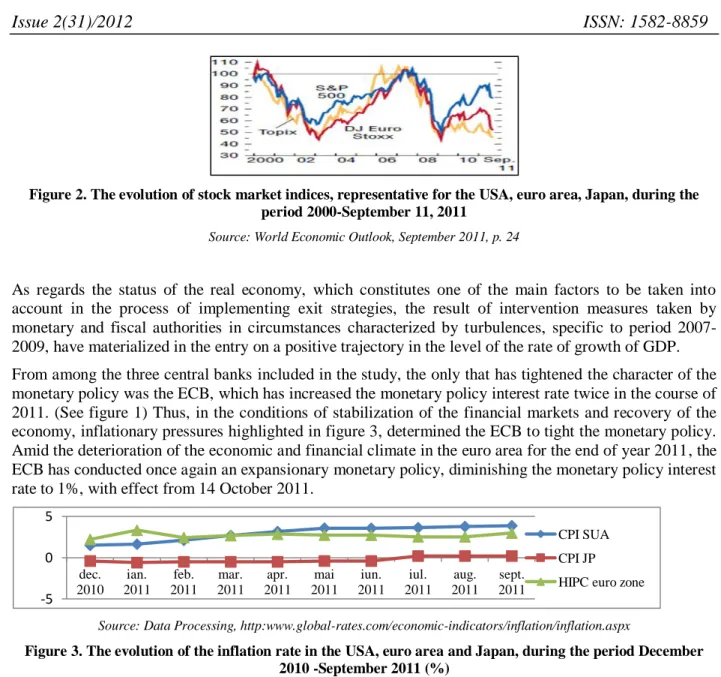
In terms of favourable evolution of the financial climate, reflected in the ascendant trend indicators representative for the three financial markets surprised in figure 2 and taking into account the possible repercussions of keeping active the extraordinary measures, the three banks which constitute the subject of this study, have launched the process of reversing the intervention measures.
0 2 4 6 D ec . … Ia n. 2008 M ar . … M ai 200 8 Iul . 2008 Se pt . … O ct . 2008 Dec . … F eb. … A pr . … Iun . 20 09 A ug . … O ct . 2009 Dec . … F eb. … A pr . … Iun. 201 0 A ug . … O ct . 2010 Dec . … F eb. … A pr . … Iun. 201 1 A ug . … O ct . 2011
The most recent modif. of the interest rate FED The most recent modif. of the interest rate ECB The most recent modif. of the interest rate BoJ
E u r o E c o n o m i c a
Issue 2(31)/2012 ISSN: 1582-8859
10 Figure 2. The evolution of stock market indices, representative for the USA, euro area, Japan, during the
period 2000-September 11, 2011
Source: World Economic Outlook, September 2011, p. 24
As regards the status of the real economy, which constitutes one of the main factors to be taken into account in the process of implementing exit strategies, the result of intervention measures taken by monetary and fiscal authorities in circumstances characterized by turbulences, specific to period 2007-2009, have materialized in the entry on a positive trajectory in the level of the rate of growth of GDP. From among the three central banks included in the study, the only that has tightened the character of the monetary policy was the ECB, which has increased the monetary policy interest rate twice in the course of 2011. (See figure 1) Thus, in the conditions of stabilization of the financial markets and recovery of the economy, inflationary pressures highlighted in figure 3, determined the ECB to tight the monetary policy. Amid the deterioration of the economic and financial climate in the euro area for the end of year 2011, the ECB has conducted once again an expansionary monetary policy, diminishing the monetary policy interest rate to 1%, with effect from 14 October 2011.
Source: Data Processing, http:www.global-rates.com/economic-indicators/inflation/inflation.aspx
Figure 3. The evolution of the inflation rate in the USA, euro area and Japan, during the period December 2010 -September 2011 (%)
According to figure 3, unlike the FED and ECB, the Japanese Central Bank faces deflationary pressures not less dangerous than inflationist ones. We place ourselves, in particular, on the side of the negative real interest rates, which does not allow for the expression of the role of interest rates in the process of stimulating/inhibiting economic and financial conditions.
According to statistical data, due to the manifestation of deflation, by the year 2012, we will not witness an increase in the interest rate. Moreover, if national currency-the yen continues to appreciate and the economy shows signs of weakening, most likely, the conduct of monetary policy remains relaxed. This relaxation is a relative one, if we consider the level of inflation.
In the case of FED, despite internal inflationary pressures, it must not be omitted the second component of the basic objective, that of ensuring sustainable economic growth and employment. Therefore, in view of the high level of unemployment in the present, compared to the period preceding the crisis as well as the pessimistic forecasts on the evolution of economic growth, it seems justified to a certain extent, the lack of action of the Central Bank in the direction of raising the monetary policy interest rate. Moreover, for the
-5 0 5 dec. 2010 ian. 2011 feb. 2011 mar. 2011 apr. 2011 mai 2011 iun. 2011 iul. 2011 aug. 2011 sept. 2011 CPI SUA CPI JP HIPC euro zone
E u r o E c o n o m i c a
Issue 2(31)/2012 ISSN: 1582-8859
11 first time, the FED said that it was possible to maintain the present level of monetary policy interest rate by mid-2013, suggesting the degree of vulnerability of the USA economy.
Although at present, central banks intend to apply exit strategies, in the context of a growing sovereign debt, the ECB has reassessed the waiver of unconventional measures and introduced on May 10 the SMP (Securities Market Program) and announced the introduction of new unconventional measures. Also in March 2011, amid natural disasters recorded, the Bank of Japan has expanded the use of unconventional measures, injecting huge liquidity level, in particular through the purchase of assets and corporate bonds. In fiscal plan, the USA, euro area and Japan are making considerable efforts in order to redress the situation of public finances, focusing in particular on the expenditures side. Thus, the USA authorities have proposed to achieve by the year 2015, a level of public debt by 70% of GDP (compared with the present level of over 100% of GDP) and to reduce half of the budget deficit by the year 2012. The Japanese Government (with the most worrisome task of public finances) intends to reduce half of the primary deficit to 3.2% of GDP by 2015, even to record budget surplus. In the euro zone austerity measures aimed at, as in the case of the aforementioned states, both cutting spending and raising taxes. With regard to the coordination of national policies in the euro area, in terms of fiscal consolidation measures to corroborate with the tightening of monetary policy by the ECB we can remark a closer coordination, as opposed to the USA and Japan.
Therefore, all the authorities covered by this study, have launched the process of fiscal consolidation, and have committed to run sustainable public finances and started to withdraw from unconventional monetary measures, but the differences in the degree of recovery of the economies and stability of the financial systems didn’t favour international coordination strategies.
5.
Considerations on Exit Strategies in the Case of Romania
In the context of confronting with the effects of the international turmoil, the Romanian economy was sustained by a loan of EUR 20 billion from the IMF, the World Bank and the EU and state loans from the internal market through issuance of bonds, which have generated the highest level of national public debt in recent years. Therefore, the only exit strategy which is subject to the fiscal authority for the purpose of intervention in crisis conditions regards the exit from the agreement with the IMF.
As regards the action of the National Bank of Romania, we can speak of a possible exit strategy, whereas on the monetary policy side it has been possible to intervene to support the economic and financial climate. In this regard, the Central Bank has successively diminished the level of monetary policy interest rate and reserve levels applicable to liabilities in lei and foreign currency. However, it should be mentioned that the resumption on a disinflation trend and the fragile state of the real economy, have favoured diminishing of the level of monetary policy interest rate at 5.5% in February 2012.
On the other hand, in the conditions of the onset of the crisis, NBR did not called for exceptional measures, like other central banks, but with effect from October 3, 2011 entered into force the expanding of the range of eligible assets of money market operations, a position considered to be unconventional, which reflects a deterioration in the conditions of the financial system. Moreover, in view of the prevention of systemic risk, the National Bank supports creating the so called "bridge-banks".
Therefore, implementing exit strategy in the monetary sphere would mean tightening the monetary policy status, removing the broadening of eligible assets and increasing the rate of mandatory minimum reserves.
E u r o E c o n o m i c a
Issue 2(31)/2012 ISSN: 1582-8859
12 Compared to most states, for instance in the European Union, the worrying level of public debt, is in great part the result of errors in the design and implementation of economic policy mix of recent years. Unlike the states which were the subject of this study, in Romania, we cannot talk about a withdrawal of support measures introduced in the context of the crisis in fiscal plan, just in the monetary one.
Thus, in Romania, the lack of space in fiscal plan did not allow for intervention to support the financial system and the real economy in the context of the establishment of the current crisis. Considering the strong fiscal imbalance (amplified in times of economic growth well above potential), Romania has introduced austerity measures. In times of severe recession, accompanied by strong compression of demand, when fiscal policy ought to be cyclical, the fiscal impulse has been a negative one, contributing to the deepening of the recession. It should be noted that, in the case of Romania, the process of fiscal consolidation could be much more effective if it would act more vehemently in the sense of improving the level of tax collection (by reducing tax evasion) and less drastic decrease of the volume of expenditure. Currently, however, there are some significant risks to the path of fiscal consolidation: external risks, in particular due to the sovereign debt in the euro area which could affect exports and capital inputs and internal risks consisting in the possibility of diminishing the political commitment, taking into account the elections scheduled for 2012. With regard to the coordination of policies, it has not existed in the period before the crisis, and currently, authorities are acting towards ensuring the sustainability of public finances, the essential condition for monetary policy to be able to exercise influence on the real economy.
6.
Conclusions
Both literature and economic practice in the approached field reflect that there is no general consensus with regard to an optimal strategy of discard the counter-measures to the effects of the current crisis. The complexity of such strategies is derived from the multiple dimensions that must be quantified, correlated and applied at the appropriate time. According to the analysis carried out in this study which broadly outlined the mirage of exit strategies, judicious justification and implementation of exit strategies at the appropriate time to give up to the intervention measures introduced in the context of the crisis (preferably coordinated at economic policy, consistent and credible commitments levels) does not mean a return to the existing policy mix before the turmoil, but a profound orientation towards financial stability, sustainability and macroprudentiality. The need for precise timings of exit strategies at national level in the first stage, derives from the challenges that are expected to exert substantial pressure on monetary policy (inflationary pressures, the problem of incorporating the objective of financial stability) and fiscal policy (sovereign debt problems). Therefore, in the national perimeter it is necessary and it is possible to coordinate the strategies of removing the intervention measures. In view of the fact that some states are in the process of implementing exit strategies on all three plans, and others even have postponed their implementation over the medium term, we cannot speak of a coordination of measures at international level. Moreover, the problem of coordination is directed primarily to the economies and financial markets that “give tone", which are globally representative. Referring to the appropriate exit strategies, on the one hand, it is vital to maintaining the sustainability of public finances in order to ensure the assumptions of sustained economic growth over the long-term, and on the other hand, given that the literature and recent economic practice refers to a possible beginning of the "true crisis", the diminishing economic growth pace due to the withdrawal of intervention measures, too contributes to the deterioration of the economic and financial climate. Thus, in the absence of methods and tools for precise identification of the moment of introducing exit strategies, their duration and pace, the mission corresponding to the competent authorities is one as complex as possible.
E u r o E c o n o m i c a
Issue 2(31)/2012 ISSN: 1582-8859
13
7. References
Acocella, N., (2011). The deflationary bias of exit strategies in the EMU countries, Retrieved from
http://eprints.bice.rm.cnr.it/3248/1/WPaper_No__82.pdf, 2.
Angeloni, Ignazio, Faia, Ester, Winkler, Ronald, (2010). Exit strategies, Retrieved from
http://dspace.cigilibrary.org/jspui/bitstream/123456789/31217/1/WP%201676%20-%20Exit%20Strategies.pdf?1
Ansgar, Belke, (2010). Financial crises, global liquidity and monetary exit strategies, Berlin, Retrieved from
http://www.diw.de/documents/publikationen/73/diw_01.c.355795.de/dp995.pdf
Bornhorst, Fabian, Budina, Nina, Callegari, Giovanni et. Al, (2010). A Status Update on Fiscal Exit Strategies, Retrieved from
http://www.imf.org/external/pubs/ft/wp/2010/wp10272.pdf, 63.
Carlo, Cottarelli, José ,Viñals, (2010). A Strategy for Renormalizing Fiscal and Monetary Policies in Advanced Economies, Retrieved from http://www.imf.org/external/np/seminars/eng/2010/kdi/pdf/exitstrategies.pdf, 3.
De, Grawe, Paul, (2009) To coordinate or not to coordinate, Retrieved from http://www.voxeu.org/index.php?q=node/4020 Foerster, Andrew, T, (2011). Financial Crises, Unconventional Monetary Policy Exit Strategies, and Agents’ Expectations, Retrieved from http://www.kansascityfed.org/publicat/reswkpap/pdf/rwp11-04.pdf.
Giavazzi, Francesco, (2009). The risky game of “chicken” between Eurozone governments and the ECB , Retrieved from
http://www.voxeu.org/index.php?q=node/4004.
González-Páramo, José Manuel , (2011). The conduct of monetary policy: lessons from the crisis and challenges for the coming years, Retrieved from http://www.ecb.int/press/key/date/2011/html/sp111013.en.html
IMF, (2009). Global Economic Prospects and Principles for Policy ExitPrinciples, Retrieved from Policy E http://www.imf.org/external/np/g20/pdf/110709.pdf, 1.
IMF, (2010). Exiting from crisis intervention policies,Retrieved from http://www.imf.org/external/np/pp/eng/2010/020410.pdf, 24.
IMF, (2011). Country Report No. 11/182, Japan, Retrieved from http://www.imf.org/external/pubs/ft/scr/2011/cr11182.pdf, 17. Jyske Markets, Research Report, (2010). Monetary policy- Exit strategy, Retrieved from
https://jyskebank.ch/wps/wcm/connect/690c308041da803c82f7e32a7a754750/329308_Temaanalyse_marts2010.pdf?MOD=AJP
ERES&CACHEID=690c308041da803c82f7e32a7a754750, 8.
Marquez, Jaime, Morse, Ari, Schlusche, Bernd, (2011). Overnight Interest Rates and Reserve Balances: Econometric Modelling of Exit Strategies, Retrieved from http://rcea-canada.org/pages/program/papers/schlusche.pdf.
Pisani-Ferry, Jean, von Weizsäcker, Jakob, (2010). Exit strategies: How soon? How fast? How to coordinate?, Retrieved from
http://www.gmfus.org/brusselsforum/2010/docs/BF2010-Paper-Bruegel.pdf, 8.
Roubini, Nouriel, (2009). Presentation to the CFA Market Forecast Dinner, Melbourne, Retrieved from
http://www.membersocieties.org/melbourne/Linked%20Files/roubini.pdf.
Smaghi, Lorenzo, Bini, (2009). Exit strategies- the international dimension, BIS Review, Retrieved from
http://www.bis.org/review/r091126e.pdf.
World Economic Outlook, (2011). Slowing growth, rising risks, Retrieved from