Word Recognition During Reading
Wonil Choi
A dissertation submitted to the faculty of the University of North Carolina at Chapel Hill in partial fulfillment of the requirements for the degree of Doctor of Philosophy in the
Department of Psychology
Chapel Hill 2013
ii ABSTRACT
WONIL CHOI: Word Recognition During Reading (Under the direction of Peter C. Gordon)
Four eye-tracking experiments were conducted to understand how sentential context and lexical factors affect word recognition during reading. Experiment 1 examined whether readers use preceding sentential context to pre-activate a specific word and whether any processing cost is found when the prediction is wrong. The results showed that readers obtain a processing benefit when the target word was expected based on a strongly
constraining context, whereas they experienced a processing cost when the target word was not the expected one even though it was semantically plausible into the context.
iii
iv
Table of Contents
Introduction ... 1
Characteristics of words that influence recognition ... 3
Characteristics of context that influence word recognition ... 8
Contextual effects on word recognition ... 17
Current study ... 22
Experiment 1 ... 24
Experiment 2 ... 35
Experiment 3 ... 45
Experiment 4 ... 54
General Discussion ... 63
Conclusion ... 73
Appendices ... 74
Appendix 1 ... 74
Appendix 2 ... 77
Appendix 3 ... 79
Appendix 4 ... 80
v
List of Tables
Table 1. An Example Sentence from Experiment 1 with each of the Four
Conditions ... 28
Table 2. Results for the target word in Experiment 1 ... 34
Table 3. Inferential statistics from ANOVA on the target word in Experiment 1 ... 34
Table 4. Orthographic characteristics of target words used in Experiment 2 ... 38
Table 5. An Example Sentence from Experiment 2 with each of the Four Conditions... 39
Table 6. Means (SDs) on the target word in Experiment 2 ... 44
Table 7. Inferential statistics from ANOVA on the target word in Experiment 2 ... 44
Table 8. Orthographic characteristics of target words used in Experiment 3 ... 49
Table 9. An Example Sentence from Experiment 3 ... 50
Table 10. Means (SDs) on the target word in Experiment 3 ... 53
Table 11. Inferential statistics from ANOVA on the target word in Experiment 3 ... 53
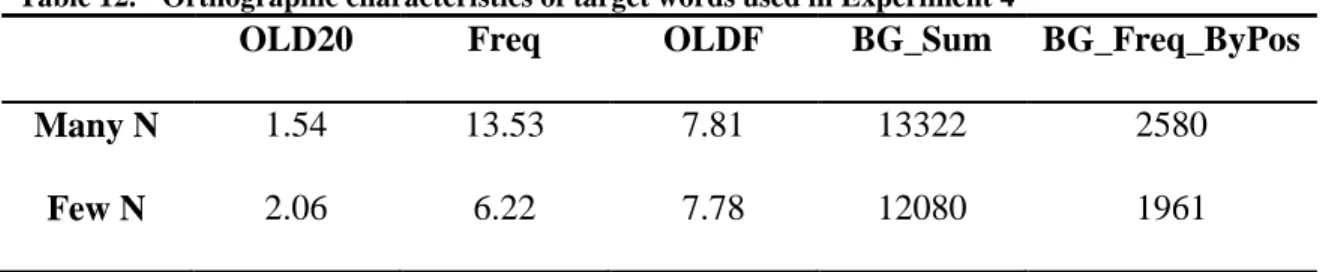
Table 12. Orthographic characteristics of target words used in Experiment 4 .... 56
Table 13. An Example Sentence from Experiment 4 ... 57
Table 14. Means (SDs) on the target word in Experiment 4 ... 62
Introduction
Despite years of study, the question of how different types of contextual information affect the operation of cognitive processes remains intriguing. Word recognition during language comprehension is an excellent domain in which to address this question because words are the critical juncture between abundant sources of word-intrinsic linguistic information (e.g., letters, phonemes, letter-clusters, syllables, word neighbors, and lexical meaning) and word-external information (e.g., context at the syntactic, semantic, or discourse levels) which may jointly or independently affect the process of word recognition. The influence of sentential contexts on word recognition can be investigated by employing a sentence-reading paradigm in which subjects read a sentence with an embedded target word. Measurement of subjects’ reading, using eye-tracking or electrophysiological measures, provides evidence about word recognition during comprehension of extended linguistic material without the need for meta-linguistic judgments such as those employed in lexical-decision or semantic-judgment tasks. Here I report four eye-tracking experiments that address how the linguistic information
2
3
Characteristics of words that influence recognition
Letter clusters. A substantial body of empirical work using methods for studying recognition of isolated words has shown that sublexical components (e.g., frequency of monogram, bigram, or trigram) influence word recognition (Biederman, 1966; Broadbent & Gregory, 1968; Seidenberg, Waters, Barnes, & Tanenhaus, 1984; Waters & Seidenberg, 1985). Also, a number of studies using eye-tracking during reading have shown that orthographic familiarity of the letter clusters affects fixation durations and positions on words (Hyönä, 1995; Lima & Inhoff, 1985; Pynte, Kennedy, & Murray, 1991; Radach, Inhoff, & Heller, 2004; Vonk, Radach, & van Rijn, 2000; White & Liversedge, 2004, 2006a, 2006b). For example, White & Liversedge (2004) showed that the orthographic familiarity of the word’s initial letter cluster affects the fixation position for the word. White (2008) also found the orthographic familiarity of letter clusters influences fixation durations on target words.
4
isolate word-frequency effects from these related factors. For example, Rayner et al. (1996) reported shorter fixation durations and higher skipping rates on high frequency words relative to low frequency words with monogram- and bigram-type frequency controlled.
Word familiarity. One difficulty associated with trying to isolate variables that affect word recognition is that many lexical variables have strong intercorrelations. For example, word frequency is highly correlated with word familiarity, as measured by subjects’ ratings. Juhasz and Rayner (2003) used a multiple regression analysis in an attempt to isolate distinct effects of familiarity and frequency. Effects of word familiarity were found on fixation durations even when word frequency and age of acquisition were controlled (see also Williams & Morris, 2004).
Age of Acquisition (AoA). Age of Acquisition (hereafter AoA) is also highly
correlated with other variables like word frequency, word familiarity, word length, and imageability. Juhasz and Rayner (2003, 2006) tested whether AoA had unique effects on word recognition during sentence reading. Juhasz and Rayner (2006) manipulated AoA while controlling for other confounding variables. They reported a significant AoA effect for first-pass reading time measures, indicating that AoA affects word
recognition during reading over and above various measures of word frequency (e.g. K-F frequency (Kucera and Francis, 1967), The Educator’s Word Frequency Guide (WFG) reflecting cumulative word frequency (Zeno, Ivens, Hillard, & Duvvuri, 1995)).
5
meaning of an ambiguous word), fixation durations are longer for balanced ambiguous words (where the alternative meanings are equally frequent, e.g., break) relative to unambiguous control words, while fixation durations do not differ between unbalanced ambiguous words (where the alternative meanings differ substantially in frequency, e.g., bank), and control words. However, when prior context is biased to the subordinate meaning of the ambiguous word, subjects look longer at the ambiguous word than the control word, which is referred to as the subordinate-bias effect (Pacht & Rayner, 1993; Rayner, Cook, Juhasz, & Frazier, 2006).
6
context in which the preceding context supports both the subordinate and dominant meaning (e.g. “The king with a toothache had a crown made by the best dentist in town) to test which model can better explain the eye-movements data. The reordered access model predicts longer fixation durations on the ambiguous word in the single-meaning context than in the dual-meaning context. In contrast, the integration model predicts no difference for fixation durations in the two context conditions because the dominant meaning was not excluded even in the single-meaning context. The results clearly supported the reordered access model in demonstrating that first-pass fixation durations on ambiguous words were longer in the single-meaning context relative to the dual-meaning context.
Word Neighborhood. A question about whether word recognition is affected by orthographically and/ or phonologically similar words has been one of central aspects in building a word recognition model. Many studies on word recognition have
demonstrated the neighbor words affect recognition of a target word. However, the manner in which the neighbors influence word recognition is relatively complicated and empirical results are not conclusive. In this section, I focus on the role of visually similar words (hereafter referred to as orthographic neighbors) on visual word recognition as it is relevant to the current study.
Orthographic neighbor words can be defined as the set of words that can be created by changing one letter of a word while keeping letter positions constant
7
example, in a lexical decision task, reaction times to words with many neighbor words are faster than those to frequency-matched words with few neighbor words, a
phenomenon known as the neighborhood size effect (Andrews, 1989; 1992). However, the facilitative effect of orthographic neighbors was rarely observed in perceptual
identification tasks or semantic categorization tasks, implying that the effects of orthographic neighbors can be modulated by the specific goals of a given task. Pollatsek, Perea, & Binder (1999) attempted to investigate whether the effects of neighborhood size were observed when a word was embedded in a sentence where no meta-linguistic judgment was needed. When the number of neighbor words was manipulated with the number of higher frequency neighbors controlled, the first-pass fixation duration measures didn’t show any difference between the two neighborhood conditions. However, regression analyses showed that increasing the number of higher-frequency neighbors had a strong inhibitory effect but increasing the number of lower frequency neighbors had a very weak facilitative effect on the target word. Taken together, the facilitative effects of neighborhood size are very fragile and not well understood. The current study attempts to further examine the effects of neighborhood size during sentence reading.
8
frequency effect has been elusive and the pattern of results have been very inconclusive in both isolated word recognition tasks and sentence reading (e.g., facilitative effect in Forster & Shen, 1996; null effect in Sears, Campbell, & Lupker, 2006; inhibitory effect in Perea & Pollatsek, 1998). Sears et al. (2006) concluded “…higher frequency neighbors have little, if any, effect on the identification of English words” (p. 1040). However, a recent study by Slattery (2009) reported that the inhibitory effect of higher frequency neighbors (hereafter HFN) was modulated by the extent to which the HFN was
semantically fitted into the preceding contexts. Specifically, the inhibitory effect of a HFN was observed when the sentential context fit well with both a target word and a HFN but the effect disappeared when the context fit only a target word. Although the inhibitory effects of HFN during normal sentence reading seem to be delicate, a few studies using priming paradigms in which the HFN actually appears earlier in a sentence have shown stronger inhibitory effects of HFN during reading (Nakayama, Sears, & Lupker, 2010; Paterson, Liversedge, & Davis, 2009). For example, Paterson et al. (2009) found that reading times were slower on a target word when one of its neighbors appeared earlier in the sentence, but did not find any influence of that neighbor’s word frequency.
Characteristics of context that influence word recognition
9
& Davis, 1984). Recent studies using eye tracking during readings have also shown that repetition priming can occur when there are intervening words between a prime and a target (Choi & Gordon, in pressa; in pressb; Gordon, Plummer, & Choi, 2013; Ledoux, Gordon, Camblin, & Swaab, 2007; Liversedge, Pickering, Clayes, & Branigan, 2003; Lowder, Choi, & Gordon, in press; Traxler, Foss, Seely, Kaup, & Morris, 2000). For example, Lowder et al. observed a significant repetition priming effect using an intra-sentential priming technique such that the first-pass fixation durations on the target word (Herman in 1a and 1b) were shorter in the repeated word condition as compared to the unrepeated word condition.
(1a) After lunch, Herman and Amanda moved the cabinet so that Herman …(Repetition) (1b) After lunch, Robert and Amanda moved the cabinet so that Herman …(New)
A few studies have examined the locus of the repetition priming effect in an intra-sentential priming paradigm. Traxler et al. (2000) assumed that if the repetition priming effect occurs at a discourse (or semantic) level, the effect would be observed when a synonym prime is used (e.g., minister versus pastor). However, Traxler et al. did not find any difference in the first-pass fixation durations on the target word (e.g., pastor) when they compared the synonym priming condition (e.g., The minister greeted the pastor yesterday at the post office) to the unrelated priming condition (e.g. The lawyer greeted the pastor yesterday at the post office), leading to the conclusion that repetition priming does not occur at a discourse (or semantic) level of representation. Although the synonyms used in Traxler et al.’s study are semantically related, they are two
10
synonym priming effect in Traxler et al. was due to the discourse independency between the prime and the target even though they are synonyms. However, Choi & Gordon (in pressa) compared sentences like 2a and 2b, in which a target word, bar, was primed by either bar (repetition prime) or club (synonym prime). They found the repetition priming effect such that the repetition condition had shorter fixation durations and higher skipping rates as compared to the synonym condition.
(2a) James knew that his friend owned a bar in town, … so his friend’s bar would be closed.
(2b) James knew that his friend owned a club in town, … so his friend’s bar would be closed.
A few studies using a masked priming paradigm have suggested that the repetition priming effect occurs at the sub-lexical orthographic/phonological form level (Holcomb & Grainger, 2006; Perea & Rosa, 2000). As discussed above, the number of neighbors of a word matters in word recognition such that words with many neighbors are processed faster than ones with few neighbors (see Andrews, 1997 for a review). In general, the facilitative effect of neighbors can be interpreted in terms of stronger
activation of letter clusters at the pre-lexical level or faster transition from
orthographic/phonological patterns to whole-word form (Grainger & Holcomb, 2009). Recent ERP studies using an isolated word recognition paradigm have shown that the facilitative effect of neighbors is captured by the N250 component, reflecting the
11
word repetition and neighborhood size. An interaction was found by Perea & Rosa (2000) in Spanish using a masked priming paradigm such that the magnitude of the neighborhood size effect was smaller when words were repeated as compared to when they were unrepeated, indicating that the effect of neighborhood can be modulated by prime and target repetition. However, Perea & Rose and Grainger and colleagues’ studies did not employ an intra-sentential priming paradigm. Further research is needed to establish the exact locus of the effect of repetition priming in an intra-sentential
priming paradigm.
12
fragment and then name a final word of the sentence as quickly as possible. They reported a target preceded by a semantically congruent context was named faster than that by a neutral context. For example, the reaction time for the word bridge was faster in the congruent condition like “The boy swam underneath the bridge” than in the neutral condition, which consisted of three presentations of the word “the” as in “the the the bridge”. Moreover, there was no inhibitory effect for a word (e.g., bridge) preceded by
a semantically incongruent context (e.g., The clothes hung inside the _____) relative to a neutral context, showing that the reaction times didn’t differ between the two conditions. These results suggest that the processing of target words was facilitated by autonomous semantic activation based on the preceding sentential contexts, not by conscious
13
These behavioral studies support the view that semantic congruence in context can pre-activate semantic features of an upcoming target, which can affect processing of the target. Schwaneflugel & LaCount (1988) argued that sentential contexts can pre-activate semantic features of the possible target words based on spreading activation, leading to facilitative effects when the actual target is well-fit into the pre-activated semantic features (see Stanovich & West, 1983 for a similar claim). Moreover, the results imply that the scope of semantic activation by sentential contexts is very specific in a highly constraint context, leading to no facilitation for the unexpected but
semantically related word. This result suggests that either semantic information pre-activated by the sentential context facilitated target processing, or that the set of word(s) itself was pre-activated by the sentential context. If the latter interpretation is correct, then the word in the unrelated condition (e.g., scolding), when it is preceded by the highly constrained context, should have an inhibitory effect relative to the same word preceded by a neutral context. The result of that comparison, however, did not show any inhibitory effects, supporting the interpretation of the pre-activation of semantic components, and not supporting the interpretation of the pre-activation of specific word(s).
However, other researchers have suggested a different role of semantic
congruence in context: ease of semantic integration. This notion argues that sentential context does not predict anything, but creates a more effective integration process (Fodor, 1983; Forster, 1979). For example, early ERP studies have shown that the N400
14
words, as a word is semantically better fitted into the prior context, a smaller N400 is observed. Brown & Hagoort (1993) found a semantic priming effect in the N400 time window such that a smaller N400 was elicited by a related prime and target pair as compared to an unrelated prime and target pair when they used unmasked prime words. But when they used masked prime words they did not observe any difference in the N400 components between the related versus the unrelated pairs, indicating that the N400 effect does not reflect automatic spreading activation, but instead reflects ease of integration of the meaning. Kutas & Hillyard (1984) also found a similar effect in the N400 time window using a sentential context instead of a single word context.
However, more recent ERP studies support a different view of the role of semantic congruence (DeLong, Urbach, Groppe, & Kutas, 2011; DeLong, Urbach, & Kutas, 2005; Kutas, Van Patten, & Kluender, 2006). Contextual information
automatically pre-activates a certain target word based on top-down information, rather than only activating a discourse (or semantic) level of representation. For example, DeLong et al. (2005) utilized a phonological rule of English to examine the
15
larger N400 amplitude was observed in the ‘an’ condition when a word with the article ‘a’ was more expected compared with when a word with the article ‘an’ was more expected based on the previous context. Note that the N400 difference began to appear when the article appeared on the screen, implying that an upcoming word’s phonological features (i.e., whether the onset of the expected word is a vowel or a consonant) was pre-activated on the basis of prior context before the critical word actually appeared. In addition, DeLong et al. (2011) were interested in what kinds of cost would be elicited when activation based on prior context is wrong. Given that readers actively pre-activate a word based on prior context, they should experience a processing cost when an unexpected word follows the context. Supporting this hypothesis, more N400 negativity in an anterior-frontal region was observed when an unexpected word appeared as compared to when an expected one appeared, demonstrating that there is some cost of pre-activation (Federmeier, Wlotko, De Ochoa-Dewald, & Kutas, 2007). Given that one can pre-activate an incoming word based on contextual information, interaction between top-down and bottom-up information should occur when the incoming word is processed.
It is noteworthy to mention that most theoretical accounts of the effect of word predictability and semantic congruence have been developed based on ERP studies in which words are generally presented one after another (Rapid Serial Visual Presentation, RSVP). Although ERP studies have provided valuable information on mechanisms of human sentence processing, the RSVP paradigm may not be an optimal tool for
16
Moreover, participants are not able to use preview from the parafovea, which is where a lot of useful information is extracted during normal reading (Choi & Gordon, in pressa; in pressb; Pollatsek, Lesch, Morris, & Rayner, 1992; Rayner, 1998). Another problem with the RSVP paradigm is its relatively slow presentation rate. In the RSVP paradigm, the stimulus onset asynchrony (SOA) is normally anywhere from 400ms to 700ms, which is much slower than the normal speed of reading. Thus, although ERP studies have shed light on how top-down contextual information affects word recognition, these
results should be interpreted with caution when generalizing to normal reading behavior. The effect of word predictability on word recognition has also been studied in natural reading. Ehrlich and Rayner (1981) first reported the word predictability effect using an eye-tracking paradigm during normal reading. They monitored participants’ eye movements while they read through a short paragraph. The target word could appear either in a high constraint context or in a low constraint one. The results showed that a highly predictable context, compared to a less predictable context, led to more skipping and shorter first-pass fixation durations on the target word. Since Ehrlich and Rayner (1981), many studies have observed similar effects of contextual predictability (Altarriba, Kroll, Sholl, & Rayner, 1996; Binder, Pollatsek, & Rayner, 1999; Frisson, Rayner, & Pickering, 2005; Rayner, Ashby, Pollatsek, & Reichle, 2004; Staub, 2011). Although these studies have consistently observed that sentential context can facilitate the process of word recognition, a specific mechanism remains unclear.
17
contextual information affects word recognition in the ERP literature, there has been relatively little discussion in the eye tracking during reading literature. The current project employs eye tracking during reading to provide a better understanding of this issue.
Contextual effects on word recognition
As discussed above, the current state of word processing is influenced both by word-intrinsic and contextual information. How these two sources of information jointly affect the processing of word recognition during sentence reading is a very important question. In this section, I review some of the empirical studies addressing the issue of the interaction between sentential contexts (e.g., word repetition, sentential constraints) and word-internal factors (e.g., word frequency, orthographic neighborhood.
18
second, followed by a word-nonword decision. The results that Scarborough et al. found contradicted search models of word recognition that assume that lexical entries are organized by word frequency in a stable way that is not easily changed by only a one-time exposure (Becker, 1979; Forster, 1976). Forster & Davis (1984) argued that the frequency-attenuation effect reflects strategic use of episodic memory traces, a strategy that is more advantageous for low-frequency than high-frequency words. In support of this idea, they found no frequency-attenuation effect when they used a masked priming paradigm in which the repeated prime word was presented too briefly for participants to notice. Exactly the same results were observed in French (Segui & Grainger, 1990). Forster and Davis (1984) reasoned that the episodic influence of the frequency
19
the effects of word frequency, which occurs at the level of lexical form. There has been little inquiry into the interaction between repetition priming and other types of word related factors.
Word predictability and word frequency. Word predictability and word frequency are the strongest factors affecting word recognition during reading. As described above, there is no doubt that each affects some aspects of word recognition. However, with respect to the joint effects of predictability and frequency, investigations have not arrived at the same conclusion. Early behavioral reaction-time studies mostly reported
interactions between the two factors (Stanovich & West, 1983; West & Stanovich, 1982). For example, Stanovich and West (1983) examined how the effects of sentential context are modulated by the frequency of target words. They had participants read a sentence fragment (e.g., The skier was buried in the…versus They said that it was the…), followed by a target word (e.g., snow). Participants were asked to perform a word-nonword decision or to name the target word. They found a significant interaction such that the predictability effect was larger for low- versus high-frequency words. Recent ERP studies have also reported an interaction effect between predictability and word
20
condition relative to a high-frequency word condition, which is consistent with the findings of behavioral studies done by Stanovich and West. The observed interaction effect would imply that these two factors jointly influence the same processing stage of word recognition, or suggest, at least, that word recognition should be accomplished by joint cooperation of more than one factor.
In contrast, eye-movement studies of reading have shown additive effects of word predictability and frequency (Altaribba et al., 1996; Ashby, Rayner, & Clifton, 2005; Lavigne, Vitu, & d’Ydewalle, 2000; Rayner, Binder, Ashby, & Pollatsek, 2001; Rayner et al., 2004). For example, Rayner et al. (2004) directly investigated the interaction of word predictability and word frequency. For first-pass reading time measures, they didn’t observe any significant interaction effects, whereas for skipping rates, they did observe a significant interaction effect such that there were higher skipping rates in the high-frequency predictable word condition as compared to in the other three conditions (which were not different from each other). However, the pattern of this interaction effect was different from what would usually be expected. Specifically, while the interaction in behavioral and ERP studies has demonstrated that the effect of predictability is generally larger in the low-frequency word condition than in the high-frequency word condition, the skipping result in Rayner et al. (2004) showed larger effects of predictability in the high-frequency word condition as compared to in the low-frequency one. Ashby et al. (2005), using the same materials as Rayner et al. (2004), did not observe an interaction effect for the first-pass fixation durations, and,
21
modulated by the saccade launch site. In an overall analysis, Hand et al. found no interaction effect for first-pass fixation duration on the target word, but they reported a significant interaction effect in cases in which the saccade into the target was executed from a position near the target (within 3 characters of the target) and from a position moderately close to the target (3-6 characters from the target), indicating that it is crucial to include the launch site information in analyzing fixation durations on target words. However, Slattery, Staub, & Rayner (2012) refuted Hand et al. (2010)’s argument by showing counterevidence that there is no effect of launch site on the predictability by frequency interaction. Slattery et al. (2012) used linear mixed-effects models to
Current study
Four eye-tracking during reading experiments were conducted to examine how contextual information and word-intrinsic linguistic information word recognition during reading. Experiment 1 used cost-benefit reasoning to address whether predictability leads to pre-activation of specific upcoming word(s) during sentence reading. Previous eye-tracking during reading studies have attempted to investigate how constrained
preceding contexts affects word recognition (Ehrlich & Rayner 1981; Frisson et al., 2005; Hand et al., 2010; Rayner & Well, 1996; Rayner, Ashby et al., 2004; Rayner, Slattery, Drieghe, & Liversedge, 2011; Slattery et al., 2012; Staub, 2011). Although these eye-tracking during reading studies consistently support the idea that constraining as compared to neutral contexts facilitate processing of words, there is no clear evidence about whether this facilitation occurs because of prediction of upcoming words.
23
Experiment 1
The question of the extent to which linguistic aspects of an upcoming word can be pre-activated based on sentential context is one of the most important issues in
establishing a better understanding of human language comprehension. As described in the introduction section, one extreme argues that sentential context only provides benefit to integrating a given target word into discourse processing, but the other extreme contends that sentential contexts can rapidly and actively pre-activate semantic
(Fedemeier & Kutas, 1999), phonological (Delong et al., 2005), and orthographic features (Laszlo & Fedemeier, 2009) of an upcoming word based on the preceding context. Whereas early psycholinguistic studies using behavioral and neural methods supported the integration view (e.g., Stanovich & West, 1981; Kutas & Hillyard, 1984), recent ERP studies have been interpreted as supporting the pre-activation view (for a review, see Kutas et al., 2006). This experiment attempted to answer this question by employing an eye-tracking method by which more natural reading processes are reflected as opposed to the RSVP paradigm that has been used in ERP studies. To address this issue, I used unexpected, but plausible target words, preceded by a strongly constrained sentential context (Federmeier et al., 2007; Schwanenflugel & LaCount, 1988).
25
For example, the word camel in sentence 1a is highly predictable based on the preceding context, while the word horse in sentence 1b is a plausible ending, but not strongly predicted. If readers pre-activate the likely upcoming word based on the preceding context before they see the actual word, a processing cost would be generated when they see the word horse (not camel). On the other hand, if readers only activate broad level of semantic features based on the sentential context, or if they only use the “processed” word to integrate into the discourse representation that is currently activated, there should be no processing cost when readers actually see the unexpected, but
plausible word (e.g. horse).
Methods Participants
Thirty two college students at the University of North Carolina at Chapel Hill were tested in the experiment, receiving course credit for their participation. All
participants had normal or corrected-to-normal vision and were native English speakers.
Apparatus
26
between the participant and the display monitor was 61cm; 3.8 characters subtended 1◦ of visual angle.
Materials and Design
six words were used as targets with each embedded in a sentence. Fifty-six sentence frames were generated, half with strongly constraining context and half with unconstraining context. Each sentence frame in the constraining condition was followed by either the most expected target word or an unexpected, but plausible target word. The same target words were also embedded in an unconstraining context, leading to four conditions: (1) expected targets in strongly constraining sentence frames, (2) unexpected plausible targets in strongly constraining sentence frames, (3) the same words as (1) in unconstraining sentence frames, and (4) the same words as (2) in unconstraining sentences frames. Table 1 shows an example sentence set of Experiment 1 (See Appendix 1 for entire sentences).
A cloze-type sentence completion task was implemented to determine the probability of the target words based on the initial sentence fragments. Sixteen native English speakers participated in a task in which they were asked to write the first word that came to mind for each sentence fragment. As expected, the average cloze
27
versus unexpected words. Word frequency was calculated using the SUBTLEX corpus (Brysbaert & New, 2009). Expected words had a mean word frequency of 28.5 counts per million and unexpected words had a mean word frequency of 32.6 per million, t (54) < 1, ns. Orthographic neighborhood size was calculated by Coltheart’ N metric
(Coltheart et al., 1977), and there was no difference in the number of orthographic
neighbor words between expected and unexpected word sets (5.6 versus 6.3, respectively, t (54) < 1, ns).
Procedure
Participants read 56 sentences. On half of the trials a strongly constraining context was presented, whereas on the other half the unconstraining context was
presented. Moreover, for each participant, half of the target words were expected and half were unexpected. As a result of each sentence frame being used only once for each participant, the predictability of the target word in a given sentence frame was
28
Table 1. An Example Sentence from Experiment 1 with each of the Four Conditions Condition Sentence
SC, Expected The humps on the back of the tall camel made it hard to ride, even with a saddle.
SC, Unexpected The humps on the back of the tall horse made it hard to ride, even with a saddle.
UC, Ctrl 1 I was afraid of the tall camel until I went for a slow, bumpy ride on its back. UC, Ctrl 2 I was afraid of the tall horse until I went for a slow, bumpy ride on its back.
Note. The words in bold are the target stimuli. SC = Strongly constraining, UC = Unconstraining, Ctrl 1 = Control for the expected condition, Ctrl 2 = Control for the unexpected condition.
After the initial calibration and validation were completed, participants were asked to read sentences on the monitor naturally. Sentences were presented at the center of the screen in a random order. Eye movements were measured when participants started to fixate the first word of the sentence. A yes-no comprehension question followed each stimulus sentences in order to encourage careful reading.
Results
29
fixations were those after the eyes fixated on a word until they moved off the word, given that they had not progressed beyond that word before the first fixation. Single-fixation duration was the average of the duration of the initial, first-pass fixation on a word given that the word received only one first-pass fixation. First-fixation duration was the average of the duration of the initial, first-pass fixation on a word regardless of whether there were subsequent first-pass fixations on the word. Gaze duration was the average of the sum of all first-pass fixation durations on a word. In addition to the first-pass fixations, two kinds of fixation measures that may reflect late stages of word processing were also considered in the analyses. Regression-path duration (RPD, sometimes called go-past time) was the sum of all fixations beginning with the initial fixation on a region and ending when the gaze is directed away from the region to the right. Total time (TTime) is the sum of all fixations on a word. Two levels of contextual constraint and those of expectancy of target word were analyzed by a two-way analysis of variance (ANOVA). Error variance was calculated by participants (F1) and by items (F2).
30
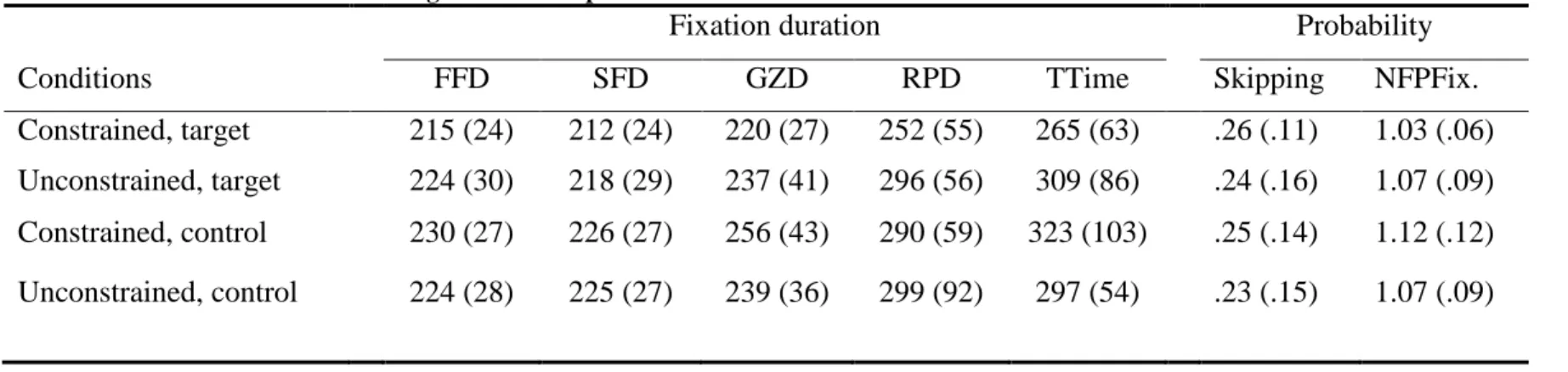
(e.g., horse) was longer in the strongly constraining condition than the unconstraining condition. Contrast analyses were conducted to clarify the source of the crossover interaction between two variables. The contrast analyses confirmed the benefit of the expected target and the cost of the unexpected target in the strongly constraining context and were statistically significant, F(1,31) = 5.19, p < .05 for the benefit; F(1.31) = 4.93, p < .05for the cost. Another interesting result was the number of first-pass fixations (NFPFix). This measure also showed a significant interaction between the sentential constraint and the expectancy of the target in that the expected target had fewer first-pass fixations in the strongly constraining condition as compared to the neutral condition, but the unexpected target had more first-pass fixations in the strongly constraining condition than in the neutral condition.
There were no significant interaction effects on regression-path duration, indicating that the processing cost elicited by the unexpected word in the strongly constraining context was generated by the unexpectedness of the target, not by the difficulty of integrating the meaning of the target into the contextual information. Note that both the unexpected and expected target words in the strongly constraining condition are plausible in the preceding sentential context.
31
the total time reflects the spill-over effect of gaze duration, the rereading time obtained by subtracting gaze duration from total time was analyzed. There was no main effect of sentential contexts, F1(1,31) = 1.21, ns; F2(1,54) = .41, ns. In addition, there was no main effect of expectancy of target, F1(1,31) = .36, ns; F2(1,54) = 1.71, ns. More importantly, there was no interaction effect between the two variables, F1(1,31) = 4.13, p = .051; F2(1,54) = 2.88, p = .096. The follow-up contrast analysis showed that the marginal trend of the interaction effect was solely due to the benefit from the expected word in the strongly constraining condition, not by the cost from the unexpected word in the same context, F(1,31) = 4.2, p < .05; F(1,31) = .63, ns, respectively. Accordingly, the result of rereading time confirmed that the interaction effect on total time was mainly due to the effect of gaze duration since there was no indication of inhibition caused by the unexpected word in the strongly constraining condition on the subsequent analysis of the rereading measure.
Discussion
32
The current results support the view that preceding sentential contexts allow readers to actively pre-activate upcoming words (DeLong et al., 2005; 2011; Federmeier et al., 2007). Recent ERP study by DeLong et al. showed that a smaller N400 amplitude in the central-posterior region of brain was observed when the expected word was
preceded by a strongly constraining context as compared to by an unconstraining context, and, more importantly, they showed a larger N400 amplitude in the frontal region when the unexpected target was preceded by the strongly constraining context as compared to by the unconstraining context. In highly constraining contexts, readers can easily pre-activate the next word, so that the reading time (or the neural activity) on the word is shorter (or smaller) when the next word is actually predicted relative to when it is not predicted. However, when the prediction on the upcoming word by the constraining context was wrong, such that the next word was not the predicted word, readers should have processing cost to inhibit the activation of the predicted word. In Experiment 1, the processing cost from wrong prediction did not continue to later stages of sentence processing because the unexpected word was very plausible in the sentential context even if it was not actually predicted.
33
account in that there was no hint of facilitation of the unexpected word in the
constraining context1. While ease of integration into the sentence meaning undoubtedly affects the processes of word recognition during sentence reading in some instances, this process does not explain the pattern of results obtained for the highly constraining contexts used in the present studies.
1 An alternative explanation would be that the unexpected word is less plausible in the highly constraining
Table 2. Results for the target word in Experiment 1
Fixation duration Probability
Conditions FFD SFD GZD RPD TTime Skipping NFPFix.
Constrained, target 215 (24) 212 (24) 220 (27) 252 (55) 265 (63) .26 (.11) 1.03 (.06) Unconstrained, target 224 (30) 218 (29) 237 (41) 296 (56) 309 (86) .24 (.16) 1.07 (.09) Constrained, control 230 (27) 226 (27) 256 (43) 290 (59) 323 (103) .25 (.14) 1.12 (.12) Unconstrained, control 224 (28) 225 (27) 239 (36) 299 (92) 297 (54) .23 (.15) 1.07 (.09)
Table 3. Inferential statistics from ANOVA on the target word in Experiment 1
Constraint Expectancy of target Interaction
F1 (1,31) F2 (1,54) F1 (1,31) F2 (1,54) F1 (1,31) F2 (1,54)
F MSE p F MSE p F MSE p F MSE p F MSE p F MSE p
FFD .20 561 .654 .30 492 .589 4.67 363 .038 3.74 400 .058 4.15 397 .05 4.84 400 .032
SFD .35 500 .561 .07 535 .798 10.6 338 .003 10.22 319 .002 1.11 517 .3 2.12 319 .151
GZD 0 1095 994 .11 1119 .774 18.2 655 .001 8.25 1006 .006 12.6 724 .001 10.5 1006 .002
RPD 10.0 2275 .003 6.76 4173 .012 3.53 3874 .07 4.28 3100 .043 2.75 3605 .107 2.68 3100 .108
TT .97 2867 .334 .49 3909 .486 8.68 1986 .006 7.53 2698 .008 10.9 3579 .002 10.7 2698 .002
Skip 1.82 .01 .118 .51 .02 .478 .39 .01 .54 .12 .03 .731 .001 .01 .996 .002 .03 .961
NFix .15 .009 .698 .034 .009 .855 8.60 .007 .006 5.26 .007 .026 9.05 .007 .005 9.60 .007 .003
Experiment 2
The results of Experiment 1 showed that the linguistic information elicited by sentential contexts leads to pre-activation of specific words. Given that the contextual information influences the current state of word processing, the important question would be to what extent the sentential context interacts with linguistic characteristics of the current word. However, as described in the introduction, the evidence has been elusive on the interaction between sentential contexts and word-form level factors in eye-tracking during reading studies (e.g., word
frequency) (Rayner et al., 2004; Slattery et al., 2012; cf. Lowder et al., in press)2.
The second experiment examines the interaction of sentential context and word-intrinsic factors by manipulating word repetition and the number of neighbors for the target word. Previous studies have shown that word repetition causes has robust facilitation of word recognition in the intra-sentential repetition-priming paradigm (Choi & Gordon, in pressa; Gordon et al., 2013; Liversedge et al., 2003; Lowder et al., in press; Traxler et al., 2000). In particular, as discussed earlier, Lowder et al. reported that word frequency effects were
significantly modulated by word repetition such that no frequency effect was observed when the
2
In our lab, an eye-tracking during reading study was conducted to examine how the effect of neighborhood size on the process of word recognition is modulated by the degree of sentential constraint. The gaze duration on a target word was shorter in the strongly constraining condition as compared to that in the neutral condition, F1(1,39) =
10.21, p < .005; F2 (1,58) = 9.71, p < .005. However, there was no interaction between effects of the neighborhood
36
target word appeared in an earlier region within the same sentence. Given the interaction between word repetition and word frequency, word repetition may modulate other types of word intrinsic factors such as the effect of the number of orthographic neighbors. As reviewed in the introduction, the number of orthographic neighbors has been extensively studied using a variety of isolated word recognition paradigms which show shorter reaction times for words with many neighbors than for those with few neighbors (See Andrews, 1997 for a review). If the effect of word repetition interacts with orthographic neighborhood size, we would expect that the
neighborhood size effect should be decreased in the repetition condition relative to the unrepeated condition.
Recent research has calculated orthographic neighborhood size using Orthographic Levenstein Distance (hereafter referred to as OLD; Yarkoni, Balota, & Yap, 2008) rather than Coltheart’s N. OLD is defined as the number of insertions, deletions, and substitutions needed to generate one word from another word. For example, the OLD from CAMEL to CAMELS is 1, reflecting one insertion (S), and the OLD from CAMEL to CARAMEL is 2, reflecting two
37 Methods
Participants
Fifty two college students at the University of North Carolina at Chapel Hill were tested in the experiment and received course credit for their participation. All participants had normal or corrected-to-normal vision and were native English speakers.
Apparatus
The apparatus was the same as that used in Experiment 1. Materials and Design
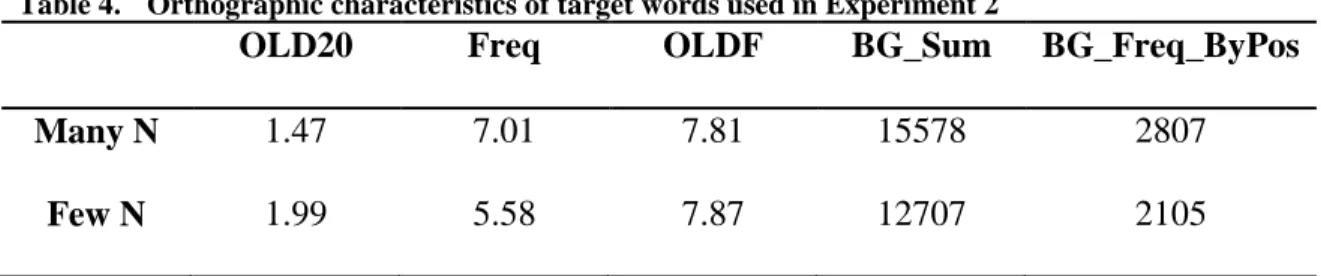
Sixty words were used as targets with each embedded in a sentence. Target words were selected from the CELEX corpus (Baayen, Piepenbrock, & Gulikers, 1995). Thirty target words had many neighbor words (small value of OLD20) and the other thirty words had few neighbor words (large value of OLD20). Table 4 showed orthographic characteristics of target words, which were extracted from the English Lexicon Project website
38
conditions because the word frequency of orthographic neighbors can affect the processes of target words, t (58) < 1, ns (Grainger & Jacobs, 1996; Pollatsek et al., 1999). Two sub-lexical orthographic characteristics were also considered: Summed bigram frequency (BG_Sum) and summed bigram frequency by position (BG_Freq_ByPos). The BG_Sum is the sum of the frequency of each bigram in a specific word. For example, a word DOG has two bigrams, DO and OG. If DO has a frequency of 10 and OG has a frequency of 5, the BG_Sum is 15. The BG_Freq_ByPos is calculated based on bigram frequencies that are sensitive to positions within words. Position-sensitive bigram counts only consider the letter positions where a bigram occurs. For example, the bigram frequency for DO in DOG counts DO bigrams only when they appear in the first two positions of a word. These two measures in the many neighbor condition were slightly greater than those in the few neighbor condition, but they did not differ statistically, t (58) = 1.74; t (58) = 1.70, respectively. In addition, the latencies of a lexical decision task (LDT) for each word were compared between words in the many versus the few neighborhood conditions. The English Lexicon Project website provides mean reaction times of LDT for 40,481 words. The mean latency of words in the many neighbor condition was 640ms, and that in the few neighbor condition was 689ms, t (58) = 3.86, p < .001. This result indicates that a similar pattern of the facilitative neighborhood effect was observed even when the metric of the orthographic neighborhood was chosen by the OLD20, not by the Coltheart’s N.
Table 4. Orthographic characteristics of target words used in Experiment 2
OLD20 Freq OLDF BG_Sum BG_Freq_ByPos
Many N 1.47 7.01 7.81 15578 2807
39
Two repetition conditions were employed for target words. Prime words were located early in the stimulus sentence, but were not the first or second word. The discourse contexts in the two conditions were similar even if the prime words in the new condition and those in the repeated condition were different. Table 5 shows an example sentence set of Experiment 2 (See Appendix 2 for entire sentences).
Participants read all 60 sentences, but on half of the trials a repeated target word was presented for a given sentence, whereas on the other half an unrepeated target word was presented. Moreover, for each participant, half of the target words had many orthographic neighbors and other half had few orthographic neighbors. Because each sentence frame was only used once for each participant, the repetition of the target word in a given sentence frame was counterbalanced across participants. The sentences were presented in a different random order to each participant.
Table 5. An Example Sentence From Experiment 2 with Each of the Four Conditions Condition Sentence
Rept, ManyN We always spice our pasta with basil rather than spice it with oregano.
New, ManyN We always flavor our pasta with basil rather than spice it with oregano.
Rept, FewN I wore my mom's scarf because I couldn't find the scarf I normally wear.
New, FewN I wore my mom's shawl because I couldn't find the scarf I normally wear.
40 Procedure
The procedure was the same as that followed in Experiment 1.
Results
Analysis of eye movements. All restrictions that were applied to the analysis of the Experiment 1 were also considered in Experiment 2. For the final analysis 5.9% of data points were excluded by these restrictions. Four participants were excluded in the final data analysis because they had severe trouble with calibration. First-pass and late reading-time measures were the same as in Experiment 1. The two levels of word repetition and orthographic
neighborhood were analyzed by a two-way analysis of variance (ANOVA). Error variance was calculated by participants (F1) and by items (F2).
41
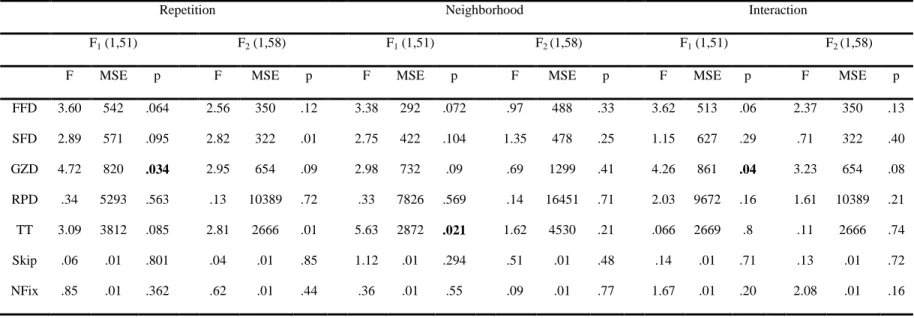
neighborhood conditions. This pattern of interaction was also observed in first fixation duration, but the effects were only marginally significant. Although the interaction effect was not in the expected direction, this effect is evidence that word repetition modulates the effect of neighborhood size.
Discussion
The most interesting result of Experiment 2 was the interaction between word repetition and orthographic neighborhood size. However, the pattern of interaction was not what had been expected. As described earlier, I assumed that if a word had many neighbors, reading times would be shorter as has been shown in isolated word recognition studies, and accordingly, the neighborhood size effect would be decreased in the repetition condition relative to the unrepeated condition. However, the actual results showed that neighborhood size had a null effect in the unrepeated condition and a facilitative effect in the repetition condition. One possible explanation for the results is that the effect of orthographic neighborhood size during sentence reading is very elusive. Unlike in results obtained by isolated word recognition paradigms, orthographic neighborhood size may not be effective in influencing lexical access during sentence reading. But in the specific case of intra-sentential priming in which a target word has already been accessed immediately before, orthographic neighbors of the pre-accessed word could help with recognizing it. For example, in a sentence like “We always spice our pasta with basil rather than spice it with oregano”, the word spice was primed earlier in the sentence, and when readers saw the target word, spice, its orthographic neighbor words such as spices, slice, peace, and spite might have helped the process of word recognition. This
42
the current word in the opposite direction (Lowder et al., in press; Stanovich & West, 1983) in that any word-intrinsic effect such as word frequency in neutral sentential contexts tends to be decreased when biased sentential contexts are given. Another possible explanation for this result involves assigning a different (opposite) role to orthographic neighbor words in the process of word recognition: they may actually inhibit target word processing rather than facilitate it. In normal reading, readers should rapidly and correctly recognize the right word to comprehend the meaning of a sentence. In the above example, the word, spice, has many orthographic neighbors, all of which may be candidates for identification. It has been claimed that readers have to inhibit activation of other candidates during reading, and that the amount of inhibition might be greater as the number of orthographic neighbor words increases. But in a priming situation in which a target word was primed in an earlier region, readers do not have to inhibit candidates because they can easily access the target word. In this case, orthographic neighbor words can aid recognition of the target, rather than inhibit it. However, this account is not supported by the current results as there was no inhibitory effect of orthographic neighbor words in the unrepeated condition. If this account were correct, inhibitory effects of neighbor words should have been observed in this experiment.
With regards to specifying the fundamental role of orthographic neighbors during sentence reading, the current experiment has one critical drawback. Words from two neighborhood conditions (many vs. few) were presented in different sentential contexts, with variation occurring in the number of letters of the preceding word, frequency of the preceding word, and meaning of the sentential context. For example, slice (a word with many neighbors) versus scarf (a word with few neighbors) is not only different in terms of the number of
43
Table 6. Means (SDs) on the target word in Experiment 2
Fixation duration Probability
Conditions FFD SFD GZD RPD TTime Skipping NFPFix.
Rept, ManyN 212 (27) 207 (28) 231 (38) 318 (105) 308 (67) .22 (.13) 1.11 (.13) New, ManyN 224 (34) 216 (33) 248 (42) 343 (135) 324 (79) .21 (.16) 1.13 (.11) Rept, FewN 222 (32) 216 (31) 246 (42) 330 (107) 327 (89) .20 (.13) 1.13 (.12) New, FewN 222 (32) 217 (33) 246 (38) 317 (97) 340 (81) .20 (.13) 1.13 (.11)
Table 7. Inferential statistics from ANOVA on the target word in Experiment 2
Repetition Neighborhood Interaction
F1 (1,51) F2 (1,58) F1 (1,51) F2 (1,58) F1 (1,51) F2 (1,58)
F MSE p F MSE p F MSE p F MSE p F MSE p F MSE p
FFD 3.60 542 .064 2.56 350 .12 3.38 292 .072 .97 488 .33 3.62 513 .06 2.37 350 .13
SFD 2.89 571 .095 2.82 322 .01 2.75 422 .104 1.35 478 .25 1.15 627 .29 .71 322 .40
GZD 4.72 820 .034 2.95 654 .09 2.98 732 .09 .69 1299 .41 4.26 861 .04 3.23 654 .08
RPD .34 5293 .563 .13 10389 .72 .33 7826 .569 .14 16451 .71 2.03 9672 .16 1.61 10389 .21
TT 3.09 3812 .085 2.81 2666 .01 5.63 2872 .021 1.62 4530 .21 .066 2669 .8 .11 2666 .74
Skip .06 .01 .801 .04 .01 .85 1.12 .01 .294 .51 .01 .48 .14 .01 .71 .13 .01 .72
NFix .85 .01 .362 .62 .01 .44 .36 .01 .55 .09 .01 .77 1.67 .01 .20 2.08 .01 .16
Experiment 3
46
The second explanation of the facilitative neighborhood effect is the multiple read-out model (hereafter, MROM) proposed by Grainger and Jacobs (1996). In the MROM, word recognition can be influenced by three different decision criteria: local lexical activity (M component), global lexical activity (Σ component), and time limitation (T component). The local lexical activity reflects lexical access for a specific word, while the other two components can be shaped by task-specific goals. Accordingly, in a lexical decision task, these three components can be dramatically changed by the
characteristics of the nonwords that are used in the task or by the instructions given to participants. For example, the facilitative neighborhood effect was larger when the nonwords in the task were very word-like (e.g., when they were pseudohomophones) as compared to when the nonwords were not word-like (e.g., when they were random consonant strings). Grainger and Jacobs argued that the facilitative effect of the number of neighbors in a lexical decision task was dependent upon how the task (e.g., composition of stimuli over trials) caused readers to adjust the threshold of the Σ component. Therefore, according to the MROM, the facilitative neighborhood effect should be eliminated in tasks such as identification of briefly presented words rather than judgment of lexical status (Snodgrass & Minzer, 1993). The fundamental difference with regard to the neighborhood size effect between the IAM and the MROM is whether the effect is driven by the mechanism of lexical selection in the mental lexicon or by the global lexical activities that are strongly shaped by task-specific goals.
47
sentence reading does not require a secondary task and therefore provides evidence about how neighbor words affect lexical access under more natural task conditions.
Experiment 2 did not show a main effect of the number of neighbor words on first-pass reading time, but words with many neighbors and those with few neighbors were
presented in different sentential contexts. In the current experiment, each target word (a word with many neighbor words versus a word with few neighbors) was preceded by the exact same sentence context thereby minimizing variability in reading time due to differences in preceding contexts. If the facilitative effect of neighborhood size occurs based on the letter-to-word facilitation by neighbor words, as proposed by the IAM, then the facilitative effect should be also observed in a sentence reading experiment.
Alternatively, if the neighborhood effect occurs due to the strategy of increasing global lexical activation in a lexical decision task as suggested by the MROM, the facilitative effect would not appear because global lexical activation is not relevant in any obvious way to word recognition during sentence reading.
Additionally, as described earlier, using Levenshtein distance (OLD20) instead of Coltheart’ N allows examination of neighborhood effects in longer words. Because use of OLD20 in studies of neighbor size is relatively recent, most studies have used very short words (4 or 5 letters) for which Coltheart’ N provides a reasonable metric;
48
is also true for neighborhood size effects in normal reading. In addition, the use of seven letter words should reduce the rate at which words are skipped and therefore provide a better measure of neighborhood effects on first-pass reading time measures such as gaze duration.
Methods Participants
Forty college students at the University of North Carolina at Chapel Hill were tested in the experiment and received course credit for their participation. All participants had normal or corrected-to-normal vision and were native English speakers.
Apparatus
The apparatus was the same as that used in previous experiments. Materials and Design
49
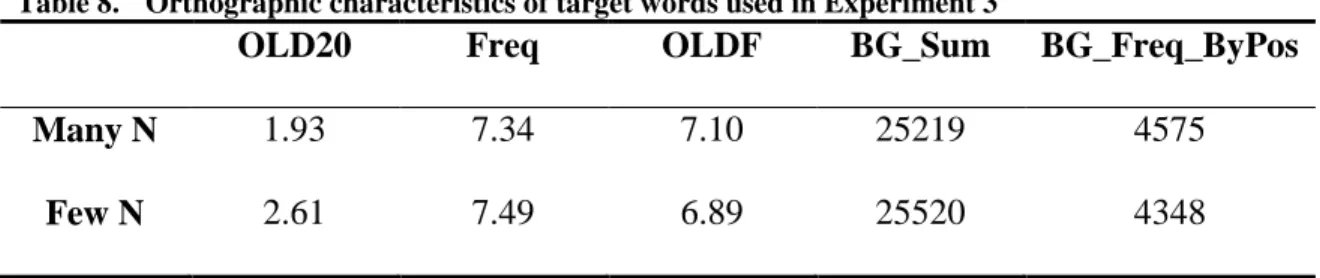
neighbors can affect the processes of target words, t (58) < 1, ns (Grainger & Jacobs, 1996; Pollatsek et al., 1999). Two sub-lexical orthographic characteristics were also considered: Summed bigram frequency (BG_Sum) and summed bigram frequency by position (BG_Freq_ByPos). These two measures were not statistically different between the two neighborhood-size conditions, ts (58) < 1, ns. As in Experiment 2, reaction times of LDT were compared between the two neighborhood conditions. The results showed the facilitative trend of neighborhood size such that words with many neighbor words had shorter reaction times as compared to words with few neighbor words (674ms vs. 697ms, t (58) = 1.31, p = .19).
A pair of words (one with many neighbors versus one with few neighbors) was embedded in the exact same sentential context (See an example in Table 9).
Participants read 30 sentences in which half of the target words were words with many neighbors and half were words with few neighbors. As a result of each sentence frame being used only once for each participant, the number of neighbors for the target word in a given sentence frame was counterbalanced across participants. The sentences were presented in a different random order to each participant.
Table 8. Orthographic characteristics of target words used in Experiment 3
OLD20 Freq OLDF BG_Sum BG_Freq_ByPos
Many N 1.93 7.34 7.10 25219 4575
50 Table 9. An Example Sentence From Experiment 3 Condition Sentence
Many N The ancient text mentioned a drought that affected the villagers' lives. Few N The ancient text mentioned a prophet that affected the villagers' lives. Note. The words in bold are target stimuli. Many N = many orthographic neighbors, Few N = few orthographic neighbors.
Procedure
The procedure was the same as that followed in the previous experiments.
Results
Analysis of eye movements. All restrictions that were applied to the analysis of the previous experiments were also considered in Experiment 3. For the final analysis, 6.05% of data points were excluded by these restrictions. First-pass and late reading-time measures were the same as in the previous experiments. The two levels of orthographic neighborhood size were analyzed by a one-way analysis of variance (ANOVA). Error variance was calculated by participants (F1) and by items (F2).
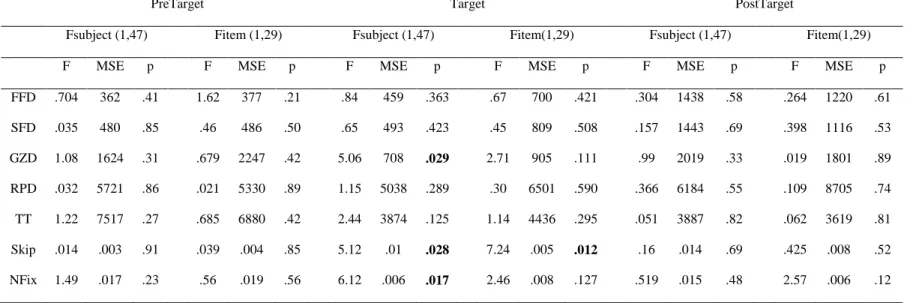
Dependent measures on pretarget words. Table 10 shows the means and standard deviations of all the dependent measures on the pretarget words, and Table 11 shows the inferential statistics on each dependent measure for each variable. As can be seen in Tables 10 and 11, there was no difference between the many and few
neighborhood conditions in any dependent measures for the pre-target word.
51
neighborhood size was observed such that gaze duration was longer for words in the many neighborhood condition than in the few neighborhood condition. Skipping rates did not differ between the two neighborhood-size conditions.
Dependent measures on posttarget words. Table 10 shows the means and standard deviations of all the dependent measures on the posttarget words, and Table 11 shows the inferential statistics on each dependent measure for each variable. As can be seen in Tables 10 and 11, the main effect of neighborhood size was also significant in subject analyses of the first-pass reading time measures on the posttarget region, but was not significant in the item analyses.
Discussion
The result of this experiment showed that words with many neighbor words are likely to be fixated longer than words with few neighbor words.
The inhibitory effect of neighborhood size is consistent with the idea from the MROM model (Grainger & Jacobs, 1996) that word recognition tasks assess the target word on multiple dimensions that are influenced by the specifics of the task. According to the MROM, the facilitative effect of neighborhood size in the lexical-decision task occurs because words with many neighbors cause a high level of lexical activation (the importance of which may be moderated by additional task factors). Global lexical activation is unlikely to be useful during sentence reading where the reader is most likely attempting to recognize the specific words in the text. In the present study, words with many neighbors showed elevated reading times as compared to words with few
52
Table 10. Means (SDs) on the target word in Experiment 3
Fixation duration Probability
Region Conditions FFD SFD GZD RPD TTime Skipping NFPFix.
Pre Target
Many N 229 (39) 216 (35) 251 (58) 310 (94) 365 (109) .36 (.13) 1.13 (.13) Few N 232 (46) 225 (36) 259 (59) 308 (87) 370 (104) .36 (.15) 1.15 (.16) Target Many N 228 (26) 221 (24) 278 (53) 347 (80) 408 (100) .093 (.09) 1.24 (.19) Few N 225 (27) 215 (28) 260 (39) 326 (79) 392 (71) .096 (.09) 1.18 (.16) Post
Target
Many N 246 (38) 240 (38) 280 (59) 407 (161) 353 (88) .44 (.20) 1.17 (.17) Few N 223 (41) 220 (43) 251 (54) 336 (107) 328 (89) .47 (.14) 1.15 (.16)
Table 11. Inferential statistics from ANOVA on the target word in Experiment 3
PreTarget Target PostTarget
F1 (1,39) F2 (1,29) F1 (1,39) F2 (1,29) F1 (1,39) F2 (1,29)
F MSE p F MSE p F MSE p F MSE p F MSE p F MSE p
FFD .135 1364 .72 .341 913 .56 .296 550 .589 .379 443 .543 8.43 1173 .006 .937 1982 .341
SFD 1.81 820 .19 .001 751 .97 1.81 378 .187 1.11 514 .3 6.97 1218 .012 .640 1949 .430
GZD .518 2100 .48 .005 1420 .94 6.13 1161 .018 4.34 1313 .046 9.13 1774 .004 1.71 2413 .201
RPD .028 4552 .87 .04 5264 .84 2.81 2953 .102 1.34 4130 .257 6.89 14507 .012 4.03 16983 .054
TT .069 7039 .8 .057 3113 .81 1.64 3263 .208 .249 10434 .622 2.6 4746 .115 .213 3327 .648
Skip .058 .015 .81 .051 .013 .82 .062 .004 .805 .014 .006 .905 1.14 .014 .293 1.69 .007 .204
NFix .638 .019 .43 .397 .015 .53 6.14 .011 .018 3.3 .016 .08 .391 .019 .536 .695 .011 .411
Experiment 4
The purpose of Experiment 4 was to assess the generality of the surprising results found in Experiment 3. It followed the design of that experiment but used target words with five letters rather than seven. If the inhibition from many neighbor words in
55
observed in the many neighborhood condition relative to in the few neighborhood condition.
Methods Participants
Forty-eight college students at the University of North Carolina at Chapel Hill were tested in the experiment and received course credit for their participation. All
participants had normal or corrected-to-normal vision and were native English speakers. Apparatus
The apparatus was the same as that used in previous experiments. Materials and Design
56
frequency (BG_Sum) and summed bigram frequency by position (BG_Freq_ByPos). These two measures in the many neighbor condition were slightly greater than those in the few neighbor condition. The BG_Sum did not differ statistically, t (58) = 1.24, ns, but the BG_Freq_ByPos was greater in the many neighbor condition relative to the few neighbor condition, t (58) = 2.97, p < .01. As in previous experiments, reaction times of LDT were compared between the two neighborhood size conditions. The results showed a statistically significant facilitative effect of neighborhood size such that words with many neighbor words had shorter reaction times as compared to words with few neighbor words (623ms vs. 696ms, t (58) = 4.58, p < .001).
A pair of words (one with many neighbors versus one with few neighbors) was embedded in the exact same sentential context (See an example in Table 13).
Participants read 30 sentences in which half of the target words were many neighbor words and half were few neighbor words. As a result of each sentence frame being used only once for each participant, the predictability of the target word in a given sentence frame was counterbalanced across participants. The sentences were presented in a different random order to each participant.
Table 12. Orthographic characteristics of target words used in Experiment 4
OLD20 Freq OLDF BG_Sum BG_Freq_ByPos
Many N 1.54 13.53 7.81 13322 2580
57 Table 13. An Example Sentence From Experiment 4 Condition Sentence
Many N Kim's favorite toy is the wooden crown her grandfather gave her. Few N Kim's favorite toy is the wooden easel her grandfather gave her. Note. The words in bold are target stimuli. Many N = many orthographic neighbors, Few N = few orthographic neighbors.
Procedure
The procedure was the same as that followed in previous experiments.
Results
Analysis of eye movements. All restrictions that were applied to the analysis of Experiment 1 were also considered in Experiment 4. For the final analysis, 6.3% of data points were excluded by these restrictions. First-pass and late reading-time measures were the same as in Experiment 1. The two levels of orthographic neighborhood size were analyzed by a one-way analysis of variance (ANOVA). Error variance was calculated by participants (F1) and by items (F2).
Dependent measures on pretarget words. Table 14 shows the means and standard deviations of all the dependent measures on the pretarget words, and Table 15 shows the inferential statistics on each dependent measure for each variable. As can be seen in Tables 14 and 15, no dependent measure showed a significant difference between the many and the few neighbor conditions.