SOLUTIOIM SLOTS OR ICE-WEDGE CASTS? j
VANDENBERGHE-CONTENTS page
ABSTRACT 36INTRODUCTION 36
DESCRIPTION OF THE DEFORMATION STRUCTURES IN THE TOP
OF THE CABERG TERRACE AT MAASTRICHT-BELVÈDÈRE 36
ICE-WEDGE CAST AT NAGELBEEK (Southern Limburg) 36
COMPARISON OF THE SUBSIDENCE FEATURES AT BELVÉDÈRE
WITH ICE-WEDGE CASTS 38
CONCLUSIONS 38
ACKNOWLEDGEMENTS 39
REFERENCES 39
Institute of Earth Sciences Free University Amsterdam, De Boelelaan 1085,
ABSTRACT
Several types of wedge-shaped and graben-like deformations in loams and terrace deposits at Maastricht-Belvédère show some striking similarities with ice-wedge casts. Normal faulting, vertically dressed pebbles and infilling by flow and downfall are
characte-ristic. Comparison with a typical ice-wedge cast from the same re-gion stresses the absence of a vertically laminated central part in thedeformation structuresat Maastricht-Belvédère. It isconcluded that wedge-shaped and graben-like features at Belvédère are cau-sed by slot solution in the underlying chalk subsoil.
INTRODUCTION
Wedge-like downsinking structures are striking featu-res on top of and in the Caberg terrace at Maastricht-Belvédère. They are piercing the terrace deposits and are filled with overlying loams. Their general form re-sembles ice-wedge casts. On the other hand circular hollows are frequently observed in the top of the ter-race gravels and in the underlying coarse-grained Pa-laeocene chalk. The Jatter rock is very appropriate for dissolution and a karstic origin for the circular hol-lows is obvious. The interpretation of the deformation structures is important for the characterisation of the palaeoenvironment. In order to check the hypothesis of the deformations at Maastricht-Belvédère to be ice-wedge casts a comparison is made with typical ice-wedge casts formed in loess outside the chalk area.
DESCRIPTION OF THE DEFORMATION
STRUCTURES IN THE TOP OF THE
CABERG TERRACE AT
MAASTRICHT-BELVÉDÈRE
Small graben-like or wedge-like forms occur frequent-ly in the Belvédère pit at Maastricht. Their width va-ries from a few decimeters to several meters. The top of the disturbances is situated within the 'Loams' (Unit 5; see Vandenberghe et al., 1985). The deforma-tion structures pierce through the 'loams' and fluvial sands (Unit 4) down into the terrace gravels (Unit 3). Whether they penetrate the underlying subsoil as well could not be observed.
In order to investigate the characteristics of the concerned structures three examples are described in detail.
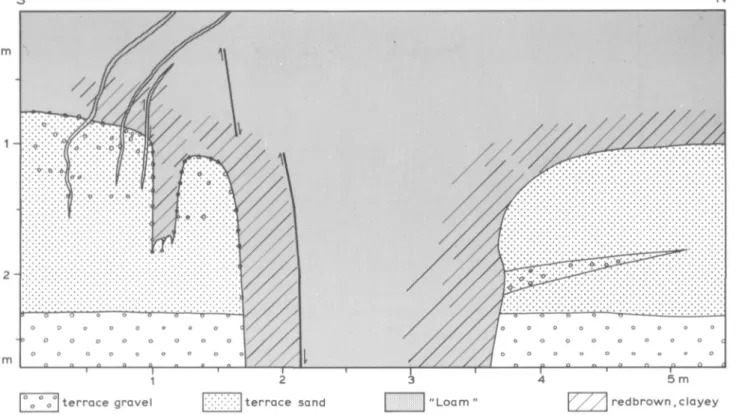
In a first form (fig. 1) the wedge is sharply limited at the boundary with the surrounding fluvial sands. This limit is continuous and shows no interruptions by faulting. The wedge is filled with 'loams' which gra-dually and regularly have sunk downward. Movement is sometimes accompanied by downfaulting. The central part of the wedge consists of the uppermost part of disturbed sediments, in this case material deri-ved from the B2t-horizon of the Rocourt-soil. The ex-terior part of the wedge is composed of dark-brown, clay-enriched 'loams' normally occurring below the Rocourt-soil. A smaller 'adventive' wedge also shows sharp boundaries and the same type of small normal fault at its Southern edge marks the limit of the global sinking structure. The small edge may be explained as a tensional crack accompanying extension faulting. The upper part of frost fissures, which are posterior to the Rocourt-soil, have been moved towards the
centre of the depression.
A second type of perturbation is a graben structure with similar characteristics but formed entirely in the terrace gravels (fig. 2). lts large width is caused by a series of extension faults. Although a step-like struc-ture is obvious, the layering is almost continuous along the fault planes as well as in the centre of the structure.
A third kind of deformation is also formed within the terrace gravels. It shows vertical dressed stones at the edges (fig. 3). The vertical layering is due to infil-ling of the fissures along the fault planes. In the cen-tral part, however the orientation of the pebbles is random due to flow from the sides or horizontally di-rected due to vertical subsidence of cohesive blocks of the gravel unit.
Although apparently variable, the three kinds of perturbations show a few common characteristics. The central subsided part shows a complete absence of vertical lamination. lts original layering is conserva-ted in the case of soil fall while homogenisation is due to processes of flow into a relatively wide depression. Secondly, the sides of the wedge are sharply limited by uninterrupted boundaries.
ICE-WEDGE CAST AT NAGELBEEK
(Southern Limburg)
A nearby outcrop in thick loess deposits (Vreeken & Mijcher 1981) allows the comparison with wedge forms of clearly periglacial origin. Within the Upper Silt Loams corresponding to Unit 7, ice-wedge casts are formed (Meijs et al. 1983). One of them is repre-sented in fig. 4. lts upper part consists of a downward directed involution of more than 0.80 m (the original top was no more visible). The internal section of the lower part is composed of vertically laminated Upper Silt Loams. They are penetrating into the Middie Silt Loams (Unit 6) which are fractured by a series of ex-tension faults. This zone of fracturing forms the exte-rior section of the lower part of the wedge. The depth of the lower part is about 2 m. The described subdivi-sion in different parts and their respective structures are typical for ice-wedge casts (Vandenberghe, 1983a). Especially the vertical lamination in the centre of the lower part is a characteristic feature. It origina-tes from the infilling by muddy sediments between the ice core and the wedge sides.
5 m redbrown, clayey
Fig. 1. Wedge-shaped structure within the 'loams' and terrace deposits (westside of the Belvédère-pit; top of the section is at ca 55 m + NAP).
and the Kesselt soil B (Gullentops in Haesaerts et al., 1981; Gullentops, 1981) which is an equivalent of the Nagelbeek horizon, the ice wedge has been formed slightly after 21.000 yr B.P. The ice wedges at Nagel-beek correspond to the widely occurring level of ice wedges which have developed at that time (Vanden-berghe, 1983b).
ca 1,20r
Fig. 3. Pocket-shaped downsunk structure within the terrace gra-vels of the Caberg terrace (Belvédère-pit).
— - EItville tuff layer
grey Silt Loam
yellow-brown Silt Loam
Fig. 4. Weichselian Upper Pleniglacial ice-wedge cast at Nagel-beek. I = Middie Silt Loam, II = Nagelbeek Horizon, III = Up-per Silt Loam. The O m level is at ca 117 m + NAP; for situation
see: Meijs et al. 1983.
COMPARISON OF THE SUBSIDENCE
FEATURES AT BELVÉDÈRE WITH
ICE-WEDGE CASTS
The deformation structures at Belvédère show some striking differences with ice-wedge casts:
a. The typical bipartition of the lower part of ice-wedge casts in a central and an exterior zone has never been found in the Belvédère subsidence fea-tures. The latter are characterized by sharp boun-daries while locally present faults occur both near the edges and in the central part of the deforma-ion. In the ice-wedge casts, however, faulting is li-mited to the outer part. This results in transitional boundaries as is well illustrated at Nagelbeek (fig. 4).
b. The vertical lamination in the central lower part of ice-wedge casts is not always distinctly expressed in loess deposits. However, it is completely absent in the deformations at Belvédère. There the only vertical layering is present along the steeply faulted boundaries of some of these structures (fig. 3). Generally, the main part of the infilling is homoge-nized by slumping into the wedge-shaped ope-nings. In other cases the total downsinking is ef-fectuated by multiple faulting without any vertical layering in the centre of subsidence. Consequently the complete deformation (and not only the exteri-or part) takes the fexteri-orm of a graben.
Thus the subsidence features at Belvédère are filled by graben-like blockfaulting or by downslumping. The presence of tensional structures can easily be ex-plained by any subsidence. They may show some si-milarity with ice-wedge casts (Black, 1983). Most re-markable is the complete absence of a central vertical layering which is, in the ice-wedge casts, caused by gradual melting of the ice cover accompanied by si-multaneous infilling from the sides. The infilling by vertical fall as well as by flow from the sides obviously occurred in a short time over the total width of the ca-vity. Moreover, the deformations at Belvédère show a considerable heterogeneity of forms and of filling sediments. Finally they are unequally distributed over the area in contradiction with regularly developed ice-wedge polygons.
It may thus be concluded that the wedge forms on the Caberg terrace at Belvédère are no ice-wedge casts. By analogy to the circular hollows, which clear-ly have a karstic origin, the observed longitudinal wedge forms may be caused by solution of CaCOa along joints in the Palaeocene chalk. The observed karstic features are formed at several times between the end of the terrace formation and the formation of the Nagelbeek-horizon. Besides, favorable conditions for karstic processes were only present after lowering of the water table, it means from the incision of the Maas in the terrace gravels onwards.
CONCLUSIONS
some similarity with ice-wedge casts. Their internal structure, however, points to tensional cracking and filling by inflow from the sides. The characteristic ver-tical laminition of the lower central part of ice-wedge casts is completely absent in the deformations at Bel-védère. Therefore the latter forms are interpreted as subsidence phenomena caused by slot solution of the joints in the chalk subsoil ('grikes'). The solution slots developed at different times during the deposition of the terrace sediments and overlying 'loams' up to the formation of the Nagelbeek horizon.
ACKNOWLEDGEMENTS
The author is grateful to Mr. W. M. Felder and Mr. H. Mücher for critically reading the manuscript, Messrs. H. Sion and C. van der Bliek took care of the drawings and photographic work.
REFERENCES
BLACK, R., 1983: Pseudo-ice-wedge casts of Connecticut, NE Uni-ted States. - Quaternary Research 20, 74-89.
GuLLENTOPS, F., 1981: About the climate of the last glaciation in NW-Europe. — Symp. Quaternary Climatic Variations In a Milan-kovitch Perspective, Louvain.
HAESAERTS, P., E. JUVIGNÈ, O. S, KUYL, H . J . MÜCHER & W.
ROE-BROEKS, 1981: Compte rendu de l'excursion du 13 juin 1981, en Hesbaye et au Limbourg Néerlandais, consacrée a la chronostra-tigraphie des loess du pleistocéne supérieur. - Annales Soc. Géol. Belg. 104, 223-240.
M E I J S , E,, H . J . MÜCHER, G . OUWERKERK, A . ROMEIN & H.
STOLTEN-BERG, 1983: Evidence of the presence of the EItville tuff Layer in Dutch and Belgian Limbourg and the consequences for the loess stratigraphy. - Eiszeitalter u. Gegenwart 33, 59-78.
SEMMEL, A . , 1967: Neue Fundstellen von vulkanischem Material in hessischen Lossen. - Nollzbl. hess. L.-Amt Bodenforsch, 95, 104-108.
VANDENBERGHE, J . 1983a: Ice-wedge casts and involutions as per-mafrost indicators and their stratigraphical position in the Weich-selian. — Proceedings of the fourth International Conference on Permafrost, Fairbanks, Alaska. Nat. Acad. Press, Washington D.C., 1298-1302.
VANDENBERGHE, J . , 1983b: Some periglacial phenomena and their stratigraphical position in Weichselian deposits in the Nether-lands. - Polarforschung 53, 97-107.
VANDENBERGHE, W . J . , H . J . MÜCHER, W . ROEBROEKS & D. GEMKE,
1985: Lithostratigraphy and palaeoenvironment of the Pleis-tocéne deposits at Maastricht-Belvédère, Southern Limburg, the Netherlands, Meded. Rijks Geol. Dienst, 39, 1, 7-18. VREEKEN, W . J . & H. J . MÜCHER, 1981: (Re)Deposition of loess in
Southern Limburg, The Netherlands. I. Field evidence for condi-tions of deposition of the Lower Silt Loam complex. — Earth Surface Processes and Landforms 6, 337-354.