CHOOSING TO LEARN: EXPLORING WHITE TEACHERS’ PATHS OF CRITICAL CONSCIOUSNESS DEVELOPMENT
Kelly J. Barber-Lester
A dissertation submitted to the faculty of the University of North Carolina at Chapel Hill in partial fulfillment of the requirements for the degree of Doctor of Philosophy in the School of
Education (Learning Sciences and Psychological Studies).
Chapel Hill 2019
Approved by:
Eileen C. Parsons
Janice L. Anderson
Brian Gibbs
J. Montana Cain
ABSTRACT
Kelly J. Barber-Lester: Choosing to Learn: Exploring White Teachers’ Paths of Critical Consciousness Development
(Under the direction of Eileen C. Parsons)
Freire once wrote, “Education either functions as an instrument which is used to facilitate
integration of the younger generation into the logic of the present system and bring about
conformity or it becomes the practice of freedom, the means by which men and women deal
critically and creatively with reality and discover how to participate in the transformation of
their world” (Freire, 2005, p.34). This dissertation argues that the aim of education should be
the latter, and that in order to achieve that aim, we must employ a teaching force of critically
conscious educators. Owing to the fact that approximately 80% of our current teaching force
is White, and thereby occupy a dominant racial positionality within U.S. society, this study
aimed to explore White teachers’ paths of critical consciousness development over their life
courses. This study is grounded in Culturally Relevant Pedagogy (Ladson-Billings, 2009) as
a conceptual framework, with particular attention to the construct and process of critical
consciousness (Freire, 2005). Utilizing a qualitative descriptive design with a life history
approach, three White teachers were purposively selected based on evidence of critically
conscious thinking about education for deep case study. Each teacher participated in ten to
fifteen hours of life-history interviews, utilizing a timeline-construction elicitation device. A
cross-case thematic analysis resulted in five major themes: Motivators, Context, Influencers,
critical consciousness based on specific sources of motivation (Motivators). Throughout their
paths, both broad contextual factors and localized environments (Context) played important
roles in both supporting and undermining critical consciousness development. Specific
people (Influencers) along their paths influenced critical consciousness development through
their roles as More Radical Others. Both material (media, social media) and conceptual
(words, language) Resources served as supports. Critical consciousness development was
driven through variety of processes (Mechanisms), including observing, experiencing and
resolving contradictions, experiencing marginalization or difference, taking action, engaging
in conversation, and choosing to learn. Findings are discussed in relation to how they
illuminate and expand a process model of critical consciousness. Implications for teacher
This work is dedicated to Tyler, my partner and my rock; to my children, Izzy, Solomon, and Aeneas, who have served as unending sources of motivation to do work that is important to this world, even when it is really hard; and to all the scholars (and their families) whom I had
ACKNOWLEDGEMENTS
As this journey comes to a close, I find myself filled with immense gratitude for the
many people who have played varied and very crucial roles in helping me get to this day.
To my advisor and chair, Dr. Eileen Carlton Parsons, you embody some of the finest
qualities I could hope for in a scholar and mentor. It has been an honor and a privilege to
work under your advisement. I hope you know how grateful I am for your generosity in
pouring time and energy into helping me become a stronger writer and researcher, and a
more critically conscious scholar. Much love and thank you for everything.
To my committee, Janice Anderson, Brian Gibbs, J. Montana Cain, and Anna Beeber,
I am eternally grateful for your support and guidance through this process. To sit on a
dissertation committee is to commit a great deal of time and effort to the long and complex
process of guiding someone towards becoming a scholar. Your investment in me is greatly
appreciated.
To the seven teachers that participated in this study, without you this work would not
have been possible. Over the course of our interviews, I was constantly humbled and
awestruck by your willingness to give of yourselves (in time, effort, emotion, and honesty) to
me, a stranger. I hope that, as you read the words on these pages, you can sense the love with
which they were written. I have tried hard to capture the beauty and complexity in your
stories, and to do justice to the hard work you did in sharing them with me. I care for you all
deeply, and am heartened to know that there are students who walk into your classrooms
process of continual learning and growing in order to better serve their students and the
world. Keep up the good work (on yourselves and with your students)! It matters!
They say that no woman is an island, and, in my case, it could not be truer. Those
who know me know that I hold a broad definition of family, recognizing that kinship ties
reach far beyond blood and law. That said, I want to thank my village, my family, for their
undying support and encouragement throughout this very long journey. For all of those that
have called, sent me encouraging texts, sent funny memes, cleaned my kitchen, watched my
kids, wiped my tears, celebrated with me, cried with me, brought me bone broth when I was
sick, listened to me talk about all of my ideas (even when you weren’t really sure exactly
what I was talking about), told me I could do it (especially when I thought I couldn’t),
hugged me, held me, patted me on the back, and picked me up when I was down, dusted me
off, and urged me to keep going. There are too many of you to name here, so if you don’t
find your name, please hold it against my head and not my heart. I am very tired, but very
grateful. Please know that I love you and I am thankful for you.
Madelyn Davis, Christopher Davis, Michelle Thomas, Coletta Johnson (AKA
Grammish), Jennifer Haynes, SB, Jasmine Zowniriw, Alexa Skandar, Aneen Skandar,
Chanelle Wilson, Sharon Powell, Tammy Siler, Sandra Strupe, Robert Strupe, St. Titus
Episcopal Church, and all my Frontier friends, y’all are the best cheer-squad a person could
ask for. Any time I needed a little pick-me-up, I knew that you all were but a visit, a call, or a
text away. Your belief in me and encouragement were never-ending. Thank you!
Joan Vick and Michael Lester (my amazing in-laws), what would I do without you?!
Thank you, thank you for the date nights, for making time to spend with the babies, and for
Lana and Kristin, my best Ph.D. buddies. Words cannot express how much better this
whole journey has been because you two have been there to walk it beside me. Sometimes
one just needs to be understood, and I could always count on you both for that. Lana, I know
you try to pretend that you weren’t sure about me at first, but we all know that right from the
start you knew you hit the jackpot with this little buddy. KB, there were many times in which
the activation of our wonder twin powers is what saved the day for me. Much love, always.
Colleen and William Barber (my amazing parents), I know that as a 34 year old
woman, it may seem silly that I still want to make you proud, but I do. It gave me little
bumps of motivation each time you told me how proud you were of me, every step of the
way. I love you both so much, and appreciate all you have done to support me, Tyler, and
the babies.
Tyler, the whole reason that I am in this mess to begin with (wink, wink). You
encouraged me to apply to graduate school, even when I was fairly certain that I wouldn’t get
in. You have been beside me every single step of the way, taking on far more than your fair
share of responsibilities at home to make sure that I could do what I needed to do. I have
always said that you are the best person that I know; it is truer now than ever. You believe in
me, and for that I will be forever grateful. On to the next one. Congratulations, you are
Table of Contents
LIST OF TABLES ... xvi
LIST OF FIGURES ... xvii
LIST OF ABBREVIATIONS ... xviii
CHAPTER 1: INTRODUCTION ... 1
Equity Demands Critical Consciousness ... 1
Education, Equity, and Oppression ... 3
Exploring the Problem Space: Challenging the Traditional Narrative of Schooling ... 6
Not quite meritocratic, universal, or apolitical: Failings of the traditional narrative. ... 8
Teaching with Critical Consciousness ... 11
Focusing on White Teachers ... 12
Summary of the Problem Statement ... 15
Aim of the Study and Research Questions ... 15
Significance of the Study ... 16
Positionality ... 17
Chapter 1 Summary and Dissertation Overview ... 21
Culturally relevant pedagogy. ... 27
Development of CRP. ... 29
Theory of CRP. ... 30
Tenets. ... 30
Academic Achievement. ... 31
Cultural Competence. ... 32
Critical Consciousness. ... 33
Theoretical underpinnings. ... 34
Conceptions of self and others... 34
Structure of social relations. ... 35
Conceptions of knowledge. ... 36
The criticality of culturally relevant pedagogy. ... 37
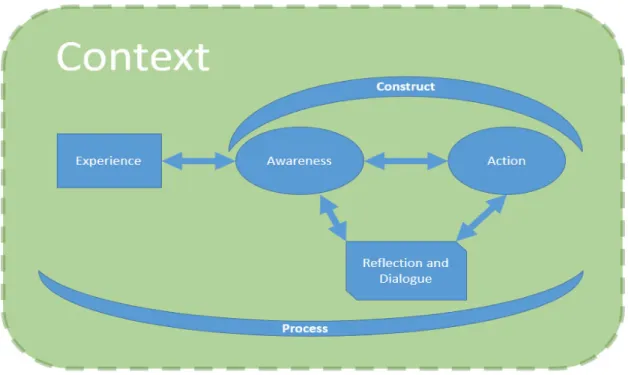
Critical Consciousness Unpacked ... 40
Experience, awareness, action, dialogue, and reflection. ... 44
Broadening Focus of Critical Consciousness Scholarship ... 47
Critical Consciousness and Culturally Relevant Pedagogy ... 50
Teacher Critical Consciousness Development over the Life Course ... 54
Studying White Teachers’ Paths of Critical Consciousness over Their Life Courses ... 57
CHAPTER 3: METHODOLOGY ... 59
Research Design ... 62
Qualitative Description ... 62
Life history. ... 64
Research Methods ... 68
Criterion Sampling ... 68
White K-12 teachers. ... 69
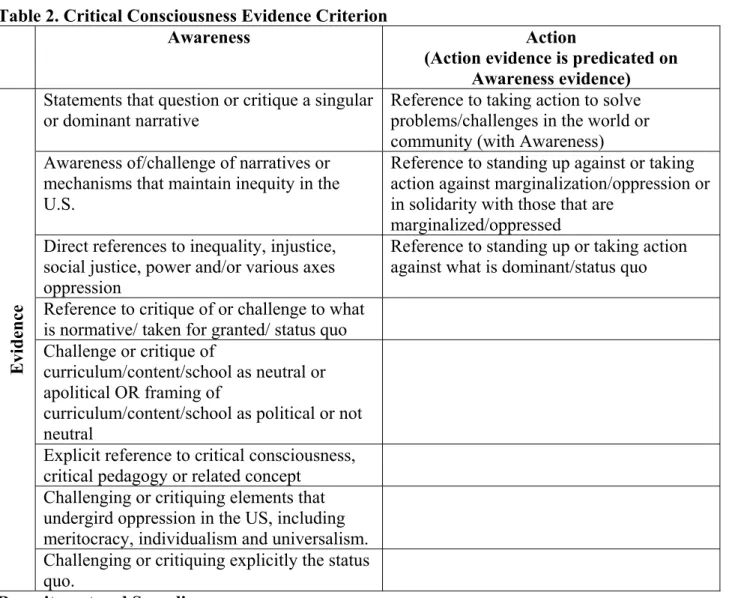
Critical consciousness criterion. ... 69
Development of criterion tables. ... 71
Recruitment and Sampling ... 73
Initial participant pool and selection. ... 74
Research Context ... 75
Data Collection and Sources: ICVSE, Interviews, and Timelines ... 76
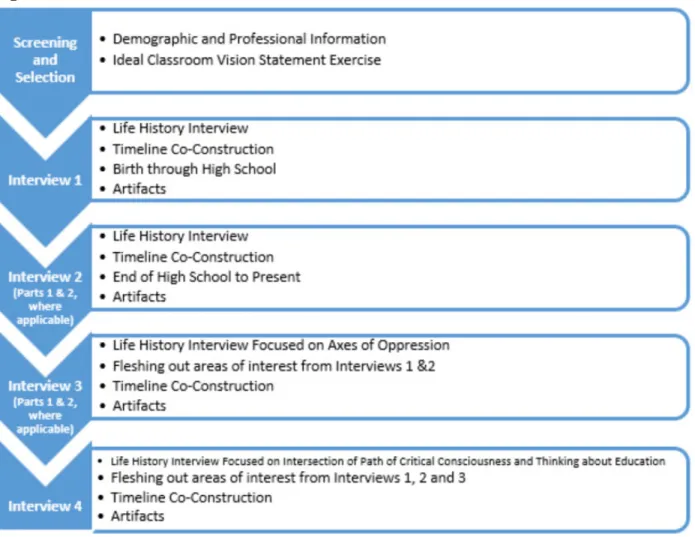
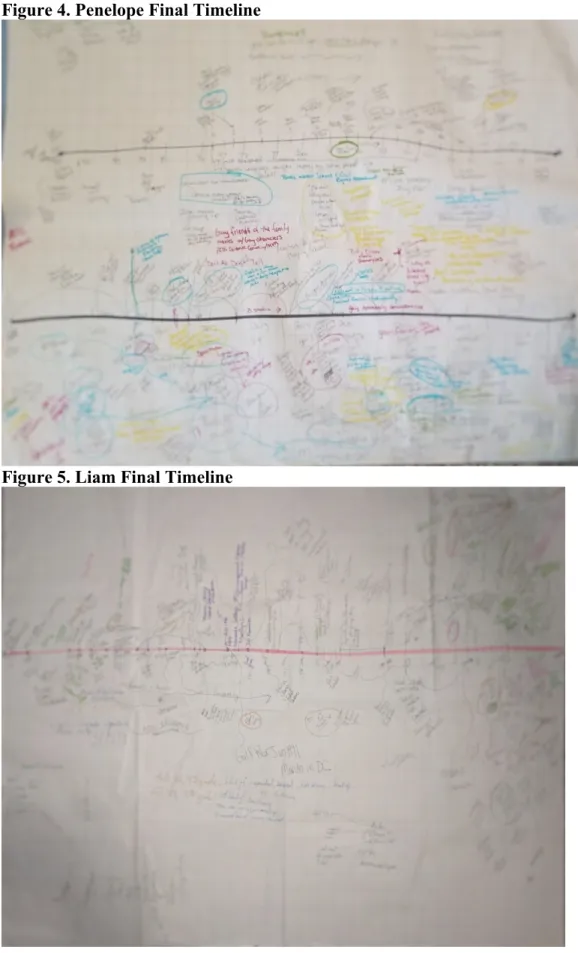
Open-ended, in-depth interviews and timelines. ... 77
Developing interview guides. ... 82
Piloting the initial interview guide. ... 83
Continuous refinement of interview process. ... 85
Participants: Selection and Narrowing ... 86
Charlotte. ... 89
Liam. ... 90
Data Analysis ... 93
Memoing. ... 94
Coding. ... 96
Visual data display: Time-ordered matrices. ... 99
Cross-case analysis: Developing themes. ... 100
Trustworthiness ... 101
Ethics and Participant Protections ... 103
CHAPTER 4: FINDINGS ... 106
Describing Participants’ Paths: Significant Themes ... 107
Motivators: Why ... 109
Charlotte: God Loves Everyone and Fights Against Injustice ... 110
Liam: Connecting Beliefs and Action ... 111
Penelope: Right and Wrong, Doing Something About It ... 112
Context: When and Where ... 115
Broad Contextual Factors ... 115
Environments: Antithetical, Unsupportive and Supportive ... 120
Antithetical and unsupportive environments. ... 120
Antithetical environments. ... 121
Unsupportive environments. ... 122
Diverse and different environments. ... 128
Ethos. ... 133
Influencers: Who ... 137
Parents ... 139
Race consciousness: Acknowledging race and racism. ... 140
Models of changing, growing, and learning. ... 141
Friends ... 143
Teachers ... 147
Students ... 151
Fellow Educators ... 154
Resources: What ... 157
Media ... 158
Social Media ... 161
Words... 163
Mechanisms: How ... 166
Experiencing Difference or Marginalization ... 167
Experiencing and Resolving Contradictions ... 170
Observing... 173
Observing marginalization. ... 174
Taking Action ... 178
Engaging in Conversations ... 183
Choosing to Learn ... 188
Continually learning, growing, changing... 192
Chapter 4 Summary ... 193
CHAPTER 5: DISCUSSION AND IMPLICATIONS ... 198
Building on the Conceptual Model of Critical Consciousness ... 199
Elaborating the Original Model of Critical Consciousness Development ... 200
Motivation: Considering Why ... 204
Context: Broad and Local ... 204
Mechanisms: Unpacking “Experience” ... 204
Reflection... 205
Influencers: Who is Important ... 208
Resources: What Participants Engage With ... 209
Revised Model ... 209
Implications ... 210
White Teacher and Teacher Candidate Recruitment and Selection ... 210
White Teacher Education and Support ... 213
Ensuring the presence of More Radical Other educators. ... 214
Promoting Critical Consciousness in Service of Culturally Relevant Pedagogy ... 220
Limitations and Possibilities for Future Research ... 223
APPENDIX A: IDEAL CLASSROOM VISION STATEMENT EXERCISE PILOT 1 ... 228
APPENDIX B: IDEAL CLASSROOM VISION STATEMENT EXERCISE PILOT 2 ... 229
APPENDIX C: CHANGES TO ICVSE INSTRUMENT AND RATIONALES ... 230
APPENDIX D: FINAL IDEAL CLASSROOM VISION STATEMENT EXCERCISE ... 231
APPENDIX E: RECRUITMENT FLYER ... 232
APPENDIX F: LIAM’S CASE NARRATIVE ... 233
APPENDIX G: PENELOPE’S CASE NARRATIVE ... 256
APPENDIX H: CHARLOTTE’S CASE NARRATIVE ... 281
APPENDIX I: INTERVIEW GUIDES ... 301
APPENDIX J: CREDIBILITY EXERCISE ... 308
LIST OF TABLES
Table 1. Hammerness’s Vision Statement Writing Prompt ... 70
Table 2. Critical Consciousness Evidence Criterion ... 73
Table 3. Qualified and Selected Participant Pool Overview ... 74
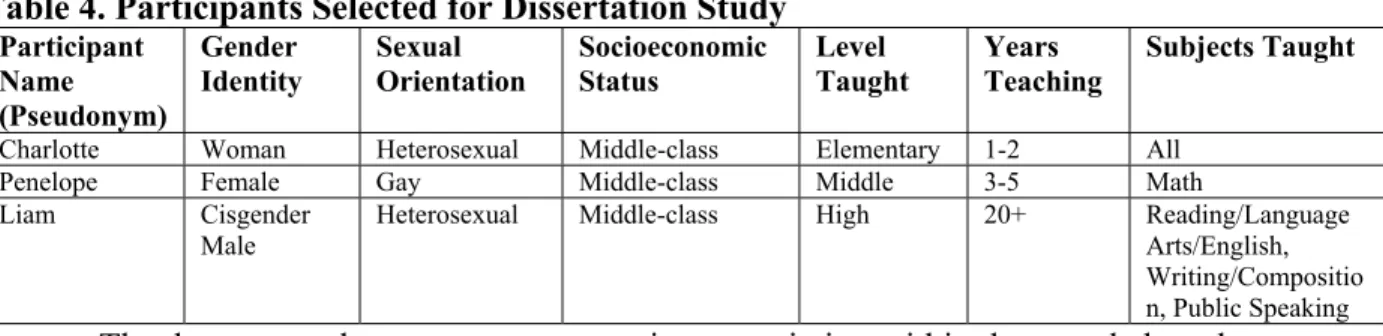
Table 4. Participants Selected for Dissertation Study ... 87
Table 5. Participants’ Current School Contexts ... 88
LIST OF FIGURES
Figure 1. Connections between Teacher Critical Consciousness and CRP ... 38
Figure 2. Conceptual Model of Critical Consciousness Based on Freire’s Work ... 43
Figure 3. Data Collection and Sources ... 77
Figure 4. Penelope Final Timeline ... 81
Figure 5. Liam Final Timeline ... 81
Figure 6. Charlotte Final Timeline ... 82
Figure 7. Overview of Process of Data Collection and Analysis ... 96
Figure 8. Original Conceptual Model of Critical Consciousness Based on Freire’s Work (Process Emphasis) ... 201
Figure 9. Findings Mapped onto the Original Model of Critical Consciousness ... 202
Figure 10. Revised Model of the Process of Critical Consciousness ... 203
Figure 11. Connections between Teacher Critical Consciousness and CRP ... 221
LIST OF ABBREVIATIONS
CRP Culturally Relevant Pedagogy
CRT Critical Race Theory
CC Critical Consciousness
U.S. United States
CHAPTER 1: INTRODUCTION Equity Demands Critical Consciousness
Social inequity, particularly race-based inequity, is a constant which runs through the
history of our nation (Bell, 1992). Built on lands stolen from indigenous peoples and on the
stolen lives, labor, and humanity of African peoples enslaved and oppressed for hundreds of
years, our nation has grown from a foundation of inequity and oppression which continues to
run fervently through the structures and systems we have today.
Our system of schooling is in no way separate from these inequitable foundations. For
decades there has been concern over the ever-persistent gap in educational outcomes between
White1 students and those that are members of marginalized racial or ethnic groups, such as
African American, Latinx and Native American Indian students2 (Coleman et al., 1966;
National Commission on Excellence in Education, 1983). In addition to the oft-cited
quantitative gaps that are typically based on standardized test scores (Bohrnstedt, Kitmitto,
1 I continually engage in an internal struggle over the most productive terminology for referencing White
people/European Americans in the pursuit of anti-racist action. I have elected to use the word White, as opposed to European American, in my own writing here to denote people racialized as White in the United States. I view White as a racial identifier. I make this choice in order to highlight the racialized experiences of all people in the U.S. and in particular White people, who so frequently fail to recognize the raced nature of their own and others’ experiences. I also continually struggle with whether or not it is more effective to capitalize or not the word White. I have elected to capitalize it, and any other racial identifiers used in this writing (e.g. Black), for the same aim of highlighting the racialization of all of our experiences.
2 In the literature cited herein, there are a variety of terms used to describe students from racially or ethnically
Ogut, Sherman & Chan, 2015; Vanneman, Hamilton, Anderson & Rahman, 2009) and
graduation rates (Schott Foundation, 2012), other scholars have discussed schooling inequity
more qualitatively in terms of the subtractive and assimilationist schooling experiences of
marginalized students (Bartolomé, 2004; Ladson-Billings, 1992a; Paris & Alim, 2014;
Valenzuela, 2010). Subtractive and assimilationist schooling experiences divest marginalized
youth from important social and cultural resources (Valenzuela, 2010) by attempting to
absorb these youth into the dominant culture and the existing social and economic order
(Ladson-Billings, 1992b). Not unrelated to the quantitative gaps, this type of inequity
highlights the racially-, linguistically-, and culturally-biased nature of schooling in the United
States. In order to genuinely address inequitable educational experiences and outcomes, these
systemic biases, in schooling and beyond, must be confronted and any solution must address
them directly.
While the inequitable systems within which teachers work are quite powerful,
teachers themselves retain the ability to ultimately make important decisions that impact
profoundly the type of education that the students in their classrooms experience. Though
they may be few and far between, there do exist “dreamkeepers” (Ladson-Billings, 1994;
Ladson-Billings, 2000; Duncan-Andrade, 2007; Catone, 2017), who approach their teaching
with a critical consciousness that drives their equity-oriented pedagogy. These teachers strive
to prepare all of their students, and in particular their racially and ethnically marginalized
students, to not only achieve academically, but to do so in a way that maintains their cultural
This study investigates and describes, using a life history approach, three White
teachers’ paths of critical consciousness3. In the following pages, I explain the problem that
this study seeks to address by arguing for the central role of critical consciousness in the
pursuit of educational equity. I then posit that it is both important and appropriate, therefore,
to examine teachers’ paths of critical consciousness. In particular, I explain why it is
necessary to consider specifically White teachers’ paths of critical consciousness. I conclude
with a statement on my own positionality, highlighting how salient aspects of my own
experiences have shaped the design and execution of this study.
Education, Equity, and Oppression
Many terms are used within the sphere of education without appropriate attention to
their meaning. This is particularly true today, when nearly everyone seems to be concerned
with education “reform” in some way, shape, or form. Equity is one of those terms. As the
issue of equity is of central importance to this study, I feel it necessary here to explain what I
mean when I refer to equity. Due to the importance of individualism, meritocracy, and
universalism in the traditional school narrative (discussed in detail in the coming sections)
the issue of equity is often incorrectly framed as equality (Secada, 1989). By definition,
equality relates to the idea of things being equal or the same. Considering the implication of
sameness, it is easy to draw a clear line to the issues of universalism (everyone has the same
opportunity), individualism (because we all have the same opportunity, what I, individually,
do matters), and meritocracy (because everyone has the same opportunity, and what I
3 Use of the phrase “path of critical consciousness” is purposeful. As opposed to something that one “has” or
individually do matters, when I succeed or fail, it is because I deserve it). Equity as equality
or sameness, a key characteristic of liberalism and the focus on formal equality of
opportunity (La Brecque, 1990), serves as the basis for the mass use of and faith in
standardized testing and mass-produced curricula. It assumes that all are at the same starting
place and disregards the current conditions of various groups and the origins of those
conditions. It focuses on parceling out the same education and resources to all students,
implying that everyone gets the same amount of the same thing (Duncan-Andrade, 2007). It
undergirds the reluctance to consider how systemic issues inside of and outside of school
influence students’ scholastic and life-long success. This focus on equality, and steadfast
dedication to the underlying values of the traditional school narrative, result in the prevalence
of superficial and sanitized multicultural initiatives that disregard genuine issues of equity
(Gorski & Salwell, 2015). In contrast to equality, equity is centrally concerned with justice,
which requires attending to and combating systemic and structural biases and discrimination.
An equitable education, therefore, refocuses educational efforts towards rectifying issues of
social and economic injustice that are historically rooted and systemically perpetuated
(Gutstein et al., 2005).
In considering systemic and structural biases and discrimination, it is necessary to
acknowledge the various and intersecting ways that oppression operates within a given
context. I use the term oppression to denote the “interlocking forces that create and sustain
injustice” (Bell, 2016, p.5). It is important to note, here, that this definition of oppression, by
focusing on forces that create and sustain injustice, includes both mechanisms that privilege
some groups (promoting their dominance) and those that oppress some groups (promoting
of oppression are multifaceted and vary according to one’s position along various axes of
social identity. The term “intersectionality” was coined by Crenshaw (1989) to push attention
toward the multidimensionality of experiences of oppression. This seminal work centers the
experiences of Black women, contrasting the multidimensionality of their experiences with
the typical “single-axis analysis that distorts these experiences” (Crenshaw, 1989, p. 139).
Crenshaw’s intersectionality helps us to examine how “dominant conceptions of
discrimination condition us to think about subordination as disadvantage occurring along a
single category” (Crenshaw, 1989, p. 140). An intersectional approach, in contrast,
acknowledges the “intercentricity of racialized oppression—the layers of subordination based
on race, gender, class, immigration status, surname, phenotype, accent and sexuality”
(Solorzano & Yosso, 2002, p. 25).
From an intersectional perspective, oppression is considered at the intersections and
interactions between various socially constructed categories. Society categorizes groups of
people through the process of social construction (Bell, 2016). These group categories (such
as race or gender) are not “real” per say, but have very “real” effect and consequences due to
their influence on implicit beliefs, systems, and social practices which operate as if the social
categories were real (Bell, 2016). In the United States we have major socially constructed
categories based on race, class, gender, sexual orientation, and other social markers. These
ways of categorizing social identity groups are embedded in our history, patterns of
immigration, geography and socio-political context (Bell, 2016). These social constructions
are then used to rationalize differential allocation of resources, differential treatment, and
social inequities broadly in ways that make inequitable outcomes seem inevitable. Racism,
“cultural messages and institutional policies and practices as well as the beliefs and actions of
individuals” (Tatum, 2000, p. 127), is an example of this. Per this definition, racism in the
United States operates not only in terms of its ideological components, but more importantly
in terms of a racialized social system, in which
the placement of people in racial categories involves some form of hierarchy that produces definite social relations between the races. The race placed in the superior position tends to receive greater economic remuneration and access to better occupations and/or prospects in the labor market, occupies a primary position in the political system, is granted higher social estimation (e.g. is viewed as “smarter” or “better looking”), often has the license to draw physical (segregation) as well as social (racial etiquette) boundaries between itself and other races, and receives what DuBois (1939) calls a “psychological wage.” (Bonilla-Silva, 1997, p. 469-470)
Conceptualizing oppression as intersectional across various axes of socially
constructed categories undergirds the way in which critical consciousness is conceptualized
broadly within this work. Rather than a focus on a single axis of consciousness, the focus is
to consider participants’ critical consciousness development with respect to various axes of
oppression, specifically race, class, gender and sexual orientation, four major social
categories in the United States.
Exploring the Problem Space: Challenging the Traditional Narrative of Schooling
The traditional and dominant narrative (Giroux, 1989) about schools and the purpose
of education in the United States asserts that schools are the key to individual success and
that the provision of a free public education will be the great equalizer in American society.
In this traditional view of schooling, access to a free public education is meant to ensure that
all Americans can pull themselves up by their bootstraps and be successful in the pursuit of
material wealth if they simply work hard and take advantage of the educational opportunities
available to them (Labaree, 2010). This narrative is tied to problematic neoliberal values
section. First, meritocracy has been referred to as, “the myth that you get ahead simply by
virtue of your hard work and talents” (Bartolomé, 2004, p.103), an underpinning of the
well-known idea of the American Dream. Meritocracy is also often used as a way to justify and
explain the existing social order, which maintains racially and ethnically marginalized people
at the “bottom” and Whites on the “top” of the political, socioeconomic and academic
ladders (Bartolome, 2004; Villegas & Lucas, 2002). Tied to meritocracy are strong values
placed on individualism and universalism. Individualism places high value on autonomy,
independence, uniqueness and self-reliance, favoring freedom of action over collectivity
(Triandis, 2018). In a meritocracy, it is individual effort alone that is credited for one’s
success or failure. Furthermore, the idea of a “free society,” which does not acknowledge the
oppressive order that is at work, perpetuates universalist myths that “all persons are free to
work where they wish, that if they don’t like their boss they can leave him and look for
another…the myth that anyone who is industrious can become an entrepreneur” (Freire,
2005, p. 139). Universalism centers on the idea that there is a common human experience,
and that differences between human beings are either unreal or unimportant (Budziszewski,
2010). The assumption of one universal experience or set of opportunities reinforces
individualism and meritocracy. Schools are often posited as a mechanism by which to “level
the playing field” (Villegas & Lucas, 2002, p. 22). From that base of a level playing field
(which is part of the liberal commitment to formal equality of opportunity), there is assumed
to be universal, equal opportunity that allows students to rise or fall according to their own
individual merit and effort (Ukpokodu, 2007). From this perspective, the system of
domination is perpetuated by failing to consider, much less interrogate or combat, the
success of both marginalized and privileged students (Villegas & Lucas, 2002; Ukpokodu,
2007).
The belief in universalism also contributes to the framing of schooling as an apolitical
or neutral endeavor. Universalism leads to the treatment of school and schooling as largely
devoid of material and social context. Evidence for this ranges from the tendency toward
mass-produced, boxed curricular materials that are designed toward the “average” (typically
White and middle-class) students, to the adoption of large curricular projects which avoid
controversial topics and ideas (Britzman, 2000). This view fails to acknowledge that when
educators “select a particular textbook, a unit of study, or provide specific knowledge, they
are exercising political choices and decisions” (Ukpokodu, 2007, p.11). Shor (1987) explains
that the use of a curriculum that does not in some way challenge the current and standard
conditions of society communicates to students that both knowledge and the world are fixed,
are not in need of change, and there is no role for the students to play in transforming them.
This universalistic, meritocratic, individualist narrative of schooling fails to provide an
equitable education for marginalized students across our nation, and further fails to equip all
students with the necessary critical consciousness to become agents of change towards equity
and social justice.
Not quite meritocratic, universal, or apolitical: Failings of the traditional
narrative. This traditional narrative of schooling has a strong bias in its predictive value
along racial lines. There is ample evidence to suggest that, rather than meritocratic and
universal, students’ schooling experiences are very much influenced by systemic
discrimination and bias, both within and without the schooling system. The aforementioned
students tend to perform at lower levels on traditional measures of achievement as compared
to their White counterparts (Vanneman et al., 2009). This has become commonly referred to
as the “achievement gap” (Ladson-Billings, 2006a; 2013). However, the term “achievement
gap” decontextualizes the achievement disparities among racial groups in the U.S. from the
historical, economic, and sociopolitical conditions deliberately devised to create them
(Ladson-Billings, 2006a; 2013). The term “education debt” (Ladson-Billings, 2006a; 2013)
reframes these disparities by recognizing them as a result of purposeful decisions and
policies that have characterized our society. The debt is ongoing and the effects of it have
compounded throughout the history of our nation and continue to be felt acutely today.
As is clear in the conception of education debt, issues of systemic inequity do not
reside in school-based systems alone, but are interconnected with systemic oppression
throughout our society. While even a minimal review of the abundant and varied types of
systemic oppression historically and currently in US society is well beyond the scope of this
dissertation, several examples illustrate the historical and contemporary systemic oppression
of various groups. Mass-incarceration and the so-called war on drugs disproportionately
affect communities of color (Alexander, 2010). In fact, systemic discrimination is evident at
all levels of the criminal justice system. For example, though Black people and White people
use drugs at virtually the same rate (U.S. Department of Health and Human Services, 2014),
Black people are arrested for drug use at a much higher rate (Human Rights Watch, 2009).
Though we lack federal-level data on racial profiling, a look a city-level data shows evidence
of bias in policing. For example, in Ferguson, Missouri, Black people are stopped, searched,
and arrested more than White people, despite the fact that White people are more likely to be
evidence of systemic oppression in the disparate sentencing guidelines for those who possess
crack cocaine (who are more likely to be of low socioeconomic status and Black) and those
who possess powder cocaine (more likely to be used by Whites; Palamar et al., 2015).
Federal sentencing legislation was passed in the mid-1980s that included mandatory
sentencing laws that produced much more severe sentencing for those convicted of
possessing crack cocaine to the tune of a 100:1 ratio (Coyle, 2002). This means that
possession of 500 grams of powder cocaine triggered a mandatory 5-year sentence, while
possession of merely 5 grams of crack cocaine will trigger the same five year sentence
(Coyle, 2002). More recent legislation passed in 2010 has reduced that to an 18:1 ratio, but
did not eliminate the sentencing disparity entirely and did not apply retroactively to those
arrested prior to it its enactment (Palamar et al., 2015). Ultimately these factors converge,
alongside others, with the result being that African Americans make up approximately 13 %
of the population of the United States, but represent 59% of the U.S.’s prison population
(U.S. Department of Justice, 2014). There is also research to show specific examples of
economic oppression. For example, Black borrowers applying for loans are denied at higher
rates and pay higher interest rates than White borrowers with comparable qualifications
(Cheng, Lin & Liu, 2015; Kau, Kennan, Munneke, 2012). People of color are also targeted
by predatory lending schemes, which include high interest rates and risky loans (Cheng et al.,
2015; Kau et al., 2012). Additionally, research in public health has documented numerous
health disparities between racial groups, with African Americans and Latinos having less
access to care and greater negative health consequences than their White counterparts
The previous examples demonstrate that issues of injustice and inequity are not
confined to the school system, and that in order to begin to genuinely address issues of social
inequity we must recognize and challenge how systems of oppression operate throughout our
society as a whole. Critical consciousness in education plays an essential role in creating a
more equitable, just society. This goal, as former President Barack Obama (2008) reminded
us, is a goal expressed in the vision of our nation at the time of its founding. It is our
responsibility, therefore, to continue to strive in order to “narrow that gap between the
promise of our ideals and the reality of our time” (Obama, 2008).
Teaching with Critical Consciousness
The imperative of addressing systemic bias and oppression, working towards a more
equitable and just society, directly requires a critical consciousness. Ladson-Billings (1995)
defines critical consciousness4 as the ability to recognize, understand, interrogate and engage
with social inequities, often with political action implications. Though I flesh out the
construct of critical consciousness further in the next chapter, the definition provided here,
beautiful in its simplicity, highlights the fundamental elements of a critical consciousness: 1)
recognizing, understanding and interrogating social inequity, and 2) the action that takes
place in an effort to combat or correct that inequity, to seek justice. Critical consciousness
plays a central role in the theory of Culturally Relevant Pedagogy (CRP; Ladson-Billings,
4 I, herein, will use the term critical consciousness, though Ladson-Billings herself has even used it
1995), which is discussed in detail in Chapter 2 and serves as the conceptual framework for
this study.
Understanding the relationship between teachers’ critical consciousness and their
ability to pursue equitable, culturally relevant pedagogy highlights the importance of how
teachers think about their pedagogy and the world. Education towards equity is
fundamentally about how teachers think about “the social contexts, the students, about the curriculum and about instruction” (Ladson-Billings, 2006b, p. 30). Teaching with critical
consciousness “requires teachers and other educationalists to examine what they do or do not
do in relation to a social order replete with inequities that includes but extends beyond their
own classrooms” (Parsons & Wall, 2011, p. 17).
It is the ability for teachers to think in a critically conscious way, oriented toward awareness of social inequity and action towards justice, which undergirds equity-oriented
pedagogy. If we want teachers who are able to teach in ways which help students develop
their own critical consciousness, then teachers themselves must be on the path of critical
consciousness. It is, therefore, of central importance to understand teachers’ own paths of
critical consciousness, which they bring to bear on how they think about education.
Understanding teachers’ paths of critical consciousness will help us to be better prepared to
support teachers in coming to and moving along that path. Breaking free of the tendency to
reduce pedagogy to skills (Bartolomé, 1994), and instead delving deeply into the issue of
how critically conscious teachers have come to think the way they do about education and
the world will provide vital insight into how we might promote that type of critical
consciousness development in other teachers.
Teachers’ critical consciousness is an imperative in attaining equitable education and
research on how teachers develop it is limited and necessary. This study examines the
development of critical consciousness among White teachers, a population selected for
several reasons. Students of color (Black, Latinx, Asian, Pacific Islander, and American
Indian/Alaska Native) now make up more than 50% of the overall K-12 student population in
the United States, with White students making up fewer than 49% and dropping (NCES,
2017 ). At the same time, the U.S. teaching force remains majority White, middle-class and
female (Assaf, Garza & Battle, 2010; Buehler, Ruggles Gere, Dallavis & Haviland, 2009;
Laughter, 2011). Over 80% of our current teaching force is White, a trend which has
persisted since at least the 1980s (U.S. Department of Education, 2016). This racial gap
between student body and teaching force has been described as the “demographic
imperative” (Lowenstein, 2009, p. 167). It raises questions about whether an overwhelmingly
White and middle-class teaching body is adequately prepared to teach a student body which
is increasingly multiracial or multiethnic and “likely to be divided along linguistic, religious,
ability and economic lines that matter in today’s schools (Ladson-Billings, 2001, p. 14). In
short, we have a lot of White, middle-class teachers, and an increasingly large proportion of
students that are marginalized across a variety of axes.
One often argued way to address this “demographic imperative” is in recruiting and
retaining more teachers of color. I certainly recognize and support the need and value in that
approach. When compared with their White peers, teachers of color have been shown to be
more likely to hold higher expectations of students of color, confront issues of racism
(Grissom & Redding, 2016), serve as advocates and cultural brokers, and develop more
background (Villegas & Irvine, 2010). However, the reality we face is that we have a current
teaching force that is 80% White and holding strong. Therefore, even in the presence of
efforts to recruit and retain more teachers of color, the need to consider the critical
consciousness development of White teachers, specifically, remains pressing.
I also choose to focus on White teachers because they exist in a sphere of
experiences that is highly influenced by their status as White people (and often, too, as
middle-class people). As Parsons and Wall (2011, p. 21) explain, “The United States, like
many societies worldwide, is stratified. On a large scale, as a consequence of history, public
life in the United States is stratified by wealth, education and race, and these strata do not
exist in isolation but often overlap.” Experiences of and views of being members of U.S.
society differ across strata. Rather than there being one universal lived experience of the U.S.
citizen, “groups and the individuals that comprise different strata in the United States
perceive and live substantially different realities” (Parsons & Wall, 2011, p. 21). White
teachers occupy positions within the strata that are privileged (e.g. White, college-educated,
and often middle-class), and their positionality can make it challenging for them to
understand the importance of teaching in culturally relevant, equity oriented ways (Picower,
2009; Ladson-Billings, 2001; Cochran-Smith, 2004; Irvine, 2003). Their privileged positions
render it difficult, often, for “people and groups to acknowledge the existence of inherent
inequities in a stratified society that privileges them—a herculean obstacle to surmount in
order to interrogate and disrupt social inequity” (Parsons & Wall, 2011, p. 21-22). In
overcoming this obstacle, privileged individuals must be able to come to “perceive inequities
that are evident to those who occupy less privileged strata in the United States” (Parsons &
with social inequities, what I am conceptualizing as the path of critical consciousness, is the
central concern of this study.
Summary of the Problem Statement
As I have argued herein, critical consciousness undergirds culturally relevant,
equity-oriented pedagogy. In order for teachers to be able to engage in pedagogy that prepares their
students to be active agents of change in their world, the teachers themselves must be on the
path of critical consciousness. White teachers hold an outsized presence in the school system
and occupy privileged social positions. These factors render them an important and
interesting case to consider with relation to their development of critical consciousness.
Driving education towards genuinely culturally relevant, equity-oriented practices requires
that we delve more deeply into the matter of how teachers themselves come to develop
critical consciousness.
Aim of the Study and Research Questions
This study uses a life history approach to explore, understand, and describe White
teachers’ perceptions of their paths of critical consciousness over the courses of their lives.
Toward this aim, this study investigates the following research questions:
For White teachers who show evidence of critical consciousness in how they think about education:
How do participants describe their paths of critical consciousness?
a. What experiences do participants view as significant to their paths of
critical consciousness?
b. How do participants describe how their paths of critical consciousness
Significance of the Study
Building from the argument outlined in the problem statement, which underscores the
importance of teachers’ critical consciousness, this research contributes significantly in
several important ways. First, much of the work on or related to critical consciousness
development and teachers focuses on purposefully crafted critical educational experiences
and pre-service teachers (e.g. Ladson-Billings, 2001; Zamudio, 2009; Hill-Jackson, 2007;
Beilke, 2005; Sleeter, Torres & Laughlin, 2004). This study, with its focus on understanding
the paths of critical consciousness for in-service teachers, contributes by drawing data from
teachers that are in practice, and whose experiences and reflections are, therefore, rooted in
the everyday realities, opportunities, and constraints of teaching. Contrary to pre-service
teachers, whose thinking with regard to pedagogy is largely confined to theoretical and
hypothetical discussions of classrooms, schools, communities, students, and teaching, the
participants in this study all have experiences firmly grounded in practice and the contexts
thereof.
Additionally, by examining development of teachers’ thinking with respect to critical
consciousness over the course of their life-history, this study remains focused on how they
“think” rather than on what they “do,” with regard to critical consciousness. The life-long
focus of this study, as opposed to narrower study of development over the course of
pre-service or in-pre-service training, also has the benefit of taking a more wide-angle approach,
thereby expanding how and what we understand about the development of White teacher
critical consciousness.
What we learn from this study, therefore, contributes to both pre-service and
have influenced these teachers’ developing critical consciousness. By having more insight
into these experiences, we, as teacher educators and school leaders, may be able to design for
similar experiences, and even recruit teachers and teacher candidates with these types of
experiences.
Finally, this study is significant in that it provides the narratives of several White
teachers that step outside of traditional ways of thinking about education. There is certainly a
need for making available to White teachers, both pre-service and in-service, narratives
which can serve as examples (or counter-examples) for them in their own practice. These
teachers’ experiences and stories serve as a handful of those examples, from which other
White teachers may draw inspiration for their own reflection and practice as they move along
their own paths of critical consciousness. The stories of these teachers have a role to play in
undermining the dominant narratives about teachers and schooling which uphold our
stratified society. From my own experience as a White teacher, I lacked models or examples
of other White teachers who were on the path of critical consciousness, and certainly would
have benefited from having had exposure to stories like those I have documented and
constructed with the participants in this study. My own experiences, my positionality, have
shaped many aspects of this study.
Positionality
Glesne (2011) explains a researcher’s positionality as the particular perspective that
the researcher brings into the research context based on her own knowledge and experiences
of the world. When conducting research, researchers must work to examine and understand
how their own positionalities shape the entire trajectory of their research from design to
including personal characteristics that are considered fixed (e.g. gender, skin color, age) and
also ascribed characteristics, such as ancestry or nationality, and achieved characteristics,
such as education level or socioeconomic status (Glesne, 2011).
I am engaging in this research project as a queer, White woman, from a mostly
working class childhood, having accrued experiences in this world from that specific vantage
point. It is important for me to acknowledge, from the beginning, that my own specific
positionality undoubtedly influences all aspects of this work from the questions that I ask to
my choices in sampling to my analysis. My social position as a White person has influenced
my decision to focus this study on White teachers. As a White person, I have come to realize
the importance of working with and talking to other White people in order to pursue
anti-racist work. Too often, the work of bringing White people along and educating White people
about issues of social justice, and racism in particular, is left to people of color. In choosing
to focus this work on White people, I am attempting to take responsibility, as a White person,
for the work that White people need to do to be genuine allies with people of color in the
fight for social equity and justice.
In addition to my own social identities (e.g. queer, White, woman), my experiences in
education, both as a teacher and as a student, have also profoundly influenced how I think
about this work. As a public school teacher, I saw first-hand the many ways in which the
public school system was not set up for the success of the racially- and linguistically-
marginalized students in my classes. Inflexible systems that were set up for the dominant,
White, middle-class “norm” and with dominant, White, middle-class values further
marginalized many of the students in my classes and their families. At the time, however, I
words or frames within which to analyze and name what was happening. I knew it was
wrong, but it was not until I came to graduate school that I began to develop an
understanding of helpful frames and vocabulary to be able to name, articulate, and more fully
understand the inequitable aspects of these systems.
My inability at the time to more clearly see and name the systemic discrimination
properly, meant that much of the action that I aimed to take to fight against the injustice
commonly referred to as the “achievement gap,” did little to challenge the systemic nature of
these issues. My own genuine and tireless efforts as a teacher to combat educational inequity,
in hindsight, smack of individualism and a failure to consider or address systems beyond my
own classroom walls. While I would sometimes discuss the realities of racism with my
students, I failed to equip them (or myself) to do anything to combat it. My conception of
how to work with my students for a brighter future played out within the larger system,
without challenging it. I considered the issue of educational equity, not genuinely as an issue
of equity, but more as an issue of equality.
Our schools were failing, I would have argued, to provide marginalized students
equal access to high quality education, high expectations, and adequate support. And while
all of those things were, and are, true, that was not enough to engage in genuinely
equity-oriented work. This was but the tip of the iceberg in my ability to begin to see and address
systemic injustice. I did view issues of educational equity as justice issues, however. That
concern for justice is what has continued to drive my own personal growth and development
along the path of critical consciousness.
Also profoundly impactful on my path has been my exposure to key concepts in the
greatly advanced my ability to recognize, interrogate, and engage with social inequities.
These concepts have become an ingrained part of how I see, interact with, and understand the
world. Bell’s (1992) concept of racial realism, for example, holds that racism is an endemic
and permanent part of American society. Race is understood as a social construction with no
biological basis (Banks, 1995; Delgado & Stefancic, 2012; Winant, 2000), but nevertheless,
as having a strong influence on the lived experiences of everyone in our society. The salience
of racism is also more acknowledged in this study through the focus on critical
consciousness, which takes aim at issues of social inequity, including racism. This idea is
also evident in the rejection of any pretense of “colorblindness” (Gotanda, 1991) in the
conceptualization of the study by directly considering how White teachers’ experiences of
critical consciousness have been influenced by their positions as White within American
society.
The rejection of colorblindness is also seen in broader critiques of liberalism,
including its major features, universalism, individualism, and meritocracy (Bonilla-Silva,
2014). These elements have been directly discussed in the problem statement, in which I
outline their role in the traditional narrative of schooling. To elaborate on my previous
discussion of these elements, universalism, reinforced by aspirations of colorblindness, fails
to take into account fundamental differences across human experiences attributable to
various stratifying axes of social identity (including class, gender, and especially, race).
Inherent in the fallacy of universalism is the privileging of the dominant perspective and
the dominant racial group, by and large, Whites do not see themselves as a racial group5, and
therefore perceive their own experiences and viewpoint as being universally valid, neutral,
and as representing “the truth” (Delgado & Stefancic, 2012, p. 90). The dominant ideology
camouflages the self-interest, power, and privilege of dominant groups (Solorzano & Yosso,
2002) and, thereby, maintains conditions of inequity. Critiquing these elements of liberalism
undergirds the importance of a critical consciousness in this study by emphasizing the
imperative to challenge the dominant ideology and the traditional narrative on schooling.
Chapter 1 Summary and Dissertation Overview
This dissertation is organized into five chapters. In this chapter I have outlined my
argument for the importance of critical consciousness in undergirding genuine efforts toward
educational equity. Critical consciousness is necessary in order to challenge the traditional
narrative of schooling, which values individualism and is founded on the assumptions of
universalism and meritocracy. Only an approach which seeks to actively recognize,
understand, interrogate, and engage with social inequities can be truly equitable. I have
explained that a culturally relevant and equity oriented pedagogy is founded on a teachers’
critical consciousness. Due to their large numbers and privileged social positions, White
teachers prove an important and interesting case for investigating the development of critical
consciousness. In particular, this study utilized a life-history approach to understand, explore,
and describe how White teachers who show evidence of critical consciousness in how they
think about education understand their own paths of critical consciousness. Next, I outlined
5Two notable and marginal exceptions to this generalization are White nationalists and critical whiteness
significant elements of my own positionality, including the influences of my own teaching
experiences, my exposure to tenets of CRT, and my position as a White person, and how
those have shaped this study.
The following chapter, Chapter 2, provides an overview of the theory of Culturally
Relevant Pedagogy (CRP; Ladson-Billings, 1995), which serves as the conceptual framework
for this study, and elaborates specifically the construct of critical consciousness. I also
discuss limitations of current literature with regard to both CRP and critical consciousness.
Chapter 3 then discusses the critical social constructivist paradigm within which this work is
grounded and gives a detailed overview of the research design and methods. The context of
the study and the participants are introduced. Following that, Chapter 4 presents the findings
of the cross-case analysis, organized as major themes. Finally, Chapter 5 provides a
discussion of those findings, including their relevance to the conceptual framework,
CHAPTER 2: REVIEW OF THE LITERATURE
In Chapter 1, Culturally Relevant Pedagogy (CRP; Ladson-Billings, 1995), was
briefly introduced in connection to critical consciousness. In this chapter I expand by
explaining, in depth, the theory of CRP, which serves as the overarching conceptual
framework for this study. I review the development of the theory, its place within the critical
and resource pedagogy traditions, and its tenets and theoretical underpinnings. I then dive
more deeply into the element of critical consciousness and its vital role in undergirding the
tenets and underpinnings of CRP. Drawing from Freire (2005), I flesh out critical
consciousness as both a construct and a process, explaining its conceptualization in this
study. I then examine limitations in current literature with regard to the application of the
theory of CRP generally, and critical consciousness, specifically, explaining how this study
provides important focus on critical consciousness and insight into the development of
critical consciousness of White teachers.
Towards Culturally Relevant Pedagogy to Address Inequity
As discussed in Chapter 1, our nation faces a host of issues related to social inequity,
which are evidenced in systems and outcomes ranging from schools and educational
outcomes to judicial systems and incarceration. In their traditional, and dominant form,
schools play a role in contributing to and maintaining social inequity (Apple, 2013; Giroux,
1989). Even in the wake of decades of research aimed at understanding and improving the
reduction in the disparities in traditional measures of academic achievement between White
students and students of color (Vanneman et al., 2009).
Initially, much scholarship interested in improving the educational outcomes of
students of color operated from a deficit approach to teaching and learning, also referred to as
the “cultural deprivation” (Banks, 2004, p. 18) perspective, which focused on helping racially
and socioeconomically marginalized students overcome the perceived deficits of their early
family and community experiences. These deficit approaches view the “languages, literacies,
and cultural ways of being of many students and communities of color” (Paris, 2012, p. 93)
as deficient while simultaneously legitimizing the dominant literacy, language, and cultural
practices of schooling. The dominant practices valued and required in schooling mirror
White, middle-class norms, thereby framing those languages, literacies, and cultures outside
of those norms as deficient (Paris & Alim, 2014; Woodson, 2011). The deficit approaches,
therefore, can be boiled down to an assimilationist perspective, which sought to replace the
cultural practices of many students of color with dominant practices, which were viewed as
superior (Paris, 2012).
While deficit or “cultural deprivation” (Banks, 2004, p. 18) perspectives explicitly
dominated much of the early scholarship aimed at improving educational outcomes for
students of color, there has been significant progress more recently to operate from a
resource perspective. Resource-oriented work has come to be more commonplace than
explicitly deficit-oriented approaches for scholarship in this vein. Scholarship in the resource
vein positions the cultural practices of marginalized communities as “resources to honor,
explore, and extend in accessing dominant American English language and literacy skills and
schools” (Paris, 2012, p. 94). Archetypical of the resource tradition is the work conducted by
Moll, Amanti, Neff and Gonzalez (1992) in which they developed the concept of funds of
knowledge (FoK). FoK denotes the body of knowledge and skills represented within a
household and necessary for that household to function. This concept developed out of their
work training teachers as ethnographic researchers as a means for the teachers to gain access
to the FoK of their students, which they leverage in the service of formal learning in the
classroom.
Though the FoK work is well known in the resource pedagogy tradition, there have
been a variety of terms used by researchers to indicate the use of pedagogical strategies
aimed at connecting to students’ cultures. These strategies include “culturally compatible”
(Vogt, Jordan & Tharp, 1987, p. 281), “culturally appropriate” (Au & Jordan, 1981, p. 139),
“culturally congruent” (Erickson & Mohatt, 1981, p. 117), “culturally responsive” (Cazden
and Leggett, 1981, p. 69), and “culturally sensitive,” (Lee, 1992, p. 279). Though many
varied definitions of culture exist, culture in this tradition can be broadly understood as the
blend of values, norms, beliefs, knowledge, emotional responses, expectations, and
conventional forms of communication and actions of a group (Phelan, Davidson & Cao,
1991). The heart of this earlier work in the resource tradition is the attempt to make teaching
better match and incorporate the home and community cultures of racially and ethnically
marginalized students.
However, while a resource-orientation is certainly valuable to any effort to strive
towards more just and equitable schooling experiences and outcomes for marginalized
students, a resource-orientation in and of itself is not sufficient. When taken to an extreme, a
bootstraps” philosophy embodied in the dominant schooling narrative, which gives primacy
to individual agency while ignoring or discarding the oppressive influence of systems and
structures. It is quite possible to espouse or even operate with a resource-orientation, and yet
still basically work within the mainstream status quo (Parsons & Wall, 2011). In order for
educators, and thereby educational experiences, to become genuinely equity-oriented, a
criticality is required. Criticality explicitly seeks to “interrogate and disrupt the status quo”
(Parsons & Wall, 2011, p. 17). The aforementioned inequitable and oppressive systems and
structures, both within and beyond the school walls, must be directly interrogated and
challenged.
This criticality in pedagogical approach has been broadly referred to as “critical
pedagogy” (Malott, 2011). Critical pedagogy can be defined as the “theory and practice of
education aimed at stimulating social critique and political engagement” (Nygreen, 2011, p.
62) with the aim of progressive social change. The roots of critical pedagogy tend to be
traced to Brazilian educator Paulo Freire, and German critical thinkers of the Frankfurt
School, with their place of departure arguably traceable to Antonio Gramsci, an Italian
neo-Marxist (Malott, 2011). Scholars like Giroux (2001), Kincheloe (2004), McLaren (2007) and
Apple (1993) have often represented the tradition’s coming of age in the late 20th century,
though their work has garnered criticism for being overly conceptual and not well-enough
grounded in the realities of practice (Nygreen, 2011). Though these scholars, largely White
and male, are often most prominently connected with the concept of critical pedagogy,
another cohort of scholars (e.g. Ladson-Billings, 1995; Duncan-Andrade, 2009; Emdin,
2016; Gay, 2010; Nieto, 2010; Paris, 2012) emerged and gained momentum in the late 20th
a body of work, more concretely grounded in practice. These scholars work in the interest of
educational equity and have variously articulated key elements of powerful, equitable
pedagogy for marginalized students (Aronson & Laughter, 2016). One particularly
significant and influential area of scholarship within the equity pedagogy arena is Culturally
Relevant Pedagogy (CRP; Ladson-Billings, 1995).
Culturally relevant pedagogy. The work of Gloria Ladson-Billings (1994; 1995)
and specifically her theory of CRP have a seminal place in the overlapping fields of critical
and resource-pedagogy scholarship, which I herein refer to as equity pedagogy. CRP makes
three important contributions to the field of equity pedagogy that render it an important
theoretical tool for addressing educational inequity.
First, CRP serves as a “coherent theoretical statement” (Paris, 2012, p. 93) for the
resource pedagogies developed throughout the years that preceded it. The resource pedagogy
scholarship, discussed above, laid important foundational work for conceptualizing students’
and families’ heritage and community cultures as important resources for school learning, but
CRP pulls together various relevant dimensions of that practice in a coherent way which sets
it apart from previous work.
Second, Ladson-Billings’s CRP extends past the traditional implication of culturally
responsive approaches by not solely promoting student academic achievement. Academic
achievement is but one component of CRP; of equal importance are emphases on students’
affirmation and acceptance of their own cultural identities and the development of critical
perspectives with which students can understand and challenge social inequities in the world
around them. These explicit emphases on student cultural competence and critical
past notions of equity that implicitly or explicitly center on assimilating marginalized
students into normative ways of knowing, speaking, and writing (Bang & Vossoughi, 2016;
Paris & Alim, 2014).
Finally, CRP recognizes directly the ways in which centering on the aforementioned
goals for students requires philosophical and ideological foundations for teachers’ practice.
In other words, CRP is based in how teachers think about “the social contexts, about the students, about the curriculum, and about instruction” (Ladson-Billings, 2006b, p.30). This
represents a significant development in the field. This recognition of the philosophical
foundations of practice, not just the practice itself, is unique to CRP, particularly in how fully
and explicitly they are articulated. Ladson-Billings (1995b) calls these elements, “theoretical
underpinnings” (p. 477), and they are discussed in detail in the following sections.
The theory of CRP encompasses key elements that run throughout the various
conceptualizations of equity-oriented pedagogical frameworks (Duncan-Andrade, 2009;
Emdin, 2016; Gay, 2010; Nieto, 2010; Paris, 2012; see also Brown, 2007; Aronson &
Laughter, 2016). Ladson-Billings (1995) explains that “a culturally relevant pedagogy is
designed to problematize teaching and encourage teachers to ask about the nature of
student-teacher relationships, the curriculum, schooling, and society” (p. 483). In this way, CRP, by
centering on questioning and challenging traditional narratives and assumptions about
teaching, learning, and society, is undergirded by critical consciousness (Parsons & Wall,
2011). It is the explicit centrality of criticality in CRP that ultimately makes it the most fitting
framework for this study; I have selected CRP, rather than, for example, Gay’s (2010)
Culturally Responsive Teaching for this reason. Gay (2010) explains that the key anchors of