The handle
http://hdl.handle.net/1887/67541
ho
lds various files of this Leiden University
dissertation.
Author:
Rood, M.T.M.
Title:
Reversible noncovalent assemblies for imaging applications
Reversible noncovalent assemblies for
imaging applications
Proefschrift
ter verkrijging van
de graad Doctor aan de Universiteit Leiden
op gezag van Rector Magnificus Prof. mr. C.J.J.M. Stolker,
volgens besluit van het College voor Promoties
te verdedigen op donderdag 20 december 2018
klokke 13:45
door
Promotores
Prof. dr. J.L. Bloem
Prof. dr. ir. J. Huskens (Universiteit Twente)
Co-promotor
Dr. F.W.B. van Leeuwen
Leden promotiecommissie
Prof. dr. E. Bouwman (Universiteit Leiden)
Prof. dr. A.H. Velders (Wageningen University & Research)
Prof. dr. H.J. Tanke
1. General introduction ... 7
2. An activatable, polarity dependent, dual-luminescent imaging agent with long luminescence lifetime ... 13
3. MMP-2/9-Specific activatable lifetime imaging agent ... 25
4. Supramolecular host-guest interactions as a means to realize membrane-receptor specific cell surface modifications ... 51
5. The cell viability effects of layer-by-layer cell encapsulation ... 69
6. Summary ... 91
Samenvatting ... 95
List of publications... 97
Curriculum vitae ... 99
AI. Supporting information to Chapter 2 ... 101
1
1.1.Molecular imaging
In biomedical and biochemical studies, it is often desirable to visualize the molecular composition of cells (in vitro) at the microscopic level. Such insights can help to identify different morphological structures as well as help unraveling their role in biological processes. In this in vitro setting, luminescence imaging is a highly desired imaging modality due to its detection sensitivity, spatial resolution, and ease of implication. Ultimately, through molecular imaging, the same type of information can be translated to the macroscopic in vivo scale, resulting in imaging technologies that are suitable for patients. One critical component in the realization of both in
vitro and in vivo molecular imaging solutions lies in the design of imaging
agents.[1, 2] Such imaging agents usually comprise of a functional moiety for targeting or activation of the molecule of interest and an imaging label that allows detection.
1.1.1. Optical imaging
Optical imaging relies on the interactions between molecules and light. Different interactions between light and molecules are possible, but perhaps the most interesting for molecular imaging is the use of luminescence emitting agents. The energy needed to generate emissions can be introduced via biochemical reactions (bioluminescence), via high energy particles (e.g. electrons, positrons), or by excitation with light of a different wavelength.[3] This last approach is used in fluorescence and phosphorescence imaging.
interest and the background (the so-called signal-to-background ratio). Luminescence based methods to improve the imaging contrast can be divided into two broad categories: 1) enhancement of specificity for a particular molecular feature/structure, which helps to increase the signal to background ratio, 2) reduction of the non-specific background signal, which increases the relative visibility of the molecular feature/structure under investigation. The outcome of these two methods is illustrated in Figure 1. In this thesis, the second category was chosen as the predominant approach to improve imaging contrast.
Figure 1. Two approaches to increase contrast in molecular imaging
1.1.2. Selected methods to decrease background influence
Although most optical imaging is performed by observing the signal intensity of a luminophore (a light-emitting molecule), an alternative imaging method to distinguish between luminescence signals is based on their luminescence lifetime – the exponential decay rate of the fluorescence.[4, 5] For endogenous luminophores (e.g. DNA, NADH, proteins), responsible for the native background luminescence, the lifetime is in the order of 0.5 - 10 ns. Commonly applied organic dyes such as fluorescein and Cy5 have luminescence lifetimes in the same range as the endogenous luminophores.[4] This feature complicates lifetime-based differentiation between endogenous and exogenous signals. Obviously
Decreased background Increased
separation becomes more straightforward when the differences in luminescence lifetime are more pronounced.[6] Luminescence lifetimes from 100 ns up to milliseconds can be achieved using inorganic transition metal complexes.[7] Specific localization of these luminescence signals can be the result of targeting molecular features [8] or via (enzymatic) activation processes that are specific for cellular compartments or cell types. The latter are generally referred to as “activatable” agents. Activatable imaging agents are designed so that they provide a signal after a (bio)chemical response to a (local) external factor, comparable to an ON switch.[9, 10] If a distinct alteration in (intensity or lifetime) is realized after activation, this helps to locally induce imaging contrast.
1.2.Luminescence imaging as means to study cell functionalization
As described above, cells or molecular features therein can be seen as targets for luminescence imaging. Alternatively, luminescence imaging can also be used to study the chemical functionalization of cells. At the same time luminescence imaging can be applied to monitor cellular functions such as migration and grafting. For instance in stem cell therapy, it would be groundbreaking to obtain chemical control on the migration of the stem cells to the location of choice and to monitor their activities (such as tissue re-generation in situ).[11-13]
1.3.Scope and outline of this thesis
In Chapter 2, an activatable imaging agent suited for luminescence lifetime imaging was investigated. For this, the long-lifetime (100 ns) inorganic luminophore Ir(ppy)3 was covalently attached to the organic
luminophore Cy5 using a cleavable disulfide bond. When connected, the photophysical interactions between the two luminophores led to a quenching of the luminescence for both luminophores and a decrease of the luminescence lifetime of Ir(ppy)3 to 5 ns. Chemical cleavage of the
connecting disulfide bond induced luminescence of both luminophores and restored the luminescence lifetime of Ir(ppy)3.
In Chapter 3, an MMP-2/9 enzyme-specific activatable lifetime
imaging agent was generated based on the luminophores Ir(ppy)3 and Cy5.
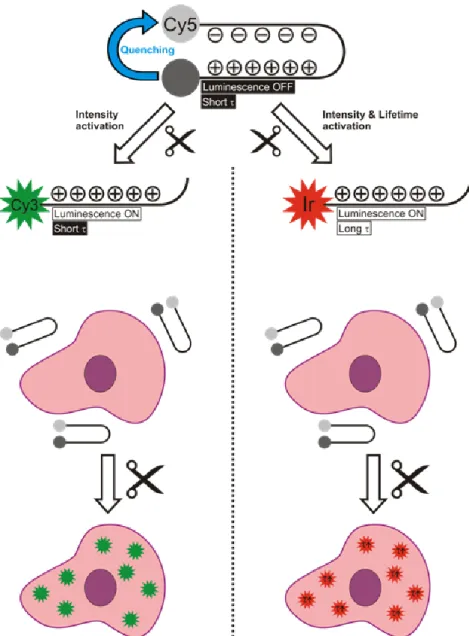
By using matching ionic interactions, a peptide hairpin was created whereby both luminophores were placed within the right distance required for both intensity and lifetime quenching. In vitro studies revealed that in MMP-2/9 positive cell lines the peptide sequence was cleaved, resulting in the restoration of the luminescence emission (intensity and lifetime) of both luminophores.
In the second part of this thesis, luminescence imaging is used to study supramolecular modification on the cell surface. Hereby, the use of supramolecular interactions (between β-cyclodextrin and adamantane) as a means to induce cell surface modifications was explored.
In Chapter 4, the feasibility of supramolecular host-guest
was also possible to demonstrate how such surface functionalizations could, in the future, be used for further cell functionalization, with other molecules or with complete cells.
In Chapter 5, it is described how the host-guest interactions
described in Chapter 4 can be used to realize layer-by-layer functionalization of a cell membrane. Hereby fluorescence imaging was used to monitor each individual step in the cell functionalization process. These functionalization steps were then related to the cell vitality and the uptake of a cytostatic drug.
Chapter 6 summarizes the main results and conclusions of every
chapter.
1. Mankoff, D.A., A definition of molecular imaging. J Nucl Med, 2007. 48(6): p. 18n, 21n. 2. James, M.L. and S.S. Gambhir, A Molecular Imaging Primer: Modalities, Imaging
Agents, and Applications. Physiol Rev, 2012. 92(2): p. 897-965.
3. Ma, X., et al., Recent Advances in Optical Molecular Imaging and its Applications in Targeted Drug Delivery. Curr Drug Targets, 2015. 16(6): p. 542-8.
4. Berezin, M.Y. and S. Achilefu, Fluorescence Lifetime Measurements and Biological Imaging. Chem rev, 2010. 110(5): p. 2641-2684.
5. Becker, W., Fluorescence lifetime imaging - techniques and applications. J Microsc, 2012. 247(2): p. 119-136.
6. Maliwal, B.P., et al., Long-Lived Bright Red Emitting Azaoxa-Triangulenium Fluorophores. Plos One, 2013. 8(5).
7. Ruggi, A., et al., Dendritic Ruthenium(II)-Based Dyes Tuneable for Diagnostic or Therapeutic Applications. Chem-Eur J, 2011. 17(2): p. 464-467.
8. Kuil, J., A.H. Velders, and F.W.B. van Leeuwen, Multimodal Tumor-Targeting Peptides Functionalized with Both a Radio- and a Fluorescent Label. Bioconjugate Chem, 2010. 21(10): p. 1709-1719.
9. van Duijnhoven, S.M., et al., Bioresponsive probes for molecular imaging: concepts and in vivo applications. Contrast Media Mol I, 2015. 10(4): p. 282-308.
10. Urano, Y., Novel live imaging techniques of cellular functions and in vivo tumors based on precise design of small molecule-based 'activatable' fluorescence probes. Curr Opin Chem Biol, 2012. 16(5-6): p. 602-8.
11. Ansboro, S., et al., Strategies for improved targeting of therapeutic cells: implications for tissue repair. European Cell Mater, 2012. 23: p. 310-319.
12. Kean, T.J., et al., Development of a peptide-targeted, myocardial ischemia-homing, mesenchymal stem cell. J Drug Target, 2012. 20(1): p. 23-32.
2
An activatable, polarity dependent,
Abstract
Activatable luminescent imaging agents have the potential to generate highly sensitive and specific diagnostic read-outs. Examples where the concept is coupled to (long) lifetime imaging are few. In this study, an activatable imaging agent specifically designed for luminescence lifetime imaging is reported. When the two luminophores Cy5 and Ir(ppy)3 were covalently linked, both emissions were quenched; Ir(ppy)3
is quenched by energy transfer to Cy5, and Cy5 is quenched by spin-orbit coupling induced by the iridium atom. Cleavage of the connective disulfide bond, either in solution or in vitro resulted in a >100-fold increase in the luminescence intensity for both luminophores. Activation also led to an increase in the luminescence lifetime of Ir(ppy)3, going up to 90 ns. The availability of imaging agents with an
activatable shift in lifetime, in our view, opens unique new opportunities in the field of lifetime imaging.
2.1.Introduction
Organic dyes, which are most commonly explored as activatable imaging agents, are prone to interference from autofluorescence. This disturbance can be minimized by tailoring the wavelengths towards the far-red and near-infrafar-red window where the autofluorescence is minimal.[8] Alternatively, luminophores may be designed to have a large Stokes shift (> 100 nm) to obtain a peak intensity that lies beyond the spectral range where autofluorescence generally occurs.[1] Luminescence lifetime may also help to separate exogenous from endogenous signals.[9]
The combination of luminescence signal activation and luminescence lifetime imaging was examined using an Ir(ppy)3 complex and
a Cy5 dye to combine the desired effects of both imaging strategies in a dual-luminescent imaging agent.
2.2.Results and discussion
After synthesis of the Ir(ppy)3-complex (1), a suitable linker was
attached (2-3). Excess linker was used to minimize dimer formation (Scheme 1, see Appendix I (AI) for detailed experimental section). This resulted in yields of 42% (2) and 56% (3). Cy5 was chosen as FRET acceptor
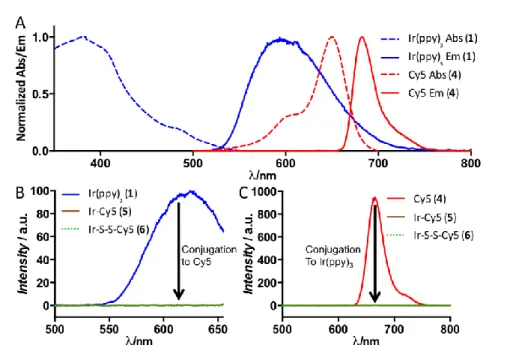
because of its spectral overlap with Ir(ppy)3 (Figure 1A) and high extinction
coefficient (ε = 2.5*105). Compounds 5 and 6 were made to provide both stable and activatable derivatives of the conjugate. Conjugation with Cy5 (4) was achieved using standard peptide coupling chemistry. After purification, in both cases a blue/green solid was obtained in yields of 64 % (5) and 33 % (6).
Figure 1: A) Normalized absorption and emission spectra of Ir(ppy)3 and Cy5 in PBS showing the spectral overlap. B)
Emission of equimolar solutions of 1, 5 and 6 with 457 nm excitation and C) emission of equimolar solutions of 4, 5 and 6 with 627 nm excitation in PBS
When Ir(ppy)3 (1) is excited, it undergoes rapid inter-system
crossing to a triplet excited state and from there emits phosphorescence light (ε = 9*103; Φ = 0.12 (DMSO)).[25] FRET from Ir(ppy)3 to Cy5 prevented
Ir(ppy)3 emission in 5 and 6 in phosphate buffered saline (PBS) (Figure 1B).
Independent of the solvent, the Ir(ppy)3 emission remained fully quenched
state by FRET; we calculated the Förster distance between these luminophores to be 4.8 nm (see AI.2.).[26] The donor-acceptor distances in our compounds fall well within this distance, allowing for efficient quenching.
The spin-orbit coupling induced by the iridium atom was used to quench emission of Cy5 efficiently (Figure 1C) by allowing energy transfer from the singlet excited state of Cy5 to a non-emissive triplet excited state of Cy5 (Figure S1). Regardless the excitation wavelength (405 or 633 nm), at 77 K the emission spectra of 5 showed two peaks at 760 and 840 nm (Figure S3). These peaks correspond to the previously reported triplet state emission of Cy5.[27] Since in 5 and 6 the emission of both luminophores is substantially quenched (>99.7 %), we state that in PBS the luminescence is in the off-state when the luminophores are conjugated.
The difference in distance dependence between the two quenching mechanisms was used to largely mitigate spin-orbit coupling, while leaving FRET intact. Using MeOH as co-solvent increased the solvation of 5 and 6
and this resulted in Cy5 singlet emission at 670 nm upon excitation of Ir(ppy)3 (Figure AI.2). In the absorption spectra, changing to a more apolar
solvent leads to a decrease in the peak (610 nm) that indicates stacking interactions (Figure AI.4B). This conformational change resulted in a 30-fold increase of Cy5 fluorescence intensity (Figure AI.4C), while the Ir(ppy)3
emission remained quenched. The rotational freedom of the molecules, however, seems to prevent complete signal restoration. The triplet emission caused by spin-orbit coupling in 5 (observed at 77 K in H2O)
spectra in CD3OD did not reveal close distance correlations between Cy5
and Ir(ppy)3 (See AI.6).
Similar to the use of MeOH, micelles of SDS were able to increase the Cy5 luminescence intensity, providing a model system for interactions with the cell membrane. Only above the critical micelle concentration of 1 mM[28] an increase of Cy5 fluorescence intensity was observed (Figure AI.5). In line with these findings, interaction of 5 (the uncleavable derivative; Figure 2) or 6 (Figure AI.6) with cell membranes provided a detectable Cy5 emission; Ir(ppy)3 emission remained quenched.
Figure 2:A) Schematic representation of partial activation by conformational change of the probe. B-D) Confocal
microscope image of 4T1 cells after 1h incubation with 5 at 4 °C. B) Differential interference contrast, C) Cy5, D) overlay.
In 6,the quenching of both Ir(ppy)3 and Cy5 can be fully undone by
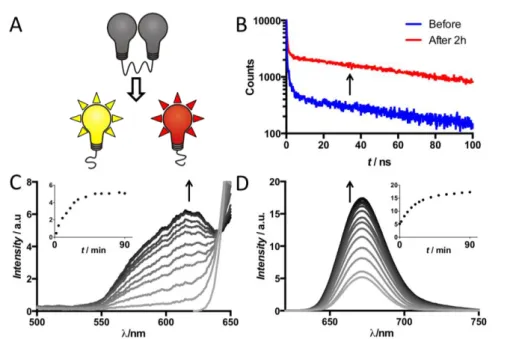
cleavage of the connective bond between the two dyes (Figure 3A). To study the full activation, the disulfide bond of 6 (a model system for cleavage) was initially cleaved using cysteamine (Scheme AI.2). In MeOH:PBS 4:1, after 1h at RT, the cleavage reaction induced by an excess of cysteamine yielded an intensity increase of both Ir(ppy)3
products were analyzed using HPLC and mass spectrometry (Figures AI.8 and AI.9).
Figure 3: A) Schematic representation of disulfide cleavage, B) difference in luminescence decay before and after
cleavage in solution, C) increase of luminescence of Ir(ppy)3 and D) Cy5 upon cleavage. Insets in C) and D) are the
change of peak height over time.
In vitro evaluation of the disulfide bond cleavage was performed in
the 4T1 murine breast tumor cell line. After passive cellular internalization at 37 °C, Ir-S-S-Cy5 (6) was confined in the lysosomes of the cell, where the disulfide bond was reduced by a redox enzyme or an intracellular thiol.[29] We observed activation of both Ir(ppy)3 and Cy5 in the lysosomes (Figure 4;
Figure AI.10) and even when a high concentration (5 μM) of 6 surrounded the cells, only the cleaved components were visible (Figure AI.11). No Ir(ppy)3 signal activation was observed when cells were incubated at 37 °C
Figure 4: Confocal microscope images of 4T1 cells after 24h incubation with 6 at 37 °C. A) Cy5 in red, B) Ir(ppy)3 in green, C) differential interference contrast, D) overlay of all channels. Yellow indicates overlay of red and green.
Luminescence lifetime measurements showed minor differences between the iridium complexes 1, 2, and 3 (Table 1). Conjugation with Cy5 (4) drastically shortened the lifetime. A short-lived species (τ < 1 ns), representative for residual Cy5 emission, accounted for a large part of the total emission at 600 nm; 89 % in 5 and 91 % in 6 (Figure AI.13). After cleavage, there is a relative large increase of long-lifetime emission (Figure 3B), indicating re-activation of Ir(ppy)3 phosphorescence. Activation effects
observed in solution were confirmed in vitro by fluorescence lifetime imaging microscopy (FLIM) using two different cell lines, 4T1 and U2OS. Results were independent of cell type (Figures 5 and AI.14). With 5
(uncleavable), the lifetime was short, while after activation of 6 (cleavable) the lifetime increased to 90 ns, similar to control experiments (Figure AI.14A). The change in lifetime seen with FLIM provides a clear measure of
the in vitro activation. Unfortunately, the suboptimal filter cube also allows
Table 1: Luminescence lifetimes of selected compounds in MeOH:PBS 4:1
Compound 1 2 3 4[a] 5 6
τ fast (ns) N.A.[b] N.A.[b] N.A.[b] 1.0 0.55 (89 %)[c] 0.35 (95 %)[c] τ slow (ns) 97.2 79.4 87.5 N.A.[b] 78.6 91.1
Average τ (ns) 97.2 79.4 87.5 1.0 9.1 4.9
[A] Emission measured at 680nm [B] Not applicable [C] Relative signal contribution
Figure 5: Fluorescence lifetime microscopy images of U2OS cells after 24h incubation with 6 at 37 °C using a CFP/YFP filter cube (excitation 436/12 & 500/20, dichroic 445 & 515, emission 467/37 & 545/45). A) Transmission, B) lifetime, the scale of the lifetimes is depicted on the right side (0-150 ns).
2.3.Conclusions
To conclude, the photophysical interactions between Cy5 and Ir(ppy)3
were studied and used to generate an unprecedented activatable (long) lifetime imaging agent (6). The Cy5 emission of this agent depends on the polarity of the environment, while both the Cy5 and Ir(ppy)3
emission can be activated by cleavage of the connective bond. In our view activatable long lifetime imaging agents provide a promising tool for future molecular imaging related to disease progression, complementary to intensity-based fluorescence detection.
1. Chin, P.T.K., et al., Optical imaging as an expansion of nuclear medicine: Cerenkov-based luminescence vs fluorescence-Cerenkov-based luminescence. Eur J Nucl Med Mol I, 2013. 40(8): p. 1283-1291.
2. Weissleder, R. and V. Ntziachristos, Shedding light onto live molecular targets. Nat Med, 2003. 9(1): p. 123-128.
3. Urano, Y., Novel live imaging techniques of cellular functions and in vivo tumors based on precise design of small molecule-based 'Activatable' fluorescence probes.
Curr Opin Chem Biol, 2012. 16(5-6): p. 602-608.
4. Lovell, J.F. and G. Zheng, Activatable smart probes for molecular optical imaging and therapy. J Innov Opt Heal Sci, 2008. 1(1): p. 45-61.
5. Huang, C.W., Z.B. Li, and P.S. Conti, Radioactive Smart Probe for Potential Corrected Matrix Metalloproteinase Imaging. Bioconjugate Chem, 2012. 23(11): p. 2159-2167.
6. Tung, C.H., et al., In vivo imaging of proteolytic enzyme activity using a novel molecular reporter. Cancer Res, 2000. 60(17): p. 4953-4958.
7. Urano, Y., et al., Rapid Cancer Detection by Topically Spraying a gamma-Glutamyltranspeptidase-Activated Fluorescent Probe. Sci Transl Med, 2011. 3(110): p. 110ra119.
8. Zhang, G., et al., Near-Infrared-Emitting Iridium(III) Complexes as Phosphorescent Dyes for Live Cell Imaging. Organometallics, 2014. 33(1): p. 61-68.
9. Alford, R., et al., Fluorescence lifetime imaging of activatable target specific molecular probes. Contrast Media Mol I, 2010. 5(1): p. 1-8.
10. Berezin, M.Y. and S. Achilefu, Fluorescence Lifetime Measurements and Biological Imaging. Chem Rev, 2010. 110(5): p. 2641-2684.
11. Ruggi, A., et al., Dendritic Ruthenium(II)-Based Dyes Tuneable for Diagnostic or Therapeutic Applications. Chem-Eur J, 2011. 17(2): p. 464-467.
13. Murphy, L., et al., The time domain in co-stained cell imaging: time-resolved emission imaging microscopy using a protonatable luminescent iridium complex. Chem Commun, 2010. 46(46): p. 8743-8745.
14. Xiong, L., et al., Phosphorescence Imaging of Homocysteine and Cysteine in Living Cells Based on a Cationic Ir (III) Complex. Inorg Chem, 2010. 49(14): p. 6402-6408. 15. Li, G., et al., Thiol-specific phosphorescent imaging in living cells with an
azobis(2,2'-bipyridine)-bridged dinuclear iridium(III) complex. Chem Commun, 2013. 49(20): p. 2040-2042.
16. Ruggi, A., F.W.B. van Leeuwen, and A.H. Velders, Interaction of dioxygen with the electronic excited state of Ir(III) and Ru(II) complexes: Principles and biomedical applications. Coordin Chem Rev, 2011. 255(21-22): p. 2542-2554.
17. Zhong, W., P. Urayama, and M.A. Mycek, Imaging fluorescence lifetime modulation of a ruthenium-based dye in living cells: the potential for oxygen sensing. J Phys D Appl Phys, 2003. 36(14): p. 1689-1695.
18. Baggaley, E., et al., Dinuclear Ruthenium(II) Complexes as Two-Photon, Time-Resolved Emission Microscopy Probes for Cellular DNA. Angew Chem Int Ed Engl, 2014. 53: p. 3367-3371.
19. Shiu, H.Y., M.K. Wong, and C.M. Che, "Turn-on" FRET-based luminescent iridium(III) probes for the detection of cysteine and homocysteine. Chem Commun, 2011. 47(15): p. 4367-4369.
20. Costa, R.D., et al., A Deep-Red-Emitting Perylenediimide-Iridium-Complex Dyad: Following the Photophysical Deactivation Pathways. J Phys Chem C, 2009. 113(44): p. 19292-19297.
21. Rachford, A.A., et al., Boron Dipyrromethene (Bodipy) Phosphorescence Revealed in Ir(ppy)(2)(bpy-C C-Bodipy) (+). Inorg Chem, 2010. 49(8): p. 3730-3736.
22. Jares-Erijman, E.A. and T.M. Jovin, FRET imaging. Nat Biotechnol, 2003. 21(11): p. 1387-1395.
23. Rae, M., A. Fedorov, and M.N. Berberan-Santos, Fluorescence quenching with exponential distance dependence: Application to the external heavy-atom effect. J Chem Phys, 2003. 119(4): p. 2223-2231.
24. Rothe, C., S. King, and A. Monkman, Long-range resonantly enhanced triplet formation in luminescent polymers doped with iridium complexes. Nat Mater, 2006. 5(6): p. 463-466.
25. Kuil, J., et al., Peptide-Functionalized Luminescent Iridium Complexes for Lifetime Imaging of CXCR4 Expression. Chembiochem, 2011. 12(12): p. 1896-1902.
26. Horvath, G., et al., Selecting the right fluorophores and flow cytometer for fluorescence resonance energy transfer measurements. Cytom Part A, 2005. 65A(2): p. 148-157.
27. Huang, Z.X., et al., Direct observation of delayed fluorescence from a remarkable back-isomerization in Cy5. J Am Chem Soc, 2005. 127(22): p. 8064-8066.
28. Williams, R.J., J.N. Phillips, and K.J. Mysels, The critical micelle concentration of sodium lauryl sulphate at 25-degrees-C. T Faraday Soc, 1955. 51(5): p. 728-737. 29. Saito, G., J.A. Swanson, and K.D. Lee, Drug delivery strategy utilizing conjugation
via reversible disulfide linkages: role and site of cellular reducing activities. Adv Drug Deliv Rev, 2003. 55(2): p. 199-215.
30. Becker, W., Fluorescence lifetime imaging - techniques and applications. J Microsc-Oxford, 2012. 247(2): p. 119-136.
3
Abstract
Optical (molecular) imaging can benefit from a combination of the high signal-to-background ratio of activatable fluorescence imaging with the high specificity of luminescence lifetime imaging. To allow for this combination, both imaging techniques were integrated in a single imaging agent, a so-called activatable lifetime imaging agent. Important in the design of this imaging agent is the use of two luminophores that are tethered by a specific peptide with a hairpin-motive that ensured close proximity of the two while also having a specific amino acid sequence available for enzymatic cleavage by tumor-related MMP-2/9. Ir(ppy)3 and Cy5 were
used because in close proximity the emission intensities of both luminophores were quenched and the influence of Cy5 shortens the Ir(ppy)3
luminescence lifetime from 98 ns to 30 ns. Upon cleavage in vitro, both effects are undone, yielding an increase in Ir(ppy)3 and Cy5 luminescence
and a restoration of Ir(ppy)3 luminescence lifetime to 94 ns. As a reference
for the luminescence activation, a similar imaging agent with the more common Cy3-Cy5 fluorophore pair was used. Our findings underline that the combination of enzymatic signal activation with lifetime imaging is possible and that it provides a promising method in the design of future disease specific imaging agents.
3.1.Introduction
presence of autofluorescence and background signal as a result from non-specific retention of an imaging agent.[1]
Autofluorescence is the combined name for all emissions by endogenous compounds, and is mainly associated with molecules such as NADH and flavins.[2] Although the emission intensity of such endogenous molecules is generally weaker than that of specifically designed luminophores and predominantly occurs upon excitation with shorter wavelength light (e.g. UV), these emissions can still obscure imaging findings.[3] Luminescence lifetime, a the exponential decay rate of luminescence, offers a technology that can be exploited to separate luminescence signals of different origins. Most endogenous and organic luminophores have luminescence lifetimes in the same range (0.1–10 ns).[4] To reduce the background caused by endogenous emissions, dedicated lifetime imaging agents should have a lifetime that lies well beyond this range.[5] A luminescence lifetime of 20 ns can already easily be separated from shorter lifetimes using lifetime gating.[6] There is also a downside to lifetime elongation, since the use of longer luminescence lifetimes decreases imaging speed and photon flux. This is important if small volumes and low concentrations are measured, for instance in confocal microscopy, and also when real-time images are required, like in image-guided surgery. To obtain high-quality imaging that is fast enough for these applications, a maximum lifetime of 100 ns has been estimated.[7] Such luminescence lifetimes cannot be obtained using organic luminophores but are typical for transition metal ion complexes based on e.g. Ru(II) or Ir(III).[8–10]
for instance remain present in blood, or give non-specific uptake in tissue/organs.[11] In luminescence-based molecular imaging, this disadvantage can be overcome by disease-related enzyme-controlled activation of a luminescence signal; before activation, the signal should be in the off-state (quenched).[12]The most promising enzymes in this application are the ones that are overrepresented in malignant tissues, such as cathepsins,[13] gamma-glutamyl transpeptidase [14] and matrix metalloproteinases (MMP).[15,16] Many different photophysical and chemical quenching mechanisms have been studied for activatable luminescent imaging agents, including Förster Resonance Energy Transfer (FRET),[17–19] photon-induced electron transfer,[20,21] chemical reactions on the luminophore itself,[22] and spin-orbit coupling.[23] In theory, for each enzyme that can cleave a chemical bond, a suitable activatable imaging agent can be generated to ensure local and specific signal enhancement.[24]
MMP-2 and MMP-9 are closely related and they both cleave the same PLGLA peptide sequence.[15,25] MMP-2/9 have the natural function of cleaving the extracellular matrix, which is rarely required in healthy tissue, but since tissue reconstruction is needed around fast-growing tumors, the presence of MMP-2/9 is said to be related to the presence of invasive tumor tissue.[26,27] The family of MMPs has proven its potential in oncology related molecular imaging, with applications extending as far as fluorescence-guided surgery.[28]
We have previously shown that covalent attachment of Ir(ppy)3 and
accompanied by a shortening of the Ir(ppy)3 related lifetime. Cleavage of the
connective disulfide bond led to the restoration of the luminescence intensity of both luminophores and an elongation of the lifetime of the Ir(ppy)3
emission [29]. In this approach, the luminescence lifetime should allow for the separation of luminescence signal from autofluorescence, while the signal activation should reduce the background signal generated by non-specifically distributed imaging agent.[29–31] We therefore reasoned that a Ir(ppy)3-Cy5 pair combined with MMP-2/9 selective signal activation has the
potential to provide a new generation of molecular imaging agents.
3.2.Experimental Section
3.2.1. General
All chemicals were obtained from commercial sources and used without further purification. HPLC was performed on a Waters system by using a 1525EF pump and a 2489 UV detector. For preparative HPLC a Dr. Maisch, GmbH, Reprosil-Pur 120 C18-AQ 10 μm (250 × 20 mm) column was used and a gradient of 0.1 % TFA in H2O/CH3CN (95:5) to 0.1 % TFA in H2O/CH3CN (5:95)
in 40 min was employed. For analytical HPLC a Dr. Maisch, GmbH, Reprosil-Pur C18-AQ 5 μm (250 × 4.6 mm) column was used and a gradient of 0.1% TFA in H2O/CH3CN (95:5) to 0.1 % TFA in H2O/CH3CN (5:95) in 40 min was
employed. HPLC traces of the final compounds are included in the Supplementary Materials, conforming >95 % purity. MALDI-ToF measurements were performed on a Bruker Microflex system.
Two very similar peptides were synthesized on Rink Amide Resin using standard Fmoc-strategy solid phase peptide synthesis methods. The sequences were as follows (L-amino acids are upper case, D-amino acids lower case):
NH2-eeeeeGPLGLArrrrrrrrk-RESIN (L-amino acids) NH2-eeeeegplglarrrrrrrrk-RESIN (D-amino acids)
The only difference between the two peptides was the stereochemistry of the six amino acids of the cleavage site (highlighted in red in Scheme 1). Both peptides were treated equally for the next steps. Cy5-COOH was coupled to the peptide using standard protocol for solid phase labeling. In short, to the resin-bound peptide with all protecting groups attached (10 μmol) in DMF (2 mL) was added Cy5 (17 mg, 20 μmol), PyBOP (10.4 mg, 20 μmol) and DIPEA (6.8 μL, 40 μmol). The reaction was stirred overnight at RT, after which the resin was washed three times with DMF and three times with DCM. After drying, the dark-blue resin in vacuum, the peptide was cleaved from the resin using 1 mL cleavage mixture (92.5 % TFA: 5 % H2O: 2.5 % TIS) for 4 h at RT. The solution was collected and the
resin was washed with TFA until the solution became colorless. The TFA solution was added dropwise to MTBE:hexane 1:1 at −20 °C to give a blue precipitation. The blue precipitation was washed with MTBE:hexane 1:1, dissolved in H2O and lyophilized to give a blue solid.
For 1L, the yield was 27.4 mg (87 %). m/z (MALDI-ToF): [C138H231N48O40S3]+ calcd 3298.9, found 3298.4. For 1D, the yield was 12.0
mg (36 %). m/z (MALDI-ToF): [C138H231N48O40S3]+ calcd 3298.9, found
Scheme 1. Synthesis of the activatable imaging agents discussed in this research. (a) Cy5, PyBOP, DIPEA, DMF; (b)
TFA, H2O, TIS; (c) Cy3-NHS, H2O/DMSO; (d) Ir(ppy)3-β-Ala-COOH, DCC, NHS, H2O/DMSO. The amino acid sequence for
cleavage is highlighted in red and comprised of either L-amino acid or D-amino acids. All other amino acids used to
generate these structures were D-amino acids.
3.2.3. Synthesis of Cy3-Cy5 Peptides (2L and 2D)
collected and lyophilized to give a purple solid (2L, 0.3 mg, 18%). m/z
(MALDI-ToF): [C171H271N50O50S6]+ calcd 4019.7, found 4020.2.
1D (0.6 mg, 0.19 μmol) was dissolved in 1 mL DMSO and 2 mL 0.1 M phosphate buffer pH 8.0 (no further base was added since this would increase the likelihood of hydrolysis). Cy3-NHS (0.8 mg, 1.0 μmol) was dissolved in dry DMSO added to the reaction mixture. Work-up was similar to 2L to give 2D (0.3 mg, 39%). m/z (MALDI-ToF): [C171H271N50O50S6]+ calcd
4019.7, found 4020.7.
3.2.4. Synthesis of Ir(ppy)3-Cy5 Peptides (3L and 3D)
Ir(ppy)3-COOH (5.4 mg, 7 μmol), synthesized as previously described,[32] was
dissolved in 500 μL DMSO. To this solution was added NHS (1.2 mg, 10 μmol) and DCC (1.2 mg, 6 μmol) and the reaction was stirred for 15 min at RT to form Ir(ppy)3-NHS in situ.
Three hundred microlitres of the freshly made solution of Ir(ppy)3-NHS
(4.2 μmol) was added to a solution of 2 (L: 5.1 mg, 1.5 μmol; D: 1.4 mg, 0.4 μmol) in 500 μL phosphate buffer (pH 8.0). The solution was stirred overnight at RT, and a precipitation formed. This precipitate was redissolved and purified by HPLC. The product peak was collected and lyophilized to give a blue-green solid. The yield of 3L was determined by UV/Vis to be 5.1 nmol (<1%). m/z (MALDI-ToF): [C175H258IrN52O42S3]+ calcd
3.2.5. Spectroscopic Measurements
All spectroscopic measurements were performed in quartz cuvettes. UV-Vis measurements were performed on an Amersham Ultrospec 3000. Emission spectra were measured using a Perkin Elmer S55. For fluorescence measurements, the absorbance was kept below 0.1 to prevent inner filter effects. Luminescence lifetime measurements were carried out using time-correlated single photon counting on a F900 Spectrometer (Edinburgh Instruments, Livingston, UK). For this, Ir(ppy)3 compounds (3L and 3D) were
dissolved in phosphate buffered saline (PBS) and excited using a picosecond pulsed diode laser (PicoQuant LDH-P-C-375, 372 nm) operated at 2.5 MHz. Luminescence emission was detected at 600 nm on a microchannel plate detector. Lifetimes were fit to a bi-exponential decay model using one long lifetime of 100 ns and one short lifetime of 1.0 ns.
3.2.6. Calculation of Distances between Luminophores
Distances between Cy3 and Cy5 were estimated using Equation (1).[33] Peak intensities at 566 nm were used, and R0 was set as 53 Å.[34]
FDA = Fluorescence intensity of donor in the presence of acceptor; FD = Fluorescence intensity of donor emission in the
absence of acceptor; R0 Forster radius; r = distance between donor and acceptor.
Distances between Ir(ppy)3 and Cy5 were estimated using Equation
(2),[33] and R0 was set as 48 Å.[29]
τDA = Luminescence lifetime of donor in the presence of acceptor; τD = Luminescence lifetime of donor in the absence of
3.2.7. Enzymatic Peptide Cleavage by Cells in Suspension
The individual imaging agents (2L, 2D, 3L, 3D) were dissolved in 2 mL buffer (100 mM NaCl, 10 mM CaCl2, 50 μM ZnCl2, 50 mM Tris, pH 7.1) in a quartz
cuvette to create a 0.2 μM solution. To this 2.0 × 10⁴ SKOV-3 cells in 500 μL DMEM were added. Enzymatic assays were performed at 37 °C to mimic physiological conditions as much as possible. Fluorescence spectra of the compounds were measured with intervals of 1–2 h up to 24 h to monitor the cleavage process.
For 2L and 2D, spectra were measured by excitation at 525 nm (Cy3 excitation), while the emission was detected between 540–750 nm. For 3L
and 3D, Ir(ppy)3 spectra were measured by excitation at 450 nm, and
emission detection was measured between 480 and 750 nm. Cy5 spectra (3L,
3D) were measured using excitation at 625 nm, and emission detection between 640 and 750 nm.
3.2.8. Enzymatic Peptide Cleavage by Adherent Cells
3.2.9. Confocal Imaging
After incubation, live cell images were taken on a Leica SP5 confocal microscope under 63× magnification. Ir(ppy)3 luminescence was measured
using 458 nm excitation (Ar laser line) and emission was collected between 560–620 nm. Cy3 fluorescence was measured using 514 nm excitation (Ar laser line) and the emission was collected between 550 and 600 nm. Cy5 fluorescence was measured using excitation at 633 nm (HeNe laser) and the emission was collected between 650 and 700 nm.
3.2.10. Fluorescence Lifetime Imaging Microscopy
FD-FLIM images of SKOV-3 cells incubated with 3L or 3D (0.5 μM, 24 h) were obtained with LI-FLIM hardware (Lambert Instruments, Roden, The Netherlands) and software (v.1.2.23.59) with a modulated GaAs intensifier fiber-optically coupled to a digital CCD-camera (LI2CAM, Lambert Instruments) attached to the microscope (Leica DMIRE2; Leica Microsystems, Heidelberg, Germany) with a 63× objective (numerical aperture 1.3, glycerine-immersion). A 1-W, 442-nm LED was modulated at 1 MHz, and light passed a CFP/YFP filtercube (excitation 436/12 & 500/20, dichroic 445 & 515, emission 467/37 & 545/45). Rhodamine 6G in H2O was used as reference (τphase: 3.83 ns
at 37 °C) (Sigma-Aldrich, St. Louis, MO, USA). The cells were placed in preheated (37 °C) 4-(2-hydroxyethyl)-1-piperazineethane-sulfonic acid (HEPES)–buffered saline (140 mM NaCl, 5 mM KCl, 1 mM MgCl2, 1 mM
CaCl2, 10 mM glucose, and 10 mM HEPES, pH 7.4) after washing with PBS.
3.3.Results and Discussion
3.3.1. Design and Synthesis of the Imaging Agents
conformational rigidity, while leaving the cleavage site freely available for the MMP-2/9 enzymes (Figure 1).[15] To prevent non-specific cleavage (e.g., by other peptidases), except for the cleavage site, the hairpin motive was generated out of D-amino acids.
The synthesis of all agents was successful. Labeling of the D & L hairpin motive peptides with Cy5 resulted in yields of 87 % (1L) and 36 % (1D). Generation of the reference compounds containing Cy3 and Cy5 gave reasonable yields of 18 % (2L) and 39 % (2D). The relatively poor solubility of
1 in DMSO proved to be limiting for the reaction to occur. In fact, for the synthesis of 2D, the solvent of the reaction was changed to a water/DMSO mixture, despite the risk of hydrolyzing Cy3-NHS. It proved to be more difficult to obtain the imaging agents containing Ir(ppy)3 and Cy5, 3L and 3D,
resulting in very low yields of < 1 %, which was, however, enough to perform proof-of-concept studies. Ir(ppy)3-NHS had to be synthesized in situ and
directly used, since the activated ester was not soluble in water and its purification was cumbersome. As one may realize, this increased the solubility issues even further. To still allow for a reaction to take place, Ir(ppy)3-NHS (in DMSO) had to be added quickly to a stirring solution of 1 in
aqueous solution (phosphate buffer pH 8.0). These non-ideal conditions resulted in precipitation of compounds and a large amount of hydrolysis of the active ester. Given our focus on the utility of the compounds generated, no further attempts were made to optimize the yields.
3.3.2. Photophysical Analysis of the Imaging Agents
(Figure 2). Based on the fluorescence intensities, we calculated the Cy3-Cy5 distances to be 53 Å for 2L and 38 Å for 2D. This difference in calculated distance between the dyes can be caused by a slightly different structural configuration of the hairpin structure with the D-amino acids compared to the one with L-amino acids. Since FRET efficiency depends to the sixth power on the donor-acceptor distance, these relatively small differences in the hairpin configuration may explain the much larger differences in FRET efficiency. Another possibility is that the difference in amino acid stereochemistry leads to a difference in dipole orientation. This also has a pronounced effect on the correct calculation of the distances.[33]
Figure 2. (A,B) Excitation-emission plots of peptides 2L (A) and 2D (B). The peaks labeled as “FRET” are the peaks that show acceptor emission (670 nm) with donor excitation (550 nm); (C) Luminescence decay traces at 600 nm of 3L, 3D, and
reference compound Ir(ppy)3-COOH in water. All compounds were excited with a 372 nm laser at 2.5 MHz.
For peptides 3L and 3D, no FRET signals could be detected using the spectrometer. In fact, emissions of both Ir(ppy)3 and Cy5 were efficiently
quenched. This indicates that the earlier-described double quenching interactions between Cy5 and Ir(ppy)3 are also applicable in this hairpin
structure.[25,29] In short: emission from Ir(ppy)3 is quenched by FRET to Cy5,
lifetime of Ir(ppy)3 emission in the peptides (30 ns for 3L and 43 ns for 3D)
was measured to be clearly different from that of pure Ir(ppy)3-COOH (98 ns,
Figure 2C). This reduction of lifetime of Ir(ppy)3 is indicative for a quenching
interaction between both luminophores.[33]
Ir(ppy)3-Cy5 distance calculations based on emission intensities
proved to be inaccurate due to the low signal intensities. Instead, donor-acceptor distances were estimated based on the luminescence lifetime.[33] This gave distances between Ir(ppy)3 and Cy5 of 42 Å for 3L and 46 Å for 3D.
These distances are in the same order as the distances estimated for 2L and
2D. Although these distances are generally considered to be too long for efficient spin-orbit coupling,[39] still efficient Cy5 quenching was observed. This might indicate that a different quenching mechanism could be responsible for the quenching of Cy5 by Ir(ppy)3; potential candidates
include static quenching, excimer formation or photoinduced electron transfer.[33,40]
3.3.3. Enzymatic Cleavage Assay by Cells in Suspension
individual signal intensities. Hereby, it has to be taken into account that the ratio between donor and acceptor emission is influenced by both an increase in donor emission and a decrease in acceptor emission, meaning that the cleavage is effectively counted double in the donor/acceptor ratio.
In 2L, enzymatic cleavage resulted in a simultaneous increase in donor emission (566 nm) and decrease in acceptor emission (666 nm) (Figure 3A–C). In contrast, 2D (the control) revealed no alterations when exposed to the enzymes, underlining that the D-amino acids do not get cleaved. Since MMP-2/9, like almost all enzymes, will only cleave one specific stereoisomer (in this case the L-amino acids of 2L), this is exactly like expected for the enzymatically induced disruption of the FRET donor-acceptor pair in 2L. In numbers, the intensity ratio Cy3/Cy5 of 2L showed an eight-fold increase after cleavage, going from 0.9 to 7.7. In contrast, the compound with D-amino acids on the cleavage site (2D) only went from 0.22 to 0.27 after 24 h (Figure 3D).
Similar to what we observed for peptides 2D and 2L, cleavage of lifetime imaging agents 3D and 3L resulted in an increase in donor-acceptor distance. The spin-orbit coupling that caused the quenching of the Cy5 emission is nullified after cleavage of peptide 3L. This resulted in a four-fold increase of Cy5 emission in time, while the control compound 3D only showed a 1.1-fold increase after 18 h (Figure 3G,H). The increase in Ir(ppy)3
emission was only minimal (Figure 3E). This can be explained by cellular uptake of the activated cell penetrating peptide that is formed after cleavage.[15] The combination of the many positive charges from the arginine residues with the lipophilicity of the Ir(ppy)3 creates a compound
that is easily taken up by cells. This uptake effectively reduces Ir(ppy)3
activation. Apparently, the hydrophilicity and negative charges on Cy3 on 2L
partly prevented cellular uptake, since Cy3 activation was visible in solution. As a result, the ratio between donor and acceptor emission in Ir(ppy)3-Cy5
imaging agents cannot be used for signal quantification, since both donor and acceptor intensity increase in time.
Figure 3. (A–D) Cleavage assay of 2L and 2D by MMP-expressing cells (A,B) Emission intensity from peptides 2L (red circles) and 2D (blue squares) of the donor peak (Cy3, excitation 525 nm, emission 566 nm) (A) and the FRET peak (Cy5, excitation 525 nm, emission 666 nm) (B) in time; (C) Variations in emission spectra (excitation 525 nm) of 2L in time from blue (first time point) to red (last time point) and (D) the donor/acceptor ratio. (E–H) Cleavage assay of 3L and 3D by MMP-expressing cells; (E,G) Emission intensity changes from peptides 3L (red circles) and 3D (blue squares) of the peaks at 590 nm (E) and 666 nm (G) in time; (F,H) Change in emission of these peaks of 3L in time from blue (first time point) to red (last time point) with excitation at 420 nm (F) or 625 nm (H). Arrows indicate change in time.
3.3.4. Enzymatic Cleavage Assay Followed by Microscopy
After successful cleavage of the activatable imaging agents by cells in suspension, SKOV-3 cells were grown on a glass slide and incubated in vitro
with 2L and 2D. Confocal microscopy was used to examine the cleavage activity after 24 h of incubation. Just as it was observed for the cleavage in suspension (Figure 3), peptide 2L yielded an activated donor (Cy3) emission,
0 500 1000 1500
0 100 200 300 400
t / min
In te n s it y / a .u . 2L 2D
550 600 650 700 750 0 100 200 300 400 l/nm In te n s it y / a .u .
0 500 1000 1500
0 100 200 300 400
t / min
In te n s it y / a .u . 2L 2D
0 500 1000
0 500 1000 1500
t /min
In te n s it y / a .u . 3L 3D
650 700 750
0 500 1000 1500 l/nm In te n s it y / a .u .
0 500 1000
0 200 400 600 800
t / min
In te n s it y / a .u . 3L 3D
500 600 700
0 200 400 600 800 l/nm In te n s it y / a .u .
0 500 1000 1500
0 2 4 6 8
t / min
C y 3 /C y 5 r a ti o 2L 2D
A B C
E F G
D
H
Cy3 Cy5
Cy5 Ir(ppy)3
which was not detected for 2D (Figure 4A,D). The emission of Cy5 was used as a control, since the acceptor fluorescence upon direct acceptor excitation is not affected by the presence or absence of the Cy3 donor. Cy5 intensities of 2L and 2D were similar (Figure 4B,E).
Figure 4. Confocal images of SKOV-3 cells after 24 h incubation with 2L (A–C) or 2D (D–F). (A,D) Cy3 channel in green; (B,E) Cy5 channel in red; (D,F) Overlay of differential interference contrast, nuclear stain (Hoechst 33342, blue), Cy3 (green), and Cy5 (red). Excitation and emission wavelengths are described in the Experimental Section.
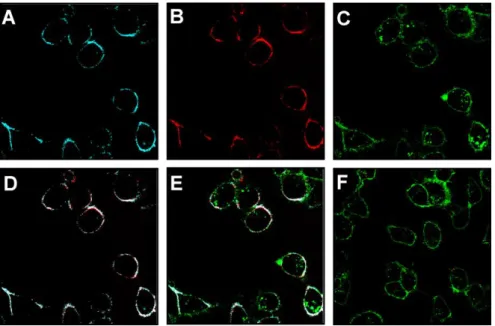
The activation of compounds 3L and 3D was also tested using confocal microscopy. After 24 h incubation of SKOV-3 cells with either compound, signals of both Ir(ppy)3 and Cy5 were observed (Figure 5). Compound 3L
showed bright signals of both luminophores inside the cells, indicating successful cleavage of the activatable imaging agent 3L in vitro. In contrast, in 3D the emission intensities of both luminophores were very weak, possibly due to non-specific cleavage by other enzymes. Nuclear staining with Hoechst was not possible due to spectral overlap with Ir(ppy)3.
A
D
B
F
E
C
Figure 5. Confocal images of SKOV-3 cells after 24 h incubation with 3L (A–C) or 3D (D–F). (A,D) Ir(ppy)3 channel in green; (B,E) Cy5 channel in red; (C,F) Overlay of both channels. Yellow means co-localization of red and green.
Lifetimes were also used to measure the cleavage reaction in suspension. Since the initial signal intensities of the quenched starting point were very weak, long measurement times (>3 h per sample) were necessary to provide reliable lifetimes. This made dynamic measurements during the cleavage reaction impossible. Therefore, we measured the luminescence lifetime of 3L and 3D only after the cleavage reaction was complete (Figure 6A). Again, the uptake of the polycationic Ir(ppy)3 peptide caused low
concentration of Ir(ppy)3 in solution, making lifetime measurements even
more difficult. The only conclusion that can be drawn from these measurements is that there is relatively more long-lifetime activated Ir(ppy)3 present after incubation of 3L compared to 3D (Figure 6A).
A
F
E
D
C
B
Figure 6. (A) Luminescence decay traces of a suspension of SKOV-3 cells after 24 h incubation with 3L (red) or 3D (blue); (B) FLIM image of cells incubated with 3L; (C) FLIM image of cells incubated with 3D. The scale bar on the left depicts
τ, going from 0 ns (blue) to 150 ns (red).
The potential of this new activatable lifetime imaging agent for Fluorescence Lifetime Imaging Microscopy (FLIM) is shown in Figure 6B,C. After incubation of SKOV-3 cells with either compound 3L or 3D (24 h), the average lifetime of each pixel of the microscopy image was measured. From that, the average lifetime of the luminescence signal from cells was determined. For 3L, the cleavable version, the average lifetime was 94 ns, while the control compound 3D gave a substantially different average lifetime of 57 ns. These values are only slightly different from the respective lifetimes measured in solution, 98 ns (Ir(ppy)3) and 43ns (3D), respectively
(see above). Based on the similarity in the spectroscopic measurements findings and the FLIM measurements, we feel confident that luminescence lifetime has provided a quantifiable readout for the MMP-2/9 induced activation of 3L. This is the second time that we have shown the value of the Ir(ppy)3-Cy5 combination for activatable luminescence lifetime imaging,
indicating that this combination has potential in different chemical formulations. Hence, it may also provide value in other—FRET based— designs for activatable imaging agents,[41] thereby generating added value for the quantification of different disease related features. As alluded to in the introduction, a reduction in autofluorescence and thus non-specific background signal may be achieved using the concept of activatable lifetime
0 100 200 300
50 500 5000
t / ns
C
o
u
n
ts
3L 3D
imaging. In this concept, the sensitivity of enzymatically activated luminescence intensification can be strengthened further by enzymatically activated lifetime prolongation. This effect combined with a disease specific enzyme may help increase signal-to-background ratios between healthy and diseased tissue in vitro or in the future possibly also in vivo. The latter may help provide new imaging concepts in the field of luminescence-based interventional molecular imaging.[42]
3.4.Conclusions
To conclude, a peptide-based activatable imaging agent based on quenching interactions between Cy5 and Ir(ppy)3 was obtained. This
peptide could be cleaved by the tumor-specific enzymes MMP-2/9, leading to an increase in luminescence intensity both in solution and in vitro. A control peptide which could not be cleaved showed no luminescence activation. In combination with Ir(ppy)3, this concept can now even be
extended to enzyme-induced activatable luminescence lifetime imaging.
1. Rao, J.; Dragulescu-Andrasi, A.; Yao, H.; Yao, H. Fluorescence imaging in vivo: Recent advances. Curr. Opin. Biotechnol. 2007, 18, 17–25.
2. Monici, M. Cell and tissue autofluorescence research and diagnostic applications. Biotechnol Annu Rev. 2005, 11, 227–256.
3. Billinton, N.; Knight, A.W. Seeing the wood through the trees: A review of techniques for distinguishing green fluorescent protein from endogenous autofluorescence. Anal. Biochem. 2001, 291, 175–197.
4. Berezin, M.Y.; Achilefu, S. Fluorescence lifetime measurements and biological imaging. Chem. Rev. 2010, 110, 2641–2684.
5. Hennig, A.; Roth, D.; Enderle, T.; Nau, W.M. Nanosecond time-resolved fluorescence protease assays. Chembiochem 2006, 7, 733–737.
6. Maliwal, B.P.; Fudala, R.; Raut, S.; Kokate, R.; Sorensen, T.J.; Laursen, B.W.; Gryczynski, Z.; Gryczynski, I. Long-lived bright red emitting azaoxa-triangulenium fluorophores. PLoS ONE 2013, 8, e63043.
background from fluorescence tissue images by use of time-gated detection and the azadioxatriangulenium (adota) fluorophore. Anal. Bioanal. Chem. 2013, 405, 2065– 2075.
8. Ruggi, A.; van Leeuwen, F.W.B.; Velders, A.H. Interaction of dioxygen with the electronic excited state of Ir(iii) and Ru(ii) complexes: Principles and biomedical applications. Coord. Chem. Rev. 2011, 255, 2542–2554.
9. Ruggi, A.; Beekman, C.; Wasserberg, D.; Subramaniam, V.; Reinhoudt, D.N.; van Leeuwen, F.W.B.; Velders, A.H. Dendritic ruthenium(ii)-based dyes tuneable for diagnostic or therapeutic applications. Chemistry 2011, 17, 464–467.
10. Kuil, J.; Steunenberg, P.; Chin, P.T.K.; Oldenburg, J.; Jalink, K.; Velders, A.H.; van Leeuwen, F.W.B. Peptide-functionalized luminescent iridium complexes for lifetime imaging of cxcr4 expression. Chembiochem 2011, 12, 1896–1902.
11. Longmire, M.; Choyke, P.L.; Kobayashi, H. Clearance properties of nano-sized particles and molecules as imaging agents: Considerations and caveats. Nanomedicine 2008, 3, 703–717.
12. Lovell, J.F.; Zheng, G. Activatable smart probes for molecular optical imaging and therapy. J. Innov. Opt. Health Sci. 2008, 1, 45–61.
13. Johnson, J.R.; Kocher, B.; Barnett, E.M.; Marasa, J.; Piwnica-Worms, D. Caspase-activated
cell-penetrating peptides reveal temporal coupling between endosomal release and apoptosis in an rgc-5 cell model. Bioconjug. Chem. 2012, 23, 1783–1793.
14. Urano, Y.; Sakabe, M.; Kosaka, N.; Ogawa, M.; Mitsunaga, M.; Asanuma, D.; Kamiya, M.; Young, M.R.; Nagano, T.; Choyke, P.L.; et al. Rapid cancer detection by topically spraying a gamma-glutamyltranspeptidase-activated fluorescent probe. Sci. Transl. Med. 2011, 3, 110ra119, doi:10.1126/scitranslmed.3002823.
15. Jiang, T.; Olson, E.S.; Nguyen, Q.T.; Roy, M.; Jennings, P.A.; Tsien, R.Y. Tumor imaging by means of proteolytic activation of cell-penetrating peptides. Proc. Natl. Acad. Sci. USA 2004, 101, 17867–17872.
16. Akers, W.J.; Xu, B.; Lee, H.; Sudlow, G.P.; Fields, G.B.; Achilefu, S.; Edwards, W.B. Detection of mmp-2 and mmp-9 activity in vivo with a triple-helical peptide optical probe. Bioconjug. Chem. 2012, 23, 656–663.
17. Lee, S.; Park, K.; Kim, K.; Choi, K.; Kwon, I.C. Activatable imaging probes with amplified fluorescent signals. Chem. Commun. 2008, 4250–4260.
18. Zlokarnik, G.; Negulescu, P.A.; Knapp, T.E.; Mere, L.; Burres, N.; Feng, L.X.; Whitney, M.; Roemer, K.; Tsien, R.Y. Quantitation of transcription and clonal selection of single living cells with beta-lactamase as reporter. Science 1998, 279, 84–88.
19. Dorokhin, D.; Hsu, S.H.; Tomczak, N.; Blum, C.; Subramaniam, V.; Huskens, J.; Reinhoudt, D.N.; Velders, A.H.; Vancso, G.J. Visualizing resonance energy transfer in supramolecular surface patterns of beta-cd-functionalized quantum dot hosts and organic dye guests by fluorescence lifetime imaging. Small 2010, 6, 2870–2876. 20. Kobayashi, H.; Choyke, P.L. Target-cancer-cell-specific activatable fluorescence
imaging probes: Rational design and in vivo applications. Acc. Chem. Res. 2011, 44, 83–90.
21. Dorokhin, D.; Hsu, S.H.; Tomczak, N.; Reinhoudt, D.N.; Huskens, J.; Velders, A.H.; Vancso, G.J. Fabrication and luminescence of designer surface patterns with beta-cyclodextrin functionalized quantum dots via multivalent supramolecular coupling. ACS Nano 2010, 4, 137–142.
23. Garcia-Beltran, O.; Mena, N.; Berrios, T.A.; Castro, E.A.; Cassels, B.K.; Nunez, M.T.; Aliaga, M.E. A selective fluorescent probe for the detection of mercury (ii) in aqueous media and its applications in living cells. Tetrahedron Lett. 2012, 53, 6598–6601. 24. Drake, C.R.; Miller, D.C.; Jones, E.F. Activatable optical probes for the detection of
enzymes. Curr. Org. Synth. 2011, 8, 498–520.
25. Aguilera, T.A.; Olson, E.S.; Timmers, M.M.; Jiang, T.; Tsien, R.Y. Systemic in vivo distribution of activatable cell penetrating peptides is superior to that of cell penetrating peptides. Integr. Biol. 2009, 1, 371–381.
26. Kessenbrock, K.; Plaks, V.; Werb, Z. Matrix metalloproteinases: Regulators of the tumor microenvironment. Cell 2010, 141, 52–67.
27. Westermarck, J.; Kahari, V.M. Regulation of matrix metalloproteinase expression in turner invasion. Faseb J. 1999, 13, 781–792.
28. Nelson, A.R.; Fingleton, B.; Rothenberg, M.L.; Matrisian, L.M. Matrix metalloproteinases: Biologic activity and clinical implications. J. Clin. Oncol. 2000, 18, 1135–1149.
29. Rood, M.T.M.; Oikonomou, M.; Buckle, T.; Raspe, M.; Urano, Y.; Jalink, K.; Velders, A.H.; van Leeuwen, F.W.B. An activatable, polarity dependent, dual-luminescent imaging agent with a long luminescence lifetime. Chem. Commun. 2014, 50, 9733– 9736.
30. Solomon, M.; Guo, K.; Sudlow, G.P.; Berezin, M.Y.; Edwards, W.B.; Achilefu, S.; Akers, W.J. Detection of enzyme activity in orthotopic murine breast cancer by fluorescence lifetime imaging using a fluorescence resonance energy transfer-based molecular probe. J. Biomed. Opt. 2011, 16, doi:10.1117/1.3594153.
31. Goergen, C.J.; Chen, H.H.; Bogdanov, A.; Sosnovik, D.E.; Kumar, A.T.N. In vivo fluorescence lifetime detection of an activatable probe in infarcted myocardium. J. Biomed. Opt. 2012, 17, doi:10.1117/1.JBO.17.5.056001.
32. Steunenberg, P.; Ruggi, A.; van den Berg, N.S.; Buckle, T.; Kuil, J.; van Leeuwen, F.W.B.; Velders, A.H. Phosphorescence imaging of living cells with amino acid-functionalized tris(2-phenylpyridine)iridium(iii) complexes. Inorg. Chem. 2012, 51, 2105–2114. 33. Lakowicz, J.R. Principles of Fluorescence Spectroscopy, 2nd ed.; Kluwer Academic:
New York, NY, USA, 1999.
34. Ishii, Y.; Yoshida, T.; Funatsu, T.; Wazawa, T.; Yanagida, T. Fluorescence resonance energy transfer between single fluorophores attached to a coiled-coil protein in aqueous solution. Chem. Phys. 1999, 247, 163–173.
35. Rabinovich, A.; Medina, L.; Piura, B.; Segal, S.; Huleihel, M. Regulation of ovarian carcinoma skov-3 cell proliferation and secretion of mmps by autocrine il-6. Anticancer Res. 2007, 27, 267–272.
36. Whitney, M.; Savariar, E.N.; Friedman, B.; Levin, R.A.; Crisp, J.L.; Glasgow, H.L.; Lefkowitz, R.; Adams, S.R.; Steinbach, P.; Nashi, N.; et al. Ratiometric activatable cell-penetrating peptides provide rapid in vivo readout of thrombin activation. Angew. Chem. 2013, 52, 325–330.
37. Savariar, E.N.; Felsen, C.N.; Nashi, N.; Jiang, T.; Ellies, L.G.; Steinbach, P.; Tsien, R.Y.; Nguyen, Q.T. Real-time in vivo molecular detection of primary tumors and metastases with ratiometric activatable cell-penetrating peptides. Cancer Res. 2013, 73, 855–864. 38. Lee, S.; Lee, J.; Hohng, S. Single-molecule three-color fret with both negligible spectral
overlap and long observation time. PLoS ONE 2010, 5, e12270.
40. Doose, S.; Neuweiler, H.; Sauer, M. Fluorescence quenching by photoinduced electron transfer: A reporter for conformational dynamics of macromolecules. Chemphyschem 2009, 10, 1389–1398.
41. Zadran, S.; Standley, S.; Wong, K.; Otiniano, E.; Amighi, A.; Baudry, M. Fluorescence resonance energy transfer (fret)-based biosensors: Visualizing cellular dynamics and bioenergetics. Appl. Microbiol. Biotechnol. 2012, 96, 895–902.
4
Abstract
The application of mammalian cells for therapy is finding its way into modern medicine. However, modification or “training” of cells so that they are applicable for a specific application, remains complex. In an attempt to provide a chemical technique that enables specific, but straight-forward and generic, cellular functionalization we investigated if membrane-receptor (pre)targeting could be combined with supramolecular host-guest interactions based on β-cyclodextrin and adamantane. The feasibility of this approach was studied in cells that (over)express the chemokine receptor 4 (CXCR4) on their surface; CXCR4 plays a key role in cellular motility. CXCR4 could be targeted specifically using an adamantane (Ad)-functionalized Ac-TZ14011 peptide (guest molecule; KD = 56 nM). To provide multivalent host
molecules, fluorescent and radiolabeled
4.1.Introduction
Cells are the cornerstones of mammalian life forms, their versatile surfaces are naturally evolved to express molecules which provide a refined means to interact with their surroundings, e.g. functionalizations.[1] These functionalities can stimulate and/or respond to cellular activity,[2] regulate vital processes such as hormone balance[3, 4] and induce immune responses.[5, 6] The strength of using cells for therapeutic purposes is progressively being recognized in medicine and is (among others) exploited in the form of immunotherapy and (stem) cell transplantations.[7-9] Such cell-based therapies often go alongside with relatively complex biological modification processes such as genetic modification[10] or metabolic tampering.[11] As each medical application desires specialized features and functions, these modification processes differ for each cell type and the pursued application. Ideally, interaction-enhancing functionalizations can be realized on different cell types using well defined and generic (chemical) functionalization approaches.[12]
aqueous environments, supramolecular host-guest interactions, e.g. using beta-cyclodextrin (β-CD) and adamantane (Ad), provide outcome.[28-30] Membrane-expressed biomarkers provide a unique and specific fingerprint for cell populations and allow efficient and specific targeting using vectors such as antibody-derivatives and peptides.[31] Such vectors are routinely used for applications in imaging and therapy.[32] Not only can specificity be achieved by directly targeting the receptor, indirect targeting can also be applied in a pretargeting setup. Here a receptor-targeting vector is first directed towards the membrane receptor, which is then followed by a secondary functionalization, using an agent that contains e.g. a diagnostic or a therapeutic label.[33-35] Other than applying the pretargeting concept to introduce such diagnostic/therapeutic labels, the same concept could potentially also be used to introduce other functionalities such as guest moieties that provide a base for further functionalizations.