Abstract:
It is important to study DNA damage such as double strand breaks (DSBs) because DSBs can cause cancer and genomic instability. DSB are repaired by homologous recombination which can cause a crossover or non-crossover event. Crossovers are detrimental because they can lead to genomic instability. Synthesis dependent strand annealing (SDSA) is a form of double strand break repair (DSBR) without crossovers. It is beneficial because it protects against genomic instability. This experiment seeks to determine the role of Marcal1 in SDSA in Drosophila melanogaster using a P{wa} P-element system in a fly line with a Marcal1 deletion. Marcal1 was studied because we have evidence that it is involved in some aspect of DSBR; however, it is unclear about which aspect of DSBR. It is hypothesized that when Marcal1 is deleted and DSBs are induced in the fly line, there will be an increase in aberrant repair. Results show an increase in aberrant repair and a decrease in SDSA, indicating that Marcal1 has a role in SDSA. PCR results of the aberrant repair flies found no statistical difference in the tract lengths between wild type flies and Marcal1 mutant flies.
Introduction:
(SIOD), an autosomal recessive disorder of T-cell deficiency, nephropathy, and growth retardation (Postow et al. 2009).
Previous studies have found SMARCAL1 to have a role in repair during DNA replication. Silencing SMARCAL1 makes cells hypersensitive to replication stress-inducing agents such as hydroxyurea, camptothecin, and aphidicolin (Baradaran-Heravi et al. 2012). During replication stress, SMARCAL1 localizes to sites of stalled replication by co-localizing with RPA2. ATM, ATR, and DNA-PK kinases phosphorylate SMARCAL1 to start a signal cascade (Bansbach et al. 2009). RNAi knockdown of SMARCAL1 causes an increase in DNA damage and cell cycle arrest (Bansbach et al. 2010).
Marcal1 is the ortholog of SMARCAL1 in Drosophila melanogaster, which was used as
SMARCAL is needed for annealing helicase activity (Bansbach et al. 2014). The distance between the two domains in flies is not appreciably different.
Studies with Drosophila Marcal1 have shown that it may be involved in transcription. Marcal1 binds to H3K4me3, which is a marker of open chromatin and an indicator of transcription rather than replication (Baradaran-heravi et al. 2012). However, both Marcal1 and SMARCAL1 can move Holliday junctions and dissociate D-loops in vitro which are template switching intermediates. Sensitivity assays performed by our lab indicate Marcal1 mutants are not sensitive to replication stress-inducing agents (unpublished data). These data are consistent with recently published biochemical studies that show that, unlike SMARCAL1, Marcal1 cannot unwind model replication forks (Kassavetis et al. 2014). Altogether, these data suggest D. melanogaster Marcal1 may have a role in DSB repair via synthesis dependent strand annealing
(SDSA) or homologous recombination (HR)—a role that has not been studied in metazoans to date.
Both HR and SDSA are forms of high fidelity double strand break repair (DSBR). SDSA is a form of HR that does not produce crossovers. When a DSB is repaired by SDSA, the 5’ ends are resected to produce 3’-ended single stranded tails (Figure 2). One of the strands invades the
been found to dissociate D-loops, but its mutation has less of an effect on DSBR than Blm (Kuo et al. 2014). The results of the Marcal1 studies outlined in this project may implicate that
Marcal1 plays a role in DSB repair which has not yet been explored in SMARCAL1.
Materials and Methods:
Fly Stocks
D. melanogaster were raised on standard cornmeal-based media at 25°C. The fly crosses
P{wa} Assay
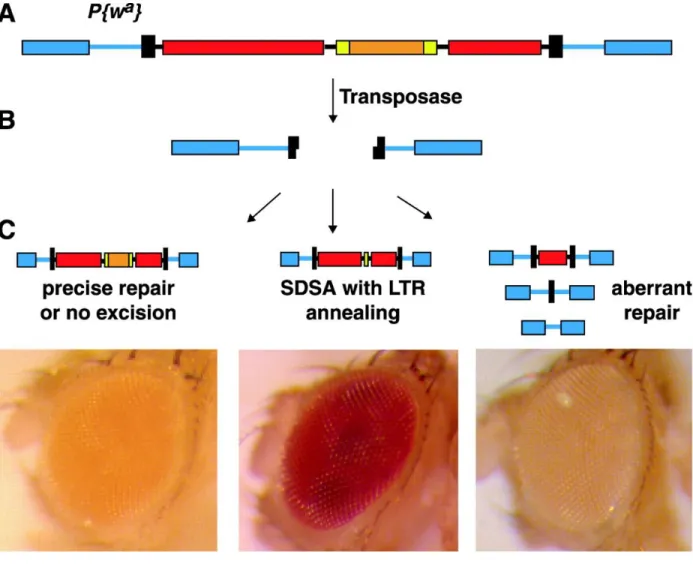
A P{wa} P-element system previously designed by our lab was used to determine if Marcal1 plays a role in SDSA. Briefly, the system utilizes a P-element containing the white gene that is inserted into the X chromosome of D. melanogaster. Copia is inserted into an intron of the w gene and there are repeated 276-bp long terminal repeats (LTRs) at each end of the copia
retrotransposon, resulting in the wa allele. P transposase was used to excise the P{wa} element, generating a DSB and large gap.
Results:
We adapted an assay published by our lab in Adams et al. (2003) to test SDSA efficiency in Marcal1 mutants. Fly eye color was used to indicate the type of DSB repair utilized by Marcal1 mutants using the P{wa}system. The P{wa} system consists of a P-element insertion on the X chromosome that contains the white (w) gene. In normal flies, w+ gene causes red colored eyes; however, the P{wa} construct has a copia element flanked by long terminal repeats (LTRs) inserted in an intron of the white gene decreasing gene expression and causing apricot-colored eyes, wa (Figure 3). Marcal1 mutant flies with the P{wa} construct were crossed to a transposase source. The transposase excises the P{wa} by a DSB at its ends, creating a large gap for repair. The fly’s eye color is indicative of the way the gap is repaired. If the gap is repaired by SDSA,
caused by the presence of the entire P{wa} P-element. This can be caused by non-excision of the P{wa} or by excision and complete repair to restore the P{wa} element. Yellow eyes are an indicator of aberrant repair causing the loss of white activity (Adams et al. 2014). We performed this assay in male flies. Males were used because males do not have meiotic recombination, so any repair event was the result of mitotic DNA damage repair.
The percentage of red, apricot, and white-eyed Marcal1 deletion flies were compared to the percentages of red, apricot, and white-eyed wild-type flies to determine the effect of the Marcal1 deletion. The Marcal1 deletion flies had an increase in aberrant repair, a decrease in
complete SDSA, and an increase in overall gap repair (Figures 4 and 5).
After the flies were scored, PCR was used to determine the extent of synthesis in aberrant repair events. There was no statistical difference in the tract lengths between wild type flies and Marcal1 mutant flies (Figure 6).
Discussion:
We hypothesized that Marcal1 is involved in SDSA. As expected, we found that Marcal1 mutant flies had an increase in aberrant repair, a decrease in total repair, and decrease in SDSA. We hypothesized that Marcal1’s role in SDSA is to facilitate the homology search by anneal the
but Fancm may be a backup repair pathway to Blm (Kuo et al. 2014). Because Marcal1 mutants do not have a decrease in tract synthesis or increase in flanking deletions like Blm and because Marcal1 has known annealing activity, Marcal1 could still play a role in the annealing step of SDSA. Marcal1 could also dissociate D-loops. The role of Marcal1 remains unclear.
Figure 4. This figure illustrates that Marcal1 mutants have fewer total repair events.
References:
Adams, Melissa D, Mitch McVey, and Jeff J Sekelsky. “Drosophila BLM in Double-Strand Break Repair by Synthesis-Dependent Strand Annealing.” Science (New York, N.Y.) 299.5604 (2003): 265–7. Web. 30 Nov. 2014.
Bansbach, Carol E et al. “The Annealing Helicase SMARCAL1 Maintains Genome Integrity at Stalled Replication Forks.” Genes & development 23.20 (2009): 2405–14. Web. 22 Feb. 2014.
Bansbach, CE, CF Boerkoel, and David Cortez. “SMARCAL1 and Replication Stress.” Nucleus 1.3 (2010): 245–248. Web. 22 Feb. 2014.
Baradaran-Heravi, Alireza, Kyoung Sang Cho, et al. “Penetrance of Biallelic SMARCAL1 Mutations Is Associated with Environmental and Genetic Disturbances of Gene Expression.” Human Molecular Genetics 21.11 (2012): 2572–2587. Print.
Baradaran-Heravi, Alireza, Anja Raams, et al. “SMARCAL1 Deficiency Predisposes to Non-Hodgkin Lymphoma and Hypersensitivity to Genotoxic Agents in Vivo.” American journal of medical genetics. Part A 158A.9 (2012): 2204–13. Web. 11 Feb. 2014.
Bétous, Rémy et al. “SMARCAL1 Catalyzes Fork Regression and Holliday Junction Migration to Maintain Genome Stability during DNA Replication.” Genes & development 26.2 (2012): 151–62. Web. 22 Jan. 2014.
Holsclaw, Julie Korda. Determining the Role of Blm and Marcal1 Helicases in Replication Fork Remodeling and Progression. N.p. Print.
Kassavetis, George a, and James T Kadonaga. “The Annealing Helicase and Branch Migration Activities of Drosophila HARP.” PloS one 9.5 (2014): e98173. Web. 2 Oct. 2014.
Kuo, H, Susan McMahan, Christopher Rota, Kathryn Kohl, and Jeff Sekelsky. “Drosophila FANCM Helicase Prevents Spontaneous Mitotic Crossovers Generated by the MUS81 and SLX1 Nucleases.” Genetics 198 (2014): 935-945. Print.
McVey, Mitch, Jeannine LaRocque, Melissa Adams, and Jeff Sekelsky. “Formation of deletions during double-strand break repair in Drosophila DmBlm mutants occurs after strand invasion.” PNAS (2004): 15694-15699. Print.
“Overview | flyCRISPR.” N.p., n.d. Web. 30 Nov. 2014.