AN EXPLORATION OF SOCIAL PARTICIPATION FOR YOUNG ADULTS FOLLOWING A FIRST PSYCHOTIC EPISODE
Valerie Fox
A dissertation submitted to the faculty of the University of North Carolina at Chapel Hill in partial fulfillment of the requirements for the degree of Doctor of Philosophy in the
Department of Allied Health Sciences (Occupational Science).
Chapel Hill 2016
Approved by: Antoine Bailliard Nancy Bagatell Virginia Dickie Sue Estroff
© 2016 Valerie Fox
ABSTRACT
Valerie Fox: An Exploration of Social Participation for Young Adults Following A First Psychotic Episode
(Under the direction of Antoine Bailliard)
Individuals with mental illness continue to be among the most excluded in society. Adolescents and young adults with psychotic disorders often fare worse than their peers in areas such as education and the adoption of adult social and occupational roles. Although various factors have been identified that influence this exclusion and impairment, studies have predominantly focused on stigma with insufficient attention paid to other societal factors influencing participation (e.g., socioeconomic status, normative age expectations, and social institutions). In addition, there is a notable gap in the literature studying
participation beyond that of employment for individuals with first episode psychosis (FEP). Numerous studies have shown that the ability to participate and interact with others is vital to recovery for people with mental illness. Indeed, participation and social interaction promote the development of social networks to support the recovery process, encourage engagement in meaningful activity, and foster community integration. A thorough
guiding theoretical frameworks for this study. Semi-structured interviews, participant observations, and discourse elicitation were used for data collection. Seven factors were revealed that impacted consultants’ social participation: 1) social norms and expectations; 2) a sense of responsibility to others; 3) consultants’ occupational histories and prior routines, including their relationships prior to the illness; 4) change in the physical and social
ACKNOWLEDGEMENTS
At times our own light goes out and is rekindled by a spark from another person. Each of us has cause to think with deep gratitude of those who have lighted the flame within us.
-Albert Schweitzer To be honest, I did not plan to pursue a doctoral degree, but as has happened
numerous times, the people in my life saw a potential and opportunity that I did not see. I am beyond blessed to have the support and mentorship that I currently have and have had in the past. First and foremost, I extend expense gratitude to my husband and true partner, Kyle Fox. He did not hesitate to support me when I decided to pursue a doctoral degree and he has been my rock throughout this experience. To have the unwavering support and confidence of someone like this is a blessing beyond compare. In addition, my family, friends, and supportive cohort have been immensely helpful through their encouragement and guidance. From the early life lessons to the regular check-in phone calls, my parents have been an unending source of support. One of their many lessons was one of
commitment in that once you commit to something, quitting is not an option. That lesson has helped me through this process and many other journeys throughout my life. I am thankful for those lessons, many of which were not easy but helped me develop the discipline and strength I needed to succeed. And to my cohort, the community that has been developed over these last few years will forever be treasured; I am thankful for your camaraderie, collaboration, and most of all your friendship.
for occupational therapy and a drive to continue to expand the field. I will be forever grateful for the knowledge they shared, for challenging me to always be a better clinician and scholar, and equipping me with the tools I needed to make a difference in the world. Thank you to Dr. Virginia Dickie for being my mentor and guide throughout the masters and doctoral program, whether she knew it or not. I have always admired her ability to imagine new pathways for occupational science, her passion for mental health and continued learning, her honesty and directness in sharing her ideas, and her ability to foster
TABLE OF CONTENTS
LIST OF TABLES ... xii
LIST OF FIGURES ... xiii
CHAPTER 1: INTRODUCTION ... 1
1.1 Introduction ... 1
1.2 Purpose of the Study ... 3
1.3 Significance and Contribution ... 4
1.4 Chapter Organization ... 5
CHAPTER 2: THEORETICAL FRAMEWORKS AND LITERATURE REVIEW ... 7
2.1 Theoretical Frameworks ... 8
2.1.1 Transaction ... 8
2.1.2 Life Course ... 14
2.1.3 Theories of Action ... 16
2.2 Literature Review ... 19
2.2.1 First Episode Psychosis ... 19
2.2.2 Social Participation ... 21
2.2.3 Factors Impacting Social Participation ... 25
2.2.4 Identity and Social Participation ... 28
2.2.5 Occupational Science’s Stance on Identity and Participation ... 32
CHAPTER 3: METHODS ... 35
3.1 Overview ... 35
3.2 Consultants ... 38
3.4 Data Collection, including Benefits and Drawbacks to each Approach ... 41
3.4.1 Participant Observations ... 41
3.4.2 Semi-structured Interviews ... 47
3.4.3 Discourse Elicitation ... 54
3.5 Data Analysis ... 62
CHAPTER 4: EXPLORATION OF SOCIAL FACTORS IMPACTING SOCIAL PARTICIPATION ... 64
4.1 Social Norms and Expectations ... 65
4.1.1 Stuck in a Liminal Space of Dealing with Mental Illness ... 68
4.1.2 Normative Expectations for Determining Socially Appropriate Behaviors ... 70
4.1.3 Impact of Social Norms and Age Expectations on Belonging ... 71
4.2 Sense of Responsibility to Others ... 73
4.2.1 Impact of Sense of Responsibility on Belonging ... 74
4.3 Occupational History and Prior Routines ... 75
4.3.1 Relationships Prior to the Illness ... 78
4.3.2 Impact of Occupational History and Prior Routines on Belonging ... 82
4.4 Change in the Physical and Social Environment ... 83
4.4.1 ‘Hiding Out’ in Public Places ... 87
4.4.2 Comfort via Shared Experience ... 87
4.4.3 Impact of Changes in the Physical and Social Environment on Belonging ... 88
4.5 Types of Participation Available ... 90
4.5.1 Adapting Participation Styles at Various Stages of the Illness ... 93
4.5.2 Impact of Varied Types of Participation on Belonging ... 94
4.6 ‘Managing’ the Illness ... 95
4.6.2 Impact of Managing the Illness and Fear of Relapse on
Belonging ... 98
4.7 Self-perception and Perceived Occupational Possibilities ... 100
4.7.1 Impact of Self-perception and Perceived Occupational Possibilities on Belonging ... 101
4.8 Summary of Findings ... 102
CHAPTER 5: OCCUPATION AS MEDIUM FOR IDENTITY WORK ... 103
5.1 Hospitalization Experience as Initial Identity Construction Period: “Feeling like a Waste to Our Society” ... 103
5.2 Emotional Link with Identity ... 106
5.3 Power to Define Oneself ... 112
5.4 Role of Media in Integrating Illness Identity ... 114
5.5 Identity Work: Drawing Intra-group Distinctions ... 116
5.6 Intersectionality of Identities ... 119
5.7 Positive Factors of Adopting the ‘Mentally Ill’ Identity... 122
5.8 Summary ... 123
CHAPTER 6: DISCUSSION ... 125
6.1 Summary of Findings ... 125
6.1.1 Social Participation and Belonging ... 125
6.1.2 Rethinking the Experience of FEP Relative to Belonging ... 134
6.1.3 Reframing FEP as a Problematic Situation ... 135
6.1.4 Belonging and Identity ... 137
6.1.5 Liminal Space of FEP: Importance to Identity Work and Social Participation ... 139
6.2 Limitations ... 146
6.3.1 Future Avenues for Research ... 148
CHAPTER 7: CONCLUSION ... 153
APPENDIX A: RECRUITMENT FLYER... 158
APPENDIX B: INFORMED CONSENT... 159
APPENDIX C: LIST OF CONSULTANT OBSERVATIONS ... 163
APPENDIX D: SEMI-STRUCTURED INTERVIEW QUESTIONS ... 166
APPENDIX E: PHOTOS USED DURING DISCOURSE ELICITATION ... 168
APPENDIX F: CONSULTANT IDENTIFIED DISCOURSE ... 169
LIST OF TABLES
LIST OF FIGURES
CHAPTER 1: INTRODUCTION 1.1 Introduction
Mental illness affects one in five adults in the US, accounting for 13% of the global burden of disease (SAMSHA, 2012; WHO, 2012). The nature of mental health problems and stigma, as well as limitations in income and employment, have detrimental effects on
interpersonal relationships for individuals with mental illness, leading to reduced
opportunities for social contact and occupational participation (Huxley & Thornicroft, 2003). Prince and Gerber (2005) found that although individuals with psychiatric disabilities living in the community were able to access basic resources, they remained socially isolated and only minimally interactive with others in their community. In addition, cognitive deficits (e.g., executive function, memory, attention, and verbal learning), as well as social impairments resulting from positive and negative symptoms lead to significant functional impairments for individuals with psychotic disorders (Sharma & Antonova, 2003).
(Birchwood et al., 1998; Harrison, et al., 2001). There is a need to develop treatment that is more suitable to the earlier phases of illness and to younger client populations (Malla & Payne, 2005).
As a mental health clinician, it has become apparent in my clinical practice that traditional individual-based interventions are inadequate to foster significant change in social and occupational functioning. There is a paucity of available intervention strategies that address the social barriers that limit participation for adults with FEP. Understanding the impact of social factors on participation and life trajectories following FEP can inform the development of interventions and policies to effectively target the early stages of mental illness to mitigate long-term effects on health and well-being.
To date, clinical interventions and research have primarily focused on the individual and experiences of stigma with little regard to how social forces impact recovery and
community participation. While psychopathology is important for understanding experiences of mental illness, it is equally important to study how mental illness affects quality of life, participation in occupation, and social functioning (Malla & Payne, 2005). According to these authors, research must study the complex relationships between factors that predict
lacking (Boydell et al., 2010). Boydell et al. called for an extension of the scope of qualitative research to examine the full trajectory of FEP. Occupational science nor the broader social science literature have focused on occupation and pathways for participation for FEP; this is a current gap in research.
1.2 Purpose of the Study
The objective of this collaborative ethnography was to explore participation in social life for young adults following their first psychotic episode. To meet this objective, the study adopted two specific aims: 1) explore the sociocultural mechanisms that facilitate or hinder the experience of social participation for young adults following FEP; and 2) explore
perceived opportunities for participation for young adults following FEP. It was anticipated that social elements played at least an equally important role as individual factors in facilitating or hindering community participation for young adults following a first psychotic episode. Identifying those social factors, in addition to exploring the interplay between the individual and social components, is important for improving clinical outcomes and
participation in meaningful life roles. The purpose of aim 2 was to understand how social factors and perceptions impact individual function and were adopted by the individual. It was assumed that individuals adjusted their life goals and pathways following first episode psychosis based on social stereotypes, perceived opportunities available to them, and anticipated success in future life roles. Using discursive examples to examine social beliefs and factors impacting participation served three purposes: 1) to explore the social messages being produced in a local context; 2) determine how each individual responded to such messages, and 3) ascertain whether these discursive examples impact an individual’s perceived possibilities for participation in particular contexts.
The intent of this study was two-fold. First, this study filled a gap in qualitative
provided preliminary data to focus early intervention practice and research, program development, and improve functional outcomes on a broader scale for those with mental illness.
1.3 Significance and Contribution
This research contribution is significant for two reasons. First, this research
increased knowledge of sociocultural elements that influence social participation, which is an area of focus in the President’s New Freedom Commission on Mental Health and vital to community and societal well-being. Without a holistic understanding of the societal factors that influence individual action, intervention is limited in its scope and may not be as effective if the most significant barrier to participation is beyond the individual. When the individual is the focus of attention, broader sociocultural elements are often left unaddressed (Whiteford & Hocking, 2012). Because individual participation occurs through social
environments, interventions that address social factors will consequently impact individual participation. While outside of the scope of this particular study, this study generated preliminary data to inform early intervention practice, specifically focused on the social elements influencing participation, which could lead to better functional outcomes and reduce the need for chronic management of illness.
Second, this research is significant to occupational science because it extended understandings of sociocultural factors impacting occupational participation, while also expanding application of existing occupational concepts to new populations. Occupational science research on older adults has examined how social structures and neoliberal
mental illness, in part due to the social perceptions and elements influencing social
engagement. Prior to this research, occupational science has not explored the experience of first episode psychosis and how this population negotiates occupational participation.
Understanding occupation is central to the experience of FEP. Research examining FEP has not explored the role occupation serves in supporting well-being, quality of life, and role expansion. This study filled this gap both within the occupational science literature, as well as the broader mental health literature. In addition, this study discussed the ways to expand occupational therapy’s role in early intervention for FEP via a focus on occupation as central to the experience of FEP.
1.4 Chapter Organization
This chapter has served to provide an overview of the current state of affairs for first episode psychosis research, including gaps in the research and limitations in clinical
interventions. In addition, the importance of this study in filling those gaps and offering preliminary data to expand more effective clinical and social interventions has been
underscored. In the next chapter, I present my philosophical perspective and the theoretical frameworks that guided the design and analyses of this study. Subsequently, I will review the current body of literature in occupational science and other social sciences in relation to social participation and identity. In the third chapter, I present the study design and
CHAPTER 2: THEORETICAL FRAMEWORKS AND LITERATURE REVIEW The philosophical assumptions underlying a researcher’s work have strong implications for the type of research conducted and the knowledge produced. Science is fundamentally a social construct and values and beliefs are inherent to scientific work (Bishop, 2007); there are “no theory-free approaches or methods…they all presupposed a number of things about what the world is really like, what truth about it would resemble, and what is worth knowing in the first place” (p. 50). I have adopted the social constructionist paradigm, which assumes that knowledge is socially constructed and shaped, often through interactions. This view requires questioning the taken-for-granted assumptions and opposes the idea that knowledge is objective and unbiased (Burr, 2015; Crotty, 1998; Daly, 2007). Through our interactions with our world, meanings and interpretations are constructed and shaped by shared societal and cultural beliefs, values, and perceptions. Daly (2007) affirmed, “We don’t simply create idiosyncratic meanings of behavior, but we construct meanings on the basis of socially available, shared understandings of reality” (p. 32).
Because meaning is constructed from being in the world, it is contingent on interactions with others (Daly, 2007). Accordingly, reality or truth can be represented or interpreted in multiple ways and there is no one way, objective truth or way of seeing the world. This philosophical orientation framed the design of this study including methods for data collection and
analysis.
each theoretical perspective that specifically relate to this study and how I understand the findings.
2.1 Theoretical Frameworks 2.1.1 Transaction
A holistic examination of the experience of FEP requires a broad theoretical theory that highlights society as much as the individual while blending them into a unified
observable relationship: action. The transactional perspective on occupation (Dickie,
Cutchin, & Humphry, 2006) offers such a theory. The perspective suggests an “ever-present and always changing interpenetration of humans and their world” (p. 88) wherein all entities are co-defining and continuous. The transactional perspective is a relational perspective; the focus is on the relationships or the interplay of elements that constitute any given situation. Interaction and self-action imply a duality between a person and their world; though a person may interact with their world, these two concepts are viewed as distinct entities. Transaction transcends interaction and self-action, highlighting that focusing on the
interaction between elements is insufficient for understanding the way in which people and their environments co-define and co-constitute each other (Cutchin & Dickie, 2013). According to Humphry and Wakeford (2013), “A transactional perspective serves as a metatheory and reflects a different view of what can be known. It realigns our focus, away from the individual and onto the relationships among all elements of a life situation” (p. 216). They termed this holistic system the occupational situation, “comprised of multiple
interpenetrating elements, including the person, the occupation, and temporal, cultural, social, and physical contexts, but which is also more than the sum of those parts” (p. 219).
Functional coordination is a “dynamic, coordinated restructuring of relationships of person and situation” (Cutchin & Dickie, 2013, p. 27). Functional coordination results in a
harmonious balance or fit of a person and their situation where all parts work together towards a functional outcome: the ability to act and participate in their world. According to Dewey, when a situation becomes problematic, there is a loss of coordination amongst the elements in a given situation. To resolve this, individuals must coordinate their action with their environments to again achieve functional coordination of the situation. Individuals do this by imagining new possibilities for action and restructuring their habits.
Dewey claimed that habits dominate transactions, “operating subconsciously to foster basic functional coordination of the person-context relationship” (Aldrich, 2008, p. 152). For Dewey, habits are “social tools…functions acquired from both natural and social dimensions of our habitats…that are at the ready as potentialities and only actualized through transactional coordination with a situation” (Cutchin, 2007, p. 525). They are the building blocks of all action. Habits allow individuals to act in their world more efficiently, leaving more energy available for creative thinking and action. People act, think, or feel according to a more or less stable, foreseeable pattern of behavior; these patterns of behavior are largely influenced by past experiences and historical events (Fesmire, 2003). The automaticity of habits can be very helpful in moving through daily life if the habits used are effective; they can provide stability and “serve as a platform for exploring additional ways of being in the world” (Fritz, 2014, p.167). However, when they become ineffective and are not adapted, habits can be detrimental.
the individual and their environment. Examining psychosis in this way encourages understandings of the illness as a relational issue that extends beyond the individual. In addition to the habits disrupted by the illness, new habits may be acquired through the experience of mental illness and these must be coordinated with other habits while
participating in certain social settings (Davidson, 2007). For example, new medication habits or routine medical appointments will have to be coordinated with habits already operating in certain contexts, such as work or school. Individuals may have to take time off of work, schedule appointments in the evening, or receive adaptations to utilize habits needed for illness management, while also coordinating the habits of the environment in which they are participating. They may have group projects that require evening meetings that interrupt medication routines or sleep habits needed for symptom management.
The ability to functionally coordinate, and thus recover, requires opportunities for action and inquiry. It is through action that people “express the habits of the present self and form the future self” (Garrison, 2001, p. 16). For Dewey, participation in community is the primary mode through which humans grow their capabilities (Cutchin & Dickie, 2012). Opportunities for growth are revealed through contact with others and their ways of being (i.e., habits) (Fesmire, 2003). Habits emerge from participation in the world and exist only through the relationships that support or limit the use of habits; they can never be viewed as internal to or deriving from the individual (Cutchin & Dickie, 2012). While social factors condition and limit us, Dewey also emphasized that through social participation, we
relationships within a context, subfunctions of larger functions” (p. 125). Dewey
acknowledged the relationship between habits and the broader environing conditions and social structures, as well as the limited impact of agency in changing habits. Indeed, Fesmire (2003) noted, “[Habits] cannot magically be changed simply by will or coercion” (p. 21). Thus, focusing on how habits are adjusted following FEP, including how these habits are shaped via social factors, could offer new insights to understand the situation of FEP and how to assist individuals with FEP to functionally coordinate their situation following a psychotic episode. According to the transactional perspective, all elements comprising a situation (e.g., person, environment, policies, etc.) can have an impact on the actions generated by that situation. Consequently, the environment, policies, organizations, and cultural attitudes can limit possibilities for action and thus possibilities for functional coordination.
The transactional perspective is a useful framework for exploring the relationship of broad sociocultural factors and participation and its impact on individuals with first episode psychosis. In thinking about participation, research needs to move away from a focus on individual performance to investigate the array of factors that impact an individual or group’s participation. A focus on individual performance overemphasizes individual responsibility for recovery, while undervaluing the impact of social factors that influence individual functioning and ability to engage in social life. As Dickie et al. (2006) asserted “an understanding of individual experience is a necessary but insufficient [emphasis in original] condition” (p. 83) for understanding the complexity of occupation. The transactional view encourages
Participation in social life is the primary way humans expand their capacities and grow as both individuals and societies (Cutchin & Dickie, 2013). Occupation is the primary mode through which participation occurs in communities. It is a form of relational action through which functional coordination between person and environment is achieved
(Cutchin, Aldrich, Bailliard & Coppola, 2008). Through occupation, experience and meaning are realized, identities are formed, societal interaction occurs, and habits are modified for improved living (Cutchin, 2013; Hasselkus, 2002; Laliberte Rudman, 2002; Wilcock, 2006). Given occupation’s position as the relational glue (Cutchin et al., 2008), it is logical and essential to focus on occupation when attempting to study a complex, interdependent system. In utilizing the transactional perspective, the focus of inquiry shifts away from substances comprising a situation to focus on the relationships joining those substances. In the case of first episode psychosis, it refocuses attention to the relationships between determinants of participation and allows for examination and intervention at the social level, which was the goal of this study. As Cutchin and Dickie (2013) underlined, “It is the
relationships among things, not what takes place within things, which should hold a
scientist’s attention” (p. 27). Utilizing a transactional perspective to examine occupation and participation for individuals with FEP provides a way to achieve insight into the social and cultural processes that shape situations and the actions that influence those situations. According to Cutchin, Dickie, and Humphry (2006), such an approach empowers occupational scientists to address broad sociocultural concepts and concerns that limit engagement in occupation.
2.1.1.1 Anti-dualism
The relational nature of transaction emphasizes an anti-dualistic approach to research and clinical practice. The transactional perspective denies the existence of a dualism between individuals and their physical or social environments. Rather, it
other and they continuously influence each other. This anti-dualistic stance is important for examining first episode psychosis and social participation and fully understanding the complex situation of FEP. Many dualisms exist in the health field, especially when examining mental illness. Dualisms, such as mind-body or person-context fail to
acknowledge the fluid transactional relationship between elements. Container metaphors continue to exist when discussing the person, the environment, and health as if they could be separated into distinct entities. Aldrich and Cutchin (2013) highlighted the traditional view of the body in the health sciences:
To speak of the body in the health sciences is to speak of a physical form: a corporeal, fixed object encapsulating organs, bones, and the mind. Implicit in this idea of the body is the idea of separation, of an individual figure whose shape and contents are restricted and apart from the rest of the world…When the body is viewed only as a physical container for the human being, it becomes challenging to deal with the non-physical features of human life. For example, the question of how culture and environment affect the body arises only when the body’s separation from the world is taken as a starting point. (p. 14)
This same notion can be applied to the mind when discussing how traditional research has examined mental illness. For example, medication adherence is a common term amongst mental health providers. Clinicians often focus on why clients are medication non-adherent despite physician recommendations without consideration of social and environmental factors that impact this behavior (e.g., education level, socioeconomic status, history and past experiences of family members who have taken medications, power dynamics between clients and mental health providers, or spiritual beliefs about medication). Adopting a non-dualistic approach could facilitate creative thinking about a person’s recovery and shift treatment towards more holistic interventions that address various aspects of the situation of mental illness.
the client, without fully addressing the relationship of the person and their environment (Garrison, 2001). A transactional view replaces this dualistic framework and instead focuses on the relationship of things. Aldrich and Cutchin (2013) argued that adopting a transactional view of the body and mind refocuses science to examine the process of embodiment
whereby humans actively live through non-bodily aspects of the world. These authors accentuated that embodiment is always a collective process due to the social and communal aspects involved in the process of embodiment; thus, the more integrated an individual is into social life, the more potential there may be for growth and recovery.
Adopting the transactional perspective in examining first episode psychosis offers vast potential for expanding the social and health sciences. First, the transactional perspective replaces the dualistic view of person and environment with a view of active embodiment whereby all elements in a given situation are related and should be examined as such. Second, focusing on first episode psychosis as a problematic situation that requires functional coordination through engagement in occupation expands occupational sciences’ role with this population and could serve to enhance social programs and less-stigmatized approaches towards mental health treatment. And third, adopting a transactional
perspective expands the various lines of inquiry to be examined with the goal of deepening and widening our knowledge of the role occupation plays in health and well-being.
2.1.2 Life Course
throughout the life-span and emphasizes that living is a highly contextualized, social process in which individuals change social positions and roles across the course of their lives
(Diewald & Mayer, 2009). The life course theory moves beyond an emphasis on the physical, mental, social, and emotional changes occurring within an individual to study the broader factors impacting roles acquired during the life course. There are five principles of life course theory (Elder, 1999): 1) Human development and aging are life-long processes (accumulated experiences with past occupations impact current forms of engagement); 2) Antecedents and consequences of life transitions and events vary according to their timing in a person’s life (i.e., normative expectations, age cohorts); 3) Lives are linked
interdependently and social-historical influences are expressed through this network of shared relationships; 4) Historic events and times shape the life course of individuals; and 5) Individuals construct their own life course through the choice and actions they take within the opportunities and constraints of history and social circumstances.
Humphry and Womack (2014) affirmed, “The life course perspective encourages us to acknowledge the intertwined factors leading to the complexity of any one person’s occupational engagement…life course perspective illustrates what people do is simultaneously individual, interpersonal, social and historical” (p. 11). Examination of changes in the life course enables investigation of the links between macro-level elements and occupational possibilities; increased understanding of the political, social, cultural, and historical influences on occupation can help to shape environments that maximize
occupational possibilities (Laliberte Rudman, 2010).
2.1.2.1 Application of Life Course Perspective to FEP
other major life transitions such as expectations for increased independence and career planning. Typical onset of FEP occurs at a life stage that is fraught with normative age expectations and social demands that impact self-perception and confidence in managing their health. By adopting a life course perspective, occupational scientists are encouraged to examine the experience of FEP from a variety of perspectives, including the ways normative age expectations impact occupational choices and self-efficacy; how societal, cultural, and individual histories impact current function and future occupational possibilities; and the shared relationships inherent to mental health treatment that impact occupational function. 2.1.3 Theories of Action
There are two primary action theorists who have drastically shaped how I have approached this research study: Pierre Bourdieu and John Dewey. John Dewey’s perspective on transaction has already been discussed. This section will focus on
is determined by the unequal distribution of capital versus the characteristics of players in the field. The game, which was a powerful metaphor used by Bourdieu, epitomizes the domination, competitiveness, and power associated with given fields. Social rules are created by specific social groups, often more dominant groups, who then apply those rules and labels to particular individuals or groups (Becker, 1963). We enter the game knowing the rules. We are competitive. We buy into the rules as being legitimate, but we all play the game a little differently based on the skills we possess, the capital we have accumulated, and most importantly, the habitus that we have (Swartz, 1997). We all develop a sense of the game in our fields based on our positions and habitus.
Bourdieu emphasized institutions, social hierarchy, class structure, and social customs and traditions as important in shaping habitus and opportunities for action (Swartz, 1997). Habitus, which is a system of predisposed ways of being, builds on the notion that “actors respond in terms of deeply ingrained past experiences to the opportunities and the constraints offered by present situations” (Swartz, 2002, p. 625). Habitus tends to shape individual and group action towards anticipated chances of success or failure that have been internalized from past experiences. It involves an unconscious calculation of what is
Bourdieu argued that social classes are contested identities that are constructed through struggles over legitimacy, and internalized through habitus (Swartz, 1997). While mental illness is not necessarily a class in the traditional sense, the same principles apply. The ‘mentally ill’ identity is defined in terms of similar positions in social spaces that provide similar conditions of existence and similar dispositions, or habitus, which in turn lead to similarities in all cultural and social practices. People with mental illness often have low cultural and economic capital, and the collective habitus formed through past experiences and interactions with others informs what opportunities are available, beyond the role of the disability in their lives. Thus, in exploring social participation for people with mental illness, it is important to fully assess the social field and to realize that there will inherently be
constraints, as well as opportunities for participation. However, their ability to participate socially will not be based solely on the disability. Instead, their ability to participate will more likely be based on an individual or group’s social position within a given field, the amount of capital available, as well as the habitus that has developed that will ultimately predispose someone to act and engage in certain ways.
The shared situation of having a mental illness has led to the creation of shared habitus and predisposed ways of acting in the world. While clinicians and treatment providers often blame social isolation and withdrawal, lack of social skills, and inability to interact appropriately with others as typical behaviors for a person with mental illness, these actions and behaviors are equally molded through social structures, available resources and capital, constraints and opportunities in certain fields, and the habits formed as a result of the internalization of the successes and failures associated with previous experiences. Broad social structures and hierarchies are often forgotten when someone is diagnosed with a mental illness, and the blame for isolation and apathy is frequently imposed on the
acknowledgement of social structures, predisposed ways of being, and other situational elements besides the person and their strengths and deficits. Based on Bourdieu’s theory, this study aimed to explore the social structures that impact social participation and recovery to garner a more holistic understanding of the situation of FEP and how to adapt
interventions to address particular areas of the situation.
The aforementioned theories of action emphasize the social nature of habit
development and identify opportunities for change through transaction. These theories have encouraged me to focus on social participation and use methods that rigorously but
effectively look at the lived experience holistically. Occupation is a primary mode through which participation occurs and social relationships are formed; thus, it is important to fully explore how occupation is used by individuals with FEP as a facilitator of social participation and belonging. These theoretical perspectives have provided guidance as to the social factors that could play a role in the occupational situation of young adults with FEP. 2.2 Literature Review
2.2.1 First Episode Psychosis
There is currently no operational definition for what constitutes first episode psychosis. Definitions for ‘first episode psychosis’ generally fall into 3 categories: 1) first treatment contact; 2) duration of antipsychotic medication use; and 3) duration of psychosis (Breitborde et al., 2009). Breitborde et al. (2009) recommended that FEP be defined as lasting 2-5 years since the onset of psychotic symptoms when most functional deterioration occurs. The third definition was used to recruit consultants for this study as this definition possesses the most construct validity.
determined (Henry & Coster, 1996; McGorry, Killackey, & Yung, 2007). The stress of these life transitions is heightened for those with the added challenge of dealing with first episode psychosis, which often interrupts the achievement of vital educational, occupational, and social milestones (Ramsey et al., 2011). The onset of illness interrupts a crucial
developmental phase, that of transitions to adulthood; this developmental transition often goes unaddressed in clinical treatment (Judge et al., 2008). Active symptoms are often missed or ‘normalized’ as part of the self because they become associated with
developmental changes (e.g., teenage ‘acting out’), or linked to less stigmatized syndromes, such as affective disorders or physical disorders. Thus, there is often a delay in seeking treatment; it typically takes 1-2 years for someone experiencing their first psychotic episode to seek treatment (Lieberman & Fenton, 2000). During this period of adjustment to
psychosis, individuals experience high levels of hopelessness (Perry, Taylor & Shaw, 2007), as well as reduced participation in daily life roles. Researchers have consistently found that young people with psychotic disorders fare poorer than their peers in education and the adoption of adult social and occupational roles (Pottick et al., 2008). For example, Stoep et al. (2000) found that young adults diagnosed with psychiatric disorders were less likely to complete secondary education, less likely to secure gainful employment, tended to have more unplanned pregnancies, were more likely to have criminal issues, and struggled with developing relationships, often living alone.
Schulenberg, Sameroff, and Cicchetti (2004) also stressed that it is especially important to examine this transition period from a systems perspective. As development is viewed as a function of person-context transactions, it is understood that the social
after an episode of psychosis because of the significant social pressure. In their study, Hopper et al. (2007) acknowledged the importance of the sociocultural context in social participation. Iyer, Mangala, Thara, and Malla (2010) called for further “identification of factors that contribute to these differences in outcomes and participation” (p. 232). These studies suggest that an examination of the whole situation enveloping FEP is needed to fully flesh out the factors impacting social participation following a first psychotic episode. A complete understanding of the situation is vital to fostering successful interventions. Without a clear understanding of this transition period and how opportunities for participation shift following a diagnosis, potential avenues for intervention are limited. For example, social programs that target integration of individuals with and without psychiatric disabilities could be developed to develop social skills, relationships, and networking, which may improve social and occupational roles, while potentially reducing social perceptions about individuals with psychiatric disabilities. However, for these interventions to be developed, it is critical that we fully understand the many social dynamics impacting the situation of FEP. 2.2.2 Social Participation
There is currently no consensus on a definition of social participation. Piskur et al. (2014) completed a broad literature review on how social participation is conceptualized in academia. Their review found that social participation is referred to in three ways: 1) consumer participation, which involves the individual’s right to self-determine their
engagement in society; 2) social activity, which restricts social participation to interactions between people and involvement in social activities with others; and 3) levels of involvement in society, which emphasizes that social participation can be both an objective and a
decisions affecting them). In this study, I define social participation as ‘engagement in social activities and roles in ways that foster a sense of belonging or connection within social groups for the individual(s) participating’. This concept of social participation requires that there be some level of intent to engage and interact with others, in addition to opportunities available for such engagement.
2.2.2.1 Benefits of Social Participation
The positive benefits of social interaction and participation have been well
Research in occupational science has also identified many benefits of social participation for health and well-being, while also more recently acknowledging the repercussions on health through limitations in participation. Hasselkus (2002) stated,
“Research on the human state of well-being is permeated by the belief that a person’s ability to engage in life’s daily activity is a key ingredient” (p. 60). Hasselkus synthesized many authors’ works to underscore the importance of participation in occupations to well-being. One such paper by Ryff and Singer (1996) claimed that well-being was defined by two core features: 1) leading a life of purpose, and 2) quality connections to others, emphasizing that positive health requires social engagement. Wilcock (2006) also linked participation or ‘doing’ as important to individual and social health. Wilcock claimed that doing with others is important to the development of communities to support one another for the common good or human survival. However, she acknowledged that for participation to contribute to well-being and health, it must offer meaning, choice, satisfaction, a sense of belonging, purpose, and socialization. Wenger (1998) also found that engagement in social practice is how we become who we are and learn about ourselves and our world. Through communities of practice that are developed via participation in shared pursuits, individuals begin to negotiate meanings with one another, they develop their identities, and find spaces of belonging. Without opportunities for social participation and interaction with others, learning, growth, and overall health is limited.
2.2.2.2 Hindrances to Social Participation
taken up, and how that influences the ways we come to think about what we, and others, can and should do in our occupational lives” (p. 58). By understanding how occupational possibilities have been shaped over time, occupational therapists and scientists can better examine how occupations are negotiated, enacted, and constrained in given contexts. This knowledge could lead to better social advocacy movements, changes to discriminatory policies and cultural procedures, and better targeting of the elements that hinder occupational function across the individual-social spectrum.
Social injustice, exclusion, and occupational deprivation continue to be dominant themes in mental health research and treatment (Townsend, 2012). Occupational
deprivation was defined by Whiteford (2000) as a “state of preclusion from engagement in occupations of necessity and/or meaning due to factors that stand outside the immediate control of the individual” (p. 201). While occupational deprivation is not unique to those with mental illness, the combination of impairments, social stigma and prejudice, and shifts in opportunities for participation play a critical role in the occupational pathways open to those with mental illness (Wilcock, 2006). The impairments in self-concept and daily function caused by psychiatric disorders are often more devastating than those of chronic physical illnesses and have been shown to truncate educational attainment, increase risk of teenage pregnancy, lower family income, hinder employment, and limit social supports (Hecht & Wittchen, 1988; Kessler, Walters, & Forthofer, 1998). With the additional deprivation that occurs as a result of having a stigmatized identity and the notable impairments in daily function mentioned above, opportunities for occupational participation are further reduced, which leads to greater occupational impairment and deprivation for this population. Despite research demonstrating it to be a biological disease just like other physical disabilities, generational knowledge, policies and laws, and cultural beliefs continue to lead to
It is vital for occupational science and occupational therapy to begin examining and providing early intervention for first episode psychosis. As stated in the introductory chapter, early intervention for psychosis has the potential to affect clinical and life trajectories earlier and more significantly (Birchwood et al., 1998; Harrison et al., 2001; Malla & Payne, 2005). A focus on occupational trajectories for this population could enhance overall functioning and lead to greater social participation. Malla and Payne (2005) argued that it is important to examine occupational and social functioning, including the elements impacting function, especially in the early phases of psychosis to understand the impact of the illness on future life trajectories, as well as identify ways to reduce the chronicity and impairment often associated with mental illness.
2.2.3 Factors Impacting Social Participation
Several studies have identified factors that impact participation in social life for individuals with FEP. Woodside, Krupa, and Pocock (2007) described young people’s
experiences prior to FEP by focusing on activity performance, in areas such as employment, education, self-care, recreational pursuits and social participation. They developed a
strategies to manage symptoms in the workplace, and difficulties articulating realistic goals and plans.
Eklund, Hermansson, and Hakansson (2012) found that societal attitudes contributed extensively to their informants’ feelings and sense of meaning in life; belonging in a social context and feeling accepted promoted positive emotions and occupational meaning. Schon, Denhov, and Topor (2009) noted that interpersonal relationships were crucial to recovery; past friends and social supports and feeling needed were important to their participants. Past friendships helped constitute a connection between the individual’s current situation of psychosis and their past, when the individual did not have to manage the illness. Perry, Taylor, and Shaw (2007) also found that feeling a sense of belonging and being able to continue to ‘do’ activities normal for their age group were important to maintaining hope in their participants. Lastly, Sakiyama, Josephsson, and Asaba (2010) found that participation was positively and negatively influenced by extrinsic (physical space, social
attitudes/supports) and intrinsic (personal motivation, skills) factors. They found that participation often required a level of interdependency, or balance between agency and social support. This interdependency, or shared social support, was often achieved through interconnecting occupations. Social and economic realities (e.g., availability of jobs, social supports, age, social expectations) played a key role in what occupations could be pursued or chosen by those with mental illnesses.
In sum, these studies identified several factors supporting participation including feeling a sense of belonging and connection with others, which often occurred through occupational engagement. They also discussed several barriers to participation. For instance, ongoing social and self-stigma led to concerns about disclosure and subsequent withdrawal from prior occupations. In addition, the need to manage symptoms, feeling less competent to engage in occupations, and loss of interest in prior occupations and
These studies have begun to acknowledge the role of social structures as influencing social participation. The determinants of participation in and of themselves have not been well-examined in first episode psychosis, especially in regards to the social mechanisms by which participation in social activities are limited. Although social inclusion, normalization, resilience, and hope are emphasized in recovery and psychiatric rehabilitation (Drake, Green, Mueser, & Goldman, 2003), the focus remains on how an individual can overcome societal barriers to make a life for themselves. Occupational deprivation and dysfunction persists, in part because the recovery process continues to be viewed as a reductionist, individually focused system with some environmental supports thrown into the mix. By shifting the focus towards participation and the ‘doing’ and ‘belonging’ aspect (Wilcock, 2006), and away from the individual as the center of study and intervention, we broaden our scope of inquiry and potential intervention to include environmental and social targets. Occupational science can examine the multiple layers through which people participate and how social structures impact recovery, exploring how individuals or groups negotiate these layers through ‘doing’. By examining occupation itself, which has been advocated by Hocking (2009), we can better grasp the entirety of the system influencing the occupation and the person engaging in the occupation, including the barriers and supports to
engagement and participation. An occupational perspective could contribute significantly to the understanding of participation and experience of individuals with early psychosis by: 1) integrating the importance of ‘doing’ and ‘belonging’ with experience and identity; 2)
2.2.4 Identity and Social Participation
2.2.4.1 Social-Constructivist Framework of Identity
Identity is a formative construct in understanding human development, function, and action. It is an important factor in understanding social participation, especially in
stigmatized and marginalized populations. The social-constructivist framework holds great promise for examining identity as it relates to participation for individuals following FEP and fits well with my philosophical foundations and theoretical perspective. The
social-constructivist framework states that identities are constructed through interaction and social discourse (Holland, Lachicotte, Skinner, & Cain, 1998), and do not exist a priori from
people communicate their dispositions and coordinate action. It is in and through these dramatizations that selves are signified and affirmed, both to others and reflexively to one’s self” (p. 114). In creating the codes and shared representations of particular identities, a group creates possibilities and constraints for people to express certain kinds of selves. People with mental illness may be limited in the identities they are able to code and share based on historical understandings, media depictions, and social perceptions of what signs and symbols constitute the identity of mental illness, which impacts their participation in social life.
Social identities are formed through action and participation in figured worlds. Figured worlds are culturally and socially constructed arenas of practice in which particular characters are recognized and particular outcomes are valued over others (Holland et al., 1998). In these worlds, people are positioned differently, assigned positional identities, and subsequently, are afforded different opportunities for participation. This concept highlights the importance of context in identity work, emphasizing that participation may vary between contexts depending on the identities and meanings that are triggered through those specific contexts. Holland et al. also emphasized that action is motivated by the desire to validate and reinforce one’s perceived identities, which leads to the pursuit of certain activities and opportunities to enact one’s claimed identities. The ability to do this is dependent on
opportunities for participation. In sum, identities are formed through doing; without the ability to ‘do’ or participate, identity work is restrained and the ability to adopt positive, meaningful identities that foster function and well-being is limited. Limited opportunities for social participation for individuals with mental illness will reduce their ability to adopt identities outside of the illness identity and could significantly impede recovery.
stigma, underlined the importance of identity and meaning as it relates to participation and action in the broader social sphere:
In all of these various instances of stigma, the same sociological features are found: an individual who might have been received easily in ordinary social intercourse possesses a trait that can obtrude itself upon attention and turn those of us whom he meets away from him, breaking the claim that his other attributes have on us. He possesses a stigma, an undesired differentness from what he had anticipated. (p. 5) Goffman highlighted the stigmatizing process wherein through the use of symbols that mark prestige or stigma, attention is drawn to the ‘different other’ in a manner that devalues the individual. Language, signs, and symbols are used to label and classify individuals based on certain traits; individuals assume these identities based on their positions in society and the language used to describe them. Holland et al. (1998) termed these identities ‘socially positioned identities’. Socially positioned identities are defined as “identities attributed or imputed to others in an attempt to place or situate them as social objects…based primarily on information gleaned on the basis of appearance, behavior, and the location and time of action” (Snow & Anderson, 1987, p. 1347). These identities are shaped by local attitudes, stereotypes, and broader sociohistorical beliefs and views (Holland et al., 1998; Snow & Anderson, 1987).
2.2.4.2 The Relationship between Doing and Identity
outside of the treatment environment. Estroff expressed that more opportunities for positive engagement with others was needed for individuals with mental illness. Davidson (2007) claimed that for recovery to occur, individuals needed opportunities to participate and act to form new habits and achieve a functional coordination with their situation. Davidson argued that shared clinical environments, routine appointments with mental health providers, and strategies for illness management instill an identity of mental illness in individuals with a recent psychotic episode. Without opportunities to participate in arenas of practice outside mental health treatment, identities related to chronic impairment flourish. Lastly, in Boydell et al.’s (2010) descriptive review of qualitative studies in FEP, ‘achieving identity’ was a
common theme for this population. These studies highlighted the importance of ongoing identity work for those experiencing psychosis for the first time, including how they “anticipate, project, define, interpret, assess, accept, resist, and modify images of their selves and of others in their daily encounters” (Boydell et al., 2010, p. 17). McCay et al. (2006) claimed that the stress associated with managing a first episode of psychosis may “predispose young people to the phenomenon of illness engulfment, whereby personal identity is lost and replaced with a sense of self defined entirely by the illness” (p. 105). The authors stated this is particularly concerning for individuals with first episode psychosis because of the timing of the onset of illness. Typical onset occurs during a developmental phase when identity is fluid and more vulnerable to change. Those who become engulfed by the illness become increasingly demoralized, depressed, and emotionally numb. They lead progressively more restricted lives, and “all activities of daily life gradually revolve around being a psychiatric patient, with accompanying alienation from others and loss of previous social roles” (p. 106). Thus, limitations in opportunities to define oneself, which often occur through participation in occupations, can inherently lead to worsening function and
2.2.5 Occupational Science’s Stance on Identity and Participation
Identity is significantly understudied in the occupational science literature, especially in regards to mental illness. Although the discipline has long acknowledged the role of occupation for health and well-being, few scholars have discussed the link between identity and occupation, or specifically the role participation itself plays in identity formation.
However, with the exception of a few scholars, occupational science has not fully integrated action theory or the transactional perspective into its theories about identity and occupation. And to date, no one has studied the relationship between occupation and the specific identity demands for young adults with first episode psychosis. This is important for several reasons. Examining occupation and identity related to early experiences of
psychosis could provide a more holistic understanding of how recovery and management of the illness occurs, which could expand clinical treatment and occupation-based
interventions. Utilizing existing occupational constructs, such as occupational deprivation and occupational identity to understand how the label of mental illness consumes all other individual differences or identities and reduces access to certain forms of participation in particular communities of practice could lead to greater interventions for social inclusion and acceptance. It will allow us to look past the mental illness identity to view the person as an occupational being with many facets to their person, including their daily routines,
CHAPTER 3: METHODS 3.1 Overview
This multi-method qualitative study was designed to explore how participation in social life shifts for young adults following their first psychotic episode. To achieve this exploration, two research aims guided this study: (1) explore the sociocultural mechanisms that facilitate or hinder the experience of social participation for young adults following FEP; and 2) to explore perceived opportunities for participation for young adults following FEP. Study aims were met using semi-structured and open-ended interviews, participant observations, and discourse elicitation. Due to the complexity of social participation, the need to move between layers of understanding where multiple realities exist (Daly, 2007), and a desire to research the lived experience itself, qualitative methodologies were chosen for this study. The chosen methods were grounded in my theoretical perspective, which emphasizes the need to examine relational aspects of human action in a holistic manner. Study procedures and confidentiality measures were approved by the Institutional Review Board (IRB) at the University of North Carolina at Chapel Hill (#14-1313). This study
combined elements of collaborative ethnography and critical discourse analysis to examine the experience of first episode psychosis as it relates to engagement in social occupations.
participation in mental health treatment and experiences with managing the illness. In addition, individuals with mental illness are commonly grouped together by society and share a socially positioned identity (Holland et al., 1998). Second, ethnography offers a broad and flexible design, capable of adapting to unanticipated discoveries, and is an effective means for investigating the non-personal elements of a situation (Bailliard, Aldrich, & Dickie, 2013). Third, collaborative ethnography is an approach to ethnography that deliberately and explicitly emphasizes collaboration throughout the ethnographic process (Lassiter, 2005). Traditional ethnography relies on the experiential authority of the
researcher. This experiential authority tends to squash participants’ voices and further remove the observer from the lived experience of the participants being observed (Rosaldo, 2003). This idea has come to be questioned in recent anthropological work (Hinson, 2000), with a move to focus on collaboration within the ethnographic process. In collaborative ethnography, participants are co-producers of knowledge and are more overtly included in the research process. For marginalized individuals or groups, collaborative ethnography offers an opportunity to empower their voices and diminish the power differentials often inherent to research processes (Hinson, 2000). Language is important in highlighting this collaboration, which is why ‘consultant’ is used instead of ‘participant’.
This ethnography was not purely collaborative as I did not have input from
ideas and perspectives would likely shift the research process. This is a core assumption of collaborative ethnography (King, 2010).
Critical discourse analysis (CDA) was also chosen as a methodology for exploring the sociocultural mechanisms that facilitate or hinder social participation for young adults following first episode psychosis. Critical discourse analysis examines texts as they are situated in cultural, political, and historical contexts. Its philosophy encourages actively confronting discourses in an effort to challenge unjust power dynamics and reduce
inequality (Cheek, 2004). Discourse is defined as an “ever changing constitution of meaning that is specific to a particular group, culture or historical period” (Gavey, 1989, p. 464). Discourses take many forms (e.g., media, photos, advertisements, government policy, etc.) and are understood to be any medium that communicates a message that can be reflected on and interpreted (Silcock, Hocking, & Payne, 2014). Through analyzing discourse, teasing apart the language used and messages portrayed in the discourse, critical discourse
analysis strives to highlight taken for granted assumptions of possibilities for action and social power. Laliberte Rudman (2013) has encouraged occupational scientists to adopt discourse analysis to examine the situated nature of occupation, factors governing
occupation, and to study occupation as a broad social and relational phenomenon. Although collaborative ethnography and discourse analysis are both useful methodologies in their own regard, the combination of the two is most effective in illuminating the experiences of early psychosis and treatment. Atkinson, Okada, and Talmy (2011) claimed that
ethnography allows examination of broad cultural and social beliefs and patterns, while critical discourse analysis facilitates examining how broad social messages are negotiated and processed on a micro-level via conversation and interaction. These approaches
individual and social habit more fully. The combination of ethnography and discourse analysis encourages the appreciation of how all parts of the system influence the other.
Based on the principles of CDA, a subtype of CDA was used: discourse elicitation. Discourse elicitation, which is a novel approach and application of CDA principles, was used to elicit discussions about broader social messages and expectations. There are few
reports of the use of discourse elicitation in the literature. For example, it has been used in studies with individuals with aphasia or traumatic brain injury as a way for them to articulate their experiences (Hengst & Duff, 2007; Leer & Turkstra, 1999; Olness, Ulatowska, Wertz, Thompson, & Auther, 2002). To my knowledge, discourse elicitation has not been used as a way to understand broader, tacit social beliefs and perceptions. In examining the illness experience, we need to examine how discourses and history position certain individuals or groups and shapes how they are viewed (Holland et al., 1998).
Discursive texts and visuals were used in this study to elicit discussion about broader social messages and assumptions that impact social participation, as well as to acquire an understanding of local social perceptions that directly impact the lives of study consultants. Examining local discourse with my consultants allowed us to collaboratively examine how language, signs, history, and symbols situate identity and facilitate or hinder opportunities for participation. It also allowed us to consider how consultants incorporated these broader social messages into their daily routines and identities. The combination of these three approaches (collaborative ethnography, critical discourse analysis, and discourse elicitation) provided an opportunity to move between levels of understanding and knowledge along the individual-social continuum.
3.2 Consultants
age was 18-25 as the Substance Abuse Mental Health Services (SAMHSA) identified the rate of mental illness to be particularly high for this age group (SAMHSA, 2012). During the recruitment phase of the study, the upper age range was increased from 25 to 30 years of age due to recruitment challenges described below.
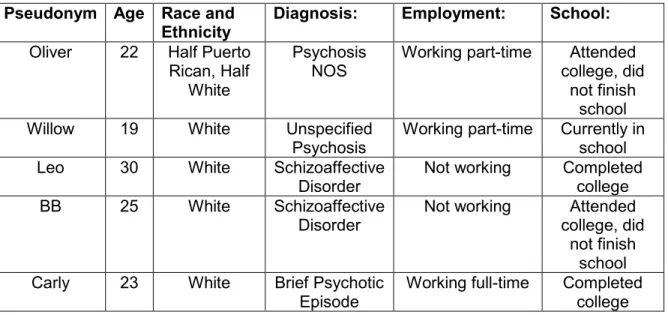
Table 1. Consultant Characteristics
Pseudonym Age Race and Ethnicity
Diagnosis: Employment: School:
Oliver 22 Half Puerto Rican, Half
White
Psychosis NOS
Working part-time Attended college, did
not finish school
Willow 19 White Unspecified
Psychosis
Working part-time Currently in school Leo 30 White Schizoaffective
Disorder
Not working Completed college
BB 25 White Schizoaffective
Disorder
Not working Attended college, did
not finish school Carly 23 White Brief Psychotic
Episode
Working full-time Completed college
To be included in the study, all consultants must have met Diagnostic Statistical Manual (DSM-V) diagnostic criteria for brief psychotic disorder, schizophrenia,
3.3 Recruitment and Sampling
Given the stressful time surrounding initial diagnosis and treatment, finding individuals willing to spend the time needed for an in-depth understanding of their life experiences related to FEP was an anticipated challenge. Recruitment lasted for 8 months; a total of 49 organizations were contacted over the course of those 8 months for referrals. Recruitment initially began with the OASIS (Outreach and Support Intervention Services) program, located in Chapel Hill, North Carolina. OASIS is part of the University of North Carolina at Chapel Hill’s Center for Excellence in Community Mental Health. This center specializes in early identification and treatment for young people and their families at the start of a psychotic disorder. However, recruitment areas were expanded to include various mental health agencies, churches, and healthcare organizations in the Raleigh, Durham, Chapel Hill, and Greensboro area. Criterion sampling was used for recruitment. As stated above, all consultants were diagnosed with a psychotic disorder within the last 5 years, according to the diagnostic criteria from the DSM-V. Methods of recruitment included direct referral from providers/agencies, as well as posting of the IRB-approved recruitment flyers at clinics and healthcare agencies, in mental health newsletters, and around college campuses (see Appendix A). While not a predicted source for recruitment, universities and college campuses became a prime target for recruitment as the age of this population closely fit with the age of many college students. Recruitment from this source led to sampling more
affluent and educated people. This was not problematic for this study because
generalizability was not the objective and exploration of social factors was the primary aim. Once initial contact was made, I met with each consultant individually to explain the research and their role in the study. Each consultant provided written consent