MULTIPARTY MEDIATION: IDENTIFYINGCHARACTERISTICS OF THEMEDIATION
DREAMTEAM
Elizabeth J. Menninga
A dissertation submitted to the faculty of the University of North Carolina at Chapel Hill in partial fulfillment of the requirements for the degree of Doctor of Philosophy in the
Department of Political Science.
Chapel Hill 2015
c
2015
ABSTRACT
Elizabeth J. Menninga: Multiparty Mediation: Identifying Characteristics of the Mediation Dream Team
(Under the direction of Stephen E. Gent)
This dissertation explores when and how multiparty mediation can help the prospects for peace in civil wars, considering when additional mediators are desirable and when they are not. While additional mediators can provide positive sources of leverage, they also increase the risk that forum-shopping, mixed messages, or free-riding will hinder the negotiations.
I identify three characteristics of mediation efforts expected to improve mediation’s chances of suc-cess. First, complementary efforts improve the mediation team’s ability to respond to challenges at all phases of the resolution process, providing three important sources of leverage: contextual knowledge, economic/military resources, and staying power. Furthermore, complementary efforts reduce the risk of overcrowding by excluding mediators who do not bring a unique source of leverage to the table. Second, balanced mediation efforts include mediators biased toward both sides of the conflict. Each side has a mediator they trust to protect their interests at the negotiating table as well as to protect them if the other side reneges on the agreement. In this way, balanced mediation can help alleviate disputants’ security concerns, improving the chances that negotiations are successful. Finally, coordination among the me-diators should improve the chances of mediation success by maximizing the ability to take advantage of the additional resources and tools of another mediator while also minimizing the negative consequences of adding a new party to the negotiations.
ACKNOWLEDGMENTS
I would like to thank Navin Bapat, Kyle Beardsley, Skyler Cranmer, Mark Crescenzi, and Stephen Gent for all the time and expertise they invested in helping me develop this project. Not only did their advice make this project better, but their support was invaluable. In particular, I would like to thank Stephen Gent for his patience and encouragement.
So many others have contributed to this project and encouraged me throughout the dissertation process. I want to thank my cohort for growing through graduate school with me, providing support when needed and a sounding board for my ideas from the very beginning. I would also like to thank the students and faculty at UNC and Duke that have organized workshops, providing opportunities to discuss my project. Finally, I would like to thank my colleagues and friends who have helped me talk through complications, read drafts, and reminded me why this project is so interesting and important. While too many have played important roles to list them all, I would especially like to thank Lindsay Reid and Paula Mukherjee. Lindsay Reid’s eagerness to talk about mediation and conflict resolution meant that I always had someone to talk with when I faced an obstacle and a source of encouragement at every step. Paula graciously listened to me as I celebrated breakthroughs and agonized over obstacles. To the many friends who encouraged me along the way, I also thank you.
TABLE OF CONTENTS
LIST OF TABLES . . . ix
LIST OF FIGURES . . . xi
1 INTRODUCTION . . . 1
Mediation and Conflict Resolution . . . 4
2 THE MEDIATION DREAM TEAM . . . 15
Mediation as a Club Good . . . 16
Obstacles to Peace . . . 17
Challenges of Overcrowding . . . 23
The Mediation Dream Team . . . 25
Evaluating Success . . . 25
Complementary Mediation . . . 26
Balanced Mediation . . . 29
Coordination . . . 32
3 RESEARCH DESIGN & DESCRIPTIVE STATISTICS . . . 37
Measuring Mediation Success . . . 37
Reaching an Agreement . . . 37
Halting the Violence . . . 38
Generating a Durable Peace . . . 39
Measuring the Dream Team . . . 41
Complementary Mediation . . . 41
Mediation Balance . . . 47
Identifying Coordination . . . 51
4 ANALYSIS & RESULTS . . . 55
Bivariate Relationships . . . 55
Reaching Agreement . . . 62
Halting the Violence . . . 67
Durable Peace . . . 70
Discussion . . . 75
5 ILLUSTRATIVE CASES . . . 76
Angola . . . 77
Mozambique . . . 85
Discussion . . . 92
6 CONCLUSION . . . 93
APPENDIX . . . 99
LIST OF TABLES
3.1 Distribution of Mediated Settlements . . . 38
3.2 Complementary Mediation Coding . . . 42
3.3 Components of Contextual Knowledge by Mediation Effort . . . 45
3.4 Global & Regional Powers . . . 46
3.5 Sources of Influence & Complete Mediation . . . 47
3.6 Mediation Balance Coding . . . 48
3.7 Mediator Balance by Dimension & Overall Mediation Balance . . . 50
3.8 Mediation Balance by Multiparty Mediation . . . 51
3.9 Mediation Coordination . . . 52
4.1 Completeness & Agreement Outcome . . . 56
4.2 Balance & Agreement Outcome . . . 57
4.3 Coordination & Agreement Outcome . . . 57
4.4 Completeness & Halted Violence . . . 58
4.5 Balance & Halted Violence . . . 59
4.6 Ordered Logistic Regression: Reaching Agreement . . . 63
4.7 Logistic Regression: Halting the Violence . . . 68
4.8 Weibull Regression: Duration of Post-Agreement Peace . . . 71
A.1 Brant Test of Proportional Odds Assumption . . . 100
A.2 Generalized Ordered Logistic Results: Unconstrained Central Command . . . 101
A.3 Unconstrained Cent. Command, Terr. Conflict, Conf. Duration & Region . . . 103
A.4 Ordered Logistic Regression: 3 Category Outcome Variable . . . 104
A.5 Brant Test of Proportional Odds Assumption: 3 Category Outcome . . . 105
A.6 Generalized Ordered Logistic Regression: Complete Mediation & Region . . . 106
A.7 Logistic Regression: Halting the Violence (Peace Agreements Only) . . . 107
A.8 Logistic Regression: Varying Peace Thresholds . . . 109
A.9 Censored Probit Estimation . . . 111
A.11 Cox Proportional Hazard Models: Duration of Post-Agreement Peace . . . 115
A.12 Weibull Duration Model with Selection . . . 117
A.13 Ordered Logistic Regression: Interaction Complete & Redundancy . . . 118
A.14 Logistic Regression: Interaction Complete & Redundancy . . . 119
A.15 Weibull Regression: Interaction Complete & Redundancy . . . 121
A.16 Ordered Logistic Regression: Interaction Balance & Multiparty . . . 122
A.17 Logistic Regression: Interaction Balance & Multiparty . . . 123
A.18 Alternative Operationalizations of Contextual Knowledge . . . 126
A.19 Complete Mediation by Coding of Contextual Knowledge . . . 127
A.20 Ordered Logistic Results: Contextual Knowledge . . . 128
A.21 Logistic Results: Contextual Knowledge . . . 129
LIST OF FIGURES
3.1 Duration of Post-Agreement Peace (in Months) . . . 40
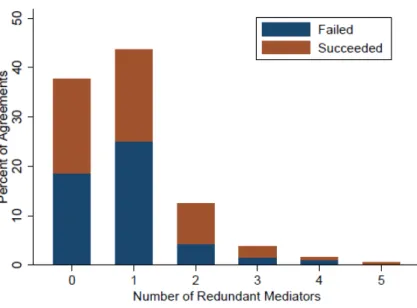
3.2 Distribution of Redundancy . . . 47
4.1 Redundancy & Agreement Outcome . . . 56
4.2 Redundancy & Halted Violence . . . 58
4.3 Completeness & Peace Duration . . . 60
4.4 Redundancy & Peace Duration . . . 61
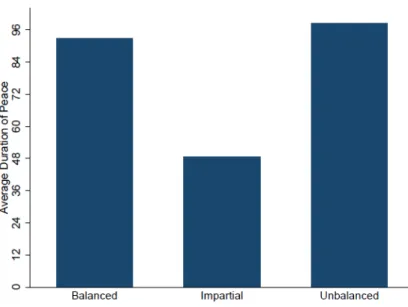
4.5 Balance & Peace Duration . . . 61
4.6 Predicted Prob. of Comprehensive Peace Agreement (with 95% CIs) . . . 65
4.7 Predicted Prob. of Comprehensive Peace Agreement (with 95% CIs) . . . 66
4.8 Predicted Prob. of Halting the Violence (with 95% CIs) . . . 70
4.9 Median Expected Duration in Months (with 95% CIs) . . . 73
4.10 Median Expected Duration in Months (with 95% CIs) . . . 74
A.1 Survival Curves . . . 113
A.2 Cumulative Hazard Curves . . . 114
A.3 Predicted Prob. of Comprehensive Peace Agreement (with 95% CIs) . . . 124
CHAPTER 1
INTRODUCTION
As a popular conflict management tool, mediation receives great attention from both scholars and policy-makers. Much of this attention conceives of mediation and its effects in terms of how the media-tor relates to the disputants or how the mediamedia-tor influences the disputants’ relationship with one another. Crocker, Hampson and Aall (2004) describe this dynamic, writing that “Mediation is an inherently trian-gular political process” (23). Mediation, however, frequently involves more than one mediator. In fact, almost fifty percent of the efforts to mediate civil wars between 1989 and 2005 identified by DeRouen, Bercovitch and Pospieszna (2011) were multiparty mediation efforts.1 Focusing on conflicts in Africa, Zartman asserts that “Africa does not lack mediators...African heads of state do more than stand ready to be of assistance—they rush forward in numbers” (Zartman, 2000, 142). Thinking of mediation as triangular necessarily collapses multiple third parties into a single actor. Multiparty mediation, how-ever, not only changes the nature of the mediator; it changes the nature of the mediation. Understanding the process of mediation therefore requires understanding the connections and interactions among the mediators as well as the connections and interactions between the mediators and the disputants.
To the extent that the presence of multiple mediators is considered in the literature thus far (see e.g. Beardsley (2011)), the conclusions drawn are often pessimistic: multiparty mediation decreases the chances of mediation success. This conclusion might seem intuitive at first, given that mediators face an incredibly challenging task. Disputants turn to mediators for assistance when they are unable to resolve their differences bilaterally. They recruit mediators to help them both find common ground as well as rebuild enough trust (or develop sufficient monitoring and enforcement mechanisms) that both sides are
1
willing to put down their weapons in pursuit of a negotiated settlement. Multiparty efforts add additional complexity to the mediation process, facing several unique challenges not present during single-party mediation, such as forum-shopping, mixed messages, and free-riding among the mediators (Crocker, Hampson and Aall, 1999a). The civil wars in Burundi and Guinea-Bissau attracted many mediators and are prime examples of what happens when mediators fail to coordinate and send different signals to the disputants. Despite these challenges, however, multiparty mediation does sometimes succeed. In Angola, the Troika (composed of the United States, Russia, and Portugal) worked with the United Nations to broker the Lusaka Protocol (Hare, 1999). In Mozambique, a multiparty mediation team including the Community of Sant’Egidio and Italy helped negotiate a lasting peace agreement (Bartoli, 1999).
Moreover, the presence of the Troika was considered an important part of the resolution process in Angola. Hare (1999) cites United Nations Special Representative Beye as telling the Troika representa-tives, “It is not certain that the mediators will be able to bring peace to the Angolans, but it is perfectly clear that they will never achieve it without our help” (658). So why do mediators seeking to improve the prospects for peace embrace multiparty mediation in these cases? When do the benefits of multiple mediators outweigh the costs? I argue that while all mediators face tough obstacles to peace, the right mix of mediators can improve the chances these obstacles are overcome. More, however, is not always better. The composition of the mediation team2has meaningful implications for the likelihood an agree-ment is reached, the probability an agreeagree-ment is impleagree-mented, and the expectation that the agreeagree-ment will last. While multiparty mediation efforts face a challenging task, understanding the dynamics of multiparty efforts gives mediators the tools necessary to respond to these challenges and capitalize on their strengths. The better prepared and designed the mediation team, the better the team’s chances of success.
Importantly, even a perfectly designed and executed mediation effort might not succeed. Mediators cannot control every aspect of the conflict environment and many factors outside the mediators’ control could send the disputants away from the negotiating table and back to the battlefield. Thus, even the best
2
designed mediation team is not a sufficient condition for peace. The right mix of mediators, however, can improve the chances.
Identifying when and how additional mediators improve the chances for success has important im-plications for policy-makers as well as states, international organizations, and other international medi-ators. Potential mediators have to select in which conflicts they are going to invest time and resources. This forces third parties to prioritize in which conflicts, if any, they desire to intervene. These pressures can lead to redundancy in conflicts where many potential mediators have interests and can marginalize other disputes in which the belligerents are ready to negotiate. A more refined understanding of how an additional mediator helps (or hurts) chances for resolution will help third parties better allocate their resources. Understanding what makes for an effective mediation effort will help identify cases in which an additional mediator would provide meaningful support or resources, thus improving the chances of success. Likewise, it could help states and organizations identify cases in which their presence would only detract from current efforts, decreasing overcrowding in those conflicts and freeing up resources for other crises.
This dissertation explores what the ideal mediation team looks like. In order to develop expectations regarding which types of mediation teams will be most effective, Chapter 2 considers the role mediators play in conflict resolution, the obstacles blocking resolution, and the various tools mediators can use to help the disputants overcome the obstacles to resolution. In short, I argue that multiparty mediation is a heterogeneous club good in which desirable members of the club improve the chances of overcoming the obstacles to resolution while undesirable members complicate the negotiations without providing new sources of leverage or influence, diminishing the chances for successful resolution.
attempt from the risk of free-riding, mixed messages, and forum-shopping. Coordination enables the mediation effort to take advantage of the mediators’ sources of leverage and influence while mitigating the complexities additional mediators bring to the table.
The success of a resolution process can be conceptualized along many dimensions; this project de-fines successful mediation by the kind of agreement reached at the end of the mediation attempt, as well as whether the mediation attempt results in halted violence and a durable peace. Chapter 3 outlines the research design used to test my hypotheses, operationalizing these measures of success as well as the mediation characteristics of interest. Chapter 4 evaluates the hypotheses generated in Chapter 2, em-pirically testing the effectiveness of complementary, balanced, and coordinated mediation in producing successful mediation outcomes. In Chapter 5, case illustrations of the mediation processes in Angola and Mozambique provide a deeper look at these characteristics of mediation and how they helped con-flict resolution processes in these countries.
Mediation and Conflict Resolution
As mediation has become a popular strategy to resolve crises, both international and civil, it has received substantial scholarly attention. These works range from studies of who offers to mediate, to when combatants accept mediation offers, to how mediation improves the chances of reaching a stable settlement. From these various studies, scholars have learned that mediators with historical linkages to the disputants are more likely to offer their services (Greig and Regan, 2008). Additionally, supplying mediation incurs costs for the mediators. These costs range from administrative burdens and operational expenses to reputational damage if the process fails, to the opportunity costs of foregoing intervention elsewhere (Terris and Maoz, 2005). These costs lead Clayton and Gleditsch (2014) to conclude that potential third parties are most likely to offer mediation when they have a stake in the resolution of the war and believe that their intervention will improve the chance of resolution.
They consider the incentives to offer mediation and to accept mediation in tandem, providing a better picture of what leads to mediation onset. Also exploring when mediation is accepted, Terris and Maoz (2005) find that disputants are most likely accept mediation in highly volatile conflict structures. Ad-ditionally, governments are reluctant to accept mediation as agreeing to mediation tacitly legitimizes the rebel group (see e.g. Clayton and Gleditsch, 2014; Melin and Svensson, 2009). This discourages governments from agreeing to mediation unless the costs of negotiating are outweighed by the benefits. While most scholars assume rebels are almost always willing to mediate as mediation bestows legiti-macy upon the non-state actor, Beardsley (2011) asserts that rebels also have incentives to be reluctant to agree to mediation. Beardsley argues that mediation reduces the control that rebels have over nego-tiation outcomes, especially given the power asymmetry that is typical between a rebel group and the government (154). Sometimes this loss of control can be advantageous. When disputants know that the resolution will require unpopular concessions, combatants are more willing to accept mediation, using mediation as political cover Beardsley (2010). This reluctance to accept mediation indicates that mediation is adopted in the most difficult conflicts where bilateral negotiations are difficult to imple-ment and the costs of continued fighting are high (see e.g. Svensson, 2007a; Greig and Regan, 2008). Importantly, these studies of mediation onset all indicate that mediation is not selected into randomly. Therefore, while many mediated agreements fail shortly after signing, this does not necessarily indicate that mediation is ineffective.
As Gartner and Bercovitch (2006) stress, mediation is typically used in the most difficult cases, those that the disputants cannot resolve bilaterally. Once there, however, mediators provide resources and leverage that can encourage resolution. Gartner and Bercovitch refer to this as mediation’s competing “selection” and “process” effects. Once these selection effects are controlled for, the positive process effects of mediators on the negotiations are more easily visible.
Effects of Mediator Bias
mechanisms by which biased mediators are expected to be more effective than neutral mediators. First, they have incentives to protect their prot´eg´es. Second, they can reveal information. Third, they have the necessary connections and influence to pressure their ally to make unpopular concessions. Finally, they are capable of “counterbalancing the asymmetry in the concession-making process” (448). While a wealth of scholarship has explored these different mechanisms, I focus on the role of bias in overcoming information problems and alleviating commitment problems.
Kydd (2003) focuses on the role of mediators in overcoming the information problem. Kydd argues that mediators that are biased toward one side are able to communicate (and be believed) when counsel-ing caution to their preferred side. In a related argument, Maoz and Terris (2006) assert that mediators with strong interests in the conflict are more motivated and prepared to resolve the conflict, but that this sometimes comes with mediator preferences for a solution that does not agree with the belligerents’ interests (411). Focusing on mediator credibility, Maoz and Terris argue that the more credible the me-diator, the less intrusive the mediator will be in the negotiations and more successful the mediation will be. Crescenzi et al. (2011) provide three mechanisms that increase a mediator’s credibility by increasing the mediator’s costs of deception. They assert that democratic mediators face greater costs to lying and are thus more credible, that a strong democratic community increases the costs of deception, and that the more connected the disputants are to the international community (through common membership in International Organizations) the greater the costs of deception as well.
Savun (2009) empirically evaluates the relationship between the mediator’s ability to provide rel-evant information to the disputants in international conflicts and mediator success. Savun considers the strength of the mediator’s military intelligence agency, diplomatic relationships in the region, and military alliances (factors she expects to correlate with having more relevant information), finding that informed mediators are more likely to produce an agreement than uninformed mediators. In an empir-ical study of mediation in international conflicts, Savun (2008) finds that biased mediators (defined as having preferences that align with one party over the other) are more likely to be successful at generating a ceasefire or peace agreement in international conflicts, providing some support for these theoretical expectations.
one another. An impartial mediator has difficulty credibly communicating with the disputants. The disputants know that if the mediator’s primary goal is to generate peace, then the mediator has an incen-tive to misrepresent the opposition’s resources and minimally acceptable demands in order to pressure the disputants into an agreement. Instead, states providing support to either of the disputants or actors that prefer an outcome more in line with the preferences of one side over the other can play an impor-tant role at the negotiating table. Because of their known bias, biased mediators have less incentive to misrepresent the opposition’s strength or resolve.
When the mediator is biased toward one side, however, the other side is more likely to see the mediation as unfairly tilting the agreement toward the preferred side. As Zartman (1995) phrases it, “mediators need not be impartial, but they must deliver the side to which they are perceived as close; they must not be perceived as selling a proposed agreement that is biased in their friends’ favor” (21). This is incredibly difficult (if not nearly impossible) for a single mediator to do. Every concession in favor of the mediator’s preferred side is an opportunity for the opponent to reject the agreement on grounds of bias.
These drawbacks of bias and concerns about legitimacy encourage scholars like Carnevale and Arad (1996) and Beber (2012) to believe unbiased mediators are more effective. Because biased mediators, despite perhaps being able to reveal information to their ally under some narrow circumstances, are unable to communicate credibly with the other side, Beber (2012) argues that biased mediators are actually less effective at resolving conflict than unbiased mediators. Beber asserts that only unbiased mediators can credibly reveal “conflict-relevant” information (399). Beber provides qualitative evidence from international conflicts in support of these assertions. Carnevale and Arad (1996) agree that the best mediators are neutral (having no preference over the outcome) and impartial (having no preference over the disputants).
intrusive strategies with a greater chance of success to be employed. In a study of super power media-tors, Favretto (2009) argues that the extent of the mediator’s bias influences outcomes. Strongly biased mediators are more effective because their threats (and promises) to use force to secure a settlement are more credible than a weakly biased mediator. She asserts that impartial mediators will actually be more effective than weakly biased mediators because impartial mediators will not use coercion, looking instead for agreements the disputants are willing to accept without enforcement.
Others, concerned with the role of bias in overcoming commitment problems, assert that biased mediators can alleviate disputants’ fears during the transition period in which they are particularly vul-nerable to defection. Svensson (2007a) empirically explores the relationship between mediator bias and mediation success, concluding that third parties biased in favor of the government have a positive effect on delivering a negotiated settlement while mediators biased toward the rebels have no significant effect. He explains that the peace process shifts power relationships over time, taking power from the govern-ment and giving it to the rebels (180). Therefore, mediators that are biased in favor of the governgovern-ment are able to assuage the government’s fears of being exploited by the rebels. Biased mediators are in a better position to assuage these fears than impartial or neutral mediators as they can more credibly promise to protect their side during the implementation phase. Interestingly, Svensson (2009) finds that rebel-sided mediators are more effective at generating power-sharing and third-party guarantees than mediators that favor the government. As third-party guarantees have a positive impact on conflict res-olution (Walter, 2002), the direction of the mediator’s bias has interesting implications for mediation outcomes.
Mediator Leverage and Mediation Strategies
Mediators employ a variety of strategies and tools to influence disputant behavior. Touval and Zartman (1985) divide the strategies employed by the mediator into a three-fold typology based upon the level of involvement of the mediator in the negotiation process: communication-facilitation, procedural, and directive. Bercovitch and Houston (2000) consider the effects of the choice of mediation strategy on outcome, finding that communication-facilitation strategies are most common while directive strategies are most effective at generating an agreement. Quinn et al. (2013) confirm this finding that mediators are most effective in negotiating agreements in ethnic conflicts when using a more intrusive strategy. Beardsley et al. (2006) tell a more nuanced story confirming again that manipulation has the strongest effect on reaching agreement but also that facilitation decreases the tension between the combatants post-crisis more than the other strategies.
These findings raise an interesting question: if directive strategies are most effective, then why are they not also the most common? Perhaps a partial answer to this question is that not all mediators are capable of utilizing more intrusive strategies, making the strength of the mediator important. Beardsley (2009) explores when and why weak mediators intervene in conflicts. While weak mediators still bring some positive benefits to the negotiating table, they are limited in the resources they are able to expend. Beardsley defines strong mediators as great powers, groups of states, and the United Nations; all other mediators (other intergovernmental organizations (IGOs), states that are not major powers, individuals and non-governmental organizations (NGOs)), Beardsley considers to be weak. Beardsley finds that weak mediators are more likely to be involved in conflicts that are peripheral to the international system as well as conflicts in which the belligerents have incentives to negotiate insincerely. Svensson (2007b) looks at the effect of mediator strength on mediation outcomes, dividing mediators into “power” medi-ators and “pure” medimedi-ators3. Power mediators, according to Svensson, have the leverage to influence the disputants using carrots and sticks, but do not necessarily have the requisite skills to address the underlying causes of the conflict. Pure mediators lack carrots and sticks, but might have the necessary knowledge and influence to navigate the deeper sources of disagreement. Svensson concludes that a
3
combination of power and pure mediations is optimal, finding that the combination has the strongest positive effect on signing a peace agreement relative to no mediation.
These positive effects of mediation, however, come at a price. Beardsley (2008) discusses the time-inconsistency problem that mediation can generate. The presence of mediators in a negotiation process changes the environment of the negotiations, the dynamics between the disputants, and the relative pay-offs of continued conflict compared to peace. As Rothchild (2008) states, “Leverage is derived from the parties’ need for a solution they cannot achieve on their own. To the extent they depend on a mediator to facilitate an agreement, they strengthen his or her ability to reward cooperative moves and raise costs on inaction” (107). Kuperman (2008) discusses ways that mediators can encourage negotiations, including offering side payments that generate “mutually enticing opportunity” (10). Kuperman also warns that such manipulation by mediators can backfire. By using their influence and resources to manipulate the negotiation environment, mediators are able to induce cooperation and produce an agreement between the disputants. Reaching an agreement, however, does not necessarily lead to peace. Beardsley (2008) finds that mediated successes are generally short-lived. The durability of these agreements is limited as the long-term incentives and preferences of the belligerents are often unchanged, increasing the risk of war recurrence.
Different types of mediators, therefore, have different tools they can bring to the negotiating table and thus have different impacts on mediation outcomes. Kaufman (2006) argues that focusing on the need to overcome information or commitment problems ignores the symbolic roots of the conflict, es-pecially in ethnic conflicts, asserting that resolution requires acknowledging and reconciling the deeper “intragroup symbolic politics” (47). Kaufman cautions against mediators focusing exclusively on insti-tutional responses urging more contextual considerations of the conflict instead. Cohen (1996) argues that the culture of the mediators matters as well. For a mediator to bridge the gap between the disputants, the mediators must understand what barriers to communication exist between the disputants. Mediators from a different culture or negotiating tradition, Cohen asserts, will struggle to overcome these barri-ers. Cohen provides qualitative evidence for the impact of the mediators cultural misunderstandings on producing peace agreements.
Reid (2015) builds on the idea that the effect of mediation will be context specific. Importantly not all weak/pure mediators have the same available tools. Reid (2015) characterizes mediator leverage along two dimensions: capability and credibility. She characterizes capability leverage as a mediator’s ability to use military/economic resources to compel/coerce the combatants. Credibility leverage is a softer set of tools where the mediators use past experience and relationships with the disputants to help them navigate the peace process. Weak mediators could still be able to influence the negotiations through these softer forms of leverage. In her analysis of mediation in civil wars, Reid finds that capa-bility leverage improves the likelihood of reaching an agreement but suffers from the time-inconsistency problems identified by Beardsley (2008) in international conflicts. Credibility leverage is not associated with a higher chance of producing an agreement, but it is associated with longer-lasting peace once an agreement is signed.
This tension between mediator characteristics that produce agreements versus those that reduce the risk of war recurrence indicates another important part of the mediation and conflict resolution litera-ture: duration of post-agreement peace.4 Quinn et al. (2013), in their study of ethnic wars in Africa, find that mediator strategy has no significant relationship with decreasing post-crisis tensions, support-ing Beardsley’s time-inconsistency story and perhaps validatsupport-ing Kaufman’s concerns that focussupport-ing on
4
material causes and solutions has limited benefit to resolving the underlying causes of the crisis. Once again, however, this literature has focused on the leverage of individual mediators. This dis-sertation builds upon this part of the mediation literature by considering multiple sources of mediator leverage and influence. I consider three broad sources of mediator leverage or influence: material re-sources (reminiscent of power or strong mediators), contextual knowledge (similar to Reid’s credibility leverage), and credible staying power. This third source of leverage accounts for the short life of most peace agreements, highlighting the important role that mediators who can credibly commit to assist not only during negotiations but also during implementation can play. In particular, I consider how these sources of leverage fit together. While it is possible to have a single mediator with all three sources of leverage, I expect this to be rather rare. Instead, I argue this is another situation in which consider-ing the often multiparty nature of mediation can enrich our understandconsider-ing of what generates successful mediation outcomes.
Multiparty Mediation
These studies, while significantly advancing our understanding of mediation, consider mediators in isolation. Either they assume that only one mediator is present in any given conflict, that multiparty ef-forts operate as if the mediators are a cohesive unit, or that the influence of each mediator is independent of all other present mediators. Some scholars control for multiparty mediation efforts with an indicator variable for the presence of multiple mediators (see e.g. Beardsley, 2011). These studies, however, do not consider the diversity of multiparty mediation efforts and how this diversity influences outcomes. Clumping all multiparty mediation efforts together, the findings on multiparty mediation are rather pes-simistic, often concluding that multiparty efforts are less effective than single-party efforts. I argue this pessimism comes from the unacknowledged diversity within multiparty efforts. Relationships, connec-tions, and characteristics of the individual mediators as well as how the mediators influence each other are important pieces of the mediation story.
staying power, political stamina, and resources) is rare (Crocker, Hampson and Aall, 2004, 15). These same authors, however, refer to multiparty mediation as “herding cats,” highlighting the challenges of intervention by multiple third parties in the same conflict (Crocker, Hampson and Aall, 1999a).
Work systematically exploring the efficacy of multiparty mediation thus far has been rather limited. B¨ohmelt (2012) considers the onset of multiparty mediation in international conflicts. He finds that coalitions of states are most likely to be used when the states have a lower average GDP per capita, a higher level of accountability, and are closer together geographically. In his 2011 piece, B¨ohmelt consid-ers the characteristics of mediation teams that lead to greater success, hypothesizing that medium-sized coalitions, more cooperative interactions among the mediators, and higher average levels of democracy in the mediation team will increase the likelihood multiparty mediation succeeds (B¨ohmelt, 2011).
These studies, however, are limited to coalitions of states mediating in interstate conflicts. The pool of mediators, especially in civil wars, is much broader than states, including intergovernmental organizations, individuals, and nongovernmental organizations. Moreover these non-state actors provide important sources of leverage that states are often unable to exploit, making their role an important consideration in a study of multiparty mediation. The theoretical framework I develop to explore what combinations of mediator leverage should improve the chances for success allows for the inclusion of non-state mediators, providing a more comprehensive understanding of multiparty mediation.
Another strand of mediation research has considered the presence of multiple diplomatic interveners over time. In his article, “Failing to Succeed?” B¨ohmelt (2013) explores the cumulative impact of me-diation efforts in international conflicts. He pushes back against the conventional wisdom that repeated interactions should reduce uncertainty and lead to a greater chance of success. B¨ohmelt theorizes in-stead that the cumulative effect diminishes after a point, producing a curvilinear relationship between the number of mediation efforts and mediation effectiveness. Looking more broadly at peacemaking efforts (which include mediation but are not limited to mediation), Heldt (2013) notes that between 1993 and 2004, it took an average of thirty-one peacemaking attempts to produce an agreement in emerging civil conflicts. Interested in the impact of these consecutive attempts on producing stable agreements, Heldt asserts that a lack of coordination across efforts is a substantial challenge to success. He argues that uncoordinated peacemaking processes prevent the peacemakers from learning from previous efforts.
across time, but also in simultaneous multiparty mediation efforts. I consider the extent to which mul-tiparty efforts coordinate, expecting a coordinated effort to be substantially more likely to succeed than uncoordinated efforts.
CHAPTER 2
THE MEDIATION DREAM TEAM
Past studies controlling for multiparty mediation efforts find that multiparty mediation is equally as or less effective than single-party efforts, depending on the particular metric of success used. These stud-ies, however, ignore the diversity of multiparty efforts. By lumping multiparty efforts that coordinate mediators with diverse strengths together with multiparty efforts involving many redundant mediators, these past studies obscure the positive effect of some multiparty mediation efforts.1
This treatment also generates a false dichotomy separating single-party and multiparty efforts when, in fact, the characteristics of the mediator(s) are often more relevant than the number. Successful me-diation is more likely when the mediator(s) provides enough leverage to credibly build trust between the disputants, helping the disputants overcome the obstacles to peace (by revealing information and overcoming credible commitment problems). Perhaps this can be achieved by a single international actor, such as a regional power, with knowledge of the conflict as well as the resources and will to as-sist in the implementation of the agreement. Often, however, the ideal intervention will involve more than one mediator. Multiparty efforts can take advantage of the comparative strengths of each mediator, building a more powerful mediation team that is better prepared to steer the conflict toward peace than any single actor. For example, a team with a major powerand a neighboring state benefits from the material resources of the major power while also benefiting from the neighbor’s deep knowledge of the conflict, disputants, and grievances. Mediation by a major power alone can exert material, political, and economic influence over the disputants, but it likely lacks important contextual knowledge that would enable it to use those resources effectively. It is important to note that the composition of the mediation dream team will not be the same for all conflicts. The right combination of mediators in one conflict
1
will not necessarily be the best combination in another.
Mediation as a Club Good
Admittedly, the pessimism coming out of past works stems from valid concerns about the chal-lenges of multiparty mediation. Multiple mediators mean more sources of leverage, a greater possibility of deep ties to all sides of the conflict, and more resources available for use both during the negotiation and implementation phases of the peace process. More, however, is not necessarily better. The ben-efits of another mediator must be weighed against the disadvantages of adding an additional party to the negotiations. The addition of a new mediator complicates the process by increasing the diversity of interests and opinions at the table. This can slow down the negotiations and make finding an agreement acceptable to all parties more difficult. Additional mediators, therefore, can generate negative exter-nalities that hurt the chances of success. The value of an additional mediator is a function of the new resources or modes of influence the mediator brings to the table as well as the complexity they add.
In this way, mediation can be conceived of as a club good: members participate voluntarily, non-members are excluded, and mediation can result in congestion or overcrowding.2 Mediation is volun-tary: international actors are willing to mediate because it produces a net benefit in terms of international prestige or the ability to influence the outcome of the conflict to align more closely with their prefer-ences). Non-members are excluded: international organizations and states not present at the negotiating table might benefit from some of the outcomes of mediation (such as regional or international stability), but they do not receive any of the benefits associated with helping to broker the peace. Furthermore, actors interested in joining the efforts must gain the permission of at least the disputants and potentially any mediators already present in order to gain a seat at the negotiations; not all interested mediators are welcome to participate. Finally, mediation suffers from overcrowding. Having too many mediators increases the risk of forum-shopping, mixed messages, and free-riding, which in turn decreases the prob-ability that mediation is successful. Multiparty mediation efforts are heterogeneous clubs. Some mem-bers have desirable traits that increase the utility of the club (by increasing the probability of success) while others have less desirable traits that decrease the utility of the club (by decreasing the probability
2
of success).
I identify these desirable traits and how they fit together to generate the mediation dream team. First, I discuss the obstacles to peace that mediators face and how mediation can help the disputants move past them. I then highlight the specific problems associated with overcrowding in mediation efforts. Finally, I identify three characteristics of mediation teams that maximize mediation effectiveness and assert that desirable mediators contribute to these characteristics while undesirable mediators do not.
Obstacles to Peace
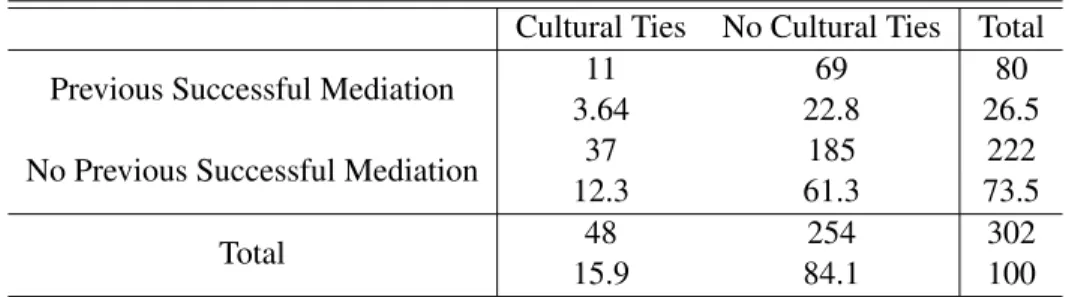
Mediators play a key role at three important phases of the negotiation process: resolving immediate concerns in order to bring and keep the relevant parties at the negotiating table, identifying a mutu-ally acceptable agreement, and resolving commitment problems in order to implement the terms of an agreement effectively. Each of these moments presents a new obstacle that requires a specific source of leverage from the mediation team in order to move forward. To overcome these obstacles, mediators need to possess contextual knowledge of the conflict, help the disputants navigate information asym-metries, alleviate the commitment problems that inevitably arise, and be able and willing to exert the military and economic resources necessary to help the disputants transition through the implementation phase.
Preparing the Table: The Importance of Contextual Knowledge
to be able to block an agreement. Others might be more important to reaching a stable agreement than is readily apparent. Furthermore, some actors might not be crucial to reaching an agreement but have the ability to interrupt the implementation of an agreement. A contextual understanding of the conflict is therefore critical to being able to identify the relevant and irrelevant actors, as well as being able to update that classification throughout the negotiations so that the necessary parties are always included.
After the parties to the negotiations are agreed upon, the mediators still face substantial challenges in getting them to talk and compromise. While several sources of leverage and influence can help the mediators encourage discussion and concessions, contextual knowledge plays a role here as well. As Cohen (1996) has stressed, facilitating communication requires acknowledging the cultural dynamics that influence and shape how the parties perceive the negotiations. Once again, neighbors or countries with cultural ties to the disputants are more likely to understand the conflict and disputant-specific obstacles to communication.
The relevant parties and the concerns that must be addressed during the negotiations vary substan-tially from conflict to conflict. As generating an agreement requires knowledge of the relevant disputants are in the negotiation process, the barriers preventing these disputants from negotiating bilaterally, the vulnerabilities of each side, and how to mitigate these vulnerabilities, not all international actors in-terested in mediating will have the same depth of knowledge. Mediators with strong historical and cultural connections to the belligerents are more likely to possess the knowledge necessary to navigate the unique complexities of the situation. Regional organizations, neighboring states, or colonial powers, for example, are more likely to have (or easily obtain) this information than large international bodies (like the United Nations) or distant major powers. Thus, mediators that share cultural and historical linkages provide a specific and important source of influence at the negotiating table.
Reaching Agreement: Knowledge and Strength
threatening punishment if no agreement is reached or rewarding an agreement through economic, polit-ical, or military assistance. Second, commitment problems arise throughout the negotiations. As these problems plague the peace process not only during but also after negotiations, the role of mediators in mitigating the commitment problems will be discussed in the next section.
Information and Legitimacy
The first hurdle to reaching an agreement is revealing private information. Finding a mutually ac-ceptable agreement that all disputants would prefer to war requires being able to obtain and reveal information about the available bargaining range to the combatants. As mentioned in the previous chap-ter, some scholars point to mediation bias as a useful tool for revealing information. As the conditions under which bias enables the revelation of private information is very narrow and the other side is likely to be reluctant to believe information from a biased mediator is credible, I side with the skeptics of bias when it comes to the role of mediators in revealing information. Since both impartial and biased mediators have incentives to misrepresent, the disputants will be skeptical of information provided by both types. Instead of focusing on mediators revealing information the disputants do not already have, I consider the role mediators play in changing how the bargaining range is perceived by the disputants through agenda-setting or issue-linkage.
Mediators with contextual understanding are more likely to know what issues can be linked or what agenda needs to be set in order to tackle the obstacles to agreement. While not revealing information directly, they are able to help the disputants communicate and are more able to use the information the disputants share effectively. Mediators with a contextual understanding of the conflict are able to influence how the disputants see the bargaining range and reveal compromises previously not viewed as plausible.
with little history with the conflict or combatants are unlikely to have this specialized knowledge and are therefore less likely to navigate these obstacles effectively, potentially pushing issues before the disputants are ready or not prioritizing issues that must be resolved before further progress can be made in the negotiations.
Strength and Manipulation
Agenda-setting and issue-linkage rely on softer forms of influence to encourage negotiation. In ad-dition to using relational leverage, mediators can also try to encourage resolution by directly influencing the range of mutually acceptable agreements with carrots and sticks. The mediator must have sufficient economic or military power over the disputants in order to to use threats and promises to influence behavior effectively. Conventionally strong mediators will be in the best position to manipulate the bargaining range to encourage agreement, but such manipulations suffer from the time-inconsistency problems discussed in the last chapter. Thus, if agreement is reached by influencing the bargaining range, commitment problems are likely to be exacerbated. In some cases, using relationships to in-fluence the bargaining range might be sufficient to produce an agreement. For other cases, a strong mediator might be more effective, at least in the short run.
Mediators who are best suited to find the opportunities to increase the disputants’ expected gains from negotiation and those who have the muscle to influence the bargaining range will vary from con-flict to concon-flict. Moreover, strong mediators and mediators with relational leverage are often not the same. Multiparty efforts that include both conventionally strong mediators and mediators with strong relationships with the disputants can wield both sources of influence in pursuit of a settlement.
The Problem of Credible Commitment
the disputants and report violations, because they have incentives to let minor violations slide if they fear revealing those violations would jeopardize the prospects for peace. Disputants anticipate the com-peting incentives impartial mediators face, preventing impartial mediators from effectively alleviating the disputants’ security concerns.
Biased mediation can help address security concerns, although this assistance comes at a price. Bi-ased mediators have incentives to protect the side toward which they are biBi-ased. This not only means providing support at the negotiating table, but more importantly, being able to provide assurances that facilitate trust during the negotiation process. Government-biased mediators can help alleviate the gov-ernment’s concerns about losing power to the rebels throughout the negotiations by credibly committing to protect their interests and monitor rebel activity (Svensson, 2007a). This decreases the government’s perceived vulnerability in negotiating with the disputants, increases the government’s willingness to discuss compromised settlements, and thus increases their confidence in the conflict resolution process. Mediators biased toward the government do little to alleviate rebel concerns, however, and in fact might exacerbate rebels’ feelings of vulnerability. Without protection for the rebels, the rebel groups are concerned that once they sign an agreement (which often requires demobilization), the government will take advantage of their temporary weakness to launch a counteroffensive. These concerns cause rebel groups to lose confidence in the peace process and become unwilling to sign agreements that leave them vulnerable. With a mediator biased in favor of the rebels, however, the rebels can have more confidence that the mediator will not abandon them as soon as an agreement is signed. Such a mediator has an interest in ensuring that the government follows through on its agreements. Therefore, the rebel group believes the mediator’s promises to monitor the actions of the government and to assist during the implementation. Some evidence of this is seen in Svensson (2009); mediators biased in favor of the rebels are more likely to include third-party guarantees in the negotiated agreements than other mediators.
of the agreement, preventing a smooth transition to peace. By leaving one side feeling vulnerable, biased mediators exacerbate the commitment problems and distrust that block implementation, resulting in an unstable environment in which to establish peace.
Multiparty efforts that include mediators biased toward both sides of the conflict are able to reconcile the challenges and benefits of bias in alleviating commitment problems. Moreover, multiparty efforts composed of the mix of mediators best able to address both the information and commitment prob-lems should be more effective at reaching an agreement than single-party efforts and other multiparty compositions.
Implementation
Reaching an agreement is an important and necessary step to a lasting peace, but implementing even a partial ceasefire requires overcoming a new set of challenges. The implementation process exposes all parties in the conflict to new periods of vulnerability. Almost fifty percent of peace treaties signed in civil wars between 1945 and 2004 failed within eight weeks of being signed (Gartner, 2012). This high rate of failure highlights the importance of considering the impact of mediation on the agreement’s chances of being implemented.
Enforcing or monitoring the implementation of an agreement has been acknowledged as a tool available to third parties interested in fostering peace (see e.g. Fortna, 2004; Walter, 2002; Sisk, 2009). Mediators can include formal or informal provisions in the agreement to assure the disputants that they will stay throughout implementation to monitor the transition to peace. Not all mediators who promise this, however, are likely to be believed. Some organizations, such as the United Nations (UN) or African Union (AU), have a reputation for sending monitors or peacekeepers to conflicts. States that can credibly signal an interest in the long-term outcome of the conflict or an interest in protecting one side of the conflict are also better able to signal a commitment to staying after the formal negotiations are over than neutral or impartial mediators.
and economic resources to monitor implementation and intervene appropriately if violations occur. Again, multiparty efforts are in an advantaged position. Organizations such as the UN or AU have experience coordinating and deploying peacekeeping forces to post-conflict areas. Countries such as the United States have the power and resources to fund and supply such missions. Intervention by the UN alone is not sufficient, however, as UN efforts without major power support are very difficult to execute (see e.g. Crocker, 2001). The UN relies on its member states for resources and personnel; for a UN promise to be credible, it must be accompanied by states’ promises to send money and troops. Major powers often lack the political will to shoulder the burden of a monitoring or peacekeeping mission alone. When these two types of mediators work together, states can avoid shouldering the entire burden of such missions while the organization benefits from the states’ resources. Organizations and major powers together can more credibly signal that peacekeeping be deployed, if necessary, and that troops will stay throughout the transition.
Challenges of Overcrowding
In addition, Crocker, Hampson and Aall (1999a) identify three important challenges unique to mul-tiparty mediation: forum-shopping, mixed messages, and free-riding. These problems are challenges for all multiparty efforts but are magnified in overcrowded efforts. Forum-shopping occurs when dis-putants search for a sympathetic mediator. This search by the disdis-putants can delay mediation onset as disputants drag their feet in order to identify a mediator with similar preferences. Forum-shopping also delays on-going mediation as it encourages disputants to spend energy searching for a sympathetic ear and playing mediators off each other instead of investing in the current negotiation process.
Forum-shopping not only changes the behavior of the disputants, but it also puts the mediators in a difficult position. Mediators have good reason to be distrustful of the disputants’ sincerity, making differentiating between legitimate concerns and stall tactics challenging. Forum-shopping can be miti-gated by identifying a mediation team that makes both sides of the dispute feel that their concerns are being addressed. In addition, the mediators can discourage new mediators from joining the negotiations once talks have begun.
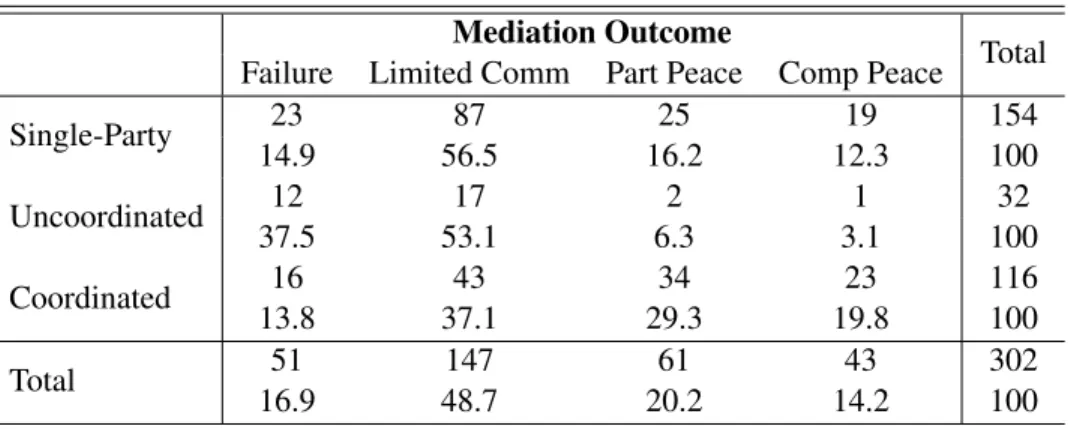
Mixed messages arise when the mediators have divergent preferences and send competing signals to the disputants. Mediators who prioritize different aspects of the conflict will propose and support competing peace plans. Different promises, ideas, or expectations from the mediators make resolving the conflict and reaching a settlement more difficult. Conflicting information and agendas can bring the progress of negotiations into doubt and decrease the willingness of the disputants to engage in continued mediation. Mixed messages can be avoided by coordination among the mediators, so that proposals are presented as a unified message.
tools, sources of leverage to the table.
The Mediation Dream Team
To most effectively overcome these obstacles to peace and minimize the negative externalities of overcrowding, the ideal mediation team is complementary, balanced, and coordinated. Complementary efforts maximize the sources of leverage at every phase of the negotiations, providing the knowledge, resources, and credibility necessary to improve the prospects for peace while also avoiding redundant mediators that crowd the mediation process. Balanced efforts help resolve the commitment problems associated with negotiating and implementing an agreement. By including an ally of both the rebels and the government, balanced efforts leave both sides feeling more protected, decreasing the severity of the commitment problems faced by the disputants. Coordinated efforts help overcome the problems unique to multiparty mediation efforts, diminishing the risk of forum-shopping, mixed messages, and free-riding. Mediators that help balance or complement the team possess desirable traits that increase the probability of mediation success. Mediators that can complement or balance each other will vary across conflicts. While the ideal composition of the dream team will vary by context, I expect these characteristics to be important for all intrastate conflicts.
Before elaborating upon how the mediation dream team improves mediation success, it is worth considering what it means for a mediation effort to be successful. An important initial step in the resolution process is getting the disputants to reach agreement. Getting a peace agreement signed is difficult; by this metric, most mediation efforts result in failure. In fact, 65.6 percent of mediation efforts in civil wars between 1989 and 2005 failed to produce a partial or comprehensive peace agreement. Even if a peace agreement is signed, the chance of war recurrence post-mediation remains high in civil wars. Forty-two percent of partial and full peace agreements signed in the same time period failed in the first month. This implies that short- and long-term conceptualizations of the peace process might have different obstacles and thus different roles for mediators to play.
Evaluating Success
successful in getting the disputants to find a mutually acceptable compromise from those that could not find common ground between the disputants. As most agreements fail within two months of being signed and mediation has shown to have competing short- and long-term impacts, I also consider the durability of the agreements. First, I measure the durability of the agreement by determining if the agreement managed to last through the difficult initial two-month period. A second conceptualization of the durability of the peace agreement measures the months of post-agreement peace. Taken together, these conceptualizations of success allow for evaluating the short- and long-term impacts of mediation. While some characteristics of the dream team might encourage an agreement to be signed, considering the duration of post-agreement peace allows for evaluating if mediation is producing agreements that have no chance of resulting in a durable resolution.
Complementary Mediation
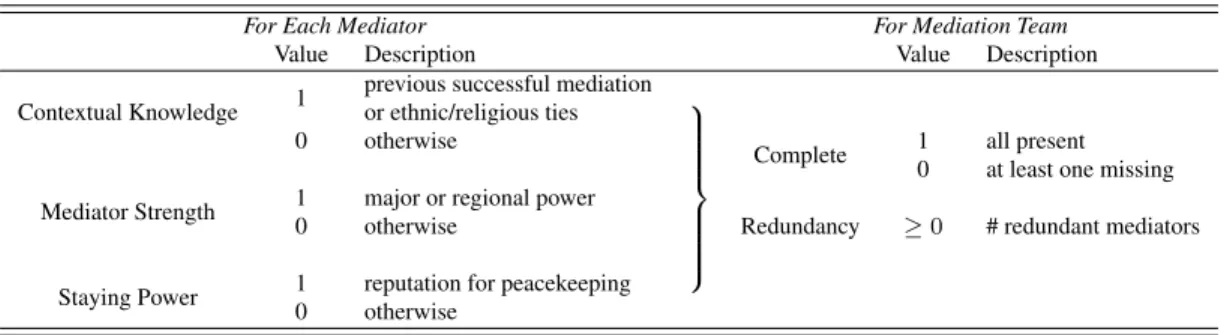
Complementary mediation teams bring together mediators with different sources of leverage. By having mediators with sufficient contextual knowledge of the conflict, enough will to credibly commit to stay involved as long as necessary, as well as the resources necessary to generate and enforce an agreement, the team is in a stronger position to overcome all three obstacles to resolution. Mediators can generate complementary teams in several ways. Perhaps the team includes a local organization with contextual knowledge and the will to help implementation, as well as a regional or global power with the necessary resources. Perhaps each role is provided by a different actor. The important characteristic of the dream team is that each role is filled, without unnecessary mediators crowding the negotiations.
Mediators with contextual knowledge are crucial to identifying the relevant parties to the negotia-tions, as discussed previously. Contextual knowledge of the crisis and the disputants gives the mediator a better understanding of the bargaining range and ways to expand the range through issue-linkage or outside assurances. Mediators with contextual knowledge are in a better position to make sure all nec-essary parties are involved in the talks and to use their knowledge to help the disputants find a mutually acceptable agreement.
cases, mediators with economic or military power will have the leverage necessary to compel or co-erce the disputants into an agreement. Promises of aid or preferential trade relationships could expand the bargaining range, opening up mutually acceptable compromises. Likewise, threatening military ac-tion, economic sanctions, or the removal of current aid packages could increase the costs of continued conflict, expanding the bargaining range.
While strong mediators will have the leverage to use these carrots and sticks to encourage resolution, the reality is that the influence of such efforts would be short-lived. This makes the third component of a complementary effort, staying power, very important. Mediators that are willing to stay after the agreement has been reached are able to respond to new tensions as they arise. Having actors that are still in dialogue with the disputants provides earlier detection of problems and potentially more readily available solutions. Identifying moments where additional influence from the mediators could be useful (perhaps to reopen talks and deal with an unforeseen source of conflict, to assert more pressure, or to provide additional protections and assurances) could help stabilize the implementation process and reduce the chances the agreement fails.
Moreover, I argue that disputants interested in a lasting peace are aware of the time-inconsistency problems often associated with mediation agreements. Disputants who expect an agreement to fail immediately will be reluctant to sign on to the agreement in first place. Actors with staying power are important from the very beginning of the negotiations in order to improve the disputants’ expectations about the effectiveness of the talks, encouraging them to invest fully in the negotiations.
Complementary efforts will positively effect the chances of reaching an agreement that will endure. By having all three sources of leverage present at the negotiating table, the mediation team is equipped to address a variety of challenges and potential obstacles. The consequences of overcrowding imply that while the presence of these three types of leverage is important, avoiding redundancy within the mediation effort is also important. Additional mediators are not always desirable. The value of another mediator is a function of how that mediator contributes to the strengths of the mediation team. Mediators that add new sources of leverage to the mediation effort will increase the chances of mediation success, while those that are redundant hurt the chances of success.3
3It is conceivable that the effect of redundant mediators might be different depending upon the composition of the mediation
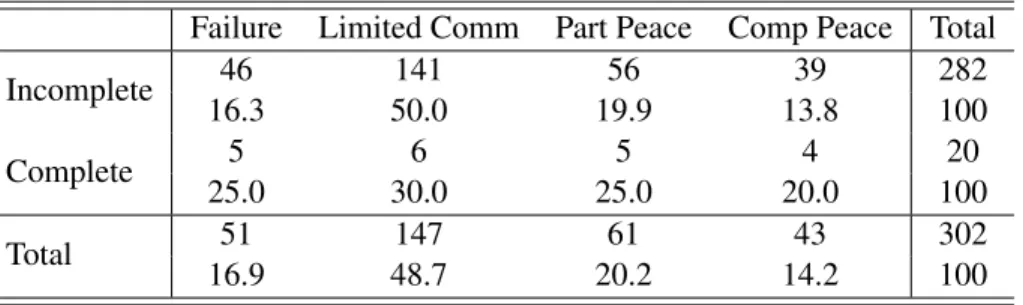
This discussion identifies two important dimensions to a complementary effort: having all three sources of leverage (beingcomplete) and having no redundant mediators (i.e. mediators who do not bring a unique source of leverage to the table). I expect complete efforts to be more successful than incomplete efforts (regardless of the number of redundant mediators). Likewise, mediation efforts with fewer redundant mediators should be more successful, all else equal.
The mediation effort by the Community of Sant’Egidio, the United States, Italy, and the United Nations in Mozambique illustrates the effectiveness of complementary mediation. The Community of Sant’Egidio provided contextual knowledge and cultural leverage, the UN provided peacekeeping forces and legitimacy, and Italy and the United States provided resources and credibility to the process. Italy also served as a liaison between the United States and the rest of the mediation team, allowing the team to draw on the United States’ resources, while also minimizing the complications that would result from a more direct American presence (Bartoli, 1999).
The case of Mozambique highlights the benefits of having acompletemediation effort in which all three sources of leverage are present. The Community of Sant’Egidio, the United States, Italy, and the UN provided different tools to the mediation effort, collectively ensuring that the mediation team had contextual knowledge, resources, and credible staying power. Efforts like this are able to exert influence at each stage of negotiations, helping the disputants navigate the hurdles they face. Incomplete efforts (i.e. those lacking in one or more of these sources of leverage) might still have some influence over the disputants, but this influence will be limited, reducing their effectiveness at helping negotiate a settlement.
Hypothesis 1 Complete mediation teams increase the probability of successfully reaching a mediated
agreement, as well as the duration of post-agreement peace, relative to incomplete mediation teams.
Consider alternatively a multiparty mediation team consisting of representatives from four neigh-boring states. Each of these mediators likely provide contextual knowledge, an interest in generating re-gional stability, and some resources. All four neighbors, however, provide the same sources of leverage, making three out of the four of these states redundant and encouraging free-riding among the mediators.
If more than one mediator possesses the same resources and leverage, those mediators have incentives to minimize their costs by delaying action in the hopes another actor bears the costs. This generates inefficiency, potentially slowing down the mediation team’s efforts, stalling progress, complicating the process, and ultimately reducing the chances of success.
Hypothesis 2 Mediation teams with fewer redundant mediators increase the probability of successfully
reaching a mediated agreement, as well as the duration of post-agreement peace, relative to mediation
teams with more redundant mediators.
The composition of the mediation team are important influences in the outcome of mediation. The ideal mediation team provides enough leverage to help the combatants reach agreement, yet avoids complicating the mediation effort with actors that generate inefficiency. Furthermore, each mediator fills a specific role, requiring each member to play their part in order to reach the desired outcome, while also ensuring that each function is provided. It is worth noting that single-party mediation can be complementary, if that single mediator possesses all three sources of leverage. The relevant variance is in the types of leverage present at the negotiating table, not the number of mediators.
Balanced Mediation
Balanced mediation is unique to multiparty efforts because achieving balance requires at least two mediators. A balanced effort is a mediation process in which each side of the dispute has a mediator looking out for its interests. In other words, a balanced effort has at least one mediator who favors the rebels and at least one mediator who favors the government. While many forms of mediator bias exist, in this project a mediator is considered biased if she has provided support to one side during the conflict or if she has ties to one side of the conflict such that she prefers an outcome that advantages that side. Bias then is captured both in terms of the mediator’s actions and the mediator’s preferences. Mediation efforts that are not balanced are either impartial or unbalanced. Impartial efforts are those in which no mediator is biased toward either side. Unbalanced, or biased, efforts are those in which at least one mediator is biased toward one side and no mediator is biased toward the other side.
functions: to provide information so that the disputants can find a mutually acceptable agreement and to help the disputants overcome the commitment problems that accompany conflict resolution attempts. While mediators can in certain circumstances reveal information, their ability to do so is often quite limited. A balanced mediation effort could improve information revelation as each side would have a mediator to recommend caution when appropriate. Proposals approved by a balanced mediation effort would also have a higher level of legitimacy. This improvement, however, would be constrained by the ability of these mediators to learn information their preferred side does not already know. Therefore, the primary mechanism by which balanced mediation efforts improve the chances of success is in mitigating the credible commitment problems.
Impartial mediators would not exacerbate the security concerns of the disputants, but they also cannot extend credible promises of protection or monitoring to either side. Biased mediators are in a unique position to address the concerns of their allies. A biased mediator is more likely to alert its ally of any opponents’ action that indicates defection from the negotiations or agreements. This early warning provides additional protection to disputants, alleviating the urge to defect first in order to protect against an ambush by their opponent. In addition to serving as an early warning system, biased mediators can also credibly promise to protect their allies should the opposition try to take advantage of a period of relative weakness. For example, demobilization leaves the side putting down weapons vulnerable; reacquiring arms can be both costly and time consuming. The time it takes to rearm could be sufficient to allow the other side to change the balance of power between the disputants and ruin any progress toward peace. A biased mediator cancrediblypromise to send support should such a situation arise, protecting their ally from this risk and encouraging their ally to agree to temporary ceasefires, demobilization, or other necessary steps that might leave them at a temporary military disadvantage. In this way, biased mediators can reduce the costs of exploitation, decreasing the need for preventive action and encouraging disputant cooperation in a way that impartial mediators cannot.
in favor of the Ugandan government. The LRA thus claimed that their concerns would not be taken as seriously. An effort in which both the rebels and the government have an ally provides all the advantages of bias in overcoming commitment problems onboth sidesof the conflict. By alleviating the disputants’ commitment problems during the negotiation and implementation of a peace accord, balanced media-tion improves the chances of mediamedia-tion success. By including mediators biased in favor of each side, the mediation effort as a whole benefits from both sets of protections that biased mediators provide. Mediation teams that include the right mix of mediator bias improve the chances of reaching an agree-ment by helping mitigate the commitagree-ment problems that lead to negotiation breakdown. This enables the mediation effort to benefit from mediator bias without leaving one side feeling more insecure.