
Penn Law: Legal Scholarship Repository
Penn Law: Legal Scholarship Repository
Faculty Scholarship at Penn Law2019
Startup Governance
Startup Governance
Elizabeth Pollman
University of Pennsylvania Law School
Follow this and additional works at: https://scholarship.law.upenn.edu/faculty_scholarship
Part of the Agency Commons, Business Organizations Law Commons, Corporate Finance Commons,
Finance Commons, Law and Economics Commons, and the Securities Law Commons
Repository Citation Repository Citation
Pollman, Elizabeth, "Startup Governance" (2019). Faculty Scholarship at Penn Law. 2135.
https://scholarship.law.upenn.edu/faculty_scholarship/2135
This Article is brought to you for free and open access by Penn Law: Legal Scholarship Repository. It has been accepted for inclusion in Faculty Scholarship at Penn Law by an authorized administrator of Penn Law: Legal Scholarship Repository. For more information, please contact [email protected].
(155)
ARTICLE
STARTUP GOVERNANCE
ELIZABETH POLLMAN†
Although previously considered rare, over three hundred startups have reached valuations over a billion dollars. Thousands of smaller startups aim to follow in their paths. Despite the enormous social and economic impact of venture-backed startups, their internal governance receives scant scholarly attention. Longstanding theories of corporate ownership and governance do not capture the special features of startups. They can grow large with ownership shared by diverse participants, and they face issues that do not fit the dominant principal-agent paradigm of public corporations or the classic narrative of controlling shareholders in closely held corporations.
This Article offers an original, comprehensive framework for understanding the unique combination of governance issues in startup companies over their life cycles. It shows that venture-backed startups involve heterogeneous shareholders in overlapping governance roles that give rise to vertical and horizontal tensions between founders, investors, executives, and employees. These tensions tend to multiply as the company matures and increases the number of participants with varied interests and claims. This framework of startup governance offers new insight into issues of current debate, including monitoring failures by startup boards and late-stage governance complexity, and suggests that more attention should be paid to how corporate law principles apply in the startup context.
† Professor of Law, Loyola Law School, Los Angeles. For helpful conversations and comments, thanks to Yifat Aran, Shyam Balganesh, Jordan Barry, Robert Bartlett, Carlos Berdejó, Brad Bernthal, Margaret Blair, Bill Bratton, Brian Broughman, John Coyle, Ben Edwards, Jared Ellias, Jill Fisch, Mike Guttentag, Dave Hoffman, Summer Kim, Mike Klausner, Michael Knoll, Justin Levitt, Gregg Polsky, Gabriel Rauterberg, Jennifer Rothman, Natasha Sarin, Jeff Schwartz, Shannon Treviño, Jeff Wolters, Yesha Yadav, David Yosifon, Adam Zimmerman, and the participants of the BYU Winter Deals Conference, the Grey Fellows Forum at Stanford Law School, the National Business Law Scholars Conference, the Notre Dame Governance Workshop, the Private Equity and Venture Capital Committee of the ABA Business Law Section, the UC Hastings Workshop in Law, Business & Economics, and faculty workshops at Brooklyn Law School, Temple Law School, and the University of Pennsylvania Law School.
INTRODUCTION ... 156
I. THE DISTINCTIVENESS OF STARTUPS AND THEIR LIFE CYCLE ... 162
A. Legal Boundaries and Definitions ... 163
B. Two Dimensions of the Startup Life Cycle ... 165
1. The Nature of the Business ... 165
2. The Complexity of the Capital Structure ... 170
II. AFRAMEWORK OF STARTUP GOVERNANCE ... 176
A. Fundamental Startup Governance Issues ... 178
1. Vertical Issues ... 179
a. Shareholders vs. Board ... 179
b. Board vs. Founders or Executives ... 184
c. Shareholders vs. Founders or Executives ... 185
2. Horizontal Issues ... 188
a. Preferred vs. Common ... 189
b. Preferred vs. Preferred ... 191
c. Common vs. Common ... 193
B. Increasing Governance Issues Over Time ... 196
III. IMPLICATIONS AND FUTURE PATHS ... 200
A. Understanding Challenges ... 200
1. Monitoring Failures ... 200
2. Extreme Late-Stage Governance and Liquidity Pressure ... 209
B. Applying Corporate Law ... 216
CONCLUSION ... 220
INTRODUCTION
The world’s largest companies in 2019 by market capitalization—Apple, Alphabet, Microsoft, and Amazon—all began as venture-backed startups.1
They defied existing theory by growing to significant size with ownership shared between founders, investors, executives, and employees.2 In the years 1 NAT’L VENTURE CAPITAL ASS’N,2017NAT’L VENTURE CAPITAL ASS’N YEARBOOK 9 [hereinafter NVCA YEARBOOK], https://nvca.org/blog/nvca-2017-yearbook-go-resource-venture-ecosystem [https://perma.cc/3HQ7-DR6Q]; Stephen Grocer, Biggest Public Company? Microsoft. Wait, Apple Again. Amazon? No, Back to Microsoft., N.Y. TIMES: DEALBOOK (Feb. 5, 2019), https://www.nytimes.com/2019/02/05/business/dealbook/apple-amazon-microsoft-market-value.html [https://perma.cc/KD2A-KS24]. This Article focuses on innovative, venture-backed startups, defined in Section I.A, infra.
2 See HENRY HANSMANN,THE OWNERSHIP OF ENTERPRISE 40-44 (1996) (observing the “nearly complete absence of large firms in which ownership is shared among two or more different types of patrons, such as customers and suppliers or investors and workers” and theorizing the high cost of collective decisionmaking that would result from having different types of owners).
since these trailblazing startups crossed over into public company status, record-breaking amounts of capital have flowed into new private companies.3
Over three hundred “unicorn” startups have reached private valuations described as one billion dollars or more.4 Many of these companies have also
reached the ten-year mark and face critical inflection points in their life cycles.5 Thousands of other startups are following on their heels or hope to
do so. Our economy and society are increasingly dominated by companies that start in the proverbial garage or dorm room and, for a critical period, operate with a venture-capital style of ownership and governance.
Corporate law and theory have not kept pace in giving due attention to this development and adapting general principles to fit the special features of startups.6 Courts apply traditional contract strictures to the preferred stock
that venture capitalists hold not as public company debt, but rather as a stake in a distinctive system of shared equity and governance.7 Recent case law
requires startup directors to maximize value for common shareholders, without recognizing that in startups these shareholders do not have a monolithic set of interests and do not represent the firm value.8
Corporate law literature remains similarly rooted in traditional paradigms of public and closely held corporations that do not map on well to startups. Landmark works on the separation of ownership and control in public
3 See Begum Erdogan et al., Grow Fast or Die Slow: Why Unicorns Are Staying Private, MCKINSEY (May 2016), https://www.mckinsey.com/industries/high-tech/our-insights/grow-fast-or-die-slow-why-unicorns-are-staying-private [https://perma.cc/S8CU-HGQM] (noting that the influx of capital to private companies tripled from $26.5 billion to $75.3 billion between 2013 and 2015).
4 Venture capitalist Aileen Lee coined the term “unicorn” in 2013 to capture the elusive and rare nature of mega-hit ventures in a fund that are worth a billion dollars or more. Aileen Lee, Welcome to the Unicorn Club: Learning from Billion-Dollar Startups, TECHCRUNCH (Nov. 2, 2013), https://techcrunch.com/2013/11/02/welcome-to-the-unicorn-club [https://perma.cc/SP4S-4SXA]. In just several years, the list of unicorns rose to over three hundred private technology companies. The Global Unicorn Club, CBINSIGHTS, https://www.cbinsights.com/research-unicorn-companies [https://perma.cc/DS5A-ET7T] (last visited Aug. 11, 2019).
5 See Alfred Lee, Delayed IPOs Undercut Startup Employee Options, THE INFO. (July 13, 2018), https://www.theinformation.com/articles/delayed-ipos-undercut-startup-employee-options [https://perma.cc/AD59-EPBD] (noting that fifty-two unicorns hit the ten-year mark by 2018 and that more would follow in 2019). Notable examples in this batch of unicorns include Airbnb, Uber, Pinterest, Palantir, and SpaceX—some of which have since transitioned to public company status. Id.
6 See Robert P. Bartlett & Eric Talley, Law and Corporate Governance, in 1 THE HANDBOOK OF THE ECONOMICS OF CORPORATE GOVERNANCE177, 185-86 (Benjamin E. Hermalin & Michael S. Weisbach eds., 2017) (“Th[e] increasing concentration of economic value in private companies poses something of a challenge for corporate governance scholars, both empirically and theoretically .... To the extent this trend continues, the study of governance in privately held firms is likely to become more critical to important policy debates.”).
7 See infra subsection II.A.2.b. 8 See infra Section III.B.
corporations and a principal-agent theory of the firm have oriented the field to view reducing managerial agency costs “as the essential function of corporate law.”9 A smaller body of work on controlled and closely held
corporations has, by contrast, highlighted that these corporations do not share the hallmark feature of widely dispersed shareholders and instead face the potential problem of minority shareholder oppression.10
Amid this dichotomous approach to corporations,11 a separate body of
venture capital and entrepreneurship literature has emerged to examine specific governance issues in startups. Key work in this field includes, for example, the study of venture capital financing12 and the use of preferred
stock.13 Some scholars have recently begun studying unicorns, the largest
startups by valuation, and have advocated for increasing disclosures and strengthening mechanisms that impose discipline on founders.14 Yet, despite 9 Zohar Goshen & Richard Squire, Principal Costs: A New Theory for Corporate Law and Governance, 117 COLUM.L.REV.767, 769 (2017); see ADOLF A.BERLE,JR.&GARDINER C. MEANS,THE MODERN CORPORATION AND PRIVATE PROPERTY2-4 (1932) (identifying the separation of ownership and control in corporations with dispersed share ownership as a key governance issue); Michael C. Jensen & William H. Meckling, Theory of the Firm: Managerial Behavior, Agency Costs and Ownership Structure, 3 J.FIN.ECON. 305, 308-09 (1976) (theorizing that the misalignment between shareholders and managers gives rise to agency costs).
10 See, e.g., Lucian A. Bebchuk & Assaf Hamdani, Independent Directors and Controlling Shareholders, 165 U.PA.L.REV. 1271, 1279-80 (2017); see generally Benjamin Means, A Contractual Approach to Shareholder Oppression Law, 79 FORDHAM L.REV. 1161 (2010); Douglas K. Moll, Shareholder Oppression and “Fair Value”: Of Discounts, Dates, and Dastardly Deeds in the Close Corporation, 54 DUKE L.J. 293 (2004).
11 Robert P. Bartlett, III, Venture Capital, Agency Costs, and the False Dichotomy of the Corporation, 54 UCLAL.REV.37, 37 (2006) [hereinafter Bartlett, False Dichotomy] (“On one side of the dichotomy rests the publicly held corporation suffering from a significant conflict of interest between its managers and dispersed shareholders; on the other side, the closely held corporation plagued by intershareholder conflict.”).
12 See, e.g., Bartlett, False Dichotomy, supra note 11, at 61-64 (examining horizontal issues between venture capital investors); William W. Bratton, Venture Capital on the Downside: Preferred Stock and Corporate Control, 100 MICH.L.REV. 891, 914-16, 939-44 (2002) (discussing why venture capitalists use preferred stock and how they contract for protections from downside failure); Ronald J. Gilson, Engineering a Venture Capital Market: Lessons from the American Experience, 55 STAN.L. REV. 1067, 1082 (2003) (discussing how venture capital contracts respond to agency costs between venture capitalists and entrepreneurs); D. Gordon Smith, The Exit Structure of Venture Capital, 53 UCLAL.REV. 315, 316-20 (2005) [hereinafter Smith, Exit Structure] (examining potential conflicts between venture capitalists and entrepreneurs regarding exit).
13 The literature on the conflict between the preferred and common shareholders in startups includes: Robert P. Bartlett, III, Shareholder Wealth Maximization as Means to an End, 38 SEATTLE
U.L.REV. 255 (2015) [hereinafter Bartlett, Shareholder Wealth]; William W. Bratton & Michael L. Wachter, A Theory of Preferred Stock, 161 U.PA.L.REV. 1815 (2013); Jesse M. Fried & Mira Ganor, Agency Costs of Venture Capitalist Control in Startups, 81 N.Y.U.L.REV. 967 (2006); Charles R. Korsmo, Venture Capital and Preferred Stock, 78 BROOK.L.REV. 1163 (2013); Leo E. Strine, Jr., Response, Poor Pitiful or Potently Powerful Preferred?, 161 U.PA.L.REV. 2025 (2013).
14 See Jennifer S. Fan, Regulating Unicorns: Disclosure and the New Private Economy, 57 B.C.L. REV. 583, 583 (2016) (arguing “for enhanced disclosure requirements that will alleviate the risks of unicorns without restraining their innovation”); Renee M. Jones, The Unicorn Governance Trap, 166
growing influence and concern, no article has provided a full account of the unique features of startups and their governance.
This Article takes aim at that goal. With their focus on technology and innovation, and their correspondingly high levels of risk and emphasis on growth, startups are different from both public corporations and traditional closely held corporations. As a result, their governance is also different. This Article provides an in-depth, holistic analysis of the governance problems in venture-backed startup companies that exist through various stages of their life cycles. Specifically, it offers a framework showing that startups involve heterogeneous shareholders in overlapping governance roles that give rise to vertical and horizontal tensions between founders, investors, executives, and employees. These tensions tend to multiply as a company matures and increases the number of participants with varied interests and claims.
This original account of startup governance shares features with traditional models but also differs in significant ways that have wide-ranging implications for corporate law and theory. Prevailing accounts, whether focused on public corporations and their shareholder-manager conflicts, or closely held corporations and their issues of controlling shareholder opportunism, present the corporation in static terms as facing one essential governance issue that is either vertical or horizontal in nature.15 Corporate
law literature has also often characterized shareholders as homogeneous in their interests and has excluded employees from analysis, recognizing their relevance to the corporation in only contractual terms.16
U.PA.L.REV.ONLINE 165, 169 (2017) (arguing that “recent market trends and deregulatory reforms have weakened or eliminated the principal mechanisms that imposed discipline on start-up company founders”).
15 One notable exception is work by Robert Bartlett that provides a dynamic account showing that the staged and syndicated financing that venture capitalists (VCs) use to constrain shareholder-manager agency costs can give rise to a new dimension of horizontal conflict among preferred shareholders in startups. See Bartlett, False Dichotomy, supra note 11, at 108-14. This Article builds on this insight and is the first to provide a comprehensive dynamic account of the multiple vertical and horizontal tensions in startups and argue, in contrast to Bartlett, that startups have unique governance features and do not present the same agency problems and investment risks as all other firms. See id. at 37-40 (asserting that “all firms—public and private—often face the same agency problems” and “all firms—public and private—frequently face the same structural investment risks”).
16 See, e.g., FRANK H.EASTERBROOK &DANIEL R.FISCHEL,THE ECONOMIC STRUCTURE OF CORPORATE LAW 1-39 (1991) (providing a contractarian theory of corporate law and characterizing employees as creditors protected by contract and external regulation); Henry Hansmann & Reinier Kraakman, The End of History for Corporate Law, 89 GEO.L.J. 439, 440-41 (2001) (“[The] emerging consensus [is] that ultimate control over the corporation should rest with the shareholder class; ... [and] other corporate constituencies, such as creditors, employees, suppliers, and customers, should have their interests protected by contractual and regulatory means rather than through participation in corporate governance.”); Henry Hansmann, Worker Participation andCorporateGovernance, 43 U.TORONTO L.J.589, 591-92 (1993) (“Shareholders have highly homogeneous interests with respect to most corporate decisions: they all basically want to maximize
This approach is a poor fit for startups. Participants in startups often occupy overlapping and shifting roles. For example, a venture capital (VC)
firm is a shareholder and may additionally hold a designated seat on the board. This complicates conventional applications of principal-agent theory as participants may have a dual status as both principal in one context and agent in another.
In addition, startup shareholders are heterogeneous. In light of extreme levels of uncertainty and asymmetric information, startups typically issue common stock to founders and raise money from investors by issuing rounds of convertible preferred stock with varying terms and layered contractual rights.17 This capital structure creates significant divergences in preferences
among shareholders. Furthermore, employees make essential investments of human capital and hold common equity or options.18 In many instances the
interests of founders and executives align with those of employees, but in some situations they diverge because of differences in control, potential deal payouts, and post-exit opportunities. Conflicts therefore arise not only between preferred shareholders, and between preferred and common shareholders, but also between common shareholders—a point that even scholars focused on startups have generally left unexplored.19
Setting out the full picture of vertical and horizontal tensions highlights the distinctiveness of startups and also uncovers an important pattern: The governance tensions tend to multiply as the startup business evolves and the complexity of its capital structure grows. Unlike public companies and other closely held corporations, which do not display predictable or linear patterns
the net present value of future distributions.”); but see Margaret M. Blair & Lynn A. Stout, A Team Production Theory of Corporate Law, 85 VA.L.REV. 247, 253 (1999) (including employees in the “corporate ‘team’”); Kent Greenfield, The Place of Workers in Corporate Law, 39 B.C.L.REV. 283, 283-88 (1998) (critiquing the exclusion of workers from corporate law doctrine); Brett H. McDonnell, Employee Primacy, or Economics Meets Civic Republicanism at Work, 13 STAN.J.L.BUS.& FIN. 334, 334-37 (2008) (arguing for “employee primacy” in corporate governance).
17 See infra subsection I.B.2.
18 Scholars have largely overlooked the role of non-founder employees in startup governance. For an excellent essay that considers the vulnerability of startup employees to risk in mature startups, see Abraham J.B. Cable, Fool’s Gold? Equity Compensation & The Mature Startup, 11 VA.L. &BUS. REV. 613 (2017). Other startup employee-related literature has primarily focused on theorizing stock options and analyzing legal issues such as taxation. See Victor Fleischer, Taxing Founders’ Stock, 59 UCLAL.REV. 60, 75-100 (2011) (arguing for reform to the preferential tax treatment of founders’ stock); Saul Levmore, Puzzling Stock Options and Compensation Norms, 149 U. PA.L.REV. 1901, 1924-40 (2001) (offering an explanation for the popularity of stock options as part of compensation packages).
19 As Section II.A explains, in startups this divergence between common shareholders typically occurs between the management and employees. Scholars are beginning to explore interinvestor conflicts in public companies that might offer a parallel. See Bartlett & Talley, supra note 6, at 8 (“[T]he nature of governance disputes within public companies has itself begun to migrate in recent years to ‘horizontal’ disputes between shareholders (e.g., activists versus long-term investors).”).
of governance change, venture-backed startups that survive foreseeably face increasing potential conflicts.
While it may seem intuitive that startups increase in governance complexity as they continue to operate, this account is missing from the existing literature. Because startups are often unprofitable for long periods while they develop innovative products or services, they usually raise outside investment and continue to do so to fuel growth.20 Each round of financing
may bring investors with different terms and interests into the capital structure, adding to potential governance conflicts.21 Further, employees are
typically hired on an ongoing and increasing basis, and become staggered in their option vesting schedules and exercise prices. Thus, as a startup company matures, it expands the number of participants with varied interests and claims affecting its governance structure.22
These central contributions of the Article help elucidate vexing issues of current debate and open future directions for corporate law. Part I discusses the distinctiveness of startups and their paradigmatic life cycle. It sets out legal boundaries and definitions, and identifies two dimensions of the startup life cycle that drive governance issues: the evolving nature of the business and capital structure. Part II provides a holistic analytical framework of the recurring issues of startup governance, both vertical (such as between the board and founders) and horizontal conflicts (such as between shareholders). It includes all startup participants and shows how they have diverging interests and might be involved in more than one type of governance issue, serving overlapping roles. Furthermore, it observes that governance issues tend to increase over time because of the evolving stage of business and increased complexity of the capital structure.
Part III explores how these observations help to explain current developments and illuminate implications for lawmakers. First, with scandals at companies such as Uber and Theranos making headline news, recent accounts of startups have bemoaned unaccountable companies with large social footprints and compliance failures.23 This Article’s framework helps
show how a startup’s evolving governance structure pushes toward prioritizing growth and puts key participants in overlapping roles, which can result in conflicts of interest and weaken oversight. This explanation solves a puzzle left open by existing literature, which assumes that VCs will serve as strong monitors. Further, it reveals cause for concern that likely cannot be solved with the standard corporate governance proposal for greater board
20 See infra Part I. 21 See infra Section II.A. 22 See infra Section II.B. 23 See infra subsection III.A.1.
independence. Startup governance may insufficiently constrain the social costs created by growing, innovative companies.
Second, the law and finance literature has examined various reasons for companies to go public but has overlooked what the framework offered here posits—complex governance dynamics in the extreme late stage of the startup life cycle.24 Staying private with an increasingly diverse group of shareholders
involves significant difficulty and cost in negotiating new rounds of financing, managing information flows, and meeting the liquidity needs of not just early investors but also large numbers of employees who constitute a crucial part of the workforce. This closer examination of the dynamics of startups in the extreme late stage provides a contemporary, governance-based account explaining why liquidity is so critical and why companies like Spotify and Slack go public even when private capital is available. Going public can enable companies to simplify their governance complexity while providing liquidity. Third, Part III suggests that corporate law should adapt in its application to startups in recognition of their distinctive features. Corporate law has largely developed to deal with the classic shareholder–manager and controlling–minority shareholder conflicts arising in public and traditional closely held corporations. Courts have applied these conventional frames of reference in cases involving startups, treating preferred shareholders as creditors with respect to their contractual preferences and characterizing common shareholders as the residual claimants of the corporation. A key example of this approach arises with fiduciary duty doctrine that is at the heart of corporate law. The last section examines In re Trados,25 Delaware’s
most notable fiduciary duty case involving a startup, and shows how the court overlooks the heightened need of heterogeneous shareholders to resolve complex governance issues by contract and a board with constituency directors that is renegotiated over time.26 A better approach would recognize
the corporation itself as the beneficiary of the fiduciary duties, representing the firm value and the interests of all startup participants.
I. THE DISTINCTIVENESS OF STARTUPS AND THEIR LIFE CYCLE To start at the beginning of understanding startup governance is to recognize that despite widespread reference to companies by the moniker of “startup” and recognition of their economic importance,27 the law does not
24 See infra subsection III.A.2.
25In re Trados Inc. S’holder Litig., 73 A.3d 17 (Del. Ch. 2013). 26 See infra Section III.B.
27 See, e.g., Gilson, supra note 12, at 1068 (noting that startup companies and the venture capital market are “among the crown jewels of the American economy”); Simone M. Sepe, Intruders in the Boardroom: The Case of Constituency Directors, 91 WASH.U.L.REV. 309, 314-15 (2013) [hereinafter
create such a category. This Part begins with definitional background and then sets out the unique combination of business and finance features in innovative venture-backed startups, which give rise to several recurring fundamental governance issues.
A. Legal Boundaries and Definitions
The law does surprisingly little to formally define startups or mandate their governance. Federal securities law draws a line between “public” and “private” corporations.28 A company becomes “public” by making a public
offering of securities, listing securities on a national securities exchange, or by reaching a certain asset size and number of shareholders of record.29 Once
a company is public, it is subject to a wide variety of governance requirements provided by federal statutes and by the securities exchange on which the company’s stock is traded.30 For example, a public corporation’s board must
have a majority of independent directors and must give shareholders a non-binding “say-on-pay” vote on executive compensation.31
If a company does not become public by one of the established paths, it is “private.”32 Some private corporations are referred to as “closely held” or Sepe, Constituency Directors] (noting that venture-backed startups “are growing exponentially in importance in the U.S. economy”).
28 A.C. Pritchard, Revisiting “Truth in Securities” Revisited: Abolishing IPOs and Harnessing Private Markets in the Public Good, 36 SEATTLE U.L.REV. 999, 1000 (2013). Venture-backed startups typically organize as corporations. See Joseph Bankman, The Structure of Silicon Valley Start-Ups, 41 UCLAL.REV.1737, 1738 (1994) (“In Silicon Valley, notwithstanding the concomitant loss of tax benefits, a substantial number of new ventures are carried out by newly-formed corporations.”); Victor Fleischer, The Rational Exuberance of Structuring Venture Capital Start-Ups, 57 TAX L.REV. 137, 137 (2003) (“A typical start-up is organized as a corporation under state law, which means that it is treated as a separate entity from its owners for tax purposes.”); Gregg Polsky, Explaining Choice-of-Entity Decisions by Silicon Valley Start-Ups, 70 HASTINGS L.J. 409, 411 (2019) (noting lawyers who advise startups “stubbornly prefer C corporations”).
29 15 U.S.C. §§78l(a), 78o(d) (2018); see also Donald C. Langevoort & Robert B. Thompson, “Publicness” in Contemporary Securities Regulation After the JOBS Act, 101 GEO.L.J.337, 351 (2013) (noting the ways a company may become public). Congress raised the Exchange Act’s section 12(g) threshold in the Jumpstart Our Business Startups (JOBS) Act of 2012, triggering public reporting obligations when a company has total assets exceeding $10 million and 2,000 or more shareholders of record, of which no greater than 499 are unaccredited investors. Jumpstart Our Business Startups Act, Pub. L. No. 112-106, §501, 126 Stat. 306, 325 (2012).
30 Langevoort & Thompson, supra note 29, at 381-83 (discussing corporate governance requirements on public companies); see, e.g., Paul G. Mahoney, The Exchange as Regulator, 83 VA.L. REV. 1453 (1997) (discussing the role of securities exchanges).
31 Developments in the Law—Corporations and Society, 117 HARV.L.REV. 2169, 2182-94 (2004); Jill E. Fisch, Leave It to Delaware: Why Congress Should Stay Out of Corporate Governance, 37 DEL.J. CORP.L. 731, 752-54 (2013) [hereinafter Fisch, Delaware].
32 To maintain this status, companies issue their securities in private placements conforming to the rules for exemptions from registration requirements. Stephen J. Choi & A.C. Pritchard, SECURITIES REGULATION:THE ESSENTIALS 297-98 (2008).
“close,” and are generally partnership-like businesses involving family or personal ties.33 The Internal Revenue Service defines a closely held
corporation as having more than half of the value of its outstanding stock owned by five or fewer individuals.34
Common usage often refers to startups with their own title or the broader term “private” rather than “closely held,” suggesting that startups connote different characteristics.35 Startups are typically started by entrepreneurs and
backed by outside investment with the goal of developing an innovative product or service, creating high growth, and exiting through a trade sale of the company or initial public offering (IPO).36 Unlike traditional closely held
corporations, startups are aimed at eventually being acquired by another corporation or transforming to a public corporation—their existence in startup form is understood to be ephemeral like a caterpillar in its chrysalis.
After an initial seed stage, startups often have more than a small handful of shareholders, with the numbers increasing as the company raises capital from syndicates of investors, including VCs, and grants restricted stock and stock options to employees which vest over the course of employment.37 Like
traditional closely held corporations, startups have stock that is not publicly
33 Edward B. Rock & Michael L. Wachter, Waiting for the Omelet to Set: Match-Specific Assets and Minority Oppression in Close Corporations, 24 J.CORP.L. 913, 916 (1999); see also Benjamin Means, Nonmarket Values in Family Businesses, 54 WM. & MARY L. REV. 1185, 1192 (2013) (highlighting the “distinctive features” of family businesses, which constitute a “vital part of the [United States] economy”).
34 INTERNAL REVENUE SERV.,U.S.DEP’T OF TREASURY,PUB.NO.542,CORPORATIONS 3 (Feb. 2019), https://www.irs.gov/pub/irs-pdf/p542.pdf [https://perma.cc/TDY5-FPEJ].
35 See, e.g., Telecom-SNI Inv’rs, L.L.C. v. Sorrento Networks, Inc., No. Civ.A. 19038-NC, 2001 WL 1117505, at *1 (Del. Ch. Sept. 7, 2001) (“Sorrento-California, as a startup corporation with no immediate prospects of profitability, required constant and significant cash infusions to sustain it until an initial public offering (‘IPO’) could be accomplished.”); JOHN B.VINTURELLA &SUZANNE
M.ERICKSON,RAISING ENTREPRENEURIAL CAPITAL 33 (2d ed. 2013) (distinguishing the “closely held” corporation from the “private” corporation by the number of shareholders and stating that “[a] start-up company with high growth aspirations will typically go through a period as a private corporation”).
36 See, e.g., SCOTT KUPOR,SECRETS OF SAND HILL ROAD:VENTURE CAPITAL AND HOW TO GET IT 2, 21, 27 (2019) (noting that “tech startups are basically innovative product or service companies” and that taking VC financing affects their governance and leads to exit through trade sale, IPO, or bankruptcy); Joseph Bankman & Ronald J. Gilson, Why Start-Ups?, 51 STAN.L.REV. 289, 289 (1999) (describing a “prototypical start-up” as comprising a founder with an idea and outside investment from venture capital). Exits through trade sales greatly outnumber exits through IPOs. NAT’L VENTURE CAPITAL ASS’N, 2018 NAT’L VENTURE CAPITAL ASS’N
YEARBOOK. 29-31, https://nvca.org/no-access/download-id/67488 [https://perma.cc/38UY-LUEH] (providing historic data on U.S. venture-backed exit activity, including 2017 data indicating 750 acquisitions versus 59 IPOs).
37 Startups typically manage the number of their holders of record to maintain private status, but the numbers may be significantly greater than the definition of “closely held” provided by the IRS. See Elizabeth Pollman, Information Issues on Wall Street 2.0, 161 U.PA.L.REV. 179, 191-93 (2012); cf. supra note 34 and accompanying text.
traded.38 But even in this regard, startups are different in that outside demand
for the high-growth asset class exists and startups may facilitate partial liquidity events.39 This Article focuses on these companies—innovative,
venture-backed startups and their distinctive governance features.40
In short, corporate and securities laws do not define or provide special rules for startups. From a legal perspective, startups simply represent part of the universe of private companies, subject to general principles of corporate law but otherwise free to privately order their affairs.41 It is therefore the
nature of the startup business and its life cycle that significantly drive governance arrangements and conflicts.
B. Two Dimensions of the Startup Life Cycle
Startups evolve in predictable ways across two dimensions that ultimately affect their governance. The first is the nature of the startup business, which progresses through stages of maturity. The second is the complexity of the capital structure, which increases with additional rounds of financing that are required to build and grow the company. Each of these dimensions underlies the framework of startup governance that this Article offers.
1. The Nature of the Business
Although any particular company’s trajectory may involve fits and starts, bumps and detours, in the larger picture of startups there are recognizable
38 See DOUGLAS K. MOLL &ROBERT A.RAGAZZO, 1 THE LAW OF CLOSELY HELD
CORPORATIONS §1.01 (Matthew Bender & Co. 2017 ed.) (“A closely held corporation can be generally defined as a corporation whose stock is not publicly traded on an established market.”).
39 For discussions of regulatory and technological changes that have facilitated liquidity and capital formation in startups outside of exchange listings and public offerings, see, for example, Langevoort & Thompson, supra note 29; Pollman, Information Issues, supra note 37; Robert B. Thompson & Donald C. Langevoort, Redrawing the Public-Private Boundaries in Entrepreneurial Capital Raising, 98 CORNELL L.REV. 1573 (2013).
40 Silicon Valley is famous for producing startups, but the framework offered here is not specific to any geographic location. Rather, the governance issues arise from the structures typically used by VCs, such as staged financing and preferred stock, and the common practice of granting stock options to employees, which together combine to form a structure that has varied participants and interests aimed at growth and exit.
41 State corporate law is generally enabling in nature. See Fisch, Delaware, supra note 31, at 742 (“[T]he structure of Delaware’s corporate law is largely enabling rather than mandatory.”); see also Melvin Aron Eisenberg, The Structure of Corporation Law, 89 COLUM.L.REV. 1461, 1481 (1989) (“Delaware is usually taken as the apotheosis of enabling states.”).
and predictable patterns. Startups famously fail at high rates.42 Those that
succeed generally proceed through well-established business phases.43
Early-stage startups are highly entrepreneurial and focused on innovation and technology. Startups are typically founded or cofounded by entrepreneurs who have an invention, technological idea, or discovery, and a desire to pursue commercial development.44 Cofounders Larry Page and
Sergey Brin started in their Stanford dorm rooms by building an internet search engine that they brought to market as Google.45 The “two Steves”—
Jobs and Wozniak—started by building a computer circuit board, Apple I, and selling Jobs’ VW microbus and Wozniak’s calculator to begin funding its production.46 Companies that are started to pursue existing business models
based on known products or services are replicative and not typically referred
42 See Deborah Gage, The Venture Capital Secret: 3 out of 4 Start-Ups Fail, WALL ST.J. (Sept. 20, 2012), https://www.wsj.com/articles/SB10000872396390443720204578004980476429190 [https://perma.cc/7QZZ-LLQP] (finding that “about 60% of startups survive to age three and roughly 35% survive to age 10”); Mary Jo White, Chair, Keynote Address at the SEC-Rock Center on Corporate Governance Silicon Valley Initiative (Mar. 31, 2016), https://www.sec.gov/news/speech/chair-white-silicon-valley-initiative-3-31-16.html [https://perma.cc/7SQ2-DGVY] (noting that nine out of ten startups fail and seventy percent of failed startups die within twenty months after their last financing, having raised an average of $11 million).
43 Researchers have coined various terms and framed different numbers of phases, but generally track the discussion offered in this section. See, e.g., NOAM WASSERMAN, THE
FOUNDER’S DILEMMAS: ANTICIPATING AND AVOIDING THE PITFALLS THAT CAN SINK A
STARTUP206-07 & n.* (2012) (identifying the stages as startup, transitional, and mature, and noting that “different functions within startups may go through them at different rates”); Max Marmer et al., Startup Genome Report Extra on Premature Scaling 14 (Mar. 2012), http://s3.amazonaws.com/startupcompass-public/StartupGenomeReport2_Why_Startups_Fail _v2.pdf [https://perma.cc/Y6HS-PK9Q] (gathering data from over 3,200 startups and identifying six stages: “Discovery, Validation, Efficiency, Scale, Sustain, and Conservation”).
44 See, e.g., DANIEL F.SPULBER,THE INNOVATIVE ENTREPRENEUR 2 (2014) (identifying “invention” and “entrepreneurship” as the early stages of startup formation).
45 From the Garage to the Googleplex, GOOGLE, https://about.google/our-story [https:// perma.cc/CB7B-HM7Q].
46 Steve Jobs: An Extraordinary Career, ENTREPRENEUR, https://www.entrepreneur.com/ article/197538 [https://perma.cc/D3MS-AXRG].
to as startups.47 By their nature, startups pursue innovation—“something new
that is introduced to the marketplace.”48
The key early stage question is: Can we make a product or service that people want?49 The nature of this challenge is typically both technological
and operational because of engineering or scientific challenges involved in developing innovative technology and the need to raise money to fund this work.50 Most founders do not have sufficient funds to bring an innovative
product or service to market and the business may not be profitable for long periods of time.51 Founders therefore usually look to friends and family, angel
investors, and VCs to finance the early and most uncertain stages of the startup.52 The company’s board, typically established in earnest upon the
raising of a round of financing, is in a highly managerial phase—helping the
47 See SPULBER, supra note 44, at 2 (“Innovative entrepreneurs differ from replicative entrepreneurs who imitate or purchase existing business models. The innovative entrepreneur combines inventions, initiative, and investment to create the start-up.”); see also WASSERMAN,supra note 43, at 6 (distinguishing “between the founding of high-potential startups and the founding of small businesses that are designed to remain small and owner-operated”); Darian M. Ibrahim & D. Gordon Smith, Entrepreneurs on Horseback: Reflections on the Organization of Law, 50 ARIZ.L.REV. 71, 84-85 (2008) (“Entrepreneurial opportunities may be novel in astrong sense, which typically implies a technological breakthrough backed by venture capital financing, or they may be novel in a weak sense, such as opening a new restaurant in a vacant building.”).
48 SPULBER, supra note 44, at 10; see also JOSEPH A. SCHUMPETER,THE THEORY OF
ECONOMIC DEVELOPMENT 74-83 (1934) (Redvers Opie trans., Transaction Publishers 2012) (describing entrepreneurs as introducing new goods or methods of production or opening new markets or supply sources); PETER THIEL,ZERO TO ONE:NOTES ON STARTUPS, OR HOW TO
BUILD THE FUTURE 8, 10 (2014) (“Properly understood, any new and better way of doing things is technology .... New technology tends to come from new ventures—startups.”); Ibrahim & Smith, supra note 47, at 84 (“Entrepreneurship involves new products or services, new ways of organizing, or new geographic markets.”).
49 GUY KAWASAKI,THE ART OF THE START 2.0:THE TIME-TESTED,BATTLE-HARDENED
GUIDE FOR ANYONE STARTING ANYTHING 39 (2015); WASSERMAN, supra note 43, at304. 50 Biotechnology startups face costs and risks associated with new drug development that are on a different scale and timeline than other innovative startups, and accordingly reflect specialized patterns of startup governance such as the prevalence of VC financing and joint ventures with large pharmaceutical companies. See, e.g., Ronald J. Gilson, Locating Innovation: The Endogeneity of Technology, Organizational Structure, and Financial Contracting, 110 COLUM.L.REV. 885, 910-14 (2010) (observing that biotech often involves “a combination of venture capital and joint venture financing that reflects the nature of the technology being financed and the organizational structure through which the product is carried out”).
51 See PAUL GOMPERS &JOSH LERNER,THE VENTURE CAPITAL CYCLE 157 (2d ed. 2004) (“Entrepreneurs rarely have the capital to see their ideas to fruition and must rely on outside financiers.”); THIEL, supra note 48, at 45 (noting that startups “often lose money for the first few years: it takes time to build valuable things, and that means delayed revenue”).
52 BRAD FELD &MAHENDRA RAMSINGHANI,STARTUP BOARDS:GETTING THE MOST
company with connections, resources, strategy, and expertise to succeed in launching its innovative product or service to the market.53
After the early stage, startups typically become focused on refining product development to generate revenues and grow quickly. The key mid-stage question is: Can we scale the manufacture, distribution, and sale of our innovative product or service?54 This question is often linked to the crucial
issue of generating revenues or reaching profitability with a large market opportunity.55 To ultimately reach large exits, startups need to be able to
scale.56 Venture capital firms that finance startups are based on a business
model that depends on having a few “home runs” in the portfolio that account for much of the fund returns.57 Sequoia Capital, for example, invested $60
million in WhatsApp, which later sold to Facebook for $16 billion—yielding a return to Sequoia of fifty times its investment.58
As a startup evolves to late stage, its focus has typically shifted to managing a more complex organization and finding an exit to achieve liquidity for the participants holding equity stakes in the company. To have survived this long, the company has successfully developed some innovative product or service and generated customers and sales. The nature of the business may have become more complex, potentially involving global
53 Id. at 5, 30, 68; see Jill E. Fisch, Taking Boards Seriously, 19 CARDOZO L.REV. 265, 286 (1997) [hereinafter Fisch, Boards] (“Foragrowthcompanyinadevelopingfield, faced with a variety of strategic decisions and an inexperienced CEO, the board’s role as manager may be an essential component of firm success. That role may require board members with developed industry expertise, business relationships with the firm, or even insiders.”).
54 See, e.g., Ranjay Gulati & Alicia DeSantola, Start-Ups That Last, HARV.BUS.REV., Mar. 2016, at 54, 55-61 (discussing critical activities to scale a venture and transition to a mature firm).
55 See KAWASAKI, supra note 49, at 37 (explaining that the term scale “refers to the concept that there are processes in place that are fast, cheap, and repeatable,” giving rise to the possibility that “there will soon be millions of customers who generate billions of dollars of revenue”); THIEL, supra note 48, at 21 (discussing product development and “viral growth”); id. at 54-55 (discussing scaling). Growth is often discussed as equal or greater in importance as profitability for startups. See Fred Wilson, Profits vs Growth, AVC (June 25, 2015), https://avc.com/2015/06/profits-vs-growth/ [https://perma.cc/5S2J-YKRU].
56 See KAWASAKI, supra note 49, at 38 (“[I]f Pierre Omidyar had to test every used printer offered for sale, eBay couldn’t scale. If Marc Benioff had to make every sales call, Salesforce.com couldn’t scale. If Steve Wozniak had to manufacture every Apple I, Apple couldn’t scale.” (emphasis omitted)).
57 See THIEL, supra note 48, at 86-87 (noting that “the best investment in a successful fund equals or outperforms the entire rest of the fund combined,” and that therefore “every single company in a good venture portfolio must have the potential to succeed at a vast scale”); see also Bob Zider, How Venture Capital Works, HARV.BUS.REV., Nov.-Dec. 1998, at 131, 136 (“Given the portfolio approach and the deal structure VCs use, ... only 10% to 20% of the companies funded need to be real winners to achieve the targeted return rate .... In fact, VC reputations are often built on one or two good investments.”).
58 William Alden & David Gelles, In WhatsApp Deal, Sequoia Capital May Make 50 Times Its Money, N.Y.TIMES (Feb. 20, 2014), https://dealbook.nytimes.com/2014/02/20/in-whatsapp-deal-sequoia-capital-may-make-50-times-its-money/ [https://perma.cc/9Z4K-VJYG].
operations, new opportunities, competition, and continued challenges in terms of cash flow and growth.59 Founders who have not kept up with these
needs may no longer occupy top executive positions.60 For instance, Tesla was
founded by Martin Eberhard, who was later fired and replaced by Elon Musk, a large investor and chairperson of the board.61
Indeed, by the late stage the number of participants has likely grown significantly and the needs of some have changed. Although some early employees may have left the company, others have stayed and fully vested their stock options, building pressure for an opportunity to sell.62 Different
types of investors may have participated in financing the company, and the most common type of large investor—the VCs—likely need the startup to
find a liquidity event so that they can return cash to their own investors and make money.63 VC firms typically raise capital from passive limited partners,
organized in funds with ten-year terms.64 Not only are VC firms sensitive to
liquidity within the timing of a particular fund’s term, but their business model also depends on raising successive funds and thus their ability to generate returns affects their reputation and ongoing operations.65 As one
partner explained, VCs are the “entrepreneurs behind the entrepreneurs.”66
59 See ROBERT COOTER &AARON EDLIN,THE FALCON’S GYRE:LEGAL FOUNDATIONS OF ECONOMIC INNOVATION AND GROWTH 2.2-2.3 (2014) (discussing the life cycle of an innovative business venture including the rise of competition that eventually settles into equilibrium); WORKING GRP. ON DIR.ACCOUNTABILITY &BD.EFFECTIVENESS,ASIMPLE
GUIDE TO THE BASIC RESPONSIBILITIES OF VC-BACKED COMPANY DIRECTORS 1 (Oct. 2007), https://www.levp.com/a-simple-guide-to-the-basic-responsibilities-of-vc-backed-company-directors/ [https://perma.cc/X2Y9-S5LP] [hereinafter VC Director Guide] (noting that “business processes become more complex” through the startup stages).
60 See WASSERMAN, supra note 43, at299 (finding that more than half of startups have replaced their CEO-founders by the time of their third rounds of financing); Brian J. Broughman & Jesse M. Fried, Do Founders Control Start-Up Firms That Go Public? 1, 9-10 (Eur. Corp. Governance Inst., Law Working Paper No. 405, 2018), https://papers.ssrn.com/sol3/papers.cfm?abstract_id=3171237 [https://perma.cc/M3HH-JKPA] (finding that in almost sixty percent of venture-backed firms that go public, the founder is no longer CEO at IPO).
61 Dana Olsen, Ousted CEO Club: Founders Who Left Startups They Helped Build, PITCHBOOK
(June 21, 2017), https://pitchbook.com/news/articles/ousted-ceo-club-founders-who-left-startups-they-helped-build [https://perma.cc/2NBP-H935].
62 See Pollman, Information Issues, supra note 37, at 194-96 (discussing employees and former employees participating in online marketplaces for trading private company stock).
63 See, e.g., Philippe Aghion et al., Exit Options in Corporate Finance: Liquidity Versus Incentives, 8 REV.FIN. 327, 331 (2004) (discussing the VC cycle which requires liquidating the proceeds of investment); Gilson, supra note 12, at 1070-76 (explaining the VC business model).
64 Gilson, supra note 12, at 1071. 65 Id.
66 ROCHELLE KOPP &STEVEN GANZ,VALLEY SPEAK:DECIPHERING THE JARGON OF
SILICON VALLEY 15 (2016) (quoting Keith Rabois from Khosla Ventures, with original attribution to Sequoia Capital).
In sum, a mature startup faces complex business challenges as well as growing pressure to sell the company or go public. Thus the key issues may range from particular strategic needs in addressing competitors or improving
financial metrics, but will ultimately always come down to one essential question: Can we find an exit?67 Of course, the startup aims for success by
not only finding an exit, but one that is lucrative for its participants and meets with their approval.
2. The Complexity of the Capital Structure
The nature of the startup business drives the forms and structure of entrepreneurial finance. Both of these dimensions of the startup in turn set the stage for governance.
At the founding, entrepreneurs usually split the entire ownership pie by issuing the initial common equity to themselves as founders’ stock.68
Founders generally pay a nominal amount for this stock because the company has minimal assets and business operations at the time of founding, and the stock is often structured to include a company repurchase right that lapses over time.69 In terms of initial capital, founders often ‘bootstrap’ the business
using their own funds, and those of family and friends, to finance development efforts and early operations.70 One study found that in
seventy-seven percent of founding teams, at least one founder contributed seed capital early in the life of the startup.71
High-potential innovative startups typically need far greater capital than founders can self-fund or raise through family and friends, however, and startups therefore seek alternate sources of capital.72 Traditional banks do not
lend to startups, particularly in their early stages, due to their lack of a track record, negative cash flow, lack of tangible assets, and high failure rate.73 Two
types of investors specialize in financing startups: angel investors and VCs.
67 See, e.g., GOMPERS &LERNER, supra note 51, at 28 (“A venture capitalist must liquidate a return in private firms to make money.”); PITCHBOOK &NAT’L VENTURE CAPITAL ASS’N, VENTURE MONITOR 1Q 2018, at 13 [hereinafter NVCA, VENTURE MONITOR 1Q 2018], https://nvca.org/research/venture-monitor/ [https://perma.cc/5N59-9ULT] (follow “1Q 2018 PitchBook-NVCA Venture Monitor” hyperlink) (“As companies move along the venture lifecycle, exits at some point move to the forefront of discussion and business positioning.”).
68 CONSTANCE E.BAGLEY &CRAIG E.DAUCHY,THE ENTREPRENEUR’S GUIDE TO LAW AND STRATEGY 90-92, 95-96 (5th ed. 2018).
69 THERESE H. MAYNARD ET AL., BUSINESS PLANNING: FINANCING THE START-UP
BUSINESS AND VENTURE CAPITAL FINANCING 374, 375 (3d ed. 2018). 70 WASSERMAN,supra note 43, at 252.
71 Id.
72 Id. at 253-54.
73 GOMPERS &LERNER,supra note 51, at 6-7; Paul Gompers & Josh Lerner, The Use of Covenants: An Empirical Analysis of Venture Partnership Agreements, 39 J.L. & ECON. 463, 465 (1996);
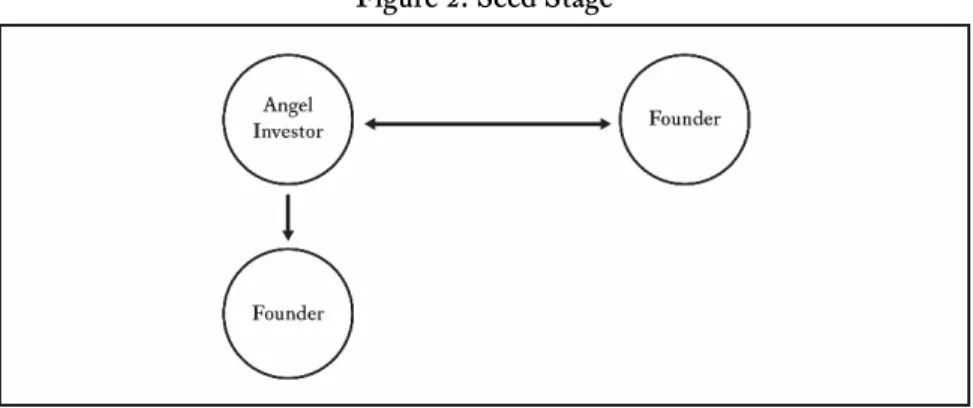
Angel investors are frequently the first source of outside funding— wealthy individuals, often with backgrounds as successful entrepreneurs, who invest their own money in early-stage companies.74 Angels tend to rely on
informal relationship-driven methods of screening and monitoring, or to aggregate their investments and efforts through regional angel groups.75 They
fill a critical funding gap in the beginning of a startup’s life, often coming in earlier and in smaller amounts than VCs are willing to entertain because of the size of their funds and costs.76 Angels are generally forward-looking: they
invest with the hope that the company can show enough business promise to attract subsequent financing by VCs. Angels typically receive common stock for their capital or invest through convertible notes or similar debt instruments that provide a means of making deferred equity investments with minimal transaction costs.77
Thus, in the early stage of a startup, when it is highly focused on innovation, its capital structure is relatively simple: basic debt or equity granted to founders, family and friends, and angel investors. A startup will also usually adopt a stock option plan and establish a pool of options to grant employees an incentive-based ownership stake.78 Stock options for startup
employees have become a norm because of cash constraints for high salaries,
see also KUPOR, supra note 36, at 28 (noting that equity-based VC financing typically backs companies that are very risky and expect long periods of illiquidity and a lack of near-term cash flow). For a discussion of specialized venture lenders that follow venture capital investment, see Darian M. Ibrahim, Debt as Venture Capital, 2010 U.ILL.L.REV. 1169 [hereinafter Ibrahim, Venture Debt].
74 See Darian M. Ibrahim, The (Not So) Puzzling Behavior of Angel Investors, 61 VAND.L.REV. 1405, 1406, 1408-09 (2008) [hereinafter Ibrahim, Angel Investors]. A notable alternative or additional source of capital and expertise for early-stage startups is a startup incubator or accelerator program. For a discussion of investment accelerator programs, see, for example, Brad Bernthal, Investment Accelerators, 21 STAN.J.L.BUS.&FIN.139 (2016).
75 Ibrahim, Angel Investors, supra note 74, at 1408-09.
76 Id. at 1416-18; Joshua Lerner, “Angel” Financing and Public Policy: An Overview, 22 J.BANKING
&FIN. 773, 778 (1998). Recent years have also witnessed the development of an institutional seed market. KUPOR, supra note 36, at 271.
77 See Bratton & Wachter, supra note 13, at 1882 (“Significantly, angels tend to take common stock stakes, foregoing board seats, negative covenants, vetoes, and exit rights.”); see also John F. Coyle & Joseph M. Green, Contractual Innovation in Venture Capital, 66 HASTINGS L.J. 133, 165-73 (2014) (describing convertible securities, simple agreements for future equity, and preferred seed stock). A typical debt instrument used in angel investing is the convertible note: “a debt instrument that may be converted into equity” and “pays interest, has a formal maturity date, gives the holder priority over equity holders, and puts the holder on an equal footing with other unsecured debt holders and trade creditors in liquidation.” Coyle & Green, supra, at 151.
78 MAYNARD ET AL., supra note 69, at 337-38; see Will Gornall & Ilya A. Strebulaev, Squaring Venture Capital Valuations with Reality, J. FIN. ECON. (forthcoming) (manuscript at 6), https://papers.ssrn.com/sol3/papers.cfm?abstract_id=2955455 [https://perma.cc/S39X-6ZRF] (“The rank and file employees of VC-backed companies often receive much of their pay as stock options.”).
the potential for stock options to incentivize employees, and the uncertainty that employees accept in joining the startup.79
In light of capital needs for continued growth, many startups next seek additional financing from venture capital investors.80 VCs are professional
investors—general partners of funds organized as limited partnerships—who put other people’s money to work.81 The passive limited partners include
pension funds, endowments, foundations, banks, insurance companies, and others seeking access to a high-growth alternative asset class.82 The VC, acting
as general partner of the fund, makes and monitors the investments in a portfolio of startup companies.83 As noted, funds have a fixed term, typically
ten years, and the VC makes money by receiving an annual management fee plus carried interest—a right to receive a percentage of the profits made from the investments in the portfolio of startup companies.84
A significant body of research examines the key issues that VCs face of great uncertainty combined with incomplete contracting problems, information asymmetry, and agency costs.85 Particularly through its early
stages, a startup’s success is highly uncertain: Countless things can go wrong and cause failure, but extraordinary returns are also possible.86 VC contracts
with entrepreneurs will inevitably be incomplete because of bounded rationality and the inability to foresee and resolve all potential contingencies
79 See, e.g., Levmore, supra note 18 (discussing norms in stock option practices).
80 Not all startups seek, or succeed at, raising money from VCs. WASSERMAN,supra note 43, at 255; see Darian M. Ibrahim, Should Angel-Backed Start-Ups Reject Venture Capital?, 2 MICH.J.PRIV. EQUITY &VENTURE CAP.L. 251, 251-52 (2013) (arguing that some startups should avoid venture capital to lower transaction and agency costs). Strategic investors such as corporate venture capital might provide an alternative source of financing. See Josh Lerner, Corporate Venturing, HARV.BUS. REV., Oct. 2013, at 86, 88-90; see generally Paul Gompers & Josh Lerner, The Determinants of Corporate Venture Capital Success: Organizational Structure, Incentives, and Complementarities, in CONCENTRATED CORPORATE OWNERSHIP 17 (Randall K. Morck ed., 2000).
81 Gilson, supra note 12, at 1068, 1069 (explaining that VCs are “tailored to the special task of financing [the] high-risk, high-return activities” of startup companies, which are “peculiarly suited to commercializing innovation”).
82 Id. at 1070. 83 Id. at 1071.
84 Id. at 1071-72. Many VC funds provide for the possibility of a one- or two-year extension at the discretion of the general partner VC managing the fund. J. Brad Bernthal, The Evolution of Entrepreneurial Finance: A New Typology, 2018 BYUL.REV. 773, 843 n.276.
85 See, e.g., GOMPERS &LERNER, supra note 51; Steven N. Kaplan & Per Strömberg, Financial Contracting Theory Meets the Real World: An Empirical Analysis of Venture Capital Contracts, 70 REV. ECON.STUD. 281 (2003); Joseph A. McCahery & Luc Renneboog, Venture Capital Financing of Innovative Firms: An Introduction, in VENTURE CAPITAL CONTRACTING AND THE VALUATION OF
HIGH TECHNOLOGY FIRMS 1-26 (Joseph A. McCahery & Luc Renneboog eds., 2003); William A. Sahlman, The Structure and Governance of Venture-Capital Organizations, 27 J.FIN.ECON. 473 (1990). 86 See Strine, supra note 13, at 2037 (“Venture-backed companies are the kind of companies that can become wildly successful or fail entirely.”).
and outcomes.87 Further, “some information is observable by only one party
(the entrepreneur) who cannot credibly communicate it to others (information asymmetry),” and “the parties cannot control post-financing behavior by contract because either the behavior itself or future states of the world cannot be verified by third party arbiters (agency problems).”88
In response to these fundamental challenges, VCs screen, monitor, and control their startup investments.89 They use staged financing that can
incrementally transfer control and threaten abandonment if the company falters.90 They contract for convertible preferred stock that comes with voting
rights, liquidation preferences, and other protective terms.91 They negotiate
for designated board seats for information, monitoring, and voice or control.92
They contract for covenants to guard against certain unfavorable outcomes and for specific exit rights.93
Consequently, the typical pattern is for a startup to engage in sequential rounds of issuing convertible preferred stock with various protective terms and designated board seats.94 In contrast to public companies, which generally
have a single class of common equity, startups usually issue a new class of equity every twelve to twenty-four months in order to raise money to grow the company.95 Each round of financing varies with regard to its participants
and the contract provisions associated with the new class of equity (valuation,
87 OLIVER HART,FIRMS,CONTRACTS, AND FINANCIAL STRUCTURE 23-24 (1995); see also Philippe Aghion & Patrick Bolton, An Incomplete Contracts Approach to Financial Contracting, 59 REV. ECON.STUD. 473, 473 (1992) (recognizing “that financial contracts are inherently incomplete” and that “founders of the firm must determine how future investment and operating decisions left out of the corporate charter ought to be taken”).
88 George G. Triantis, Financial Contract Design in the World of Venture Capital, 68 U.CHI.L. REV. 305, 307 (2001).
89 See Michael Klausner & Kate Litvak, What Economists Have Taught Us About Venture Capital Contracting, in BRIDGING THE ENTREPRENEURIAL FINANCING GAP 54, 55-64 (Michael J. Whincop ed., 2001); Bratton & Wachter, supra note 13, at 1878-82; Paul A. Gompers, Optimal Investment, Monitoring, and the Staging of Venture Capital, 50 J.FIN. 1461, 1464 (1995) [hereinafter Gompers, Optimal Investment]; Smith, Exit Structure, supra note 12, at 318-55; supra note 85.
90 Smith, Exit Structure, supra note 12, at 323-24.
91 Id. at 346-54. A liquidation preference typically entitles the holder to its original investment amount, or a multiple of this number, in certain events before payments are made to other security holders. KUPOR, supra note 36, at 155.
92 Id. at 318-19. Venture capital firms have traditionally used this model of convertible preferred stock financings, however it is possible that with the rise of new technologies such as blockchain and crypto, the industry will evolve. See, e.g., Alex Konrad, Blowing Up the Venture Capital Model (Again), FORBES (Apr. 30, 2019), at 64, 67-68 (discussing how the prominent VC firm Andreessen Horowitz has registered the firm as a financial advisor to enable it to pursue additional models of investments).
93 Gilson, supra note 12, at 1074, 1082, 1084-85.
94 Funding rounds are traditionally ordered alphabetically: Series A, Series B, Series C, and so on. Gornall & Strebulaev, supra note 78, at 3.
liquidation preferences, exit rights, etc.).96 Each round of financing generally
also brings changes to the company’s governance structure, such as the size and composition of the board.97
As the company takes on additional capital, the founders’ and other earlier investors’ ownership percentage in the company is diluted.98 According to the
National Venture Capital Association, using data from Capshare, the capital structure “evolve[s] in fairly predictable ways as the company grows.”99
Specifically, “employee ownership decreases from 100% at founding to approximately 70% in the seed round and starts to level off around 38% by Series C financings. Employee ownership (and by extension, investor ownership) is so predictable that it almost perfectly fits a log trend line.”100
Altogether, over its life cycle, a venture-backed startup will have an increasingly complex capital structure. It includes not only founders and employees, but also a variety of shareholders with different associated valuations, cash flow, and control rights.101 Consider an example. In its startup
days, payment-technology company Square Inc. raised $150 million by issuing
9.7 million Series E Preferred Shares for $15.46 per share to a variety of investors.102 These shares would convert to common shares if the company
did well and the holders wanted to participate in the upside, but came with downside protections that provided Series E investors at least $15.46 per share in a liquidation or acquisition and at least $18.56 per share in an IPO, with both of those claims senior to the claims of all other shareholders.103 The
Series E shares followed several other classes of equity (common, Series A, B-1, B-2, C, and D Preferred Shares), each with different cash flow, liquidation, control, and voting rights.104
96 Multiple VCs or other investors form a syndicate to participate in each round of financing. BRAD FELD &JASON MENDELSON,VENTURE DEALS 10-11 (2d ed. 2013). VCs often specialize in early-, mid-, or late-stage financings, and other investors may participate, such as from private equity, family offices, or strategic partners. See id. at 6 (advising that “VCs come in many shapes, sizes, and experience levels”); NVCA,VENTURE MONITOR 1Q 2018, supra note 67, at 5, 12 (observing that private equity, family offices, and strategic partners have gotten involved in early financing of startups).
97 WASSERMAN, supra note 43, at 307.
98 See MAYNARD ET AL., supra note 69, at 577 (noting that dilution can result whenever a company issues more shares of stock). Investors can avoid dilution by negotiating for a right of first refusal in future rounds of financing. D. Gordon Smith, Team Production in Venture Capital Financing, 24 J.CORP.L. 949, 969 (1999) [hereinafter Smith, Team Production in VC].
99 NVCA, VENTURE MONITOR 1Q2018, supra note 67, at 9. 100 Id.
101 FELD &RAMSINGHANI, supra note 52, at 43; Gornall & Strebulaev, supra note 78, at 3; see also FELD &MENDELSON, supra note 96, at 95-97 (discussing startup capitalization tables).
102 Gornall & Strebulaev, supra note 78, at 3. 103 Id.
104 Id. Square’s IPO price was $9 per share and Series E holders received extra shares per their negotiated protective terms. Leena Rao & Dan Primack, Square Prices IPO at Just $9 Per Share, Valued
![Figure 3: Venture-Backed [Series A]](https://thumb-us.123doks.com/thumbv2/123dok_us/838146.2606542/45.918.216.705.456.769/figure-venture-backed-series-a.webp)
![Figure 4: Venture-Backed [Series B & On (P 3 , P 4 , P 5 , etc.)]](https://thumb-us.123doks.com/thumbv2/123dok_us/838146.2606542/46.918.214.705.159.495/figure-venture-backed-series-b-amp-p-p.webp)
