UNDERSTANDING HEALTH CARE REFORM IN COMMENTS SECTIONS OF ONLINE NEWS SITES
Laura Heisner Marshall
A dissertation submitted to the faculty of the University of North Carolina at Chapel Hill in partial fulfillment of the requirements for the degree of Doctor of Philosophy
in the School of Media and Journalism.
Chapel Hill 2017
Approved by:
© 2017
ABSTRACT
Laura Heisner Marshall: Understanding Health Care Reform in Comments Sections of Online News Sites
(Under the direction of Maria Leonora Comello)
Since the idea of a universal national healthcare system was first introduced in the United States in the 1920s, the messages propagated by its opponents and supporters have been fraught with emotional images and inflammatory rhetoric. In the recent past,
opponents have accused supporters of proposing the creation of “death panels” and advocating the intrusion of emotionless bureaucrats into physician-patient privacy. Clinicians who supported government health care programs were characterized as
“insurgents” and insurers as evil, profit-hungry entities unconcerned with their members’ health.
TABLE OF CONTENTS
List of Tables ... viii
List of Figures ... ix
List of Conventions/Abbreviations ... x
Introduction ... 1
Problem Statement ... 3
Significance of the project ... 5
Chapter 1: Background ... 9
National health care reform ... 9
Historical health care reform efforts and the importance of social networks ... 11
Cotton Mather, physicians, and moral opposition to vaccines ... 11
Citizenship and “Fitness for Freedom.” ... 13
Current situation ... 16
Efforts to communicate about health care policy have been affected by simplification of messages in mainstream media. ... 16
The partisan nature of the health care reform debate ... 17
Chapter 2: Conceptual framework ... 19
Symbolic interactionism ... 19
Social network theory ... 20
Framing in media studies and sociology ... 23
Research Questions ... 29
Chapter 4: Methods ... 31
Overall approach: Grounded theory analysis of web content ... 31
Background on Grounded Theory and rationale for using it ... 31
Constant comparison is integral to the analysis ... 32
Generative criticism ... 33
Reflexivity ... 37
Sampling ... 39
Chapter 5: Data analysis procedures ... 42
Initial coding ... 42
Open coding ... 43
Axial coding ... 45
Chapter 6: Findings ... 48
Analysis of themes and messages ... 49
Othering, expressing fear or distrust, honoring personal responsibility, offering solutions and hope ... 53
Othering: fear, distrust, credibility, group identity ... 54
Distrust of government, including political party ... 56
Moral framing and politics; personal responsibility and social justice ... 59
Offering solutions and support ... 60
How do conversations in comments sections end? ... 62
Analysis of conversations on the “Joy of Cooking” ... 62
Othering and Group Identification to Support an Argument ... 64
A frightening personal story elicits derision, then hope ... 71
One conversation responding to “Joy of Cooking” does not include mention of social justice 75 Analysis of conversations on “Break Obamacare’s Back” on Breitbart.com ... 77
Breitbart conversations exhibit intense interaction, brevity and rapidity ... 80
Telling a personal story: Credibility, hope, and cost ... 81
Social justice, personal responsibility: who gets how much ... 86
Setting a tone: Primacy of the message ... 90
The grounded theory that emerges from this study ... 95
Chapter 7: Discussion ... 96
Differences: value of hope, social justice vs. group identity and personal responsibility ... 99
Structure of conversations: Ask, other, solution, hope ... 100
Lurking is used as an information-seeking process ... 101
Recommendations ... 103
Limitations ... 104
Appendices and Tables ... 107
Appendix B ... 110
Appendix C ... 113
Appendix D ... 117
Appendix E ... 124
References ... 128
LIST OF TABLES
Table 1, Top four stories by comments and replies………...36
Table 2, Top 10 open codes, frequencies and percentages from "Break Obamacare's Back"………45
Table 3, Top 10 open codes, frequencies and percentages from "Joy of Cooking"……..45
Table 4, Emergent categories in “Break Obamacare’s Back”………...47
Table 5, Emergent categories in “Joy of Cooking”………...47
Table 6, Examples: axial categories and corresponding open codes……….47
Table 7, Quotes that illustrate axial codes……….53
LIST OF FIGURES
Figure 1 Pew Center for People and the Press, Political Partisanship among active voters,
1994………..6
Figure 2 Pew Center for People and the Press, Political partisanship among active voters, 2014……….6
Figure 3 Stroud, Van Duyn, Alizor & Lang, (2016), Comment Section Survey Across 20 News Sites……….25
Figure 4 Data reduction process………38
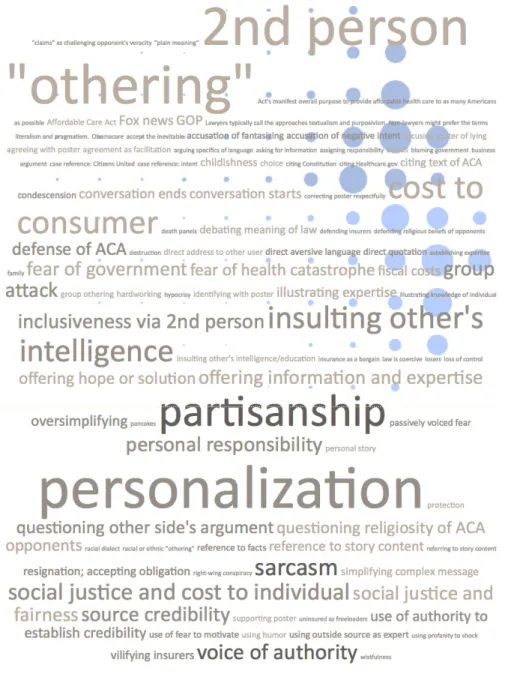
Figure 5 WordCloud generated by Atlas.ti after initial open coding………50
Figure 6 Huffington Post story March 3, 2015……….62
LIST OF CONVENTIONS/ABBREVIATIONS
Conventions used in this research:
#[number], date, time: for example #18, January 5, 2017; indicates the number of the comment in order of its appearance in all comments responding to a story, and the date and time at which it was posted.
ACA: Affordable Care Act
GOP: Grand Old Party, used frequently as a reference to the Republican Party in the United States.
HMO: Health Maintenance Organization, one of several models of health insurance available in the United States
IP: Initial Poster, the first user in a conversation
Obamacare: Nickname for the Affordable Care Act first used by its detractors, later by supporters as well.
PPO: Preferred Provider Organization, another model of American health insurance RS[1]: Response [sequential number] by order in which the user ID first appears in a
conversation
SCOTUS: Abbreviation for Supreme Court of the United States “shouting”: Use of all capital letters in electronic communication.
INTRODUCTION
Since the idea of a universal, government-funded national healthcare system was first introduced in the United States in the early 20th century, the messages propagated by its opponents and supporters have been fraught with emotional images and inflammatory rhetoric. In the recent past, opponents have accused supporters of proposing the creation of “death panels” and advocating the intrusion of emotionless bureaucrats into physician-patient privacy. Clinicians who supported government health care programs were
characterized as “insurgents” and insurers as evil, profit-hungry entities unconcerned with the health care of their members. These characterizations—the extreme terminology and emotion-laden language—are not new.
One of the oldest characterizations of universal health care programs still in use is the term “socialized medicine.” That phrase emerged in the 1920s, and has been used by opponents to evoke images of government control of private medical decisions. At the time, it derived from negative opinions of socialist Germany’s national healthcare
system, a government-funded and -administered program proposed by some in the United States as a potential model for an American solution to rising health care costs.
the ACA likely contributes to continued misunderstanding of its tenets as much as its politics do (Meirick, 2013).
I focus here upon online communication about the ACA in politically partisan media outlets and in the comments posted to those stories by its supporters and
opponents. This dissertation qualitatively analyzes the language used in partisan online news media to evaluate its significance in the arguments of the leaders of social groups debating the issue. The larger goal of this research is to improve the effectiveness of communication about health care policy to enhance the accuracy of audience
understanding of what has become a divisive issue.
The decision to use online-only news sites was reached after considerable research into the potential partisanship of online websites of local newspapers as compared to readership of openly partisan online-only news outlets. Because of the nature of online media, especially the ease of tailoring information to an individual’s worldview, I determined that the purposes of my dissertation would be best served by analyzing web-based outlets to more narrowly focus the comparison. Websites that provide only online access to their publications also tend to focus more on national or international readership defined by viewpoints or subject preference than by local issues, and are therefore more likely to present a politically-charged issue with a partisan
viewpoint that appeals directly to a subject-focused audience.
commonly-available and much-used Internet connections with other social media, such as Facebook and Twitter. Demographic data on the two websites obtained from Alexa, a web analytics tool, also show their audiences fitting previously-established (Pew Charitable Trusts, Doherty & Weisel, 2015) profiles of conservative and liberal audiences respectively; Breitbart’s audience is more likely to be older, less well-educated, and less ethnically diverse than that of the Huffington Post.
Problem Statement
Health care reform and proposals to implement a national health care program in the United States have emerged and been quashed since the early 20th century. Presidents Roosevelt, Truman, Nixon and Clinton have faced enormous political opposition and personal defeat in attempting to make changes to the nation’s health care system. Over time, the messages used to frustrate such efforts have shown remarkable staying power. Certain specific concepts show persistence in historical messages within the public debate over health care reform. For example, unbylined 1920s news reports show opponents of a national health care system opposed to “socialized medicine,” calling it a “vexatious and persistent evil” (New York Times editorial, Nov. 1928) while supporters exhorted the importance of “social responsibility” in caring for those who could not afford to pay (New York Times Editorial, Jan. 1929).
examine arguments and the extent to which they are used in online news media, a key source of information for most Americans, for and against health care reform in the United States. Which are the most likely to be used again by their readers? How do they use them? Do social processes reify or reinforce the repetition of those messages among politically partisan audiences? These questions have been under-examined in research to date.
For the purposes of this paper, the phrase “health care reform” will be used to refer to a systemic, government-driven change (generally, for purposes of this discussion, within the United States) from a market-based private payer system to a government-supported public health care system. The term is also used in professional and public discussions to refer to individual elements of an overall systemic change, for instance restructuring of risk reimbursement for insurers or rebalancing an individual plan’s out of pocket costs with employer-funded health care.
To break down those concepts, Himmelstein (2014) defines payment strategies, funding, and insurance models that move from strictly market-based and privately-paid to taxpayer-funded and government-run. An inherent difficulty in communicating about health care reform is this very complexity. Even in countries that have adopted
government-funded or –administered systems, payment structures differ for providers and for funding of facilities such as hospitals and laboratories. In the United States, the ACA works within an existing market-based structure that provides profitability for
manufacturers and many providers of healthcare goods and services. Government
Significance of the project
This effort to analyze communication about a complex policy issue is important for several reasons. From the standpoint of health care policymaking, opponents and supporters of the ACA acknowledge that the current status of health care policy in the United States is likely to change. At this writing, a new healthcare law has been proposed in the U.S. Congress. Even the ACA has already changed since its implementation: It has been successfully challenged in court (Nat'l Fed'n of Indep. Bus. v. Sebelius, 2012) and its funding undercut in Congress (Livingston, 2015). A second key issue is that the merits of universal health care versus a market-based system have become key arguments in many political platforms and sway some voters. The aging U.S. population is a key factor in the importance of this analysis: older Americans will require more health care services, which will likely require more out-of-pocket costs in a market-based health care economy (Favreault, Gleckman, & Johnson, 2015), and that economic impact will be keenly felt by the societies burdened with the costs of care. A fourth practical factor that makes this research important; the costs of health care for everyone in the United States continue to rise, consuming a greater portion of personal, individual budgets and the Federal budget every year (Pollitz & Cox, 2014).
More generally, the study makes a contribution because it has potential to
Figure 5 Pew Center for People and the Press, Political Partisanship among active voters, 1994
Health care, and who pays for it, is one of many debates that spark animated— sometimes anguished—conversations among the politically passionate and across the dinner table. My research aims to illuminate the effect of social processes upon the language used in communication about a complex, politicized issue. This focus is critical in an era when 36% of online news consumers seek information on websites or phone applications and the two topics that most stimulate response are community and health (Mitchell, Gottfried, Shearer, & Lu, 2017).
From a methodological standpoint, the research makes a contribution by being one of the few qualitative examinations of public communication about the ACA, and perhaps the only approach primarily guided by grounded theory. Previous studies (Brodie, Hamel, Deane, & Cho, 2013; Gollust, Barry, Niederdeppe, Baum, & Fowler, 2014) have quantitatively evaluated content of news stories about the ACA. Some studies have linked political partisanship to support for health care reform specifically or social welfare programs generally (Hindman, 2012; Meirick, 2013; Richardson & Yilmazer, 2014), but few scholars have qualitatively analyzed how these messages and specific frames are used utilized among writers and users of news websites that are openly
processes. By providing this new perspective, this study will complement existing work on the issue.
CHAPTER 1: BACKGROUND
National health care reform
The health care reform communication I research here relates specifically to the Patient Protection and Affordable Care Act, often shortened to the Affordable Care Act (ACA) or, colloquially, “Obamacare.” That law passed Congress in 2010 after rancorous debate within the Capitol, Senate and House and among media pundits and their
audiences. The ACA was not the first attempt at a large-scale reconfiguring of the
American health care landscape, but it was the first to potentially benefit as large a group as it has and the first successful effort since health care reform conversations began in the 1920s. The two exceptions were Medicare and Medicaid, which covered only specific demographic groups as part of President Lyndon Johnson’s Great Society program in the 1960s (Califano, 1999).
Health care reform efforts in general can trace their roots to nineteenth-century Germany and Otto von Bismarck. The German chancellor formulated a national health care program as the country’s business leaders debated whether to establish funds to defray healthcare costs for their employees. These “sickness funds” emerged as German labor unions grew in number and strength. The country established a national health insurance program in 1883. The carefully planned management of “sickness funds” incorporated labor and business representatives in nonprofit, self-governing bodies (Altenstetter, 2003).
Perhaps health care reform’s roots in a country later implicated in the start of two world wars influenced discussions about national health care reform in the United States. The phrase “socialized medicine,” still used today by opponents of the Affordable Care Act and an earlier program proposed during the Clinton Presidency, showed up early in the American debate. Medical journals and newspaper articles from the 1920s and 1930s include essays and opinion pieces on “Drastic Centralization” proposed by a group of reform-minded physicians favoring a national health program versus a tenacious grip on “the Individual Relation of Physician and Patient” (By, 1932) held by American medical societies. The editors of the journal California and Western Medicine decried “A New Drift to ‘Socialized Medicine’” and cited North Carolina Senator Josiah Bailey reminding Americans to “remember that the basis of American life is local self-government, not federal control” (Cal. West Med., 1929).
that national health care programs infringe upon the rights of state governments, interfere with the private relationship between a doctor and his or her patient, and diminish
individual need to take responsibility for one’s own health. Supporters, conversely, stated then and do now that social justice requires public funding of health care for the
socioeconomically disadvantaged and that economic need should not trump access to care.
Some history of early efforts to support communities in need of care gives us an understanding of where societal norms and expectations have successfully brought about change in health care policy—if after a time. In particular, early campaigns intended to influence public support for new policy, such as introducing immunization to hesitant populations in the 1700s, focused on social relationships within specific communities, and used moral frames and messages to inspire followers.
Historical health care reform efforts and the importance of social networks
Cotton Mather, physicians, and moral opposition to vaccines
The Reverend Cotton Mather learned of a new medical technology—
immunization—to fight a scourge that took thousands of lives in the 18th century and asked physicians in Boston to meet with him to discuss it. Despite his local influence as a church leader, other physicians refused his request and fought his campaign to inoculate Bostonians against smallpox. Their messages argued that the vaccine would spread disease and was an affront to religion. It would be “simply immoral to interfere with the working of divine providence” (Brown, 1988, p. 2248).
Mather countered their messages with his own religious reference: the 6th
applied to an instance wherein one could prevent a death but chose not to do so. Inherent in his argument was a social justice theme that men and women could, and should prevent death in case God did not.
Social justice notwithstanding, the physicians of colonial Boston were not swayed by Mather’s scriptural citations. In addition to citing Mather’s lack of professional
qualifications, doctors in Boston used racial arguments to dispute the possibility that a vaccine could be effective. The discovery of inoculation against smallpox is believed to have originated in Africa, where a “Levantine” physician performed the experiments that showed its efficacy. That foreign origin was used by American opponents of the smallpox vaccine as illustration of the lack of science behind its use. How could an African and a Levantine—today we might say a Muslim—have the education or erudition needed to scientifically prove such a thing?
Citizenship and “Fitness for Freedom.”
In the 1820s and 1830s, slaves who escaped the South and found their way to Philadelphia were often captured and returned. Any civil rights black citizens had won in that Northern city began to diminish. As the South defended slavery, racism was endemic and popular “knowledge” held that Africans were inherently inferior to whites, with “racially determined deficiencies of body and mind” (DeLancey, 2010, p. 298).
To defend themselves and demonstrate the intellectual and physical equality of African-Americans, leaders of the black religious community mobilized parishioners in an effort to demonstrate their appropriateness for citizenship. A campaign to encourage vaccination against smallpox centered on the message “fitness for freedom,” a
communication frame that was used by newspapers within the African-American community and propagated from the pulpits of local churches. As later communication researchers found and as this research determines, this campaign—appealing to a sense of community responsibility and group identify—used a message within a social network that augmented the impact of the communications campaign. At the time, African-American communities were often overlooked (or pointedly ignored) during vaccination campaigns even as Philadelphia’s black social networks emphasized the importance of being seen as “fit” or healthy by other communities within the city.
consciously used in contemporary public health campaigns to, for instance, promote vaccine use (Nyhan, Reifler, Richey, & Freed, 2014) and discourage tanning bed use to fight skin cancer (Lemal & den Bulck, 2010).
Eighteenth and nineteenth-century messages promoting health as a key
component of social justice and citizenship often focused on morality, group identity and social norms to emphasize social support as an appropriate government activity.
Presented as altruistic, giving supporters the feeling of contributing to their communities, such emotional appeals may be more likely to succeed than messages that are descriptive and intended to appeal to reason. Scholars of media effects have shown that framing a message to appeal to “values” such as morality or goodness is generally more effective than a media campaigs that attempst to sway audiences with factual data and
dispassionate arguments.
Religion also creates and reifies social networks that can be used to present a message that motivates an audience to act. Cotton Mather cited the Bible as justification for smallpox vaccination—“Thou shalt not kill,” in his communications, also meant preventing death, and the African-American church community in Philadelphia leveraged its efforts to inoculate members with a message about the greater good of protecting an entire class of people and preventing or ameliorating the social injustice of slavery and denial of citizenship to black Americans.
In contemporary discourse, social justice and values focus on message of societal responsibility rather than personal responsibility or individual citizenship. These
in recent health policy debates, as researchers have pointed out: In the 1993-94 effort to pass significant health reform, communications experts for President and Hillary Clinton decided that the most important messages their health care effort could use would be “health security” and personal impact (Winter, 2005, p. 462). The messages used by opponents of the Clinton health care plan, by contrast, used simple, clear, emotional messages about privacy and “big government” in a campaign that included television commercials featuring “Harry and Louise,” a middle-aged couple worrying about the affordability of their own care.
News stories have used emotional messages in stories about the reform of American health policy since universal health care was first proposed in the 1930s. Physicians fought to keep their independence, equating a national health plan with socialism; unions fought at first against reform, then in favor of it, to preserve the rights of protected workers. The language of competition has been used in political speech and can contribute to lessened source credibility. Capella and Jamieson (1997) found that a win/lose frame contributes to voters’ cynicism because it prompts them to perceive the politicians represented in the media as self-interested rather than concerned with the groups and individuals who would benefit from the outcome of the debate. In strategic frames, politicians are portrayed as “winning” or “losing” based on polls and attendance at their campaign events. That political cynicism is, ironically, evidenced by recent American polls that show Congress’ disapproval ratings at historic highs and voter turnout increasingly low.
terms of publicly-provided care generally and public health messages specifically. These events illustrate the framing of advocates for each side of the debate using themes of social justice, personal and civic responsibility to argue their positions.
Current situation
Efforts to communicate about health care policy have been affected by
simplification of messages in mainstream media. The intertwining of healthcare with local and national government in a capitalist model creates an intrinsic and unavoidable conflict between government programs and priorities and those of business leaders in a for-profit industry. In a representative governmental system such as a republic or democracy, “the people” may influence policy but for-profit industries may directly influence politicians. Complex issues can be oversimplified in public communication with brief sound bites and 140-character Tweets. Specific groups focus on specific tenets of policy in crafting language intended to influence their stakeholders to support their positions. Shapiro and Jacobs (2010) studied the manipulation of specific “publics” by political interest groups during the debate over the ACA and found that “…shifts in public attitudes stemmed, at least in part, from carefully crafted presentations that misled or alarmed the public”(p. 9). Studying the partisan use of the phrase “death panel” in news coverage of the 2009 ACA debate, Meirick references the intentional nature of misleading news and media frames used by the conservative Fox News and radio personality Rush Limbaugh: “…party-serving misperceptions serve their directional processing goals”(Meirick, 2013, p.40).
included disparaging messages about women in general and the bill’s putative sponsor, Hillary Clinton, in particular (Winter, 2005, p. 460). “All sides of the debate focused on crafting and disseminating appeals to the public, which meant that the public was awash in communications campaigns relating to health care reform” which included gendered messages, inherent in relationship of historically male physicians to women, who tend to seek healthcare more than men.
The partisan nature of the health care reform debate. In their book on political communication in news media, Spiral of Cynicism (1997), Cappella and Jamieson also evaluated news coverage of the health care plan proposed by the Clinton administration. The authors found a correlation between strategic presentation of Clinton-era health care reform and a cynical reaction on the part of news viewers and readers. Their definition of “strategic” coverage includes presentation of a story within a win/lose frame, using the language of “wars, games, and competition” (Cappella & Jamieson, 1997, p. 33) rather than explication of the details of an issue.
Studying surveys about public attitudes toward the ACA and its chief sponsor, President Barack Obama, Tesler (2012) found alignment between racial attitudes and health care opinions among white voters. The correlation was stronger than partisanship or existing ideology about health care, but not necessarily connected with the President’s race as much as with perceptions of recipients of social program benefits. Other
CHAPTER 2: CONCEPTUAL FRAMEWORK
A key sociological theory with which grounded theory is often connected by researchers and scholars is symbolic interactionism. I employ that concept among the premises that inform my research here because of its emphasis on the non-static nature of communication. Two pioneers of grounded theory, Corbin and Strauss (1990), wrote of symbolic interactionism that it helps researchers “…determine how the actors respond to changing conditions and to the consequences of their actions..” Symbolic interactionism and GT seek to analyze both the message itself and the actor conveying that message, and account for the changing nature of a symbol or theme as social processes unfold. This research seeks to determine how social interaction online affects the “staying power” of a given message about a policy issue that also has a personal impact on most living human beings.
Symbolic interactionism
interactions, he also addressed the content of those actions—and words—in ways that presage the theoretical concept of framing: “…an idealized impression is offered by accentuating certain facts and concealing others” (Goffman, 1959, p. 43).
Goffman’s work predates Blumer’s construct of symbolic interactionism (Blumer, 1969) in which he examines the ways we communicate with each other through the use of common ideas. Blumer suggested that media effects studies often ignored the
interaction among audience members and process of what he called “collective definition.”
Studies seeking to ascertain the effects of mass media are easily led to overlook the state of sensitivity of the “audience,” and particularly the process of collective definition that is so powerful in shaping and sustaining this state of sensitivity. (Blumer, 1969, p. 188)
The work of Blumer and his predecessor, Goffman, led to the complementary constructs we now refer to as social networks and framing . Several fields of scholarly study are devoted to social network analysis or SNA; it is not my intention here to delve deeply into SNA, but I refer to the work of Harrison White (1976) and those who follow his model of social ties and the influence they can have upon an individual within a network.
Social network theory
Social networks influence our beliefs and the ways we perceive the world (Escobar & Roman, 2011; Southwell, 2013; Summers et al., 2006). Someone who does not make it their business, as a journalist would, to stay informed about a complicated issue like health policy may also be less likely to be exposed to or able to decode
easily share with their friends (via Facebook or Twitter, for example). Their social ties may be fewer, and more likely to encompass a narrower network representing people of a very similar status and knowledge base.
Our social networks consist of strong ties and weak, close friends and distant acquaintances, all of whom can influence how we interpret what we see and hear in media messages.
…two people may have roughly an equal chance to see a particular story on the morning television news and yet, over the course of a day, may end up with very different knowledge, beliefs, and behaviors relative to the topic of that story because of the influence of others around them. (Southwell, 2013, p. 5)
The effects of social networks upon individuals within groups have been documented by sociologists (Smith & Christakis, 2008), computer scientists (Boyd & Ellison, 2007), and economists (Davern, 1997) as well as health care and communication researchers. Social networks can affect the impact of external influences, i.e., exposure to messages in mainstream or social media (Siegel, 2013). Particularly in regard to
complicated messages about our physical and mental health, we look to those we trust--friends, family, and people we consider experts--to help us understand information. For health care reform, most-trusted sources include our physicians and family members (Fox, 2011).
Our friends and family can also reify misinformation and strengthen our
are repeated within a smaller, less informed social network and misinformation cemented more firmly in the minds of those who receive it. The stronger influence of our stronger social ties ensures that the points of view we already hold will be reinforced, especially if we do not often venture outside our closer social ties to understand new information. Complex ideas are likely to be discarded in favor of more easily-grasped messages, as Lippman pointed out nearly a century ago in The Phantom Public: “If the voter cannot grasp the problems of the day because he has not the time, the interest, or the
knowledge…He will simply be more bewildered, more bored, and more ready to follow along.” (Lippmann, 1927, p. 27).
The impact of social networks upon health and the habits that affect our personal health (for good and ill) is well established in the literature (Christakis, 2004; Rounds & Israel, 1985; Shye, Mullooly, Freeborn, & Pope, 1995; Vassilev et al., 2011) and public health campaigns rely upon the power of social norms to affect individual health behavior (Dorfman, Wallack, & Woodruff, 2005; Noar, 2006; Wakefield, Loken, & Hornik, 2010). Social norms are often communicated via the members of networks, encoded in
behaviors that reinforce compliance with a given group’s status quo. With the advent of social media, sharing norms via posts to friends or followers is likely to result in frequent repetition of messages that enforce norms and discourage non-normative behavior. We email friends news stories that support our beliefs (Southwell, 2013) or augment our fears. We post and retweet Facebook memes or Twitter messages that repeat messages in which we believe. The nature of sharing via social media is brief and frequent as
Because of the partisanship of many media outlets, especially Internet-based outlets, it is more possible than ever to apply pre-screening to the information we process in order to reinforce our individual frames. Michael Slater writes about “reinforcing spirals” (2007), the theoretical construct that firm opinions and beliefs are reinforced by our media choices, which then reinforce those beliefs, and with Google news pages and unashamedly partisan news outlets like Fox News and the Huffington Post it is
increasingly easy to ensure that we see only the news that already matches our existing beliefs. In a way, we choose our frames—and the media we see—thus guaranteeing frequency of encounters with a news frame that agrees with our own individual frames. Framing in media studies and sociology
For the purposes of this analysis, I incorporate the constructs used in communication and media research (Entman, 1993; Lakoff, 2010; Scheufele & Tewksbury, 2007) and sociology (Goffman, 1974; Goffman, 1959) into a general definition of framing as both the media’s presentation and interpretation of an idea or issue and the individual interpretation and re-use of that frame. Lakoff (2010) takes a generous attitude toward the use of frames as being inherent in human communication, whether within ourselves or with those in our communities. “All of our knowledge makes use of frames, and every word is defined through the frames it neurally activates.” (p. 71)
As Lakoff also points out, frames are especially relevant to studies of political issues because politics is so closely related to an individual’s ideology. My research examines messages in the contexts of shared frames, the communicator's shaping of a message to resonate with these shared frames, and individual frames that may affect
I am primarily concerned with investigating the intersection and exchange of information that occurs when media frames meet individual interpretations of media messages, sometimes referred to as “schemata” (Benford & Snow, 2000; Chong & Druckman, 2007; Goffman, 1974; Goffman, 1956). All of us use our own personal experiences and existing communication “infrastructure” to understand the messages we see or hear in media communication. When we then communicate with people within our social networks, how do the different frames interact? “Simply put, even if the effects of media frames are consequential, they are not the only sources of influence on the
audience. Other sources may mask, amplify, or catalyze framing effects.” (Cappella & Jamieson, 1997, p. 49.)
Individual or audience frames versus media frames are key components of Scheufele’s (Scheufele, 1999; Scheufele & Tewksbury, 2007) work which also relate directly to this analysis. The idea of an individual frame as proposed by Scheufele could be used interchangeably with the “schemata” originally proposed by Erving Goffman (Goffman, 1974; 1956), who considered an individual’s internal understanding of external images and messages a key component of information processing.
Dorfman, Wallack and Woodruff (2005) group stories about public health issues into “portrait” and “landscape” frames. Portrait frames present “great drama and
are likely to find portraits easier to produce since they require less research and time. The increasing corporatization of news outlets with its consequent emphasis on profitability also contributes to a portrait emphasis over “landscape” presentation of health stories because quicker news production is paramount in a news environment that prioritizes quantity and quickness over quality.
In the same study, Dorfman and colleagues cite the work of Lakoff in examining three conceptual levels of framing of public health issues and social programs: values, issues, and details (Dorfman et al., 2005, p. 324). Values frames evoke moral constructs of fairness, equality, and responsibility; issues frames present the general frameworks of health, environment, schools and other social or political programs. Detail frames might address the strategic or tactical aspects of implementing a given program or focus on a specific provision or tenet of a proposal, as with the provision of the ACA that allows young adults to remain covered by their parents’ insurance policies until the age of 26. This study supports evidence showing that both supporters and opponents use moral versus detail frames in their arguments about the ACA.
or moral imperative. Detail frames about the ACA—the specific provisions and who they benefit—have been lacking in the studies conducted to date of media coverage of its implementation.
In sum, although there is current debate about the scope of framing research, scholars tend to agree that framing involves emphasizing certain aspects of an issue over others in order to influence an audience to favor certain interpretations over others. The issue of framing itself can be viewed in multiple ways, and this section has summarized the key distinctions that have been drawn. In order to understand how frames are used and interpreted, it is necessary to study the social groups that shape our interactions, which I will address in another section of this paper.
CHAPTER 3: PURPOSE OF THIS STUDY
As established earlier in this paper, the language used to discuss politically divisive issues like party affiliation and policy preference merits study and has been evaluated extensively by scholars in myriad academic disciplines. Other researchers have shown that the presentation and interpretation by audiences of messages relating to social programs, health care, and public health in mainstream media and in social interaction can sway public opinion. At the same time, political and personal values and existing social networks combine to affect the influence of those messages and their framing. This study analyzes the significance assigned by audiences to certain evocative phrases and verbal imagery and the context in which they are presented. Grounded theory is applied here in order to provide a more detailed, granular analysis than previous
Referencing the literature on political influence on attitudes toward social programs and health disparities, as well as previous research quantifying content of stories about the Affordable Care Act, my work will place into context the words and phrases used by professional writers and by their readers to frame their arguments about health care reform.
Research Questions
This analysis was informed by the following questions:
RQ 1. Which messages are used most to convey messages about health care reform on partisan online news sites?
RQ 2. Do those messages differ by political inclination?
RQ 3. To what extent do readers reify messages presented in stories in their comments and online conversations about health care reform?
RQ 4. When comments and replies comprise extended conversations, what factors lead to positive and negative resolutions, i.e. when do the social processes end in agreement/greater understanding versus lack of consensus?
Four years after the Affordable Care Act became law, political scholars noted the continued misunderstanding of its provisions and the contribution of that
misunderstanding to attitudes toward the law. “Awareness and knowledge of the ACA’s benefits appears to be key to unraveling the mystery of disapproval of health reform in the abstract and support for its specific provisions.” (Jacobs, 2014, p. 636). That lack of knowledge and awareness has shown itself in informal interviews by comedians, in which individuals voice support for the provisions of the Affordable Care Act—and even for the law itself when that name is used—but disdain for “Obamacare” or health care reform in general (Jimmy Kimmel Show, 2013).
CHAPTER 4: METHODS
Overall approach: Grounded theory analysis of web content
Background on Grounded Theory and rationale for using it. This study uses grounded theory (GT) and its method of open, axial and selective coding as well as its interpretive analysis of social processes, to examine comments posted to stories in online-only news websites. Grounded theory, as originally founded by Barney Glaser and Anselm Strauss (Glaser & Strauss, 1965), evolved from analysis of communication between nurses and their terminally ill hospital patients. As a result of their qualitative analysis of these conversations, Glaser and Strauss theorized that the concept of social value mattered in the treatment of those patients by hospital staff. Older patients, closer to the end of the average human lifespan, were “valued” by nursing staff at lower levels than younger terminal patients and that internal estimation of value was reflected in the messages and social constructs nurses used to communicate with and about them.
fields, analyzes computer-mediated communication (CMC) and texts, including a study of Wikipedia users’ concepts of community (Pentzold, 2011), email interviews with autistic people (P. Benford & Standen, 2011), and a proposed design framework for overall analysis of CMC (Abbasi & Chen, 2008). This analysis adds to that body of work by examining online conversations in established communities of readers of partisan news websites. Glaser himself proposed the use of grounded theory for documents and other information in defining what a researcher could analyze.
“‘All is data’ is a well known Glaser dictum. What does it mean? It means exactly what is going on in the research scene is the data, whatever the source, whether interview, observations, documents, in whatever combination” (Glaser, 2002). This study analyzes written online “conversations” between reporters and their readers to find which messages appear to have the greatest impact for each and whether that impact is similar in nature.
Glaser considered grounded theory a study of social processes intended to form theory, an inductive process, rather than a deductive study of data in order to verify existing theory. Corbin and Strauss similarly describe GT as process-focused rather than meant to measure data. Grounded theory attempts to find reason and explanation rather than just description. “The procedures of grounded theory are designed to develop a well-integrated set of concepts that provide a thorough theoretical explanation of social phenomena under study. A grounded theory should explain as well as describe” (Corbin & Strauss, 1990, p. 5).
revising and rewriting later as more data are discovered. The concept of a continuing process is central to grounded theory; in GT, the method of data analysis is iterative, using category development (Draucker, Martsolf, Ross, & Rusk, 2007), open and axial (or selective) coding, and the constant comparative method (Glaser, 1965), and ends only when the gathered data become “saturated;” when no new concepts or categories emerge from the data.
Grounded theory analyzes verbal and visual content to form theory. It is an inductive or abductive qualitative research method that allows the data to inform the research, coding categories and determining relationships among them in order to decontextualize and recontextualize communication exchanged during social processes. GT seeks to form rather than verify theory. The “grounding” of grounded theory refers to the idea that the outcome (theory) is grounded in the data being analyzed, rather than data being used to verify or confirm an existing theory as much quantitative research does. A GT researcher categorizes the data she is analyzing and codes it as themes emerge, groups those categories into concepts about processes evidenced by the data, and forms a theory based upon those concepts.
Generative criticism
This analysis is also informed by generative criticism as described by Foss
(2004). Generative criticism is a method of rhetorical analysis that questions data openly, beginning with an encounter with a “curious artifact” (p. 411) that stimulates a
the misconceptions around healthcare reform and the misunderstanding in many
Americans of what, specifically, the Affordable Care Act would do. That these inaccurate perceptions of the law persisted throughout its Congressional debate and into its
implementation roused questions in me and drove my desire to examine how mainstream audiences understood the law itself as well as the issues around how healthcare is
provided via the American system of fee-for-service medicine and for-profit insurance companies.
Generative criticism uses methodology similar to the grounded theory method: beginning the process with a broad inquiry rather than with specific questions or hypotheses and continuing through broad-brush coding, examination of frequency and intensity of initial codes, and interpretation of initial codes to an explanatory schema. The method includes a form of constant comparison, returning to the data after coding to question initial concepts and develop the schema. Foss suggests a format for writing the results that I adopt here, using as subheadings the conceptual components of the schema whether those components have been used by previous scholars or are new to the
analysis. In this dissertation, I use components as subheadings that explain the categories refined by constant comparison and revisitation of the data.
Generative criticism also helped clarify the artifacts analyzed for this study, establishing as units of analysis the words and phrases used in messaging about the Affordable Care Act as well as the social processes involved in commenters’
physics, an artifact can be viewed as a particle—a single, isolated unit of analysis: a word or phrase uninfluenced or affected by processes or environment. As a wave, an artifact changes or adopts new meaning during its progress through time and space. In this analysis, artifacts may change as they move through conversations and the thought processes of individuals or groups. Viewed as fields, units of analysis may be seen as occupying a “place in a larger system or network” (Foss, 2004, p. 422) such as the construct of political party or the understanding of a complex issue such as health care policy.
In this analysis the Affordable Care Act could itself be viewed as a particle—the individual law, defined by its legally established provisions and effects upon uninsured Americans. A clearly defined construct, as I have done here in equating the ACA with health care reform in the United States, would be a static and unchanging artifact. The ACA could also be viewed and analyzed as a wave, in that attitudes toward it and the status of different tenets of the law have changed over time. And, finally, health care reform generally and the public debate over the ACA could be studied as a field in which are placed the other two definitions of the law as an artifact; a particle (the law as a static entity) within the influence of a wave (understanding of the law and attitudes toward it changing over time) within a field (health care reform).
Yates, 2001, p. 52). CA also examines phrases, clauses and words for their utility in conversations, and evaluates patterns that emerge in social interaction.
Quantitative analysis was used to prioritize analysis of data within the comments posted to each of Breitbart’s and Huffington Post’s stories as defined earlier by the “King v. Burwell” tag. The order in which stories and their comments were coded was
prioritized by comment count and the ratio of replies to comments. Two lists were generated; one that that ranked the news stories from the site’s authors by raw total of all comments posted to a given news story, and another that ranked the stories’ comment counts by proportion of replies to original posts. The second method helped pinpoint “conversations” or comment threads in which a single post stimulates a within-group interaction similar to a conversation amongst individuals in the same physical location.
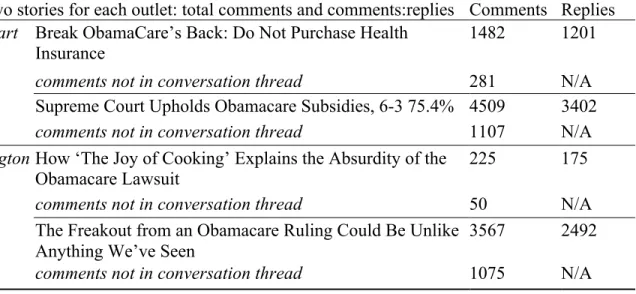
Four stories were then prioritized for further rereading and coding as a result and are shown in Table 1. Two stories with the largest comment totals generated a sample for analysis of 8,076 comments; 4,509 were posted to Breitbart’s story, and 3,567 to
Table 1 Top four stories by comments and replies
Top two stories for each outlet: total comments and comments:replies Comments Replies
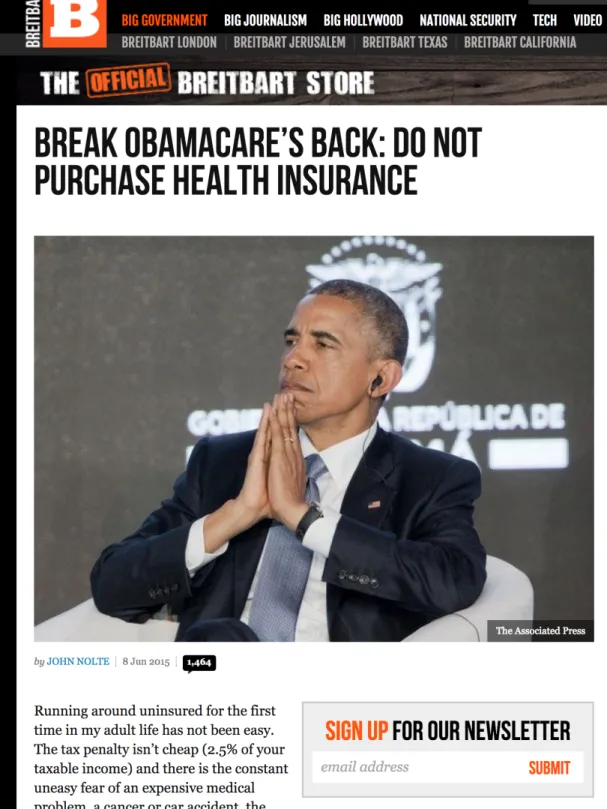
Breitbart Break ObamaCare’s Back: Do Not Purchase Health
Insurance 1482 1201
comments not in conversation thread 281 N/A
Supreme Court Upholds Obamacare Subsidies, 6-3 75.4% 4509 3402
comments not in conversation thread 1107 N/A
Huffington Post
How ‘The Joy of Cooking’ Explains the Absurdity of the Obamacare Lawsuit
225 175
comments not in conversation thread 50 N/A
The Freakout from an Obamacare Ruling Could Be Unlike Anything We’ve Seen
3567 2492
comments not in conversation thread 1075 N/A
Average ratio of comments:replies per outlet: Huffington Post 63.8%, Breitbart 70.5%
The two stories with the highest ratio of comments that were replies to previous posts were “Break Obamacare’s Back: Do Not Purchase Health Insurance”
(http://www.Breitbart.com/big-government/2015/06/08/break-obamacares-back-do-not-purchase-health-insurance, June 8, 2015, retrieved Jan 30, 2017) and “How ‘The Joy of Cooking’ Explains the Absurdity of the Obamacare Lawsuit”
http://www.huffingtonpost.com/2015/03/03/obamacare-lawsuit-explained_n_6793348.html, March 3, 2015, retrieved Jan 30, 2017). Those stories were examined first, using the open and axial coding and further categorization required by GT.
Reflexivity
analysis and even gathering of data. Qualitative researchers acknowledge the importance of reflexivity and being aware of one’s own potential bias in interpreting data. One’s personal experiences, professional background, individual schemata and level of self-awareness influence understanding of the world generally and of data being analyzed for research purposes (Mauthner & Doucet, 2003). In my own case, choosing to use
grounded theory for this research project grew from a genuine personal curiosity about the political and policy issues of healthcare from a position within the system itself. First, as a communications practitioner, and then as an academic researcher I sought to
understand the elements that make memorable given messages in public media spheres about complex social issues. In this case, the issue was one that continues to become interwoven with political policy and public debate; healthcare as a social program rather than a free-market good or service to be purchased by consumers.
At the same time, that experience and my own personal beliefs about healthcare and insurance meant I entered this research with foreknowledge that had the potential to affect the coding process. Having come from a journalism and public relations
At the time this data was being analyzed, the American presidential election was decided and new President Donald Trump inaugurated. The emergence of Breitbart as a deciding influence on the election, and heightened emotional debates on the website itself as well as within communities of friends and family had a noticeable personal effect as I was coding and rereading material. Having a deep knowledge of the Affordable Care Act and earlier efforts to fundamentally restructure the American health care system also affected initial coding processes, in that I found myself reacting to wrong information by mentally arguing with the commenter or the post. On those occasions, I made a point of memoing the occurrence and my thoughts, and when necessary acquiring physical distance by suspending the coding process temporarily to have a cup of tea or take a walk.
Another interesting self-observation during this research revealed either a
preference for learning techniques acquired prior to the pervasive use of word-processing technology or a tactile effect on analysis and theory-forming. Surprisingly, to this author at least, hand-coding by examining hard paper copies of the text of both stories and comments was extremely important to analysis, particularly in finding associations between initial, open codes and axial code groups or categories. While the software used in this analysis was helpful in some degree, “letting the data speak” came more easily on a kitchen table surrounded by colorfully highlighted copies of text than staring at a flat screen and typing on a computer keyboard.
Sampling
a specific “tag” used by the two websites targeted for this analysis. In order to “scrape” the comments, a technologically-proficient software coder was enlisted to construct an application programming interface or API to download the comments in a text format. Using a software system designed for qualitative coding, Atlas.ti, I began the process of constant comparative analysis. As initial reading and open coding progressed, I used both computerized and hand-coding methods to highlight specific quotes that illustrate the axial codes or themes that emerged.
Specifically, I chose to evaluate those stories tagged as referencing a U.S.
Supreme Court decision handed down in June 2015 upholding a specific provision of the law. The decision, King v. Burwell, upheld the legality of subsidies provided to lower-income Americans who are ineligible for Medicaid but whose lower-incomes leave them unable to afford health care insurance premiums. That ruling prompted much debate and
discussion in mainstream and partisan news media and was seized upon by conservative and liberal media as illustrative of the parties’ attitudes toward social programs.
The desires to narrow health disparities and support social programs are cited by Gollust and Capella (2014) as relevant to favoring social justice frames over narratives
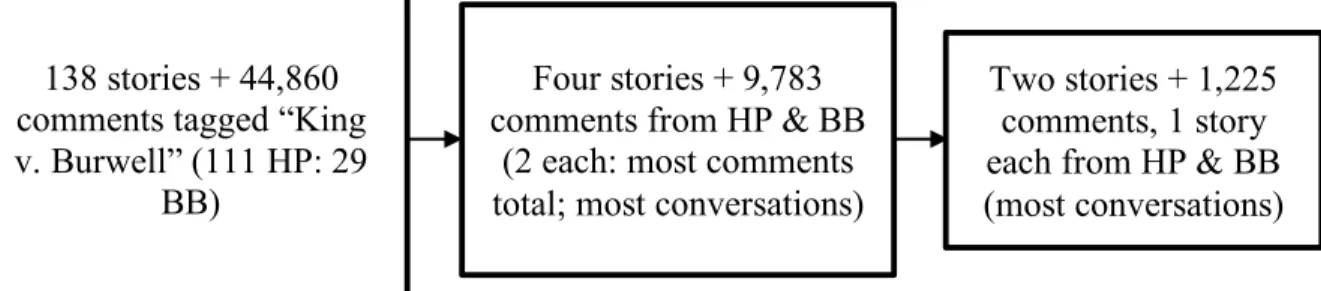
Figure 4 Data reduction process 138 stories + 44,860 comments tagged “King v. Burwell” (111 HP: 29
BB)
Four stories + 9,783 comments from HP & BB
(2 each: most comments total; most conversations)
that highlight the need for personal responsibility around health issues. This particular point in the history of the Affordable Care Act offered the clearest opportunity to target a specific sample of content in a consistent way, since both websites used a specific tag to identify their stories about the ruling (“King v. Burwell”) and, in much mainstream news coverage of the decision prior to and after the Court announced its ruling, the issue stirred up the emotional response frequently related to frames of personal responsibility and social justice. A total of 138 stories appeared on the two sites tagged with the name of the Supreme Court decision, and more than 60,000 comments were posted on the stories. One hundred and five stories were posted on the Huffington Post website; 29 on
CHAPTER 5: DATA ANALYSIS PROCEDURES
In the research I conducted for this analysis, the coding process began as the preparation for this research started. I examined stories written about healthcare reform on politically partisan blogs, websites, and social media sites. I read the content of the comments posted to those stories by readers of the online media outlets, scanning for common themes and messages and observing the uptake by readers of a particular frame or phrase presented in the website’s own story. Constant comparative analysis meant repeatedly revisiting and rereading the 138 stories and more than 40,000 comments that appeared in stories on the websites Breitbart and Huffington Post that were tagged to the King v. Burwell Supreme Court decision, and recoding and rewriting initial findings in order to develop and strengthen to form the theory that emerged.
Initial coding
Open coding
Open coding, the second step of grounded theory, began with selection of the data to be analyzed for this study. Those stories and comments were downloaded via the API described in Methods, and downloaded from their URLs to individual text documents (one for each story, another for each story’s comments) began in August 2015. The sample selected for this study included headlines and text content of Breitbart’s and Huffington Post’s entries about King v. Burwell (2015), the U.S. Supreme Court ruling that upheld Federal subsidies for families whose income was too high to meet the Medicaid poverty threshold but too low to be able to afford the insurance premiums available to ACA-qualified recipients.
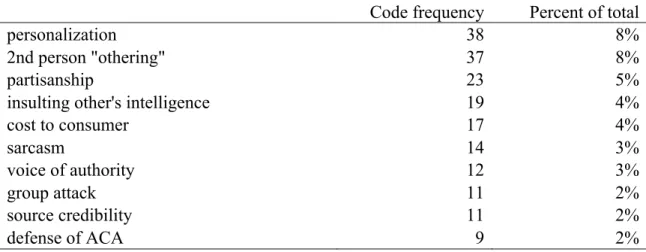
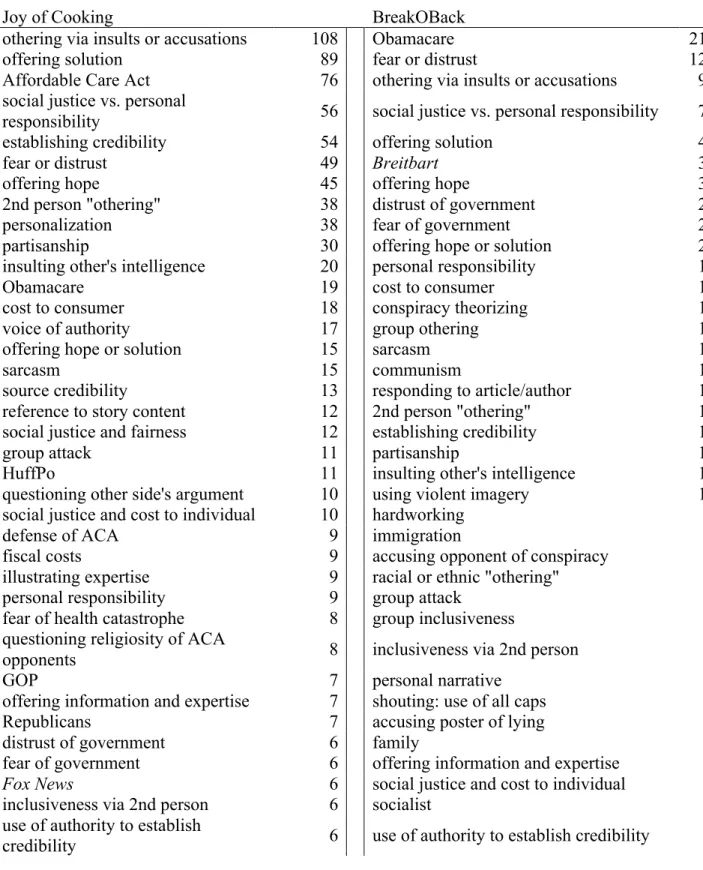
After a first read-through of the stories and comments analyzed for this study, Atlas.ti was used to code line by line, highlighting and coding frequently-occurring phrases and social processes within the comments sections of each news story. Tables 2 and 3 show the most frequently-occurring initial codes for each of the stories that had the highest proportion of replies to comments, those being the stories most likely to involve conversations and thus social interaction within the comment threads. Scholars who study computer-mediated communication (CMC) such as online chat rooms and news site comment sections often use the term “thread” to refer to comments that generate responses and replies; in this analysis, those comment threads are also called conversations.
from most-frequently-used to least, a very low-technology association of related codes started on the author’s kitchen table with piles of differently-colored post-it notes, highlighting pens, and a large open space. Simple as that method seems (and seemed at the time), it generated groupings that produced clear association of certain words or phrases with ideas shared by others. Distrust of government and fear in general frequently co-occurred and came from text describing the same uncertainties; one’s personal
property lost, loss of control, health and safety of family members were often expressed in these frequent categories.
After software-assisted coding and memoing, I hand-coded each story’s
comments and used a notebook to memo observations of the flow and frequency of codes within conversations. Hand-coding, interestingly, revealed insights that were not
immediately apparent via coding software and reinforced the importance of using constant comparison to return to the data.
Open coding also revealed in vivo codes used by commenters to denote shared group concepts, such as “humanity,” “liberal” and “conservative,” and “hard-working” versus “lazy.” As Charmaz describes in vivo codes, these terms “flag condensed but significant meanings” (Charmaz, 2014, p. 134) and often indicate implicit assumptions on the part of group members. Grounded theory coding generally involves the use of
Table 2 Top 10 open codes, frequencies and percentages from "Break Obamacare's Back"
Code frequency Percentage of total
fear of government 21 5%
distrust of government 19 4%
cost to consumer 18 4%
conspiracy theorizing 17 4%
offering hope or solution 17 4%
communism 14 3%
personal responsibility 14 3%
responding to article/author 14 3%
2nd person "othering" 13 3%
partisanship 13 3%
Table 3 Top 10 open codes, frequencies and percentages from "Joy of Cooking"
Code frequency Percent of total
personalization 38 8%
2nd person "othering" 37 8%
partisanship 23 5%
insulting other's intelligence 19 4%
cost to consumer 17 4%
sarcasm 14 3%
voice of authority 12 3%
group attack 11 2%
source credibility 11 2%
defense of ACA 9 2%
Axial coding
converts text into concepts upon which the theory itself is built. Some grounded theory researchers prefer to avoid the term or the more formal procedure of axial coding and instead use an analytic strategy that finds emergent categories (Charmaz, 2014, p. 148) but the principle is similar; finding theoretical categories by determining the relationships and patterns among initial codes using constant comparison. Some initial codes were refined or combined to become categories as axial coding progressed within this data, for example “othering,” as a category that included insulting other commenters or using partisan language to discredit another person’s arguments, and “offering solution or hope,” as a category that combined two earlier emergent axial codes.
Axial coding included both machine-guided and hand analysis, using software tools to group initial codes into categories and paper tools to revisit those categories. Paper tools included Post-It notes and highlighting pens, hand-writing open codes on individual notes and using a large flat surface to hand-group them by both language and meaning, by topic or social process (e.g. reference to costs, as a topic, or insulting another’s intelligence as a social process).
Table 4 Emergent categories in "Break Obamacare's Back" Category
Fear or distrust 125
Othering via insults or accusations 99
Social justice vs. personal responsibility 78
Offering solution 46
Offering hope 34
Table 5 Emergent categories in "Joy of Cooking" Category
Othering via insults or accusations 108
Offering solution 89
Social justice vs. personal responsibility 56
Establishing credibility 54
Fear or distrust 49
Offering hope 45
Table 6 Examples: axial categories and corresponding open codes
Axial category Open code
Othering via insults or accusations Insulting other’s intelligence Accusing opponent of conspiracy Group attack
Questioning religious beliefs Offering solution or hope Offering information or expertise
Simplifying complex information Sharing personal story
Empathizing Voicing fear or distrust Vilifying insurers
Fear of socialism or communism Concern about quality of healthcare
CHAPTER 6: FINDINGS
A recent study by the Engaging News project found that three-quarters of online commenters want to “clarify factual questions and [ask] experts to respond to comments” (Stroud, Van Duyn, & Peacock, 2016). This analysis generated the theory that
commenters on news websites seek to establish an identity by defining the group to which they belong—conservative or liberal—using othering language or second-person inclusive language, particularly “you” as the precursor to an epithet or as an invitation to sympathize. Once their membership in a group is clear, commenters seek and share information so as to find solutions, whether hopeful or pessimistic. At times those solutions appear extreme, involving civil disobedience bordering on violence; at other times they are helpful, proposing legal options and reinforcing a sense of community.
Analysis of themes and messages
The research questions that informed this analysis asked: which frames are used to communicate about health care reform in the highly partisan environment of a political news website? Is partisan identification necessarily reflected in the frames and messages that are used? How much do readers reify the story’s frames in their own comments, and when those comments evolve into length conversations, how do those conversations themselves end?
counter-argument, and commenters who espoused social justice often framed their arguments as “responsible” to society.
Frames and messages seemed less affected by political party or inclination than by personal experience, whether one of fear, financial success, parenting, or problem-solving. This may be the good news: there is not as much as we might expect separating those who disagree on a complex policy issue, when their discussions in a computer-mediated environment and asynchronous. Frames presented by the stories themselves, particularly those that use unusual analogies or emotional language, are often repeated in by writers of comments. In the sample for this study, the stories that received the most comments and generated the most conversations had headlines and story content that were echoed by users of the comment sections, occasionally verbatim.
Frequent open categories were not always shared across partisanness of media outlet. While Breitbartians might voice fear and distrust of government agencies and other political believers, they actually tended to use partisanship specifically as a way to other fellow commenters. More frequently, Huffington Post writers used “Republican” and GOP as insults than BB writers used “Democrat” or other party-associated words as an epithets.
adequate “until we get something better” (comment #39, March 3, 2015, “Joy of
Cooking”) within liberal arguments, commenters who voiced conservative political views largely disparaged the law as an intrusion on privacy or suggestive of socialism. “That's because government involvement in health cares only increases the costs of health care. That's the nature of government bloat.” (comment #991, June 8, 2015, “Break
Obamacare’s Back).
One early association about Huffington Post commenters seemed worth noting. In many cases, writers there who commented on one of the outlet’s stories were more likely than those on Breitbart to use the second person to “other” a perceived opponent, as in “You conservatives” or “you wouldn’t understand.” Often that othering was a clear insult to the other’s intelligence, sometimes in the simplest terms. “You’re an imbecile. There is a fact for you.” (#220 “Joy of Cooking” 6/9/15 2:00am) It became clear as axial coding progressed that some more specific open codes fit within more general categories, as with “insulting other’s intelligence,” “individual attack” and “accusing opponent of
hypocrisy.” Some early codes did not use gerunds, as is a frequent practice for grounded theory, but those also became clearly associated with the axial group used in this analysis. “Health care profits,” for instance, co-occurred only with other negative association vilifying insurers (which was another early code).
negative portrayal of a “greedy on the dole personality type” (#180, “Break Obamacare’s Back, 6/8/15, 5:20pm). This juxtaposition so frequently showed up as a pair of
contrasting images—often with a rationale for supporting one or the other—that it became clear early in the axial coding process this pairing was important to maintain.