Manuscript Preparation Instructions
Responses of Arctic Marine Ecosystems to Climate Change
Contact:
Sue Keller—[email protected] Alaska Sea Grant
University of Alaska Fairbanks PO Box 755040
Fairbanks, AK 99775-5040 USA (907) 474-6703
Overview
The proceedings will be published as an electronic document only. Alaska Sea Grant will manage the peer review; and copyedit, proofread, format, produce, and distribute the publication. Steering Committee members are invited to serve as proceedings editors.
Where to submit manuscripts, on or before March 26, 2013
A PDF of your complete manuscript is required at the time of the symposium (March 26-29, 2013) for review. Assemble as required below.† Please send one PDF, attached to email, to
[email protected]. Each PDF manuscript will be reviewed by peers.
Where to submit manuscripts after peer review and acceptance for publication
After you receive final acceptance of your manuscript, please submit the following to
[email protected]: (1) Word file, (2) PDF version of the Word file with graphics added, and (3) separate electronic files of the figures if needed. The preferred submission method is by email attachment. If the files are too large for email, please “zip” them OR ask about submitting them to the Alaska Sea Grant FTP site. The purpose of the PDF file is to show the correct graphics, equations, and other features (errors are sometimes introduced when files are moved to different computers).
Manuscript Preparation
All text must be in Microsoft Word. Submissions should be formatted for 8.5" × 11" or A4 paper, with 1" (2.5 cm) margins on the right, left, top, and bottom. Number the pages at the bottom. Use a font size comparable to Times New Roman 12-point type. Double-space the text, references, and table and figure captions. Begin each paragraph with a tab, and end each paragraph with a single paragraph return. Format the text flush left, ragged right.
Italicize scientific names and mathematical variables, but nothing else. Do not use all caps, bold, italics, or other styles anywhere else in the paper unless it is essential. Use one space after periods, colons, commas, and semicolons.
To format the reference list, use hanging indents as shown in the examples. Leave no space between initials in names (A.B. Cross).
†Assemble manuscripts in this order: (1) text and references, (2) figures and figure captions, and (3) tables and table titles, all in one file. Please do NOT insert figures and tables into the text where they are cited. Manuscript must not exceed 25 double-spaced pages, including tables and figures.
Title
Limit the title to 10 words or fewer.
Manuscript organization
Include an Abstract, Introduction, Materials and methods, Discussion, References, and other divisions as appropriate.
Headings
Place asterisks to the left of headings to indicate level, and use upper and lower case flush left. Do not use font size, bolding, or italics to indicate heading levels.
*First level heading **Second level heading ***Third level heading
Abbreviations, symbols, and scientific names
The text should be understandable by readers from different disciplines. Define all symbols, abbreviations, and acronyms. Spell out chemical names when first used. Use symbol font for symbols.
Measurements
Use metric units. The abbreviation for metric tons (tonnes) is t.
Equations
Use Word Equation Editor or MathType for equations. Simplify and shorten equations as much as possible. If times signs are needed, use the symbol font (x). Please avoid using an asterisk (*) for times sign. Be sure that the PDF submitted shows the equations in their proper format.
Text footnotes
Avoid the use of footnotes. (But on tables, footnotes can be used as in the examples below.)
Title page
Include title, and all authors’ full names and affiliations. Designate the corresponding author, and include email address.
Abstract
The abstract should succinctly summarize the content of the paper in about 250 words.
Introduction
Limit the introduction to the scope, purpose, and rationale of the study.
Results
Limit the results to answer the questions posed in the purpose of the work, and make them as succinct as possible.
Discussion
Limit the discussion to the main contributions of the study and interpreting findings, comparing them with those of other workers.
In the References section, list references alphabetically by the first author’s last name. Abbreviate journal names according to CASSI (http://cassi.cas.org/search.jsp) or BIOSIS Serial Sources. Indicate the language in parentheses at the end, if a source is in a language other than English. Include web addresses for references accessible only on the web. If it is available, include doi at the end of each reference; see http://www.crossref.org/SimpleTextQuery/.
All non-published sources should be cited as personal communications, with name and affiliation, e.g., (Sam Smith, University of Arizona, Tucson, 2008, pers. comm.). Do not list personal
communications in the reference section. See examples below.
Figures
All figures should be referred to in the text; for example Fig. 1.
• Orient figures to fit on the page vertically (portrait), not horizontally (landscape). • Lines should be 0.50 pts or thicker, the same density as one another.
• Lettering on figures should be upper/lower case Arial or Helvetica.
• Submit figures as separate electronic files: Excel, AI, EPS, PDF, TIFF, or WMF.
• Size figures to a maximum of 4.5 x 7.25 inches (11.4 x 18.6 cm) including caption. Smaller is OK if everything is readable.
• Save photographs as300 dpi (dots per inch) TIFF files, at their final size.
• Save line figures as600 dpi AI or PDF files (AI is the best option). NOTE: look for the “save as” or “export” option in the file menu of the software in which you created the figure.
• Files can be “zipped” to take up less space for email or FTP.
• Upload large files to Alaska Sea Grant FTP site (contact [email protected]).
Tables (see examples of Table style below)
• All tables should be referred to in the text; for example, Table 1.
• Tables should be produced using Microsoft Word table editor or Microsoft Excel. • Table titles should be short.
• Put explanatory information in table footnotes. Table footnotes should be “numbered” consecutively in letters, across the page from left to right, then down.
• Give each column a heading, with units of measure in parentheses.
• Each piece of data must be in a cell of its own. Remove all spaces and paragraph returns from cells.
• For numbers less than one, zeros should precede decimal points. • All units must represent significant figures.
• Follow the examples provided below in this document.
Spellchecking
Set the file to English (US) before spellchecking and saving.
Questions on Manuscript Preparation?
Reference styles Journal article
Farina, J.M., S. Salazar, K.P. Wallem, J.D. Witman, and J.C. Ellis. 2003. Nutrient exchanges between marine and terrestrial ecosystems: The case of the Galapagos sea lion Zalophus wollebaecki. J. Anim. Ecol. 72:873-887.
http://dx.doi.org/10.1046/j.1365-2656.2003.00760.x
Entire issue of journal
Gordon Jr., D.C., and A.S. Hourston (eds.) 1983. Proceedings of the Symposium on the Dynamics of Turbid Coastal Environments. Can. J. Fish. Aquat. Sci. 40(Suppl. 1):1-365.
Book in a series
Nelson, J.S., E.J. Crossman, H. Espinosa-Pérez, L.T. Findley, C.R. Gilbert, R.N. Lea, and J.D. Williams. 2004. Common and scientific names of fishes from the United States, Canada, and Mexico. 6th edn. American Fisheries Society, Special Publication 29, Bethesda.
Book not in a series
Love, M.S., M. Yoklavich, and L. Thorsteinson. 2002. The rockfishes of the Northeast Pacific. University of California Press, Berkeley. 405 pp.
Chapter in a book
Arnold, G., and H. Dewar. 2001. Electronic tags in marine fisheries research: A 30-yr perspective. In: J.R. Sibert and J.L. Nielsen (eds.), Electronic tagging and tracking of marine fisheries. Kluwer Academic Publishers, Dordrecht, pp. 7-64.
Thesis
Chavarie, L. 2008. Changes in the biological characteristics of Canadian arctic charr (Salvelinus alpinus) populations in response to climate-induced environmental variation. M.S. thesis, University of Waterloo, Waterloo. 71 pp.
Corporate author
American Public Health Association, American Water Works Association, and Water Pollution Control Federation. 1975. Standard methods for the examination of water and wastewater. 14th edn. Washington, D.C. 1193 pp.
Report
Orr, J.W., M.A. Brown, and D.C. Baker. 2000. Guide to rockfishes (Scorpaenidae) of the genera Sebastes, Sebastolobus, and Adelosebastes of the northeast Pacific Ocean. 2nd edn. NOAA Tech. Memo. NMFS-AFSC-117. 47 pp.
Online only
NPFMC. 1998. Summary of the fishery management plan forBering Sea/Aleutian Islandsking and Tanner crabs. North Pacific Fishery Management Council, Anchorage. Accessed February 2010: http://www.fakr.noaa.gov/npfmc/fmp/crab/crabfmpsum.htm.
Table styles
Table 1. Summary statistics for dive sequences of groups of Dall’s porpoises with and without calves in Puget Sound, Washington.
Groups with calves
(n = 8) Groups without calves (n = 9)
Variable Mean SE Mean SE
Number of dives/min 0.60 0.03 0.46 0.05
Percent time diving 0.62 0.03 0.70 0.03
Dive time 1.05 0.07 1.81 0.35
Surface time 0.61 0.07 0.63 0.07
CV dive time 0.61 0.06 0.49 0.05
Times are in minutes (n = number of groups, CV = coefficient of variation, and SE = standard error).
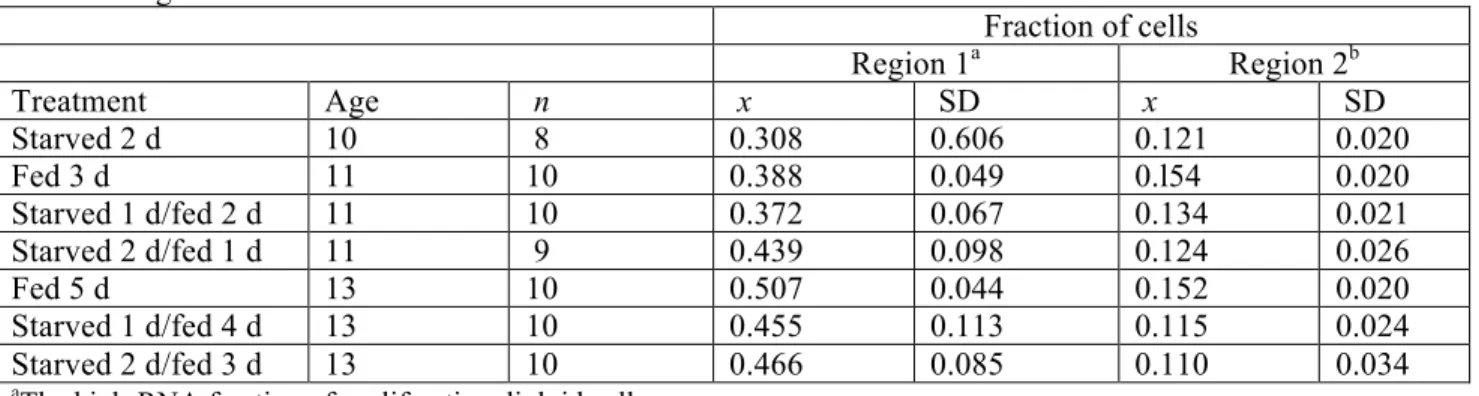
Table 2. Distribution of walleye pollock brain cells in two phases of the cell cycle compared to feeding regime. Fraction of cells Region 1a Region 2b Treatment Age n x SD x SD Starved 2 d 10 8 0.308 0.606 0.121 0.020 Fed 3 d 11 10 0.388 0.049 0.l54 0.020 Starved 1 d/fed 2 d 11 10 0.372 0.067 0.134 0.021 Starved 2 d/fed 1 d 11 9 0.439 0.098 0.124 0.026 Fed 5 d 13 10 0.507 0.044 0.152 0.020 Starved 1 d/fed 4 d 13 10 0.455 0.113 0.115 0.024 Starved 2 d/fed 3 d 13 10 0.466 0.085 0.110 0.034
aThe high-RNA fraction of proliferating diploid cells. bThe fraction of cells synthesizing DNA.