Summer2012; Vol. 24, No. 3 139
Original Article
Comparison of Temperature Rise in Silorane-Based and Methacrylate
Based Composites Cured by LED and Argon Laser
M. Hasani Tabatabaei 1, M. Etrati Khosroshahi 2, A. Pahlavan 1, S. Arami 3, S. Valizadeh 4 1Associate Professor, Department of Restorative Dentistry, School of Dentistry, Tehran University of Medical Sciences, Tehran, Iran
2
Professor, Department of Biomedical Engineering, Amirkabir University of Technology, Tehran, Iran.
3Assistant Professor, Department of Restorative Dentistry, School of Dentistry, Tehran University of Medical Sciences, Tehran, Iran
4
Operative Dentist
Corresponding author:
ValizadehS., Operative Dentist
Received: 26 June 2011 Accepted: 31 Dec 2011
Abstract
Background and Aim:Temperature rise occurs during photoactivation of dental composites due to the exothermic polymerization reaction and different curing units. The aim of this study was evaluation of temperature rise in two kinds of composites with different curing units.
Materials and Methods:In this experimental study, five samples of each composite resin (Filtek Z250, Filtek P90) were placed in two-millimeter deep Teflon molds which were 4mm in diameter. Curing was done from top surface with LED, high power LED and argon laser and temperature was recorded by a thermometer placed under the samples. After reaching room temperature, samples were cured and the temperature was recorded again. The time of maximum temperature was also record ed. The data were analyzed by two-way ANOVA and Tukey HSD.
Results:Composites and curing units had statistically significant influence on the temperature rise (p<0.001) Silorane-based composites showed significantly higher temperature rise than methacrylate-based ones. A significantly lower rise in tempera ture occurred when illuminationwas performed by argon laser. There was no signify cant difference in temperature rise between the two types of LEDs. The type of com posite had no effect on the time of maximum temperature and in all samples the max imum temperature was recorded at the beginning of irradiation.
Conclusion:Silorane-based composites showed higher temperature rise than methacrylate- based ones. Argon laser revealed less heat than LEDs. The maximum temperature rise was recorded at the beginning of irradiation.
Key Words:Polymerization,Temperature,Gas Laser,Filtek Silorane,Methacrylates
Journal of Islamic Dental Association of IRAN (JIDAI) / Summer 2012 /24 / (3)
Introduction
The increasing rate of production of light-activated dental materials has made curing units essential and common devices of each dental office. They are used to polymerize light-activated composite resins, resin light-activated glass ionomers and bonding systems [1]. Composites have gained popularity due to their low prices, conservative application technique and
accepta-ble esthetics [2]. Polymerization of composites is a light-activated process. Adequate polymeriza-tion of light-cured materials is related to the light intensity, wavelength, and curing time [3]. Ade-quate polymerization of these materials provides improved physical and mechanical properties, decreased solubility, and increased biocompati-bility and longevity of restorations [4] Studies have shown that curing units can cause a
Summer2012; Vol. 24, No. 3 140
perature rise harmful for the pulp. An increase in the power of the available curing units may cause increased temperature beyond the pulpal resistance threshold. Quartz-tungsten-halogen (QTH) units are the most frequently used curing units in dentistry. The disadvantages of this cur-ing system include an extremely low energy out-put in comparison with the consumed electrical energy, and increased operation heat build-up that harms both the curing unit and the dental pulp [5,6]. Therefore, QTH lamps have limited effective life and on the other hand, decreasing their light energy output with time causes a de-crease in effective polymerization of the compo-site material [1].
Light-emitting-diode (LED) lamps are able to cure composites in lower temperatures. Effec-tiveness of the LED units is justified by their light emission spectrum which is more consis-tent with the standard absorbing light spectrum of the champhorquinone in comparison with that of QTH lamps. Contrary to the QTH lamps, no light is emitted within the spectrum of the infra-red waves by LED units. Other advantages of the LEDs include increased lifetime, and more sta-ble light energy output in comparison with QTH lamps [7] High-power LEDs are also available with a ligh intensity similar to that of QTH lamps [8].
Argon laser is a newer technology recommended to overcome the problems of composite polyme-rization. This system emits light energy in blue and green spectra. The blue spectrum of this la-ser beam has the ability to photo-polymerize
champhorquinone- containing composites,
which is a unique feature among all laser types. The green light is applied for soft tissue man-agement and blood coagulation [9]. Argon laser has properties such as being mono-chromatic and collimated. It also has a selective absorption [10]. There is an increased penetration possibili-ty for the argon laser photons for curing purpos-es due to their visibility, consistency with the absorbing wavelength of camphorquinone, and a lower absorption coefficient in comparison with
other wavelengths. Therefore, improvement of optical parameters can lead to more favorable curing degrees [11] The light intensity in QTH lamps and LED units attenuates with increased distance, but according to the optical properties of the laser beam, such beam attenuation is neg-ligible in comparison with other light sources. Polymerization of composite resins cause heat buildup due both to the exothermic polymeriza-tion reacpolymeriza-tion and the energy absorbed from the curing light source which can be detrimental for the pulpal tissue. [14]
The objective of this study was to compare the temperature increase of the light-activated com-posite resins following use of LED and argon laser curing systems.
Materials and Methods
Two LED units and one argon laser curing unit was used in this experimental study. The features of the curing units are represented in table 1. The compose resins used were A2 shade Filtek Z250 (3M ESPE,USA) and Filtek P90 (3M ESPE,USA). The features of the composite re-sins used are also represented in table 2. Five samples with equal sizes of 4mm in diameter and 2mm in width were prepared in Teflon molds for each composite/curing unit combination at the room temperature. In each experiment, the upper surface of the composite was covered with a 0.03-mm thick translucent strip. Then, the con-ducting head of the light was placed in contact with the strip and parallel with the composite surface. Samples were cured according to the each manufacturer’s recommendation. Polymeri-zation temperature was measured by a k-type thermocouple fixed at the bottom of the cavity and attached to a thermometer (CNY 502A1, Taiwan) and showed in a monitor. The accuracy of the temperature measurement for the thermo-meter was 0.1 degrees centigrade. After initial
Summer2012; Vol. 24, No. 3 141
curing in the suggested times and recording the temperature rise, a time was given for the sam-ples to cool down for five minutes to their origi-nal temperature before curing for the second step with the previous curing time. The temperature rise was recorded for the second time. Tempera-ture rise in the primary step of curing is due to light emission of the curing unit and polymeriza-tion reacpolymeriza-tion. The resultant temperature increase within the next step is mainly due to the curing unit because the polymerization procedure is almost maximally completed. Therefore, it is possible to measure the temperature rise due to curing procedure separate from that of polymeri-zation reaction.
The quantitative variables were reported as mean (±SD). Two way analysis of variance was used to evaluate the effects of curing unites and com-posites on the temperature increase, but due to the significance of the interaction of independent variables in the statistical analyses, the strategy for statistical analysis was shifted to one-way analysis of variance (to compare the effects of the three curing units) and independent t-test (to compare the effect of the composite type). Ac-cording to the increased number of comparisons
and the change in statistical strategy, the statis-tical significance level was considered 0.01 in-stead of 0.05.
Results
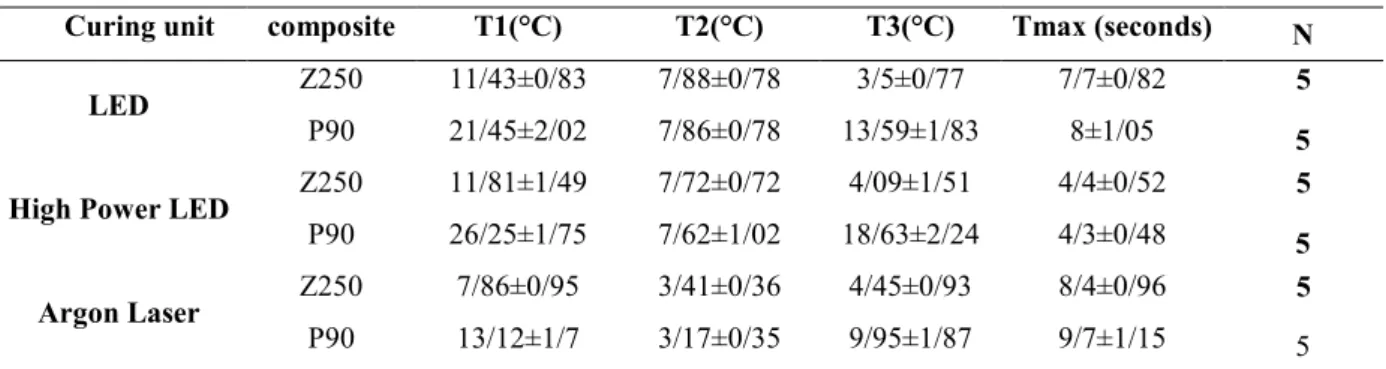
In this study, the primary temperature increase was related to both polymerization reaction and the curing unit and was referred to as T1. The temperature increase resulted from the curing unit during the second lighting procedure through the polymerized material was designated as T2. T3 was the difference between T1 and T2 and showed the temperature rise due to the po-lymerization reaction. Tmax was a time when the
maximal temperature was recorded.
In all three curing units, the type of composite had a significant effect on T1 and T2. (p=0.001) In all three curing units T1 and T3 were signifi-cantly higher in P90 group in comparison with Z250. In none of the curing units, the composite type had a significant effect on T2. P-values for the LED, high-power LED and argon laser units were 0.96, 0.80 and 0.13, respectively. In both composite types, the curing units had a signifi-cant effect on T2 (p<0.001) with argon laser sys-tem producing less sys-temperature increase com
Curing procedure Unit type
manufacturer Curing unit
40s-450mw/cm2
LED Ultradent,USA
Ultralume2
10s-1800mw/cm2
High-power LED , Liechtenstein
Ivoclar- Vivadent Bluephase 16i
40s-500mw/cm2 Argon laser
USA Melles Griot
Weight percent of filler content Volume percent of
filler content Filler size
m)
8
( Filler composition resin
type Commercial
name
%76 %55
0/1-2 Quartz, yttrium
fluoride Silorane
Low shrinkage posterior restorative
P90
%78 %60
0/01-3/5 Zirconia/ Silica
Bis-GMA, UDMA, Bis-EMA, TEGDMA Hybrid
Z250
Table 1: Characteristics of the curing units used in this study
Table 2: Characteristics of the composites used in the study
Summer2012; Vol. 24, No. 3 142
Discussion
The aim of this study was to evaluate the tem-perature increase in Filtek P90 and Flitek Z250 composites while curing with two LED and one argon laser curing systems. In this study, the to-tal temperature increase due to the curing unit, and polymerization reaction as well as the time required to reach the maximal temperature in composite samples was measured.
Temperature increase during restoration with light-activated composite resins is related to two factors; the exothermic polymerization reaction, and the output heat produced by the curing sys-tem [14]. Other factors such as the composite type, its thickness and color, curing time and the distance to the curing source are influential in the buildup of heat after use of composites [15]. In this study, the composite type had a signifi-cant effect on the total increase in temperature and the temperature increase due to polymeriza-tion in all curing units but was not effective in the temperature of the curing unit itself.
Higher increase in polymerization temperature of silorane-based composite P90 can be attri-buted to its difference in polymerization reaction which is based on siloxane and oxirane through a pared to the other LED systems. Type of compo-site was not significantly effective on Tmax in any
of the curing systems. (See table 3)
tring opening cationic reaction. This reaction occurs in the oxirane residue [16]. Optical pyro-metric studies show that the ring opening
cationic reaction of the oxirane is severely exothermic
resulting in a heat buildup of 100 degrees centi-grade at room temperature [17]. Further, the amount of heat produced during cationic poly-merization is positively related to the number of photo-initiators [18]. This finding is in accor-dance with that of Vesna Miletic in 2009 who compared the increased polymerization tempera-ture of Silorane, Ormocer and di-methacrylate based composites and concluded that P90 had a higher temperature increase in comparison with Admira (Ormocer) and Herculite XRV (a metha-crylate-based dental composite). The other two materials did not differ in terms of polymeriza-tion temperature increase. In this study, only one high-power LED (Bluephase) was used and the curing time was 20 seconds [19]. The type com-posite did not have any significant effect on T2 (the temperature increase due to the curing unit) in any of the groups using different curing units. This finding is logical because T2 is a tempera-ture rise measured after polymerization of the composites and therefore is related to the curing unit only. At this time, the composites are max-imally polymerized and the resultant heat is dis-sipated after cooling down of the samples to the room temperature. T2 is a heat produced as a result of light emission from the curing units, therefore the composite type and the increased temperature due to the polymerization process is not influential in T2. This finding is congruent with Khezevic’s study in 2005 in which the ki-netics of temperature increase following polyme-rization and a second-time curing did not signifi-cantly change with different curing modes [20].
N Tmax (seconds)
T3(°C) T2(°C)
T1(°C) composite
Curing unit
5
7/7±0/82 3/5±0/77
7/88±0/78 11/43±0/83
Z250
LED
5
8±1/05 13/59±1/83
7/86±0/78 21/45±2/02
P90
5
4/4±0/52 4/09±1/51
7/72±0/72 11/81±1/49
Z250
High Power LED
5
4/3±0/48 18/63±2/24
7/62±1/02 26/25±1/75
P90
5
8/4±0/96 4/45±0/93
3/41±0/36 7/86±0/95
Z250
Argon Laser
5 9/7±1/15
9/95±1/87 3/17±0/35
13/12±1/7 P90
Table 3: Maximum total temperature increase (T1), maximum temperature obtained from the curing unit (T2), maximum temperature due to polymerization reaction (T3) and the time required to reach the maximal temperature (Tmax) using
different curing systems.
Summer2012; Vol. 24, No. 3 143
On the contrary, this finding is in contrast with a study conducted by Tabatabaee and co-workers in 2009 in which the curing unit-induced heat was influenced by the type of composites used. This difference might have been attributable to the difference in particle type and size of the composites used which could have caused dif-ferences in opacity and/or variability in diffrac-tion of the transmitted curing light through the composites used [21]. Accordingly, it seems that both Z250 and P90 composites have similarities in terms of light diffraction and transmission. The highest temperature increase (T2) was rec-orded for LED and high-power LED curing units and the lowest for the argon laser unit, for both composite types. There was no significant dif-ference between two LED systems in T2, but the argon laser system showed a significantly lower temperature increase. This was in accordance with Rasteli et al. in their study, curing was per-formed by argon laser, QTH, and LED units through cured Z250 composite samples at five, ten, twenty, thirty, forty, fifty and sixty seconds and the temperature increase was recorded. The highest temperature increase was recorded for QTH, LED and argon laser, in a descending or-der [22]. Argon laser emits a light spectrum within the wavelength of 488nm and is in accor-dance with the maximal absorption spectrum of CQ which is within the range of 468-492nm. The total light produced by the argon laser unit is a usable energy; therefore, less heat is ab-sorbed by the pulp. It has been shown by some studies that better clinical results can be obtained by argon laser units due to better energy distribu-tion and less heat buildup within the pulp [23]. None of the composite types had a significant effect on Tmax when different curing units were
utilized. The time when maximum temperature increase is reached (Tmax) provides suitable
in-formation about the pre-gel stage. In polymeriza-tion of the dental composites, the gel area is of utmost importance in compensation of the poly-merization stresses [24]. In both composites used, the maximal temperature was recorded in
initial stages of the curing process when LED and argon laser systems were used. This oc-curred regardless of the composite used. Kne-zevic also reported that the maximum tempera-ture increase following polymerization occur within the initial few seconds and then decreases thereafter [20]. In addition, Pilo and Sakaguchi stated that the rapid increase in temperature dur-ing initial 20-30 seconds is dependent upon the curing light emission intensity and reaches a pla-teau within 50 seconds [24,25]. In a study by Tabatabaee et al, the maximal polymerization temperature was reached in a longer period of time in a nano-filled (Filtek Supreme) composite in comparison with a hybrid (Tetric Ceram) composite. This can be related to the slower process of polymerization due to smaller nano-sized fillers and their increased efficient surface [21]. It should be noted that in the current study, increased temperature of the composite was measured without considering the temperature changes of the dental tissue. Clinically, dentin prevents heat to be transferred to the pulp due to its low thermal conductivity, but in deep cavities an increased potential exists for thermal damage to the pulp due to reduced remaining dentin thickness and increased tubular surface [26].
Conclusion
1.Argon laser and LED curing systems provide the lowest and highest temperature increase dur-ing polymerization procedure in both composite samples, respectively.
2.P90 composite sample showed a significantly higher temperature increase in comparison with Z250, regardless of the curing unit. Therefore, the composite type was significantly influential in increase of temperature following polymeriza-tion. As a result, P90 composite should be used with caution in deep cavities.
3.The maximal thermal increase was considered to happen within initial curing stages in both composite samples and all curing units.
Summer2012; Vol. 24, No. 3 144
Acknowledgements
This paper was part of a postgraduate disserta-tion and a research project approved by The La-ser Research Center, School of Dentistry, Tehran University of Medical Sciences and Health Ser-vices. Therefore the kind assistances of Dr. Kho-sroshahi in Laboratory of Laser, Faculty of Med-ical Engineering, Amir Kabir University, Mrs. Zamani in Polymer Research Center and Dr. Shamshiri who performed the statistical analyses are hereby acknowledged.
References
1-Olaf A, Martin H. Advance in light curing. Am J Dent. 2000 Feb;13(S Pec no.):77D- 81D.
2-LF Schneider, S Consani, Halogen and LED light curing of composite: Temperature increase and Knoop hardness. Clin Oral Invest. 2006 Jan; 10(1):66-71.
3-Z Tarle, A Knezevic, N Demoli. A Comparison of composite curing parameters: Effects of light source and curing mode on conversion, tempera-ture rise and polymerization shrinkage. Oper Dent. 2006 Feb;31(2):219-226.
4-A Al-Qudah, CA. Mitchell. Effect of composite shade, increment thickness and curing light on temperature rise during photocuring. J Dent. 2007 March;35(3):187-274.
5-Hussey DL, Biagioni PA & Lamey PJ, Thermo-graphic measurement of temperature change dur-ing resin composite polymerization invivo. J Dent. 1995 Oct;23(5):267-271.
6-Goodie HE, White JM, Gamm B, Watanabe LG. Pulp Chamber temperature changes with visible- light- cured composite in vitro. Dent Mater. 1990 Apr; 6(2):99-102.
7-Mill RW, Jandt KD, Ashworth SH. Dental com-posite depth cure with halogen and blue light emit-ting diode technology. Br Dent J. 1999 Apr;186(8):388-91.
8-Sung Jeong, Young-Ran KIM. Effects of LEDs on microhardness and temperature rise of dental composite rsins. Dent Mater J. 2007 Jun; 26(6):838-844.
9-Dotsalva T, Jelinkova H. Shear bond strength after ER: YAG laser radiation conditioning of enamel and dentin. Proc. Spie Dig Lib,1997 Sep; 3192(3):34-39.
10-Vargas M, Cobb D, Schmit J. Polymerization of composite resin: Argon laser vs conventional light. Oper Dent. 1998 Mar-Apr;23(2):87-93. 11-Cobb D, Vargas M, Rundle T. Physical proper-ties of composites cured with conventional light or argon laser. Am. J Dent. 1996 Oct,9(5): 199-202. 12-CS Delfino, CSC Pfeifer, RR Braga. Shrinkage stress and mechanical properties of photoactivated composite resin using the argon ion laser. Laser and Optic, Applied Phys B. 2009 Jan;96(1):3366-6.
13-M Hanning, B Bott. In vitro pulp chamber tem-perature rise during composite resin polymeriza-tion with various light curing sourse. Dent Ma-ter,1999 Jul;15(4),275-281.
14-Smail SRL, Patterson CJW, Mclundie AC, Strang R. In vitro temperature rise during visible- light curing of a lining material and posterior com-posite. J Oral Rehabil. 1988 Jul; 15(4): 361- 366. 15-Masutani S, Setcos JC Schnell RW. Tempera-ture rise during polymerization of visible light-activated composite resins, Dent Mater. 1988 Aug; 4(4):174-178.
16-Boaro LC, Gonçalves F, Guimarães TC, Ferra-cane JL, Versluis A, Braga RR. Polymerization stress, shrinkage and elastic modulus of current low-shrinkage restorative composites. Dent Mater. 2010 Dec;26 (12):1144-50.
17-Crivello J, Falk B, Zonca MR Jr. Photoinduced cationic ring-opening frontal polymerizations of oxetanes and oxiranes. J Polym Sci [A]. 2004 Apr;42(7):1630-46.
18-Weinmann W, Thalacker C, Guggenberger R. Siloranes in dental composites. Dent Mater. 2005 Jan; 21(1):68-74.
19-Vesna Miletic, Vladimir ivanovic. Temperature changes in silorane-, ormocer-, and dimethacrylate -based composites and Pulp chamber roof during light-curing. J Esthet Dent. 2009 Apr;21(2):122-131.
Summer2012; Vol. 24, No. 3 145
20-Knezevic, A. Tarle, Z. Influence of light inten-sity from different curing units upon composite temperature rise. J Oral Rehabil. 2005 May; 32(5): 362-7.
21-Tabatabaei M, Motevasselian F. Evaluation of temperature rise and DC in two composites using various curing units. [Thesis]. Tehran: Dent Facul-ty, Tehran University of Medical Science; 2007. 22-A N S Rastelli, D P Jacomassi. Changes in the temperature of a dental light-cured composite resin
by different light-curing units.Laser Physics. 2008
Jun 18(8):1003-1007.
23-Jacomassi D, Rastelli D. Degree of conversion and temperature increase of a composite resin light
cured with an argon laser and blue LED. Laser
Physics. 2008 Jun;18(12):1570-1575.
24-Pilo R, Oelgiesser D, Cardash, H S. A survey of output intensity and potential for depth of cure among light-curing units in clinical use. J Dent. 1999 Mar;27(3):235-41.
25-Sakaguchi RL. Douglas W H. Peters M C. Cur-ing light performance and polymerization of com-posite restorative materials. J Dent. 1992 Jun; 20 (3):183-8.
26-A Santini, C Watterson.Temperature rise
with-in the Pulp chamber durwith-ing composite reswith-in poly-merization using three different light sources.
Open Dent J. 2008 Dec; 2(5):137-141.