1Postgraduate Student at International Islamic University Malaysia. Email: [email protected] VOLUME 18 ISSUE 2 (2020), Page 59 – 72
IDENTIFYING THE PARAMETERS OF THE MALAY CLASSICAL ARCHITECTURE
Tengku Anis Qarihah bt Raja Abdul Kadir1, Puteri Shireen Jahn Kassim2, Nurul Syala Abdul Latif 3 , Harlina Md. Shariff 4
1,2,4 Kulliyyah of Architecture and Environmental Design
UNIVERSITI ISLAM ANTARABANGSA MALAYSIA
3Faculty of Architecture
UNIVERSITI SAINS ISLAM MALAYSIA
Abstract
As modernization and urbanization grow, there has been a rising interest in townships with historical elements in their urban landscape. The identification and classification of Malay architectural language are crucial to architects seeking to instill history and culture into the new design. The paper traced the characterizations of classicality in Malay architecture through a thorough study of palaces and aristocrat buildings in Malaysia. Morphological analysis of 50 case studies was mapped but only six palaces from different sites and eras were marked as samples in this paper. The focus of the study not only on their origins, typology, history, and stylistic characters but also on the proportions and elemental attributes of the frontal façade. These case studies were selected as sentinels or samples of successive evolutionary phases in classical Malay architecture which had a huge gap and carried different historical evolutions. It was argued that while the earlier palaces reflected all Malay style attributes, the later expression reflected the cultural pressure of globalization via colonialism diffused from colonial institutions. The study extracted the five parameters of the Malay classical architecture, whereby it was found that even under such pressure, certain features were still maintained to root the identity of the Malays and later developed as new city urbanscape.
© 2020 by MIP 60 INTRODUCTION
As modernization and urbanization grow at a rapid rate in developing tropical Asian cities, there has been a rising interest in townships that use historical elements of language in their urbanscape. Recent townships by renowned Malaysia developers have utilized imported Classical language to add historical interest to the new township and adorn their commercial and institutional facades.
The rise of using ‘Classical’ stylization is due to the homogeneity of modern ‘bare’ styling. Mohamad Tajuddin Mohamad Rasdi (2001) stresses that there is local language that can add historical interest to commercial urban landscape, urban forms, and frontages, rather than cut-and-paste solutions. Zhang et al. (2018) said the issues of scale, proportion, what constitutes the essences of local aesthetic characters and parameters that can be used to interpret traditions to the modern building are challenging issues. Global expression and stylistic in public large modern multilevel structures in the Asian city are increasingly modeled upon the Western model or the Arabised-Islamic template. Concerning Malaysia, for example, the interest in the vernacular is due to the dominance of Modernist style public buildings which had spurred a counter-movement.
The identification of Malay templates and resources is also crucial for architects and urban designers seeking to instill history and culture into new building design and development. Within this area, architects are also searching for resources and broad principles and models that can guide them. Within this area, the evolution of construction techniques and works have a dual criticality in Asian tropics, as the materials range from the fragile timber into the modern masonry techniques. Hence classification would not only allow one to recognize the overall stylistic tenor of the work but to gain quick access to technologies and techniques of conservation specific to the material at hand. The aspect and demand for authenticity have additionally highlighted the importance of architectural heritage classification. Llamas et al. (2017) for example, concludes that typological assessment and assessment of heritage into specific classifications is crucial to the preparation of vulnerability analysis and diagnostics, and differentiate building stock according to specific eras and periods, as different classification may require a different approach to the definitions of guidelines and strategies. To provide a cutting line between the
Malay architectural language ‘from the roots of Malay architecture; from the
external Colonial ‘tree’ of style; one must outline the parameters of the Malay
61 © 2020 by MIP
LITERATURE REVIEW
Development of policies and strategies and guidelines towards refurbishment, restoration, and enhancement of architectural heritage inherently requires not only a morphological analysis on the evolution of site features of the place but a process of architectural identification and classification. Lee (2015), Llamas et al. (2017) and other summates of the identification of specific styles and classification as part of the conservation process. In architectural design, similar classifications are needed to identify certain approaches to design, without going into the separated elements. Hence according to Lee (2015) and Zhang et al. (2014), one must uncover specific intrinsic yet shared characteristics of architectural heritage to classify them. The southeast Asian tropical region is indisputably rich in diversity of traditions, heritage structures and traditions. Amongst the most characterizing structures are palaces and aristocratic mansions, yet there is a lack of effort to classify and identify common categories of the architectural language of our Malay identity. The difficulty lies in its diversity and transcending such diversities. Thus, the aim must be to identify common identities. Architecturally, Sabrizaa (2014), Mohamad Tajuddin Mohamad Rasdi (2001) and others have debated and discussed in depth the diversity of vernacular houses focusing on traditional houses and also mosques of this region and particularly within the Malay world, there is a rising interest due to the need to establish frameworks of place-making and cultural identity.
An architectural style is characterized by the features that make a building historically identifiable. (Baker et al., 2002) said a style may include elements such as form, method of construction, building materials, and regional character. The evolution of architectural form can be classified as a chronology of styles that had changed over time. (Ju et al., 2015) These changes, at times, are gradual and at times, are abrupt - reflecting changing fashions, beliefs, and religions, or the emergence of new ideas, technology, or materials globally. As a
typology, ‘palaces’ hold a significant position in the Malay community and
civilization. They not only represent the center of past socio-political life but are locations of the public life of the past in spatial and temporal terms. Physically and architecturally, they represent the peak of aesthetic sensibilities and capabilities of Malay populations, and collectively represent the identities of
these regions of its ‘Classicality’. On the definition of Classicality, Frampton (1992) has elaborated: The ‘classical’ is always conceived as a ‘continuous tradition from ‘antiquity’, and by the mid-18th century, the Classical was a historicist style. ‘Classicality’ can thus be argued as a temporal attribute related
© 2020 by MIP 62 METHODOLOGIES
The methodology adapted to this research is through mapping based on frontages, comparative analysis, and literature reviews. Over 50 case studies of palaces and aristocratic buildings built from the 1700s to 1930s throughout the Malay region were mapped and identified as local evolutions, common parameters and classifying milestones were observed. All of the regions are sharing similar styles and attributes, either the same historical sultanate/ patrons, intermarriage between regions, craftsmen and skill workers, cultural influences and others. The mapping of the Malay palaces and aristocrats helped to categorize the buildings into a group for characterizations. In analyzing this essence, the methods of (Clark & Pause, 2012) are adapted. The research is not exhaustive; instead, examples are designed to illustrate the nuances of the idea and theory. The analysis of the building frontal façades and forms derived from the consequence of multiple interpretations, dominant patterns and formative features of the buildings by extracting the similar styles/ character of each case study. SirBanister Fletcher which was known as his Book of History of Architecture had ruled up the importance of categorizing the architectural elements and history through its origins, timeline, and styles.
The subsidiary attributes of culture, politics and others will not be discussed further in this paper as the focus is more on developing the parameters
of architectural languages. These will include the building’s style, type,
63 © 2020 by MIP
Table 1: The Comparison of Case Studies Case Studies
Istana Rokan, Sumatera, Indonesia. Built-in the Year 1770
Rokan Palace is a relic of the 200-year-old
‘Nagari Tuo” sultanate has a unique collection of
Royal Rokan IV Koto carving, with dragon-carved
engravings
, plants ornamentations, andunique form of building. Side Elevation of Istana Rokan
Istana Balai Besar, Kedah, Malaysia. Built-in the Year 1730
The form survived through the tumultuous era of the late 1800s and
early 1900s
of external attacks, fire, and colonization but stillretained
the essence of Malay architectureeven though
with infusion of masonry and technology of cast iron.Side Elevation of Istana Balai Besar
Istana Hulu, Perak, Malaysia. Built in the Year 1903.
It was believed that Captain Maurice Alexander Cameron, the Deputy Colonial Engineer (1883 and 1892), was the one who designed the art forms and construction of this castle but with orders by Sultan, the
essence
of Malay architecture still can be found.Side Elevation of Istana Hulu
Baitul Rahmah, Perak, Malaysia. Built-in the Year 1911
It is an example of a Malay-Perak variation of a Classical vernacular language. At the corner part of the roof fascia of the villa
are elements
decorated with carving inspired by the character of honey bees. It was designed to complement the
'buton' woodcarving elements. Side Elevation of Baitul Rahmah
Istana Che Sepahchandera, Kedah, Malaysia. Built-in the Year 1911
The Sepachendera Palace was built for the wife of Sultan Abdul Hamid Halim Shah (1882-1943) Che Sepachendera. The palace is built with three floors and has a flat roof. On the ground floor is
© 2020 by MIP 64 Istana Woodneuk, Singapore.
Built-in Year 1930s.
Istana Woodneuk was built for the Sultan’s
fourth wife Sultana Khadijah in 1890 and took two years to complete. The blue-roof palace consisting of the main building with two smaller houses by its side.
Side Elevation of Istana Woodneuk
Source: Battalion AIF Association
FINDINGS AND DISCUSSION The Malay Frontage Character
Throughout the mapping of the 50 case studies was observed, the parameters of the Malay evolving style to differentiate from the colonial tree of style had been developed.The frontages may evolve into masonry versions, yet still be identified as Malay, if it complies with essential rules of character based on parameters of identification. These can be used to assess a language despite the pressure or evolution of change. These variations are rooted in a series of ancient models which is also the highpoint of aesthetic language. From the 50 or more case studies, the Five parameters of defining a classical Malay Architectural language rooted in Malay world summarised as follows:
1) Origins and Typologies 2) The Stylistic Grammar
3) The Building's Shape and Form; Ratio and Proportion 4) Expression of Structure and Construction
5) The Detailing of Decorative and Architecture Elements
a) The Origins and Basic Typologies
To define whether a frontage is Malay Classical, one must refer back to the theory of origins as the center of its culture. In the Malay world, the center of its culture arises from its history which is rooted back into the Riau Srivijaya region and these sites have been mapped and documented where their expressive language traced (Reid, 2004). Its rootedness must be traced towards the point of its dissemination into the neighboring region, diaspora and other parts of the region (Shireen, Kassim, Hanita, & Majid, 2017). Many historians (Andaya, 2008; Milner 2011) support the views that the Southeast polities of Sumatera are primarily the Malay ancestral homeland. Thus, a Malay Classical architecture; can be traced back to the roots of its style. Its patron or proponent must have originated and located within the Malay Kingdomor ‘Nusantara Land’. The
buildings should be owned or built by Malay aristocrat or patron or owners and dominated by decisions by a Malay patron who is instrumental in
65 © 2020 by MIP
Table 2: The Origins and Typologies Characteristics: The Six Case Studies Case
Studies Istana Roka n
Is. Balai
Besar Istana Hulu Rahmah Baitul Sepachendra Istana Woodneuk Istana
Location Riau Kedah Perak Perak Kedah Singapore
Years Built 1750 1735 1903 1911 1882 1890
Built For Sulta
n Sultan Sultan Sultanah Sultanah Sultanah
Built By Local
peopl e
Local
People people Local People Local Siamese & Local Local & Chinese
Designed
By Sultan Sultan & Artisan Sultan & British Sultan & Artisan Sultan & Artisan British
Though located within the ‘Malayness territory’ (Reid, 2004) certain designs and
forms were initiated by foreign architects or advocates although the patron is a Malay. As refer to table 2, for Istana Sepachendra and Istana Woodneuk, although these seem eclectic or British, the advocates or patrons are Malay and design administered by a Malay. For Istana Hulu, the frontage is designed by a British officer, but the Sultan had asserted a degree of the identity of Melayu in the design. A sample of this identification is in Table 4 below. The attributes below marked how the palaces were being designed as such and how it is carried out. All of these attributes and influences lead to the authenticity of the architecture.
b) The Stylistic Grammar
An architectural style is characterized by the grammar of language whose elements make it notable or historically identifiable. A grammar is a set of elements or technique which may include such elements as form, a method of construction and regional character. Any local decorative style can be influenced by the design style such as Neo-Gothic, Baroque and Neoclassical, Dutch Patrician, Art Deco and International Style (SeoRyungJu & Omar, 2011). Malay architecture cannot avoid certain evolutions and hybridization. Although
a Malay style can be infused by Colonial or ‘global’ elements, if a case contains
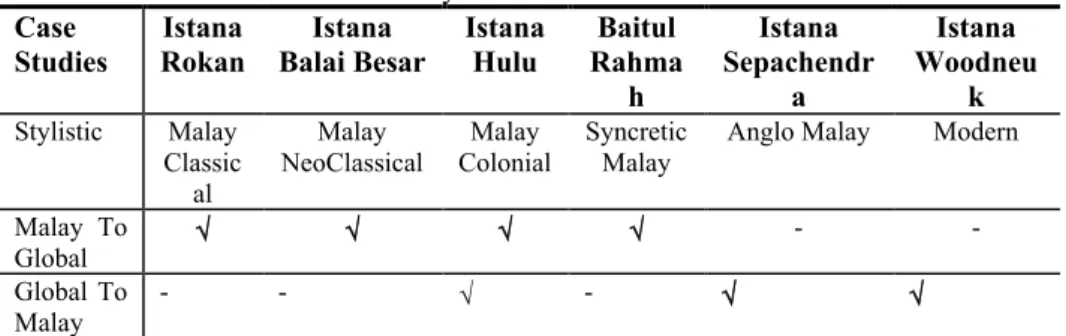
more than 50% of the Malay detailed elements, then it is classical. From a range between the poles of ‘Malay to Globalization’ and ‘Globalization to Malay’, the degree of Malayness is the more than half -fulfillment of these elements to define the dominant style of Malayness in the overall language of the building.
Table 3 shows the stylistic characters of the case studies. For Istana Hulu’s
© 2020 by MIP 66
triangular shape of gable end with slender columns. The building's architecture can be deemed as essentially an eclectic language due to the influence of the reigning Jawi Peranakan style in British Penang at the time with a Moorish-shaped déco and features of local ornaments found at the railings.
Table 3: Shows the Stylistic Grammar of The Case Studies Case
Studies Rokan Istana Balai Besar Istana Istana Hulu RahmaBaitul h
Istana Sepachendr
a
Istana Woodneu
k Stylistic Malay
Classic al
Malay NeoClassical
Malay Colonial
Syncretic Malay
Anglo Malay Modern
Malay To
Global √ √ √ √ - -
Global To
Malay - - √ - √ √
c) The Shape, Form, Ratio, and Proportion
Figure 1 below represents the Generic and Variant Forms of Malay architecture,
essentially derived from the five ‘generic’ Classical formal typologies of Malay
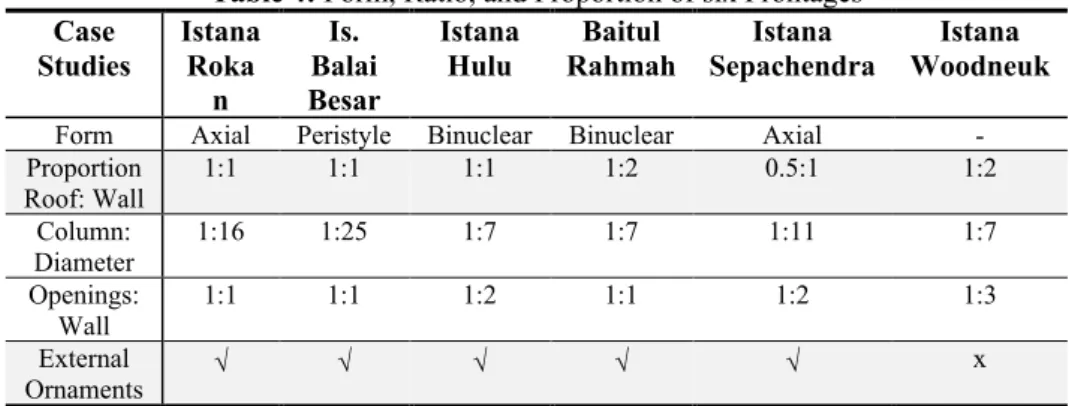
aristocratic frontages and facades (Anis et al., 2018). The work of Clark, & Pause (2012) was used to identify essential types of the Malay façade based on aristocratic compositions and elevations. All frontage can be classified and organized according to the five types, despite variations due to neighboring influences and variations according to evolution or dominant material (Refer to Figure 1 and Table 1). Example of Istana Baitul Rahmah Perak has a binuclear
form with the ‘double’ extended portico or verandah organized with roof finials
and decorative panels, similar to Istana Hulu with two vertical towers on the left and right side of the building.
67 © 2020 by MIP While the Colonial Classical is defined by Greek-based proportions such as 1: 7 in defining column proportions, the Malay column proportion exceeds this ratio. Anis et al. (2018) and Sabrizaa (2014) has discussed the ratio of solids and voids. Similarly, the Malay classical style would have its specific ratio of the proportion of ground floor to the upper floor, roof and wall and openings and wall. Table 4 below highlights a certain ratio found. The form description refers to Figure 1.
Table 4: Form, Ratio, and Proportion of six Frontages Case
Studies Istana Roka n
Is. Balai Besar
Istana
Hulu Rahmah Baitul Sepachendra Istana Woodneuk Istana
Form Axial Peristyle Binuclear Binuclear Axial -
Proportion Roof: Wall
1:1 1:1 1:1 1:2 0.5:1 1:2
Column:
Diameter 1:16 1:25 1:7 1:7 1:11 1:7
Openings:
Wall 1:1 1:1 1:2 1:1 1:2 1:3
External
Ornaments √ √ √ √ √
x
-
T
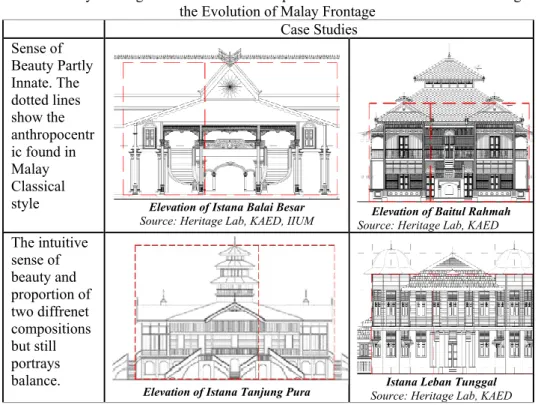
he Malay Sense of Aesthetic Proportion© 2020 by MIP 68
Table 5: The Malay Frontage Reflects Sense of Proportion – Golden Ratio Survived through the Evolution of Malay Frontage
Case Studies Sense of
Beauty Partly Innate. The dotted lines show the anthropocentr ic found in Malay Classical
style Elevation of Istana Balai Besar
Source: Heritage Lab, KAED, IIUM Source: Heritage Lab, KAEDElevation of Baitul Rahmah The intuitive
sense of beauty and proportion of two diffrenet compositions but still portrays balance.
Elevation of Istana Tanjung Pura Source: Heritage Lab, KAEDIstana Leban Tunggal
d) Expression of Structural System and Construction
69 © 2020 by MIP
M-T1 M-T2 M-T3 M-B1 M-B2
Figure 2: Observed Five hybrid models based on Construction Methods of the palaces
Table 6: shows the coding for the materials according to the case studies
CODING Materials
M-T1 All Timber
M-T2 All Timber Except Staircase and Ground Column
M-T3 Ground Column and Wall Are Bricks, Others Timber
M-B1 Only Ground Fl. Brick, Others Timber
M-B2 All Brick Except Roof Components
Case
Studies Rokan Istana Besar Balai Istana Hulu Rahmah Baitul Sepachendra Istana Woodneuk Istana
Materials M-T1 M-T2 M-B2 M-T1 M-B2 MB2
e) The Detailing of Decorative and Architecture Elements
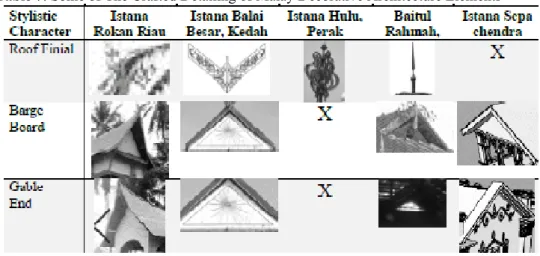
There is a controlled ornamentation in the definition of the Malay character in its visual form. The Malay ornamentation is essentially art formed from a specific pattern and environment with a specific composition of motif which links the Malay style back to an essentially ecological style of nature’s vegetal and flora
© 2020 by MIP 70
Table 7: Some of The Crafted Detailing of Malay Decorative Architecture Elements
Istana Woodneuk does not have any of these attributes. This stylistic
character’s table/chart helps to measure the authenticity of a Malay building with
stylistic elements that are supposed to be found in Malay buildings.
CONCLUSION
71 © 2020 by MIP
ACKNOWLEDGMENTS
The authors would like to acknowledge the Transdisciplinary Research Fund TRGS/1/2016/UIAM/01/5/2 from the Ministry of Higher Education for the support of this research.
REFERENCES
Anis, T., Raja, Q., Kadir, A., Shireen, P., Kassim, J., Hanita, N., … Nawawi, M., (2018). Classical Hybrid Language of Malay Aristocratic Buildings Identifying Generic and Variant Forms, Journal of the Malaysian Institute of Planners 16 (2), pp304 – 322 Baker, P., Barson, S., Cole, E., Flemingto, M., Gee, E., Gibson, T., … Yinong, X., (2002).
Architectural Details - A Visual Guide to 5000 Years of Building Styles. (S. Luck, Ed.) (First Edit). United Kingdom: Ivy Press.
Clark, R. H. & Pause, M., (2012). Precedents in Architecture; Analytic Diagrams, Formative Ideas and Parts (Fourth). New Jersey: John Wiley & Sons, Inc.
Frampton, K., (1992). Modern Architecture: A Critical History (Third Edition, Revised and Enlarged). London: Thames and Hudson.
Ismail Jasmani, Norzalifah Zainal Abidin, Shamzani Affendy Mohd Din, Puteri Shireen Jahn Kassim, (2019). Architecture Ecologised: Nature’s Patterns and Abstractions in Malay Built Traditions. Cultural Syndrome Journal, Vol. 1 (2), 2019, Univeristy of Unindra. Jahnkassim, Puteri Shireen, Abdul Majid, Noor Hanita, Nawawi, N., (2017). The Resilience of Tradition; Malay Allusions in Contemporary Architecture (First). Penang: Areca Books.
Ju, S. R., Kim, B. M., & Ariffin, S. I., (2015). Continuation and Transformation of Traditional Elements in Colonial Vernacular Houses in Kampong Bharu, Malaysia.
Journal of Asian Architecture and Building Engineering.
Lee, S., Maisonneuve, N., Crandall, D., Efros, A. A., & Sivic, J., (2015). Linking Past to Present: Discovering Style in Two Centuries of Architecture. 2015 IEEE International Conference on Computational Photography (ICCP).
Llamas, J., M. Lerones, P., Medina, R., Zalama, E., & Gómez-GarcíaBermejo, J., (2017). Classification of Architectural Heritage Images, Applied Sciences, 7(10), 992. Milner, A., (2004). Afterword: A History of Malay Ethnicity. In T. P. Barnard (Ed.),
Contesting Malayness- Malay Identity Across Boundaries, Singapore Uni Press.242-257
Mohamad Tajuddin Mohamad Rasdi, (2001). Seni Bina dan Permasalahan Identiti. In Identiti
Seni Bina Malaysia Kritikan Terhadap Pendekatan Reka Bentuk (pp. 1–8).
Reid, A., (2004). Understanding Melayu (Malay) as a Sources of Diverse Modern Identity. In T. P. Barnard (Ed.), Contesting Malayness- Malay Identity Across Boundaries (First Edit, pp. 1–24). Singapore: Singapore University Press.
Sabrizaa, M. R., A., & Amat, S. C., (2014). Local Genius Revisited (March), 28-31.
Said, I., (2005). Criteria for Selecting Timber Species in Malay Woodcarving. Journal of Asian
Architecture and Building Engineering, 4(1), 17–23.
https://doi.org/10.3130/jaabe.4.17
SeoRyungJu, & Omar, S. B., (2011). A typology of Modern Housing in Malaysia. 1st South East Asia Housing Forum of ARCH, Seoul, Korea, 11(June), 1–12.
© 2020 by MIP 72
Shomali, F. M., (2000). The gnomonic theory of architecture: a computational theory of the geneology of design. PQDT - UK & Ireland.
Andaya, Y. L., (2004). The Search for the ‘Origins’ of Melayu. In T. P. Barnard (Ed.), Contesting Malayness- Malay Identity Across Boundaries, Singapore Uni Press.56-75 Zhang, L., Song, M., Liu, X., Sun, L., Chen, C., & Bu, J., (2014). Recognizing architecture styles by hierarchical sparse coding of blocklets, Information Sciences, 254(1), 141– 154.
Zumahiran Kamarudin & Ismail Said, (2008). Visual Forms of Carved Components in Traditional Timber Houses of Kelantan and Terengganu. Jurnal Alam Bina.