Effect of Sandblasting on Retention of Maxillary Complete Denture
MA. Hemmati 1, A. Jamali 1, S. Barzegar 2, F. Taghavi 31Assistant Professor, Department of Prosthodontics, School of Dentistry, Shahed University,Tehran, Iran 2Dentist, Private Office, Sari, Iran
3Assistant Professor, Department of Prosthodontics, School of Dentistry, Ghilan University of Medical Sciences, Ghilan, Iran
Corresponding author: F. Taghavi, Assistant Professor, Department of Prosthodontics, School of Dentistry, Ghilan University of Medical Sciences, Ghilan, Iran
Received: 3 July 2014 Accepted: 25 July 2015
Abstract
Background and Aim: Retention of complete denture plays an important role in patient satisfaction. The aim of this study was to evaluate the effect of sandblasting of the internal surface of maxillary denture on its retention.
Materials and Methods: In this before and after clinical trial, for 15 patients presenting to the Department of Prosthodontics of Shahed University, two acrylic bases similar to their original maxillary denture were fabricated. By using a digital force transducer, the force needed to dislodge the base from the palate was measured. The internal surface of the bases was sandblasted by 50-micron alumina particles for one minute except for the borders, which were covered by thin aluminum foils. The data were analyzed using paired t-test.
Results: Sandblasting increased the mean retention of the bases from 30.89±10.74 N to 37.66±9.76 N (21.9%), which was statistically significant (p<0/0001).
Conclusion: According to the findings of the present study, sandblasting of the internal surface of maxillary complete denture enhances its retention.
Key Words: Air Abrasion, Maxillary Complete Denture, Retention
Journal of Islamic Dental Association of IRAN (JIDAI) Summer 2015 ;27, (3)
Introduction
Adequate retention is an important factor determining the success and acceptance of complete dentures by patients. Rate of patient dissatisfaction with the retention of dentures is high despite all attempts. Thus, researchers are in search of new ways to enhance the retention of complete dentures.
Retention of complete dentures is influenced by several mechanical, physical, physiological and biological factors in the oral cavity. Psychological characteristics of patients and their level of expectation also play a role in this respect. The following factors are believed to play a role in retention of complete dentures:
1. Undercuts: Small tissue undercuts not
interfering with the insertion of denture can enhance retention.
2. Gravity: Gravity increases the retention of mandibular and decreases the retention of maxillary denture.
3. Atmospheric pressure: Atmospheric pressure,
which is equal to 1 kg/cm2maintains the denture in
place as a retentive factor.
In order for all the factors responsible for denture retention to function properly, the following conditions must be met:
A. Borders of the denture must be sealed.
B. Complete adaptation between the denture base and tissue is required.
C. The surface from which, an impression is taken must be maximized.
D. Viscosity of the saliva must be relatively high. Role of saliva in retention of denture depends on the forces in its thin layer entrapped between the denture base and mucosa, which include cohesion forces, adhesion forces, surface tension forces and its viscosity.
4. Muscular system: Oral and facial muscles that are related to denture in some way can also affect the retention of denture as a physiological factor [1-4].
Several studies have evaluated methods to increase the retention of maxillary dentures such as sandblasting and use of a thin layer of adhesive materials [5-14]. Also, different techniques have been used to measure the denture retention such as strain gage force transducer and hydrolytic systems using extra oral transducers [5,6,10].
Considering the factors affecting the retention of dentures, Kikuchi et al, in 1999 evaluated methods to increase the retention of complete denture base. They fabricated acrylic bases for 10 dentate patients using autopolymerizing acrylic resin with 3mm distance from the free gingival margin. Using a strain gage designed for this purpose, they measured the load required for dislodging the acrylic base from the palate before and after sandblasting with 50µ alumina particles. They showed that the load required for dislodgement after sandblasting was significantly higher than that before sandblasting the denture base [5]. In 2006, Husham et al. evaluated 20 patients complaining of poor retention of maxillary denture. They used a strain gage force transducer designed for this purpose to measure the load required for dislodgement of acrylic base from the palate before and after sandblasting. They showed significant improvement in the mean retention of well-fit dentures after air abrasion [6]. Sipahi et al, in 2007 evaluated the efficacy of different factors to increase the retention of maxillary denture in patients who had gone radiotherapy such as the use of artificial saliva, sandblasting and denture adhesives and showed that sandblasting did not improve retention significantly [7].
In 2013, Sharma et al. evaluated the effect of sandblasting on maxillary denture retention in five patients and used strain gage force transducer to
measure the load required to dislodge the bases. They showed that sandblasting increased the retention by up to two times [8].
Thus, in order to increase the accuracy of measurements and considering the small number of studies in this respect, this study sought to assess the effect of sandblasting on retention of maxillary
complete denture.
Materials and Methods
This before and after clinical trial was registered at www.irct.ir (IRCT2015041921835N1). This study was conducted on 15 patients presenting to the Department of Prosthodontics of School of Dentistry, Shahed University requiring complete dentures. The patients had no oral diseases or mucosal undercuts and were not allergic to any dental material [5,8]. The participants were briefed about the study and written informed consent was obtained from them. After obtaining the maxillary master cast, two gypsum cast duplicates were fabricated by agar impression. Next, acrylic bases in the form of complete denture were fabricated with a hook in their center. The wire of the hook was made of stainless steel (0.9 mm orthodontic wire), which was at the center of the base. The strain gage was connected to the hook and maximum load was measured as such (Figure 1).
A digital strain gage (FG-5100, Lutron Electronic Enterprise CO., Taipei, Taiwan) with SN:
10e070857 software and a large LCD display, capable of measuring, displaying and recording maximum tensile and compressive loads was used. It had 100kg capacity. For measurement, the zero
Figure 1. Acrylic base with a hook
button can be set to normal or maximum load. Sandblasting was performed using a sandblaster (Pars Medical, Tehran, Iran).
First, the internal surface of acrylic base borders was covered with aluminum foil (1mm) to prevent sandblasting of borders. Then, using alumina particles 50µ in diameter, sandblasting was performed under 2-2.5 bar pressure for one minute with 10cm distance from the nozzle.
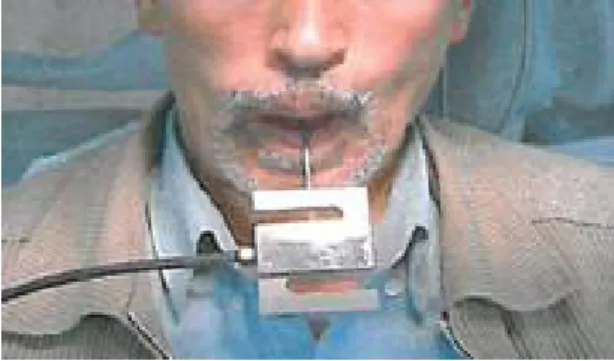
With patients seated on dental chair, acrylic bases, stored in humid environment, were placed in their mouth. One-minute time was allowed for complete adaptation of acrylic base to the palate and complete seating of denture. Next, the patients, seating upright with their heads laid on the headrest, were asked to completely open their mouth in such a way that their maxillary occlusal plane was parallel to the horizontal plane. The strain gage was hooked to the hook and we tried
our best to apply the dislodging force
perpendicular to the maxillary occlusal plane (Figure 2).
The applied load in N was read on the display monitor and the maximum load causing dislodgement of the denture base was recorded in N. The same process was repeated after sandblasting of the denture base and the load value was recorded. The data were analyzed using paired t-test.
Results
This study was conducted on 15 patients including eight (53.3%) males and seven (46.7%) females. Eight patients did not have a history of using
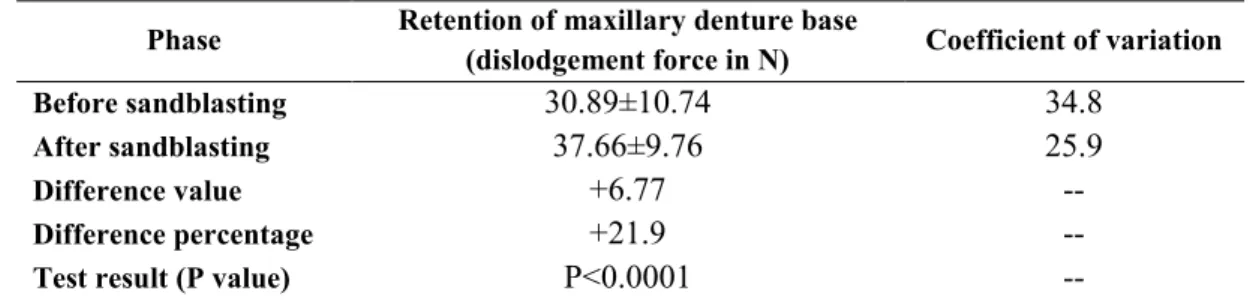
complete dentures while the remaining had experienced it. The retention of complete dentures before and after sandblasting is presented in Table 1. As seen in Table 1, the load was 30.89±10.74N before and 37.66±9.76N after sandblasting, which indicated 6.77N (21.9%) increase in retention. According to the paired t-test, this increase was statistically significant (p<0.0001).
Discussion
Patient satisfaction with removable complete denture depends on several factors. Denture retention is among the most important factors determining patient satisfaction, which depends on several parameters. Attempts have been made to improve denture retention. In the current study, we increased the internal surface area of denture by sandblasting to assess its effect on retention of complete denture.
Acrylic resin is resistant to surface wetting due to its low surface energy. This characteristic has been the topic of many studies attempting to find methods to increase denture retention by modifying its internal surface. Sandblasting is among the suggested techniques for this purpose [5,6,9-11].
Using a very thin layer of silicon dioxide in the internal denture surface [12], use of soft reline materials [13] and changing the internal surface of denture by titanium hydrogen peroxide [14] are among other suggested techniques. Roughening the internal surface of denture by sandblasting increases its hydrophilicity and subsequently its wettability and can improve denture retention particularly in the maxillary denture. This effect is due to decreased contact angle of saliva and acrylic denture surface. This change results in better penetration of saliva into small porosities. Thus, increased contact area of saliva and acrylic leads to higher retention of denture and its greater resistance to dislodging forces [5,8].
Adhesion and cohesion of saliva are directly correlated to increased surface area because the area occupied by the thin layer of saliva between denture and mucosa increases as such. Based on this hypothesis, we sandblasted the internal surface of denture to increase the surface area. Our results showed that sandblasting increased the retention of denture base (the null hypothesis was refuted).
Figure 2. Measuring the load required for dislodgment of the maxillary denture base
Several instruments have been used in previous studies for measurement of retention including a spring balance [15], lever arm with loading apparatus [12,16], Riehle universal testing machine [17], push-pull dynamometer [18,19], strain gage force transducer [5,6,10] and hydrolytic and electronic systems using an extra oral transducer. Each of these tools has its own limitations while the digital strain gage transducer used in our study does not have the shortcomings of the afore-mentioned tools. The strain gage transducer used by Kikuchi et al, and Husham et al. is not suitable for this purpose since it must be replaced with another gage during the experiment because it does not display the maximum load at dislodgement [5,6].
The results of our study showed that the mean load required for dislodgement of denture was 30.89±10.74N before and 37.66±9.76N after sandblasting, indicating 6.77N (21.9%) increase in retention, which was statistically significant. Such an increase in retention was in agreement with the findings of Kikuchi et al, in 1997 [5]; however, quantitatively, some differences were noted between the results of the two studies, which may be due to the followings:
A. In the study by Kikuchi et al, [5] the acrylic base was only limited to the palatal surface. Thus, the measured load in their study probably indicated pure retention; whereas, in our study, we assessed the clinical application of a complete denture and thus, denture retention in total was evaluated (which was a combination of denture base
retention and some other factors). This explains slight differences in the results of the two studies. B. They fabricated the acrylic bases from auto polymerizing acrylic resin and measured the
load using strain gage force transducer. Thus, for higher capacity, they had to change the gage during the experiment while the gage used in our study was capable of measuring and recording maximum load at dislodgement. Husham et al, [6] and Sharma et al, [8] also used a strain gage with the limitations stated above.
However, they also concluded that sandblasting of the internal surface of denture significantly increased its retention. In 2002, another study reported the same results using an air gage, which could not display the maximum load at dislodgement and it had to be recorded manually by observing the value shown on the display monitor the moment the dislodgement occurred. After dislodgement, the value was no longer shown on the monitor. Thus, we used a digital gage transducer, which displays and records the maximum load at dislodgement automatically. In a study by Sipahi et al, in 2007 on patients with xerostomia secondary to radiotherapy, the effects of different factors changing the consistency of the saliva and internal surface of maxillary denture on retention were evaluated. They concluded that sandblasting had no effect on denture retention while use of denture adhesives increased the retention of maxillary dentures. This result, to a great extent, was thought to be due to the severe reduction of saliva, which could no longer play its part in efficacy of sandblasting in these patients [7].
However, it should be noted that sandblasting of the internal surface of denture can also enhance accumulation of microbial plaque [5]. Therefore, this method is only recommended for patients with good oral hygiene. Since sandblasting is performed by alumina particles, which are spherical in shape,
Phase Retention of maxillary denture base
(dislodgement force in N) Coefficient of variation
Before sandblasting 30.89±10.74 34.8
After sandblasting 37.66±9.76 25.9
Difference value +6.77 --
Difference percentage +21.9 --
Test result (P value) P<0.0001 --
Table 1.The retention of maxillary denture base before and after sandblasting
the created porosities also have a circular cross-section and are in the form of semi-circular cavities without undercuts. Thus, they can be easily cleaned. However, further studies are required in this respect.
Conclusion
Based on the results of this study, sandblasting of the internal surface of maxillary dentures can increase their retention.
References
1. Zarb G, Hobkirk J, Eckert S, Jacob R. Prosthodontic treatment for edentulous patients. 13thed. USA: Elsevier; 2012,53-90.
2. Rahn AO; Heartwell CM, Textbook of complete dentures. 5thed. Hamilton, Ontario, Canada: BC Decker; 2002.
3. Darvell BW, Clark RKF. The physical mechanisms of complete denture retention. Br Dent J. 2000 Sept; 189:248-252.
4. Aoyagi K, Sato Y, Kitagawa N, Okane M, Kakuda T, Takayama M. Development of a simple chair-side evaluation method for complete denture retention forces and its reproducibility. Ronen Shi-ka Igaku J. 2014; 29(1):21-28.
5. Kikuchi M, Ghani F, Watanbe M. Method for enhancing retention in complete denture bases. J Prosthet Dent. 1999 Apr; 81(4):399-403.
6. HuSham AM, Al-Bazirgan MH. Effect of air abrasion on the retention and texure of the maxillary complete denture. Am J Dent. 2006 Apr; 19(2):115-22.
7. Sipahi C, Beyzadeoglu M, Demirtas S, Ozen J. Effect of different mucosal and acrylic resin surface treatments in a denture retention model for patients with radiotherapy-induced Xerostomia. Int J Prosthod. 2007 Jul-Aug; 20(4):405-8.
8. Sharma S, Gupta V,Godbole SR, et al. Effect of surface texture of intaglio surface on Denture
Retention- An Invivo Analysis. Chhattisg arh J of Health Sci. 2013 Sept; 1(1):35-39.
9. Winkler S, Ortman HR, Ryczek Mt. Improving the retention of complete dentures. J Pronhet Dent. 1975 July; 34(1):11-15.
10. Kawazoe Y, Hamada T. The role of saliva in retention of maxillary; complete dentures. J Prosthet Dent. 1978 Aug; 40(2):131-36.
11. Monsenego P, Baszkin A, Costa ML, Lejoyeux J. Complete denture retention. Part-II: Wettabilitv studies on various acrylic resin denture base materials. J Prosthet Dent. 1989; 62(3):308-12.
12. Boucher LJ, Ellinger C, Lutes M, Hickey JC. The effect of a microlayer of silica on the retention of mandibular complete dentures. J Prosthet Dent. 1968 June; 19(6):581-86.
13. Battersby BJ, Ghel DH, O’Brien Wj. Effect of an elastic lining on the retention of dentures. J Prosthet Dent. 1968 Dec; 20(6):498-505.
14. Gesser HD, Castaldi CR. The preparation and evaluation of wetting dentures for adhesion and retention. J Prosthet Dent. 1971 March; 25(3):236-43.
15. Ostlund SC. Saliva and denture retention. J Prosthet Dent.1960 July-Aug; 10(4):658-63. 16. Hamrick JE. A comparison of the retention of various denture-base materials. J Prosthet Dent. 1962 July-Aug; 12(4):666-77.
17. Swartz WH. Retention forces with different denture base materials. J Prosthet Dent. 1966 May-June; 16(3):458-63.
18. Niedermeier HW, Karmer R. Salivary secretion and denture retention. J Prosthet Dent. 1992 Feb; 67(2):211-16.
19. Anthony De F, Ghel DH. Clinical study of the retention of maxillary complete dentures with di ferent base materials. J Prosthet Dent. 1970 Apr; 23(4):374-80.