Andreas K. Orphanides. Extraction of Natural-Language Dates and Comparison of Dates in Hypothesis and Text to Identify Negative Textual Entailment. A Master’s Paper for the M.S. in L.S degree. April, 2008. 66 pages. Advisor: Catherine Blake
We present a system to determine entailment, when a sentence (the text) implies a second sentence (the hypothesis). While some systems use temporal information to decide entailment, no study has measured the effectiveness of temporal features alone in entailment resolution. The system identifies natural-language dates, and precludes entailment solely by comparing dates in the hypothesis and text. Evaluation of date detection on three 800-pair corpora from the Recognising Textual Entailment (RTE) Challenges provided precision of 98.0% (RTE3devmt, 338/345), 96.6% (RTE3test, 198/205), and 99.7% (RTE1test, 336/337), and recall of 97.7% (RTE3devmt, 338/346), 99.0% (RTE3test, 198/200), and 99.1% (RTE1devmt 336/339). For sentence pairs with years, the proposed method improved entailment accuracy from 33 to 42/72
(RTE3devmt) and from 42 to 44/63 (RTE3test,) which corresponds to an overall improvement of 1.1% (RTE3devmt) and 0.1% (RTE3test). Our analysis suggests that matching temporal information with an event would further increase the entailment accuracy.
Headings:
Text mining -- Textual entailment
Text mining -- Temporal information
EXTRACTION OF NATURAL-LANGUAGE DATES AND COMPARISON OF DATES IN HYPOTHESIS AND TEXT TO IDENTIFY NEGATIVE TEXTUAL
ENTAILMENT
by
Andreas K. Orphanides
A Master’s paper submitted to the faculty of the School of Information and Library Science of the University of North Carolina at Chapel Hill
in partial fulfillment of the requirements for the degree of Master of Science in
Library Science.
Chapel Hill, North Carolina
April 2008
Approved by
_______________________________________
Table of Contents
1 Introduction... 4
1.1 The PASCAL Recognising Textual Entailment Challenges ... 5
1.2 Previous approaches to the Recognising Textual Entailment Challenges ... 7
1.3 Temporal features in the Third Recognising Textual Entailment Challenge ... 8
1.4 Motivation beyond entailment ... 9
1.5 Research question and approach... 10
2 Methods... 11
2.1 Preliminary investigations ... 11
2.2 System framework ... 13
2.3 Date identification and extraction... 14
2.4 Entailment method ... 20
3 Results... 22
3.1 RTE3 Development ... 22
3.2 RTE1 Test ... 26
3.3 RTE3 Test ... 29
3.4 Discussion ... 32
3.5 Future work... 33
3.6 Summary of results ... 34
4 Conclusion ... 37
5 Acknowledgments... 39
6 Appendix: PL/SQL script ... 40
6.1 PL/SQL Script... 42
Table of Figures
Table of Tables
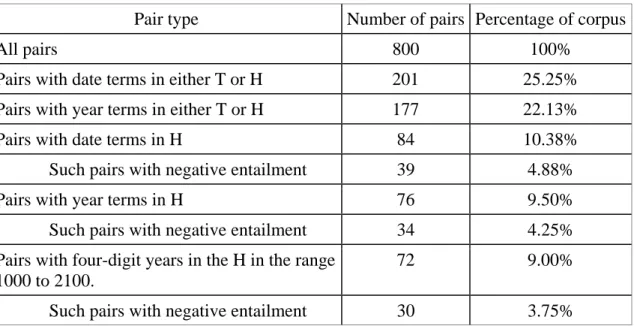
Table 1: Pairs in RTE3 development set with date terms ...12
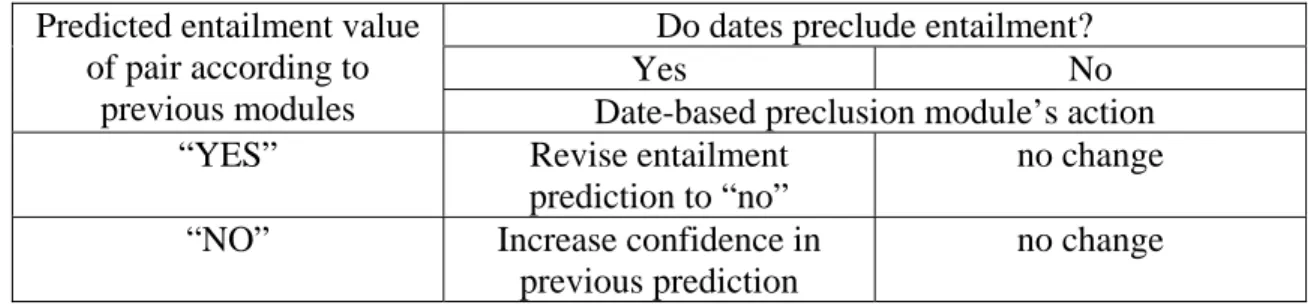
Table 2: Actions to be performed by date-based preclusion module when evaluating entailment pairs containing dates ...14
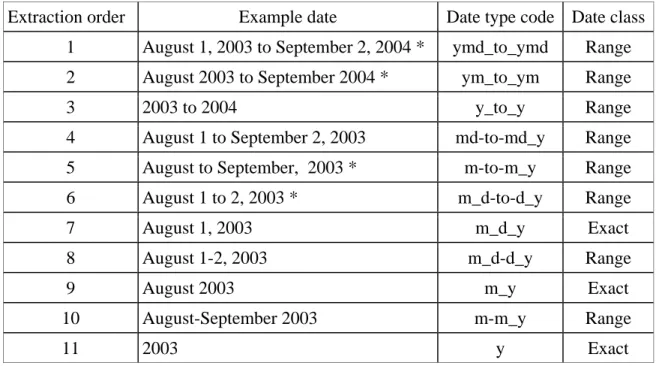
Table 3: Date extraction precedence...15
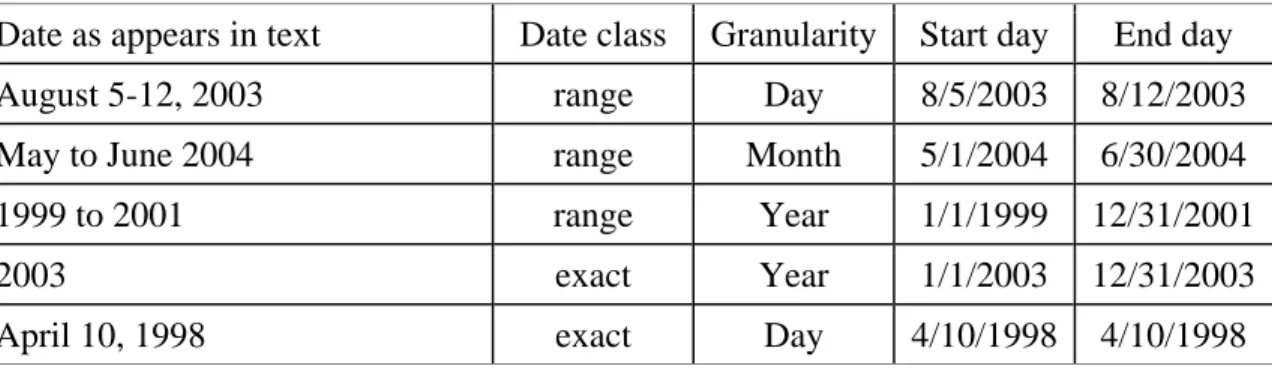
Table 4: Date statement examples and the date spans they imply ...19
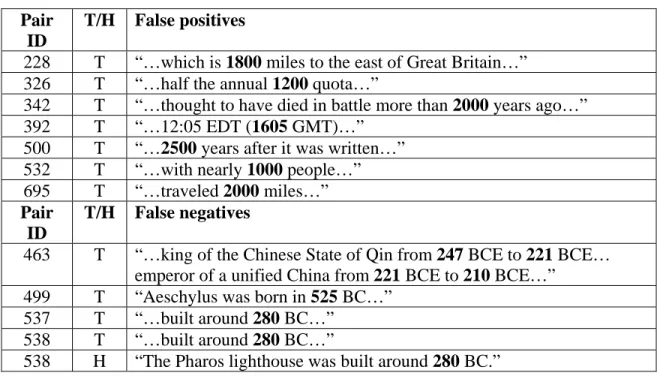
Table 5: Text excerpts of false positives and negatives from year identification in RTE3D...23
Table 6: Confusion matrix for system results on RTE3D...23
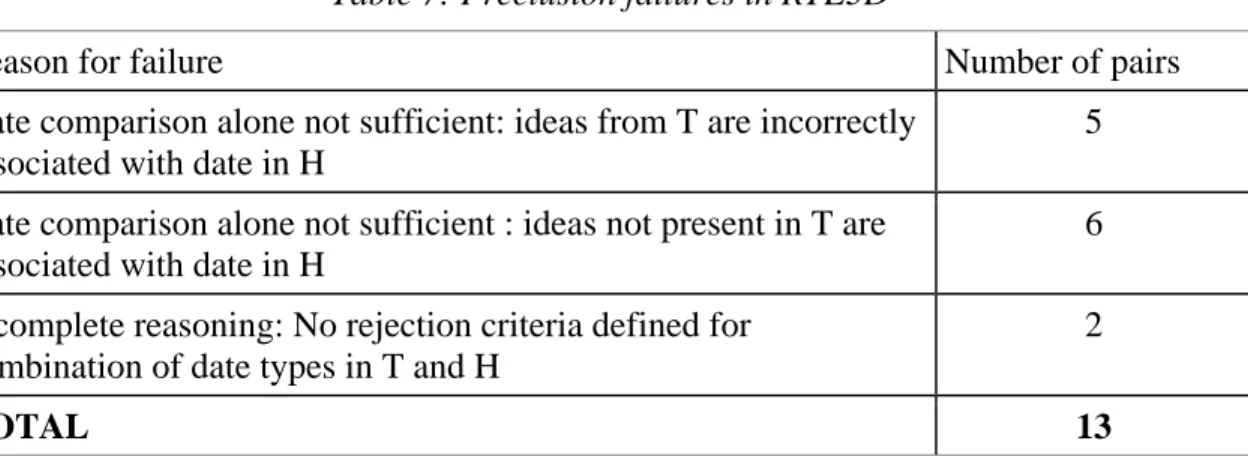
Table 7: Preclusion failures in RTE3D ...24
Table 8: Pairs in RTE1 test set with date terms ...27
Table 9: Confusion matrix for system results on RTE1T ...27
Table 10: Preclusion failures in RTE1T ...28
Table 11: Pairs in RTE3 with date terms ...29
Table 12: Confusion matrix for system results on RTE3T ...30
Table 13: Preclusion failures in RTE3T ...31
Table 14: Confusion matrix for system results on the combined corpus...32
Table 15: Causes of preclusion failure in combined corpus ...32
1
Introduction
Dagan et al. (2005) define textual entailment as “a directional relationship between pairs
of text expressions, denoted by T - the entailing ‘Text’, and H - the entailed
‘Hypothesis’… [where] T entails H if the meaning of H can be inferred from the meaning
of T, as would typically be interpreted by people.” Consider this pair of texts from the
third PASCAL Recognising Textual Entailment Challenge (Giampiccolo et al. 2007):
RTE3 Development Set pair 17:
T: Allen was renowned for his skill at scratch-building and creating scenery, and he pioneered the technique of weathering his models to make them look old and more realistic.
H: Allen introduced a new technique of creating realistic scenery.
Since T implies H, T entails H (stated differently, entailment between this pair holds, or
the pair has positive entailment). On the other hand, consider this pair, from the same
Challenge:
RTE3 Development Set pair 625:
T: Following a steady flow of leaks and statements on apparently incriminating discoveries, her office has been gagged by senior legal authorities.
H: Because of leaks, a gag was placed on Holland’s office.
In this case, T does not entail H (or entailment does not hold, or the pair is said to have
negative entailment), since information exists in the hypothesis (the office holder’s name)
that is not in the text. Entailment may fail to hold for other reasons; for instance, details
RTE3 Development Set pair 25
T: Bountiful arrived after war’s end, sailing into San Francisco Bay 21 August 1945. Bountiful was then assigned as hospital ship at Yokosuka, Japan, departing San Francisco 1 November 1945.
H: Bountiful reached San Francisco on 1 November 1945.
Here, entailment does not hold because in the hypothesis, the idea of Bountiful reaching
Japan is incorrectly paired with the date of Bountiful leaving Japan, resulting in a
hypothesis that does not follow from the text.
Automated textual entailment recognition has many potential applications. Identifying an
entailment relationship between two texts can establish a link between two ways of
expressing an idea (Dagan et al., 2005), and recognizing an entailment relationship can
suggest semantic associations between texts. The identification of a nonexistent or
incomplete entailment relationship between texts can suggest that the meaning in the new
text does not duplicate existing text (Monz & Rijke, 2001).
The problem of textual entailment relates to semantic entailment and inference in
language. Condoravdi et al. introduced entailment as a distinct problem area i.e. “the
detection of entailment...relations between texts”) in 2003. Work on textual entailment
began in earnest in 2004, with the establishment of the PASCAL Recognising Textual
Entailment (RTE) Challenges (Dagan et al., 2005), and the development of the Microsoft
Research Paraphrase Corpus (Dolan et al., 2005).
1.1
The PASCAL Recognising Textual Entailment Challenges
The PASCAL Recognising Textual Entailment Challenges were introduced in 2004 to
motivate research in textual entailment. In each challenge, participants are provided with
pairs, each pair consisting of one or more complete sentences in the text and in the
hypothesis. The pairs were either taken from existing corpora or derived from freely
available Web-based sources. The data sets consist of approximately a 50/50 split
between pairs where entailment holds and those where it does not, as judged by three
human annotators, who had to agree on a pair’s entailment value for it to be included in
the data set. Each pair is also labeled with a task type indicating a text application
relevant to that pair, again as judged by the annotators. Each task type contains
approximately a 50/50 split between entailed and non-entailed pairs. Participants know
the task types and can exploit them in their systems (Dagan et al., 2005). Task types in
the third Challenge were Information Extraction (IE), Information Retrieval (IR),
Question Answering (QA), and Summarization (SUM) (Giampiccolo et al., 2007).
Challenge participants use the development data set (in which the entailment value of
each pair is provided) during system development and tuning. Once they complete
system development, they run their systems on the test data set (in which the participants
do not know the entailment value of each pair); results are provided to the RTE judges,
who measure system performance is measured in terms of accuracy, defined as the
number of entailment predictions correct out of the number of pairs tested. Systems are
optionally scored on a separate relative precision metric, which takes into account the
system’s confidence in each prediction. We consider only accuracy in our analysis of
RTE systems; since the relative precision formula changed between RTE1 and RTE2,
1.2
Previous approaches to the Recognising Textual Entailment
Challenges
Approaches to recognizing textual entailment have evolved over the three PASCAL
Recognising Textual Entailment Challenges. In RTE1, word overlap, lexical relations,
and syntactic matching were each used on 13 of the 28 runs on the full corpus (46%). The
accuracy of systems in RTE1 ranged from 49.5% to 58.6% on the whole corpus (Dagan
et al., 2005). The lowest-scoring system (Perez & Alfonseca, 2005), however, achieved
an accuracy score of 72% on RTE1’s “Comparable Document” task type, using only
word overlap features; this suggests that approaches unsuitable for the full corpus can
achieve high accuracy on a well-defined subset thereof.
In RTE2, lexical relation identification was used in 32 out of 41 systems (78%)
(Bar-Haim et al., 2006). Both the lowest scoring runs (Nicholson et al. (2006) with 50.88%
and 52.88% accuracy scores), and the highest scoring (Tatu et al. (2006) with 73.75%;
Hickl et al. (2006) with 75.38%) made use of this feature, and lexical relation is the only
feature in common between Tatu et al. and Hickl et al., making this feature’s contribution
to performance unclear. In addition, Tatu et al. used three features, whereas Hickl used
seven. This suggests that as features are added, each improves performance with
diminishing effectiveness, and that carefully selecting features and providing for feature
interaction can lead to strong performance.
In RTE3, the high scorers were Hickl & Bensley (2007) (80%), and Tatu & Moldovan
(2007) (72.25%); the low scorers were Baral (49.63%) and Clark et al. (2007) (47.25%).
Eight systems made use of anaphora resolution; all but one scoring above .6 accuracy
the features used by Tatu and Clark are identical. The use of anaphora resolution alone
does not account for the 25% difference in scores, especially in light of other systems that
used more features than Tatu’s (including anaphora resolution), and did not score as
highly. This suggests that implementation of features, in addition to feature selection,
affects system performance.
1.3
Temporal features in the Third Recognising Textual Entailment
Challenge
1Although temporal feature analysis was not tracked as an approach in Giampiccolo et al.
(2007), five systems in RTE3 (Bobrow et al.; Tatu & Moldovan; Rodrigo et al.; Adams et
al.; MacCartney & Manning; all 2007) used temporal features. Tatu & Moldovan
implemented full temporal tagging with the TARSQI (Verhagen et al., 2005) toolkit,
using temporal features to establish logic representations. Rodrigo et al. observed that
entailment holds between two temporal expressions if the hypothesis’s temporal
reference contains the text’s reference (e.g., the date “1923” in the text entails the date
range “the 1920s” in the hypothesis), which is corroborated by Delmonte et al. (2005).
Adams et al. identified negative cases by using temporal relations in conjunction with
grammatical dependency to compare event orders in the text and the hypothesis. That a
temporal relationship is a necessary condition for a causal relationship (Stanford
Encyclopedia, 2007) suggests that Adams et al. were correct to use temporal features for
negation. MacCartney and Manning utilized temporal relations in their implementation of
a natural logic.
1
1.4
Motivation beyond entailment
Temporal analysis is important for applications beyond entailment. Both Jang et al.
(2004) and Wong et al. (2005) describe temporal analysis as a subset of information
extraction (IE) and named entity recognition, and point out that temporal information is
essential for question answering (QA) tasks, for questions that ask “when,” “how long,”
or “in what sequence.” They also point out that temporal information can be used to order
extracted text in summarization (SUM) tasks. These tasks represent three of the four task
types in RTE3. Wong et al. identify temporal relations and derive temporal reasoning by
combining analysis of temporal comparators such as “before” and “after” with
identification of reference and reporting dates. Schilder (2004) extracts temporal
information from noun and prepositional phrases. Roddick and Spilipoulou (2002) survey
temporal knowledge discovery techniques in data mining applications, including
temporal association discovery and temporal extensions to classification. These
techniques use unstructured temporal information in text, including relative temporal
keywords and natural-language dates. Jang et al. outline an automatic temporal tagging
system for Korean, which uses a dictionary of temporal terms to identify and interpret
relative, absolute, and duration-based temporal references. The TARSQI suite (Verhagen
et al., 2005) consists of tools to automatically label temporal features according to the
TIMEX3 temporal metadata standard, but its system requirements, which include Python,
Perl, and SGML-tagged parts of speech, fall outside the scope of this project. We did use
the temporal vocabulary from TARSQI’s GUTime tool as the basis for our own in a
1.5
Research question and approach
Our goal is to investigate to what degree temporal information can improve performance
in an entailment recognition system. We present a system that precludes entailment by
comparing year-containing dates in the hypothesis to such dates in the text. We describe a
date-extraction sequence that ensures that, for each date, all relevant information is
extracted; and we provide a list of techniques for extracting different types of dates. We
then provide a decision-making process that precludes entailment based on the dates
identified in each entailment pair. We evaluate these methods on three data sets from the
RTE challenges: the RTE3 development set (RTE3D), the RTE1 test set (RTE1T), and
the RTE3 test set (RTE3T). We measure system performance on accuracy, number of
predictions correct out of number made; and on recall, number of predictions correct in
the subset containing temporal information extractable by the system. Finally, we
propose techniques for matching actors (nouns) and actions (verbs) to the dates on which
2
Methods
2.1
Preliminary investigations
We performed a pilot study to investigate the prevalence of temporal terms in entailment
pairs. We created a temporal vocabulary extended from the vocabulary used by the
TARSQI toolkit’s GUTime tool (Verhagen et al., 2005). Our vocabulary included day
names, month names, units of time such as “day,” “month,” and “year,” temporal
modifiers such as “before” and “after,” and regular expression patterns that matched
four-digit years (e.g. “1992”) and decade statements (e.g., “1980s”). We used a SQL query to
count sentence pairs in RTE3D that containing terms in the temporal vocabulary. The
SQL query identified 493 pairs in RTE3D (61.6%) that contained at least one temporal
term. Hand-counting revealed 456 true positives and 37 false positives, giving the query a
precision (correctly identified pairs out of all pairs identified) of 92.5%. While all words
in the temporal vocabulary were identified, the regular expression failed to match years in
4 pairs, for a recall (correctly identified pairs out of total pairs with temporal information)
of (456/460) = 99.1%.
Our analysis revealed that 15.3% of RTE3D (122 pairs) contained temporal terms in the
hypothesis. In 10 pairs, terms were incorrectly identified as temporal, for a precision of
(112/122) = 91.8%. The regular expression failed to match a year in 1 hypothesis
We examined sentence pairs in RTE3D where a year in the hypothesis did not match
years in the text. In 26 of the 27 such pairs (96.3%), entailment did not hold. This
prompted the current approach of using temporal mismatches between the hypothesis and
texts to identify cases of negative entailment.
Table 1: Pairs in RTE3 development set with date terms
Date terms are terms or phrases that represent a numbered day of the month, a month, a year, or span of years. Year terms are terms that represent a year or a span of years.
Pair type Number of pairs Percentage of corpus
All pairs 800 100%
Pairs with date terms in either T or H 201 25.25%
Pairs with year terms in either T or H 177 22.13%
Pairs with date terms in H 84 10.38%
Such pairs with negative entailment 39 4.88%
Pairs with year terms in H 76 9.50%
Such pairs with negative entailment 34 4.25%
Pairs with four-digit years in the H in the range 1000 to 2100.
72 9.00%
Such pairs with negative entailment 30 3.75%
We performed a manual analysis of the RTE3 development set, counting pairs that
explicitly refer to a numbered day of the month, a month, a year, or a range of years
(including decades and centuries) (see Table 1). Such date terms appeared in 201 pairs,
177 of which (88.1%) included a year in either H or T. Of the 201 pairs, 76 (37.8%)
included a year in H, comprising 9.25% of RTE3D. Among the pairs with years in the
2.2
System framework
Our system precludes entailment by comparing dates in the hypothesis and texts. For
each entailment pair, the system identifies dates and maps each natural-language date to a
span of viable calendar dates. It then compares the overlap between the dates in the text
and hypothesis sentences, predicting negative entailment according to the heuristic
provided in 2.4.
Since the system operates on a subset of entailment pairs, and only rules out entailment,
we envision that our work would be embedded in a larger entailment system (see
). Our work would corroborate or reject the entailment predictions from other system
components, for those pairs containing dates. The actions to be performed by our system
are shown in Table 2.
Figure
1
We developed our system using the 800-pair development data set from the third
PASCAL Recognising Textual Entailment Challenge (RTE3D) (Giampiccolo et al., Entailment predictions
No change
Date-based entailment preclusion
No date in H: no change in prediction
Revise “yes” to “no” Pairs
with dates in H
Date ex
tr
actio
n
Yes
No Entailment
prediction system Entailment
pairs
Support “no” prediction
Figure 1: Possible implementation model for date-based entailment preclusion.
After an entailment prediction system predicts entailment for the pairs in the corpus, this module would extract dates from the pairs. For pairs with dates in H, the system would compare the dates in H and in T, and perform one of three actions: a) pass the pair through without altering the entailment prediction; b) revise a yes
prediction to a no; c) provide additional support to a no prediction.
2007). We evaluated system performance on the 800-pair test data set from RTE3
(RTE3T), with the 800-pair test data set from RTE1 (RTE1T) as a secondary evaluation
set. Data was stored in an Oracle database, and the system’s decision-making procedures
were coded in Oracle PL/SQL.
Table 2: Actions to be performed by date-based preclusion module when evaluating entailment pairs containing dates
Do dates preclude entailment?
We used version 1.6 of the Stanford parser (Klein & Manning, 2003a, 2003b) to produce
a dependency parse for each sentence, and we produced a normalized word list by
stripping leading and trailing nonword characters from the tokens identified by the parser.
For instance, the token (1923) would be normalized to 1923, and socialism” to
socialism.
2.3
Date identification and extraction
The system identifies dates that contain a year. It does not identify dates with only a
month or day, relative temporal references (e.g., “last year,” “tomorrow”), decades (e.g.,
“1980s,” “2000’s”), or centuries (e.g., “17th century”); nor does it identify year ranges
separated by hyphens (e.g., “1900-1923”).
The system identifies years through a regular expression that matches all numbers
between 1000 and 2100. It identifies months and days by comparing terms against
Yes No Predicted entailment value
of pair according to
previous modules Date-based preclusion module’s action
“YES” Revise entailment
prediction to “no”
no change
“NO” Increase confidence in previous prediction
vocabularies. We created a vocabulary of month terms, which included both full month
names (e.g., “August”) and abbreviations (e.g., “Aug”), and day terms, which included
the cardinal numbers 1 through 31 and the ordinals 1st through 31st.
Table 3: Date extraction precedence
Date classes marked with an asterisk were not present in the development set, so we did not create code to handle them specifically. Since we developed the sequence (including the marked terms) without consulting the data set, we include them here for reference.
Date types marked “exact” indicate a single day, month, or year, without explicitly mentioning a range of dates. Date types marked “range” explicitly indicate the start and
end of a range of dates.
Extraction order Example date Date type code Date class
1 August 1, 2003 to September 2, 2004 * ymd_to_ymd Range
2 August 2003 to September 2004 * ym_to_ym Range
3 2003 to 2004 y_to_y Range
4 August 1 to September 2, 2003 md-to-md_y Range
5 August to September, 2003 * m-to-m_y Range
6 August 1 to 2, 2003 * m_d-to-d_y Range
7 August 1, 2003 m_d_y Exact
8 August 1-2, 2003 m_d-d_y Range
9 August 2003 m_y Exact
10 August-September 2003 m-m_y Range
11 2003 y Exact
We developed a sequence to dictate the order of extraction of different types of dates.
The sequence, given in Table 3, is designed to reduce the likelihood that a date range is
interpreted as a specific date, and to ensure that granularity—the smallest unit of time in
each date—is preserved. For example, the sequence ensures that “from May to June
2003” is not interpreted as “May 2003” or “June 2003” alone, and that “August 16, 1942”
2.3.1 Ranges with multiple years (y_to_y)
2.3.1 Ranges with multiple years (y_to_y)
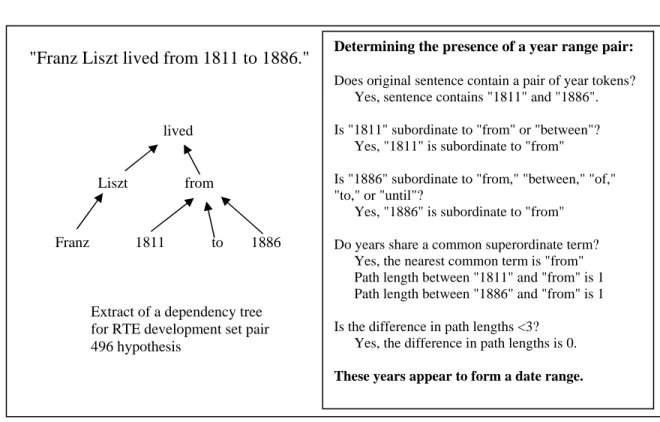
The system identifies ranges with multiple years (e.g., “1811 to 1886”) by first
identifying all cases where a single sentence contains at least two years. It checks each
pair of years against the following conditions: the first year term must be subordinate in
the dependency parse to one of the words “from”, “between” or “of”, and the second term
must be subordinate to “from”, “between”, “of”, “to”, or “until”. The pair must have a
superordinate term in common. The path length from each year term to the nearest
common superordinate term must differ by less than 3. If these conditions are met, the
two year terms are the bounds of a date range, with the sequentially first (i.e., first in
sentence) year as the start date and the sequentially second year as the end date. Each pair
of years is considered separately; if multiple pairs meet these criteria, the system finds
multiple year ranges for that sentence.
The system identifies ranges with multiple years (e.g., “1811 to 1886”) by first
identifying all cases where a single sentence contains at least two years. It checks each
pair of years against the following conditions: the first year term must be subordinate in
the dependency parse to one of the words “from”, “between” or “of”, and the second term
must be subordinate to “from”, “between”, “of”, “to”, or “until”. The pair must have a
superordinate term in common. The path length from each year term to the nearest
common superordinate term must differ by less than 3. If these conditions are met, the
two year terms are the bounds of a date range, with the sequentially first (i.e., first in
sentence) year as the start date and the sequentially second year as the end date. Each pair
of years is considered separately; if multiple pairs meet these criteria, the system finds
multiple year ranges for that sentence.
Extract of a dependency tree for RTE development set pair 496 hypothesis
Liszt
Franz
lived
from
1811 to 1886
"Franz Liszt lived from 1811 to 1886." Determining the presence of a year range pair:
Does original sentence contain a pair of year tokens? Yes, sentence contains "1811" and "1886".
Is "1811" subordinate to "from" or "between"? Yes, "1811" is subordinate to "from"
Is "1886" subordinate to "from," "between," "of," "to," or "until"?
Yes, "1886" is subordinate to "from"
Do years share a common superordinate term? Yes, the nearest common term is "from" Path length between "1811" and "from" is 1 Path length between "1886" and "from" is 1
Is the difference in path lengths <3? Yes, the difference in path lengths is 0.
These years appear to form a date range.
As an example, consider the hypothesis from the RTE3 development set, pair 496, shown
in Figure 2. The system identifies the tokens “1811” and “1886” as years. The system
checks if the sequentially first year token, “1811,” is subordinate in the dependency parse
to one of the terms “from,” “between,” or “of.” "1811" is subordinate to the word “from.”
The system checks if the sequentially second year term, “1886,” is subordinate to “from,”
“between,” “of,” “to,” or “until.” “1886” is subordinate to “from.” The system checks if
the year terms share a superordinate term. They share “from” and “lived” as
superordinate terms. The distance from the first token, “1811,” to the nearest common
superordinate term, “from,” is 1, as is the distance between “1886” and “from.” The
difference in these distances is 0, which is less than 3. This pair represents a date range,
with "1811" as the start year and "1886" as the end.
2.3.2 Ranges with multiple months and days and a single year (md-to-md_y)
For ranges with a single year and multiple months and days (e.g., “August 1 to September
2, 1993”), the system uses reasoning similar to 2.3.1 to determine if two month terms
form a date range. For each such pair of month terms, the system associates the pair with
the year term that most closely follows it that is within five terms following the
sequentially second month term. The system searches for a day number fewer than three
terms away from each month. The sequentially first month and day are taken as the
beginning of the date range, and the second month and day as the end.
2.3.3 Dates and date ranges with month and year (m_d_y, m_d-d_y, m_y)
The system next identifies dates and ranges that include a single year and a single month.
the nearest month to the year. Since date ranges with two months have already been
identified, the likelihood of incorrectly pairing a month to the year is minimized.
These (month, year) pairings serve as candidates for three date statement classes: First,
the system searches for day terms (described above) from 2 terms prior to the month
term, to immediately prior to the year term. This range allows for both American-style
dates (”April 1, 1992”) and European-style dates (”1 April, 1992”) to be identified, as
well as expressions such as “1st of April, 1992”. (The system assumes that the month
term occurs before the year term in all cases.)
For pairs where no day term is found, the system searches for ranges of days (as in “April
1-15, 1992”, “1st-10th of April, 1992”) between the month and year and one to two terms
prior to the month. The system searches for these ranges separately from individual dates
because the hyphenated terms are treated as single tokens in the database.
For (month, year) pairs for which no day or day range is found, the system concludes that
the date refers to a month and year alone (e.g., “April 1992”).
2.3.4 Hyphenated month ranges (m-m_y)
Date ranges that include hyphenated month ranges (“April-June 1992”) are identified and
matched to corresponding years in a manner similar to 2.3.3. The system searches for
hyphenated month ranges within five terms immediately prior to years.
2.3.5 Single year alone (y)
The system takes any numeric token between 1000 and 2100 that does not fall into one of
2.3.6 Converting each natural-language date into a span of calendar dates
Since dates and ranges can refer to different spans of time depending on the granularity
of the dates, the system maps each date found to a span of calendar dates, by identifying a
“start day” and “end day” for the date. Each date has a granularity, the smallest time unit
included in the date: either “day,” “month,” or “year”. For a date with “day”
granularity—that is, where the smallest unit expressed in the date is the day of the
month—the start day and end day are equal to the date itself. For example, “April 1,
1992” would have 4/1/1992 as the start day and 4/1/1992 as the end day. For a range with
“day” granularity, the start date and end date of the range are the start day and end day,
respectively, of the span. For an exact date or range with “month” or “year” granularity,
the system uses the earliest possible day and month for the start day, and the latest
possible day and month for the end day. For example, the system assigns the start day
8/1/1995 and the end day 8/31/1995 to the date “August 1995,” which has “month”
granularity (see further examples in Table 4). The system assumes that February has 28
days unless a date refers explicitly to February 29. Universally assuming a 29-day
February would allow better matching on leap days, but Oracle’s date functions do not
accept a 29-day February in nonleap years.
Table 4: Date statement examples and the date spans they imply
Date as appears in text Date class Granularity Start day End day
August 5-12, 2003 range Day 8/5/2003 8/12/2003
May to June 2004 range Month 5/1/2004 6/30/2004
1999 to 2001 range Year 1/1/1999 12/31/2001
2003 exact Year 1/1/2003 12/31/2003
2.4
Entailment method
2.4
Entailment method
The system detects only false entailment. It compares dates in the hypothesis to those in
the corresponding text, using the start and end days calculated in 2.3.6. If no date exists in
the hypothesis that can be inferred from a date in the text, the system precludes
entailment.
The system detects only false entailment. It compares dates in the hypothesis to those in
the corresponding text, using the start and end days calculated in 2.3.6. If no date exists in
the hypothesis that can be inferred from a date in the text, the system precludes
entailment.
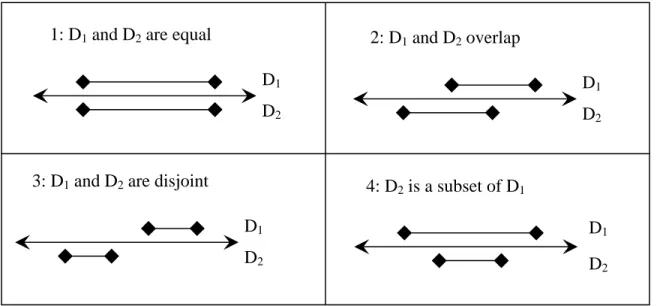
We define the following pairwise relationships on dates: Two dates D1 and D2 are equal
if their spans have the same start and end days, regardless of the granularity of the
original dates; D1 and D2 overlap if either the start day or end day of D1 (but not both)
falls between the start and end days of D2; they are disjoint if the end day of D1 precedes
the start day of D2; and they have a superset/subset relationship if D2 (the subset) has
both its start and end days (non-strictly) between the start and end days of D1 (the
superset) and the two dates are not equal (see Figure 3 for a visual representation of
these relationships).
We define the following pairwise relationships on dates: Two dates D1 and D2 are equal
if their spans have the same start and end days, regardless of the granularity of the
original dates; D1 and D2 overlap if either the start day or end day of D1 (but not both)
falls between the start and end days of D2; they are disjoint if the end day of D1 precedes
the start day of D2; and they have a superset/subset relationship if D2 (the subset) has
both its start and end days (non-strictly) between the start and end days of D1 (the
superset) and the two dates are not equal (see Figure 3 for a visual representation of
these relationships).
D1
1: D1 and D2 are equal 2: D1 and D2 overlap
D2 D1
D2
D2 D1
3: D1 and D2 are disjoint 4: D2 is a subset of D1
D1
D2
For each sentence pair, the system compares each date in the hypothesis D(H) to each
date in the text D(T). The system will rule out preclusion for a sentence pair if any
(D(H),D(T)) meets one of the heuristics ruling out preclusion. If no such combination
exists, and (D(H),D(T)) exists that meets one of the heuristics precluding entailment, then
entailment is precluded for the sentence pair. Comparisons are based on the equality,
overlapping, disjunction, and superset/subset definitions above, in addition to the
classification of the date as “exact” or “range” as described in Table 3. Exact dates
specify a single day, month, or year, without explicitly indicating a span of time. Range
dates include start and end years, months, or days, to explicitly indicate duration.
Preclusion is ruled out for any sentence pair, and we will say that D(H) and D(T) align, where D(T) and D(H) exist such that any of the following conditions is met:
1. D(H) equals D(T) and both D(H) and D(T) are of the same date type (“range” or “exact”)
2. D(T) is a subset of D(H), and D(H) is exact
3. D(T) is a subset of D(H), both D(H) and D(T) are ranges, and D(H) is less
granular than D(T), with start and end dates in corresponding months and/or years
Entailment is precluded for any sentence pair where preclusion is not ruled out above,
and D(H) and D(T) exist such that either:
4. D(H) and D(T) overlap, or D(H) and D(T) are disjoint
5. D(H) is a subset of D(T)
Two of these conditions warrant further explanation:
• Condition 2 identifies cases where an exact date D(H) (with granularity of month or year) contains a range D(T):
o D(T): “May 15-24, 2003” D(H): “May, 2003”
o D(T): “April 10, 2003” D(H): “April 2003”
o D(T): “April-June, 2005” D(H): “2005”
• Condition 3 rules out preclusion when D(H) is a less granular expression of D(T).
o D(T): “Apr 10, 2002 to Jun 23, 2003” D(H): “April 2002 to May 2003”
3
Results
The system analyzed three data sets: RTE3D, RTE1T, and RTE3T (see section 1.5, page
10), each with 800 pairs and approximately 50% positive entailment and 50% negative
entailment. Our system was developed and optimized using RTE3D, with RTE3T set as
the primary evaluation set. We analyzed RTE1T to measure performance outside of the
RTE3 Challenge environment.
For each set, we show a manual count of pairs with dates; we examine the performance
of the year extraction method (see section 2.3, page 14); and we discuss the results of the
entailment preclusion method (see section 2.4, page 20).
In the analyses below, the system performed “correctly” if it predicted negative
entailment for a pair where the hypothesis is not entailed by the text. It performed
“incorrectly,” or produced a false negative, if it predicted negative entailment for a pair
that had positive entailment. It “missed” the entailment relationship if it came to no
conclusion on a negative pair.
3.1
RTE3 Development
Table 6: Text excerpts of false positives and negatives from year identification in RTE3D
Excerpts labeled “T” are from texts; those labeled “H” are from hypotheses.
Pair ID
T/H False positives
228 T “…which is 1800 miles to the east of Great Britain…” 326 T “…half the annual 1200 quota…”
342 T “…thought to have died in battle more than 2000 years ago…” 392 T “…12:05 EDT (1605 GMT)…”
500 T “…2500 years after it was written…” 532 T “…with nearly 1000 people…” 695 T “…traveled 2000 miles…” Pair
ID
T/H False negatives
463 T “…king of the Chinese State of Qin from 247 BCE to 221 BCE… emperor of a unified China from 221 BCE to 210 BCE…”
499 T “Aeschylus was born in 525 BC…” 537 T “…built around 280 BC…”
538
In RTE3D, the year identification pattern matched 338 years (true positives), while
incorrectly identifying 7 nonyear tokens as years (false positives), for a precision of
338/345 (98.0%). The regular expression failed to match 8 years in five sentences (false
negatives), since these years had only three digits. Recall for identifying years was
338/346, or 97.7%. False positives and negatives are shown in Table 5. This analysis
does not consider decades, centuries, or hyphenated date ranges, of which there were 17. T “…built around 280 BC…”
538 H “The Pharos lighthouse was built around 280 BC.”
Table 5: Confusion matrix for system results on RTE3D
Pairs included in table are those with years in the range 1000-2100 in the hypothesis.
This system
Actual entailment No prediction
Entailment
precluded Totals
The system precluded entailment for 19 pairs, of which 17 (89.5%) had negative
entailment. The 17 correct pairs represent 2.1% of the corpus. The system’s performance
is summarized in Table 6. Of the correct pairs, 1 was of the IE task type, 3 were IR, 2
were SUM, and 11 were QA.
Table 7: Preclusion failures in RTE3D
Reason for failure Number of pairs
Date comparison alone not sufficient: ideas from T are incorrectly associated with date in H
5
Date comparison alone not sufficient : ideas not present in T are associated with date in H
6
Incomplete reasoning: No rejection criteria defined for combination of date types in T and H
2
TOTAL 13
The system missed 13 pairs with a year in the range 1000-2100 in the hypothesis that
should have been precluded (see Table 7). In 11 cases, date comparison alone was not
enough to preclude entailment: the dates in H and T align (see section 2.4, page 20) but
entailment does not hold because event details are incorrectly paired with dates in H. For
example:
RTE3 Development Set pair 25
T: Bountiful arrived after war’s end, sailing into San Francisco Bay 21 August 1945. Bountiful was then assigned as hospital ship at Yokosuka, Japan, departing San Francisco 1 November 1945.
H: Bountiful reached San Francisco on 1 November 1945.
RTE3 Development Set pair 77
T: Following the Declaration of the Establishment of the State of Israel, May 14, 1948, seven Arab states entered Palestine and engaged Israeli forces.
H: Israeli forces attacked seven Arab states in 1948.
RTE3 Development Set pair 265
of guilt to the other for provoking the border war of 1941, when Peru took most of the 120000 square miles in
contention between the two countries. H: President Fujimori was re-elected in 1995.
In pair 25, the date in H aligns with a date in T, but H’s date is associated with a different
event from T. In pair 77, the dates align but the subject and object of the associated ideas
are swapped between T and H. In five cases, dates were incorrectly matched with event
details in this manner. In pair 265, the date in H aligns with two dates from T, but an idea
in H (“re-election”) does not appear at all in T. In six cases, hypothesis dates were
matched with ideas not present in the text.
In 2 cases, the system did not draw a conclusion on entailment because the entailment
method neither precluded entailment nor ruled out preclusion:
RTE3 Development Set Pair 494:
T: Victor Emmanuel III yielded most of his powers to his son Umberto II in 1944, when Umberto was appointed as
Lieutenant General of the Realm, and finally abdicated in 1946.
H: Victor Emmanuel III was king of Italy from 1900 to 1946.
RTE3 Development Set Pair 497:
T: The Altenburg is located in the Jenaer street which lies just outside of Weimar’s city centre beyond the Ilm park. It was built in 1810-1811 and during the years following 1848, Princess Carolyne of Sayn Wittgenstein and her husband, Franz Liszt, lived there.
H: Franz Liszt lived from 1811 to 1886.
In pair 494, the dates in T are exact and the date in H is a range. For both T dates, D(T) is
a subset of D(H). The method to preclude entailment makes no judgment in this case, so
entailment is not precluded. In pair 497, the first date in T is not interpreted, because it is
a hyphenated year range. The second date in T is a subset of the range in H. Once again,
In four pairs, no decision was made because the system does not decipher decade
statements (e.g., “1990s”).
The system produced false negatives in two pairs:
RTE3 Development Set pair 495
T: Victor Emmanuel III, 1869-1947, king of Italy (1900-1946), emperor of Ethiopia (1936-43), king of Albania (1939-43), son and successor of Humbert I.
H: Victor Emmanuel III was king of Italy from 1900 to 1946.
RTE3 Development Set pair 655
T: Argentina was still obsessed with the Falkland islands even in 1994, 12 years after its defeat in the 74-day war with Britain.
H: The Falklands War took place in 1982.
In pair 495, the system does not interpret the hyphenated year ranges. For pair 655, the
system recognizes the date in the text, but it does not interpret “1994” and “12 years
after” as a reference to the year 1982.
3.2
RTE1 Test
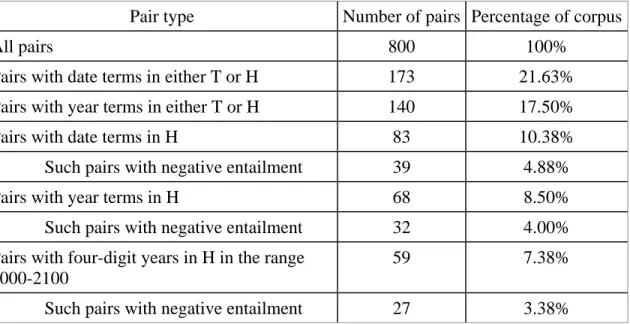
A manual inspection of RTE1T (see Table 8) reveals that 173 pairs contain explicit
references to days of the month, months, years, decades, or centuries. Of these pairs, 140
(80.9%) refer to a year. Of the 173 pairs, 68 (39.3%) include a year in the hypothesis,
comprising 8.5% of RTE1T. Of the 68 pairs with years in the hypothesis, 32 (47.1%)
have negative entailment.
The system’s year-matching pattern correctly identified 198 years and incorrectly
identified 7 nonyear tokens as a year, for a precision of 198/205 (96.6%). It failed to
identify 2 years that fell outside of the pattern’s search range (both references to “AD
The system precluded entailment for 11 pairs, doing so correctly for 9 pairs (81.8%). The
9 correct pairs represent 1.1% of the corpus. In 2 pairs, nonyear strings were identified as
years, although the system correctly precluded entailment. The system’s performance is
summarized in Table 9.
The system precluded entailment for 11 pairs, doing so correctly for 9 pairs (81.8%). The
9 correct pairs represent 1.1% of the corpus. In 2 pairs, nonyear strings were identified as
years, although the system correctly precluded entailment. The system’s performance is
summarized in Table 9.
Table 9: Pairs in RTE1 test set with date terms
Date terms are terms or phrases that represent a numbered day of the month, a month, a year, or span of years. Year terms are terms that represent a year or a span of years.
Pair type Number of pairs Percentage of corpus
All pairs 800 100%
Pairs with date terms in either T or H 173 21.63%
Pairs with year terms in either T or H 140 17.50%
Pairs with date terms in H 83 10.38%
Such pairs with negative entailment 39 4.88%
Pairs with year terms in H 68 8.50%
Such pairs with negative entailment 32 4.00%
Pairs with four-digit years in H in the range 1000-2100
59 7.38%
Such pairs with negative entailment 27 3.38%
Table 8: Confusion matrix for system results on RTE1T
Pairs included in table are those with years in the range 1000-2100 in the hypothesis.
This system
Actual entailment No prediction
Entailment
precluded Totals
YES 31 2 33 NO 20 7 27
Totals 51 9 60
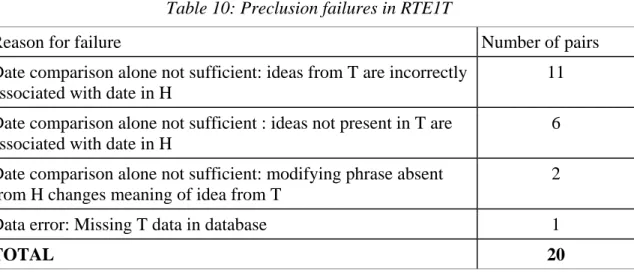
The system missed precluding entailment for 20 pairs with a year in the hypothesis (see
). In 2 cases, date comparison alone was not sufficient because a key word or
phrase from T was removed in H. For example:
The system missed precluding entailment for 20 pairs with a year in the hypothesis (see
). In 2 cases, date comparison alone was not sufficient because a key word or
phrase from T was removed in H. For example: Table 10
Table 10: Preclusion failures in RTE1T
Reason for failure Number of pairs
Date comparison alone not sufficient: ideas from T are incorrectly associated with date in H
11
Date comparison alone not sufficient : ideas not present in T are associated with date in H
6
Date comparison alone not sufficient: modifying phrase absent from H changes meaning of idea from T
2
Data error: Missing T data in database 1
TOTAL 20
RTE1 Test Set pair 2082:
T: Microsoft was established in Italy in 1985. H: Microsoft was established in 1985.
Here, the dates in T and H match, but the omission of the phrase “in Italy” from H alters
the meaning of the sentence, and entailment does not hold.
Entailment was not precluded for one pair because the pair’s T data was omitted from the
database. In two pairs, no entailment decision was made because the system does not
decipher decade statements.
The system produced false negatives in 2 pairs:
RTE1 Test Set pair 1214
T: It is planned that by the end of the year 2001, France will have minted 7.6 billion Euro coins weighing 30 thousand tons or approximately four times the equivalent weight of the Eiffel Tower.
H: According to plans, France should have minted 7.6 billion Euro coins before 2002.
RTE1 Test Set pair 1877
T: The English team arrived last night in Lisbon, Portugal, to play its first Euro 2004’s match.
H: Euro 2004 is held in Portugal.
In pair 1214, the date range indicated by the hypothesis, “before 2002,” can include any
equal to the range implied by the text’s “by the end of the year 2001.” The system does
not interpret the modifiers “by the end of” and “before,” and identifies the time spans for
the text and hypothesis as 1/1/2001-12/31/2001 and 1/1/2002-12/31/2002 respectively. In
pair 1877, the date in the text is not recognized because the system only identifies year
terms that are exactly four characters long.
equal to the range implied by the text’s “by the end of the year 2001.” The system does
not interpret the modifiers “by the end of” and “before,” and identifies the time spans for
the text and hypothesis as 1/1/2001-12/31/2001 and 1/1/2002-12/31/2002 respectively. In
pair 1877, the date in the text is not recognized because the system only identifies year
terms that are exactly four characters long.
3.3
RTE3 Test
3.3
RTE3 Test
A manual inspection of RTE3T (see Table 11) reveals that 239 pairs contain explicit
references to days of the month, months, years, decades, or centuries. 223 of these pairs
(93.3%) refer to a year, of which 66 (29.6%) of the 223 pairs include a year in the
hypothesis, comprising 8.25% of RTE3T. Of the 67 pairs with date terms in the
hypothesis, 27 (40.3%) have negative entailment.
A manual inspection of RTE3T (see Table 11) reveals that 239 pairs contain explicit
references to days of the month, months, years, decades, or centuries. 223 of these pairs
(93.3%) refer to a year, of which 66 (29.6%) of the 223 pairs include a year in the
hypothesis, comprising 8.25% of RTE3T. Of the 67 pairs with date terms in the
hypothesis, 27 (40.3%) have negative entailment.
Table 11: Pairs in RTE3 with date terms
Date terms are terms or phrases that represent a numbered day of the month, a month, a year, or span of years. Year terms are terms that represent a year or a span of years.
Pair type Number of pairs Percentage of corpus
All pairs 800 100%
Pairs with date terms in either T or H 239 29.88%
Pairs with year terms in either T or H 223 27.88%
Pairs with date terms in H 67 8.38%
Such pairs with negative entailment 27 3.38%
Pairs with year terms in H 66 8.25%
Such pairs with negative entailment 27 3.38%
Pairs with four-digit years in H in the range 1000-2100
63 7.88%
Table 12: Confusion matrix for system results on RTE3T Table 12: Confusion matrix for system results on RTE3T
Pairs included in table are those with years in the range 1000-2100 in the hypothesis. Pairs included in table are those with years in the range 1000-2100 in the hypothesis.
This system This system
Entailment precluded
Actual entailment No prediction Totals
YES 27 3 30 NO 24 9 33 Totals 51 12 63
The system’s year-matching pattern correctly identified 336 years and incorrectly
identified 1 nonyear token as a year, for a precision of 336/337 (99.7%). It failed to
identify 3 years that fell outside of the pattern’s search range (all with three digits), for a
recall of 336/339 (99.1%).
The system’s year-matching pattern correctly identified 336 years and incorrectly
identified 1 nonyear token as a year, for a precision of 336/337 (99.7%). It failed to
identify 3 years that fell outside of the pattern’s search range (all with three digits), for a
recall of 336/339 (99.1%).
The system precluded entailment for 12 pairs, doing so correctly for 9 pairs (75%). The 9
correct pairs represent 1.13% of the corpus. Of these pairs, 7 were in the QA problem
class, 1 in the SUM class, and 1 in the IR class. The system’s performance is summarized
in Table 12.
The system precluded entailment for 12 pairs, doing so correctly for 9 pairs (75%). The 9
correct pairs represent 1.13% of the corpus. Of these pairs, 7 were in the QA problem
class, 1 in the SUM class, and 1 in the IR class. The system’s performance is summarized
in Table 12.
The system missed precluding entailment for 17 pairs with dates in the range 1000 to
2100, summarized in Table 13. In one pair, the system was not able to identify a pair of
years as a date range. The system finds year pairs in the formats “from XXXX to
YYYY,” “of XXXX to YYYY,” and “between XXXX and YYYY.” In RTE3 test set
pair 747, the date range in the text was expressed, “began in 1982 and continued through
1994,” and was not identified as a range. In two pairs, the event stated in H matched an
event in T, but in the hypothesis the antonym of the original verb was provided. In 2
cases, the system did not draw a conclusion on entailment because its reasoning neither
precluded entailment nor ruled out preclusion.
The system missed precluding entailment for 17 pairs with dates in the range 1000 to
2100, summarized in Table 13. In one pair, the system was not able to identify a pair of
years as a date range. The system finds year pairs in the formats “from XXXX to
YYYY,” “of XXXX to YYYY,” and “between XXXX and YYYY.” In RTE3 test set
pair 747, the date range in the text was expressed, “began in 1982 and continued through
1994,” and was not identified as a range. In two pairs, the event stated in H matched an
event in T, but in the hypothesis the antonym of the original verb was provided. In 2
cases, the system did not draw a conclusion on entailment because its reasoning neither
Table 13: Preclusion failures in RTE3T
Reason for failure Number of pairs
Date comparison alone not sufficient: ideas from T are incorrectly associated with date in H
5
Date comparison alone not sufficient : ideas not present in T are associated with date in H
6
Date comparison alone not sufficient: Modifying phrase present in H changes meaning of idea from T
1
Date comparison alone not sufficient: Verb in H antonymous to verb in T
2
Incomplete reasoning: No rejection criteria defined for combination of date types in T and H
2
Incomplete reasoning: Date range in T expressed in a manner not recognized by date extraction algorithm
1
TOTAL 17
The system produced false negatives in 3 pairs:
RTE3 Test Set pair 486
T: Charles de Gaulle, 1890–1970, French general and statesman, was the first president (1959–69) of the Fifth Republic. H: Charles de Gaulle died in 1970.
RTE3 Test Set pair 503
T: The reigns of Victor Emmanuel II (1861–78) and Humbert I (1878–1900), and the first half of the reign of Victor Emmanuel III (1900–1946) were marked by moderate social and political reforms and by some industrial expansion in
Northern Italy (mainly in the 20th cent.).
H: Victor Emmanuel III was king of Italy from 1900 to 1946.
RTE3 Test Set pair 615
T: The world’s population is set to reach a staggering 10bn by the middle of 21st century up from 5.7bn now.
H: The world population will probably reach over 10 billion in 2050.
In pairs 486 and 503, the system did not interpret hyphenated date ranges. In pair 615, the
system did not provide a year value for “the 21st century”, and would have been unable
Table 14: Confusion matrix for system results on the combined corpus
This system
Entailment precluded
Actual entailment No prediction Totals
YES 116 7 123
NO 50 33 83
Totals 166 40 206
3.4
Discussion
On the combined (RTE3D + RTE1T + RTE3T) corpus, the system identified 887 terms
as years, of which 872 were identified correctly (98.3% precision). There were 885 years
in the corpus (not counting decades, hyphenated year ranges, or centuries) (98.5% recall).
Across the combined corpus, dates with years appear in 540 pairs.
The system precluded entailment for 42 pairs in the combined corpus, and entailment did
not hold for 35 of those pairs (83.3%). See for a summary of the system’s
performance. It was unable to preclude entailment for 50 pairs with years in the range
1000-2100 in the hypothesis; the causes of preclusion failure are summarized in Table 15,
can be grouped into two categories: cases of data loading errors or incomplete date
comparison reasoning (7 pairs), and pairs where date comparisons alone were not
sufficient to preclude entailment (44 pairs).
Table 14
Table 15: Causes of preclusion failure in combined corpus
Reason for failure Number of cases Percentage of failures
Percentage of pairs with entailment=no
and years in 1000-2100
Date comparison alone not sufficient 44 88.0% 53.0%
3.5
Future work
Across the three data sets (2400 pairs total, 83 pairs with years in the range 1000-2100 in
the hypothesis), the system failed to preclude entailment for 50 pairs. For 4 pairs, the
system did not predict false entailment because it did not compare the dates in those
pairs. These cases can be corrected by providing additional date comparison steps. In 1
pair, a data loading error prevented the system from precluding entailment. In 1 pair, a
date range was expressed in a fashion not recognized by the system. In the 44 remaining
missed pairs, entailment was not precluded because date comparison alone was not
sufficient to do so; entailment preclusion is unattainable for these pairs without
expanding the scope of the system beyond date comparison.
For three pairs, the system produced false negatives because it did not interpret
hyphenated dates. Additional date extraction steps can improve performance on these
pairs. For six pairs containing decade statements, no prediction on entailment was
reached. Interpretation of prepositions and prepositional phrases modifying temporal
statements, present in three false negatives, and interpretation of century statements,
present in one false negative, would have further improved performance. The system has
been designed for the RTE challenges and may need modification to achieve maximum
effectiveness in another context.
In light of the error analysis provided above, we make two suggestions. First, extend the
current system to include decade and century handling, deciphering of hyphenated date
ranges, handling dates that do not include year, and the interpretation of temporal
prepositional phrases and other temporal modifiers. This will provide an increase in
framework. Second and more significantly, expand this system to identify events and to
associate events with their dates of occurrence. Such a system may be able to preclude
entailment on the 44 pairs outlined above where date comparison alone is not sufficient to
preclude entailment. Such a system may also be able to provide support for positive
entailment pairs with temporal information.
3.6
Summary of results
In RTE3D, the system identified 345 strings as years and did so correctly 338 times, for a
identification accuracy of 98.0%. There were 346 years in the data set, for a
year-identification recall of 97.7%. The system was 89.5% accurate in precluding entailment,
predicting correctly in 17 of the 19 pairs for which it made a prediction. The system
correctly precluded entailment for 2.1% of the 800 pairs in RTE3D.
In RTE1T, the system identified 205 strings as years and was correct 198 times, for a
identification accuracy of 96.6%. There were 200 years in the data set, for a
year-identification recall of 99.0%. The system precluded entailment in 11 pairs, doing so
correctly in 9, for an accuracy of 81.8%. The system correctly precluded entailment for
1.1% of 800 pairs.
In RTE3T, the system identified 337 strings as years and was correct 336 times, for a
identification accuracy of 99.7%. There were 339 years in the data set, for a
year-identification recall of 99.1%. The system correctly precluded entailment in 9 out of the
12 pairs for which it made a prediction (75% accuracy). The system made the correct
In aggregate (considering RTE3D, RTE1T, and RTE3T as a combined corpus), the
system identified 887 strings as years and was correct 872 times, for an accuracy of
98.3%. There were 885 years in the combined corpus, for a recall of 98.5%. The system
was correct in precluding entailment in 35 out of the 41 pairs for which it made a
prediction (85.3% accuracy). The system correctly precluded entailment for 1.5% of 2400
pairs.
To examine to what extent this system improves an existing system, we compared the
performance of a baseline system (Blake, 2007) on RTE3D and RTE3T to the
performance it would have achieved with the addition of our method. The baseline
system predicts positive entailment by using a decision tree to compare grammatical
features in the H and T sentences. It identifies cases where the subject, verb, and object of
H sentences match those in T sentences, and predicts positive entailment for those pairs.
Table 16: Performance of baseline system alone, and with date-based preclusion method
Only pairs with years in the hypothesis in the range 1000-2100 are considered.
RTE3D Baseline alone
RTE3D
Baseline with preclusion method
Predicted Predicted
Actual YES NO Totals Actual YES NO Totals
YES 21 21 42 YES 20 22 42
NO 18 12 30 NO 8 22 30
Totals 39 33 72 Totals 28 44 72
RTE3T Baseline alone
RTE3T
Baseline with preclusion method
Predicted Predicted
Actual YES NO Totals Actual YES NO Totals
YES 28 9 37 YES 28 9 37
NO 11 15 26 NO 10 16 26
Among sentences with years in the range 1000 to 2100 in the hypothesis, the baseline
system had an accuracy of 33/72 (45.8%) in RTE3D and 43/63 (68.3%) in RTE3T. When
combined with our method, the scores for the system improved to 42/72 (58.3%) for
RTE3D and 44/63 (69.8%) in RTE3T (see Table 16). For the full 800-pair sets, inclusion
of our method improved accuracy from 399/800 (49.9%) to 408/800 (51.0%) in RTE3D,
4
Conclusion
We have presented a system that precludes entailment by identifying dates in the
hypothesis that do not correspond to dates in the text. The system requires that sentences
be Stanford-parsed, with tokens normalized. The system operates independently of other
efforts to resolve entailment, and we envision that it would be part of a larger entailment
resolution system.
Our method first identifies and extract dates from natural language text, then precludes
entailment by comparing the dates in the text and hypothesis sentences.
We proposed a precedence for extracting dates that limits the chance that components of
a date (such as months, days, or portions of a date range) will be overlooked (see Table
3). We introduced four relationships between two dates: equality, overlap, disjunction,
and superset/subset; and a method that considers both the relationship between dates and
the type of date (exact or range) to preclude entailment (see section 2.4). Finally, we have
conducted an extensive failure analysis of our system on three data sets from the RTE
Challenges. This analysis suggests that, although temporal features alone improve
entailment accuracy, the combination of entailment features and event recognition is
ultimately required to accurately predict entailment for pairs with temporal information.
Scores in the RTE challenges are closely clustered: fewer than seven percentage points
separate the accuracy scores of the third-best performing system and the thirteenth-best in
entailment for between 1.1% and 2.1% of each test set it processed. Our method can
contribute to a larger entailment system by precluding entailment on these pairs or
providing support to predictions made by other components. To better understand our
method’s contribution, we propose that designers integrate our method into such an
entailment system along with other components, and carefully evaluate the contributions
of each component.
Temporal information is an important area for research in entailment and in other text
applications. Our work adds to the available knowledge on temporal features by
providing a means to identify dates and by exploring the roles that they play in
entailment. There is much research to be done in this area, and we encourage researchers
to explore temporal features further, both within and beyond the realm of textual
5
Acknowledgments
Thanks to Cathy Blake for advising this paper, for dedicating time and effort to helping
me produce a well-designed system and report, for providing material assistance by way
of database space and preprocessing, for getting me interested in text mining (and
teaching me pretty much everything I know), and for never allowing me to be satisfied
with the merely adequate.
Thanks to the faculty and staff of UNC-SILS for making this educational experience a
possibility and a success.
Thanks to Amol Bapat for being sporting in dealing with my data nightmares.
Thanks to Mom and Dad for being Mom and Dad, and for encouraging me to learn at
6
Appendix: PL/SQL script
In the code below, references are made to the following tables. A brief description of
each table’s schema is provided:
dre_months(monthterm, monthnum, mtype, numdays)
This table holds the names, numbers, and number of days in each month. monthterm
holds the token that represents the month name. monthnum contains the number of the
month (e.g., October = 10). mtype is “full” if the month term is the full name of the
month or “abbr” if it is an abbreviation. numdays is the number of days in each month.
February is assumed to always have 28 days.
dre_numbers(numterm, numval)
This table holds the tokens that represent numbers that are valid day values for a month,
from 1 through 31. numterm is the token that represents the number—either cardinal or
ordinal—and numval is the corresponding numerical value.
dre_numranges(numrange, numval1, numval2)
This table contains all the possible number range values that could represent valid date
ranges within a month (e.g., “1st-15th,” “10-12”). numrange is the token representing
the number range, numval1 is the value of the starting number in the token, and
dre_monthranges(monthrange, mtype, monthnum1, monthnum2, month2days)
This table contains all the possible month ranges that could exist within a year.
monthrange contains the month range tokens (e.g., “January-April”), mtype is “full” or
“abbr” depending on whether the month terms composing the month range token are full
names or abbreviated, monthnum1 and monthnum2 are the number of the two months,
and month2days is the number of days in the ending month.
rte3dtext(pairid, usentid, source, sentid, text)
This table contains the text of the data set to be analyzed, named thus because the
example code provided is for the RTE3 development data set. Each row of the table
contains one sentence from the corpus. pairid is the unique pair id provided in the corpus
for the entailment pair, usentid is a unique number provided to each sentence in the table,
and source is ‘E’ if the sentence is from the text and ‘H’ if the sentence is from the
hypothesis. sentid indicates the ordering of sentences, starting from zero, for each
sentence with the same (pairid, source), and text is the text of the sentence.
rte3d_nwd(usentid, termid, term)
This table contains the normalized words for each word in the corpus. usentid is the
unique sentence ID (from rte3dtext) of the sentence containing the listed word. termid is
the position of the word in the sentence, starting with 1. term is the word token itself,
extracted from the text of the sentence.