1
Abstract
2
Figure 1. (B) Wild type neurons expressing Actin. (C) AMPKα mutant showing enlarged plasma membrane domains in neuronal dendrites. (D) Wild-type AMPKα transgene autonomously within neurons completely rescues the dendrite phenotype (from Swick et al,. 2013).
Introduction
AMP-activated protein kinase (AMPK) plays an important role in regulating metabolism and maintaining homeostasis at cellular as well as whole-body levels. The enzyme is expressed ubiquitously throughout an organism’s body and is found in tissues of the liver, brain, skeletal muscle, and more. It mainly functions by sensing fluctuations in the energy-transfer compounds ATP and AMP and coordinating numerous catabolic and anabolic processes including glucose uptake and fatty acid metabolism (Mihaylova and Shaw, 2011). As a result, AMPK is an essential gene and is especially important for organisms when experiencing stress such as hypoglycemia or hypoxia (Hardie et al., 2006; Shaw, 2006).
Recent studies using Drosophila melanogaster have suggested that AMPK metabolic pathways may also be related to the development of neurodegenerative traits. AMPK levels and localization in neuronal structures have
been shown to correlate with the development of diseases such as Alzheimer’s disease and Huntington’s
disease (Salminen et al., 2011; Ju et al., 2014). Additionally, Swick et al. found
that certain fly strains containing mutants for AMPK also experience blebbing, or swelling, in neuronal dendrites; this blebbing is reflective of cell death (Figure 1 from Swick et al., 2013). Although the knockout of AMPK is normally lethal, other studies by Oyenwoke et al.
demonstrate that crosses between these knockout flies and other strains with mutations in the
3
(Oyenwoke et al., 2015). As a result, this research suggeststhat AMPK signaling may be linked to genes that contribute to the development of neurons and affect traits linked to
neurodegeneration.
Our project sought to build upon these recent findings. The goal of our experiment was to identify whether genes linked to neurodegeneration are also associated with the metabolic
pathways of AMPK. We hypothesized that certain lines of Drosophila with neurodegenerative mutations would be capable of rescue when AMPK was knocked down, or when its expression was suppressed. The detection of such genes may help reveal potential targets for the treatment of neurodegenerative diseases through AMPK signaling.
Methods
The Gal4-UAS system
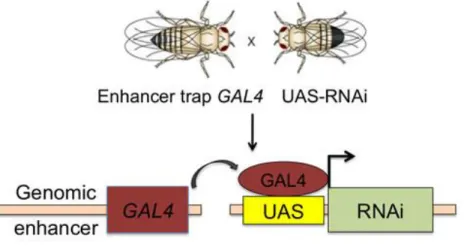
In order to test our hypothesis, we used Drosophila to conduct genetic screens that implemented the Gal-UAS system. This system is commonly applied in biological studies to analyze the expression and interactions of genes. Gal4 is a transcription activator which binds to the promoter sequence UAS. This binding initiates the transcription of the gene following UAS. For our project, we used UAS-AMPK-RNAi for AMPK knockdown. When a fly strain
4
Figure 2. The Gal4-UAS system (fromRodan, 2015).
To test mutations of genes related to neurodegeneration, we crossed Gal4 strains with mutant strains, and we then crossed progeny containing both the Gal4 and the focal
neurodegenerative mutation with UAS-AMPK-RNAi strains. If we found progeny from the final cross that had both the mutation and AMPK knockdown, this discovery would indicate that the mutant gene compensated for suppressed AMPK activity.
Screening procedure
Our genetic screens required that we identify male and virgin female flies, allow them to mate, and score progeny for the applicable visible markers. Virgin females were collected in the mornings and evenings from fly bottles with pupae that were on the verge of enclosing, and these bottles were placed overnight in an incubator set at 18°C to slow the flies’ growth. Males were
obtained from fly vials. Flieswere collected by first injecting carbon dioxide gas into the
5
Additionally, all fly strains involved in the experiment were continuously transferred into new containers in order to maintain the strains.
Control and experimental crosses
The mutations that we studied were on either the flies’second or the third chromosome. In order to make sure that progeny from the first cross had both the mutation and Gal4, we crossed the mutant strains with fly strains that had Gal4 on a different chromosome. Second-chromosome mutants were crossed with a fly strain whose Gal4 expression was driven by a tubulin promoter (Tub-Gal4) because our Tub-Gal4 is on the third chromosome, and third-chromosome mutants were crossed with a fly strain whose Gal4 expression was driven by an actin promoter (Act-Gal4) because our Act-Gal4 is on the second chromosome. Both of these Gal4 strains are expressed ubiquitously, ensuring that AMPK is knocked down in all tissues by the Gal4-UAS system (Johnson, 2010).
We first conducted test crosses in order to ensure that the Gal4-UAS system functioned properly. Positive control crosses were set up using UAS-AMPK-RNAi flies and flies with either Tub-Gal4 or Act-Gal4. Since the Gal4-UAS system would have been implemented, we expected that progeny with Gal4 would not be viable. Additionally, we used negative control crosses between UAS-GFP flies and either Tub-Gal4 or Act-Gal4 flies in order to rule out the possibility of contamination or abnormalities in Gal4. Since RNAi was not present in the negative control crosses, we expected that all progeny, including those with Gal4, would remain viable. Examples of the test crosses using Tub-Gal4 are diagramed in Supplementary Figures 1 and 2.
6
Progeny that had both Gal4 and the mutation were then crossed with UAS-AMPK-RNAi flies. We expected that final progeny that did not have Gal4 would survive and those with both Gal4 and UAS-AMPK-RNAi would not survive. If progeny with Gal4 and UAS-AMPK-RNAi as well as the mutation were identified, our results would imply that the mutation interacted with AMPK pathways; such progeny were noted as “rescues.” Examples of the experimental crosses using Tub-Gal4 are diagrammed in Supplementary Figure 3.
The mutant fly strains that we studied are listed in Table 1. All flies were obtained from the Bloomington Drosophila Stock Center.
Strain Identification Number Gene With Mutation
32457 LRRK
39019 LRRK
34750 LRRK
38262 PINK1
41671 PINK1
31170 PINK1
31262 PINK1
38262 PINK1
34747 PARK
37509 PARK
38333 PARK
17690 tau
28891 tau
48075 tau
39698 NMNAT
24887 NMNAT
29402 NMNAT
8297 PSN
8299 PSN
38374 PSN
10615 Par-1
32410 Par-1
35342 Par-1
7
Results
Tables 2 and 3 list the results from the test crosses and experimental crosses, respectively. The results were obtained from scoring the final progeny of each cross and interpreting their phenotypes.
The results from the test crosses met expectations.When Tub-Gal4 flies or Act-Gal4 flies were crossed with UAS-AMPK-RNAi, progeny that had both Gal4 and UAS-AMPK-RNAi were not viable. Additionally, all possible progeny from the crosses with the Gal4 flies and UAS-GFP were viable. Therefore, we established that the Gal4-UAS system was functioning properly.
Type of Control Cross Results
Positive Tub-Gal4 x UAS-AMPK-RNAi
Progeny with both Tub-Gal4 and UAS-AMPK-RNAi were not viable
Positive Act-Gal4 x UAS-AMPK-RNAi
Progeny with both Act-Gal4 and UAS-AMPK-RNAi were not viable
Negative Tub-Gal4 x UAS-GFP All progeny were viable Negative Act-Gal4 x UAS-GFP All progeny were viable
8
Strain Identification
Number
Gene With Mutation
Total Number of Progeny
Number of Progeny with
Rescue
Percent Rescue
32457 LRRK 182 0 0%
39019 LRRK 159 0 0%
34750 LRRK 203 0 0%
38262 PINK1 147 0 0%
41671 PINK1 241 0 0%
31170 PINK1 194 0 0%
31262 PINK1 216 0 0%
38262 PINK1 170 0 0%
34747 PARK 163 0 0%
37509 PARK 208 0 0%
38333 PARK 186 0 0%
17690 tau 142 0 0%
28891 tau 191 0 0%
48075 tau 219 0 0%
39698 NMNAT 217 13 6%
24887 NMNAT 169 7 4%
29402 NMNAT 178 0 0%
8297 PSN 155 0 0%
8299 PSN 209 0 0%
38374 PSN 201 0 0%
10615 Par-1 174 0 0%
32410 Par-1 193 0 0%
35342 Par-1 210 0 0%
Table 3. Results from experimental crosses. Strains that resulted in rescue are highlighted.
Discussion
Of the 23 fly strains that we tested for the experimental crosses, 2 strains (39698 and 24887) showed rescue because they resulted in viable progeny that had both the mutation and AMPK knockdown. Both of these strains had mutations in the NMNAT gene, so our results indicated that the NMNAT gene may interact with AMPK pathways. NMNAT has been
9
As a result, our findings suggested a possible linkage between this neurodegenerative gene and the metabolic mechanisms of AMPK. NMNAT now serves as a solid candidate for further characterization in more definitive assays, such as testing for direct protein interactions.
It should be noted that although the other fly strains we analyzed did not show rescue, our results do not rule out the possibility that some of these genes may also interact with AMPK. It is possible that the strains we used were not compatible with our Gal4-UAS screening protocol or that we did not find rescue by chance. We will continue our screening process using different fly strains and with repeat testing to thoroughly examine these and other genes related to
neurodegeneration.
10
References
Boissan, M., Dabernat, S., Peuchant, E., Schlattner, U., Lascu, I., Lacombe, M. (2009). The mammalian NM23/NDPK family: from metastasis control to cilia movement. Mol Cell Biochem 329, 51-62.
Duffy, J. (2002). Gal4 System in Drosophila: A Fly Geneticist’s Swiss Army Knife.
dos Santos, G., Schroeder, A., Goodman, J., Strelets, V., Crosby, M., Thurmond, J., Emmert, D., Gelbart, W. (2015). Gene Dmel\Nmnat. The FlyBase Consortium.
Engel, M., Veron, M.., Theisinger, B., Lacombe, M., Seib, T. Dooley, S., Welter, C. (1995). A novel serine/threonine-specific protein phosphotransferase activity of Nm23/nucleoside-diphosphate kinase. Eur J Biochem 234, 200-207.
Hardue, D., Hawley, S., Scott, J. (2006). AMP-activated protein kinase development of the energy sensor concept. J physiol 574, 7-15.
Johnson, E., Kazgan, N., Bretz, C., Forsberg L. Hector, C., Worthen, R. Onyenwoke, R., Brenman, J. (2010). Altered metabolism and persistent starvation behaviors caused by reduced AMPK function in Drosophila. PLoS One 5, piiel2799.
Ju, T., Chen, H., Chen, Y., Chang, C.P., Chang, C., Chern, Y. (2014). AMPK-α1 functions downstream of oxidative stress to mediate neuronal atrophy in Huntington's disease.
Biochim Biophys Acta. 1842(9), 1668-80.
11
Meley, D., Bauvy, C., Hauben-Weerts, J., Dubbelhuis, P., Helmond, M., Codogno, P., Meijer, A. (2006). AMP-activated protein kinase and the regulation of autophagic proteolysis.
Journalism of Biological Chemistry 281, 34870-34879.
Mihaylova, M. and Shaw, R. (2011). The AMP-activated protein kinase (AMPK) signaling pathway coordinates cell growth, autophagy, & metabolism. Nat Cell Bio 13(9), 1016-1023.
Onyenwoke, R., Forsberg, L., Liu, L., Williams, T., Alzate O., Brenman, J.(2012). AMPK directly inhibits NDPK through a phosphoserine switch to maintain cellular homeostasis.
Molecular Biology of the Cell, 23, 381-389.
Oyenwoke, R., Sexton, J., Yan, F., Díaz, M., Forsberg, L., Major, M., Brenman, J. (2015). The mucolipidosis IV Ca2+ channel TRPML1 (MCOLN1) is regulated by the TOR kinase.
Biochem J 470(3), 331-42.
Prüßing, K., Voigt, A., Schulz, J. (2013). Drosophila melanogaster as a model organism for Alzheimer’s disease. Molecular Neurodegeneration, 8.
Rodan, A. (2015). Rodan Lab Research. UT Southwestern Medical Center. http://www.utsouthwestern.edu/labs/rodan/research/.
Salminen, A., Kaarniranta K., Haapasalo, A., Soininen, H., Hiltunen, M. (2011). AMP-activated protein kinase: a potential player in Alzheimer’s disease. J. Neurochem. 118(4), 460-74.
Samari, H., Møller, M., Holden, L., Asmyhr, T., Seglen, P. (2005). Stimulation of hepatocytic AMP-activated protein kinase by okadaic acid and other autophagy-suppressive toxins.
12
Swick, L., Kazgan, N., Onyenwoke, R., Brenman, J. (2013). Isolation of AMP-activated protein kinase (AMPK) alleles required for neuronal maintenance in Drosophilamelanogaster.
Biology Open 2, 1321-1323.
Venkatachalam, K., Long, A., Elsaesser, R., Nikolaeya, D., Broadie, K., Montell, C. (2008). Motor deficit in a Drosophila model of Mucolipidosis Type IV due to defective clearance of apoptotic cells, Cell, 135, 838-851.
Williams, T., Brenman, J. (2008). LKB1 and AMPK in cell polarity and division. Trends Cell Biol, 18, 193-198.
13
SUPPLEMENTARY INFORMATION
Figure 1. Positive control cross with Tub-Gal4 flies
𝑦−𝑤− 𝑦−𝑤−;
+ +;
𝑇𝑢𝑏−𝐺𝑎𝑙4
𝑇𝑀3,𝑆𝑏 ( ) x 𝑦−𝑤−
𝑦− ;
𝐾𝑟 𝐶𝑦𝑂;
𝐴𝑀𝑃𝐾𝛼−𝑅𝑁𝐴𝑖 𝐴𝑀𝑃𝐾𝛼−𝑅𝑁𝐴𝑖 ( ) (1st chromosome) 𝒚−𝒘− 𝒚−𝒘−
𝒚−𝒘− 𝑦−𝑤−
𝑦−𝑤−
𝑦−𝑤− 𝑦−𝑤−
𝒚− 𝑦−𝑤−
𝑦−
𝑦−𝑤− 𝑦−
(2nd chromosome) + +
𝑲𝒓 𝐾𝑟 + 𝐾𝑟 + 𝑪𝒚𝑶 𝐶𝑦𝑂 + 𝐶𝑦𝑜 +
(3rd chromosome) 𝑻𝒖𝒃 − 𝑮𝒂𝒍𝟒 𝑻𝑴𝟑, 𝑺𝒃
𝑨𝑴𝑷𝑲𝜶 − 𝑹𝑵𝑨𝒊 𝑇𝑢𝑏−𝐺𝑎𝑙4
𝐴𝑀𝑃𝐾𝛼−𝑅𝑁𝐴𝑖
𝑇𝑀3,𝑆𝑏 𝐴𝑀𝑃𝐾𝛼−𝑅𝑁𝐴𝑖
𝑨𝑴𝑷𝑲𝜶 − 𝑹𝑵𝑨𝒊 𝑇𝑢𝑏−𝐺𝑎𝑙4
𝐴𝑀𝑃𝐾𝛼−𝑅𝑁𝐴𝑖
𝑇𝑀3,𝑆𝑏 𝐴𝑀𝑃𝐾𝛼−𝑅𝑁𝐴𝑖
𝑦−𝑤− (𝑦−𝑜𝑟 𝑦−𝑤−);
(𝐾𝑟 𝑜𝑟 𝐶𝑦𝑂)
+ ;
𝑇𝑢𝑏−𝐺𝑎𝑙4 𝐴𝑀𝑃𝐾𝛼−𝑅𝑁𝐴𝑖
These progeny are not expected to survive because the Gal4-UAS system will activate RNAi expression,
inhibiting AMPK
𝑦−𝑤− (𝑦−𝑜𝑟 𝑦−𝑤−);
(𝐾𝑟 𝑜𝑟 𝐶𝑦𝑂)
+ ;
𝑇𝑀3,𝑆𝑏 𝐴𝑀𝑃𝐾𝛼−𝑅𝑁𝐴𝑖
These progeny are expected to survive because Gal4 is not present so RNAi will not be expressed. Sb codes
14
Figure 2. Negative control cross with Tub-Gal4 flies
𝑦−𝑤−
𝑦−𝑤−;
+ +;
𝑇𝑢𝑏−𝐺𝑎𝑙4
𝑇𝑀3,𝑆𝑏 ( ) x 𝑦−𝑤−
𝑦− ;
𝑈𝐴𝑆−𝐺𝐹𝑃 𝑈𝐴𝑆−𝐺𝐹𝑃;
+ + ( ) (1st chromosome) 𝒚−𝒘− 𝒚−𝒘−
𝒚−𝒘− 𝑦−𝑤−
𝑦−𝑤−
𝑦−𝑤−
𝑦−𝑤−
𝒚− 𝑦−𝑤−
𝑦−
𝑦−𝑤−
𝑦−
(2nd chromosome) + +
𝑼𝑨𝑺 − 𝑮𝑭𝑷 𝑈𝐴𝑆−𝐺𝐹𝑃
+
𝑈𝐴𝑆−𝐺𝐹𝑃
+
𝑼𝑨𝑺 − 𝑮𝑭𝑷 𝑈𝐴𝑆−𝐺𝐹𝑃
+
𝑈𝐴𝑆−𝐺𝐹𝑃
+
(3rd chromosome) 𝑻𝒖𝒃 − 𝑮𝒂𝒍𝟒 𝑻𝑴𝟑, 𝑺𝒃
+ 𝑇𝑢𝑏−𝐺𝑎𝑙4 + 𝑇𝑀3,𝑆𝑏 + + 𝑇𝑢𝑏−𝐺𝑎𝑙4 + 𝑇𝑀3,𝑆𝑏 +
𝑦−𝑤− (𝑦−𝑜𝑟 𝑦−𝑤−);
𝑈𝐴𝑆−𝐺𝐹𝑃
+ ;
(𝑇𝑢𝑏−𝐺𝑎𝑙4 𝑜𝑟 𝑇𝑀3,𝑆𝑏)
+ All progeny are expected to survive because GFP is
15
Figure 3A. Experimental cross between mutant (mut) and Tub-Gal4 flies
𝑦−𝑤−
𝑦−𝑤−;
+ +;
𝑇𝑢𝑏−𝐺𝑎𝑙4
𝑇𝑀3,𝑆𝑏 ( ) x 𝑦−𝑤−
𝑦− ;
𝑚𝑢𝑡 𝑏𝑎𝑙𝑎𝑛𝑐𝑒𝑟;
+ + ( ) (1st chromosome) 𝒚−𝒘− 𝒚−𝒘− (2nd
chromosome) + +
𝒚−𝒘− 𝑦−𝑤−
𝑦−𝑤−
𝑦−𝑤−
𝑦−𝑤− 𝒎𝒖𝒕
𝑚𝑢𝑡 +
𝑚𝑢𝑡 +
𝒚− 𝑦−𝑤−
𝑦−
𝑦−𝑤−
𝑦− 𝒃𝒂𝒍𝒂𝒏𝒄𝒆𝒓
𝑏𝑎𝑙𝑎𝑛𝑐𝑒𝑟
+
𝑏𝑎𝑙𝑎𝑛𝑐𝑒𝑟
+
(3rd chromosome) 𝑻𝒖𝒃 − 𝑮𝒂𝒍𝟒 𝑻𝑴𝟑, 𝑺𝒃
+ 𝑇𝑢𝑏−𝐺𝑎𝑙4 + 𝑇𝑀3,𝑆𝑏 + + 𝑇𝑢𝑏−𝐺𝑎𝑙4 + 𝑇𝑀3,𝑆𝑏 +
Selected progeny: 𝑦 −𝑤−
𝑦−𝑤−;
𝑚𝑢𝑡 + ;
𝑇𝑢𝑏−𝐺𝑎𝑙4 + ( )
Since these progeny do not have Sb, they will have a non-stubble phenotype and will not show the phenotype of the balancer on the mutation chromosome.
Figure 3B. Experimental cross with UAS-AMPKα-RNAi
𝑦−𝑤−
𝑦−𝑤−;
𝐾𝑟 𝐶𝑦𝑂;
𝐴𝑀𝑃𝐾𝛼−𝑅𝑁𝐴𝑖
𝐴𝑀𝑃𝐾𝛼−𝑅𝑁𝐴𝑖 ( ) x 𝑦−𝑤−
𝑦−𝑤−;
𝑚𝑢𝑡 + ;
𝑇𝑢𝑏−𝐺𝑎𝑙4
+ ( ) (1st chromosome) 𝒚−𝒘− 𝒚−𝒘− (2nd
chromosome) 𝑲𝒓 𝑪𝒚𝑶
𝒚−𝒘− 𝑦−𝑤−
𝑦−𝑤−
𝑦−𝑤−
𝑦−𝑤− 𝒎𝒖𝒕
𝑚𝑢𝑡 𝐾𝑟
𝑚𝑢𝑡 𝐶𝑦𝑂
𝒚− 𝑦−𝑤−
𝑦−
𝑦−𝑤−
𝑦− +
𝐾𝑟 +
𝐶𝑦𝑂 +
(3rd chromosome) 𝑨𝑴𝑷𝑲𝜶 − 𝑹𝑵𝑨𝒊 𝑨𝑴𝑷𝑲𝜶 − 𝑹𝑵𝑨𝒊
𝑻𝒖𝒃 − 𝑮𝒂𝒍𝟒 𝑇𝑢𝑏−𝐺𝑎𝑙4
16
𝑦−𝑤− (𝑦−𝑜𝑟 𝑦−𝑤−);
(𝐾𝑟 𝑜𝑟 𝐶𝑦𝑂)
+ ;
𝐴𝑀𝑃𝐾𝛼−𝑅𝑁𝐴𝑖
+
These progeny are expected to survive because Gal4 is not present so RNAi will not be expressed
𝑦−𝑤− (𝑦−𝑜𝑟 𝑦−𝑤−);
𝑚𝑢𝑡 (𝐾𝑟 𝑜𝑟 𝐶𝑦𝑂);
𝐴𝑀𝑃𝐾𝛼−𝑅𝑁𝐴𝑖
+
𝑦−𝑤− (𝑦−𝑜𝑟 𝑦−𝑤−);
(𝐾𝑟 𝑜𝑟 𝐶𝑦𝑂)
+ ;
𝑇𝑢𝑏−𝐺𝑎𝑙4 𝐴𝑀𝑃𝐾𝛼−𝑅𝑁𝐴𝑖
These progeny are not expected to survive because the Gal4-UAS system will activate RNAi expression,
inhibiting AMPK
𝑦−𝑤− (𝑦−𝑜𝑟 𝑦−𝑤−);
𝑚𝑢𝑡 (𝐾𝑟 𝑜𝑟 𝐶𝑦𝑂);
𝑇𝑢𝑏−𝐺𝑎𝑙4 𝐴𝑀𝑃𝐾𝛼−𝑅𝑁𝐴𝑖
These progeny will not survive unless the mutation rescues the flies; if so, further testing will be conducted on the line to determine if the gene acts on