Heather L. Siekkinen. Factors influencing comic book and graphic novel collecting among private elementary and middle school libraries in North Carolina.A Master’s Paper for the Master of Science in Library Science degree. April 2012. 88 pages.Advisor: Sandra Hughes-Hassell.
This two-part study analyzed school library websites, OPAC holdings, and survey results, using six data collection instruments, to examine various factors influencing and explore variables relating to comic book and graphic novel collecting among private elementary and middle school librarians in North Carolina. Librarians in this study who collect comic books and graphic novels were found to be more likely to display such professional characteristics as being technology and curriculum leaders, having a library website, and reading professional literature of various types. Private elementary and middle school librarians with an MLS degree in North Carolina who collect comic books and graphic novels have richer and larger comic book and graphic novel collections, and use more varied tools to develop them. Most of the schools in the OPAC study are collecting recommended core comic book and graphic novel titles, regardless of religious affiliation or location in the state.
Headings:
Comic books, strips, etc.
Graphic novels -- selection
School libraries – Collection development
School libraries – Independent schools
School libraries – North Carolina
by
Heather L. Siekkinen
A Master’s paper submitted to the faculty of the School of Information and Library Science of the University of North Carolina at Chapel Hill
in partial fulfillment of the requirements for the degree of Master of Science in
LibraryScience.
Chapel Hill, North Carolina
April 2012
Approved by
_______________________________________
Acknowledgments
First, I would like to thank my librarian mentor, Malin Lauschus, who believed in me when I didn’t know if I could take on the awe-inspiring challenge of being a school library media specialist. Thank you, Malin, for seeing the librarian inside me, and for teaching me. The world is very fortunate that you decided to become a librarian.
Much gratitude goes to Dr. Sandra Hughes-Hassell, for her inspiring professionalism, deep expertise, compassion and respect for students, and sense of humor. Dr. Hughes-Hassell has provided me with a wonderful vision of how school libraries can help students, teachers, and librarians transcend the mediocre and frustrating to make something uniquely powerful and beautiful. She has taken my librarianship to new heights, and creates the best school librarians on the planet. She is one of the most gifted, dedicated, and knowledgeable teachers I have ever had the privilege to learn from, and I am humbly grateful to be her student.
I would also like to thank Dr. Joanne Gard Marshall, who gave me a deeper
understanding of research and taught me the joys of rigorous methods, exciting study design, and elegant sampling.
I am so grateful to my friends and family for their help and support, the times they listened and sympathized, and their inspiring words to help me persevere.
Kudos go to the awesome comic book artists and authors who make such incredible art. Thank you to Scott McCloud for his meta comics and brainy cognitive discourses; thank you to Greg Rucka and George Perez for making me such a fan and giving Wonder Woman back to me; thank you to Andy Runton and all the comic book authors that give the love of reading to kids who never read. Thank you, Chapel Hill Comics, for being so excellent and so helpful. May you win the Indy Award many more years.
Thank you to all the librarians who took their extremely valuable time to take my survey; some even took it late at night after a long day serving the whole school. I am honored to be in your profession. Thank you to all the hardworking school librarians.
Finally, I would like to thank my librarian husband, Emil, for his amazingly generous heart, Zen wisdom, sharp intellect, patient kindness, and endless help in nurturing me to be the best librarian I can be. Thank you, Emil, for your smart insights about
Table of Contents
Acknowledgements ………. 1
List of Figures ……… 3
Introduction ……….. 6
Literature Review ……… 11
Methodology ………. 20
OPAC and Library Webpage Analysis Results ………. 32
Survey Analysis Results ……….. 45
Conclusions ………. 66
For Further Study ……… 68
Works Consulted ………. 69
Appendix A: Evidence of Reading Promotion on Library Webpage ……… 75
Appendix B: Evidence of Web 2.0 Tools on School Library Webpages ……….……… 76
Appendix C: Evidence of Comic Book Promotion on Library Website ………….………. 77
Appendix D: Comic Books And Graphic Novels Recommended by Survey Respondents for Private Elementary and Middle Schools ………. 78
Appendix E: Survey Schedule ……….……… 82
List of Figures
Figure 1: NCAIS private elementary and middle school LMCs providing OPAC access to
students online
Figure 2: NCAIS elementary and middle school libraries with a LMC webpage
Figure 3: Presence of school websites in North Carolina’s twelve poorest counties
Figure 4: Presence of school library webpages in all private elementary and middle
schools in the twelve poorest counties in North Carolina
Figure 5: LMC OPACs available to students in all private elementary and middle schools
in the 12 poorest counties in North Carolina
Figure 6: Elementary comic book and graphic novel titles collected by private North
Carolina schools in this study
Figure 7: Middle school comic book and graphic novel titles collected by private North
Carolina schools in this study
Figure 8: Elementary North Carolina schools in this study collecting core titles other than
Bone or Babymouse
Figure 9: North Carolina middle schools in this study collecting core titles other than
Bone or Spider-Man
Figure 10: Elementary and middle schools’ scores on OPAC checklists
Figure 11: Total North Carolina private secular elementary and middle schools’ comic
book and graphic novel OPAC checklist scores
Figure 12: Total North Carolina private religious elementary andmiddle schools’ comic
book and graphic novel OPAC checklist scores
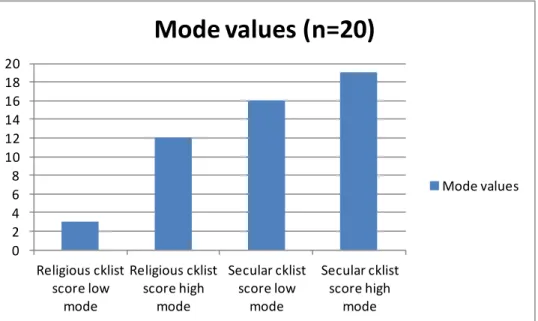
Figure 13: Mode OPAC checklist values of religious and secular private elementary and
middle schools
Figure 14: Median and mean OPAC checklist values of religious and secular private
elementary and middle schools
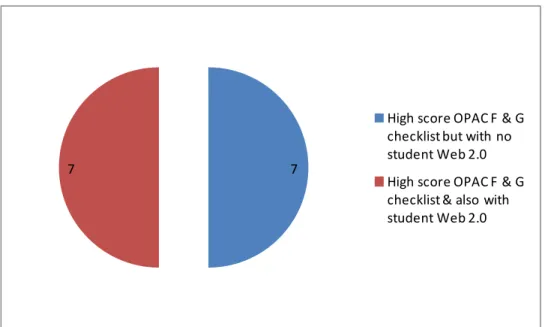
Figure 15: Evidence of student use of Web 2.0 tools on LMC webpages and OPAC comic
book and graphic novel checklist scores
Figure 16: Evidence of active comic book promotion on LMC webpages
Figure 17: Evidence of reading promotion, comic book promotion, and OPAC checklist
scores
Figure 18: North Carolina survey respondents’ counties
Figure 19: North Carolina private elementary and middle schools’ comic book and
graphic novel collection sizes
Figure 20: Profile of library workers in North Carolina’s 12 poorest counties’ private
List of Figures (cont.)
Figure 21: North Carolina’s 12 poorest counties’ elementary and middle schools by
religious affiliation
Figure 22: North Carolina private elementary and middle school librarians who collect
comic books and graphic novels
Figure 23: Collection or non-collection of comic books and graphic novels by secular
private elementary and middle schools in North Carolina
Figure 24: Collection or non-collection of comic books and graphic novels by religious
private elementary and middle schools in North Carolina
Figure 25: Religious affiliation of private elementary and middle schools in North
Carolina compared to size of LMC comic book or graphic novel collection
Figure 26: Presence of comic book collecting in North Carolina’s private elementary and
middle school libraries compared to wealth of schools’ counties
Figure 27: Comic book titles North Carolina private elementary and middle school
librarians read as children or teens
Figure 28: Drill down with religious profile of schools and respondents’ history of comic
book reading as a child or teen
Figure 29: Presence of a school library website and the collecting of comic books or
graphic novels
Figure 30: The collecting of comic books or graphic novels and ways in which the
students contribute to the LMC website
Figure 31: Elementary and middle school librarians at private schools in North Carolina
who train teachers in technology or curriculum
Figure 32: Respondents’ relationship with technology correlated with the collecting of
comic books and graphic novels
Figure 33: Private elementary and middle school librarians in North Carolina with an
MLS compared to the prevalence of collecting comic books and graphic novels
Figure 34: The size of the comic book and graphic novel collections of private
elementary and middle school librarians in North Carolina, compared to whether they hold an MLS degree
Figure 35: Percentages of prevalence of various tools used to select comic books and
graphic novels among private school library workers with and without an MLS degree
Figure 36: Types of comic books and graphic novels selected by library workers with and
without an MLS degree
Figure 37: Types of comic books and graphic novels collected according to religious
affiliation of private elementary and middle school libraries in North Carolina
Figure 38: Percentages of types of comic books and graphic novels collected overall by
List of Figures (cont.)
Figure 39: “Types” of comic books or graphic novels elementary and middle school
librarians in North Carolina avoid collecting
Figure 40: Reasons that elementary and middle school librarians do not collect comic
books or graphic novels categorically, according to religious affiliation of schools
Figure 41: Open text response of attitudes regarding comic books and graphic novels of
elementary and middle school LMC who don’t collect them
Figure 42: Factors motivating private elementary and middle school librarians to collect
comic books and graphic novels, according to religious profile of school
Figure 43: Open text responses of attitudes regarding comic books and graphic novels of
elementary and middle school librarians who collect them
Figure 44: Size of comic book or graphic novel collection correlated with reasons
elementary and middle school librarians collect them
Introduction
Librarians’ attitudes towards and collecting of graphic novels and comic books have evolved throughout the past hundred years or so. In the past, many librarians
considered it their duty to protect and promote high culture, to civilize and bring great culture and literature to the masses (Ellis and Highsmith, 2000, 30). Many disapproved of comic books because they perceived the writing, artwork, and physical materials of the books themselves to be of poor quality (Ellis and Highsmith, 2000, 26). Throughout the decades of the twentieth century, as the popularity of comic books and graphic novels waxed and waned, most librarians still disdained them and did not collect them in earnest. In time, however, more “appropriate” titles aimed at younger readers
proliferated (McPherson, 2006, 67); more empirical studies appeared indicating strongly that comic books challenge readers cognitively and uniquely (McPherson, 2006, 67); and multi-media and heavily visual communication tools such as television, film, and the Internet became more accepted and more sophisticated (McPherson, 2006, 67). Serious, respected novelists began writing comic books and graphic novels; bigger publishers began producing graphic novel and comic book titles; and high quality
imports came from Japan and France, where graphic novels had a strong history without negative stereotypes (McPherson, 2006, 67). The boom in superhero movies in the 2000s also contributed to comic books’ strong return in the 2000s. Between 2001 to March 2009, there were 61 U.S. movies based on comic books or graphic novels
(Griffith, 2010, 182). And so a previously scorned format became a popular, multi-billion dollar industry, supported by artiste writers, coveted awards, hip cache, and respected empirical research.
By 2012, many school librarians have begun to collect graphic novels and comic books. Comic books and graphic novels have won or been nominated for several prestigious awards, such as the Pulitzer Prize, the National Book Critics Circle Award, Los Angeles Times Book Prize (Yanes, 2011), Printz, Sibert, Geisel, Alex, Hugo, and National Book Award (Volin, 2011).They have especially been valued because they bring readers in to the school library during an era when fewer children read for pleasure.
Most of the professional literature about collecting comic books and graphic novels in school library media centers has fallen into a few categories. These are:
introduction to the format;
pieces encouraging media specialists to get started;
advice about promoting the collection;
successful lessons planned and executed with comics;
sources for selection and selection tools;
adolescent or teenagers’ attitudes about comic books, and selection recommendations
Despite a plenitude of recommended lists, there is very little research about which comic book and graphic novel titles school librarians currently collect; how they collect them; which factors influence that collecting; and how this collecting fits in with new information literacies expected in the twenty-first century and delineated in the American Association of School Librarians Standards for the Twenty-First Century Learner. There are even less data regarding private school elementary and middle school librarians and these issues; much of the literature focuses on its uses and readers in high schools. This study focused on an under-researched topic: in what manner and which titles elementary and middle school private school librarians in North Carolina collect comic books, and an exploration of factors that correlate to and influence that collecting.
This study also explored links and correlations among the variables. This study examined the patterns and connections among such factors as OPACs that have a high numbers of recommended comic book titles, librarians with MLS degrees, school characteristics such as wealth of county and religious or independent profiles of the schools, librarians’ attitudes towards comic books, librarians’ comfort levels with technology, librarians’ position as technology or curriculum leaders in their schools, selection tools, evidence of comic book promotion, presence of a school library web page, etc. I wanted to establish whether a relationship existed between how many of the desirable checklist comic book titles each school has, and whether the school library webpage scores highly in online evidence of student use of Web 2.0 tools and online promotion of reading and comic books. I was investigating whether a quality graphic novel collection has a connection with whether the school library to which it belongs helps nurture student reading and student use of Web 2.0 tools.
This topic is timely for several reasons. First, the school library field is undergoing several significant changes. In the past few years, many school library positions have been eliminated or filled with paraprofessionals or volunteers. This trend is taking place among some North Carolina private school library media centers as well (Independent Schools Librarians’ Networking Event, Spring 2011). However, because private schools are managed by governing boards locally, they are not subject to the sweeping district-wide layoffs affecting public schools in North Carolina that can eliminate large numbers of positions at once.
Second, some areas of North Carolina, such as Charlotte and the technology magnet Raleigh- Durham-Chapel Hill region, have continued to prosper throughout the current recession and have done better financially than most areas of the country (Kotkin, 2011). While many school and public libraries struggle in the state and indeed
throughout the country, some private school librarians in North Carolina still enjoy and report wealthy parents and (comparatively) healthy budgets (Independent Schools Librarians’ Networking Event, 2011). Indeed, throughout the past twenty years, Raleigh has enjoyed the third-highest job growth in the U.S. A Forbes evaluation published in 2011 proclaimed Raleigh to be an “economic superstar, with job-creation records among the best in the nation” (Kotkin, 2011, p. 1). Raleigh was ranked #2 in the U.S. for growth in the next ten years, while banking center Charlotte was ranked #8 (Kotkin, 2011). For this reason, along with the fact that they tend to avoid the widespread layoffs that public schools can suffer, private schools in Charlotte, Raleigh, and other prospering areas of North Carolina might be an important model for surviving American school libraries staffed by professional librarians. If so, how and what these librarians collect – and the types of libraries they shape ‒ will matter for the future.
collectors in school media centers throughout the country right now. Thus it is very interesting and informative to investigate their comic book collections for elementary and middle school students, when more and more comic books appropriate for younger grades are being published (Gutierrez, 2009). It will also be significant to compare the collecting of comic books in these wealthier elementary and middle school private school libraries in relation to their counterparts in poorer areas of North Carolina that are struggling. Do these schools in more economically challenged counties, with perhaps fewer resources, smaller budgets and maybe more precarious professional librarian job positions, see comic books as essential? If not, which – if any ‒ comic book titles are they committed to? How are comic books perceived in these areas? Do they collect more or fewer comic books compared to their wealthier counterpart school libraries? How does a religious profile of a school impact the type or amount of comic books collected? Thus this study will provide current data about trends in private school library comic book collecting. It will indicate to what extent comic books have truly been
accepted as a necessary element of the collection, even when money is tight. Although comic books boost circulation, provide statistics to show how well-used the library is during a time when people are not sure if they still want brick and mortar libraries, bring more readers and different types of readers into the library – do these factors outweigh their negative image from the past?
Additionally, this study surveyed the private school librarians about what they collect, and which comic books they feel should be collected. As Michele Gorman, one of the experts in school library comic book collecting, noted, “A decade from now there will be a list of must have children’s graphic novels,” but there is not yet a canon for
elementary and middle school comic books (Weiner, 2010, p. 49). This study examined which titles are collected that appear on some suggested lists created by other
librarians, and surveyed the librarians about which titles they would recommend that other private elementary and middle schools should collect. This is significant for two reasons: First, it will gather data about what’s actually being collected, by librarians with more and less funding. Which comic books are prioritized? Also, it will indicate whether private school librarians agree that certain recommended comic books are actually the ones they feel are appropriate for their communities when tough choices have to be made. I would hope that this study could contribute to a recommended comic book canon for elementary and middle school children that librarians actually purchase in a challenging economic climate.
I was also interested in the factors influencing comic book collection in private
Literature Review
Scope and Methodology of the Literature Review
To review the literature, I searched Library Literature, LISA, ERIC, Google Scholar, Google, EBSCO, ProQuest, Academic Search Premier, Journal of Popular Culture, and JSTOR. I also searched the University of North Carolina’s library catalog for popular and research articles, monographs, Master’s Papers, graphic novels, and online holdings. I used various combinations of subject headings and search terms, such as “graphic novels,” “comic books,” “comics,” ”manga,” “attitude,” “media centers,” “private schools,” “North Carolina,” “collection,” “collecting,” “media specialists,” “school librarians,” “factors influencing,” “factors affecting,” “surveys,” “purposive sampling.” These searches returned articles, monographs, papers, and theses mostly about how librarians have progressively begun to embrace graphic novels and comic books after many years of some support but often negative or ambivalent attitudes about collecting them. The research studies on comic books in school library media centers largely focus on reading acquisition, justification for collecting comic books based on literacy and cognitive development, collaborative and library lessons, or adolescent or teenagers’ attitudes about comic books. There is not much recent published research data about which titles school librarians collect, how school librarians select their comic book collections, or factors influencing that selection. There is even less published research data about current collecting of comic books among private elementary and middle school librarians; much of the literature focuses on its uses and readers in high schools, or collecting and collections in public or academic libraries.
After extensive reading of popular and scholarly journal articles, books, monographs, blog postings, and University of North Carolina at Chapel Hill’s School of Information and Library Science Master’s Papers, the only data I was able to find specifically about North Carolina school librarians’ collecting of and attitudes towards graphic novels were in some University of North Carolina at Chapel Hill’s Master’s Papers. I also read approximately 30 comic books and graphic novels recommended in the professional literature for elementary and middle school libraries.
development tools, and I also researched studies conducted using different types of library collection evaluation tools.
History of Comic Books in the U.S. and Librarians’ Attitudes Towards Them: An Overview
In the earlier part of the twentieth century in the U.S., comic books were wildly popular with both adults and children, if not librarians. The “funnies” and comic books’
popularity with a wide segment of the American population reached a peak during the so-called “Golden Age of Comics,” during World War II when Superman was an
untarnished hero everyone could embrace (Ellis & Highsmith, 2000, p. 23). A more cynical American public turned more to violent horror and crime comics after the war, which led to a public backlash against comic books (Ellis & Highsmith, 2000, p. 23). Dr. Fredric Wertham was the voice of this backlash, and he led a cry that these violent comics, which he claimed were associated with juvenile delinquency, were an evil influence and should be banned. His movement led to Congressional hearings, which in turn prompted the comic industry to begin to produce more insipid, safe, and unpopular comic books. In addition to the industry’s resultant self-policing under the “Comics Code,” the rising popularity of television and changes in the way magazines were distributed crippled the comics industry, leading to a sharp decline in popularity (Ellis & Highsmith, 2000, p. 23).
The “Silver Age” of comics came in the 1960s, however, with the introduction of DC’s Flash and Marvel’s new, more flawed heroes. It became hip to like comic books (Ellis & Highsmith, 2000, p. 24). Other factors contributed to comics’ popularity: cultural critics began to examine comics; fans began to collect them; and underground “comix” by the likes of R. Crumb were considered arty. In the 1960s, another turning point came when popular culture became a scholarly study; comics were included in that research (Ellis & Highsmith, 2000, p. 30). During the 1970s, professional library literature indicates that public librarians began to collect it more frequently, and view it more positively, although much of the literature still documents negative attitudes towards it (Ellis & Highsmith, 2000, p. 32). During the 1970s, the phrase “graphic novel” appeared
(McCloud, 1993). Although the definition of the labels “comic book” and “graphic novel” are still controversial (McCloud, 1993), the term “graphic novel” helped lend comic books the more intellectual stamp that they carry today. During the 1980s, professional conversations advocating comic book and graphic novel collecting in school libraries began to appear in such journals as School and Community and School Library Journal
(Ellis & Highsmith, 2000, p. 33). Academic libraries, public libraries, and school libraries thus were collecting comic books and graphic novels by the 1980s, with scholarly monographs, popular culture studies, and debates and reviews in professional journals such as Voice of Youth Advocates bringing the topic into view (Ellis & Highsmith, 2000, p. 35). By the 1980s, OCLC began to include comic book and graphic novel records; chain book stores began to carry comics and graphic novels (Ellis & Highsmith, 2000, p. 34);
collections. The critical darling Maus was published in 1986, winning many awards (including the Pulitzer in 1992) and spurring a paradigm shift as many librarians began to consider the idea of comic books as serious art. During the 1980s, many school librarians in Missouri surveyed said that they had comic books in their collections; eighty-six percent of the librarians surveyed (most of whom were school librarians) said that they had books with comic strips in them. While during the early 1990s comic books thrived both artistically and economically, by the end of the decade the industry was struggling. Marvel, one of the “Big Two” along with DC, even filed for bankruptcy in 1996 (Ellis & Highsmith, 2000, p. 25).
However, as the 1990s progressed into the 2000s, more research appeared in the literature supporting comic books as tools educators could use to promote critical thinking and literacy. Teachers, reading experts, and more and more librarians had positive things to say about the value of comic books and graphic novels. Joanne Ujaii and Steven Krashen’s landmark 1996 study of seventh-graders who read comic books strongly indicated that comic books and graphic novels did not hurt readers (Ujaii and Krashen, 1996). Popular library journals, a class of professional reading regularly read by 53% of the school library media specialist who responded to this study, frequently touted the benefits of collecting comic books and provided start-up collection title lists. Comic books and graphic novels are now regularly reviewed in reputable book review journals, a collection tool that 94% of the school library media specialists who
responded to this survey use. School library media specialists have started to collect comic books and graphic novels more and more.
Children’s and Young Adult Librarians in North Carolina: Librarians’ Attitudes Towards and Factors Influencing the Collecting of Graphic Novels and Comic Books
way they examined the books and what they said about certain elements, for example, “violence,” “descriptions of females,” “age of character.”
The librarians in this study responded positively to including graphic novels in their collections. All of the librarians said they would collect at least two of the “exemplary” books. All of the librarians except for one said that they had not read a graphic novel but that they were interested in collecting them. Some of their reasons for collecting them included using them as bait for children who don’t normally use the library, and hoping that the graphic novels would serve as a bridge so they would later read “real” books.
Priest noted that their responses indicated that most of the librarians lacked a profound understanding of the format, and that they were reviewing the comic books with the same criteria they would use for text-only books. Thus they were dissatisfied at times with the lack of text, concerned that the page layout was too busy, or difficult to read, etc. The researcher argued that librarians should be more educated about the fact that graphic novels should be judged on different criteria and should be recognized as a different medium, that they are not just books with illustrations.
Several of the participants in Priest’s study said that they would “want to read the whole thing before putting it on the shelves” (p. 12). One of the participants even noted, “I’m not really comfortable just picking [graphic novels] like this…. I would want reviews to back my decisions and in case of a complaint” (p. 39). Another said that “I’d really like a review” (p. 34).
Clare Snowball’s 2007 study on “Researching graphic novels and their teenage readers” provided some interesting insights into some factors that influence how librarians do (or do not) collect comic books and graphic novels, and how those factors fit in to the culture of their individual organizations. Snowball surveyed librarians in various regions of Australia to examine factors shaping these librarians’ graphic novel collecting habits. She notes such common negative factors as fear in the community and librarians’ lack of familiarity with the format. She also discusses common positive factors that encourage librarians to collect them. Although the study took place in Australia, her findings confirm the influence of some variables explored in studies of North Carolina children’s and young adult’s comic book and graphic novel collections.
Jessica Gill’s 2007 University of North Carolina at Chapel Hill’s SILS Master’s Paper “Establishing an Elementary Graphic Novel Collection: An Analysis of the Most Frequently Utilized Collection Development Resources” addresses how elementary school librarians in North Carolina establish a comic book and graphic novel collection. She used a purposive sample of economically diverse North Carolina elementary schools located in the Raleigh-Durham area. It is not stated whether these librarians were public or private school librarians. Gill surveyed North Carolina elementary school library media specialists to determine which collection development tools these media specialists use when they establish a graphic novel collection, and which tools they found most effective. Gill analyzed results from 65 returned surveys. Additionally, she interviewed 15 media specialists to gather more data.
Gill found that the North Carolina media specialists in her study most often used
professional journals, recommended title lists, and recommendations from other media specialists when selecting comic book and graphic novel titles. Least used tools were recommendations from comic book stores, public librarians, and library professors (Gill, front matter). Gill’s paper notes that “additional research could be done which would look at the characteristics of media specialists who add graphic novels to their
collections, as well as the characteristics of media specialists who elect not to…. Questions could be posed about if there were any commonalities regarding individuals who select to purchase graphic novels” (p. 28). The results were not cross tabulated or correlated with other factors. Gill’s study notes that “blogs, websites, and professional books specific only to an elementary level are all desired [as articulated by the school librarians participating in the study]. Research done on collection development tools in five to ten years may well indicate a prevalence of these…” (p. 29). Gill also argues that, since the librarians she studied relied on other school librarians for recommendations for building their collections, therefore workshops, conferences, and professional learning communities provide excellent opportunities for these conversations to take place (p. 30).
Methodologies for Evaluating Library Collections
citations in research papers’ bibliographies, feedback from users, age of items, inter-library loan requests, relevance of information, book reviews, using deductive and inductive checklists, comparisons with class curriculums, and in-depth case studies (Moss, 2008, p. 149).
In the most commonly used method of collection evaluation (Elzy & Lancaster, 1990, p. 1), a collection is checked against a specified list of titles. Using a deductive checklist to search the OPAC for the presence of specific titles, a library’s collection is then assessed based on the gaps that are exposed by missing titles. Anna Lundin’s 1989 article “List-Checking in Collection Development” describes the use of checklists in collection
evaluation, and reviews the library literature about the use of checklists. She notes that while they are frequently used, many librarians are skeptical about their drawbacks. Lundin advises using them, but with a caveat: they are better for smaller libraries with “more specialized goals” (p. 108), which did make these deductive checklists
appropriate for this study. Lundin also points out that lists are a basic form of
communication among libraries and scholars and that they help constitute the “art” of collection building (p. 111).
In reaction to the limitations of the deductive checklist, Herbert Goldhor developed the method of using inductive checklists to evaluate a library collection. He discusses the application of this method in his oft-cited 1973 article “Analysis of an Inductive Method of Evaluating the Book Collection of a Public Library.” In contrast to a deductive checklist method, which exposes gaps in the collection (Elzy & Lancaster, p. 1), an inductive checklist looks at what a library has. This method has the advantage of taking into account items that perhaps should not have been collected and so provides a bigger picture than the deductive method (Elzy & Lancaster, p. 2). The use of an inductive checklist involves sampling the collection, for example, by using a sampling interval after a random start (Elzy & Lancaster, 1990, p. 3), and then checking the sample against a similarly selected sample from several published bibliographies (Elzy & Lancaster, 1990, p. 4). Titles in the sample are compared against selected bibliographies; the more bibliographies that include the title, the more “stars” or points that title could earn. If that title is not included in any of the selected bibliographies, then the title would earn no stars.
vulnerabilities of the deductive checklist method, an inductive checklist was more likely to provide a more comprehensive overview of a given collection. Moss used three lists and a stratified sample to determine the percentage of core desirable GLBT titles that Louisville Public Library held. She noted that a significant disadvantage of using the inductive method for her study was that this method depends on excellent subject heading in cataloging; certain titles were not located due to faulty headings (p. 155). A deductive checklist method does not have this disadvantage.
Elzy and Lancaster’s 1990 study “Looking at a collection in different ways” evaluated the collection at Illinois State University’s Teaching Materials Center (TMC). The researchers used both inductive and deductive checklists to compare results derived from the two checklist methodologies. They used four different bibliographies to check the titles in the collection; none of the four bibliographies had been used as a book selection tool at TMC. The researchers concluded that the two methodologies were effective in
indicating areas of weakness in the collection, in different ways. The deductive checklist indicated gaps that should be filled by purchase of recommended books; the inductive checklist indicated that TMC had too many books that were not highly recommended (Elzy & Lancaster, 1990, p. 9).
Russell Dennison’s 2000 article “Quality Assessment of Collection Development Through Tiered Checklists: Can You Prove You Are a Good Collection Developer?” examines using tiered checklists to make results of a deductive checklist study less subjective and therefore more usable and more valuable. In the usage of tiered checklists, titles are divided into several categories, such as “essential,” “highly recommended,”
“recommended,” and “listed” (p. 25). Using existing checklists from qualified
organizations or databases, titles checked for in the collection are classified into the top tier if they appear in four lists; on the next tier if they appear on three lists, and so on. Statistical analysis is then applied to reduce the subjectivity of results interpretation.
In Donahue’s, Johnson’s, Mandarino’s, and Usiondek’s 2010 “Graphic Novel Collection Evaluation: Designing a Three-Part Instrument to Evaluate the Usability and Accessibility of a Library’s Graphic Novel Collection” study, the researchers observed what this study’s examination of the literature has found: “While graphic novel collections have grown quickly over the past ten years, a lot of the literature covers how to build a
decided that 20 – 25% of the titles should ideally be from the “best” list. This percentage was derived after discussion; it is often used in deductive checklisting.
Glenn Masuchika and Gail Boldt’s 2010 study, “Japanese Manga in Translation and American Graphic Novels: A Preliminary Examination of the Collections in 44 Academic Libraries,” sought to gather data indicating whether, given the popularity of Japanese manga comic books in the U.S., American academic libraries were collecting manga to the same extent that they were collecting American graphic novels. The authors argued that if they weren’t, this would indicate a Western bias, noting that manga’s popularity should require an aggressive collecting rate. The authors did determine that there is a strong bias among academic American libraries in favor of Western graphic novels; their research indicated that graphic novels are collected five times as much as manga (p. 515), although manga sales are a much higher percentage of comic book sales than 20%. The authors furthermore determined that schools located in areas with significant Asian populations, or with respected Japanese studies departments, also collected graphic novels much more heavily than they did manga (p. 515). The researchers used 17 lists to derive their titles. The researchers also describe how they intentionally included certain universities known as centers of Japanese studies, to determine whether they would collect manga at higher rates.
Evidence of AASL Standards for the Twenty-First Century Learner on Independent North Carolina School Library Webpages
The American Association of School Libraries delineates five instructional strands in the “Teaching for Learning” section of Empowering Learners, its 2009 landmark guideline for school library media programs. By collecting and promoting comic books and graphic novels, school library media specialists can foster these three of the five goals:
1.) The school library media program promotes collaboration among members of the learning community and encourages learners to be independent, lifelong users and producers of ideas and information.
2.) The school library media program promotes reading as a foundational skill for learning, personal growth, and enjoyment.
3.) The school library media program provides instruction that addresses multiple literacies, including information literacy, media literacy, visual literacy, and technology literacy
(AASL, 2009, p. 19).
inquiry-based learning, and librarian assessment of student learning. She concluded that there was some evidence on these library web pages of online resources that can
enable these goals, but that there was less evidence that these goals were actually being implemented in or through the libraries (p. 30). She concludes that independent
Methodology
General Description
This study examined which comic books and graphic novels elementary and middle school librarians in North Carolina private schools are collecting, and which factors influence that collecting or correlate with that collecting. This study sought to establish patterns of comic book and graphic novel collecting in these schools in North Carolina according to such variables as professional characteristics of the librarian, librarians’ attitudes towards comic books and graphic novels, the tools North Carolina private elementary and middle school librarians use to select comic books and graphic novels, and varying levels of wealth by region of the state. To triangulate the data, this study was designed in two parts: in one part, data was collected from 20 schools’ library web pages and OPACs; in the second part, library workers in various private elementary and middle schools all over North Carolina were surveyed.
The survey sought to explore how and why private school librarians do or do not collect comic books and graphic novels; factors that influence whether they select certain titles; which comic books and graphic novels they think private elementary and middle school libraries should collect; which titles they actually do collect; classification questions about their school population; and the professional characteristics of the surveyed librarians, including whether the surveyed librarians are implementing the AASL’s Standards for the Twenty-first Century Learner in their library curriculum, and whether the participating librarians are technology or curriculum leaders in their schools. These answers were cross-tabulated and examined for correlations with such things as size of the graphic novel collection, whether the librarian had an MLS, types of professional reading, whether the librarians read comic books as a child or teen, whether the librarian had a school library website, and the librarians’ relationship with technology. There were six data collection instruments: two OPAC checklists, three rubrics for noting the presence of three categories of indicators of the AASL Standards for the 21st-Century Learner on school library web pages, and the survey. There has been no published research that correlates these factors with the collecting of graphic novels or comic books in private elementary and middle schools in North Carolina.
Methodology and Goals of This Study in Relation to the Library Literature
This study built on Horner’s 2006 research into North Carolina public librarians’
controversial materials than their private school librarian counterparts. Horner notes that “the interviewed librarians seemed less concerned with the sex and violence stereotypically associated with comic books, and more concerned with portrayals of women” (p. 24). This study examined whether private school librarians’ perceptions of sex, violence, and portrayals of women, as well as their perception that comic books and graphic novels lead to more reading, influence the way private school librarians collect comic books and graphic novels in North Carolina. While Horner states that “the library literature increasingly shows an attitude that … is ready to accept comics as a positive source of reading material, and this is also true of the librarians who participated in this study” (p. 30), this study was designed to determine whether private elementary and middle school librarians collecting in schools located in counties with a wide range of socioeconomic levels, and with different religious profiles, had those same positive attitudes.
Furthermore, of the seven librarians Horner interviewed, six had rarely read comics as children and did not read them regularly now (p. 22). The seventh librarian was an avid reader of comic books and also had read them extensively as a child (p. 22). The other six librarians had only read Archie or the newspaper comic strips (p. 22). This study collected data to seek a correlation between private school librarians who read comic books as children and those who collect them heavily and promote them now. This survey also asked respondents which comic book titles they had read as children. Although they did not read comic books for pleasure, several of the librarians in Horner’s study did attempt to keep up with popular and new comic book and graphic novel titles, by reading reviews, visiting comic books stores, and talking with patrons about it (p. 23). This study examined whether private school elementary and middle school librarians do this as well, and which tools they use to stay current with comic books, even if they are not fans of the format themselves.
This study built on Horner’s study by attempting to gauge attitudes of librarians who collect comic books, and how that affects their collecting. Horner interviewed public librarians “mostly in Orange, Durham, and Wake counties” of North Carolina (p. 15); however, Wake County librarians do not select materials. In Wake County, materials are selected by a centralized office, Collection Development Services. Horner’s 2006 study provided meaningful, useful data, but did not distinguish attitudes based on each county’s collecting model. The Horner interviews provide insight into public North Carolina librarians’ attitudes about graphic novels, but since some of them do not select, it is not possible from that study to correlate their attitudes toward comic books with how and what they collect. This study was designed to build on the excellent qualitative responses Horner’s interviews elicited, and attempted to link attitudes of children’s and young adult librarians working in North Carolina with purchasing decisions.
graphic novels and comic books. This study also looked at the selection tools used by private elementary and middle school librarians when developing their comic book and graphic novels collections; it is not clear whether Gill’s data includes this group of librarians.
This study, which took place five years after Gill’s, also followed up on her
recommendation to investigate whether private school librarians in North Carolina build their comic book and graphic novel collections by utilizing workshops, conferences, blogs, websites, and professional books with comic book and graphic novel
recommendations. Respondents in Priest’s study, which explored the decision-making process of some North Carolina school librarians as they selected comic books and graphic novels, mentioned several selection tools they used. This research was designed to illuminate which selection tools private elementary and middle school librarians in North Carolina use, how often they use those tools, and correlations of the use of those tools to other factors. This was also designed to build on Priest’s research by examining whether, ten years later and as our society is more multi-media driven, there is evidence that a shift has occurred among private school librarians in recognizing that comic books and graphic novels are valuable books intrinsically, or whether they are still viewed as desirable because they are stepping stones to “real” books.
In order to explore some of the theories of Clare Snowball’s studies of teenage readers of graphic novels in Australia, this study also looked for patterns of comic book and graphic novel collecting according to region and perceived negative attitudes in the school community about comic books and graphic novels, and whether that prevented some librarians in this study from purchasing them.
Similar to the way that Masuchika and Boldt wanted to investigate whether there was a correlation between richer manga collecting in academic libraries belonging to schools that had Asian studies concentrations, this study sought to investigate how comic book and graphic novel collecting fits in with school libraries that are supposed to be
Data Collection Instruments
To examine which comic book and graphic novel titles elementary and middle school librarians collect in private schools in North Carolina, this study included two deductive checklists to analyze OPACs of twenty private elementary and middle school libraries in various regions in North Carolina. The OPAC checklist titles were based on
recommendations from lists compiled by comic book experts, school library media specialists, library literature article authors, website authors, and monograph authors. They included award winners, popular titles, titles that meet published criteria for quality comic books, and titles that appear on multiple recommended lists. Their presence in a collection would indicate a quality graphic novel and comic book
collection. Like Masuchika and Boldt, I used several lists to make this study’s list, since there is a lack of an agreed-upon canon in comic books and graphic novels for
elementary and middle school libraries. Among others, the recommended comic book and graphic novel lists of Michele Gorman, Allison and Barry Lyga, Francisca Goldsmith, David Serchay, Diana Maliszewski, and Gene Kannenberg, Jr. were all consulted in choosing the titles for the two OPAC checklists. I then checked for the presence of twenty “desirable” comic book and graphic novel titles in the elementary schools, and twenty “desirable” titles in the middle school. Schools that had both an elementary and middle school were evaluated using both checklists. (See Appendix F, “Deductive Comic Book and Graphic Novel Checklist for Elementary Schools,” and Appendix G, “Deductive Comic Book and Graphic Novel Checklist for Middle Schools.”)
Three of the titles were repeated on both lists. Bone is probably the one graphic novel title that school libraries must have. Tintin is a core title that represents a beloved classic, and I was curious to determine whether school libraries were likely to have it, especially since the popular movie was just released. Its presence also indicated a school library with an interest in collecting international and critically acclaimed titles. To Dance is an award-winning autobiography that is often considered Young Adult, but its artwork seems more appropriate for younger audiences. It is an important title,
appearing on many lists, and I thought including it was important, but I knew librarians might differ on which level library should collect it. Therefore I thought it appropriate to search for it in both types of libraries. Schools that had any of these duplicated titles received “credit” twice for it when I calculated the scores, so that they were not penalized for having the title.
tallied indicators of these elements, some of which are derived from Jane McMahon’s 2010 University of North Carolina’s SILS Master’s Paper study “Evidence of Virtual Learning Commons in Independent School Library Web Pages.”
To establish evidence of Web 2.0 tools facilitated by the school librarian, I used Appendix A,” Evidence of Reading Promotion in Library Webpages.” I looked on the library website for student wikis, blogs, social networking, and interactive reading tools.
To look for evidence of reading promotion, I used Appendix B, “Evidence of Web 2.0 Tools in school Library Webpages.” I looked for recommended book lists, links to other libraries, readers’ advisory tools, related video or podcasts, reading-related wikis, and information about new materials.
I also used Appendix C, “Evidence of Comic Book Promotion on Library Website,” to look for evidence that the librarian was promoting graphic novels and comic books as
desirable reading choices, by checking to see whether there was any information about new comic book materials; projects involving comic books; links to comic book websites, stores, or blogs; research about comic books; recommended comic books; or librarian or student blog postings about comic books. I assigned a point to each of these indicators.
In order to triangulate the data collected from the OPAC analyses, I also distributed a survey to private elementary and middle school librarians all over North Carolina. The survey method was appropriate for my study for several reasons. First, I was seeking to connect factors influencing and correlating with the collecting of comic books and graphic novels. A web-based Qualitrics survey facilitated using statistics to correlate librarians’ survey answers with other variables and look for patterns to draw meaningful conclusions. Web-based surveys, in contrast to phone interviews or face-to-face
interviews, help eliminate bias as much as possible. I am an enthusiastic advocate for graphic novels and comic books, and I think that if I were to conduct personal
interviews, I would have difficulty appearing neutral, avoiding leading questions, or not giving emotional responses to subjects’ answers. Another advantage of the Qualtrics web-based survey is that participants can pace themselves (Wildemuth, 200, p. 260): Qualtrics provides the option to save and go back to it later, which I hoped would encourage a greater completion rate and more well-thought-out responses. This is also appropriate for busy school librarians, who are often interrupted by classes to teach and multiple demands for help and service from students, teachers, and administrators. Furthermore, a web-based survey can be distributed throughout a wide region (Wildemuth, 2009, p. 260), which suited my study well, since I wanted to survey different areas throughout the state. Web-based surveys are also cost-effective (Wildemuth, 2009, p. 260), which was appropriate for this study, which has no grant funding. Moreover, they provide the shortest collection times of any surveys
instruments and one survey instrument, and also interpret time-consuming, open-ended responses, within a short time.
The majority of the survey questions were ended. As Wildemuth points out, close-ended questions are easier for respondents and require less time to analyze (p. 258). This is important due to the fact that this study was time-intensive due to the use of two data collection instruments, due to the collection of qualitative data in the open-ended survey question responses, which were time-consuming to analyze, and due to the limited nature of the scope and time allowed for this study. There were seven open-ended questions to elicit deeper responses. Appendix E has the schedule of survey questions.
I also would have liked to collect data about each library’s total comic book holdings. I could have done this by searching holdings under the Library of Congress subject headings “comic books, strips, etc,” “graphic novels,” and “cartoons and comics.” However, many books that are truly comic books are not cataloged under this heading, such as wordless books composed of comic book panels and non-fiction titles. Other comic books might also be present in the collection, but might lack accurate subject headings. I decided to forgo seeking totals of comic books and graphic novel obtained through OPAC subject heading searches in light of the false positives and false negatives this search could produce.
Identifying and Recruiting the Participants
To make the sample as representative as possible, I wanted to make sure that data was collected from regions all over North Carolina, from schools in counties with varying economic levels, and from religious and non-religious schools. There are 82 schools in the North Carolina Association of Independent Schools. Of these, 70 schools met the study criteria of being either elementary or middle school or both, with a school library. The NCAIS website membership role of the schools indicates which geographic regions the schools occupy; the member schools come from all over the state: Charlotte, the Raleigh-Durham-Chapel Hill region, the Coastal Plain, the Greensboro-High Point-Winston-Salem area, the mountains, the northern coastal plains, the Piedmont, the Sandhills, and the Southern Coastal Plains. Although the Charlotte metropolitan area and the Raleigh-Durham-Chapel Hill area have a disproportionately large number of the member schools in this organization, I included all of the schools in Charlotte and the schools in Raleigh-Durham-Chapel Hill. This is because I was interested in gathering and analyzing data about these two areas of the state, since they have a large concentration of wealth, and contrasting them with the data from the schools in the twelve poorest counties of North Carolina, as well as data from other regions of North Carolina.
of the schools in the twelve poorest counties in North Carolina, but some do not. The librarians in this group represent a wide mixture of schools with various economic profiles from various geographic regions in North Carolina. I also hoped that surveying this group would help increase the response rate I would receive. Since some of these librarians know me and attended a school library workshop I taught that was well received, I hoped they would be more motivated to complete the survey.
Using only the NCAIS and North Carolina Independent School Librarians’ Network Event membership roll potentially introduced bias into the sample, as this would select only schools that had ample funds and administration time to cultivate and join such organizations. It would also exclude schools that want to shape their own curriculum according to their values, which they may not feel are aligned with a larger organization. This is especially true since many private schools are founded to adhere to a religious mission or a parent charter vision. Often, these schools are alternatives to the bigger educational school system with which they disagree for various reasons.
I therefore wanted to include in the study schools not identified with a professional organization or professional learning network, and not located in the wealthiest regions of the state, so I could have a more representative sample of the state’s school libraries and could try to detect patterns of comic book collecting by the wealth of North
Carolina schools. I used U.S. census data to identify the twelve poorest counties in North Carolina: Pitt, Robeson, Columbus, Hertford, Northampton, Halifax, Warren, Vance, Scotland, Tyrell, Edgecomb, and Richmond. Next I consulted the North CarolinaAtlas and Gazetteer, the online Yellow Pages, and the Internet, in order to locate the 150 townships, towns, and cities in those twelve counties. The North Carolina Division of Non-Public Education’s 2011 Directory of Non-Public Schools yielded 68 private schools in the 12 poorest counties. I located 20 additional schools from the 12 poorest counties that did not appear in the North Carolina Division of Non-Public Education’s 2011
Directory of Non-Public Schools by searching through the Yellow Pages listings of the 150 townships, towns, and cities of these counties, using the search term “private schools” combined with the name of the township, towns, and cities. Using the Yellow Pages led me to schools I might not have found if I had searched for school websites online, since many of these smaller schools in the poorer North Carolina counties do not to have a school website and do not appear in NCDNPE’s directory. Thus I constructed a sampling frame of 88 private elementary or middle schools in the twelve poorest counties that I could contact for the survey and look at for the OPAC analysis. After researching further, this frame was reduced to 62 after eliminating “private schools” that were day care centers, out of business, or not educational centers.
Most of the schools in the twelve poorest counties were not listed in any of the roles of the North Carolina Association of Independent Schools and did not send librarians to the annual North Carolina Independent School Librarians’ Network Event. This lack of
Each of the twelve poorest counties had varying numbers of private schools. Some counties had many, others had few. For example, Halifax County had five private schools; Pitt County had 15; Robeson had 14. However, some had as few as 3 or 2. Two (Tyrell and Edgecomb counties) had no private schools. In order to reduce bias from the large range among this group of counties, I decided to survey a similar number from each county. I planned to select 5 from each county. In cases where counties had fewer than 5 private schools, I planned to survey them all. Within that total, I planned to break the schools down into strata according to whether they are independent or religious, and to strive to survey an equal number of independent and religious schools. I would have liked to have surveyed all 62 of these schools, since there is no recorded data of these counties’ schools collecting of comic books and graphic novels. However, due to time constraints, I had to sample this group.
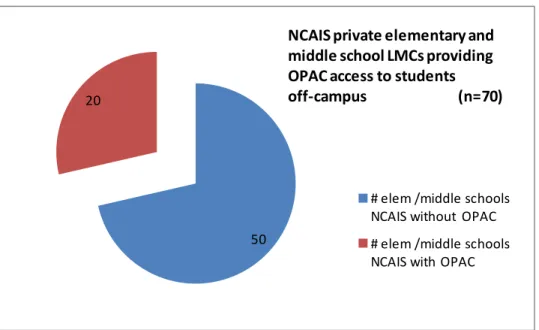
50 20
# elem /middle schools NCAIS without OPAC
# elem /middle schools NCAIS with OPAC
NCAIS private elementary and middle school LMCs providing OPAC access to students
off-campus (n=70)
Figure 1: NCAIS private elementary and middle school LMCs providing OPAC access to students online
Thirty-one of the NCAIS elementary and / or middle schools had LMC web page; 39 did not. (See Figure #2.)
31
39
0 5 10 15 20 25 30 35 40 45
# NCAIS elem & middle school LMC with web page
# NCAIS elem & middle school LMC without web page
(n=70)
Figure 2: NCAIS elementary and middle school libraries with a LMC web page
Representativeness of the Sample
Due to issues of access, this OPAC sample probably is not the most representative of all possible catalog holdings samples among North Carolina’s private elementary and middle schools. Eighteen of the twenty collections are either located in a school that belongs to a professional membership, or are administered by an individual who belongs to a professional librarians’ network or association. Of the remaining two schools, one was the only school in the twelve poorest counties that fit the OPAC study criteria. The other was a school whose librarian is known to the investigator, and who graciously allowed access to her OPAC to help contribute data to the OPAC analysis. Her school was chosen in part because its LMC has a robust technology program, and it was interesting to compare its LMC technology offerings to its comic book and graphic novel holdings.
Of the twenty schools whose comic book and graphic novel holdings and LMC web pages were examined, five were from the Charlotte area, six were from RDU/CH, eight were from other counties, and one was from one of the twelve poorest counties.
Of the twenty schools that had an OPAC and a LMC web page, eighteen of the schools had at least one librarian with an MLS. One of the remaining two librarians had a doctorate, although the school website didn’t say in which subject, and the other one does not have an MLS.¹
A Note about Attempting to Obtain OPAC Data from the Twelve Poorest Counties In North Carolina
33 29
Poor county schools with a school website
Poor county schools without a school website
All private elem & middle schools in NC's 12 poorest counties: presence of school website
(n=62)
Figure 3: Presence of school website in North Carolina’s twelve poorest counties
Only 4 of the 62 schools in these counties had a LMC web page; one was inconclusive as it required a log-in. (See Figure #4.)
4
57 1
Poor county schools with library webpage
Poor county schools without library webpage
Requires log-in; not conclusive
All private elem & middle schools in 12 poorest counties in NC: presence of SLMC webpage
(n=62)
Figure 4: Presence of a school library web page in all private elementary and middle schools in the twelve poorest counties in North Carolina
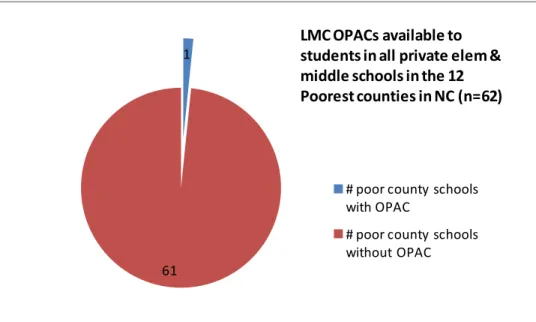
1
61
# poor county schools with OPAC
# poor county schools without OPAC
LMC OPACs available to students in all private elem & middle schools in the 12 Poorest counties in NC (n=62)
Figure 5: LMC OPACs available to students in all private elementary and middle schools in the 12 poorest counties in North Carolina
OPAC and Library Webpage Analysis Results
Results of the Title Checklists: What’s Being Collected
To try to gather data about the titles being collected, I devised two deductive checklists: one for elementary titles, and one for middle school titles. These titles included a wide range: popular series, award-winners, quality stand-alone fiction titles, comic strip collections, and titles that appear on multiple core collection lists. (See Appendix F for elementary school OPAC checklist.)
The most collected comic book and graphic novel titles on the elementary checklist were Babymouse, Bone, Peanuts, Batman, and Calvin and Hobbes. These are all popular, well-known series that often appear on core lists. (Owning one volume of the series was enough to “get credit” for having the series; multiple volumes did not increase the score. (See Figure #6 for a graph of elementary titles collected.)
0 2 4 6 8 10 12 14 16 18 20 A rc h ie B ab ym o u se B ab ys it te rs C lu b B at m an B ig a d ve n tu re s o f … B o n e C al vi n a n d H o b b e s C o u ra ge o u s … Fa sh io n K it ty Lio n s, tig e rs , an d … M ag ic P ic kle O w ly P e an u ts St ar w ar s C lo n e … St in ky Tin tin To d an ce U n cle Sc ro o ge / … W ar rio rs m an ga Yo ts u b a
Elementary Titles
Elem TitlesFigure 6: Elementary comic book and graphic novel titles collected by private North Carolina schools in this study
0 2 4 6 8 10 12 14 16 18 20
Middle school titles
Middle school titles
Figure 7: Middle school comic book and graphic novel titles collected by private North Carolina schools in this study
I noticed that a lot of high quality, award-winning stand-alone core titles that appear on numerous core lists are not being collected in high numbers by the North Carolina schools in this study. For example, Herobear, Courageous Princess, Usagi Yojimbo, Castle Waiting, To Dance, and Satchel Paige:Striking out Jim Crow are not being collected heavily. This can be understood in the context of the results of this study’s survey, which indicate that the more popular tools for selecting comic books and graphic novels were book reviews, student input, perusing the graphic novel or comic book, and other
It was also interesting that Archie comics are being collected in such low numbers, when so many of the librarians surveyed who collect comic books and graphic novels said that they read Archie when they were children or teenagers. However, this finding does support the fact that the survey results found no correlation between librarians who collect graphic novels and comic books as adults and those who read them as children or teens.
It was also surprising that some very popular series that are appropriate for elementary grades that appear on multiple recommended core lists, such as Owly, Fashion Kitty,
Yotsuba, and Babysitters’ Club, are not collected in high numbers by the schools studied in this survey.
Manga
Each checklist had three manga titles on it. These manga titles are not being collected much by the schools in this study. In the elementary list, I included one title by an independent publisher (TheBig Adventures of Majoko), one spin-off of a very popular series (Erin Hunter’s Warriors manga about cats), and one very popular core title series (Yotsuba). Yotsuba was collected by one school; Majoko was collected by none; and
Warriors was collected by six of the twenty. These librarians collect the Warriors books heavily in the traditional all-text format. Majoko and Yotsuba were not “flipped,” that is, they are not reproduced with the panels reading left-to-right, but maintain their original right-to-left orientation, as they were published in Japan. Perhaps some librarians feel it is too difficult for students to read the “genuine” Japanese manga back-to-front, or read right-to-left.
Nor were the manga titles on the middle school checklist being collected heavily. Usagi Yojimbo appears on multiple core lists; only three libraries had collected it. None of the eight religious schools had collected Manga Messiah, and Maximum Ride was collected by four libraries, despite the high prevalence of the traditional all-text format of the original books.
15 4
Elementary schools collecting core elem titles other than Bone or Babymouse
Elementary schools not collecting core elem titles other than Bone or Babymouse
Figure 8: Elementary North Carolina schools in this study collecting core titles other
than Bone or Babymouse
Seventeen of the middle schools are collecting core titles other than Bone or Spider-Man, two of the most well-known of the “must-have” core middle school collection titles. (See Figure #9.)
17 3
Middle schools collecting middle core titles other than Bone or Spider-Man
Middle schools not collecting middle core titles other than Bone or Spider-Man
Figure 9: North Carolina middle schools in this study collecting core titles other than Bone or Spider-Man
In fact, the middle school librarians in our study are collecting award-winners more heavily than they seem to be collecting popular culture spin-offs such as Star Wars and
Results of the Title Checklists: Checklist Scores
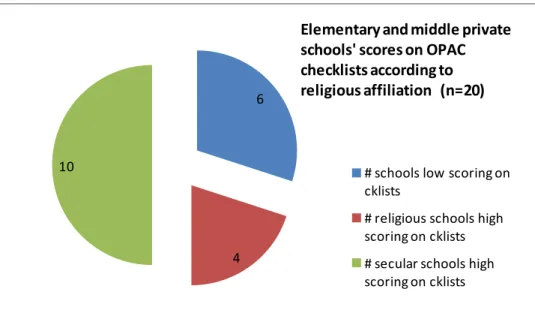
Of the twenty schools studied, six scored low on the total checklist scores. (“Low” is defined as less than 10 out of a possible 40 score, or less than 25%.) Of the remaining fourteen “high” scoring schools, four of those were religious, and ten were secular. (See Figure #10.)
6
4
10 # schools low scoring on
cklists
# religious schools high scoring on cklists
# secular schools high scoring on cklists
Elementary and middle private schools' scores on OPAC checklists according to religious affiliation (n=20)
Figure 10: Elementary and middle schools’ scores on OPAC checklists
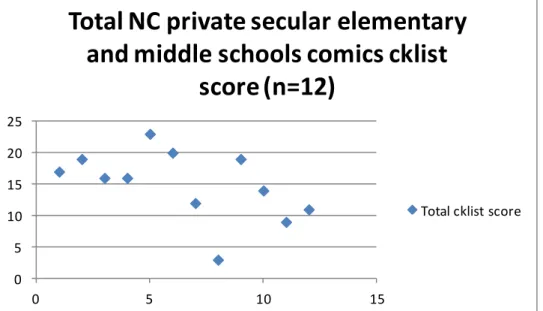
0 5 10 15 20 25
0 5 10 15
Total NC private secular elementary
and middle schools comics cklist
score (n=12)
Total cklist score
Figure 11: Total North Carolina private secular elementary and middle schools’ comic book and graphic novel OPAC checklist scores
0 5 10 15 20
0 2 4 6 8 10
Total NC private religious elementary
and middle schools comics checklist
score (n=8)
Total cklist score
Figure 12: Total North Carolina private religious elementary and middle schools’ comic book and graphic novel OPAC checklist scores