Representation of linguistic and domain knowledge for second language
learning in virtual worlds
Alexandre Denis
∗, Ingrid Falk
+, Claire Gardent
∗and Laura Perez-Beltrachini
+∗CNRS/LORIA,+Lorraine University/LORIA
Nancy, France
{alexandre.denis,ingrid.falk,claire.gardent,laura.perez}@loria.fr
Abstract
There has been much debate, both theoretical and practical, on how to link ontologies and lexicons in natural language processing (NLP) applications. In this paper, we focus on an application in which lexicon and ontology are used to generate teaching material. We briefly describe the application (a serious game for language learning). We then zoom in on the representation and interlinking of the lexicon and of the ontology. We show how the use of existing standards and of good practice principles facilitates the design of our resources while satisfying the expressivity requirements set by natural language generation.
Keywords: virtual environments, ontology-lexicon interface, natural language generation
1.
Introduction
As shown in (Geroimenko and Chen, 2005), (Ibanez-Martinez and Mata, 2006), semantic annotations of 3D scenes improve 3D content retrieval and managment. More recently, they have also been shown to enable intelli-gent simulations which support semantics reasoning or semantic-based planning (Kapahnke et al., 2010). In the se-rious game for learning French called I-FLEG (Interactive French Learning Game, (Amoia et al., 2011)), we exploit semantic annotations of 3D worlds in a novel way namely, as a means to support the generation by a 3D game of natu-ral language sentences. In this game, touching a 3D object triggers the automatic generation of teaching material by a natural language generator. To produce this material, the generator uses (i) the semantic annotations of the 3D world i.e., the ontology describing the 3D objects in the virtual world used for teaching French and (ii) a lexicon which pro-vides the linguistic information necessary to generate text about these objects.
In this paper, we show how to represent and link the on-tology and the lexicon used in I-FLEG so as to facilitate maintenance and portability while satisfying the expressiv-ity requirements set by the generation of natural language. In particular, we show how to use the LIR standard (Peters et al., 2009) to represent the lexicon and link it to the on-tology; and how the good practice principles proposed in (Bateman, 1990) permits designing an ontology that best supports the requirement set by natural language genera-tion.
We start (Section 2.) by sketching the game scenario and explaining how natural language generation is used to asso-ciate 3D objects with language learning exercices. In Sec-tion 3., we then zoom in on the semantic annotaSec-tions of the 3D world and explain the principles underlying the design of the knowledge base. Finally in Section 4., we show how we adapted the LIR standard to develop a lexicon that me-diates between the semantic annotations and the linguistic resources used by the generation system.
2.
The I-FLEG serious game
To learn French with I-FLEG, the learner moves his avatar inside a virtual house and clicks on objects thereby trigger-ing the display of language learntrigger-ing exercices. These exer-cises are generated by a natural language generator based on the ontological axioms and facts associated with the ob-jects and on a lexicon linking concepts to words. Here is a toy example illustrating the ontology and the lexicon un-derlying text generation. Suppose that the world contains a red chair which, in the knowlege base is associated with the following axioms and facts:
Chair(c), SubClassOf(Chair, Noun), Red(c), SubClassOf(Red, Adjective), Small(c), SubClassOf(Small,Adjective), John(j), SubClassOf(John, Noun), Move(e), Agent(e,j), Theme (e,c) SubClassOf(Move, Verb),
That is, there are three objects named c, j and e; c is a red chair, j is John, e is a moving event ofcby j. Fur-ther,Chairis a subconcept of theN ounconcept,Redand
Small of the Adjectiveconcept andM ove of theV erb
concept.
Now suppose that the learner wants to work on adjectives. Then the generator will select from this knowledge base a set of facts that can be verbalised as a sentence contain-ing an adjective. In particular, the selection algorithm will search for anAdjectivesubconcept (to produce an adjec-tive) and aV erbsubconcept (to produce a verb). For in-stance, the following content might be selected:
Chair(c), Red(c), John(j), Move(e), Agent(e,j), Theme (e,c)
NPj
Jean
john(j)
Sx
NP↓j VPbe NP↓c
Ve
bouger
move(e)
Agent(e,j)
Theme(e,c)
NPc
Det N*c
le chaise
chair(c)
Nc
rouge N*c
red(c)
jean(j),move(e),Agent(e,j),Theme(e,c),def(c),chair(c),red(c)
Figure 1: FB-LTAG trees for “Jean bouge la chaise rouge (John moves the red chair)”
Figure 1 shows a toy grammar1 illustrating the FB-LTAG
trees used to generate the sentence John moved the red
chair. In essence, the grammar consists of a set of trees,
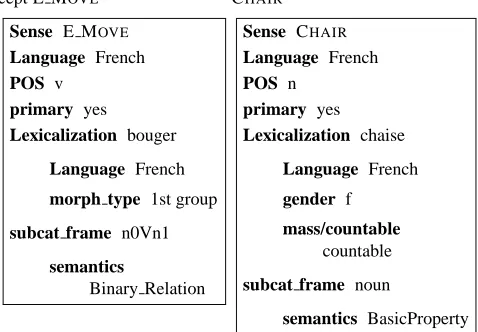
each anchored with a lemma and a semantics. To keep the grammar size manageable however, tree schemas are stored separately and a syntactic lexicon is used to indi-cate which lemmas can anchor which tree or family (set) of trees. For instance, the lexical entry for the verb bouger
(to move) shown below indicates that bouger anchors all
the trees in the n0Vn1 family that is the set of trees de-scribing the syntactic contexts in which a transitive verb can occur. In addition, the semantics of each lemma is specified using parameterised macros which expands to the appropriate semantics. Thus the parameterised macros Bi-nary Relation[Move] indicates that the tree anchored by
bouger is associated with a binary relation with
predi-cate Move. In other words, the semantics of bouger is
{Move(E),Agent(E,X),Theme(E,Y)}.
Lemma: bouger Category: verb
Semantics: Binary Relation[Move] Trees: n0Vn1
During generation, trees that are associated with a seman-tics matching one of the selected facts are retrieved and combined using the grammar tree combination operations. The yields of these trees then give the lists of lemmas mak-ing up sentences verbalismak-ing the input. For instance, the yield of the tree derived by combining the trees shown in Figure 1 produces the list of lemmas Jean bouger le chaise
rouge.
To generate a well formed sentence, a morphological
licon is looked up and the appropriate word forms are
ex-tracted taking into account the morphosyntactic constraints encoded by the grammar for instance, that the subject must agree in person and number with the verb and similarly, that determiner, noun and adjective must agree in gender and number. The morphological lexicon associates each word form with a lemma and a set of (feature,value) pair describ-ing its morphological properties. For instance, the entries for chaise are:
1
The grammar has been simplified. In reality, the grammar has separate trees for Nouns and for determiners (rather than a single tree including boht the determiner and the noun.
chaise chaise {cat:n,num:sg,gender:f,mass:-}
chaises chaise {cat:n,num:pl,gender:f,mass:-}
3.
Annotating the 3D World with Semantic
Annotations
We now describe the semantic annotations we use to de-scribe the virtual world and the general principles underly-ing these annotations.
3.1. Representing Knowledge using OWL
To annotate the virtual environment with semantic infor-mation, we use the Web Ontology Language (OWL, (Hor-rocks et al., 2003)). As illustrated in the preceding section, we implement both an A-Box and a T-Box. We produce an axiomatic description of concepts in the domain (T-Box). In particular, we place domain concepts in a concept hirar-chy where higher-levels are taken from WordNet hypernym structure. For instance, SubClassOf(Chair Piece Furniture) SubClassOf(Piece Furniture Artifact). We then describe each object in the virtual world by linking it to an instance in the A-Box and associating this instance with a set of facts describing this object. As a result, each object in the I-FLEG world is associated both with a set of assertions specific to that object and with a set of ontological axioms providing additional information about the class of objects this object belongs to.
3.2. Upper model for content selection
As mentioned in Section 2., the I-FLEG natural language generator needs to check for certain properties in the input. For instance, if the generated output must contain an adjective, then generation must check that the selected content contains a concept that is a subconcept of the
Adjective concept. In other words, in our generation
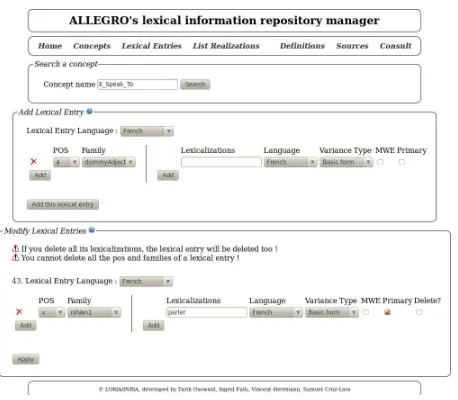
Figure 4: Screenshot of web interface for editing lexical entries.
Second, we implemented the lexicon as a database rather than an OWL ontology. In this way, we created a “light-weight” model of the relation between lexicon and ontol-ogy which was easier to handle while still keeping domain knowledge and linguistic data separated. Figure 4 shows a screenshot of the web interface for creating and editing lexical entries.
From the ontology and the data-base just described, we then automatically derive the syntactic lexicon used by the sen-tence realiser (cf. Section 2.). The data-base provides the required (morpho-)syntactic distinctions while the ontology provides the concept names required to inform the semantic field of lexical entries.
4.3. Some features of our extension to LIR
Adopting the LIR model as an intermediate, generic re-source mediating between the knowledge base and the spe-cific lexicons used by the generator, allows for a straightfor-ward account of morphology, of synonymy, of multi-word expressions and of multilingualism. We now briefly exem-plify each of these points.
Morphology The morphological lexicon can be derived from lexical entries provided that they include morpholog-ical features such as morph type or gender. The lexicon can be obtained by stemming the lemma and deriving the inflected forms thanks to the morphological features. The irregular cases such as the well known choux, bijoux,
jou-joux,... which lists the few words in French that are
in-flected with an -x in plural form instead of the regular -s inflection, can be managed with dedicated morphological features.
Synonymy Synonymy in the original LIR is handled by explicitely stating that two lexical entries are related with ahasSynonymrelation. However, in our “lightweight” model, this relationship is implicit. Two different lexical entries can be related to the same concept. For instance, the synonymy between couch and sofa can be represented by a
single concept COUCHrelated both to a couch lexical entry
and to a sofa lexical entry.
Multi-Word Expressions Multi-word expressions range from fixed expressions (in short, by and large), semi-fixed expressions (spill the beans, kick the bucket), and syntacti-cally flexible expressions (break up, make a mistake) (Sag et al., 2001). Our framework can handle these three cat-egories. Fixed expressions are considered as words-with-spaces in the lexicalization entry and thus can anchor syn-tactic trees as whole units. For instance machine `a caf´e (coffee machine) is a single lexicalization unit. Semi-fixed and flexible expressions are dealt with a primary anchor and co-anchors in the syntactic trees, separated by an under-score in the lexicalization entry. For instance the concept
of HOUSEMOVINGis related to a multi-word expression
d´em´enagement faire in which d´em´enagement is the
pri-mary anchor and faire is the verbal co-anchor. By conven-tion, the first word is the primary anchor, the other anchors are ordered as how they appear in the canonical tree of the syntactic family associated to the lexical entry. Hence the entry d´em´enagement faire can be realized as faire un
d´em´enagement, literally to do a house moving. Note that
thanks to the synonymy, we can also realize the concept of
HOUSEMOVINGwith the single verb d´em´enager (to move
out).
Translation Multilinguality is supported natively in LIR by means of theLanguageattribute of lexical entries. The same concept, for instance CATcan be linked to an English lexical entry cat or to a French lexical entry chat. More-over, it is possible to include compound concepts as senses, for instance, the complex concept CAT ⊓YOUNGcan be linked to the lexical entry gatito, the Spanish word for kit-ten. Vice versa, a primitive concept such as GATITOin a Spanish ontology, can be related to the multi-word lexical entry cat young, where cat is the primary anchor and young is the co-anchor. This lexical entry can then be associated to syntactic trees realizing it as young cat.
5.
Conclusion
Acknowledgments
The research presented in this paper was partially funded by the European Fund for Regional Development within the framework of the INTERREG IV A Allegro Project.
6.
References
M. Amoia, C. Gardent, and L. Perez-Beltrachini. 2011. A serious game for second language acquisition. In
CSEDU 2001, Noordwijkerout, The Netherlands.
J. A. Bateman. 1990. Upper modeling: A general organi-zation of knowledge for natural language processing. In
1989, USC/Information Sciences Institute.
D. Davidson, 1967. The Logic of Decision and Action, chapter The Logical Form of Action Sentences. Pitts-burgh: University of Pittsburgh Press.
E. Franconi. 1994. Description logics for natural language processing.
C. Gardent and E. Kow. 2007. A symbolic approach to near-deterministic surface realisation using tree adjoin-ing grammar. In ACL07.
C. Gardent. 2008. Integrating a unification-based seman-tics in a large scale lexicalised tree adjoining grammar for french. In COLING’08, Manchester, UK.
V. Geroimenko and C. Chen. 2005. Visualizing the
Seman-tic Web: XML-based Internet and Information Visualiza-tion. Springer.
I. Horrocks, PF Patel-Schneider, and F. van Harmelen. 2003. From shiq and rdf to owl: The making of a web ontology language. Journal of Web Semantics, pages 7– 26.
J. Ibanez-Martinez and D. Mata. 2006. Virtual environ-ments and semantics. European Journal for the
Infor-matics Professional, 7(2).
P. Kapahnke, P. Liedtke, S. Nesbigall, S. Warwas, and M. Klusch. 2010. Isreal: An open platform for semantic-based 3d simulations in the 3d internet. In
ISWC 2010.
E. Montiel-Ponsoda, G. Aguado de Cea, A. G´omez-P´erez, and W. Peters. 2008. Modelling multilinguality in on-tologies. In COLING (Posters).
W. Peters, M. Espinoza, E. Montiel-Ponsoda, and M. Sini. 2009. Multilingual and localization support for ontolo-gies. Technical report, D2.4.3 NeOn Project Deliverable. I. A. Sag, T. Baldwin, F. Bond, A. Copestake, and D. Flickinger. 2001. Multiword expressions: A pain in the neck for NLP. In Proc. of the 3rd International
Conference on Intelligent Text Processing and Computa-tional Linguistics (CICLing-2002), pages 1–15.
The LMF Working Group. 2008. Language Resource Management - Lexical Markup Framework (LMF). Technical report, ISO/TC 37/SC 4 N453 (N330 Rev. 16). The MLIF Working Group. 2010. MultiLingual