DESIGNING AND VALIDATING A STRESS QUESTIONNAIRE ON INFORMAL CAREGIVERS: BASELINE DATA FROM TELEPHONE INTERVIEWS WITH CAREGIVERS FROM THE FAMILY CAREGIVER SUPPORT PROGRAM AT THE
DURHAM COUNCIL FOR SENIOR CITIZENS
by Khaula Baloch
A master's paper submitted to the faculty of the University of North Carolina at Chapel Hill in partial fulfillment of the requirements for the degree of
Master of Public Health
in the Gillings School of Global Public Health, Public Health Leadership Program.
Abstract
Daily caregiving can impact a caregiver's emotional and physical health. Some caregivers receive a break in providing care through respite care programs. The Durham Council of Senior Citizens provides respite care to participants in their Family Caregiver Support Program. The Council of Senior Citizens lacks a method to evaluate stress in their caregivers. Validated instruments that measure stress in the caregiver population include the Zarit Burden Interview (Zarit, Reever, Bach-Peterson, 1980) and the Caregiver Burden Scale (Montgomery, Borgatta, and Borgatta, 2000). The purpose of this study is to design and validate a questionnaire for informal caregivers at the Council for Senior Citizens. The results indicate the Zarit Burden Interview is a valid instrument in measuring stress in this population. No statistically significant relationships concerning participant stress were detected through the administration of the
Acknowledgments
Table of Contents
Page
List of Tables... 5
List of Figures... 6
List of Abbreviations... 7
Introduction... . . 8
Methods... 13
Hypothesis... 15
Results... 16
Discussion... . . . 23
Recommendations... 26
Appendix 1: Family Caregiver Support Program Questionnaire... 28
Appendix 2: Department of Aging and Adult Services Form 101... .... ... .. ... .... .. . .. 35
List of Tables
Page Table 1: Family Caregiver Support Program Questionnaire: Baseline Interview
Metrics... 15 Table 2: Descriptive Statistics of the Zarit Burden Interview, Caregiver Burden
Scale, and Question 38. .. . . . ... . . ... . .. . . . .. . .. . . .. . .. .. . ... . .. ... ... . .. .. . .. . ... ... 17 Table 3: Correlation Coefficients of the Zarit Burden Interview, and the Caregiver
Burden Scale to Question 38... ... ... ... ... ... ... 18 Table 4: Descriptive Statistics ofthe Instrumental Activities of Daily Living (IADL)
and Activities of Daily Living (ADL) Index Scores... 21 Table 5: Total Length ofCaregiving... ... ... ... ... ... ... 21 Table 6: Correlation Coefficients of the Zarit Burden Interview and Question 38 to
Instrumental Activities of Daily Living (IADL) -Activities of Daily Living (ADL)
Index... 21 Table 7: Examination of Relationship between Zarit Burden Interview, Question 38
List of Figures
Page
Graph 1: Stress Rating on Date DAAS Form Initially Completed and on Date of 19 Baseline Interview ... .
List of Abbreviations
Abbreviation
Activities of Daily Living... ADL Caregiver Burden Scale... CBS Council for Senior Citizens
...
esc
Department of Aging and Adults . . . ....
DAAS Family Caregiver Support Program ... . FCSP Family Caregiver Support Program Questionnaire ... . FCSPQ Instrumental Activities of Daily Living ... . lADLIntroduction
Over 22 million Americans act as informal caregivers everyday to elderly or disabled people over 18 years old (Office of Women's Health, 2008). An informal caregiver is defined as someone who provides "extraordinary, uncompensated care, predominantly in the home setting, involving significant amounts of time and energy for months or years, requiring the petformance of tasks that may be physically, emotionally, socially, or financially demanding" (Biegel, Sales, and Schultz, 1991 ). Formal caregivers are those who receive training and certification prior to providing care. Some characteristics of these informal caregivers are:
• Women (approximately 60% of caregivers are women) • Middle-aged ( 40-64 years old)* as defined by Collins Dictionary (1999) • Aging (approximately 13% are over 65 years)
o Currently employed (almost 60% work).
Office of Women's Health, 2008
health, quality oflife and well being. In addition, it is necessary to fmd ways that society can help people take care of their loved ones in their homes by helping them manage their stress.
One way to alleviate stress from constant caregiving is through respite care, where the primary caregiver takes a break for a period of time while someone else provides care for the loved one. There are many options of respite care in the United States such as: adult day care; in home respite care; short term nursing homes; and day hospitals (Office of Women's Health, 2008). The Family Caregiver Support Program (FCSP) at the Council for Senior Citizens (CSC) in Durham, North Carolina ofters respite care and educational programs to individuals who are primary caregivers of adults who need constant care giving. The goal of the respite care program within the FCSP is to reduce caregiver' stress and burden of care by providing respite care on a regular basis. As a participant in this program, each caregiver qualifies for six hours of respite care per month from an outside agency. This program, in its sixth year, presently lacks a method or tools to evaluate self-reported level of caregiver stress. The purpose of this study is to design and validate a questionnaire to measure stress over time in informal caregivers at the CSC. Benefits of creating a measurement tool include accountability for measuring the impact of the . respite care program on caregiver stress, capability to generate a focused needs assessment for
future
esc
programs, and opportunities to improve the program.Designing the Questionnaire
Caregiver Support Program Questionnaire (Appendi_x 1) was developed using the following caregiver stress measurement instruments: Zarit Burden Interview (Zarit, Reever, Bach-Peterson, 1980) and the Caregiver Burden Scale (Montgomery, Borgatta, and Borgatta, 2000). The Family Caregiver Support Program Questionnaire also includes demographic elements and specific questions related to the CSC program (e.g., Have you attended an educational program for caregivers at the Council for Senior Citizens?). The question "On a scale of 1 to 5, with 1,
not at all, and 5, extremely, how would you rate how stressful care giving is for you?" was included to validate the ZBI and the CBS with this population of informal caregivers.
The Zarit Burden Interview is the most widely used scale in measuring the burden on caregivers and is available in 27 languages. The original ZBI was introduced in 1980 as a 29-item Likert Scale instrument (Zarit, Reever, Bach-Peterson,1980) that has been modified to a 22-item Likert Scale (Zarit, Orr, and Zarit,1985) and now is also available as a 12-22-item Likert Scale (Bedard, et al, 2001). The shorter version of the scale (12-item) is more suited for diagnostic groups of cognitively impaired older adults, and can be used for cross-sectional, longitudinal, and i..>J.ten·ention studies (Bedard, et al, 2001). The score for the ZBI ranges from 0-88 for the 22-item scale and 0-48 for the 12-22-item scale. In general, a higher score on the ZBI indicates a higher level of stress and burden. Specifically, a score of 17 or higher on the 12-item ZBI scale may indicate a higher burden (Bedard, et al, 2001). Examples of questions from the ZBI include "DO YOU FEEL that because of the time you spend with your relative that you don't have enough
time for yourse(f'? and DO YOU FEEL stressed between caring.for your relative and trying to
explain why the words "DO YOU FEEL" are capitalized, it is ti1eorized that these words are capitalized for emphasis so the caregiver can provide an honest opinion to rate their stress level.
The Caregiver Burden Scale is evaluated with three burden scores: Objective Burden, Subjective Demand Burden, and Subjective Stress Burden. This 14-item instrument is quick and easy to use. The Objective Demand score measures "perceived infringement or disruption of tangible aspects of a caregiver's life" (Montgomery, Borgatta, and Borgatta, 2000). Subjective Demand score is defined as the extent to which the caregiver perceives care responsibilities to be overly demanding (Montgomery, Borgatta, and Borgatta, 2000). And the Subjective Stress Burden score measures the emotional impact of caregiving responsibilities (Montgomery, Borgatta, and Borgatta, 2000). Objective Burden scores range from 6-30; Subjective Demand Burden scores range from 4-20; Subjective Stress Burden scores range from 4-20. Higher scores on these three burden scales indicate higher levels of stress. Questions include "Do you have personal privacy? Do you have attempts by your relative to manipulate you? Do you have time
friends and other relatives." Therefore, the questions on the ZBI are more broad and general, than the CBS.
The Family Caregiver Support Program Questionnaire is based on the 12-item Zarit Burden Interview for the ease of caregivers answering the questions in a telephone interview. In order to measure stress over a specific period of time, the question on the ZBI "Circle the response that best describes how you feel" was revised to "Please answer the following questions about how you felt in the last two weeks." Additionally, for the Caregiver Burden Scale, the question, "Since you began caregiving, how has assisting or having contact with the person for whom you care affected the following aspects of your life?" on the FCSPQ was revised to "In the last two weeks, how has assisting or having contact with the person for whom you care affected the following aspects of your life?" The interval of2-weeks was added to the ZBI and the CBS so that all caregivers could answer the question within a standard timeframe. The CBS was also selected for inclusion in the FCSPQ to help the Council for Senior Citizens determine the areas of burden for future programs.
Therefore, stress can be potentially measured by three different scores in the Family Caregiver Support Program Questionnaire:
1. Zarit Burden Interview Score: A score of 17 or higher on this scale suggests a high level of stress and burden (Scores can range from 0-48).
3. Question 38: On a scale of I to 5, ·with 1 not at all and 5, extremely, how would you rate how stressful caregiving is for you? A score of3 or higher on this scale suggests a high level of burden.
Methods
IRB approval was obtained to contact caregivers who participate and receive respite services in the Family Caregiver Support Program at the Council of Senior Citizens in Durham North Carolina, using the Family Caregiver Support Program Questionnaire (University of North Carolina Institutional Review Board Approval #08-1349). The IRB approval was sought to contact these caregivers at a baseline interview and a month interview. Results from the 3-month interviews are not presently available for summarization and analysis.
• Inclusion criteria: All caregivers in the FCSP at the CSC in Durham, North Carolina.
• Exclusion criteria: No exclusions
toileting and bowel/bladder incontinence that reflect a person's capacity for self-care" (North Carolina Department of Health and Human Services, 2009). According to the NC Division of Aging and Adult Services, caregivers would qualifY for respite services if the care recipient has severe IADL impairment in four activities and has three deficits in ADLs (North Carolina
Department of Health and Human Services, 2009). For this research project, the scores for IADL and ADL impairments were combined to create a composite IADL-ADL Index. Therefore, a composite score of 7 or higher would indicate a person qualifies for caregiver services. The purpose for abstracting data from the DAAS Form 101 is to determine if there are any notable differences in levels of the composite IADL-ADL Index or in the length of care compared to the caregiver reported level of stress. The DM.S Form 101 is provided in Appendix 2. In addition, other information about the caregiver was also abstracted from this form (e.g., How many hours of care do you provide in a day? Are you a long distance caregiver?).
I
Table 1Family Caregiver Support Program Questionnaire: Baseline Interview Metrics
Interviews Total
Attempted 39
Completed 18 (46%)
Refused 2 (5%).
Not Done 19 (49%) 1
Hypothesis Three primary hypotheses were e.r:amined:
1. The Zarit Burden Interview should correlate with Question 38: "On a scale of I to 5, with I not at all and 5, extremely, how would you rate how stressful care giving is for you?" In
addition, Question 38 should also correlate with each burden score (Objective Burden, Subjective Demand Burden, Subjective Stress Burden) of the Caregiver Burden Scale. 2. Caregivers who provide care to people with high Instrumental Activities of Daily
Living-Activities of Daily Living Index (IADL-ADL Index) or for a longer length of time will have more stress as measured by the Zarit Burden Interview, the three burden scores in the Caregiver Burden Scale, or by Question 38 than those caregivers of individuals with low IADL-ADL Index scores. Longer length of care, as measured by the Question 5
"How long have you been providing care" should be positively correlated with more
stress as measured by the ZBI , CBS, and Question 38.
Caregiver Burden Scale or Question 38, How stressfid is caregivingfor you.
Results
Caregiver Summary:
The mean age of caregivers in the study group is 65.7 years old. Sixty three percent of caregivers were female, which is similar to the data from the Office of Women's Health (2008). Mean age of care recipients is 79.3 years old. Fifteen out of the 18 (85%) caregivers live with their care recipient. Two caregivers (11%) reported providing care to more than one person in the household. Fifty-six percent of caregivers are retired, which is higher than the data from the Office of Women's Health (2008). Of those who are currently retired, 20% retired early due to the need to provide care. Ahnost 45% of these caregivers reported their health as "fair" or "poor." Thirty-one percent reported their health as "Good" or "Very Good." Only 25% reported their health as "Excellent." Ahnost 40% of caregivers reported that they have a physical
impairment and of these caregivers, 71% reported this impainnent limits their activity in
caregiving. According to Vita1iano, Zhang, and Scanlan, caregivers have a slightly higher risk of health problems than non-caregiver controls (2003). In addition, the authors found a 63% higher risk of death among caregivers than non-caregiver controls in an average of four years
(Vitaliano, Zhang, and Scanlan, 2003). The authors controlled for various factors such as gender and disease.
Evaluation of Hypothesis 1: Association of Stress Measures
of25, well above the threshold of 17 for this scale (see Table 2). The results for Question 38:
"On a scale of I to 5, with I not at all and 5, extremely, how would you rate how stressful
caregiving is for you?" for those interviewed revealed that no caregivers reported less than a value of2 (slightly stressful), 31% reported 3 (moderately stressful), 44% reported 4 (quite a bit stressful), and 25% repmted 5 (extremely stressful) as their level of stress. The most frequently observed response was "quite a bit stressful" (median=4.0). Table 2 provides the mean and related descriptive statistics for the ZBI, the burden scores in the CBS, and the mean score for Question 38.
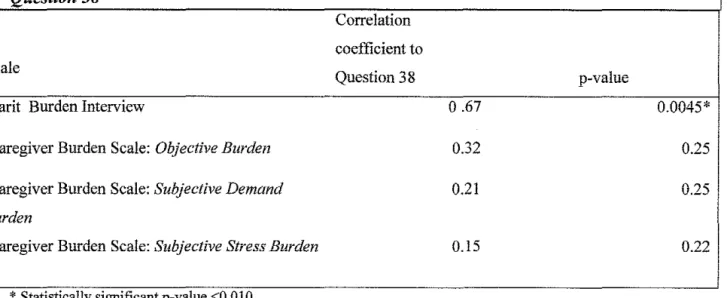
The Zarit Burden Interview had a highly statistically significant positive correlation with the Question 38 (R=.67, p-value=0.045, Table 3). Table 3 provides the correlation coeftlcients among the ZBI to Question 3 8, and to the three burden scales from the Caregiver Burden Scale with Question 38. In addition, Question 38 was not significantly correlated with the Objective Burden, Subjective Demand Burden, or the Subjective Stress Burden scores of the CBS. Table 2
Descriptive Statistics of the Zarit Burden Interview, Caregiver Burden Scale, and Question 38
Scale N Mean Median Std Min Max
Zarit Burden Interview 18.0 25.0 26.5 7.5 14.0 40.0
Caregiver Burden Scale: Objective Burden 15.0 21.2 20.0 2.5 18.0 25.0
Caregiver Burden Scale: Subjective Demand Burden 14.0 12.5 12.5 2.0 10.0 17.0
Caregiver Burden Scale: Subjective Stress Burden 15.0 12.2 12.0 2.1 8.0 18.0
Question 38: How stressfili is caregivingfor you 16.0 2.94* 4.0 0.7 3.0 5.0
I
Table 3
Correlation Coefficients of the Zarit Burden Interview, and the Caregiver Burden Scale to Question38
Scale
Correlation coefficient to
Question 38 p-value
Zarit Burden Interview 0 .67 0.0045*
Caregiver Burden Scale: Objective Burden 0.32 0.25
Caregiver Burden Scale: Subjective Demand
I
Burden0.21 0.25
I
Caregiver Burden Scale: Subjective Stress Burden 0.15 0.22*
Statistically significant p-value <0.01 0cannot attribute the observed decline in self-reported caregiver stress due to the respite program alone.
Graph 1
Stress Rating on Date DAAS Form Initially Completed and on Date of Baseline Interview
Bar Graph of Stress on Date DAAS Initially Completed and on Date Baseline Interview
16 -rc-~-c-:-:-c--~~-:-c-~--,
1~
10
~
~~~~'---="-~ +--"---~~~~'---="-~""'
0
Stress Rating
0 Date DAAS Form 101 ·
lnttial~ Completed
· a Date of Baseline Interview
Evaluation of Hypothesis 2: Impact of Recipient IADL-ADL Index and Length of Time Providing Care
There is little variation in the IADL-ADL Index scores in the stndy group and subsequently no significant relationship was able to be detected between impact ofiADL-ADL Index and caregiver stress as measured by the ZBI or Question 38. Table 4 provides the descriptive
statistics for IADL-ADL Index levels and Table 5 provides the correlation coefficient of the ZBI and Question 38, How stressful is caregiving compared to IADL-ADL Index scores. The
Caregiver Burden Scales were not considered for this evaluation, since these measures were not found to be indicative of the level of stress for this study population.
More than 80% of caregivers interviewed reported having provided care for more than one year. No statistically significant relationship was found between length of caregiving with the Zarit Burden Interview, or the three burden scales in the Caregiver Burden Scale, or Question 38, How stressfUl is caregiving (Table 6). Because the majority of caregivers have provided care for more than a year (median value of 4, > l year), there is little variation in length of caregiving which subsequently limits the ability to detect statistically significant relationships between length of care and caregiver stress. Expanded categories beyond the present should be included for future examination ofthese measures. Table 4 provides descriptive statistics on Instrument Activities of Daily Living and Activities of Daily Living Index. Table 5 provides information on the total length of care for caregivers. Table 7 provides details concerning the statistical
Table4
Descriptive Statistics of the Instrumental Activities of Daily Living and Activities of Daily Living Index Scores and Lenf(th of Care
Variable N Mean Median Std Min Max
IADL-ADL Index 13.0 11.7 12.0 1.1 4.0 13.0
Total Length of Caregiving
I
Table 5
<I month 1-6 months 7-12 months >I year Data not available
!Length of Care
0 0 2 (11%) 13 (72%) 3 (17%)
Table 6
Correlation Coefficients of the Zarit Burden Interview and Question 38 to Instrumental Activities of Daily Living-Activities of Daily Living Index Scores
Correlation coefficient Scale
to IADL p-va1ue
Zarit Burden Interview -0.23 0.47
Question 38: How stress/it! is caregivingjor you -0.13 0.69
Table 7
Examination of Relationship between Zarit Burden Interview, Question 38 and Caregiver Burden Scale to Length of Care
Cochran-Mantel- Cochran-Mantel
Scale
Haenszel Statistic (df) -Haenszel p-value
Zarit Bw-den Interview 0.3314 (1) 0.56
Correlation Coefficients of the Caregiver Burden Scale to Length of Care
Scale
Caregiver Burden Scale: Objective Burden
Caregiver Burden Scale: Subjective Demand Burden I
I
Caregiver Burden Scale: Subjective Stress BurdenCorrelation coefficient
to Length of Care
0.14
0.04
-0.22
Evaluation of Hypothesis 3: Relationship of Caregiver to Recipient
p-value
No statistically significant relationship was found between the caregiver's relationship to
0.62
0.90
0.43
the care recipient and the reported stress scores of the Zarit Burden Interview, or the three burden scales in the Caregiver Burden Scale, or Question 38, How stressful is caregiving. Graph 1 provides a summary of the relationships of caregivers to care recipients in this study. In general, providing care to a person is very stressful, regardless of this person is a parent or a spouse or child. Further analysis could not be performed on the relationships of caregivers to care
recipients due to the small sample size. Table 8 provides a summary of the Department of Aging and Adult Services 101 Form. These data indicate that this study group is mostly composed of middle-aged, married, African American women, who provide care to someone older.
Graph2
Relationship of Care Recipient to Caregiver
Relationship of Care Recipient to Caregiver
mOther !I!IParent
Table 8
Department of Aging and Adult Services Form Summary
Variable
Women Caregivers
Working Full Time Caregivers
Mrican American Caregivers
Married Caregivers
Mean Caregiver Age
Mean Care Recipient Age
Discussion
I
Value
61%
39%
61%
61%
64 years
I
79 years
I
The purpose of the Family Caregiver Support Program Questionnaire is to measure stress in an informal caregiver population over time. As mentioned in the introduction, informal
caregivers are those who provide "extraordinary, uncompensated care, predominantly in the home setting, involving significant amounts of time and energy for months or years, requiring the performance of tasks that may be physically, emotionally, socially, or financially
demanding" (Biegel, Sales, and Schultz, 1991). The FCSQ includes two instruments commonly used to measure stress in caregivers, the Zarit Burden Interview and the Caregiver Burden Scale. Limitations of this study include low participation (response rate of 46%). The ZBI was found to be statistically significant with Question 38, "On a scale of 1 to 5, with 1 not at all and 5,
While some questions on the Zarit Burden Interview and the Caregiver Burden Scale (CBS) are similar, the CBS may be more appropriate for screening and intervening with newer caregivers. For example, the ZBI asks "DO YOU FEEL that you don't have as much privacy as you would like because of your relative?" and the CBS asks "Do you have personal privacy?"
However, possible responses are slightly different. The ZBI questions a caregiver's burden at the current time. However, the CBS asks a person to compare their stress from a prior time. The choices are "A lot less," "A little less," "The same," "A little more," and "A Lot more. "For caregivers who have provided care for some time, it is hypothesized there maybe little variation in their levels of burden in day-to-day routines such as changes in manipulation of care recipient, vacation activities or trips, or tension in life over a two week period. Therefore, the CBS may be more appropriately used to measure changes in burden levels in newer caregivers who may need assessment and placement into support programs based on their answer to questions related to the burdens of Objective Demand, Subjective Demand, or Subjective Stress.
The Zarit Burden Interview is an appropriate tool to measure stress in a new or an experienced caregiver because it asks simply "Please answer the following questions about how you feel in the last 2 weeks." The choices are "Never/Rarely," "Sometimes," "Quite Frequently,"
and "Nearly Always. " These choices provide a person an opportunity to measure how they feel; it does not ask them to measure a difference in how they felt from before which may also introduce recall bias. The ZBI is a quick tool to measure stress in caregivers. The Caregiver Burden Scale which requires more thought and consideration is better suited to measure
The information from the Depat-tment of Aging and Adult Form 101 (DAAS) allows us to measure differences in stress between the dates of completing the application for enrollment in the Family Caregiver Support Program to the date of the baseline interview. There was an
observed difference in levels of stress or self reported health ratings at the time of completing the DAAS Form 101 and the time of the baseline interview (see Figure 2). This suggests that the current respite program does provide some relief in care giving. However, the program as presently offered-may not suffice since the median rate of stress at the baseline interview revealed a value of 4, "Quite a bit" stressed (see Table 2). It is interesting to note that the caregivers, on average, are very satisfied with the Council for Senior Citizens Caregiver
Program, as reported by a median score of 5 (Extremely satisfied) and a mean score of 4.1 for the question "On a scale of 1 to 5, with 1 not at all, and 5 extremely satisfied, how would you rate how satisfied you are with the caregiver program? "(Table 9) This suggests that the caregivers appreciate very much any assistance in care giving. Almost 90% of the caregivers in this program are the primary caretakers of their loved ones.
Table 9
Satisfaction of the Caregiver Program, Question 42 "On a scale of 1 to 5, with 1 not at all, and 5 extremely satisfied, how you would rate how satisfied you are with the caregiver program?"
Satisfaction
Value
Not at all satisfied 0%
Slightly satisfied 0%
Moderately satisfied 33%
Quite a bit satisfied 6%
Extremely satisfied 44%
It remains disconcerting to confirm the level of stress and burden these caregivers feel. According, to Bourgeois, Schulz, and Burgio (1996), respite interventions may not provide adequate amount of relief. The Council of Senior Citizens provides only six hours of respite care per month for a caregiver which may not be sufficient time to relax. Classes offered at the
Council of Senior Citizens include monthly educational programs (e.g., Taking Care ofYOU, Identifying and Reducing Personal Stress, Communication Feelings, Needs and Concerns). However, only 20% of the caregivers interviewed attended an educational program at the
Council for Senior Citizens. One frequently noted barrier to attending a class was "Who will take care of my loved one while I attend this class? ".
Recommendations
With t.'J.e fmdings from the baseline questionnaire, it appears the Caregiver Burden Scale does not provide an accurate measure of stress of caregivers already in the respite program who have provided care for at least 12 months. However, this may be due to small sample size of this study. Further research is warranted, but the data from the baseline questionnaire strongly suggests that the Zarit Burden Interview is a more accurate measure for caregiver stress. Therefore, at this time, it is suggested that the Council for Senior Citizens modify the current Family Caregiver Support Questionnaire by removing the Caregiver Burden Scale (questions 24-3 7.) The ZBI scores and Question 24-3 8 correlate at a significant level, suggesting that the ZBI is a valid measure for measuring stress and burden in caregivers. However, there was no significant relationship between Questions 38 and the CBS scores. The CBS may be more appropriate for initial assessment for newer caregivers who are new participants in this program. Further
on the 3 month follow up questionnaire is forthcoming. These data will help determine the reliability of the ZBI across time.
Appendix 1:
Council for Senior Citizens Summary Form
Stress Inventory- Family Caregiver Support Program
Interval 0 Baseline
Questionnaire Status
0 Complete Reasons Incomplete or Not Done
0 Incomplete~~~~~~~~~~~~~~~~~~ 0 Refused
0 Not Done ~~~~~~~~~~~~~~~~~~ 0 Too ill/deaf
Source
0 Caregiver
Interviewer Initials
Questionnaire Entered By: _ _ _ _ _ _ _
Questionnaire QC By:
0 Unable to locate
0 Death
0 Other _ _ _ _ _ _ _ _
Date: _ _ ! _ _! ___ _
MM/ DDYYYY
Date: I - -I
Council for Senior Citizens
Stress Inventory- Family Caregiver Support Program
Interval D Baseline
The purpose of this questionnaire is to understand how caring for someone may impact stress level. We understand that you are currently receiving respite care for someone you care for through an agency. Please answer the following questions about you, the caregiver. There are no wrong or right answers. Your answers will remain confidential and will not be released to anyone outside the research staff.
This questionnaire will take approximately 10-15 minutes.
Today's Date: __ ! _ _! ___ _
MM D D YYYY
Demographics
1. Your Current Working Status D Working Full Time D Working Part Time
D Unemployed I Looking for Work
D Retired D Disabled
D Other ____________________________________ __
2. Do you feel your work is stressful?
D No
D Yes-7-7-7-7-7-7-7-7-7 Does this impact your life at home? DNo DYes-7-7-7
If yes, please describe how:
3. Currently, how many people do you provide care for (not including yourself)? D 1
D 2
D >34. What is your relationship to the person your provide care for? Please check all that apply.
D Parent
D Spouse/Significant Other D Child
5. How long have been providing care? (note: if you are currently the caregiver for more than one person, please check the longest time you have provided this type of care.)
0 <1 month 0 1-6 months 0 7-12 months 0 >1 year
6. Do you receive any service or assistance with care giving? Check all that apply.
0 No
0 Yes-7-7-7-7-7-7-7-7-7 What services? 0 In home respite care
7. Do you feel you need any additional services?
0 No
0 Yes-7-7-7-7-7-7-7-7-7 What services?
0 Short term respite care(S? day) 0 Long term respite care (>7days) 0 Formal care giving
0 Financial assistance
0 Help with household chores 0 Adult day care
0 Transportation assistance 0 Private paid care giving (not through Council)
0 Other _ _ _ _ _ _ _ _
Check all that apply.
0 In home respite care
0 Short term respite care (S7 day) 0 Long term respite care (>7days) 0 Formal care giving
0 Financial assistance
0 Help with household chores 0 Adult day care
0 Transportation assistance 0 Private paid care giving (not through Council)
8. Do you live with the person you provide care for?
D
NoD Yes-7-7-7-7-7-7-7-7-7 Including the person you provide care for, and yourself, how many people live in your home? # of people 9. Does anyone else provide assist you in providing care for this person?
D
NoD Yes-7-7-7-7-7-7-7-7-7 Are you the primary care giver? DNo DYes
10. Is your current monthly household income more, less or about the same as a year ago?
D More D Less
D About the same D Don'tknow
D Prefer not to answer
11. How well does your household's income meet your household's basic needs (i.e., food, clothing, shelter, and medical expenses, including medicines)?
D Not at all D Somewhat D Adequately
D More than adequately D Don't know
Please answer the following questions about how you feel in the last 2 weeks. (Zarit Burden Scale)
Quite Nearly
Question Never/Rarely Sometimes Frequently Always
12. DO YOU FEEL that because of the time you spend with your relative
D
DD
Dthat you don't have enough time for yourself?
13. DO YOU FEEL stressed between caring for your relative and trying to
meet other responsibilities D
D
DD
{work/family)?
14. DO YOU FEEL angry when you are
around your relative?
D
D D D15. DO YOU FEEL that your relative currently affects your relationship
with family members or friends in a D
D
DD
negative way?
16. DO YOU FEEL strained when you
D
D D Dare around your relative?
17. DO YOU FEEL that your health has
suffered because of your
D
D DD
involvement with your relative? 18. DO YOU FEEL that you don't have
as much privacy as you would like
D
D D Dbecause of your relative?
19. DO YOU FEEL that your social life
has suffered because you are caring
D
D D Dfor your relative?
20. DO YOU FEEL that you have lost
control of your life since your
D
D
DD
relative's illness
21. DO YOU FEEL uncertain about what
D
D DD
to do about your relative?
22. DO YOU FEEL you should be doing
D
D
DD
more for your relative?
23. DO YOU FEEL you could do a better
D D D D
In the last 2 weeks, how has assisting or having contact with the person for whom you care affected the following aspects of your life? (Caregiver Burden Assessment)
Question A lot A little A little A Lot
less less The same more more
24. Do you have time to yourself?
0
0
0
0
0
25. Do you have stress in your relationship
with your relative?
0
0
0
0
0
26. Do you have personal privacy?
0
0
0
0
0
27. Do you have attempts by your relative
to manipulate you?
0
0
0
0
0
28. Do you have time to spend in
recreational activities?
0
0
0
0
0
29. Do you have unreasonable requests
made of you by your
0
0
0
0
0
relative?
30. Do you have tension in your life?
0
0
0
0
0
31. Do you have vacation activities and
trips?
0
0
0
0
0
32. Do you have nervousness and depression concerning your
0
0
0
0
0
relationship with your relative?
33. Do you have feelings that you are being taken advantage of by your
0
0
0
0
0
relative?
34. Do you have time to do your own work
and daily chores?
0
0
0
0
0
35. Do you have demands made by your relative that are over and
0
0
0
0
0
above what s/he needs?
36. Do you have anxiety about things?
0
0
0
0
0
37. Do you have time for friends and other
0
0
0
0
0
I
I
38. On a scale of 1 to 5, with 1 not at all and 5, extremely, how would you rate how stressful caregiving is for you?
1
2
3
i 4i'Jot at all Slightly Moderately
I
Quite
a
bit stressful stressful stressful stressfulPlease answer the following questions about YOUR overall health. 39. In general would you say your health is:
D Excellent D Very good D Good
0 Fair D Poor
40. Do you have an impairment that limits your activity?
D
No5
Extremely stressful
D Yes~~~~~~ Does this impact your ability to provide care? ~~DNa
DYes If yes, please describe how:
41. Have you attended an educational program for caregivers at the Council for Senior Citizens?
D No ~~Do you plan to attend caregiver education programs in the future?
D No
D Yes
D Yes~~~~~~ Please list below:
Title/Topic:
(When:--:-:--:--:---Were you satisfied with this program?
D
NoD Yes
Title/Topic: _ _
When:---:-::----Were you satisfied with this program?
D
NoD Yes
42. On a scale of 1 to 5, with 1 not at all and 5, extremely, how would you rate how satisfied you are with the caregiver program?
1 2 3 4 5
Appendix2:
Department of Aging and Adult Services Form 101 (DAAS Form 101)
• • • • CLIENT REGISTRATION FORM DAAS 101 (Long F o r m ) · · · · NC Department of Health and Human Services • Division of Aging and Adult Services
Check the applicable categoiY or categories below and follow corresponding directions. Service Codes
.
HCCBG- congregate nuffltlon (180), congregate supplemental meals (182), NS!P-only congregate meals {181) Sections I, II, and VII only.
HCCBG-general (250) or medical (033) transportation complete Sections I and VII only.
Family Coregiver Support Program (services 820, 830, 840, 850); and HCCBG Respite Services [In-hOme a!de respite (235, 236, 23 7, 238), group respite {309) and !nstltutlonal respite (21 O)J Sections I, VI, and VII (caregiver information) and Sections IU, tv, and V (care recipient information).
HCCBG -Care management {610), home-delivered meals (020), NSIP-only home--delivered meals {021 ), home--delivered supplemental meals (022) complete Sections 1. H, 1\1, v (If appropriate),VI (Jf approprlote), and VII
.
For all other HCCBG services complete Secffons I, IY, V (If appropriate), VI ~f appropriate), and VIIRegion Code Provider Code
1. Client (Caregiver) Status: Check the appropriate box. More than one box may be appropriate. Date 0 New Registration/Activate (complete all per lnslructlons above) ·
0 WaHing for 5ervice: service codes: _ _ _ _ _ _ (complete Section I ~ unit based
services only)
0 Inactive 0 applies to client/caregiver OR 0 appffes to care recipient 0 adult care home/assisted living 0 moved
0 altemative fMng arrangement 0 improved function/need eliminated
0 death 0 serviCe not needed/wanted
0 hospitalization 0 illness
0 other (specify) 0 nursing home placement
0 Change (complele section I, ~ems 2. 4. 5 and any changed items.)
2. Name
""'
I
FrnI
M.l. 4. Last 4 Digits SSN-3. Street Address linel 5. Date of Birth
MMDD~
0 Special Eligibility {under age 60)
Mailing Address une2 6.Phone#
-0 Nophone _ _ _
Clly
1-
Zip !County7. Sex 8.At/Below 9. Marital Status (check one) 10. Household size (check one)
(check one) Poverty
Ll single (never married) Ll lives alone D 21nhome
Level
IQ Female
(check one) D married D 3 or more In home lEi Male
0 Yes D single (divorced/Widowed) D group/shared home D No Ll refused to answer Ll refused to answer
11. Race Check one race which Check all 12. Hispanie/Latino (check one)
Ask: What is your race? client most closely that apply Ask: Are you of Hispwtic or Latino origin?
identifies
a. Black or African-American 101 0 D Yes D No
b. Asian 10 0 (a person ol CU!XIn, Mexican. Puerto fllcon. SOuth a Centro! Amelieon, or other c. American Indian 101 0 Spanish cU!u'a of origin. JeQC:lfC§ess of ICCe)
or Alaska Native 13. Primary Language Spoken
d. Wh~e 101 0 Ask: What language do you speak in your home?
e. Native Hawaiian/other 101 0
Pacific !slander Language
f. Unknown/refused ID 0 g. other (specify) D
14. Overall Functional Status: DWell 0 At-risk OHigh Risk (lt Section N is required, do not complete.)
Section II· Requhed onh for clients of HCCBG cong1egate meals, home-delivered meals, supplemental meals, NSIP-onJy meals and care management.
15. Nutrition Health Score
-"'"""""
a. Do you have an mness or condition that made you change the kind DYes ONo 0 and/or amount of food you eat?
b. How many meals do you eat per day? #
c. How many servings of fruit per day? #
d. How many servings of vegetables per day? #
e. How many servings of mllk/dairy products per day? #
f. How many drinks of beer, liquor, or wine do you have every day #
or almost every day?
g. Do you have tooth/mouth problems that make it hard for you to eat? DYes ONo 0
h. Do you always have enough money or food stamps to buy the food you need? DYes ONo 0
I. How many meals do you eat alone daily? #
j. How many prescribed drugs do you take per day? #
k. How many over-the-counter drugs do you take per day? #
I. Have you lost 1 0 or more pounds In the past 6 months without trying? DYes ONo D
m. Have you gained l 0 or more pounds In the past 6 months without trying? eves CJNo 0
n. Are you physically able to shop for yourself? [JYes [JNo D
o. Are you physically able to cook for yourself? DYes ONo 0
p. Are you physically able to feed yourself? oves ONo 0
DAAS-101 (ReviSed0?/09{2007) Page 2of4
-Section III: Complete on the cme renpwnl {not ctuegiver) fm HCCBG 1cspite {in-home aide 1espite, group respite and mstitutiooc~l resplt~'} & Pamily Caregiver Suppo1t Prog1am.
CARE RECIPIENT #1 (For additional se1Vice recipients, attach an additional DAAS-101, Section III, J1l and V.)
16. Name
""'
I~
I
M.l. Last 4 Digits SSNStreet Address Unel
Mailing Address line2
Date of Birth
C'v
l"are
I""
--;;r.;;-_D_D_nn
17. Is care recipient a person with severe disabilities? DYes ONo
18. Does care recipient live in same household as caregiver? [JYes QNo
19. Care recipient marital status: (check one) 0 ~ngle {never married) 0 single (divorced/Widowed)
omarrled CJ refused to answer
Section IV. Complete iOJ all clients/tecipients except congtegate nutution, transportation 01 nunm reldhve chilfhen without se\ele d1sab1lit1es fox FCSP.
20. Does client {care recipient) have significant melnory loss or confusion? '1-DYes ONo
21. Number of IADL
(Instrumental Activities
of Daily living)
Cllent(care recipient) can
corry out 1he
following tasks
without help.
1---,----J hassomeone
YES NO who'"""'-unpaid
22. Number of ADL (Activities of Daily Uving)
f. Ambulate {walk or move about the
a-i#22is
no
""""·
23. How many unpaid caregivers involved in care including primary caregiver'? Enter # _ _ _ _
Section V: Complete f01 IICCBG respite, FCSP, and others responding with "J" 01 more in# 23.
24. How many hours per day of help, care, or supervision does care recipient need?
a. # of dally hours needed b. If not daily, # of hours per week needed
25. How many hours per day of help, care, or supervision does primary caregiver provide?
a. # of daily hours provided b. If not dally, # of hours per week provided
26. Primary caregiver's relationship to care recipient: {check one)
0 wife 0 granddaughter/granddaughter~Jn-law
0 husband 0 grondson/grandson-ln·law
0 daughter/ daughfer~in~!aw 0 niece
0 son/son·ln-!aw 0 nephew
0 sister 0 mother
0 brother 0 father
27. Primary sell-reported health on scale of I (poor)
to5
28. Primary caregiver: How stressful for you is caregiving on a scale !rom I (not at all/Very low) to S (very high) {Choose one.)
0 grandmother
0 grandfather
0 aunt
0 uncle
0 other relative
0 non-relative
D Full-flme D Part-flme D Is not/Was not working 0 Retired early due to caregivlng
0 Quit due to ca~egMng
D Retlredltull benefits D Lost job/dismissed due to caregiving
30. Is the primary caregiver a long distance caregiver¥ 0 Yes 0 No
Section VII: REQl-IRED FOR ALL CLIENTS. ~"" _?{~4~.
I, the client. understand the Information contained on this form will be kept confidential unless disclosure is required by court order or for authorized federal, state or local program reporting and monitoring. I understand that any entitlement I may have to Social Security benefits or other federal or state sponsored benefits shall not be affected by the provision of
the aforementioned Information. My signature authorizes the providing agency to begin the servlce(s) requested.
DATE: _ _ _ _ _ _ _;CUENT(Caregiver) SIGNATURE: _ _ _ _ _ _ _ _ _ _ _ _ _ _ _ _ _ _ _ _ _ _
MI'E''---~AGENCYEMPLOYEE S I G N A T U R E '
-EMERGENCY CONTACT PERSON
Name: ____________________________________________________________________ ___
Phone (day): _______ -_ _ _ _ :___________ {evening): _________ -_______
---0 Refused to provide emergency contact Information
Appendix3:
Information to be abstracted from Client Registration Form DAAS 101
Question Caregiver Recipient of Care
1. Age (calculate from DOB)
2.
Gender DMaleD Female
3. At/below poverty D No
level DYes
4. Marital Status D Single/never married D Single/never married D Married/living as married D Married/living as married D Divorced or Widowed D Divorced or Widowed D Refused to answer D Refused to answer
5.
Race D Black or African-AmericanDAsian
D American Indian or Alaskan Native
DWhite
D Native Hawaiian/other Pacific Islander
D Unknown or Refused D Other
6.
Is care recipient a minor child with mental retardation or developmental disability?D
No DYes7. Does care recipient have significant memory loss or confusion?
Information to be abstracted from Client Registration Form DAAS 101 cent
If the answer to items 49-56 or items 58-63 are "no" then select one of the following:
Client (care
I
Client (carerecipient) can carry Client (care Client (care
I
recipient) out the following recipient) recipient ) cannot do tasks without help. cannot do cannot do and hasI
and has and has both Client (care Number of IADL someone someone unpaid and recipient) (Instrumental Activities of Daily unpaid who paid who paid has no one Living)
YES
NO assists assists assistance to assists. 8. Prepare meals prepare9. Shop for personal items
iO. Manage own medications
11. Manage own money (pay
bills) t
12. Use telephone
13. Do heavy housework
14. Do light cleaning
15. Transportation ability
16. Total "no column"=IADL impairments
17. Eat
18. Get dressed
19. Bathe self
20. Use the toilet
21. Transfer into/out of toilet
22. Ambulate (walk or move
about the house without one's
help
Total "no column"=ADL impairments
..
23. How many hours per day of help,care or superviSIOn does care rec1p1ent need?
_ _ _ .hours _ _ _ _ .if not daily , # of hours per week needed
24. How many hours per day of help, care, or supervision does primary caregiver provide?
_ _ _ .hours if not daily , # of hours per week needed 25.1s the primary caregiver a long distance caregiver? oNooYes
I
I
I
26. House hold size _ _ _
27. Household size oLives alone 02 in home o3 in home
oGroup/share home oRefused to answer
28. Care recipient a person with severe disabilities? oNooYes
29. Does care recipient live in the same household as caregiver(# 18) oNooYes
30. How many unpaid caregiver involved in care including primary caregiver? (#23)
31. Primary caregiver's relationship tci care recipient Wife
Husband
Daughter/daughter-in law Son/son in law
Sister Brother
Grand-daughter/drand-daughter in law Grand-son/grand son in law
Niece Newphew Mother Father
Grandmother Grandfather Aunt
Uncle
Other relative
32. Primary caregiver's self-reported health on a scale of I to 5 _ _ _ _
Works Cited
Bedard M, Molloy DW, Squire L, Dubois S, Lever JA, O'Donnell M (2001). The Zarit Burden Interview: a new short version and screening version. Gerontologist. 2001
Oct;41(5):652-7.
Biegel, D., Sales, E., and Schulz, R. (1991). Family caregiving in
chronic illness: Heart disease, cancer, stroke, Alzheimer's disease, and chronic mental illness. Newbury Park, CA: Sage Publications.
Bourgeois MS, Schulz R, Burgio L. (1996). Interventions for caregivers of patients with Alzheimer's disease: a review and analysis of content, process, and outcomes. International Journal of Aging of Human Development 43:35-92.
Collins Concise Dictionary 4th edition 1999 Collins
Montgomery, R.J.V., Borgatta, EF and Borgatta, ML (2000). "Societal and Family Change in the Burden of Care." Pp. 27-54 in Who Should Care for the Elder!~? An East-West Value Divide, (p. 27-54) edited by W.T. Liu & H. Kendig. Singapore: The National University of Singapore Press.
North Carolina Department of Health and Human Services (2009). Personal Care Service FAQs. Retrieve April4, 2009 from http://www.ncdhhs.gov/dmalpcs/032009pcsfags.pdf
North Carolina Division of Aging and Adult Services (2009). Adult Services Directory. Retrieved April4,2009 from http://www.ncdhhs.gov/aging/services/inhomedescr.htm Office of Women's Health (2008). Caregiver Stress. Retrieved January 14, 2009 from
http://www.4woman.gov/fag/caregiver-stress.cfrn.
Vitaliano PP, Zhang J, Scanlan JM (2003). Is caregiving hazardous to one's physical health? A meta-analysis. Psychological Bulletin. Nov; 129(6):946-72.
Yu, J and Cooper, H (1983). A Quantitative Review of Research Design Effects on Response Rates to Questionnaires, Journal of Marketing Research, Retrieved April2, 2009 from http://www.jstor.org/pss/315141 0
Zarit, S. H., Orr, N. K., & Zarit, J. M. (1985). The hidden victims of Alzheimer's disease: Families under stress. New York: New York University Press.