Communicating the Value of Services on the World Wide Web. A Master's paper for the M.S. in L.S. degree. November, 2002. 55 pages. Advisor: David W. Carr.
Map librarians face communication challenges in promoting their collections to an academic community. The interdisciplinary nature of map collections, combined with the lack of experience many patrons have with spatial data, make it difficult for map collections to claim a well-defined user group. Map librarians must communicate to a broad group in order to alleviate patrons’ intimidation and to encourage exploration of map collections. The World Wide Web is a communication medium that is effective for reaching a wide audience.
This paper analyzes the contents twenty-six academic map collection websites. Special attention is devoted to accessibility, elementary and advanced description of spatial data tools and resources, the provision of online map resources, and the presence of instructional documents and services.
Headings:
Library websites.
Map Collections—Public relations. Academic libraries—Public relations.
PROJECTING THE MAP COLLECTION : ACADEMIC MAP LIBRARIES AND COMMUNICATING THE VALUE OF SERVICES
ON THE WORLD WIDE WEB.
by Jessica Kilfoil
A Master's paper submitted to the faculty of the School of Information and Library Science of the University of North Carolina at Chapel Hill
in partial fulfillment of the requirements for the degree of Master of Science in
Library Science.
Chapel Hill, North Carolina November, 2002
Approved by:
Table of Contents
Introduction ……….3
Literature Review………..………7
Methodology………...25
Results……….…29
Discussion………..….30
Conclusion………..46
Appendix A……….…49
Appendix B……….50
Introduction
In an ideal library, perhaps, maps would be classified with complementary books in the each section of the library, where patrons could pull them easily from the shelves during the course of their research or browsing in subject areas. Historical maps would accompany related books; weather and ecological maps would be shelved in the science library; religious, sociological, census, decorative, and other maps would find their place in the library stacks. Unfortunately, due to the peculiarities of format, these maps are typically separated from their linear counterparts in a library.
There are many reasons for this separation. Unique preservation needs of
cartographic materials necessitate flat storage. A logical, geographically-based classification schedule ensures that maps inhabit spaces in a library that are closer to other maps and geographic references than to any related subject of an individual map. Specialized technical knowledge is required of the map librarians who manage map resources. According to Mary Larsgaard in the third edition of Map Librarianship: an Introduction, map librarians must be proficient with “spatial data (history, how to interpret them, how they are made, and how to care for and provide service for them), selection, acquisition, classification, cataloging, storage, reference, marketing, preservation, management, and cartobibliography” (301). Not every librarian is familiar enough with the format or reference sources to provide assistance, even if they specialize in history, meteorology, ecology, or other map themes.
be the term used herein to describe the department or branch within an academic library that houses paper and digital spatial data, including: atlases, map reference tools such as
gazetteers and place-name thesauri, geographic information systems (GIS) and their data sets, and related serials. In many instances in this paper, the term maps will be used interchangeably with the term spatial data. Both terms signify information that is based on geographic systems. In the case of maps, the data are expressed pictorially or symbolically on sheets or in digital format, usually through cartographic processes. Maps include charts, diagrams, grids, and other pictorial representations of data based on geographical components. The term spatial data includes maps, but also includes atlases, dictionaries, serials, gazetteers, indexes, and other tools associated with the study of maps. Map collections
contain maps and spatial data.
The outsider status of map collections, which prompted William L. Hall’s frequently quoted suggestion that “Maps are often the stepchildren of libraries,” has nothing to do with the information value of spatial data. Most university and college libraries contain a spatial data collection. Spatial data continue to be active parts of academic collection development because of they are valuable to many types of patrons. Spatial data, in all formats, convey worlds—literally—of information. Academic libraries collect and manage graphic and cartographic resources because this format expresses data efficiently.
disciplines—such as geography, geology, and city planning—have traditionally been connected with spatial data in research and data collection. Many other disciplines— including life and social sciences—may also benefit from spatial data. Many patrons lack experience in spatial data use. Two problems stem from unfamiliarity with spatial data: inexperienced patrons may not recognize the value of spatial data resources in their subject discipline, and they may not recognize the value of spatial data for creating patterns and illustrating ideas. The exclusion of spatial data collections from many patrons’ research plans puts map librarians and curators at a disadvantage. In addition to managing their collections, they must put effort into promoting the value of their collections to potential patrons; once patrons enter, map librarians often act as instructors in the most basic skills needed to locate, interpret, and cite spatial data materials.
Promotional communication is not often discussed in the context of academic librarianship. But in academic map collections, promotional communications were in the forefront of discussion between the early decades of map collections in libraries and the 1970s. Numerous articles appeared in map library publications providing tips for luring patrons into map collections. In “A Case Study In Promotion and Use of the Map
Because the potential clientele for a map collection is unclear, map librarians must widely communicate the value of their collection. Recommendations for promotion include all varieties of written and verbal outreach, aimed at academic and public communities. Now, thirty years later, there is less discussion of luring patrons in. Through the 1980’s and 1990’s, major changes took place in the tools that librarians used to organize collections and inform patrons and potential patrons of their collections.
Literature Review
Map collections provide valuable spatial resources for many academic disciplines; the contents and services must be communicated to the community of users. To answer the question, “What is a collection,” Hur-Li Lee provides the following description:
Collections facilitate information seeking. An immediate collection
provides the first level of access where users of the community may retrieve needed quality information readily and conveniently. This collection may not exist in isolation, and its users should have flexibility and support to reach beyond this level of access when they need to do so (1111).
The value of spatial data is offset by the lack of familiarity most patrons have with the use and retrieval of such resources.
The value of spatial data
Most library materials convey information textually or verbally. Spatial data materials, having few words, convey information graphically. In his essay “Visualization in Historical
Describing the importance of spatial data as cognitive and communication tools, W.G.V. Balchin stresses the necessity of “the communication of spatial information that cannot be conveyed adequately by verbal or numerical means” (Balchin 216). That which in text is convoluted with prepositions and adjectives—like a simple geographic description of Georgia, which is north of Florida, east of Alabama, bordering South Carolina to the north and northeast, and bordering North Carolina a little on its northwest tip, to say nothing of major cities, vegetation, ports, or transportation—may be simply conveyed in a map. In his essay “Visualization in Historical Context,” Michael Wood states, “When something is visualized, the viewer is brought closer to understanding it” (14).
To contrast this visual communication of spatial relationships with a textual communication, a 1993 study of spatial language by Landau and Jackendoff showed that “language used to describe the location of an object or place usually relies on a limited number of prepositions (only 80-100 spatial locatives are used in the English language) that are open to interpretation unless qualified with precise numerical information (Kitchin and Blades 78-79). To contrast the graphic communication of spatial data with physical
existence in a place, R. Lloyd [cited by Michael Woods] demonstrated that “for distance and directional information […] 10 minutes of map study was more effective than 10 years of living in an environment” (Woods 15).
W.G.V. Balchin states, “The well-educated person will be articulate, literate, numerate, and graphicate” (217). While the first three of his four requirements are quite common, the last is not something that is often discussed in education. In Map
institutions, works towards creating learners and thinkers. Schools of higher education strive to ensure that students are educated and competent in a variety of life skills. A related topic, creativity, seems at times to lack credibility in the halls of higher education. Yet imagery and creativity are related. In his essay, “Cognitive Issues in Cartographic Visualization,” Michael Peterson summarizes research by R. Finke, showing “how images can stimulate the
discovery of unexpected patterns, new inventions, and creative concepts” (36). Edward Tufte also assigns higher-order thinking to imagery and visualization: “We envision information in order to reason about, communicate, document, and preserve that knowledge” (33).
Numerous geographers write about the research and cognitive values of spatial data in learning and creating knowledge. Two of Mark Monmonier’s books on the subject of map use in research and learning, one a general and the other a Humanities and Social Sciences, are cited in this paper. Other geographer-educators whose work is useful are Paul A. Longley, who writes about the multidisciplinary potential for GIS, and Alan M.
MacEachren, whose focus is on the communication value of maps. Both are notable authors in the field of teaching and learning with spatial data.
Contemporary and historical maps are, in the simplest terms, pictures of the world. They capture a specific idea—with numerous opportunities for complexity—in space and time.
Map collections in the library
Within an academic library, departmental and subject collections are a part of a larger system of collection development, organizational culture, information focus, and
thinking and doing things the way the organization thinks and does things” (Powers 478). The Association of College and Research Libraries (ACRL) defines such component collections as ‘branch’ libraries; they may also be called ‘departmental’ (if they originated in response to the need of one academic discipline, such as geology) or ‘special collection’ libraries.
In the 1990 guidelines the ACRL developed for branch libraries, the description states, “the primary mission of the branch library is to provide information and access to information to meet the instructional and research needs of its user group […] as well as the cross-disciplinary needs of others in the academic community” (171). Each branch library must provide certain resources, including “competent staff […] staff is a primary link between the communities needs and the library’s services and collections” (172). Whether students and patrons know of the availability and uses of spatial data is up to instructors and librarians.
Since before Robert S. Taylor wrote his 1968 article “Question-Negotiation and Information Seeking in Libraries,” librarians have struggled with the problem of how the user, in a self-help environment like a library collection, “depends on his own knowledge, frequently incomplete, of the system” (Taylor 179). In collections of spatial data, incomplete knowledge may be magnified. Barbara Tiberio, a map librarian at the State University of New York in Bingamton, claims “the lack of the most elementary cartographic skills [among users] will probably surprise the map librarian” (51). Larsgaard states, “Americans in general are less map-conscious than are Europeans, perhaps due to the low status of geography in education at all levels” (275). Describing the spectrum of patrons, Larsgaard states “One category, for example, is made up of those who do not know how to read a map but who are interested in using spatial data” (274). The potential map collection visitor may not know that he or she could use spatial data resources at all, or how widely spatial data can be applied.
Robert S. Taylor uses a coincidentally apt metaphor to describe a major problem for map librarians when he describes the anomalous states of knowledge that surround a library visitor, who might have “a certain incompleteness in his picture of the world—an
inadequacy in what we might call his ‘state of readiness’ to interact purposefully with the world around him,’ in terms of a particular area of interest” (Taylor 180-181). Taylor’s model goes on to describe the importance of the reference librarian in creating new boundaries in the patron’s ‘picture of the world.’
the knowledge of the types of sources, much of map reference requires a knowledge of maps” (181). An unusually formatted collection, maps may not fit precisely into a system created for textual information in book form (Weimer 386; Rockwell 40).
In the information age, profligate information necessitates open lines of
communication between librarians and patrons. Patrons of academic libraries—students, faculty, staff, researchers, and often the public—are presumed to know the services and tools that will best provide them with the information they need. Yet in the large academic library, information in all formats is relegated to many areas and collections. Patrons may have to explore multiple library departments and collections in order to meet information needs. Because search tools depend upon collections, cataloging, format, and location of materials, patrons may have difficulty navigating library resources. Effective information retrieval is affected by patrons’ familiarity with the organization and availability of
information within a library system.
Promotion of specific collections within a library system cannot begin effectively until it is decided “what you are offering and to whom” (Coote 23). For map collection staff, what is being offered is relatively stable, with the newest change being GIS technology. To promote services to a general audience ‘audience’ requires organization and planning. Map collection staff must look at the information and pedagogical needs of the academic community and decide from that point how to present their collections.
Promotion and Communication
describe activities and relationships that a librarian adopts in order to communicate the value of his or her collection and services to the public, including those that are defined in the literature as public relations, marketing, advertising, and other similar phrases.
Helen Coote, the author of How to Market your Library Service Effectively, uses the Chartered Institute of Marketing’s definition to define marketing as: “the management process responsible for identifying, anticipating, and satisfying customer requirements” (6). It is important that the librarian proactively communicates the library’s missions, goals and services. This helps to clarify the role of the librarian in the mind of patrons and potential patrons, the public, and the institution in which one is a part. Richard L. Daft describes promotional activity as a “major strategy for handling environmental uncertainty” (84). In a library, uncertainty may arise from unclear expectations of patrons, from internal changes in services and staffing, or from a variety of decisions and imperatives that ones institution enacts. Student patrons are usually working to deadlines and often wish to expend the least amount of effort to accomplish a task.
A wordy definition of public relations, created by Rex Harlow from numerous other definitions, describes the many facets of promotional activities:
Public relations is the distinctive management function which helps establish and maintain mutual lines of communication, acceptance, and cooperation between an organization and its publics; […] helps management keep abreast of and effectively utilize change, serving as an early warning system to help anticipate trends; and uses research and sound and ethical communication techniques as its principal tools. (Steinmacher 12)
assessment of resources and needs. Finally, to “effectively utilize change” parallels Daft’s earlier definition of promotion; to use change is to decrease uncertainty in the face of it.
Coote, with her stress on marketing strategies, is one of the few who states that promotional activities are important for all libraries, “public, academic, or special” (3). Public relations, marketing, and promotion are words not often associated with the job responsibilities of academic librarians. A common assumption in the field is that a collection—by virtue of the library’s considerate selection and careful augmentation, maintenance, and organization—should naturally attract and satisfy patrons.
Cosette Kies, a proponent of library promotion and a prolific author on the subject, states that number of academic libraries do not have written public relations goals and objectives in their mission statements (90). Why should they? The library presumably acquires those materials necessary for the research needs of the academic community. Selections are traditionally based on institutional strengths, faculty and student research interests, and historical strengths, limited by budget. Even if the librarians do not know every patron, they may assess the users’ needs through communication with the faculty, staff, and academic administration. The community of users in an academic setting depends on the library to meet information needs, which in this setting often revolve around curriculum needs. Academic libraries are considered “the first and basic requirement of the institution” (Harrison 11). Patrons “will be different for different libraries, depending upon each institution’s purpose and potential audience” (Larsgaard 274).
simply assisting with retrieval of necessary information, librarians will understand the pedagogical incentive of assignments. Hope, Kajiwara and Liu explore the challenge faced in the modern academic library as the support of information literacy, which must build upon a foundation of core-curriculum research skills (30).
Important changes in the library, academic, and Web environments have led librarians to describe their “increasing roles as teachers, in formal instruction classes, from the reference desk, and as partners in developing information literacy programs to meet new university curricular requirements” (Hope, Kajiwara and Liu 15). Branch libraries are at an advantage in this requirement, with the responsibility to “serve as an effective liaison between the faculty, staff, students, and administration of the schools or departments served” (ACRL 173).
The primary problem with this plan to increase the teaching responsibilities is that instructors often “have not thought about the library” in the stages of curriculum
development (Hope, Kajiwara and Liu 30). Participation in “course planning and curriculum development, provision of subject based guides and bulletins” and other academic interests assists librarians bringing about student’s achievement of “departmental or institutional goals” as well as their own goals in fostering information literacy (19).
According to Heery and Morgan, the main focus of the academic librarians should be “service-orientation,” which is similar to the general definitions of promotional
complements the earlier definitions of Harlow and Daft, by “utilize change … to help anticipate trends” (Steinmacher 12).
Before seeking information, however, a patron must make the decision based on an information-need to seek answers in a library. In academic institutions, the library is a natural choice. As Robert S. Taylor describes, the patron must make a decision to choose the library; factors in this decision include familiarity with the library environment, and ease of access (181). If the patron has little or no experience with the library, the information-need may be prolonged or unmet. Larsgaard makes an important statement while discussing public relations and marketing in Map Librarianship, that “Reaching out to the casual user or the nonuser is a difficult procedure” (288). As will be discussed later, the Internet acts as a potential communication medium that ‘reaches out’ to the distant user or non-user.
Carlos Hagen states, “In a large university, the map library serves the needs of the entire campus community” (47). In this circumstance, the target audience must begin with those closest to the service, the faculty and students. In his article on course-related library Web pages, Patrick Ragains argues, “In middle- to large-sized universities, students often have limited exposure to library instruction” (86).
Representing the importance of communication in the map collection, the Special Libraries Association Geography and Maps Division Standards for University Map
common practice; their inclusion is not unusual in the standard. Promotion is more surprising. In promotional services, the “Commentary on Standard A.1” explicates:
Promotion of the map collection shall be through publications, presentations, and exhibits. While reference and instructional services facilitate structured contacts between librarians and users, promotional activities educate and inform individuals who may not be aware of the availability and value of cartographic materials […] (2).
This standard raises the responsibility of the academic map collection from the role of acquirer and manager to educator and informer. These roles are seemingly considered separate from the reference and instructional roles that map librarians must fill. The Web is
becoming a powerful tool for all these responsibilities; a growing number of libraries “have developed or are developing instructional websites” with the goal of empowering students in the information-seeking environment (Hope, Kajiwara and Liu 26).
Reference, instruction, and promotional communication may easily coexist on the World Wide Web. Rather than reaching out to “individuals,” as the standards recommend, the collection website provides the potential for communication with hundreds of patrons simultaneously; reference, instruction, and promotional communication. In “Bibliographic Instruction on the Internet,” Gillian Allen states that choosing instruction topics, the intended audience, and active methods for tutorials should be a highly self-evaluative procedure (147-148).
Libraries have moved rapidly from paper to electronic catalogs over the past twenty years, a process that improves access from remote locations around the clock. Map
to David Cobb (50). If larger percentages are cataloged, it is often through an internal system and is “not represented in the library’s online catalogs” (50). Retrospective
conversion is causing a move towards online cataloging, but spatial data remain inaccessible from remote locations for as long as the conversions take (Andrew 406).
Cataloging is not often considered a promotional activity in library culture; yet the difference between cataloging in a small card catalog locked in the basement map collection and the presence of the same catalog information in an online public access catalog (OPAC) could mean an increase of patronage. In an article for the “Maps and Related Cartographic Materials”issue of Cataloging and Classification Quarterly, Kathryn Womble states,
“Mainstreaming maps by cataloging them in a centralized online catalog along with books, journals and other library materials will provide the avenue of access that the users of these materials deserve” (414).
Map collection communication
The two dominant approaches to writing about library promotion seem to be the theoretical exposition and the handbook. The first approach, described above, speaks of the library taboo on promotional activity but works through the costs and benefits rationally. The promotional literature that specifically describes map collections is pragmatic, based on the theoretical value of such communications and activities. For map collection libraries and curators, promotional literature mainly takes the form of the handbook: lists of suggested steps to take towards practical promotional expenditures of time and energy.
Librarians may perform some simple and natural activities to successfully
creation of information sheets listing such items as “location, hours, categories of materials housed, major holdings […] and the compilation of bibliographies of interest to broad cross sections of potential patrons” (50). Olsgaard and Van Balen describe a successful
cartobibliographic promotion with the University of South Dakota in Vermillion map collection; their method depended on “four mechanisms to promote the map/travel collection: handouts, newspaper articles, general campus mailings for new map and document acquisitions, and displays” (108). Essentially, the public relations activity on which the article focused was based on a selected audience—college students who might have time and resources to plan vacations and travel—and created lists of spatial data resources that might help the audience plan adventures.
Those articles that listed specific methods that communicate the existence and strength of the collection have numerous commonalities. The most popular of the guidebook recommendations, synthesized, include:
• Exhibits highlighting a thematic or attractive collection of the map collection’s materials.
The creation of exhibits highlights a certain collection or feature of the map collection. Because imagery dominates in many spatial data formats, maps and atlases may be selected for visual or emotional impact. An exhibit theme may be chosen to highlight a collection strength, to pique the interest of a wide variety of patrons, or to celebrate a local event. (Tiberio 44; Larsgaard 290; Olsgaard and Van Balen 108; Harrison 97; Barrow and Hudson 27).
• Creating cartobibliographies—compiled on-site or acquired from another source—that highlight a
Many agencies that are linked closely with the creation and use of spatial data—like the USGS, the Census Bureau, the Sanford Insurance Company, and National Geographic— publish cartobibliographies. If a collection has significant holdings published by an
agency—as a government repository might—a cartobibliography is a good investment. Such a list helps researchers see the scope of publications. Authored cartobibliographies, those that are compiled by a researcher based on a theme or subject, might also be useful to researchers who wish to consult maps for a specific research endeavor, like a Civil War project or a local history. The last type of cartobibliography, which takes more time and effort, is that produced by a librarian describing his or her collection’s specific holding. (Larsgaard 288; Olsgaard and Van Balen 109; Barrow and Hudson 27; Harrison 35; Tiberio 51)
• Research guides for a specific topic or class, perhaps naming a variety of sources, from cartobibliographies to
gazetteers and pertinent publishers.
Guides assist patrons in finding related sources, regardless of format. A research guide for an ecology class, for example, might list the primary index for the topic, agencies that produce ecology maps (with contact information), specific general map titles, and any materials on CD-ROM, online, or in other collections that could prove rich for researchers. This complies with Cosette Kies recommendation for a practical way to get started with a promotional endeavor, “the identification of target audiences […] and the promotion of specifics to particular groups” (45). One conversation with one professor could potentially bring him and fifty of his students into the collection. (Larsgaard 288; Tiberio 50).
in one major way—use of the World Wide Web as a tool to communicate map collection holdings and services to a broad range of patrons and potential patrons. One additional recommendation, only found in more recent publications, suggests:
• Maintaining an informative website that lists hours and some service highlights.
Larsgaard describes potential Web usage for several sections of the public relations chapter. Barrow and Hudson, in addition to recommending online exhibits and bibliographies, suggest “post campus/community map meetings on Maps-l, campus homepage, electronic bulletin boards, the local ‘free-net’” (27). (Barrow and Hudson 29; Larsgaard 287).
Homepages and the library collection
In “A Primer on Developing and Using Course-related Library Web Pages,” Patrick Ragains discusses subject-related websites, stating he “has found this type of Web page to be a well-accepted access tool and an effective supplement to the one shot [bibliographic instruction] session but not as a replacement for group instruction” (89).
According to Kristen Garlock and Sherry Piontek in Designing Web Interfaces to Library Services and Resources, website design should be influenced by four primary factors:
• Statement of the problem • Target audience
• Information organization • User interface (4).
faculty. Information organization and user interface should mainly make the site navigable. Web interfaces to academic sources should be “as intuitive as possible” and should exist mainly to organize information so users may effectively use the information provided (Hope, Kajiwara and Liu 32).
Ragains recommends library subject pages have definite contents, including: • “Links to points on the library website, including the library home page, the online
catalog, a page of reference information …
• A subject-related list of proprietary online indexes and databases.
• Recommended subject-related websites that are freely available. These sites include, but are not limited to, subject gateways, scholarly associations, government organizations, and interest groups” (86).
A site with multiple levels of information should provide “a few simple, categorical selections and then branch into specifics” (Hope, Kajiwara and Liu 6). Problems may arise in the “information organization” stage of website design. Hur-Li Lee describes:
Collections of information resources should be developed with a policy that provides all necessary parameters for the collections, including a definition of the user community, collection scope, format, and depth. Collections have interrelationships with each other and some collections are subsets of others (1111).
A library website probably has numerous categorical choices that branch into widely different services and materials. According to Lee, the community of patrons should be considered in the phrasing and description of categories at all levels. Naming links with jargon or vague terms (such as “OPAC” or “resources” or “databases”) is acceptable, assuming that everyone knows what these terms mean (Klein 37). For online map
As a fundamental necessity in the academic environment, librarians are facing the problem of changing patron culture. Hope, Kajiwara, and Liu state that busy students increasingly value “convenience over quality” (18). Lee states, “Research indicates that users tend to base decisions in information seeking on their own benefit, cost, and/or effort (1110). When a perfunctory search of the online catalog returns an adequate number of sources (some with the added convenience of being ephemeral digital documents), students may not seek further. Web presence is therefore vital to the average library collection. All available digital resources should be used and linked online. Additionally, materials that are impractical in an online environment should be described and promoted so patrons may realize the value of resources that are stored in paper or non-networked formats.
The digitization of library materials is perhaps the ideal for access and preservation for any library collection. The Library of Congress is hoping to mount more than 60,000 map and cartographic images for the National Digital Library project (Fitzpatrick 62). The Online David Rumsey Collection, a digital map collection of approximately 7200 items, had more than 100,000 visitors during its first six months of existence; the average visitor explored the site for twenty minutes (Rumsey 97-98). For preservation, accessibility and reaching out to atypical patrons, digital pictures are advantageous. Digitization of images simplifies browsing, increases public accessibility and search flexibility (Arms 381).
the print and the background” (Corsmeier 14). The process of digitization requires space, hardware, software, and large amounts of money. A plan must be created in order to select and prioritize materials that warrant digitization (Fitzpatrick 66). Corsmeier would say size is detrimental to the effort; additionally, copyright law and the need to provide spatial metadata and cataloging deter collections from digitization pursuits (Corsmeier 19; Arms 383; Rumsey 103).
Methodology
The purpose of this study is to find a pattern in the information provided on the websites of large academic map collections. A collection-specific website allows the academic map collection to communicate the unique holdings it offers to the library community. Web pages inform patrons and potential patrons of the organization, research services, tools, and major types of materials offered in the collection. Additionally, map librarians may take the opportunity to answer common questions, to address information needs, and to act as a starting point for information-seekers unfamiliar with spatial data resources. To find a pattern in map collection web pages, I plan to closely study the organization of twenty-six academic map collection websites.
Selection
The initial list of potential participants was compiled from the World Directory of Map Collections and the ALA Guide to U.S. Map Resources. The first directory was compiled via a voluntary questionnaire, and is not comprehensive. The ALA guide— compiled with the aggressive assistance of map librarians in numerous regions—may be considered comprehensive. Charles A. Seavey’s “Ranking and Evaluating the ARL Map Collections” supplemented the map collection data.
collection management is subject to relative stability in institutional policy and procedures, funding, objectives, user patterns and needs. The second criterion, a collection home page on the World Wide Web, was really the most important. Maintenance of a home page proved to be a standard practice. Only one of the collections from the initial search was excluded because it failed to meet this requirement. In one other case, the online expression of the map collection existed only as part of a ‘digital library’ site. After much deliberation, I discarded the data.
The final requirement, that the collection exceed a minimum size, was necessary to narrow the potential subject group. The original criterion was for 210,000 maps or more; I lowered it in order to increase the test group size. This increased the test group size too much, however it widened the regional scope of the test group greatly. When I had to limit, despite size qualifications, I chose a collection in a state unrepresented in the test group over a collection whose state of origin was already represented. A survey group containing all
map collections that meet the criteria was not deemed necessary. The final list of twenty-six URL’s appears in Appendix A.
Research
All map collections chosen for examination in the survey are also represented by home pages on the World Wide Web. Home pages were compiled using the World
Directory of Map Collections. When an address failed, I entered the complete name of the institution and the word “library” into a Google search <www.google.com.> and navigated to the map collection from the library homepage.
recommendations for library websites in order to analyze each site (Appendix B). The checklist was divided into two sections. The first asked three introductory questions about the collections’ hours, number of staff, and presence of links to staff. The introductory questions could be answered from anywhere on the collection or the main library website (particularly important in the case of listing hours and staff).
A checklist of ten items follows these introductory questions. Analyses for the checklist were based on the collection’s homepage and the next three levels [no more than four links, or clicks, into the pages]. In order to reduce variables and subjectivity, these questions were phrased to warrant a yes or no response. Answers indicated the presence or absence of information about services, collections, organization, instruction, and other important promotional communications that may be prominently placed in the first levels of the websites. In several cases, I noted how many of the twenty-six collection websites displayed a certain category of information on the home page. The data gathered solely from homepages is marked as such.
Several of the questions stem from common promotional recommendations,
Results
The following chart summarizes the content analysis undertaken for this study:
Questions N=26
Averaged number of hours of operation/week 44.4 Averaged number of FT staff members listed 2.0
yes no
Email contact 22 4
Description of exhibits (online or local) 7 19
List of new acquisitions, new maps, new services, etc. 11 15 Instructions for maps: guides, reference, how-to, etc. 13 13 Bibliographic instruction, orientation, tours offered 7 19 Description of cataloging/classification (using
OPAC, cards, subject system, etc.) 19 7
Cartobibliographies, bibliographies, lists of map
holdings & paper sources 13 13
Thematic list(s) of materials (for a topic or class) 19 7 Online search tools [gazetteers, atlases, guides to
agencies, etc.] 21 5
Discussion
My areas of inquiry into each map collection may be divided into general categories of communication. The first category involves access—when the library is open, what types of materials are available in the physical collection and online, and who may use the materials and services. The second category, reference sources, includes descriptions and links to reference tools that may help a patron find information. Tools include online maps and data sources, cartobibliographies and bibliographies of materials by type or subject, dictionaries, journals, and indexes. The online catalog is a tool, as is a list of topographic maps. The third category involves those services the map collection staff may put online in order to teach users the basic skills for spatial data use. These may range from “how-to” descriptions of searching the catalog, to offering bibliographic instruction or orientation sessions. The fourth category, general interest, includes other information that may attract patrons to the website or the map collection. Examples of general interest areas include local maps, current events maps, new acquisitions and services, and links to related websites.
Access
where it is located. Providing this information online is important due to the frequency of such questions and the consistent nature of Web-based communication. Internet access to the collection is available twenty-four hours a day, seven days a week.
In my analysis, the average map collection has 2.0 full-time staff members. Several list their student assistants on the website; others do not. Student assistants were not included in this count. Several sites fail to list staff at all. If the existence of staff could not be located through the institution’s main library pages, the collections were listed as having no staff, which brought the staff averages down. The staff for five collections failed to appear, even after searching library online directories. Yet several of the “ghost” libraries included a generic email address for patron contact within their website, which still makes them an approachable entity to inquiring patrons. Altogether, four collections failed to provide an email contact; two of those also failed to list staff.
Listing hours is another basic element of a library website posting. The average map collection in this study is open 44.4 hours each week, which essentially excludes evening and weekend hours from the schedule. This trend reduces “after hours” availability of staff for non-traditional or working students, making the Web presence of the collection more important for researchers who may have limited time during business hours, Monday through Friday. Each collection listed its hours within its Web pages or easily available through the institution’s library website.
Web pages may communicate the library’s policy on access to materials. Twenty-five homepages in the survey present a description or a link that describes “Collection
provided a brief history and description of the collection. The links provided a description of the collection size, formats of holdings, and often a history and an acquisition policy. Such descriptions prepare a patron for the major types of spatial data sources that the collection maintains. Additionally, the organization of materials—into categories of reference, circulating, and non-circulating, or supervised use—helps patrons prepare for a trip to the collection.
GIS are growing in popularity in schools across the country; many map libraries now manage the hardware, software, and data the systems require. Seventeen of the twenty-six surveyed collection home pages included a link to information about the institution’s GIS services, to GIS data, or to a FAQ page for GIS resources. Several of the seventeen map collections offering GIS information links are not responsible for GIS services, yet include a link to the responsible library or academic department.
Some map collections gave dates to provide frames for remote searching of the OPAC. If one is searching the OPAC for a map from the 1960’s, for example, in a
collection that has concentrated cataloging efforts on maps published after 1980, the process could be more frustrating than productive. The American Geographical Society Library, at the University of Wisconsin at Milwaukee, provides dates and a description of searching by call number and topic for patrons who visit the website (Fig. 1). This presentation accounts for all methods of access.
Sources and tools
All map library websites describe their reference collections in some manner. Important reference sources must be described on a map site because their use might not be part of the common knowledge base of patrons. Sources such as gazetteers, index maps, thematic atlases, map sets that cover common themes and areas, and place-name thesauri might warrant added description within the map collections’ Web pages. Communication about reference sources is provided at the discretion of map collection staff.
Providing online tools—for both reference inquiries and mapping—allows remote searchers to explore information independently before making a trip into the collection. Twenty-one of the twenty-six collection websites provided links to at least one online search tool. Search tools include gazetteers, dictionaries, interactive map indexes, links to mapping agencies and their resources, and other spatial data tools. The online reference tool is one of the most common categories of information found across the twenty-six websites surveyed. Nineteen of the collections included the link from their home page, which seems to imply that the information that may easily be supplied online—place-name tools, mapping services, and map images—effectively fulfill many users’ needs in digital format.
Links to online resources are an effective way to increase the amount and
accessibility of information offered by a collection. While it is expensive to put maps online, it is relatively easy to create links to services that have already done so. Government
included links to online mapping services and online maps. Online mapping services provide interactive digital maps for public use via the World Wide Web. Such services are numerous; most are free. Establishing a link to such free services provides a venue for patrons who may be looking for directions, images, or ideas of spatial relationships.
Online map collections are usually created from the process of scanning and cataloging paper maps; recent government maps are created and available in digital form They may be browsed in ways analogous to paper collections. Often the classification method is based on regions, themes, dates, or publishers—or some combination of these. Providing a link to such collections enriches ones own collection by as many materials as are included.
The Perry Castañeda Library Map Collection, of the University of Texas at Austin, has a notable collection of digitized maps offered through its website. A statement in the website’s FAQ section states, “Only a small part of our printed map collection has been scanned and made available on the Web. Currently this amounts to about 5,000 map images.” A collection of five thousand maps is insignificant when compared to the size of many paper map collections. The map collection puts more of an emphasis on the 5,000 online maps than on the 245,000 paper maps it also contains. Yet the online maps act as an index and search tool for visiting patrons. Seemingly, an online collection is something map librarians believe their customers are interested in—nineteen of the twenty-five remaining collections include a link to the Perry Castañeda Library Map Collection website .
the UCLA Library website, this description of the physical map collection is found in the Reference and Instructional Services Department Web pages:
“Cartographic Information / Cartographic resources include modern and historical maps (topographic, nautical, aeronautical, city plans), atlases, gazetteers, guidebooks, aerial photographs, specialized books and serials on mapping and cartography, and related cartographic materials covering all areas of the world. A selection of cartographic materials is available on the Web from the Maps & GIS page.”
No further mention is made of the physical maps, which are presumably accessible through the online reference “Maps & GIS” page, which provides access to the following categories of online materials from its homepage:
Gazetteers | Maps | Los Angeles Area | Historical Maps | Geography Search Engines | Aerial Photographs & Satellite Images | GIS.
Of the twenty-six surveyed collections, it is the most extreme example of a Web-based collection, surpassing even the Perry Castañeda Library Map Collection.
Teaching and Learning
Bibliographic instruction—in the form of classes, orientations, or guided tours— provide an opportunity for the map collection staff to familiarize a group of potential patrons with the collection. Group explorations save the time needed to perform orientations to each patron individually. Seven of the twenty-six map collections list the potential for bibliographic instruction in their Web pages. One of the most prominent, Cornell University includes a “Reference and Instruction” link on its home page; this brings visitors to two options: learning more about library workshops, and an “Email: ask us your question” link. Commonly, the sites requested appointments to be scheduled before the class session.
Another type of bibliographic instruction is the guide. Thirteen of the twenty-six websites included a guide of “how-to” instructions for at least one paper collection or form of spatial data in the collection. These varied immensely. Some collections included basic instruction on topics like map reading and map citation. Many broke down holdings by format—into atlases, serials and serial indexes, USGS and government maps, and other categories that may require some explanation to the unfamiliar user.
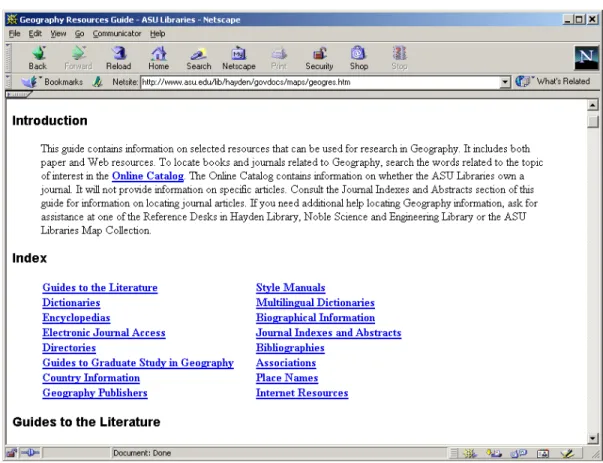
The Arizona State University Guide to the map collection takes a wide view of describing holdings and retrieval (Fig. 2). The indexed guide provides a breadth of
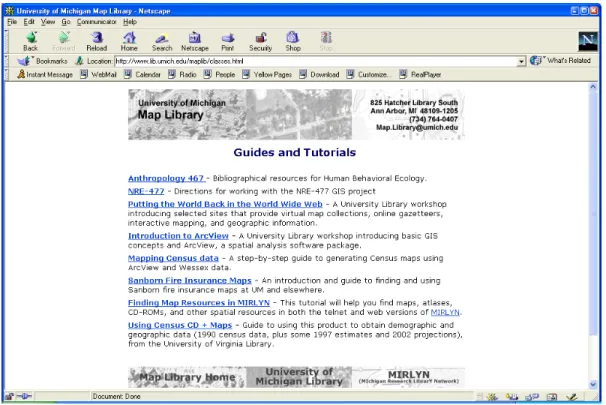
classification, and retrieval for the type of source. This is ideal if one knows in advance that the material is of interest in research. The University of Michigan Map Library combines map tutorials and guides on a common page (Fig. 3).
A comparison between Figures 2 and 3 provides an example of the difference in data quality and presentation that may exist between sites. The Arizona State University Map Collection breaks down help topics in a very broad way; users choose between “Guides to the Literature,” “Dictionaries,” “Encyclopedias,” and many other broad categories under the heading “A Guide to Geography Resources in the Arizona State University Libraries” (Fig. 2). The University of Michigan Map Library “Guides and Tutorials” website provides a more specific breakdown of topics. These vary between class-related, system-related, and map-related topics. Tutorials are offered for the OPAC, census maps, and GIS applications.
Figure 3: The Map Library, University of Michigan, provides a variety of tutorials and collection guides relating to using specific and general materials based on publisher, theme, and format.
Nine map collections provided a tutorial for the location of cartographic and geographic materials through an OPAC, map index, paper catalog, classification system, or some combination of these retrieval tools. Each collection used a unique method to explain and display their tutorial. Many paste OPAC screen images for search steps, like the
Cartographic Information Services from the University of Washington (Fig. 4). Series and title searches for one series of USGS maps are a very narrow scope for a tutorial. As discussed by Tenner and Weimer, in “Reference Service for Maps: Access and the Catalog Record,” title searching is difficult for maps. This tutorial deals mainly with the steps to performing a title search on USGS topographic maps from Washington State; seven specific sections and five screen pastes are devoted to the tutorial. It is a very complicated tutorial. Presumably, topographic maps are a popular resource at the University of Washington. The most common topics among map collection tutorials include: descriptive search methods, using classification systems, and GIS.
The guides mentioned above are collection-specific, as opposed to general guides provided by outside organizations in support of a service or product. A common example occurs in GIS tutorials. In addition to offering a schedule of local GIS instruction
opportunities, several sites sponsor links to software-based tutorials in support of their collection’s GIS software. Because of the complexity and lack of standardization in GIS applications, software providers offer self-paced tutorials and instructions in order to assist users.
government—like the USGS and the Census Bureau—which describe the publication, use, and availability of their spatial data. Another example, which falls into the commercial and governmental realm, may be found in geospatial data clearinghouses of GIS data sets. The websites of Clearinghouses usually provide instruction for the downloading of data and the migration of data for various software packages. In these examples, map librarians do not need to create such tutorials and guides locally because issuing agencies provide general information about the creation, use, and retrieval of spatial data. If patrons are directed towards these guides, less time is dedicated to collection-specific information for general resource information.
An additional activity that is related to learning is the communication between map librarian and academic instructor. The only obvious website manifestation of such a communication is a guide or site created specifically for an academic class—often in the form of a reserve list, a guide, or a thematic grouping of maps with a course name in the title. Nine of the twenty-six websites contained one or more demonstrations of instructor-library collaboration.
General interest
certain materials from the collection based on a characteristic or idea. This activity may seem redundant, as all materials presumably are searchable to those who are truly interested in finding them. Yet general interest links call patrons’ attention to subjects, themes, and materials that may enrich their research experience.
Eleven of the twenty-six surveyed collections include a page devoted to new
acquisitions, new services, or new maps. Several of the collections list new maps and atlases related to Afghanistan and the Middle East, regions of current interest. Other new materials list focus on new GIS data sets, calling attention to GIS program growth. Both examples of new materials communicate active collection development procedures to patrons. Such inclusions fulfill a dual purpose: communicating an active acquisition process to patrons, and ensuring active website editing.
Fifteen of the twenty-six collections include a link from their home page to data on the subject of local (state or urban area) spatial data. Local atlases, GIS information, digital maps, digitized historical maps, and cartographies are included in these sources. Such a focus ensures that patrons from the academic community have a spatial resource for the area and community of which they are a part. Patrons and affiliates of the institution who are doing primary research close to home would find this an invaluable resource. Additionally, students, faculty and patrons may find such resources helpful for planning trips, exploring the region, and enriching their associations to the community.
to a map exhibit. Many included a brief description of a local exhibit, held in the map gallery or some other location on campus. For instance, the Thomas R. Smith Map Collection at the University of Kansas presents a “Link to Online Map Exhibits” which includes links to ten online map exhibits, ranging in themes from “Out of This World: The Golden Age of the Celestial Atlas,” to “Maine Wilderness Transformed: Timber, Sporting, and Exploitation of the Moosehead Lake Region.” Clearly, the Thomas R. Smith collection would not wish to expend the time and energy to curate the ten exhibits. By linking them to their website, the images and wonder may be shared without the trouble of compilation.
Figure 5: Exhibit linked to the Exhibits page of the T.R. Smith Map Collection, University of Kansas. From the British Library's "The Earth and the Heavens: The Art of the Mapmaker" exhibit.
Nineteen of the twenty-six websites included a thematic list of materials that described a specific class of spatial data. These lists differ from cartobibliographies,
approaches to the spatial data resources. Patrons may choose between well-defined collections like “census maps,” “topographic maps,” “National Geographic maps,” and “World War II maps.” These classes are interspersed with finding aids and non-map resources. The resulting collection description is cross-referenced, a multifaceted approach to the collection.
The University of Florida’s Map and Imagery Library divides its special collections into several categories of maps, by topic, region, map type, and publication date (Fig. 6). The “Special Collections” heading holds cartobibliographies, indexes, digital maps, and class reserve lists, many of which are also cross-referenced within the pages.
Figure 6: The Map and Imagery Library, University of Florida, describes unique collections by topic, region, format, and age.
Figure 7: The collection grouping on the Geography and Map Library homepage, Indiana University at Bloomington.
The map collection staff may present cartobibliographies and bibliographies in order to bring like materials together and inform patrons of holdings. Thirteen of the twenty-six collections present cartobibliographies or bibliographies in their websites. A
cartobibliography (a bibliographic list of cartographic materials such as maps, charts, or diagrams in paper, digital, or CD-ROM format) may be organized by map theme, academic discipline, region, map publisher, or some other unifying element. Cartobibliographies list the title and publication information; collection-specific cartographies include the call number for easy withdrawal. Map collection staff, librarians, researchers, and mapping agencies are common compilers of cartobibliographies.
Conclusion
The twenty-six map collection websites that I analyzed varied greatly in structure and in content. One contributing factor to wide variation could be the lack of updated map collection standards. No standards have been created since 1987, when the Special Libraries Association stated, “Information services in the map collection shall include reference service, bibliographic instruction, and promotional activity.” In the past fifteen years, the continuous growth of Web-based communication has provided a medium for the
informative and educational devices found in this survey. Reference service, bibliographic instruction, and promotional activity have changed dramatically as a result of the World Wide Web.
The average map collection website in this survey includes the following information:
• A description of the collection, including hours of operation, major types of spatial data sources, and a brief description of the OPAC or local cataloging system.
• An email contact to staff.
• Instructions for map collection use. There are many forms of instruction, including orientations, tutorials, descriptive guides printed online, and FAQ sheets. The subject matter varies greatly, as well.
•
•
•
•
or some other feature. They are a useful starting point in collection exploration; they often focus on a collection’s strengths.
• Links to online search tools, online maps, and GIS resources.
All twenty-six collections, it is significant to note, embraced the World Wide Web as a medium for communication, to varying degrees of effectiveness. The best sites, after close study, would contain all of those categories of information described in the above list. Additionally, they would provide:
More extensive descriptions of the collection, to include: each material type and useful resources specific to the format, including digital and online information sources. Since I only checked for the presence or absence of information, sites supplemented by this
criterion would not be distinguishable from other sites using my research criteria; but one of the most common sources of confusion on the sites stemmed from a lack of descriptive text. A site composed of two-hundred hyperlinks to additional information is useless if a patron does not know which link to choose. Categories of information that are logical to a map librarian (“Topos,” “TIGER files,” “The Perry Castañeda Library,” and “Sanborn maps,” for example, with no further description) will probably not be helpful to a student.
The name and telephone number of a member of the reference staff, thus reducing anonymity of contact.
Acquisition policy for materials, explaining what collections are most important in the library mission.
this practice were adopted, a patron looking in a local paper collection might learn that the library also holds CD-ROMs of similar data, which might better suit needs. Online retailers do this; it is one of the valuable capabilities of computer technology. Patrons, particularly those unfamiliar with spatial data and the map collection.
The most prominent problem among map collection websites is the technical— geographic, cartographic, and governmental—jargon. These fields are peppered with rather esoteric knowledge, language, and understanding of concepts and organization. As has been discussed throughout this paper, communication is the key to teaching and guiding
unfamiliar patrons through spatial data resources. The librarian should act as a translator, instructor, and friendly information source to patrons who find themselves in the strange world of map collections.
Appendix A
http://libweb.uoregon.edu/~map/ Univ. Oregon—Eugene
http://www.uwm.edu/Library/AGSC/index.html Univ. Wisconsin—Milwaukee
http://www.libs.uga.edu/maproom/ahtml/mchpi1.html Univ. Georgia
http://www.library.uiuc.edu/max/ Univ. Illinois—Urbana-Champaign
http://www.library.ucla.edu/libraries/yrl/referenc/rco/geographic.htmUniv. California—Los Angeles
http://www.geography.wisc.edu/map_lib.htm Univ. Wisconsin—Madison
http://www.lib.berkeley.edu/EART/MapCollections.html Univ. California—Berkeley
http://www.ku.edu/~anschutz/ University of Kansas—Lawrence
http://hcl.harvard.edu/maps/ Harvard University
http://www.lib.uchicago.edu/e/su/maps/ University of Chicago
http://www.cic.lsu.edu/index.html Louisiana State Univ.
http://www.library.yale.edu/MapColl/index.html Yale Univ.
http://web.uflib.ufl.edu/maps/ Univ. Florida
http://www.lib.utk.edu/cic/ Univ. Tennessee
http://www.libraries.psu.edu/crsweb/maps/ Pennsylvania State Univ.
http://www.lib.utexas.edu/maps/index.html Univ. Texas—Austin
http://www.lib.umich.edu/maplib/index.html Univ. Michigan—Ann Arbor
http://map.lib.umn.edu/ Univ. Minnesota
http://www.princeton.edu/~geolib/map/ Princeton Univ.
http://www.library.kent.edu/branches/map/ Kent State Univ.
http://www.lib.washington.edu/maps/ Univ. Washington
http://www.library.cornell.edu/okuref/maps/map.htm Cornell Univ.
http://www.lib.unc.edu/maps/ Univ. North Carolina
http://www.indiana.edu/~libgm/index.html Indiana Univ.—Bloomington
http://www.asu.edu/lib/hayden/govdocs/maps/mapcoll.htm Univ. Arizona
Appendix B
Questions # Site:
How many hours of operation:
How many staff members listed:
yes no
email contact:
yes no comments
description of exhibits (online or local)
list of new acquisitions, new maps, new
services, etc.
guides for map use: reference, how-to, etc.
bibliographic instruction, orientation, tours
offered
description of cataloging/classification
(using OPAC, cards, subject system, etc.)
cartobibliographies, bibliographies, lists of
map holdings & paper sources
thematic list(s) of materials (for a topic or
class)
yes no
online search/reference tools [gazetteers,
atlases, guides to agencies, etc.]
descriptive instructions for digitized maps,
GIS data information, etc.
links to online maps, mapping services, etc.
Works Cited
Allen, Gillian. “Bibliographic Instruction on the Internet.” The Role and Impact of the Internet on Library and Information Services. Lewis-Guodo Liu, ed. Westport, Conn. : Greenwood Press, ©2001.
Andrew, Paige G. “A Survey Technique for Map Collection Retrospective
Conversion Projects.” Cataloging and Classification Quarterly. New York : Haworth Press. Vol. 27, no. 3/4 (1999). P. 405-428.
Arms, Carolina R. “Getting the Picture: Observations from the Library of Congress on Providing Online Access to Pictorial Images.” Library Trends. Urbana, Ill. : University of Illinois Library School. Vol. 48, no. 2 (Fall 1999). P.379-409. Association of College and Research Libraries. “ACRL guidelines for branch libraries in
colleges and universities.” College & Research Library News. Chicago : Association of College and Research Libraries. Vol. 52, no. 3 (Mar. 1991) P. 171-174.
Balchin, W.G.V. Concern for Geography: A selection of the work of Professor W.G.V. Balchin. Swansea, U.K. : Dept. of Geography, University College of Swansea, 1981. Barrow, Bill, and Alice Hudson. “Promoting the Map Library to Your Boss and to the
Public: How Local Map Societies, Library Friends Groups and Geographic Alliances Further the Work of Map Libraries.” Bulletin (Special Libraries Association. Geography and Map Division). New York : Special Libraries Association.. No. 182 (Spring 1996) p. 26—29.
Bell, Suzanne S. “Integrating Access to Formal and Informal Collections: What is Important and What Succeeds.” Journal of Academic Librarianship. Ann Arbor, Mich. : Mountainside Publishing. Vol. 21 (May 1995). P. 181-186.
Cobb, David. Limits to Access: You Can Look, but Don’t Touch.” INSPEL. Berlin : Universitätsbibliothek der Technischen Universität Berlin. Vol. 36, no. 1 (2002). P. 49-52.
Coote, Helen. How to Market Your Library Service : and enjoy it in the process!. London : Aslib, The Association for Information Management, 1994.
Daft, Richard L. Management. 5th ed. Fort Worth : Dryden Press, ©2000.
Fitzpatrick, Gary. “Digital Developments in the Geography and Map Division, Library of Congress.” Information Bulletin. Sacramento, Calif. : Western Association of Map Librarians. Vol. 29, no. 2 (Mar. 1998). P. 61-66.
Garlock, Kristen L. and Sherry Piontek. Designing Web Interfaces to Library Services and Resources. Chicago : American Library Association, 1999.
Hagen, Carlos B. A survey of the usage of a large map library. Bulletin (Special
Libraries Association. Geography and Map Division). New York : Special Libraries Association. No. 87 (March 1972) p. 46-47.
Harrison, K.C. Public Relations for Librarians. 2nd rev. ed. Aldershot, England : Gower
Publishing Company Ltd., c1982.
Heery, Mike, and Steve Morgan. Practical Strategies for the Modern Academic Library. London : Aslib, The Association for Information Management, 1996.
Hope, Charity B., Sandra Kajiwara, and Mengxiong Liu. “The Impact of the Internet: Increasing the Reference Librarian’s Role as Teacher.” Evolution in Reference and Information Services : the Impact of the Internet. Edited by Di Su. New York : Haworth Press, 2001. P. 13-36.
Kies, Cosette. Marketing and Public Relations for Libraries. Metuchen, N.J. : The Scarecrow Press, 1987.
Kitchin, Rob, and Mark Blades. The Cognition of Geographic Space. New York : I.B. Tauris, 2002.
Klein, Leo. “The Web is Not Your Library.” Library Journal. New York : Bowker. Vol. 126, no. 1 (Winter 2001) p. 36-38.
Larsgaard, Mary Lynette. Map Librarianship: an Introduction. 3rd ed. Englewood, Colo. :
Libraries Unlimited, 1998.
Lee, Hur-Li. “What is a Collection?” Journal of the American Society for Information Science. New York, N.Y. : The Society. Vol. 51, no. 12 (Oct. 2000). P. 1106-1113. MacEachren, Alan M. How Maps Work : Representation, Visualization, and Design. New
York : Guilford Press, ©1995.