ABSTRACT
JAY M. COLORING. Synthesis and Biological Activity
of a Series of Nitrated Cyclopenta-Fused Polycyclic
Aromatic Hydrocarbons. (Under the Direction of Dr.
Avram Gold)In order to test current hypotheses of
nitroarene-induced mutagenesis, a series of nitrated
cyclopenta-fused isomers of benzanthracene and pyrene (Fig.4) were
synthesized and their mutagenic activities toward
Salmonella typhimurium were evaluated in the Ames plate
incorporation assay. Current theories state that
endogenous enzymes present in bacterial and mammalian
cells activate nitroarenes via reduction tohydroxylamines which can be converted upon protonation or
conjugation to nitrenium ions which are the postulated
active chemical species. Thus mutagenic activity should
be correlated with both the "ease of reduction" of thecompound as well as the stability of the postulated
arylnitrenium ion.
The theoretical "ease of reduction" of the nitrated
polycyclic aromatic hydrocarbons (PAH) in this study
was determined by calculating lowest unoccupied molecular
orbital (LUMO) energies (Klopman et al., 1984); our
be exceptionally stable compared to other nitroPAH. Thus
these compounds are anticipated to be active mutagens whose activity should parallel the stability of the nitrenium ions.
However, while these compounds do produce
significant numbers of revertants in the Ames assay, they are not nearly as active as some of the more potent
nitroarenes. Reasons for this relative lack of activity
are discussed and modifications in the abovementioned
ACKNOWLEDGEMENTS
I would like to thank Dr. Louise Ball for her
personal interest and guidance during my study in the
Department. I am no less grateful to Dr. Avram Gold for his support. I also appreciate the help given me by Dr. R. Sangaiah; he took time out of his busy schedule to
introduce me to the difficulties of organic synthesis.
I am also grateful to Dr. Marc Mass, Ms. Andi
Weiss Bartczak and Ms. Lucy Sonnenberg for their positive
criticism of the various drafts of this report. Also,
without the help of Ms. Robin Thomas and Ms. Sarah Warren, the mutagenicity testing would not have nearly
been so easy.
The United States Environmental Protection Agency,
TABLE OF CONTENTS
I. Introduction---1
Bacterial Nitroarene Activation---2
Mammalian Nitroarene Activation---5
Human Health Risks of Nitroarenes---8
Structure-Activity Relationships of Nitroarenes---9
A Model System to Test Theories of Nitroarene Activation---10
II. Materials and Methods---14
•Instrumentation---14
Synthesis of Nitro PAH---14
Purification of Chemicals---15
Bacterial Mutagenicity Assays---35
III. Results---37
Identification of Products---37
^ Bacterial Mutagenicity Assays---38
IV. Discussion---47
Synthesis---47
Bacterial Mutagenicity Assays---48
LIST OF FIGURES
1. Bacterial Activation of Nitroarenes---3
2. Activation of Nitroarenes by Mammalian Cells----5 3. Nitrated Cyclopenta-Fused Isomers of
Benzanthracene and Pyrene---12 4. Charge Delocalization in Nitrenium Ions
Derived from Cyclopenta-Fused PAH---13 5. Spectra of 4-nitrocyclopentapyrene
UV-vis---17
Mass Spectrum---18
"'"H NMR---
ͣ
----19
6. Spectra of 2-nitrobenz(j)aceanthrylene
UV-vis---20
Mass Spectrum---21
"'"H NMR---22
7. Spectra of 6-nitrobenz(e)aceanthrylene
UV-vis---——---23
Mass Spectrum---24
"""H NMR---25
8. Spectra of 2-nitrobenz(1)aceanthrylene
UV-vis---26
Mass Spectrum---27
ͣ
^H NMR---
ͣ
---28
UV-vis---29
Mass Spectrum---30
ͣ
^H NMR---
ͣ
---31
10. Spectra of 5-nitrobenz(k)acephenanthrylene UV-vis---3 2 Mass Spectrum---3 3
"""H NMR---34
11. Synthesis of Nitrated Cyclopenta-Fused PAH: Proposed Reaction Mechanism---47
12. Resonance Stabilization of Carbonium Ions Derived From 4- and 5-nitrobenz (k )acephenanthrylene---48
13. LUMO Energy Correlation with Mutagenicity
in TA98---52LIST OF TABLES
1. Mutagenicity of 4-nitrocyclopentapyrene---39
2. Mutagenicity of 2-nitrobenz(j)aceanthrylene---40
3. Mutagenicity of 6-nitrobenz(e)aceanthrylene---41
4. Mutagenicity of 2-nitrobenz{1)aceanthrylene---42
5. Mutagenicity of 4-nitrobenz(k)acephenanthrylene-43
6. Mutagenicity of 5-nitrobenz(k)acephenanthrylene-447. Summary of Mutagenic Activities of Nitrated
Cyclopenta-Fused Benzanthracene and Pyrene Derivatives in TA98---499. Comparison of ir-energy Differences and Delocalization Energies of Carbonium Ions
Derived from Cyclopenta-Fused PAH and Pyrene---53 10. ir-energy Differences Between Carbonium and
Nitrenium Ions Derived from Cyclopenta-Fused : PAH and Pyrene and the Corresponding Parent
INTRODUCTION
Nitro-substituted polyaromatic hydrocarbons
(NO_PAH) are among the most potent bacterial mutagens known. NO-PAH were originally detected in photocopier
toner (Lofroth et al., 1980; Rosenkranz et al., 1980),
and have since been found to be widespread in the
environment. NO~PAH are formed in the atmosphere by the
reaction between unsubstituted PAH, which are formed
readily as byproducts of combustion, and atmospheric NO .
Direct sunlight and high temperature or pressure create
favorable conditions for this reaction; thus, NO_PAH have
been found in high concentrations in urban ambient air
(Gibson, 1982; Wise et al., 1985), diesel emissions (Pederson and Siak, 1981; Schuetzle et al., 1982), coal fly ash (Harris et al., 1984), and extracts from wood smoke reacted with NO- and 0-, (Kamens et al. , 1985).
Rosenkranz (1982) has suggested that NO-PAH are the major
contributors to the direct-acting mutagenicity of
airborne particulates. Moreover, nearly every nitroarene tested in vivo has proven to be tumorigenic (Rosenkranz,
1983). Estimates of excess cancer risk from
environmental exposure to these compounds range from
0.0005 to 0.5 per 100,000 (Rosenkranz and Mermelstein,
1985) .
The potent mutagenicity of this class of pollutants
2 stimulated considerable interest as to their potential effects on human health; knowledge of the mechanism of
mutagenicity is necessary to any such assessment. Like
most other environmental mutagens such as unsubstituted
polycyclic aromatic hydrocarbons, the compounds
themselves are not mutagenic but must be enzymatically
activated to electrophiles in order to induce mutations.
Bacterial Nitroarene Activation.
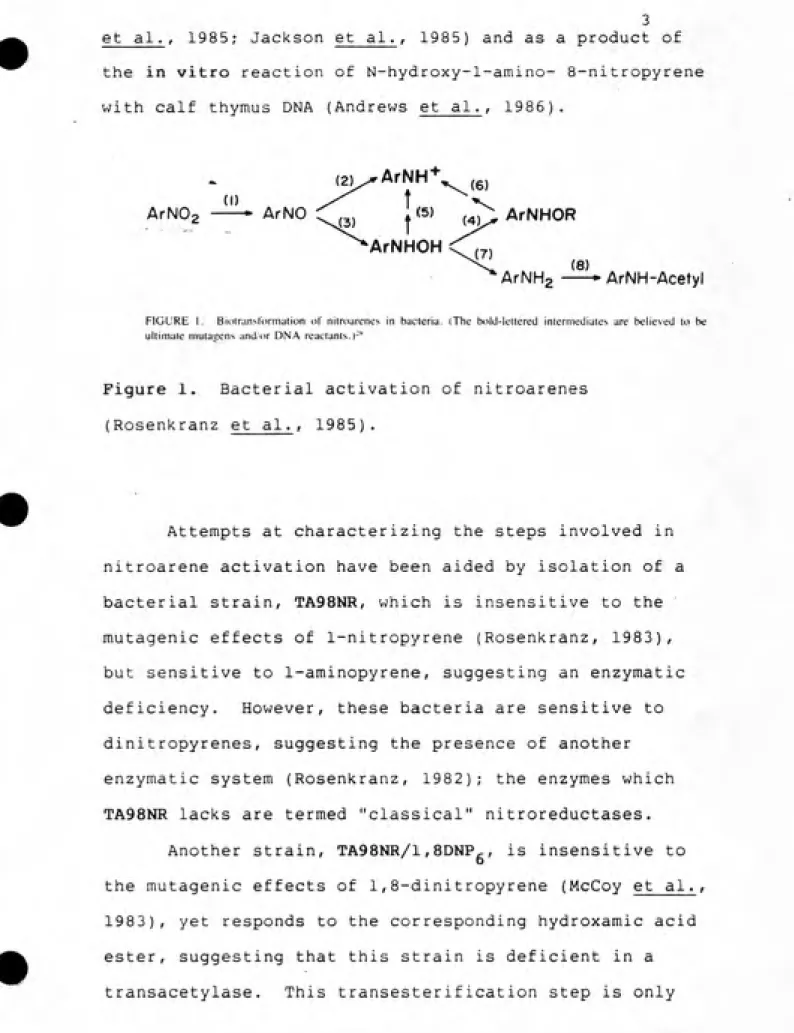
One group of enzymes that effects this activation is collectively known as "nitroreductases." These
enzymes reduce the nitro group to arylhydroxylamines or
transacetylate them to acetoxyamino derivatives (Fig. 1;
McCoy et al., 1983), which are, in the case of pyrene, potent mutagens (Ball, et al., 1984; Fifer et al., 1986; Helflich et al., 1985). These compounds form adducts
mainly with guanine (see below). Adducts with adenine have been proposed which cannot be detected by the Salmonella strains currently in use (Massaro et al.,
1983); however, such adducts have not yet been positively
identified.
The arylhydroxylamines and acetoxyamino derivatives may
form arylnitrenium ions (Fig. 1) upon protonation and
loss of the oxy group. This highly electrophilic species
is apparently capable of interacting with cellular DNA to form covalently-bound DNA adducts such as
1-aminopyrene-C8-deoxyguanosine, which has been identified in
Salmonella strains susceptible to 1-nitropyrene (Howard
3
et al., 1985; Jackson et al., 1985) and as a product of
the in vitro reaction of N-hydroxy-1-amino- 8-nitropyrene
with calf thymus DNA (Andrews et al., 1986).
(5) (aT^ ArNHOR
ArNHOH <C,
^\^ (8)
^ArNHg---
ͨ
ArNH-Acetyl
FIGURE I. Biotranslormation of nilroarenes in bacteria. (The bold-lettered intermediates are believed to be ultimate niutaaens and.or DN.A reactants.)-''
Figure 1. Bacterial activation of nitroarenes
(Rosenkranz et al., 1985).ArNO ArNO
Attempts at characterizing the steps involved in
nitroarene activation have been aided by isolation of a
bacterial strain, TA98NR, which is insensitive to the
mutagenic effects of 1-nitropyrene (Rosenkranz, 1983),
but sensitive to 1-aminopyrene, suggesting an enzymatic
deficiency. However, these bacteria are sensitive to
dinitropyrenes, suggesting the presence of another
enzymatic system (Rosenkranz, 1982); the enzymes which
TA98NR lacks are termed "classical" nitroreductases.Another strain, TA98NR/1,8DNP,, is insensitive to
the mutagenic effects of 1,8-dinitropyrene (McCoy et al.,
1983), yet responds to the corresponding hydroxamic acid
4
necessary for certain classes of nitroarenes as some
classes such as nitrofurans (Rosenkranz et al., 1982) are
fully active in this strain. Perhaps hydroxamic acid
esters formed from dinitropyrenes are especially unstable
and readily form arylnitrenium ions while for other
nitroarenes other intermediates are more important.
Yet another activation pathway is characterized by
the necessity of mammalian enzyme activation. McCoy et
al. (1983) showed that 5-nitroacenaphthene, which is
inactive in the nitroreductase-deficient Salmonella
strains, becomes a potent mutagen in the presence of the
9000g supernatant fraction of Aroclor-induced rat liver
homogenate (S9). Moreover, El Bayoumy and Hecht (1983)
showed that 1-nitropyrene also forms a mutagenic
dihydrodiol metabolite. These results suggest that oxidation of the aromatic nucleus is an important
determinant of the S9-dependent mutagenicity. McCoy et
al. (1983) postulate that the role of the nitro group is
to exert a directing effect on ring oxidation. Little
nitro-reduction, even with nitroreductase-competent
strains, takes place in 6-nitrochrysene (El Bayoumi and
Hecht, 1984); its main metabolite is
1,2-dihydro-l,2-dihydroxy-nitrochrysene. Similarly,
6-nitrobenzo(a)pyrene appears to be metabolized to a
mutagenic dihydrodiol (Lofroth et al. , 1984) since it
1-5
nitrobenzo(a)pyrene also forms a dihydrodiol metabolite.
Thus, some nitroarenes exert their mutagenic
effects upon nitroreduction and subsequent adduction to
DNA while others require oxidation. Endogenous bacterial
enzymes are sufficient to activate those nitroarenesrequiring nitroreduction while those which are oxidized
to the dihydrodiols require mammalian enzyme activation.
Most nitroarenes appear to be frameshift mutagens (they
are inactive in strain TA1535; see below).
Mammalian Nitroarene Activation.
(I)
(2,^ArNH+^(6,
ArNOp ---
ͨ
ArNO C (3) j <^^ {Ay ArNHOR
ArNH0H\,7,
^^' ^^ArNHo---
ͨ
ArNH-Acetyl
(10)
diHdiOH-ArNOp ---
ͨ
---
ͨ
diHdiOHArNHOH
(II)
DiolEArNOg
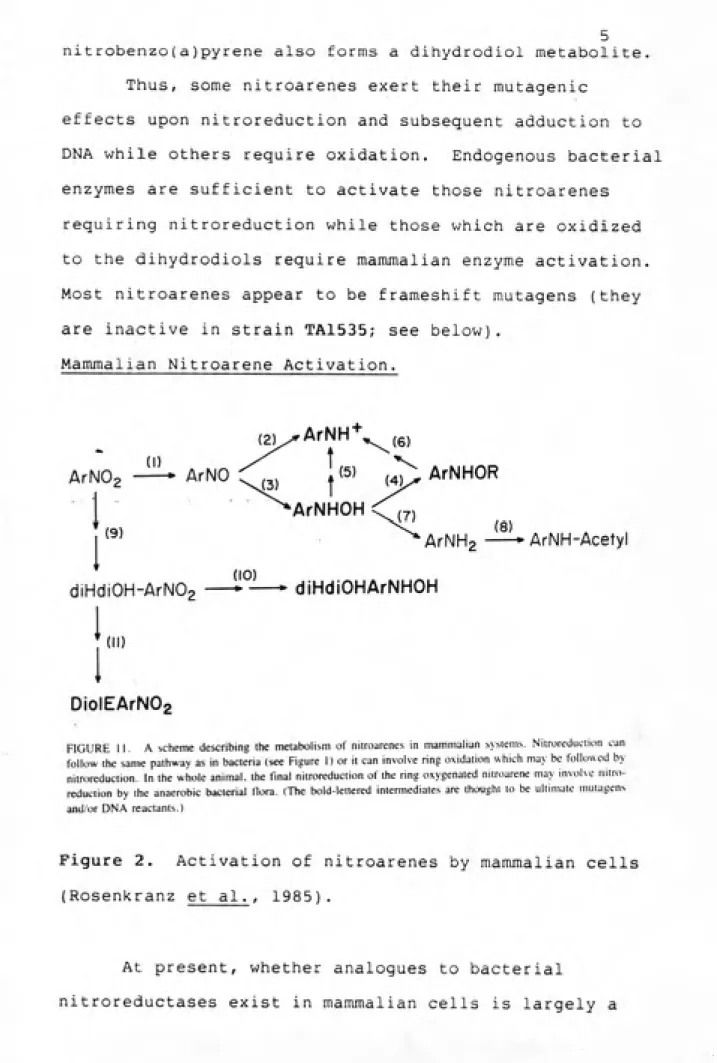
FIGURE II. A scheme describing the metabolism of nitroarenes in mammalian systems. Nitroreduction can
follow the same pathway as in bacteria (see Figure 1) or it can involve ring oxidation which ma\ be followed by
nitroreduction. In the whole animal, the final nitroreduction of the ring oxygenated nitroarene may involve nitro¬ reduction by the anaerobic bacterial tlora. (The bold-lettered intermediates are thought to be ultimate mutagensand'or DNA reactants.)
Figure 2. Activation of nitroarenes by mammalian cells
(Rosenkranz et al., 1985) .
At present, whether analogues to bacterial
6
matter of speculation and indirect observation (Fig. 2).
A number of mammalian enzymes are known to possess
nitroreductase activity including xanthine oxidase (Wang
et al., 1974), aldehyde oxidase (Wolpert et al., 1973),
DT-diaphorase (Harada et al., 1980), NADPH-cytochrome
P450 reductase (Wang et al., 1975; Wolpert et al, 1973;
Howard et al., 1982) and cytochrome P450 (Symms et al.,
1974; Wang et al., 1974), which has been postulated to be
the major mammalian nitroreductase (Saito et al., 1984).
Others (Tatsami et al., 1986) implicate cytosolic
aldehyde oxidase as the most important enzyme.
The importance of nitroreductases in mammalian
cells is not entirely clear. At first, investigators
were unable to induce mutations in Chinese hamster ovary
cells by treatment with nitroarenes but found that their
nitroso derivatives were rapidly reduced and formed DNA
adducts (Helflich, 1985). The adducts identified,
1-aminopyrene-C8-deoxyguanosine, were identical in
mammalian and bacterial cells. Moreover, none of the
mononitrobenzo(a)pyrene derivatives described above were
active in CHO cells without exogenous activation. The
explanation offered for both these observations was that
mammalian cells are incapable of nitroreduction in the
presence of oxygen. However, the reduction of
1-nitropyrene to 1-aminopyrene has recently been observed
in primary rat hepatocytes and hamster V79 cells (Ball et
7
been detected in respiratory tissues (Jackson at al.,
1985) In addition, Patton et al. (1986) recently found
high mutagenic activity of 1-nitropyrene in diploid human
fibroblasts. They suggest that, since other
investigators used haploid CHO cells which form very few
adducts (see Helflich et al., 1984), the mutations which
occur are not visible. Other investigators have found
high forward mutation frequencies at the HGPRT locus in
the CHO cell assay (Li et al., 1983) and high sister
chromatid exchange frequencies in the same cell type
(Nachtman and Wolff, 1982). Thus, while it was
originally thought that reduction of nitroarenes was
unimportant in mammalian cells, recent evidence points to
the' opposite conclusion.In whole animals, nitroarenes appear to be reduced,
but it is not known if such reduction is mediated by the
gastrointestinal flora or the cells of the host animal
(Fig. 2). It is known that E. coll extensively
metabolize 1-nitropyrene under anaerobic conditions
(Peterson, et al., 1979) and that such reduction does not
take place in germ-free animals (El Bayoumi et al.,
1983). In addition, oxidation by the enzymes referred to
above appears to be important. Ball et al. (1984) found
14
that over half of the [ C] labeled 1-nitropyrene
administered by intraperitoneal injection was excreted
within 24 hr in the feces and urine as mutagenic
hydroxynitropyrenes, acetylated aminopyrenols and
8
excretion of 1-iiitropyrene and 1-aminopyrene along with
sulfate and glucuronide conjugates (Marshall et al.,
1982). Stanton et al. (1985) found the DNA adduct
mentioned above in liver, kidney and mammary glands, also
following intraperitoneal injection.
Human Health Risks of Nitroarenes.
Whether environmental nitroarenes pose a great risk to
human health is unknown. Little experimental work has
been performed under conditions which simulate human
exposure, i.e., inhalation. Sun et al., (1983), adsorbed
14
[ C]-labeled 1-nitropyrene onto particles of varying
sizes and the particles were inhaled by rats; little
absorption took place and most of the administered dose
was' exhaled or recovered unchanged in the feces. One
case-control study has been performed by Silverman et al.
(1986) which demonstrated elevated cancer risk in truck,
taxicab and bus drivers and concluded that this excess
risk was attributable to exposure to diesel exhaust,
which is rich in NOjPAH.
All NO„PAH which have been tested have proven to be
carcinogenic in animals (Rosenkranz and Mermelstein,
1985). Like the "classical" environmental carcinogens
benzo(a)pyrene (B(a)P) and 3-methylcholanthrene (3-MC)
they can cause tumors at the site of injection as well as
metastases at distant organs (Hirose et al., 1984). But,
despite the potent mutagenicity of some NO„PAH in
bacteria, Ohgaki et al. (1984) state that they are no
9
Structure-Activity Relationships of Nitroarenes.
Not all NO2PAH are potent mutagens; in fact, wide
variations in activity exist between different members of
this class (Rosenkranz and Mermelstein, 1983).
Determination of structural features associated with
mutagenic activity or lack thereof would be highly
desirable from an environmental standpoint. Newly
identified pollutants or dyes, for example, could be
evaluated for health risks without expensive and
time-consuming mutagenicity testing. Attempts at such
determinations through literature reviews have met with
mixed success (Rosenkranz and Mermelstein, 1983) due to
wide variations in methods between laboratories. Using
data derived from bacterial mutagenicity testing,
however, investigators have begun to answer the first
basic questions concerning structure-activity
relationships.First, what determines whether or not a nitroarene
is a good substrate for the nitroreductase enzymes?
Klopman et al. (1984) have found a strong correlation
between the ease with which a given nitroarene can be
reduced, measured by electrochemical reduction and
half-wave potential calculations, and its mutagenicity. They
were also able to associate the ability to place an
electron in the lowest unoccupied molecular orbital
(LUMO) of the molecule, (calculated using HUckel
molecular orbital theory to obtain the -rr-energy of the
10
calculations represent the first attempt to
correlate mutagenicity of nitroarenes with purely
theoretical models.
Second, successful reduction seems not to be the
only determinant of mutagenicity in those compounds which
appear to be good substrates for the nitroreductase
enzymes. How is the stability of the reactive species,
the postulated arylnitrenium ion, associated with
mutagenic potential? The resonance-stabilization energy,
aE J -, /g, which predicts the capacity of the positive
charge on nitrogen to be stabilized by redistribution
around the aromatic nucleus, is one theoretical measure
of such stability (Jerina et al., 1976). Large values of
this parameter have been associated with mutagenic
potential in the carbonium ions the bay region diol
epoxides formed from PAH (Jerina et al., 1976). Vance
and Levin (1984) have postulated that the mutagenic
activity of nitroarenes may be correlated with the amount
of resonance stabilization of the nitrenium ion.
Examination of the mutagenic activity of a series of
isomers capable of forming nitrenium ions whose resonance
stabilization can be predicted theoretically would allow
us to test this hypothesis. Such a series can be derived
from PAH possessing cyclopenta-fused rings (Fig. 3;
Eisenstadt and Gold, 1978; Gold et al., 1980; Nesnow et
al., 1984).11
PAH, in particular, cyclopenta(cd)pyrene and the series
of cyclopenta-fused isomers of benz(a)anthracene, which
have proven to be active bacterial and mammalian mutagens
(Nesnow et al., 1984a, 1984b) and in some cases animal
carcinogens (Nesnow et al., 1984c). These PAH are
metabolized by epoxidation on the etheno bridge of the
cyclopenta-fused ring and are activated by opening of the
oxirane ring to yield resonance-stabilized benzylic
carbonium ions. Their genotoxic activity, as expressed
by mutagenicity in the Ames assay, correlates
approximately with the stability of the carbonium ion
(Nesnow et al., 1980). Such stability can be
approximated by the "delocalization energy," ^E^ , /g,
or the degree to which the charge formed on the carbonium
atom is spread throughout the aromatic nucleus.
Since the cyclopenta ring contains a highly
localized double bond and is a region of high electron
density as calculated by Fu et al., (1980), it should be
susceptible to electrophilic attack; hence the reaction
leading to nitration selectively occurs at the cyclopenta
ring (Fig. 3). The electron distribution of the
arylnitrenium ions formed from reduction of such NO„PAH
to hydroxylamines would be similar to the benzylic
carbonium ions generated from the cyclopenta epoxides of
the parent PAH, and would also be expected to be highly
resonance-stabilized due to delocalization of the
positive charge (Fig. 4). An estimate of the degree of
4-nitrocyclopenta{cd) pyrene
'NO2
6-nJtrobenz(e)aceanthrylene
4-nitrobenz (k) acephenanthrylene
2-nitrobenz(j)aceanthrylene 2-nitrobenz(l)aceanthrylene 5-nitrobenz (k) acephenanthrylene
13
simply by summing the c-energies the occupied molecular
orbitals (Yates, 1978) and comparing the totals to those
calculated for the parent hydrocarbons.
O
OIOIQ
Figure 4. Charge delocalization in nitrenium ions
derived from cyclopenta-fused PAH.
The system of nitrated cyclopenta-fused PAH thus
provides a unique and convenient system of compounds in
which theories regarding activation and mechanisms of
mutagenic activity of NO_PAH can be explored. The
mutagenic activity of each compound can be assessed and
compared with other NO„PAH in order to further understand
the relationships between specific structural features of
i!ggg¥^'CT!«L I I .iniiUlljpBp^igr
14
MATERIALS AND METHODS
Instrumentation. H NMR spectra were obtained in
acetone-d, on a Bruker WM 250 spectrophotometer.
Signals are expressed in ppm downfield from
tetramethylsilane. Mass spectrometry was performed on a
VG Micromass 7070F mass spectrometer (Vacuum Generators,
Altrincham, Cheshire, UK) operated in the electron
impact mode at 70 eV. UV-vis spectra were obtained on a
Gary model 15 spectrophotometer (Varian Associates, Palo
Alto, CA).
HPLC analysis was carried out with a DuPont 850
controller and pump (DuPont Instrument Co., Wilmington,
DE) equipped with an Alltech C18, 10 y, 4.6x250mm column
(Alltech Associates, Deerfield, IL). Samples were
analyzed by gradient elution from 70 to 100% CH^CN in
H_0 over 15 min. The eluate (ImL/min) was monitored for
UV absorbance at 254 nm (LC-85B spectrophotometric
detector, Perkin-Elmer Corp., Norwalk, CT). Resolution
of the 4- and 5- nitrobenz(k)acephenanthrylene isomers
for analysis of purity was accomplished on a Lichrosorb
Si60 lOf 4.6x250mm column (EM Reagents) eluted with a
gradient of 0 to 10% CH2CI2 in C.^-^. (1% min""*") at 1
mL/min.
Synthesis of nitro PAH. All routine chemicals were
15
by published methods (Sangaiah and Gold, 1983; Sangaiah
et al., 1983). The hydrocarbons were then nitrated by
the method of Radner (1983); 0,5 mL of N^O., poured from
a cooled tank (Matheson), was added to 20 mL of CH^C1«,
and the vessel into which it was poured was tightly
capped. This solution (0.1 mL for each mg of parent
hydrocarbon) was added to a methylene chloride solution
of the parent hydrocarbon (5 mg/mL). The course of the
reaction was monitored to UV-vis spectrophotometry; when
the spectrum of the starting hydrocarbon disappeared (30
min to 1 hr), the reaction was terminated by evaporating
the CH_C1„ under a stream of nitrogen.
By synthesis and testing of a series of compounds
in the same laboratory, the problem of interlaboratory
variation can be avoided. The assay results for each
compound can thus be directly compared for the series.
The compounds were purified to the greatest degree
possible before mutagenicity analysis since the presence
of minute quantities of active impurities can yield
seriously misleading results (Jin et al., 1982).
Purification of Chemicals. The crude mixture,
dissolved in methylene chloride, was applied to a column
of silica gel (Kieselgel 60, 230-400 mesh ASTM, EM
reagents) and chromatographed with CCl^. The residual
parent hydrocarbon eluted first, as a yellow band,
followed by a deep red band of nitrated product. The
nitro compounds were collected, dried under a stream of
16
procedure produced red microcrystals of
4-nitrocyclopenta(cd)pyrene, 2-nitroben2{j)aceanthrylene,
5-nitrobenz(e)aceanthrylene and
2-nitroben2(l)aceanthrylene. In the case of
benz(k)acephenanthrylene, two isomers, 4-nitro and
5-nitrobenz(k)acephenanthrylene, were formed in
approximately equal quantities. These isomers were
separated by preparative thick layer chromatography
(silica gel GF_ , 1 mm x 20 cm x 20 cm plates
(Analtech, Nev/ark, DE) , developed repeatedly in
n-hexane/benzene, 1:1, v/v. All compounds were
characterized and physico-chemical data are completely
conistent with the assigned structures:
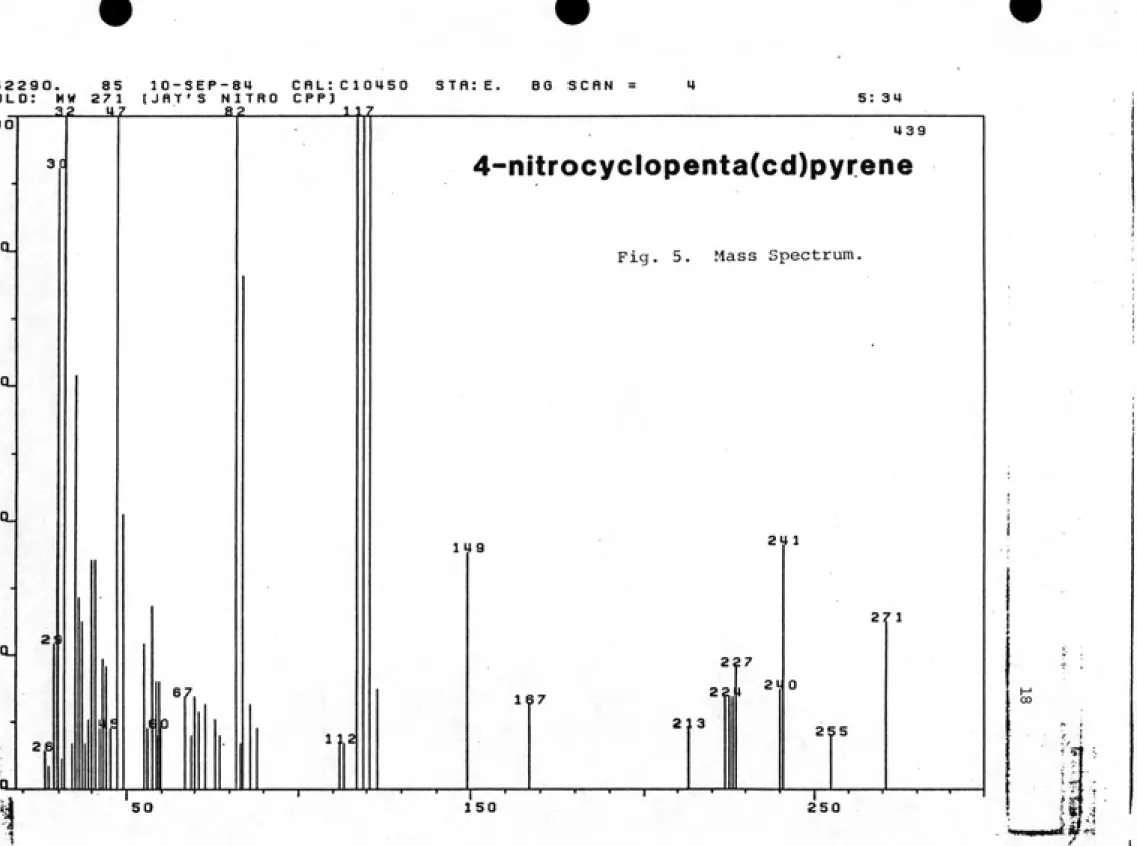
4-nitrocyclopentapyrene (fig. 5): m. p. 182-184*^ C;
the accurate mass and H NMR spectrum correspond to data
recently reported (van der Braken-van Leersum et al.,
1985).
2-nitrobenz(j)aceanthrylene (fig. 6): m. p.
237-239° C; accurate mass 297.07868.
6-nitrobenz(e)aceanthrylene (fig. 7): m. p.
198-200° C; accurate mass 297.08015,
2-nitrobenz(1)aceanthrylene (fig. 8): m. p.
244-246° C; accurate mass 297.07956.
4-nitroben2(k)acephenanthrylene (fig. 9): m. p.
209-211° C; accurate mass 297.07956.
5-nitrobenz(k)acephenanthrylene (fig. 10): m. p.
186-188° C; accurate mass 297.07956.
Fiq. 5. UV-Vis,
—
-i -^ ͣ• ͣͣ
-i
•
:
ͣ
; <
1
i ; '
i ' 1
~ '' )
]
-1 '~
__ ... ͣ - ----—
---.1 ... : .
ͣ
1 " '
i
i
i
i 1
! 1
'(y
i ^ --- ^
ͣ
i i
_ 1 - -.,.._ J. 1 ji
1 i
-ͣ- -> - - j ...
1 * 1 ͣ i
, .. .... , .
\ ': i
! i. :
-
ill'-1 : ill'-1 '
1 1 'ͣͣ \
i. ; i ͣ i - i ͣ ' ; ; : i
::"tJ;\:|^^£:.|.:;-:L:^
;' 1 i "1
—j— i-_i__
—
-.^--i 1...! .
i ; ^ ^ QfAiAr/;^ ' ^
1—*
h'-^-'--
.- "\"*-1
i 7^^=^.^^^^^ ; i
. i.. .. ! 1 ' ͣ .). r1 , r- 6 5 ^k./> "~ T---'
i lyL - : j j 1 . 1 ! " INUo
T
n - j 1
i
1 L i . ,11
f ~ ' - —
—
^-"i"---~
>. j\ j i** 1 A-nitrnrurlr»nAntn^rri^nvrene 1
'3 i 1 1 1 1
—-1--^---V^ 1 j
1
; - ... .1 .. ! ..i 1 1 . . - ͣ . 1... . . 1 !
l-u
" 1 ^*^^j '' i ^ ͣ i i i—
; i -T - 'm
-0.5 i ' ^rt ͣ i 1 ^
i 1 1 1
I ,_., ...|.._-_VCb_____i__.__L _. 1 —1-— h- ͣ i ͣͣͣ;ͣͣ 1 ͣͣͣ j ͣ 1
1 /:i;::;::L:"hr i^::i/ 1
w T ---I--- ._ _...1 ._ ^ '" 1 . ,u.,.. . . . i. -^.. ; .. 1 ._. . : ; . :ͣ i . i ! ..!,.( •-1
. . -1 ..-^.. .- : : . j. . . .1 : j . '
ͣ
1 ͣ /\ "^ 1 1 '1 ; i , : 1 ^ i________________
1 . i ____4^ .-JA_ - _. la„ _i_ _ .L.^„.
....
-.:: 2:
^ ! i i 1 1 , ! ' ^
1 1
-i:^---/rVt:-:.
^ _i-.i- - 1
---. ---. ---.^, :---.---. : I i i 1 1 ---.j---. 1 ; ;---.---.---.,---.
c; VL..:r _ .^ /_.__r "> ___ 1
-rt Q-
__.Q.; ... ..I .j..|. . .! 1 i , ! -i—- i |- ! i -i i-
--1 /^ ^^ I n i
V -'- -i-^ -H--1
f-P^--
---:-:^:[": |:/V- i ' | | "k i.;: t J |
j.,:;:;!:--V i ^^..." ] V. L.^L V IT "ͣ V^«" V —
—^I'/i" iii'i
'
! V i / 1 \ 1 i/ iV ^ 1 1 1
-i-A; ^
'~t__ -\^"
1 i—-srl. /- - ;\- i I 1 . .._.|. ...
""
! -\
L^ . 1 \ j ]1__^i ^L^iV ... 1. 1___L„ .1 -..J...., '.„_.„
/v\i J ! 1 ' { 1 i i
- ͣ '
i
fc^^ 1
-...--1____ j \
i \_ „," :\_7Tr. ::/i :::::i;L". i .. i ":"!ͣͣ ͣ"i ͣ i"...; 1
-""
' i \ '
-0.4] ^r*^^ir { ' 1 1 1 ' >
^_...J__. .1..._. I____1
V
Z ' ! L L ! . . .1. j I .. : i ;ͣ n ͣ"1
..": Xf '
ͣ
' - i-- -i L ;„_...
--- "~Y
y
-____1____ . 1. i '
1
r- -
\M---j.^^. ----
.... 1. . 'i''' 1..."i"'" r"'
ͣ
" 'r " '" "':: r -i
1 1 ^ § 'ͣ \ - \ ' v '- • \ I
--- . _ ^ :.V.._. L ._..
zkxL
__________j__L . .„ .- -._,
, ! . . _; _ L_ ' i
\ 1_____ .. . ...J 1 1 ..; 1 _ !...: ͣ: •!
'
V
..'-"-r-i
— —
-|-i-...^ 1
--- j
[" 1 %
cJz
jt J
v-\
...
-xz
1 1
1
..-j --::.:-
)1
. j
~^ !
1^
---
1---1---. — -j- - 1---1---. - ,,
i 1 i .. .. „. .. .^-j....^.
1 1 / 1
1 ͣ ' ! I . ,
--- —
It^
/. 1—
---.... :j'"-il::.:-:|.:.::
"V...1 1^ -.
---1 r , *".;_.;/"
__
V
.... ]l.. ..V-
f1 I ͣ \ X 7 L
1 1 v<:__.. . ; i 1 i j
i 1 -C.2 j I ' [ ! -" (
i 1
---T
____ . >f ''^71 .1
] i I
\'']--\^y^''---i r^--r—--'i
! '
j i I '
" -| , i ]
'-'
ͣͣ
'^\—...^- ^-...\---
.., i... \\ ._^xr^i." :L..-.;.-:^" \' 'r -J-'!
/ -^r\ .
,___L —+--\
-1
ͣ
-V i_. T^ -
v:_:„ - ;L..^
tzJ.I] ^
\.. .(3". !.'.:.. j:..: "ͣ;
--- .. ._
,
j...__r
.... !...r. - -+. ?
:--\::\ ^^^^^^ i - - -1-...
V
'-y '
.___1 1
-^--\ -—1 --'- i i
-0.1- 1 O 1 i i ; »^J ' ; ͣ -'-:
^, ,_ ---1 H
842290. 85 lO-SEP-84 C fl L : C 1 0 U 5 0
gold: MW 271 [JflT'S NITRO CPP] ___^P U7 «?___________1 17 100
STfl:E. B6 SCAN =
5: 34
3C
80.
60.
¥1
40.
20.
Ik
%
} 3
50
11
439
4-nitrocyclopenta(ccl)pyrene
149
167
I
150
Fig. 5. Mass Spectrum.
241
227
213
'" ͣ" 'I
21-271
255
I
250
I I' 'ͣ I""". I
00
-/
4-nitrocyclopenta(cd) pyrene
Pxg-; "5T--4-ir^tmR
f
1
o
i
1
1
___ .
-,_q
ͣ
%
'^
>
I
>
D
09T
•
852368. 120 25-JRN-85 CnL:C25 OOLnRINO: BtJ]R N02
STfl: B6 SCAN = 73 100
80.
60.
XI
M0_
2-nitrobenz (j) aceanthrylene
2Q_
O.
^;3
43
4$ 3.6
Uii
Fig. 6. Mass Spectrum.
U9
125
a
5 112
ͣ
iili>ii|tm
tiki50
l3
267
239
23
22^
t. I . I. I .III I .mi. Ill
Mj
2^
1
6: 32
297
i^
150 250
ee.T
321
I ' "'i I i' ͣ ͣ to
i. ͣ
... -j..
j i i j
-^-1...i
1 ͣͣ• 1
"...w
\ 1
i
( \ 1
...f...r
...ͣ
...i-, . ' !
1 !
i 1
...
: .
...
,i . ͣ .;:'ͣ.ͣ;ͣ
s
,.ͣ; ͣ;ͣ: :-;
u^""
ͣ
;" :?;"ͣ
' :
1
i 2 ' ; . ; < 1 i :-ͣ -'- .... ͣ ͣ -:-- — : _...-ͣ --ͣ —--'' 1,.... ,:J ".4I
:-^ͣ
: ͣͣ •ͣ i
: .' ' ͣͣ
—- - - ....:..
1 ^
ilW
ipi *'[:: 22
1
ͣ
' ^-r
ͣ
-ͣ ͣi
i
.
ͣ
' r ...
i^i :n= \v ͣ.:i
jlfj
Hi!
1
ill' i '-ͣ•ͣͣ ͣ . t'M .... ;:l : ͣ .... ͣ '-: ͣ '" .... ͣ -.... . ---"'!l:'l Iii'tIM'1"
ͣ
: i
ͣ ͣ ----H T-- "---11...ͣ
-:;-ͣ
_,.
1
'.."^^^.\ -.1...
:
: ,i..:.
.:..
c
i:
lA f
"ͣ ....
;..:
_:.!... -.
j
"^-^— ..,..:
: '
- ., i .
i
... ͣͣ ::.,. :ͣͣͣ L.. :- ͣ'- — :! _ ";" -—- ---., ... ;....:.. -f^
1 -j- '
_\
. . 1
31
: --... ͣ ;;;:ͣ ͣ i .'.;Ll p::|-.;: .
«ͣ »o evj o
O ^
'£ CVI ͣ :;: :' / ͣͣ ! 1: 7-7
:iij- . ...
..I:
... \: .... _. ͣͣ ...ͣ; ...-: T J_1
.:- ~it
-1^^ ͣUD
El
^
-~-L.
-!
a^^nli
l==j
^
. :J... . -..
T-JT-rl^:rd
1
uS ;^ ^—
1 1
,
ͣ
MaL.—
-r-i-.2
-f^
u. u. U..
1__L
1 1
1 . ., .1
i
1
i
. I'-f t"!'
-J
^
'
£
ͣ
sssz »-^
ͣ
\ \
i ͣ : ͣ 1 . i: ' " ! .! i . . ; . . i .
; 1 1
ͣ
\ \
1 ; 1 ... ; ͣͣ!-ͣ ͣ 1 . i r ͣͣͣ ͣͣͣ ; ;: ... "1 :..j _« U-iJ
^
=£==4=4' *! ! ... ... , ; ͣ
" i
: :. — "~" ~-~ ;-!ͣ• : ͣ i _i._
^_.-.^ ^ %^
-
ͣͣ
"1^
:...&=*da*r
i \ :• OS r-l :.a.:.:...
i .. i . .
' .^ͣJ...
;
ͣ
;;| J;
: i
\.Z...i;
1 I
]
ͣ
•^'...--i-^
: ...i ^
' ; " "ͣ...i
'i " i
1
. . j..'.,,..'.:...
iͣ
1 ...!"ͣ
ͣ
t
:..,l...
:.-; j.
.... ...
-,;ͣ
...
I i ͣ
...: --...~
.. i..
i::.
—
. 1 : ,^
___.— ---ͣͣͣ
\l
•-• ... '__^ ...'T
i _.. ... _ ...: .:.. --^ ,: '.':' j..:: 1
— =i
1
1 11
ͣ ͣ .... _.. ..__ 1 ..:_ 1 i i ! .„, _[ '.: . . y^-^T-
ͣ-ͣ- -•- ...:.1
1
ͣ
!
ͣ
.
i !ͣ
ͣ
-
ͣ
i 1•-•
ͣ
..; 1
.... . j £
;
ͣ
^:i
i \ 1 1 1 : -.. .. .. i . •ͣ
ͣ
;ͣ : ͣͣͣ i
jj:
i ͣ
•
1 .'^ „i ii 1
i
j
ͣ
! "! ͣͣͣ
'ͣ i
.' ..-!ͣ i 1 "ͣ
i
i
1
"
-'7'
.. .J..
1
.... ...ͣ
:.-._...
i .•!
i...1-i ͣͣ ^ i
I
•<
[...^:c^..X-toQ.hi-^.
i-r^-^
i , • i" 1
"'-f
! i ij i
III X/J'aI
8 6 3 6 3 1. 12 '4 0 ?- " J i I L - 7 8 C fl L : r, R L 7 0 ' SIR; B 6 3 C R N
60LD E
x_5_____________________________________________ -...___£..az
8CL
7 4
life':!, !.i .:• . JL:
5 U
1 25
Ml
^ nr.
2 38
!,.
..I.-1^t; ' i'
? 4
l^i" I :
6: 2 0
267
to
t-iK^ti-'sttasr
I
m
'!i^aP'.^«v^-jfM!ii?^H*,?i^
(,:.?
•M
vin'i
-.
ncfS"?'^ -f'iu
m •H
>
I
>
00
tn
#^
!370B. ILDER I no;
5 08-FEB-35 CnL:C032 STfl: MW 297 DEPLETION OF SHMPLE
B6 SCAN = 0
2-nitrobenz(l)aceanthrylerie
Fig. 8. Mass Spectrum.
125
a ^
112
JJl
ͣͣ
IJ. il .i|i im.i.Mif.,. 1.1,1
iq:u
u1 49
-UJ-J___111____jjj
250
239
224
v-J^
-LUL—l___IL IBl .III
ͣͣ
jlEf. Ill
ui267
237
O:
11 r
11,1
o
Fig. 9. UV-Vis,
1A
a ;
_!_____l1.
"> -^
^ 4-nitrobenz (k)acephenanthrylene
c
30
W!
Ln
ͣ
£ͣ•»
a ii'i
G N
oi-N
CD-00 co¬ ca
—i.
I
(E O
00
"1 I o
01-":S
-:,i;!
cr.! :3\^ei
too'
lOO
00 CD
O
o 03
"3"
(0
ͣ
3"
3- tM
Fig. 9. ^H NMR
B(K1R-N0Z-1
8 7 6 5
4-nitrobenz (k)acephenanthrylene
sv^VfV^
JOB*!'
DHTE ; 5F 01
SI i: TO K SB : H2/pr
PW-liO RQ RC NS TE FK
02 5 DP 6..
LB
GB
CX CT Fl F2
HZ/CM
rrn/c
ͣ
^^^^' '-"^
M4.'\
1 I D
1
-T«il<.a>^
fl4y-l 1-^
3 y-T^
:^0J)f5i;L
<i>bix
|3
• ^w i
pi=r ' O^-n
*ͣ-' XI
if) -.: i£' a
C'J_J o d d d d o'
U3C O 1-; o
03 (0 W
Fig. 10. -1-H NMR
5-nitrobenz (k)acephenanthrylene
Vw.*S/vw<«w*„/i^^«*.y^
Ofl:
5F 5T . 01
31 ra 3« HZ RD na RC NS rE FH 02
DP
fmrmsmi^mw
35
derivatives v;ith the formula C^^H, UO^, the accurate
mass calculated by Beynon and Williams (1963) is297.078973 which gives an error of <4ppm for all
compounds.
Bacterial Mutagenicity Assays. Mutagenicity was
assayed by the histidine-reversion plate incorporation method
described by Ames et al. (1975), with the following
modifications (Claxton et al., 1982): minimal histidine was added to the base agar rather than to the soft agar overlay and plates were counted at 72h. The Salmonella typhimurium tester strains (TA98, TAIOO, TA1535, TA1537 and TA1538) were obtained from Dr. Bruce Ames, University of California, Berkeley, CA. Exogenous metabolic
activation was provided by the S9 fraction (9000g
supernatant) from the livers of Aroclor-1254 treated male CD-I rats (Charles River, Wilmington, MA) and an NADPH-generating cofactor mix (Ames et al., 1975). The amount of S9 protein added (1.4-1.5 mg/mL) per plate was
optimized for benzo(a)pyrene and 2-anthramine. The
compound was dissolved (0.4 mg/mL) in acetone since HPLC analysis demonstrated that the nitro compounds were more stable in acetone than in DMSO. Samples were assayed in triplicate on two separate occasions over a dose range of 0.1-20 g/plate (in a constant volume of 50 1
acetone/plate), with and without S9, in the five tester
strains. 2-Nitrofluorene, 2-anthramine, sodium azide and 9-aminoacridine were used as positive controls' 36
was confirmed by plating small colonies onto
histidine-free media; in all cases, growth was observed.
Spontaneous revertance was measured by addition of the
'^^^^^^w^w
RESULTS
Identification of products.
The mass spectral fragmentation patterns of the nitrated products were typical of nitroarenes (Henderson
et al., 1983) with major peaks corresponding to M+, M+-NO
and M+-HNO^ present in all spectra. UV-vis spectra were
characterized by broad bands >400nm (Figs. 5-10). Theposition of nitro substitution was verified by analysis
of the """H NMR spectra (Figs. 5-10). In all cases,
nitration of the etheno bridge was confirmed by the appearance of only a single etheno proton resonance
shifted downfield from the position in the parent PAH by the adjacent nitro group. Nitration of C2 of
benz(j)aceanthrylene and C6 of benz(e)aceanthrylene was established by the relatively small perturbation in the
shift of the singlet meso proton signal adjacent to the
etheno bridge, indicating the nitro substitution had not
occured on the bridge carbon nearest the meso carbon.
Substitution at C2 of benz(1)aceanthrylene was assigned
on the basis of the extremely low-field signal of the etheno proton resulting from its location within the 4-sided "gulf" region and proximity to the nitro
substituent. The C4 and C5 nitro isomers of
benz(k)acephenanthrylene were distinguished by the
relative downfield shift of the meso proton signal in
5-nitrobenz(k)acephenanthrylene.
Purity of the compounds was verified by HPLC.
33
5-nitrobenz(e)aceanthrylene was over 95% pure,
nitrobenz(j)aceanthrylene over 98% pure,
2-nitrobenz(1)aceanthrylene and 4-nitrocyclopenta(cd)pyrene
were over 99.5% pure. The nitrobenz{k)acephenanthrylene
isomers contained less than 0.5% unrelated material, but
each isomer as finally tested contained about 20% (as
judged by UV absorbance at 254 nm) of the other isomer.
Bacterial mutagenicity assays. The bacterial
mutagenicity data are summarized in Tables 1-6.
The activity of all compounds tested in TA98 is low
in comparison to the most potent of the known
"direct-acting" mutagens; for example, in this laboratory,
1-nitropyrene produced approximately 250-300 rev/nmol in
TA9'8 in the absence of S9 (Ball et al. , 1984). The
compounds can be roughly divided into two groups (Table
7): those which are moderately active
(4-nitrocyclopenta(cd)pyrene, 2-nitrobenz(j)ace-anthrylehe,
4- and 5-nitrobenz(k)acephenanthrylene) and those which
are weakly active (6-nitrobenz(e)aceanthrylene and
2-nitrobenz(1)aceanthrylene); there is no correlation
between activity and potential impurities (see above).
Interestingly, none of the compounds except 4- and
5-nitrobenz(k)acephenanthrylene shows significant
diminution of activity in the presence of S9. Either
with or without S9 activation, all of the compounds are
less active than the parent hydrocarbons (Nesnow et al.,
TABLE 1
MDTAOSNXCZTY* OF 4-NITR0Cya;.0PENTAFYRm III mHXMDRIDM
Dose
(ug/plate) TA98 -S9 sg**
TAIOO
• -S9 +S9
TA1S35
-S9 +S9
TA1537
-S9 +S9
TA1538 -S9 +S9 Positive
Control 275±11 361±45 661t24 440±24 767±33 139±17 316±37 216±47 449±51 266±33
0** 25±« 38±3 153±15 156±18 32±10 18±2 22±9 19±5 15±7 29±8
0.1 23 ±3 34±15 161±12 151±14 27±6 22±S 12±6 17±4 18±3 24±10
0.5 46±11 51±19 161±12 144±64 29±4 19±3 12t6 39±7 17±5 29±13
1.0 60t23 67±27 177±17 178±18 27±5 17±3 21±8 47±3 20±4.8 29±15
5.0 139±23 143±33 203±li 196±27 29±5 23±6 61±9 71±8 58±11 6419
10.0 24S±60 242154 244±12 213±26 2318 16±2 64±18 77±12 75±19 85±11
20.0 339±25 325±54 330±11 217±15 27±3 19±5 128±27 --- ---
---rcv/nmol* 5.9 5.5 2.3 1.7 ~ ~
1.5 1.5 1.7 1.7
r .99 .99 .99 .91 — —
.92 .88 .98 .99
^Mutagenicity was determined in the Ames plate incorporation assay (Ames^et al.. 1975, Claxton et al., 1982). Each dose level was
tested in triplicate on 2 separate occasions. Results are given in His revertants per plate, without correction for background.
.Average values and standard deviations are shown.
For metabolic activation, 0.3 mg of S9 protein (from the livers of Aroclor-treated rats) was added per plate, along with
(UVOPH-generating cofactors.
The positive controls used were: (without activation) 2-nitrofluorene, 3.0 Pg/plate, for strains TA98 and TA1538, sodium aside,
3.0 pg/plate, for strains TAIOO and TA1535r %_^-aminoacridine, 100 ug/plate, for strain TA1537> (with metabolic activation)
2-anthramine, 0.5 Mg/plate for strains TA98, TAIOO and TA1538. and 3.0 g/plate for strains TA1535 and TA1537.
Spontaneous revertance was measured by addition of 50 L of acetone to a plate. The number of revertants was also measured
after addition of 100 mL of DMSO to a different plate; differences between acetone and OMSO-treated plates were insignificant.
Specific mutagenicity (expressed in His revertants/nmole) was calculated by least squares regression from the linear portion of
Che dose-response curve (0.1 - 10 ug/plate). Slopes were calculated for each of the two separate experiments, and since
TABLE 2
NDTAOEHXCZTY* OF 2-NITR0BEliZ(J) ACEAMTHRYLENE IN SAUOHBUbA mraOBIDM
TA98 TAIOO TA1535 TA1537
-S9 +sr -S9 -«-S9 -S9 +S9 •S9 +S9
311±76 809±41 34±5 45±9 4318 49±21 51±4 51±11 74±14 63±13 113±20 76±16 167±18 ie5±36 188±22 228±43 7.2 8.2 .92 1.0 874±334 846±160 167±14 170±9 178±7 172±7 190±10 172±11 197±13 189±17 200±22 189±16 216±27 253±35 251±45 278±71 2.1 4.8 .80 .99 809±187 135±15
34±5 17 ±4
35±5 22±8
36±9 15 ±4
38±10 16±6 34±8 15±4 36±8 15±1 29±7 15±3 -S9 TA1S38 +S9 Dose (ug/plate) Positive Control^ o.os 0.1 0.5 1.0 5.0 10.0 rev/nmol* r
^Mutagenicity was determined in the Ames plate incorporation assay (Ames^et al., 1975, Claxton et al,
tested in triplicate on 2 separate occasions. Results are given In His revertants per plate, without correction for background.
^Average values and standard deviations are shown.
For metabolic activation, 0.3 mg of S9 protein (from the livers of Aroclor-treated rats) was added per plate, along with
MAOPH-generating cofactors.
The positive controls used were: (without activation) 2-nltrofluorene, 3.0 ug/piate, for strains TA98 and TA1538, sodium azide, 3.0 Mg/piate, for strains TAIOO and TA1535; 9^_^-aminoacrldlne, 100 Pg/plate, for strain TA1537i (with metabolic activation)
^2-anthramlne, 0.5 Mg/plate for strains TA98, TAIOO and TA1538, and 3.0 Wg/plate for strains TA1535 and TA1537.
Spontaneous revertance was measured by addition of 50 UL of acetone to a plate. The number of revertants was also nwasured
after addition of 100 UL of OMSO to a different plate; differences between acetone and DHSO-treated plates were insignificant.
Specific mutagenicity (expressed in His revertants/nnole) was calculated by least squares regression from the linear portion of the dose-response curve (0.1 - 10 ug/plate). Slopes were calculated for each of the two separate experiments, and since differ¬ ences between the two were insignificant (•*< .1, as determined by the linear regression program REG, SAS Institute Inc., Gary, NC
average values are given.
42±63 307±72 470±11 424±66
9±3 13±4 8t2 19±4
12±5 17±3 15±1 31±7
16±4 12±4 12±3 21±9
27±10 20±3 18t4 24±6
29±10 23±7 18±4 26±6
42±14 37±19 30±3 24±5
39±10 47±9 42±12 35±5
1.7 1.3 1.1 ~
.87 .95 .92 ~
on et al.. 1982). Each dose level was
Dose (ug/plate) Positive Control 0.1 0.5 1.0 5.0 1«.0 rev/naK>l' r TABLE 3
MUTAQENZCITY* OF 6-NZTR0BEia(E)ACEAMTHRYLBNE IN
TASa TAIOO TA1535
-S9 +S9" -S9 +S9 -S9
356±30 409±76 28t5 48±11 28±6 48±10 3S±3 49±10 44±13 53±6 60±8 66±6 6718 88±13 1.1 1.2 .93 .99 666±37 529150 173±25 181113 189±19 170111 187123 186111 203126 189115 230132 235119 248170 238116 2.9 3.5 .94 .98 543176 42116 43125 45118 35110 39111 4511X JOMLUi TnuMntinM +S9-TA1537 -S9 +S9 TA1538 -S9 +S9
153127 275186 219125 457144 253*17
24l7 917 19l4 15l6 2816
2213 8l6 16±5 12±4 3515
2415 1113 2117 1414 30163
2316 1316 2014 1717.8 25111
2214 1816 2314 24141 3915
2514 22111 2516 3118 5614
~
.53 .28 .63 ~
—
.95 .76 .96 __
^(utagenicity was determined in the Ames plate incorporation assay (Ames^et al., 1975, Claxton et al., 1982). Each dose level was
tested in triplicate on 2 separate occasions. Results are given in His revertants per plate, without correction for background.
^Average values and standard deviations are shown.
For metabolic activation, 0.3 mg of S9 protein (fron the livers of Aroclor-treated rats) was added per plate, along with NADPH-generating cofactors.
The positive controls used were: (without activation) 2-nitrofluorene, 3.0 ug/plate, for strains TA98 and TA1538, sodium azide, 3.0 ug/plate, for strains TAIOO and TA1535i 9-aminoacridine, 100 ug/plate, for strain TAlS37i (with metabolic activation)
.2-anthramine. O.S ug/plate for strains TA98, TAIOO and TA1538, and 3.0 ug/plate for strains TA1535,and TA1537.
Spontaneous revertance was measured by addition of 50 uL of acetone to a plate. The number of revertants was also measured
after addition of 100 uL of DHSO to a different plater differences between acetone emd DHSO-treated plates were insignificant.
Specific mutagenicity (expressed in His revertants/omole) was calculated by least squares regression from the linear portion of the dose-response curve (0.1 - 5 ug/plate). Slopes were calculated for each of the two separate experiments, auid since differences between the two were insignificant («'< .1, as determined by the linear regression program REG, SAS Institute Inc.,
TABLE 4
MUTAGENICITY^ OF 2-NITROBEMZ(1)ACEANTHRYLENE IM SALMONELLA TTPHUCIRIOM
Dose
(ug/plate) TA98
-S9 +S9^
TAIOO
-S9 +S9
TA1535
-S9 +S9
TA1537
-S9 +S9
•VhlSit
-S9
1
+S9
Positive
Control*^ 254±32 38S±69 S46±78 560±44 388i53 152±13 311±84 190±23 422t42 547±44
0^ 24±5 44t9 163tl2 156+13 27±8 17±3 8±4 20±9 15±6 23±6
0.1 31±6 51±10 162*7 155*11 24*4 14*3 7*2 18*5 22*5 28*8
0.5 39±3 51±13 173 ±9 163*13 24*4 18*5 10*4 18*4 21*6 27*12
1.0 47 ±7 48*9 168±19 160*13 27*12 15*3 11*5 20*5 25*5 28*4
5.0 73±5 48*9 182±15 163*13 24*6 15*6 11*1 24*6 37*5 39*5
10.0 91±8 55±8 196*23 168*10 23*8 13*4 19*2 24*6 57*13 51*6
20.0 129124 94±6 191*17 171*20 30*2 20*9 24*3 36*6 97*20 71*12
r«v/nnol* 1.8 ---- •93
.30 ~ ~
.29 .18 l.l .76
r .96 ---- .97 .84 — —
.93 .87 .99 .99
Mutagenicity was determined in the Ames plate incorporation assay (Ames^et al., 1975, Claxton et al., 1982). Each dose level was
tested in triplicate on 2 separate occasions. Results are given in His revertants per plate, without correction for background. .Average values and standard deviations are shown.For metabolic activation, 0.3 mg of S9 protein (from the livers of Aroclor-treated rats) was added per plate, along with
NADPH-generating cofactors.
The positive controls used were: (without activation) 2-nitrofluorene, 3.0 xg/plate, for strains TA98 and TA1S38, sodium azide, 3.0 ug/plate, for strains TAIOO and TA1535; ^-aminoacridine, 100 ug/plate, for strain TA1537; (with metabolic activation)
^2-anthraiiiine, 0.5 Wg/piate for strains TA98, TAIOO and TA1538, and 3.0 fg/plate for strains TA1535 and TA1537.
Spontaneous revertance was measured by addition of 50 uL of acetone to a plate. The number of revertants was also measured
after addition of 100 uL of OMSO to a different plate* differences between acetone and DMSO-treated plates were insignificant.
^Specific mutagenicity (expressed in His revertants/nmole) was calculated by least squares regression from the linear portion of
the dose-response curve (0.1 - 10 ug/plate). Slopes were calculated for each of the two separate experiments, and since differences between the two were insignificant {<^< .1, as determined by the lineilr regression program REG, SAS Institute Inc.,
TABLE 5
MUTAGENICITY* OF 4-NITR0BEMZ(k) ACEPHENANTHKyLENE IN SALMOMtUA TnBZMDRIUM
TA1537
-S9 +S9 -S9 +S9 -S9
322134 375i34 31±8 52±10 36±10 53±12 46tl3 60±10 55±3 SStS 114^30 45±9 212±31 79±6 298±39 127112 4.7 1.0 .99 .93 713i26 733±113 168±19 161t21 166±30 159±8 172±23 166±23 168tl8 164±11 183118 149±18 188tl8 19318 214±15 233±6 .68 1.0 .99 .92 +S9 150±37 13 ±4 26111 1814 16±6 1214 1516 -S9 +S9 TA1538 -S9 +S9 Dose
(wg/plat«) TA98 ^ TAIOO TA1535
Positive
Control'' 322134 375i34 713126 7331113 693 ±77
0*^ 31±8 52±10 168±19 161±21 28±7
0.1 36110 53112 166130 159±8 28l7 0.5 46113 60±10 172±23 166123 32l7 1.0 S5i3 5518 168118 164111 29i9 5.0 114130 4519 183118 149118 24l7 10.0 212131 7916 188118 19318 20±8
20.0
r«v/nmol*
r
^Mutagenicity was determined in the Ames plate incorporation assay (Ames^et al., 1975, Claxton et al.
tested in triplicate on 2 separate occasions. Results are given in His revertants per plate, without correction for background.
wAverage values and standard deviations are shown.
FOr metabolic activation, 0.3 mg of S9 protein (from the livers of Aroclor-treated rats) was added per plate, along with
NAOPH-generating cofactors.
The positive controls used were: (without activation) 2-nitro£luorene, 3.0 ug/plate, for strains TA98 and TA1538, sodium azide, 3.0 ug/plate, for strains TAIOO and TA1535> 9,_^-aminoacridine, 100 ug/plate, for strain TA1537; (with metabolic activation)
^2-anthramlne, 0.5 ug/plate for strains TA98, TAIOO and TA1538. and 3.0 ug/plate for strains TA1535 and TA1537.
Spontaneous revertance was measured by addition of 50 uL of acetone to a plate. The number of revertants was also measured
after addition of 100 uL of DMSO to a dj^fferent plate; differences between acetone and DHSO-treated plates were insignificant. ^Specific mutagenicity (expressed in His revertants/nmole) was calculated by least s<iuares regression from the linear portion of
the dose-response curve (0.1 - 20 u9/plate) . Slopes were calculated for each of the two separate experiments, and since differences between the two were insignificant {«< .1, as determined by the linear regression program REG, SAS Institute Inc.,
Gary, NO average values are given.
4721202 286±43 572126 531128
8t3 14±4 13t4 23i6
11±4 18±5 13±5 22±5
11±5 17±6 15±3 18±33
21l6 19l6 19l4 24±4
15l2 17110 30i7 23t3
21t7 23+7 44±6 35±16
2216 29110 42±1 43±8
.16 .18 .48 .33
.71 .93 .89 .95
ton et al.. 1982). Each dose level was
TABLE 6
MDTAGENICm* OF 5-NITR0BENZ(lc) ACEPHEMANTHRYLENE IN SALMOnUA TyPBIMJRIOM
Dose (ug/plate) Positive Control 0.1 0.5 1.0 5.0 10.0 20.0 r«v/nmol r TA98 TAIOO
-S9 +S9 -S9 •t-S9
322±34 375±34 31±8 52110 35±11 53112 54±5 5919 68tl2 54111 199±23 S3l4 308±76 84110 409121 9516 8.3 .86 .99 .97 713126 7331113 168119 161121 158127 161119 155115 148113 161119 152113 168139 182116 197111 228153 25514 333132 1.0 2.1 .91 .96 TA1S35 -S9 +S9 693177 150137 28170 1314 8317 1513 18110 1915 3019 1217 3417 1419 29110 1519 TA1537 -S9 +S9 TA1538
-S9 +S9
4721202 7 86144 572126 531128
813 1414 13l4 23l6
1314 1511 17l3 20l4
913 1816 30l7 2514
912 1813 4219 2217
2118 1818 76138 7816
1615 1715 93138 3114
14419 31l6 146124 5417
.26 —
2.3 ~
.68 ~
.95 —
ton et al., 1982). Each dose level was
^Mutagenicity was determined in the Ames plate incorporation assay (Ames^et al., 1975, Claxton
tested in triplicate on 2 separate occasions. Results are given in His revertants per plate, without correction for background.
.Average values and standard deviations are shown.
For metabolic activation, 0.3 mg of S9 protein (from the livers of Aroclor-treated rats) was added per plate, along with NAOFH-generating cofactors.
The positive controls used were: (without activation) 2-nitrofluorene, 3.0 yg/plate, for strains TA98 and TA1538, sodium azide,
3.0 ug/plate, for strains TAIOO smd TA1535> 9._^-aminoacridine, 100 pg/plate, for strain TA1537» (with metabolic activation) .2-imthraraine, 0.5 yg/plate for strains TA98, TAIOO and TA1S38, and 3.0 pg/plate for strains TA1535 and TA1537.
Spontaneous revertance was measured by addition of 50 uL of acetone to a plate. The number of revertants was also measured
after addition of 100 uL of OMSO to a different plate; differences between acetone and DMSO-treated plates were insignificant.
Specific mutagenicity (expressed in His revertants/nmole) was calculated by least squares regression from the linear portion of the'dose-response curve (0.1 - 20 pg/plate). Slopes were calculated for each of the two separate experiments, and sincedifferences between the two were insignificant (ͣ^< .1, as determined by the linear regression program REG, SAS Institute Inc.,
45
produce much lower activity in TAIOO, which detects base-pair substitution, than in TA98, which detects frameshift
mutations (Ames, 1975). Strain TA1535, which also
detects base-pair substitutions but lacks the plasmid for repair deficiency, shows no activity toward any of the
NO_PAH tested. However, strain TA1537 shows moderate
activity and strain TA1538 behaves in a similar manner.
The results in TA1537 and TA1538 are consistent with the
activity in TA98, since all three strains are sensitive to frameshift mutations with the former two lacking the
plasmid.
The molecular basis of the mutations seen in the
Ames test is that those strains detecting frameshift mutagens have long repetitive sequences at the gene
locus; TA1537 has a long sequence of cytosine residues at the mutation site while TA1538 has a repetitive GCGC
sequence (Ames et al., 1975). However, TA1535 has the His46 allele which is defective due to a guanine-cytosine
(GC) base pair mutation and cannot be reverted by frameshift mutagens (Arce et al., 1983). The plasmid pKMlOl in TA98 and TAIOO induces error-prone repair, thus making the mutations which occur more visible. Since TA98 can detect only GC base pair mutations, AT
47
DISCUSSION Synthesis.
In dry CH^Cl-/ the reaction of PAH and
nitrogen dioxide is presumed to involve electrophilic
attack of the NO2 radical followed by oxidation of the
intermediate aryl radical to yield the nitroPAH {Fig.
11).
CH2C
HNO'
Encounter ____________
NOr + ArH ---—-> NO, +
ArH+-controllt-'d
+ /H ->A<
Figure 11. Synthesis of nitrated cyclopenta-fused PAH
and proposed reaction mechanism (Eberson et al., 1978).
Since the cyclopenta ring contains a highly localized
double bond and is a region of high electron density
(Sangaiah et al., 1983), it should be susceptible to
electrophilic attack; hence, the reaction leading to
nitration selectively occurs at the cyclopenta ring. For
all compounds except B(k)A, the charge distribution on
the etheno bridge forming the cyclopenta ring is highly
asymmetric so that only a single product is obtained and
purification is straightforward.
In the case of B(k)A, however, the electron density is
48
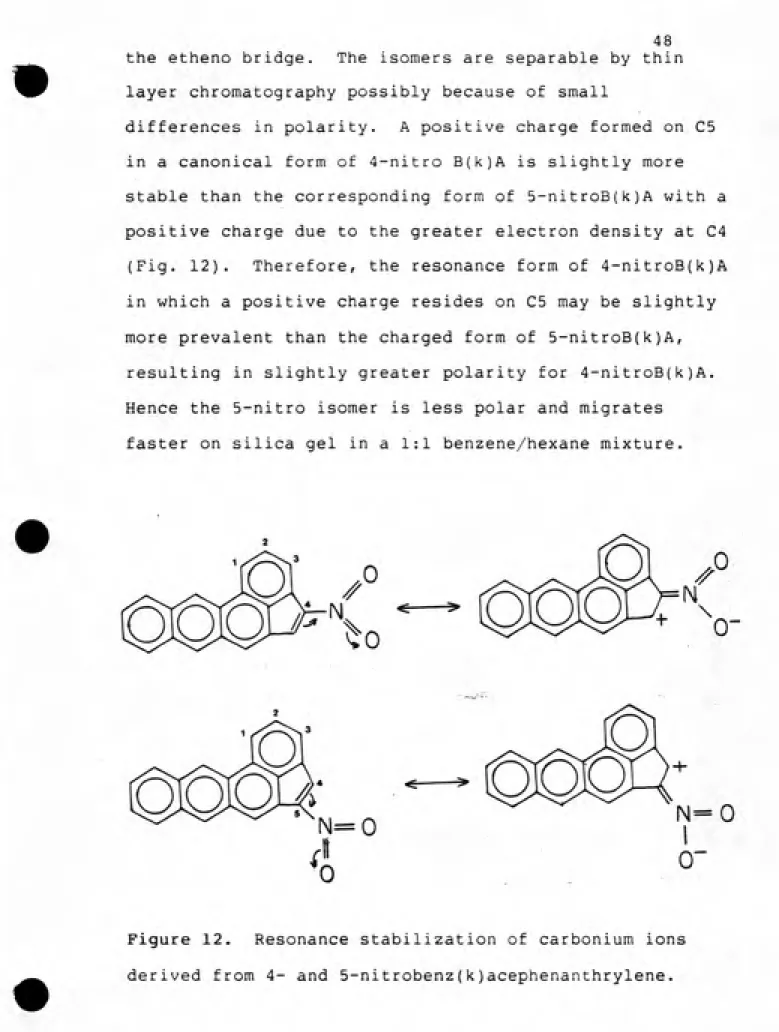
the etheno bridge. The isomers are separable by thin layer chromatography possibly because of small
differences in polarity. A positive charge formed on C5 in a canonical form of 4-nitro B(k)A is slightly more stable than the corresponding form of 5-nitroB(k)A with a positive charge due to the greater electron density at C4
(Fig. 12). Therefore, the resonance form of 4-nitroB{k)A
in which a positive charge resides on C5 may be slightly more prevalent than the charged form of 5-nitroB(k)A,
resulting in slightly greater polarity for 4-nitroB(k)A. Hence the 5-nitro isomer is less polar and migrates
faster on silica gel in a 1:1 benzene/hexane mixture.
Q
Q
Q
Q
Q
Q
Q
Q
Q
Q
Q
Q
N=0
•o
o
Q
Q
Q
N=0
Figure 12. Resonance stabilization of carbonium ions
"St^'."*»'' '
49 Bacterial Mutagenicity Assays.
The results of the Ames assay (Table 7) suggest that all the compounds tested are biologically active. Consistent with many other NO„PAH previously tested
(Rosenkranz and Mermelstein, 1981), they do not require S9 activation, suggesting that they are "direct-acting" mutagens; in addition, they appear to induce primarily
frameshift mutations.
Compound Rev/nn 4-nitrocyclopenta(cd)pyrene
2-nitrobenz(j)aceanthrylene 6-nitrobenz(e)aceanthrylene 2-nitrobenz(l)aceanthrylene 4-nitrobenz(k)acephenanthrylene 5-nitrobenz(k)acephenanthrylene
Table 7. Summary of mutagenic activities of nitrated cyclopenta-fused benzanthracene and pyrene derivatives in
TA98.
However, these compounds are significantly less
active than some other NO-PAH of similar molecular
weight, e.g. 1-nitropyrene and 3-nitrofluoranthene, nor
are they as active as the parent cyclopenta PAH (which require S9 activation). Vance and Levin (1984) reported similar low activity with another nitrated
cyclopenta-fused PAH, 1-nitroacenaphthylene (9.5 rev/nmol).
Moreover, preliminary results in the mammalian C3H10T, ,„
(-S9) Re^/nmol (+S9)
5.9 5.5
7.2 8.2
1.1 1.2
1.8
---4.7 1.0
50 morphological cell transformation assay indicate that
2-nitrobenz(1)aceanthrylene is highly toxic but induces
little or no transformation (Mohapatra, Nesnow, unpublished results).
Why, then, are these compounds relatively inactive?
The first question we must ask is: are these compounds
reduced by the nitroreductase enzymes? This question can obviously be best answered by experiment; i.e. expose Salmonella to varying concentrations of the chemicals and
analyze the metabolites. Such experiments are
contemplated in future work, but may be discussed in terms of structure-activity relationships using HUckel
molecular orbital calculations to derive parameters
described by Klopman et al. (1984) to determine the energy level of the lowest unoccupied molecular orbital
of each compound. According to Klopman's theory, the
closer the LUMO energy is to 0, the "easier" it is to place an electron in the LUMO and the "easier" the compound is to reduce.
LUMO energies were calculated by the method of Yates (1978). All atoms which were part of the t system were numbered and the secular matrices were constructed using the arbitratily assigned value of 1.0 for g(the
ir-overlap integral) for nearest-neighbor w-orbital
interactions between carbon atoms. The value 0.78 used
for the carbon-nitrogen bond was determined by