Joint Attention and Language Development in Children with Autism and Children with Developmental Delay
Anna Ollinger
A senior honors thesis submitted to the faculty of the University of North Carolina at Chapel Hill in the Department of Linguistics
Chapel Hill 2013
Abstract:
Although typically developing one- and two-year olds learn new words at an astounding rate, the process of establishing word-to-world links is not simple. Children must gather a variety of information from different sensory modalities in their
surrounding environment about the current social situation and use their knowledge of how language is used in order to correctly map a word onto its referent. Along with other social-communicative behaviors, joint attention plays a pivotal role in the development of early word-mapping abilities as it allows children to jointly experience social situations and understand that a speaker’s utterance is used to label the object to which both communicative participants are attending.
Joint attention is a part of a broad range of social-communicative skills that children with autism often lack, further preventing them from participating in the social world around them. Given the strong relationship between joint attention and early language acquisition, it is not surprising that children with autism often experience delays in both joint attention and early word learning. Children with other developmental disabilities, however, do not exhibit the consistent impairments in joint attention and language acquisition that are characteristic of children with autism.
This study was conducted in order to further investigate the relationship between joint attention and language ability in children with disabilities, comparing children with autism to children with non-autism related developmental delay.1 Each participant in this study was evaluated in his or her ability to initiate and respond to joint attention. A variety of assessments were used to determine each participant’s concurrent expressive
and receptive language abilities, along with these abilities one to seven years later. Thus, the joint attention and language abilities of the group of children with autism were
compared to those of the group of children with developmental delay. Additionally, each child was compared to himself or herself across two different time points in order to determine whether a long-term association between joint attention and language ability exists in these two populations. Statistical analyses reveal that, in both groups, children that initiated and responded to joint attention more often had higher measures of
concurrent spontaneous language production, which was used to determine their
expressive language abilities, and more advanced receptive language abilities at the same time point. However, the associations between these two developmental variables were always stronger in children with autism than in children with developmental delay. These findings suggest that joint attention plays a different role in the expressive and receptive language development in children with autism than it does in children with developmental delay.
The importance of joint attention to early language acquisition was not only apparent in the short term. Higher levels of joint attention predicted subsequent language development later in time. In children with autism, one’s ability to initiate joint attention was correlated with higher expressive and receptive language abilities later on in life. Additionally, better rates of responses to joint attention were predictive of receptive language ability one to seven years later in both children with autism and children with developmental delay.
subsequent expressive and receptive language delays. Understanding deficits in joint attention and their subsequent effects on social-communicative development in both children with autism and children with developmental delay may provide us with valuable information on how to develop more effective intervention strategies for children with disabilities.
Joint Attention and Word Learning Overview
Typically developing children struggle with the rote memorization of facts and figures, but they easily engage in word learning. Around the age of twelve months, most children begin to produce their first words. Following this developmental milestone, they enter a period in which they rapidly associate words with their referents, a critical step in the process of word learning.2 During this stage, children acquire as many as ten words a day, often times with limited exposure to such words (Bloom, 2000). Learning words is largely dependent on social interactions: when someone uses a word, it is important for a child to understand the speaker’s communicative intention to label a certain object or event (Miller, 2006). According to the social-pragmatic approach to language
acquisition, humans use linguistic symbols in a universal manner (Ambridge and Lieven, 2011). A speaker uses nouns to refer to objects in the environment and to convey
information in social contexts, allowing both the speaker and listener to jointly
experience the current social situation and observe what is going on in their surrounding environment. Lois Bloom claims that children learn words “in and for conversations” and thus, word learning is an intrinsically social process based on interactions with others (Bloom, 1998, p. 347). During language acquisition, children attempt to determine the
adult’s intentions when a specific noun is used in order to understand the present social situation (Nelson, 2005). Although children use this social learning process for learning nouns, they must also learn a wide variety of other types of words (i.e. verbs, adjectives, conjunctions, determiners, prepositions, auxiliaries, etc.) that cannot be learned primarily via social cues. While it is important to remember that a variety of mechanisms play into the learning of abstract word categories, here the primary focus will be on noun learning. Joint attention, or “the capacity of an individual to coordinate his or her attention with a social partner vis-a-vis an object or event,” is one of the cognitive mechanisms implicated in word learning, as it helps children link a novel word with its referent (Morales, 2000, p. 283).3 Although we can engage in joint attention using other
physiological senses -- e.g. we can jointly attend using auditory or tactile senses -- joint attention is typically described according to one’s gaze.4 This ability includes a wide variety of behavioral forms such as gaze alternation, following and production of points, and sharing (Charman, 2003). Joint attention abilities are complex, however, and always involve more than simply two people both looking at the same object (Kaplan and Hafner, 2010). Shared attention occurs when two individuals are both looking at the same object. When two individuals engage in joint attention, however, there is mutual recognition that both communicative participants are coordinating their attention towards the same object. Joint attention and shared attention are distinct phenomena.
3Other similar definitions of joint attention are found in Tomasello (1995, p. 106), Ambridge and Lieven (2001, p. 71), and Akhtar and Gernsbacher (2007, p. 196).
During interactions that exemplify joint attention, one often alternates one’s gaze between an object and another person. This gaze alternation shows an individual’s recognition that both communicative participants are (1) simultaneously looking at the same object and (2) jointly coordinating their focus towards that object. Throughout this thesis, joint attention will be referred to as a specific psychological-communicative phenomenon involving a three-way relationship between two attendees and an object.5 This form of attention is active since the communicator must monitor and direct the listener’s attention towards the object at which they are looking. The listener must understand and interpret the communicator’s intentions. As a result, the listener must not only focus their attention on the object at which the communicator is already looking, but also recognize that the communicator intends to direct the listener’s attention towards the object. By the time joint attention is completely developed -- around the age of eighteen months -- children recognize that adults have intentions to direct the actions and attention of others (Adamson & McArthur, 1995; Morales, 2000).6,7
5Joint attention involves psychological and conceptual capacities (eye direction detector, intentionality detector, shared attention mechanism, etc.) that contribute to its
communicative function.
6Recognizing that others have intentions is related to the development of Theory of Mind, or the ability to represent others’ mental states. Children begin to develop Theory of Mind and come to understand that the adult’s intentions may differ from their own intentions, a realization that is crucial for early word learning
Development of Joint Attention
Children’s recognition of visual stimuli plays a crucial role in typical social-communicative development. Prior to the onset of language acquisition, visual stimuli enable children to gather information about objects, individuals, and events in their surrounding environment. Typically developing infants are sensitive to social stimuli (i.e. human faces) when they are just six weeks old (Maurer & Salapatek, 1976; Morton & Johnson, 1991; Dawson et al., 2004) and register changes in eye gaze by the time they are five months old (Symons, Hains, & Muir, 1998; Dawson et al., 2004). As children begin to engage in interactions characterized by joint attention, they learn that eye gaze and gaze following, when used with communicative partners, allow information of all kinds to be transmitted between individuals. Joint attention emerges according to a universal developmental sequence in most children who are typically developing
(Tomasello, 1995). Despite the abundance of research on joint attention, the age of onset of this ability is widely debated among experts. While some researchers argue that joint attention behaviors begin to emerge as early as six months of age (Butterworth & Jarrett, 1991; Scaife & Bruner, 1995; Morales, 2000), most experts believe that infants do not consistently engage in joint attention until they are at least twelve months old (Adamson & McArthur, 1995; Morales, 2000). Some infants demonstrate limited amounts of simultaneous looking and inconsistent instances of gaze following when they are only nine months old (Tomasello, 1995). However, it is unlikely that such erratic examples of gaze following reflect the child’s ability to share attention, follow the attention of
The ability to respond to joint attention (RJA) emerges prior to the onset of
initiation of joint attention (IJA). RJA refers to the capacity of an individual to accurately respond to others’ bids for shared attention. RJA behaviors include following a
communicative partner’s gaze, line of regard, head turn, and/or pointing gesture (Mundy & Crowson, 1997; Sigman and Kasari, 2005). On the other hand, IJA is associated with an individual’s ability to direct the attention of another via initiating eye gaze alternation between a nearby object and a communicative partner, protodeclarative pointing to an object of interest, and/or showing an object to the person with whom they are interacting (Mundy & Crowson, 1997; Sigman and Kasari, 2005). More simply put, RJA involves a child’s response to any bids for attention a communicative partner directs towards the child, while IJA involves any actions the child uses to manipulate the attention of their communicative partner. The fact that RJA and IJA develop separately suggests that they are associated with different cognitive and psychological processes and thus, have distinct effects on subsequent language development (Mundy and Gomes, 1998). Alternatively, given that RJA develops prior to IJA, it is also possible that IJA could build upon the development of RJA abilities. RJA is more closely related to receptive language development (Mundy & Gomes, 1998; Morales, 2000), while IJA is a strong correlate of expressive language development (Mundy & Gomes, 1998). Although they are separate abilities, both RJA and IJA are crucial in a child’s typical
social-communicative development sequence (Mundy et al., 2003).
simultaneous emergence of other social behaviors: “Joint attention emerges in response to the dynamic integration of basic information processing, social cognitive,
self-regulatory and social emotional factors that affect how one interacts with their caregivers and others” (Sigman and Kasari, 1995, p.185). Since joint attention enables children to better understand and communicate with the world around them, it is no coincidence that related social-communicative abilities (i.e. imitative learning, social referencing,
language acquisition, etc.) emerge around the same age (Tomasello, 1995). It is difficult to determine whether a causal relationship exists between the development of joint attention and the emergence of these other social-communicative behaviors. Although the answer to this question remains unclear, there is no doubt that all of these social-communicative behaviors (i.e. joint attention, imitative learning, social referencing, etc.) are essential for a typical social-communicative development sequence.
successfully mapped the novel label to the object in the follow-in condition, only the 18- and 19-month old children that were able to successfully map the novel word onto its referent in both the “follow-in” and “discrepant labeling” condition. This suggests that it is only a little before two years of age in which children are able to utilize their joint attention abilities to infer to which object the experimenter’s label refers (Baron-Cohen, Baldwin, and Crowson, 1997). The connection between joint attention and language will be further addressed in the next section.
Joint Attention and Language Development
In principle, unfamiliar nouns can label a wide variety of objects or entities. Joint attention, however, helps children narrow down a noun’s reference and its possible meanings. Take, for example, a situation in which an adult uses the word “shoe” to refer to a running shoe located on the shelf across the room. If both the child and adult engage in joint attention, then the child will alternate his or her gaze between the adult and the shoe in order to determine that the adult intends for the child to look at the shoe. When the adult utters /ʃu/, the child is then able to conclude that the sound /ʃu/ is used by speakers to refer to the entity it represents in the world. With continued parent-child interactions and improvements in joint attention, children begin to understand that they can also use words to manipulate their listener’s attention and direct their eye gaze towards the object that the word represents. In summary, joint attention enables the listener to focus on the speaker’s target of reference and understand that the speaker’s utterance is used to label the object or entity to which both communicative participants are jointly attending.
Although joint attention can be helpful for children as they map novel object labels for nouns onto their associated referents, it is unlikely that joint attention or other related forms of non-verbal communication assist in the complex process of verb
the here and now, the child’s resulting word-to-world match may not be accurate. Not only is it probable that the child and adult are attending to different aspects of the same event when the verb is uttered, but the verb may relate to the world in obscure and abstract ways that the child cannot observe (i.e. think, wonder, suppose, etc.). Given the complexity of verb learning, it is likely that other learning mechanisms, outside of joint attention, play into learning this specific category of words (Gleitman, 1990; Gleitman et al., 2005). It is noteworthy to mention that verb learning may be a distinct process from noun learning; however, the bulk of the literature on the relationship between joint attention and word learning has focused on the relevance of joint attention for noun learning.
Further evidence for the importance of joint attention to noun learning comes in the form of experiments conducted with young children. Studies reveal that children’s ability to perceive objects in their surrounding environment is not enough for word learning. In one study, 15-20-month old children were placed alone in a room with a novel object. An adult’s voice was played over a loud speaker and labeled the novel object: however, children did not learn the new word (Baldwin et al., 1996). Although the child was able to see and perceive the object, the child did not have any social
In the same study, experimenters developed a “joint attention” condition in which the adult and child engaged in an interaction involving joint attention (Baldwin et al., 1996). The adult alternated his or her gaze between the child and the novel object to which the child was attending. The adult then proceeded to label the child’s novel toy with an unfamiliar word. In contrast to the first experimental condition, the 15-20-month olds did map the novel word onto its referent when the novel object label was produced while the child was engaging in joint attention with the adult. When joint attention was involved, children successfully established word-to-world links. However, they failed to do so when there was no form of social interaction or cues helping the child determine to which object the adult was referring. In a similar study, researchers found that infants between the ages of 18- and 21-months had brain waves suggestive of semantic
integration when learning new words in episodes exemplifying joint attention. However, such brain waves were not present when novel words were presented in interactions not characterized by joint attention (Hirotani, 2009). These findings suggest that children heavily rely on joint attention to guide them as they develop early word-mapping abilities.
related to the child’s vocabulary development at the end of the six-month period (Tomasello & Todd, 1983; Tomasello & Farrar, 1986). In yet another study, Mundy et al. (1990) found that joint attention abilities measured at 45 months of age were
associated with language ability twelve months later in both children who were typically developing and those with developmental delay (Mundy et al., 1990; Courchesne et al., 1994). Other studies have found that joint attention is predictive of language ability not only in the short term, but in the long term as well. Sigman & Ruskin (1999) found that RJA abilities in infants were positively associated with expressive language ability twelve years later (Courchesne et al., 1994; Sigman & Ruskin, 1999).
Joint Attention in Children with Autism
Autism is characterized by a wide variety of social and communicative deficits. Although there are many atypical behaviors associated with autism, one of the most common features of autism is a social orienting impairment, in which a child is “unable to spontaneously orient to naturally occurring stimuli in their environment” (Dawson et al., 2004, p. 273). Typically developing children register visual and social stimuli from a very young age. However, children with autism often fail to adequately respond to such social stimuli and as a result, it is no surprise that they show large deficits in the
to distinguish among children who are typically developing, children with autism, and children with developmental delay. Among the three domains, joint attention was the best way of distinguishing among the three groups of children, especially in the process of differentiating children with autism from children with developmental delay (Dawson et al., 2004). Although children with autism attended to their name less frequently and showed less attention to distress than children with developmental delay, these abilities did not help to differentiate the two populations. Instead, it was the lack of ability to both initiate and respond to joint attention among children with autism that set them apart from both those who were typically developing and those with developmental delay.
Retrospective analyses of home videos reveal that in infancy, children with autism engage in fewer interactions characterized by joint attention than their peers who are typically developing and peers with other forms of developmental delay (Dawson et al., 2004). More specifically, Arien et al. (1993) found that infants later diagnosed with autism used fewer social smiles, exhibited hypotonia (decreased muscle tone), used minimal facial expressions, and had poor attention to social stimuli in home videos at one year of age (Arien et al., 1993; Charman, 2003). In a similar study, Osterling & Dawson (1994) concluded that at their first birthday parties, children later diagnosed with autism were less likely to look at others, show or point to an object, or orient to others who called their name (Osterling & Dawson, 1994; Charman, 2003). By the time these children were two years old, they demonstrated an even wider array of social
et al. (2000) in which experimenters found that children with autism exhibited no difficulty in shifting their attention towards objects and other non-social stimuli, but demonstrated impairments in orienting towards social cues (i.e. gaze alternation, head turn, point, etc.) (Leekam et al., 2000; Charman, 2003). Taken together, these studies demonstrate that preschoolers with autism are often able to engage in a variety of nonverbal forms of communication, but fail to correctly orient to social stimuli in their surrounding environment, resulting in subsequent joint attention impairments (Curcio, 1978; Mundy & Crowson, 1997).8
There are a variety of possible reasons why children with autism do not attend to social stimuli and/or engage in joint attention. Many children with autism show a basic attentional functioning deficit (Mundy, 1995; Mundy & Neal, 2001; Charman, 2003). Early social communicative interactions require infants to shift their attention rapidly and frequently and thus, it is plausible that children with autism do not possess the ability to adequately deal with such large attentional processing demands placed upon them (Dawson et al., 2004). Magnetic resonance (MR) and autopsy analysis from nine independent research studies have found that approximately 89% of individuals with autism exhibit cerebellar pathology (Courchesne et al., 1994; Mundy & Crowson, 1997).
8 Children with autism often do not have trouble responding to or initiating protoimperative gestures used to request an object of interest. However, they are
severely impaired in their ability to respond to or initiate protodeclarative bids (Loveland and Landry, 1986; Leekam, Lopez, and Moore, 2000). The production of
protodeclarative gestures may require an intrinsic motivation to jointly experience a social situation, which children with autism seem to lack. On the other hand,
Although the cerebellum is traditionally linked to motor control ability, recent studies have led researchers to conclude that this region of the brain may also play an important role in attention coordination. If a young child with autism has a mal-developed
cerebellum, he or she may be incapable of accurately processing social cues in the surrounding environment and, consequently, unable to respond to and/or initiate joint attention (Courchesne et al., 1994).
In their study, Courchesne et al. (1994) presented visual and auditory stimuli to children with autism in order to see if they were able to accurately shift their attention between two different sensory modalities (i.e. detect an auditory stimulus when currently focusing on a visual stimulus). However, given a two and a half second time window, children with autism, like patients with acquired cerebellar damage, were unable to shift their attention and attend to the newly presented stimulus in another sensory modality. Although children with autism had slower reaction times than children who were
Children with autism have trouble shifting, coordinating, and manipulating
attention. As a result, what they gather about the world from their social interactions may lack the temporal and contextual continuity needed to make sense of the world:
“knowledge of the social world would be made up of disconnected fragments of gestural, facial, vocal, and emotional information” (Courchesne, 1987, p. 314). If children with autism are unable to register the communicative significance of a smile or eyebrow raise, then they will fail to take note of the clues in their surrounding environment that are required to develop social-communicative competence. Without an ability to engage in joint attention, children with autism will also be unable to develop a breadth of other related social-communicative skills that develop around the same time (i.e. imitation, turn-taking, symbolic play, ability to exchange information, etc.). All of these abilities play a crucial role in typical social-communicative development. The fact that children with autism demonstrate associated impairments suggests that they gain a fragmented view of the world around them, making social-communicative development, especially language acquisition, extremely difficult.
Researchers have found that impairments in joint attention in infancy lead to subsequent delays in other areas of development (Leslie, 1987, 1994; Rogers &
determined the manners in which typically developing children, children with
developmental delay, and children with autism respond to bids for joint attention shifts. In one trial, the child’s reaction was recorded during a “blocking task” in which the experimenter covered the child’s hands after the child became fully engaged with a toy. In a subsequent trial named the “teasing task,” the experimenter offered the child a toy and then took it away when the child became interested. As compared to children who were typically developing and those with developmental delay, children with autism gaze-switched less and looked less toward the experimenter during both the blocking and teasing task (Charman et al., 1997). Overall, children with autism participated in fewer joint attention episodes with the experimenter than did the other participants. These results highlight the joint attention deficits that so many children with autism experience. As a result of their unawareness of social cues, children with autism have less exposure to people and the gestural and eye contact information. With less exposure, it is obvious that they are less expert at handling social situations than their peers who are typically developing (Charman, 2003).
Their inability to coordinate their attention with the speaker or understand that others have different intentional states from their own may explain why they often do not acquire words at the same rate as other typically developing children (Baron-Cohen, 1995). Children with autism who undergo behavioral interventions that target joint attention show increases in their receptive and expressive language abilities following the conclusion of treatment (Kasari et. al, 2008). As in children who are typically
developing, Mundy et al. (1990) found that differences in joint attention abilities in children with autism are related to their subsequent language development (Mundy et al., 1990; Mundy & Crowson, 1997).
(Baron-Cohen, Baldwin, and Crowson; 1997, p. 52).9 Analyses reveal that the children with autism that failed in the “discrepant labeling” condition mapped the object label onto the incorrect object, or the one that they were attending to.
This word-to-world mapping error in the “discrepant labeling” condition may result from the child’s inability to deal with the high attentional processing demands associated with such a complex social situation (Baldwin & Moses, 2001). In such a scenario, the child must note the difference between their attention and the attention of the adult. Then, they must shift their attention from their current line of focus while simultaneously processing the speaker’s social cues. Once they process these clues in a quick and accurate manner, they must appreciate the significance of information in order to interpret and process the phonological cues. Thus, in order to successfully map a word onto its referent in the “discrepant labeling” condition, the child must complete a variety of tasks, all of which place high attentional processing demands on the child. Typically-developing children are able to successfully map the novel object label onto its referent in both the “follow-in” and “discrepant labeling” condition by the time that they are 18-20-months old. However, the attentional processing demands associated with the
“discrepant labeling” condition may prove to be too much for the children with autism to handle, resulting in word-to-world mapping errors. This present study may help to explain the ways in which joint attention deficits in children with autism contribute to their developmental language delay.
Rationale for my Study:
This study was conducted in order to determine the relationship between joint attention and concurrent language abilities, both expressive and receptive, in children with autism and children with developmental delay, and to study how this relationship differs between the two populations. Language abilities were also analyzed at a point later in time to determine whether joint attention is predictive of subsequent language development. Although a variety of previous studies have analyzed the relationship between joint attention and language development, not all of them accurately reflect a child’s joint attention ability. For instance, the Attention Following and Initiating Joint Attention Protocol (Watson, Baranek, & Poston, 2003) was used in order to determine a child’s joint attention ability for use in the Sensory Experiences Project (SEP) at the University of North Carolina at Chapel Hill. Although the scoring system for this
protocol accurately reflected a child’s ability to respond to joint attention, it did not give a child credit for all of his or her initiations of joint attention and thus, may have
underestimated IJA abilities. Using a new joint attention coding system in conjunction with a variety of diagnostic tools, the research questions below were addressed in an attempt to provide a more accurate reflection of the role that joint attention plays in language acquisition.
Research Questions:
2. How does the number of responses to joint attention episodes during the joint attention protocol predict concurrent spontaneous language production and receptive language ability at time one in children with autism? How does this compare to children with developmental delay?
3. How does the number of initiation of joint attention episodes at time one predict expressive and receptive language ability at time two as measured by the
Vineland Adaptive Behavior Scales (VABS) in children with autism and children with developmental delay?
4. How does the number of responses to joint attention episodes at time one predict expressive and receptive language ability at time two as measured by the
Vineland Adaptive Behavior Scales (VABS) in children with autism and children with developmental delay?
Methodology: (1) Participants
developmental delay at both T1 and T2 as determined by specific diagnosis criteria. The autism spectrum disorder diagnosis criteria include: 1) an autism spectrum disorder diagnosis from a clinical professional 2) diagnostic scores within the autism spectrum disorder range on the Autism Diagnostic Interview-Revised (ADI-R), and 3) diagnostic scores within the autism spectrum disorder range on the Autism Diagnostic Observation Schedule (ADOS) (Hurwitz, 2010, p. 25). Children classified as having developmental
delay did not meet criteria for an autism spectrum disorder on the ADOS and did not have a clinical diagnosis of an autism spectrum disorder. Developmental delay
diagnostic criteria include: 1) a clinical diagnosis of developmental delay, 2) an overall cognitive score that was more than two standard deviations below the mean or cognitive scores that were at least one and a half standard deviations below the mean in two separate areas of development, and 3) no symptoms of autism as determined by the ADOS and the Childhood Autism Rating Scale (Hurwitz, 2010, p. 32-33).
Table 1: Participant Demographics
Diagnosis Number Total Number of Girls CA (months) (months) NVMA
Autism 17 1
Mean: 59.3 Mean: 38.5 Standard
Deviation: 33.0
Standard Deviation: 19.0
Range: 24-144 Range: 7-66
Developmental
Delay 10 5
Mean: 67.2 Mean: 41.3 Standard
Deviation: 26.7
Standard Deviation: 18.8
(2) Experimental Measures Conducted and/or Referenced at Time One (i) Joint Attention
The Attention Following and Initiating Joint Attention Protocol (Watson, Baranek, & Poston, 2003) was used as a measure of each participant’s ability to initiate and respond to joint attention. Each participant was administered the Attention
Following and Initiating Joint Attention Protocol (JA protocol) at T1. The protocol consisted of sixteen trials designed to measure IJA and RJA abilities.
In eight of these trials, the child was presented with bids to follow the attentional cues of the examiner in order to accurately measure RJA abilities. These eight attention following trials consisted of four different types of bids: (1) head turn in the absence of any other cues; (2) head turn plus protodeclarative point gesture; (3) head turn in conjunction with protodeclarative pointing gesture and verbalization: “Look,” and (4) heard turn used with the pointing gesture and a verbalization: “Look, (name object).” (Watson, Baranek, & Poston, 2003) Each of these four bids for joint attention was repeated twice throughout the JA protocol. The child was given credit for an attention following trial if he or she followed the examiner’s bid for attention via head turn, eye gaze alternation, and/or appropriate vocalization. On the other hand, the child was given no credit for the RJA trial if he or she failed to follow the examiner’s bid for attention. RJA scores ranged from 0 to 8 instances of joint attention (see table 2 below).
marker box, (2) ball drop, (3) dress-up, (4) wristband, (5) book with altered pages, (6) musical instruments, (7) remote control car, and (8) bag of toys.
When the IJA trials were originally scored for their use in the SEP, children were only given credit for one initiation of joint attention per IJA trial, despite the fact that they may have initiated joint attention multiple times during that trial. Additionally, children were not given credit for any bids for joint attention that they initiated during the attention following trials. By counting all instances of IJA, it is likely that we had more sensitive measures of IJA abilities.
In order to accurately reflect a child’s IJA abilities, the JA protocol was recoded for IJA according to a novel coding analysis. In contrast to the original way the Attention Following and Initiating Joint Attention Protocol was scored, our coding system gave a child credit for each instance in which he or she initiated joint attention with the
experimenter during both the IJA and RJA trials. Our coding system was adapted from the Early Social Communication Scales coding system for joint attention (Mundy et al., 2003). Using our system, IJA abilities are divided into three separate categories:
her gaze back to the experimenter within two seconds of switching their gaze from the experimenter to the object. If two alternations are completed consecutively, the child must complete the first alternation three seconds prior to the start of the second alternation in order to be coded as two separate instances of gaze alternation. Gaze alternations completed within the three-second period following the experimenter’s bid for joint attention during the RJA trials are not counted. Gaze alternation is considered a low level form of IJA.
(2) Protodeclarative point occurs when the child uses his or her index finger to point out an object of interest to the
experimenter. In order to count as a point, the index finger must be clearly separated from the other fingers. The other fingers must be retracted in the direction of his or her palm OR widely separated from the other three fingers. In addition, the index finger must be erect. Orientation of the hand (palm up or down) when the point is produced does not matter.
Protodeclarative points completed within the three-second period following the experimenter’s bid for joint attention during the RJA trials are not counted. Protodeclarative points are considered a high level form of IJA.
child hands the experimenter an object as a request to complete an action or series of actions using the object. Shows
completed within the three-second period following the experimenter’s bid for joint attention during the RJA trials are not counted. Shows are considered a high level form of IJA. Table 2: IJA and RJA Scores
AUT GROUP
IJA:
Alternate IJA: Point IJA: Show IJA Total RJA Total
Mean: 6.35 2.94 0.53 9.82 5.59
Standard
Deviation: 4.92 4.48 0.80 9.20 2.94
Maximum: 18 15 3 34 8
DDI/DDG
GROUP IJA: Alternate IJA: Point IJA: Show IJA Total RJA Total
Mean: 25.00 4.80 1.20 31.00 6.70
Standard
Deviation: 13.38 4.16 1.40 15.06 2.50
Maximum: 39 13 4 40 8
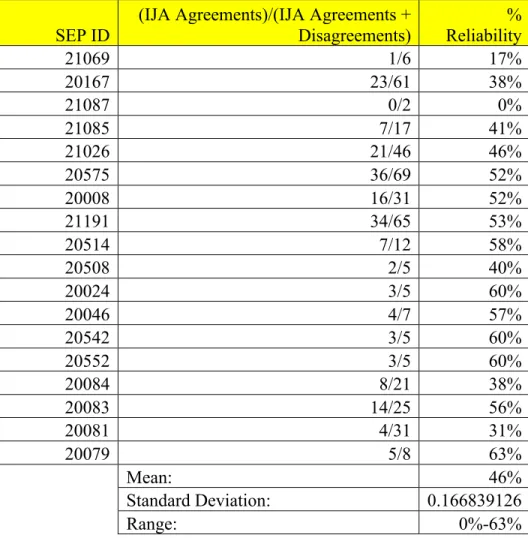
Table 3: Initial Reliability
SEP ID
(IJA Agreements)/(IJA Agreements + Disagreements)
% Reliability
21069 1/6 17%
20167 23/61 38%
21087 0/2 0%
21085 7/17 41%
21026 21/46 46%
20575 36/69 52%
20008 16/31 52%
21191 34/65 53%
20514 7/12 58%
20508 2/5 40%
20024 3/5 60%
20046 4/7 57%
20542 3/5 60%
20552 3/5 60%
20084 8/21 38%
20083 14/25 56%
20081 4/31 31%
20079 5/8 63%
Mean: 46%
Standard Deviation: 0.166839126
Range: 0%-63%
As a result of the infeasibility of obtaining reliability, we double coded for IJA. Throughout the data analysis portion of the study, we coded the same set of five videos independently. Once we each finished coding one set of videos, we met to reach a consensus on all disagreements. To reach a consensus, we compared the time points in which we coded for gaze alternation, protodeclarative point, and show for each video. An instance of IJA was counted as an agreement if we coded the same form of joint attention within the same three-second period. However, an instance of IJA was
attention within the same three-second period, or c) one person coded a form of joint attention at a specific time point and the other person did not code any form of IJA at that time point. After compiling a list of all of the time points of our agreements and
Table 4: IJA Reliability—Data Collection Phase SEP ID % Reliability
21088 50%
20523.03 42%
20529 50%
20533 71%
20543 68%
20519 58%
20527 58%
20523 60%
21119 43%
20517 86%
21059 41%
21078 20%
21084 100%
20551 71%
21091 61%
20534 26%
21023 29%
21010 31%
21130 100%
21146 14%
21187 52%
21168 63%
21165 28%
21172 25%
20555 49%
20573 46%
21169 50%
Mean: 52%
Standard
Deviation: 0.222336082
Range: 86%
(ii) Vineland Adaptive Behavior Scales (VABS)
disabilities, but as a means to develop effective intervention strategies. The VABS scores children’s abilities in a variety of domains: (1) communication, (2) daily living skills, (3) socialization, (4) motor skills, and (5) maladaptive behavior index. The communication domain is further broken down into three subdomains: (1) expressive, (2) receptive, and (3) written. The raw expressive and receptive language sub-scores were used to measure each participant’s expressive and receptive language abilities at both T1 and T2. The VABS expressive language sub-scores were especially important to verify that the measures of expressive language ability collected for each participant during the JA protocol were an accurate reflection of the child’s expressive language ability.
(iii) Intelligence Measures
The Mullen Scales of Early Development (Mullen, 1995) is a measure of a child’s development and intelligence. The Mullen Scales Visual Reception Score was used as a non-verbal measure of each child’s mental age (MA) in months. However, not all children were administered the Mullen Scales of Early Development due to the point in time in which they became a SEP participant. As a result, some children were
(iv) Date of Birth (DOB) and Chronological Age (CA)
Each child’s DOB was recorded and used to calculate the child’s chronological age (CA) at both T1 and T2. CA became especially important in the statistical analyses in order to adjust for any variation that was due to differences in age.
(3) Spontaneous Language Production
In order to measure expressive language ability, each participant’s speech during the Attention Following and Initiating Joint Attention Protocol was transcribed. The experimenter’s speech was not transcribed. The children’s speech was transcribed at the morphemic level and thus, if an utterance was recognized as a word or multiple words, it was recorded in normal English spelling. The utterance was omitted if a) a portion or all of the child’s utterance was unintelligible or b) it took more than three attempts to
Table 5: Spontaneous Language Measures
SEP ID Type Count MLU Word Count Diagnosis
21088 68 3.30 183 AUT
21119 58 3.18 145 AUT
20517 0 0.00 0 AUT
21059 81 3.32 222 AUT
21078 0 0.00 0 AUT
21084 13 1.14 24 AUT
21091 87 3.32 279 AUT
20534 41 3.68 96 AUT
21023 28 1.13 52 AUT
21010 112 2.59 277 AUT
21130 1 1.00 1 AUT
21146 21 1.44 35 AUT
21187 99 2.91 269 AUT
21168 60 3.95 142 AUT
21165 106 4.43 259 AUT
21172 2 1.00 2 AUT
21169 148 5.34 390 AUT
Mean: 54.41 2.45 139.76
Standard Deviation: 46.07 1.58 125.43
Maximum: 148.00 5.34 390
SEP ID Type Count MLU Word Count Diagnosis
20523.03 3 1.00 5 DDG
20529 93 2.87 190 DDG
20533 83 3.41 148 DDG
20543 100 3.22 339 DD-I
20519 189 4.01 626 DD-I
20527 0 0.00 0 DDG
20523 30 1.89 71 DDG
20551 17 1.19 98 DD-I
20555 47 1.78 87 DD-I
20573 122 3.29 294 DD-I
Mean: 68.40 2.27 185.80
(a) Mean-length of utterance (Brown, 1973, p. 338): Mean-length of utterance was calculated in accordance with the guidelines outlined in Brown, 1973. MLU ranged from 0 to 5.34.
(b) Word count: The word count is simply a count of all words (tokens) spoken throughout the JA protocol. The word count ranged from 0 to 626 words. (c) Type Count: The type count measures the amount of different words spoken
by each participant during the JA protocol. If a child spoke the same word more than once, then that word was only counted once in the type count. Given that the type-token frequency is not the best indication of a child’s expressive language ability, the type count serves to be a more accurate measure of lexical variety in my study.
(4) Statistical Analysis
With the help of Chris Wiesen of the Odum Institute, a series of statistical tests were conducted in order to analyze the data that was collected. A linear regression model was used to find the associations between various developmental variables for each research question. CA was used as a covariate in order to account for any variation due to age given that the CA of the participants ranged from 1-12 years. MA was not used as a covariate as this measure is too related to the other developmental language variables used in the study. The simple t-test involved twenty-two degrees of freedom and was two-tailed.
Results:
Research Questions:
1. How does the number of episodes of initiation of joint attention during the joint attention protocol predict concurrent spontaneous language production and receptive language ability at time one in children with autism? How does this compare to children with developmental delay?
Hypothesis 1:
Based on the conclusions drawn from previous research studies conducted, it is apparent that joint attention facilitates language acquisition (Bruner, 1977; Dunham, P. J., Dunham, F. & Curwin, 1993). More specifically, IJA has been found to be an especially strong correlate of expressive language ability (Mundy & Gomes, 1998). Given these two claims, I predicted that both children with autism and children with developmental delay who initiated joint attention more often throughout the Attention Following and Initiating Joint Attention Protocol would have higher measures of spontaneous language production (MLUs, word counts, and type counts). In addition, I predicted, children with more instances of IJA would have higher VABS expressive language sub-scores.
Results for Question 1:
(a) Association between IJA and VABS expressive language sub-score According to the linear regression model, there is a positive association between IJA count and the VABS expressive language sub-score that is statistically significant for children with autism (t(22)=3.01, p=.0073). There is also a positive association between IJA count and the VABS expressive language sub-score for children with developmental delay. However, the positive association between these two variables in children with developmental delay is not statistically significant (t(22)=.37, p =.7135). Additionally, the contrast between the associations in these two groups is statistically significant
(t(22)=2.31, p=.0324). Given this t-value, we can speculate that the relationship between IJA count and the VABS expressive language sub-score is not the same in children with autism as it is in children with developmental delay.
Group
IJA Count/VABS Expressive Language Sub-score
T-Value P-Value
Autism Statistically Significant 3.01 0.0073
Developmental
Delay Not Statistically Significant 0.37 0.7135
Contrast Statistically Significant 2.31 0.0324
(b) Association between IJA and MLU
Group IJA Count/MLU
T-Value P-Value
Autism Statistically Significant 3.71 0.0012
Developmental
Delay Not Statistically Significant 0.65 0.5243
Contrast Statistically Significant 2.51 0.0200
(c) Association between IJA and Word Count
There is a positive association between instances of IJA and word count that is statistically significant in both children with autism (t(22)=3.56, p =.0018) and children with developmental delay (t(22)=2.51, p=.00198). However, the contrast between these two groups when looking at the association between IJA and word count is not
statistically significant (t(22)=3.56, p=.2524).
Group IJA Count/Word Count T-Value P-Value
Autism Statistically Significant 3.56 0.0018
Developmental
Delay Statistically Significant 2.51 0.0198
Contrast Not Statistically Significant 1.18 0.2524
(d) Association between IJA and type count
Group IJA Count/Type Count
T-Value P-Value
Autism Statistically Significant 3.90 0.0008
Developmental
Delay Statistically Significant 2.51 0.0198
Contrast Not Statistically Significant 1.44 0.1631
(e) Association between IJA and VABS receptive language sub-score There is a positive association between IJA and the VABS receptive language sub-score at time one that is statistically significant in children with autism (t(22)=2.01, p=.0473). In contrast, the positive association between these two developmental
variables in children with developmental delay is not statistically significant (t(22)= -.20, p=.8426). The difference between these two groups when analyzing the association between IJA and the VABS receptive language sub-score at time one is not statistically significant (t(22)=1.79, p=.0877).
Group
IJA Count/VABS Receptive Language
Sub-score T-Value P-Value
Autism Statistically Significant 2.10 0.0473
Developmental
Delay Not Statistically Significant -0.20 0.8426
Contrast Not Statistically Significant 1.79 0.0877
Research Question 2:
Hypothesis 2:
Although one’s ability to both initiate and respond to joint attention is positively associated with subsequent language ability. A variety of studies have found that IJA is more closely related to expressive language abilities while RJA is more closely related to receptive language abilities (Mundy & Gomes, 1998). As a result, I hypothesized that for both groups, one’s ability to respond to joint attention would not have a strong positive association with the measures of spontaneous language production, including the VABS expressive language sub-score, MLU, word count, and type count. However, I also hypothesized there would be a strong positive association between one’s ability to respond to joint attention and the VABS receptive language sub-score.
Results for Question 2:
(a) Association between RJA and VABS expressive language sub-score
There is a positive association between RJA and the VABS expressive language sub-score that is statistically significant for children with autism (t(22)=3.39, p=.0031). Although there is a positive association between these two developmental variables in children with developmental delay, it is neither as strong as is the association in children with autism nor statistically significant (t(22)=1.69, p =.1066). When looking at these two variables and contrasting the two groups, the contrast is not statistically significant (t(22)=.38, p=.7117).
Group RJA Count/VABS Expressive Language Sub-score T-Value P-Value
Autism Statistically Significant 3.39 0.0031
Developmental
Delay Not Statistically Significant 1.69 0.1066
(b) Association between RJA and MLU
There is a positive association between RJA and MLU that is statistically
significant in children with autism (t(22)=3.09, p=.0053) but not statistically significant in children with developmental delay (t(22)=.26, p=.7979). The contrast between these two groups when analyzing the associations between these two developmental variables is not statistically significant (t(22)=1.48, p=.1536).
Group RJA Count/MLU T-Value P-Value
Autism Statistically Significant 3.09 0.0053
Developmental
Delay Not Statistically Significant 0.26 0.7979
Contrast Not Statistically Significant 1.48 0.1536
(c) Association between RJA and Word Count
The positive association between RJA and word count is not statistically significant in children with autism (t(22)=1.83, p =.0805) or in children with
developmental delay (t(22)=1.06, p =.3006). The contrast between these two groups is not statistically significant (t(22)=.08, p =.9344).
Group RJA Count/Word Count T-Value P-Value
Autism Not Statistically Significant 1.83 0.0805
Developmental
Delay Not Statistically Significant 1.06 0.3006
Contrast Not Statistically Significant 0.08 0.9344
(d) Association between RJA and Type Count
The positive association between RJA and type count is not statistically significant in either children with autism (t(22)=1.98, p=.0606) or children with
Group RJA Count/Type Count
T-Value
P-Value
Autism Not Statistically Significant 1.98 0.0606
Developmental
Delay Not Statistically Significant 1.04 0.3074
Contrast Not Statistically Significant 0.18 0.8616
(e) Association between RJA and VABS receptive language sub-score
There is a positive association between RJA and the VABS receptive language sub-score at time one in children with autism that is statistically significant (t(22)=7.57, p<.001). However, the association between the two variables is not statistically significant in children with developmental delay (t(22)=1.06, p=.2986). The contrast between the two groups when looking at these two variables is statistically significant (t(22)=3.24, p=.0037).
Group
RJA Count/VABS Receptive Language Sub-score
T-Value
P-Value
Autism Statistically Significant 7.57 <.001
Developmental
Delay Not Statistically Significant 1.06 0.2986
Contrast Statistically Significant 3.24 0.0037
Research Question 3:
3. How does the number of initiation of joint attention episodes at time one predict expressive and receptive language ability at time two as measured by the
Vineland Adaptive Behavior Scales (VABS) in children with autism and children with developmental delay?
Hypothesis 3:
Sigman & Ruskin, 1999). As a result, I predicted that there would be a strong positive association between one’s ability to initiate joint attention at time one and expressive language ability at time two as measured by the VABS expressive language sub-score. I hypothesized that the association would be much stronger in children with autism than for children with developmental delay. Given that many studies have found that IJA is not as strong of a correlate of receptive language ability as is RJA, I hypothesized that IJA ability at time one would not serve as a good predictor of receptive language ability in either children with autism or children with developmental delay at time two.
Results for Question 3:
(a) Association between IJA at T1 and VABS expressive language sub-score at T2
A positive, statistically significant association exists between IJA at T1 and the VABS expressive language sub-score at T2 in children with autism (t(22)=2.41, p=.0249), but not in children with developmental delay (t(22)=.95, p=.3540). When analyzing the association between these two variables, the contrast between children with autism and children with developmental delay is not statistically significant (t(22)=1.28, p=.2125).
Group IJA Count (T1)/VABS Expressive Language Sub-score (T2) T-Value P-Value
Autism Statistically Significant 2.41 0.0249
Developmental
Delay Not Statistically Significant 0.95 0.3540
Contrast Not Statistically Significant 1.28 0.2125
p=.1820) or children with developmental delay (t(22)=74, p=.4679). Additionally, the contrast between the two groups is not statistically significant (t(22)=.61, p=.5499).
Group
IJA Count (T1)/VABS Receptive
Language Sub-score (T2) T-Value P-Value
Autism Not Statistically Significant 1.38 0.1820
Developmental
Delay Not Statistically Significant 0.74 0.4679
Contrast Not Statistically Significant 0.61 0.5499
Research Question 4:
4. How does the number of responses to joint attention episodes at time one predict expressive and receptive language ability at time two as measured by the Vineland Adaptive Behavior Scales (VABS) in children with autism and children with developmental delay?
Hypothesis 4:
Given that joint attention often predicts language ability, I hypothesized that there would be a strong positive association between children’s ability to respond to joint attention at time one and their receptive language ability at time two as measured by the VABS receptive language sub-score. I did not predict that there would be a statistically significant, positive association between a child’s ability to respond to joint attention and their subsequent expressive language ability as measured by the VABS expressive language sub-score given previous evidence for the claim that IJA is a better predictor of expressive language development than is RJA (Mundy & Gomes, 1998).
Results for Question 4:
In contrast to my hypothesis above, there is a very strong, positive association between one’s ability to respond to joint attention at time one and the VABS expressive language sub-score at T2 that is statistically significant in both children with autism (t(22)=3.62, p=.0015) and children with developmental delay (t(22)=2.30, p=.0313). The contrast between these two groups is not statistically significant (t(22)= -.02, p=.9860).
Group
RJA Count (T1)/VABS Expressive
Language Sub-score (T2) T-Value P-Value
Autism Statistically Significant 3.62 0.0015
Developmental
Delay Statistically Significant 2.30 0.0313
Contrast Not Statistically Significant -0.02 0.9860
(b) Association between RJA and VABS receptive language sub-score at T2 There is a strong, positive association between one’s ability to respond to joint attention at T1 and their receptive language sub-score at T2 in both children with autism (t(22)=4.06, p=.0005) and children with developmental delay (t(22)=2.63, p=.0154). The contrast between the two groups is not statistically significant (t(22)= -.06, p=.9515).
Group
RJA Count (T1)/VABS Receptive
Language Sub-score (T2) T-Value P-Value
Autism Statistically Significant 4.06 0.0005
Developmental
Delay Statistically Significant 2.63 0.0154
Results Summary:
• Associations that were statistically significant for AUT group, but not for
DDI/DDG group:
o IJA/VABS Expressive (T1) o IJA/MLU
o IJA/VABS Receptive (T1) o RJA/VABS Expressive (T1) o RJA/MLU
o RJA/VABS Receptive (T1) o IJA/VABS Expressive (T2)
• Statistically significant contrasts between AUT and DDI/DDG group:
o IJA/VABS Expressive (T1) o IJA/MLU
o RJA/VABS Receptive (T1)
• Associations that were statistically significant for both AUT and DDI/DDG
group, but not a statistically significant contrast: o IJA/Word Count
o IJA/Type Count
o RJA/VABS Expressive (T2) o RJA/VABS Receptive (T2)
• Associations that were not statistically significant for either AUT nor
DDI/DDG group:
o RJA/Word Count o RJA/Type Count
o IJA/VABS Receptive (T2) Discussion:
count, word count, and VABS receptive language sub-score at T1). With the exception of two measures of expressive language ability (word count and type count), there was also a statistically significant correlation between RJA and all concurrent measures of language ability in children with autism (VABS expressive language sub-score at T1, MLU, and VABS receptive language sub-score at T1). Given that word count and type count are measures of lexical ability, it is possible that RJA may not play as influential as a role as does IJA in the lexical development of children with autism. Nonetheless, these findings suggest that the abilities to initiate and respond to joint attention are
developmental variables that can be used to predict the concurrent expressive and receptive language abilities of children with autism.
Although there was a positive association between ability to initiate and respond to joint attention and all measures of concurrent expressive and receptive language ability in children with developmental delay, these associations were rarely statistically
significant. For research questions one and two, I calculated ten different associations between joint attention and concurrent language ability. Only two out of these ten associations were statistically significant in children with developmental delay: 1) IJA and word count and 2) IJA and type count. From this, we can conclude that neither IJA nor RJA are extremely strong correlates of concurrent expressive or receptive language ability in children with developmental delay.
attention, as compared to initial language score, MA, CA, and IQ, was a significant predictor of language ability in children with autism, but not in children with
developmental delay. Autism is characterized by a social orienting impairment in which individuals with autism are unaware of the constant stream of social stimuli in their surrounding environment (Dawson et al., 2004). Thus, many children with autism are unable to attend to or make meaning of facial expressions, eye gaze alternations, and other gestures that individuals use to communicate with those around them. If children with autism fail to take note of the abundance of such stimuli in their surrounding environment, then they will also fail to rapidly shift their attention between objects and communicative participants. Without a natural inclination to attend to social stimuli, children with autism will develop impaired RJA and IJA abilities, leading to other impaired social-communicative abilities, including language development. Given that language acquisition is largely a social process, it is likely that joint attention
impairments are more detrimental to the language development of children with autism as compared to children with developmental delay. The relative homogeneity of social deficits within the autism group may contribute to the reason why joint attention ability is so much more related to subsequent language development in the autism group than it is in the developmental delay group.
did children with autism. Perhaps children with developmental delay rely more on joint attention and less on other word-learning mechanisms than do children with autism. Given that children with developmental delay have good joint attention skills, joint attention may not be a barrier to their language development. On the contrary, they may experience impairments employing other word-learning strategies, resulting in language deficits. Children with autism, however, exhibit significant impairments in joint
attention. Consequently, they may rely less on their joint attention abilities and more on other word-learning mechanisms that assist children as they map words onto their
referents. For instance, children with autism may utilize constraints (i.e. the whole-object constraint, mutual exclusivity, etc.) to help them determine a word’s referent (Markman, 1994).10 These word-learning constraints help children recognize that words are used according to certain principles and as a result, they guide children in early word mapping. Syntactic bootstrapping, which allows one to make inferences about a word’s meaning based on its function in the sentence, is another cognitive mechanism that may assist children in early word learning. It could be that children with autism rely more on these word-learning strategies and less on their impaired joint attention abilities as they map words onto their referents.
When contrasting the associations between joint attention and measures of language ability in children with autism and children with developmental delay, three associations were statistically significant: a) IJA and VABS expressive language sub-score at T1, b) IJA and MLU, and c) RJA and VABS receptive language sub-sub-score at T1.
It is interesting that when looking at the above associations, IJA is only related to measures of expressive language ability rather than measures of receptive language ability. On the other hand, RJA is related to receptive language ability and not to
expressive language ability. This may be evidence for the claim that IJA is more strongly associated with expressive language ability, whereas RJA is more closely related to receptive language ability (Mundy & Gomes, 1998; Morales, 2000). RJA and IJA develop separately and according to a universal development sequence (Tomasello, 1995). In a similar manner, receptive and expressive language abilities develop
separately. Given that RJA and receptive language abilities typically develop prior to IJA and expressive language abilities, it could be that RJA and IJA are distinct cognitive processes that have differential effects on subsequent language acquisition. During early interventions that target joint attention, it takes children more time to learn IJA skills, as opposed to RJA skills, suggesting that they represent separate cognitive processes (Jones, Carr, & Feeley, 2006). When a child responds to an adult’s bid for joint attention, they are simply responding to the adult’s nonverbal request. However, when a child initiates joint attention with an adult, he or she must have an intrinsic social motivation to share something with the adult. As a result, there may be a functional difference between these two behaviors, resulting in different effects on language development (Jones, Karr, and Keeley 2006). RJA and receptive language abilities are similar in that the child must understand that the adult has a communicative intention to direct the attention of the child, whether it is in a verbal or nonverbal form. In a similar manner, initiation of joint attention is similar to expressive language abilities in that the child must have an
inherent similarities between IJA and expressive language ability and RJA and receptive language ability that drive the observed associations.
Additionally, these three statistically significant contrasts between the two groups concern measures of syntactic ability as opposed to measures of lexical ability. This suggests that children with autism and children with developmental delay utilize their joint attention abilities in different manners throughout their syntactic development. As mentioned above, it could be that children with autism rely less on their joint attention abilities than do children with developmental delay. Instead, children with autism may rely more on other word-learning mechanisms, such as syntactic bootstrapping. Joint attention does not seem to be a barrier for language development in children with developmental delay and thus, it may be their inability to use other word-learning mechanisms that hinders their language development.
The relationship between joint attention and language ability does not solely exist in the short term. In children with autism, there is a statistically significant, positive association between IJA at time one and expressive language ability at time two, as measured by the VABS expressive language sub-score. However, this positive association is not statistically significant in children with developmental delay. This finding suggests that IJA is more closely related to subsequent expressive language ability in children with autism than in children with developmental delay. Additionally, this could mean that ability to initiate joint attention is a very good predictor and measure of subsequent language ability in children with autism. These conclusions are consistent with many of the past research studies conducted. For instance, Mundy et al. (1990) found that as compared to MA, CA, and IQ, joint attention was a better predictor of language ability thirteen months later in children with autism. In contrast, language level and MA were the best predictors of language ability in children with Down syndrome thirteen months later. Since children with developmental delay are naturally more
attuned to social stimuli, then it may be that other developmental variables, as opposed to joint attention, are more predictive of subsequent language development.
There was not a statistically significant association between one’s ability to initiate joint attention at time one and their subsequent receptive language ability at time two (as measured by the VABS receptive language sub-score) in either the autism group or the developmental delay group. This is further support for the claim that in all