Anna M. Branscome. Sustainability and Social Impact Perception: A Comparative Study of Two State Literary Festival Organizational Models. A Master’s Paper for the M.S. in L.S degree. April 2009. 63 pages.
Advisor: Evelyn H. Daniel.
This study describes a questionnaire survey of the directors of two state literary festival models, the “distributive model” as illustrated by
Georgia’s system, and the “centralized model” as exemplified by that of North Carolina. The intent of this study was to compare and contrast the two models in terms of two critical variables, sustainability and positive social impact, and to begin to establish a research base for further exploration.
Although a low and unbalanced return rate of the surveys precluded a comparative analysis, a descriptive analysis of the responses and
supplementary material suggests the strengths of the distributive model include avoiding resource exhaustion, reaching a wider and less
culturally privileged audience at lower cost, and reinforcement of
community identity and pride; the centralized model’s strongest points appeared to be unity of vision and the ability to tap a broad range of authors as well as a large audience.
Headings:
Festivals -- United States -- Georgia
SUSTAINABILITY AND SOCIAL IMPACT PERCEPTION: A COMPARATIVE STUDY OF TWO STATE LITERARY FESTIVAL
ORGANIZATIONAL MODELS
by
Anna M. Branscome
A Master’s paper submitted to the faculty of the School of Information and Library Science of the University of North Carolina at Chapel Hill
in partial fulfillment of the requirements for the degree of Master of Science in
Library Science.
Chapel Hill, North Carolina April 2009
Approved by
Introduction
A quick perusal of the National Center for the Book’s on-line calendar shows twenty-five states now hosting state literary festivals. Nearly half of these began in the last ten years, seven of these in the last six. Many of these festivals are hosted by either a public or an academic library, or a host committee within which they have a strong role. At a time when there has been an enormous proliferation of book and literary festivals both nationally and internationally, there have also been ongoing pressures on both local public-library and college- and university-level library budgets in the United States. For example, the DeKalb County Public Library system, home of the Georgia Center for the Book which coordinates the Georgia State Literary Festival, was recently denied funding for new positions for three new and five expanded library facilities jeopardizing their openings. (Some, however, since this paper was begun, are being reconsidered.) At the public-university level, in 2007, the University of North Carolina-Chapel Hill (UNC-CH) librarian and vice provost Sarah Michalak was forced to announce that there would be no North Carolina Literary Festival in 2008, UNC-CH’s year to host it, citing the university’s inability to organize, staff or fund the event.1 Not only are
public libraries at all levels, according to Library Journal, usually among the first to feel the fiscal crunch when legislators must face economic shortages, endowments at private institutions may also go down as much as five percent or more a year in such periods,
increasing competition for grants and other types of sponsorships.2
country is not expected to recover for some years. Public institutions are being asked to dramatically reduce their budgets, and cultural non-profits report a substantial reduction in funding.
Given the library’s and other educational institutions’ inherent commitment to strengthening the book community and society in general, it is essential to determine best practices for effectively
utilizing both financial and human resources to meet core goals when planning a state literary festival. To address this challenge, it is necessary both to examine current practices, and to decide on useful methods by which to evaluate them. In researching state literary festival organizations and the literature of events management in general, two critical areas of focus emerge: the measurements of positive social impact and sustainability.
Much of the impetus for the current interest in book festivals can be traced back to an initiative begun in 1977 by the Library of Congress called the Center for the Book, which was intended “to organize, focus, and dramatize our nation’s interest and attention on the book, to marshal the nation’s support—spiritual, physical, and fiscal—for the book.” Its aims were to persuade organizations not usually associated with the “book community,” such as the media, government agencies, and the business world, to become involved in the initiative; to ensure that future technologies will coexist with books; to encourage all aspects of the production of books, literacy (both literal and cultural), and access to books.3 These goals continue
to provide guidelines for libraries and book communities around the nation and constitute a strong cultural basis for defining the criteria for measuring the positive impact of literary festivals.
While the goals espoused by the U.S. Center for the Book would seem to be goals with obvious “positive social impact” for any
events management such as Small, Delamere, and Fredline and Jago have been developing more scientific scales for intangibles such as these factors.
The second factor to be examined in this study, sustainability, arises when one considers that the benefit of such literacy-promoting activities may be of limited value if their existence cannot be reliably perpetuated. As Getz reports in his article, “Why Festivals Fail,” even in a survey of one hundred members of the International Festivals and Events Associations (IFEA), of a limited return of thirty-nine
members, thirty-one reported personal knowledge of festivals that had failed or suffered serious problems in the previous five years; nineteen reported a total of twenty-eight festivals that had “disappeared
completely.”4 “Knowing common reasons why festivals fail, or having
an understanding of potentential causes of failure, should help event managers avoid some of the pitfalls and aid in strategic planning,” Getz states.5
A comparative study of two different organizational models of state literary festivals represented by the North Carolina Literary Festival and the Georgia Literary Festival was undertaken to determine how well each model meets defined criteria for positive social impact and sustainability. These two organizational models for literary festivals can be generally described as “centralized” and
“distributive” models, types into which the majority of festivals fall, although the centralized is by far the most common. In the
By comparison, a “distributive” festival is moved from location to location, initiated from a coordinating hub, but otherwise
essentially funded, staffed and run by varying host communities, although it continues under the same aegis. In this study, the
Georgia Literary Festival is representative of this organizational type. While fewer state book festivals are run along this model, including the Georgia, Nebraska and South Dakota State Festivals, other literary festivals such as the Geraldine Dodge Poetry Festival in New Jersey provide examples of events that have had great success using this model. The Dodge Festival, known as the “Wordstock of Poetry,” has had a run of twenty-two years, moving from town to town.
The location and host responsibilities of the centralized, biennial North Carolina Festival are rotated among UNC-CH, North Carolina State University (NC State), Duke University, and, most recently, North Carolina Central University (NC Central). The primary festival sponsors are these universities’ Friends of the Library. Until recently, when Duke and UNC-CH created full-time festival-director positions, each host school has had to “start from scratch with planning and raising money” for their event.6 Unfortunately, after
Duke’s enormously popular event in 2006, for which it raised a $280,000 budget, half of which was raised by the school, the other half of which came from “foundations, corporations and the other three campuses,”7 UNC-CH, whose turn it was in 2008, found itself
unable to raise the money for the festival, and was thereby forced to cancel it. After much outcry then-Chancellor James Moeser
eventually allocated discretionary funds to allow UNC-CH to hold the event, although it was postponed until the fall of 2009.8
host the festival by sending letters to the director of the Center explaining why they want the festival in their area, what resources they are able to muster for such an event, and outlining a year’s preparation plan. After the director, currently William W. Starr,
selects a host community, he makes as many as twelve to fifteen trips there to act as a consultant. The Georgia Center for the Book’s
director provides these consultations at no cost. A $5,000 grant is also provided by the Georgia Humanities Council to the Center for the Book to dispense each year to the host community. Beyond this “seed money” and organizational advice, plus connections and publicity provided by the Center for the Book, each community makes its own decisions and is responsible for raising and using funds; recruiting authors, local artists, volunteers and vendors; and handling basic public services such as traffic direction and sanitation. Each festival is non-profit; any profit made must be donated back into the
community, and is often given to the public library system. Current competition for selection for festivals is more than four years into the future.9
The benefits of a centralized model hosted by major universities such as the system current in North Carolina include the possibility of becoming an established venue and a recognizable name, some place where people plan to go year after year, as they do to the New Orleans Jazz Festival, or the Spoleto Arts Festival. Certain sponsors, vendors or local groups may develop long-standing associations with these events. And a literary festival with strong name recognition and the ability to attract larger audiences has an advantage in attracting and affording big-name authors. Such an event probably also has excellent resources in terms of personnel and volunteers.
the potential difficulty of a centralized festival existing in an urban environment rich in other cultural events, whether those already exist or whether they spring up around the festival, which may compete for audience attention and resources. As well—and of particular
importance to events such as state literary festivals in which outreach is a core goal—the centralized nature of the festival may tend to lend itself to a repeat and more educated audience, as may be the case of the North Carolina Literary Festival, instead of reaching out to wider and more diverse groups that could benefit from its offerings.
A distributive model such as Georgia’s Literary Festival, in which a festival moves from place to place each year, may conceivably find it more difficult to attract large corporate sponsors or to attract authors with name recognition who appeal to broader audiences. More time and effort may be necessary to convince local sponsors of the value of such an event both financially and culturally. Likewise, more recruitment and training may be needed to assemble an
adequate team of volunteers to run a literary festival smoothly. But hosting such an important festival in various smaller communities may have an enormous upside in that it can introduce local businesses and entrepreneurs to the value of literacy and the arts to their own concerns without risking donor exhaustion.
included not only local librarians but also such diverse community representatives as museum curator, the area’s director of economic development, and a Baptist minister.
This comparative case study examines which organizational model works best in terms of the defined criteria of positive social impact and sustainability: distributive state literary festivals with a small, central, professional staff that provides expertise and
coordination for an event that is rotated yearly to different host communities; or centralized state literary festivals that are both organized and held in central locations.
Literature Review
A survey of professional literature relevant to this study yields much from the field of events management and cultural tourism. Event-management studies concern themselves most frequently with economic effect, which sounds tangential to the values of the Center of the Book until one considers Engel’s Law that cultural
consumption within a community increases proportionally with an increase in disposable income.10 The better off people are financially,
the better educated they are likely to become, and well-educated people are more likely to read books. “The arts,” according to the Perryman Group in a study commissioned by the Texas Cultural Trust in 2000, “are essential to the long-term economic development initiatives of any community, particularly those in regions
characterized by low incomes, inferior workforce skills, or a lack of diversification. In fact, wide-ranging, broad-based investment in the arts can be a fundamental force in providing greater opportunities for the least advantaged segments of society.”11 This argument would
only reaches different economies but also spreads cultural opportunities to various less advantaged groups around a state.
The literature about event management focuses on best practices for organizing events and raising and perpetuating sponsorships for events—general guidelines which should be
adaptable to literary and arts festivals as easily as sporting events. Galeri Salem, Eleri Jones and Nigel Morgan, for example, use a
performance management model as the basis for focusing on the key elements of festivals and cultural events: “decision; detailed planning; implementation; [and] evaluation.”12
Another excellent resource, from Elsevier’s “Events Management Series,” is Events Management, which covers in exhaustive detail
planning, logistics, government involvement, legal issues, the effects on tourism, practical aspects of staging events, and future trends and issues. Case studies at the end of each section illustrate each topic. Both this volume and Events and Festivals: Education, Impacts and Experiences contain useful chapters on developing measurement instruments and surveys for evaluating different kinds of events. One interesting consultant report made by Dabney & Associates at the request of the city of Austin, Texas, surveys and compares the practices of twenty other major United States cities and counties to recommend best practices and benchmarks for Austin’s own public cultural arts and their funding. Their recommendations include best practices such as having dedicated staffing, providing organizational training to arts groups, and focusing on events that take place in various city neighborhoods to provide access to different population groups.13 These recommendations are highly relevant to the
Although little of the events-management literature concentrates on book festivals in particular, some (e.g., Wilda Williams’s “Booking Authors: Advice From the Pros” in Library Journal, or The Learning Festivals Guide produced by UNESCO) do deal with practicalities specific to these events, such as attracting authors and publishers, and how best to reach target audiences for promoting literacy.
One of the core values of the Center for the Book is the
promotion of literacy. An ongoing concern of the use of book festivals for this purpose is the difficulty of effectively reaching populations who may not be active readers or who may be uncomfortable in a literary environment. Stanley Waterman notes in his history of the development of élitism in art festivals that “[f]estival information [usually] reaches only those who are tuned to the right wavelength, i.e., those who already have information about it in the first place. …[Festivals are] constructed upon a format that favours those with a specific cultural background and / or education.”14 In a column in
the London Independent, Tim Walker uses the annual literary festival at Hay-on-Wye to support his wry assertion that “[l]iterary London would rather decamp to Wales than compete with the capital’s distractions…. The event attracts a narrow group of London literati, who mingle with the same people as they would back in the capital.”15
The issue of cultural élitism would appear to support a festival model like Georgia’s, based in small town and cities rather than North
Carolina’s which is located in arguably the state’s richest cultural center. It also implies that a marketing strategy to reach out to underserved populations is highly important.
various countries that have created learning festivals for marginalized members of their communities.16 Several have developed events that
travel to areas that do not ordinarily have access to such literary opportunities. The objectives for these festivals include giving new learners a voice, highlighting role models, helping to form working partnerships within communities, expanding upon existing literacy programs, and making learning enjoyable. Goals similar to those of UNESCO lie at the heart of the National Center for the Book, as evidenced in such programs as “River of Words,” “an environmental poetry and art contest for young people” and “Telling America’s Stories,” an ongoing promotion of reading which “emphasizes how [personal] stories connect people to the world of books and reading.”17
“Promoting Reading Through Partnership,” a valuable review of ten years of the literature, focuses primarily on the mutual benefits of cooperation between libraries, booksellers and publishers. Thebridge and Train quote studies and reports that advocate “the building of relationships between libraries and the commercial sector” as well as government at both the local and national level.18 They discuss
Kinnell and Shepard’s influential 1998 research report to the UK Library and Information Commission, in which the presenters note that while 93% of libraries surveyed considered reading promotion “essential, very important or important,” only 18% of those libraries had a written policy statement concerning its implementation.19
Thebridge and Train conclude with the observation that the ten-year span of their literature review has seen an increasing recognition of the role libraries must play, with help from both the book industry and the government, in actively promoting books and reading, rather than resting on their more traditional role as simply repositories of books.20
systematically been studied,” and that his project is a beginning point for learning “common reasons why festivals fail,” in order to “help event managers avoid some of the pitfalls and aid in strategic planning.”21 By means of anecdotal evidence gathered about a
number of festivals located in Calgary, and from a questionnaire he sent out to one hundred IFEA members, Getz collected and analyzed data about festival failures and problems. He presents his
conclusions about festival sustainability within the context of a thorough explication of relevant management theories and models. Several of the theoretical models Getz discusses were helpful in formulating the hypothesis of this study: that the Georgia
organizational model would be a more sustainable model. Among a number of theories Getz discusses, Resource
Dependency Theory deals with how effectively an organization is able to acquire and utilize various necessary resources such as corporate and government financing, and volunteers, particularly in the face of competition from other such organizations. Emery and Trist’s 1965 article on organizational environments emphasizes that, although nearly every organization—including festivals—would prefer a stable, predictable supply of critical resources, in reality, adaptability is required in acquiring these resources. They suggest drawing from a wide range of suppliers, being creative in outreach to new sources, forming alliances, and cultivating advocates.22 By rotating festival
sites, using different host institutions and organizers, and drawing from different pools of sponsors and volunteers, it would appear that the Georgia Festival model has an adaptive strategy for dealing with competition for resources and the risks associated with an
Getz also discusses the slightly different perspective of Porter’s Competitive Strategy Model, which states that for-profit organizations can adapt and determine their own changes in order to survive
through strategic planning. 23 Getz, applying Porter’s concepts of
“barriers to entry” and “exit barriers” in the life cycles of industrial competitors, asserts that non-profit festivals, unlike corporations or other for-profits, can be brought into existence “with minimal cost or repercussion to the organizers,” and disappear with equal ease.24 A
crowded market can be even more challenging for them, however, as they are forced to compete with other cultural organizations for scarce resources such as grants and sponsorships; furthermore, literary festivals are usually free or mostly so and can seldom depend on carry-over revenue from year to year. Festivals and other cultural events in such a market are often “highly substitutable,” meaning that an event that becomes too expensive or otherwise loses its original appeal will also lose its edge unless it has been able to establish its unique niche in the minds of its resource providers and customers.25
Getz addresses several other “population ecology” models, theories that study the dynamics of the event’s environment for the causes of success or failure, rather than focusing within the internal structure of the organization itself. One element of population ecology is the principle of density that refers to how many similar
organizations exist in an area. Janiskee, writing about macroscale trends in the festival industry, concludes that, due to over-saturation in some areas, while a certain number of older festivals “are likely to survive and stabilize at some acceptable level, …the day may soon arrive when non-viable community festivals are discontinued at a rate approaching or exceeding the rate of new festival establishment.”26
for sponsorships, grants, and public moneys, as well as one in which there is a multitude of events, cultural and otherwise, that compete for both volunteers and attendees. The Georgia Literary Festival, however, in shifting its venue across the state, may be less likely to have to compete in an already overcrowded market. In discussing the Life Cycle Model within the population-ecology paradigm, Getz
buttresses the latter argument when he points out that, “[un]like permanent attractions, events [that] can be moved spatially and temporarily in response to environmental or internal problems” can usually do so without damage to their reputation or attractiveness.27
Getz concludes his article with the assertion that the study of festivals and the various factors involved in their successes or failures will continue to provide “fertile ground for researchers, combining issues of considerable practical significance… with great scope for theoretical development.” In his suggestions for future research directions, Getz includes the need for “structured comparisons” of festivals “between cities and regions” and research studies where “input is received directly from the managers [of festivals].”28 This
project furthers both of these research objectives and is designed to contribute to an emerging knowledge base for future social research.
In recent decades, there has been an increased focus on the social impact, both negative and positive, of events and festivals in tourism and event-management research literature. Shifting from the more quantifiable measures of economic benefit, researchers have begun to look at the benefits and social costs that such events have in their communities and to develop scales to measure these impacts.29
further refine these items for scale use. In two subsequent studies, he has worked on the purification and verification of these scales.30
The event research of Fredline, Jago, and Deery also develops and validates an instrument for social impact measurement and suggests broadening the understanding of social impact research by examining the variance in impact between urban and rural settings and different community types.31 This study is useful in illustrating
how different factors such as traffic and noise pollution, venue management, and economic benefit may have different weights in different environments.
The Social Impact Perception (SIP) scale has been developed and refined in a series of projects over three years.32 This research
focuses on residents’ perceptions of the positive and negative impacts of festivals on communities. Small concludes, “The SIP scale… can inform policy making regarding the type of event most likely to enhance the social quality of a community. This is an important consideration in developing a new festival or modifying an existing festival so that it contributes the greatest social benefits to the host community.”33
In summary, based on a review of the literature, this researcher proposes that the distributive organizational model provides the best opportunity to demonstrate both positive social impact and
sustainability. In being relocated around the state, a literary festival in this model can reach out to involve many community members and cultural groups that usually have less access to cultural and literary events. It can include them as active attendees, volunteers and performers who might otherwise not be involved in an event that creates community pride around literacy and literature. New
community networks and new involvements may develop among these minority groups, small businesses and local government
Local authors who may be less well known and less often on the tour circuit may gain more recognition through these events, as well as providing advice and role models with whom would-be writers can connect and identify. All of these effects address key goals of the Center for the Book. These possibilities inherent in the distributive model would seem to provide the opportunity to have a more
widespread positive social impact across the state as a whole. And although the centralized festival may appear to have the financial advantage in terms of permanency and availability of sponsors and large corporate donors, as well as in terms of a built-in audience, these festivals are in fact more vulnerable to donor and volunteer burnout and to suffer from a crowded and competitive market, while the distributive model is more adaptive in generating local enthusiasm in order to draw from a fresh resource pool for each festival.
Proposed Methodology Design
review of pertinent literature, including articles by Small, Delamere and Fredline, et al., which describes the need for a measure of the social benefits that are the motivation for many festivals. The
literature notes that such events are often developed by non-profits or other groups that focus on a primary educational or cultural benefit to the community. Small also maintains that there is a “relationship between community satisfaction and the long-term sustainability of an event.”34
The perception, by definition subjective, of these impacts is more difficult to assess than the more common, easily quantifiable economic indicators typically measured in tourism and
event-management research. The SIP Scale, although still being developed and undergoing reliability and validity testing, was adapted for use in this project to collect impact data related to the values and goals of the Center for the Book and to add specific factors developed in the SIP study to measure general social benefit. This study adopts the Center’s goals as an accepted standard and is not designed to evaluate their quality or value.
Two state literary festivals were chosen as the independent variables in this project. One, the North Carolina Literary Festival, representing the model referred to as “centralized” in this study, is run by a consortium of four major universities that take turns
operation in 2004, there have also been four festivals. The similar time frame and number of festivals in these two Southern states provides an opportunity to examine and contrast different
organizational approaches, uses of resources, and the impacts on their communities.
Data for the case studies were gathered by self-administered surveys of a non-random sample that ideally included the directors, coordinators or organizers of the four past North Carolina State
Literary Festivals (1998, 2002, 2004, 2006), and the last four Georgia State Literary Festivals (2005-2008), eight in all. The surveys were coded for researcher-only identification and mailed with a letter of introduction explaining the purpose of the study, a copy of the Confidentiality and Fact Sheet, a copy of the survey, and a self-addressed, stamped envelope. An anonymous letter of introduction and explanation with another copy of the above materials, including an SASE, was included, in case the initial recipient knew of a
knowledgeable colleague who would also be willing to fill out the survey. (See Appendix A for these materials.) Included in the cover letter were instructions on how to respond on-line if they preferred. The on-line survey, identical to the hard-copy version, was set up anonymously on a password-encoded site on SurveyMonkey.com, with the password known only to the researcher to protect the respondents’ confidentiality and the integrity of the data.
The survey instrument was divided into three components. (See Appendix B for the complete survey.) The first component is a series of qualitative open-ended questions designed to obtain general information about festival history, community context, staffing, budgets, significant challenges, and outreach and marketing
strategies, and to identify key operating and organizational principles of the festivals. The responses were analyzed for key concepts that related to the study variables and relevant theoretical models. This data was supplemented by additional independent research on the festivals. The results of this analysis and the general research were to be used to generate a framework for comparing and understanding the two festival models.
< 2.5 might indicate better sustainability while a rating of > 3.5 might demonstrate weaker sustainability.
The third component of the survey uses a summative scale adapted from Small's SIP Scale.35 The criteria used to assess social
impact is based upon the Center for the Book's priorities and includes supplementary statements that measure socio-cultural benefit factors drawn from related research, in particular that of Small. In this
study, only “social benefits” are measured, although scales usually measure “social costs” as well (e.g., traffic congestion). This need to modify the SIP Scale was anticipated by Small, who states in her conclusion, “It is not expected… that the impact statements that make up the SIP Scale will be generic to other festivals. On the
contrary, it will be necessary to select the range of social impacts that are specific and relevant.”36
The fourteen items in this instrument include positive impact statements such as “The festival attracted individuals or families not normally involved in the ‘community for the book’.” Respondents were instructed first to select Yes, No, or Don’t Know, indicating whether they believed there was an impact, and then, if they believed so, to choose from a numerical scale ranging from -5 to +5 to indicate the level of perceived impact.37 As explained for the sustainability
variable, the mean for each scale item was to be calculated to create a positive impact rating for each scale factor, first for each festival year and then for each festival model. Similarly, a composite social-impact score was to be calculated for each festival year and then each festival model. The mean results from the Georgia festivals will be compared to the North Carolina festivals to illustrate the perceived differences in the social impact of the festivals as well as how effectively the different models address the priorities of the Center for the Book.
these different organizational models of book festivals in prose and tabular form; to assess whether one book festival structural model lent itself to sustainability more than the other; and to identify the criteria best supported by each model. Comparative analysis was also to be used to determine whether a particular model was more likely to achieve a greater perceived social impact, and whether one model was likely to support the priorities of the Center for the Book more
thoroughly. This cross-case analysis was meant to conclude with a discussion of how well each of these organizational models performed in the sample in providing both sustainability and positive social impact.
Limitations
This research study is limited by its small sample size, which limits its generalizability. This limitation was intended to be balanced somewhat by comparing two cases and surveying four festivals from each model. The study is also limited by its reliance on respondents from the “top” of the festival organization, introducing bias that is not corrected for by samples of the attendees and volunteers / workers. Time constraints for this project and the difficulty of constructing samples of groups other than organizers from past festivals dictated this approach.
The Likert Scale to be used for measurement of the sustainability factors, although an established scale, may also introduce distortion through central tendency bias, or the wish to avoid extremes of response,38 and social desirability bias.39 Social
of an event are probably the least likely to criticize aspects of its execution.
The SIP Scale is not fully validated as a method and is adapted in a rudimentary fashion to measure perception in this study. As such its results may be suggestive, but are not intended to be considered conclusive. This is partially mitigated by the fact that accepted standards of effectiveness are already set out in the Center for the Book goals.
Revised Methodology and Results
As described under “Methodology,” eight surveys were both mailed and emailed: four to the organizers of the last four Georgia Literary Festivals and four to those of the last four North Carolina Literary Festivals, with a request for any supplementary materials they might be able to provide, and extra copies of the survey in case they had a colleague from that festival who would also be willing to participate in the study. After two weeks, those who had neither responded nor officially opted out were sent a follow-up email, asking for a reply within the next week.
The low return rate and the unbalanced representation of the two organizational models make a comparative analysis based on the surveys infeasible, requiring a shift in methodology to a descriptive analysis of the data without attempting to make comparisons or draw any conclusions about the merits of one model over the other in terms of sustainability or positive social impact.
It will still be useful however to analyze the survey results from the Georgia festivals to see how well the distributive model performs on sustainability items and the perceptions of positive social impact items, to suggest in what areas this model may report more problems and more positive impacts, and to see if any patterns emerge that suggest further questions for study or suggestions for festival
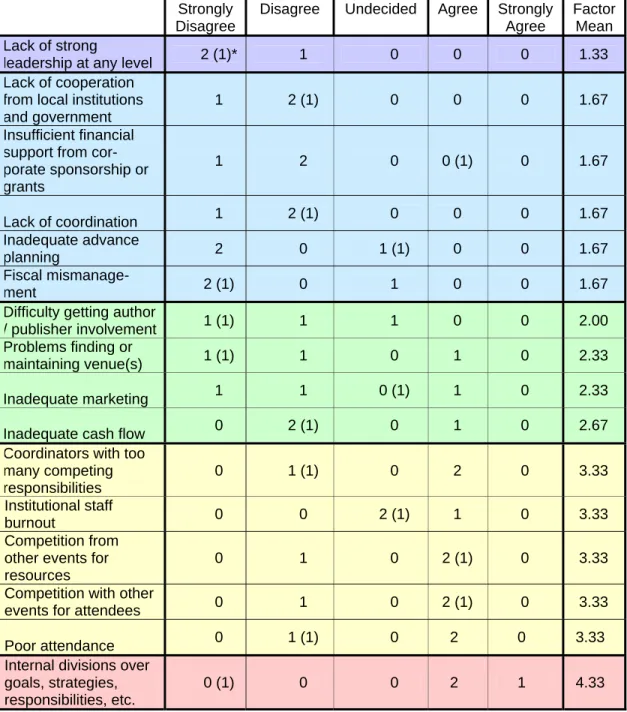
organizers. These responses from the surveys are tabulated in Tables I (Sustainability) and III (Social Impact Perception). The Sustainability Table (I) lists the factors as rated in order from the least problematic to the most. The Social Impact Table (III) lists the factors as rated from the most positive impact to the least positive impact. The ratings were grouped into categories and color coded to facilitate understanding and discussion. For example, on the Sustainability Table, ratings <1.5 are categorized as “not a problem” and coded purple. The short-answer surveys and evaluation reports submitted will be used to provide a more complete context for these answers.
The survey results of the one centralized-model response and the two centralized-model festival evaluations will be examined as well to provide useful information and suggestions. The results of the one centralized-model survey return are indicated in parentheses ( ) in Tables I and III for comparison.
Of the three survey instruments, the first was an open-ended series of questions. Again, three of these were completed by
representatives of the Georgia distributive model and one from the North Carolina centralized model. It was possible, however, to construe answers to many of the open-ended question part of the survey from the one festival evaluation that was sent alone.
The second scale has to do with sustainability (see Table I). The survey asked the respondents to rate the relevance, from their
perspective, of some of the factors Getz identifies as among those most likely to cause festivals to fail. All of those who replied to the survey replied to all of the questions.
The third component of the survey focused on Social Impact Perceptions (see Table III) issues as modified to fit the literary-festival scenario. Respondents were asked to decide whether or not, in their opinion, a particular issue had affected their own festival, and to select “Yes,” “No,” or “Don’t Know.” If the answer was “Yes,” the respondent was asked to rate the level of impact as they perceived it. “No” or “Don’t Know” meant that no rating for that factor was given. All of those who replied to the survey replied to all of the questions, although there were two “No” answers indicating that no impact at all was perceived, and one “Don’t Know.”
Table I: Summary of Sustainability Factors, Distributive Model (GA)
Strongly Disagree
Disagree Undecided Agree Strongly Agree
Factor Mean Lack of strong
leadership at any level 2 (1)* 1 0 0 0 1.33
Lack of cooperation from local institutions and government
1 2 (1) 0 0 0 1.67
Insufficient financial support from cor-porate sponsorship or grants
1 2 0 0 (1) 0 1.67
Lack of coordination 1 2 (1) 0 0 0 1.67
Inadequate advance
planning 2 0 1 (1) 0 0 1.67
Fiscal
mismanage-ment 2 (1) 0 1 0 0 1.67
Difficulty getting author
/ publisher involvement 1 (1) 1 1 0 0 2.00
Problems finding or
maintaining venue(s) 1 (1) 1 0 1 0 2.33
Inadequate marketing 1 1 0 (1) 1 0 2.33
Inadequate cash flow 0 2 (1) 0 1 0 2.67
Coordinators with too many competing responsibilities
0 1 (1) 0 2 0 3.33
Institutional staff
burnout 0 0 2 (1) 1 0 3.33
Competition from other events for resources
0 1 0 2 (1) 0 3.33
Competition with other
events for attendees 0 1 0 2 (1) 0 3.33
Poor attendance 0 1 (1) 0 2 0 3.33
Internal divisions over goals, strategies, responsibilities, etc.
0 (1) 0 0 2 1 4.33
1.33 to the highest mean, 4.33. These responses are further divided into shaded areas based on the dispersal of ratings on the scale for these factors. The lowest rating, shaded in purple, indicates that there was “very little problem” with this item. The next category, containing five responses with a mean of 1.67 and shaded in blue, is described as “mostly not a problem,” since all ratings are on the undecided and disagreement end of the scale. The third group (≥2.9 but ≤3.0), shaded in green, is rated by the festival coordinators with a much wider range of responses, from strongly disagree to agree; this category is considered for this model “a minor challenge, but mostly not a problem.” The next group of five responses (>3 but <4) to be discussed are shaded yellow and can be labeled as representing a “moderate problem” in terms of sustainability for this model. A final item (>4), shaded red, suggests “a problem” factor for sustainability in these distributive-model festivals.
From Table I it is clear that the first factor, listed with the lowest rating of 1.33, indicates that all directors in the distributive model felt positively that there was strong leadership at all levels and “no or very little problem” in their experience. It is worth noting that all three mentioned in their short answers one or two other
individuals who were essential to festival coordination.
Five items share the next highest rating of 1.67, signifying that organizers felt these items were “mostly not a problem” in this model. Local government and other institutions appear to have provided good cooperation and all three directors seem satisfied by the sponsorships they were able to obtain. One wrote, “We actually declined a
Table II: Sustainability Factors By Festival, Distributive Model (GA)
2006 (larger)
2007 (smallest)
2008 (mid-sized) Lack of strong leadership
at any level 1 1 2
Lack of cooperation from local institutions and government
1 2 2
Insufficient financial support from corporate sponsorship or grants
2 2 1
Lack of coordination 1 2 2
Inadequate advance
planning 1 3 1
Fiscal mismanagement 1 1 3
Difficulty getting author/
publisher involvement 1 3 2
Problems finding or
maintaining venue(s) 1 4 2
Inadequate marketing 1 4 2
Inadequate cash flow 4 2 2
Coordinators with too many competing responsibilities
4 2 4
Institutional staff burnout 4 3 3
Competition from other
events for resources 4 4 2
Competition with other
events for attendees 4 4 2
Poor attendance 4 4 2
Internal divisions over goals, strategies, responsibilities, etc.
5 4 4
Composite
Sustainability Rating By Year
personally.” Likewise, coordinating the various events presented few challenges. The next two factors, which each had two responses on the “Disagree” end of the scale and one “Undecided,” can be
categorized as “mostly not a problem.” “Advance planning” was strongly dismissed as a problem by the large and medium-sized venues; the “Undecided” organizer from the smallest locale notes that theirs was also the first experiment the Georgia Literary Festival had made in venturing out of what the organizer described as the “‘literary heartland’ of the state... generally a region within 50 to 75 miles of Athens, GA.” “Fiscal mismanagement” was also strongly rejected as a problem by two organizers; the “Undecided” respondent in this case did not comment on this response and the general source of the indecision was not otherwise apparent. The third “mostly not a problem” issue, which had a mean rating of 2.00 because of the even spread of answers, was that of author / publisher involvement: The largest site had no problem at all; the mid-sized relied heavily on Bill Starr of the Georgia Center for the Book for connections; the smallest was again “Undecided,” but mentioned that they had focused their event specifically on a prominent local author and on other writers with roots in the area.
The next four responses, shaded green, with ratings ≥2 and <3, but still on the positive / undecided end of the scale, might be
described as “minor challenges, but not a problem.” Again, as might be expected, the largest festival group had the least trouble finding appropriate venues for their events and in conducting its publicity campaign; the respondent for the mid-sized community reported that a nearby college had helped with facilities and by providing articles written by an English instructor on each author to the local
marketing the festival in the most small-town / rural area, but the difficulty that might normally be expected was offset by the fact that the area has two major art festivals every year, and so some
infrastructure already existed. “Inadequate cash flow” was not particularly an issue for two festivals. The organizer who marked “Undecided” for “Fiscal mismanagement” also marked “Agree” for this factor, but again, there is no further explanation or definite indication of correspondence between the two answers.
The next grouping of responses fall into the >3 but <4 range. A response in this yellow-shaded range might be thought of as an area representing a moderate problem in terms of sustainability. All five items in this group received a rating of 3.3 which, lying just above the neutral value of 3, could be described as a “very moderate challenge or problem.” The one of the three organizers who felt there had been little trouble with “too many competing responsibilities” also said that he had been working as a free-lance writer at that time, and, while he would be willing to coordinate a festival again, it would have to wait until “after I retire!” The other two who agreed time had been a problem were working full-time while they were coordinating their festivals, although in both cases there was some overlap between their institutional jobs and festival work. Whether or not “Institutional staff burnout” was a factor seems to have caused some uncertainty for the two “Undecided” respondents, possibly because the survey itself did not define “institutional staff,” and organizers in this model saw themselves first as volunteers rather than official “staff.”
numbers, which were modest, …those who DID participate were very, very enthusiastic.”
Factors rated in Table I as >4 were judged “a problem,” that is, something all three festivals found challenging. Only one factor, “Internal divisions over goals, strategies, responsibilities, etc.,” fell into this category. Two managers felt that this issue had been
troubling; the third reported that seriously conflicting ideas of what the festival should “be” had led to the event’s growing too large and awkward both for the organizers and for the attendees to cope with easily.
Averaging together the sustainability means for each festival year, the overall composite sustainability score for these festivals, representing the distributive model, is 2.125. Unfortunately, this composite score cannot be compared to a similar one for the centralized model, but it does indicate a moderate rating from the Georgia directors on the sustainability factors of this scale.
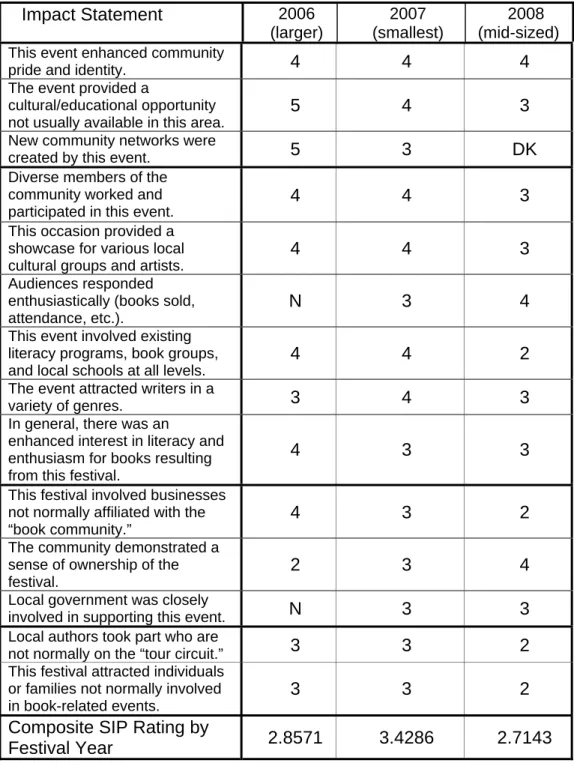
Table III presents a summary of the Social Impact Perception scale factors and the mean for each factor as they were rated by the respondents from the three Georgia festival organizers, while Table IV reports the individual festival ratings and composite positive social impact by festival year and relative community size. The responses range from 4.0, the highest rating of SIP, to the lowest rating of 2.67, slightly below the mid-range value of the scale, 3.0. The following summary response descriptions will be used to describe this range: Factors judged highest in positive social benefit and shaded purple in the table (≥ 4.0) are described as having a “large positive social
Table III: Summary of SIP Factors, Distributive Model (GA)
Level of Impact Factor
Impact Statement Very
Small Small Moderate Large Very Large Mean
This event enhanced
community pride and identity. 0 0 0 (1)* 3 0 4.00 The event provided a cultural
/ educational opportunity not usually available in this area.
0 0 1 (1) 1 1 4.00
New community networks
were created by this event. ** 0 0 (1) 1 0 1 4.00 Diverse members of the
community worked and participated in this event.
0 0 1 2 (1) 0 3.67
This occasion provided a showcase for various local cultural groups and artists.
0 0 1 (1) 2 0 3.67
Audiences responded enthusiastically (books sold, attendance, etc.).***
0 0 1 1 (1) 0 3.50
This event involved existing literacy programs, book groups, and local schools at all levels.
0 1 (1) 0 2 0 3.33
The event attracted writers in
a variety of genres. 0 0 2 1 (1) 0 3.33
In general, there was an enhanced interest in literacy and enthusiasm for books resulting from this festival.
0 0 2 (1) 1 0 3.33
This festival involved businesses not normally affiliated with the “book community.”
0 (1) 1 1 1 0 3.00
The community demonstrated a sense of ownership of the festival.
0 1 1 (1) 1 0 3.00
Local government was closely involved in supporting this event.***
0 0 (1) 2 0 0 3.00
Local authors took part who are not normally on the “tour circuit.”
0 1 2 (1) 0 0 2.67
This festival attracted individuals or families not normally involved in book-related events.
0 1 2 0 (1) 0 2.67
* Parentheses represent the response from the single NC / centralized model director. ** One of the participants replied “Don’t Know” to this question.
having had no impact, and another marked one factor as “Don’t Know.” In calculating the mean rating for each factor, these three answers were assigned a value of zero.
Of the three factors rated as having a “large positive social impact,” the one that scored highest was “This event enhanced community pride and identity,” which all three respondents marked as “Large.” Judgment of the uniqueness of the cultural / educational opportunity provided to the community was evenly spread among “Moderate,” “Large,” and “Very Large.” Although one organizer marked “Don’t Know” when asked whether the festival had created new community networks, the organizer for the smallest host said this sort of impact had been “Moderate,” while the largest host chose “Very Large.”
The biggest category into which answers on the SIP scale fell was that of “moderately large impact.” The strongest positive social impacts here came in the opportunity to showcase local authors and cultural groups, and in having diverse members of the community come together to create and to participate in the festival. One organizer said that this diversity was the “aspect of the festival organization of which I was most proud.” Another, while wryly
remarking that “Joe Six-pack” had been absent overall, pointed to the strong showing of the general public in the form of children and
families, and to the enthusiastic participation of area high-school students, who, among other things, organized a bus tour, performed a short play, and composed a collection of writings which the festival committee published. The third coordinator commented that they had drawn an older crowd than they had expected, possibly because of the presence of the retired baseball-coach-turned-writer, although they had in fact developed advertising of his presence targeted
Table IV: Social Impact Perceptions Factors by Festival, Distributive Model (GA)
Impact Statement 2006 (larger)
2007 (smallest)
2008 (mid-sized)
This event enhanced community
pride and identity. 4 4 4
The event provided a
cultural/educational opportunity not usually available in this area.
5 4 3
New community networks were
created by this event. 5 3 DK
Diverse members of the community worked and participated in this event.
4 4 3
This occasion provided a showcase for various local cultural groups and artists.
4 4 3
Audiences responded enthusiastically (books sold, attendance, etc.).
N 3 4
This event involved existing literacy programs, book groups, and local schools at all levels.
4 4 2
The event attracted writers in a
variety of genres. 3 4 3
In general, there was an
enhanced interest in literacy and enthusiasm for books resulting from this festival.
4 3 3
This festival involved businesses not normally affiliated with the “book community.”
4 3 2
The community demonstrated a sense of ownership of the festival.
2 3 4
Local government was closely
involved in supporting this event. N 3 3
Local authors took part who are
not normally on the “tour circuit.” 3 3 2
This festival attracted individuals or families not normally involved in book-related events.
3 3 2
Composite SIP Rating by
Although the mean rating for how much enthusiasm was
generated within the audience as demonstrated by related book sales, attendance at events, etc., seems moderately high at 3.50, one
respondent responded that, as far as she could determine, the festival had had no impact at all. The other two said that there had been a positive impact, judging it as “Moderate” and “Large.” However, the same organizer who believed there was no physically demonstrable audience enthusiasm generated by the festival rated the “enhanced interest in literacy and enthusiasm for books resulting from this festival” as a 4, or “Large,” while the other two rated the increase in general interest as “Moderate.” Although no conclusion can be drawn about this seeming discrepancy, there are many possible
explanations, such as this particular director’s reported enthusiasm for having created new and diverse networks among the existing literary community. It is difficult to do more than speculate when using a survey without the opportunity for follow-up questions, as was the case here.
The other two factors that showed “moderately large positive” Social Impact Perception (SIP) ratings were the active involvement of “existing literacy programs, book groups, and local schools at all levels,” and the ability to attract writers in a wide variety of genres. The level of involvement of the existing literary community, including schools of all kinds, was rated more highly in the smallest and largest host locales than in the mid-sized one, in which it was marked
“Small.” One festival in particular, coordinated by two members of a local literary society, had made a very active effort to involve area schools and colleges
involvement of local government. The director in the largest
community saw a small sense of ownership but large involvement of out-of-the-usual businesses, while the mid-market director’s
perceptions were the opposite, and the small-town coordinator
remarked on a moderately positive social impact for both factors. For the third factor in this category, regarding whether the local
government had been closely involved in supporting their festival, there was one answer of “No,” and the other two rated it as being of “Moderate” impact.
The two factors that showed the least perceived social impact in this survey were judged as being of “moderately small positive
impact.” Two of the three directors rated a moderate positive impact from having local authors participate and from bringing in attendees that were not usually involved in the book community. The third director reported only a small impact for these two factors.
Although there was only one survey returned from the North Carolina Literary Festival, the centralized-model example, the responses
obtained are summarized here for informational purposes. On the sustainability scale, the 2002 organizer reported strong disagreement that there were any problems with five of the items: lack of leadership at any level; internal divisions over goals or festival management; problems with venues; fiscal mismanagement; or arranging
responsibilities,” which had the highest rating for being a problem in the Georgia distributive model, had the lowest in the North Carolina response. It can be speculated that members of the humanities departments and programs in this university-hosted centralized model have had more experience in producing such programs and more experience working together; while new networks must be created for each festival in the distributive model, and members may well not have this experience or pre-existing working relationships.
Five other sustainability factors elicited the next rating, “Disagree,” meaning that they were “mostly not a problem.” These factors include lack of cooperation from government or other
institutions, coordinators with too many competing responsibilities, inadequate cash flow, lack of coordination, and poor attendance. One remark regarding attendance by this director stated that although they had between 5,000 and 6,000 attendees, they had hoped for nearer 10,000, and felt that inclement weather had discouraged many. She also commented that every festival organizer should develop weather contingency plans. Again, a university setting has some unique characteristics, with most venues being within walking distance, but with parking often being rather far away and sometimes very challenging to find around a busy campus. Transportation and parking arrangements were not directly addressed, but could be an important consideration for such an event.
The next three sustainability items were rated “undecided” in terms of whether they presented problems. They included
scheduled, although she herself was a one-time appointment made eighteen months in advance. In response to the query, “Would you be involved in coordinating this festival again?” the respondent answered emphatically, “No…. The workload for the director is nothing short of mindboggling.”
Although she did not mark any item as a 5.0, this N.C. director gave three factors a high challenge rating of 4.0 on the sustainability scale. All three seem to relate directly to the issue of competition for funding and other resources, as well as attendees, in an urban area full of opportunities for cultural enrichment. In regard to two items, “insufficient financial support from corporate sponsorship or grants” and “competition with other events for resources,” the organizer
comments that the university development department was not nearly as supportive in seeking sponsors and promoting the event as she felt it would have been if the festival were not “shared” with other
universities. The festival also acquired no corporate sponsorships, relying on gifts from Friends of the Library groups from all three universities as well as other UNC campuses, grants, and extensive in-kind donations from a multitude of organizations. The organizer stresses the importance of decreasing competition for attendees by selecting an event date far in advance that does not compete with other events or school schedules. This consideration seems
particularly important in a university-oriented environment, although the director notes that cooperation with other events of a similar nature could be turned into a positive.
Haynes Stone Black Cultural Center, the Duke-UNC Program in Latin American Studies, the Carolina Environmental Program, and the North Carolina Writers’ Network. The diverse authors / performers in turn brought in an enthusiastic and diverse audience. This director cites the “huge group of Hispanic teens bused in from all over the state” to hear the keynote speaker, Julia Alvarez; the strong
popularity, despite unpleasant weather, of the Family Tent’s children’s writers, storytellers and illustrators; and the African-American youth who turned out for writing workshops with Phillip Shabazz and events such as the WordBand poetry performance.
Factors that were rated as of “Moderate” social impact include several that may illuminate the nature of the North Carolina festival’s locale, rather than of its organizational model. Given the all-star cast of the festival—Julia Alvarez, two state poets laureate, critically
acclaimed and bestselling writers such as Alan Gurganus, Lee Smith, Robert Morgan and Gail Godwin, among many others—one might find it surprising that community sense of identity, pride and “ownership of the festival” were all ranked as merely moderately affected by it. One might also perhaps expect that such a cultural / educational opportunity in the community might rate a “Very Large” on the SIP scale, rather than “Moderate.” It is probable, however, that Chapel Hill and its neighbors already have a strong sense of cultural identity and pride. Also, the moderate rating for the item concerning having local authors and other artists featured on the billing may be
accounted for by the fact that the Triangle area of the Piedmont is a major writer’s community. The director’s moderate rating that the event increased interest in literacy and enthusiasm for reading is interesting given her stated commitments to “educational outreach… to promote reading and writing,” and to diversity.
the involvement of other literacy programs, book groups and schools of all levels. One, the involvement of businesses outside of the literary community, was ranked “Very Small,” understandable in that none of the festival’s funding was corporate. The lesser positive social impact generated by the two other factors probably reflects again the fact that this festival was primarily intended, as stated by this coordinator, as an outreach effort of the university community to the rest of the state. While the 2002 director mentions the attempt at outreach through websites and learning modules for schools, the festival evaluation has no data on the success of these efforts.
Other important information that can be gleaned from the short-answer questions and from publicity about these events is information about the size and cost of festivals in the two models. Attendance estimates as reported by the three Georgia festival organizers ranged from 1,500 to 3,000; budget expenditures ranged roughly from $18,000 to $23,000. The North Carolina Festival budgets have ranged from $150,000 to $280,000. The 2002 North Carolina festival director estimated attendance at 5,700, although she had hoped for 7,000-10,000; NC State anticipated 10,000, although no actual reported figures have been located; and the Duke Festival was considered “wildly successful,” attracting an estimated audience of 11,000.40 These figures highlight the strong contrasts in terms of
cost and audience size resulting from the approaches taken by these two festival models.
Summary of Conclusions and Significance
human resources wisely becomes both more difficult and more essential. Evaluating and suggesting some means to this end in terms of state literary festivals was the original purpose of this study. Because there was only one survey response from the directors of the North Carolina Literary Festival, the representative of the “centralized” organizational model, it was not possible to do the proposed
comparative analysis of the centralized and distributive models to suggest an answer to the important questions: Does one of these organizational models perform better in terms of positive social impact as defined by the goals of the National Center for the Book? Does one rate more highly on factors related to sustainability in order to
continue to deliver these cultural benefits? The already small sample size in this study, compounded by the limited response rate, means that the data gathered cannot support the validity of any specific conclusions and does not provide for generalizability.
But the information does provide a basis for discussion of the two models and provides many details about the four responding festivals. A descriptive analysis of the data from the three responding directors in the distributive model is suggestive as well of certain patterns in this model. The information gathered may be helpful to state literary festivals that are struggling for survival and to groups considering initiating new state literary festivals in this difficult economic environment.
Both organizational-model examples pursue goals that directly or indirectly reflect the objectives of the National Center for the Book. The hub of the Georgia model is in fact the Georgia Center for the Book, whose mission is “the support of libraries, literary programs and literature,” and which describes the festival as a “moveable feast” intended to promote literacy and the enrichment of the book
with the state Center for the Book, one organizer in her survey described the festival as “an educational outreach project… to promote reading and writing and to spotlight the literature of the American South…. [I]ts target audience is the general public….” Another director was quoted in the media as saying that he “felt that the central goal was to have a festival for the community…. I wanted to rip the festival from its academic moorings and have it be more public-friendly.”42
Both the centralized and distributive models demonstrate
different ways of dealing with the issue of remaining sustainable. The Georgia Literary Festival floats from small town to small cities,
changing its venue every year with loose coordination from its Center for the Book hub, to take advantage of fresh local enthusiasm among sponsors and volunteers. A coordinator of the North Carolina Literary Festival, on the other hand, explicitly states that their model was designed to be more sustainable by sharing responsibility for the festival among three universities (now four) and holding it only biennially.
While it may not be possible to say which model is “best,” some of the pros and cons of each are suggested by the data. The
centralized North Carolina festival is rich in opportunities to produce a wonderful “flagship” cultural event, and can attract bigger-name authors and larger crowds. But, even with the support of several major universities behind it, this event represents a vast expenditure of resources in terms of time and money, and is an enormously complicated venture to pull off.
The results might indicate, however, that there are difficulties in building a team from scratch each time that can work effectively together. Inexperience in planning such events, along with internal conflict, may hamper efficient marketing, scheduling; these and other factors may affect audience turnout. However, in the present
economic environment, this study suggests that the distributive model may be worth a second look for festivals struggling to survive and to groups considering a new festival. The economies of scale for staff and financial resources, the distribution of the strain on
resources across the state, and the relatively easy-in and easy-out nature of this model may provide advantages in many states.
The limits of this study design in answering a complex research question became increasingly apparent as it proceeded. However, there is more abundant data on state literary festivals as a result and two models, centralized and distributive, and two important variables, sustainability and positive social impact, were identified for study. This researcher recommends that this area of research be advanced with more in-depth field studies of individual state literary festivals. These types of projects would allow follow-up questions to understand the nuances of responses and could capture in “real-time” the
NOTES
1 Craig Jarvis, “Librarians Say Book Festival Future is Bleak,” News & Observer [Raleigh] 25 Nov. 2007. 15 July 2008 http://www.newsobserver.com/lifestyles/ books/v-print/story/791700.htm.
2 Andrew Albanese, “Academic Library Budgets Squeezed by Lowered Revenues,” Library Journal 15 Nov. 2002: 16. Academic Search Premier, EBSCO, UNC-CH, 5 July 2008 http://search.ebscohost.com.
3 John Y. Cole, “The Center for the Book in the Library of Congress: The Planning Year,“ Washington, DC: Library of Congress, 1978. Academic Search Premier, EBSCO, UNC-CH, 4 July 2008 http://www.loc.gov/loc/cfbook/ctr-bro.html.
4 Donald Getz, “Why Festivals Fail, Events Management 7.4 (2002): 210. 5 Getz 209.
6 Jarvis. 7 Jarvis.
8 Craig Jarvis, “Moeser Finds Money to Revive N.C. Literary Festival for ’09: UNC Chief Cancels Call to End Event Decision to End It.” News & Observer [Raleigh] 21 Dec. 2007. 15 July 2008.
http://www.newsobserver.com/news/highereducation/v-print/story.htm. 9 William W. Starr, personal interview with the author, 15 Dec. 2008. 10 Allen J. Scott, “Cultural Products Industries and Urban Economic
Development,” Urban Affairs Review 39.4 (2004): 462. Academic Search Premier, EBSCO, UNC-CH, 9 Sept. 2008 http://uar.sagepub.com.
11 Perryman Group, The Catalyst for Creativity and the Incubator for Progress: The Arts, Culture, and the Texas Economy (Austin, TX: Texas Cultural Trust, 2001): v. 9 September 2008
http://www.perrymangroup.com/reports/ArtsImpact.pdf.
12 Ian Yeoman, Martin Robertson, and Una McMahon-Beattie, Festival and Events Management: An International Arts and Culture Perspective (Burlington, MA: Butterworth-Heinemann, 2004): 14.
13 Dabney & Associates, Identification of Public Cultural Arts Funding Best Practices and Benchmarks (Austin, TX: City of Austin, 2002). 9 Sept. 2008
http://www.ci.austin.tx.us/culturalcontracts/.
14 Stanley Waterman, “Carnivals For Élites? The Cultural Politics of Art Festivals,” Progress in Human Geography 22.1 (1998): 64. Academic Search Premier, EBSCO, UNC-CH. 15 July 2008 http://web.ebscohost.com.
15 Tim Walker, “What’s Behind the Rise in Literary Festivals, and What’s Their Purpose?” Independent [London] 27 May 2008. 15 July 2008
http://www.independent.co.uk/arts-entertainment/books/features/the-big- question-whats-behind-the-rise-in-literary-festivals-and-whats-their-purpose-834609.html.
16 Francisca Martinez, and Markus Weil, eds., The Learning Festivals Guide, Aug. 2000. 2 Sept 2008 http://www.unesco.org/education/.
17 “The Center for the Book Home: Major Themes and Projects,” The Library of Congress,20 March 2009. http://www.loc.gov/loc/cfbook/cfbproj.html.
18 Stella Thebridge and Briony Train, “Promoting Reading Through Partnerships: A Ten-Year Literature Overview,” New Library World 103.1175/1176 (2002): 132. Academic Search Premier, EBSCO, UNC-CH. 7 July 2008