World Maritime University
The Maritime Commons: Digital Repository of the World
Maritime University
World Maritime University Dissertations Dissertations
2000
Real impact of oil tankers as opposed to other
sources of oil in the marine environment
Erie Justine Hien
World Maritime University
Follow this and additional works at:http://commons.wmu.se/all_dissertations Part of theEnvironmental Studies Commons
This Dissertation is brought to you courtesy of Maritime Commons. Open Access items may be downloaded for non-commercial, fair use academic
Recommended Citation
Hien, Erie Justine, "Real impact of oil tankers as opposed to other sources of oil in the marine environment" (2000).World Maritime University Dissertations. 403.
WORLD MARITIME UNIVERSITY
Malmö, Sweden
REAL IMPACT OF OIL TANKERS AS OPPOSED
TO OTHER SOURCES OF OIL IN THE MARINE
ENVIRONMENT
By
HIEN Erie Justine
Côte d’Ivoire
A dissertation submitted to the World Maritime University in partial fulfillment of the requirements for the award of the degree of
MASTER OF SCIENCE
In
MARITIME ADMINISTRATION AND ENVIRONMENTAL PROTECTION (MAEP)
July, 2000
Dedication
To my beloved Children
Pierre-Yves & Noémie Priscille
DECLARATION
I certify that all the material in this dissertation that is not my own work has been identified, and that no material is included for which a degree has previously been conferred on me.
The contents of this dissertation reflect my own personal views, and are not necessarily endorsed by the University.
21-08-2000
Supervisor:
Capt. Fernando Pardo Associate Professor
World Maritime University
Assessor:
Lt. Cdr. Robert E. McFarland Associate Professor
World Maritime University
Co-assessor:
Ms. Anne Christine Brusendorff Maritime Secretary
Helsinki Commission
Acknowledgments
I will start by expressing my very deep gratitude to the Canadian International Development Agency, which has allowed me to join the World Maritime University by granting me a scholarship. Then, I will extend my recognition to my government for all kind of help I received from it. I will certainly not forget CDT Attoumou Honorat Hoba my ex-director and also a former WMU student who informed me about the university and who also guided me for the necessary steps to enroll.
World Maritime University has played an immeasurable rule as my training is concerned and I will always be grateful that. Of course when I say WMU, that includes the teaching staff, the administrative personnel as well as the librarian personnel.
ABSTRACT
Technological developments have increased the need of oil and consequently the development of oil transportation in very sophisticated tankers. The important volume of oil transported every day through the seas doubled risks of accidents and pollution. Some famous spills are; Torrey Canyon (1967), Amoco Cadiz (1978), Exxon Valdez (1989), Haven (1991), Braer (1993), Sea Empress (1996) and the most recent one, Erika (December 1999).
Because of that record, oil tankers very quickly became the first targets for environmentalists and the general public. Indeed, there is no doubt that oil tankers play an important role in the pollution of marine environment, both through their normal operations and their accidents. Aware of that, the International Maritime Organization together with the flag states adopted some international rules in order to regulate among other things to prevent pollution from those vessels or at least minimize the impacts of their spills. The main instrument in that matter is MARPOL 73/78, that has proved to very efficient after twenty-five of active implementation. Studies have shown that in 1990, oil tankers account for 12% of all oil pollution as opposed to 30% before 1970.
Unfortunately, land- based pollution has that specific characteristic, which makes its global management almost impossible. Indeed, land-based pollution occurs within the territory of each country, which involves the notion of preservation of sovereignty.
It is clear that oil pollution is not the fact of only one sector and it is a global or an integrated management of all involved sectors that can lead to the best results.
List of figures
List of abbreviations
COW………Crude Oil Washing DSC……….Digital Selective Calling EEZ………..Exclusive Economic Zone GESAMP…..International Group of Experts on Scientific Aspects of Marine Pollution
IMO………...International Maritime Organization INMARSAT……… International Maritime Satelite organization IOPP………..International Oil Pollution Prevention Certificate
ISM code……….………….International Management code for the safe operations of ships and for pollution prevention
LOT………...Load On Top system
MARPOL73/78………….International Convention for the Prevention of Pollution from ships 1973 as modified by the protocol of 1978
OPRC……….International Convention on oil pollution preparedness, response and co-operation
PCB………Polychlorinated Biphenyl SBT………..Segregated Ballast Tank SMS………Safety Management System SOLAS…………International Convention for the Safety Of Life At Sea STCW……….International convention on Standards of Training, Certification and Watchkeeping for Seafarers
Table of contents
Declaration……….ii
Acknowledgements………iii
Abstract……….. iv
List of figures………..vi
List of abbreviations……….vii
1 Introduction………..1
Objective………...4
Methodology………...4
Outline of the study……….4
2 The sources of marine pollution……….6
2.1 Ship-based pollution………...6
2.1.1 Specific pollutions from HNS tankers………7
2.1.2 " " dry bulk carriers………...9
2.1.3 " " passenger ships……….10
2.14 Other marine pollution from ships(exotic species, TBT, air pol)…………...11
2.2 Ships scrapping operations………...17
2.3 Land-based pollution………20
2.3.1 Industrial discharges………..20
2.3.2 Agricultural waste……….21
2.3.3 Municipal wastewater and coastal population pressure………22
2.3.4 Land-based oil pollution………23
3 The impact of oil tankers on the marine environment……….25
3.1 The accidental oil pollution (most recent serious accidents)………..26
3.1.1 Haven case (1991)……….26
3.1.2 Braer case (1993)………..27
3.1.3 Sea Empress case (1996)………..29
3.2The operational pollution……….30
3.2.2 Tanks washing………..32
3.3 The clean-up operations………..33
3.3.1 Use of dispersants……….33
3.3.2 Bioremediation………..36
3.3.3 In situ burning system………...38
4 The international agreements on the prevention and control of oil pollution by oil tankers………...40
4.1 Preventive instruments………40
4.1.1 Solas requirements……….41
4.1.1.1 Structural requirements………...41
4.1.1.2 Equipment requirements……….42
4.1.2 Marpol requirements………..44
4.1.2.1 LOT, COW and SBT..………45
4.2.2.2 Reception facilities………..48
4.2.2.3 Shipboard oil pollution contingency plan………...48
4.2.2.4 Effects of Marpol 73/78………..49
4.1.3 Human factor………51
4.1.3.1 STCW……….52
4.1.3.2 ISM Code………53
4.2 Oil spills control………...54
4.2.1 OPRC……….54
4.2.2 Intervention convention………..55
5 Conclusion and recommendations………57
5.1 Conclusion……….57
5.2 Recommendations……….59
Appendix 1 Possible sources and remedies of oil pollution during port operations Appendix 2 The sequence of anti-pollution operations in port
Appendix 3 Summary of the main equipment concerned with pollution to be found on board a tanker together with their design and testing requirements Appendix 4 Sample of pollution prevention checklist
CHAPTER I
INTRODUCTION
“Safer ships, cleaner oceans”
The sentence ahead quoted has become one of the most famous mission statements in the maritime field that the International Maritime Organization (IMO) has been spreading since several decades. Actually, that is a kind of alarm bell that the secretary general of that institution is ringing, as the problem of marine pollution has become so serious. Indeed, pollution in general is undoubtedly one of the major issues of the twentieth century but also one of the most difficult to deal with. Marine pollution became the most important component of this concept, as seas are in a way or another the receptors of the various types of pollution.
As a matter of fact, due to the huge water masse of the oceans (71% of the earth surface) and their capacity of natural dispersal and biodegradation, oceans have been for a long time the natural receptor of wastes generated both on shore and on board ship. Those physical aspects make oceans difficult to be really appreciated until recently. And even though technology allows scientists to evaluate the impact of pollution in the seas, results cannot go further as to the exact degree of that pollution, meaning that some negative effects of human activities will still keep on going until they are discovered.
activities including fishing, impairment of quality for use of sea water and reduction of amenities”. The unfortunate fact is that people have created a link between marine pollution and shipping activities as the main source of marine pollution, especially oil tankers.
As a matter of fact, it is well recognized that shipping has witnessed an important development over the past several decades. That type of transport, which was at the beginning so homogenous (in the sense that there were not many types of ships and the transport requirements were quite simple and identical), has become so huge and risky that it attracts public’s attention. The general notice was that as the global commerce has grown so too the world’s hunger for oil. The amount of oil it takes to satisfy this demand on just a daily basis is staggering. Every day, it is estimated that 100,000,000 tons of oil is ferried between the ports of shippers and consuming nations.
Subsequently, that growth led to a specialization process and the apparition of new types of oil tankers. Within a short period of time, tankers have developed in size and design as well. In 1960, it was estimated that more than half of the ships in the world fleet was under 50,000 deadweight tons with only a few numbers of “supertankers”. By 1970, 45% of the world tanker fleet were ships of more than 105,000 deadweight. Ten years after, more than half of the fleet consisted of tankers of more than 200,000dwt, with several ships over 500,000dwt. These changes have unfortunately made significant impacts on pollution risks factors. Giving the volume of oil shipped over the oceans, as well as the scale of supertankers involved, it is not surprising that some oil makes its way into the oceans. Disasters such as Torrey Canyon, Amoco Cadiz and recently Exxon Valdez provided gripping illustrations of the problem of vessel pollution. The frequency with which public hears about of environmental bad news seems to be increasing. Since large coastal spills are both newsworthy and accessible, television regularly treats viewers up to the minute pictures of the ensuing ecological harm.
world what he or she thinks is the main cause of marine pollution, he or she will certainly say “oil spills”. However, these tanker accidents, while damaging are not the only threat. An additional source of vessel pollution comes from operational discharges on the high seas. Away from the watchful eyes of television, many vessels discharge water contaminated as a result of normal ship operations. Of the oil released by ships, seventy-five percent is reported to have come from operational discharges and twenty-five percent from accidental spills.
However, if it true is that oil tankers greatly pollute the seas, it is also true that people have always ignored or should we say tolerated other sources of marine oil pollution such as land-based oil pollution and pollution from ships other than oil tankers. Indeed, studies have revealed that of the oil in the seas, more than fifty percent come from land. Unfortunately, this has no impact on the public even though the effects on the marine environment are likely the same. Also, ships such as chemical tankers, dry bulk carriers, passenger ships can be source of serious pollution even if right now people do not pay due attention to them.
This state of fact leads the author to wonder why people have such a bad opinion about oil tanker. Also, what is done right now to prevent and control pollution from oil tankers?
Objective and scope of the study
The author’s contribution as the topic is concerned is to refresh people’s mind but also draw the attention to the particular problem of land-based oil pollution that people seem to take less seriously as they do with the oil tankers.
The specific objectives of the topic are;
-To distinguish the sources of oil pollution in the marine environment,
-To point out the ship-based pollution in general and mainly all kinds of pollution from oil tankers,
-To highlight land-based oil pollution
-To identify the preventive and combative measures that have been taken and that are related to oil tankers and their efficiency,
-To make some proposals in the sense of improvement of the safety of the marine environment.
Study Methodology
The study has involved literature research of published and unpublished materials relating to oil tankers pollution. This includes an analytical review of oil tankers in terms of their operations, accidents that they involve and human element as well. Further literature researches and has been undertaken to examine how other ships can pollute the marine environment. Resident professors and visiting experts’ views in the field have been analyzed and incorporated.
Outline of the study
spreading. In the second part, land-based pollution is also treated according to its sources; industry, municipal, coastal pollution.
Chapter III focuses on the effects of oil tankers in their normal operations and in case of accident as well as the clean-up operations after accidents. The accidental part describes the effects of three recent and significant oil spills.
Chapter IV deals with the international conventions adopted to prevent and control oil pollution. These measures go from the construction, the equipment on board ships to the enforcement ones such as Port State Control (PSC), Flag State Control (FSC). This chapter also points out the human factor that is said to play an import role in the maritime safety and the marine environment pollution as well.
CHAPTER II
THE SOURCES OF MARINE POLLUTION
Over twenthienth century human activities on land and at sea have increasingly altered the balance of fluxes between land and sea, increasing others and generating new chemicals that the seas have never had to deal with. So, by the middle of the century, it become clear that human activities could contaminate the oceans and alter their chemical composition in a measurable way, but the media inevitably selected items that were particularly striking and visual, so oil spills became a popular heading in the news papers and oil was seen (and seen) as the major marine pollutant. It is therefore worth looking at the other sources of marine pollution apart from oil tankers.
2.1 Ship-based pollution
Figure 1: Sources of marine oil pollution
M ARINE PO LLUTIO N BY O IL, 1998
Accidents 6% Ships' operations
18% Off-shore
2% Natural
10%
Atm osphere 12% Land-based
The technological improvement has given birth to a variety of ships both in size and in purpose. Unfortunately, this change will increase the pollution risks in many ways:
- Increase of traffic concentrations, particularly in coastal waters, channels and harbors approaches that pose higher collision risks.
- Carriage of an increasingly wide range of dangerous and noxious substances that could not be transported before.
- The prevalence of commercial practices taking precedence over safety consideration. Now, only the annual number of voyage is really important for shipowners. So, they will make ships sail as much as possible, retaining seafarers on board for several months.
2.1.1 Specific pollution from HNS tankers
Specialized Vessels have become a fast growing sector of the shipping industry, their growth, a direct reflection of the industry that they serve. It is estimated that more than 50 per cent of the cargoes transported by see can be regarded as dangerous, hazardous and /or harmful under the IMO classification criteria.
Through the International Maritime Dangerous Goods Code (IMDG Code), IMO has divided dangerous goods into the following classes:
Class1 Explosives
Class2 Gases regrouping compressed, liquefied or dissolved under pressure gases
Class3 Flammable liquids Class4.1 Flammable solids
Class4.2 Substances liable to spontaneous combustion
Class4.3 Substances which, in contact with water, emit flammable gases Class5.1 Oxidizing substances
Class5.2 Organic peroxides
Class6.2 Infectious substances Class7 Radioactive materials Class8 Corrosives
Class9 Miscellaneous dangerous substances, that is any other substance which experience has shown, or may show to be of such a dangerous character that the provisions of the above classification.
Those goods are generally transported in ships that have also been classified according to their hazard. Three types of ships have been identified;
A type 1 ship that is intended to transport products with very severe environmental and safety hazards, which require maximum preventive measures to preclude an escape of such cargo.
A type 2 ship is a ship that is intended to transport products with severe environmental and safety hazards, which require significant preventive measures to preclude an escape of such cargo.
A type 3 ship is intended to transport products with sufficiently severe environmental and safety hazards, which require a moderate degree of containment to increase to increase survival capacity in a damaged condition
It is estimated that a number of approximately 400 types of products is carried by sea in sophisticated tankers. And each of these products requires specific precautions as to their handling as well as their loading. As a matter of fact, chemicals when being loaded, consideration shall be given as to their compatibility with other cargoes, compatibility with tank coatings, methods of containment, heating requirement, reactivity, pumping and venting arrangements, fire fighting techniques tank cleaning procedures etc.
The hazards coming from cargoes carried by HNS tankers are very diverse and may involve explosibility, flammability, toxicity, corrosivity, and suffocation. A number of severe accidents involving substances carried by HNS tankers have taken place in the past. Some famous examples of devastating accidents are the followings:
In 1917, during the First World War, the allies were concerned with an important quantity of ammunition within a very short time. The freighter “Mont Blanc” has been chosen to deliver 2,600 tons of explosives. She was about to enter the harbor of halifax (Canada) on her way from the United States to Europe when she collided with another ship. Due to the type of cargo she had on board, the “Mont Blanc” caught fire and shortly after exploded. The explosion is still considered as the biggest man-made explosion until the event of the atomic bomb. The consequences were disastrous as there were about 3,000 people killed, 9,000 others injured and 6,000 homes destroyed.
The “Fort Stikine” case in 1944 in Bombay (India) killed 1,250 people and destroyed 15 other ships in the vicinity.
The “Taquari” case; In 1971, this ship, which had on board toxins in containers grounded on the coasts of Urugway. Several years later, the containers began cracking, which killed the fauna and the flora in a very big area.
From what precedes, one can see that in addition to the immediate disastrous effects from accidents involving chemical tankers, there are the long-term negative effects on the marine environment. It is also reported that some coastal populations had been obliged to flee inland.
2.1.2 The specific pollution from bulk carriers
Most of dry bulks such as grain, coal are not real pollutants, but products like fertilizers, cement may become so. Indeed, it has been reported that due to the physical characteristics of their cargoes, bulk carriers use to loose an important part during loading and discharging operations.
By considering the important number of bulk carriers sailing on the seas, their impact within the port areas where those operations take place may be significant in a long run.
In addition, while chemicals carriers and oil tankers are submitted to severe restrictions as regard their tank washing, dry bulk carriers keep on throwing their tank washing waters into the seas. And this will continue until scientists find in five or ten years that these waters are also polluting the marine environment.
Furthermore, some reports have related a significant number of casualties in total loss to the old age of these bulk carriers.
2.1.3 The specific pollution from passenger ships
By international law, any ships with space for more than 12 passengers are passenger ships. These ships range from roll-on/roll-off ferries to luxurious cruise ships that carry as many as 2,500 passengers plus the crewmembers around the world.
order to prevent the pollution of the marine environment. Furthermore, the Annex 4 dealing with sewage management is not in force so far meaning that some ships keep on throwing overboard their sewage.
Another possibility offered to passenger ships is to discharge their waste in the reception facilities that each port should provide. But even though so provided by MARPOL73/78, not all the port authorities have adequate reception facilities. In this case, what can a ship, which has stored its garbage or sewage on board do if it can not discharge them at a loading port? It will simply discharge them into the sea before the following call port.
2.1.4 Other marine environment problems
Air pollution
Observations have found that a certain number of pollutants from ships have a bad impact on the air. These substances can be divided into three main groups: - Ozone depletion elements coming from firefighting operations, refrigeration and
movements that enhance their productivity and, therefore, their survival. Exposure to higher solar UVB radiation has been shown to affect both orientation mechanism and mobility in phytoplankton, resulting in reduced survival rates for these organisms. Scientists have demonstrated a direct reduction in phytoplankton production due to ozone depletion-related increases in UVB. One study has indicated a 6-12% reduction in the Antarctic zone. Also, solar UVB radiation has been found to cause damage to early developmental stages of fish, shrimp, crab, amphibians and other marine living resources.
- Nitrogen Oxides (NOx) and Sulphur oxides (SOx) are two main substances, whose use on ships has been regulated in Annex VI of MARPOL 73/78 in order to reduce their effects on the ozone layers. Regulation 13 of Annex VI prohibits the operation of diesel engine of ships with a power output of more than 130kw and whose Nitrogen Oxide emission is more than 17.0g/kw. However, the Annex allows the use of diesel engine under the sole condition that an exhaust gas cleaning system approved by the Administration is used to reduce onboard NOx emission to the required limits. As for the SOx, Regulation 14 of the ahead mentioned Annex states that “the Sulfur content of any fuel oil used on board ships shall not exceed 4.5%m/m”. Also, in special areas such as Baltic seas, ports’ zones the regulation requires that either the sulfur content of fuel oil used on board be less than 1.5% m/m or, an exhaust gas cleaning system or any other equivalent technology be used. Like the requirements for oil discharges, Nox and Sox emission have to be monitored by the flag states and port states as well. Flag States have to undertake an initial survey that will allow the ship to get the International Air Pollution Certificate followed by periodical or intermediate surveys to ensure that the equipment, systems, fittings, arrangements and material fully comply with the requirements of the Annex.
- Microtoxic pollutants generated by the incineration operations of garbage from ships. They contribute to over-all air pollution. That is why, Regulation 16 of Annex 6 of MARPOL 73/78 prohibits these operations in areas such as harbors, estuaries and ports but also urges ships to confine these operations only in a shipboard incinerator. However, substances of Annex II and III of MARPOL PCBs and garbage containing more than traces of heavy metal shall not be incinerated
Anti fouling paints
Marine growth on marine structures and the bottom of boats and ships is a constant source of energy consumption and expensive maintenance. Naval vessels, commercial ships and recreational boats waste significant amounts of energy due to the drag imposed by marine growth. As a matter of fact, it is estimated that there are over 4,000 marine fouling species.
Thus, biocides used in anti-fouling paints such as Tributyltin (TBT) must have a wide spectrum of activity to cover such a diversity of species able to colonize a ship’s hull. However, TBT from the paints migrates into the surrounding seawater and accumulates in sediments around harbors and along shipping lanes. It is then ingested by marine animals and becomes a part of the food chain. The World Wide Fund for Animals reported that sea otters are dying off the coast of America and that dolphins, whales, sea lions, sea birds and fish are being contaminated in the Atlantic Oceans. The poison affecting them all is TBT. TBT became the most popular anti-fouling remedy after the World War II, because of its efficiency (4,000 species to combat). Indeed, ships that use it can go up to five years before requiring a hull cleaning.
TBT toxicity is such that a spoonful is enough to cause damage if dissolved in a swimming pool six miles long.
In response to calls from several governments to ban the use of TBT as an anti-fouling biocide throughout the world, the 42nd meeting of the IMO-MEPC (November 98) unanimously passed a “draft assembly resolution” calling for a global ban on the application of anti-fouling products containing TBT by January 1, 2003 and a complete prohibition on their presence on ships hulls by January 1, 2008.
In Marsh 2000, IMO went further by the adopting a basic structure for a convention to ban certain antifouling paints. That instrument will be called “International Convention on the Antifouling Systems on Ships”. However, before the adoption of that future convention, some questions need to beconsidered such as;
• Types of ships that will fall under the scope of the coming convention;
• The suitable system for its entry into force;
• Shall shipowners remove all traces of TBT or can they simply apply a sealant to the hull of their ships?
• What are the criteria that should be used to evaluate the performance?
• And finally, will the convention outline an evaluation plan for alternative antifouling paints or must ships owners assume that all non-tributyltin alternatives are environmentally sound
Organisms in ballast waters
In order to maintain stability, all cargo ships and in particular oil tankers on their ballast voyage fill dedicated tanks with water. Large ships may carry millions of gallons of ballast water. This water is taken from coastal port areas and transported with the ship to the next port of call where it may be discharged or exchanged. Coastal port areas are known as home to a wide variety of organisms that live in the water and bottom sediments.
been found in ballast water. As ships travel faster and world trade grows, species are better able to survive the journey, and the threat of invasive species from ballast water increases. The United States alone is said to receive at least 21 billion gallons of ballast water each year from around the world, leading to problems like that of the well-known Zebra mussels.
Eurasian Zebra mussels, Dreissena polymorpha are said to be introduced via ballast to the Great Lakes in the mid 80’s. Able to thrive, the mussels spread throughout the lake, as well as the Mississippi and Hudson River. The mussels have had a number of negative effects: because they rapidly reproduce, the have clogged up water and drainpipes at municipal water supplies and at industries. They are expected to cost US 5 billion in control efforts and reparation. They have displaced native freshwater mussels of the area, and drastically altered the food web. The Zebra mussel population continues to grow and no immediate end is foreseen.
Another example of an exotic species, which has invaded an area after introduction via ballast water, is the American comb jelly, Mnemiopsus leidyi. A comb-jellyfish is a small marine invertebrate superficially resembling a jellyfish. It is carnivorous and preys on tiny aquatic animals, such as plankton. Transported in ballast possibly from New England, the American comb jelly invaded the Black and Azov Seas in Europe. The rapidly expanding population preyed so heavily on plankton that its biomass declined by as much as 90 percent. Anchovies, which feed on plankton, sharply declined as well, causing local fisheries to suffer.
The impact of introducing non-indigenous species can be divided into two areas: ecological and economic. These categories, however, are inter-dependent because, if for instance specific exotic species exterminate local species in a given area, and it is known that the exploitation of those species represent an important part in the national income of a concerned country, the economic impact is obvious. Even though, it is sure that not all species introduced in new environment survive, but most of survive and cause far reaching economic and ecological impacts.
which can destroy vulnerable native inhabitants. In some areas, observations showed that native species are the brink of extinction due to the introduction of exotic species.
Biologists also recognize that exotic species can reproduce with natives and produce hybrids. These hybrids not only can change the gene pool of an area, but they can also simplify an ecosystem. By simplifying an ecosystem, as well as causing population declines and species extensions, exotic species can reduce biodiversity. Biodiversity is defined as the variation and variety of genes, organisms and species found in an ecosystem. As biodiversity decreases, the vulnerability of an ecosystem to pests and diseases decreases.
In order to solve the problem, an international legal instrument under IOM is being finalized. The proposed of the new regulations are intended to address the environmental damage caused by the introduction of harmful aquatic organisms in ballast water through the following issues;
• The preferred approach to application whether globalized, via the designation of ballast water management areas, or other approaches;
• Development of a range of standards, e.g, for evaluation and acceptance of new ballast water management and control options;
• Development of regional concept;
• The extent of application of the provisions to some categories of vessels, such as fishing vessels, pleasures boats, etc.
Options for the introducing the proposed regulations include among other things;
• A new Annex to the International Convention for the Prevention of Pollution from ships, 1973, as modified by the protocol of 1978;
• A completely new Convention on ballast water management, under which the terms for entry into force would be determined by a conference, instead of having to comply with existing terms established by MARPOL73/78
2.2 Ship scrapping operations
Ship breaking has become a veritable booming industry during the shipping recession years in the mid-80’s (Ma Shuo, Maritime Economics, p 122). And Asian countries, mainly India, Bangladesh and Pakistan are actually the leading ship breakers right now. In 1997, statistics showed that they obtained 90 percent of the world market. How do ship breakers operate?
Compared to shipbuilding, shipbreaking is considered by shipping operators to be a rough operation. Most of the world’s ship scrapping industries uses manual labor to break ships in whatever facilities are available, often a beach. The process of this non-mechanized shipbreaking methods are said to fall into three stages:
First of all, the owner of the vessel undertakes various operations including stopping up all intake apertures, pumping out all bilge water, blocking off intakes and valves and removing all non-metal objects together with potentially explosive materials. If the vessel is a tanker, it must be cleared of potentially explosive gas.
The second stage is that the vessel is sent to a beach. There, all large metal structures, such as mats, pipes, platforms, main engine etc are removed. The remainder of the vessel is then hauled or lifted on dry land by means of slipways, ramps or dry docks and cut into large sections. In some of the less sophisticated shipbreaking operations, the ship is simply winched on to the beach.
The third and last stage consists in cutting the panels and sections obtained from the ship into small pieces as required and transporting it to the ultimate destination.
In the meantime, ships scrapping will continue with all its unknown consequences on the workers as well as on the marine environment.
2.3 Land-based pollution
Because of the importance of oil spills and waste dumping, early international efforts to protect the seas were concentrated on controlling marine sources of pollution, which threatened mainly the open seas. Sources say that not only until 1980’s did the world community seriously begins to tackle the problems of land-based sources of pollution.
Now, the bulk of scientific opinion is that the open seas are contaminated but not yet seriously polluted as many coastal areas. And this is because coastal waters are generally shallower and less well mixed than areas far from the shore. As a matter of fact, some studies have found that 80 percent of the contaminants introduced by man into the sea comes from land via rivers, pipelines, groundwater seepage or fallout from the atmosphere.
Also, it is worth noting that the mayor sources of coastal and marine pollution originating from the land vary from country to country. The nature and intensity of development activities, the size of the human population, the state and type of industry and agriculture are the factors contributing to each country’s unique pollution problems.
But for the purpose of this study, which intends to give a general overview of land-based sources of marine pollution, three sources will be examined.
2.3.1 Industrial discharges
The industrial development in general and the migration of industries to the coasts is an important factor in the coastal zone pollution. The term “industrial activities” includes;
-General industry -Tourism and recreation
- Oil and gas exploration and exploitation
- Exploration and extraction of mineral from the sea-bed - Construction activities.
If all the above mentioned activities are not well planed and co-ordinated (as it is usually the case in most developing countries), it may happen that the control of effluents is not satisfactory and may originate a lost of the equilibrium of the system with the possible occurrence of severe impacts on the marine environment.
Industries dealing with petrochemical, chemical, wood, pulp, pesticides, metal and electroplating are point sources of toxic pollutants characterized by their persistence in the aquatic environment, their bio-accumulation in marine organisms and their highly toxicity to human via the consumption of sea-food.
Toxic substances are generally released as a result of manufacturing operations, effluent discharges and accidental spills.
In the Baltic and North Seas for example, the situation is said to be alarming as organic matter, Nitrogen, Phosphates, chemicals, heavy metals have found their way to the Seas.
2.3.2 Agricultural waste
Continued economic growth and development has drastically changed the traditional land patterns. The rapid agricultural development is now source of problems to the marine environment. As matter of fact, the technological development, which allowed the realization of the extensive agricultural production has brought into the market an important number of pesticides (insecticides, herbicides, fungicides…) and fertilizers.
targeted species. Pesticides are highly toxic and tend to accumulate in the coastal and biota, making pesticide contamination a serious concern. The negative effects of pesticides in the marine and coastal environments include changes in reef community structure, such as decreases in live coral cover and increases in algae and sponges and damage to seagrass beds and other aquatic vegetation from herbicides. Marine organisms may be affected either directly, as the pesticide moves through the food chain and accumulate in the biota, or by loss or alteration of their habitat. This, in turn, will lead to decreased fisheries production. Pesticides may cause fish kills in areas of poor water circulation, and groundwater and drinking water supplies may be contaminated. In addition, fertilizers are also known as one of the main source of eutrophication.
2.3.3 Municipal wastewater and coastal population pressure
It is generally accepted that towns and agglomerations have a net of pipes or conducts to collect treated wastewater to be discharged into the river or coastal waters. Hence, a survey made in 1972 found that coastal communities discharged untreated sewage into the sea. Domestic sewage is a significant contributor to marine pollution. Typical pollutants in sewage effluents are suspended solids, oxygen demanding substances, nitrogen, phosphorous, oil, grease and pathogens. Industrial wastewater has a wide range of pollutants depending on the type of industry producing the waste. Wastewater from the food processing industry, distilleries and soft drink industries is also high in oxygen demanding substances, as is chemical industry wastewater, which also frequently contains toxic substances.
impacts of the coastal zones are very much due to the increasing population and their activities on land. Impacts are seen for instance in the form of spreading occurrences of harmful algae blooms, growing concern for food security with respect to marine produce, changing conditions in estuaries, severe degradation of coral reefs and mangroves. Erosion and subsidence problems have also been found in some coastal zones due to the massive use of sand for construction and the physical pressure of the coastal land.
Because of what precedes, coastal pollution must cause concern but also because it is estimated that coastal waters are the only marine environments with significant biological productivity.
2.3.4 Land-based oil pollution
CHAPTER III
THE IMPACT OF OIL TANKERS ON THE MARINE
ENVIRONMENT
MARPOL 73/78 defines oil tanker as “a ship constructed or adopted primarily to carry oil in bulk in its cargo spaces …” while oil is defined as “petroleum in any form including crude oil, fuel oil, sludge, oil refuse and refined products…”
Among the 82,890 ships of more than 100gross tons counted in 1985 by Lloyd’s Register of Shipping, there were 6,153 oil tankers with a total of 132,438,195 gross tons, an evidence of the importance of oil tankers in the maritime industry.
3.1 The accidental oil pollution: the most recent serious accidents
Figure 2 Oil Pollution from Ships (tankers)
Source; International Tankers’ owners’ pollution Federation
Accidents involving oil tankers have always attracted people because of the visible effects on the marine environment. Actually, the severity of the oil spill is closely related to the area within which the spillage occurs. It is generally accepted that the nearest the accident is, the more catastrophic are the consequences. An important number of oil spills have been counted so far but for the purpose of this study, only the most recent serious ones will be analyzed.
3.1.1 Haven case (1991)
Haven is an oil tanker of 109,700 gross tons with 232,162 tons deadweight built in 1973 and registered in Cyprus. In January 1991, the vessel was chartered by the National Iranian Tanker Company in order to carry crude oil from Kharg Island to Europe. On April 7th 1991, the tanker moored at the oil platform off Multedo Harbour in order to discharge 90,000 tones. On April 8th, Haven left the platform and proceeded to Genoa Roads, where she anchored the following day in position named “M” about 6 miles off the coast, still having on board 144,000 tones of cargo, awaiting for orders. Then, suddenly, there was an explosion followed by a second one and a moment later, the vessel was up in flames. The rescue of the crew took
pollution from oil tankers
90% 10%
place while burning slick oil was surrounding the ship. 31 of the crewmembers were picked up by a salvage craft, all suffering from burns, smoke inhalation and shock.
Unfortunately, the master and a technician had been found dead, while three crewmembers were missing. The threat of an ecological disaster was enormous, not only because of the quantity of oil that could be dumped into the sea, but also for the kind of oil. Indeed, the Iranian crude oil is well known by specialists for its thickness due to the high quantity of sulfur that it contains. This characteristic make an oil turn rapidly into tar, capable of reducing the evolution of the flora and killing any marine animal that digests it. Also, the threat was greater as spillage was taking place at just a shot distant from one of the most scenic coasts in the country (Italy) spotted with various very small towns having summer tourism as their only resource.
Owing to the efforts of prompt firefighting operators, the vessel sank in a sandy seabed, only 195 feet down. Its tanks remained intact after sinking and at the site of the wreck, there was no sign of surging. On the basis of the surveillance carried out by helicopters overflying the area, the quantity of oil spilled was estimated as being less than 5,000 tones out of the 144,000 tones that the vessel still had on board. The catastrophe had been avoided owing to the firefighters who had had the ingenious idea to direct their water jet to the oil escaping from the tanks in order to push it towards the burning surface. That is how they achieved in burning 6,000 to 8,000 tones of the oil, whose residue in the seabed has been checked later on by the local authorities and which has been declared non-toxic due to the effects of fire.
3.1.2 Braer case (1993)
On the third day of her sailing (05-01-1993), she sustained an engine breakdown in heavy seas after seawater had entered her fuel supply off the coast of Shetland Islands. That same day, she ran aground, while the entire crewmember (34) had been airlifted to safety before the grounding. The entire cargo of the Braer was then spilled into the sea off an area of spectacular beauty, polluting not only the sea and adjacent beaches, but also the farmland of the southern mainland due to the oil vapors spread by the wind. After the incident, locals stated that the air was thick with oil at times and as is usual in similar mayor marine pollution incidents, it was the seabirds that took the full impact. Over a thousand were reported to have perished.
However, pollution and environmental damage subsequently proved to be much less serious than was originally feared. The slick caused by the Braer is said to have extended some 30 or 40 miles west of the Shetlands at its maximum, with traces of oil also found 25 miles North of the wreck. The interim report on the disaster from the Ecological Steering Group found that the immediate impact of the oil spill was less harmful than had been first been expected. Indeed, the effects of the seas had dissipated the light Norwegian North Sea oil. Nevertheless, 1,500 birds died and the Shetlands, three main industries were badly affected, namely, fishing industry, tourism and salmon industry.
A diving survey in April 1993 (four months later) concluded that the wreck no longer any pollution threat. Four divers who carried out a survey concluded that the tanker’s crude oil cargo, along with heavy fuel oil and diesel bunkers had been completely dispersed.
3.1.3 Sea Empress case (1996)
The third worst marine pollution disaster to affect the British Isles occurred in February 1996 with the multiple groundings of the three-year old 147,273 deadweight, Liberian motor tanker. As a matter of fact, the Sea Empress incident resulted in the leakage of about 65,000 tones of her North Sea crude oil. As reported by investigators, the named vessel had loaded some 130,000 tones of crude oil at the River Forth terminal of Hound Point on February 13th 1996. Unfortunately, on the 15th February, at the entrance to the Milford Haven estuary, she ran aground spilling half of her cargo (65,000 tones out of 130,000 tones) into the sea. Owing to the efforts of the salvers, the vessel did not spill all her cargo. Yet, at 65,000 tons, the Sea Empress spill is still almost twice the size of the Exxon Valdez spill in March 1989 and according to the World Information System Oil Spill database, Sea Empress ranks as 16th largest tanker spill in world history.
Because the spilled oil from Sea Empress was relatively light, the oil reported to evaporate or dispersed in the stormy conditions that prevailed after the grounding. Hence, the spillage can be qualified as an environmental disaster as it killed over 2,500 birds of 19 different species. The fishermen were prevented from catching crabs, lobsters, whacks, cocks, plaice, and cod within the area. Almost 3,000 persons of the local industry and those employed on 60 fishing vessels had been affected. According to oil industry sources, the environmental and economic cost of the disaster was reported to have been 99 million US Dollar.
3.2 The operational pollution from tankers
When a tanker is sailing, the main operations, which can give rise to pollution if not properly conducted are; ballasting, transferring bunkers, de-ballasting and discharging bilge water from machinery spaces. Indeed, the common pollution incidents are said to occur during terminal operations when oil is being loaded or disboarded. According to figures published by the International Tanker Owners’ Pollution Federation, these operations sometimes contribute up to 92% of oil spills from oil tankers.
3.2.1 Loading and unloading operations
Bunker transfer
The fuel used by the ship for its normal movements is taken from setting tanks in the engine room where it is treated to remove water and unwanted sediments. These tanks are topped up at regular intervals from the bunker tanks, which are commonly located between the cargo pump room and the engine room. For ships sailing for long period, it is necessary to transfer oil from the forward bunker tanks to those aft in order to replace the bunker consumed. This operation also contributes in the maintenance of the stability of the ship as it avoids the ship not to trim too far by the head. The most common cause of spillage during these operations is the overfilling of tanks receiving the bunkers. The simplest explanation of this cause is that the operations often take a long time (some hours) and the rate of pumping is sometimes misjudged. Nonetheless, it is common nowadays that, big ships are equipped with high level alarms fitted to bunker tanks. The role of these alarms is to give an audible warning when the oil reaches a pre-selected level, which allows ample time for the operation to be stopped safely.
Cargo transfer
Once the oil loaded in tanks, generally, it is not transferred any more until the unloading port. However, it may happen that oil is transferred at sea in the event of a leakage developing or, in some very large crude oil in order to maintain an even keel and minimize the draught at the arrival port. Here again as the transfer of bunker, spillage will happen if due care is not taken to avoid overflow as the tanks receiving the oil are likely already to contain cargo and have small ullages.
Ship to ship transfer
Oil is very often transferred from ship to ship or to barge in harbors or estuaries. A recent development that has been reported is that oil is transferred in the open sea from Very Large Crude oil Carriers (VLCC) to smaller tankers principally in order to lighten the VLCC’s draught and allow them to get into ports for which their draught is too great. Specialists qualify this operation as a sophisticated one requiring lightening tankers specially equipped with large pneumatic fenders and cranes for handling the cargo hoses. There are three aspects of the operation which have, if not properly handled, the potential to cause pollution. These are;
- The berthing of the two ships alongside one another where hull damage is the risk, - The connection of hoses, ullaging etc during which safety precautions are observed to prevent the ignition of oil or vapors and
3.2.2 Tanks washing operations
The loading operations of oil are done in a number of tanks within the hull of the ships. When the oil is discharged, some of it is left clinging to the sides of the tanks. These deposits have to be cleaned off before fresh cargo is loaded and up to the 1970’s, the normal practice was to use high-pressure hot-water cleaning machines and the mixture of waste oil and water that resulted was simply pumped overboard into the sea. The quantity of this waste oil has been estimated as much as 800 tones of oil on a large tanker and more than 8 million tones a year.
Fortunately, technical advances in the early 1970’s resulted with an alternative known as “load-on top “ system; a process, which has the double advantage of saving money for the cargo owner and protecting the marine environment from this operational pollution.
Despite the introduction of the load on top system, researches have demonstrated later on that the system does not completely eliminated pollution resulting from tank cleaning operations. This result led to the introduction of a new method of oil tanks cleaning called “crude oil washing”. The main difference with the new system is that instead of using water, the tank-cleaning machines use crude oil. And this method is the one used for tanks washing nowadays.
3.3 The clean-up operations
The same way IMO has qualified the Port State Control (PSC) the last safety net, the same way cleanup operations can be qualified as the last countermeasures to marine oil pollution. As a matter of fact, when prevention efforts have failed and an oil spill occurs on the water, spill responders use a number of tools at their disposal, depending on the particulars of each situation. Those methods are generally into two groups: - The mechanical cleanup methods such as containment booms and skimmers,
- The non-mechanical methods such as dispersants, in-situ burning, the use of bacteria.
For the purpose of this study, focus will be put on the second group of methods, subject of so much controversial.
3.3.1 Use of dispersants
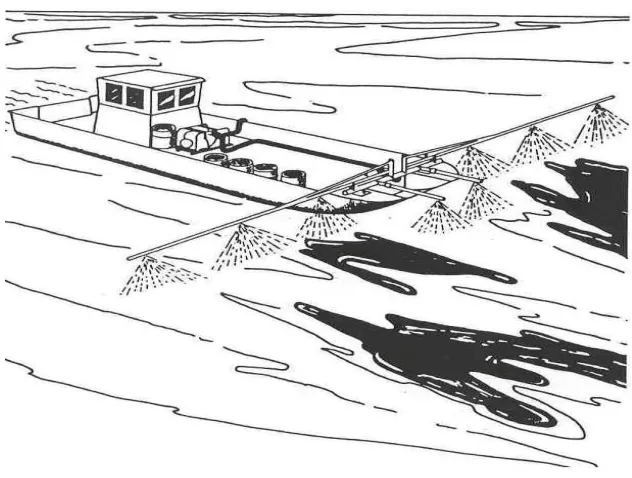
Figure 3: Application of dispersants
dispersants have the capacity to break the oil slick into small particles, which disperse into the water , where they are further broken down by natural processes. Dispersants also have the advantage of preventing the oil droplets from coming up again and forming another surface slick. Fire and explosion hazards are lessened as dispersants reduce evaporation of volatile oil components. The evidence from six spills treated with dispersants in United Kingdom waters since 1980 is that dispersion of oil into the water can minimize overall environmental impacts by reducing damage to the shoreline and sea surface ecosystems. The limited environmental damage from 1993 Braer incident, where large volumes of oil were dispersed, provides particularly strong evidence that dispersion of oil can minimize the overall effects of a spill. Also, chemical dispersion in the Sea Empress spill in 1996 was found to reduce environmental damages and cleanup intrusiveness, cost and duration.
Effective oil dispersal will require some equipment such as airplanes, helicopters or vessels for the spraying of the products. And like other spill response techniques, dispersants are not 100% effective in dispersing surface oil but the effectiveness is greatly dependant on the type of oil, the environmental conditions and the way they are used.
As a matter of fact, the use of dispersants is not necessary when the spill involves light oils such as diesel oil or light crude oils as their natural characteristics allow them to disperse very easily. But the problems come when the spills involve heavy crude oils, heavy fuel oils or lubricants that are characterized by their viscosity and that are likely to easily crystallize in cold sea waters. Indeed, according to laboratory tests, viscosity has two effects in the dispersal of oil. Not only it retards dispersant migration to the oil-water interface but also, it increases the energy required to shear off a drop from the slick. That is why timing is said to be very important in the dispersal of heavy oils.
But people against the use of dispersants will argue that the introduction of those products can affect some marine organisms, which will not otherwise be reached by oil the latter had to remain on the surface of the water. The threat of increase quantity of extraneous substances into the marine environment is also usually evoked.
The dispersants issue is as serious as the related policy will differ from one country to another. Form the “Bonn Agreement”, one can see that in Belgium and UK, the combating capability is largely based on the use of dispersants, whereas the Netherlands have simply stopped their (dispersants) use. On the other side, France, Denmark and Norway have decided to use dispersants if according to the case, the latters prove to be more effective than the mechanical means.
The use of dispersants leads to a serious concern for two reasons; their toxicity and the toxicity of the dispersed oils. The toxicity of the dispersed oil actually frightens common people who do not have enough knowledge about the dispersal operations. However, some laboratory tests showed that the toxic effects per unit of dispersed oil are usually the same for oil dispersed chemically as those for naturally dispersed oil.
Unfortunately, it has been reported that many earlier laboratory studies of the joint toxicity of oil and dispersants had erroneously concluded that dispersed oils were more toxic than oil alone.
Figure 4: Mechanism of dispersion
3.3.2 Bioremediation
the environment. The natural biodegradation, because it is slow process, can only helps in the elimination of oil from water on a long term basis, in particular for oil existing naturally in the sea. Indeed, research demonstrated that petroleum could be biodegraded by a wide range of naturally occurring microorganisms such as bacteria, marine and soil fungi, cyanobacteria (blue green algae) and algae. But in case of oil spills, because of the important amount of oil involved, the natural biodegradation process cannot be of good help. In order to solve the spills’ problem, scientists have had recourse to an artificial technique of biodegradation, which aims to enhance the natural biodegradation and whose name is: Bioremediation.
Yet, bioremediation is not a panacea for oil contamination. As a matter of fact, a successful cost-effective of this technique will greatly depend on factors, such as hydro-geologic conditions, microbial ecology and other spatial/temporal factors that can widely vary. As far as oil spills are concerned, different types of techniques have been used so far;
- The use of nutrients. Here, the aim of this technique is to introduce nutrients rich in nitrogen and phosphorous so as to make the existing bacteria to quickly proliferate themselves and degrade the oil.
- The use of oil-degrading bacteria plus nutrients. This system consists in the
3.3.3 In-situ Burning
In-situ burning is defined as the controlled burning of oil “in place “ meaning in the area where the spill occurred. The use of this method can be traced back to the early 1970’s, where it has been used as an oil spill countermeasure for a variety of type oil spills. The objective of this technique is to ignite and burn thick slicks that are trapped in ice and /or contained and thickened by fire-resistant booms in open water spills.
The advantages of this technique is that it requires less labor than most other methods and can be applied to areas where other countermeasures can not be used because of limited access to the spill location or ice conditions. Because of the rapid consumption of the oil burn, this system can reduce the impact of surface oil on shorelines, sensitive habitats, birds, mammals and other wildlife. But also, it avoids oil storage and disposal problems. In-situ burns have typically removed over 90% of the contained oil during experiments and accidental burns of petroleum on water. The results of the research also say that only a small percentage of the original oil volume left unburned. And because the remaining material was a viscous, taffy-like one that could float for a long enough period time to be manually removed.
Another advantage of this method is that it eliminates the air quality impacts of the volatile hydrocarbons that would have otherwise evaporated.
Unfortunately, this technique presents some disadvantages that attract more the public. Indeed, among the air pollutants produce by the in-situ burning, one type pollutant is said to be of great concern as these particulate can cause respiratory disease in the elderly or those with impaired lung function if they are inhaled at high levels. There is also the possibility of causing flashback to the source of the spill or causing secondary fires.
CHAPTER IV
THE INTERNATIONAL AGREEMENTS ON THE PREVENTION
AND CONTROL OF OIL POLLUTION BY OIL TANKERS
From the information given in the previous chapters, one can remember two things: first that the sources of marine oil pollution are various and second that even the methods used to control oil spills are not generally tolerated by the public opinion due to their potential negative effects on the marine environment. This sad observation makes the author looks back to the international instruments that have been adopted to prevent oil pollution at sea with a glance at some combating measures.
4.1 The preventive instruments
Most of the instruments related to the matter have been adopted under the auspices of IMO. All of them are in a way or another dealing with safety at sea and the marine environment protection. For a detailed study, six (6) of them directly connected to our topic will be dealt with in that part of our research;
-The International Convention for the Prevention of Pollution from Ships 1973, as modified by the Protocol of 1978 (MARPOL73/78),
-The International Convention on Standards of Training, Certification and Watchkeeping for the Seafarers (STCW), 1978, and Amendments of 1995
-The International Safety Management Code (ISM Code),
-The International Convention relating to the Intervention on the High Seas in Cases of Oil Pollution Casualties (INTERVENTION), 1969,
- The International Convention on Oil Pollution Preparedness, Response and Co-operation (OPRC).
4.1.1 The SOLAS Convention 1974
The SOLAS Convention is considered as the most important of international agreement concerning the safety of merchant ships. Indeed, the main objective of the said convention is to specify the minimum standards for the construction, equipment and operation of ships, compatible with their safety. Flag States in that case are responsible for ensuring that ships under their Flag comply with their requirements and a number of certificates are prescribed in the convention as proof that this has been done. That convention even if dealing with ships’ safety in general is considered in this dissertation under the “structural solution to pollution” that it brings in the maritime industry.
4.1.1.1The structural requirements
In the construction process, the SOLAS Convention requires that particular measures be taken so that even in damaged condition (in case one or two adjacent compartments are flooded), the ship is able to withstand the flooding.
The SOLAS Convention also requires seagoing ships to be fitted with double bottom. However, while this requirement applies to passenger ships differently according to their length, it applies to new cargo ships (including oil tankers) without any consideration of the length.
Requirements for bilge pumping arrangements are also laid down both for the passenger and cargo ships. As a matter of fact, SOLAS Regulation 21 requires that efficient bilge pumping system be provided to the above mentioned ships. But above all, the system shall “be capable of pumping from and draining any watertight compartment other than a space permanently appropriated for the carriage of fresh water, water ballast, oil fuel or liquid cargo”.
Apart from the three points ahead mentioned, the SOLAS Convention deals with an important range of structural requirements such as the access to spaces in the cargo areas of oil tankers, the openings of watertight bulkheads etc.
4.1.1.2 Equipment requirements
Fire detection, protection and extinction appliances are essential equipment to have onboard a ship and particularly on oil tankers that transport very easy flammable product. In addition to those installations, the SOLAS Convention urges the concerned authorities to make sure that ventilation systems are provided in the areas of the ship subjects to easily catch fire such engine rooms or cargo spaces such as oil tanks.
Immersion suits, survival crafts, thermal protective aids, life boats, lifejackets, rescue boats are some of the equipment that all ships undertaking international navigation shall have onboard so that if an incident can not be avoided, at least human lives are protected.
Because shipping is a hazardous adventure that takes place in remote areas, far from land, it is necessary that vessels be quipped with efficient means of communication to ensure the ship-to shore, the shore-to-ship and the ship-to-ship connection. The internal means of communication between the different bridges of the ship shall be covered so as to ensure that any emergency situation in one area is quickly transmitted to the others. In that respect, the SOLAS Convention requires all ships falling under its scope to be provided with:
• A VHF (Very High Frequency) radio installation capable of transmitting and receiving,
• A Digital Selective Calling (DSC) on the frequency 156-525 MHz (channel 70),
• A Radiophone on the frequencies 156-300 MHz (channel 6), 156-650MHz (channel 13) and 156-800 MHz (channel 16),
• A Radar transponder capable of operating in the 9G Hz band,
• A receiver capable of receiving international NAVTEX service broadcast,
• A Radio facility for reception of maritime safety information by the International Maritime Satellite (INMARSAT) Organization,
Every ship shall, in addition, be fitted with a radio installation consisting of a radiotelephony distress frequency watch receiver and a device for generating the radiophone alarm signal, both devices covering 2,182 kHz.
Those are some of the requirements established by SOLAS 74 and that are more related to our subject matter. A tanker vessel, which meets those structural and communication requirements from, SOLAS is well equipped and likely to face an emergency situation and avoid or mitigate spillage and pollution of the marine environment. Communication equipment for example can permit the master, in case of emergency to get in touch with the shipowner very quickly and take the appropriate decision. Also, it can allow the former to alert the coast guards, Search and Rescue Centers, vessels in the same vicinity, or any salvage company for help.
4.1.2 The MARPOL 73/78 Convention
That instrument is actually a combination of two treaties adopted in 1973 and in 1978, which can be considered as the international community’s answer to the problem of vessel pollution. Since international commerce is greatly dependent upon sea transport, MARPOL73/78 attempts to strike a balance between the need to protect and preserve the marine environment and the desire not to impose laws, which will heavily increase shipping costs. Through its Annex I dealing with oil (and which is our main interest here), the convention prohibits the deliberate discharge of oil or oily mixtures from all seagoing vessels. That requirement is extended at least 50 miles from the nearest coasts. Even after 50 miles, special requirements should be followed when discharging.
At this point, MARPOL73/78 allows oil discharge if;
-The maximum quantity of oil to be discharged is done on a ballast voyage -At 1/50,000 of the cargo carried for existing ships and
-The rate at which that quantity should be discharged is a maximum of 30 liters per miles traveled by the ship.
Those requirements aforementioned involve the provision of appropriate equipment including oil-discharge-monitoring system, oily-water separating equipment and filtering system slop tanks, sludge tanks, piping and pumping arrangements.
In order to allow maritime authorities to verify that ships have discharged their oils in accordance with the regulations, the MARPOL Convention prescribes that every ship which uses fuel oil and all tankers be provided with an Oil Record Book in which all the oil transfers and ballasting operations shall be recorded. Apart from the requirements previously mentioned, some are worth being studied in detail.
As statistics have demonstrated that ballasting and cargo tank washing are the main source of tankers’ operational pollution, MARPOL 73/78 requires ships to utilize some or all of the following methods: Load On Top (LOT), Crude Oil Washing (COW) and Segregated Ballast Tank (SBT) in order to minimize or eliminate that pollution.
4.1.2.1 Load On Top, Segregated Ballast Tanks and Crude Oil Washing
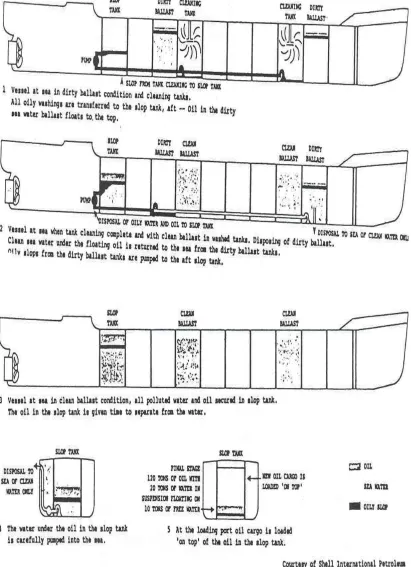
Load On Top
Unfortunately, a few years later, observations and analysis will demonstrate that despite the great contribution of that cleaning process to the marine protection, it did not completely eliminate pollution resulting from tank cleaning operations. In order to solve the problem, the oil industry has developed a new cleaning system for new ships called Crude Oil Washing (COW).
The following figure sums up the different phases of that system as provided by the convention.
FIGURE 5: Load On Top System
COW
With this technique, dirty tanks are not washed with water any longer but with crude oil (the cargo itself). When sprayed onto the sediments clinging to the tanks’ walls, the oil simply dissolves them, turning them back into usable oil that can be pumped off with the rest of the cargo. The advantage of this system is that it increases the cargo out turn, the ship has less dead freight and the operational pollution is reduced. It is worth noticing that COW is accepted as alternative to SBTs on existing tankers and an additional requirement for new tankers (the delivery of which is after 31 DEC 1979). Also, unlike LOT which takes place at sea away from supervision, COW takes place at the unloading port where a governing body is likely to conduct an adequate inspection.
SBTs
Under its policy related to the mitigation operational pollution, the MARPOL 73/78 convention has made some requirements with regard to the use of tanks. The convention defines segregated tanks as tanks in which only water ballast is pumped. The objective being to avoid risk of cargo being mixed with ballast that can result to pollution when the cargo is pumped out. SBTs are required on crude oil tankers of 20,000 tons deadweight and above. The convention also requires that SBTs be protectively located, that is, they must be positioned in such a way that they will help to protect the cargo in the event of a collision or grounding.