KUO-HSI CHENG. The Influence of Environmental Tobacco Smoke on
the Lifetime Probability of Lung Cancer due to Exposure to Radon
(Under the direction of Douglas J. Crawford-Brown)ABSTRACT
An analysis concerning the effect of environmental tobacco
smoke (ETS) on estimation of lifetime risk of radon-induced lung
cancer is made. Based on the consideration of radon dosimetry as a
function of age, a generalized state-vector model is used to estimate
the total probability of lung cancer due to exposure to both radon
and ETS during a normal (73 year) lifespan. This report suggests
that there is a general tendency of increasing working level
concentration of radon progeny and decreasing unattached fraction
of radon progeny RaA (Po-218) with greater amounts of ETS present
in the home. The initial concentration of ambient aerosols plays an
important role in quantifying the effect of ETS on radon exposure.
The combined ETS and radon exposure may either raise or lower the
risk of lung cancer associated with radon exposure alone, primarily
depending upon the initial aerosol concentration and amounts of
cigarette smoke.
ACKNOWLEDGEMENT
I would like to extend appreciation to my research advisor, Dr. D. J. Crawford-Brown, for his encouragement, support, guidance throughout the development and completion of this study and during
my graduate training. The other members of the advisory committee. Dr. A. G. Turner and Dr. J. E. Watson, are gratefully acknowledged for their review and valuable suggestions in preparation of this report.
I am indebted to Dr. W. Hofmann who generously provided his computer code for calculating the dose of radon progeny. In addition, gratitude is also expressed to my girlfriend, Yi-Hsin Yang, who assisted in computer work of fitting the spline functions and provided the moral and emotional support during the hard time of
preparing this report.
This report is especially dedicated to my parents and family in
Taiwan.
TABLE OF CONTENTS
Page
LIST OF TABLES ... vi
LIST OF HGURES... viii LIST OF ABBREVIATIONS ... ix
Chapter
I. INTRODUCTION ... 1 1.1. A Brief Review of Radon... 2 1.2. A Brief Review of Environmental Tobacco Smoke .... 4
n. THEORETICAL FRAMEWORK... 6
2.1. Estimation of Exposure Conditions ... 6
2.2. Calculation of Deposition and Doses ... 1 2
2.3. Risk Estimation... 1 3
2.3.1. Description of State-Vector Model ... 14
2.3.2. Mathematical Formulations ... 1 8
2.3.3. Equation Solutions... 2 0
III. DETERMINATION OF PARAMETER VALUES... 2 5
3.1. Parameters in Estimation of Exposure Conditions ...2 5
3.2. Parameters in State-Vector Model ... 2 6
3.2.1. Rate Constants for Background Transition ... 2 8
a. Spontaneous Rate of Mitosis (Ms)...2 8
b. Spontaneous Rate of Transition fromState 0 to State 1 (kos)... 3 5
c. Spontaneous Rate of Transition fromState 1 to State2 (kis)... 3 7
d. Spontaneous Rate of Transition fromState 3 to State 4 (kss)... 3 8
e. Spontaneous Rate of Transition from
State 4 to State 5 (k4s)... 3 8
3.2.2. Radiation Induced Rates...3 8
IV. RESULTS...4 1
V. DISCUSSION... 4 8
VI. RECOMMENDATIONS FOR FUTURE RESEARCH... 5 1
REFERENCES... 5 4
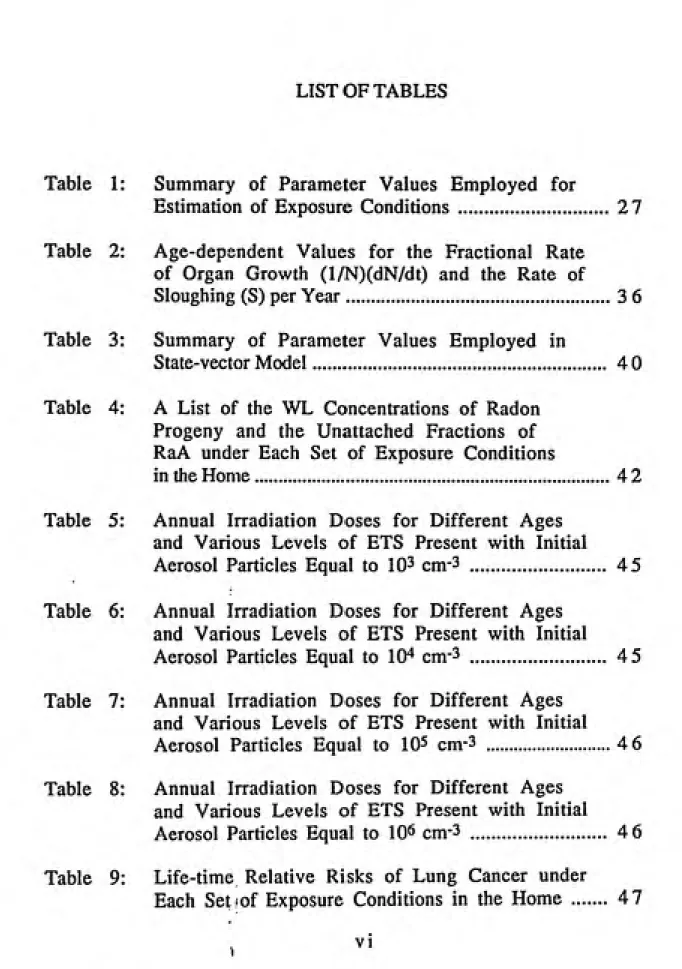
LIST OF TABLES
Table 1: Summary of Parameter Values Employed for
Estimation of Exposure Conditions ... 27
Table 2: Age-dependent Values for the Fractional Rate
of Organ Growth (l/N)(dN/dt) and the Rate of
Sloughing (S) per Year...3 6
Table 3: Summary of Parameter Values Employed in
State-vector Model... 4 0
Table 4: A List of the WL Concentrations of Radon
Progeny and the Unattached Fractions of
RaA under Each Set of Exposure Conditions
in the Home...4 2
Table 5: Annual Irradiation Doses for Different Ages
and Various Levels of ETS Present with Initial
Aerosol Particles Equal to 10^ cm-3 ... 4 5
Table 6: Annual Irradiation Doses for Different Ages
and Various Levels of ETS Present with InitialAerosol Particles Equal to lO^ cm-3 ... 4 5
Table 7: Annual Irradiation Doses for Different Ages
and Various Levels of ETS Present with Initial
Aerosol Particles Equal to 10^ cm-3 ...4 6
Table 8: Annual Irradiation Doses for Different Ages
and Various Levels of ETS Present with InitialAerosol Particles Equal to 10^ cm-3 ... 4 6
Table 9: Life-time Relative Risks of Lung Cancer under
Each Set of Exposure Conditions in the Home ... 47
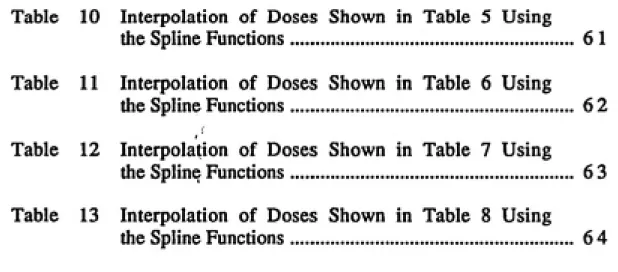
Table 10 Interpolation of Doses Shown in Table 5 Using
the Spline Functions... 6 1
Table 11 Interpolation of Doses Shown in Table 6 Using
the Spline Functions... 6 2
Table 12 Interpolation of Doses Shown in Table 7 Using
the Spline Functions... 6 3
Table 13 Interpolation of Doses Shown in Table 8 Using
the Spline Functions... 6 4
LIST OF FIGURES
Figure 1: Flow Diagram for Various Fates of Radon Progeny
in the Home... 8Figure 2: State-vector Model... 15
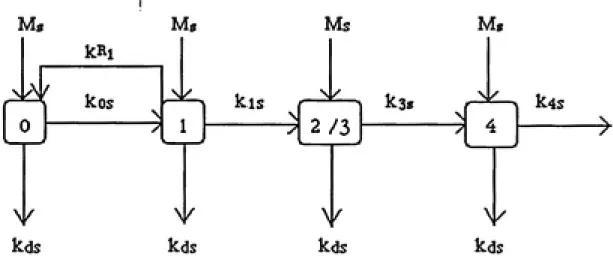
Figure 3: Model for Background Transition ...2 9
Figure 4: Model for Spontaneous Mitosis... 3 0
Figure 5: Age Dependence for Fractional Rate of Change
of the Organ Masses (yr') for the Human ... 3 3
Figure 6: Partial Summary of the Data Used to Develop a
Relationship Between the Mass and the Biological
Half-time in the Whole Body...3 4
Figure 7: Age Dependence of Organ Masses for the
Human... 3 4
LIST OF ABBREVIATIONS
BEIR Committee on the Biological Effects of Ionizing Radiations
EPA Environmental Protection Agency
ETS Environmental Tobacco Smoke
MMAD Mass Median Aerodynamic Diameter
MS Mainstream
NCRP National Council on Radiation Protection and
Measurements
NOPL Naso-oro-pharyngo-laryngeal
NRC National Research Council
RaA Progeny Radium A (Po-218)
RaB Progeny Radium B (Pb-214)
RaC Progeny Radium C (Bi-214)
RSP Respirable Suspended Particulates
SS Sidestream
TB Tracheobronchial
WL Working Level
WLM Working Level Month
1. INTRODUCTION
The health risks related to indoor radon and environmental
tobacco smoke (ETS) are of great public concern. The evidence from
epidemiological studies of uranium miners and from animal
experiments suggests that there is a strong association between
exposure to radon and lung cancer (NRC88). However, the
relationship between ETS and lung cancer is controversial at the
moment. Some studies have concluded that exposure to ETS causes
lung cancer, but others found no significant effect. It is noted that
many previous studies have been conducted to assess each of these
two pollutants associated with lung cancer separately, but little
attempt has been made to examine the combined risk from exposure
to radon and ETS simultaneously.
The purpose of this study is to estimate the lifetime risk of
radon-induced lung cancer by considering the effect of ETS on the
tracheobronchial (TB) distribution and dose of radon progeny. In
addition, the issue of radon dosimetry as a function of age will be
taken into account in calculating the delivered dose to the lung for
each age.
Chapter 2 explains the theoretical framework for estimating
the lifetime risk of lung cancer attributable to exposure to radon and
ETS. This includes the assumptions, mathematical models, and
solutions for estimating exposure conditions, deposition of radon
progeny, doses to the lung, and the probability of developing lung
cancer.
Chapter 3 discusses the parameter values used in estimating
exposure conditions; and, the parameter values used in the
state-vector model for estimating the lifetime risk of lung cancer.
Chapter 4 presents the final results, including the effect of ETS
on radon progeny working level (WL) concentration and unattached
fraction of progeny RaA; the annual doses under each set of exposure
conditions for each age; and, the different ratios of risks (with
ETS/smoke free) under each set of exposure conditions.
Chapter 5 discusses the implications of the results found in this
study, including the relevance to other studies and interpretation for
mitigation purposes.
Chapter 6 includes further investigations and recommendations
for future research.
1.1. A Brief Review of Radon
Radon is a radioactive gas occurring naturally by alpha decay
of radium-226 in rocks and soil. As radon undergoes the radioactive
decays , it decomposes into short-lived decay products called radon
progeny. Radon progeny are chemically active and believed to
contribute a major portion of the biologically significant doses when
they deposit in the lung. Indoor airborne radon arises principally
from the following sources : the basement floor under which the
rocks and soil are located, many building materials, and
containing water supply. Since radium can be found almost
everywhere in the earth's crust, all homes actually contain some
levels of radon. Due to the ubiquity of radon in homes, there is a
growing concern about its associated health risks among the general
population. ;
In the 1988-1989 home surveys in 25 states conducted by the
U.S. Environmental Protection Agency (EPA87), homes in many states
have a radon concentration exceeding the action level (4 pCi/L) set
by the EPA. Among these surveyed states, Iowa (71%), North Dakota
(63%), and Minnesota (46%) have the highest percentage. Even
though indoor radon concentration varies from home to home, which
is basically dependent on house characteristics and geological areas,
an annual average radon level of 0.83 pCi/L or 0.004 working level
(WL) is used by the EPA for estimating the health risk associated
with radon exposure (EPA 87).
There have been a number of investigations of radon-related
health risks of underground miners since the United Nations
Scientific Committee on the Effects of Atomic Radiation (UNSCEAR)
1977 report was issued (NRC90). Because different models and risk
coefficients were used, the risk estimates due to radon exposure vary
significantly, ranging from 130 to 730 deaths out of 10^ persons per
working level month (WLM). For example, the Biological Effects of
Ionizing Radiations (BEIR) III Committee used a constant absolute
risk model which generated the highest estimate of 730 deaths per
10^ person WLM. The National Council on Radiation Protection and
Measurement (NCRP) used an absolute risk model with exponentially
decreasing risks with time after exposure and projected a lowest
estimate of 130 deaths per 10^ person WLM. In contrast, the BEIR
IV committee used the time and age dependent relative risk model
which resulted in a moderate estimate of 350 attributable lung
cancer deaths per 10^ person WLM. Overall, the lifetime risk of lung
cancer due to indoor radon exposure is about 400 per million persons
per WLM, and the lifetime exposure dose is approximately 15 WLM
(Lao90).
The EPA estimated a radon-exposed lung cancer mortality rate
of 5,230 to 20,894 per year in the United States. This implies that a
probability of 23 to 92 excess lung cancer deaths for each one million
people per year is attributable to indoor radon exposure (Lao90).
1.2. A Brief Review of Environmental Tobacco Smoke
ETS is a complex substance containing over 4,000 chemicals, which
primarily comes from a combination of sidestream (SS) smoke
released from the burning end of the cigarettes and exhaled
mainstream (MS) smoke emitted from the smokers. The SS smoke
contributes the major constituents to ETS. Each mixture, SS, MS, and
ETS, is an aerosol consisting of a particulate phase and a vapor phase.
The concentration of many carcinogenic and other toxic compounds
is higher in SS smoke than in MS smoke. Included are ammonia,
volatile amines, volatile nitrosamines, nicotine decomposition
products, and aromatic amines (NRC86). Many field studies and
mathematical models have demonstrated that ETS is one of the major
potential sources of indoor air pollutants and contributes a significant
portion of particles to indoor air pollution.
The potentially adverse effects of ETS may range from
irritation or acute respiratory disease to fatal lung cancer due to
regular long-term exposure. Since mainstream smoke is believed to
cause lung cancer, the possibly qualitative similarities between ETS
and mainstream smoke make it reasonable to suspect that long-term
exposure to ETS might increase the risk of developing lung cancer.
The National Research Council (NRC) concluded that
epidemiological studies have demonstrated an association between
lung cancer in non smokers and ETS exposure, and that laboratory
experiments provide a biological plausibility for ETS to cause lung
cancer in human cells (NRC86). Based on the review and analysis of
24 epidemiological studies, a formal risk assessment done by EPA
concluded that ETS is a Group A carcinogen known to cause lung
cancer in human (EPA90). However, a number of scientists have
suggested that epidemiological studies of ETS are not reliable due to
the possibility of recall bias, misclassification, and other
methodological problems. The risk assessment of ETS based on these
questionable studies can not prove the causality between ETS
exposure and increased risk of lung cancer. The difficulty in
identifying ETS effects arises primarily for the following three
reasons : (1) ETS is a complex mixture containing over 4,000
components whose biological effects can not be precisely quantified
given the relatively insensitive techniques available, (2)
epidemiology is too blunt a tool to distinguish between "very low
risk" and "no risk" of lung cancer from ETS (Roe90), and (3) ETS may
interact with numerous other indoor air pollutants, including radon,
asbestos, formaldehyde, and others.
11. THEORETICAL FRAMEWORK
To predict the lifetime risk of lung cancer attributable to
exposure to radon and ETS, the risk assessment is broken into the
following analytical steps : (1) estimation of the exposure conditions
for radon with and without ETS present, (2) calculation of the
deposition of radon progeny in the tracheobronchial (TB) region of
the lung under each set of exposure conditions, (3) calculation of the
doses to the epithelial cells in each generation of the lung under each
set of exposure conditions, and (4) calculation of the probability of
lung cancer from these doses under each set of exposure conditions.
2.1. Estimation of Exposure Conditions:
In this study, the radon concentration in indoor air is assumed
to remain at a constant value of 1 pCi/L, which is reported as the
approximate average indoor concentration of radon in the U.S.
(NCRP84). The indoor progeny derive from the radioactive decay of
airborne radon in the home and transport through ventilation from
the outside atmosphere. A fraction of the radon progeny exists in a
free form called the unattached fraction, while the remainder is
attached to aerosol particles. Free progeny with a positive charge
will undergo one of the following fates:
(1) They migrate onto room surfaces to which they are
attached.
(2) They attach to aerosol particles in the room, and are
either inhaled along with the particles, deposited on room
surfaces along with the particles, or released from
particles into a free form again due to recoil during
subsequent decay.
(3) They remain free in air and eventually will be inhaled.
A block diagram depicting the general features of the decay,
transport, and attachment of radon progeny is shown in Figure 1.
Several parameters appearing in Figure 1 are defined as
follows: (1) Xi (time-i) is the radioactive decay rate constant for the
ith progeny, (2) Xy (time-i) is the rate of ventilation, (3) X^j and X.d,a
(time-i) are the rates of deposition onto room surfaces for free and
attached progeny, respectively, (4) ai is the fraction of the i^h
attached progeny that release from attachment to aerosol particles
during subsequent decay, and, finally, (5) Xs (time-i) is the rate of
attachment of free progeny to aerosol particles.
The relation between X^ and ambient particle conditions is
given in the form of (NRC88):
?is =Njtd2 v/4 (1)
Where: N= concentration of particles in air (cm-3)
d = median diameter of particles in air (cm)
V = mean ion velocity in air (cm/sec), employed here
rConcentration 1 Concentration 1
of free of attached
progeny i-1 in the home
progeny i-1 in the home
Ci-i.f 1
Ci-i,a 1
Xi-i
/
-1 cxi-i Xi-i(l-cx,i-i)\!/ K \l/
1 Concentration!
1 r\f fr^^ L
Av
>
1 Concentration
[Xs
Concentrationof attached
progeny i in the home
Ci,a
Xv Concentration 1
of attached progeny i outdoors Ci,o / ---7 progeny i
outdoors 1
1 Ci.o.f f
/
progeny i
J in the home
1 Ci,f
\y
Xv Xv
Xd,f y^ M
/Xioti
Xi(l-oci) \X<3,a\/
f
"^\
Room surfaces Concentration
of free
Concentration
of attached
Room surfaces
in the home
progeny i+1
in the home
Ci+i,r
progeny i+1 in the home
Ci+i,a
in the home
Figure 1 Flow Diagram for Various Fates of Radon Progeny
in the Home
From the flow diagram shown in Figure 1, two differential
equations in the form of general expressions for the i^h progeny may
be written to describe the rate of change of concentrations of the
progeny which are either free (Ci,f(t)) in air or attached to aerosol
particles (Ci,a(t)) :
d Ci,f(t)
= ?lilCi.i,f(t) + XvCi,o,f(t) + ?.iiaiiCi.i,a(t) Xd,fCi,f(t)
-d t ?ivCi,f(t) - XiCi,f(t) - ?isCi,f(t) (2)
d Ci,a(t)
--- = ?^vCi,o,a(t) + >-sCi,f(t) + Xi.i(l - ai.i)Ci.i,a(t) - >.d,aCi,a(t)
d t ?iiaiCi,a(t) - ?ivCi,a(t) - Xi(l-ai)Ci,a(t) (3)
Here, the subscript i equal to A represents the progeny RaA
(Po-218), i equal to B represents the progeny RaB (Pb-214), and i
equal to C represents the progeny RaC (Bi-214); the subscript f
denotes the free progeny (unattached to aerosol); the subscript o
means the outdoor atmosphere; and, the subscript a stands for the
progeny attached to aerosol particles.
In an undisturbed area with little air circulation, the short¬
lived progeny will come into equilibrium with the parent radon
(NCRP85). Upon reaching the state of equilibrium, the progeny
concentrations will not change with time. This means that equations
(2) and (3) may be solved at equilibrium by setting dCi,f(t)/dt and
of indoor radon (C222) and outdoor progeny (Ci,o,f and Ci^o.a) are
constant in time.At equilibrium, the concentrations of progeny are:
^222 C222 + '^V CA,o,f CA,f
=---Xd,f + ?tv + ^A + ?^s (4)
^v C-A.o.a + ^s CA,f
Ca a =----A,a
Cfi.f =ͣ
>^d,a + ^A + ^v (5)
^A CaJ + ^v CB,o,f + ^A OCA CA,a
?ld,f + ^v + ^B + ^s (6)
K CB,o,a + ^s Cfi.f + X,A (1 -aA) CA,a
Cb,a
Cc,f=->^d,a + ^B + ^v (7)
^B CB,f + X,v Cc,o,f + ^B Wb CB,a
^d,f + ^v + ^C + ^s (8)
^v Cc,o,a + ^s Cc,f + X,B (I-wb) CB,a
Cc,a
—---Ua + >-C + ?^v (9)
In equations (4)-(9), the units of the concentrations are atoms
per liter of air (atoms/L). From the report of the NCRP (NCRP85), the
approximate number of atoms per pCi is 18,000, 10, 85, and 63 for
ͣ
Rn, RaA, RaB ,and RaC, respectively. Concentrations in pCi/L may be
obtained by dividing the results of equations (4)-(9) by the
appropriate conversion factor from the NCRP report.
Working level (WL) is the common unit employed in risk
analyses for radon progeny, originally in uranium mines but now in
environmental exposures as well. Numerically, the WL is any
combination of short-lived progeny in one liter of air that will result
in the emission of 1.3 x 10^ MeV of potential alpha energy (NCRP88).
It is calculated from the following relation (Ev68):
WL = 0.00103 (CA,f + CA,a) + 0.00507 ( CB,f + CB,a )
+ 0.00373 ( Cc,f + Cc,a) (10)
In equation (10), all concentrations are expressed in units of pCi/L.
The presence of ETS will influence the concentration of aerosol
particles to which the radon progeny may attach. The results of
measurements of the mean diameter of particles in SS smoke have
been reported in several studies. The mass median aerodynamic
diameter (MMAD) for ETS particles was measured by McCusker et al.
(Mc83) and ranged from 0.37 to 0.52 ^m, which is similar to the
results obtained by Keith (Kei60) using a specially modified
centrifuge. The aging of ETS will reduce the MMAD by a factor of 2
to 3 due to the loss of larger particles by settling (Kei60, Wy67,
In85). Therefore, the MMAD for ETS particles is approximately 0.15
[im, which is consistent with the MMAD for ambient indoor aerosols
to which radon progeny normally are attached without the presence
of ETS. This implies that the addition of ETS changes the
concentration (N) but not the diameter (d) of particles in air in
equation (1).
2.2. Calculation of Deposition and Doses
Based on the fact that the observed lung cancers among
uranium miners appear to occur primarily in the TB region (Mc80),
the basal cells of the bronchial epithelium are regarded as the most
radiosensitive and are the target cells for lung cancer induced by
radiation from radon progeny. The calculation of deposition
probability in the TB region for radon progeny is determined by the
breathing rate, the size distribution and the unattached fraction of
progeny, and the filtration efficiency of the nasopharyngeal region
(Lao90). While several processes contribute to the deposition of
aerosol particles in a cylindrical tube like the lung airway, the three
most important mechanisms of deposition are impaction,
sedimentation, and diffusion. The total probability, P(n), of a particle
depositing in the n^h generation of the lung is given by (C-B87):
P(n) = 1 - [ 1 - Pi(n) ] [ 1 - Ps(n) ] [1 - PoCn) ] (11)
where, Pi(n), Ps(n), and PoCn) represent the fractions of particles
which deposit by impaction, sedimentation, and diffusion,
respectively, in the n^h generation.
After calculating total deposition in each generation of the lung
for the radon progeny, the radiation dose is estimated by the
following steps : (1) mucus flow is modeled to calculate how the
progeny move; (2) this movement is used to estimate the site of
decay for the progeny, yielding decays/cm^ in each generation
during a year of exposure; (3) depth-dose curves are developed to
yield dose per decay/cm^; and, finally (4) dose to basal cells is
calculated by multiplying the result of (2) and (3). This dose
calculation based on the location of critical cells relative to the site of
decay for progeny takes into account the shielding effect of
mucociliary layer, mucus thickness, bronchial morphometry, and
other factors. The detailed processes for modeling movement on the
mucociliary blanket, computing areal density of the radon progeny
on the walls of the generations, and generating depth-dose curves
refer to "Dosimetry" by Crawford-Brown (C-B87).
For purposes of this report, deposition of progeny in the
generations of the TB region and dose to basal cells of the lung were
calculated using the computer code of Hofmann.
The age-variant doses under each set of exposure conditions
are shown in Tables 5 to 8.
2.3. Risk Estimation
The generalized state-vector model of radiation carcinogenesis
by Crawford-Brown and Hofmann (C-B90) has been demonstrated to
successfully explain patterns found in experimental or
epidemiological studies involving radiation and cancer. The concept
of this model is that a cell must pass through several distinctive
stages to produce a fatal tumor. Unlike the multistage model, the
state-vector model specifies the biophysical meaning of each
transition and stage in terms of initiation, promotion, and
progression.
Initiation is triggered when a cell experiences DNA damage and
has undergone a required number of divisions. The whole process of
initiation is characterized by the following four steps : (1) inception
of a first specific DNA strand break, (2) occurrence of a second less
specific DNA strand break, (3) interaction of the above two breaks,
and (4) division-related fixation of this primary damage. Promotion
is produced by the loss of contact inhibition in a focus of cells, which
for radiation occurs due to the loss of proliferative capacity in a
fraction of the cells surrounding an initiated cell (C-B90).
Progression is associated with the growth of the promoted cells into a
frank tumor. This transition is related to the kinetics of growth,
death, and removal of cancer cells.
In the following risk estimation, this model will be used to
calculate the lifetime probability of lung cancer. The lifetime risk of
lung cancer is assumed to be proportional to the number of cells
reaching the state of progression during a normal (73 year) lifespan.
2.3.1. Description of State-Vector Model
The model is designed to describe radiation induced cellular
transformation by assuming that an initially undamaged cell must
pass through 7 states (from state 0 to state 6) to yield a colony of
transformed cells, especially for alpha irradiation due to radon
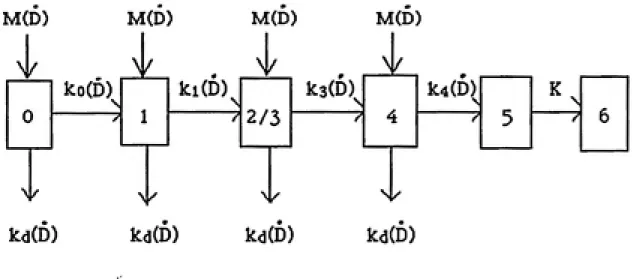
exposure. The features of the model may be found in figure 2 and
the details are discussed below.
State 0 refers to cells in a normal and undamaged state. Cells
in state 0 have not yet experienced any lesion after exposure to
radiation or chemicals starts.
M(D) M(D) M(D) M(D)
V V . V -
y0
koCD)
1
kiCD)
2/3
lC3(D)^
4
k4(D) 5
K 6
/ / / >>
N^ \p N^
Nkkd(D) kd(D) k<j(D) k<3(D)
Where: Numerical number i (i.e. from 0 to 6) represents state i
9M(D) is the rate of mitosis (day-l)
kd(D) is the rate of cell killing (day-i)
ki(D) is the rate of transition for state i (day-1)
K is the fraction of cells in state 5 moved to state 6
State 1 is reached when a cell has experienced a specific DNA
strand break. The transition from states 0 to 1 is assumed to be
m
characterized by first-order kinetics with a rate constant ko(D),
which is a function of the dose rate D during each year of exposure.
It is important to bear in mind here and in the remaining discussion
that D will vary with age due to changes in breathing characteristics
and lung anatomy.
A cell reaches state 2 when it suffers a second less specific DNA
double strand break(C-B90). This transition governed by first-order
* •
kinetics with a rate constant ki(D) is also a function of dose rate D.
State 3 represents an interaction between the first and the
second DNA double-stranded breaks, which for alpha irradiation
occurs immediately after a cell has reached state 2.
The transition to state 4 is the result of cell division. During
each division, only a required fraction (P4) of cells in state 3 are
moved into state 4 (C-B90). This transition is referred to as
division-related fixation of primary lesions, with a rate constant k3(D) which
is dependent on the rate of mitosis of cells in state 3. This rate of
mitosis is related to D due to stimulation of cell division by
cytotoxicity.
The transition of a cell to state 5 is the result of promotion. As
m
discussed earlier, the rate of promotion k4(D) contains a spontaneous
rate and a radiation induced component. This radiation-induced
transition occurs when a required fraction of the cells surrounding a
state 4 cell loses proliferative capacity. From histological
considerations, an epithelial cell is found to be surrounded by six
four out of these six neighboring cells are killed (C-B90). The loss of
proliferative ability of dead cells interrupts cellular inter¬
communication within the community to yield an uncontrolled
growth of cells in state 5. This is referred to as contact inhibition
removal.A cell in state 6, the final state, has progressed from a
preneoplastic lesion to a frank tumor. The study of atomic bomb
survivors suggests that the latency period of cancer is not
significantly affected by radiation (Shi90). Based on this information,
it is assumed here that a fraction K of state 5 cells are moved to state
6, and that K is not a function of D. This implies that any cell
reaching state 5 has an equal chance to produce cancer regardless of
time or dose rate.
Prior to state 5, there are rate constants for cell killing, Kd(D),
and for the mitosis of cells, M(D), in each state, respectively. These
two transition rates are assumed to include a spontaneous rate,
which is based on the belief that a natural transition would occur
without any delivered dose, and a radiation induced rate, which is
considered to be governed by linear kinetics (details discussed in the
next chapter). In addition, the spontaneous rate of mitosis is an
age-dependent parameter due to organ growth prior to adulthood. Both
spontaneous rates, therefore, change with age.
To complete the final risk estimation, the interaction of ETS and
radon progeny must be taken into account. A multiplicative model is
used to depict the mechanism of interaction (NRC88). This model
assumes that ETS acts as a promoter in the process of carcinogenesis
RR = RRradon ( 1 + 0.024 n ) (12)
where RR is the final estimate of relative risk of lung cancer, RRradon
is the relative risk from radiation alone, and n is the rate of
cigarettes smoked (in units of packs per day). Given a recent report
from experimental data (Gri88), the particulate phase of cigarette
smoke is considered to contain the primary carcinogens for most
induced cancers. It is assumed that the mass of respirable
suspended particulates (RSP) deposited in the TB region is an
appropriate measurement of carcinogenicity for both MS smoke and
ETS. Therefore, the conversion from exposure to MS smoke to
exposure to ETS is based on the assumption that the total deposition
of RSP in the TB airways is an approximate measure of equivalence
(NRC86). The total inhaled mass of RSP has been calculated by Wells
(WeSS) to be 240 mg for the active smoker and 3 mg for the passive
smoker. Multiplying these values by the TB deposition fractions
(C-B82) yields 36 mg of total deposited RSP for the active smoker and
0.12 mg of total deposited RSP for the passive smoker. If an active
smoker consumes one pack of cigarettes per day in the home, the
passive smoker would inhale a mass of RSP equivalent to 0.08
cigarettes per day. Multiplying this quantity by the excess risk of
smoking miners (i.e. 0.3) yields a value of 0.024. This implies that
there is an increased risk of 2.4% in the presence of ETS equal to one
pack of cigarettes per day when the promoting effect of ETS is
considered in the radon-induced carcinogenesis.
2.3.2. Mathematical Formulations
The quantitative characterization of state-vector model is
simply based on the concept that the rate of change of each state is
equal to total rate in minus total rate out. Let Ni(t) be the number of
cells of the lung in state i at time t after exposure to radon starts. In
Figure 2, each box prior to state 5 has a mitotic rate constant M(D)
feeding in and a rate constant of cell killing kd(D) flowing out. The
product of Ni(t) and M(D) means the rate of cell increase derived
from cell division, while the value of Ni(t) times kd(t) represents the
rate of cell loss due to cell killing. Because of the prompt interaction
between states 2 and 3 for alpha irradiation, this should not be
considered as a distinctive transition. A single box representing both
state 2 and state 3 is used in the state-vector model for the present
study.
Based on the above discussion, the differential equations
describing this model are:dN^(t)
dt
dN^(t)
dt
dN3(t)
dt
= M(D) N^Ct) - ( k^(D) + k^CD) ) N^Ct) (13)
k^(D) N^(t) + ( M(D) - k^(D) - k/D) ) Nj(t) (14)
kj(D) N/t) + ( M(D) - k3(D) - k^(D) ) N3(t) (15)
dN^Ct)
dt
= kgCD) N3(t) + ( M(D) - k3(D) - k^(D) ) N^Ct) (16)
State 5 is given separately by integral equation due to the
constant K independent of dose rate. This means that cells reaching
state 5 will pile up and undergo the transition to state 6 with a fixed
fraction K.
T
N3(t)= Jk^CD) N/t) dt (17)
0
But, Ng(t) = K N5(t) (18)
T
Ng(t)= K jk/D) N^(t) dt (19)
0
Therefore, the total probability of lung cancer is:
P^(D,t)= JKk^(D) N^(t) dt (20)
0
2.3.3. Equation Solutions
Through repetitive applications of Bernoulli's solution (Kel60),
the above differential equations are solved as follows:
No(t) = No(0) e - ('^d(D) + MD) - M(D) ) t ^^l)
ko(D)No(0)
Nj(t)= ---(e'^' -e"^' ) + N,(0)e"^' (22)
B -A
k,(D)kJD)NJO) e"^'-e"^' e"^'-e'^'
B - A C - A C-B
NjCt) =---
ͣ
---(---)
ki(D)N^(0)
C-B
+---(e'^'- e'^') + NgCO) e"^' (23)
kgCD) kj(D) k^(D) Nq(o) e'^' - e'^' e"^' - e"°'
N^d)
=---(---(B-A)(C-A) D-A D-C
k3(D) k^(D) k^CD) Nq(0) e'^' - e"°' e'^' - e"^'
(
(B-A)(C-B) D-B DC
o #
k3(D) kj(D) Nj(0) e"^'- e'^' e'^' - e"^'
_---(---C-B D-B DC
k3(D)N3(0)
DC
+---(e"^' - e"^') + N,(o) e"^' (24)
k^(b) kgCD) kj(D) kp(D) Np(0) 1 e'^' -1 e""^'-1
N5(t)=--- [--- (---)
(B-A)(C-A) D-A D A
1 e"^^ -1 e"^^ -1
)]DC D
k^ii)) k^(D) kj(D) k^iD) Nq(0) 1 e"^' -1 e"^' -i
---[---(---)
(B-A)(C-B) D-B D B
1 e'^^ -1 e-^^ -1
(---)]
D-C D
• •
k^ij)) k3(D) kj(D) N^(0) 1 e'^' -1 e'^' -1
+---[---(---C-B D-B D B
1 e-^^-1 e-'^^-i
)]
DC D
k^(D) k3(D) N3(0) e"^' -1 e'^' -1
(
DC D C
k^CD) N^CO)
( e'^'- 1 ) + N,(0) (25)
5D
Where:
A = k^(D) + k^CD) - M(D)
B = k^(D) + k^(D) - M(D)
C = k^(D) + k3(D) - M(D)
D = k/D) + k^CD) - M(D)
As discussed earlier, it is assumed that the lifetime probability of lung cancer is proportional to the number of cells reaching the
state of progression (i.e. state 6) during a normal 73-year exposure. Meanwhile, any cell reaching state 5 will undergo the transition to
state 6 with a constant fraction regardless of age. Based on the assumption of a 20-year latency period for developing lung cancer, the number of cells reaching state 5 after a 53-year exposure (i.e. N5(53)) can be a measuring scale proportional to the lifetime risk of
lung cancer. |
To calculate the accumulative probability of lung cancer, the method of dividing the lifetime into intervals assumes a constant
annual dose during each year. This means that those
dose-dependent parameter values appearing in equations (21) to (25) are
constant within a given year. The annual doses are interpolated
using the spline functions to fit a smooth curve among the given data
shown in Tables 5 to 8. The detailed discussion refers to Appendix.
The initial condition for calculating the number of cells
reaching each state at age 1 is obtained by arbitrarily setting one cell
in state 0 at age 0. Inserting No(0) = 1, Ni(0) = NsCO) = N4(0) = NsCO)
= 0, and the corresponding parameter values into equations (21) to
(25) yields the number of cells in each state at age 1. This obtained
vector at age 1 in turn provides the initial condition for calculating
the number of cells reaching each state at age 2. Repeating the same
computing process, the number of cells reaching state 5 at age 53 can
be calculated under each set of exposure conditions using computer
software . The relative risks shown in Table 9 are the results ofdividing the number of cells in state 5 with different amounts of ETS
present by that with smoke free for differing initial aerosol
concentrations.III. DETERMINATION OF PARAMETER VALUES
3.1. Parameters in Estimation of Exposure Conditions
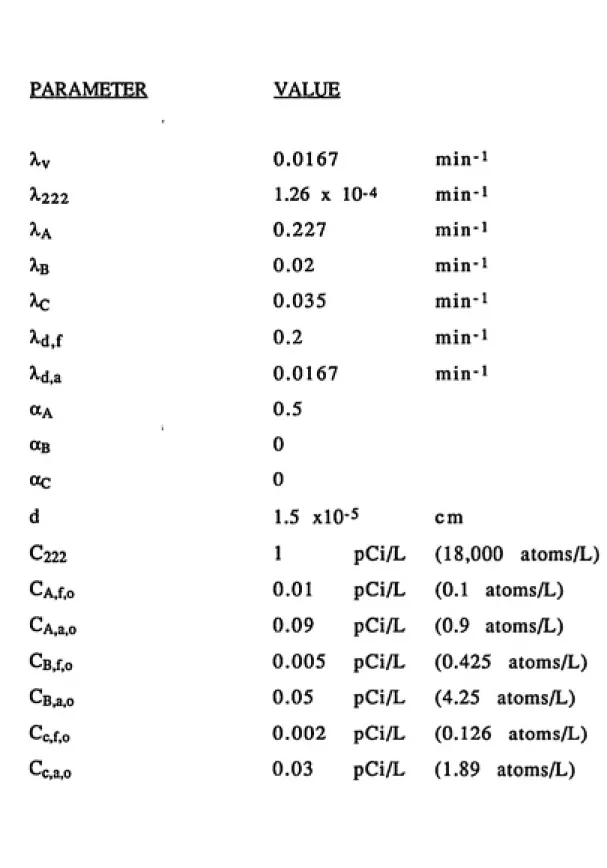
The values of various parameters appearing in equations 4 to 9
must to be determined to estimate the exposure conditions.
Assuming a rate of one entire air circulation per hour for
typical home conditions, a value of 0.0167 min-1 for the ventilation
rate is assumed here. The decay rate constants for Rn, RaA, RaB, and
RaC are 1.26 x 10⁻⁴, 0.227, 0.026, and 0.035 min-i(NCRP8 8),
respectively. The value of 0.2 min-^ for X,d,f is the average of values
determined by Rudnick and Maher (Ru86) and the NCRP (NCRP84),
while the value of 0.0167 min-i for Xd.a is adopted from the NCRP
(NCRP84) and is applicable to the deposition of cigarette smoke. The
fraction of decay for attached RaA that results in unattached RaB, aA,
is approximately equal to 1/2, but for attached RaB (as) or attached
RaC (ac) is zero (Raa69). Since the MMAD for both natural aerosols
and tobacco smoke particles is approximately identical, the value of
0.15 ^m for d is used in equation (1).
In solving for Xs, the aerosol density (N), which is affected by
the presence of tobacco smoke must be specified. From the report of
the NRC (NRC86), a consumption of 1 pack of cigarettes per day will
produce 26 mg of RSP per hour. For a typical home volume of 400
m3 with ventilation rate equal to 1 hr-i, this rate of release will add
an increased aerosol content of 60 [ig/m^. This amount is equivalent
to an increased aerosol density of approximately 2 x 10^ cm-3 and
must be added to the initial particle concentration without ETS
present. The same reasoning is applied to smoking rates of 1/2 and2 packs of cigarettes per day. Therefore, an increased amount equal
to 1 X 10^ and 4 x 10^ cm-^ must be added to the initial aerosolconcentration for 1/2 and 2 packs of cigarettes per day, respectively.
Tablel provides a detailed list of the values of various
parameters for exposure assessment in this study.3.2. Parameters in State-Vector Model
The values of parameters employed in the state-vector model
are assumed to contain a spontaneous rate and a radiation-induced
component. This yields the following mathematical formulations:
M(D) = Ms-I-Mr(D) (26) kd(D) = kds + kdRD (27) ko(D) = kos + koR D (28)
ki(D) = kis + kiRD (29)
k3(D) = M(D)P4 (30)k4(D) = k4s + k4R(D) (31)
Here, subscript s refers to the spontaneous component and
subscript R denotes the radiation-induced component in each of the
above equations.
Table 1 Summary of Parameter Values Employed for
Estimation of Exposure Conditions
PARAMEIER VALUE
^^ 0.0167 min-i
^222 1.26 X 10⁻⁴ min-i
^A 0.227 min-i
^B 0.02 min-i
Xc 0.035 min-i
^d,f 0.2 min-i
^d,a 0.0167 min-i
"A 0.5
ttB 0
oc 0
d 1.5 xlO-5 cm
C222 1 pCi/L (18,000 atoms/L)
Caj.o 0.01 pCi/L (0.1 atoms/L)
CA,a,o 0.09 pCi/L (0.9 atoms/L)
CB,f,o 0.005 pCi/L (0.425 atoms/L)
CB,a,o 0.05 pCi/L (4.25 atoms/L)
Cc.f.o 0.002 pCi/L (0.126 atoms/L)
Cc,a,o 0.03 pCi/L (1.89 atoms/L)
3.2.1. Background Transition Rates:
In the case of a natural transition, cell repair from state 1 back
to state 0 occurs. This background rate of repair, 0.13 hr^, is
independent of dose rate (discussed later) and taken from in-vitro
studies (Roo90). The block diagram for background transition prior
to state 4 is depicted in figure 3.
The rate constants for background transition (kos, kis, k3s) are
determined by the equilibrium values of No(t), Ni(t), and N3(t)
without exposure to radon progeny at t equal to 0. These
equilibrium values (Nqe, Nie, and Nse) calculated by Crawford-Brown
and Hofmann using in-vitro data are equal to 0.94, 0.06, 0.001,
respectively (C-B90).
a). Spontaneous Rate of Mitosis (Ms):
The process of spontaneous mitosis in the lung occurs mainly in
the basal cells of each generation. The dividing basal cells may
either be lost by sloughing, or differentiate into epithelial cells, which
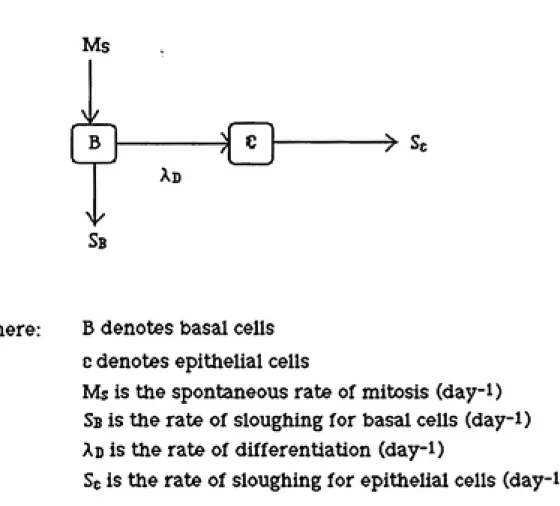
in turn may be lost by sloughing. The schematic model describing
the spontaneous mitosis of the lung is displayed in Figure 4.
The mathematical formulations are given as follows:
d NB(t)
--- = MsNB(t)-(^D+SB)NB(t) (32)
d t
Ms
M
0
kds
kRi
kos
Mb
:^
kds
kis
Ms
N/ -7 2/3
kds
k3s
M«
^ 4
kds
ͣ
>
Where: Numerical number i (i.e. o, 1, 2, 3, 4) represents state i
Ms is the spontaneous rate of mitosis (day-i)
kds is the spontaneous rate of cell killing (day-i)
k^i is the rate of cell repair from state 1 back to state 0 (day-i)
Kis is the spontaneous rate of transition for state i (day-l)
Figure 3 Model for Background Transition
Ms
Sb
^ e Ad
ͣ
> Se
Where: B denotes basal cells c denotes epithelial cells
Ms is the spontaneous rate of mitosis (day-i)
Sb is the rate of sloughing for basal cells (day-i)
Ad is the rate of differentiation (day-i)
Sc is the rate of sloughing for epithelial cells (day-i)
Figure 4 Model for Spontaneous Mitosis
d Ne(t)
--- = >.DNB(t)-Se Ne(t) (33)
d t
Assume that Ng = k Nb, which means each dividing basal cell
could differentiate into k epithelial cells. Inserting this relation into
equation (33), Ms is solved as :Ms = Xd(1 + l/k) + SB-Se (34)
If k equals 1, then
Ms = 2 Xd + Sb - Se
Inserting Xd = ( Ms + Sg - Sb )/2 into equation (32) yields:
1 dNB
Ms = 2(---) + (SB + Se) (35)
Nb dt If k equals 2, then
Ms = 2 Xd/3 + Sb - Se
Inserting >,d = 2 ( Mg + Se - Sb )/3 into equation (32) yields:
1 dNB
Ms = 3(---) + (SB + Se) (36)
Nb dt
A general expression of Ms is : 1 dN
Ms=(k+1)(---) + S (37)
N dt
1 dN
Where:---is the fractional rate of change of the lung mass
N dt
S equals (Sb + kSe), which is the overall rate of
sloughing of lung cells
The value of 2 for k is employed in this study, since there are approximately two epithelial cells for each basal cell in the upper generations of the TB region. Therefore,
1 dN
Ms = 3(---) + S (38) N dt
The age dependent values of (1/N) (dN/dt) are shown in Figure 5, taken from a paper by Crawford-Brown (C-B83).
It should be noted that the curve for the whole body is used here due to the absence of data specific to lung epithelium. The age-dependent values of S are determined by the biological half-life in humans of i37Cs in the whole body. It is assumed that i37Cs js
retained in the body by attachment to biomolecules in cells. When
cells are removed, the contained i^T^g goes with them. Based on this assumption, the half-life of the ^37Cs in human bodies is considered
to be identical to the half-life for removal of cells. If the mechanism
of excretion is governed by a first-order kinetics, the relation of the half life (T1/2) and the rate of sloughing (S) is given by:
S = 0.693 / Ti/2 (39)
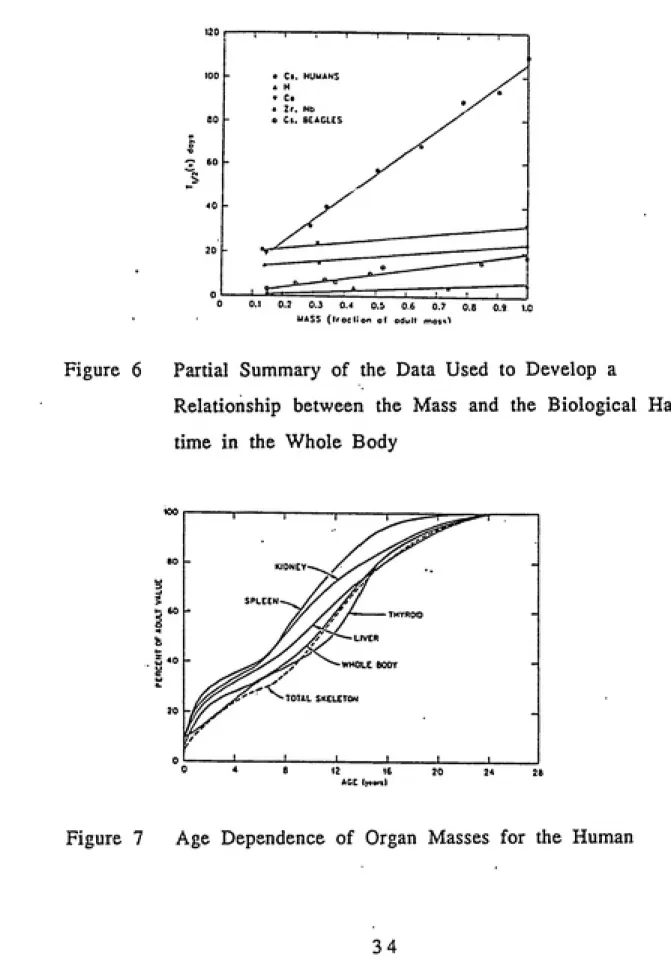
The value of T1/2 as a function of organ mass (fraction of adult
mass) may be seen from Figure 6 (C-B83). The age dependence of
organ masses in units of percent of adult value for the human may
be found in Figure 7 (C-B83). Therefore, inserting the data from
Figure 6 and Figure 7 into equation (39), the age-dependent rates of sloughing (S) can be obtained.
10"
SKtLETON
LIVER
WHOLE BODY K DNEY
SPLEEN^.
AGE (ytort)
Figure 5 Age Dependence for Fractional Rate of Change of the
120 r
« Cs. HUMANS
A H
• c.
• Zr. Nb o Ci. 8£*GLES
0.1 0.2 0.3 0.4 0.5 0.6 0.7 0.8 0.9 1.0
MASS ((roclion o( oduM mos^l
Figure 6 Partial Summary of the Data Used to Develop a
Relationship between the Mass and the Biological
Half-time in the Whole BodyKIDNEY
SPLEEN
THYROID LIVER
WHOLE BODY TOTAL SKELETON
12 16 AGE lyconl
Figure 7 Age Dependence of Organ Masses for the Human
Table 2 provides a list of the fractional rate of organ growth,
(l/N)(dN/dt), and the rate of sloughing, S, for each year prior to age
22. Beyond age 22, these rates are constant.
b). Spontaneous Rate of Transition from State 0 to State 1 (kos):
It is assumed in this analysis that kos is independent of age.
Based on the concept of material balance at equilibrium, the rate of
input must be equal to the rate of output for state 0. This
relationship, shown in Figure 3, may be formulated as follows:
Ms NoE + k^i NiE = (kds + kos) No (40)
Therefore, kos = (Ms - kds ) + k^^ (Nie/Nqe) (41)
To maintain organ homeostasis in adults, the background rates
of mitosis and cell killing are approximately equal (i.e. Ms = kds).
Therefore, the value for kos is 0.2 day-i.
The spontaneous rate of transition from state 0 to state 1, kos,
is an input for state 1. A cell in state 1 will undergo one of the
following three fates: (1) it undergoes further transition to state 2
with a rate of kis; (2) it is removed by background cell killing with a
rate of kds; or (3) it is repaired and goes back to state 0 at a rate of
R R
k 1. Due to the relatively large value of k i, the actual rate of
transition from state 0 to state 1 is significantly offset by cell repair.
Therefore, the fraction of kos that contributes to transitions is equal
to the sum of kg and kig divided by the sum of kg, kis, and k i. The
effective portion of kos, referred to as (kos)eff, is the product of kos
and the fraction of transitions (from state 0 to state 1) which avoid
repairing the cells in state 1 back to state 0. This yields :
Table 2 Age-Dependent Values for the Fractional Rate of Organ Growth (l/N)(dN/dt) and the Rate of Sloughing (S)
per year
Age fl/N) CdN/dt^
0.5
S
0 14.45
1 0.35 14.05
2 0.2 12.05
3 0.12 11.5
4 0.08 8.43
5 0.07 7.23
6 0.085 6.67
7 0.09 6.32
8 0.095 6.02
9 0.1 5.06
10 0.11 4.60
1 1 0.11 4.36
12 0.1 4.08
13 0.095 3.78
14 0.085 3.51
15 0.07 3.24
16 0.05 3.16
17 0.04 2.98
18 0.03 2.81
19 0.03 2.72
20 0.03 2.66
21 0.03 2.58
kds + kls
(kos)eff =(--- ) kos (42)
kds + kls + k^i
= 0.00638 (day-l)
= 0.23 (year-1)
In fact, ko is a function of dose rate. However, the radiation
component is relatively small compared to the background rate. It is
assumed that ko is not significantly affected by radiation and is
independent of age in this study. The constant value of 0.23 (yr'l)
derived above is applied to each age.
c). Spontaneous Rate of Transition from State 1 to State 2 (kis):
As with kos, kls is estimated at equilibrium with D equal to
zero. This yields :kisNiE + Ms (I-P4) NsE = MSP4N3E +kdsN3E (43) Therefore, kis = [ Ms (2P4-I) + kds ] (Nbe/Nje) (44)
P4 is a constant representing the probability per cellular
division that a cell in state 3 will undergo transition to state 4. Its
value equals 5 x 10⁻⁴, which was determined by Crawford-Brown
and Hofmann (C-B90) using the data of Han et al (Han84). N3E times
P4 is the fraction of cells in state 3 undergoing transition to state 4
during mitosis, while the fraction of cells remaining in state 3 will be
equal to N3E times (I-P4). It is assumed here that Mg = kds- The
value of kls is obtained as follows :
kis=2P4Ms(N3E/NiE) (45)
= 1.67 X lO-^ (day-i)
= 0.00006 (yr-i)
d). Spontaneous Rate of Transition from State 3 to State 4 (k3s):
The transition from state 3 to state 4 is a division-related
fixation, which is proportional to the mitotic rate with a constant P4.
k3s = Ms P4 (46)
= Ms 5 X 10⁻⁴
e). Spontaneous Rate of Transition from State 4 to State 5 (k4s):
From in-vitro studies, a lifetime probability of spontaneous
promotion is determined to be approximately 0.1 (C-B90). This value
has been shown to be consistent with limited in-vivo data. Assuming
a mean life expectancy of 73 years in the U.S. and a 20-year latency
period of developing a lung cancer, the time interval for promotion
(neglecting the initiation period) to occur is about 53 years.
Therefore,
53
J k4s dt = 0.1 (47)
0
k4s = 2 X 10⁻³
3.2.2. Radiation Induced Rates
The value of kiR was determined from in-vitro experiments
(Roo90), and equals 4 x 10-^ mrad-1. The rate of mitosis is
stimulated by cell killing due to exposure to radiation, and the rate of
radiation induced mitosis (Mr) is assumed to equal the rate of cell
killing caused by radiation to maintain the lung mass. The value of
kdR is taken here to be 1.67 x lO'^ mrad"!.
0
The parameter k4R(D) is a radiation induced rate related to
contact inhibition removal within the cellular community during
mitosis. This depends on a specific number of dead cells surrounding
a cell in state 4. As discussed earlier, the total number of cells
contiguous to a epithelial cell is six, and at least four of these six cells
must be dead to stimulate the transition toward state 5. Assuming
binomial distribution, therefore.
x=6 x! (fy(l-f)^-'
k4R(D) = M(D)X
---i=4 (x-i)! i!
(48)
Here, f is the fraction of dead cells in the tissue surrounding a
cell in state 4. It is assumed that cells, except those being killed, are
in a dividing state. These surviving cells are removed from the
organ by lysis at rate constant R (C-B90). Therefore, f is given by the
following relationship :
kd(D)
f =--- (49)
kd(D) + RWhere R is the rate of removal set equal to 1 dayi to be
consistent with the rate of mitosis in heavily damaged organs (C-B91
in press).
A summary of parameter values used in state-vector model of
this study is provided in Table 3.
Table 3 Summary of Parameter Values Employed in State-Vector Model
PARAMETER VALUE
kiR
kdR
kN
ko
kis
k4s
NOE
NiE
N3E
P4
R 1 day 4 X 10⁻⁵ mrad'l
1.67 X 10⁻⁵ mrad"^
0.13 hr-i
0.23 yr-i
0.0061 yr-i
0.002 yr-i
0.94 0.06
0.001
5 X 10⁻⁴
IV. RESULTS
The influences of different amounts of ETS on the working level (WL) concentrations of radon progeny and the unattached fractions of RaA (fa) under various initial particle concentrations (N) are presented in Table 4. The initial particle concentrations refer to the
concentrations present before the introduction of ETS.
It is noted that there is a general tendency of increasing
working level concentration and decreasing unattached fraction of RaA with greater amounts of ETS. In addition, the presence of ETS
only slightly raises the working level concentration, with a maximum increase of a factor of two, but significantly reduces the unattached
fraction of RaA by three orders of magnitude which is the largest difference identified. Comparing 2 packs of cigarettes versus smoke
free for an initial particle concentration of lO^ cm-3, the ratio of the
WL concentration is equal to 2 (i.e. 3.78 x 10⁻³/L89 x 10-3), while
the ratio of the RaA unattached fraction increases to 1.45 x 10^ (i.e.
0.63/0.0044). Since the dose per inhaled atom is significantly higher for unattached progeny than for those attached, the effects of ETS are more significant when the initial aerosol concentration is as low as
Table 4 A List of the WL Concentrations of Radon Progeny and
the RaA Unattached Fractions under Each Set of
Exposure Conditions in the Home
N Amount smoked
(particles/c.c.) (packs/day)
103
WL
104
105
106
0 1.89 X 10⁻³ 0.63
1/2 3.73 X 10⁻³ 0.0172
1 3.76 X 10⁻³ 0.0087
2 3.78 X 10⁻³ 0.0044
0 3.29 X 10⁻³ 0.15
1/2 3.74 X 10⁻³ 0.0158
1 3.77 X 10⁻³ 0.0084
2 3.78 X 10⁻³ 0.0043
0 3.73 X 10⁻³ 0.017
1/2 3.76 X 10⁻³ 0.0088
1 3.78 X 10⁻³ 0.006
2 3.78 X 10⁻³ 0.0035
0 3.79 X 10⁻³ 0.0018
1/2 3.79 X 10⁻³ 0.0016
1 3.79 X 10⁻³ 0.0015
2 3.81 X 10⁻³ 0.0013
The calculation of annual doses for different ages with different
amounts of smoke in the environment are shown in tables 5 to 8
under each set of initial aerosol concentrations.
From the results shown in Tables 5 to 8, the addition of ETS
tends to lower the doses of radon progeny to the lung, and an
increased amount of smoke in the environment results in a lower
dose. This implies that when the initial concentration is so high that almost all the progeny have been attached to particles, the contribution of aerosol particles from ETS has a minimal effect on the calculated progeny doses. In addition, the curve of age-variant doses reveals that the subgroup most sensitive to radon progeny exposure would be children in the ages between 5 and 10.
It is interesting that the doses with ETS present are slightly
higher for Ni = lO^ cm-3 than those corresponding doses for Nj = 10^ cm-3 regardless of age and amounts of cigarette smoke. The similar
relationship remains for the case of comparing the doses when Ni
raises from 10^ up to 10^ cm-3. But, for the case of comparing the
doses for Ni = 10^ and 10^ cm-3, a decreasing tendency of annual
doses is found with higher density of initial aerosols present. This fluctuating change of annual doses with different initial aerosol concentrations is the result of many competing factors. Due to thecomplicated process of dose calculation, it is difficult to pinpoint out a specific factor responsible for this change. Instead of comparing the
doses among different values of Ni, however, a comparison concerning the relative change of annual doses with and without ETS
present for each initial aerosol concentration may provide an indirect
The value of RaA unattached fraction (fa) for Ni = 10^ cm-3
without ETS present is approximately four times of that for Ni = 10^
cm-3 without ETS present (i.e. 0.63 versus 0.15). The presence ofETS, which will release an amount of particles equal to a magnitude
of five orders per cm3 into the ambient air, reduces the f^ down to
approximately the same level for both Ni = 103 and 10^ cm"3. For all
ages, the addition of ETS equal to 1/2 pack of cigarettes per day
lowers the doses by a factor of four for Ni = 103 cm-3 and by a factor
of only 2.5 for Ni = 10"^ cm-3. Therefore, the higher doses with ETS present for Ni = 10^ compared to 103 cm-3 niay result from the ETSparticles that have more significant effect on reducing the RaA
unattached fraction for Ni = 103 cm-3 than that for Ni = 10^ cm-3.
The final sensitivity analysis for life-time relative risk of lung
cancer (i, e. the possibility of lung cancer with ETS present compared
to that without ETS present) is displayed in Table 9.
If the initial aerosol concentration in the home is less than 10"*
cm-3, the addition of ETS equal to less than 1 pack of cigarettes per
day may lower the risk of lung cancer. A general trend indicates
that the relative risk of lung cancer increases as the initial concentration goes up and more ETS is added.
Table 5 Annual Irradiation Doses for Different Ages and Various Levels of ETS Present with Initial Aerosol Particles Equal
to 103 cm-3
Age
(yrs)
Annual Doses (mrad/year), when Ni= 103 |
Amount Smoked (packs) |
0 1/2 1
2 1
0 260 70 65 65
2 250 63 56 56
5 320 60 75
75 1
10 340 65 79
79 1
22 150 36 35
35 1
Table 6 Annual Irradiation Doses for Different Ages and Various
Levels of ETS Present with Initial Aerosol Particles Equal
to 104 cm-3
Age
(yrs)
Annual Doses (mrad/year), when Ni= 104 |
Amount Smoked (packs)
0 1/2 1
2 1
0 220 64 60
60 1
2 200 11 73 73
5 250 96 91
91 1
10 270 102 96 96
22 120 46 44
44 1
Table 7 Annual Irradiation Doses for Different Ages and Various
Levels of ETS Present with Initial Aerosol Particles Equal
to 105 cm-3
Age
(yrs)
Annual Doses (mrad/year), when Ni= 105
Amount Smoked (packs)
0 1/2 1 2
0 77 61 61 61
2 70 56 56 56
5 66 70 70 70
10 95 76 76 76
22 42 34 34
34
Table 8 Annual Irradiation Doses for Different Ages and Various
Levels of ETS Present with Initial Aerosol Particles Equal
to 105 cm-3
Age
(yrs)
Annual Doses (mrad/year), v/hen Ni= 106
Amount Smoked (packs)
0 1/2 1 2
0 66 66 66 66
2 60 60 60 60
5 75 75 75 75
10 61 61
61 61
22 36 36
36 36
Table 9 Life-time Relative Risks of Lung Cancer under Each Set of Exposure Conditions in the Home
Initial Aerosol
Concentration
(particles/cm3)
RRETS/vithoutETS
1/2 packs of
cigarettes
of ETS
1 pack of cigarettes
of ETS
2 packs of cigarettes
of ETS
103 0.693 0.766 1.000
104 0.601 0.669 1.164
105 1.060 1.193 1-560
106 1.115 1.255 1.641
DISCUSSION
The analysis in Table 9 implies that estimating the possibility
of lung cancer depends on various competing factors. The initial
aerosol concentration in the home plays an important role in
quantifying the effect of ETS on radon exposure.
For relatively low concentrations of aerosol particles (less than
lO^cm'^), the presence of ETS lowers the unattached fraction of RaA
and progeny doses dramatically. This may result in a lower risk of
lung cancer than a smoke free environment. Combining the
promotional effect of ETS by an increased risk of 2.4 % per pack of
cigarettes, the final results indicate a decreased relative risk of 0.766
for an initial particle concentration of 10^ cm-3, and 0.889 for an
initial particle concentration of lO^cm-3. Analogously, the smoke
from 1/2 pack of cigarettes will result in a decreased relative risk of
0.693 for an initial particle concentration of 10^ cm"3, and 0.801 for
an initial particle concentration of 10^ cm-3.
It is noted that the influence of ETS on radon induced lung
cancer is related to, but not limited to, the competition of the initial
aerosol concentration and the magnitude of promotional effect of ETS.
For low initial aerosol concentrations in the home, the particle
density in air has a dominating effect on progeny attachment and
will yield a relatively lower risk of lung cancer; however, for high
-umt' "'" muv^mfi
initial aerosol concentrations, the promotional effect outweighs the
reduced radiation dose due to the addition of ETS. This will result in
a higher risk of lung cancer.
The results predicted from this study are basically consistent with the results from animal experiments. The NRC report (NRC88)
found that respiratory tract tumor incidences
* increase with the unattached fraction of radon progeny.
* decrease if cigarette smoking follows completion of exposure to radon progeny, but has no effect if smoking precedes exposure.
* decrease if animals are exposed to smoking and radon progeny alternately on the same day.
The combined lung cancer relative risk of 1.34 from the meta¬ analysis of 13 epidemiological studies (NRC86) is much higher than would be expected from comparisons of biological markers of smoke exposure between ETS-exposed people and active smokers. The analysis of urinary levels of cotinine discussed in the NRC report (NRC86) suggested that ETS exposure was roughly equivalent to smoking 0.1 to 0.2 cigarettes per day, which is approximately the
range used in the present study (i.e. 0.04 to 0.16 cigarettes per day). The excess lung cancer risk calculated from epidemiological studies (34%) is about 10 times greater than the excess lung cancer risk
obtained here using extrapolation from MS smoke data to estimate
the cigarette equivalence inhaled by the passive smoker (1.2 to 4.8%). The NRC contended that the effects of ETS cannot be precisely
compared on the basis of biological markers due to the different
components between ETS and MS smoke. Another explanation from
the opposite viewpoint stated that the observed association from
epidemiological studies was misclassification of smokers and
ex-smokers as nonex-smokers. This discrepancy raises the controversy of
the association between ETS and lung cancer remained to be further
identified.
The most striking conclusion of this study suggests that the effect of ETS on radon-induced lung cancer can not be simply
classified as protective, additive, or synergistic. Whether the
combined risk is less than, equal to, or greater than these two
separate risks primarily depends on the initial aerosol concentration
and the amounts of ETS in the home. Several competing factors
influence the effect of ETS on radon progeny, which complicates the
mitigation schemes.
For the initial particle concentration of 10^ or 10^ cm-3 and the
amount of smoke equal to less than 1 pack of cigarettes per day, the removal of ETS may not result in the expected lower life-time risk oflung cancer. A higher risk is computed in this study. When the