From Los Angeles to The Cloud: Driving Revenue and Exposure In The
Contemporary Digital Soundscape
By Nicole Leonard
Senior Honors Thesis
School of Journalism and Mass Communication University of North Carolina
April 2015
Approved:
_______________________________________ Dr. Adam Saffer, Chair
_______________________________________ Dr. Anne Johnston, Reader
DEDICATION
As everything, for Alyse Nass Pinto as my unbroken supporter in life and thereafter:
Not a day goes by that you don’t cross a hundred minds, And you cross mine
ACKNOWLEGDMENTS
My first right of gratitude is extended to TouchTunes Interactive Networks, and particularly Vicki Saunders. Over the course of my summer internship, Vicki first introduced me to the world of digital music marketing and label relations and, in turn, exposed me to the benefits and
challenges of working in a digital music industry. More than anything else, it was this experience that drove my curiosity to eventually develop my own research study.
I would also like to thank the University of North Carolina School of Journalism and Mass Communication for its outstanding curriculum. It is hard to imagine that I could have found my passion for music marketing without the inspiring UNC professors driving students to identify their passions and channel their creativity.
I am also forever grateful to Adam Saffer for his knowledge and assistance related to this study over the past nine months. Adam not only challenged me to develop my academic voice, but also unfailingly extended profound advice to the development of my research and literature.
TABLE OF CONTENTS
Acknowledgements………...3
Table of Contents………...4
Abstract………....5
Chapter 1: Introduction…….……….………..6
Literature Review……….…………...7
Research Questions..………26
Chapter 2: Methods………28
Context of Research..……….…..28
In-Depth Interviews..………...30
Limitations..……….33
Chapter 3: Results and Discussion………35
Music Streaming..………36
Live Performance..………...44
Licensing and Brand Integration.……….47
Social Marketing..………54
Chapter 4: Conclusion………...62
Implications for Music Marketing………...63
Opportunities for Future Research………...64
Bibliography………..65
Appendix A………...67
ABSTRACT
This study explores the innovations, controversies, and new strategies being employed in the contemporary digital soundscape. Focusing on the post-iTunes era, this study attempts to contextualize two paradigm shifts occurring in the music market today: (1) the new roles that revenue and exposure play in defining return on investment (ROI); (2) the ways that technology is empowering those who create and those who consume music (including online consumers, tech companies, record labels, and artists). In tracing the reoccurrence and evolution of these two themes, digital streaming, social media, live performances and brand integration are revealed as four major paths to monetize and/or market music in today’s hectic digital soundscape.
CHAPTER 1: INTRODUCTION
Since music raced into the digital arena, artists have struggled to keep up. Initially, the industry’s rapid digitization yielded careless security provisions, allowing dangerous copyright and illegal sharing platforms to disrupt industry money flow (Melton, 2003). Illegal online platforms gave listeners a choice of whether to pay for the music they listened to or not, and many chose the latter. 1999 marked the invasion of piracy on a level the tangible CD and vinyl black market could never have imagined. In 2003, Apple launched the innovative and cost-efficient iTunes platform that sought to convince listeners to purchase music again. While hugely successful, piracy continued to battle iTunes through the first decade of the millennium.
By 2009, music streaming sites entered the digital arena to put an end to piracy by establishing customizable listening experiences for online consumers (Peoples, 2012). However, to distinguish their experience from iTunes, streaming sites redesigned the payment model central to an era in which album release sales still dominated artist compensation. Full albums faded from the popular soundscape as the growing popularity of digital services began to out-compete tangible album sales (Amedeo, 2009; Pham, 2012). By 2011, the moneymaking engine of album releases was broken (Horowitz, 2013; Peoples, 2012).
Literature Review
Music began as a creative outlet of shared culture and experience within communities. In 1877, Thomas Edison invented the “talking machine” as the first phonograph and earliest sound recording device. Edison triggered a series of audio technological advancements in the early 20th century, which ended in the splitting of audio engineers into three record label groups: Edison, Victor, and Columbia. Edison’s original wax cylinders progressed to the Diamond Disc Player in 1913. By 1917, an entire industry of independent record labels was built around the sale of sound recording devices. For the first time, music was a tangible, sellable product (Grey, 2012).
Post World War I, the demand for music soared as people yearned to escape reality through entertainment. The industry saw a boom of new record labels as entrepreneurs capitalized on music’s new revenue potential (Grey, 2012). Market competition forced
profiteering motives over the creation of music, thus affecting the sound of music. Specifically, ideas of popular music and “good” and “bad” traits were established as labels only recruited artists who mimicked characteristics of previously high-selling songs. Suddenly, the prime motivation to create music was revenue; originality had been forgotten amidst the invasion of the capitalist market (Grajeda, Katz, & Taylor, 2012). The sound recording industry continued to thrive until the end of the 20th century, as digital hackers like Napster, Limewire and MP3.com forced record labels to adjust to the digital age.
The print media industry experienced similar repercussions from the technology influx of the early 2000s. The function of traditional print media was severely disrupted by the Internet, as digital subscriptions cannibalized physical paper distribution. Traditional news channels,
sources, including Twitter, Reddit, and Buzzfeed. Most importantly, they re-allocated money to build websites and personalized smartphone apps, and embraced their potential for engaging a global readership.
The music industry is currently in the phase of deciding whether to fight or embrace digitization and how to rebuild effective monetization strategy for both long-term growth and short-term stability. The ability to innovate and employ new marketing tactics that will engage their growing audience in real-time ROI is the most important asset to any record label or music provider (IBISWorld, 2014). This thesis investigates the marketing strategies that digital music services and traditional labels have employed to capitalize on opportunities for monetization in the dynamic digital marketplace. The subtopics examined below are interconnected and unique in various ways, and include innovation, monetization and digital marketing.
Digital Innovation Lands on Music Streaming
It is also clear that music is consumed at a higher rate today than it has been in decades. The concern, therefore, lies in the fact that the cost of one digital music sale equates to less monetary value than one physical sale.
As digital music sales continue to outcompete physical sales, the total value of music declines. In fact, in 2008, the total value of music sales fell by 11.8 percent (Amedeo, 2009). Music industry enthusiasts use this startling data to suggest that the industry is in a recession and that digital streaming has cannibalized artists’ revenue. However, existing research and the gradual adoption of licensing agreements between labels and music streaming sites suggest that the industry’s shift towards the digital space is not reflective of a recession, nor is it temporary (Amedeo, 2009; Pham, 2012).
iTunes was able to cannibalize physical music sales (CDs) because it gave listeners the power to choose which music to buy and made it convenient to do so. For instance, iTunes re-introduced the practice of releasing singles prior to full albums, meaning listeners could choose whether they just wanted to purchase one song, a few songs, or the full album (Amedeo, 2009). Also, iTunes offered users the ability to store their entire personalized music library on one portable domain: the iPod. Suddenly, every listener’s favorite artist, album, and song could travel in users’ pockets anywhere they went (Amedeo, 2009). It quickly became clear that people preferred to pay less for a convenient and personalized listening experience than more for the full album experience. Thus, after the introduction of iTunes, the album gradually faded from the popular soundscape.
2009). Piracy became a major issue for artists, necessitating immediate change in the digital music marketplace. However, illegally downloaded music files could not be synced to the iTunes library, meaning that when iTunes users engaged in piracy, they no longer could store all of their music in one digital library. While it may be free, the convenience of digital music was lost.
Since the motive behind piracy was not to hurt artists, but to save money, innovative music industry entrepreneurs like Spotify co-founder/CEO Daniel Ek knew “the best way to compete with [illegal downloads] is to come up with a better product, which gives fans
everything music piracy can offer and much more, while also compensating labels and artists" (Koranteng, 2009, p. 1). And so entered ad-funded free streaming sites, originally Pandora and Rhapsody, as the “legal alternative to file sharing and part of the industry’s anti-piracy efforts” (Peoples, 2012, p. 1).
Streaming sites offer a single database to hold each listener’s entire music library. Furthermore, they give listeners access to a larger catalog in which to construct their personal music libraries. Essentially, listeners no longer needed to commit piracy in order to access music for free, and they could even store their paid and free music all in one digital library domain. Finally, since music streaming was legal and catalogs were based on royalty contracts, artists received compensation for the same songs that listeners accessed for free.
Monetization streams and new definition of ROI
The ‘death of the album’ at the hands of digital music consumption drastically changed the way artists receive compensation for their music. In order to offer users free music, music streaming sites adopted a lifetime monetization model based on royalty contracts. Peoples (2012) described it perfectly:
As subscription services force the industry to rethink how people consume music, it has caused artists and their teams and labels to evaluate how they're compensated -- and how they take advantage of those platforms. Known: A consumer can pay to access music rather than purchase and own a recording in perpetuity. Known: Rights owners and artists get paid based on listening activity, not purchasing activity. Known: Rather than rights owners and artists receiving a lump of money upfront, they're paid in much smaller increments, when people listen. (p. 2)
At a high level, music streaming sites reversed the roles of revenue and exposure. Intrinsic to the pay-per-play royalty model, it takes longer for artists to receive full return for their investment into recording each track. In other words, compensation occurs incrementally over a long period of time, rather than in the first week of a new release. Before streaming sites, music was monetized one time per consumer at the time of purchase (when the CD was bought), and then never again regardless of the number of times the song was played. With the new monetization model, digital streaming sites’ licensing agreements with record labels monetize a song each time it gets played (Koranteng, 2009).
subscribers. Artists are able to leverage the global reach and stored user data inherent in this massive digital marketplace to target potential fans and grow their audiences (Koranteng, 2009; Peterson, 2013). Widespread visibility can now be immediately achieved just by having one’s catalog on music streaming sites. So even though there is little revenue growth initially, these fans are more likely to invest their money on merchandise and tours throughout the artist’s career.
Pham (2012) claimed that Michael Acton, a 38-year-old music enthusiast and Spotify user, demonstrates this new definition of ROI as the creation of a larger, more loyal fan base: Acton spends less buying downloads and CDs. But that is not the end of his experience with music. ‘The net result is that I listen to more music now,’ he says. ‘And I probably spend more money on music in total than I had before, going to shows and such.’ (p. 2) Therefore, exposure, which used to be a long-term marketing goal, is instant while monetization has become a long-term concept. Faced with this new understanding of ROI, music professionals are forced to weigh exposure against sales in defining music success.
While presenting the need for other forms of monetization to provide the bulk of revenue for labels and artists, this pay-per-play model allows the industry to grow at an exponential rate and provides long-term stability for artists. With that said, someresearch suggests streaming sites already began to boost income for labels. Universal Music Sweden’s CEO claimed that Spotify earned the label more money than iTunes (Bruno, 2009). Nonetheless, some artists fail to see the value of streaming sites as a solution to piracy and path to global exposure.
Artists windowing releases. While the opportunity for growth is undeniable, the future monetary value of ad-funded streaming sites remains unclear. Research states that many
piracy (Pham, 2012, p. 1). Radiohead, Kid Rock and the Beatles refused to sell singles on iTunes in fear of sacrificing full-album sales (Peoples, 2012). Other artists and label managers including Coldplay, Taylor Swift, Adele, The Black Keys and Rihanna have taken similar routes to protect their music against an initial decline in album sales due to streaming sites. These artists
“window” new releases, meaning they withhold updated catalogs from streaming sites for a period of time. A window can last any amount of time from 100 days after the public release, as the case with Coldplay’s Mylo Xyloto, to over a year, as with Adele’s 21 (Peoples, 2012).
The rationale behind this practice is to increase album scarcity, and in turn, force fans to purchase the album in order to hear it. In reality, windowing only directs fans to other online sites like YouTube, “where artists receive a fraction of the royalties they would from a premium on-demand subscription service” (Pham, 2012, p. 6). In effect, many artists lose more money by fighting streaming sites than they would get from forcing album sales.
In summary, windowing is hurtful for both artists and streaming sites, which rely on access to record labels’ updated catalogs to retain users (Pham, 2012). The industry as a whole would profit more from fair partnerships between music streaming sites and record labels. Just as windowing hurts the maintenance of a growing catalog, advertisements on music streaming sites are key to funding these growing catalogs.
Ad-funded model. Core to the attraction of music streaming sites is their extensive
catalogs. For instance, Spotify, a streaming service founded on the basis of offering users a larger catalog and unobtrusive advertising, gave registered users access to free on-demand music
traditional price, determined by iTunes. Indeed, paid subscriptions alone do not cover the royalty costs that free steaming users pile up. Instead, the free service is supported predominantly by revenue from banner and audio advertising (Bruno, 2009; Koranteng, 2009). Likewise, in 2013, Pandora predicted 80 percent of revenue to stem from advertising (Peterson, 2013).
As free users are converted to paying subscribers, the burden on advertising to fund the royalty costs lessens. However, at the same time, royalty costs increase as more people engage with music streaming sites. In-site advertisements, therefore, are invaluable to streaming sites regardless of the proportion of free to paying users. The advertising industry has become
increasingly interconnected with music since the turn of the century, perhaps due to the recently proven effectiveness of targeting consumers by music taste. In the context of behavioral
targeting, music taste has metaphorically entered the realm of demographics due to its
consideration as a highly effective means of exposure for certain culture groups. For instance, Spotify recently announced an additional opportunity to integrate targeted advertising into their Spotify for Brands platform. Set to launch on May 1, 2015, corporate brands will be able to target Spotify listeners based on the playlists or ‘moods’ they are streaming. “For example, if you are listening to a workout playlist, you would most likely get ads about health and fitness rather than chocolate” (The Next Web, 2015). This realization also presents the opportunity for advertisers to reach certain types of people and strains of culture in a revolutionary form of product placement: fusing brand mentions into lyrics and music videos.
prominent technology companies that have incorporated analytic databases into their platforms (Baysal & Holmes, 2013). Many other smaller databases have been established in the recent years as well, including Sysomos and DART. As the analytics-driven culture grows, more marketing companies turn to quantitative data to improve campaigns and optimize their targeted messages (Baysal & Holmes, 2013).
Advertising agencies are becoming more and more able to target users through the songs they listen to by matching their music taste with demographic information, all of which is available on music streaming databases. As the global music industry continues to grow, songs become an effective medium for product placement advertising.
The early 1990s saw the first explosion of in-song advertising: 40 percent of music videos mentioned specific brands. In 2002, Busta Rhymes’ video for the song “Pass the
Courvoisier” increased sales of the cognac by 20 percent (Schmidt, 2011). By 2004, “Of the 105 songs [in Billboard Top 20 singles charts], 42 (40 percent) mentioned at least one brand” (Behrer & Van Der Bergh, 2011, p. 190). With the digital music industry’s growing adolescent audience and longer ad shelf life than previous non-digital platforms, product placement in music videos became increasingly popular, “blurring the line between music videos which include product placements, and advertisements which are set to music” (Schmidt, 2011, p. 2) Lady Gaga’s 2010 music video for the hit single “Telephone” sold ad space to nine brands, including Virgin
Mobile, HP, Diet Coke, and Chanel (Schmidt, 2011). However, in order for music’s potential as an advertising medium to be extended beyond the assured success of pop music icons, marketing professionals must understand the way music has evolved in the past decade and how its
The evolution of in-song brand mentions can be traced back to the origins of hip-hop. Kanye West is one of many rappers known for name-dropping expensive brands, with a whopping 19 brand mentions in just four singles. After Universal Music-affiliated hip-hop and metal record label, Def Jam, set up a meeting between RUN-DMC and executives from Adidas, the hip-hop group released a song titled “My Adidas.” Many hip-hop artists have even gone so far as to create their own fashion brands, such as Jay-Z RocaWear, 50-Cent G-Unit, and Eminem Shady Clothing, of which they unrelentingly promote through their music (Behrer & Van Der Bergh, 2011). In summary, while not all artists and record labels have accepted it, data suggests digitization presents opportunities to generate more revenue over time than the traditional point-of-purchase model. Moreover, genuine interactions between artists and their global fan base, through calculated digital marketing, largely drive this new perspective of revenue.
Digital Marketing Strategies
Oversaturated digital market. Potentially the largest downfall of digital marketing is the over-saturated market, which causes annoyed consumers to tune out ads. Analytic services allow market researchers to know how viewers react with invasive ads that interrupt their digital experience. For example, Google Analytics reports how long viewers wait to skip a video advertisement preceding their YouTube video. Typically, after five seconds, viewers are given the opportunity to skip the video. Indeed, most viewers skip at exactly five seconds, revealing two important insights: (1) viewers are annoyed with invasive ads; (2) smart advertising must state the brand name in those first five seconds. Moreover, a brand name will likely be repeated within the first five seconds of a YouTube preview ad, ensuring the viewer is at least exposed to the brand name before skipping the ad’s actual message. This focus on growing brand awareness and exposure over driving revenue is just one example of how marketing has adjusted to a definition of ROI in the digital space. In many cases, social and digital marketing have become so interconnected that they are used synonymously.
Social marketing. Many digital spaces have adopted aspects of social platforms into their models, like the ability to follow people or playlists, like and unlike songs, and directly share music content on Facebook by linking one’s Spotify and Facebook accounts. As a result, there is an ever-growing network connecting artists to (1) more fans (2) in a more personal way, than anything previously attainable.
banner ads can only engage viewers if they promise a valuable offer. Second to banner ads, Facebook fan pages are an effective social marketing tactic, since they provide a relevant
audience with access to audio and live, often exclusive, video content. As of 2009, 47 percent of Facebook users were young adults, analogous to digital music’s targeted audience. Aside from giving fans access to music content, artists can send targeted ad messages to fans about new products, merchandise, and upcoming tours. Much of current social promotion, in fact, has the end motive of establishing interest for a tour (Amedeo, 2009). In the same way that successful social interactions convert to selling concert tickets, Freemium streaming service platforms may be utilized as a conversion for Premium subscription registrations.
Freemium to premium conversion. Literature and consumer behavior suggest listeners prefer paying for customized access to a limitless catalog of their favorite and undiscovered artists over purchasing individual albums (Bruno, 2009; Peoples, 2012). Music streaming sites initially offer a “Freemium” platform designed to hook users with its extensive catalog and customized experience, and eventually convert Freemium users to paying subscribers (Amedeo, 2009; Bruno, 2009; Peoples, 2012). For example, Spotify’s indefinite trial period acts as free promotion for their Premium subscription service. After hooking users on their extensive catalog, Spotify promotes the possibility of no ads, mobile accessibility and slightly better audio quality with the purchase of a Premium subscription (Bruno, 2009). Peoples (2012) also suggested that “free streaming is essentially a promotional tool that pays out a minimal expense to royalties” (p. 1). In fact, Spotify reported a 25 percent conversion rate in 2013 for registered Freemium users to paid Premium subscribers (Peoples, 2012).
decades. However, “it is now easier and less expensive to give music away because of the digital formats” (Amedeo, 2009, p. 10). As the only currently successful platforms offering infinite trial periods, Spotify and Pandora have effectively represented the marketing capability of trial periods, or Freemium models. Other streaming sites, however, like Beats Music by Apple, only offer temporary trial periods for fear of compiling debt from royalty fees. Potential conversions from an indefinite Freemium model may never turn a profit for the alternative providers due to the dominance that Spotify and Pandora have already established within the target audience. Nevertheless, the importance of a customized experience is inarguable.
Targeted marketing. The digital shift, beginning in 2003 and intensifying with the introduction of music streaming sites, caused music’s largest stakeholder to naturally narrow to 18 to 34 year-olds, since “young adults are more willing to purchase products online than any other group” (Amedeo, 2009, p. 3). Young adults’ tendency to buy with more confidence than older populations inherently designated New York City, L.A. and Chicago as the three target markets for digital brands due to their high proportion of 18-34 year olds (Amedeo, 2009). This information is all essential to targeting and executing a successful marketing campaign for a new release. However, building targeted marketing strategies goes beyond defining a digital target audience.
advertisement, and take many steps to incorporate it into their platforms. Pandora reported that 75 percent of advertising on their mobile radio platform is targeted locally (Peterson, 2013).
As previously mentioned, customized experiences are also key to the consumer appeal of music streaming sites. Complex algorithms designed by streaming sites are able to determine a user’s unique music taste based on his or her respective listening history, and then present relevant new music throughout each user’s personalized interface. In other words, instead of having to spend money, effort, or time to discover new music, analytics of user-driven targeted algorithms are introducing listeners to new and developing artists based on their previous plays and perceived music taste (Bruno, 2009).
Pandora’s 2011 public launch marked the first successful streaming model, of which later successes, including Spotify, have sought inspiration. Pandora owes much of its success to its Music Genome Project, which essentially founded the concept of using complex algorithms to personalize each user’s streaming experience, particularly in regards to new music discovery. Peterson (2013) cited Pandora’s custom model as a good example for streaming sites attempting to optimize their level of targeted messaging:
Pandora combines users' registration data, age, gender and ZIP code-with the time of day, day of week and device as well as its so-called Music Genome Project. The 13-year-old program is a music taxonomy compiled by more than 25 analysts who evaluate each song coming into Pandora based on up to 450 different musicological attributes. (p. 1)
the content they see. In this way, providers display a new understanding of motivating spending (subscriptions, more plays) through a personalized user experience.
Digitization has presented many opportunities to market effectively based on the idea of giving listeners a personalized experience, whether it is through targeting relevant brand
advertisements, building custom algorithms to introduce undiscovered music, or directly engaging artists and fans through social media. The digital space has also presented a variety of other opportunities for music to help target a campaign, allowing music marketers to reach potential fans without their knowledge. For instance, placing songs in non-music targeted digital platforms expands awareness within a relevant audience for both the artist and the brand.
Licensing songs for films and commercials. Since the turn of the century, film
Licensing songs for video games. As the gaming industry recently took off as the fastest growing area of the entertainment business, it began to promise large potential as another
moneymaking platform for music publishers, record labels, and recording artists looking to license their music. The terms of video game licensing range by agreement: “Some agreements provide for an actual royalty but many provide for a one-time buy-out fee per composition
regardless of the number of games actually sold or how many times the game is played. Per
game royalties range from 8 cents to 15 cents per composition and buyouts range from $2,500 to
over $20,000” (ASCAP). The real power in video game placement, though, is the number of
eyes on the gaming industry.
Video games are particularly easy to manipulate and target towards specific audiences. In fact, 65 percent of all American households have video gamers, of which 49 percent fall into an identical target audience as the music industry. For these reasons, it is no surprise that “sales of songs placed on the Guitar Hero soundtrack increased by an average of 200-300 percent” (Amedeo, 2009, p. 23). A slightly more targeted demographic are those involved in the Social Network Game industry. Social gamers, as they are called, currently amount to millions across the globe. The total amount spending on virtual goods in the first half of 2012 was $1.26 billion. In an industry report done by IBISWorld Market Research (2014), the social gaming industry was predicted to reach $11.3 billion in revenue by 2016. The rise of the gaming industry presents a large opportunity for artists to gain valuable exposure that can result in song purchases, but will likely result in broadened fan bases. Therefore, the potential for reaching these targeted listeners will be crucial to the future success of monetizing music. With that said, some traditional
Traditional Marketing Strategies
In researching the ways digitization has affected music marketing, it is important to not forget that some traditional forms of music marketing are still effective and frequently used. For example, label-marketing managers work hard to get the right music exposed in the right cities and towns via college representatives and promoters hosting listening and release parties. This grassroots promotion crosses into the digital space when reps gather names and addresses to create listserv emails and connect with fans on social media platforms (Amedeo, 2009).
Traditional music marketing was centered on album and single releases, touring, and merchandise sales. While album and single releases are still marketed across digital music platforms, new releases are not a significant revenue source for artists due to the incremental pay-per play model that is based off of royalty contracts. However, touring and merchandise sales have become even larger sources of revenue as the digital space has allowed artists to establish larger fan bases willing to spend money to support their favorite artists, like the purchase of concert tickets.
Live performances. To take full advantage of live performances, artists must get around exclusive record label contracts, or 360° deals, that drive up ticket prices and exclude much of the music industry’s young adult target audience. Once this is managed, live performances open doors to multiple revenue streams, including album, merchandise, and ticket sales. Much of the strategy behind live performances is around building an audience and driving record sales that will create demand for a larger tour (Amedeo, 2009). Additional methods to build larger tours include forging big-name brand partnerships.
Promotional artist-brand partnerships. Horowitz (2013) referenced multiple
LIFT programs. Additionally, in an age where streaming sites rely on label partnerships to provide users with complete and updated music catalogs in real-time, having music as soon as it is publicly released is just as important as it is for news organizations to be the first channel at the crime scene. This means that one effective marketing strategy is pre-releases, which “target the most loyal fans that are more likely to purchase the album and post encouraging blogs and favorable reviews about the album, creating hype and positive word of mouth” (Amedeo, 2009, p. 14). Koranteng (2009) cited Spotify’s one-week pre-release of U2’s album as an example of the marketing value pre-releases have for a streaming site. Target took another angle with the same “exclusivity” concept, releasing a deluxe edition of Justin Timberlake’s 20/20 Experience featuring two bonus cuts only available on their music service.
In late March 2015, Jay-Z launched a new subscription-based streaming site that advertises itself as a platform that is owned by artists, claiming all proceeds go directly to the artists. The platform lures listeners with exclusive content and better audio quality not available on other streaming sites, but requires subscription after only one month of free trial. “The challenge is to get everyone to respect music again, to recognize its value,” said Jay-Z (Sisario, 2015). However, the bigger challenge will not be to convince artists to window releases on Tidal, but to convince their record labels that really own the rights to the music content. Jay-Z real plan is not to bankrupt Spotify and Pandora, but rather to introduce competition into the streaming sector and force current platforms to raise royalty rates for artists. “They don’t have to lose for me to win,” claims the multi-generational rap legend (Sisario, 2015).
labels as well as big-name brands that sponsor stages and artist performances. Peoples (2012) suggested that merchandise, licensing for commercials and TV, and touring are becoming the primary revenue streams for artists in the digital age. This thought supports other literature suggesting that the potential exposure streaming sites offer artists, at a (initially) lower return on investment (ROI), may be worth the risk when thinking of building a career and long-term revenue (Amedeo, 2009; Bruno, 2009; Horowitz, 2013; Korentang, 2013; Peterson, 2009). Summary
The literature reviewed for this thesis serves as the backdrop for the research. Digitization has flipped the music industry in terms of valuing artist exposure and album sales, and in so doing, has redefined industry ROI. However, it is not just the way artists produce music, release music, and receive compensation for their work that changes; inevitably, due to these
transformations, the way music is marketed must change as well.
Essentially, this predicament that artists and industry professionals currently face directly confronts the power of digital promotion, and even marketing as a profession entirely. Is it worthwhile for artists to invest in a new monetization model that pays off incrementally over time, or is iTunes’ traditional point-of-sale monetization still more profitable in the long-term?
Streaming sites, music providers, marketing directors, and artists alike have failed to predict the future of the music industry. Amedeo (2009) predicted that:
Amedeo’s prediction was accurate. The same year, however, and using the same research, he also predicted that:
Subscription based music services will net providers enough money to cover the cost of performance royalties but will never reach numbers similar to physical and digital record sales. (p. 32)
Amedeo is an academic scholar and thought leader within the music industry. Yet even with his comprehensive research, the future of the industry remains unpredictable. For this reason, this thesis will suggest marketing strategies that, as supported by my interviews and research, would be successful in the current digital soundscape.
Research Questions
The music industry currently faces some daunting questions. Is it dying, as many believe? Or, as industry thought leaders suggest, is it undergoing yet another shift that will result in an overall global expansion of consumption and revenue? One way to begin understanding these questions is to look at the marketing strategies, as they best reflect changing monetization schemes. Therefore, the research questions posed here deal specifically with sources of industry revenue, as well as the digital marketing strategies that reflect them:
RQ1: How has monetization of music changed since the introduction of music streaming sites in the early 2000s?
aims to identify the revenue streams in the current digital soundscape and compare them with monetization models of the pre-streaming soundscape.
RQ2 draws from the responses of the first. Having identified the paths to monetize music in today’s soundscape, it is then possible to analyze how sales goals are communicated to
listeners with various calls to action. Thus, RQ2 considers surviving marketing strategies as well as new marketing strategies that have been developed in order to capitalize on capital potential in a digital music market.
RQ2: What marketing strategies have been employed to engage listeners with these new paths to monetization?
CHAPTER 2: METHODS
The previous chapter introduced relevant literature on the emerging technologies, channels of monetization, and marketing strategies in the digital soundscape. This preliminary discussion enriched the foundation and development of these three key concepts and informed the decision to conduct in-depth interviews as the method of research for this study.
Context Of Research
The main concepts dealt with in this research are the following: digitization, innovation, monetization, and digital marketing. All of these concepts are related to one another in various ways. In general, though, their relationship is defined as the following: innovation, as a
byproduct of digitization, has driven new forms of monetization that are able to adapt to music industry’s transition into the digital age; in so doing, the dynamic two-way relationship between changing methods for monetization and marketing strategy has become key for music companies to understand and thrive in the digital music context.
Digitization refers to the introduction of the Internet and all of its consequences across societies. Among these consequences, the most important include social media, technological innovation and digital marketing. In this study, globalization can be defined as the cross-cultural sharing of ideas and traditions that has been exponentially quickened by the rate of digitization. Once the marketplace went digital, the channels between companies and consumers drastically changed in many ways. More importantly, the channels between artists and fans changed in many ways. Through social media, in particular, artists are able to engage and interact with their fans from across the globe (Bruno, 2009). Beyond this, globalization is a topic that has
Innovation is another consequence of digitization and, for the purposes of this study, refers to the new channels of communication that have been made possible and are continuing to be made possible between companies and their consumers. Innovation refers to the creative ways that market analytics have been able to drive company directives. The primary aim for
innovation is increasing the natural flow of both business-to-business (B2B) and business to consumer (B2C) communication. The end goal of innovation is engaging a targeted audience that will spend money on the brand.
Innovation, therefore, is tightly connected to the concept of digital and social marketing. As companies innovate their products and communication strategies, they tend to shift to digital mediums as they give companies access to the largest audience possible. Furthermore, my research is revolved around the music industry, which has the same target audience (18-34 year-olds) as most popular social media platforms. This is another reason why music companies have increasingly turned to the Internet, and either used existing or invented their own social media platforms (an example of innovation) to reach and engage the target audience.
Lastly, monetization can be identified as the end goal and most contested concept within the industry right now. Monetization refers to the different methods music industry professionals are using (and innovating) to control the money flow and bridge the existing financial gap between artists and music consumers that was created in the wake of digitization and its most immediate negative consequence: piracy. Monetization, therefore, can be assumed to be one of the major drivers of music marketers’ messages and campaigns.
introduction of music streaming sites impacted revenue streams in the music industry?; (2) what marketing strategies have been employed to engage listeners with these new revenue streams?
The first phase of my data collection was a critical evaluation of primary and secondary sources as well as non-academic industry journals and magazine articles. Billboard and Rolling Stone magazines as well as prevalent music blogs like Indie Shuffle and Pitchfork are examples of valuable industry sources. While these are not academic, and therefore can contain bias, they will provide more timely insights on developing promotional strategy. This preliminary phase of research is included in the literature review, and provided the foundation of my study and
development of key concepts and research questions. The bulk of research was gathered from eight in-depth interviews and helped to address and refine key insights from the literature review.
In-Depth Interviews
Since the topics examined in this study concern recent and constantly changing practices within the music industry, those informing its progression were the best sources for up-to-date information. Therefore, in-depth interviews with marketing professionals provided the most useful data for this study. Interviews that are aimed at one particular role or demographic are a form of purposeful sampling. Lindlof and Taylor (2011) rationalized purposeful interview sampling as allowing researchers to focus a study on a relevant social context that can most effectively inform the researcher’s judgments. By this logic, a purposeful sample of music marketing professionals was used for the in-depth interviews conducted over the telephone and Skype video calls.
Sample
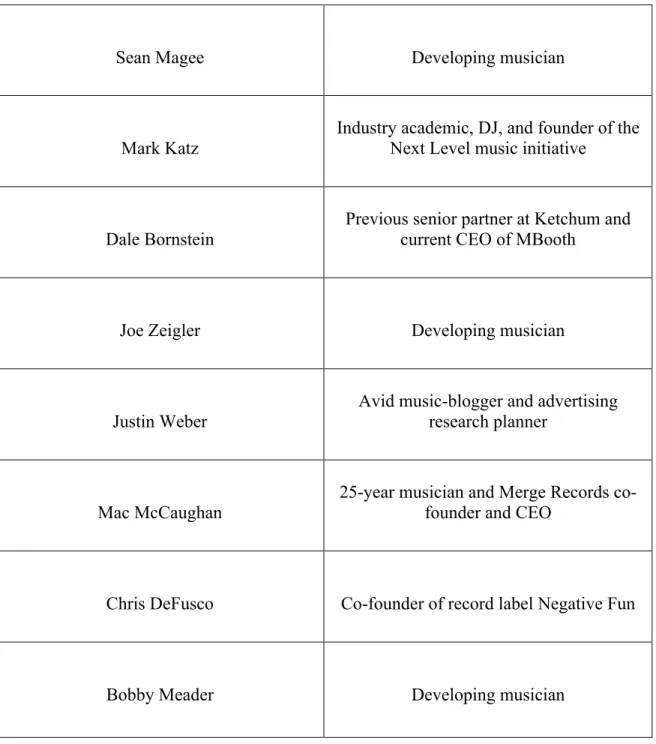
(2003) first triggered this digital shift. Furthermore, eight in-depth interviews were conducted with marketing professionals from different areas of the music industry. Interviews were conducted with Mac McCaughan, 25-year musician and Merge Records co-founder and CEO; avid music-blogger and advertising research planner, Justin Weber; Christopher DeFusco, co-founder of record label Negative Fun; industry academic, DJ, and co-founder of the Next Level music initiative, Mark Katz; developing musician Joe Zeigler; previous senior partner at Ketchum and current CEO of MBooth, Dale Bornstein; developing musician Sean Magee; and developing musician Bobby Meader. These interviewees each have high exposure to the promotional opportunities in today’s digital soundscape and, due to their diverse backgrounds, provide unique perspectives on current marketing strategy.
Furthermore, snowball sampling is useful for studies looking to recruit participants “who have certain attributes in common” (Lindlof & Taylor, 2011, p. 114). In this study, participants are all required to have experience in music marketing. Therefore, snowball sampling was used to further develop the number of interviews. While most music marketing sources are
acquaintances from personal experience in the field, snowball sampling will be useful in guaranteeing the accessibility of ample participants.
Procedures
to their responses as well as how their responses were used. Skype interviews were
recommended for viable participants seeking anonymity, as they do not have to provide personal details such as a phone number or full name.
Informal interviews were conducted via Skype or over the phone. Video calling provides researchers an opportunity to speak with otherwise inaccessible participants due to geographical or timing issues as well as negating traveling costs. In addition, participants have a heightened sense of anonymity in that they need only provide their Skype contact details and not personal details like their phone number (Deakin & Wakefield, 2013). Finally, perhaps the greatest benefit of Skype interviews is that they provide participants with the ability to choose a location that is most convenient for their schedules. For instance, if they are in full time employment, the interviewee could request the interview to take place in the evening from his or her home
computer. Likewise, if they are on the go, they could request to have it take place on their mobile device through the Skype app. In these ways, Skype offers interviewers greater flexibility in creating comfortable environments for participants. The important task for the researcher in this situation is “ensuring interviewees are in a location free from controllable distractions” (Deakin & Wakefield, 2013, p. 7). For example, if the interview is taking place at a participant’s home, the researcher should request that all other windows be closed to prevent controllable
distractions, like email, that could affect the data.
short-term and long-short-term career growth. Furthermore, questions addressed each revenue stream covered in the literature review (targeted digital advertising through streaming sites’ algorithms, product placement in movies, video games and commercials, brands advertising in songs, etc.).
For instance, participants newer to the industry were asked to explain what specific outcome or consumer behavior their music promotions aim to inspire. Interviews with
participants who have been in the industry for over seven years were more open-ended, focusing on the ways marketing strategies have adjusted to digital media (Lindlof & Taylor, 2011). For instance, one open-ended question was to identify the major changes in typical music marketing campaigns over the last three years. A second discussion question compared exposure and album sales in marketing value for both artists. Is one more important for undiscovered artists while the other is more important for popular artists? Finally, a third discussion question was focused on the current status of royalty contracts between record labels and music streaming sites. Do they see this model changing? Are artists, songwriters, and publishers compensated fairly? If not, does the interviewee have a better idea on how they can be? These questions provided context to research questions and informed the development of a broader understanding of marketing in the digital soundscape. Additionally, each interview was loosely transcribed into a digital document following its conclusion. With that said, there are inherent shortcomings of interviewing those employed in the field of study as well as conducting interviews over Skype.
Limitations
Deakin and Wakefield (2013) examined the drawbacks of conducting in-depth interviews over Skype. While video calling provides an opportunity to talk to otherwise inaccessible
beginning of an interview may make it feel more formal and negatively affect the researcher’s ability to build rapport. Secondly, technological drawbacks are “evident more often when video was being used” (p. 9). For example, time lags and drop-outs, or frozen screens resulting in dropped calls, can occur and also disrupt the building of rapport. To battle this technological drawback, multiple emails and exchanges should be made prior to each interview to help build a rapport between the researcher and participant (Deakin & Wakefield, 2013). In the case of continuous drop-outs, the text box below the Skype video will be used to conduct the interview in an instant chat-like fashion.
It is also important that the participant “has access to internet as well as technological expertise to use Skype” (Deakin & Wakefield, 2013, p. 6). Lastly, removing the in-person setting of traditional interviews heightens the possibility of absentees. By incorporating Skype
CHAPTER 3: RESULTS AND DISCUSSION
Fifteen years after the invasion of Napster, the music industry still finds itself trapped in turmoil. Many believe the industry is slowly dying, while scholars suggest that the cyclical industry is simply entering a new era dominated by technology. In this age, the previously empowered role of record labels is dwindled by innovative tech companies capitalizing on the digital soundscape as we see countless paradigm shifts from ownership to empowerment and from convenient consumption to understandings of industry ROI. Eight in-depth interviews help to understand these shifts from the perspectives of those deeply involved in today’s digital soundscape, shedding light on two research questions at the heart of this study and key to industry survival.
RQ1 considers contemporary (post-2007) paths to monetize music streams. Literature suggests that, after the introduction of streaming sites in 2007, there has been an unequal shift from monumental album sales to fractional royalty payments. In the need to make up for lost revenue, touring, licensing and brand integration have attempted to account for previous album sales figures. RQ2 considers how music marketing strategy has adjusted to today’s revenue streams.
While the current royalty payment models used by streaming sites do not come close to accounting for lost revenue in album sales, scholars advocate that the free global exposure offered by algorithm-driven streaming sites will lead to greater long-term revenue by expanding and developing artists’ fan bases. Furthermore, by engaging in meaningful interactions with fans on social media platforms, artists leverage the global exposure to convert hundreds or thousands of average listeners to evangelists willing to invest both short-term and long-term in the
with a motive of driving immediate sales on release day, to generalized branding initiatives, with a motive of expanding an artist’s exposure and evangelist fan base. Beyond social media, brand partnerships, more live performances and customized listening experiences have been named to help marketing professionals achieve new goals focused on generating evangelists out of artists’ two paying audiences: fans and brands.
This study argues that the transition from short-term revenue models and resulting album-specific marketing campaigns to lifetime monetization royalty models with long-term behavioral goals has rattled the distribution of control between artists, industry professionals and listeners. As album sales dwindled and digital consumption skyrocketed, artists and record labels lost a degree of control over the listening experience to the hands of tech companies and online music consumers. Finally, this study proposes that the consequences of artists’ loss of control, as well as their struggle to regain it, has necessitated innovation regarding the way music is marketed and monetized today.
Findings are thus divided into four major themes of music marketing and monetization: digital streaming, touring, licensing or brand integration, and social media. Each of these themes interest both monetization and marketing strategies, meaning both research questions are
addressed in each discussion section. Furthermore, the previously mentioned paradigm shifts involving long-term marketing strategy and distribution of control between listener and artist are two reoccurring conversations pertinent to the development of each theme (streaming, touring, licensing, and social media) and thus will be woven throughout the discussion chapter.
Music Streaming from the Artist to the Listener
on one portable platform – a process referred to by industry academic, DJ, and founder of the Next Level music initiative, Mark Katz, as the “dematerialization of music.” iTunes’ failure, however, to cannibalize piracy meant that music streaming was a more sustainable solution to illegal file sharing (Peoples, 2012; Pham, 2012). As opposed to Daniel Ek’s accurately predicted global success of streaming sites, the Spotify CEO initially acknowledged the importance for streaming sites’ payment models to be viable monetization path for labels and artists, but failed to follow through.
Joe Zeigler, acoustic rock musician and founder of the band Leftmore, compares
purchasing a song on iTunes to purchasing a 99-cent license for lifetime ownership of that song. Over time, industry professionals fantasized a new payment model that would yield much higher profit margins than iTunes’ 99-cent lifetime license, let alone the zero compensation artists’ received through illegal file sharing. By incorporating radio’s royalty payment model into everyday public music consumption, a song could instead be monetized over the course of its lifetime (Joe Zeigler). And so entered streaming sites.
Six years later, interviews are able to shed light on (1) why consumers are so attracted to streaming as their major form of music consumption and (2) the reality of compensation in a marketplace controlled by streaming. These two topics were heavily discussed in the interviews and many reoccurring themes emerged; some that support established literature, and some that do not. Since all interview participants were familiar with or personally consumed music via streaming sites, they were able to make claims both as consumers as well as industry
examination of specific qualities that professionals have integrated into the streaming experience that make it so appealing to listeners and drive consumer engagement.
Evidence of streaming for popular versus developing artists. Interview questions aimed to reveal participants’ opinions on both the benefits and drawbacks of digital streaming. Bobby Meader, Sean Magee, and Joe Zeigler, who all represent developing artists, highly value the free global exposure granted just by getting your music on a streaming sites. However, they also agree that the pay-per-play royalty agreements many streaming sites have adopted
unfortunately do not favor artists. Since streaming became so popular so quickly, the major platforms like Spotify and Pandora manage to have disproportional control over the market and can use their royalty agreements to take advantage of artists in need of the global exposure. Thus, the reoccurring acknowledgement of unfavorable payment models alongside the marginally greater benefit of growing their fan base through streaming sites surfaced as an overall “it is what it is” attitude throughout interviews.
The 23-year-old developing solo-artist, Sean Magee, expounds on this trade-off between music sales and free exposure. When asked if he values exposure more than direct sales, Magee responded as most developing artists would, “1,000 percent. Not even close. Exposure is way more important.” Therefore, the “it is what it is” perspective suggests that global exposure may in fact make up for the current loss in royalty fees, at least for developing artists. While
The literature and interviews mutually suggest that by fighting streaming sites, artists would only redirect users to even more unfavorable digital platforms like YouTube (Pham, 2012). If developing artists were to window a release or abstain their catalog from a streaming site, they would not only lose any royalty payments, but by sacrificing the free global exposure, it may well cost them their career. When comparing album sales this year to a few years ago, Weber claims, “These platforms are a necessity now.” Likewise, Zeigler admits, “I’ve thought many times of taking my music off of Spotify… it was a necessity to get music out and labels to see I was connected through platforms. It's a matter of exposure.”
Contributions to scholarly thought on digital exposure. Some literature suggests that artists, in general, tend to fight the royalty, or pay-per-play, model at the expense of the music streaming sites and the overall growth of the music industry (Peoples, 2012; Pham, 2012). Using examples of popular artists fighting streaming sites, research advocates that artists’ opposition to the fractional royalty models overpowers their appreciation of the free global exposure—the exact opposite of claims made by interview participants.
popular artists have likely already established a global fan base. Bornstein approaches Taylor Swift’s removal of her catalog from Spotify with the claim, “Taylor Swift doesn’t need the money from Spotify. People will go out and buy it [her album] anyway.” Bornstein goes on to suggest that perhaps Taylor Swift is exercising her power by popularity to regain lost control over how her audience listens to her new album. Likewise, Zeigler claims, “I respect Taylor’s decision but… she doesn't need to be paid for every play.” In the end, a tendency for scholars to represent all artists with pop stars is inaccurate since the majority of artists are still developing.
The shift from physical to digital consumption in the music industry is not debated. Nowadays, academic debate is over the cost of one digital music sale equating to less monetary value than one physical sale. In other words, as digital music sales continue to outcompete physical sales, the total value of music declines (Amedeo, 2009). Present research views declining rates of piracy as evidence that streaming sites cannibalized illegal file sharing, but views the overall declining value of music as evidence that streaming sites do not have adequate pay structures for artists and labels (Pham, 2012). Research also supports this study’s findings in suggesting that digital streaming has expanded the global music industry. Streaming sites like YouTube, SoundCloud, Spotify, Pandora and Rhapsody give artists the ability to let both fans and potential fans access their catalogs for free. As a result, artists and industry professionals have an opportunity to gain global exposure without ever boarding a plane (Amedeo, 2009; Bruno, 2009; Horowitz, 2013; Korentang, 2013; Peterson, 2009).
catalog, but they are also known for keeping their interface digestible. For instance, Spotify has an entire page that is updated every Tuesday with each week’s newest releases, listed by user-driven popularity. By organizing their extensive catalog into playlists based on popularity, genre, chronology and moods, Spotify has been able to drastically simplify a previously overwhelming process of discovering new music online.
The well-versed digital marketing professional, previous senior partner at Ketchum and current CEO of MBooth, Dale Bornstein sheds light on the key to engaging consumers with a new product. According to Bornstein, streaming sites saw such success because they completely captured the power of simplicity in an inherently complex platform:
People gravitate towards the easiest thing. [People can] listen to stuff that is similar to what they like but they don’t want to pick it. It’s on your phone and on your desktop. It’s not illegal, [and it has a] huge catalog.
Streaming sites can be synced between mobile, tablet and desktop so that the listener can access and update their entire music library wherever they are. Moreover, “people value
convenience over quality,” so even though the sound quality received by streaming via an electronic device is not as good as purchasing the sound file or, even better, purchasing a tangible record, the ability of streaming sites to surpass geographic and portable barriers defeats any drawbacks (Mark Katz). Today, people in rural towns have the same access to music as people in urban centers. Likewise, Chris DeFusco, owner of record label Negative Fun, admits to paying for a Spotify subscription and valuing its ability to “put new music at everyone’s
Contributions to scholarly thought on streaming convenience. Literature suggests that digital services now outcompete tangible album sales both in revenue and popularity and that streaming sites have already begun to boost income for labels (Amedeo, 2009; Bruno, 2009; Pham, 2012). Accordingly, streaming has become so popular because listeners no longer need to commit piracy in order to access music for free and they can store their paid and free music all in one digital library domain. Literature focuses on the same four aspects when looking at the way listeners interact with music streaming as were revealed through interviews: portability,
affordability, availability (extensive catalogs), and customization (algorithms). However,
literature also suggests the power of banner advertising that was never mentioned in interviews. Contributions to professional practice. Targeted advertising via algorithms produces customized listening experiences that are absolutely key in creating an appealing, simple, and convenient platform for users to consume and discover music. Pandora, YouTube and Spotify have all configured complex algorithms in their attempts to optimize their level of targeted messaging. (Korentang, 2013; Horowitz, 2013; Peterson, 2013). Moving forward, it is likely that personalization will be integrated deeper and deeper into the online listening experience.
Furthermore, using methods of behavioral targeting, successful music providers have
incorporated elements of personalization that allow the user’s preferences to drive the content they see. In this way, providers display a new understanding of motivating spending
(subscriptions, more plays) through a personalized user experience.
general public is aware of their minimalist royalty agreements. Even record label executives, who have watched their salaries dwindle alongside the rising popularity of streaming, admit to using and loving streaming sites like Spotify.
Summary. By balancing revolutionary aspects of a customized listening experience with new transportable capabilities, establishing extensive catalogs while maintaining a simple user interface, and offering it all for free, streaming sites have capitalized on Bornstein’s “the easiest thing.”Interviews suggest that streaming sites proved to be just as convenient as illegal file sharing, while also incorporating revolutionary aspects of convenience that had yet to be introduced to music consumers. Affordability, portability, simple digital interfaces, extensive catalogs, and customized listening experiences encompass the five main ways that streaming sites re-invented “the easiest thing.”
While the pay-per-play model allows the industry to grow at an exponential rate and provides long-term stability for artists, no one denies the need for other forms of monetization to provide the bulk of revenue for labels and artists since the current distribution of control
engrained in streaming sites, at least in terms of artist compensation, remains disproportionally in favor of the consumer. With that said, literature and interviews mutually support that while their fractional royalty models do not favor artist compensation, streaming sites are an undeniably better alternative for artists than illegal file sharing. In conclusion, the convenience of streaming sites has seemingly overshadowed its unfavorable payment models, allowing the music industry to continue to grow despite questionable sales figures.
which allow fans to choose how much they want to pay for an album, that fans are starting to cave to the dire need of purchasing music content. DeFusco reported that on an album he released on Bandcamp, 50 percent of fans paid more for the album than the asking price.
Regardless of when or whether or not streaming sites will ever adopt more fair payment models, the disparity between album sales and royalty fees has necessitated creativity and innovation in developing new revenue streams now. One such stream is not so much revolutionary as
revitalized. Industry professionals found that by leveraging streaming sites’ global exposure to expand a fan base, artists are able to create demand for larger tours. In so doing, ticketing and merchandise have resurfaced in the digital streaming era as the backbone of revenue for artists. Live Performances “Best Way To Market Your Music”
One such revenue stream has not been so much revolutionized as revitalized: touring. Industry professionals found that by leveraging digital platforms’ global exposure to expand a fan base, artists are able to create demand for larger tours. In so doing, ticketing and merchandise sales have resurfaced as the revenue backbone for artists. Thus, touring addresses both research questions. Ticket and merchandise sales collected through tours interests RQ1 while the ability to connect with concert attendees to grow evangelist fan bases provides an effective solution to RQ2. Thus, artists use live performances to drive both short-term and long-term revenue via merchandise sales and building loyal fan bases that will continue to invest in their careers.
streaming sites allow them to offer great exposure for developing artists, in particular. DeFusco further supports this claim, “Streaming is not too much of a loss because the more people who hear it the better… fans will pay it back during tours.” In other words, despite the incremental revenue supplied by current streaming pay-per-play agreements, the exposure produces more fans that are likely to invest their money on merchandise and tours throughout the artist’s career.
Touring is not a new revenue stream by any means. Live performances and merchandise have been the backbone of artist compensation since music and commerce first crossed paths. In fact, album sales only became an essential revenue stream in the 1970s. “Historically, the era of the album is more of an anomaly than the norm,” (Mark Katz). Music had been a moneymaking business since 1917 (Grey, 2012). So, in effect, the substantial monetary value of album releases was only a short phase within a much longer lifetime of music profiteering, with live
performance and merchandise as the recurrently dominant stream. Likewise, Weber paints the industry as cyclical, claiming “the full length album was just a phase…. Before that, it was lots of live concerts and radio play.” Weber continues to claim the industry is starting to shift back, referencing the returning importance of touring and royalty contracts.
Meader elaborates on the claim by DeFusco, Magee, and McCaughan that the best way to take advantage of today’s major revenue stream is quite simple: play as many live performances as possible.
Contributions to scholarly thought on touring. Interviews suggest that streaming payment models, while fractional, help build demand for tours, which have replaced album sales as the primary revenue stream for popular and developing artists. As mentioned in chapter one, Pham (2012) uses the Michael Acton example to also support the trade off between album sales and ticket sales, “‘I probably spend more money on music in total than I had before, going to shows and such’” (p. 2).In turn, interviews suggest smart artists now focus on using digital platforms to expand tours and capitalize on their revenue potential (Bobby Meader, Sean Magee). Established literature also supports these findings. Bruno (2009) claims the increased exposure via digital platforms helps grow artists’ fan bases and boost their revenue through offline purchases like concert tickets and merchandise sales.Likewise, Amedeo (2009) reiterates the marketing strategy behind live performances: building an audience that will create demand for a larger tour.
Contributions to professional practice. Live performances have always been
that has defeated all of time, technology, and digitization: create demand for larger tours. Meader’s experience shows this strategy remains relevant today: artists should grow tours by expanding their shows per city.
Summary. Regardless of the century and technology, artists and those associated with artists have depended on tours to market their music and grow their audience. Artists and label directors are in agreement that in today’s soundscape, touring is really what grows a fan base and generates loyal fans willing to spend money to support their favorite artists’ careers. Private commissions were key to growing early artists’ tours just as public sponsorships (brand
partnerships) often help fund and expand contemporary artists’ tours today (Horowitz, 2013). As social hierarchy softened and the aristocracy subsided, private patrons of musical commissions were replaced by the new powers controlling the flow of money: corporations.
Brand Partnerships Feed Fan Loyalty and Long-Term Compensation
brand spokesperson. In addressing RQ2, partnerships allow an artist to extend their visibility to a wider audience who, if done effectively, is at a heightened likelihood to become loyal fans.
Evidence of licensing. Through the fusion of advertising and music, artists gained the power to license rights to their song to a corporation at a fee, and advertisers gained the ability to transfer a track’s pre-established connotations directly to their product (Huron, 1989).
Developing artists suggest that, if done correctly, it truly is a win-win scenario. Apart from the ability to make money off licensing agreements, the integration offers valuable free exposure for developing artists. Representing the enthusiasm for brand licensing present among many
developing artists, Bobby Meader references Pro Skater as an example of how video games, specifically, help artists target a relevant audience.
The value is in the repetition. Take Tony Hawk's Pro Skater. The first one. That
soundtrack was legendary. Helped a lot of bands get popular because the kids would hum along to every song on every different level they played, then a big portion of them would look up the bands and buy the albums or go to the shows!
Likewise, Mark Katz claims that while this exposure does not necessarily correlate to
single/album sales, it is an undeniably valuable long-term investment. Meader goes on to touch on the importance of the brand image aligning with the artist’s goals: “If Levi’s wanted to use my song cause I have a beard and they wanted to use my face I would probably be stoked.” In agreement, Dale Bornstein brings in the importance of establishing authenticity: “if the brand finds the right integration vehicle it can be authentic… [as long as] its disclosed and there’s a fit, no problem.”