Carolina
Planning
A
Student-run
Publication of the University of
North
Carolina
Department
of
City
and
Regional Planning
Volume
14
Number
1Spring
1988
Forum
Planning
from
the
Bottom
Up
ElizabethMorton
Heidi Walter Powell
Articles
Reflections
on
Donor
Coordination:
An
Attempt
toEstablish
a
Microcomputer-based Development
Project
Directory
inSudan
Dale Whittington Craig
Calhoun
Development
on
the
Urban
Fringe:Recent
Chinese Experience
Simon
Powell 15No
Voice,No
Choice:
Community
Group
Involvement
inLondon's
Metropolitan
StrategicPlanning
Process
Judith Allen 23
Population—
A
Key
Component
of
Planning Education
for
Developing
Countries
Linda Lacey 30
Commentary
Meeting
the
Needs
of
Developing
Countries:
Introducing a
New
Program
of
Study
Staff
Editor's
Note
Editor
Lynn
FavourEditor Heidi Walter Powell
Associate Editor Paul
Kron
Associate Editor Elizabeth
Morton
Computer-generated coverdesign
by
theComputer
Cartography
Laboratory,Depart-ment
of Geography, University ofNorth
Carolina atChapel
Hill.Graphics
by
Paul Kron.Photography
contributionsfrom
Judith Allen, LindaLacey,Simon
Powell, Research Triangle Foundation,Marie
Walterand
Dale Whittington.Inourshrinkingworld,itisimportantforU.S. planningprofessionalstounderstandthedifficultiestheir counterparts face inother countries.European planning issuesmayresemblethosein theU.S., but the variety ofpolitical,socialandeconomic systemstheremaketheapproaches verydifferentfrom one another
and fromours.ThirdWorldplanningissuesincludepopulationcontrolandprovidingfoodandshelter,
whichmayseemfarremovedfromissuesweconsidertobeplanning-related.Buttheproblemsof
over-crowding,hungerandhomelessnessaffect ourpersonal andprofessionallives.
ThisissueofCarolinaPlanningexaminestheprofessioninavarietyof internationalcontextsandfrom
a variety of perspectives.Theproblems plannersfaceinother parts of theworld,andtheapproachesthey
havetaken, provideinsights into thewaywepracticeplanning intheUnitedStates.
TheinterviewwithVienneseProfessorWalter StohrandthefirstfeaturearticlebyDale Whittington
andCraigCalhounare applications-oriented, involving fieldwork.Stohrdiscussesthe collectionand anal-ysisofEuropeanlocaldevelopmentinitiatives—analternativeapproachtoeconomic development, which utilizes localresourcestobuild strongeconomies.Dale WhittingtonandCraigCalhounsharetheir
experi-encetryingtoestablishamicrocomputer-based developmentprojectdirectory fordonorcoordinationin Sudan.
Thenexttwoarticlesevaluateplanningproblems,albeitinverydifferent contexts.SimonPowellexamines
therelatedproblemsofplanningforindustrialdevelopmentontheurbanfringeofNanjing,China,and ofensuring agriculturalself-sufficiency.JudithAllendescribes theGreaterLondonCouncil's(GLC) chal-lengetoBritain's"conventionalwisdom,"whichseesplanning onlyas atoolforcontrollingdevelopment. Allen thenanalyzes the positive impact of theGLC'sapproachonLondon'sdisempowered groups.
Linda Laceytakes a prescriptiveapproachbyproposingnewwaysof teachingpopulationstudiesto plan-ners. SheillustratesinCommentarytheapplication ofsuchan approach throughthenewcurriculumat theDepartmentofCityand RegionalPlanning.
CarolinaPlanningstaffextends aspecialthankstotheNorthCarolinachapter of the
APA
whoseefforts have helpedincrease thejournal'ssubscribers. StaffalsothankscontributorstotheJohnParker TrustFund,advertisersand regular subscribers fortheircontinuedsupport.
HeidiWalter Powell
Editor
CarolinaPlanningwelcomescomments andsuggestionsonthearticlespublishedandwill be
happytoacceptnewmaterial for future editionsfrominterestedpersons.Suchmaterialshould be submittedtothe Editor typewrittenanddoublespaced.
CarolinaPlanningispublished biannuallybystudentsintheDepartmentofCityandRegional
Planning, University ofNorthCarolinaatChapelHill, withthe assistance offundsfromthe
John A. ParkerTrustFund,Department ofCityandRegional Planning.
Thisissue(Volume14,No.1)succeedsVolume13,No.1.Subsequentissues willberenumbered 1 intheSpring; 2 inthefall.
^
SubscriptionstoCarolinaPlanningare available atan annualrateof$8.00,or$15.00fortwoyears.
Spring1988,Vol. 14, No. 1
Forum
Planning
from
the
Bottom
Up
An
Interview
with
Professor
Walter Stohr
Elizabeth
Morton
Heidi Walter Powell
WalterStohrisa professorofregionalplanning,
and
Directorofthe InterdisciplinaryInstituteforUrban and
RegionalStudies, University of
Economics
(Wirtschaftuniversitat), Vienna, Austria.He
iscurrentlyundertakinga compilationand
analysisoflocaleconomic development
initiativesinseveralregionsofEurope,and
hasrecentlycompletedastudyon
the impacts of industrial parks in the United Statesand
abroad.CP:
Please describe the"EuropeanPerspectives Project" thatyou
areworking
on
for United Nations University.STOHR:
UN
Universityislocated inTokyo, but itdoes researchworldwide.The
studywhich
was
contracted tome
willdocument
experiencesfrom
Europe.The
goal is toseehow
localor regionalcommunities havesuccessfullyrestructured internally,
and
primarily out of theirown
initiativeand
resources, tocope withthechanginginter-national division oflabor.
A
team
of twelve case-study authorsisexamining
what
experiences havebeenmade
in several
major
regions ofEurope
as a result of thisrestructuring.
We
areconductingresearchinrural areas,which
is themost
common
area type in the analysis,and
oldindustrial areas,where
declining industrieshaveto be restructured
—
these are thetwo major problem
areas.We
alsolookatsmall-and
intermediate-sizedcitiesand
atsome
restructuring cases of large metropolitan areaswhich
have very specificproblems
and
different potentials.CP:
Could
you
givesome
examples ofthe types ofde-velopment
activitiesyou
have found?STOHR:
We're looking at the actors within individual communitieswho
haveinitiated thischangeprocess.We're considering the type of actorand
how
he orshehasrelated tolocal institutional,politicalorsocialstructures in bring-ing about such a change.The
precondition has always beenan
actor, butactorsvaryfrom
clergytoan entrepre-neurwho
became
more
thanjusta private entrepreneur, butasocialentrepreneur—
hetried tostimulateactivitiesin addition to his
own
enterprise.Very
often the actorwould
bealocal authority. Forthemost
part, successfullocal authorities
were
in countries withdynamic
localgovernments
which had
recently introduced increasingautonomy
forpoliticaland economic development
atthelocal level.
CP:
You'vestressedtheimportance ofinternal develop-ment,and
have describedtwo
types of external inputswhich
tend to increase dependency: centralgovernment
and
large multiregional or multinational enterprises. Is oneof these the"lesseroftwo
evils"?Do
depressed regions havemore
room
forinnovationand
flexibilityunder
one
set of external conditions?STOHR: One
cannot generalizeby
saying thatone
isbetteror
worse
than theother. In the centrally planned countries,two
ofwhich
areincludedin thisstudy (Hun-garyand
Poland), the centralgovernment
isalways themajor
initiatorofdevelopment
atthelocallevel, butthegovernment
has brought about adependency
of localcommunities
which
has to a great extent stifled their ability to act out of theirown
initiative. This also very oftenhappens
with multinational companies. Multina-tionalcompanies
—
thetypicalcaseisacompany
town
—
willbecome
such adominating
factor in a localcom-munity
thatno
otherinitiativescanemerge
successfully.m
7United ) CT^ Kingdom'-n? Norway I I
. ^^\) Sweden /
f^ \ Poland
/*^H
\»_ y-KHungary Finland
2?V
J iBasque
f J Region 1 C Spain
J *
o°
tf
1 ltaly\
V^
\SS>> o
r-O
E=twillbetolerated
and which
canmobilizehuman
and
other resourcesfor localdevelopmentsuccessfully.The
same
can be applied to largecompany
towns. There areways
inwhich
alocalcommunity
cantry tobenefitfrom
the multi-nationalcompany
withoutbecoming
completely depen-denton
itby
using it as a catalyst for introducingnew
technologieswhich
localfirmscantakeadvantageof.So
thequestionhereveryoftenis:How
canwe
promote
theinvolvement of local firms in servicing or initially
con-tractingorsubcontractingwith
MNCs,
ratherthanleaving thesecompanies
to get all theirinputsfrom
outside the region.CP:
How
isthe"community
interest"usuallyrepresentedinnegotiations as areas try toattract
new
high-techand
industrialdevelopment?Specifically,do
you
feelthecom-munity
as awhole
has been servedby
the presence of Research Triangle Park?STOHR:
Most
often, local or regional authorities willnegotiatewithexternal firms
—
thatisthenormal
pattern.The
negotiatormay
also be a separatecompany
setup
for development. In Research Triangle Park, Triangle J Councilof
Governments
substitutesforor representslocalgovernment
innegotiations.My
impressionofResearch TriangleParkisthatitwas
abletoattractlarge enterprises,both public
and
private. This is important for creating anew
image
and
for starting high-technology activities inNorth
Carolina, sincethe state has traditionallyhad
a different
image
and
differentdominant
sectors.The
questionis:
How
broad
hasthiseffectbecome
and
how
broad
willitbecome?
ResearchTrianglePark seemstobecomprised of a large
number
of enterprises that close themselvesofffrom
theoutside; theytrynottointerrelatewith other enterprises, while benefitting
from
localre-sources like university knowledge.
Once
they get thisknowledge, however, they
want
tomonopolizeit, refusing to sharewith neighboringenterprises. This isone
ofthe dangersof attractinglargecorporations. Itmight bepos-sible to establish a
number
of facilities within Research Triange Park to establishwhich
would
beable to house small-and medium-sized
enterprises, sort-ofon an
incu-batorbasis, toestablish relationsand
offer services to thelarge enterprises.
The
small-and
medium-sizedenterpriseswould
therebybecome
beneficiaries ofsome
of thein-novations that the large enterprises are developing in
Research Triangle Park.
The
incubator could be within thepark,adjacentto, or outside the park.Thiswould
pro-vide a type of spillover or multiplierwhich
would
cer-tainly
broaden
theimpactofsucha researchtechnology park.CP:
Have
localdevelopment
endeavors been successful inutilizinglocallyavailable resources, ratherthan attempt-ing to create or attract high-tech industries?STOHR:
Many
of the case studiesthatwe
have analyzedin the
European
contextshow
that thepanaceaofintro-ducing high-technologyindustriesisoftennotconsidered
by
localcommunities
asthemost
importantaspect.The
most
important aspect is to transform existing sectors,retraining theirtraditional strengths, but adapting
them
tomodern
requirementsand
toexistingworld marketcon-ditions. Localities
must
transformand
modernizeexistingenterprises
and
findnew
forms of cooperationamong
Spring1988, Vol. 14, No. 1
existingenterprises
which
would
permitthem
tobecome
competitivewithout beingclosed
down
and
replacedby
high-technology firms.There
are anumber
of successstorieseveninsectorsconsideredasdecliningin industri-alized countries.
The
Italiantextileindustry,forexample, hashad
amarvelous
successstory. Afterinitialclosures,the Italians
modernized
smalland
decentralized plantswhich
today arecompletely competitive becausethey'vechanged
theirtechnologyand
they'vechanged
their prod-uct mix.They
arenow
making
verygood money.
They'vebecome
profitabledespite strongcompetitionfrom
East Asianfirmsin textilesand
similarsectors. They've been abletocarveoutfunctionswhich
thelow-wage
countries cannot fulfill.CP:
What
do
you
think ofindustrialrecruitment asan
economic development
strategyand
how
prevalentisit?STOHR:
Industrial recruitment has been thedominant
strategy of localcommunitiesthat try tooutbidother com-munitiesto attractoutsidefirms.Usuallytheonlycriteriawhich communities
specifiedwere
that firms be large,powerful
and
willing tocreate a largenumber
ofjobsinthearea.
The
types of jobs thatwould
be created,and
the types of entrepreneurial functions that
would
be transferred to the areawere
usually overlooked.These
have turned outtobe keyelements. Ifa firmoffers only routinejobswithout providingany
key entrepreneurialfunctions,it
may
havea negativeeffecton
thecommunity.The
firmmay
draw
laborfrom
othersectors—
agriculture orservices—
becauseitmay
pay
slightlyhigher wages. Butitdoes notcreate
any
developmentalpotential. Itisvery important forlocalcommunities
tomake
arrangements with suchenterprisestolocatekeyentrepreneurial func-tions like researchand development
or marketing or headquarter functions.These
are certainly the essentialfunctionsthat, ifattracted tothearea, bring
much
greater benefits because they are creating quality jobsand
the determination ofcompany
policyismuch
more
accessible tolocal employees.Ifafirmperforms onlyroutinefunc-tions,thelocal
community
merelyimplements
what
was
decidedsomewhere
else.One
therefore,by
definitionbe-comes
more
dependenton
outside decisionmakers. It is importantforlocalcommunitiestobecome
awareof these keyissuesso thattheycanadvocatefortheir interests innegotiationswithoutsidefirms.Indefiningtheirinterests,
communities
should notlook onlyatthenumber
of jobs ormagnitude
ofcapitalinvested, butatthe types of jobsand
types of investment that will bemade.
Such
qualitative issues have very often
been
overlooked.CP:
What
aresome
advantagesand
disadvantages of using qualitativedevelopment
indicators?STOHR:
Qualitative measures are not substitutes for quantitativemeasures.They
shouldbe usedtogether,and
one
can quantifymany
of the qualitative criteria.One
would
try toquantifyqualitativecriteriainordertomake
a
more
objective evaluation. In the past, however,re-searchershave excludedqualitative characteristicsbecause theycould not be evaluated withsufficiently rigid
quan-titativetests.Ifacharacteristicisimportant, itissensibletoforgo the"rigid criterion"
and
includesomethingwhich
may
be methodologically lessdemanding
butwhich
would
stillservean importantfunctioninevaluatingsuch a project.CP:
How
mightone
measure
qualitative characteristicsover time? If
one were
interested inexamining
changesinculture, forexample,
how
would
onetestorprove suchan
hypothesis?STOHR:
Culture might be a "soft" area in this respect;however, even within the
economics
fieldyou
have anumber
of qualitativecriteriawhich
have notbeen takeninto considerationin the past. For example,
an
areaex-periencing a decline ofindependentfirms
and an
increas-ing
number
ofbranchplantsneedstobeconsidered.Such
factors indicate that theautonomy
of theregionalecon-omy
isgraduallybeingdebilitated. Similarly, ifone
looksatthe qualificationstrataof theworkforce,
one
sees that there are large increases inemployment,
but they allhappen
inonlyone
stratum—
maybe
theleast qualified orthemost
qualified only,which happens
very ofteninhigh-technologyzonessuchasSilicon Valley.
Once
alerted to thisphenomenon,
one
would
askthe question:"What
happens
ifthelabormarket
beginsdemanding
theinter-mediate qualifications?"
One
would
then try todevelopactivities
which
would
giveemployment
to a lessbifur-catedlabor
market
thanthatwhich
often resultsfrom
a high-technologyindustry.Another
qualitative character-isticishow
much
researchand development
money
firmsin the region are spending. If
one
calculates the rate oftotal
R&D
expenditurescompared
to total expenditures of theseenterprises,one
gets a qualitativecharacteristicmeasured
in quantitative terms.CP:
Have
you found
a greaterdegreeof similarityamong
types of areas you'vedefined, suchas "rural"or"old in-dustrial," or within individual countries?
What
sorts ofsimilarities
and
differenceshaveyou found
among
localdevelopment
initiatives?STOHR:
There aremore
similar characteristicsamong
areas of similar type. Rurallocal
development
initiatives will probably resembleone
anothermore
closely than theywill initiatives in old industrial areas in theirown
areas
between European
countrieswill bemore
similar with those of other areas.There
are certain nationally determinedrestrictionsand
advantages.Nationalpolicy,for instance, or national constitutional conditions, will restrict or
promote
possibilities existing in all types ofareas.
A
highlycentralized politicaland
administrative structure will probably have a negative impacton
thedevelopment
ofall types oflocal initiatives. In adecen-tralized federalcountry
on
theotherhand, allareaswould
benefit
from
theincreasedautonomy
oflocaland
regionalauthorities, irrespective of area type.
CP:
Might
you
not have otherproblems under
such a decentralizedsystem; forexample, theemergenceofcom-pany towns which
you
spoke of earlier?STOHR:
Ithinkcompany
towns
would
cutacrosscoun-tries.
Company
townswould
normallyemerge
insparselysettled areas with
no
othereconomic
activities besides agricultureand
maybe some
localsupportservices.Thesewould
generallybe rural, peripheral areas.Sweden,
forinstance, hassuch
communities
initsnorthernmostterri-tories
where
ironmining
dominates theeconomy.
No
othereconomic
activity ofany magnitude
exists there.CP:
What
common
development
problems
do
suchpe-ripheralareasface?
Have you found any
particularly inno-vative localdevelopment
initiatives in peripheral areas?STOHR:
Ifone
definesperipheralareas asthosewithout easy access tomajor
population centers oreconomic
activities, this
means
that they are marginal to existing markets,and
in thisrespectarehandicapped.On
theother hand, withregardtolocalinitiatives,ithas been observed thatthis distanceprovidesthem
withgreatermaneuver-ability.
That
is, thecentralgovernment
tendstoexertless control. InScandinavia, thisperipheral locationhasbeen considered an advantage becauseithas givenlocal com-munitiesmore
ofan
"actionradius"todevelopinititativeson
theirown. There
are, therefore, advantagesand
dis-advantages.
The
artistousetheadvantagestospecialize inproductswhich
do
not need extensive transportnet-works.Forinstance,particularly inhigh-technologyfields,
airhas
become
themost
importantmedium
fortranspor-tation.
One
cantryto developa strategywhich
satisfiesboth requirements.
Scandinaviapresents
an
interestingexample
ofan
at-tempttobringcomputer-basedhomework
intoperipheral areaswhere one
canlinkup
computersfairly easily.This enables residents to remain in dispersed settlementpat-terns inperipheral locations.
Another example
ofan
innovative initiative isfrom
Scotland
—
theconcept of acommunity
cooperative.These are cooperativeswhich
aregeared notonlytoone
sectorInitiatives inScandinavia's peripheral areasenableresidents toremain indispersed settlements.
—
they aremultisectoral.They
try toincludenotonly pro-duction, but service activitiesand
social services.They
are therefore multifunctional
and
multisectoral. InHungary,therural localcooperatives are establishedon
aterritorialbasis.They
canemploy
all types of activ-ities,notonlyagricultural,butmanufacturingand
service activities. In thisrespect, theyare similar toamultisec-toral complex, but theyhave a territorial
bond
and
are thereforeinterested indevelopingthatterritorialunitwith whatever sector activityseems
feasibleand
promising. Thisisquite differentfrom
theaverage cooperative,which
is usually onlyan
agricultural, manufacturing ormar-keting cooperative.
These
traditional cooperatives are linked primarily to international markets; theirmajor
allegiances are with such markets rather than with the
local
community
orterritorial unit.A
similarexample
isthe
Basque
Mondragon
cooperative. Here, a territorial identity is also the basis for thecooperativefederation, awhole
system of cooperatives.The
goal is to developbroad
packagesofactivitieswithinthecommunity
rather thantospecialize in fieldswhich
areonlyworld
market-oriented buthavefew
local linkagesand narrow
multi-pliers.CP:
What
are the current attitudes internationally,re-garding the
promotion
of these kinds ofdevelopment
activities?STOHR:
Inmany
European
countries,and
also in the United States, it hasbeen
considered properto separate governmentalactivitiesfrom
private enterpriseactivities—
and
forunderstandablereasons.However, thesue-Spring1988, Vol. 14, No. 1
cessful inthesemiconductorindustrybecausethe govern-ment,in thiscase theMinistryof InternationalTrade
and
Industry, isintegratedwithprivate industry.Togetherthey developed acommon
strategy ofsectoral development, particularly in thecomputer
industry,which
has given Japanese industrytremendous advantagesoverU.S. indus-try.An
imitation of theJapanesemodel
currentlyunder
negotiationinthe U.S. isSematech,
which
isthefirstjointventure
between
the U.S.government
and
private enter-prise.In this project, thefederalgovernment
would
team
up
with about adozen
computer
firms to create a jointcomputer development
center.CP:
What
canand
shouldbetheroleofnational govern-mentsinstimulating thetype ofinternaldevelopmentyou
advocate?STOHR:
Ina departurefrom
past practices,governmentswould
nottry tocreatejobsdirectly in ruralorold indus-trialareas, or onlyattract capital totheseareas throughcapital incentives. This policy has proven to be very short-sightedbecauseit
assumes
thatcapitaland
jobs arehomogenous
factors—
neitheris. Itismuch
more
impor-tant for centralgovernment
toimprove
access to com-munications to rural or old industrial areas aboutnew
technologies,bothregardingworld marketconditions
and
potential niches of
unmet
demand
which
might be local-ly filled,and
also about organizationalmanagement
practices.The
government
should bemore
involved in facilitatinginformationaccessthantryingtointerveneby
givingcapitalor
employment
incentives inanunqualified way.Another
important stepwould
be topromote
the formationofinnovativestructures. In Japan, thecentralgovernment
haspromoted
the establishment of localprivate-public-university partnerships, tripartite
partner-ships, asthe basis oflocalinnovation
and
development. If suchlocal partnerships are provided, thegovernment
is willing to co-financean
applied research center, forinstance, for local industry, particularly forlocal
small-and medium-sized
enterprises.CP:
What
approach
can areas lacking the resources todevelopatripartitepartnership taketostimulate
develop-ment?
STOHR:
The
Basque
cooperative,Mondragon,
hasbeen verysuccessfulinlinkingup
withforeign universities inthe U.S.
and
inFrance,from which
itdraws
basicresearch data.The
cooperative then transformsthe technologiesinitscenter forapplied technological innovation, for use within
members'
own
regional contexts. Distancefrom
a university can often be bridged quite successfullyby
transferringinformationwhich, ifwell-organized, canbe
sufficientforabriefperiod. Inthelong-run, suchanarea
would
certainlyneedtodevelopitsown
local university orresearchand
training functionsunderauniversity-like label. But if this is not possible initially, there aresubstitutes, as the case studies have
shown.
CP:
What
are theprospects forhigh-techdevelopment?
Do
you
seeany
new
innovations or trendseither inthe technology itself, or the spatial patterns thatemerge
as a result?STOHR:
Microelectronicsdevelopment
isextremely im-portant,buttherearenew
developments suchas biotech-nologiesand
new
materialswhich
arealsovery important.The
Japanese have identified five areas of innovationwhich
they promote.One
is microelectronics; a second iscomputers; a thirdisnew
materials, suchasceramics; a fourthisbiotechnology;and
finallytelecommunications. Microelectronics isakey innovative element, bothtech-nologically
and
spatially.Itpermitstheefficientoperation of smallmachines
and
small firms,which
are flexibleenough
toproducefordifferentiateddemand.
Small-and
medium-sizedenterprisescan then be verycompetitiveina decentralized pattern.
Such
"flexible automation" is spatially important becauseitcanbeestablished outside of the largeagglomerations,where
small-and
medium-sized firms dominate.
Microcomputer-based
Development
Project
Directory
in
Sudan
Dale
Whittington
Craig
Calhoun
The
World
Bank and
USAID
have
encouragedthecoordination of ThirdWorld donor
organizations as aworthwhileand
feasibleendeavor.However,
the authors' experience inSudan
illustratesthat, despite theavailabilityofmicrocom-puters
and
the tacit agreement of thedonor
organizations themselves,donor
coordination is noteasily obtained.In the
summer
of 1987, thegovernment
ofSudan
ex-pelled several private voluntary aid organizations
from
thecountry
and
prohibitedthem from
futureoperationsin Sudan.
The
international press reported thisevent as another inexplicableexample
of erratic behaviorby
an Africangovernment. Infact,theseand
other aid organiza-tionshad
been operating inSudan
as if therewere
no
sovereign
government
inthecountry. Representatives of these donorswere
flying inand
out ofKhartoum,
the country's capital, without the slightest pretense of co-ordinatingtheir activitieswiththeSudanese government
orother aid organizations.The
recentaction of thegov-ernment
ofSudan was an
understandable attempt toobtain at ieast
some
minimal
knowledge
ofand
control overdonor
activities.Ironically, the
World Bank
recently citedSudan
as a countrywhich
hasmade
significantprogressinimprovingdonor
coordination (IBRD, 1984, p. 42).Our
own
work
inSudan
suggests, however, that theproblem
ofdonor
coordinationisindeedseriousand
islikely toprovemuch
more
intractablethan iscommonly
realized. Inthesum-mer
of 1984,we
initiated a project inSudan funded by
theUnitedStates
Agency
for InternationalDevelopment
(USAID)
towork
withtheSudanese
MinistryofFinanceand Economic
Planning(MOFEP).
The
purpose of the projectwas
to establish microcomputer-based decision supportand
management
information systems.One
ofseveral
components
of our effortwas
to create acom-puterizeddatabaseofallongoing,planned
and
completeddevelopment
projects inSudan which would
assist theMOFEP,
and
thedonors withtheplanningand
manage-ment
ofdevelopment
assistance.The
Ministryand
USAID
conceivedof thisproject as apreliminarystep topromote
donor
coordination;itwas
toprovideafast, easy
way
for adonor
to find outwhat
otherdonorshad done
orwere
doingina particular sec-tor or region. This article describes the failure of the donorstoprovidetheinformationrequired forthisproj-ect data base to function effectively.
We
offer severalexplanationsof thedonors'failure tocooperate with the
MOFEP
and
discuss the implications ofthis experience for future attempts atdonor
coordination.Background
There has for
some
timebeen
agrowing
awarenessamong
both bilateraland
multilateral donors that lack ofdonor
coordination isamajor
problem. It is at leastpartlyresponsible for thefailureofAfrican
economies
to effectively utilize theirdevelopment
assistance. In itsreport
Toward
SustainedDevelopment
inSub-Saharan
Africa, the
World
Bank
paints acomprehensive, sobering picture of theregion'seconomic
problems,and
outlines a series of policy measures necessary for itseconomic
rehabilitation.Two
of the report's central recommenda-tionspertaintotheneedforimproved
nationaleconomic
management and donor
aid coordination.The
reportcalls formore
strategicand
flexiblepublic sectorplanningby
national governments. In addition, it calls for explicit
commitments from both
donorsand
recipientgovern-ments
toimplement
their responsibilitiesunder an agreedeconomic
recoveryprogram. Specifically, theWorld Bank
callsfor (1) strengthening
management
informationsys-temsinplanning
and
finance ministriesinorderto facil-itate timely policy analysisand
strategic planning,and
(2) providing high-quality technical assistance to those
Spring1988, Vol. 14, No. 1
AFRICA
The
World
Bank
reportpaysparticular attentiontothe need forimproved
donor
coordination.Aidadministrationisaparticularlyimportantareafor institutional reform. Basicinformation on aid flows
isoften lacking; responsibility fordonorcontactand
negotiationisunclear;linksseldomexistbetweenthe plan, the budget, sector ministries, project entities, and donoractivities. . ..The weaknessesof
uncoordi-natedaid are increasinglyrecognizedbyAfrican gov-ernments and donors.
More
consultative groups,UNDP-sponsoredroundtables,andotherarrangements have beensetuptocoordinateaid. .. .However,
con-sultative groups have generally suffered from two majorweaknesses. First, the commitments
made
by both governmentsanddonorson programcontentand financialsupport have notbeenfirmenough. Second,thegroupshavefailed togetmoreinvolvedin detail
—
priorities and assistance for particular sectors,pro-grams,andprojects,orspecificchangesinpricingand
other incentive policies (IBRD, 1984, pp. 39-43).
Such
increasedinvolvementby donors
inthe details of aidadministrationisdependentupon
improved
accesstoinformation
on
bothgovernment and donor
development activities.Our
projectwas an
attempt towork
towardimprovements
in these areas in Sudan.The World
Bank'scallforimproved
donor
coordina-tionand
public sector planning certainly preceded the publication ofthisreport,and
Sudan
was one
of thefirst countriesin Sub-SaharanAfrica toinitiateseriouseffortsalongtheselines.
At
thesixthConsultativeGroup
Meeting forSudan
heldinParisinJanuary1983, severaldonors, including theUnited Statesand
theEuropean Economic
Community
(EEC),calledfortheformationofsubgroups ofdonorsand government
representatives, organizedby
sector,which
would
meet
inKhartoum
and monitor
the implementationofSudan'seconomic
recoveryprogram.The
idea forthese sectorsubgroups developedfrom
theWorld
Bank'scountry implementation reviewprocess,inwhich
Bank
and government
representativesmeet
toreview progress
on
Bank
investment programs.At
the January 1983ConsulativeGroup
meeting, thechiefWorld
Bank
representativeand chariman
of the ConsultativeGroup
reaffirmed the Bank'ssupportfor such monitor-ingactivitiesand welcomed
the inclusion of otherdonorsin such discussions.
The
discussions held during this ConsultativeGroup
meetingledtotheestablishment oftheJointMonitoring
Committee (JMC)
in1983.The
JMC
was
chairedby
the Minister ofFinanceand Economic
Planningand
included the resident representatives of theWorld
Bank,Interna-tional
Monetary Fund and
concerneddonors. Itsprimary
purposewas
toprovide alocalforum
formore
detailed discussions ofhow
donor
assistancecouldbe better co-ordinated with Sudan'seconomic
policiesand
investment program. Itwas
originallyenvisionedthattheJMC
would
meet
quarterly inKhartoum,
and
theJMC
Secretariat,consisting ofstaff
from
theplanningwing
of theMOFEP,
would
prepare progress reportsand
analyses for the quarterlymeetingsand
fortheannualConsultativeGroup
meeting.
The
JMC
met
three timesin 1983and by
theseventh ConsultativeGroup
Meeting
inDecember
1983, itwas
clear tothe
donors
thatadditional technicalstaffneeded
to be assignedto theJMC
Secretariatif thework
of theJMC
was
to be productive. Gettingdonors
and
govern-ment
representatives togetherwas
beneficial, but theyneeded
informationand
analysison
theproblems
they weretodiscuss. Still,members
of the seventh ConsultativeGroup
Meeting wereenthusiasticaboutthe potential con-tribution of theJMC. The
chairman's report notes thatthere
was
a consensus that theJMC
was
performing a usefulfunctionand
that donors should supportit inthecoming
year.The
representative of the Netherlandssaid that theJMC
was
agood
start towarddonor
coordina-tion in
Sudan and
thatitmight haveapplicability inother Africancountries.The
EEC
representativesupportedthework
of theJMC
and hoped
that the coordinationthathad
been startedwould
be intensifiedand
extended.Finally, the
Sudanese
Minister of Financeand Economic
Planningatthe timepromiseda strengthening of theJMC
and
notedthatthelocaldonor
representativeswould
need timelyinformationon
commitments and
disbursementsfrom
theircentral offices in order to support its work.severalmatterstoexamine, the
most
importantofwhich
was
aiddisbursement.The
Minister ofMOFEP
suggested thatacomprehensive reviewofdonor
disbursement pro-ceduresneeded
to be conducted in order to understand the reasons for theslowdown
in disbursement ofcom-modity
aid.The
representativesof theArab
Fund and
the AfricanDevelopment
Bank
expressed theview
that theissue of undisbursed project assistance should be
ex-amined
toseeifways
couldbefound
toincrease theflow ofpreviouslycommitted money,
and
alsorecommended
thatthistaskbegiventotheJointMonitoringCommittee. Thus, inDecember
1983, therewas
ostensibly strong supportforimproved
donor
coordinationinSudan
and
for the
work
of theJMC,
when
quiteindependentlywe
proposed
to theUSAID
Khartoum
mission director that amicrocomputer
data base ofdevelopment
projects inSudan
beestablished.Our
initialideawas
tocreateadata base using commercially available software (dBase III); eachrecordinthedata basewould
contain variouskinds ofinformationon
aspecificdevelopment
project. Users couldeasily search the projectdatabases for projects of acertaintype(e.g.,allagriculturaland
irrigationprojectsin a particular region, or all energyprojects
funded
by
WesternEuropean donors
which
are behind schedule).As
originally envisioned, this computerized project directorywas
to servetwo
primaryobjectives.First, a cen-tralized, easily accessibleprojectdata basewould
provide an overview of donor-financeddevelopment
activities,and promote
the dissemination ofinformationon
proj-ects
among
donors.The
MOFEP
staff could prepare reports in response to specific requestsfrom donors
orgovernment
agencies for projectinformation.Although
conceptually simple, theimportance of this objective of information storageand
dissemination should not be underestimated.The
institutionalmemory
ofdonor
or-ganizationsincountriessuchas
Sudan
isquiteshortdue
to brief staffassignments, so there isan urgent needfor basicdataon
projectactivities. Paperrecords arepoorly maintained,and
projectreports arenotwidelycirculated.The
secondobjective,and
ultimately themore
impor-tant one,was
to begin to establish a project data basewhich
would
supportanimproved
planningand
budget-ingsystem withintheMOFEP.
An
up-to-date, centralized project data base is essential for (1) the preparation of thedevelopment
budget, (2) sectoral planning, (3) the estimation of recurrent costs,and
(4)projectmonitoringand
evaluation.One
major
goalwas
toprovidethe Min-istrywith an earlywarning
systemfor implementationand
financialproblems
on development
projects.The
needfor a centralized setofdataon development
projects
was
widely recognized within theMOFEP
and
the
donor community.
The
April, 1984World
Bank
report, Sudan: Planning
and
BudgetingforRecovery,by
R. Ridker, called for the establishment of a centralized projectdirectory,
and
actuallyproposed
two
projectdataforms
for useinsystem designand
data collection.The
MOFEP
itselfhad
made
several attemptstocollectproj-ectdata,
and
variousforms
were
availableinthe Minis-try. For example,when
we
began
our project in thesummer
of 1984,we
were
shown
a collection of hand-writtenindex cardswhich
containedlimitedprojectinfor-mation. Inaddition, the
UNDP
AdvisorstotheMOFEP
had
draftedforms
tobe used to collect informationon
project activities.
This discussiondemonstratesthat, althoughthe
com-puterization of a project directory
may
have beensome-what
originalinKhartoum,
theneedfora centralfileof informationon development
projectswas
widely recog-nized, bothby
theMOFEP
and
thedonor community.
In our opinion, however, the actualphysical processing
and
management
oftherecords forapproximately250 on-going,donor-financeddevelopmentprojectsand
750loansand
grants proved amajor impediment
toboth
simple dataanalysisand improved
planningand
budgeting pro-cedures.A
computer
data basewas
themost
practicalway
to efficientlymanage
thismuch
information ina timely manner. Inthesummer
of 1984,we
arrivedinKhartoum
to attempt to create such a data base.Data
Collection EffortsThe
development
ofthesoftwareforthe projectdirec-tory
was
quite straightforward.By
farthemost
difficultpart of establishing the project directory
was
thecollec-tion ofthedata toputinto thesystem. There
were
three primaryplaceswhere
projectdata couldbelocated:donor
offices, theMinistry ofFinance
and Economic
PlanningSpring1988, Vol. 14, No. 1 11
itselfandtheimplementingagencies. Thissectiondescribes
the efforts to collect data
from
thedonor community.
At
the July1984meetingof theJointMonitoringCom-mittee, the Undersecretary of Planning formally
an-nounced
thatUSAID
had
agreed tofund our project to establish a microcomputer-baseddevelopment
project data base.He
requested the donors' assistance in thiswork, reminding
them
ofdiscussionsalong theselines atthe
December
1983 ConsultativeGroup
Meeting.InAu-gust1984, togetherwithstaff
from
the Secretariat of theJMC,
we
personally visited the representatives of themajor
bilateraland
internationaldonorsinKhartoum
toexplain thenatureof the
proposed
projectdirectoryand
to elicit theirhelp in completingtwo
dataforms
which
had
been designed to collect informationon
donor-financeddevelopment
projects.We
paid personal visitsto the
Khartoum
representatives of thefollowing donors:UNDP,
World
Bank,EEC,
France, UnitedKingdom,
Fed-eral Republic of
Germany,
Italy, Japan, Netherlands, Switzerlandand
USAID.
These visitswere
followedup
by
a formal written request to twenty-twodonors
from
theUndersecretaryofPlanningin
August
1984,inwhich
he requested their assistance in completing thesetwo
forms. Inadditiontotheeleven
donors
noted above, thisletter
was
sent to theEmbassy
ofDenmark,
AfricanDevelopment
Bank,OPEC
Fund
forInternational Devel-opment,Kuwait
Fund
forArab
Economic Development,
Islamic
Development
Bank,Abu
Dhabi
Fund
forEco-nomic and
SocialDevelopment,Abu
Dhabi Government,
SaudiFund
forDevelopment,
Arab
Fund
forEconomic
and
SocialDevelopment,UNCDF
and
InternationalFund
for Agricultural
Development.
Tothe bestofour knowledge, theUndersecretary never received a replytohisletter
from
theWorld
Bank,UNDP,
EEC,
Federal Republic ofGermany,
Italy, Netherlands, Switzerland,Kuwait
Fund
forEconomic
Development,or theArab Fund
forEconomic and
SocialDevelopment.
Contrary to theexpectations of theWestern donors,by
far themost
complete, thoroughand prompt
responses werereceivedfrom
theArab
donors.Most
of themajor
Western donors never even botheredtoanswer
theUnder-secretary's letter; even
among
the respondents, severalreplied in a superficial
and
incomplete manner.In
November
1984and
in January 1985,we
againvisited the
Khartoum
officesofmany
of these donorstorequest theircooperationin this effort.
The
Undersecre-tary ofPlanning also sent afollow-up letter in January 1985, noting the importance of thiswork
for theJMC.
By
thesummer
of 1985, theUndersecretaryhad
received onlytwo
replies to hissecondrequest for projectprofilesfromthedonors: aletterfromtheFederalRepublic of
Ger-many
informingtheundersecretarythatthey didnothavetimetofillouttheforms,
and two
projectdataformsfrom
the Swiss Embassy.
What we
find extraordinary about this experience isthat themajorityof the
donors
didnotevenfeelobligedto
answer
theUndersecretary'sletters,aseemingly simplecourtesy.Perhapsthe experiencewiththe
World
Bank
bestillustratesthelack of
donor
cooperationinthiseffort.As
noted, thiseffortwas
directlyresponsivetoWorld Bank
policy objectives in
Sub-Saharan
Africa.The World
Bank's
own
mission toSudan
inMarch
1984 called for theestablishmentofacomputerized data baseinSudan.World
Bank
staffinbothKhartoum and
Washington were contacted personallyon
severaloccasionstomake
specificsuggestions for changes in the project directory.
These
were
incorporated into the system design.World Bank
staffcontinuallypromised
tocooperatewiththeMOFEP
and
USAID
to support this effort. Yet theWorld Bank
did not complete the data
forms
nor did itanswer
the lettersfrom
the Undersecretary.Reasons for the Donors' Failure to
Cooperate
In their recent book,
Does
Aid
Work?
(1986), RobertCassen
and
his associates note threemain
reasons for donors' reluctancetoundertakemeaningfulaid coordina-tion efforts:a. Coordination is likely to impair the
freedom
withwhich donors
can pursuetheir politicaland
commer-cial interests through their aid programs.b.
Donors
know
thatthere arebothideologicaland
tech-nicalsubjectson which
they arelikely todisagree,and
aid coordination
would
create conflicts.c.
Aid
coordination canbecostlyinadministrative timeand money.
Although
theseexplanationscertainlyhavemerit, basedon
ourexperienceinSudan
theproblem
ofdonor
coor-dination seems likely to bemore
invidious than these reasons suggest.We
found
both relatedand
additional explanations for the failure of the donors to cooperate withtheMOFEP
and
USAID
toestablishacentral deposi-toryofinformationon
projects.We
havecategorizedthem
into threegroups:(1)reasonsinternaltothedonor
bureau-cracy, (2) donors' impressions of the external planning environment,
and
(3) donors' impressions of themicro-computer
technology itself.Each
of these explanationswas
informally profferedto usby donor
representatives themselves in follow-up interviewswe
conducted in thesummer
of 1985.First, even if donors' intentions are good, there is a varietyoforganizational pressures
which
mitigate againstto
promote
aid coordination.There
arefew
bureaucratic incentives to individuals withindonor
bureaucracies towork
with other donors.As
theWorld Bank
hasnoted,donor
coordination is administrativelydemanding and
timeconsuming
and
itisrarelyrewardedintermsof pro-fessional evaluation orpromotion
(1984, p.43). Bothex-ecutives
and
juniorstaff areevaluatedby
central officeswhich
havelittleawareness ofeffortsby
their field staff towork
withotherdonors.Infact,central officepersonnel evaluation procedures often fostercompetitionbetween
donors.
An
enterprisingprogram
officerwho
letsothersknow
some
ofhis"best"projectideasmay
well findthem
fundedby
other donors.On
the otherhand,many
donorsmake
most
of theirmajor
programming
decisionsat thecentral headquartersso that individualsinthefield typi-callyfeelthereislittletheycan
do
topromote
donor
coor-dination, eveniftheywanted
to.Finally, thedonors'fieldofficesare typicallyunderstaffedrelative tocentral
head-quarters,
and
the individualsfrom
whom
we
requested assistancewere
often extremely busy.The
second set of explanations concerns the donors' perceptions of theirexternalplanningenvironment. Given the pressureson
their time,donor
representativeswere
forcedto
make
ajudgment
astothelikelihood of success ofoureffort toestablishacomputerizedprojectdatabase,and
the effectiveness of such a system if itwere
estab-lished.
Too
often, the subjective probability assigned toboth of these events
was
low.The
likelihood thatwe
would
succeedincreating thesysteminthefirstplacewas
perceived to below, in part becauseeach
donor
felt the otherdonorswould
notcooperate.Therefore, individual donorssaw
little reason to participate in the datacol-lection effort themselves.
The
Western bilateral donors,in particular, felt that the
Arab donors
would
notcoop-erate. Thisisaclassic "freerider"
problem which
we
had
hoped
to addressby
reaching a collective agreement inthe
JMC
to supportthis effort. In the end, however, theJMC
failed to meet regularly. Moreover, little informal pressure could,be exertedon donors
who
did notpar-ticipate.
The
donorsalsohad
littleregard for theefficacyof the planningwing
oftheMinistry.To
many
donor
represen-tatives, the planning
wing
was
so ineffective as to beirrelevant to theirobjectives. Theirprimaryinterest inthe Planning Ministry
had
become
finding theeasiest, fastestmeans
of getting theirprojectsapproved
and
theirfunds disbursed.An
effectiveplanningoperationintheMOFEP
would
inevitablyentaillessdiscretionon
thepart of the donors inprogramming
their aid and, in the short runat least, this
was
perceivedtobe anobstacle totheiraidprogram
rather than a necessary step in institutionaldevelopment. It
was
thus not clear to donors that theThe capital cityof Sudan, Khartoum.
MOFEP
wanted
theeffort tosucceed.As
one
representa-tive of a private voluntary organization put it, I don't reallythink youwillbeableto establishthis microcomputerdatabase,butwhathappensifyoudo? I see more problems for
me
than advantages.Why
should I want to give the Planning Ministry thein-formation to meddlein ouraffairs?
Another
relatedreasonforthedonors'failure tocoop-erate
which
pertained totheir impressionof the external planningenvironmentwas
that the projectwas
perceivedto be too closely tied to
USAID.
For the planningwing
ofthe
MOFEP
tohaveacentralizeddata baseofdevelop-ment
projectswas bad
enough;forUSAID
tobetheonlydonor
with suchcentralizedinformationwas
even worse.At
the July1984JMC
meeting, thisprojectwas announced
to thedonors.Both
USAID
and
MOFEP
representatives assured the other donors that the data in the project directorywould
beavailabletoall.However,
thedonors' skepticism is understandable inan environment
where
dataisscarceand
istypicallytreatedas proprietary.Therewas
a fear that the planningwing
ofMOFEP,
and
in-directlyUSAID, would
havemuch
greater access to the projectdatabase. Forat leastone
donor
representative, therewas
alsoan underlying apprehension aboutcreating the institutional capabilityinwhat
was
then a military dictatorshiptocreateand
manage
centralizeddatabases.(This concern
was
not entirely unwarranted. Within a matterofjust afewweeks
afterthe creation of thenew
Management
InformationSystemUnitintheMOFEP,
one of theUSAID-supplied
computerswas
commandeered
by
the security police
whose
stated objectivewas
to setup
a data base of automobile license plates in
Khartoum).
A
third setofreasons for thedonors' lack of coopera-tion relates to theirimpressionsof the technologyitself.Spring1988, Vol.14, No. 1 13
they
were
not. Forthisreason, theywere
unable toreal-isticallyevaluate the
magnitude
of thesoftwaredevelop-ment which
we
proposedand
the likelihoodthatitwould
succeed.
Many
had had
frustratingexperienceswith main-frame computers ofsome
sortand
tendedto extrapolatetheirhorrorstories to microcomputers.
We
encountered awide
rangeof skepticalcomments
about computersin general.At
least five individuals independently offered us that sage advice, "garbagein; garbage out," implyingthatthe
whole
effortwas
futile.The
message
was
really thatcomputerswerean
inappropriatetechnologyinsuch a data-poor environment; that thiswas
simply anotherexample
of a capital-intensive technology beingpushed
by
donors without regard to the needsand
capabilitiesof thelocaleconomy.
We
disagreewiththislineofreason-ing, but it certainly deserves serious examination (see
Calhoun,
Drummond
and
Whittington, 1987).Incontrastto
hardware
issues, severaldonor
represen-tativesfelt thatthesoftwaredevelopmentapplications
we
proposed
were
far too sophisticated. Inreality, thesoft-ware development
was
theeasiest,most
tractableand
least timeconsuming
part ofourassignment.Maintainingsoft-ware
and
training people in itsuse,on
the other hand, is an important issue.Implications for Future
Donor
Coordination EffortsTo
date, thecampaign
fordonor
coordinationhasbeen carried out at a fairly superficial level. It isone
more
exercise inwhat
Robertson (1985)hastermedthe"ritual ofplanned development."Many
of thedonorsthatrheto-ricallycallforcoordinationsimply
do
notwant
it.More-over,
many
Westerndonors
adopta patronizing attitude towardsthewhole
process.Theirattitudeisalso asource ofmisunderstandingabouttheirown
and
others' perfor-mance.At
thecenter of thispatronizingattitudeisabelief in theirown
bureaucraticefficiencyand
intheinefficiencyof the host country's bureaucracy.
Although
donors suchas theWorld Bank
supportthe idea ofimproved donor
coordination, theirrepresenta-tives
do
notreallyknow
what
this entails intermsofdatamanagement
and
analysis.Most
donor
coordinationefforts have not proceeded
beyond
the level of general discussions becausedonors
place datamanagement
de-mands upon
theministriesoffinanceand
planningwhich
eventhedonors themselvesdo
notknow how
toaddress.Few donor
representativeshave thought seriouslyabouthow
theywould
manage
theflowofpaperwork
associated withhundreds
of millions of dollars of aidfrom
thirtydonor
agencies—
allwithdifferentaccountingprocedures, currenciesand
priorities—
withthe limitedbudgetavail-able to a minister of finance or planning in an
aid-dependent
economy
such as Sudan's.Ironically, donors'
demands
for informationon
therecipientgovernment's
development
projectsand
policiesmay
begreatestprecisely in thosecaseswhere
thegovern-ment
isleastabletorespondand where
thedevelopment
plans are least likely to be effective.Such
demands
can contribute to the destruction of host country planninginstitutions(Morss, 1984).Thissuggeststousthatthefield
staff of
donor
agencies concerned with aid administra-tion need to spend less time giving advice to ministries of financeand
planning about datamanagement
and
planningproblems which
they themselves have neverfaced,
and
more
time actuallyworking
withthesebureau-cracies to
improve
theirmanagement
informationand
decisionsupportsystems. Inourexperience,
many
ofthe staffoftheMOFEP
want
todo
abetterjobmanaging and
coordinating
donor
assistance,butitisacomplicatedtask withwhich
they need help—
particularly in the area ofmicrocomputer
applications.Donors
tendtoberatethem, butofferlittle intheway
ofideasorconcreteassistance.Moreover, donors
do
notadequatelyappreciate thenature of the datamanagement demands
they themselves are placingon
thedevelopment
planning enterprise.Calls for
improved
donor
coordinationarelikely tofailunlessunderlyingorganizational
and
attitudinal issuesare addressedmore
directlyand
seriously. Part of theprob-lem
issimply thatall donorswant
tocoordinate, butno
one wants
to be coordinated. Basedon
our experiencesin Sudan,
we
believe futureimprovements
in thearea ofdonor
coordinationdepend
in large partupon more
explicit policy directivesfrom
topmanagement
in bothmultilateral
and
bilateraldonor
agencies.Almost
without exception, thedonor
representatives inKhartoum
withwhom
we
dealt treateddonor
coordinationasa peripheral concern.Typically, theirprimaryresponsibilitywas
tosee thatthebudgettargetsfortheiraidallocationswerespent,notthat they
were
effectively coordinatedwithnationalgovernment
prioritiesand
thework
of other donors.Top managers
indonor
agenciesmust change
thein-centive structure
which
theirstafffaces, inorderthattime spenton
coordinationwithotherdonorsisrecognizedand
rewarded in personnel evaluationsand
advancement. Until then, real progressindonor
coordination will be slow.We
suggestthatmanagement
experiment withways
ofobtaining written evaluations ofstaffjobperformance
from
nationalgovernment
counterpartsinthe ministries withwhich
theydeal.Management
must
also realize thatdonor
coordination efforts are timeconsuming
and
re-quire a long-termcommitment
to the institutionalde-velopment
of both thedonor agency and
the national government. If serious attention isgiven to the issue ofREFERENCES
Calhoun,
C; Drummond,
W.;andD. Whittington."Computer-izedInformation
Management
inaSystem-Poor Environment: Design and Implementation of a Computer System for theSudanese PlanningMinistry."ThirdWorldPlanningReview,Vol. 9, No. 4, 1987. pp. 347-365.
Cassen, R.andassociates.DoesAidWork?Oxford: Clarendon Press, 1986.
IBRD. TowardSustainedDevelopmentinSub-SaharanAfrica:
A
JointProgramof Action. Washington,DC:
IBRD, September1984.
Morss, E.R."InstitutionalDestruction ResultingfromDonor and
Project ProliferationinSub-SaharanAfrican Countries."World Development, 12(4). (1984). pp. 465-70.
Pinckey, T.C.;J.M. Cohon; andD.K. Leonard."Kenya'sUseof
MicrocomputerstoImproveBudgetingandFinancial Manage-mentinan OperatingMinistry:
An
UpdatedReport." Develop-mentDiscussion PaperNo. 169. Cambridge,MASS:
Harvard Institute for International Development, 1984.Robertson, A.F. People and the State:
An
Anthropology ofPlanned Development. Cambridge: CambridgeUniversityPress,
1984.
Whittington, D.; C.Calhoun;andW.
Drummond.
DraftFinalReport to
USA1D
KhartoumMission on theManagement
In-formation SystemProjectwith theMinistryofFinanceandEco-nomic Planning, Government of Sudan. Washington,
DC:
USAID, Contract No. 650-0071-C-00-4031, June1986.DaleWhittington teachesinthenewconcentration.Planningin
Develop-ing Areas, inthe Department ofCityand Regional Planning at the University ofNorthCarolinaatChapelHill.Hismajorfieldsof research arepublicinvestment theoryandwaterresourceeconomicsin
develop-ing countries.
CraigCalhounteachesintheDepartmentofSociologyattheUniversity ofNorth CarolinaatChapelHill. Hisfieldsofresearchincludesocial theory andthesocialimplications ofcomputertechnologies.
HAMMKR
•SlLKR
GkORGE
•ASSOGIAI
KS
EconomicandDevkm>pmknt Consultants
1111 Bonifant Street•SilverSpring•Maryland•20910• 301/565-5200
Atlanta•Denver•SilverSpring•Wellington
ProfessionalServices
Civil, Environmental. Structural. Mechanical&ElectricalEngineering/
ComprehensivePlanning, Economic
&Community Development/
Commercial. Institutional& EducationalArchitecture
120N.BoylanAvenue Raleigh.NC
27603 919-828-0531
301W. 14th Street SuiteB Greenville,NC
27834 919-757-1096
^Wooten
Company
Engineering Planning
Spring 1988, Vol. 14, No. 1 15
Development
on
the
Urban
Fringe:
Recent
Chinese
Experience
Simon
G.
Powell
The
challengeof developingon
theurban
fringe takeson
new
dimensionsin the changingeconomic
climateof China. This article explores the difficulties planners face in trying to balance China's desire for increased industrialgrowth
on the fringe with the politicalgoal of Chinese cities to maintain a self-sufficient agricultural base.Introduction
In recent years, Western
media
reportshaveemphasized thedramatic reformswhich
havebeen sweeping contem-porary China, transforminga rigid, bureaucraticsocialistsystemintoaburgeoningmarket
economy
True,important advanceshave beenmade
inChina
since1978when Deng
Xiaopingconsolidatedhispower-base. Butas
many
foreignfirms, luredto
China by
theprospect ofone
billion con-sumers have discoveredto their cost,China
is farfrom
being amarket
economy.
The
realityofeconomic
reform inChina
is a picture ofuneven and
patchydevelopment.The
officialplanning system—
despitesome
relaxations—
stillcontrols the pro-ductionand
supplyof themost
importantgoodsand
com-modities,
and
inmany
ways
remains asunwieldy
now
asit
was
undertheMaoists. Itisin thiscontext—asysteminastateofupheaval
—
thatcurrentdevelopments
on
theurban
fringemust
be placed.Nanjing: the setting
One common
location ofrelativeprosperityinthecur-rent phaseof
development
ison
theurban
fringe.The
extent
and
depth ofdevelopment
will varyfrom
city tocity, butbeltsof significant ruralwealth aretobe
found
on
the outskirts ofmost
Chinese cities.Throughout
historyNanjing hasbeen
one
ofChina'smost
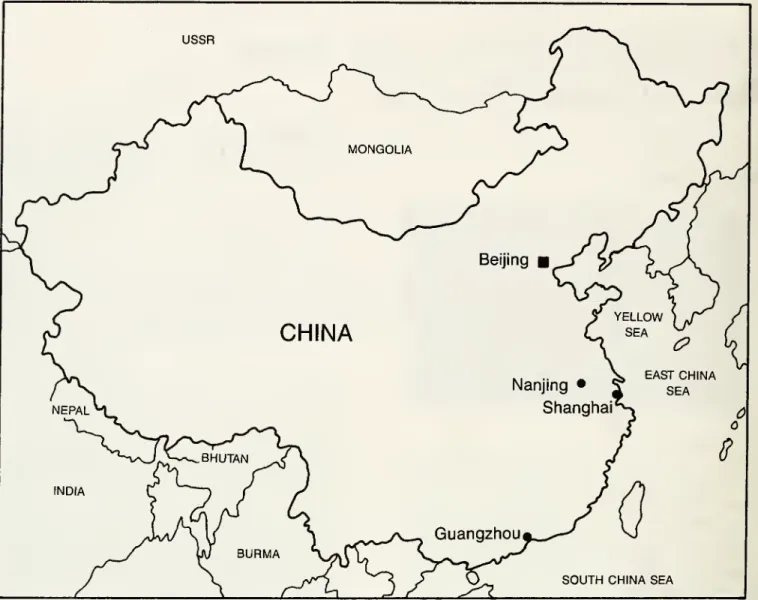
important cities. First settled in 472 B.C., Nanjing hasatvarious timesbeen
China'scapital. Situatedon
a plain in southwestern Jiangsu province, eastern China, Nanjingissurroundedby
aterrainoflow
hillsand
rivers,most
notably the Yangzi.The
urbancoreissurroundedby
suburbancitydistricts ofmixed
landuse—
Dachang, Qixia,Yuhuataiand
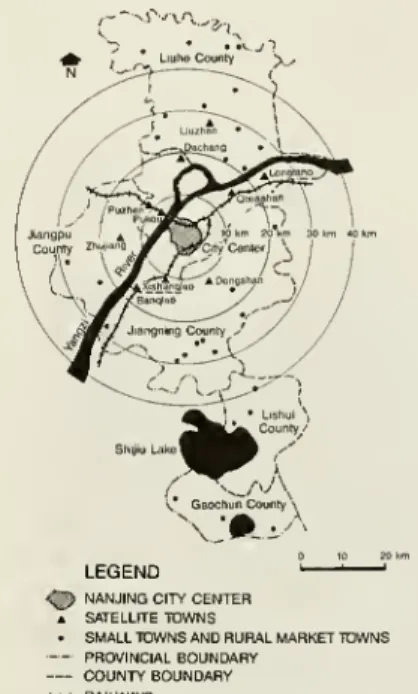
Pukou.Beyond
thesuburbandistrictsarethefivedty-administeredrural counties
—
Jiangpu, Jiangning, Liuhe, Lishuiand
Gaochun
—
with 198,000hectares(ha) of cultivableland(seeFigure1).
The
peripheryalso contains a diversity of mineralwealthincluding deposits ofiron,gypsum,
lead,zinc
and
manganese
aswell aslimestoneand
sandstone. Agricultureand
ruralindustry arebothwelldeveloped.Figure
1.Nanjing
MunicipalityLEGEND
INANJINGCITYCENTER
SATELLITETOWNS
SMALLTOWNS ANDRURALMARKETTOWNS PROVINCIALBOUNDARY
COUNTY BOUNDARY RAILWAYS