1
Black-White Disparities in Angiographic Coronary Artery Disease and Associations with Hypertension
By
Matthew Triplette
A Master’s Paper submitted to the faculty of the University of North Carolina at Chapel Hill
in partial fulfillment of the requirements for the degree of Master of Public Health in
the Public Health Leadership Program.
Chapel Hill
2010
Signature
Date
Advisor/First Reader
Signature
Date
2
Health disparities, including substantial differences in health status and quality of health
care across racial, ethnic, socioeconomic and sexual orientation groups, remain a significant
concern in the United States. An examination of health disparities and their causes is essential so
that strategies to close these gaps can be developed.
Coronary artery disease (CAD) is the leading cause of death for all racial groups in the
U.S.;1 but blacks are disproportionately affected compared to whites. Studies demonstrate that blacks are more likely to die from CAD—and die at a younger age—than whites. This increased
mortality rate likely represents a complex interaction of different health as well as
healthcare-seeking behaviors and different risk factor profiles for blacks and whites. Lower socioeconomic
status and differential medical treatment based on race may also contribute.1-4
In sharp contrast to these concerning findings, several studies have demonstrated that
black patients are less likely to have significant angiographically-detected CAD than whites.
This is an interesting and important finding, given that angiography is the “gold-standard”
diagnostic test of the presence and severity of CAD and is used to make definitive
patient-specific treatment decisions. There are no studies to date that have adequately assessed causes
for this paradoxical finding.
The goal of this master’s paper was to examine this topic through two distinct
approaches. First, through a literature review, I attempted to systematically find and examine
studies which have addressed racial differences in angiographic findings to determine the current
quality and magnitude of the evidence that supports the conclusion that blacks have a lower rate
of CAD than whites. Through my review, I found that several studies have examined this topic,
and although the quality of most is moderate, the majority have found a substantially lower
3
Second, through original research using a clinical database at UNC Hospitals, my
colleagues and I attempted to examine a potential explanation for black-white differences in
angiographic CAD. Hypertension is more prevalent, and its cardiac effects more deleterious, in
blacks compared to whites. Hypertensive heart disease may mimic the signs and symptoms of
CAD despite a lack of significant coronary plaque and therefore lead to angiography for
suspicion of CAD. We found that hypertension is associated with black-white differences in
angiography. Black patients are far less likely to have disease than whites in the subset of
patients with hypertension; however, black and white rates of disease are nearly identical in the
subset of patients without hypertension.
This research represents a summary of the literature on racial disparities in angiographic
findings in addition to an initial exploration of the reasons behind these findings. This paper
provides evidence that there is a significant difference in rates of angiographic CAD between
white and black patients and that hypertension may account for this difference. The most
important implications of this paper are for future research; a determination of which aspects of
hypertension are leading to negative angiographic evaluations and how this information can
contribute to clinical decision-making could help decrease the rate of invasive negative studies
and improve the usefulness of angiography in black patients, both of which could provide
4
Do blacks have a lower burden of angiographic coronary artery disease than whites?: A review of the literature
ABSTRACT:
Introduction. Black Americans have a higher mortality rate from coronary artery disease (CAD) than whites, which may reflect a greater risk factor burden, increased barriers to care,
lower socioeconomic status and differences in treatment. However, several studies have shown
that despite a higher mortality rate and clinical burden of disease, black patients referred for
angiography are less likely to have detected coronary stenoses than whites. This review is an
attempt to summarize the evidence from the literature that examines black-white differences in
angiographic disease.
Methods. A systematic search strategy was used to identify articles which address the topic of interest. Eligible articles were reviewed for quality using a pre-specified and validated method
of quality assessment. Important study characteristics and study findings were also examined for
included articles.
Results. Eight articles met all eligibility criteria and were included in this review. The majority (6) of the articles were given moderate quality ratings for internal validity, while the applicability
of the studies to the key question of the review varied. Six of the articles reported a significantly
lower rate of angiographic CAD in blacks compared to whites, one reported mixed findings and
a single study found no differences between the race groups.
Conclusions. There is fair evidence that black patients referred for angiography are less likely than whites to have significant CAD. This finding has important implications for future research
to examine explanations for this finding as well as the clinical and prognostic value of
5 INTRODUCTION
Coronary artery disease (CAD) is the leading cause of death in the United States;1 however, mortality rates continue to decline in an era of improved diagnostic techniques and
treatments for heart disease and its risk factors. Despite this optimistic trend, gains for whites
over the past half-century have been disproportionately greater than gains for blacks and
significant racial disparities in CAD outcomes have worsened.2, 5 Black Americans have a significantly higher mortality rate from CAD than their white counterparts in addition to an
appreciably younger average age of ischemic heart disease death.1-4
The mortality differences between these racial groups have been attributed to a number of
factors. Compared to whites, black Americans have a higher burden of risk factors for CAD
including hypertension, diabetes and obesity.2, 6, 7 Moreover, blacks are more likely to face socioeconomic barriers to heathcare access and display less healthcare-seeking behavior.2-4, 7 Studies also reveal that black patients may be less likely to receive appropriate care for CAD,
particularly invasive treatment,2, 8-11 and this may also contribute to poorer outcomes in this group.
Despite this multitude of factors contributing to racial disparities in CAD outcomes and
death, several authors have reported a perplexing finding: Blacks undergoing angiography for
clinical suspicion of CAD are less likely to have stenosis in the coronary arteries and therefore
have an overall lower burden of angiographic disease.5, 12-16 This finding adds another layer of complexity to racial disparities in CAD. Eliminating racial disparities in CAD outcomes will
certainly involve improving risk factor identification and control, increasing access to care, and
addressing differences in healthcare quality in blacks, but it may also be necessary to explore
6
Before testing hypotheses that might explain this paradoxical finding, it is essential to
review and summarize the evidence on racial disparities in angiographic CAD. The aim of this
literature review is to examine original studies from the past two decades to assess the quality of
the evidence and summarize the magnitude and significance of any results for studies that
address black-white differences in angiographic findings for patients suspected of having CAD.
METHODS
Identification of Relevant Articles
The Medline/Pubmed database was searched to find and examine studies on
angiographically-proven CAD for black and white patients. The following combinations of key-word searches were used: “coronary artery disease” and “African Americans,” “coronary artery
disease” and “race” and “difference,” “coronary angiography” and “African Americans,”
“coronary angiography” and “race,” “coronary angiography” and “black,” coronary
angiography” and “ethnicity,” and “coronary artery disease” and “race” and “paradox.”
In order to target the most relevant and accessible studies for this review, eligibility was
restricted to English-language publications after 1990 with observational design, and papers
presenting original quantitative data. Studies also had to include a patient population undergoing
clinically indicated coronary angiography, examine race as the exposure of interest, use
angiographically-detected coronary plaque as the means of comparison and compare the
outcomes between adequate samples of black and white patients.
Study Selection
The titles of all studies retrieved for each search were initially reviewed. If the title
indicated that the paper may meet eligibility criteria, the abstract was reviewed. For these
7
examined. All papers that met inclusion criteria after review of the full-text were included in this
literature review. The bibliographies of the included papers were also examined for titles which
may indicate eligible studies (then abstracts and full texts were reviewed for inclusion in a
similar process as that outlined above).
Data Collection Methods
For the studies that met inclusion criteria for this review, the main findings and important
features (study design, description of study population, selection criteria defining study
population, measurement methods) were abstracted and tabulated. Each study was also assessed
for overall quality.
Quality of each study was evaluated using a modified form of the McMaster University
Quality Assessment Tool for Quantitative Studies.17, 18 Six major areas were assessed and graded according to the strength of the study: study design, selection, confounding, measurement,
withdrawals and analysis. Under each component heading, studies were given scores
corresponding to strong (score of 1), moderate (score of 2) or weak (score of 3).
The quality of the study design was based on the authors’ description of important design
elements, the relative strength of the general design used compared to other methods (for
example, a case series is considered a relatively weak design while randomized controlled trials
are often considered the strongest design) and the thoroughness and appropriateness of the
design to answer the study question(s). Selection (one component of selection bias) was
evaluated based on the completeness of the description of selection procedures and objective and
equal selection of participants between groups. Confounding was assessed by both the potential
8
Measurement was evaluated by the completeness of the description of study procedures and a
determination of whether measurements were equal between groups (including blinding of
assessors if appropriate), valid and reliable. Withdrawal and drop-out (the other component of
selection bias) was evaluated by the thoroughness of the description and explanations for
drop-out and withdrawal as well as the overall rate of attrition and differential attrition between
groups. The data analysis was assessed by its appropriateness to the study question and its
adherence to important principles (such as the reporting of confidence intervals,
intention-to-treat, etc.). These six elements were used to create a global assessment of the internal validity of
the study. Studies received a rating of 1 (strong) if they had four areas with strong ratings and no
weak ratings, 2 (moderate) if they had less than four strong areas and one weak rating and 3
(weak) if they had two or more weak rated areas.
The external validity of the study was assigned a similar rating. The external validity was
assessed by determining the applicability of each study to the defined study population of this
literature review: black and white patients in the U.S. undergoing angiography for clinical
suspicion of CAD.
RESULTS
Study Selection
Using the pre-defined search strategy, 585 articles were originally retrieved in the
Medline/Pubmed database. Of these articles, 43 original studies had titles which suggested they
may meet inclusion criteria for this study. Of these selections, 11 of the abstracts suggested the
article merited a full review for inclusion in the study. Seven of these articles met all inclusion
9
one article met all inclusion criteria), which resulted in eight articles included for full review of
evidence and quality. 5, 12-16, 19-21 The article selection process is outlined in detail in Figure 1.19
Basic Study Characteristics
The eight included articles (Table 1) represent studies designed to provide original data to answer the main question of this literature review: Do white and black patients undergoing
angiography for clinical suspicion of CAD differ in burden of angiographic disease?
Five of these studies were retrospective cohorts, while three were prospective cohort
studies. The studies vary in size from 311 patients to more than 700,000. Although all provided
data towards the literature review topic of interest, their main study question varied, with two
studies examining angiographic findings by race as a secondary outcome. Peniston and
colleagues were concerned with the variation in the likelihood of revascularization as it related to
both race and CAD on angiograpy,14 while Afonso and colleagues determined the effect of ethnicity and sex on the relationship between obesity and disease severity.21 Other studies only addressed a subset of the population of interest for this review: Whittle, Kressin and colleagues
only examined patients who had a positive nuclear scan,16 while Whittle, Conigliaro and colleagues only examined patients with an Acute Coronary Syndrome (ACS).5 Several studies were limited to men only.5, 14, 16
Review of Study Quality
The quality of each study was evaluated on six characteristics to determine a global
assessment of internal validity, and assessed for external validity, or applicability, to the main
10
All studies were rated as moderate on the basis of study design. Each study had a cohort
design: five had retrospective data collection, while three were prospective. All studies provided
adequate descriptions of important study design features. Each design had limitations: the
retrospective cohorts were limited by the investigators’ inability to prospectively record
measures for important variables (such as self-defined race, risk factor information, medical
history information, etc.). The prospective cohort study by Whittle, Kressin and colleagues was
limited by an inability to contact and enroll a large number of the eligible patients as well as
strict exclusion criteria which left a sample of less than 15% of those potentially eligible,16 and the study by Budoff and colleagues was limited by the inclusion of all patients (rather than the
subset with suspected CAD) undergoing coronary angiography.12 Two of the prospective cohorts, as studies nested within larger cohorts, suffered from forced adherence to eligibility
criteria for the entire cohort which hindered the investigators’ ability to enroll appropriate
subjects.16, 20
The majority of the studies were rated as strong studies in the selection of patients.13-15, 20,
21
These studies provided detailed information of enrollment procedures and selection criteria.
Each enrolled consecutive white and black patients who were candidates for angiography over a
period of time with minimal, but appropriate, exclusions. The study by Whittle, Conigliaro and
colleagues was given a moderate rating because white patients were selected by matching them
to black patients on certain characteristics chosen by the investigators.5 The study by Whittle, Kressin and colleagues was also given a moderate rating because only 75.7% of the eligible
patients were enrolled, and an additional 19% of potentially eligible patients could not be
11
moderate due to a limited description of the selection processes as well as the exclusion of
patients unwilling to undergo additional testing beyond coronary angiography.12
The studies differed widely in their ability to minimize confounding. The relationship
between race and angiographic outcomes in patients suspected of having CAD is likely
confounded by several variables as there are marked differences between the races in CAD risk
factors and process of care.2-4 Four studies were given a strong rating on minimizing confounding; these studies identified potential confounders and adjusted for them in their
analysis of angiographic findings by race.5, 12, 15, 16 Three papers received weak ratings for confounding as they did not address the potential for confounding and presented analysis on the
main outcome of interest without adjustment for any potential confounding variables.14, 20, 21 One paper adjusted for an inadequate number of confounding variables and was rated as moderate.13
All papers contained an adequate description of measurement and assessment methods.
Most of the papers had outcomes measurements that were both valid and reliable. For all these
studies, the ideal measure of race (the exposure variable) is self-report; however, it is unclear
whether any study used this measure. An area where the studies differed was whether those
assessing the angiography report were blinded to the patient’s race. Studies with blinded
assessment, improving the equality of measurement between race groups were rated as strong,5, 16
while the other studies were given a moderate rating.12-15, 20, 21
Withdrawals and drop-outs were rarely a concern for these studies, because most of the
studies were retrospective in nature. Five of the studies were given strong ratings because of
12
patients who were initially enrolled (having a positive nuclear study) did not receive angiography
within 90-days and were thus dropped from the study (70% of all initially enrolled patients).16 The study by Whittle, Conigliaro and colleagues was given a moderate rating as 25% of subjects
who were enrolled in the retrospective chart review were later removed because detailed charts
could not be obtained.5 The paper by Budoff and colleagues was given a moderate rating due to a limited description of how many patients who received angiography withdrew from the study
or did not consent to be followed.12
The studies varied greatly in strength of analysis as judged by description and
appropriateness of the analytical techniques as well as the presentation of the findings. Three
studies were given strong reviews: they described the analytical methods, presented both
unadjusted and adjusted findings for the outcome of interest and reported and interpreted the
significance of the findings correctly.5, 12, 16 Two studies received moderate ratings on analysis. The study by Onwuanyi presented findings without adjustment for any potential confounding
variables but was otherwise strong.20 The study by Shaw and colleagues did not present all the findings of the study used to draw conclusions.15 Three studies received weak ratings for quality of analysis: all had no adjustment for confounding in addition to other concerns. The study by
Peniston and colleagues included results with no confidence intervals and an unclear main
outcome measure (extent and severity of disease).14 In the study by Liao and colleagues, the division of the analysis by different age and sex subgroups was inappropriate and the method of
significance testing was unclear.13 The study by Afonso and colleagues used an inappropriate number of subgroups for the low sample size, and used an alpha of 0.05 with no multiple testing
13
For the overall rating of global internal validity, as determined by the preceding six
subcomponents, six papers were given a moderate rating and two were given a weak rating. The
strongest studies (those with the lowest score determined by adding the ratings of the six
components) were those by Shaw and colleagues and Whittle, Conigliaro and colleagues.5, 15 The weakest study was the paper by Peniston and colleagues.14 The range of total scores on the six components from strongest to weakest was 9 to 13 (with 6 being the strongest possible score
and 18 being the weakest).
The external validity of each study was assessed as its applicability to black and white
adults in the U.S. undergoing angiography for suspected CAD. Two studies were given strong
ratings. Liao and colleagues had a large, racially diverse sample which included men and
women undergoing angiography under usual clinical circumstances.13 Shaw and colleagues used national database records for data and had a sample representing a large portion of all patients
undergoing angiography in the U.S.15 Four studies were given moderate ratings and two were given poor ratings for external validity. Common issues with applicability in these studies
included using only a Veterans Affairs population,5, 14, 16 enrolling only males,5, 14, 16 conducting the study in a population with a majority black population,14, 20, 21 only enrolling patients
undergoing angiography for ACS,5, 16 or excluding patients with ACS.20
Review of Study Characteristics
The major characteristics including study population, measurements and results for each
of the eight studies were reviewed and are summarized in Table 1.
These eight studies varied in their choice of study population. Each study population
14
however, as mentioned in the description of external validity, several studies only examined a
limited aspect of this population.5, 14, 16, 20 Besides the aforementioned selection criteria from these studies (which excluded subjects on the basis of gender or ACS status), the inclusion and
exclusion criteria for most of the studies was minimal. As these were studies of rates of
angiographic CAD, most studies excluded patients with a history of procedures indicating
definitive previous CAD (including coronary artery bypass grafting and/or percutaneous
coronary intervention).5, 13, 14, 20, 21 A second common selection criteria was aimed at targeting only patients who were undergoing angiography for suspected CAD by excluding those with
valvular conditions, congenital heart diseases and cardiomyopathies.13-15 Several of the
investigators limited their study population to those in a middle age range, excluding the elderly
and young adults.5, 13, 20 The most interesting, and perhaps most unfortunate, selection criteria was from the nested study by Onwuanyi and colleagues, who were unable to include patients
treated with lipid-lowering medications because of the focus of the larger parent study.20
The outcome measurements varied greatly among the eight included studies. Onwuanyi
and colleagues were focused on an outcome of normal coronary arteries, defined as no vessel
stenoses > 24%.20 Three studies focused only on simple outcomes using a measure of any significant stenosis vs. no significant stenosis.5, 12, 15 The other studies used more complicated measures to grade overall coronary stenosis based on the location of disease and the amount of
stenosis present.13, 14, 16, 21 In addition, several of the studies focused on a distinction between 1-, 2- and 3-vessel disease.5, 13, 14 However, each study incorporated an outcome dichotomizing patients into “diseased vs. not diseased,” and this outcome allowed comparison between this
15
The eight studies differed in the magnitude and the significance of the association of race
(black vs. white) with CAD findings on angiography. On the common measure for all the
studies, some measure of obstruction vs. no obstruction (or significant stenosis vs. no significant
stenosis), six studies found that black patients were significantly less likely to have disease than
white patients.5, 13-16 For example, in the study by Shaw and colleagues which examined angiographic findings by race in two large cohorts of patients, the investigators found that after
adjusting for risk factor differences, among patients without ACS, blacks had 0.47 (95% CI
0.45-0.50) times the odds of having significant CAD as whites, and among patients without ACS,
blacks had 0.91 (95% CI 0.87-0.96) times the odds of having significant CAD as whites. For
these studies with significant results, relative odds of disease in blacks compared to whites
ranged from 0.27 (in a group of men with an acute myocardial infarction)5 to 0.91 (in a large group of men and women with ACS).15 Three of these studies with significant findings included more complicated measures of disease burden (such as an overall stenosis or severity score) in
their analysis; each demonstrated differences on these measures illustrating a lower burden of
disease in black patients compared to whites.13, 14, 16
The study by Afonso and colleagues had no significant results when comparing rates of
disease in four race-gender subgroups.21 The study by Onwuanyi and colleagues presented mixed results. The authors found that black patients were more likely to have normal coronary
arteries than whites (OR 1.3 (95% CI 0.93-1.85)) but that this difference was not significant.
However, when stratifying the patients by gender, they found that black men had 2.09 (95% CI
1.31-3.32) times the odds of having normal coronary arteries compared to white men while black
women had 0.63 (95% CI 0.37-1.09) times the odds of having normal coronary arteries
16
stratified by sex did not find these differences between the gender groups.15 Overall, most of these cohort studies found that there is a lower disease burden in black patients undergoing
coronary angiography than their white counterparts.
DISCUSSION
Summary of the Evidence
The findings of the majority of the literature reviewed indicate that black patients
undergoing clinically indicated coronary angiography are less likely to have CAD than white
patients. Six of the eight studies included in this literature review found lower rates (or adjusted
odds) of CAD for black patients, and there were significant quality concerns for the two studies
which found no difference in the rates of angiographic disease between these race groups. The
study by Afonso and colleagues was given a poor rating for internal validity, mostly due to lack
of adjustment for confounding, low sample sizes, and inappropriate analysis.21 The other negative study, by Onwuanyi and colleagues, was given a poor rating for external validity as the
patient population was limited to a hospital with a racial mix not representative of the general
population, and the study excluded patients with an Acute Coronary Syndrome and those taking
lipid lowering agents, which represents a large portion of those undergoing angiography.20
The magnitude of the race difference in rates of angiographic disease is difficult to
estimate, as each study had different findings, slightly different outcomes and adjusted for
different confounding variables in their analysis. Overall, five moderate quality and one poor
quality study demonstrate substantial differences between the race groups; therefore, there is a
fair amount of evidence that indicates that black patients undergoing angiography have a lower
17 Significance of the Review
These findings have several important implications. First, further investigation is
warranted to determine causes for the lower rate of disease in blacks as it is difficult to explain in
the context of other research on racial disparities in CAD. Besides having a higher morbidity
and mortality from CAD, black patients are less likely to report for care and may be less likely to
be referred for angiography than whites.1-3, 7-11 These factors would lead one to conclude that among the subset of black patients who do undergo angiography for clinical suspicion of CAD,
disease would be more likely to be detected than among whites; however, the opposite is true.
Potential explanations for this paradox include a factor present in black patients undergoing
angiography that leads to invasive evaluation despite a low likelihood of CAD (such as
hypertension mimicking CAD on clinical evaluation) or a factor which is more likely to be
present in black patients that causes CAD outcomes despite a low burden of disease (such as a
higher likelihood of small unstable plaques).
Also, the findings need to be integrated into the larger disparities literature, particularly in
relation to access to cardiac care. Several studies indicate that blacks are less likely to receive
appropriate angiography and revascularization than whites;8, 22, 23 however, in the context of these findings, this may simply indicate a lower burden of disease in black patients. The article by
Peniston and colleagues included in this review found that black and white patients had the same
likelihood of revascularization after adjusting for burden of disease.14 Further reviews and research could determine if differences in revascularization are purely a reflection of different
18
Finally, the results may indicate a differential utility of coronary angiography between
the races. Angiography may not be as valuable of a test in the black population; it may not have
as high a sensitivity and specificity to detect clinically meaningful CAD as it does in the white
population. This finding would be important; although angiography followed by percutaneous
coronary intervention does not necessarily lead to a mortality benefit in those with stable angina,
the ability to detect stenoses and revascularize appropriate patients with an acute coronary
syndrome can be lifesaving.24-26 Future research in this area is needed; prospective studies could correlate findings on angiography for patients of different races to eventual CAD outcomes to
determine the prognostic value of angiographic findings in these two populations.
Limitations
There are a few limitations to this literature review. First, this is not a full systematic
review; the search strategy was not exhaustive and some articles that address the key question of
this review are likely not included. However, by using both a Pubmed/Medline search in
addition to a bibliography review, the included articles likely represent most of the articles that
have addressed this topic.
The quality reviews and data-abstraction were also conducted by a single reviewer.
While dual review is an essential component of formalized and publishable systematic reviews, a
single review using systematic methods is adequate to gain an understanding of the magnitude
and quality of the evidence on this topic.
Conclusions
Several recent articles have examined angiographic findings by race, and a majority show
19
articles is moderate, the finding is both consistent and clinically significant in magnitude.
Therefore, there is fair evidence that among patients suspected of having CAD, black patients are
less likely to have significant findings on angiography. This has significant implications for
future research: It is essential to determine underlying reasons for these findings, examine the
relationship of this finding to other studies in the health disparities literature, and determine the
different value of angiography in the clinical management of suspected CAD in white and black
20 REFERENCES:
1. Heron M, Hoyert DL, Murphy SL, Xu J, Kochanek KD, Tejada-Vera B. Deaths: Final data for
2006. Natl Vital Stat Rep. 2009;57(14):1-134.
2. Clark LT. Issues in minority health: Atherosclerosis and coronary heart disease in African
Americans. Med Clin North Am. 2005;89(5):977-1001, 994.
3. Clark LT, Ferdinand KC, Flack JM, et al. Coronary heart disease in African Americans. Heart
Dis. 2001;3(2):97-108.
4. Ferdinand KC. Coronary artery disease in minority racial and ethnic groups in the United
States. Am J Cardiol. 2006;97(2A):12A-19A.
5. Whittle J, Conigliaro J, Good CB, Hanusa BH, Macpherson DS. Black-white differences in
severity of coronary artery disease among individuals with acute coronary syndromes. Journal of
General Internal Medicine. 2002;17(11):876-882.
6. Alderman MH, Cohen HW, Madhavan S. Myocardial infarction in treated hypertensive
patients: The paradox of lower incidence but higher mortality in young blacks compared with
whites. Circulation. 2000;101(10):1109-1114.
7. Sonel AF, Good CB, Mulgund J, et al. Racial variations in treatment and outcomes of black
and white patients with high-risk non-ST-elevation acute coronary syndromes: Insights from
CRUSADE (can rapid risk stratification of unstable angina patients suppress adverse outcomes
21
8. Canto JG, Allison JJ, Kiefe CI, et al. Relation of race and sex to the use of reperfusion therapy
in medicare beneficiaries with acute myocardial infarction. N Engl J Med.
2000;342(15):1094-1100.
9. Thomas KL, Al-Khatib SM, Kelsey RC,2nd, et al. Racial disparity in the utilization of
implantable-cardioverter defibrillators among patients with prior myocardial infarction and an
ejection fraction of <or=35%. Am J Cardiol. 2007;100(6):924-929.
10. Holmes JS, Arispe IE, Moy E. Heart disease and prevention: Race and age differences in
heart disease prevention, treatment, and mortality. Med Care. 2005;43(3 Suppl):I33-41.
11. Jha AK, Varosy PD, Kanaya AM, et al. Differences in medical care and disease outcomes
among black and white women with heart disease. Circulation. 2003;108(9):1089-1094.
12. Budoff MJ, Yang TP, Shavelle RM, Lamont DH, Brundage BH. Ethnic differences in
coronary atherosclerosis. J Am Coll Cardiol. 2002;39(3):408-412.
13. Liao Y, Ghali J, Berzins L, Cooper R. Coronary angiographic findings in African-American
and white patients from a single institution. J Natl Med Assoc. 2001;93(12):465.
14. Peniston RL, Lu DY, Papademetriou V, Fletcher RD. Severity of coronary artery disease in
black and white male veterans and likelihood of revascularization. Am Heart J.
2000;139(5):840-847.
15. Shaw LJ, Shaw RE, Merz C, et al. Impact of ethnicity and gender differences on
angiographic coronary artery disease prevalence and in-hospital mortality in the American
22
16. Whittle J, Kressin NR, Peterson ED, et al. Racial differences in prevalence of coronary
obstructions among men with positive nuclear imaging studies. J Am Coll Cardiol.
2006;47(10):2034-2041.
17. Effective Public Health Practice Project. Quality assessment tool for quantitative studies.
Available at: www.ephpp.ca/index.html. Accessed May 16, 2010.
18. Effective Public Health Practice Project. Dictionary for the effective public health practice
project quality assessment tool for quantitative studies. Available at: www.ephpp.ca/index.html.
Accessed May 16, 2010.
19. Liberati A, Altman DG, Tetzlaff J, et al. The PRISMA statement for reporting systematic
reviews and meta-analyses of studies that evaluate health care interventions: Explanation and
elaboration. Ann Intern Med. 2009;151(4).
20. Onwuanyi AE, Abe O, McMahon DJ, et al. Disparity in frequency of normal coronary artery
in black and white patients undergoing cardiac catheterization. Ethn Dis. 2006;16(2):370-374.
21. Afonso L, Niraj A, Veeranna V, Fakhry H, Pradhan J. Ethnic and sex differences in disease
burden in patients undergoing coronary angiography: The confounding influence of obesity. Ethn
Dis. 2008;18(1):53-58.
22. Vaccarino V, Rathore SS, Wenger NK, et al. Sex and racial differences in the management of
23
23. Maynard C, Sun H, Lowy E, Sales AE, Fihn SD. The use of percutaneous coronary
intervention in black and white veterans with acute myocardial infarction. BMC Health Serv Res.
2006;6:107.
24. Boden WE, O'Rourke RA, Teo KK, et al. Optimal medical therapy with or without PCI for
stable coronary disease. N Engl J Med. 2007;356(15):1503-1516.
25. Keeley EC, Boura JA, Grines CL. Primary angioplasty versus intravenous thrombolytic
therapy for acute myocardial infarction: A quantitative review of 23 randomised trials. The
Lancet. 2003;361(9351):13-20.
26. Mehta SR, Cannon CP, Fox KAA, et al. Routine vs selective invasive strategies in patients
with acute coronary syndromes: A collaborative meta-analysis of randomized trials. JAMA.
24 Figure 1: Selection of Articles for Review Inclusion
=
0...
~ 585 records identified
CJ
5 through database search
-
=
Q,i;:s
\II
585 titles screened for inclusion+ bibliography
review
\II
71 abstracts reviewed
12 full-text articles reviewed
for inclusion
8 articles included for full
review
, 14 duplicate
f---,..~ articles removed
4 articles excluded for:
(2)-limited ability to draw direct comparison
f---:::.~ between white and black patients (1)-no consistent use of angiography for
outcomes measures
(1)-all patients received fibrinolysis prior to angiography
25 Table 1. Summary Information and Evidence from each Included Study Study Author, Year Study
Design
Study Population Study Sample
Inclusion/Exclusion Criteria
Measurements Significant Results
Afonso L, Niraj A, Veeranna, V, Fakhry H, Pradhan, J. 2008
Retrospective cohort study
-N=640
-428 black patients (66.9%) -212 white patients (33.1%)
-consecutive subjects referred for coronary angiography to same tertiary care center between January-October 2005
-962 patient records examined for inclusion -excluded all patients of races other than black and white
-excluded all patients with history of CABG
-significant lesions defined as >50% in LMA or >70% in other arteries -high-risk coronary anatomy defined as >50% in LMA or significant lesions in ≥ 3 vessels -Duke Myocardial Jeopardy Score = 0-12 score based on stenosis in 6 vessel segments
-no adjusted analysis
-all results reported as comparisons between four race-gender
subgroups
-no significant differences between significant lesions, high-risk coronary anatomy or Duke Jeopardy score between groups
Shaw L, Shaw R, Merz CN, et. al. 2008
Retrospective cohort study
2 study populations:
1) N= 375,886
-24,998 black patients (6.7%) -338,252 white patients (90.0%) -consecutive patients referred for coronary angiography with stable chest pain at 388 participating hospitals from 2000-2002
2) N= 350,329
-23,382 black patients (5.2%) -412,918 white patients (91.7%) -consecutive patients referred for coronary angiography with ACS at 388 participating hospitals from 2000-2002
-examined all patients from 388 participating hospitals with variables recorded in ACC-NCDR registry for inclusion -excluded patients receiving angiography prior to valvular surgery -excluded patients receiving angiography for evaluation of other heart diseases
(transplant, congenital, cardiomyopathy)
-Significant CAD defined as stenosis ≥ 70% in LAD, LCx, or RCA
-analysis adjusted for CAD risk factors and non-cardiac atherosclerosis
1) For non-ACS patients: Unadjusted:
-52.2% of black men had significant CAD
-67.6% of white men had significant CAD
-41.7% of black women had CAD -50.0% of white women had CAD Adjusted:
-blacks had 0.47 (95% CI 0.45-0.50) times the odds of having significant CAD as whites 2) For ACS patients Unadjusted:
-64.2% of black women had significant CAD
Adjusted:
26 Whittle J, Conigliaro C,
Good B, Hanusa B, Macpherson D. 2002
Retrospective cohort study
-N=628
-313 black patients (50.0%) -315 white patients (50.0%)
-subjects who had an ACS and received angiography during hospitalization from 1989-1995 at 6 geographically diverse VA hospitals
-all eligible black patients included, with equal number of white patients selected
-white patients matched on age, center, primary diagnosis and year of discharge
-examined 3,137
potential subjects records -included only those who met standard criteria for ACS
-only males
-only patients over age 30
-excluded those with prior PCTA/CABG -excluded those originally admitted for reasons other than ACS
-Significant obstruction defined as ≥ 50% in LMA or ≥ 70% in other major vessels
-also examined 2 and 3 vessel significant disease
-analysis adjusted for CAD risk factors and AMI location
1)for patients with AMI: Unadjusted:
-19% of black men had no
significant obstruction compared to 7% of white men (p=0.001) Adjusted:
-black men had 0.27 (95% CI 0.12-0.63) times the odds of significant obstruction as white patients 2) for patients with unstable angina:
Unadjusted:
-33% of black men had no
significant obstruction compared to 17% of white men
Adjusted:
-black men had 0.40 (95% CI 0.23-0.70) times the odds of significant obstruction compared to white men Onwuanyi A, Abe O,
McMahon D, et. al. 2006
Prospective cohort study
-N=560
-226 black patients (40.4%) -334 white patients (59.6%)
-consecutive patients from 1991-1994 from 2 hospitals who underwent angiography for suspected CAD
-nested study within the large Harlem-Bassett cohort study
-examined all patients within the cohort who underwent angiography -excluded patients age > 70
-excluded patients with recent MI
-excluded patients who had received thromolysis -excluded previous PCI patients
-excluded those with previous CABG
** main cohort excluded those who use lipid-lowering agents
-Normal coronary arteries defined as no segment (of 15 coronary artery segments assessed) with stenosis > 24%
-no adjusted analysis
-overall, 42.9% of black patients had normal coronary arteries compared to 36.5% of white patients. (OR 1.3 (95% CI 0.93-1.85)).
-Black men had 2.09 (95% CI 1.31-3.32) times the odds of having normal coronary arteries compared to white men
-Black women had 0.63 (95% CI 0.37-1.09) times the odds of having normal coronary arteries compared to white women
Peniston R, Lu D, Papandemetriou V, Fletcher R. 2000
Retrospective cohort study
-N=1,460
-726 black patients (49.7%) -734 white patients (50.3%)
-consecutive eligible patients
-1688 records screened for enrollment
-only males included -only black and white patients
-Extent of disease score based on 27 anatomic segments (CASS method) -Severity score based on 27 anatomic segments
-37% of black men had no disease compared to 19% of white men (p<0.001).
27 referred for coronary
angiography from 1986-1992 in one VA hospital
-only one catheterization for each patient included -excluded patients with history of CABG -excluded patients receiving angiography for valvular disease and prior to
electrophysiology study
-1, 2, 3 vessel disease defined as >50% stenosis in a vessel
-LMA disease defined as >50% stenosis
-no disease defined as no stenosis >50% in any vessel
-no adjusted analysis
-5% of black men had LMA disease compared to 8% of white men (p<0.001)
-Extent and Severity of disease scores lower in black men (p<0.001)
Whittle J, Kressin N, Peterson E, et al. 2006
Prospective cohort study
-N=311
-52 black patients (16.7%) -259 white patients (83.3%)
-patients with positive nuclear scans who later had angiography from 1999-2001 at several VA hospitals
-nested within the CDMS prospective cohort study
-2.335 patients with positive nuclear studies screened for enrollment -only males included -only white and black patients
-excluded patients with altered mental status -excluded patients with cardiac procedures in last 6 months -excluded patients without follow-up angiography within 90 days (only 30.3% of otherwise eligible patients)
-No disease defined as no stenosis ≥ 70%
-Moderate stenosis defined as ≥ 70% stenosis in one vessel with proximal LAD affected -Minimal stenosis defined as ≥ 70% stenosis in one vessel without proximal LAD affected
-Severe stenosis defined as LMA stenosis ≥70% or all three vessel systems with a stenosis of ≥70%
-analysis adjusted for age, site, other conditions, angina, previous CAD, medical therapy, results of perfusion study and physicians global estimate of risk
Unadjusted analysis:
-26.9% of black patients have severe disease compared to 39.4% of white patients (p=0.01) -36.5% of black patients have no disease compared to 23.6% of white patients (p=0.01) Adjusted analysis:
-whites are 2.77 (95% CI 1.29-5.93) times more likely to have significant obstruction compared to blacks
Liao Y, Ghali, J, Berzins I, Cooper R. 2001
Retrospective cohort study
-N=4,417
-1,793 black patients (40.6%) -2,624 white patients (59.4%)
-consecutive patients from 1990-1997 from a single institution who had catheterization for suspected CAD
-4,883 records reviewed for inclusion
-included only white and black patients
-included only those age > 35
-excluded patients with multiple catheterizations,
-significant disease defined as stenosis ≥ 50% in any vessel
-1, 2 and 3 vessel disease -overall stenosis score (defined by the sum of the luminal stenosis in all vessels with LMA
1) For ages 35-54:
-41% of blacks had no significant disease compared to 34% of whites (p<0.05)
28
previous CABG, previous PCI
-also excluded patients with valvular disease, cardiomyopathy, congenital heart disease and endocarditis
stenosis doubled)
-analysis in 2 age cohorts -all analysis adjusted for sex
2) For age >55:
-32% of blacks had no significant disease compared to 17% of whites (p<0.05)
-blacks with CAD more likely to have 1-vessel disease than whites and less like to have 3-vessel disease (p<0.05)
-higher severity score in whites (p<0.05)
Budoff M, Yang T, Shavelle S, Lamont D, Brundage B. 2002
Prospective cohort study
-N=782
-108 black patients (13.8%) -453 white patients (57.9%)
-patients from a single institution (unclear study period)
undergoing coronary angiography for clinical indications followed by electron beam tomography within 3 months
-included white, black, Hispanic and Asian patients
-included any indication for catheterization -excluded those who did not have EBT scans within 3 months
-obstruction on angiography defined as >50% obstruction in any vessel
-adjusted for CAD risk factors
Unadjusted analysis:
-49% of blacks had obstruction on angiography compared to 71% of whites (p<0.001)
Adjusted analysis:
-blacks had 0.48 (0.29-0.78) times the odds of obstruction on angiography as whites
Abbreviations key:
CAD: Coronary Artery Disease
CABG: Coronary Artery Bypass Grafting PCTA: Percutaneous Transluminal angioplasty PCI: Percutaneous Coronary Intervention LMA: Left Main Artery
LAD: Left Anterior Descending LCx: Left Circumflex Artery RCA: Right Coronary Artery ACS: Acute Coronary Syndrome AMI: Acute Myocardial Infarction MI: Myocardial Infarction
29 Table 2. Summary of Quality Assessment Scores for Each Study
Each study was rated 1-3 on each category. 1=strong study, 2=moderate study, 3=weak study
Study Authors, Year Study Design Selection Bias
Confounding Measurement Bias Withdrawals and Drop-Outs Appropriate Analysis Global Assessment of Quality (internal validity) Assessment of External Validity
Afonso L, Niraj A, Veeranna V, Fakhry H, Pradhan J. 2008
2 1 3 2 1 3 3 2
Shaw L, Shaw R,
Merz CN, et. al. 2008 2 1 1 2 1 2 2 1
Whittle J, Conigliaro C, Good B, Hanusa B, Macpherson D. 2002.
2 2 1 1 2 1 2 2
Onwuanyi A, Abe O, McMahon D, et. al. 2006
2 1 3 2 1 2 2 3
Peniston R, Lu D, Papandemetriou V, Fletcher R. 2000
2 1 3 2 1 3 3 2
Whittle J, Kressin N, Peterson E, et al. 2006.
2 2 1 1 3 1 2 3
Liao Y, Ghali, J, Berzins I, Cooper R. 2001
2 1 2 2 1 3 2 1
Budoff M, Yang T, Shavelle S, Lamont D, Brundage B. 2002
30
The Contribution of Hypertension to Black-White Differences in Likelihood of
Coronary Artery Disease Detected during Elective Angiography
Matthew Triplette, BA,1 Joseph Rossi, MD, 2 Anthony Viera, MD MPH, 1,3
Mauricio G. Cohen, MD,4 Donald E. Pathman, MD MPH5
1
Department of Public Health Leadership, Gillings School of Global Public Health and School
of Medicine, University of North Carolina at Chapel Hill
2
Cardiology Division, Department of Medicine, School of Medicine, UNC-CH
3
Department of Family Medicine, School of Medicine, UNC-CH
4
Cardiovascular Division, Department of Medicine, University of Miami Miller School of
Medicine, Miami, FL.
5
Cecil G. Sheps Center for Health Services Research and Department of Family Medicine,
31 ABSTRACT:
Background. Black patients in the U.S. undergoing angiography for suspected coronary artery disease (CAD) have consistently been found to have less disease than whites. As the effects of
hypertension are greater in blacks than whites, and hypertensive heart disease may mimic CAD
and lead to catheterization, we examined the association between race and hypertension as an
explanation for the disparities in angiographic CAD.
Methods. Using an academic hospital’s institutional database, we studied patients undergoing
first-time elective angiography from 2001-2008. Using multivariable logistic regression with
data on patient demographics, CAD risk factors and coronary stenoses we compared rates of
angiographic disease for blacks and whites, creating models separately for patients with and
without hypertension. We then tested the significance of an interaction term between race and
hypertension on angiographic findings.
Results. We identified 1,203 black and 2,538 white patients who underwent initial elective angiography. Black patients were less likely to have a significant stenotic lesion (≥50% stenosis
in the left main coronary artery or ≥70% stenosis elsewhere) than whites (adjusted odds ratio
(aOR) 0.54; 95% confidence interval (CI) 0.44-0.66). Among patients with hypertension this
difference was exaggerated (aOR 0.47; 95% CI 0.38-0.59). However, among patients without
hypertension, the odds of having a significant lesion were similar in blacks and whites (aOR
0.95; 95% CI 0.60-1.53). The interaction term for race and hypertension was confirmed as
statistically significant.
32 INTRODUCTION
Significant racial disparities exist in the clinical evaluation, management and outcomes of
coronary artery disease (CAD) in the United States (U.S.). Most research in this area has
focused on the disparate clinical burden of disease and poor outcomes in blacks compared to
whites. Blacks have been shown to have higher rates of traditional CAD risk factors and
co-morbidities,1-4 face greater barriers to care,4 and often receive less appropriate invasive
management.2-9 These factors contribute to a substantially higher age-adjusted death rate from CAD in blacks compared to whites.10 Despite these disparities, in several studies examining angiographic burden of CAD by race, blacks have been found to have less detectable coronary
plaque than whites.7, 11-13 The reasons for the lower rate of angiographic findings in this population remain unclear.
A potential explanation for racial differences in angiographic disease is that the effects of
hypertension in blacks may disproportionately, in comparison to whites, mimic the symptoms
and signs of CAD, leading to angiographic evaluation and negative study findings. Black
patients in the U.S. have hypertension of greater severity,14, 15 with earlier age of onset, 16-20 leading to higher rates of end-organ damage, including hypertensive heart disease, compared to
other racial groups.14, 16 Hypertensive damage to the heart, including microvascular disease and left ventricular hypertrophy (LVH),11 can cause chest pain as well as resting and exercise electrocardiogram (ECG) changes.11, 21-25 Thus the relative severity of hypertension in blacks may lead to invasive CAD evaluations prompted by the effects of hypertension rather than
coronary insufficiency. This may be particularly true in the subset of patients undergoing
cardiac catheterization without a high likelihood of disease: those without a confirmed history of
33
In order to explore this novel hypothesis, we sought to examine patients undergoing
initial elective angiographic evaluation to (1) confirm differences in angiographically detected
CAD between black and white patients, (2) examine differences in risk factors and
characteristics by race, and most importantly, (3) examine whether hypertension is associated
with black-white differences in disease found at angiography and therefore might explain the
lower rate of angiographic disease found in blacks.
METHODS
Study Design and Data Collection
This study is a secondary analysis of a comprehensive database of all cardiac
catheterizations performed at a single academic medical center in the southeastern U.S. The
hospital uses Apollo software, a proprietary reporting program (Lumedx, inc. Oakland, CA) for
data capture, storage and reporting to the National Cardiovascular Disease Registry (NCDR).26 Prior to each catheterization procedure, patient demographics are entered into the database by a
registration clerk and trained catheterization lab technicians and nurses while patient medical
history and the clinical circumstances of the catheterization are entered by cardiology fellows.
Following the procedure, detailed information on coronary anatomy findings, including the
maximum percent stenosis found within each vessel, is entered by the physician who performed
the procedure. The data are subsequently reviewed by a research nurse who is responsible for
the integrity and consistency of the data. Global data reviews are performed annually to ensure
accuracy.
34
The database included 29,433 catheterization procedures performed on 18,553 unique
individuals from its inception through December 16, 2008. We identified the first registry-listed
cardiac catheterization for each individual, and then selected the 10,627 of these that were
performed after August 1, 2001 when data on coronary stenosis and severity were first routinely
recorded. Of these procedures, 8,530 included coronary angiography: 2,305 for black patients,
5,597 for white patients, 602 for patients of other races and 26 for patients of unknown race. For
these 7,902 black and white patients undergoing a first angiography at this hospital, 1,780 were
excluded for having previously confirmed CAD: 753 were excluded for having previous
angiographic intervention, 373 for having a history of coronary artery bypass surgery, and 654
for having a history of myocardial infarction. Another 2,381 were excluded for presenting with
an Acute Coronary Syndrome (ACS), as these patients have a diagnosis with a high likelihood of
significant CAD and an indication for urgent or emergent catheterization. These exclusion
criteria reduced the sample to 3,741 patients in an attempt to target the population undergoing
first angiography under elective circumstances for suspected, but not yet confirmed, CAD.
Study Variables of Interest
The outcome variables “any stenosis” and “significant stenosis” were created from
existing variables in the dataset defining stenosis in each major coronary artery segment assessed
at angiography (left main artery (LMA), proximal left anterior descending (LAD), mid-distal
LAD, left circumflex (LCx), right coronary artery (RCA)). The outcome of “any stenosis” was
defined as any identified atherosclerotic lesions (>0% stenosis) in any of the segments. The
outcome of “significant stenosis” was defined as either ≥50% stenosis in the LMA or ≥70%
35
Race information for each patient was entered by catheterization lab nurses and fellows,
typically by copying race information recorded in the hospital’s electronic patient medical
records (EMR). Race information in the EMR is available in two locations: on a patient
demographics page that presents information recorded by registration clerks for administrative
purposes and within physicians’ clinical notes. In most cases it is likely not self-reported.
Covariates for the multivariable analyses included age, sex and traditional CAD risk
factors (hypertension, diabetes, hyperlipidemia, smoking status and family history of premature
cardiovascular disease). Analysis was originally conducted including patient BMI and history of
congestive heart failure (CHF) as covariates. BMI was not entered into the multivariable model
because of its lack of association with positive angiographic findings. History of CHF was also
not entered because, as a consequence of long-term hypertension, it may over-correct for the
explanatory variable of interest. All the independent variables are binary with the exception of
age (continuous in years) and patient BMI (continuous in kg/m²).
Analysis Strategy
We compared characteristics and CAD risk factors among patients in our sample by race
and tested for significance using Pearson’s Chi-square test within categories and 2-tailed t-tests
for continuous measures. We dichotomized age and BMI to report associations between each
independent variable (including race) and the outcomes as proportions, using Pearson’s
Chi-square to test for significant differences between proportions.
Logistic regression modeling was used to examine the independent association of race
with each of the two outcomes while adjusting for traditional CAD risk factors and
36
all logistic regression analyses, we report adjusted odds ratios (OR) with 95% confidence
intervals (CI). To examine the potential effect modification by hypertension on the relationship
between race and the outcomes of angiographic stenosis we repeated the logistic model for those
with and without hypertension combined and included an interaction term between race and
hypertension, testing for significance (using the Wald test). Patients with missing data were
excluded from the multivariable models.
Data analysis was performed using STATA (version 10.1; College Station, TX) statistical
software program. All statistical testing was two-sided with the level of significance set at
p≤0.05. This study was approved by the Biomedical Institutional Review Board of the
University of North Carolina at Chapel Hill.
RESULTS
Sample Patient Characteristics and Comparison by Race
Of the 3,741 patients undergoing initial elective catheterization, approximately one-third
(32.2%) were black. Slightly over half (52.2%) were male and a majority (70.8%) had a history
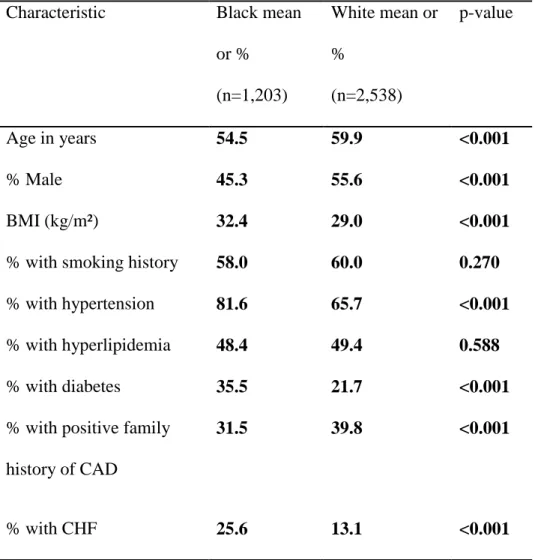
of hypertension. Black patients in the sample were significantly younger, had higher BMI, and
greater prevalence of both diabetes and hypertension (Table 1). Rates of smoking and hyperlipidemia were comparable between black and white patients.
Coronary Artery Disease Risk Factors
Most traditional risk factors for CAD (including older age, smoking, hypertension,
hyperlipidemia, diabetes and family history) were associated with positive findings on
37
stenotic lesion on angiography compared to 23.6% of patients without hypertension (p<0.001).
Interestingly, obese patients (BMI ≥ 30 kg/m²) were less likely to have evidence of a significant
stenotic lesion in comparison with non-obese patients (26.7% vs. 35.6%, p<0.001). This finding
was also noted for the outcome of having any stenosis.
Black Patients and Low Angiographic Burden of Disease
Among the entire sample, 63.5% of the patients had disease detected in at least one major
vessel on angiography, while 30.4% were found to have significant stenosis. Black patients had
lower prevalence of disease than whites by both outcome measures. Black patients had 0.52
(95% CI 0.45-0.61) times the odds of having any stenosis compared to whites and 0.47 (95% CI
0.40-0.55) times the odds of having significant stenosis compared to whites.
The relatively lower prevalence of angiographic disease among blacks did not change
substantially after adjusting for demographics and CAD risk factors, where black patients had
0.59 (95% CI 0.49-0.71) times the odds of having any detected stenotic lesions compared to
whites and 0.54 (95% CI 0.44-0.66) times the odds of having significant stenosis compared to
whites.
Race, Hypertension and Burden of Disease
In the adjusted multivariable models stratified by patient history of hypertension, among
those patients with hypertension, blacks had 0.50 (95% CI 0.41-0.62) times the odds of having
any stenotic lesions and 0.47 (95% CI 0.38-0.59) times the odds of having significant stenosis
(Table 3). In contrast, among the patients without a history of hypertension blacks had roughly equivalent odds as whites of having any stenosis (OR 0.93 (95% CI 0.63-1.36)) or a significant
38
The significance of the difference between hypertensive and non-hypertensive patients in
the size of the black-white relative odds of having any disease and significant disease was
confirmed in a multivariable model that included all patients (hypertensives and
non-hypertensives) and an interaction term for race and hypertension. The interaction terms were
significant in the models with both any stenosis (p=0.024) and significant stenosis (p=0.034) as
the outcomes.
All models were also tested with the addition of the covariates BMI and history of CHF.
The addition of these two covariates had minimal effects on the findings.
DISCUSSION
In this study, we investigated the possible role of hypertension in explaining black-white
differences in angiographically detectable coronary disease by examining data from an
institutional database in a sample of black and white patients undergoing non-emergent coronary
angiography for suspected CAD. Our study confirmed that black patients were significantly less
likely to have any detected disease or any significant stenosis (≥50% in LMA or ≥70% in other
artery segments) on coronary angiography, but to explore our novel hypothesis, we stratified
patients by history of hypertension and then tested the racial differences in angiographic CAD.
Among the patients with hypertension, blacks remained less likely than whites to demonstrate
any disease or any significant disease. Among the patients without hypertension, however, there
was not a significant black-white difference in the rate of detected disease. This finding was
supported by the significance of a statistical test of the interaction between hypertension and race
39
blacks undergoing elective catheterization for possible CAD have a lower burden of
angiographic disease.
Our sample’s patients resemble those of previous studies assessing black-white
differences in CAD risk factors.27, 28 Black patients were more likely to have hypertension, diabetes and elevated BMI than white patients, but the groups had roughly equivalent rates of
smoking and hyperlipidemia. In our study stample, we also found, as expected, that traditional
CAD risk factors were associated with the outcomes of stenotic disease. Interestingly, non-obese
patients had higher rates of detected CAD than obese patients. In several other studies, BMI has
been found to have an inconsistent association with the presence of coronary atherosclerosis.29-32
Significance of Results
We are not aware of any studies to date that have examined explanations for the lower
incidence of angiographically detected CAD and higher rate of negative diagnostic studies in
black patients. Hypertension, and its differential severity between races, provides a plausible
explanation for these findings, as its effects and associated symptoms may lead to catheterization
in patients without CAD. While hypertension is an established risk factor for CAD itself, its
effects extend beyond increasing the likelihood of atherosclerosis or plaque rupture in the
coronary arteries, and include both microvascular damage and end-organ disease. Rates of both
elevated blood pressure itself and these long-term effects have been shown to be higher in blacks
40
noninvasive tests for CAD have been shown to be quite low in hypertensive patients.33, 34 Moreover, patients with hypertensive heart disease, including LVH and eventual heart failure,
may appear to be sicker and at higher risk of cardiac death, prompting clinicians to undertake
catheterization.
We feel it is important to examine the potential causes of black-white differences in rates
of CAD found during angiography. Coronary angiography is an invasive procedure, and in our
sample, black patients—particularly those with a history of hypertension—appear to have a
disproportionately high rate of receiving procedures with negative results. Such procedures may
be considered unnecessary, costly, potentially harmful, and distracting from other diagnostic
strategies appropriate to finding the actual cause of the patient’s symptoms. However, it is
important to note that these findings do not temper or dispute the concerning evidence that many
blacks in the U.S. do not receive cardiac catheterization when it is clearly indicated.4, 6
Further research, utilizing catheterization findings in conjunction with continuous BP
measures over time and data on hypertension-related variables (such as LVH, ECG
abnormalities, age of hypertension onset, endothelial dysfunction and others), may elucidate a set
of specific factors that contribute to the disproportionately higher rate of negative studies in this
subset of black patients. Such information may eventually support the development of
individualized algorithms for clinical evaluation and management of suspected CAD, taking both
race and the impact of hypertension into account.
Limitations
Race classification was based on information from the hospital records rather than
41
the U.S.35 While hospitals have been shown to misclassify race on a small but significant number of individuals,36 the effect of this misclassification would be nondifferential and tend to minimize rather than exaggerate race group differences.
The use of race as an exposure variable also presents many difficulties. Race is
challenging to study as it is a social categorization that does not necessarily reflect genetic
variation.37, 38 The diverging effect of hypertension in white and black subjects on angiographic outcomes is complex and likely represents care and access disparities in addition to a myriad of
health behavior, socioeconomic, and historical differences between these groups. Biological
differences related to hypertension may contribute but are likely not the primary cause of these
findings.38, 39 In our study, we included race as a stand-alone variable, without data to assess which aspects of race may be responsible for study findings.
The definition of hypertension as a variable also has important limitations. As it was
recorded in the database, patients were grouped according to personal history of hypertension.
We did not have information on patient blood pressure over time and could not estimate the
direct effect of hypertensive myocardial damage, as it is related to race, on the outcomes.
Conclusions
In this study we assessed how hypertension might explain the racial differences in
likelihood of angiographic disease. We found that black-white differences in angiographic CAD
can be demonstrated only for patients with a history of hypertension, with rates of coronary
stenosis being equivalent for blacks and whites without hypertension. These findings apply to
patients undergoing catheterization suspected to have CAD with no indication for emergent