R E S E A R C H
Open Access
Recruitment and retention in obesity
prevention and treatment trials targeting
minority or low-income children: a review
of the clinical trials registration database
Zhaohui Cui
1, Elisabeth M. Seburg
2, Nancy E. Sherwood
2, Myles S. Faith
1and Dianne S. Ward
1*Abstract
Background:Efforts to recruit and retain participants in clinical trials are challenging, especially in studies that include minority or low-income children. To date, no studies have systematically examined recruitment and retention strategies and their effectiveness in working successfully with this population. We examined strategies employed to recruit or retain minority or low-income children in trials that included an obesity-related behavior modification component.
Methods:First, completed home-, community-, and school-based trials involving minority or low-income children aged 2–17 years were identified in a search of the ClinicalTrials.gov registry. Second, a PubMed search of identified trials was conducted to locate publications pertinent to identified trials. Recruitment and retention rates were calculated for studies that included relevant information.
Results:Our final analytic sample included 43 studies. Of these, 25 studies reported recruitment or retention strategies, with the amount of information varying from a single comment to several pages; 4 published no specific information on recruitment or retention; and 14 had no publications listed in PubMed. The vast majority (92 %) of the 25 studies reported retention rates of, on average, 86 %. Retention rates were lower in studies that: targeted solely Hispanics or African Americans (vs. mixed races of African Americans, whites, and others); involved children and parents (vs. children only); focused on overweight or obese children (vs. general children), lasted≥1 year (vs. <1 year), were home or community-based (vs. school-based), included nutrition and physical activity intervention (vs. either intervention alone), had body mass index or other anthropometrics as primary outcome measures (vs. obesity-related behavior, insulin sensitivity, etc.). Retention rates did not vary based on child age, number of intervention sessions, or sample size.
Conclusions:Variable amounts of information were provided on recruitment and retention strategies in obesity-related trials involving minority or low-income children. Although reported retention rates were fairly high, a lack of reporting limited the available information. More and consistent reporting and systematic cataloging of recruitment and retention methods are needed. In addition, qualitative and quantitative studies to inform evidence-based decisions in the selection of effective recruitment and retention strategies for trials including minority or low-income children are warranted.
Keywords:African American, behavior, children, Hispanic, intervention, lifestyle, low income, recruitment, retention, systematic review
* Correspondence:[email protected]
1Department of Nutrition, Gillings School of Global Public Health, University of North Carolina at Chapel Hill, 2202 McGavran-Greenberg Hall, Campus Box 7461, Chapel Hill, NC 27599, USA
Full list of author information is available at the end of the article
Background
Successful recruitment and retention are critical for evaluating intervention effectiveness in clinical trials that address childhood obesity. However, the recruitment and retention of participants is challenging, especially in clin-ical trials that involve ethnic minority or low-income populations in the prevention or treatment of child-hood obesity. Problems in participant recruitment may lead to untimely delays in implementation, added finan-cial burden, and failure to meet recruitment goals. Once participants have been recruited, maintaining their en-gagement across the course of the trial requires thoughtful planning, careful monitoring, and sometimes extraordin-ary efforts.
Recently, the National Heart, Lung, and Blood Insti-tute convened a workshop to address recruitment and retention strategies in phase 3 and 4 clinical trials. In an article about this initiative, Probstfield and Frye [1] sum-marized critical steps that must be taken to ensure ad-equate participant enrollment and retention. These authors noted that trials that involve women and minority pop-ulations are more challenging and costly because of is-sues related to transportation, childcare, and individual and community acceptance. Moreover, reaching minor-ity participants creates additional challenges.
Childhood obesity studies, both for prevention and treatment, present additional challenges related to par-ticipant recruitment and retention. Parents and caregivers are often not interested in or have little concern for obes-ity as a problem and may not recognize excess body weight, especially when it occurs in younger children [2, 3]. An added component of research involving chil-dren is that family participation, either direct or indir-ect, is required. Even when parents or other primary caregivers are not targeted as study participants, family members must provide consent, support, and coordin-ation for the child’s participation in the research study. Thus, recruitment and retention of participants must consider the index child and a parent or guardian for study success.
Childhood obesity intervention trials, especially those conducted within community settings, offer great chal-lenges for participant recruitment and retention because of the time required for baseline measures, intervention delivery, post-intervention testing, and measures of sus-tainability. Although successful recruitment and reten-tion strategies have been generally described in studies focusing on adults [4] and children [3], no prior reviews have systematically assessed the recruitment and reten-tion of minority or low-income children and families in obesity treatment and prevention studies. In addition, no studies have attempted to determine what information about recruitment and retention is provided in childhood obesity intervention studies following their completion.
More information is needed about successful recruitment and retention strategies for interventions that involve mi-nority or low-income children and families to provide re-searchers with needed information for better design and budgeting for research studies.
The United States Clinical Trials Registration Database (CTRD) offers an excellent study frame to address these issues. For this database, a clinical trial is defined as any research study that assigns human participants to inter-ventions (e.g., a medical product, behavior, or procedure) to evaluate the effects on health outcomes [5]. In 2000, the United States CTRD (ClinicalTrials.gov) was estab-lished as an official web platform and catalog for regis-tering a clinical trial. Run by the United States National Library of Medicine, ClinicalTrials.gov was the first on-line registry for clinical trials and is the largest and most widely used trial registry today. Part of the purpose of the CTRD is to make clinical trial information more widely available and to standardize information provided about trials. In 2005, the International Committee of Medical Journal Editors initiated the policy that trials will be considered for publication only if they were regis-tered before submission [6]. This policy has been followed by a large number of journals [7]. The CTRD is ac-cepted by the International Committee of Medical Journal Editors [6].
Because of the importance of recruitment and reten-tion strategies, the increased participareten-tion of community intervention trials in the CTRD, and the provision of information on the trials’ process, a review of the re-cruitment and retention strategies of childhood obesity prevention and treatment intervention studies located within the database was undertaken. The purpose of the review was to glean collective information from the registered trials, which could be used to improve subse-quent childhood obesity interventions and to enhance future recruitment and retention efforts. Specifically, this review aimed to (1) describe strategies employed to recruit minority participants to intervention trials tar-geting child diet, physical activity, or obesity-related outcomes and assess the success of these recruitment efforts; and (2) examine strategies used to retain partic-ipants in these intervention trials and evaluate reten-tion success.
Methods
or adolescents as the intervention target; (b) diet, physical activity, or obesity-related outcome; (c) a com-pleted trial; and (d) specific information on recruitment or retention numbers and strategies used. Studies were ex-cluded if they tested a specialized diet, medication, diet-ary supplement, or monitoring device; studied infants (i.e., <2 years of age); or focused on an infectious dis-ease outcome or illness other than obesity or diabetes.
Using the CTRD search engine, specific search terms used included: (underserved OR ‘hidden population’OR uninsured OR minority OR low income OR Latino OR Latina OR Hispanic OR black OR African American OR Mexican American OR poverty OR vulnerable OR eth-nic). Also within the CTRD search engine: the‘ Recruit-ment’ parameter was constrained to be‘completed’; the
‘Study type’parameter was constrained to‘interventional studies’; the ‘Conditions’ parameter was constrained to (type 2 diabetes OR diabetes mellitus OR obesity OR overweight OR diet OR nutrition OR physical activity OR sedentary behavior); and the ‘Age group’ parameter was constrained to‘Child (birth to 17 years)’.
As secondary sources of information on recruitment and retention, we searched within CTRD for pertinent papers associated with each identified study. In addition, a PubMed search was conducted using the following information: (CTRD number OR grant number OR intervention name noted in the CTRD) AND name of the principal investigator AND date of study start. All searches of the CTRD and PubMed were conducted by the first author (ZC) after consulting a university librar-ian assigned to services exclusively for public health re-search. The first author (ZC) read all of the registration information in an effort to identify appropriate studies. Studies that provided information on recruitment or retention numbers and strategies were retained. Data extraction was performed independently by two au-thors using tailored tables, and results were cross-checked for accuracy and completeness. Disagreements between the two authors were discussed and resolved in regular writing group meetings.
Results
Analytic sample and sample characteristics
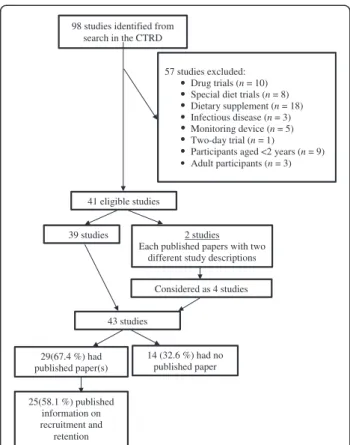
A total of 98 studies were retrieved from our search of the CTRD (Fig. 1). Of these, 57 studies were excluded for the following reasons: drug trials (n= 10); special diet trials (n= 8); dietary supplement (n= 18); infectious dis-ease (n= 3); monitoring device (n= 5); 2-day trial (n= 1); participants younger than 2 years (n= 9) or older than 17 years (n= 3). This yielded a total of 41 eligible stud-ies. Search methods identified two additional papers that described studies that were linked to two of the 41 CTRD numbers but appeared to represent slightly differ-ent studies (differdiffer-ent sample sizes). These were included
as separate studies, bringing our final analytic sample total to 43 studies. Of these 43 studies, 29 had at least one published article in a peer-reviewed journal, with 25 having specific information on recruitment or retention of participants. One of the 25 studies (i.e., Girls Health Enrichment Multi-Site Studies or GEMS) included sev-eral articles published, from seven different study phases or sites.
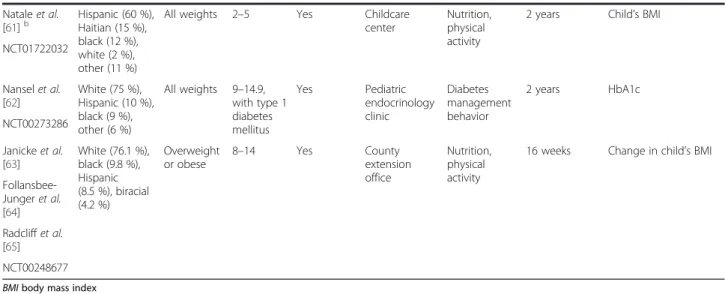
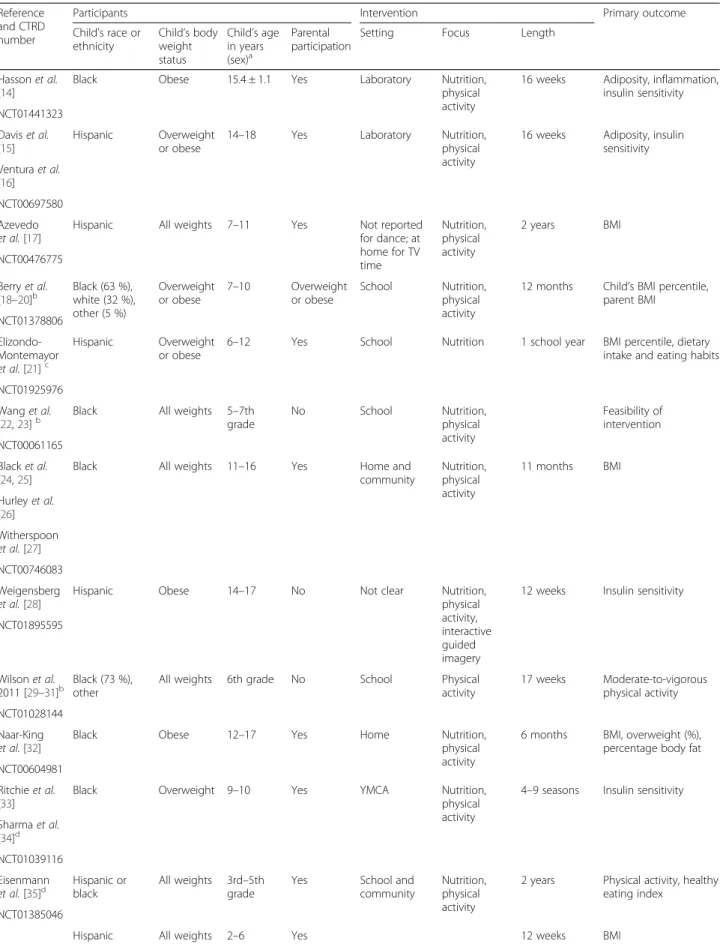
Characteristics of the 25 studies included in this re-view are described in Table 1. More than half of the studies were randomized controlled trials (n= 14); five were cluster randomized controlled trials; two were non-randomized controlled trials; and four were trials with-out a control group. Studies were conducted in various settings, including home or community, including county extension offices, YMCA and childcare centers (n= 11), schools (n= 7), clinics (n= 5), laboratories (n= 3). Cat-egories are not mutually exclusive, as some studies had more than one setting. By design, all studies enrolled His-panics or African Americans, but could have enrolled white participants. Eighty percent of the studies tar-geted both children and parents. More than 75 % of studies included both nutrition and physical activity intervention components. Two-thirds of the studies lasted less than 1 year. Most studies utilized body mass index (BMI, n= 11) or insulin sensitivity or blood
98 studies identified from search in the CTRD
57 studies excluded: Drug trials (n= 10) Special diet trials (n= 8) Dietary supplement (n= 18) Infectious disease (n= 3) Monitoring device (n= 5) Two-day trial (n= 1)
Participants aged <2 years (n= 9) Adult participants (n= 3)
2 studies Each published papers with two
different study descriptions 39 studies
Considered as 4 studies
43 studies
29(67.4 %) had (s)
14 (32.6 %) had no
25(58.1 %) published information on recruitment and
retention
41 eligible studies
published paper published paper
Table 1Characteristics of extracted studies
Reference and CTRD number
Participants Intervention Primary outcome
Child’s race or ethnicity
Child’s body weight status
Child’s age in years (sex)a
Parental participation
Setting Focus Length
Hassonet al.
[14]
Black Obese 15.4 ± 1.1 Yes Laboratory Nutrition,
physical activity
16 weeks Adiposity, inflammation, insulin sensitivity NCT01441323
Daviset al.
[15]
Hispanic Overweight or obese
14–18 Yes Laboratory Nutrition,
physical activity
16 weeks Adiposity, insulin sensitivity Venturaet al.
[16] NCT00697580 Azevedo
et al.[17]
Hispanic All weights 7–11 Yes Not reported
for dance; at home for TV time
Nutrition, physical activity
2 years BMI
NCT00476775
Berryet al.
[18–20]b
Black (63 %), white (32 %), other (5 %)
Overweight or obese
7–10 Overweight or obese
School Nutrition, physical activity
12 months Child’s BMI percentile, parent BMI
NCT01378806 Elizondo-Montemayor
et al.[21]c
Hispanic Overweight or obese
6–12 Yes School Nutrition 1 school year BMI percentile, dietary intake and eating habits
NCT01925976 Wanget al.
[22,23]b Black All weights 5grade–7th No School Nutrition,physical activity
Feasibility of intervention NCT00061165
Blacket al.
[24,25]
Black All weights 11–16 Yes Home and
community
Nutrition, physical activity
11 months BMI
Hurleyet al.
[26] Witherspoon
et al.[27] NCT00746083 Weigensberg
et al.[28]
Hispanic Obese 14–17 No Not clear Nutrition,
physical activity, interactive guided imagery
12 weeks Insulin sensitivity
NCT01895595
Wilsonet al.
2011 [29–31]b
Black (73 %), other
All weights 6th grade No School Physical
activity
17 weeks Moderate-to-vigorous physical activity NCT01028144
Naar-King
et al.[32]
Black Obese 12–17 Yes Home Nutrition,
physical activity
6 months BMI, overweight (%), percentage body fat NCT00604981
Ritchieet al.
[33]
Black Overweight 9–10 Yes YMCA Nutrition,
physical activity
4–9 seasons Insulin sensitivity
Sharmaet al.
[34]d NCT01039116 Eisenmann
et al.[35]d
Hispanic or black
All weights 3rd–5th grade
Yes School and
community
Nutrition, physical activity
2 years Physical activity, healthy eating index
NCT01385046
Table 1Characteristics of extracted studies(Continued)
Barkinet al.
[36]
Community recreation center Nutrition, physical activity NCT00808431
Burnetet al.
[37]e Black Overweightor obese 9family-12, with history of type 2 diabetes mellitus
Yes Community Nutrition,
physical activity
1 year Child’s BMIzscore, parent’s BMI, glucose tolerance
NCT00723853
Daviset al.
[38–40]
White (58 %), black (39 %), Hispanic (3 %)
Overweight or obese
7–11 No Laboratory Nutrition,
physical activity
10–15 weeks Risk of type 2 diabetes mellitus, VO2max, percentage body fat, visceral fat Tkaczet al.
[41] Pettyet al.
[42] NCT00108901 Madsenet al.
[43]b Hispanic (42 %),Asian (32 %), black (12 %), white (0.6 %), other (13.4 %)
All weights 4th or 5th grade
No School Physical
activity
24 weeks Change in minutes of after-school moderate-to-vigorous physical ac-tivity, VO2max, BMI NCT01156103
Wickham
et al.[44]
Black (70.3 %), white (26.1 %), Hispanic (1.8 %)
Obese 11–18 Yes Weight
management clinic
Nutrition, physical activity
2 years (results at 6 months reported)
BMI, metabolic indicators, fitness NCT00167830
Beanet al.
[45]e
Black (75.3 %), white (22.0 %), other (2.7 %)
Obese 11–18 Yes Weight
management clinic
Nutrition, physical activity
2 years (results at 6 months reported)
Dietary changes
NCT00167830 Wysockiet al.
[46,47]
White (78.2 %), black (21.0 %), Hispanic (0.8 %)
All weights 12–16.75 with type 1 diabetes mellitus Yes Treatment center Parent– adolescent conflict 12 months (results at 3 months reported) Family relationships, psychological adjustment to diabetes treatment, treatment adherence, diabetic control
NCT00358059
Wysockiet al.
[48–50]
White (63.5 %), black (30.8 %), Hispanic (2.9 %), other (2.9 %)
All weights 11–16, with type 1 diabetes mellitus Yes Pediatric center Parent– adolescent conflict
6 months Family relationships, treatment adherence, HbA1c, health care use NCT00358059
Elliset al.[51,
52]
Black (63 %), white (26 %), other (11 %)
All weights 10–17, with type 1 diabetes mellitus Yes Home, community Home-based psychotherapy Approximately 6 months
Adherence to medical regimen, metabolic control, hospital use NCT00519935
Storyet al.[2] Black Phase I: BMI
≥25th or
≥50th percentile;
8–10 (girls) Overweight or obese Community center, school, home Nutrition, physical activity Phase I: 12 weeks;
Phase I: process measures;
Rochonet al.
[53]
Phase II: BMI≥25th percentile but≤35 kg/ m2
Phase II: 2 years
Phase II: change in child’s BMI Kumanyika
et al.[54,55] Klesgeset al.
[56,57] Robinson
et al.[58,59] Stockton
glucose metabolism (n= 10) as the primary outcome measures, while others used physical activity or fit-ness (n= 5), body fat (n= 4), diet (n= 3) or adherence behaviors (n= 3).
Recruitment rates and strategies
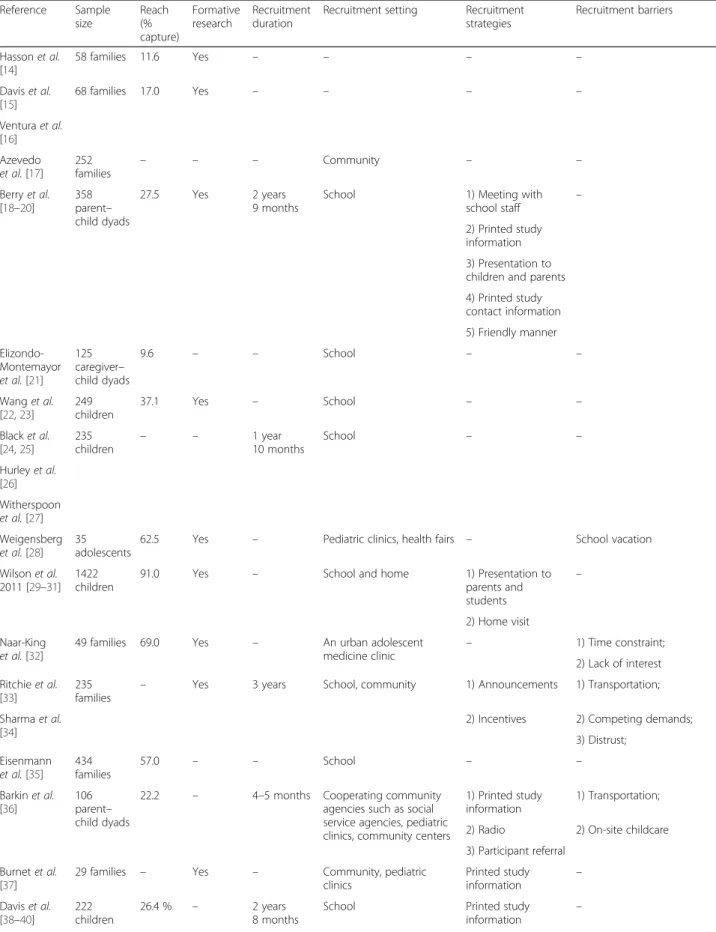
Recruitment information provided in the studies is de-scribed in Table 2. Of the 25 studies, 16 (64 %) did not report a recruitment target; 8 (32 %) did not report cap-ture rate expressed as the ratio of participants who were enrolled to potential participants who were screened. When capture rate was included, it ranged from 10 % to 90 %. Eight (32 %) of the 25 studies did not report for-mative research information on recruitment. Only eight studies reported recruitment durations, which ranged from 2.5 months (enrolled approximately 60 girls) to 3 years (enrolled 235 children). Recruitment was primarily conducted in community, school, and primary care set-tings. Specific recruitment strategies were reported in only 14 studies, with the amount of information varying from a single comment to several pages. Common recruitment methods were presentations, flyers, brochures, posters, media advertisements, phone calls, and word-of-mouth. Two-thirds of studies did not report any information on barriers for recruitment. When barriers were reported, they included participants’ time constraints, competing demands, transportation safety and distance, childcare needs, lack of interest, and study funding limitations.
Retention rates and strategies
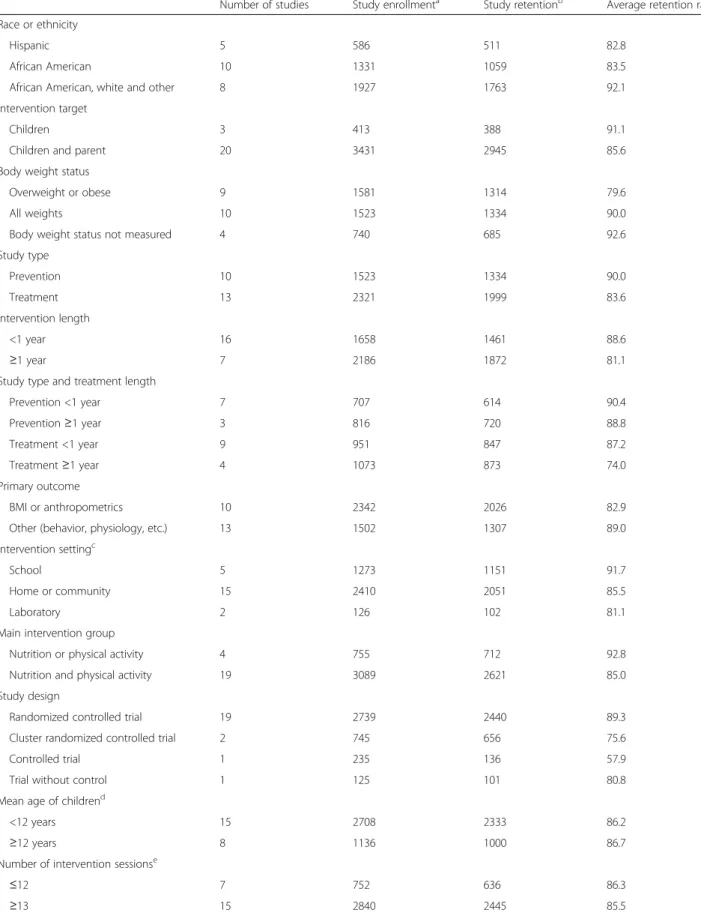
Table 3 shows the average retention rates from individ-ual studies based on study characteristics. Of the 25
studies examined, 23 studies reported retention rates, with an average rate of 86 %. Studies solely targeting Hispanics or African Americans had lower average re-tention rates, of 82.8 % and 83.5 %, respectively, than those targeting both ethnic minority and white partici-pants (92.1 %). Three studies included children only; the average retention rate from these studies was higher than the average retention rate from studies that in-volved both children and parents (91.1 % vs. 85.6 %). On average, studies that focused on overweight or obese children had lower retention rates than those that tar-geted children generally (79.6 % vs. 90.0 %). Accordingly, treatment studies had a lower average retention rate than prevention studies, especially when the intervention lasted over 1 year (74.0 % vs. 88.8 %). Overall, longer-term studies produced lower retention rates than shorter-term studies, especially for treatment studies (74.0 % for≥1 year vs. 87.2 % for < 1 year). Interestingly, studies with BMI or anthropometrics as primary outcome measures had lower retention rates than studies with other primary outcome measures (e.g., obesity-related behavior, insulin sensitivity; 82.9 % vs. 89.0 %). Home- or community-based studies had lower retention rates than school-based studies (85.5 % vs. 91.7 %). Studies including both nutrition and physical activity intervention components tended to have lower retention rates than studies focusing solely on nutri-tion or physical activity (85.0 % vs. 92.8 %). Retennutri-tion rates did not differ by the mean age of children (<12 years vs.≥ 12 years), number of intervention sessions (≤12 vs.≥13), or study sample size (<100 vs.≥100).
Of the 25 studies, 18 (72 %) reported retention strat-egies. We analyzed and coded retention strategies used Table 1Characteristics of extracted studies(Continued)
Nataleet al.
[61]b
Hispanic (60 %), Haitian (15 %), black (12 %), white (2 %), other (11 %)
All weights 2–5 Yes Childcare
center
Nutrition, physical activity
2 years Child’s BMI
NCT01722032
Nanselet al.
[62]
White (75 %), Hispanic (10 %), black (9 %), other (6 %)
All weights 9–14.9, with type 1 diabetes mellitus
Yes Pediatric
endocrinology clinic
Diabetes management behavior
2 years HbA1c
NCT00273286
Janickeet al.
[63]
White (76.1 %), black (9.8 %), Hispanic (8.5 %), biracial (4.2 %)
Overweight or obese
8–14 Yes County
extension office
Nutrition, physical activity
16 weeks Change in child’s BMI
Follansbee-Jungeret al.
[64] Radcliffet al.
[65] NCT00248677
BMIbody mass index
a
Included both sexes if not specified
b
Cluster randomized clinical trial
c
Trial without control group
d
Non-randomized controlled trial
e
Table 2Study recruitment: effectiveness, setting, strategies employed, and barriers reported
Reference Sample size
Reach (% capture)
Formative research
Recruitment duration
Recruitment setting Recruitment strategies
Recruitment barriers
Hassonet al.
[14]
58 families 11.6 Yes – – – –
Daviset al.
[15]
68 families 17.0 Yes – – – –
Venturaet al.
[16] Azevedo
et al.[17] 252 families
– – – Community – –
Berryet al.
[18–20]
358 parent– child dyads
27.5 Yes 2 years
9 months
School 1) Meeting with
school staff –
2) Printed study information 3) Presentation to children and parents 4) Printed study contact information 5) Friendly manner
Elizondo-Montemayor
et al.[21] 125 caregiver– child dyads
9.6 – – School – –
Wanget al.
[22,23]
249 children
37.1 Yes – School – –
Blacket al.
[24,25]
235 children
– – 1 year
10 months
School – –
Hurleyet al.
[26] Witherspoon
et al.[27] Weigensberg
et al.[28] 35 adolescents
62.5 Yes – Pediatric clinics, health fairs – School vacation
Wilsonet al.
2011 [29–31] 1422 children
91.0 Yes – School and home 1) Presentation to
parents and students
–
2) Home visit Naar-King
et al.[32]
49 families 69.0 Yes – An urban adolescent
medicine clinic
– 1) Time constraint;
2) Lack of interest Ritchieet al.
[33]
235 families
– Yes 3 years School, community 1) Announcements 1) Transportation;
Sharmaet al.
[34]
2) Incentives 2) Competing demands; 3) Distrust;
Eisenmann
et al.[35] 434 families
57.0 – – School – –
Barkinet al.
[36]
106 parent– child dyads
22.2 – 4–5 months Cooperating community agencies such as social service agencies, pediatric clinics, community centers
1) Printed study information
1) Transportation;
2) Radio 2) On-site childcare 3) Participant referral
Burnetet al.
[37]
29 families – Yes – Community, pediatric
clinics
Printed study
information –
Daviset al.
[38–40]
222 children
26.4 % – 2 years
8 months
School Printed study
information
in these studies and categorized strategies into interven-tion design, incentive, project bond, participant con-venience, and participant tracking (Table 4). Retention strategies related to intervention design included cul-turally appropriate intervention activities and staff, de-velopmentally appropriate goals for participants, a
run-in phase before randomization, provision of coun-seling or technical support to help participants address participation barriers, regular interventionist–principal investigator meetings to ensure participant-centered inter-vention, and the use of a delayed or alternative interven-tion for control group. Incentives, such as grocery gift Table 2Study recruitment: effectiveness, setting, strategies employed, and barriers reported(Continued)
Tkaczet al.
[41] Pettyet al.
[42] Madsenet al.
[43]
156 children, six schools
11.7 % , 50 %, 89.7 %
Yes – School Presentation to
school staff
Change in school administration
Wickham
et al.[44] 165 adolescents
– – 2 years
4 months
Comprehensive weight management program
Healthcare provider referral
–
Beanet al.
[45]
186
adolescents –
Yes 2 years
11 months
Health care, school, community
Healthcare provider
referral –
Wysockiet al.
[46,47]
119 families
31.3 % Yes – – – 1) Transportation;
2) Time constraint Wysockiet al.
[48–50]
104 families
23.9 % Yes – Pediatric diabetes centers 1) Mailed invitation letter
Funding limitation
2) Phone call Elliset al.[51,
52]
127 adolescents
69.8 % Yes – Endocrinology clinic – –
Storyet al.[2] Phase I: 35–61 girls;
Phase I : not reported;
Yes Phase I: 2.5– 4 monthsa;
Community churches, community centers, community events and school
1) Active placebo study group
Phase I:
Rochonet al.
[53]
Phase II: 261–303 girls
Phase II: 48.1 %-65.4 %
Phase II: 17 months
2) Media adverts, stories, interviews
1) No-treatment control group;
Kumanyika
et al.[54,55]
3) Flyers to homes 2) Parents interested in both child health and self-esteem programs, while children in-terested in fun programs; Klesgeset al.
[56,57]
4) Presentations to families at community and school
3) Blood draw.
Robinson
et al.[58,59]
5) Separate consent for blood draw, which was not required for participation
Phase II:
Stockton
et al.[60]
1) School vacation 2) Study staff issues 3) Study site locations Nataleet al.
[61]
1105 children
– – – Child care center – –
Nanselet al.
[62]
390 families
69.1 % – Pediatric endocrinology
clinics – –
Janickeet al.
[63]
93 parent– child dyads
83.8 % Yes Community and school 1) Printed study
information
–
Follansbee-Jungeret al.
[64]
2) Community presentations
Radcliffet al.
[65]
3) Toll-free line
a
Table 3Average retention rates by study characteristics
Number of studies Study enrollmenta Study retentionb Average retention rates Race or ethnicity
Hispanic 5 586 511 82.8
African American 10 1331 1059 83.5
African American, white and other 8 1927 1763 92.1
Intervention target
Children 3 413 388 91.1
Children and parent 20 3431 2945 85.6
Body weight status
Overweight or obese 9 1581 1314 79.6
All weights 10 1523 1334 90.0
Body weight status not measured 4 740 685 92.6
Study type
Prevention 10 1523 1334 90.0
Treatment 13 2321 1999 83.6
Intervention length
<1 year 16 1658 1461 88.6
≥1 year 7 2186 1872 81.1
Study type and treatment length
Prevention <1 year 7 707 614 90.4
Prevention≥1 year 3 816 720 88.8
Treatment <1 year 9 951 847 87.2
Treatment≥1 year 4 1073 873 74.0
Primary outcome
BMI or anthropometrics 10 2342 2026 82.9
Other (behavior, physiology, etc.) 13 1502 1307 89.0
Intervention settingc
School 5 1273 1151 91.7
Home or community 15 2410 2051 85.5
Laboratory 2 126 102 81.1
Main intervention group
Nutrition or physical activity 4 755 712 92.8
Nutrition and physical activity 19 3089 2621 85.0
Study design
Randomized controlled trial 19 2739 2440 89.3
Cluster randomized controlled trial 2 745 656 75.6
Controlled trial 1 235 136 57.9
Trial without control 1 125 101 80.8
Mean age of childrend
<12 years 15 2708 2333 86.2
≥12 years 8 1136 1000 86.7
Number of intervention sessionse
≤12 7 752 636 86.3
cards, gifts, cash, food, recipe books, and exercise equip-ment, were offered for intervention attendance or com-pletion at each data collection point. Study staff also established project bonds with participants or the broader community by building staff–participant rela-tionships, and regular communication with partici-pants, such as thank-you notes, postcards, or project newsletters. Retention strategies related to participant convenience included transportation support to and from intervention activities or data collection, make-up sessions for missed intervention sessions, make-upcoming event reminders, childcare services, and optional days or home visits for data collection. To facilitate tracking participants, complete contact information was col-lected from participants at baseline and a tracking database established. One study mentioned sending personalized letters to participants who were difficult to reach, to schedule data collection appointments. Common retention methods used were alternative or delayed interventions for the control groups, monetary incentives, regular contact and relationship building with participants and the community, provision of transportation support, and offering flexible interven-tion and measurement visits.
Discussion
Summary of key findings
Our systematic review of recruitment and retention of minority or low-income children into obesity-related intervention trials identified 41 completed studies in the CTRD, two of which were linked to two studies. Of these 43 studies, only 25 (60 %) had published information on recruitment or retention in a peer-reviewed article, with considerable variation in the amount of information provided among studies. A further≈10 % included no information about recruit-ment and retention in their papers. Even when we examined only the studies completed 2 years prior to the close date of our CTRD search, more than 30 % had no publications in peer-review journals. Although most studies with relevant information reported high retention rates, differences in retention rates existed by participant characteristics (i.e., race, obesity status, involving parents or caregivers) and study design (i.e.,
prevention or treatment, study duration, primary out-come, home-, community-, or school-based).
Previous studies that have examined recruitment and retention in this population
Two other studies have systematically examined pub-lished articles about recruitment and retention of chil-dren into obesity-related studies. Schoeppe et al. [3] summarized strategies used to recruit and retain children in behavioral health risk factor studies that achieved high capture rates and low attrition rates, while Amonet al.[8] systematically reviewed literature that included the use of Facebook to recruit 10–18-year-old children into studies that aimed to address physical or mental health issues. The authors found that paid advertising on Facebook was effective in recruiting these participants. These two studies used published literature only as their study frame; thus, their results did not cover studies without publications and could not evaluate the pro-portion of studies conducted with published informa-tion on recruitment and reteninforma-tion. Furthermore, these reviews focused on youth generally; thus, it is unclear whether findings can be generalized to minority or low-income children.
Qualitative and quantitative evidence in recruitment and retention
The articles identified in our review mainly provided narrative descriptions of recruitment and retention strat-egies used, investigators’opinions on the effectiveness of these strategies, and lessons learned in individual stud-ies. While this describes important qualitative study ex-periences related to recruitment and retention strategies, quantitative assessments of these strategies may also im-prove our understanding of their correlates and effects. Two prior observational studies have quantitatively examined factors associated with the success of re-cruitment and retention in intervention studies. Using discriminant function analysis and analysis of variance, Coatsworth et al. [9] found that retention patterns (i.e., non-attenders, variable attenders or consistently high attenders over intervention sessions) were associ-ated with sociodemographic and child- and family-level characteristics in a family-based intervention aiming to Table 3Average retention rates by study characteristics(Continued)
Sample size
<100 9 493 435 86.9
≥100 14 3351 2898 86.0
a
The sum of numbers of participants enrolled in individual studies
b
The sum of numbers of participants retained in individual studies
c
Intervention setting was not reported in the study by Weigensberget al.[28]
d
<12 years group includes one study with participants aged 8–14 years;≥12 years group includes one study with participants aged 9–14 years, one study with participants aged 10–17 years and two studies with participants aged 11–16 years
e
Daviset al.[15] Run-in phase Weekly grocery gift cards – Transportation support – 79.4 % (54/68)
Venturaet al.[16]
Azevedoet al.[17] – Rewards for retention – – – 100 % (252/252)
Berryet al.[18–20] 1) Delayed intervention for control group 2) Counseling or support
1) Exercise equipment 2) Money for data collection 3) Food 4) Gifts
1) Regular contact 2) Refrigerator magnet 3) Building staff–participant relationship
1) Reminder message 2) Flexible data collection days
3) Childcare
4) Transportation support
1) Complete contact information 2) Toll-free line 3) Tracking letter
89.1 % (638/716)
Elizondo-Montemayor
et al.[21]
– – Building staff–participant
relationship
Reminder message – 80.8 % (101/125)
Blacket al.[24,25] Culturally sensitive – – – – 78.3 % (184/235)
Hurleyet al.[26]
Witherspoonet al.[27]
Weigensberget al.[28] – – Transportation support
Make-up session –
82.9 % (29/35)
Ritchieet al.[33] 1) Alternative intervention for control group 2) Counseling or support 3) Culturally sensitive
1) Exercise equipment 2) Recipe books
1) Building staff–participant relationship
2) Regular contact
Transportation support – 57.9 % (136/235)
Sharmaet al.[34]
Burnetet al.[37] 1) Culturally sensitive 2) Activities at YMCA and grocery stores
– Building staff–participant
relationship
1) Convenient intervention sites
2) Transportation support 3) Child care
– 62.1 % (18/29)
Daviset al.[38–40] – 1) Weekly prizes
2) Increasing money for data collections 3) Food at intervention session
Regular contact Transportation support – 94.1 % (209/222)
Tkaczet al.[41]
Pettyet al.[42]
Wickhamet al.[44] – YMCA membership – – – –
Beanet al.[45] – 1) YMCA membership 2) Grocery store gift card for data collection
– – – –
Wysockiet al.[46,47] Alternative intervention for control group
1) Money for each data collection
2) Money for completing all intervention sessions
– – – 96.6 % (115/119)
Wysockiet al.[48–50] Alternative intervention for control group
1) Money for each data collection
2) Money for completion of all intervention sessions
– – – 88.5 % (92/104)
(2015) 16:564
Page
11
of
et al.
for control group 2) Fun intervention activities
3) Culturally sensitive
attendance 2) Money
3) Increasing money for data collections 4) Additional money for blood draw 5) Food
2) Regular contact 3) Build relationship between study and broader community
sites
2) Flexible study procedures and measurement visits 3) Home visits for data collection
4) Transportation support 5) Childcare6) Email and telephone reminders
information 2) Tracking database 3) Calls from‘non-identifiable’ cell phones
Rochonet al.[53]
Kumanyikaet al.[54,
55]
91.4 % (32/35) and 100 % (60/60)
Klesgeset al.[56,57] Phase II:
Robinsonet al.[58,59] 80.2 % (243/303) and
86.2 % (225/261) Stocktonet al.[60]
Nataleet al.[61] Alternative intervention for control group
Incentives (not specified) Regular contact – – –
Nanselet al.[62] Alternative intervention for control group
1) Money for completing all data collections 2) Additional money for child providing blood glucose meter data
1) Appointment reminder calls 2) Follow-up calls after appointment
1) Transportation support 2) Midpoint evaluations by telephone
– 92.3 % (360/390)
Janickeet al.[63] 1) Delayed intervention for control group 2) Proper participant goals
3) Person-centered intervention
1) Drawing for gift card at weekly child session 2) Gift card per family for each session 3) Money for data collections 4) Food
1) Build community connections 2) Regular contact 3) Phone calls to participants after missed sessions
Make-up sessions – 87.1 % (81/93)
Follansbee-Junger
et al.[64] Radcliffet al.[65]
(2015) 16:564
Page
12
of
prevent substance use in adolescent girls. Another study using chi-square analyses found that attrition of adoles-cent girls (the majority being African Americans) involved in a randomized controlled trial of a HIV-prevention intervention was associated with recruiters’ experiences, recruitment method, contact status, and parental aware-ness of study participation [10]. Our study is the first to examine retention rates quantitatively by participant char-acteristics and study design in obesity-related trials con-ducted in minority or low-income children and found results as expected.
In addition to retrospective analysis of the recruitment and retention efforts, prospective studies designed to test specific recruitment and retention strategies are needed. The randomized clinical trial design is considered to provide the strongest causal evidence. We identified three randomized trials that examined the effectiveness of direct mail letters containing different information in the recruitment of minority adults. For example, Brown et al. [11] randomly assigned 30,000 minority women into four groups formed by a factorial design: ethnically specific or generic statement on disease risk and person-alized or non-personperson-alized letterhead. They found that women who received letters with the ethnically specific statements were 34 % more likely to respond than women who received letters with a generic statement, while there was no significant difference in response be-tween women who received personalized letters and those who received non-personalized letters. However, we did not identify any randomized controlled trials that examined the effect of recruitment and retention strat-egies in minority or low-income children. Considering the limited amount of quantitative evidence available, further analytical study is needed to examine the success rates of recruitment and retention strategies in a broader scope.
Limited publications available
We found that one-third of eligible studies had not pub-lished a peer-reviewed paper. This proportion remained true if we allowed for additional time for manuscripts to reach the publication stage by excluding studies that were completed less than 2 years before our search of the CTRD. Ross et al. [12] examined 635 clinical trials funded by the National Institutes of Health and registered within CTRD and found that more than half of the trials did not publish an article in a peer-reviewed journal indexed by Medline within 2.5 years of trial completion. Furthermore, after 51 months of trial completion, a third of trials remained unpublished. Multiple factors might have contributed to this high non-publication rate, in-cluding those beyond the control of the investigators [12, 13]. Ross et al. [12] also suggested that 12–24 months should be the goal for results from clinical
trials to be published. Furthermore, among studies with published peer-reviewed papers, the scope and amount of information reported varied. The non-publication of studies and inconsistent report of recruitment and re-tention hinders the sharing of experiences and lessons learned, as well as limiting the synthesis of data across studies. Reporting guidelines, including STrengthening the Reporting of OBservational studies in Epidemiology (STROBE) and Consolidated Standards of Reporting Trials (CONSORT), have improved the reporting of observational and experimental studies in journals that support these guidelines. The development of guide-lines for reporting recruitment and retention would be a first step in improving the quality of information reported in this area.
Strengths and limitations
An advantage of our study is that we used the CTRD as the study frame and focused specifically on minority or low-income participants. In addition, the studies in-cluded varied substantially in terms of participants’ characteristics and study design, which allowed us to describe recruitment and retention strategies more broadly and to examine the retention rates quantita-tively by study characteristics. Our study has limita-tions. We searched only one trial registry. However, most obesity-related trials conducted in the United States after the launch of the CTRD might have been registered in this database. In addition, the limited number of studies identified in our study hampered our ability to conduct multivariate analysis, to examine factors associated with retention rates.
Conclusions
In conclusion, although studies with a published, peer-reviewed article generally achieved high retention rates, limited information on recruitment and retention strat-egies was available. There is a need for more consistent reporting and systematic cataloging of recruitment and retention methods. Both qualitative and quantitative evi-dence are warranted to inform evievi-dence-based decisions in choosing effective recruitment and retention strategies for trials involving minority or low-income children.
Abbreviations
BMI:body mass index; CONSORT: Consolidated Standards of Reporting Trials; CTRD: Clinical Trials Registration Database; GEMS: Girls Health Enrichment Multi-Site Studies; STROBE: STrengthening the Reporting of OBservational studies in Epidemiology.
Competing interests
The authors declare that they have no competing interests.
Authors’contributions
manuscript revision. NES: concept development, interpretation of results, and manuscript revision. MSF and DSW: concept development, interpretation of results, and manuscript writing and revision. All authors have read and approved the final manuscript.
Acknowledgements
This research was supported by grants U01 HL103561, U01 HL103620, U01 HL103622, U01 HL103629, and U01 HD068890 from the National Heart, Lung, and Blood Institute and the Eunice Kennedy Shriver National Institute of Child Health and Development and the Office of Behavioral and Social Sciences Research. This work was also supported by the National Institute of Diabetes and Digestive and Kidney Diseases at the National Institutes of Health (grant numbers R21DK078239, P30DK050456, P30DK092924). The content is solely the responsibility of the authors and does not necessarily represent the official views of the National Heart, Lung, and Blood Institute, the National Institutes of Health, or the National Institute of Child Health and Development.
Author details
1
Department of Nutrition, Gillings School of Global Public Health, University of North Carolina at Chapel Hill, 2202 McGavran-Greenberg Hall, Campus Box 7461, Chapel Hill, NC 27599, USA.2HealthPartners Institute for Education and Research, Minneapolis, MN, USA.
Received: 25 April 2015 Accepted: 27 November 2015
References
1. Probstfield JL, Frye RL. Strategies for recruitment and retention of participants in clinical trials. JAMA. 2011;306:1798–9.
2. Story M, Sherwood NE, Obarzanek E, Beech BM, Baranowski JC, Thompson NS, et al. Recruitment of African-American pre-adolescent girls into an obesity prevention trial: the GEMS pilot studies. Ethn Dis. 2003;13:S78–87. 3. Schoeppe S, Oliver M, Badland HM, Burke M, Duncan MJ. Recruitment and
retention of children in behavioral health risk factor studies: REACH strategies. Int J Behav Med. 2014;21:794–803.
4. Yancey AK, Ortega AN, Kumanyika SK. Effective recruitment and retention of minority research participants. Annu Rev Public Health. 2006;27:1–28. 5. National Institutes of Health. ClinicalTrials.gov Background. http://www.
clinicaltrials.gov/ct2/about-site/background. Accessed 1 Dec 2014. 6. International Committee of Medical Journal Editors. Clinical Trials
Registration. http://www.icmje.org/about-icmje/faqs/clinical-trials-registration/. Accessed 1 Dec 2014.
7. International Committee of Medical Journal Editors. Journals Following the ICMJE Recommendations. http://www.icmje.org/journals-following-the-icmje-recommendations/. Accessed 1 Dec 2014.
8. Amon KL, Campbell AJ, Hawke C, Steinbeck K. Facebook as a recruitment tool for adolescent health research: a systematic review. Acad Pediatr. 2014; 14:439–47.
9. Coatsworth JD, Duncan LG, Pantin H, Szapocznik J. Retaining ethnic minority parents in a preventive intervention: the quality of group process. J Prim Prev. 2006;27:367–89.
10. Seibold-Simpson S, Morrison-Beedy D. Avoiding early study attrition in adolescent girls: impact of recruitment contextual factors. West J Nurs Res. 2010;32:761–78.
11. Brown SD, Lee K, Schoffman DE, King AC, Crawley LM, Kiernan M. Minority recruitment into clinical trials: experimental findings and practical implications. Contemp Clin Trials. 2012;33:620–3.
12. Ross JS, Tse T, Zarin DA, Xu H, Zhou L, Krumholz HM. Publication of NIH funded trials registered in ClinicalTrials.gov: cross sectional analysis. BMJ. 2012;344:d7292.
13. Hudson KL, Collins FS. Sharing and reporting the results of clinical trials. JAMA. 2015;313:355–6.
14. Hasson RE, Adam TC, Davis JN, Kelly LA, Ventura EE, Byrd-Williams CE, et al. Randomized controlled trial to improve adiposity, inflammation, and insulin resistance in obese African-American and Latino youth. Obesity (Silver Spring). 2012;20:811–8.
15. Davis JN, Kelly LA, Lane CJ, Ventura EE, Byrd-Williams CE, Alexandar KA, et al. Randomized control trial to improve adiposity and insulin resistance in overweight Latino adolescents. Obesity (Silver Spring). 2009;17:1542–8. 16. Ventura E, Davis J, Byrd-Williams C, Alexander K, McClain A, Lane CJ, et al.
Reduction in risk factors for type 2 diabetes mellitus in response to a
low-sugar, high-fiber dietary intervention in overweight Latino adolescents. Arch Pediatr Adolesc Med. 2009;163:320–7.
17. Azevedo KJ, Mendoza S, Fernandez M, Haydel KF, Fujimoto M, Tirumalai EC, et al. Turn off the TV and dance! Participation in culturally tailored health interventions: implications for obesity prevention among Mexican American girls. Ethn Dis. 2013;23:452–61.
18. Berry DC, Neal M, Hall EG, McMurray RG, Schwartz TA, Skelly AH, et al. Recruitment and retention strategies for a community-based weight management study for multi-ethnic elementary school children and their parents. Public Health Nurs. 2013;30:80–6.
19. Berry DC, Schwartz TA, McMurray RG, Skelly AH, Neal M, Hall EG, et al. The family partners for health study: a cluster randomized controlled trial for child and parent weight management. Nutr Diabetes. 2014;4:e101. 20. Berry DC, McMurray R, Schwartz TA, Skelly A, Sanchez M, Neal M, et al.
Rationale, design, methodology and sample characteristics for the family partners for health study: a cluster randomized controlled study. BMC Public Health. 2012;12:250. 2458-12-250.
21. Elizondo-Montemayor L, Moreno-Sanchez D, Gutierrez NG, Monsivais-Rodriguez F, Martinez U, Lamadrid-Zertuche AC, et al. Individualized tailor-made dietetic intervention program at schools enhances eating behaviors and dietary habits in obese Hispanic children of low socioeconomic status. Sci World J. 2014;2014:484905.
22. Wang Y, Tussing L, Odoms-Young A, Braunschweig C, Flay B, Hedeker D, et al. Obesity prevention in low socioeconomic status urban African-American adolescents: study design and preliminary findings of the HEALTH-KIDS study. Eur J Clin Nutr. 2006;60:92–103.
23. Wang Y, Li J, Caballero B. Resemblance in dietary intakes between urban low-income African-American adolescents and their mothers: the healthy eating and active lifestyles from school to home for kids study. J Am Diet Assoc. 2009;109:52–63.
24. Black MM, Hager ER, Le K, Anliker J, Arteaga SS, Diclemente C, et al. Challenge! Health promotion/obesity prevention mentorship model among urban, black adolescents. Pediatrics. 2010;126:280–8.
25. Black MM, Arteaga SS, Sanders J, Hager ER, Anliker JA, Gittelsohn J, et al. College mentors: a view from the inside of an intervention to promote health behaviors and prevent obesity among low-income, urban, African American adolescents. Health Promot Pract. 2012;13:238–44.
26. Hurley KM, Oberlander SE, Merry BC, Wrobleski MM, Klassen AC, Black MM. The healthy eating index and youth healthy eating index are unique, nonredundant measures of diet quality among low-income, African American adolescents. J Nutr. 2009;139:359–64.
27. Witherspoon D, Latta L, Wang Y, Black MM. Do depression, self-esteem, body-esteem, and eating attitudes vary by BMI among African American adolescents? J Pediatr Psychol. 2013;38:1112–20.
28. Weigensberg MJ, Lane CJ, Avila Q, Konersman K, Ventura E, Adam T. Imagine HEALTH: results from a randomized pilot lifestyle intervention for obese Latino adolescents using Interactive Guided ImagerySM. BMC Complement Altern Med. 2014;14:28. 6882-14-28.
29. Wilson DK, Van Horn ML, Kitzman-Ulrich H, Saunders R, Pate R, Lawman HG, et al. Results of the‘active by choice today’(ACT) randomized trial for increasing physical activity in low-income and minority adolescents. Health Psychol. 2011;30:463–71.
30. Wilson DK, Kitzman-Ulrich H, Williams JE, Saunders R, Griffin S, Pate R, et al. An overview of‘the active by choice today’(ACT) trial for increasing physical activity. Contemp Clin Trials. 2008;29:21–31.
31. Wilson DK, Lawman HG, Segal M, Chappell S. Neighborhood and parental supports for physical activity in minority adolescents. Am J Prev Med. 2011; 41:399–406.
32. Naar-King S, Ellis D, Kolmodin K, Cunningham P, Jen KL, Saelens B, et al. A randomized pilot study of multisystemic therapy targeting obesity in African-American adolescents. J Adolesc Health. 2009;45:417–9.
33. Ritchie LD, Sharma S, Ikeda JP, Mitchell RA, Raman A, Green BS, et al. Taking action together: a YMCA-based protocol to prevent type-2 diabetes in high-BMI inner-city African American children. Trials. 2010;11:60. 6215-11-60. 34. Sharma S, Fleming SE. One-year change in energy and macronutrient
intakes of overweight and obese inner-city African American children: effect of community-based taking action together type 2 diabetes prevention program. Eat Behav. 2012;13:271–4.
eating among low-income elementary school children. BMC Public Health. 2011;11:607. 2458-11-607.
36. Barkin SL, Gesell SB, Po’e EK, Escarfuller J, Tempesti T. Culturally tailored, family-centered, behavioral obesity intervention for Latino-American preschool-aged children. Pediatrics. 2012;130:445–56.
37. Burnet DL, Plaut AJ, Wolf SA, Huo D, Solomon MC, Dekayie G, et al. Reach-out: a family-based diabetes prevention program for African American youth. J Natl Med Assoc. 2011;103:269–77.
38. Davis CL, Tomporowski PD, Boyle CA, Waller JL, Miller PH, Naglieri JA, et al. Effects of aerobic exercise on overweight children’s cognitive functioning: a randomized controlled trial. Res Q Exerc Sport. 2007;78:510–9.
39. Davis CL, Tomporowski PD, McDowell JE, Austin BP, Miller PH, Yanasak NE, et al. Exercise improves executive function and achievement and alters brain activation in overweight children: a randomized, controlled trial. Health Psychol. 2011;30:91–8.
40. Davis CL, Pollock NK, Waller JL, Allison JD, Dennis BA, Bassali R, et al. Exercise dose and diabetes risk in overweight and obese children: a randomized controlled trial. JAMA. 2012;308:1103–12.
41. Tkacz J, Young-Hyman D, Boyle CA, Davis CL. Aerobic exercise program reduces anger expression among overweight children. Pediatr Exerc Sci. 2008;20:390–401.
42. Petty KH, Davis CL, Tkacz J, Young-Hyman D, Waller JL. Exercise effects on depressive symptoms and self-worth in overweight children: a randomized controlled trial. J Pediatr Psychol. 2009;34:929–39.
43. Madsen K, Thompson H, Adkins A, Crawford Y. School-community partnerships: a cluster-randomized trial of an after-school soccer program. JAMA Pediatr. 2013;167:321–6.
44. Wickham EP, Stern M, Evans RK, Bryan DL, Moskowitz WB, Clore JN, et al. Prevalence of the metabolic syndrome among obese adolescents enrolled in a multidisciplinary weight management program: clinical correlates and response to treatment. Metab Syndr Relat Disord. 2009;7:179–86. 45. Bean MK, Mazzeo SE, Stern M, Evans RK, Bryan D, Ning Y, et al. Six-month
dietary changes in ethnically diverse, obese adolescents participating in a multidisciplinary weight management program. Clin Pediatr (Phila). 2011;50: 408–16.
46. Wysocki T, Harris MA, Greco P, Bubb J, Danda CE, Harvey LM, et al. Randomized, controlled trial of behavior therapy for families of adolescents with insulin-dependent diabetes mellitus. J Pediatr Psychol. 2000;25:23–33. 47. Wysocki T, Greco P, Harris MA, Bubb J, White NH. Behavior therapy for
families of adolescents with diabetes: maintenance of treatment effects. Diabetes Care. 2001;24:441–6.
48. Wysocki T, Harris MA, Buckloh LM, Mertlich D, Lochrie AS, Taylor A, et al. Effects of behavioral family systems therapy for diabetes on adolescents’ family relationships, treatment adherence, and metabolic control. J Pediatr Psychol. 2006;31:928–38.
49. Wysocki T, Harris MA, Buckloh LM, Mertlich D, Lochrie AS, Mauras N, et al. Randomized trial of behavioral family systems therapy for diabetes: maintenance of effects on diabetes outcomes in adolescents. Diabetes Care. 2007;30:555–60.
50. Wysocki T, Harris MA, Buckloh LM, Mertlich D, Lochrie AS, Taylor A, et al. Randomized, controlled trial of behavioral family systems therapy for diabetes: maintenance and generalization of effects on parent-adolescent communication. Behav Ther. 2008;39:33–46.
51. Ellis DA, Frey MA, Naar-King S, Templin T, Cunningham P, Cakan N. Use of multisystemic therapy to improve regimen adherence among adolescents with type 1 diabetes in chronic poor metabolic control: a randomized controlled trial. Diabetes Care. 2005;28:1604–10.
52. Ellis D, Naar-King S, Templin T, Frey M, Cunningham P, Sheidow A, et al. Multisystemic therapy for adolescents with poorly controlled type 1 diabetes: reduced diabetic ketoacidosis admissions and related costs over 24 months. Diabetes Care. 2008;31:1746–7.
53. Rochon J, Klesges RC, Story M, Robinson TN, Baranowski T, Obarzanek E, et al. Common design elements of the Girls Health Enrichment Multi-site Studies (GEMS). EthnDis. 2003;13:S6; 14.
54. Kumanyika SK, Story M, Beech BM, Sherwood NE, Baranowski JC, Powell TM, et al. Collaborative planning for formative assessment and cultural appropriateness in the girls health enrichment multi-site studies (GEMS): a retrospection. Ethn Dis. 2003;13:S15–29.
55. Kumanyika S, Fassbender J, Phipps E, Tan-Torres S, Localio R, Morales KH, et al. Design, recruitment and start up of a primary care weight loss trial
targeting African American and Hispanic adults. Contemp Clin Trials. 2011; 32:215–24.
56. Klesges RC, Obarzanek E, Klesges LM, Stockton MB, Beech BM, Murray DM, et al. Memphis girls health enrichment multi-site studies (GEMS). Phase 2: design and baseline. Contemp Clin Trials. 2008;29:42–55.
57. Klesges RC, Obarzanek E, Kumanyika S, Murray DM, Klesges LM, Relyea GE, et al. The Memphis girls’health enrichment multi-site studies (GEMS): an evaluation of the efficacy of a 2-year obesity prevention program in African American girls. Arch Pediatr Adolesc Med. 2010;164:1007–14.
58. Robinson TN, Matheson DM, Kraemer HC, Wilson DM, Obarzanek E, Thompson NS, et al. A randomized controlled trial of culturally tailored dance and reducing screen time to prevent weight gain in low-income African American girls: Stanford GEMS. Arch Pediatr Adolesc Med. 2010;164: 995–1004.
59. Robinson TN, Kraemer HC, Matheson DM, Obarzanek E, Wilson DM, Haskell WL, et al. Stanford GEMS phase 2 obesity prevention trial for low-income African-American girls: design and sample baseline characteristics. Contemp Clin Trials. 2008;29:56–69.
60. Stockton MB, McClanahan BS, Lanctot JQ, Klesges RC, Beech BM. Identification of facilitators and barriers to participation in weight gain prevention research by African American girls. Contemp Clin Trials. 2012;33:38–45.
61. Natale R, Scott SH, Messiah SE, Schrack MM, Uhlhorn SB, Delamater A. Design and methods for evaluating an early childhood obesity prevention program in the childcare center setting. BMC Public Health. 2013;13:78. 2458-13-78.
62. Nansel TR, Iannotti RJ, Liu A. Clinic-integrated behavioral intervention for families of youth with type 1 diabetes: randomized clinical trial. Pediatrics. 2012;129:e866–73.
63. Janicke DM, Sallinen BJ, Perri MG, Lutes LD, Huerta M, Silverstein JH, et al. Comparison of parent-only vs family-based interventions for overweight children in underserved rural settings: outcomes from project STORY. Arch Pediatr Adolesc Med. 2008;162:1119–25.
64. Follansbee-Junger K, Janicke DM, Sallinen BJ. The influence of a behavioral weight management program on disordered eating attitudes and behaviors in children with overweight. J Am Diet Assoc. 2010;110:1653–9.
65. Radcliff TA, Bobroff LB, Lutes LD, Durning PE, Daniels MJ, Limacher MC, et al. Comparing costs of telephone vs face-to-face extended-care programs for the management of obesity in rural settings. J Acad Nutr Diet. 2012;112: 1363–73.
• We accept pre-submission inquiries
• Our selector tool helps you to find the most relevant journal
• We provide round the clock customer support
• Convenient online submission
• Thorough peer review
• Inclusion in PubMed and all major indexing services
• Maximum visibility for your research
Submit your manuscript at www.biomedcentral.com/submit
![Table 1 Characteristics of extracted studies (Continued) Barkin et al. [36] Communityrecreation center Nutrition,physicalactivity NCT00808431 Burnet et al](https://thumb-us.123doks.com/thumbv2/123dok_us/8344920.2217490/5.892.88.805.148.1036/characteristics-extracted-studies-continued-barkin-communityrecreation-nutrition-physicalactivity.webp)