PARAMETER VARIATION FOR LINEAR EQUATION
SOLVER USING GENETIC ALGORITHM
*1A. M. IKOTUN, 2A. T. AKINWALE AND 2 O. T. AROGUNDADE
1Department of Computer Technology, Yaba College of Technology, Lagos.
2,3Department of Computer Science, Federal University of Agriculture, Abeokuta, Nigeria
*Corresponding author: [email protected], Tel: +2348188890899
winian evolution. The simulation of Charles Darwin’s evolutionary process using the computer produces Genetic Algorithm (Holland, 1975).
A System of Linear Equation is a set or col-lection of two or more linear equations. Lin-ear Equations play an important role in vir-tually all fields of Science and Engineering. In Science and Engineering field, technical computation are required for finding numer-ical solution to various equations which rep-resent realistic problems like natural phe-nomenon or engineering problems. Systems of Linear equation of the form Axb is
ABSTRACT
Genetic Algorithm has been successfully applied for solving systems of Linear Equations; however the effects of varying the various Genetic Algorithms parameters on the GA systems of Linear Equations solver have not been investigated. Varying the GA parameters produces new and exciting information on the behaviour of the GA Linear Equation solver. In this paper, a general introduction on the Genet-ic Algorithm, its applGenet-ication on finding solutions to the Systems of Linear equation as well as the ef-fects of varying the Population size and Number of Generation is presented. The genetic algorithm simultaneous linear equation solver program was run several times using different sets of simultane-ous linear equation while varying the population sizes as well as the number of generations in order to observe their effects on the solution generation. It was observed that small population size does not produce perfect solutions as fast as when large population size is used and small or large number of generations did not really have much impact on the attainment of perfect solution as much as popula-tion size.
Keywords: Genetic Algorithm, Genetic Algorithm Parameters, GA Number of Generations, GA
Popu-lation Size, Genetic Algorithm Runs, Systems of Linear Equation.
INTRODUCTION
Genetic Algorithm, as a branch of evolu-tionary computation is a search and optimi-zation technique which works based on Evolutionary Principle of Natural Chromo-somes. It is a mathematical, non-deterministic but stochastic process for solving optimisation problems. They repre-sent an intelligent exploitation of a random search used in solving optimization prob-lems. They exploit historical information to direct the search into the region of better performance within the search space. The idea of genetic algorithm was introduced by Holland in 1975. It was based on the evolu-tionary theory of Darwin (1859) called
Dar-Journal of Natural Science, Engineering
and Technology
ISSN:
Print - 2277 - 0593 Online - 2315 - 7461
used in the representation of such natural phenomenon or engineering where the co-efficient matrix A is typically a large matrix of size .
The Genetic Algorithm approach follows the concept of solution evolution by sto-chastically developing generations of solu-tions population using a definite fitness function to determine the best fit solution to the problem. Genetic Algorithm has been successfully applied for solving sys-tems of Linear Equations, however the ef-fects of varying the various Genetic Algo-rithms parameters such as the population size and the number of generations on the GA systems of Linear Equations solver has not been deeply researched into.
This study investigates the effects of varying the GA parameters – population size and number of generations on the time required to search for optimal values for the un-known variables in the equations that best fit the systems of linear equations.
Over the years, great attention has been giv-en to building computer systems, which can exhibit the distinct characteristics of intelli-gence of man. There have been classical and neo-classical attempts at modelling intelli-gence. The earliest and most significant pa-per on machine intelligence titled
“Computing machinery and intelligence” was
writ-ten by Turing (1950). Turing, in his paper, defined the intelligence behaviour of a com-puter as the ability to achieve the human– level performance in cognitive tasks (Lawal, 2003).
Several research attempts have been made to simulate the complex thinking processes found in human and two prominent field of research arose, which is regarded as the
n X n
Connectionism (that is, Neural Network and Parallel Processing) and the Evolutionary Computing.
Connectionism involves the researches that investigate the activities of neurons in the brain in relation to intelligence characteristics exhibited by man. This is called Artificial Neural Network.
Researches in Evolutionary Computing in-vestigate the computational capabilities of the biological genetics in relation to intelli-gence creation, which could be observed over several generation of evolution. This gave birth to Evolutionary Computations. Evolutionary Computation was introduced by Ingo (1964) in his work titled “Evolution
Strategy”. It is an aspect of intelligence
com-puting which involves the simulation of evo-lution on a computer. It comprises of Genet-ic Algorithm, GenetGenet-ic Programming and Evolution Strategies. Genetic Algorithm was initiated by John Holland (1975), Genetic Programming by Foget (1966). Further re-search works in Evolutionary Computation led to the discovery of Classifier systems by Holland (1994), Messy Genetic Algorithm and several others (Zbigniew, 1996).
Evolutionary Computation is an evolution-ary approach to problem solving based on computational models of natural selection and genetics. In solving problems using this approach, the idea is that the best or some good/better solutions are searched for from several possible solutions. The space of all feasible solution is tested by applying it to the problem. The better fitted ones are re-tained for further usage in the search for the optimal solution while the lesser fitted ones are discarded.
The fundamental constituents of evolution-ary computation include:
1. Selection 2. Reproduction 3. Crossover 4. Mutation
Evolutionary computation maintains a pop-ulation of structures that evolve according to the rules of selection and the genetic op-erators of crossover and mutation. Each individual in the population receives a measure of its fitness in the environment. Reproduction focuses attention on high fitness individuals, thus exploiting the avail-able fitness information. Recombination and mutation perturb those individuals, providing general heuristics for exploration. These computations, though simple from a biologist’s point of view, provides robust and powerful adaptive search mechanism. Punam(2012) researched solving linear and non-linear equation using Genetic algo-rithm. He applied Genetic Algorithm as a nonlinear technique in solving linear and nonlinear equation system and also investigated the major benefits obtained as a result of using GA. He used the GA ap-proach to confirm that the Gauss-Legendre numerical integration is more effective than fundamental method of Newton’s in system of nonlinear equation. According to him, “The result of using GA compared to the exact solutions obtained by some different numerical methods turned to be confirm-ing”.
Ikotun et al (2011) investigated the effec-tiveness of using GA to solve simultaneous equation investigated the applicability and effectiveness of genetic algorithms in find-ing the solutions of systems of linear equa-tions. Solving a system of equations is re-garded again as an optimization problem.
The proposed algorithm is able to produce more than one set of solutions for systems of equations. In that approach a chromo-some is represented by a vector with integer values that corresponds to the unknowns of the system. The crossover and mutation op-eration are used in solution process.
Ibrahiemet al (2008) studied the application of GA in solving Non-Linear Equation Sys-tems. Their paper proposes a new paradigm for solving systems of nonlinear equations through using Genetic Algorithm (GA) tech-niques. It illustrated how genetic algorithms (GA) techniques can be used in finding the solution of a system described by nonlinear equations. According to them, the obtained results indicated that GA is effective and represents an efficient approach to solve the systems of nonlinear equations that arise in the implementation of Gauss–Legendre nu-merical integration.
Roshiand Jignesh (2012) discussed the opti-misation of linear equations using Genetic Algorithms. In their research, they con-firmed that genetic algorithm is capable of producing more than one set of solutions for certain systems of equations. According to them “ To avoid the disadvantages like rounding errors, inverting large matrices, GA are introduced.”
NiKos (2005) investigated solving non-linear equation via Genetic Algorithm. He applied GA to solve a non-linear equation as well as systems of non-linear equation From his findings, he declared that “GA (Genetic Al-gorithms) is really a powerful tool for many problems in numerical analysis and scientific computation.
Isaac (2013) in his paper ‘Solution of Non-linear Equation via Optimisation’ presented
four optimisation methods for solving Nonlinear Equations.
Mafteiu-Scaiand Mafteiu-Scai proposes a memetic algorithm (MA) to solve linear sys-tems of equations, by transforming the line-ar system of equations into an optimization problem.
Researches on the effects of GA parameter variations are also reported. For instance, Sarac and Cvetkovski (2011) developed dif-ferent motor models based on parameter variations in GA. Avnii et al (2013) analyses the impact of parameter values on the Ge-netic Algorithm in TSP. Bo and Marcus proposes a hybrid approach to parameters tuning in Genetic Algorithm .
Nazmat et al (2009) investigated the effects of fitness scaling and adaptive parameters on GA based equalisation for DS-UWB Systems. The influence of the Population size on the GA performance in case of cul-tivation Process Modelling was investigated by Olympa et al (2013).
Marjan and Sadegh (2012) studied the effect of a New Generation Based Sequential se-lection operator on the Performance of GA. Liang and Changhai (2011) worked on Empirically identifying the Best GA for covering array generation .
Odat et al (2012) studied the effect of changes in Population size and Number of Generations in the application of GA for Node Placement in WMNs. Visniand Mu-raliBhaskarai (2013) worked on improving the performance of GA by reducing the Population Size. The effect of Local Search on the Performance of GA were studied by Richa and Mittal (2014)
This research work is a further investigation on the earlier work reported in Ikotun et al (2011) which investigated the effectiveness of Genetic Algorithm in Solving System of Linear Equation.
MATERIALS AND METHODS
To demonstrate the effect of the varying Ge-netic Algorithm parameters (Population Size and Number of Generation ) on the execu-tion time , the Genetic Algorithm paradigm was used to find the solution to the system of Linear equation , then the two parameters were then varied to find their effects on the time required to evolve solution from the GA Linear Equation Solver.The GA Linear Equation solver reported in Ikotun et al (2011) was employed. The GA Linear Equation solver utilized randomly generated data to represent each unknown variables to form each chromosome. Several of the chromosomes were generated to form the initial generation. Integer values were randomly generated for each variable. The values were then used in each line of equa-tion to find the fitness of each chromosome. Integer value encoding is applied and the integer values were directly manipulated. During the crossover operation and muta-tion operamuta-tion, the genes (integer values) in each chromosome selected for the respective operation were used.
To compute the fitness of each chromo-some, the concept of coefficient of multiple determination (R2) was used. This concept is
also called the squared multiple correlation coefficient
The values of R2 range between 0.0 and 1.0
(i.e. 0.0≤R2≤1.0); and the fitness values that
are closer to 1 imply a better fitness while a fitness value of 1.0 gives the best fitness that
produces the most accurate solution to the equations.
A well fitted set of generation forms the initial population for the next generation and subsequently until the stopping criteria of fitness of 1.0 or very close to 1.0 is ob-tained or the maximum generation indicated in the program has been reached.
To investigate the effect of number of gen-erations on the genetic algorithm imple-mentation, the number of generations was varied with a population size of 100 for each set of equation
To investigate the effect of the population size, maximum generation of 10 and 50 were used on the genetic algorithm implementa-tion for each set of equaimplementa-tions.
RESULTS
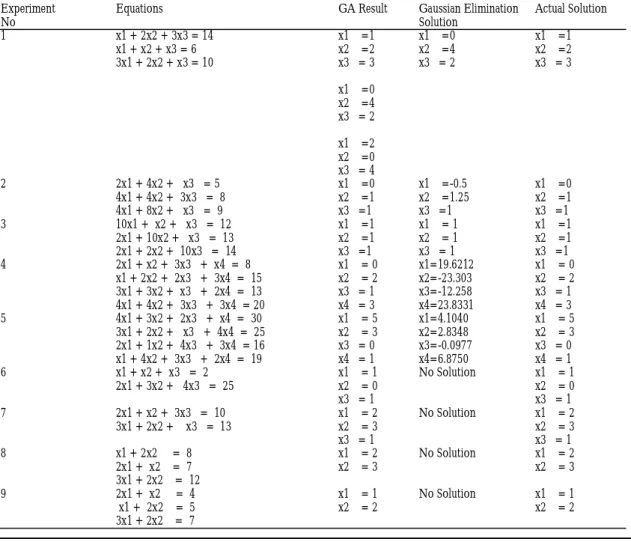
The GA Linear Equation Solver was run several times using different set of system of Linear Equations. The number of genera-tions was varied with a population size of 100 for each set of equation and different population sizes were selected with maxi-mum generation of 10 and 50 for each set of the equations. The various set of equations used is shown in the Table 1:
Table 1: Comparing Results from Genetic Algorithm Linear Equation Solver and Gaussian Elimination
Experiment No
Equations GA Result Gaussian Elimination
Solution
Actual Solution
1 x1 + 2x2 + 3x3 = 14
x1 + x2 + x3 = 6 3x1 + 2x2 + x3 = 10
x1 =1 x2 =2 x3 = 3 x1 =0 x2 =4 x3 = 2 x1 =2 x2 =0 x3 = 4
x1 =0 x2 =4 x3 = 2
x1 =1 x2 =2 x3 = 3
2 2x1 + 4x2 + x3 = 5 4x1 + 4x2 + 3x3 = 8 4x1 + 8x2 + x3 = 9
x1 =0 x2 =1 x3 =1
x1 =-0.5 x2 =1.25 x3 =1
x1 =0 x2 =1 x3 =1 3 10x1 + x2 + x3 = 12
2x1 + 10x2 + x3 = 13 2x1 + 2x2 + 10x3 = 14
x1 =1 x2 =1 x3 =1
x1 = 1 x2 = 1 x3 = 1
x1 =1 x2 =1 x3 =1 4 2x1 + x2 + 3x3 + x4 = 8
x1 + 2x2 + 2x3 + 3x4 = 15 3x1 + 3x2 + x3 + 2x4 = 13 4x1 + 4x2 + 3x3 + 3x4 = 20
x1 = 0 x2 = 2 x3 = 1 x4 = 3
x1=19.6212 x2=-23.303 x3=-12.258 x4=23.8331
x1 = 0 x2 = 2 x3 = 1 x4 = 3 5 4x1 + 3x2 + 2x3 + x4 = 30
3x1 + 2x2 + x3 + 4x4 = 25 2x1 + 1x2 + 4x3 + 3x4 = 16 x1 + 4x2 + 3x3 + 2x4 = 19
x1 = 5 x2 = 3 x3 = 0 x4 = 1
x1=4.1040 x2=2.8348 x3=-0.0977 x4=6.8750
x1 = 5 x2 = 3 x3 = 0 x4 = 1
6 x1 + x2 + x3 = 2
2x1 + 3x2 + 4x3 = 25
x1 = 1 x2 = 0 x3 = 1
No Solution x1 = 1 x2 = 0 x3 = 1 7 2x1 + x2 + 3x3 = 10
3x1 + 2x2 + x3 = 13
x1 = 2 x2 = 3 x3 = 1
No Solution x1 = 2 x2 = 3 x3 = 1
8 x1 + 2x2 = 8
2x1 + x2 = 7 3x1 + 2x2 = 12
x1 = 2 x2 = 3
No Solution x1 = 2 x2 = 3
9 2x1 + x2 = 4
x1 + 2x2 = 5 3x1 + 2x2 = 7
x1 = 1 x2 = 2
No Solution x1 = 1 x2 = 2
Effects of the number of Generations To investigate the effect of number of gen-erations on the genetic algorithm linear equation solver, the number of generations
was varied with a population size of 100 for each set of equation and the result reported in Tables 2, 3 and 4.
Table 2: Effect of varying maximum generation for Equation 1 Maximum
Generation Per Run
No. of Runs Required to obtain the closest/ best fitness
Best Fitness
10 2 1
20 9 1
30 12 1
40 15 1
50 18 1
Table 3: Effect of varying maximum generation for Equation 2 Maximum
Generation Per Run
No. of Runs Required to obtain the closest/ best fitness
Best Fitness
10 2 1
20 4 1
30 4 1
40 2 1
50 3 1
Table 4: Effect of varying maximum generation for Equation 3 Maximum
Generation Per Run
No. of Runs Required to obtain the closest/best fitness
Best Fitness
10 1 1
20 1 1
30 1 1
40 1 1
Effects of the population size
To investigate the effect of the population size, maximum generation of 10 and 50
were used on the genetic algorithm linear equation solver for each set of equations and the results reported in table 5, 6 and 7. Table 5: Effect of varying population size for Equation 1(3x3)
Max Gen Population No of Runs Best Fitness
10 50 3 1
10 100 2 1
10 150 1 1
10 200 3 1
10 250 3 1
50 50 >5 1
50 100 >5 1
50 150 1 1
50 200 2 1
50 250 2 1
Table 6: Effect of varying population size for Equation 2 (3x3) Max Gen Population No of Runs Best Fitness
10 50 6 1
10 100 2 1
10 150 2 1
10 200 4 1
10 250 8 1
50 50 3 1
50 100 3 1
50 150 2 1
50 200 3 1
50 250 3 1
Table 7: Effect of varying population size for Equation 4 (4x4) No of Runs Max Gen Population Best Fitness
>10 10 10 0.9943978
7 10 20 1
6 10 30 1
6 10 50 1
1 10 100 1
1 50 10 1
3 50 10 1
4 50 20 1
2 50 30 1
1 50 50 1
DISCUSSION
It was observed that small population size does not produce perfect solutions as fast as when large population size is used. Large population size guarantees wide search for candidate solutions, from which good and better solutions could be derived in succes-sive generations. However, as population size gets larger, it produces an overhead cost on the processing speed and storage. As the storage gets filled up with more can-didate solution solutions, it hampers the processing speed of the computer system on which the GA is being implemented. Thus, the population size should not be al-lowed to become outrageously large.
It was also observed that small or large number of generations did not really have so much impact on the attainment of per-fect solution as much as population size. At times small number of generations (e.g. 10) produces perfect results after a few runs of the GA program, while at some other times, large number of generations produces (e.g. 50 and above) perfect solutions after several runs of the program.
CONCLUSION
The efficiency of the GA program is de-pendent on the availability of enough stor-age and processing speed of the computer system being used for its implementation. Large population size is required for com-plex problem to obtain perfect solutions As the problem gets more complex, more stor-age and faster processing speed are required since larger population of candidate solu-tions guarantees attainment of good and better solutions in successive generations.
REFERENCES
Avni R., Adnan, M., Agni D. 2013. Analy-sis of the impact of parameters values on the Genetic Algorithm for TSP. International
Jour-nal of Computer Science Issues, 10
Benny R., 2000. Gaussian Elimination code in Java, Version 0.0.retrieved from http:// www.wiley.com/WileyCDA/WileyTitle/ productCd-0471487155.html
Fogel, D. B. 1998 Evolutionary Computa-tion. The Fossil Record, IEEE Press, New York.
Franz, Rothlauf 2006. Representations for
Ge-netic and Evolutionary Algorithms, Second
Edi-tion, Springer, USA
Goldberg, D. E 1989. Genetic Algorithms in Search, Optimization and Machine Learn-ing. Addison-Wesley, USA.
Holand J. L. 1975. Adaptation in Natural and
Artificial System Adaptation in Natural and Arti-ficial Systems: An Introductory Analysis with Ap-plications to Biology, Control, and Artificial Intelli-gence. University of Michigan Press, USA
Holland, J. L. 1994. The Self-Directed Search. Odessa, FL: Psychological Assessment
Resources
Ibrahiem M.. El Emary, M., Mona, M., Abd E . 2008. On the application of Genetic Algorithm in Fingerprint Registration. World
Applied Science Journal. 5(3): 276-281
Ikotun, A., Lawal, M., Olawale, N., Ade-lokun A. P. 2011. The Effectiveness of Ge-netic Algorithm in Solving Simultaneous Equations. International Journal of Computer
Applications 14(8):38–41
Optimisa-tion. Apex Research Limited, London.
Lawal, N. O. 2003. Genetic Programming: Applications. In: Econometrics. An MSc
Dissertation Submitted To The Department of Computer Sciences, School of Postgraduate Studies, University of Lagos, Lagos Nigeria.
Lipson, M., Lipschutz, S. 2001. Schaum's
outline of theory and problems of linear alge-bra.New York: McGraw-Hill.
Mafteiu-Scai L. O., Mafteiu-Scai E. J. 2013.Solving Linear Systems of Equations using a Memetic Algorithm. International
Journal of Computer Application. 58(13): 16-22
Marjan, K. R., Sadegh E. 2012. The Ef-fect of a New Generation Based Sequential Selection Operator on the Performance of Genetic Algorithm Indian Journal of Science and Technology. 5 (12):195-204
Mhetre, P. S. 2012. Genetic algorithm for linear and nonlinear equation. Int. Journal of
Advanced Engineering Technology. 3:114-118.
NiKos E. M. 2005. Solving Non-Linear
Equations Via Genetic Algorithms.
Proceed-ings of the 6th WSEAS Int. Conf. on Evolutionary Computing, Lisbon, Portugal, June 16-18.24-28
Olympia R., Stefka, F., Paprzycki, M. 2013. Influence of the Population Size on the Genetic Algorithm Performance in Case of Cultivation Process Modelling. Federated
Conference on Computer Science and Information Systems. 371–376
Roshni, V., Jignesh, P., Patel, S. 2012. Optimization of Linear Equations using Ge-netic Algorithms. Indian Journal of Applied
Re-search. 2(3): 56-58.
Sarac, V., Cvetkovski, G., 2011. Different motor models based on parameter variation using method of genetic algorithms .Electrical
Review. ISSN 0033-2097, R. 87 NR 3/2011
Turing, A.M. 1950. Computing Machinery and Intelligence .MIND, 59,433-460.
Michalewicz, Z. 1996. Genetic Algorithms +
Data Structures = Evolution Program, Third,
Revised and Expanded Edition, Springer,
USA.