S T U D Y P R O T O C O L
Open Access
Early specific cognitive-behavioural psychotherapy
in subjects at high risk for bipolar disorders: study
protocol for a randomised controlled trial
Andrea Pfennig
1*†, Karolina Leopold
1†, Andreas Bechdolf
2,3, Christoph U Correll
4, Martin Holtmann
5,
Martin Lambert
6, Carolin Marx
1, Thomas D Meyer
7, Steffi Pfeiffer
1, Andreas Reif
8, Maren Rottmann-Wolf
1,
Natalie M Schmitt
1, Thomas Stamm
9, Georg Juckel
10and Michael Bauer
1Abstract
Background:Bipolar disorders (BD) are among the most severe mental disorders with first clinical signs and symptoms frequently appearing in adolescence and early adulthood. The long latency in clinical diagnosis (and subsequent adequate treatment) adversely affects the course of disease, effectiveness of interventions and health-related quality of life, and increases the economic burden of BD. Despite uncertainties about risk constellations and symptomatology in the early stages of potentially developing BD, many adolescents and young adults seek help, and most of them suffer substantially from symptoms already leading to impairments in psychosocial functioning in school, training, at work and in their social relationships. We aimed to identify subjects at risk of developing BD and investigate the efficacy and safety of early specific cognitive-behavioural psychotherapy (CBT) in this subpopulation. Methods/Design:EarlyCBT is a randomised controlled multi-centre clinical trial to evaluate the efficacy and safety of early specific CBT, including stress management and problem solving strategies, with elements of mindfulness-based therapy (MBT) versus unstructured group meetings for 14 weeks each and follow-up until week 78. Participants are recruited at seven university hospitals throughout Germany, which provide in- and outpatient care (including early recognition centres) for psychiatric patients. Subjects at high risk must be 15 to 30 years old and meet the combination of specified affective symptomatology, reduction of psychosocial functioning, and family history for (schizo)affective disorders. Primary efficacy endpoints are differences in psychosocial functioning and defined affective symptomatology at 14 weeks between groups. Secondary endpoints include the above mentioned endpoints at 7, 24, 52 and 78 weeks and the change within groups compared to baseline; perception of, reaction to and coping with stress; and conversion to full BD.
Discussion:To our knowledge, this is the first study to evaluate early specific CBT in subjects at high risk for BD. Structured diagnostic interviews are used to map the risk status and development of disease. With our study, the level of evidence for the treatment of those young patients will be significantly raised.
Trial registration:WHO International Clinical Trials Platform (ICTRP), identifier: DRKS00000444, date of registration: 16 June 2010.
Keywords:Bipolar disorders, Early recognition, Early intervention, Cognitive-behavioural psychotherapy, Intervention study, Randomised controlled trial
* Correspondence:[email protected]
†Equal contributors
1Department of Psychiatry and Psychotherapy, Carl Gustav Carus University
Hospital, Technische Universität Dresden, Fetscherstrasse 74, 01307 Dresden, Germany
Full list of author information is available at the end of the article
Background
Bipolar disorders (BD) are among the most severe men-tal disorders. Lifetime prevalence estimates range from 1 to 5% [1-5]. They are associated with a recurrent or chronic course, insufficient clinical response, and psy-chosocial impairment in a substantial number of pa-tients. First clinical signs and symptoms frequently appear in adolescence and early adulthood (median age at disease onset 17.5 years) [6-8]. Usually there is, how-ever, a long lag before the correct diagnosis is estab-lished and treatment is often delayed for many years [6,7,9-13]. Delayed treatment and an increasing number of illness episodes have been associated with a decreased probability of response to treatment [14] and an ad-verse course of illness [15,16]. The combination of long undetected illness with no or inadequate treatment and significant psychosocial impairment renders early identification and intervention a vital role in disease management.
To date, there has been relatively little research into early identification and intervention in subjects at risk for BD. First at-risk criteria based on clinical presenta-tion and/or family history have been proposed and pilot evaluation data are available [17,18]. Moreover, structured diagnostic instruments for the prospective identification of at-risk constellations for BD have been developed and are currently validated [19,20]. These structured measures are applied in the present study. Regarding treatment in these at-risk states, in a recent systematic review [21] we identified three studies: an exploratory, controlled study of multi-family psycho-educational psychotherapy from the group of Fristad and colleagues [22], an open, uncontrolled easibility study of family-focussed therapy by Miklowitz et al. [23] and the subsequent randomised controlled study of the same group [24]. Treatment with the studied inter-ventions (in addition to treatment as usual, including psychopharmacology) showed a potential for symptom reduction and prevention of conversion to BD and a significantly faster recovery from initial mood symp-toms and more time in remission during follow-up compared to control conditions. The results, however, have to be interpreted with caution, because of the small sample sizes, permission of medication treat-ments in the intervention and control groups in all studies, and the lack of a control group or data on con-version in one study. Until now, there is no data on the efficacy of early cognitive-behavioural psychother-apy (CBT) in high-risk subjects for BD. In current clin-ical routine, neither screening for at-risk states nor specialised diagnostic processes are implemented, and even in cases that present with significant affective symptoms, no specific intervention is routinely offered before the full disorder manifests.
Objectives/hypotheses
CBT has been shown to be effective in BD (see [25,26]). Previous research suggested that, although there was no significant difference in overall recurrence rates, CBT is more effective than treatment as usual in bipolar pa-tients with few, as compared to those with many, epi-sodes in their history [27]. We therefore hypothesise that the intervention might be more effective in the early stages of disease and even more so in the prodromal phase.
We therefore aimed to conduct a prospective randomised controlled trial to compare an experimental intervention (early specific CBT including stress management and prob-lem solving strategies with eprob-lements of mindfulness-based therapy (MBT) in a group setting) against unstructured group meetings. We hypothesised that subjects randomly allocated to the experimental intervention show less psy-chosocial impairment and specified affective symptomatol-ogy at 14 weeks compared to subjects receiving the control intervention.
Methods/Design
Design of the study
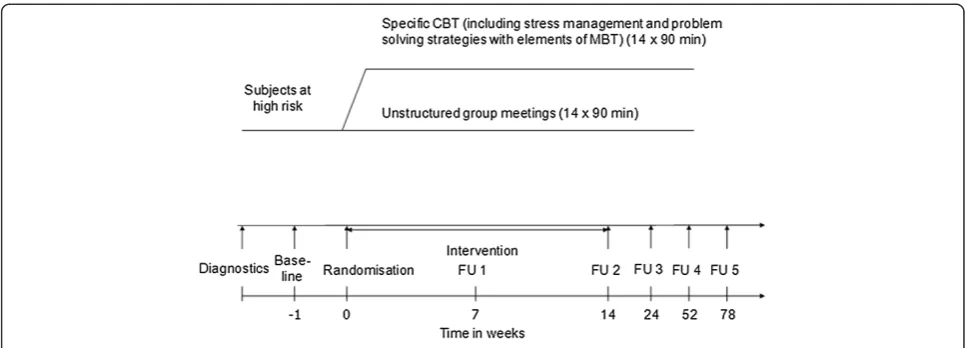
This is a randomised controlled multi-centre clinical trial to evaluate the efficacy and safety of a specific CBT for young people at-risk for BD versus unstructured group meetings for 14 weeks each with long-term follow-up until week 78. Figure 1 summarises the trial flow. Study subjects, outcome assessors, and the statistician are blinded to treat-ment allocation. The study is conducted according to good clinical practice (GCP) standards and has been approved by the responsible local ethical committees.
Description of intervention and control condition
modules of BEsT (be)for(e) Bipolar© include psycho-education about mental illnesses, and BD in particular, including treatment options, handling of early warning signs and crisis planning for prophylaxis, structuring of activities, cognitive strategies, and sensitisation for a balanced life rhythm. The control condition consists of un-structured group meetings where therapists are instructed to avoid therapeutic measures in any way possible. Both in-terventions are applied in groups of four to five subjects and in the same frequency and duration with 14 sessions each of 90 minutes within 14 weeks (one per week). To in-crease transparency and documentation as well as for ana-lysis and comparability, sessions are videotaped.
Setting and participants
Study participants were initially recruited at five, now at seven participating university centres which provide in-and outpatient care for patients with unipolar depressive and bipolar disorders (Department of Psychiatry and Psychotherapy, University Hospital Carl Gustav Carus Dresden; Department of Psychiatry, Ruhr University Hospital Bochum; Department of Psychiatry and Psycho-therapy, University Medical Center Hamburg-Eppendorf; Department of Child and Adolescent Psychiatry and Psy-chotherapy, LWL University Hospital Hamm; Department of Psychiatry, University Hospital Cologne; Department of Psychiatry and Psychotherapy, University Hospital Würzburg, Department of Psychiatry, Psychosomatics and Psychotherapy, Charité-University Medicine, CCM; all Germany). Most of them additionally run early recog-nition centres for psychoses and/or affective disorders.
Key inclusion criteria for subjects include:
Positive family history for affective and/or schizoaffective disorders (first and/or second degree relative)
Reduction in psychosocial functioning/coping with demands of daily living (measured by the Social
Interview Schedule, SIS, [32], German version: [33]) in the last 12 months compared to the previous 12 months
Specified affective symptomatology (sub-threshold mania and/or at least sub-threshold depression with cyclothymic features and/or cyclothymic features, definitions see below) (measured by the Early Phase Inventory for bipolar disorders (EPIbipolar, ©Pfennig and Leopold 2010, [19]) and the Bipolar Prodrome Symptom Scale (BPSS)-Prospective (©C Correll 2007, [20]) in the last 12 months compared to the previous 12 months
Aged 15 to 30 years
Language capacity to take part in the trial Written informed consent to participate in the
study.
[image:3.595.56.541.88.262.2]not meeting the definition of sub-threshold mania and numerous episodes with depressive symptoms.
Key exclusion criteria include:
A history of treated or untreated manic episode of at least four days duration (Structured Clinical
Interview forDiagnostic and Statistical Manual of Mental Disorders, 4th edition(DSM-IV) Disorders, SCID, in German: [34])
A history of treated or untreated psychosis of at least seven days duration (SCID)
Main symptomatology must not be present solely within the context of personality disorder or cyclothymia (SCID)
Organic brain disorder Acute suicidality
Severe, unstable medical condition (for example, cancer, neurological diseases)
Intake of psychotropic medication (only medication for sleep disturbances and a stable antidepressant medication with serotonin reuptake inhibitors (SSRIs), venlafaxine, duloxetine, mirtazapine or valdoxan (stable means intake for at least eight weeks) are allowed, all other drug doses must be tapered-down and stopped before randomisation).
Rationale for choosing the presented inclusion and ex-clusion criteria are as follows. First degree relatives of af-fected individuals have a ten-fold increased risk to also develop the disease compared to relatives of unaffected controls [35]. Twin and adoption studies have provided compelling evidence for heritable factors playing a major role in the pathogenesis of BD (see [36]). A genetically enriched population with first affective symptoms that already impact psychosocial functioning seemed to us the best way to identify subjects at high risk for develop-ing BD. Participants must not already be diagnosed as having unipolar or bipolar affective disorders but can be diagnosed as having cyclothymia, attention deficit/hyper-activity disorder (ADHD), personality disorder or psychosis of less than seven days duration, if the symptomatology is not explained solely by this diagnosis. In view of the often unspecific presentation of high-risk subjects, this ensures reduction of false-negative recruitment, while at the same time of course the risk for false-positive enrolment is in-creased. The pilot findings by Bechdolfet al. [17,18] which indicated conversion rates to four days of mania in up to 30% within 12 months, depending on the criteria applied, support this approach of inclusion criteria definition. The diagnostic procedure comprises using the SCID plus the result of a consensus board of two clinical psychiatrists per centre.
Subjects in both treatment groups are allowed to use unstructured consultations with their usual treating
physician at any time. After the intervention period, subjects in both groups are allowed to use unstruc-tured psychotherapy sessions and psychopharmacother-apy if needed (restricted to intermittent symptomatic treatment of unspecific symptoms such as sleep distur-bances and anxiety/agitation administered no longer than seven days). As mentioned, a stable antidepressant medi-cation with SSRI, venlafaxine, duloxetine, mirtazapine or valdoxan (stable means intake for at least eight weeks) is allowed at randomisation and can be prolonged during the study. Formal, structured psychotherapy and psycho-pharmacotherapy other than described before results in study drop-out.
As mentioned in the inclusion criteria, written in-formed consent is obtained from each subject after thor-ough information about the study has been provided.
Outcome measures
Primary efficacy endpoints:
Psychosocial functioning/coping with demands of daily living (SIS) at 14 weeks
Specified affective symptomatology (Hamilton Rating Scale for Depression (HAMD, [37]), Young Mania Rating Scale (YMRS, [38]), EPIbipolar, BPSS) at 14 weeks
Key secondary endpoints:
SIS at 7, 24, 52 and 78 weeks
Mini version of the International Classification of Functioning, Disability and Health for Mental Disorders (MINI-ICF-P, [39,40]) at 7, 14, 24, 52 and 78 weeks
Specified affective symptomatology (HAMD, YMRS, EPIbipolar, BPSS) at 7, 24, 52 and 78 weeks
Perception of, reaction to and coping with stress: Alltags-Belastungs-Fragebogen (ABF, [41]), Trierer Inventar zum chronischen Stress (TICS, [42]), Stress-Reaktivitäts-Skala (SRS, [43]), Fragebogen zum Umgang mit Belastungen im Verlauf (UBV, [44]), Fragebogen zur Erfassung von Ressourcen und Selbstmanagementfähigkeiten (FERUS, [45]) at 7, 14, 24, 52 and 78 weeks
Development of bipolar disorders at 52 and 78 weeks (SCID).
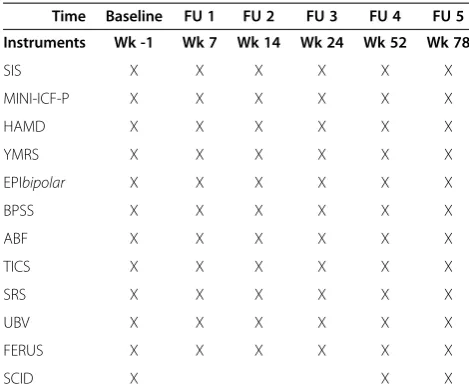
Assessment of safety: structured assessment of adverse events (GCP standard, interview: description of type, se-verity and relation to intervention). See Table 1 for an overview of instruments applied.
sensitive measure of changes in psychosocial functioning that in turn highly influences the long-term outcome of the disorder. Our study population consists of subjects at high risk for developing BD; they do not fulfill the diagnosis (yet) but already show impairment of psycho-social functioning. Improving this should have a great impact on the course of the disease development either by postponing/alleviating or even preventing the full-blown disorder. Additionally, we use the change in affective symptomatology as a primary endpoint since psychosocial functioning is only in part explained by psychiatric symptomatology.
To get an idea about adherence on the therapist’s part to the treatment manual or instructions regarding the control group setting, videotaped treatment sessions which have been developed based on the German adapted version of the Cognitive Therapy Scale for Psychosis [46] by Wittorfet al. [47], will be reviewed. Adherence on the subject’s part is assessed by checking on partici-pation in the sessions as well as home work comple-tion in the active intervencomple-tion groups.
Blinding and methods against bias
An independent statistician uses a centrally computer-generated block-designed randomisation procedure strati-fied by centre. Only the principal investigator of the study (AP) and the psychotherapist of the individual centre are
notified of the randomisation result; subjects and outcome assessors are kept blinded. The statistician who will later analyse the study results is kept blinded throughout the whole study.
An intensive three days training of GCP, study proce-dures and applied instruments was provided to psycho-therapists and raters before onset of the study to minimise differences between centres. Regular trainings are pro-vided throughout the study. All group sessions (in the intervention and control groups) are videotaped and stored for analysis. The trial is managed with help of the departmental clinical trial centre.
To ensure the performance according to the study protocol and the quality of the study monitoring is per-formed in each study centre at appointed time intervals and as needed (at least per centre once at initiation of the study, once after the first subject was randomised, once after 1/3, 2/3 and 3/3 of subjects were recruited, and once when the last subject completed the study), the monitoring process is performed according to pre-pared standard operating procedures (SOPs). The moni-tor checks completeness and plausibility of the data and aligns the study data to the original data (Source Data Verification). This is accomplished by accessing the ori-ginal subjects’charts; the subjects will give their permis-sion to that procedure within the informed consent form. The monitor ensures the basic claim of integrity and protection of the subjects’privacy. If not all data are examined, the monitor must justify that procedure and must pull a proper random sample for the check.
Supervision of the trial is present in the form of a sci-entific advisory board including members especially ex-perienced in assuring data quality and safety. They also supervised the development of the application protocol and the progress of the trial including decision making on whether to perform interim analyses or modify/stop the trial in cases of unforeseen problems arising.
Power
Sample size for the ANCOVA will be approximated with the two-sided unpaired t-test. The primary outcome measure is the difference in the adapted overall social maladjustment score. Here, the number of items in the categories M and S with a rating of 2, 3 or 4 is divided by the number of applicable items in the categories M and S. With an estimated effect size of about 0.5, a sample size of 2 times 50 patients is required to show this difference with a power of 80% and an alpha of 5% (calculated with G*Power 3.1.2).
[image:5.595.55.290.99.295.2]We assume that the compliance will be relatively good here since the intervention does not result in major side effects and the subjects already experience symptoms. However, we assume conservatively that there will be about a 30% drop-out rate, an estimate that was accounted
Table 1 Instruments applied at individual study visits
Time Baseline FU 1 FU 2 FU 3 FU 4 FU 5
Instruments Wk -1 Wk 7 Wk 14 Wk 24 Wk 52 Wk 78
SIS X X X X X X
MINI-ICF-P X X X X X X
HAMD X X X X X X
YMRS X X X X X X
EPIbipolar X X X X X X
BPSS X X X X X X
ABF X X X X X X
TICS X X X X X X
SRS X X X X X X
UBV X X X X X X
FERUS X X X X X X
SCID X X X
for in the sample size estimation. Follow-up of subjects that drop out of the study will last for the planned duration of the study.
Statistical analysis
Efficacy: two-group comparison of the psychosocial functioning/coping with demands of daily living (SIS, MINI-ICF-P), specified affective symptomatology in-cluding mood swings (HAMD, YMRS, EPIbipolar, BPSS-P) and difference in perception of, reaction to and coping with stress (ABF, TICS, SRS, UBV, FERUS) at 7, 14, 24, 52 and 78 weeks with baseline values as covariates. In all cases, the 14-week value is the primary time-point of interest. A repeated measures analysis will be carried out as a secondary result.
Description of the primary efficacy analysis: ANCOVA with SIS at 14 weeks and separately with specified affective symptomatology at 14 weeks as dependent variable and baseline SIS, affective symptomatology, centre, age, sex, education and group as covariates. We will also look into influence of the therapist on results by additionally includ-ing that variable, if not highly correlated with the variable centre, into the ANCOVA. Population: intention-to-treat (ITT) analysis with last observation carried for-ward (LOCF) in case of missing values.
Secondary endpoints:
Difference between the groups in MINI-ICF-P at 7, 14, 24, 52 and 78 weeks with baseline values as covariates
Change in specified affective symptomatology including mood swings at 7, 24, 52 and 78 weeks compared to baseline within each group
Difference between the groups in perception of, reaction to and coping with stress at 7, 14, 24, 52 and 78 weeks with baseline values as covariates Difference between the groups in SIS at 7, 24, 52
and 78 weeks with baseline values as covariates Difference between the groups in rates of developing
bipolar disorders at 52 and 78 weeks
Safety: assessment of frequency and type of unwanted effects at 7, 14, 24, 52 and 78 weeks compared to baseline within the groups and difference between the groups.
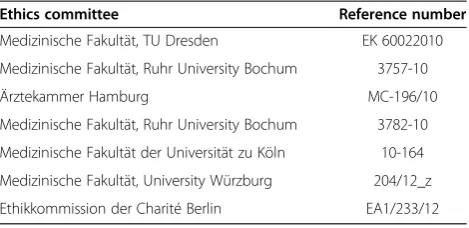
The study was approved by the respective ethics com-mittees of all participating study centres (see Table 2).
Discussion
To our knowledge, this is the first study to evaluate early specific cognitive-behavioural psychotherapy in subjects at high risk for BD. We hypothesise that subjects ran-domly allocated to early specific CBT, including stress management and problem solving strategies with ele-ments of MBT in a group setting, show less reduction in
psychosocial functioning and less specified affective symptoms at 14 weeks compared to subjects receiving unstructured group meetings.
Limitations
One possible limitation of external validity relates to re-cruitment in university hospitals in urban areas of Germany and selection of patients that utilise the healthcare system or an early recognition centre. People who do not seek (medical) advice and help may show different characteris-tics and worse treatment effects.
Diagnostic measures in early stages of disease develop-ment may show limited precision. The predictive validity of the used at-risk state definitions are currently assessed in validation studies (for example, [20]). Consequences of false positive ‘diagnoses’may result in additional psy-chosocial impairment, including worry about possible psychiatric disease and unneeded treatment causing pre-ventable adverse drug reactions and/or adverse effects of interventions. However, CBT as a non-pharmacological intervention with a low risk of adverse events seems to be appropriate from the risk-benefit perspective.
The follow-up time of the study is restricted to 78 weeks per individual, which will not be long enough to detect all cases of conversion to manifest disorder. Each participat-ing centre agreed to extend the follow-up time to as long as possible within their clinical or early recognition centre routine.
The therapeutic manual was only developed shortly before starting the study, so its efficacy had not been previously assessed. Feasibility was tested in the early recognition centre in Dresden; however, use in a multi-centre study is only practiced within the present study.
Naturally, the therapist can not be blinded to type of intervention. The subjects are kept blinded and are only sketchily informed about the content and design of the intervention to be studied.
[image:6.595.305.540.111.225.2]We decided against a third study arm providing a wait-list control condition. Therefore we cannot measure the effect of meeting in a groupper se.
Table 2 Ethics committees of the participating study centres
Ethics committee Reference number
Medizinische Fakultät, TU Dresden EK 60022010
Medizinische Fakultät, Ruhr University Bochum 3757-10
Ärztekammer Hamburg MC-196/10
Medizinische Fakultät, Ruhr University Bochum 3782-10
Medizinische Fakultät der Universität zu Köln 10-164
Medizinische Fakultät, University Würzburg 204/12_z
To reach the estimated sample size, recruitment pro-cesses were established and interconnections between departments and early detection services with local ser-vices and each other were strengthened. Continuous outreach work is performed.
Strengths
The study has several major strengths: the high-risk sta-tus is assessed and followed-up by the currently relevant diagnostic instruments available to the investigators. Also, the study is timely: treatment options for the high-risk clientele are needed with subjects suffering from impairment. Here, early on, one strategy is scien-tifically assessed for efficacy and safety. In a rando-mised controlled fashion with blinded subjects, outcome assessors and statistician, the control condition is matched as far as possible to the intervention with regard to fre-quency and duration, group character and participation of a trained psychologist or psychotherapist. Trainings and monitoring for therapists and raters are conducted on a regular basis.
The multi-centre character of the study increases sam-ple size and generalizability of the results. The cooperat-ing centres in the study are leadcooperat-ing clinical and research centres for high-risk individuals for psychosis and BD. In 2009, they founded the ‘Network for Early Recognition and Intervention in Bipolar Disorders’ (NERIBID, [48]). The aim of the network is to cooperatively develop and perform research projects and to develop clinical and re-search standards for our centres.
Relevance of study for clinical practice and future research
Our approach to identify patients with a positive family history in potentially early stages of BD is comparable to that in high-risk subjects for psychosis. In the present study, clinical presentation, impairment of psychosocial functioning, and family history is combined to define persons at risk of a significant conversion risk.
Studies show that cognitive-behavioural psychotherapy (CBT) is effective in patients with BD in reducing symp-tomatology. Scottet al. [27] showed that although there was no significant difference in overall recurrence rates, CBT was more effective than treatment as usual in pa-tients with few compared to those with many recurrent bipolar episodes in their history. We therefore suggest that the intervention might be more effective in the early stages of disease and so even more in the prodromal phase. In persons at risk for psychosis, CBT was shown to be effective in alleviating symptomatology. The transi-tion risk was reduced as long as the interventransi-tion (psycho-pharmacological and psychotherapeutic) could reduce the symptomatology. After the end of the intervention how-ever, general transition rates increased and then almost
equalled that of the group without intervention; see [49-53]. There were however, as stated above, enduring effects of CBT in that the likelihood of being pre-scribed antipsychotics in the three-year follow-up was reduced ([50]). Interestingly, in the group of subjects with psychological vulnerabilities targeted by the inter-vention, the transition risk to psychosis was also sig-nificantly reduced [49,50]. In full-blown schizophrenia, of course, CBT without psychopharmacology would be not effective enough [54].
Additionally, we suggest that the components of the studied intervention tackle symptomatology associated with the factors that influence components of the vulnerability-stress-system (for example, sleep regulation, stress manage-ment and handling of personality features) and, therefore, should be best suited to alleviate/postpone or even prevent onset/conversion to BD. Most importantly, evidence of the effectiveness and adverse events of CBT in subjects at high risk for BD is missing so that our study will answer this clinically relevant question regardless of the study results.
If efficacy of early specific CBT can be demonstrated by our trial, the level of evidence of the treatment of subjects at high risk for BD will be significantly raised. Subsequently, future research should adopt and evaluate the effectiveness of such a tailored intervention in less highly-selected populations in routine care. The results of the proposed study could be used to establish pre-ventive strategies for BD that are adequate from the risk-benefit perspective.
Trial status
Ongoing, start of recruitment: August 2010, first patient: October 2010, 50% randomised: March 2013.
Abbreviations
ABF:Alltags-Belastungs-Fragebogen; ADHD: attention deficit/hyperactivity disorder; BD: bipolar disorder; BPSS: Bipolar Prodrome Symptom Scale-Prospective; CBT: cognitive-behavioural psychotherapy; DSM-IV:Diagnostic and Statistical Manual of Mental Disorders, 4th edition; EPIbipolar: Early Phase Inventory for bipolar disorders; FERUS: Fragebogen zur Erfassung von Ressourcen und Selbstmanagementfähigkeiten; FU: follow-up; GCP: good clinical practice; HAMD: Hamilton Depression Symptom Scale 17 item version; ITT: intention-to-treat analysis; LOCF: last observation carried forward; MBT: mindfulness-based therapy; MINI-ICF-P: Mini version of the International Classification of Functioning, Disability and Health for Mental Disorders; NERIBID: Network for Early Recognition and Intervention in Bipolar Disorders; SCID: Structured Clinical Interview for DSM-IV Disorders.
Competing interests
The authors declare that they have no competing interests.
Authors’contributions
of the manuscript. TDM: design of the study, critical revision and final approval of the manuscript. SP: data collection, critical revision and final approval of the manuscript. AR: data collection, critical revision and final approval of the manuscript. MRW: data collection, critical revision and final approval of the manuscript. NMS: data collection, drafting and final approval of the manuscript. TS: data collection, critical revision and final approval of the manuscript. MB: conception and design of the study, critical revision and final approval of the manuscript. All authors read and approved the final manuscript.
Authors’information
Andrea Pfennig and Karolina Leopold share the first authorship.
Acknowledgements
The study is supported the German Research Foundation (DFG), grant BA 1504/7-1.
Author details 1
Department of Psychiatry and Psychotherapy, Carl Gustav Carus University Hospital, Technische Universität Dresden, Fetscherstrasse 74, 01307 Dresden, Germany.2Department of Psychiatry, Psychotherapy and Psychosomatics, Vivantes Hospital Urban, Berlin, Germany.3Department of Psychiatry and Psychotherapy, University Hospital Cologne, Cologne, Germany.4Division of Psychiatry Research, The Zucker Hillside Hospital, Glen Oaks, NY, USA.5Child and Adolescent Psychiatry, LWL-University Hospital for Child and Adolescent Psychiatry, Ruhr-University Bochum, Hamm, Germany.6Psychosis Centre, Department of Psychiatry and Psychotherapy, Center of Psychosocial Medicine, University Medical Centre Hamburg-Eppendorf, Hamburg, Germany.7Institute of Neuroscience, Newcastle University, Newcastle upon Tyne, UK.8Department of Psychiatry, Psychosomatics and Psychotherapy, University Hospital Würzburg, Würzburg, Germany.9Department of Psychiatry and Psychotherapy, Charite-University Medicine Berlin, Berlin, Germany. 10
LWL University Hospital and Department of Psychiatry, Psychotherapy and Preventive Medicine, Ruhr University Bochum, Hamm, Germany.
Received: 6 February 2014 Accepted: 8 April 2014 Published: 8 May 2014
References
1. Pini S, de Queiroz V, Pagnin D, Pezawas L, Angst J, Cassano GB, Wittchen HU:
Prevalence and burden of bipolar disorders in European countries.Eur Neuropsychopharmacol2005,15:425–434.
2. Bauer M, Pfennig A:Epidemiology of bipolar disorders.Epilepsia2005,
46(Suppl 4):8–13.
3. Waraich P, Goldner EM, Somers JM, Hsu L:Prevalence and incidence studies of mood disorders: a systematic review of the literature.Can J Psychiatry2004,49:124–138.
4. Merikangas KR, Akiskal HS, Angst J, Greenberg PE, Hirschfeld RM, Petukhova M, Kessler RC:Lifetime and 12-month prevalence of bipolar spectrum disorder in the National Comorbidity Survey replication.Arch Gen Psychiatry2007,
64:543–552.
5. Merikangas KR, Jin R, He JP, Kessler RC, Lee S, Sampson NA, Viana MC, Andrade LH, Hu C, Karam EG, Ladea M, Medina-Mora ME, Ono Y, Posada-Villa J, Sagar R, Wells JE, Zarkov Z:Prevalence and correlates of bipolar spectrum disorder in the world mental health survey initiative.Arch Gen Psychiatry
2011,68:241–251.
6. Lish JD, Dimemeenan S, Whybrow PC, Price RA, Hirschfeld RMA:The National Depressive and Manic-Depressive Association (Dmda) survey of bipolar members.J Affect Disord1994,31:281–294.
7. Perlis RH, Miyahara S, Marangell LB, Wisniewski SR, Ostacher M, DelBello MP, Bowden CL, Sachs GS, Nierenberg AA:Long-term implications of early onset in bipolar disorder: data from the first 1000 participants in the systematic treatment enhancement program for bipolar disorder (STEP-BD).Biol Psychiatry2004,55:875–881.
8. Kupfer DJ, Frank E, Grochocinski VJ, Cluss PA, Houck PR, Stapf DA:
Demographic and clinical characteristics of individuals in a bipolar disorder case registry.J Clin Psychiatry2002,63:120–125.
9. Hirschfeld RMA, Lewis L, Vornik LA:Perceptions and impact of bipolar disorder: how far have we really come? Results of the National Depressive and Manic-Depressive Association 2000 survey of individuals with bipolar disorder.J Clin Psychiatry2003,64:161–174.
10. Oedegaard KJ, Syrstad VEG, Morken G, Akiskal HS, Fasmer OB:A study of age at onset and affective temperaments in a Norwegian sample of patients with mood disorders.J Affect Disord2009,118:229–233. 11. Pfennig A, Jabs B, Pfeiffer S, Weikert B, Leopold K, Bauer M:
Versorgungserfahrungen bipolarer Patienten in Deutschland: Befragung vor Einführung der S3-Leitlinie zur Diagnostik und Therapie bipolarer Störungen.Nervenheilkunde2011,30:333–340.
12. Morken G, Vaaler AE, Folden GE, Andreassen OA, Malt UF:Age at onset of first episode and time to treatment in in-patients with bipolar disorder.
Br J Psychiatry2009,194:559–560.
13. Post RM, Luckenbaugh DA, Leverich GS, Altshuler LL, Frye MA, Suppes T, Keck PE, McElroy SL, Nolen WA, Kupka R, Grunze H, Walden J:Incidence of childhood-onset bipolar illness in the USA and Europe.Br J Psychiatry
2008,192:150–151.
14. Berk M, Brnabic A, Dodd S, Kelin K, Tohen M, Malhi GS, Berk L, Conus P, McGorry PD:Does stage of illness impact treatment response in bipolar disorder? Empirical treatment data and their implication for the staging model and early intervention.Bipolar Disord2011,13:87–98.
15. Post RM, Leverich GS, Kupka RW, Keck PE Jr, McElroy SL, Altshuler LL, Frye MA, Luckenbaugh DA, Rowe M, Grunze H, Suppes T, Nolen WA:Early-onset bipolar disorder and treatment delay are risk factors for poor outcome in adulthood.J Clin Psychiatry2010,71:864–872.
16. Post RM, Fleming J, Kapczinski F:Neurobiological correlates of illness progression in the recurrent affective disorders.J Psychiatr Res2012,
46:561–573.
17. Bechdolf A, Nelson B, Cotton SM, Chanen A, Thompson A, Kettle J, Conus P, Amminger GP, Yung AR, Berk M, McGorry PD:A preliminary evaluation of the validity of at-risk criteria for bipolar disorders in help-seeking adolescents and young adults.J Affect Disord2010,127:316–320. 18. Bechdolf A, Ratheesh A, Wood SJ, Tecic T, Conus P, Nelson B, Cotton SM,
Chanen AM, Amminger GP, Ruhrmann S, Schultze-Lutter F, Klosterkötter J, Fusar Poli P, Yung AR, Berk M, McGorry PD:Rationale and first results of developing at-risk (prodromal) criteria for bipolar disorder.Curr Pharm Des2012,18:358–375.
19. Leopold K, Ritter P, Correll CU, Marx C, Ozgurdal S, Juckel G, Bauer M, Pfennig A:Risk constellations prior to the development of bipolar disorders: rationale of a new risk assessment tool.J Affect Disord2012,
136:1000–1010.
20. Correll CU, Olvet D, Auther A, Hauser M, Kishimoto T, Snyder S, Carrion RE, Cornblatt B:The bipolar prodrome symptom scale-prospective: scale description and validation in a clinical high risk psychiatric sample and healthy controls.Bipolar Disord, in press.
21. Pfennig A, Correll CU, Marx C, Rottmann-Wolf M, Meyer TD, Bauer M, Leopold K:
Psychotherapeutic interventions in individuals at risk of developing bipolar disorder: a systematic review.Early Interv Psychiatry2014,8:3–11.
22. Nadkarni RB, Fristad MA:Clinical course of children with a depressive spectrum disorder and transient manic symptoms.Bipolar Disord2010,
12:494–503.
23. Miklowitz DJ, Chang KD, Taylor DO, George EL, Singh MK, Schneck CD, Dickinson LM, Howe ME, Garber J:Early psychosocial intervention for youth at risk for bipolar I or II disorder: a one-year treatment development trial.Bipolar Disord2011,13:67–75.
24. Miklowitz DJ, Schneck CD, Singh MK, Taylor DO, George EL, Cosgrove VE, Howe ME, Dickinson LM, Garber J, Chang KD:Early intervention for symptomatic youth at risk for bipolar disorder: a randomized trial of family-focused therapy.J Am Acad Child Adolesc Psychiatry2013,
52:121–131.
25. Hautzinger M, Meyer TD:Psychotherapy for bipolar disorder : a systematic review of controlled studies.Nervenarzt2007,78:1248–1260. 26. Rouget BW, Aubry JM:Efficacy of psychoeducational approaches on
bipolar disorders: a review of the literature.J Affect Disord2007,98:11–27. 27. Scott J, Paykel E, Morriss R, Bentall R, Kinderman P, Johnson T, Abbott R,
Hayhurst H:Cognitive-behavioural therapy for severe and recurrent bipolar disorders: randomised controlled trial.Br J Psychiatry2006,
188:313–320.
28. Schaub A, Bernhard B, Gauck L:Kognitive psychoedukative Therapie bei bipolaren Erkrankungen.Göttingen: Hogrefe; 2004.
29. Meyer TD, Hautzinger M:Manisch-depressive Störungen - Kognitive Verhaltenstherapie zur Rückfallprophylaxe.Beltz: Weinheim; 2004.
31. Bechdolf A, Juckel G:Psychoedukation bei Personen mit erhöhtem Psychoserisiko.Stuttgart: Schattauer; 2006.
32. Clare AW, Cairns VE:Design, development and use of a standardized interview to assess social maladjustment and dysfunction in community studies.Psychol Med1978,8:589–604.
33. Faltermaier T, Wittchen HU, Ellmann R, Lassle R:The Social Interview Schedule (SIS) - content, structure and reliability.Soc Psychiatry1985,
20:115–124.
34. Wittchen HU, Zaudig M, Fydrich T:Strukturiertes Klinisches Interview für DSM-IV.Göttingen: Hogrefe; 1997.
35. Smoller JW, Finn CT:Family, twin, and adoption studies of bipolar disorder.Am J Med Genet2003,123C:48–58.
36. McGuffin P, Rijsdijk F, Andrew M, Sham P, Katz R, Cardno A:The heritability of bipolar affective disorder and the genetic relationship to unipolar depression.Arch Gen Psychiatry2003,60:497–502.
37. Hamilton M:A rating scale for depression.J Neurol Neurosurg Psychiatry
1960,23:56–62.
38. Young RC, Biggs JT, Ziegler VE, Meyer DA:Rating-scale for mania - reliability, validity and sensitivity.Br J Psychiatry1978,133:429–435.
39. Linden M, Baron S:The‘Mini-ICF-Rating for Mental Disorders (Mini-ICF-P)’. A short instrument for the assessment of disabilities in mental disorders.
Rehabilitation (Stuttg)2005,44:144–151.
40. Juckel G, Schaub D, Fuchs N, Naumann U, Uhl I, Witthaus H, Hargarter L, Bierhoff HW, Brune M:Validation of the Personal and Social Performance (PSP) scale in a German sample of acutely ill patients with
schizophrenia.Schizophr Res2008,104:287–293.
41. Traue HC, Hrabal V, Kosarz P:Alltagsbelastungsfragebogen (ABF): Zur inneren Konsistenz, Validierung und Stressdiagnostik mit dem Daily Stress Inventory.Verhaltenstherapie und Verhaltensmedizin2000,
21:15–38.
42. Schulz P, Schlotz W, Becker P:TICS. Trierer Inventar zum chronischen Stress. Testmappe mit Manual.Göttingen: Hogrefe; 2004.
43. Schulz P, Jansen JK, Schlotz W:Stressreaktivität: Theoretisches Konzept und Messung.Diagnostica2005,51:124–133.
44. Reicherts M, Perrez M:Fragebogen zum Umgang mit Belastungen im Verlauf. Testmappe mit Handanweisung.Bern: Huber; 1993.
45. Jack M:Entwicklung eines ressourcen- und selbstmanagementorientierten Evaluationsinstrumentes zur psychotherapeutischen Informationsgewinnung und Qualitätssicherung in der stationären Psychosomatik.Regensburg: Roderer; 2001.
46. Haddock G, Devane S, Bradshaw T, McGovern J, Tarrier N, Kinderman P, Baguley I, Lancashire S, Harris N:An investigation into the psychometric properties of the cognitive therapy scale for psychosis (CTS-Psy).Behav Cogn Psychother2001,29:221–233.
47. Wittorf A, Jakobi U, Klingberg S:German Translation of the CTS-PSY.
Tuebingen: University of Tuebingen; 2007.
48. Pfennig A, Correll CU, Leopold K, Juckel G, Bauer M:Early recognition and intervention for bipolar disorders: state of research and perspectives.
Nervenarzt2012,83:897–902.
49. Morrison AP, French P, Walford L, Lewis SW, Kilcommons A, Green J, Parker S, Bentall RP:Cognitive therapy for the prevention of psychosis in people at ultra-high risk: randomised controlled trial.Br J Psychiatry
2004,185:291–297.
50. Morrison AP, French P, Parker S, Roberts M, Stevens H, Bentall RP, Lewis SW:
Three-year follow-up of a randomized controlled trial of cognitive therapy for the prevention of psychosis in people at ultrahigh risk.
Schizophr Bull2007,33:682–687.
51. Addington J, Epstein I, Liu L, French P, Boydell KM, Zipursky RB:A randomized controlled trial of cognitive behavioral therapy for individuals at clinical high risk of psychosis.Schizophr Res2011,
125:54–61.
52. Yung AR, Phillips LJ, Nelson B, Francey SM, PanYuen H, Simmons MB, Ross ML, Kelly D, Baker K, Amminger GP, Berger G, Thompson AD, Thampi A, McGorry PD:Randomized controlled trial of interventions for young people at ultra high risk for psychosis: 6-month analysis.
J Clin Psychiatry2011,72:430–440.
53. Morrison AP, French P, Stewart SL, Birchwood M, Fowler D, Gumley AI, Jones PB, Bentall RP, Lewis SW, Murray GK, Patterson P, Brunet K, Conroy J, Parker S, Reilly T, Byrne R, Davies LM, Dunn G:Early detection and intervention evaluation for people at risk of psychosis: multisite randomised controlled trial.BMJ2012,344:e2233.
54. Jones C, Hacker D, Cormac I, Meaden A, Irving CB:Cognitive behaviour therapy versus other psychosocial treatments for schizophrenia.
Cochrane Database Syst Rev2012,4:CD008712. doi:10.1186/1745-6215-15-161
Cite this article as:Pfenniget al.:Early specific cognitive-behavioural psychotherapy in subjects at high risk for bipolar disorders: study protocol for a randomised controlled trial.Trials201415:161.
Submit your next manuscript to BioMed Central and take full advantage of:
• Convenient online submission
• Thorough peer review
• No space constraints or color figure charges
• Immediate publication on acceptance
• Inclusion in PubMed, CAS, Scopus and Google Scholar
• Research which is freely available for redistribution