Available online throug
ISSN 2229 – 5046
NON-NEWTONIAN MHD FLOW WITH HEAT AND MASS TRANSFER
DUE TO AN EXPONENTIAL STRETCHING POROUS SHEET
Dr VEENA P H*
Asso. Prof. Smt V G College for Women, Gulbarga, Karnataka, India.
Dr J PHAKIRAPPA
Asso. Prof. R Y M Engg. College, Bellary, Karnataka, India.
Smt. PRIYANKA SAPALI
Research Scholar, VTU, Belgaum, Karnataka, India.
(Received On: 21-02-18; Revised & Accepted On: 21-04-18)
ABSTRACT
N
on-Newtonian MHD flow with heat and mass transfer in an electrically conducting fluid over an exponential stretching continuous porous sheet have been investigated in the present paper. Similarity analytical solution for highly non-linear momentum equation is obtained and the solution for heat and mass transfer analyses are obtained in terms of confluent hyper geometric functions. Accuracy of the analytical solution for the stream function is validated by drawing various graphs. These solutions involve an exponential dependent of stretching velocity, prescribed boundary temperature on the flow directionally coordinate. The effects of various physical parameters like visco-elastic parameter, Magnetic parameter, Prandtl number, Permeability parameter, Reynolds number, Nusslet number, Shrewood number and Eckert number on momentum, heat and mass transfer characteristics are discussed in detail Keywords: Stretching sheet; Viscoelastic fluid; MHD; Porous medium; Mass transfer.I.INTRODUCTION
Ever increasing industrial applications in the manufacture of plastic film and artificial fiber materials, in recent years, has led to a renewed interest in the study of visco-elastic boundary layer fluid flow, heat and mass transfer over a stretching sheet. Until recently, this study has been largely concerned with the mathematical analysis of the flow characteristics and heat transfer behaviours only in the visco-elastic fluid flow of the type Walter’s liquid B and Second order fluid (Rajagopal et al. [1], Siddappa and Abel [2], Gupta and Sridhar [3], Siddappa and Abel[4], Rajagopal et al. [5], Bujurke et al. [6], Dandapat and gupta [7], Rollis and Vajravelu [8], Lawrence and Rao [9], Siddappa et al. [10], Abel and Veena[11], Prasad et al. [12], and Abel et al. [13]). In some applications of dilute polymer solution, such as the 5.4% solution of polyisobutylene in cetane. The viscoelastic fluid flows occur over a stretching sheet studied by [14]. Troy et al. [15] discussed uniqueness of the solution of momentum boundary layer equation. Subsequently Change [16] and Rao [17] showed the non-uniqueness of the solution and derived different forms of non-uniqueness of the solution. Magnetic field might play an important role in controlling momentum, heat and mass transfers in the visco-elastic boundary layer flow over a stretching sheet, having some specific industrial applications such as in polymer technology and metallurgy [18-20]. Keeping this view in mind, Andersson [18] studied a magneto – hydrodynamic [MHD] flow of Walters’ liquid B past a stretching sheet without consideration of suction / blowing. Char [19] presented an exact solution for the heat and mass transfer phenomena in MHD flow of a visco-elastic fluid over a stretching surface. Subsequently, Lawrence and Rao [20] Presented an analysis on the non-uniqueness of the MHD flow of a visco-elastic fluid past a stretching surface and derived two closed form solutions.
Numerous applications of viscoelastic fluids in several industrial manufacturing processes have led to renewed interest among researchers to investigate visco-elastic boundary layer flow over a stretching plastic sheet Cortell [21]. Some of the typical applications of such study are polymer sheet extrusion from a dye, glass fiber and paper production, drawing of plastic films etc. A great deal of literature is available including those cited above on the two-dimensional viscoelastic boundary layer flow over a stretching surface where the velocity of the stretching surface is assumed linearly proportional to the distance from a fixed origin.
Corresponding Author: Dr Veena P H*,
One of the important aspects in this theoretical study is the investigation of heat transfer processes. This is due to the fact that the rate of cooling influences a lot to the quality of the product with desired characteristics. In view of this Ali [22] investigated thermal boundary layer by considering a power law stretching surface. A new dimension has been added to this investigation by Elabashbeshy [23] who examined the flow and heat transfer characteristics by considering exponentially stretching continuous surface. Elabashbeshy [24] considered an exponential similarity variable and exponential stretching velocity distribution on the co-ordinate considered in the direction of stretching. However, the works of Ali [22] and Elabashebeshy [23] are confined to the study of viscous fluid flow only.
Non-Newtonian MHD flow with heat and mass transfer in an electrically conducting fluid over an exponential stretching continuous porous sheet have been investigated in the present paper. Similarity analytical solution for highly non-linear momentum equation is obtained and the solution for heat and mass transfer analysis are obtained in terms of confluent hyper geometric functions. Accuracy of the analytical solution for the stream function is validated by drawing various graphs. These solutions involve an exponential dependent of stretching velocity, prescribed boundary temperature on the flow directionally coordinate. The effects of various physical parameters like visco-elastic parameter, magnetic parameter, Prandtl number, permeability parameter, Reynolds number, Nusslet number, Shrewood number and Eckert number on various momentum, heat and mass transfer characteristics are discussed in detail
II. FORMULATION OF THE PROBLEM
The constitutive equation satisfied by second – order fluid was given by Coleman and Noll [24], following the postulates of gradually fading memory, as
2 1 2 2 1
1
A
A
A
pl
T
=
−
+
µ
+
α
+
α
(1) Where T is the Cauchy stress tensor, -pl is the spherical stress due to construct of incompressibility, µ is the dynamics viscosity, α1α2 are the material moduli. A1 and A2 are the first two Rivlin-Ericksen tensors and they are defined as(
)
Tq
grad
q
grad
A
1=
+
(
)
(2)(
)
1T 1
1
2
A
g
rad
q
(
g
rad
q
)
A
dt
dA
A
=
+
+
(3)Equation (1) was derived by considering up to second order approximation of retardation parameter. Dunn and Fosdick [25] have shown that this model equation is invariant under transformation and thereby they concluded this model as an exact model in which the material moduli must satisfy the restrictions
µ≥ 0, α1≥ 0, α1 + α2 = 0 (4)
The fluid modeled by equation (1) with the relationship (4) is compatible with the thermodynamics. The third relation is the consequence of satisfying the Calusius-Duhem inequality by fluid motion and the second relation arises due to the assumption. That specific Helmholtz force energy of the fluid takes its minimum values in equilibrium. But recent experimental results for most of the non-newtonian fluids which assumed to be second order have contradicted the above relations of equation (4). Fosdick and Rajagopal [26] have shown, by using the data reduction from experiments, that in the case of a second order fluid the following should holds.
µ≥0, α1≤0, α1+α2≠0 (5)
The governing boundary layer equations for momentum heat and mass transfer in such flow situations Cortell [21] and Rajagopal et.al [1], in usual form, are
0
y
v
x
u
=
∂
∂
+
∂
∂
(6)u
k
y
u
x
u
y
x
u
y
u
y
u
v
y
x
u
u
k
y
u
y
u
v
x
u
u
+
−
∂
∂
∂
∂
+
∂
∂
∂
∂
∂
−
∂
∂
+
∂
∂
∂
−
∂
∂
=
∂
∂
+
∂
∂
1 2 0 2 2 2 3 3 2 3 0 2 2γ
γ
ρ
σβ
γ
(7)(
−
∞)
+
∂
∂
+
∂
∂
=
∂
∂
+
∂
∂
T
T
Q
y
u
c
y
T
y
T
v
x
T
u
p 2 2 2ρ
µ
α
(8)(
−
∞)
+
∂
∂
=
∂
∂
+
∂
∂
c
c
k
y
c
D
y
c
v
x
c
u
2 2 (9)Here u and v are the velocity components in x- and y- directions respectively and where
γ
is the kinematic coefficientHence, in the case of second order fluid flow K0 takes positive value as α1 takes negative value, α = p
k
c
ρ
is thethermal diffusivity, k is the thermal conductivity.
III. MOMENTUM TRANSFER
For the given physical problem, the stretching of the boundary surface is assumed as
=
=
lx
w
x
U
e
U
U
(
)
0 2 , v=0 at y=0 (10)0,
y0
u
=
u
=
as y
→ ∞
U0 is constant term,
l
is the characteristic length. Now it is note that the first three boundary conditions are prescribedby equation (10) are not sufficient to solve the problem uniquely. hence fourth boundary condition
u
y=
0
isconsidered.
Solution of Momentumequation:
Equation (7) is rewritten by using stream function
ψ
(
x
.
y
)
which is satisfies the equation of continuity equation (6) withy
u
∂
∂
=
ψ
,x
v
∂
∂
−
=
ψ
(11)Let
)
,
(
x
y
ψ
is defined as0
2
)
.
(
x
y
γ
lU
ψ
=
𝑓(𝜂)𝑒(𝑥/2𝑙)(11)( / 2 ) 0
2
x l
U
y e
l
η
γ
= (12)
Here f is the dimensionless stream function and
η
is the similarity variable. Substituting equation (11) in equation (7) it results in the fourth order non-dimensional and non-linear ordinary differential equation of the following form2 * 2
1 2
1
3
2
[3
] [
]
2
2
nf
η−
ff
ηη=
f
ηηη−
k
f f
η ηηη−
ff
ηηηη−
f
ηη−
M
+
K
f
η (13)Where
* / 2 2 0
1 0
(
)
x l
U
k
k e
l
γ
=
is the dimensionless visco-elastic parameter,2 0
n
w
M
B
U
σ ρ= is the dimensionless Magnetic parameter and
2 '
w
K
k
U
γ
= is the Permeability parameter.
The corresponding boundary conditions of are of the form
0
=
f
f
η=
1
atη
=
0
0
=
ηf
f
ηη=
0
asη
→
∞
(14) We assume the approximate solution forf
η(
η
)
as) (
)
(
αηη
η
=
e
−f
(15) Which satisfies the boundary condition asη
→
∞
Integrating equation (15) the solution for
f
(
η
)
is( )
1
( )
e
f
αη
η
α
−
−
Now substituting all the derivatives of approximation
f
(
η
)
into equation (13), satisfying the boundary condition of equation (14) we get2 1
2
3
1
2
nM
K
K
α
=
+
+
−
(17)
IV. HEAT AND MASS TRANSFER ANALYSES
In order to solve the temperature equation (8) and diffusion equation (9) we consider the case of non-isothermal temperature boundary conditions namely (A) Boundary with prescribed exponential order surface temperature and surface concentration (PST)
Case A:Prescribed exponential order surface temperature and surface concentration (PST)
In PST case we employ the following surface boundary conditions on temperature and concentration respectively as
∞
+
=
=
l xw
T
T
e
T
T
0 20
γ
at y = 0
∞
=
T
T
as y =∞
(18a) ∞
+
=
l xe
C
C
C
2 0 0 γat y = 0
∞
=
C
C
as y →∞
(18b)Where
ν
0andT
0 are the parameters of temperature distribution on the stretching surface andν
0andC
0are the parameters of concentration distribution on the stretching surface andT
∞&
C
∞ are the temperature and concentration far away from the stretching sheet.In order to obtain similarity solution for temperature and concentration we define dimensionless temperature and concentration variables as follows
∞ ∞
−
−
=
T
T
T
T
w)
(
η
θ
(19a)∞ ∞
−
−
=
C
C
C
C
w)
(
η
φ
(19b)The non-dimensional form of equations (8), (9) with the substitution of equations (18a) and (18b) and (19a) and (19b) convert to
2 1
0
)
Pr
(Pr
Pr
η ηηηη
θ
θ
ν
θ
+
f
−
f
n−
Q
=
−
Ef
(20) and0
)
(
0+
*=
−
+
Sc
f
φ
φ
f
ν
k
Sc
φ
ηη η η (21)Where
α
γ
=
Pr
is the Prandtl number andD
Sc
=
γ
is Schimidt number where)
e
T
(
Q
Q
2 x 0 1 0 γ=
and /2 20 *
)
(
2
l xe
U
kl
k
=
2 4 0 0 2 0 0 γ −
=
U
U
T
C
U
E
w pis the Eckert number. Boundary conditions of equations (18a) and (18b) of
temperature and concentration in non-dimensional form are reduce to
To solve the equation (20) and equation (21) we use approximation of f and
f
η and the change of variables as follows ) ( 2Pr
αηα
ξ
=
−
−e
(24)and
S
2ce
(−αη)α
−
=
ζ
(25)substitution of Eq.(24) & (25) in Eq. (20), (21) and (22), (23) respectively led to the following boundary value problems.
2
* 1
0 *
(1 Pr
)
(
)
Pr
E
ξξ ξ
α
ξθ
+ −
−
ξ θ
+
ν
−
φ θ
=
−
ξ
(26)0
)
(
)
1
(
0 **
−
−
+
=
−
+
ζ
φ
ν
φ
ζφ
ζζSc
ζk
(27) and boundary conditions of equations (24) & (25) respectively reduce to0
)
(
1
)
(
=
=
ξ
θ
ξ
θ
=
−
=
0
Pr
*ξ
ξ
at
at
(28)0
)
(
1
)
(
=
=
ζ
φ
ζ
φ
=
−
=
0
*ζ
ζ
at
Sc
at
(29)where
Pr
*Pr
2α
=
and * 2α
Sc
Sc
=
are the modified Prandtl number and modified Schimidt number respectively.The solution of equation (26) is assumed in the form
)
(
)
(
)
(
ξ
θ
ξ
θ
ξ
θ
=
c+
p (30)where
θ
c(
ξ
)
is the complementary solution andθ
P(
ξ
)
stands for particular integral. Making use of the boundary conditions equation (28) we obtain complementary solution of equation (26) in the following form interms of confluent hyper geometric function as)
,
Pr
1
),
(
(Pr
)
(
ξ
1ξ
Pr* * 0φ
1 *ξ
θ
c=
A
M
−
v
−
+
(31) closed form particular solution exists if only we choosev
0=
2
and is obtained as2 2
* *
( )
2 Pr (2
Pr )
P
Eα
θ ξ
=
−
ξ
−
(32)Now the solution of energy equation (26) in terms of the variable
η
is obtained as=
)
(
η
θ
*
Pr * 1 *
1 0 2
2 1
* 1 *
2
Pr
(1
)
(
(
),1 Pr ,
Pr
Pr
(
),1 Pr ,
C e
M P r
e
C e
M
α η αη
αη
ν
φ
α
ν φ
α
− − −−
−
−
−
+
+
−
−
−
+
(33) where)
Pr
2
(
2
Pr
* 2 * 1−
−
=
α
E
C
The solution of concentration equation (27) is obtained interms
ζ
as(
ν
ζ
)
ζ
ζ
φ
(
)
=
A
2 Sc*M
Sc
*−
(
0+
k
*),
1
+
Sc
*;
(34) Rewriting the solution of equation (34) interms of variableη
as* * * * 0 2 2 * * * 0 2
( ),1 ,
( )
( ),1 ,
Sc
Sc
M Sc k Sc e
C e
Sc
M Sc k Sc
αη α η
ν
α
ϕ η
ν
α
− − − + + = − + +
(35)Where −αη
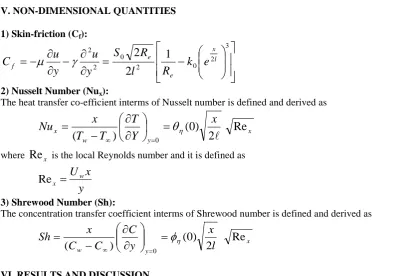
V. NON-DIMENSIONAL QUANTITIES
1) Skin-friction (Cf):
−
=
∂
∂
−
∂
∂
−
=
3 2 0 2 0 2 21
2
2
l x e ef
k
e
R
l
R
S
y
u
y
u
C
µ
γ
2) Nusselt Number (Nux):
The heat transfer co-efficient interms of Nusselt number is defined and derived as
x y w x
x
Y
T
T
T
x
Nu
Re
2
)
0
(
)
(
0
η
θ
=
∂
∂
−
=
= ∞ (36)where
Re
x is the local Reynolds number and it is defined asy
x
U
w x=
Re
3) Shrewood Number (Sh):
The concentration transfer coefficient interms of Shrewood number is defined and derived as
x y w
l
x
y
C
C
C
x
Sh
Re
2
)
0
(
)
(
0=
φ
η
∂
∂
−
=
= ∞ (37)VI. RESULTS AND DISCUSSION
Momentum, heat and mass transfer in a boundary layer viscoelastic fluid flow over an exponentially stretching impermeable sheet have been investigated in this paper. The highly non-linear partial differential equations characterizing flow, heat and mass transfer have been converted into a set of non-linear ordinary differential equations by applying suitable similarity transformations. Sequential solutions of the transformed momentum equations are obtained by solving the non-linear differential equation analytically. The approximate solution for dimensionless stream function f has been obtained analytically which satisfies all the boundary conditions. Hence we consider approximate solutions of the heat and mass transfer equations in the form of confluent hypergeometric functions. All these solutions involve an exponential dependence of (i) the similarity variable
η
(ii) starching velocity Uw.In order to have some insight of the flow, heat and mass transfer characteristics, results are plotted graphically for typical choice of encountering physical parameter in Figs 1-10
In fig (1) velocity profiles for different values of viscoelastic parameter
k
1* is drawn. From the figure, it is studied thatvelocity distribution f increases with the effect of increasing values of
k
1*.In fig (2) velocity profiles
f
η( )
η
for different values of viscoelastic parameterk
1*is drawn. From the figure it is seenthat the effect of visco-elastic parameter is to decrease the velocity field
f
η throughout the boundary layer.Fig (3) is the representation of velocity profiles
f
andf
η for various values of magnetic field parameter M for* 1
k
= 0.1. which depicts the effect of magnetic field (M) on longitudinal as well as transverse velocity. Here magnetic field acts as a drag force term so that shear stresses are lowered atη
=
0
as M increases which in turn decrease transverse velocity f. These results correlate well with the general conclusions arrived at by the studies of Ingham [27], Gebhart et al. [28]. Where as it is found from the figure that the effect of magnetic parameter Mn is to reduce thehorizontal velocity
f
η. Fig (3) also reveals the fact that increase of Mn signifies the increase of Lorentz force that opposes the horizontal flow in the reverse direction.The effect of permeability parameter K2 on longitudinal velocity
f
η and transverse velocity f versusη
is drawn infig.4. Physically K2 expresses the presence of porous matrix and quantifies the hydraulic conductivity of the porous
medium. As K2
∞
, the porous medium disappears and regime becomes one of the pure fluid at the wall. Thepermeability acts as a drag force term
2
( ) 0 f
K
η η =
in the positive x-direction. Shear stresses are therefore lowered at the wall as K2 increases that decreases the
longitudinal velocity and increasing the transverse velocity.
In Fig. (5) dimensionless temperature profiles
θ
(
η
)
Drawn for various values of Parandtl number Pr. That is increaseof Prandtl number Pr result in the decrease of temperature distribution at a particular point of flow region. The increase
of Prandtl number means slow rate of thermal diffusion. For all values of Pr, E and
k
1*, it is obvious that the walltemperature distribution is at unity on the wall. The effect of increasing the values of viscoelastic parameter
k
1*is seen to increase the temperature distribution in the flow region. The permeability acts as a drag force term so that shear stresses are lowered atη
=
0
as K2 increases which in term decreases transverse velocity f and increasing longitudinalvelocity
f
η. These results correlate well with the general conclusions arrived by the studies of Takhar et al. [29] and Schlichting and Gersten [30]. This is in conformity with the fact that increase of non-newtonianvisco-elastic parameter leads to the increases of thermal boundary layer thickness. This behaviour of temperature enhancement occurs as heat energy is stored in the fluid due to frictional heating.In Fig. (6) we represents the variations in temperature profiles
θ
(
η
)
for various values of heat source or sink parameterϕ
. The maximum temperature corresponds to the curve –I for the value ofθ
=
0.5
. This physically implies an union of zero suction with low wall temperature and week heat sink. It is also observed from the curves that, the temperature is lowered for rise inϕ
values. These results are in a very good agreement with supported the results of Sunyal and Dasgupta [31] and Ealbashbeshy.The effects of magnetic field parameter over temperature of the fluid along the wall of the surface are shown through Fig.7. In the case of uniform chemical reaction, it is observed that the temperature of the fluid gradually change from higher value to the lower value only when the strength of the magnetic field is higher than the species concentration effect. For large magnetic strength mechanism, interesting results is the large distortion of the temperature field caused for M = 4.0. Negative value of the temperature profile is seen in the outer boundary region for M = 4.0.
Fig. (8) represents the dimensionless concentration profiles for different values of the Schmidt number sc. For uniform magnetic field and porosity, an increase in Schmidt number, leads to fall in the concentration of the fluid along the wall of the surface. Hence in the case of uniform magnetic field and porous field, the chemical reaction decelerated the concentration of the fluid along the wall of the surface.
From the fig. (9) it is noticed that concentration profiles for different values of chemical reaction parameter Kr is drawn and the effect of chemical reaction over the concentration of the fluid along the wall of the surface is shown. The figure reveals the fact that as chemical reaction parameter increases concentrations decreases.
Fig.(10) shows the graph of non-dimensional skin friction parameter
C
f Vs Viscoelastic parameterk
1*, for different values of Reynolds number Re. from the figure it is observed that the increases of non-dimensional visco-elasticFigure-1: Graph of flow profile f for various values of visco-elastic parameter k1* = 0.2, 0.4 and 0.8.
Figure-2: Graph of velocity profile for various values of visco-elastic parameter k1* = 0.2, 0.4, 0.8.
Figure-4:Dimensionless velocity profiles f and fη for different values of permeability parameter k2 = 20, 40, 60.
Figure-5: Dimensionless temperature profiles
θ
(
η
)
for various values of Prandtl number Pr=0.0, 0.71, 1.0.Figure-7: Dimensionless concentration profiles for various values of Schmidt number Sc.
Figure-8: Graph of concentration profiles for different values of chemical reaction parameter kr.
Figure-9: Graph of skin friction parameter Cf Vs. Visco-elastic parameter
* 1
Figure-10: Effect of magnetic field parameter on dimensionless temperature profiles
θ
(
η
)
.REFERENCES
1. Rajagopal KR; Na Ty; Gupta AS (1984) Flow of a visco-elastic fluid over a stretching sheet. Rheol Acta 23; 213-215.
2. Siddappa B; Abel MS (1985) Non-Newtonian flow past a stretching plate. Z Angew Math Phys 36:890-892. 3. Gupta RK; Sridhar T (1985) Visco-elastic effects in non-newtonian flow through porous media. Rheol Act
24:148-151.
4. Siddappa B; Abel MS (1986) Visco-elastic boundary layer flow past a stretching plate with suctsion and heat transfer. Rheol Acta 25:319-330.
5. Rajagopal KR; Na Ty: Gupta AS (1987) A similar boundary layer on a stretching sheet in a non-newtonian fluid with uniform free stream. J Math Phys Sci 21(2):189-200.
6. Bujurke NM; Biradar SN; Hiremath PS (1987) Second Order fluid flow past a stretching sheet with heat transfer Z Angew Math Phys 38:653-657.
7. Dandapat BS; Gupta AS(1989) Flow and Heat transfer in a viscoelastic fluid flow over a stretching sheet. Int J Non-linear Mech 24(3): 215-219.
8. Rollins D; Vajravelu K (1991) Heat transfer in a second order fluid over a continuous stretching surface. Acta Mech 89:167-178.
9. Lawrence PS; Rao BN (1992) Heat transfer in the flow of a viscoelastic fluid over a stretching sheet. Act Mech 93:53-61.
10. Siddappa B; Abel S; Veena H (1995) Oscinatory motion of a visco-elastic fluid pasta stretching sheet. IL Nuovocimento 17D (1): 53-60.
11. Abel S; Veena P (1998) Visco-elastic fluid flow and heat transfer in a porous medium over a stretching sheet. Int J Non-linear Mech 33(3):531-540.
12. Prasad KV; Abel S; Joshi A (2000) Oscillatory motion of a visco elastic fluid over a stretching sheet in porous media. J Porous Media 3(1):61-68.
13. Abel MS; Khan SK; Prasad KV (2002) Study of visco-elastic fluid flow and heat transfer over a stretching sheet with variable viscosity. Int J Non-linear Mech 37:81-88.
14. H.Murkovitz, B.D. Coleman, Adv. Appl.Mech.8 (1964).
15. W.C.Troy, E.A. Overman, H G B Ermentrout, J.P.Keener, Uniqueness of flow of a second order fluid past a stretching sheet, Quart Appl Math 44(1987) 753-755.
16. W.D Chang, The non-uniqueness of the flow of a visco elastic fluid over a stretching sheet, Quart. Appl.Math.47 (20) (1989) 365-366.
17. B.N.Rao, Technical Note: Flow of a fluid of second grade over a stretching sheet, Int.J.Non-linear Mech.31 (4) (1996) 547-550.
18. Anderson HI (1992) MHD flow of a visco-elastic fluid past a stretching surface. Acta Mech 95:227-230. 19. Char MI (1994) Heat and mass transfer in a hydromagnetic flow of the visco-elastic fluid over a stretching
sheet. J Math Anal Appl 186:674-689.
20. Lawrence PS: Rao BN (1995) The non-uniqueness of the MHD flow of a visco-elastic fluid over a stretching sheet. Acta Mech 112:223-228.
22. M.E Ali, on thermal boundary layer on a power law stretched surface with suction or injection, Int. J Heat Mass Flow 16 (1995) 280-290.
23. F.M.A Elbashbeshy, Heat transfer over an exponentially stretching continuous surface with suction, Arch Mech.53 (6) (2001) 643-651.
24. B.D.Coleman, W.Noll, An approximation theorem for functionals with applications in cantinum mechanics, Arch.Rat.Mech.Anal.6 (1960) 355-370.
25. J.E.Dunn, R I Fosdick. Thermodynamics, Stability and boundedness of fluids of complexity 2 and fluids of second grade, Arch.Rational.Mech Anal. 56 (1974) 191-252.
26. R.L.Fosdick, K.R.Rajagopal, Anomalous features in the model of second order fluids, Arch. Ration. Mech. Anal.70 (1979) 145-162.
27. Ingham, D.B., 1986. Singular and Non-unique solutions of the Boundary layer Equations for the flow Due to free convection near a continuously moving vertical plate, ZAMP, 37, 559-571.
28. Gebhart, B., Jaluria, Y., Mahajan, R.L., and Sammakia, B., 1988 Buoyancy Induced flow and transport, reference edition, hemisphere, USA
29. Takhar, H.S., Chamkha, A.J., and Nath, G., 2001. Natural convection flow from a continuously moving vertical surface immersed in a thermally stratified medium, heat and mass transfer, 38, 17-24.
30. Schlichting, H., and Gersten, K., 2000, Boundary layer theory, Springer verlag.
31. Sanyal, D.C., and Dasgupta, S., 2003. Steady flow and heat transfer of a conducting fluid caused by stretching a porous wall, Ind. J.Theo.Phys., 51, 47-58.
Source of support: Nil, Conflict of interest: None Declared.