Volume 14 (2008)
Proceedings of the
Third Workshop on Petri Nets and Graph Transformations
(PNGT 2008)
Negative Application Conditions for
Reconfigurable Algebraic High-Level Systems
Alexander Rein
14 pages
Guest Editors: Paolo Baldan, Barbara K ¨onig
Managing Editors: Tiziana Margaria, Julia Padberg, Gabriele Taentzer
Negative Application Conditions for
Reconfigurable Algebraic High-Level Systems
Alexander Rein
Institut f¨ur Softwaretechnik und Theoretische Informatik Technische Universit¨at Berlin
Abstract: This paper introduces negative application conditions for reconfigurable algebraic high-level systems. These are algebraic high-level systems, i.e. algebraic high-level nets with an initial marking, together with a set of rules for changing the system dynamically. Negative application conditions are a control structure for re-stricting the application of a rule if a certain structure is present. The use of negative application conditions is motivated in a short example. Subsequently, the underly-ing theory is sketched and the most significant results are presented. Finally, the example is resumed and the main results and their usefulness within the example are discussed.
Keywords: AHL net, AHL system, net transformation, control structure, negative application condition
1
Introduction
As the adaptation of a system to a changing environment gets more and more important, Petri systems that can be transformed during runtime have become a significant topic in recent years. Their application area ranges over the description of adaptive workflows, the simulation of dy-namic processes, multi-agent systems and mobile networks. The extension of these so called reconfigurable P/T systems by data types to reconfigurable algebraic high-level (AHL) systems provides the advantage that the underlying net structure is usually much smaller than the cor-responding net without data types. Moreover, the approach of reconfigurable AHL systems in-creases the expressiveness of AHL systems and allows a formal description of dynamic changes.
In this context, the double pushout approach, presented in [EEPT06], is used for transforming
AHL systems. This approach is based on pure categorical constructions and has a lot of tiations, for example graphs, hypergraphs, Petri nets, Petri systems but also non-visual
instan-tiations like algebraic specifications. In [Pra08], the theory of adhesive high-level replacement
(HLR) systems [EEPT06], which is the categorical framework of the double pushout approach,
have been instantiated to AHL nets and systems.
In most transformation systems, there exist basic conditions for the applicability of transfor-mations. For example, a transformation should not be applied in some situations, although a consistent match can be found. For conditions like this some kind of control structure for the applicability of rules is required. Control structures are necessary if rules are applied automated and also reasonable if the rules are applied manually for preventing human failures. Negative
application conditions (NACs), introduced in Chapter 7 in [EEPT06], are such a control
present. Such a constraint influences each rule application and, therefore, the properties of the replacement system are changed significantly.
For generalizing well-known and important results like Local Church-Rosser Theorem, Com-pleteness Theorem of Critical Pairs, Concurrency Theorem, Embedding and Extension Theo-rem and Local Confluence TheoTheo-rem to the use of NACs, the notion of weak adhesive HLR
categories with NACs, basing on weak adhesive HLR categories [EEPT06], is introduced in
[Lam07,LEOP08].
By proving that AHL systems are a weak adhesive HLR category with NACs, we can transfer all these results to reconfigurable AHL systems.
In [RPL+08], we introduced NACs for reconfigurable P/T systems and motivated their use
with the help of a short example. This paper represents the extension of the results to
reconfig-urable AHL systems with a changeable data type. Moreover, the airport example of [RPL+08]
is extended to AHL systems with some additional features.
This paper is organized as follows: First we introduce our example and discuss the need
of additional control structures for the application of rules in Section2. Then we review the
formal notions of reconfigurable AHL systems in Section3. Based on these notions we define
negative application conditions and present the main results concerning parallelism, concurrency
and confluence in Section4. We discuss some of the general results with respect to the example
in Section2. Concluding remarks concern future and related work.
2
Example: Airport
This section contains an example for a reconfigurable AHL system with NACs. We model an airport control system (ACS) which is supposed to prevent accidents in the airport area. The system has to ensure that certain safety properties of an airport are satisfied, for example that some areas of the airport such as the actual runways and gates are secure, i.e. exclusively used by one airplane at the time. The system can handle airplanes and gates of different sizes and manage the coordination of the airplanes at the gates. Thereby, the condition that airplanes can only use gates of exactly the same size has to be fulfilled.
ACS can adapt to various changes of the airport. Every transformation step of the AHL system represents the rearrangement of the airport and every firing of a transition reflects a process at the airport. In this small example, changes at runtime may only concern adding and removing of gates of arbitrary sizes.
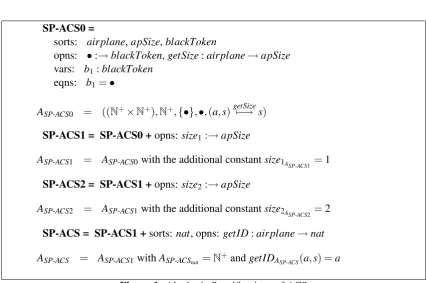
Figure1shows all required algebraic specifications. Specification SP-ACS0forms the base
of ACS. The sortapSizestands for airplane size. Remaining sortsblackTokenandair planeand
the operation getSize are self-explanatory. ASP-ACS0 is the algebra to this specification, where
N+=N\{0}is the set of all positive integers. The carrier set of the sortair planeis a tuple of
two positive integers – the first number represents the ID of an airplane and the second one the size.
In this example, the names of places are neglected and only labels and types are visualized,
i.e.l:tdenotes a placepof the typetwith a labell, which meansλ(p) =l∈Landtype(p) =t.
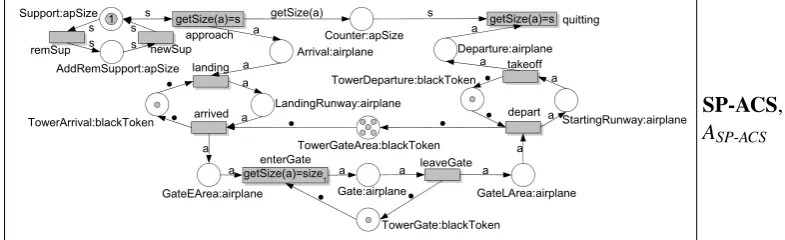
Figure2pictures the startsystem of ACS with one landing runway, one starting runway and
SP-ACS0 =
sorts: air plane,apSize,blackToken
opns: •:→blackToken,getSize:air plane→apSize
vars: b1:blackToken
eqns: b1=•
ASP-ACS0 = ((N+×N+),N+,{•},•,(a,s)
getSize
7−→ s)
SP-ACS1 = SP-ACS0 +opns:size1:→apSize
ASP-ACS1 = ASP-ACS0with the additional constantsize1ASP-ACS1 =1
SP-ACS2 = SP-ACS1 +opns:size2:→apSize
ASP-ACS2 = ASP-ACS1with the additional constantsize2ASP-ACS2 =2
SP-ACS = SP-ACS1 +sorts:nat, opns:getID:air plane→nat
ASP-ACS = ASP-ACS1withASP-ACSnat =N
+andgetID
ASP-ACS(a,s) =a
Figure 1:Algebraic Specifications of ACS
of the airport (placeArrival). This transition is only enabled if there is a token of the size of the
airplane at the placeSupport. So, only airplanes of supported sizes may enter the airspace and use
the airport. The placeAddRemSupportwith the two adjacent transitions is only a help place for
adding and removing the support of airplane sizes by applying rules and should not be used in the
regular operation of the airport. For each arrived airplane, an airplane token is placed atArrival
and a size token of the corresponding size is placed atCounter. This place represents a counter
for all airplanes at the airport and stores their sizes. Each runway and each gate consists of two places – representing the runway (resp. the gate) itself and a complement place that ensures the
exclusive use. Additionally, every runway consists of two transitionslandingandarrived, resp.
departandtakeoff. The transitionlandingof a landing runway is enabled if the runway is not
in current use and an arriving airplane is in the airspace of the airport. Firing of this transition leads to a token representing an airplane on the runway. In the lower part of the AHL system,
the gate area is modeled. The tokens at placeTowerGateArearepresent the capacity of the gate
area. To simplify matters, this capacity is fixed in this example. The first and only gate of the
airport is represented by the placesGateand the complement placeTowerGateof this gate. So
the exclusive use of the gate by only one airplane is guaranteed. The condition of the transition
enterGateensures that only airplanes of size 1 can use this gate.
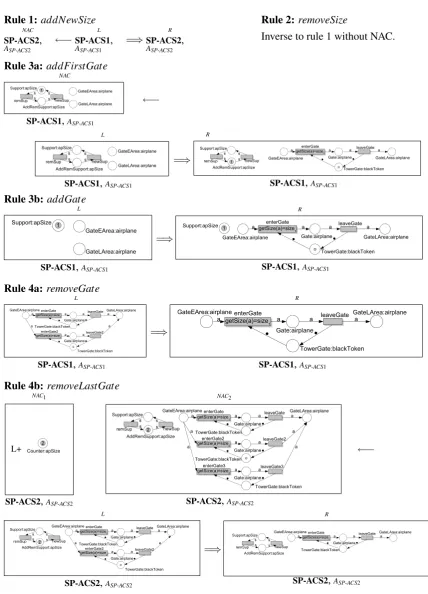
In the following, the transformation rules of ACS, depicted in Figure 3, are described. To
apply a rule to an AHL system a match from the left-hand sideLof the corresponding rule to the
AHL system has to be found. Then the satisfication of the NACs has to be checked. A NAC is satisfied if a morphism from the NAC to the AHL system via the match does not exist.
Support:apSize
newSup s s remSup
s s
getSize(a)=s approach s
Arrival:airplane a
getSize(a)
Counter:apSize a
landing
LandingRunway:airplane a
a ●
● TowerArrival:blackToken
a
GateEArea:airplane getSize(a)=size1 a enterGate
Gate:airplane a a leaveGate
● ●
a
GateLArea:airplane depart
a TowerGateArea:blackToken
● ●
arrived a
a ●
● StartingRunway:airplane takeoff
TowerDeparture:blackToken a Departure:airplane
getSize(a)=s quitting a
s
TowerGate:blackToken 1
AddRemSupport:apSize
SP-ACS,
ASP-ACS
Figure 2: ACS Startsystem
These rules have an empty net component and change only the specification of an airport net.
Adding a new size is modeled by adding a new constant of the sortapSizeto the AHL system.
Its value is determined by the match. Note that arbitrary sizes can be added through different matches. This is feasible although algebra homomorphisms are restricted to isomorphisms be-cause the carrier sets are not changed. A negative application condition is required to prevent
the creation of multiple constants with the same value. The second constant of the sortapSizein
the right-hand side is required to prevent a mapping from sortapSizeto sortnatand operation
getSizetogetID. Removing the last constant of the sortapSizeis restricted by the gluing
condi-tion since the last gate cannot be removed. This transformacondi-tion can be revoked by applying rule 2, which is inverse to rule 1 without the negative application condition.
Adding a gate to the airport requires two rules (3a and 3b in Figure 3). The procedure for
the first gate of a size, which is expressed by rule 3a, requires the additional treatment that the
support of this size is added to the airport. After applying rule 3a, the transitionnewSupis fired
so that airplanes of the new supported size can use the airport. A negative application condition
is required to restrict this rule from being applied if a token of this size is at placeSupport, i.e.
at least one gate of this size exists. Note that this rule cannot be applied if there is a token at
the placeAddRemSupportbecause of the gluing condition (see point 8. in Definition8). This
is because this rule formally deletes the placeAddRemSupportwith the two adjacent transitions
and then re-adds this structure with a token at this place. In contrast, rule 3b can only be applied if a token of the size of the gate to be added exists, i.e. the airport already has a gate of this size. This rule simply adds the new gate.
To remove gates, the use of the inverse rules of the rules for adding gates is not sufficient because of the additional condition that the last gate of the airport may not be removed. This
procedure is described by rules 4a and 4b in the bottom of Figure 3. Rule 4a expresses the
removal of a gate under the assumption that at least one gate of the same size exists and rule 4b models the removal of the last gate of a size. Two negative application conditions are required
for rule 4b. The first one (NAC1) restricts the rule from being applied if there are still airplanes
of this size at the airport. The second NAC (NAC2) guarantees that this rule can only be applied
if the gate to be removed is the last gate of its size. Note that identifying the constantssize1=
Rule 1:addNewSize
NAC
SP-ACS2,
ASP-ACS2
←−
L
SP-ACS1,
ASP-ACS1
=⇒
R
SP-ACS2,
ASP-ACS2
Rule 2:removeSize
Inverse to rule 1 without NAC.
Rule 3a:addFirstGate
NAC Support:apSize newSup s s remSup s s GateEArea:airplane GateLArea:airplane AddRemSupport:apSize 1
SP-ACS1,ASP-ACS1
←− L Support:apSize newSup s s remSup s s GateEArea:airplane GateLArea:airplane AddRemSupport:apSize
SP-ACS1,ASP-ACS1
=⇒ R Support:apSize newSup s s remSup s s GateEArea:airplane getSize(a)=size1 a enterGate Gate:airplane a a leaveGate
● ● a GateLArea:airplane TowerGate:blackToken 1 AddRemSupport:apSize
SP-ACS1,ASP-ACS1 Rule 3b:addGate
L
Support:apSize
GateEArea:airplane GateLArea:airplane 1
SP-ACS1,ASP-ACS1
=⇒ R Support:apSize GateEArea:airplane getSize(a)=size1 a enterGate Gate:airplane a a leaveGate
● ● a GateLArea:airplane TowerGate:blackToken 1
SP-ACS1,ASP-ACS1
Rule 4a:removeGate
L
GateEArea:airplane getSize(a)=size1
a enterGate Gate:airplane a aleaveGate
● ● a GateLArea:airplane TowerGate:blackToken getSize(a)=size1 enterGate2 Gate:airplane a aleaveGate2
● ●
TowerGate:blackToken
a a
SP-ACS1,ASP-ACS1
=⇒ R GateEArea:airplane getSize(a)=size1 a enterGate Gate:airplane
a a leaveGate
● ●
a
GateLArea:airplane
TowerGate:blackToken
SP-ACS1,ASP-ACS1
Rule 4b:removeLastGate
NAC1
L+ Counter:apSize 2
SP-ACS2,ASP-ACS2
NAC2 GateEArea:airplane
getSize(a)=size1
a enterGate
Gate:airplane a aleaveGate
● ● a GateLArea:airplane TowerGate:blackToken getSize(a)=size2 enterGate2 Gate:airplane a aleaveGate2
● ● TowerGate:blackToken a a Support:apSize newSup s s remSup s s 2 AddRemSupport:apSize getSize(a)=size2 enterGate3 Gate:airplane a aleaveGate3
● ●
TowerGate:blackToken
a a
SP-ACS2,ASP-ACS2
←− L GateEArea:airplane getSize(a)=size 1 a enterGate Gate:airplane a aleaveGate
● ● a GateLArea:airplane TowerGate:blackToken getSize(a)=size 2 enterGate2 Gate:airplane a aleaveGate2
● ● TowerGate:blackToken a a Support:apSize newSup s s remSup s s 2 AddRemSupport:apSize
SP-ACS2,ASP-ACS2
=⇒ R GateEArea:airplane getSize(a)=size1 a enterGate Gate:airplane a aleaveGate
● ● a GateLArea:airplane TowerGate:blackToken Support:apSize newSup s s remSup s s AddRemSupport:apSize
SP-ACS2,ASP-ACS2
homomorphism.
3
Reconfigurable Algebraic High-Level Nets
In this section, reconfigurable AHL systems are formalized. We use the algebraic notation of
“Petri nets are Monoids” in [MM90], extended by a data type and a labeling function for places.
So, an AHL net is given byAN= (SP,P,T,pre,post,cond,type,A,λ)with algebraic
specifica-tion SP= (S,OP,E,X) with additional variables X for the net, (S,OP,E)-algebra A, pre- and
post-domain functions pre,post:T →P⊕, firing conditionscond:T →Pf in(Eqns(S,OP,X)),
typing of placestype:P→S and a labeling functionλ :P→L, where L is a fixed alphabet
for places andP⊕is the free commutative monoid over the setPof places. An AHL system is
given by an AHL net with an initial marking(AN,M), whereM∈CP⊕ withCP= (A⊗P) =
{(a,p)|a∈Atype(p),p∈P}.
In order to define rules and transformations of AHL systems, we introduce AHL morphisms which are compatible with pre- and post-domains, fire conditions, typing of places and labeling. Additionally, they require that the initial marking at corresponding places is equal or increasing.
Definition 1(AHL Morphism) Given AHL systems ASi= (SPi,Pi,Ti,prei,posti,condi,typei,
Ai,λi,Mi)withSPi= (Si,OPi,Ei,Xi)fori=1,2, an AHL morphism f:AS1→AS2is given by
f = (fSP,fP,fT,fA), where(fSP,fA)is a generalized algebra homomorphism with specification
morphism fSP = (fS,fOP,fX):SP1 →SP2 with a seperate injective mapping of the additional
variables fX = (fXs)s∈S1 :X1→X2and algebra isomorphism fA= (fAs)s∈S1 :A1→VfSP(A2)and
fP:P1→P2and fT :T1→T2are two functions mapping the places and the transitions such that
λ1 = λ2◦fP (1)
∀(a,p)∈(A1⊗P1):M1(a,p) ≤ M2(fA(a),fP(p)) (2)
and the following diagrams commute:
Pf in(Eqns(S1,OP1,X1))
Pf in(f#
SP×fSP# )
(=)
T1
cond1
o
o
fT
pre1 //
post1
/
/
(=)
(TOP1(X1)⊗P1)
⊕
(f#
SP⊗fP)⊕
P1
fP
type1 //
(=)
S1
fS
Pf in(Eqns(S2,OP2,X2)) cond T2
2
o
o pre2 //
post2
/
/(TOP2(X2)⊗P2)
⊕ P
2 type
2
/
/S2
Remark1
1. fSP# is the extension of specification morphism fSPto terms and equations which maps the
(specification) variables bijectively.
2. VfSPis the forgetful functor with respect to fSP.
3. Pf inis the power set functor that maps a set to its power set.
4. fX injective impliesVar(t)⊆Var(fT(t))that ensures the preservation of firing.
Moreover, the AHL morphism f is called strict if and only if f is componentwise injective,
fSP#−1(E2)⊆E1(strict injectivity) and∀(a,p)∈(A1⊗P1):M1(a,p) =M2(fA(a),fP(p))(marking
The category defined by AHL systems and AHL morphisms is denoted by AHLSystems
where the composition of AHL morphisms is defined componentwise. The class of all strict
AHL morphisms is denoted byM.
The gluing condition is a sufficient and necessary condition for the applicability of a rule
L←l K→r Rat a given matchm:L→G. The so called pushout complement, which is required for
the first step of a transformation, exists if and only if the gluing condition is satisfied. Therefore, gluing points, identification points and dangling points are defined. In this context, points means
places, transitions, sorts, operations, terms or equations. Gluing points are all points ofLthat
have a preimage inK, identification points are all points ofLthat are not mapped injectively by
mand dangling points are all points in Lwith an image inG that is adjacent with a structure
without a preimage inL. The gluing condition is satisfied if all identification and dangling points
are also gluing points. The formal definition of the gluing condition for AHL systems can be
found in the appendix (Definition8).
Next, we present rule-based transformations of AHL systems following the double-pushout
(DPO) approach of graph transformations in the sense of [Roz97,EEPT06].
Definition 2(AHL System Rule) Given AHL systemsASi= (SPi,Pi,Ti,prei,posti,condi,typei,
Ai,λi,Mi)withSPi= (Si,OPi,Ei,Xi)fori∈ {1,L,K,R}, then a rulerule= (ASL
l
←ASK r
→ASR)
consists of AHL systemsASL,ASK, andASR, called left-hand side, interface, and right-hand side
ofruleand two strict AHL morphismsl:ASK→ASLandr:ASK→ASR.
The rule ruleis applicable at the matchm:ASL→AS1 if and only if the gluing condition
(see Definition8) is satisfied forlandm. In this case, we obtain AHL systemAS0leading to a
transformation stepAS1rule⇒,mAS2consisting of the following pushout diagrams (1) and (2). The
AHL morphismn:ASR→AS2is called comatch of the transformation step.
ASL
m
(1)
ASK
l
o
o r //
c
(2)
ASR
n
AS1 AS0
l∗
o
o
r∗ //AS2
Now we are able to define reconfigurable AHL systems, which allow the modification of the net structure using rules and transformations of AHL systems.
Definition 3(Reconfigurable AHL System) Given an AHL systemASand a set of rulesRU LES,
a reconfigurable AHL system is defined by(AS,RU LES).
In the example in Section 2, the reconfigurable AHL system consists of the AHL system
depicted in Figure2and the set of rules pictured in Figure3. Note that the application of some of
these rules is restricted by NACs and we will present the notion of reconfigurable AHL systems
4
Negative Application Conditions
In this section, we first introduce the main technical result thatAHLSystemsis a weak adhesive
HLR category with NACs. This means, the category is a weak adhesive HLR category and satisfies some additional properties such that negative application conditions can be used within AHL system transformations without losing important qualities of adhesive HLR systems like Local Church-Rosser Theorem, Parallelism Theorem, Completeness Theorem of Critical Pairs, Concurrency Theorem, Embedding and Extension Theorem and Local Confluence Theorem. All
these theorems are introduced in [EEPT06] and their extension for the use of NACs is presented
in [LEOP08,Lam07].
In addition to morphism class M, presented in Section 3, two other morphism classes are
required. On the one hand there is morphism classQ connecting the NAC and the source net,
which is the class of all (componentwise) injective morphisms, and on the other hand there is a
class of morphism pairsE, which is mainly used for constructions and proofs. This morphism
class consists of jointly equation strict and minimal jointly surjective AHL morphisms. Minimal means that the markings in the codomain are as small as possible and equation strict means that
the codomain contains exactly the translated equations of both domains, i.e. for f1:AS1→AS3,
f2:AS2→AS3with(f1,f2)∈E we have that (1.) f1,f2are (componentwise) jointly surjective,
(2.) M3(a3,p3) =max({M1(a,p)|a∈ f1−A1(a3)∧p∈ f1−P1(p3)} ∪ {M2(a,p)|a∈ f2−A1(a3)∧p∈
f2−1
P (p3)})(are minimal) and (3.)E3= f
#
1SP(E1)∪f
#
2SP(E2)(are jointly equation strict).
Definition 4(Morphism classes inAHLSystems) Given the categoryAHLSystemsof AHL systems and AHL morphisms, then the following morphism classes are defined:
M : strict AHL morphisms
Q : injective AHL morphisms
E : jointly equation strict and minimal jointly surjective AHL morphisms
Theorem 1 (AHLSystems is a Weak Adhesive HLR Category with NACs) The category
AHLSystems with the morphism classesM, Q andE as defined above is a weak adhesive HLR category with NACs, i.e. a weak adhesive HLR category with the following additional properties:
1. uniqueE-Qpair factorization,
2. unique epi-M factorization,
3. M-Qpushout-pullback decomposition property,
4. initial pushouts overQ-morphisms,
5. Qis closed under pushouts and pullbacks alongM-morphisms,
6. induced pullback-pushout property forM andQand
7. Qis closed under composition and decomposition
The proof thatAHLSystemsis a weak adhesive HLR category can be found in [Pra08] and a
description and the proof of the additional properties can be found in [Rei08]. Now we can state
Definition 5(Negative Application Condition) A negative application condition of a rulerule=
(L←l K→r R) in the weak adhesive HLR category with NACs (C,M,E,Q) is of the form
NAC(n), wheren:L→Nis aC-morphism.
A morphismm:L→GsatisfiesNAC(n), writtenm|=NAC(n), if there does not exist a morphism
q:N→G∈Qwithq◦n=m.
Definition 6(Rule with NACs) A rule in a weak adhesive HLR category with NACs(C,M,
E,Q)with a set of negative application conditionsNACSis called rule with NACs.
Definition 7(Applicability of a Rule with NACs) Given a rulerule= (L←l K→r R)with a set
of negative application conditionsNACSand a matchm:L→Gsuch thatrulewithout NACs is
applicable atm, then the rulerulewith NACs is applicable if and only ifmsatisfies all NACs of
the setNACS.
For these new rules and their restricted application we obtain the same results as known for net transformations in general. These results have been shown for NACs at the level of weak
adhesive HLR categories in [LEOP08, LEO06, Lam07]. Their instantiation to AHL systems
requires Theorem1above.
Results(For Reconfigurable AHL Systems with NACs)
1. Local Church-Rosser and Parallelism: Simplified, the Local-Church Rosser property states that the order of two sequential transformations does not matter if they are sequen-tially independent, i.e. one transformation does not create or delete some structure that the other one requires. In this case, a parallel transformation that performs both transforma-tions in one step exists.
In the airport example of Section2, it makes no difference if a gate of size 1 or a new size
is added first to the startsystem. The adding of a gate of size 1 is obviously still possible after adding a new size and the inverse direction also holds. Moreover, both transformation steps can be combined to a parallel transformation, which adds both a new size and a gate of size 1 to the airport.
2. Conflicts and Critical Pairs: A critical pair describes a conflict between two transfor-mations in a minimal context. A conflict between two transfortransfor-mations means in particular that either one transformation deletes some structure that is used by the other one or one transformation produces a structure that is forbidden by the NAC of the other transforma-tion. The critical pairs and their completeness are a significant concept because an infinite number of transformations, which are in conflict, can be reduced to a finite number of critical pairs (under the assumption that the set of rules is finite). Critical pairs are used to show the (local) confluence of a transformation system, which is described later.
Consider in the airport example of Section2an airport system corresponding to the
start-system shown in Figure2with a second constantsize2=2. The transformation that
re-moves the sizesize2 is in conflict with the transformation that adds a new gate ofsize2to
to constantsize2), which is expressed by the critical pair shown in Figure4. P1 Support:apSize newSup s s remSup s s GateEArea:airplane GateLArea:airplane AddRemSupport:apSize
SP-ACS1,ASP-ACS1
⇐= K Support:apSize newSup s s remSup s s GateEArea:airplane GateLArea:airplane AddRemSupport:apSize
SP-ACS2,ASP-ACS2
=⇒ P2 Support:apSize newSup s s remSup s s GateEArea:airplane getSize(a)=size2 a enterGate Gate:airplane a a leaveGate
● ● a GateLArea:airplane TowerGate:blackToken 2 AddRemSupport:apSize
SP-ACS2,ASP-ACS2
Figure 4: Critical Pair for RulesremSizeandaddFirstGate
3. Concurrency: Through parallelism, the summary of several independent direct transfor-mations into one equivalent direct transformation is possible. However, in general there are dependencies between several direct transformations of a transformation sequence. In this case, the Concurrency Theorem with NACs that allows to translate every transformation sequence into an equivalent direct transformation by a concurrent rule with NACs can be
applied. The construction of such a concurrent rule with NACs is explained in [LEOP08].
A concurrent rule summarizes in one rule which parts of the net should be present, pre-served, deleted and produced when applying the corresponding rule sequence to this net. Moreover, we have a summarized set of NACs on the concurrent rule expressing which net parts are forbidden when applying the corresponding rule sequence with NACs to the net.
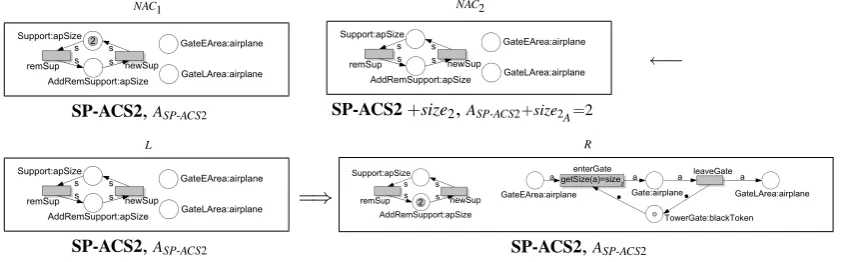
Consider in the airport example of Section2the airport system described in the last item
and the following transformation sequence. First, size2 is removed, thensize2 is added
again and, finally, a gate ofsize2 is added. This sequence can be expressed by the
con-current rule depicted in Figure5. Note that the interface objectKof this rule contains the
specificationSP-ACS1and notSP-ACS2. This concurrent rule holds two NACs, which
originate by the translation of the NACs of the single rules [Lam07].
NAC1 Support:apSize newSup s s remSup s s GateEArea:airplane GateLArea:airplane AddRemSupport:apSize 2
SP-ACS2,ASP-ACS2
NAC2 Support:apSize newSup s s remSup s s GateEArea:airplane GateLArea:airplane AddRemSupport:apSize
SP-ACS2+size2,ASP-ACS2+size2A=2
←− L Support:apSize newSup s s remSup s s GateEArea:airplane GateLArea:airplane AddRemSupport:apSize
SP-ACS2,ASP-ACS2
=⇒ R Support:apSize newSup s s remSup s s GateEArea:airplane getSize(a)=size2 a enterGate Gate:airplane a a leaveGate
● ● a GateLArea:airplane TowerGate:blackToken 2 AddRemSupport:apSize
SP-ACS2,ASP-ACS2
Figure 5: Concurrent Rule with NACs
4. Embedding and Extension: Under several conditions, a transformationt:G0
∗
⇒Gn
can be extended to a transformationt0:G00⇒∗ Gn0 via an extension morphismk0:G0→G00.
The transformationt0is based on the same rules ast. The Embedding Theorem with NACs
For the embedding of a transformation, the extension morphism k0 has to be boundary
consistent [EEPT06], which means intuitively that places which are deleted by the
trans-formationtcannot be embedded into places connected with new transitions in the bigger
AHL systemG00, and NAC-consistent [LEO06], which means intuitively that the extended
match satisfies the NACs of the rule.
5. Local Confluence: Confluence describes the behaviour of a whole transformation sys-tem. A pair of transformations of the same source object is called confluent if it is possible to transform the two results of the single transformations into the same object. A formation system is called locally confluent if this property holds for every pair of trans-formations. Confluence is the main property of interest for adhesive HLR systems (with NACs). The reasons therefore are quite obvious. Every transformation system which pro-vides multiple possibilities to transform the start object into a different object shows this behaviour for at least one pair of transformations. In the small example of this paper, this result is almost obvious since every transformation step is reversible, although, this result is nontrivial in general, e.g. for transformation systems with non-reversible transformation steps. A sufficient condition for the local confluence of an adhesive HLR system with
NACs is if every critical pair is strict NAC-confluent [Lam07]. Intuitively, this means that
a strict solution for every critical pair exists, i.e. both results of the critical pair can be transformed into the same result and this solution preserves everything that is preserved in common by the critical pair itself. Moreover, whenever the embedding of a critical pair into some larger context is possible, the extension morphism should be NAC-consistent with respect to the critical pair solution. This means in particular that all NACs occurring in the solution of the critical pair are still satisfied by the embedding into the larger context.
Consider in the example of Section2the critical pair shown in Figure4. The solution of
this critical pair is shown in Figure5 for the left-hand side P1. This solution is strictly
confluent because the placesSupport,GateEAreaandGateLAreaare preserved both by
the critical pair and the solution. The satisfaction of the first NAC of the concurrent rule
of this solution (see Figure5) is directly implied by the NAC of the critical pair (i.e. the
NAC of ruleaddFirstGate). The second NAC is always fulfilled in the case of ACS since
two constants with the same value cannot be created by applying rules to the startsystem.
Therefore, strict NAC-confluence [Lam07] holds with respect to the language generated
by grammar ACS, which is sufficient for a reconfigurable AHL system since a startsystem is always included. This result means that every conflict, where this critical pair can be embedded, can also be resolved. If every critical pair of a transformation system is strictly NAC-confluent, then the whole system is locally confluent.
5
Conclusion
We conclude with a short discussion of related and future work:
Related Work: Reconfigurable nets base on arbitrary net transformations. This approach can be restricted to distinguished transformations that preserve specific properties as safety or
LO06b], where rewriting of Petri nets in terms of graph grammars is used for the reconfiguration of nets. These marked-controlled reconfigurable nets (MCRN) are extended by some control technique that allows changes of the net for specific markings. The enabling of a rule is not only dependent on the net topology, but also dependent on the marking of specific control places.
MCReNet [LO06a] is the corresponding tool for the modeling and verification of MCRNs.
Future Work: One ongoing research task is the extension of this paper’s results to open alge-braic high-level systems, which are AHL systems with additional open places and
communica-tion transicommunica-tions (see [Ull08]). Therefore, the same conditions have to be proven for the category
OAHLSystemsof open AHL systems and open AHL morphisms. Another one are algebraic
higher order (AHO) nets (see [HEM05]), which allow the existence of dynamical tokens like
Petri systems and transformation rules. These nets are used for modeling workflows of mobile ad-hoc networks. Up to now, neither NACs nor AHL systems can be used within AHO nets. Therefore, the data type of AHO nets has to be upgraded, such that both AHL systems and NACs are formalized in this data type.
References
[EEPT06] H. Ehrig, K. Ehrig, U. Prange, G. Taentzer.Fundamentals of Algebraic Graph Transformation. EATCS Monographs. Springer, 2006.
[HEM05] K. Hoffmann, H. Ehrig, T. Mossakowski. High-Level Nets with Nets and Rules as Tokens. InProceedings of ICATPN’05. LNCS 3536, pp. 268–288. Springer, 2005.
[Lam07] L. Lambers. Adhesive High-Level Replacement Systems with Negative Application Conditions. Techni-cal report, Technische Universit¨at Berlin, 2007.
[LEO06] L. Lambers, H. Ehrig, F. Orejas. Conflict Detection for Graph Transformation with Negative Application Conditions. InProceedings of ICGT’06. LNCS 4178, pp. 61–76. Springer, 2006.
[LEOP08] L. Lambers, H. Ehrig, F. Orejas, U. Prange. Parallelism and Concurrency in Adhesive High-Level Re-placement Systems with Negative Application Conditions.ENTCS, 2008. to appear.
[LO04] M. Llorens, J. Oliver. Structural and Dynamic Changes in Concurrent Systems: Reconfigurable Petri Nets.IEEE Transactions on Computers53(9):1147–1158, 2004.
[LO06a] M. Llorens, J. Oliver. A Basic Tool for the Modeling of Marked-Controlled Reconfigurable Petri Nets.
ECEASST2:13, 2006.
[LO06b] M. Llorens, J. Oliver. Marked-Controlled Reconfigurable Workflow Nets. InSYNASC. Pp. 407–413. IEEE Computer Society, 2006.
[MM90] J. Meseguer, U. Montanari. Petri Nets are Monoids.Information and Computation88(2):105–155, 1990.
[Pra08] U. Prange. Towards Algebraic High-Level Systems as Weak Adhesive HLR Categories.ENTCS, 2008. to appear.
[PU03] J. Padberg, M. Urb´aˇsek. Rule-Based Refinement of Petri Nets: A Survey. InPetri Net Technology for Communication-Based Systems. LNCS 2472, pp. 161–196. Springer, 2003.
[Rei08] A. Rein. Reconfigurable Petri Systems with Negative Application Conditions. Technical report 2008/01, Technische Universit¨at Berlin, 2008. Diploma Thesis.
[Roz97] G. Rozenberg (ed.).Handbook of Graph Grammars and Computing by Graph Transformation, Vol 1: Foundations. World Scientific, 1997.
[RPL+08] A. Rein, U. Prange, L. Lambers, K. Hoffmann, J. Padberg. Negative Application Conditions for Recon-figurable Place/Transition Systems.Electronic Communications of the EASST, 2008.
A
Gluing Condition
In this section, we formalize the gluing condition for AHL systems. It is a sufficient and nec-essary condition for the applicability of a rule via a match. The proof therefore can be found in [Rei08].
Definition 8(Gluing Condition forAHLSystems) Given AHL systemsASi= (SPi,Pi,Ti,prei,
posti,condi,typei,Ai,λi,Mi)withSPi= (Σi,Ei,Xi)andΣi= (Si,OPi)fori∈ {1,L,K}and AHL
morphismsl:ASK →ASL∈M andm:ASL→AS1, then the gluing pointsGP, the dangling
pointsDPand the identification pointsIPare defined by
GP(P) = lP(PK),
GP(T) = lT(TK),
GP(S) = lS(SK),
GP(OP) = lOP(OPK),
IP(P) ={ p∈PL|∃p0∈PL:p6=p0∧mP(p) =mP(p0)}
IP(T) ={ t∈TL|∃t0∈TL:t6=t0∧mT(t) =mT(t0)}
IP(S) ={ s∈SL|∃s0∈SL:s6=s0∧mS(s) =mS(s0)}
IP(OP) ={ op∈OPL|∃op0∈OPL:op6=op0∧mOP(op) =mOP(op0)}
DP(P) ={ p∈PL| ∃t∈T1\mT(TL):
pre1(t) =
n
∑
i=1
λi(ri,pi)withλi6=0 andmP(p) =pi
for someior
post1(t) =
n
∑
i=1
λi(ri,pi)withλi6=0 andmP(p) =pi
for somei}
DP(S) ={ s∈SL| ∃op∈OP1\mOP(OPL)which containsmS(s)as one of
the sorts in its signature}
∪ { s∈SL| ∃p∈P1\mP(PL):type1(p) =mS(s)}
DP(TOP) ={ r∈TOPL(XL)| ∃t∈T1\mT(TL):
pre1(t) =
n
∑
i=1
λi(ri,pi)withλi6=0 andm#SP(r) =ri
for someior
post1(t) =
n
∑
i=1
λi(ri,pi)withλi6=0 andm#SP(r) =ri
for somei}
DP(EQNS) ={ e∈EQNS(ΣL,XL)
| ∃t∈TL\mT(TL):m#SP(e)∈cond1(t)}
andDP(EQNS).
The matchmsatisfies the gluing condition with respect to pif and only if
1. IP(P)∪DP(P)⊆GP(P)
2. IP(T)⊆GP(T)
3. DP(S)∪IP(S)⊆GP(S)
4. IP(OP)⊆GP(OP)
5. the setEC= (E1\m#(EL))∪m#SP(lSP# (EK))is a set of equations over the signature(SC,OPC),
where SC = (S1\mS(SL))∪mS(lS(SK))
OPC = (OP1\mOP(OPL))∪mOP(lOP(OPK))
6. DP(TOP)⊆lSP# (TOPK(XK))
7. DP(EQNS)⊆lSP# (EQNS(ΣK,XK))
8. mis marking strict on places to be deleted, i.e.∀(a,p)∈(AL⊗(PL\lP(PK))):ML(a,p) =